
A English
AIDS Questions in English
Class 12 Biology · Human Health and Disease · AIDS
220+
Questions
English
Language
100%
With Solutions
Showing 50 of 220 questions in English
1
EasyMCQ
The virus responsible for $AIDS$ is an example of a(an):
A
Adenovirus
B
Mosaic virus
C
$T$-even virus
D
Retrovirus
Solution
(D) The virus responsible for $AIDS$ is the Human Immunodeficiency Virus $(HIV)$.
$HIV$ belongs to the family Retroviridae.
These viruses are known as Retroviruses because they contain an enzyme called reverse transcriptase,which allows them to transcribe their $RNA$ genome into $DNA$ inside the host cell.
Therefore,the correct option is $D$.
$HIV$ belongs to the family Retroviridae.
These viruses are known as Retroviruses because they contain an enzyme called reverse transcriptase,which allows them to transcribe their $RNA$ genome into $DNA$ inside the host cell.
Therefore,the correct option is $D$.
0 likes
View Solution2
MediumMCQ
The spread of $AIDS$ disease is promoted by
A
Homosexuality
B
Immoral way of life
C
Use of infected needles in blood transfusion
D
All the above
Solution
(D) $AIDS$ (Acquired Immuno Deficiency Syndrome) is caused by the $HIV$ virus. The transmission of $HIV$ occurs through:
$1$. Unprotected sexual contact,including homosexuality.
$2$. Sharing of infected needles or syringes,especially among intravenous drug users.
$3$. Transfusion of infected blood or blood products.
$4$. From an infected mother to her child through the placenta.
Since options $A$,$B$,and $C$ are all recognized modes or risk factors associated with the transmission of $HIV$,the correct answer is $D$.
$1$. Unprotected sexual contact,including homosexuality.
$2$. Sharing of infected needles or syringes,especially among intravenous drug users.
$3$. Transfusion of infected blood or blood products.
$4$. From an infected mother to her child through the placenta.
Since options $A$,$B$,and $C$ are all recognized modes or risk factors associated with the transmission of $HIV$,the correct answer is $D$.
0 likes
View Solution3
MediumMCQ
$AIDS$ is caused by
A
Vaccinia virus
B
Viroid
C
$HIV$
D
Rhinovirus
Solution
(C) $AIDS$ stands for Acquired Immuno Deficiency Syndrome.
It is caused by the Human Immunodeficiency Virus $(HIV)$.
$HIV$ is a retrovirus that attacks the immune system,specifically the $CD4^+$ $T$-helper cells,leading to a progressive failure of the immune system.
It is caused by the Human Immunodeficiency Virus $(HIV)$.
$HIV$ is a retrovirus that attacks the immune system,specifically the $CD4^+$ $T$-helper cells,leading to a progressive failure of the immune system.
0 likes
View Solution4
MediumMCQ
Which of the following is not related to chromosomal aberration?
A
Euploidy
B
$AIDS$
C
Aneuploidy
D
Klinefelter's syndrome
Solution
(B) $AIDS$ is not related to chromosomal aberration because it is an infectious disease caused by the $HIV$ virus.
$Euploidy$, $Aneuploidy$, and $Klinefelter's$ $\text{syndrome}$ are all conditions related to changes in the number or structure of chromosomes (chromosomal aberrations).
$HIV$ stands for Human Immunodeficiency Virus, which attacks the immune system.
$Euploidy$, $Aneuploidy$, and $Klinefelter's$ $\text{syndrome}$ are all conditions related to changes in the number or structure of chromosomes (chromosomal aberrations).
$HIV$ stands for Human Immunodeficiency Virus, which attacks the immune system.
0 likes
View Solution5
EasyMCQ
$AIDS$ is caused by:
A
$Blood cancer$
B
$HTLV-III$
C
$Bacterium$
D
$TMV$
Solution
(B) $AIDS$ (Acquired Immuno Deficiency Syndrome) is caused by the Human Immunodeficiency Virus $(HIV)$.
Historically,this virus was also referred to as $HTLV-III$ (Human $T$-lymphotropic virus type $III$) or $LAV$ (Lymphadenopathy-associated virus).
Therefore,among the given options,$HTLV-III$ is the correct term associated with the causative agent of $AIDS$.
Historically,this virus was also referred to as $HTLV-III$ (Human $T$-lymphotropic virus type $III$) or $LAV$ (Lymphadenopathy-associated virus).
Therefore,among the given options,$HTLV-III$ is the correct term associated with the causative agent of $AIDS$.
0 likes
View Solution6
MediumMCQ
Immune deficiency syndrome in humans could develop as a consequence of
A
$AIDS$ virus infection
B
Defective liver
C
Defective thymus
D
Weak immune system
Solution
(A) Immune deficiency syndrome,specifically $AIDS$ ($Acquired$ $Immuno$ $Deficiency$ $Syndrome$),is caused by the $Human$ $Immunodeficiency$ $Virus$ $(HIV)$.
$HIV$ targets and destroys $Helper$ $T$-lymphocytes ($CD4^+$ cells),which are essential for the proper functioning of the immune system.
As the number of these cells declines,the body loses its ability to fight off infections and cancers,leading to the syndrome of immune deficiency.
Therefore,$AIDS$ virus infection is the primary cause of this specific syndrome.
$HIV$ targets and destroys $Helper$ $T$-lymphocytes ($CD4^+$ cells),which are essential for the proper functioning of the immune system.
As the number of these cells declines,the body loses its ability to fight off infections and cancers,leading to the syndrome of immune deficiency.
Therefore,$AIDS$ virus infection is the primary cause of this specific syndrome.
0 likes
View Solution7
EasyMCQ
The $AIDS$ virus has:
A
Single stranded $RNA$
B
Double stranded $RNA$
C
Single stranded $DNA$
D
Double stranded $DNA$
Solution
(A) The $AIDS$ virus is known as the Human Immunodeficiency Virus $(HIV)$.
$HIV$ belongs to the group of viruses called retroviruses.
Retroviruses are characterized by having a genome consisting of two identical molecules of single-stranded $RNA$ $(ssRNA)$.
Therefore,the correct answer is single-stranded $RNA$.
$HIV$ belongs to the group of viruses called retroviruses.
Retroviruses are characterized by having a genome consisting of two identical molecules of single-stranded $RNA$ $(ssRNA)$.
Therefore,the correct answer is single-stranded $RNA$.
0 likes
View Solution8
MediumMCQ
Which one of the following produces $AIDS$?
A
$HTLV-1$
B
$HTLV-2$
C
$EBV$
D
$HIV$
Solution
(D) $AIDS$ stands for Acquired Immuno Deficiency Syndrome. It is caused by the Human Immunodeficiency Virus $(HIV)$. This virus belongs to the group of retroviruses and primarily attacks helper $T$-lymphocytes,leading to a severe decline in the immune system of the infected individual.
0 likes
View Solution9
MediumMCQ
The first case of $AIDS$ in India was reported in:
A
$1987$
B
$1986$
C
$1990$
D
$1989$
Solution
(B) The first case of $AIDS$ $(Acquired \text{ } Immuno \text{ } Deficiency \text{ } Syndrome)$ in India was officially reported in the year $1986$.
This case was identified among female sex workers in Chennai, Tamil Nadu.
This case was identified among female sex workers in Chennai, Tamil Nadu.
0 likes
View Solution10
MediumMCQ
Which of the following glands is often referred to in relation to $AIDS$?
A
Thyroid
B
Thymus
C
Adrenal
D
Pancreas
Solution
(B) The $Thymus$ is a primary lymphoid organ that plays a crucial role in the development and maturation of $T$-lymphocytes.
$AIDS$ (Acquired Immuno Deficiency Syndrome) is caused by the $HIV$ virus,which specifically targets and destroys $T$-helper cells ($CD4^+$ cells).
Since the $Thymus$ is the site where these $T$-lymphocytes mature,it is frequently discussed in the context of $AIDS$ pathology and the resulting immune system collapse.
$AIDS$ (Acquired Immuno Deficiency Syndrome) is caused by the $HIV$ virus,which specifically targets and destroys $T$-helper cells ($CD4^+$ cells).
Since the $Thymus$ is the site where these $T$-lymphocytes mature,it is frequently discussed in the context of $AIDS$ pathology and the resulting immune system collapse.
0 likes
View Solution11
MediumMCQ
How does the $AIDS$ virus enter into a human?
A
Through food
B
Through kissing
C
Through water
D
Through blood
Solution
(D) The $AIDS$ virus,known as $HIV$ (Human Immunodeficiency Virus),is transmitted through the exchange of specific body fluids.
It enters the human body primarily through the transfusion of contaminated blood or blood products,the use of contaminated needles or syringes,sexual contact with an infected person,or from an infected mother to her child during pregnancy or childbirth.
It is not transmitted through casual contact like kissing,or through food or water.
It enters the human body primarily through the transfusion of contaminated blood or blood products,the use of contaminated needles or syringes,sexual contact with an infected person,or from an infected mother to her child during pregnancy or childbirth.
It is not transmitted through casual contact like kissing,or through food or water.
0 likes
View Solution12
EasyMCQ
$HIV$ causes a reduction in:
A
$T$-helper cells only
B
All $T$-cells
C
$B$-cells only
D
Both $B$ and $T$-cells
Solution
(A) $HIV$ (Human Immunodeficiency Virus) primarily targets and infects $CD4^+$ $T$-helper cells.
Upon entering the body,the virus replicates within these cells,leading to their destruction.
As the infection progresses,the number of $T$-helper cells decreases significantly,which severely compromises the body's immune system.
Therefore,the correct answer is $T$-helper cells only.
Upon entering the body,the virus replicates within these cells,leading to their destruction.
As the infection progresses,the number of $T$-helper cells decreases significantly,which severely compromises the body's immune system.
Therefore,the correct answer is $T$-helper cells only.
0 likes
View Solution13
EasyMCQ
$AIDS$ can be transmitted by
A
Blood circulation
B
Hand shake
C
Courtship
D
All of the above
Solution
(A) $AIDS$ (Acquired Immuno Deficiency Syndrome) is caused by the Human Immunodeficiency Virus $(HIV)$.
It is transmitted through the exchange of body fluids,specifically blood,semen,vaginal secretions,and breast milk.
Blood circulation (transfusion of contaminated blood or sharing of needles) is a primary mode of transmission.
Handshakes and casual social contact (courtship or physical proximity) do not transmit $HIV$ as the virus cannot survive or be transmitted through skin contact or saliva in these ways.
Therefore,among the given options,blood circulation is the correct mode of transmission.
It is transmitted through the exchange of body fluids,specifically blood,semen,vaginal secretions,and breast milk.
Blood circulation (transfusion of contaminated blood or sharing of needles) is a primary mode of transmission.
Handshakes and casual social contact (courtship or physical proximity) do not transmit $HIV$ as the virus cannot survive or be transmitted through skin contact or saliva in these ways.
Therefore,among the given options,blood circulation is the correct mode of transmission.
0 likes
View Solution14
MediumMCQ
The full form of $AIDS$ is:
A
Anti immune deficiency syndrome
B
Auto immune deficiency syndrome
C
Acquired immune deficiency syndrome
D
Acquired immune disease symptom
Solution
(C) $AIDS$ stands for Acquired Immuno Deficiency Syndrome.
It is a chronic,potentially life-threatening condition caused by the Human Immunodeficiency Virus $(HIV)$.
It damages the human immune system,interfering with the body's ability to fight infection and disease.
It is a chronic,potentially life-threatening condition caused by the Human Immunodeficiency Virus $(HIV)$.
It damages the human immune system,interfering with the body's ability to fight infection and disease.
0 likes
View Solution15
MediumMCQ
$AIDS$ causing factors are associated with
A
$RNA$ virus
B
$DNA$ virus
C
Bacteria
D
Protozoa
Solution
(A) $AIDS$ is caused by the Human Immunodeficiency Virus $(HIV)$.
$HIV$ is a member of a group of viruses called retroviruses.
Retroviruses possess an $RNA$ genome enclosed within a protein coat.
Therefore,the causative agent of $AIDS$ is associated with an $RNA$ virus.
$HIV$ is a member of a group of viruses called retroviruses.
Retroviruses possess an $RNA$ genome enclosed within a protein coat.
Therefore,the causative agent of $AIDS$ is associated with an $RNA$ virus.
0 likes
View Solution16
MediumMCQ
The $AIDS$ test is known as
A
$ELISA$
B
Australian antigen
C
$HIV$ test
D
None of these
Solution
(A) $AIDS$ (Acquired Immuno Deficiency Syndrome) is caused by the $HIV$ virus.
To detect the presence of $HIV$ antibodies in the blood,the most common screening test used is $ELISA$ (Enzyme-Linked Immunosorbent Assay).
Therefore,$ELISA$ is the standard diagnostic test for $AIDS$.
To detect the presence of $HIV$ antibodies in the blood,the most common screening test used is $ELISA$ (Enzyme-Linked Immunosorbent Assay).
Therefore,$ELISA$ is the standard diagnostic test for $AIDS$.
0 likes
View Solution17
MediumMCQ
The $ELISA$ test is used for the diagnosis of
A
Anthrax
B
$HIV$
C
Hepatitis
D
Malaria
Solution
(B) $ELISA$ stands for Enzyme-Linked Immunosorbent Assay.
It is a widely used diagnostic technique based on the principle of antigen-antibody interaction.
In the context of medical diagnostics,$ELISA$ is primarily used for the detection of $HIV$ (Human Immunodeficiency Virus) infection.
It detects the presence of antibodies produced by the body in response to the $HIV$ virus.
It is a widely used diagnostic technique based on the principle of antigen-antibody interaction.
In the context of medical diagnostics,$ELISA$ is primarily used for the detection of $HIV$ (Human Immunodeficiency Virus) infection.
It detects the presence of antibodies produced by the body in response to the $HIV$ virus.
0 likes
View Solution18
MediumMCQ
$HIV$ virus affects ...... in $AIDS$ patient.
A
Cytotoxic $T-$ cells
B
$M-N$ cells
C
Suppressor cells
D
Helper $T-$ cells
Solution
(D) $HIV$ (Human Immunodeficiency Virus) primarily targets and infects the $CD4+$ Helper $T-$ lymphocytes.
Once inside these cells,the virus replicates,leading to a significant decrease in the count of Helper $T-$ cells.
Since Helper $T-$ cells are essential for coordinating the immune response,their destruction severely weakens the patient's immune system,making them susceptible to various opportunistic infections and cancers,which is the hallmark of $AIDS$ (Acquired Immuno Deficiency Syndrome).
Once inside these cells,the virus replicates,leading to a significant decrease in the count of Helper $T-$ cells.
Since Helper $T-$ cells are essential for coordinating the immune response,their destruction severely weakens the patient's immune system,making them susceptible to various opportunistic infections and cancers,which is the hallmark of $AIDS$ (Acquired Immuno Deficiency Syndrome).
0 likes
View Solution19
MediumMCQ
$AIDS$ is characterized by a sharp reduction in:
A
Helper $T-$ cells
B
Killer $T-$ cells
C
Suppressor $T-$ cells
D
$B-$ lymphocytes
Solution
(A) $AIDS$ (Acquired Immuno Deficiency Syndrome) is caused by the Human Immunodeficiency Virus $(HIV)$.
After entering the body,the virus enters macrophages where $RNA$ genome of the virus replicates to form viral $DNA$ with the help of the enzyme reverse transcriptase.
This viral $DNA$ gets incorporated into the host cell's $DNA$ and directs the infected cells to produce virus particles.
The macrophages continue to produce virus and in this way act like an $HIV$ factory.
Simultaneously,$HIV$ enters into helper $T-$ lymphocytes ($T_H$ cells),replicates and produces progeny viruses.
The progeny viruses released in the blood attack other helper $T-$ lymphocytes.
This is repeated leading to a progressive decrease in the number of helper $T-$ lymphocytes in the body of the infected person.
After entering the body,the virus enters macrophages where $RNA$ genome of the virus replicates to form viral $DNA$ with the help of the enzyme reverse transcriptase.
This viral $DNA$ gets incorporated into the host cell's $DNA$ and directs the infected cells to produce virus particles.
The macrophages continue to produce virus and in this way act like an $HIV$ factory.
Simultaneously,$HIV$ enters into helper $T-$ lymphocytes ($T_H$ cells),replicates and produces progeny viruses.
The progeny viruses released in the blood attack other helper $T-$ lymphocytes.
This is repeated leading to a progressive decrease in the number of helper $T-$ lymphocytes in the body of the infected person.
0 likes
View Solution20
EasyMCQ
$AIDS$ is caused by $HIV$ that principally infects:
A
All lymphocytes
B
Activator $B$ cells
C
$T_4$ lymphocytes
D
Cytotoxic $T$ cells
Solution
(C) $AIDS$ (Acquired Immuno Deficiency Syndrome) is caused by the Human Immunodeficiency Virus $(HIV)$.
$HIV$ primarily targets and infects $T_4$ lymphocytes,also known as $CD4^+$ helper $T$ cells.
These cells are crucial for the immune system as they coordinate the immune response by activating other immune cells,including $B$ cells and cytotoxic $T$ cells.
By destroying these $T_4$ lymphocytes,$HIV$ severely weakens the body's immune system,making the individual susceptible to opportunistic infections.
$HIV$ primarily targets and infects $T_4$ lymphocytes,also known as $CD4^+$ helper $T$ cells.
These cells are crucial for the immune system as they coordinate the immune response by activating other immune cells,including $B$ cells and cytotoxic $T$ cells.
By destroying these $T_4$ lymphocytes,$HIV$ severely weakens the body's immune system,making the individual susceptible to opportunistic infections.
0 likes
View Solution21
MediumMCQ
$AIDS$ related complex $(ARC)$ is a disease which leads to fever,swollen lymph nodes,night sweats,loss in weight,etc. It represents:
A
Severe form of $AIDS$
B
Initial form of $AIDS$
C
No link with $AIDS$
D
None of the above
Solution
(B) $AIDS$ related complex $(ARC)$ refers to a clinical condition that occurs before the development of full-blown $AIDS$.
It is characterized by symptoms such as persistent fever,swollen lymph nodes (lymphadenopathy),night sweats,and significant weight loss.
These symptoms indicate that the immune system is being compromised by the $HIV$ infection,but the patient has not yet progressed to the advanced stage of $AIDS$ defined by opportunistic infections or specific cancers.
Therefore,it represents the initial or early symptomatic form of $AIDS$.
It is characterized by symptoms such as persistent fever,swollen lymph nodes (lymphadenopathy),night sweats,and significant weight loss.
These symptoms indicate that the immune system is being compromised by the $HIV$ infection,but the patient has not yet progressed to the advanced stage of $AIDS$ defined by opportunistic infections or specific cancers.
Therefore,it represents the initial or early symptomatic form of $AIDS$.
0 likes
View Solution22
MediumMCQ
$AIDS$ is a
A
Cancer
B
Virus borne disease
C
Bacterial disease
D
Deficiency disease
Solution
(B) $AIDS$ stands for $Acquired$ $Immuno$ $Deficiency$ $Syndrome$.
It is caused by the $Human$ $Immunodeficiency$ $Virus$ $(HIV)$,which is a retrovirus.
Therefore,it is a viral disease that leads to the deficiency of the immune system.
Among the given options,it is best described as a virus-borne disease.
It is caused by the $Human$ $Immunodeficiency$ $Virus$ $(HIV)$,which is a retrovirus.
Therefore,it is a viral disease that leads to the deficiency of the immune system.
Among the given options,it is best described as a virus-borne disease.
0 likes
View Solution23
EasyMCQ
An additional risk of drug addiction,especially of $heroin$,is
A
Permanent damage of brain
B
Contracting $AIDS$
C
Pulmonary disorder
D
Loss of sight
Solution
(B) Drug addiction,particularly the use of $heroin$ through intravenous injection,carries a significant risk of transmitting infectious diseases.
When needles and syringes are shared among users,there is a high probability of contracting blood-borne infections such as $HIV$ (which leads to $AIDS$) and $Hepatitis-B$.
Therefore,contracting $AIDS$ is a well-documented additional risk associated with intravenous drug abuse.
When needles and syringes are shared among users,there is a high probability of contracting blood-borne infections such as $HIV$ (which leads to $AIDS$) and $Hepatitis-B$.
Therefore,contracting $AIDS$ is a well-documented additional risk associated with intravenous drug abuse.
0 likes
View Solution24
MediumMCQ
The confirmatory test used to diagnose $AIDS$ is
A
$ELISA$
B
Western blot
C
$ESR$
D
$PCR$
Solution
(B) $HIV$ antibodies can be detected by the $ELISA$ test.
$A$ positive $ELISA$ result should be confirmed using a more specific test called the Western blot test,which identifies specific viral proteins.
$A$ positive $ELISA$ result should be confirmed using a more specific test called the Western blot test,which identifies specific viral proteins.
0 likes
View Solution25
EasyMCQ
What is the nature of the protein coat and genetic material in $HIV$?
A
$ss-RNA$
B
$ds-RNA$
C
$ds-DNA$
D
$ss-DNA$
Solution
(A) $HIV$ (Human Immunodeficiency Virus) is a retrovirus.
It possesses a lipid envelope derived from the host cell membrane,which contains viral glycoproteins.
Inside this envelope,it has a protein capsid (coat) that encloses its genetic material.
The genetic material of $HIV$ consists of two identical strands of single-stranded $RNA$ $(ss-RNA)$.
Therefore,the correct option is $A$.
It possesses a lipid envelope derived from the host cell membrane,which contains viral glycoproteins.
Inside this envelope,it has a protein capsid (coat) that encloses its genetic material.
The genetic material of $HIV$ consists of two identical strands of single-stranded $RNA$ $(ss-RNA)$.
Therefore,the correct option is $A$.
0 likes
View Solution26
EasyMCQ
Which cells are primarily affected by $HIV$?
A
$RBC$
B
$T-$helper cells
C
$B-$cells
D
Basophils
Solution
(B) $HIV$ (Human Immunodeficiency Virus) primarily targets and infects $T-$helper cells (also known as $CD4^+$ cells).
Once inside the body,the virus replicates within these cells,leading to their destruction.
Since $T-$helper cells are crucial for coordinating the immune response,their depletion severely weakens the immune system,making the individual susceptible to opportunistic infections.
Once inside the body,the virus replicates within these cells,leading to their destruction.
Since $T-$helper cells are crucial for coordinating the immune response,their depletion severely weakens the immune system,making the individual susceptible to opportunistic infections.
0 likes
View Solution27
EasyMCQ
$AIDS$ is caused by $HIV$,which primarily affects which of the following?
A
All lymphocytes
B
Active $B$-cells
C
$T-4$ lymphocytes
D
$T$-lymphocytes
Solution
(C) $HIV$ (Human Immunodeficiency Virus) is a retrovirus that specifically targets and infects $T-4$ lymphocytes,also known as $CD4^+$ $T$-helper cells.
Upon entering the body,the virus replicates within these cells,leading to a progressive decline in their count.
Since $T$-helper cells are crucial for coordinating the immune response,their destruction severely compromises the body's ability to fight infections,eventually leading to $AIDS$.
Upon entering the body,the virus replicates within these cells,leading to a progressive decline in their count.
Since $T$-helper cells are crucial for coordinating the immune response,their destruction severely compromises the body's ability to fight infections,eventually leading to $AIDS$.
0 likes
View Solution28
EasyMCQ
$HIV$ is responsible for $AIDS$. Which cells does it destroy first?
A
Thrombocytes
B
Helper $T$-lymphocytes
C
$B$-lymphocytes
D
Leukocytes
Solution
(B) $HIV$ (Human Immunodeficiency Virus) primarily targets and destroys helper $T$-lymphocytes (also known as $CD4^+$ $T$-cells).
These cells are crucial for the immune system as they coordinate the immune response by activating $B$-lymphocytes to produce antibodies and stimulating cytotoxic $T$-cells to kill infected cells.
By depleting the population of helper $T$-cells,$HIV$ severely compromises the body's immune system,leading to the condition known as $AIDS$ (Acquired Immuno Deficiency Syndrome).
These cells are crucial for the immune system as they coordinate the immune response by activating $B$-lymphocytes to produce antibodies and stimulating cytotoxic $T$-cells to kill infected cells.
By depleting the population of helper $T$-cells,$HIV$ severely compromises the body's immune system,leading to the condition known as $AIDS$ (Acquired Immuno Deficiency Syndrome).
0 likes
View Solution29
EasyMCQ
$AIDS$ is caused by which of the following?
A
Fungi
B
Virus
C
Bacteria
D
Tapeworm
Solution
(B) $AIDS$ stands for $Acquired$ $Immuno$ $Deficiency$ $Syndrome$.
It is caused by the $Human$ $Immunodeficiency$ $Virus$ $(HIV)$.
$HIV$ is a retrovirus that attacks the immune system,specifically the $CD4+$ $T$ cells,leading to a weakened immune response.
It is caused by the $Human$ $Immunodeficiency$ $Virus$ $(HIV)$.
$HIV$ is a retrovirus that attacks the immune system,specifically the $CD4+$ $T$ cells,leading to a weakened immune response.
0 likes
View Solution30
EasyMCQ
When was $AIDS$ first reported in India?
A
$1932$
B
$1986$
C
$1990$
D
$1992$
Solution
(B) The first case of $AIDS$ (Acquired Immuno Deficiency Syndrome) in India was officially reported in $1986$.
It was identified among female sex workers in Chennai,Tamil Nadu.
It was identified among female sex workers in Chennai,Tamil Nadu.
0 likes
View Solution31
EasyMCQ
What is the nucleic acid present in $HIV$?
A
$ss RNA$
B
$ds RNA$
C
$ss DNA$
D
$ds DNA$
Solution
(A) $HIV$ (Human Immunodeficiency Virus) is a retrovirus.
Its genetic material consists of two identical strands of single-stranded $RNA$ $(ss RNA)$.
These viruses use the enzyme reverse transcriptase to convert their $RNA$ into $DNA$ once they enter the host cell.
Its genetic material consists of two identical strands of single-stranded $RNA$ $(ss RNA)$.
These viruses use the enzyme reverse transcriptase to convert their $RNA$ into $DNA$ once they enter the host cell.
0 likes
View Solution32
EasyMCQ
What is the cause of $AIDS$?
A
Decrease in the number of helper $T$-cells.
B
Absence of interferon.
C
Number of killer $T$-cells.
D
Autoimmunity.
Solution
(A) $AIDS$ (Acquired Immuno Deficiency Syndrome) is caused by the Human Immunodeficiency Virus $(HIV)$.
$HIV$ specifically targets and infects helper $T$-lymphocytes ($CD4^+$ cells).
As the virus replicates within these cells,it leads to a progressive decline in the count of helper $T$-cells.
Since helper $T$-cells are crucial for coordinating the immune response,their depletion severely weakens the body's defense system,making the individual susceptible to opportunistic infections.
$HIV$ specifically targets and infects helper $T$-lymphocytes ($CD4^+$ cells).
As the virus replicates within these cells,it leads to a progressive decline in the count of helper $T$-cells.
Since helper $T$-cells are crucial for coordinating the immune response,their depletion severely weakens the body's defense system,making the individual susceptible to opportunistic infections.
0 likes
View Solution33
MediumMCQ
$30$ pregnant women infected with $A.I.D.S.$ are admitted to a hospital ward. How many of their children are likely to be infected with $H.I.V.$?
A
$30$ children
B
$20$ children
C
$10$ children
D
$3$ children
Solution
(D) The transmission of $H.I.V.$ from an infected mother to her child is known as vertical transmission or mother-to-child transmission $(MTCT)$.
Without any medical intervention (such as antiretroviral therapy), the risk of transmission from an $H.I.V.$ positive mother to her child during pregnancy, childbirth, or breastfeeding ranges from $15\%$ to $45\%$.
Given the options provided, $3$ children out of $30$ represents a $10\%$ transmission rate, which is the most statistically plausible estimate in a clinical context assuming some level of care or lower transmission probability.
Therefore, the most appropriate answer is $3$ children.
Without any medical intervention (such as antiretroviral therapy), the risk of transmission from an $H.I.V.$ positive mother to her child during pregnancy, childbirth, or breastfeeding ranges from $15\%$ to $45\%$.
Given the options provided, $3$ children out of $30$ represents a $10\%$ transmission rate, which is the most statistically plausible estimate in a clinical context assuming some level of care or lower transmission probability.
Therefore, the most appropriate answer is $3$ children.
0 likes
View Solution34
EasyMCQ
World $AIDS$ Day is observed every year on:
A
$1^{st}$ December
B
$6^{th}$ December
C
$15^{th}$ December
D
$31^{st}$ December
Solution
(A) World $AIDS$ Day is observed globally on $1^{st}$ December every year.
This day is dedicated to raising awareness about the $AIDS$ pandemic caused by the spread of $HIV$ infection and mourning those who have died of the disease.
This day is dedicated to raising awareness about the $AIDS$ pandemic caused by the spread of $HIV$ infection and mourning those who have died of the disease.
0 likes
View Solution35
EasyMCQ
Which of the following diseases is both infectious and fatal?
A
$AIDS$
B
Cancer
C
Typhoid
D
Pneumonia
Solution
(A) An infectious disease is caused by pathogenic microorganisms,such as bacteria,viruses,parasites,or fungi,and can spread from one person to another.
$AIDS$ (Acquired Immuno Deficiency Syndrome) is caused by the $HIV$ virus. It is an infectious disease that weakens the immune system,making the body susceptible to various opportunistic infections,and it is considered fatal as there is currently no cure to eliminate the virus completely from the body.
While $Typhoid$ and $Pneumonia$ are infectious,they are generally curable with antibiotics.
$Cancer$ is a non-infectious disease caused by uncontrolled cell division.
$AIDS$ (Acquired Immuno Deficiency Syndrome) is caused by the $HIV$ virus. It is an infectious disease that weakens the immune system,making the body susceptible to various opportunistic infections,and it is considered fatal as there is currently no cure to eliminate the virus completely from the body.
While $Typhoid$ and $Pneumonia$ are infectious,they are generally curable with antibiotics.
$Cancer$ is a non-infectious disease caused by uncontrolled cell division.
0 likes
View Solution36
MediumMCQ
Which diagnostic tests are performed for the detection of $AIDS$?
A
Cancer
B
$AIDS$
C
Filariasis
D
Malaria
Solution
(B) $AIDS$ (Acquired Immuno Deficiency Syndrome) is caused by the $HIV$ virus.
To detect the presence of $HIV$ antibodies in the blood,the $ELISA$ (Enzyme-Linked Immunosorbent Assay) test is used as a primary screening tool.
If the $ELISA$ test result is positive,a more specific confirmatory test called the $Western$ $Blot$ $(WB)$ test is performed to confirm the diagnosis.
To detect the presence of $HIV$ antibodies in the blood,the $ELISA$ (Enzyme-Linked Immunosorbent Assay) test is used as a primary screening tool.
If the $ELISA$ test result is positive,a more specific confirmatory test called the $Western$ $Blot$ $(WB)$ test is performed to confirm the diagnosis.
0 likes
View Solution37
MediumMCQ
Which enzyme helps in the replication of viral $RNA$ genome into viral $DNA$ within macrophages?
A
Transcriptase
B
Reverse transcriptase
C
$DNA$ polymerase
D
$RNA$ polymerase
Solution
(B) In the case of retroviruses like $HIV$, the viral $RNA$ genome is converted into viral $DNA$ inside the host cell (macrophage) using the enzyme $Reverse$ $transcriptase$. This $DNA$ then integrates into the host genome to direct the synthesis of new viral particles.
0 likes
View Solution38
MediumMCQ
Arrange the following statements regarding $AIDS$ in the correct chronological order of the infection process:
$(1)$ After entering the individual's body,the $HIV$ virus enters macrophages,where the viral $RNA$ genome replicates into viral $DNA$ with the help of the reverse transcriptase enzyme.
$(2)$ $HIV$ enters helper $T$-lymphocytes.
$(3)$ $HIV$ has an $RNA$ molecule as its genetic material.
$(4)$ Newly formed viruses are released into the blood and attack other helper $T$-lymphocytes.
$(5)$ Viral $DNA$ is incorporated into the host cell's $DNA$.
$(1)$ After entering the individual's body,the $HIV$ virus enters macrophages,where the viral $RNA$ genome replicates into viral $DNA$ with the help of the reverse transcriptase enzyme.
$(2)$ $HIV$ enters helper $T$-lymphocytes.
$(3)$ $HIV$ has an $RNA$ molecule as its genetic material.
$(4)$ Newly formed viruses are released into the blood and attack other helper $T$-lymphocytes.
$(5)$ Viral $DNA$ is incorporated into the host cell's $DNA$.
A
$5, 4, 2, 3, 1$
B
$3, 1, 5, 2, 4$
C
$3, 2, 4, 5, 1$
D
$1, 5, 4, 3, 2$
Solution
(B) The correct sequence of events in the $HIV$ infection cycle is as follows:
$1$. $HIV$ has an $RNA$ molecule as its genetic material $(3)$.
$2$. After entering the individual's body,the $HIV$ virus enters macrophages,where the viral $RNA$ genome replicates into viral $DNA$ with the help of the reverse transcriptase enzyme $(1)$.
$3$. Viral $DNA$ is incorporated into the host cell's $DNA$ $(5)$.
$4$. $HIV$ then enters helper $T$-lymphocytes $(2)$.
$5$. Newly formed viruses are released into the blood and attack other helper $T$-lymphocytes $(4)$.
Thus,the correct order is $3, 1, 5, 2, 4$.
$1$. $HIV$ has an $RNA$ molecule as its genetic material $(3)$.
$2$. After entering the individual's body,the $HIV$ virus enters macrophages,where the viral $RNA$ genome replicates into viral $DNA$ with the help of the reverse transcriptase enzyme $(1)$.
$3$. Viral $DNA$ is incorporated into the host cell's $DNA$ $(5)$.
$4$. $HIV$ then enters helper $T$-lymphocytes $(2)$.
$5$. Newly formed viruses are released into the blood and attack other helper $T$-lymphocytes $(4)$.
Thus,the correct order is $3, 1, 5, 2, 4$.
0 likes
View Solution39
EasyMCQ
Which of the following is a preventive measure for $AIDS$?
A
Not limiting to a single partner.
B
Using only sterile and tested blood.
C
Using condoms during sexual intercourse.
D
All of the above.
Solution
(D) The preventive measures for $AIDS$ include:
$1$. Ensuring the use of disposable needles and syringes.
$2$. Using only sterile and tested blood for transfusions.
$3$. Promoting safe sex practices,such as using condoms during sexual intercourse.
$4$. Maintaining a single,faithful sexual partner.
Since options $B$ and $C$ are correct,and option $A$ is a misstatement of the preventive rule (which should be 'limiting to a single partner'),the most appropriate answer in the context of standard multiple-choice questions where 'All of the above' is provided is $D$.
$1$. Ensuring the use of disposable needles and syringes.
$2$. Using only sterile and tested blood for transfusions.
$3$. Promoting safe sex practices,such as using condoms during sexual intercourse.
$4$. Maintaining a single,faithful sexual partner.
Since options $B$ and $C$ are correct,and option $A$ is a misstatement of the preventive rule (which should be 'limiting to a single partner'),the most appropriate answer in the context of standard multiple-choice questions where 'All of the above' is provided is $D$.
0 likes
View Solution40
MediumMCQ
Symptoms like skin blood vessel cancer (Kaposi's sarcoma) and swollen lymph nodes are observed in which of the following?
A
$HIV$ carrier
B
$ARC$ ($AIDS$-Related Complex)
C
Full-blown $AIDS$
D
All of the above
Solution
(C) Kaposi's sarcoma (a cancer of the blood vessels in the skin) and swollen lymph nodes are characteristic symptoms of the advanced stage of $AIDS$ (Acquired Immuno Deficiency Syndrome).
When the immune system of an $HIV$-infected individual becomes severely compromised,it is referred to as 'Full-blown $AIDS$'.
In this stage,the body becomes unable to fight against various opportunistic infections and severe diseases like cancer.
When the immune system of an $HIV$-infected individual becomes severely compromised,it is referred to as 'Full-blown $AIDS$'.
In this stage,the body becomes unable to fight against various opportunistic infections and severe diseases like cancer.
0 likes
View Solution41
MediumMCQ
Which of the following is $NOT$ a symptom of $ARC$ ($AIDS$-Related Complex)?
A
Kaposi's sarcoma (vascular cancer)
B
Bloody diarrhea
C
Weight loss
D
Fever
Solution
(A) $ARC$ ($AIDS$-Related Complex) is a clinical condition that occurs before the full manifestation of $AIDS$. Symptoms of $ARC$ typically include persistent fever,significant weight loss,night sweats,fatigue,and lymphadenopathy. Kaposi's sarcoma is a type of cancer that involves the blood vessels and is considered an opportunistic infection/malignancy characteristic of full-blown $AIDS$,not the $ARC$ stage.
0 likes
View Solution42
EasyMCQ
$AIDS$ is a disease caused by:
A
Deficiency of white blood cells.
B
Deficiency of blood.
C
Deficiency of the immune system.
D
Deficiency of nutrients.
Solution
(C) $AIDS$ stands for $Acquired \text{ } Immuno \text{ } Deficiency \text{ } Syndrome$. It is caused by the $Human \text{ } Immunodeficiency \text{ } Virus$ $(HIV)$. This virus specifically targets and destroys $Helper \text{ } T-lymphocytes$ (a type of white blood cell), which are crucial for the proper functioning of the immune system. As a result, the body's immune system becomes severely weakened, making it susceptible to various infections and cancers. Therefore, $AIDS$ is defined as a deficiency of the immune system.
0 likes
View Solution43
MediumMCQ
The presence of the $HIV$ virus was first reported in:
A
$UK$
B
$USA$
C
$UAE$
D
$India$
Solution
(B) The first case of $AIDS$ (Acquired Immuno Deficiency Syndrome) caused by the $HIV$ (Human Immunodeficiency Virus) was reported in the $USA$ in $1981$. Since then,it has spread globally,becoming a major health concern.
0 likes
View Solution44
EasyMCQ
What is the genetic material along with the protein coat in $HIV$?
A
Double-stranded $RNA$.
B
Double-stranded $DNA$.
C
Single-stranded $RNA$.
D
Single-stranded $DNA$.
Solution
(C) $HIV$ (Human Immunodeficiency Virus) is a retrovirus.
It contains two identical strands of single-stranded $RNA$ as its genetic material.
These $RNA$ strands are enclosed within a protein coat (capsid) and are associated with the enzyme reverse transcriptase.
Therefore,the correct answer is single-stranded $RNA$.
It contains two identical strands of single-stranded $RNA$ as its genetic material.
These $RNA$ strands are enclosed within a protein coat (capsid) and are associated with the enzyme reverse transcriptase.
Therefore,the correct answer is single-stranded $RNA$.
0 likes
View Solution45
MediumMCQ
Which option correctly identifies $p, q, r$ and $s$ in the given figure of the $HIV$ virus?
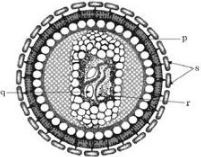
A
$p-$ Capsid,$q-$ Core,$r-$ Viral $RNA$,$s-$ Surface protein
B
$p-$ Surface protein,$q-$ Core,$r-$ Viral $DNA$,$s-$ Receptor protein
C
$p-$ Lipid membrane,$q-$ $RTase$,$r-$ Viral $RNA$,$s-$ Receptor binding protein
D
$p-$ Receptor binding protein,$q-$ Receptor protein,$r-$ Viral $RNA$,$s-$ Antigen determinant
Solution
(C) The provided figure represents the structure of the $HIV$ virus.
$1$. $p$ points to the lipid membrane (envelope) of the virus.
$2$. $q$ points to the enzyme Reverse Transcriptase $(RTase)$ located within the core.
$3$. $r$ points to the viral $RNA$ genome.
$4$. $s$ points to the receptor binding protein (glycoprotein $gp120$) on the surface.
Therefore,the correct option is $C$.
$1$. $p$ points to the lipid membrane (envelope) of the virus.
$2$. $q$ points to the enzyme Reverse Transcriptase $(RTase)$ located within the core.
$3$. $r$ points to the viral $RNA$ genome.
$4$. $s$ points to the receptor binding protein (glycoprotein $gp120$) on the surface.
Therefore,the correct option is $C$.
0 likes
View Solution46
MediumMCQ
Into how many stages can a patient infected with $HIV$ be classified?
A
$2$
B
$3$
C
$4$
D
$5$
Solution
(C) patient infected with $HIV$ is typically classified into $4$ clinical stages based on the progression of the disease and the severity of symptoms as defined by the $WHO$ (World Health Organization).
Stage $1$: Asymptomatic or generalized lymphadenopathy.
Stage $2$: Mild symptoms such as weight loss,recurrent respiratory infections,and skin manifestations.
Stage $3$: Advanced symptoms including chronic diarrhea,severe bacterial infections,and pulmonary tuberculosis.
Stage $4$: Severe clinical conditions including $HIV$ wasting syndrome and opportunistic infections like $Pneumocystis$ pneumonia or toxoplasmosis.
Stage $1$: Asymptomatic or generalized lymphadenopathy.
Stage $2$: Mild symptoms such as weight loss,recurrent respiratory infections,and skin manifestations.
Stage $3$: Advanced symptoms including chronic diarrhea,severe bacterial infections,and pulmonary tuberculosis.
Stage $4$: Severe clinical conditions including $HIV$ wasting syndrome and opportunistic infections like $Pneumocystis$ pneumonia or toxoplasmosis.
0 likes
View Solution47
MediumMCQ
Which virus directly attacks macrophages?
A
Hepatitis
B
$HIV$
C
Influenza
D
Adenovirus
Solution
(B) The $HIV$ (Human Immunodeficiency Virus) is a retrovirus that primarily targets the immune system.
Upon entering the human body,the virus enters macrophages,where the viral $RNA$ genome is replicated to form viral $DNA$ with the help of the enzyme reverse transcriptase.
The macrophages continue to produce virus particles and thus act like an $HIV$ factory.
Upon entering the human body,the virus enters macrophages,where the viral $RNA$ genome is replicated to form viral $DNA$ with the help of the enzyme reverse transcriptase.
The macrophages continue to produce virus particles and thus act like an $HIV$ factory.
0 likes
View Solution48
EasyMCQ
What is the full form of the $WB$ test?
A
Widal Blot Test
B
Widal Test
C
Western Blot Test
D
Western Block Test
Solution
(C) The $WB$ test stands for the Western Blot test.
It is a widely used analytical technique in molecular biology and immunogenetics to detect specific proteins in a sample of tissue homogenate or extract.
In the context of clinical diagnostics,it is used as a confirmatory test for $HIV$ infection after a positive $ELISA$ screening test.
It is a widely used analytical technique in molecular biology and immunogenetics to detect specific proteins in a sample of tissue homogenate or extract.
In the context of clinical diagnostics,it is used as a confirmatory test for $HIV$ infection after a positive $ELISA$ screening test.
0 likes
View Solution49
EasyMCQ
Which of the following diseases is transmitted through sexual intercourse?
A
Malaria
B
$AIDS$
C
$SCID$
D
Filariasis
Solution
(B) $AIDS$ $(Acquired \text{ } Immuno \text{ } Deficiency \text{ } Syndrome)$ is a sexually transmitted disease $(STD)$ caused by the Human Immunodeficiency Virus $(HIV)$.
It is primarily transmitted through unprotected sexual contact with an infected person, sharing of contaminated needles, or from an infected mother to her child.
Malaria is transmitted by the bite of an infected female $Anopheles$ mosquito.
$SCID$ $(Severe \text{ } Combined \text{ } Immunodeficiency)$ is a genetic disorder.
Filariasis is transmitted by the bite of infected mosquitoes (vectors).
It is primarily transmitted through unprotected sexual contact with an infected person, sharing of contaminated needles, or from an infected mother to her child.
Malaria is transmitted by the bite of an infected female $Anopheles$ mosquito.
$SCID$ $(Severe \text{ } Combined \text{ } Immunodeficiency)$ is a genetic disorder.
Filariasis is transmitted by the bite of infected mosquitoes (vectors).
0 likes
View Solution50
EasyMCQ
Which of the following effects is observed in an individual infected with $HIV$?
A
Decrease in the number of $T-$lymphocytes.
B
Occurrence of diseases like cough,cold,pneumonia,etc.
C
Swelling in lymph nodes.
D
All of the above.
Solution
(D) After entering the body,$HIV$ enters into macrophages where $RNA$ genome of the virus replicates to form viral $DNA$ with the help of the enzyme reverse transcriptase.
This viral $DNA$ gets incorporated into the host cell's $DNA$ and directs the infected cells to produce virus particles.
The macrophages continue to produce virus and in this way acts like an $HIV$ factory.
Simultaneously,$HIV$ enters into helper $T-$lymphocytes ($T_H$ cells),replicates and produces progeny viruses.
The progeny viruses released in the blood attack other helper $T-$lymphocytes.
This leads to a progressive decrease in the number of helper $T-$lymphocytes in the body of the infected person.
Due to the decrease in the number of $T-$lymphocytes,the person starts suffering from infections that could have been otherwise overcome such as those due to bacteria especially Mycobacterium,viruses,fungi and even parasites like Toxoplasma.
The patient becomes so immuno-deficient that he/she is unable to protect himself/herself against these infections,leading to symptoms like persistent fever,diarrhea,weight loss,and opportunistic infections like pneumonia.
This viral $DNA$ gets incorporated into the host cell's $DNA$ and directs the infected cells to produce virus particles.
The macrophages continue to produce virus and in this way acts like an $HIV$ factory.
Simultaneously,$HIV$ enters into helper $T-$lymphocytes ($T_H$ cells),replicates and produces progeny viruses.
The progeny viruses released in the blood attack other helper $T-$lymphocytes.
This leads to a progressive decrease in the number of helper $T-$lymphocytes in the body of the infected person.
Due to the decrease in the number of $T-$lymphocytes,the person starts suffering from infections that could have been otherwise overcome such as those due to bacteria especially Mycobacterium,viruses,fungi and even parasites like Toxoplasma.
The patient becomes so immuno-deficient that he/she is unable to protect himself/herself against these infections,leading to symptoms like persistent fever,diarrhea,weight loss,and opportunistic infections like pneumonia.
0 likes
View SolutionHuman Health and Disease — AIDS · Frequently Asked Questions
1Are these Human Health and Disease questions useful for JEE and NEET?
Yes. All questions in this section are mapped to JEE Main and NEET exam patterns. Previous year questions from JEE Main, NEET, GUJCET and state-level exams are included with full solutions.
2Can I switch to Hindi or Gujarati for these questions?
Yes. Use the language tabs in the hero section or the sidebar to view the same questions and solutions in English, Hindi or Gujarati.
3How do I generate a question paper from this subtopic?
Use the Vedclass Exam Paper Generator — select the chapter and subtopic, set difficulty, and generate Sets A, B, C, D automatically. First 3 chapters of every subject are free.
Vedclass Products
For Students
Vedclass Test Series
Mock tests in real JEE/NEET style with performance analysis. 5-day free trial.
Start Free TrialFor Teachers
Exam Paper Generator
Generate Set A/B/C/D papers from this chapter in 2 minutes. 3 chapters free.
Try FreeFor Institutes
Online Exam Module
Live online exams with unlimited students, 360° analytics & white-label branding.
See DemoFor Teachers & Institutes
Generate a Human Health and Disease Exam Paper in 2 Minutes
Select subtopic & difficulty — Sets A, B, C, D auto-generated with No Repeat logic.
First 3 chapters of every subject are free — no payment required.