
A English
AIDS Questions in English
Class 12 Biology · Human Health and Disease · AIDS
220+
Questions
English
Language
100%
With Solutions
Showing 20 of 220 questions in English
201
EasyMCQ
What role should society play towards $HIV$ infected people?
A
Society should isolate them to prevent the spread of the disease.
B
Society should provide help and sympathy instead of shunning them.
C
Society should ignore them as it is a personal health issue.
D
Society should blame them for their condition.
Solution
(B) $HIV/AIDS$ infected people require help,support,and sympathy from society rather than being ostracized.
Unless society recognizes this as a collective problem that needs to be addressed together,the risk of the disease spreading further increases significantly.
This is a malady that can only be effectively managed when society and the medical fraternity work in collaboration to prevent the spread of the infection.
Unless society recognizes this as a collective problem that needs to be addressed together,the risk of the disease spreading further increases significantly.
This is a malady that can only be effectively managed when society and the medical fraternity work in collaboration to prevent the spread of the infection.
0 likes
View Solution202
EasyMCQ
The $AIDS$ virus consists of a protein coat and genetic material as ........
A
Single-stranded $RNA$
B
Single-stranded $DNA$
C
Double-stranded $RNA$
D
Double-stranded $DNA$
Solution
(A) The $AIDS$ virus,known as $HIV$ ($Human$ $Immunodeficiency$ $Virus$),belongs to the group of retroviruses.
These viruses possess an envelope containing a protein coat (capsid) and their genetic material consists of two identical molecules of single-stranded $RNA$.
Therefore,the correct option is $A$.
These viruses possess an envelope containing a protein coat (capsid) and their genetic material consists of two identical molecules of single-stranded $RNA$.
Therefore,the correct option is $A$.
0 likes
View Solution203
EasyMCQ
The first case of $AIDS$ was reported in the year .........
A
$1971$
B
$1981$
C
$1976$
D
$1986$
Solution
(B) $AIDS$ (Acquired Immuno Deficiency Syndrome) was first reported in the year $1981$ in the United States of America. It is caused by the Human Immunodeficiency Virus $(HIV)$.
0 likes
View Solution204
MediumMCQ
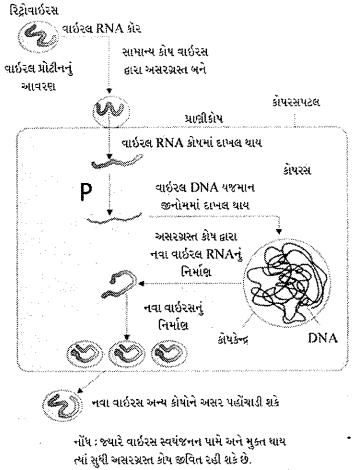
The replication of a retrovirus is shown below. Which enzyme is responsible for the process labeled $P$?
A
Transcriptase
B
$RNA$ polymerase
C
Reverse transcriptase
D
Both $A$ and $B$
Solution
(C) The process labeled $P$ represents the conversion of viral $RNA$ into viral $DNA$ within the host cell.
This process is known as reverse transcription.
The enzyme responsible for catalyzing the synthesis of $DNA$ from an $RNA$ template is called reverse transcriptase.
Therefore,the correct option is $C$.
This process is known as reverse transcription.
The enzyme responsible for catalyzing the synthesis of $DNA$ from an $RNA$ template is called reverse transcriptase.
Therefore,the correct option is $C$.
0 likes
View Solution205
EasyMCQ
$AIDS$ is caused by the reduction of:
A
Production of interferons
B
Natural $T$-lymphocytes
C
Helper $T$-lymphocytes
D
$B$-lymphocytes
Solution
(C) $AIDS$ (Acquired Immuno Deficiency Syndrome) is caused by the Human Immunodeficiency Virus $(HIV)$.
$HIV$ specifically targets and infects helper $T$-lymphocytes (also known as $CD4^+$ $T$-cells).
As the virus replicates within these cells,it leads to their destruction.
The progressive reduction in the number of helper $T$-lymphocytes severely weakens the body's immune system,making the individual susceptible to opportunistic infections and cancers.
$HIV$ specifically targets and infects helper $T$-lymphocytes (also known as $CD4^+$ $T$-cells).
As the virus replicates within these cells,it leads to their destruction.
The progressive reduction in the number of helper $T$-lymphocytes severely weakens the body's immune system,making the individual susceptible to opportunistic infections and cancers.
0 likes
View Solution206
EasyMCQ
Which method is used for the diagnosis of $AIDS$?
A
$PCR$
B
$ELISA$
C
$WB$ (Western Blot)
D
All of the above
Solution
(D) The diagnosis of $AIDS$ involves several techniques to detect the presence of the $HIV$ virus or antibodies against it.
$1$. $ELISA$ (Enzyme-Linked Immunosorbent Assay) is the primary screening test used to detect antibodies against $HIV$.
$2$. $Western \ Blot$ $(WB)$ is a confirmatory test used to verify positive results from an $ELISA$ test.
$3$. $PCR$ (Polymerase Chain Reaction) is used to detect the viral genetic material $(RNA)$ directly,which is especially useful in early diagnosis or when antibody levels are low.
Therefore,all these methods are used in the diagnosis of $AIDS$.
$1$. $ELISA$ (Enzyme-Linked Immunosorbent Assay) is the primary screening test used to detect antibodies against $HIV$.
$2$. $Western \ Blot$ $(WB)$ is a confirmatory test used to verify positive results from an $ELISA$ test.
$3$. $PCR$ (Polymerase Chain Reaction) is used to detect the viral genetic material $(RNA)$ directly,which is especially useful in early diagnosis or when antibody levels are low.
Therefore,all these methods are used in the diagnosis of $AIDS$.
0 likes
View Solution207
EasyMCQ
World $AIDS$ Day is observed on:
A
$1$ December
B
$5$ June
C
$1$ May
D
$5$ April
Solution
(A) World $AIDS$ Day is observed globally on $1$ December every year.
This day is dedicated to raising awareness about the $AIDS$ pandemic caused by the spread of $HIV$ infection and mourning those who have died of the disease.
It serves as an opportunity for people worldwide to unite in the fight against $HIV$,show support for people living with $HIV$,and commemorate those who have died.
This day is dedicated to raising awareness about the $AIDS$ pandemic caused by the spread of $HIV$ infection and mourning those who have died of the disease.
It serves as an opportunity for people worldwide to unite in the fight against $HIV$,show support for people living with $HIV$,and commemorate those who have died.
0 likes
View Solution208
EasyMCQ
To which group does the $HIV$ virus belong?
A
Rhinovirus
B
Baculovirus
C
Retrovirus
D
Reovirus
Solution
(C) $HIV$ (Human Immunodeficiency Virus) belongs to the group of viruses known as $Retroviruses$.
These viruses contain $RNA$ as their genetic material and possess an enzyme called $Reverse \text{ } Transcriptase$.
This enzyme allows the virus to transcribe its $RNA$ into $DNA$ inside the host cell, which then integrates into the host genome.
These viruses contain $RNA$ as their genetic material and possess an enzyme called $Reverse \text{ } Transcriptase$.
This enzyme allows the virus to transcribe its $RNA$ into $DNA$ inside the host cell, which then integrates into the host genome.
0 likes
View Solution209
EasyMCQ
The time interval between the infection and the appearance of $AIDS$ symptoms is usually ...........
A
$A$ few months to many years ($5$ to $10$ years)
B
$A$ few months to many years ($10$ to $15$ years)
C
$5$ to $10$ months
D
$10$ to $15$ months
Solution
(A) The incubation period of $HIV$ (the virus that causes $AIDS$) is the time between the initial infection and the onset of clinical symptoms.
This period is highly variable and typically ranges from a few months to many years,commonly estimated between $5$ to $10$ years.
During this time,the virus continues to replicate and progressively destroys the host's immune system,specifically the $CD4^+$ $T$-helper cells.
This period is highly variable and typically ranges from a few months to many years,commonly estimated between $5$ to $10$ years.
During this time,the virus continues to replicate and progressively destroys the host's immune system,specifically the $CD4^+$ $T$-helper cells.
0 likes
View Solution210
MediumMCQ
How many of the following factors are responsible for the spread of $AIDS$?
$I -$ Sexual contact with an infected person
$II -$ Wearing clothes of an infected person
$III -$ Transmission from infected mother to the foetus through the placenta
$IV -$ Shaking hands with an infected person
$V -$ Use of contaminated blood and blood products
$VI -$ Use of contaminated needles or syringes by drug addicts
$I -$ Sexual contact with an infected person
$II -$ Wearing clothes of an infected person
$III -$ Transmission from infected mother to the foetus through the placenta
$IV -$ Shaking hands with an infected person
$V -$ Use of contaminated blood and blood products
$VI -$ Use of contaminated needles or syringes by drug addicts
A
$2$
B
$3$
C
$4$
D
$5$
Solution
(C) $AIDS$ (Acquired Immuno Deficiency Syndrome) is caused by the $HIV$ virus. It spreads through the following modes:
$I -$ Sexual contact with an infected person (Responsible).
$II -$ Wearing clothes of an infected person (Not responsible).
$III -$ Transmission from infected mother to the foetus through the placenta (Responsible).
$IV -$ Shaking hands with an infected person (Not responsible).
$V -$ Use of contaminated blood and blood products (Responsible).
$VI -$ Use of contaminated needles or syringes by drug addicts (Responsible).
Thus,factors $I, III, V,$ and $VI$ are responsible for the spread of $AIDS$. The total number of such factors is $4$.
$I -$ Sexual contact with an infected person (Responsible).
$II -$ Wearing clothes of an infected person (Not responsible).
$III -$ Transmission from infected mother to the foetus through the placenta (Responsible).
$IV -$ Shaking hands with an infected person (Not responsible).
$V -$ Use of contaminated blood and blood products (Responsible).
$VI -$ Use of contaminated needles or syringes by drug addicts (Responsible).
Thus,factors $I, III, V,$ and $VI$ are responsible for the spread of $AIDS$. The total number of such factors is $4$.
0 likes
View Solution211
MediumMCQ
What is the genetic material of a retrovirus?
A
$DNA$
B
$RNA$
C
Both
D
None of these
Solution
(B) Retroviruses are a group of viruses that contain $RNA$ as their genetic material.
Upon entering a host cell,the enzyme reverse transcriptase converts the viral $RNA$ into $DNA$,which then integrates into the host genome.
Therefore,the primary genetic material of a retrovirus is $RNA$.
Upon entering a host cell,the enzyme reverse transcriptase converts the viral $RNA$ into $DNA$,which then integrates into the host genome.
Therefore,the primary genetic material of a retrovirus is $RNA$.
0 likes
View Solution212
MediumMCQ
Which of the following is commonly used nowadays for the detection of $HIV$ in a potential $AIDS$ patient?
A
Serum analysis
B
Urine analysis
C
$PCR$ (Polymerase Chain Reaction)
D
All of the above
Solution
(C) The $PCR$ ($Polymerase$ $Chain$ $Reaction$) technique is highly sensitive and is commonly used for the early detection of $HIV$ in a potential $AIDS$ patient.
It allows for the amplification of specific viral $DNA$ sequences,making it possible to detect the presence of the virus even when the viral load is very low in the patient's blood.
Therefore,$PCR$ is a standard diagnostic tool for $HIV$ detection.
It allows for the amplification of specific viral $DNA$ sequences,making it possible to detect the presence of the virus even when the viral load is very low in the patient's blood.
Therefore,$PCR$ is a standard diagnostic tool for $HIV$ detection.
0 likes
View Solution213
MediumMCQ
In which blood corpuscles does the $HIV$ undergo replication and produce progeny viruses?
A
Eosinophils
B
$T_H$ cells
C
$B$-lymphocytes
D
Basophils
Solution
(B) The correct answer is option $B$ because $HIV$ enters into helper $T$-lymphocytes ($T_H$ cells) after entering the body of the person.
Inside these cells,the viral $RNA$ genome replicates to form viral $DNA$ with the help of the enzyme reverse transcriptase.
This viral $DNA$ gets incorporated into the host cell's $DNA$ and directs the infected cells to produce virus particles.
The $T_H$ cells act as a factory for the production of progeny viruses,which are then released into the blood to attack other helper $T$-lymphocytes.
Inside these cells,the viral $RNA$ genome replicates to form viral $DNA$ with the help of the enzyme reverse transcriptase.
This viral $DNA$ gets incorporated into the host cell's $DNA$ and directs the infected cells to produce virus particles.
The $T_H$ cells act as a factory for the production of progeny viruses,which are then released into the blood to attack other helper $T$-lymphocytes.
0 likes
View Solution214
EasyMCQ
In which country was $AIDS$ first detected?
A
India
B
United States of America
C
Canada
D
China
Solution
(B) $AIDS$ (Acquired Immuno Deficiency Syndrome) was first reported in the United States of America in $1981$. It is caused by the Human Immunodeficiency Virus $(HIV)$.
0 likes
View Solution215
EasyMCQ
Human immune deficiency virus $(HIV)$ is a retrovirus with centrally located two $ssRNA$ molecules. It is covered by an outer layer of $I$ protein and an inner layer made up of $II$ protein.
A
$I - GP120, II - p17$
B
$I - p24, II - GP41$
C
$I - GP41, II - p120$
D
$I - p17, II - p24$
Solution
(D) The $HIV$ structure consists of two $ssRNA$ molecules at the center.
These are enclosed within a protein capsid.
The inner protein layer (capsid) is composed of $p24$ protein.
The outer protein layer (matrix) is composed of $p17$ protein.
Therefore,the correct sequence is $I - p17$ and $II - p24$.
These are enclosed within a protein capsid.
The inner protein layer (capsid) is composed of $p24$ protein.
The outer protein layer (matrix) is composed of $p17$ protein.
Therefore,the correct sequence is $I - p17$ and $II - p24$.
0 likes
View Solution216
EasyMCQ
After getting into the body of the person,$HIV$ enters into . . . . . . .
A
Neurons
B
Epithelial cells
C
Muscle cells
D
Macrophages
Solution
(D) After entering the human body,the $HIV$ virus first infects macrophages. These macrophages act as a factory for the virus,producing more viral particles. Subsequently,the virus spreads to helper $T$-lymphocytes ($T_H$ cells) in the blood,where it continues to replicate and cause a progressive decrease in the number of helper $T$-lymphocytes,leading to the weakening of the immune system. Therefore,the correct option is $D$.
0 likes
View Solution217
EasyMCQ
In which of the following,$HIV$ replicates and produces its progeny viruses?
A
Killer $T$-lymphocytes
B
Suppressor $T$-lymphocytes
C
Helper $T$-lymphocytes
D
Memory $T$-lymphocytes
Solution
(C) After entering the human body,the $HIV$ virus enters into macrophages where the $RNA$ genome of the virus replicates to form viral $DNA$ with the help of the enzyme reverse transcriptase.
This viral $DNA$ gets incorporated into the host cell's $DNA$ and directs the infected cells to produce virus particles.
The macrophages continue to produce virus particles and in this way,they act like an $HIV$ factory.
Simultaneously,$HIV$ enters into $Helper$ $T$-lymphocytes ($T_H$ cells),replicates,and produces progeny viruses.
The progeny viruses released in the blood attack other $Helper$ $T$-lymphocytes.
This leads to a progressive decrease in the number of $Helper$ $T$-lymphocytes in the body of the infected person.
This viral $DNA$ gets incorporated into the host cell's $DNA$ and directs the infected cells to produce virus particles.
The macrophages continue to produce virus particles and in this way,they act like an $HIV$ factory.
Simultaneously,$HIV$ enters into $Helper$ $T$-lymphocytes ($T_H$ cells),replicates,and produces progeny viruses.
The progeny viruses released in the blood attack other $Helper$ $T$-lymphocytes.
This leads to a progressive decrease in the number of $Helper$ $T$-lymphocytes in the body of the infected person.
0 likes
View Solution218
EasyMCQ
The genome of $HIV$ replicates in the macrophages with the help of an enzyme called:
A
$DNA$ Polymerase
B
$RNA$ Polymerase
C
Reverse Transcriptase
D
$DNA$ Ligase
Solution
(C) $HIV$ is a retrovirus that contains $RNA$ as its genetic material.
Upon entering the host cell (macrophage),the viral $RNA$ genome is converted into $DNA$ by the enzyme $Reverse \ Transcriptase$.
This $DNA$ then integrates into the host cell genome,allowing the virus to replicate.
Therefore,the correct enzyme is $Reverse \ Transcriptase$.
Upon entering the host cell (macrophage),the viral $RNA$ genome is converted into $DNA$ by the enzyme $Reverse \ Transcriptase$.
This $DNA$ then integrates into the host cell genome,allowing the virus to replicate.
Therefore,the correct enzyme is $Reverse \ Transcriptase$.
0 likes
View Solution219
EasyMCQ
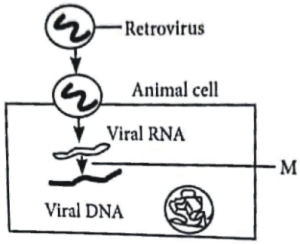
Identify the enzyme that catalyses the step labelled as '$M$' in the given schematic representation of replication of retrovirus.
A
Reverse transcriptase
B
$RNA$ polymerase
C
Recombinase
D
$DNA$ ligase
Solution
(A) The correct answer is $(A)$ Reverse transcriptase.
In the replication cycle of a retrovirus,the viral $RNA$ enters the host cell. The enzyme Reverse transcriptase (also known as $RNA$-dependent $DNA$ polymerase) catalyses the synthesis of viral $DNA$ from the viral $RNA$ template. This process is known as reverse transcription,which is represented by the step labelled '$M$' in the diagram.
In the replication cycle of a retrovirus,the viral $RNA$ enters the host cell. The enzyme Reverse transcriptase (also known as $RNA$-dependent $DNA$ polymerase) catalyses the synthesis of viral $DNA$ from the viral $RNA$ template. This process is known as reverse transcription,which is represented by the step labelled '$M$' in the diagram.
0 likes
View Solution220
EasyMCQ
During the replication of a retrovirus,what is introduced into the host cell?
A
Viral protein is introduced into the host cell.
B
Viral $RNA$ is introduced into the host cell.
C
Viral $DNA$ is introduced into the host cell.
D
Transcriptase enzyme is introduced into the host cell.
Solution
(B) The correct answer is $B$.
When a retrovirus (such as $HIV$) infects a host cell,it introduces its genetic material,which is viral $RNA$,into the host cell.
Inside the host cell,the virus sheds its protein coat.
$A$ viral enzyme called reverse transcriptase then reads the viral $RNA$ strand and makes a complementary $DNA$ copy.
This viral $DNA$ copy is then integrated into the host cell's genome,allowing the virus to replicate using the host's machinery.
When a retrovirus (such as $HIV$) infects a host cell,it introduces its genetic material,which is viral $RNA$,into the host cell.
Inside the host cell,the virus sheds its protein coat.
$A$ viral enzyme called reverse transcriptase then reads the viral $RNA$ strand and makes a complementary $DNA$ copy.
This viral $DNA$ copy is then integrated into the host cell's genome,allowing the virus to replicate using the host's machinery.
0 likes
View SolutionHuman Health and Disease — AIDS · Frequently Asked Questions
1Are these Human Health and Disease questions useful for JEE and NEET?
Yes. All questions in this section are mapped to JEE Main and NEET exam patterns. Previous year questions from JEE Main, NEET, GUJCET and state-level exams are included with full solutions.
2Can I switch to Hindi or Gujarati for these questions?
Yes. Use the language tabs in the hero section or the sidebar to view the same questions and solutions in English, Hindi or Gujarati.
3How do I generate a question paper from this subtopic?
Use the Vedclass Exam Paper Generator — select the chapter and subtopic, set difficulty, and generate Sets A, B, C, D automatically. First 3 chapters of every subject are free.
Vedclass Products
For Students
Vedclass Test Series
Mock tests in real JEE/NEET style with performance analysis. 5-day free trial.
Start Free TrialFor Teachers
Exam Paper Generator
Generate Set A/B/C/D papers from this chapter in 2 minutes. 3 chapters free.
Try FreeFor Institutes
Online Exam Module
Live online exams with unlimited students, 360° analytics & white-label branding.
See DemoFor Teachers & Institutes
Generate a Human Health and Disease Exam Paper in 2 Minutes
Select subtopic & difficulty — Sets A, B, C, D auto-generated with No Repeat logic.
First 3 chapters of every subject are free — no payment required.