
A English
Mix Examples - Human Health and Disease Questions in English
Class 12 Biology · Human Health and Disease · Mix Examples - Human Health and Disease
150+
Questions
English
Language
100%
With Solutions
Showing 50 of 150 questions in English
1
EasyMCQ
Housefly transmits all the diseases except
A
Cholera
B
Dysentery
C
Yellow fever
D
Typhoid
Solution
(C) The housefly $(Musca \text{ } domestica)$ acts as a mechanical vector for several pathogens causing diseases like cholera, dysentery, and typhoid by carrying them from contaminated surfaces to food.
Yellow fever is a viral disease transmitted primarily by the bite of infected mosquitoes, specifically the $Aedes \text{ } aegypti$ mosquito, not by the housefly.
Yellow fever is a viral disease transmitted primarily by the bite of infected mosquitoes, specifically the $Aedes \text{ } aegypti$ mosquito, not by the housefly.
0 likes
View Solution2
MediumMCQ
Lymphocytes are seen in large numbers at sites of inflammation because
A
Their function is phagocytic
B
They prevent clotting of blood
C
Their function is to form and carry antibodies
D
All the above
Solution
(C) Lymphocytes are a type of white blood cell that plays a crucial role in the immune system. Their primary function is to recognize pathogens,form specific antibodies,and provide immunological memory. During inflammation,the body recruits these cells to the site of infection or injury to neutralize pathogens and initiate the adaptive immune response.
0 likes
View Solution3
EasyMCQ
After infection by pathogens,dead cells,dead pathogens,and liquid form the:
A
Antibodies
B
Excretory product
C
Pus
D
Agglutinin
Solution
(C) During an inflammatory response to a pathogen infection,white blood cells (specifically neutrophils and macrophages) migrate to the site of infection to engulf the pathogens.
As these white blood cells die after phagocytosis,they accumulate along with the dead pathogens and tissue debris,forming a thick,yellowish-white fluid known as pus.
Therefore,the correct answer is $C$ (Pus).
As these white blood cells die after phagocytosis,they accumulate along with the dead pathogens and tissue debris,forming a thick,yellowish-white fluid known as pus.
Therefore,the correct answer is $C$ (Pus).
0 likes
View Solution4
MediumMCQ
Which one of the following pairs of diseases can spread through blood transfusion?
A
Cholera and hepatitis
B
Hepatitis and $AIDS$
C
Diabetes mellitus and malaria
D
Hay fever and $AIDS$
Solution
(B) Blood transfusion is a process of transferring blood or blood components from one person to another.
Diseases that are blood-borne can be transmitted through this process if the donor's blood is infected.
$Hepatitis$ (specifically $Hepatitis B$ and $C$) and $AIDS$ (caused by $HIV$) are both known to be transmitted through the exchange of infected blood or blood products.
Cholera is a water-borne disease, $Diabetes mellitus$ is a metabolic disorder, and $Hay fever$ is an allergic reaction, none of which are transmitted via blood transfusion.
Diseases that are blood-borne can be transmitted through this process if the donor's blood is infected.
$Hepatitis$ (specifically $Hepatitis B$ and $C$) and $AIDS$ (caused by $HIV$) are both known to be transmitted through the exchange of infected blood or blood products.
Cholera is a water-borne disease, $Diabetes mellitus$ is a metabolic disorder, and $Hay fever$ is an allergic reaction, none of which are transmitted via blood transfusion.
0 likes
View Solution5
EasyMCQ
Which of the following pairs is not correctly matched?
A
Dengue fever - Arbovirus
B
Plague - Yersinia pestis
C
Syphilis - Trichuris trichiura
D
Sleeping sickness - Trypanosoma gambiense
Solution
(C) The correct answer is $C$.
Syphilis is a sexually transmitted disease $(STD)$ caused by the bacterium $Treponema \text{ } pallidum$.
$Trichuris \text{ } trichiura$ is a whipworm that causes trichuriasis, not syphilis.
Syphilis is a sexually transmitted disease $(STD)$ caused by the bacterium $Treponema \text{ } pallidum$.
$Trichuris \text{ } trichiura$ is a whipworm that causes trichuriasis, not syphilis.
0 likes
View Solution6
MediumMCQ
The main reason why antibiotics could not solve all the problems of bacteria-mediated diseases is:
A
Insensitivity of the individual following prolonged exposure to antibiotics
B
Inactivation of antibiotics by bacterial enzymes
C
Decreased efficiency of the immune system
D
The development of mutant strains resistant to antibiotics
Solution
(D) The primary reason antibiotics have not eliminated bacterial diseases is the emergence of antibiotic resistance.
Bacteria undergo genetic mutations that allow them to survive in the presence of antibiotics.
These mutant strains,which possess resistance genes,multiply and pass these traits to subsequent generations,rendering the antibiotics ineffective against them.
While bacterial enzymes can also inactivate antibiotics,the widespread development of resistant mutant strains is the most significant global challenge.
Bacteria undergo genetic mutations that allow them to survive in the presence of antibiotics.
These mutant strains,which possess resistance genes,multiply and pass these traits to subsequent generations,rendering the antibiotics ineffective against them.
While bacterial enzymes can also inactivate antibiotics,the widespread development of resistant mutant strains is the most significant global challenge.
0 likes
View Solution7
MediumMCQ
Match the incorrect pair.
A
$Xenopsylla$ - Plague
B
$Pediculus$ - Typhoid
C
$Culex$ - Malaria
D
$Stegomyia$ - Yellow fever
Solution
(B) The question asks to identify the incorrect pair among the given vectors and the diseases they transmit:
$1$. $Xenopsylla$ (Rat flea) is the vector for Plague $(Yersinia \text{ pestis})$.
$2$. $Pediculus$ (Louse) is the vector for Epidemic Typhus, not Typhoid. Typhoid is caused by $Salmonella \text{ typhi}$ and is transmitted through contaminated food and water, not by $Pediculus$.
$3$. $Culex$ is a vector for Filariasis (Wuchereria bancrofti), not Malaria. Malaria is transmitted by the female $Anopheles$ mosquito.
$4$. $Stegomyia$ (formerly $Aedes$) is the vector for Yellow fever.
Since both $B$ and $C$ represent incorrect pairings, in the context of standard biology MCQs, $Pediculus$ is commonly cited as the incorrect vector for Typhoid, and $Culex$ is the incorrect vector for Malaria. However, $Pediculus$ is specifically associated with Typhus, making $B$ a classic incorrect pair.
$1$. $Xenopsylla$ (Rat flea) is the vector for Plague $(Yersinia \text{ pestis})$.
$2$. $Pediculus$ (Louse) is the vector for Epidemic Typhus, not Typhoid. Typhoid is caused by $Salmonella \text{ typhi}$ and is transmitted through contaminated food and water, not by $Pediculus$.
$3$. $Culex$ is a vector for Filariasis (Wuchereria bancrofti), not Malaria. Malaria is transmitted by the female $Anopheles$ mosquito.
$4$. $Stegomyia$ (formerly $Aedes$) is the vector for Yellow fever.
Since both $B$ and $C$ represent incorrect pairings, in the context of standard biology MCQs, $Pediculus$ is commonly cited as the incorrect vector for Typhoid, and $Culex$ is the incorrect vector for Malaria. However, $Pediculus$ is specifically associated with Typhus, making $B$ a classic incorrect pair.
0 likes
View Solution8
MediumMCQ
Psychosis is characterised by
A
Loss of touch with reality
B
Prolonged emotional reaction to a given stress
C
Anxiety,fear,sadness,vague aches and pains
D
All the above
Solution
(A) Psychosis results from mental or physical illness or any other trauma due to which thoughts and emotions are affected to such an extent that contact is lost with reality.
People suffering from psychosis interpret the things around them in a different way.
Hallucinations and delusions are common symptoms in the affected person.
The person becomes distressed and may hear voices that are not actually there.
Therefore,the primary characteristic of psychosis is the loss of touch with reality.
People suffering from psychosis interpret the things around them in a different way.
Hallucinations and delusions are common symptoms in the affected person.
The person becomes distressed and may hear voices that are not actually there.
Therefore,the primary characteristic of psychosis is the loss of touch with reality.
0 likes
View Solution9
MediumMCQ
Social therapy of mental illness is required for
A
Treatment of psychosis
B
Maintenance of community health
C
Rehabilitation of mentally ill persons
D
Prevention of addiction
Solution
(C) Social therapy is a crucial component in the management of mental health disorders. It is primarily required for the rehabilitation of mentally ill persons,helping them reintegrate into society,improve their social functioning,and maintain a stable life after clinical treatment.
0 likes
View Solution10
MediumMCQ
Which of the following is a mental disease?
A
Tetanus
B
Neurosis
C
Drug dependence
D
Alcoholism
Solution
(B) Neurosis is a class of functional mental disorders involving distress but neither delusions nor hallucinations,where behavior is not outside socially acceptable norms. Tetanus is a bacterial infection,while drug dependence and alcoholism are classified as substance use disorders.
0 likes
View Solution11
MediumMCQ
$A$ mentally sick person has:
A
Tendency to get upset with change in routine
B
Feeling of friendship and trust for all
C
Tendency to perform all the daily chores by oneself
D
Tendency to solve all the problems without aid of others
Solution
(A) mentally sick person often exhibits a tendency to get upset with any change in their daily routine.
This is because individuals with mental health challenges may rely on rigid patterns to cope with their environment.
Other common characteristics include an apprehensive nature,irritability,and difficulty in managing social interactions or stress.
This is because individuals with mental health challenges may rely on rigid patterns to cope with their environment.
Other common characteristics include an apprehensive nature,irritability,and difficulty in managing social interactions or stress.
0 likes
View Solution12
MediumMCQ
$A$ person is considered mentally ill if they are:
A
Worried
B
Experiencing moods fluctuating between depression and elation
C
Excessively happy
D
Extra talkative
Solution
(B) Mental health refers to a state of well-being in which an individual realizes their own abilities,can cope with the normal stresses of life,can work productively,and is able to make a contribution to their community.
Conditions like Bipolar Disorder,characterized by mood swings between depression and elation (mania),are recognized as forms of mental illness.
While being worried,excessively happy,or talkative can be temporary emotional states,persistent and severe fluctuations in mood that interfere with daily functioning are clinical indicators of mental illness.
Conditions like Bipolar Disorder,characterized by mood swings between depression and elation (mania),are recognized as forms of mental illness.
While being worried,excessively happy,or talkative can be temporary emotional states,persistent and severe fluctuations in mood that interfere with daily functioning are clinical indicators of mental illness.
0 likes
View Solution13
MediumMCQ
Which one of the following is a mental disability?
A
Psychosis
B
Neurosis
C
Schizophrenia
D
Epilepsy
Solution
(D) Epilepsy is a neurological disorder characterized by abnormal electrical activity in the brain.
It often manifests as recurrent seizures,which can involve jerking movements,stiffening of muscles,and loss of consciousness.
While it affects brain function,it is clinically classified as a neurological disorder rather than a primary psychiatric or mental disability like $Psychosis$,$Neurosis$,or $Schizophrenia$.
It often manifests as recurrent seizures,which can involve jerking movements,stiffening of muscles,and loss of consciousness.
While it affects brain function,it is clinically classified as a neurological disorder rather than a primary psychiatric or mental disability like $Psychosis$,$Neurosis$,or $Schizophrenia$.
0 likes
View Solution14
EasyMCQ
Psychoanalysis was founded by
A
Jenner
B
Parkinson
C
Freud
D
Hansen
Solution
(C) Psychoanalysis is a set of psychological theories and therapeutic techniques that have their origin in the work and theories of $Sigmund \ Freud$.
It is a clinical method for treating psychopathology through dialogue between a patient and a psychoanalyst.
Therefore,the correct answer is $Freud$.
It is a clinical method for treating psychopathology through dialogue between a patient and a psychoanalyst.
Therefore,the correct answer is $Freud$.
0 likes
View Solution15
MediumMCQ
Pests resistant to insecticides have:
A
Less permeable cuticles
B
Capacity of faster storage of toxin in fat
C
Enzymes for metabolising toxin
D
All the above features
Solution
(D) Pests develop resistance to insecticides through various physiological and biochemical mechanisms.
$1$. Less permeable cuticles: This reduces the rate of absorption of the insecticide into the pest's body.
$2$. Faster storage of toxin in fat: This sequesters the toxin away from the target site,preventing immediate harm.
$3$. Enzymes for metabolising toxin: Many resistant pests possess specific enzymes (like cytochrome $P450$ monooxygenases) that break down the insecticide into non-toxic metabolites.
Since all these mechanisms contribute to insecticide resistance,the correct answer is $D$.
$1$. Less permeable cuticles: This reduces the rate of absorption of the insecticide into the pest's body.
$2$. Faster storage of toxin in fat: This sequesters the toxin away from the target site,preventing immediate harm.
$3$. Enzymes for metabolising toxin: Many resistant pests possess specific enzymes (like cytochrome $P450$ monooxygenases) that break down the insecticide into non-toxic metabolites.
Since all these mechanisms contribute to insecticide resistance,the correct answer is $D$.
0 likes
View Solution16
EasyMCQ
Mosquito-repelling coils contain which of the following active ingredients?
A
Aluminium phosphide
B
Arsenic
C
Pyrethrin
D
Diethyl bromide
Solution
(C) Mosquito-repelling coils typically contain pyrethroids as the active ingredient. Pyrethrins are a class of organic compounds derived from the flowers of the Chrysanthemum plant,which act as natural insecticides. When the coil is burned,these compounds are released into the air,effectively repelling or killing mosquitoes.
0 likes
View Solution17
EasyMCQ
What can be diagnosed by the $ELISA$ test?
A
Hepatitis-$B$
B
Syphilis
C
Gonorrhea
D
All of the above
Solution
(D) $ELISA$ stands for Enzyme-Linked Immunosorbent Assay.
It is a diagnostic technique used to detect the presence of specific antigens or antibodies in a sample.
$ELISA$ is widely used for the detection of various infectious diseases,including $HIV$ $(AIDS)$,Hepatitis-$B$,Syphilis,and Gonorrhea,by identifying specific viral or bacterial antigens or the host's immune response to them.
Therefore,all the listed options are correct.
It is a diagnostic technique used to detect the presence of specific antigens or antibodies in a sample.
$ELISA$ is widely used for the detection of various infectious diseases,including $HIV$ $(AIDS)$,Hepatitis-$B$,Syphilis,and Gonorrhea,by identifying specific viral or bacterial antigens or the host's immune response to them.
Therefore,all the listed options are correct.
0 likes
View Solution18
MediumMCQ
Match the diseases with their respective pathogens or treatments.
| List-$I$ | List-$II$ |
| $(a)$ Amoebiasis | $(i)$ Treponema pallidum |
| $(b)$ Diphtheria | $(ii)$ Use of sterile food |
| $(c)$ Cholera | $(iii)$ $DT$ vaccine |
| $(d)$ Syphilis | $(iv)$ Use of Oral Rehydration Therapy |
A
$a-ii, b-iv, c-i, d-iii$
B
$a-ii, b-i, c-iii, d-iv$
C
$a-ii, b-iii, c-iv, d-i$
D
$a-i, b-ii, c-iii, d-iv$
Solution
(C) The correct matching is as follows:
$(a)$ Amoebiasis is caused by Entamoeba histolytica, and its prevention involves the use of sterile food and water $(ii)$.
$(b)$ Diphtheria is prevented by the administration of the $DT$ (Diphtheria-Tetanus) vaccine $(iii)$.
$(c)$ Cholera is treated by the use of Oral Rehydration Therapy $(ORT)$ to manage fluid loss $(iv)$.
$(d)$ Syphilis is a sexually transmitted disease caused by the bacterium Treponema pallidum $(i)$.
Therefore, the correct sequence is $a-ii, b-iii, c-iv, d-i$.
$(a)$ Amoebiasis is caused by Entamoeba histolytica, and its prevention involves the use of sterile food and water $(ii)$.
$(b)$ Diphtheria is prevented by the administration of the $DT$ (Diphtheria-Tetanus) vaccine $(iii)$.
$(c)$ Cholera is treated by the use of Oral Rehydration Therapy $(ORT)$ to manage fluid loss $(iv)$.
$(d)$ Syphilis is a sexually transmitted disease caused by the bacterium Treponema pallidum $(i)$.
Therefore, the correct sequence is $a-ii, b-iii, c-iv, d-i$.
0 likes
View Solution19
MediumMCQ
Which of the following is an incorrect match?
A
Dengue fever - $Arbovirus$
B
Plague - $Yersinia$ $pestis$
C
Syphilis - $Trichuris$
D
Sleeping sickness - $Trypanosoma$
Solution
(C) The correct match for each disease is as follows:
$1$. Dengue fever is caused by the $Arbovirus$ (transmitted by $Aedes$ mosquitoes).
$2$. Plague is caused by the bacterium $Yersinia$ $pestis$.
$3$. Syphilis is a sexually transmitted disease caused by the bacterium $Treponema$ $pallidum$,not $Trichuris$. $Trichuris$ (whipworm) causes trichuriasis.
$4$. Sleeping sickness is caused by the protozoan $Trypanosoma$ $brucei$.
Therefore,the incorrect match is Syphilis - $Trichuris$.
$1$. Dengue fever is caused by the $Arbovirus$ (transmitted by $Aedes$ mosquitoes).
$2$. Plague is caused by the bacterium $Yersinia$ $pestis$.
$3$. Syphilis is a sexually transmitted disease caused by the bacterium $Treponema$ $pallidum$,not $Trichuris$. $Trichuris$ (whipworm) causes trichuriasis.
$4$. Sleeping sickness is caused by the protozoan $Trypanosoma$ $brucei$.
Therefore,the incorrect match is Syphilis - $Trichuris$.
0 likes
View Solution20
MediumMCQ
Which of the following diseases are $NOT$ related to smoking?
$(1)$ Lung cancer $(2)$ Bronchitis $(3)$ Emphysema $(4)$ Coronary heart disease $(5)$ Gastric ulcers $(6)$ Bladder cancer $(7)$ Throat cancer
$(1)$ Lung cancer $(2)$ Bronchitis $(3)$ Emphysema $(4)$ Coronary heart disease $(5)$ Gastric ulcers $(6)$ Bladder cancer $(7)$ Throat cancer
A
$1, 2, 5, 7$
B
$1, 2, 3, 6, 7$
C
$3, 4, 6$
D
None of these (all are related)
Solution
(D) Smoking is a major risk factor for various health conditions.
$(1)$ Lung cancer is directly linked to smoking.
$(2)$ Bronchitis is often caused or exacerbated by smoking.
$(3)$ Emphysema is a chronic lung disease primarily caused by smoking.
$(4)$ Coronary heart disease risk increases significantly with smoking.
$(5)$ Gastric ulcers are associated with smoking as it impairs the mucosal defense.
$(6)$ Bladder cancer risk is higher in smokers due to the excretion of carcinogens in urine.
$(7)$ Throat cancer is strongly associated with tobacco use.
Since all the listed conditions are related to smoking,the correct answer is that none of the options represent diseases 'not' related to smoking.
$(1)$ Lung cancer is directly linked to smoking.
$(2)$ Bronchitis is often caused or exacerbated by smoking.
$(3)$ Emphysema is a chronic lung disease primarily caused by smoking.
$(4)$ Coronary heart disease risk increases significantly with smoking.
$(5)$ Gastric ulcers are associated with smoking as it impairs the mucosal defense.
$(6)$ Bladder cancer risk is higher in smokers due to the excretion of carcinogens in urine.
$(7)$ Throat cancer is strongly associated with tobacco use.
Since all the listed conditions are related to smoking,the correct answer is that none of the options represent diseases 'not' related to smoking.
0 likes
View Solution21
MediumMCQ
The enlargement of the spleen during malaria is caused by:
A
Excessive lymphocytes
B
Dead red blood cells
C
Both
D
None of these
Solution
(C) During a malaria infection,the $Plasmodium$ parasite infects and destroys red blood cells $(RBCs)$.
The spleen is responsible for filtering the blood and removing old or damaged $RBCs$.
Due to the massive destruction of $RBCs$ by the parasite,the spleen has to process a significantly higher volume of cellular debris (dead $RBCs$).
Additionally,the immune system responds by increasing the production of lymphocytes to fight the infection.
Consequently,the accumulation of dead $RBCs$ and the proliferation of immune cells lead to the enlargement of the spleen,a condition known as splenomegaly.
The spleen is responsible for filtering the blood and removing old or damaged $RBCs$.
Due to the massive destruction of $RBCs$ by the parasite,the spleen has to process a significantly higher volume of cellular debris (dead $RBCs$).
Additionally,the immune system responds by increasing the production of lymphocytes to fight the infection.
Consequently,the accumulation of dead $RBCs$ and the proliferation of immune cells lead to the enlargement of the spleen,a condition known as splenomegaly.
0 likes
View Solution22
MediumMCQ
Eosinophilia is caused by which of the following?
A
Taeniasis
B
Ascariasis
C
Hay fever
D
All of the above
Solution
(D) Eosinophilia is a condition characterized by an increased number of eosinophils in the blood.
$1$. $Taeniasis$ is an infection caused by tapeworms, which triggers an immune response leading to eosinophilia.
$2$. $Ascariasis$ is an infection caused by the roundworm $Ascaris$ $lumbricoides$, which also causes a significant rise in eosinophil counts.
$3$. $Hay$ $fever$ (allergic rhinitis) is an allergic reaction that often results in elevated eosinophil levels.
Therefore, all the mentioned conditions can lead to eosinophilia.
$1$. $Taeniasis$ is an infection caused by tapeworms, which triggers an immune response leading to eosinophilia.
$2$. $Ascariasis$ is an infection caused by the roundworm $Ascaris$ $lumbricoides$, which also causes a significant rise in eosinophil counts.
$3$. $Hay$ $fever$ (allergic rhinitis) is an allergic reaction that often results in elevated eosinophil levels.
Therefore, all the mentioned conditions can lead to eosinophilia.
0 likes
View Solution23
MediumMCQ
What is responsible for the resistance of insects to insecticides?
A
Less permeable cuticle
B
Ability to store toxins in fat in large amounts
C
Enzymes for metabolism of toxins
D
All of the above
Solution
(D) Insects develop resistance to insecticides through various physiological and biochemical mechanisms.
$1$. $A$ less permeable cuticle reduces the rate of absorption of the insecticide into the insect's body.
$2$. Some insects possess the ability to sequester or store toxins in their fat bodies,preventing them from reaching vital organs.
$3$. Insects often evolve or upregulate specific enzymes (such as cytochrome $P450$ monooxygenases) that metabolize and detoxify the insecticide before it can cause harm.
Since all these mechanisms contribute to resistance,the correct answer is $D$.
$1$. $A$ less permeable cuticle reduces the rate of absorption of the insecticide into the insect's body.
$2$. Some insects possess the ability to sequester or store toxins in their fat bodies,preventing them from reaching vital organs.
$3$. Insects often evolve or upregulate specific enzymes (such as cytochrome $P450$ monooxygenases) that metabolize and detoxify the insecticide before it can cause harm.
Since all these mechanisms contribute to resistance,the correct answer is $D$.
0 likes
View Solution24
MediumMCQ
Which drug can be used to reduce the risk of miscarriage?
A
Pinene
B
Quinine
C
Reserpine
D
Morphine
Solution
(B) The correct answer is $B$. Quinine is an alkaloid derived from the bark of the Cinchona tree. Historically,it has been used to treat malaria. In some medical contexts,it has been studied for its potential to help maintain pregnancy in specific conditions,although its primary use remains antimalarial. Other options like Reserpine (antihypertensive),Morphine (analgesic),and Pinene (terpene) do not serve this purpose.
0 likes
View Solution25
EasyMCQ
Which of the following diseases can be controlled by the use of vaccines?
A
Diphtheria
B
Tetanus
C
Pneumonia
D
All of the above
Solution
(D) Vaccines are biological preparations that provide active acquired immunity to a particular infectious disease.
$1$. Diphtheria is a serious bacterial infection caused by $Corynebacterium$ $diphtheriae$,which is prevented by the $DPT$ vaccine.
$2$. Tetanus is caused by $Clostridium$ $tetani$ and is also prevented by the $DPT$ vaccine.
$3$. Pneumonia can be caused by bacteria like $Streptococcus$ $pneumoniae$,and vaccines (like the pneumococcal vaccine) are available to prevent it.
Therefore,all the listed diseases can be controlled or prevented through vaccination.
$1$. Diphtheria is a serious bacterial infection caused by $Corynebacterium$ $diphtheriae$,which is prevented by the $DPT$ vaccine.
$2$. Tetanus is caused by $Clostridium$ $tetani$ and is also prevented by the $DPT$ vaccine.
$3$. Pneumonia can be caused by bacteria like $Streptococcus$ $pneumoniae$,and vaccines (like the pneumococcal vaccine) are available to prevent it.
Therefore,all the listed diseases can be controlled or prevented through vaccination.
0 likes
View Solution26
MediumMCQ
Which of the following statements is $NOT$ correct for the maintenance of personal health?
A
Consuming clean water and food.
B
Avoiding contact with individuals suffering from malaria and filariasis.
C
Cleaning water tanks at regular intervals.
D
Taking vaccines for pneumonia,tetanus,and diphtheria at regular intervals.
Solution
(B) Personal health maintenance involves hygiene,vaccination,and vector control.
$A$,$C$,and $D$ are correct practices for maintaining health.
$B$ is incorrect because malaria and filariasis are vector-borne diseases (transmitted by mosquitoes),not contagious diseases spread through direct contact with an infected person. Therefore,avoiding contact with the patient does not prevent the transmission of these diseases; rather,controlling the vector (mosquito) is essential.
$A$,$C$,and $D$ are correct practices for maintaining health.
$B$ is incorrect because malaria and filariasis are vector-borne diseases (transmitted by mosquitoes),not contagious diseases spread through direct contact with an infected person. Therefore,avoiding contact with the patient does not prevent the transmission of these diseases; rather,controlling the vector (mosquito) is essential.
0 likes
View Solution27
EasyMCQ
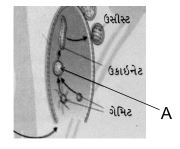
In the given diagram of the life cycle of Anopheles,what does the part labeled '$A$' represent?
A
Gametes
B
Zygote
C
Oocyst
D
Sporozoite
Solution
(B) In the life cycle of Plasmodium within the female Anopheles mosquito,fertilization occurs in the mosquito's gut. The fusion of male and female gametes results in the formation of a diploid zygote. In the provided diagram,'$A$' points to the structure formed after the fusion of gametes,which is the zygote. This zygote then transforms into a motile ookinete,which penetrates the gut wall to form an oocyst.
0 likes
View Solution28
EasyMCQ
Assertion $A$: Common cold is an infectious disease caused by rhinoviruses.
Reason $R$: The common cold typically lasts for $3$ to $7$ days.
Which option is correct for Assertion $A$ and Reason $R$?
Reason $R$: The common cold typically lasts for $3$ to $7$ days.
Which option is correct for Assertion $A$ and Reason $R$?
A
$A$ and $R$ are both true and $R$ is the correct explanation of $A$.
B
$A$ and $R$ are both true but $R$ is not the correct explanation of $A$.
C
$A$ is true and $R$ is false.
D
$A$ is false and $R$ is true.
Solution
(B) Assertion $A$ is true because the common cold is indeed caused by a group of viruses known as rhinoviruses,which infect the nose and respiratory passage but not the lungs.
Reason $R$ is also true because the symptoms of the common cold typically persist for a duration of $3$ to $7$ days.
However,the duration of the illness $(R)$ does not explain why the disease is caused by rhinoviruses $(A)$. Therefore,$R$ is not the correct explanation for $A$.
Reason $R$ is also true because the symptoms of the common cold typically persist for a duration of $3$ to $7$ days.
However,the duration of the illness $(R)$ does not explain why the disease is caused by rhinoviruses $(A)$. Therefore,$R$ is not the correct explanation for $A$.
0 likes
View Solution29
MediumMCQ
Which of the following diseases is $NOT$ caused by autoimmunity?
A
Ringworm
B
Multiple sclerosis
C
Rheumatoid arthritis
D
Insulin-dependent diabetes mellitus
Solution
(A) Autoimmunity is a condition where the immune system mistakenly attacks the body's own healthy cells.
$A$. Ringworm is a fungal infection caused by fungi like $Microsporum$,$Trichophyton$,and $Epidermophyton$,not by an autoimmune response.
$B$. Multiple sclerosis is an autoimmune disorder where the immune system attacks the protective sheath (myelin) that covers nerve fibers.
$C$. Rheumatoid arthritis is an autoimmune disorder where the immune system attacks the joints.
$D$. Insulin-dependent diabetes mellitus (Type $1$ diabetes) is an autoimmune disorder where the immune system destroys insulin-producing beta cells in the pancreas.
Therefore,Ringworm is the correct answer.
$A$. Ringworm is a fungal infection caused by fungi like $Microsporum$,$Trichophyton$,and $Epidermophyton$,not by an autoimmune response.
$B$. Multiple sclerosis is an autoimmune disorder where the immune system attacks the protective sheath (myelin) that covers nerve fibers.
$C$. Rheumatoid arthritis is an autoimmune disorder where the immune system attacks the joints.
$D$. Insulin-dependent diabetes mellitus (Type $1$ diabetes) is an autoimmune disorder where the immune system destroys insulin-producing beta cells in the pancreas.
Therefore,Ringworm is the correct answer.
0 likes
View Solution30
EasyMCQ
Match the following columns:
| Column-$I$ | Column-$II$ |
| $1$. Bone marrow | $a$. Large at birth,very small at puberty |
| $2$. Thymus | $b$. Site of production of all blood cells including lymphocytes |
| $3$. Spleen | $c$. Traps microorganisms present in the tissue fluid |
| $4$. Lymph nodes | $d$. Large bean-shaped organ |
A
$1-b, 2-a, 3-d, 4-c$
B
$1-b, 2-d, 3-a, 4-c$
C
$1-c, 2-d, 3-a, 4-b$
D
$1-c, 2-a, 3-d, 4-b$
Solution
(A) The correct matching is as follows:
$1$. Bone marrow $(b)$: It is the primary lymphoid organ where all blood cells,including lymphocytes,are produced.
$2$. Thymus $(a)$: It is a primary lymphoid organ that is quite large at the time of birth but keeps reducing in size with age and becomes very small by the time of puberty.
$3$. Spleen $(d)$: It is a large bean-shaped organ which acts as a filter for the blood by trapping blood-borne microorganisms.
$4$. Lymph nodes $(c)$: These are small solid structures located at different points along the lymphatic system that trap microorganisms or other antigens present in the lymph and tissue fluid.
Therefore,the correct sequence is $1-b, 2-a, 3-d, 4-c$.
$1$. Bone marrow $(b)$: It is the primary lymphoid organ where all blood cells,including lymphocytes,are produced.
$2$. Thymus $(a)$: It is a primary lymphoid organ that is quite large at the time of birth but keeps reducing in size with age and becomes very small by the time of puberty.
$3$. Spleen $(d)$: It is a large bean-shaped organ which acts as a filter for the blood by trapping blood-borne microorganisms.
$4$. Lymph nodes $(c)$: These are small solid structures located at different points along the lymphatic system that trap microorganisms or other antigens present in the lymph and tissue fluid.
Therefore,the correct sequence is $1-b, 2-a, 3-d, 4-c$.
0 likes
View Solution31
MediumMCQ
Identify the odd one out in the context of diseases.
A
Malaria
B
Filariasis
C
$HIV$
D
Typhoid
Solution
(C) The odd one out is $HIV$ (Human Immunodeficiency Virus).
Malaria is caused by a protozoan $(Plasmodium)$.
Filariasis is caused by a helminth $(Wuchereria)$.
Typhoid is caused by a bacterium $(Salmonella \text{ } typhi)$.
All three (Malaria, Filariasis, and Typhoid) are caused by pathogens that are cellular organisms (protozoa, helminths, and bacteria).
$HIV$ is a virus, which is an acellular infectious agent, making it the odd one out.
Malaria is caused by a protozoan $(Plasmodium)$.
Filariasis is caused by a helminth $(Wuchereria)$.
Typhoid is caused by a bacterium $(Salmonella \text{ } typhi)$.
All three (Malaria, Filariasis, and Typhoid) are caused by pathogens that are cellular organisms (protozoa, helminths, and bacteria).
$HIV$ is a virus, which is an acellular infectious agent, making it the odd one out.
0 likes
View Solution32
MediumMCQ
Which of the following statements is false?
A
Pap smear is a histological test.
B
Blood and urine tests are used in laboratory diagnosis.
C
$C.T.$ scan uses sound waves.
D
$MRI$ uses non-ionizing radiation.
Solution
(C) Analysis of the given statements:
$1$. $A$ Pap smear is a histological test used for the diagnosis of cervical cancer,which is true.
$2$. Blood and urine tests are commonly used in laboratory diagnosis,which is true.
$3$. $A$ $C.T.$ (Computed Tomography) scan uses $X$-rays to create three-dimensional images of internal organs,whereas sound waves are used in ultrasound. Therefore,this statement is false.
$4$. $MRI$ (Magnetic Resonance Imaging) uses strong magnetic fields and non-ionizing radio waves,which is true.
Thus,the correct answer is $C$.
$1$. $A$ Pap smear is a histological test used for the diagnosis of cervical cancer,which is true.
$2$. Blood and urine tests are commonly used in laboratory diagnosis,which is true.
$3$. $A$ $C.T.$ (Computed Tomography) scan uses $X$-rays to create three-dimensional images of internal organs,whereas sound waves are used in ultrasound. Therefore,this statement is false.
$4$. $MRI$ (Magnetic Resonance Imaging) uses strong magnetic fields and non-ionizing radio waves,which is true.
Thus,the correct answer is $C$.
0 likes
View Solution33
EasyMCQ
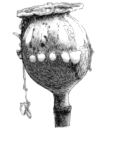
Identify the plant part shown in the figure.
A
Claviceps purpurea
B
Erythroxylum coca
C
Cannabis indica
D
Papaver somniferum
Solution
(D) The figure shows the fruit (capsule) of the poppy plant, $Papaver$ $somniferum$.
This plant is the source of opiates like morphine and heroin.
$Claviceps$ $purpurea$ is a fungus, $Erythroxylum$ $coca$ is the source of cocaine, and $Cannabis$ $indica$ is the source of cannabinoids.
This plant is the source of opiates like morphine and heroin.
$Claviceps$ $purpurea$ is a fungus, $Erythroxylum$ $coca$ is the source of cocaine, and $Cannabis$ $indica$ is the source of cannabinoids.
0 likes
View Solution34
EasyMCQ
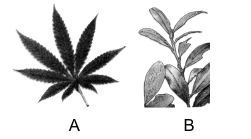
Which medicinal drugs are obtained from the given figures $A$ and $B$?
A
$i-$ Bhang,$ii-$ Coke
B
$i-$ $LSD$,$ii-$ Ganja
C
$i-$ Nicotine,$ii-$ Cocaine
D
$i-$ Bhang,$ii-$ Charas
Solution
(A) Figure $A$ represents the leaves of the Cannabis plant (Cannabis sativa),from which cannabinoids like Bhang,Ganja,and Charas are obtained.
Figure $B$ represents the leaves of the Coca plant (Erythroxylum coca),from which the drug Cocaine (also known as coke or crack) is obtained.
Therefore,the correct identification is $i-$ Bhang (or Cannabis products) and $ii-$ Coke (Cocaine).
Figure $B$ represents the leaves of the Coca plant (Erythroxylum coca),from which the drug Cocaine (also known as coke or crack) is obtained.
Therefore,the correct identification is $i-$ Bhang (or Cannabis products) and $ii-$ Coke (Cocaine).
0 likes
View Solution35
EasyMCQ
Match the following columns and select the correct option:
| Column-$I$ | Column-$II$ | Column-$III$ |
|---|---|---|
| $a$. Opium poppy | $i$. Fruit | $p$. Cocaine |
| $b$. Cannabis indica | $ii$. Dried leaves | $q$. $LSD$ |
| $c$. Ergot fungus | $iii$. Latex | $r$. Ganja |
| $d$. Erythroxylum coca | $iv$. Flowering tops | $s$. Opium |
A
$(a-iii-s), (b-iv-r), (c-i-q), (d-ii-p)$
B
$(a-iv-s), (b-iii-r), (c-ii-q), (d-i-p)$
C
$(a-i-p), (b-ii-q), (c-iii-r), (d-iv-s)$
D
$(a-ii-p), (b-iii-q), (c-iv-r), (d-i-s)$
Solution
(A) The correct matches are as follows:
$1$. Opium poppy $(a)$ produces latex $(iii)$ which is processed to obtain Opium $(s)$.
$2$. Cannabis indica $(b)$ uses flowering tops $(iv)$ to produce Ganja $(r)$.
$3$. Ergot fungus $(c)$ is used to derive $LSD$ $(q)$,though it is not a fruit,the column association in the context of the question implies the source-product relationship.
$4$. Erythroxylum coca $(d)$ uses dried leaves $(ii)$ to extract Cocaine $(p)$.
Therefore,the correct sequence is $(a-iii-s), (b-iv-r), (c-i-q), (d-ii-p)$.
$1$. Opium poppy $(a)$ produces latex $(iii)$ which is processed to obtain Opium $(s)$.
$2$. Cannabis indica $(b)$ uses flowering tops $(iv)$ to produce Ganja $(r)$.
$3$. Ergot fungus $(c)$ is used to derive $LSD$ $(q)$,though it is not a fruit,the column association in the context of the question implies the source-product relationship.
$4$. Erythroxylum coca $(d)$ uses dried leaves $(ii)$ to extract Cocaine $(p)$.
Therefore,the correct sequence is $(a-iii-s), (b-iv-r), (c-i-q), (d-ii-p)$.
0 likes
View Solution36
MediumMCQ
Which of the following pairs is mismatched?
A
Opium – Latex
B
Claviceps – Fruit
C
Erythroxylum – Flowers
D
Cannabis – Leaves
Solution
(C) The correct answer is $C$.
$1$. Opium is obtained from the dried latex of the unripe capsules of the poppy plant,$Papaver$ $somniferum$.
$2$. $Claviceps$ $purpurea$ is a fungus that infects the ovaries of rye and other grasses,producing sclerotia (ergot),which are often mistaken for grains or fruits.
$3$. $Erythroxylum$ $coca$ (coca plant) yields cocaine,which is extracted from its leaves,not its flowers. Therefore,the pair $Erythroxylum$ – Flowers is mismatched.
$4$. $Cannabis$ $sativa$ yields cannabinoids,which are obtained from the inflorescences,leaves,and resin of the plant.
$1$. Opium is obtained from the dried latex of the unripe capsules of the poppy plant,$Papaver$ $somniferum$.
$2$. $Claviceps$ $purpurea$ is a fungus that infects the ovaries of rye and other grasses,producing sclerotia (ergot),which are often mistaken for grains or fruits.
$3$. $Erythroxylum$ $coca$ (coca plant) yields cocaine,which is extracted from its leaves,not its flowers. Therefore,the pair $Erythroxylum$ – Flowers is mismatched.
$4$. $Cannabis$ $sativa$ yields cannabinoids,which are obtained from the inflorescences,leaves,and resin of the plant.
0 likes
View Solution37
MediumMCQ
Which of the following pairs is mismatched?
A
Ergot - Marijuana
B
Opium poppy - Codeine
C
Cannabis - Charas
D
Erythroxylum - Crack
Solution
(A) The correct answer is $A$.
$1$. Ergot is a fungus $(Claviceps purpurea)$ that produces alkaloids like ergotamine and $LSD$, whereas Marijuana is derived from the Cannabis plant. Thus, this pair is mismatched.
$2$. Opium poppy $(Papaver somniferum)$ is the source of opiates like Codeine and Morphine.
$3$. Cannabis sativa is the source of Charas, Ganja, and Hashish.
$4$. Erythroxylum coca is the source of Cocaine, and 'Crack' is a potent form of cocaine.
$1$. Ergot is a fungus $(Claviceps purpurea)$ that produces alkaloids like ergotamine and $LSD$, whereas Marijuana is derived from the Cannabis plant. Thus, this pair is mismatched.
$2$. Opium poppy $(Papaver somniferum)$ is the source of opiates like Codeine and Morphine.
$3$. Cannabis sativa is the source of Charas, Ganja, and Hashish.
$4$. Erythroxylum coca is the source of Cocaine, and 'Crack' is a potent form of cocaine.
0 likes
View Solution38
MediumMCQ
Which disease is likely to be transmitted by sharing needles when taking drugs intravenously?
A
$AIDS$
B
Smallpox
C
Hepatitis $B$
D
Both $(A)$ and $(C)$
Solution
(D) Intravenous drug abuse involves the use of shared needles or syringes.
If these needles are contaminated with blood from an infected person,they can transmit blood-borne pathogens.
$AIDS$ (Acquired Immuno Deficiency Syndrome) is caused by the $HIV$ virus,which spreads through infected blood and shared needles.
$Hepatitis B$ is also a viral infection that is highly transmissible through contact with infected blood,including the use of shared needles.
Therefore,both $AIDS$ and $Hepatitis B$ can be transmitted through this practice.
If these needles are contaminated with blood from an infected person,they can transmit blood-borne pathogens.
$AIDS$ (Acquired Immuno Deficiency Syndrome) is caused by the $HIV$ virus,which spreads through infected blood and shared needles.
$Hepatitis B$ is also a viral infection that is highly transmissible through contact with infected blood,including the use of shared needles.
Therefore,both $AIDS$ and $Hepatitis B$ can be transmitted through this practice.
0 likes
View Solution39
DifficultMCQ
Match the following columns:
| Column $I$ | Column $II$ |
| $1.$ Pneumococci | $a.$ Attack lymphatic vessels and lymph nodes |
| $2.$ Plasmodium | $b.$ Attack alveoli |
| $3.$ Filarial worm | $c.$ Attack macrophages and helper $T$ cells |
| $4.$ Retrovirus | $d.$ Attack liver cells and red blood cells |
A
$(1-c), (2-d), (3-a), (4-b)$
B
$(1-c), (2-a), (3-d), (4-b)$
C
$(1-d), (2-a), (3-b), (4-c)$
D
$(1-b), (2-d), (3-a), (4-c)$
Solution
(D) The correct matches are as follows:
$1.$ Pneumococci (Streptococcus pneumoniae) infect the alveoli (air sacs) of the lungs, causing pneumonia. Thus, $1-b$.
$2.$ Plasmodium, the causative agent of malaria, infects liver cells and red blood cells in humans. Thus, $2-d$.
$3.$ Filarial worms (Wuchereria bancrofti) infect the lymphatic vessels and lymph nodes, causing filariasis (elephantiasis). Thus, $3-a$.
$4.$ Retrovirus $(HIV)$ attacks macrophages and helper $T$ cells, leading to a decline in immunity. Thus, $4-c$.
Therefore, the correct sequence is $(1-b), (2-d), (3-a), (4-c)$.
$1.$ Pneumococci (Streptococcus pneumoniae) infect the alveoli (air sacs) of the lungs, causing pneumonia. Thus, $1-b$.
$2.$ Plasmodium, the causative agent of malaria, infects liver cells and red blood cells in humans. Thus, $2-d$.
$3.$ Filarial worms (Wuchereria bancrofti) infect the lymphatic vessels and lymph nodes, causing filariasis (elephantiasis). Thus, $3-a$.
$4.$ Retrovirus $(HIV)$ attacks macrophages and helper $T$ cells, leading to a decline in immunity. Thus, $4-c$.
Therefore, the correct sequence is $(1-b), (2-d), (3-a), (4-c)$.
0 likes
View Solution40
MediumMCQ
Which group of diseases is spread by mosquito bites?
A
Malaria,Filariasis,Ringworm,$AIDS$
B
Malaria,$AIDS$,Dengue,Chikungunya
C
Filariasis,Malaria,$AIDS$,Chikungunya
D
Malaria,Filariasis,Dengue,Chikungunya
Solution
(D) The diseases spread by mosquito bites are as follows:
$1$. Malaria is caused by $Plasmodium$ and transmitted by the female $Anopheles$ mosquito.
$2$. Filariasis (Elephantiasis) is caused by $Wuchereria$ $bancrofti$ and $Wuchereria$ $malayi$,transmitted by the $Culex$ mosquito.
$3$. Dengue is a viral disease transmitted by the $Aedes$ $aegypti$ mosquito.
$4$. Chikungunya is a viral disease transmitted by the $Aedes$ $aegypti$ and $Aedes$ $albopictus$ mosquitoes.
$AIDS$ is caused by the $HIV$ virus and is transmitted through sexual contact,blood transfusion,or from mother to child,not by mosquitoes. Ringworm is a fungal infection spread through contact or contaminated objects.
$1$. Malaria is caused by $Plasmodium$ and transmitted by the female $Anopheles$ mosquito.
$2$. Filariasis (Elephantiasis) is caused by $Wuchereria$ $bancrofti$ and $Wuchereria$ $malayi$,transmitted by the $Culex$ mosquito.
$3$. Dengue is a viral disease transmitted by the $Aedes$ $aegypti$ mosquito.
$4$. Chikungunya is a viral disease transmitted by the $Aedes$ $aegypti$ and $Aedes$ $albopictus$ mosquitoes.
$AIDS$ is caused by the $HIV$ virus and is transmitted through sexual contact,blood transfusion,or from mother to child,not by mosquitoes. Ringworm is a fungal infection spread through contact or contaminated objects.
0 likes
View Solution41
MediumMCQ
Match the following columns correctly:
| Column-$I$ (Disease) | Column-$II$ (Pathogen) | Column-$III$ (Symptom) |
|---|---|---|
| $a$. Common Cold | $i$. Streptococcus pneumoniae | $p$. Swelling in lower limbs |
| $b$. Pneumonia | $ii$. Rhinovirus | $q$. Skin lesions |
| $c$. $AIDS$ | $iii$. Retrovirus | $r$. Nasal congestion and discharge |
| $d$. Filariasis | $iv$. Filarial worm | $s$. Lips and fingernails turn gray to bluish |
A
$(a-i-p), (b-ii-q), (c-iii-r), (d-iv-s)$
B
$(a-ii-r), (b-i-s), (c-iii-q), (d-iv-p)$
C
$(a-iv-p), (b-iii-q), (c-ii-r), (d-i-s)$
D
$(a-iii-s), (b-iv-r), (c-ii-p), (d-i-q)$
Solution
(B) The correct matching is as follows:
$1$. Common Cold $(a)$: Caused by Rhinovirus $(ii)$,characterized by nasal congestion and discharge $(r)$. Thus,$(a-ii-r)$.
$2$. Pneumonia $(b)$: Caused by Streptococcus pneumoniae $(i)$,characterized by lips and fingernails turning gray to bluish $(s)$. Thus,$(b-i-s)$.
$3$. $AIDS$ $(c)$: Caused by Retrovirus $(iii)$,which leads to various symptoms including skin lesions or opportunistic infections $(q)$. Thus,$(c-iii-q)$.
$4$. Filariasis $(d)$: Caused by Filarial worm $(iv)$,characterized by chronic inflammation and swelling in lower limbs $(p)$. Thus,$(d-iv-p)$.
Therefore,the correct sequence is $(a-ii-r), (b-i-s), (c-iii-q), (d-iv-p)$.
$1$. Common Cold $(a)$: Caused by Rhinovirus $(ii)$,characterized by nasal congestion and discharge $(r)$. Thus,$(a-ii-r)$.
$2$. Pneumonia $(b)$: Caused by Streptococcus pneumoniae $(i)$,characterized by lips and fingernails turning gray to bluish $(s)$. Thus,$(b-i-s)$.
$3$. $AIDS$ $(c)$: Caused by Retrovirus $(iii)$,which leads to various symptoms including skin lesions or opportunistic infections $(q)$. Thus,$(c-iii-q)$.
$4$. Filariasis $(d)$: Caused by Filarial worm $(iv)$,characterized by chronic inflammation and swelling in lower limbs $(p)$. Thus,$(d-iv-p)$.
Therefore,the correct sequence is $(a-ii-r), (b-i-s), (c-iii-q), (d-iv-p)$.
0 likes
View Solution42
MediumMCQ
Match the following columns:
| Column-$I$ | Column-$II$ |
| $1$. Allergy | $a$. Immunodeficiency |
| $2$. Autoimmunity | $b$. Serotonin |
| $3$. $AIDS$ | $c$. $IgA$ |
| $4$. Colostrum | $d$. Multiple sclerosis |
A
$1-b, 2-d, 3-a, 4-c$
B
$1-c, 2-d, 3-a, 4-b$
C
$1-b, 2-c, 3-a, 4-d$
D
None of the above
Solution
(A) The correct matches are as follows:
$1$. Allergy: During an allergic reaction, mast cells release chemicals like histamine and serotonin. Thus, $1-b$.
$2$. Autoimmunity: Multiple sclerosis is a classic example of an autoimmune disease where the body attacks its own myelin sheath. Thus, $2-d$.
$3$. $AIDS$: Acquired Immuno Deficiency Syndrome is caused by $HIV$, which leads to immunodeficiency. Thus, $3-a$.
$4$. Colostrum: The yellowish fluid secreted by the mother during the initial days of lactation is rich in antibodies, specifically $IgA$. Thus, $4-c$.
Therefore, the correct sequence is $1-b, 2-d, 3-a, 4-c$.
$1$. Allergy: During an allergic reaction, mast cells release chemicals like histamine and serotonin. Thus, $1-b$.
$2$. Autoimmunity: Multiple sclerosis is a classic example of an autoimmune disease where the body attacks its own myelin sheath. Thus, $2-d$.
$3$. $AIDS$: Acquired Immuno Deficiency Syndrome is caused by $HIV$, which leads to immunodeficiency. Thus, $3-a$.
$4$. Colostrum: The yellowish fluid secreted by the mother during the initial days of lactation is rich in antibodies, specifically $IgA$. Thus, $4-c$.
Therefore, the correct sequence is $1-b, 2-d, 3-a, 4-c$.
0 likes
View Solution43
MediumMCQ
Which pair represents diseases spread through the air?
A
Typhoid-Pneumonia
B
$TB$-Dysentery
C
Pneumonia-Common Cold
D
Pneumonia-Malaria
Solution
(C) Diseases that spread through the air are known as airborne diseases.
$1$. Pneumonia is caused by bacteria like $Streptococcus$ $\text{pneumoniae}$ and $Haemophilus$ $\text{influenzae}$, which spread through droplets released by an infected person.
$2$. The common cold is caused by rhinoviruses, which also spread through droplets resulting from coughs or sneezes of an infected person.
$3$. Typhoid is water-borne, Malaria is vector-borne (mosquito), and Dysentery is typically water-borne or food-borne.
Therefore, the correct pair is Pneumonia and Common Cold.
$1$. Pneumonia is caused by bacteria like $Streptococcus$ $\text{pneumoniae}$ and $Haemophilus$ $\text{influenzae}$, which spread through droplets released by an infected person.
$2$. The common cold is caused by rhinoviruses, which also spread through droplets resulting from coughs or sneezes of an infected person.
$3$. Typhoid is water-borne, Malaria is vector-borne (mosquito), and Dysentery is typically water-borne or food-borne.
Therefore, the correct pair is Pneumonia and Common Cold.
0 likes
View Solution44
MediumMCQ
Match the following columns:
| Column-$I$ | Column-$II$ |
| $1.$ Typhoid | $a.$ Trichophyton |
| $2.$ Pneumonia | $b.$ Rhinovirus |
| $3.$ Common cold | $c.$ Haemophilus influenzae |
| $4.$ Ringworm | $d.$ Salmonella typhi |
A
$(1-d), (2-c), (3-b), (4-a)$
B
$(1-d), (2-b), (3-c), (4-a)$
C
$(1-d), (2-c), (3-a), (4-b)$
D
$(1-d), (2-b), (3-a), (4-c)$
Solution
(A) The correct matches are as follows:
$1$. Typhoid is caused by the bacterium $Salmonella \, typhi$.
$2$. Pneumonia is caused by $Streptococcus \, pneumoniae$ or $Haemophilus \, influenzae$.
$3$. Common cold is caused by $Rhinovirus$.
$4$. Ringworm is a fungal infection caused by genera like $Trichophyton$, $Microsporum$, and $Epidermophyton$.
Therefore, the correct matching is $(1-d), (2-c), (3-b), (4-a)$.
$1$. Typhoid is caused by the bacterium $Salmonella \, typhi$.
$2$. Pneumonia is caused by $Streptococcus \, pneumoniae$ or $Haemophilus \, influenzae$.
$3$. Common cold is caused by $Rhinovirus$.
$4$. Ringworm is a fungal infection caused by genera like $Trichophyton$, $Microsporum$, and $Epidermophyton$.
Therefore, the correct matching is $(1-d), (2-c), (3-b), (4-a)$.
0 likes
View Solution45
MediumMCQ
Match the following columns correctly.
| Column $I$ | Column $II$ | Column $III$ |
|---|---|---|
| $(a)$ Typhoid | $(p)$ Streptococcus | $(w)$ Human skin |
| $(b)$ Pneumonia | $(q)$ Rhinovirus | $(x)$ Patient's feces |
| $(c)$ Common cold | $(r)$ Salmonella | $(y)$ Contaminated pens |
| $(d)$ Filariasis | $(s)$ Filarial worm | $(z)$ Sputum |
A
$a-p-x; b-r-z; c-q-y; d-s-w$
B
$a-r-x; b-p-z; c-q-y; d-s-w$
C
$a-p-z; b-q-y; c-s-w; d-r-x$
D
$a-r-x; b-p-y; c-q-z; d-s-w$
Solution
(B) The correct matches are as follows:
$1$. Typhoid $(a)$ is caused by the bacterium Salmonella $(r)$ and spreads through contaminated food/water,often found in the patient's feces $(x)$. Thus,$a-r-x$.
$2$. Pneumonia $(b)$ is caused by Streptococcus pneumoniae $(p)$ and affects the lungs,leading to the production of sputum $(z)$. Thus,$b-p-z$.
$3$. Common cold $(c)$ is caused by Rhinovirus $(q)$ and is transmitted through contaminated objects like pens $(y)$. Thus,$c-q-y$.
$4$. Filariasis $(d)$ is caused by the Filarial worm $(s)$ (Wuchereria bancrofti),which affects the lymphatic system and can manifest in the skin/tissues $(w)$. Thus,$d-s-w$.
Therefore,the correct sequence is $a-r-x; b-p-z; c-q-y; d-s-w$.
$1$. Typhoid $(a)$ is caused by the bacterium Salmonella $(r)$ and spreads through contaminated food/water,often found in the patient's feces $(x)$. Thus,$a-r-x$.
$2$. Pneumonia $(b)$ is caused by Streptococcus pneumoniae $(p)$ and affects the lungs,leading to the production of sputum $(z)$. Thus,$b-p-z$.
$3$. Common cold $(c)$ is caused by Rhinovirus $(q)$ and is transmitted through contaminated objects like pens $(y)$. Thus,$c-q-y$.
$4$. Filariasis $(d)$ is caused by the Filarial worm $(s)$ (Wuchereria bancrofti),which affects the lymphatic system and can manifest in the skin/tissues $(w)$. Thus,$d-s-w$.
Therefore,the correct sequence is $a-r-x; b-p-z; c-q-y; d-s-w$.
0 likes
View Solution46
MediumMCQ
Match the following columns correctly.
| Column-$I$ | Column-$II$ | Column-$III$ |
|---|---|---|
| $(a)$ $Streptococcus$ $pneumoniae$ | $(p)$ $3-7$ days | $(z)$ Common cold |
| $(b)$ $Salmonella$ $typhi$ | $(q)$ $1-3$ weeks | $(x)$ Typhoid |
| $(c)$ $Rhinovirus$ | $(r)$ $1-3$ days | $(y)$ Pneumonia |
A
$a-r-z; b-q-y; c-p-x$
B
$a-r-y; b-q-x; c-p-z$
C
$a-q-z; b-p-y; c-r-x$
D
$a-r-x; b-q-y; c-p-z$
Solution
(B) The correct matches are as follows:
$1$. $(a)$ $Streptococcus$ $pneumoniae$ causes $(y)$ Pneumonia,and its incubation period is $(r)$ $1-3$ days.
$2$. $(b)$ $Salmonella$ $typhi$ causes $(x)$ Typhoid,and its incubation period is $(q)$ $1-3$ weeks.
$3$. $(c)$ $Rhinovirus$ causes $(z)$ Common cold,and its incubation period is $(p)$ $3-7$ days.
Therefore,the correct sequence is $a-r-y; b-q-x; c-p-z$.
$1$. $(a)$ $Streptococcus$ $pneumoniae$ causes $(y)$ Pneumonia,and its incubation period is $(r)$ $1-3$ days.
$2$. $(b)$ $Salmonella$ $typhi$ causes $(x)$ Typhoid,and its incubation period is $(q)$ $1-3$ weeks.
$3$. $(c)$ $Rhinovirus$ causes $(z)$ Common cold,and its incubation period is $(p)$ $3-7$ days.
Therefore,the correct sequence is $a-r-y; b-q-x; c-p-z$.
0 likes
View Solution47
MediumMCQ
$S -$ Statement: Cancer is a deadly infectious disease.
$R -$ Reason: $AIDS$ was first reported in the $USA$ in $1986$.
$R -$ Reason: $AIDS$ was first reported in the $USA$ in $1986$.
A
$S$ and $R$ are both true,$R$ is the correct explanation of $S$.
B
$S$ and $R$ are both true,but $R$ is not the correct explanation of $S$.
C
$S$ is true and $R$ is false.
D
$S$ and $R$ are both false.
Solution
(D) $S -$ Statement is false because cancer is a non-infectious disease caused by uncontrolled cell division,not by pathogens.
$R -$ Reason is false because $AIDS$ was first reported in the $USA$ in $1981$,not $1986$.
$R -$ Reason is false because $AIDS$ was first reported in the $USA$ in $1981$,not $1986$.
0 likes
View Solution48
MediumMCQ
$S -$ Statement: Mature seeds of opium are used to prevent stomach cramps.
$R -$ Reason: Anticancer drugs are not specific to a particular tumor.
$R -$ Reason: Anticancer drugs are not specific to a particular tumor.
A
$S$ and $R$ are both true,$R$ is the correct explanation of $S$.
B
$S$ and $R$ are both true,but $R$ is not the correct explanation of $S$.
C
$S$ is true and $R$ is false.
D
$S$ and $R$ are both false.
Solution
(D) Statement $S$ is false because mature seeds of opium (poppy seeds) are not used to prevent stomach cramps; rather,opium derivatives like morphine are used as analgesics.
Statement $R$ is false because anticancer drugs (chemotherapy) are generally non-specific,meaning they target rapidly dividing cells,which can include both cancerous and healthy cells,but they are not 'non-specific to a particular tumor' in the sense that they are designed to treat specific types of cancer. However,in the context of standard biology curriculum,anticancer drugs are often described as having side effects because they affect healthy cells,but the statement as phrased is scientifically inaccurate or misleading. Both statements are considered false in the context of standard medical biology.
Statement $R$ is false because anticancer drugs (chemotherapy) are generally non-specific,meaning they target rapidly dividing cells,which can include both cancerous and healthy cells,but they are not 'non-specific to a particular tumor' in the sense that they are designed to treat specific types of cancer. However,in the context of standard biology curriculum,anticancer drugs are often described as having side effects because they affect healthy cells,but the statement as phrased is scientifically inaccurate or misleading. Both statements are considered false in the context of standard medical biology.
0 likes
View Solution49
EasyMCQ
Which of the following is mismatched?
A
Typhoid – Salmonella typhi
B
Pneumonia – Haemophilus influenzae
C
Common cold – Rhino virus
D
Malaria – Microsporum
Solution
(D) The correct answer is $D$.
$1$. Typhoid is caused by the bacterium $Salmonella$ $typhi$.
$2$. Pneumonia is caused by $Streptococcus$ $pneumoniae$ and $Haemophilus$ $influenzae$.
$3$. The common cold is caused by $Rhino$ $viruses$.
$4$. Malaria is caused by protozoan parasites of the genus $Plasmodium$ (e.g.,$P. vivax$,$P. falciparum$).
$5$. $Microsporum$ is a genus of fungi that causes ringworm,not malaria. Therefore,the pair $Malaria – Microsporum$ is mismatched.
$1$. Typhoid is caused by the bacterium $Salmonella$ $typhi$.
$2$. Pneumonia is caused by $Streptococcus$ $pneumoniae$ and $Haemophilus$ $influenzae$.
$3$. The common cold is caused by $Rhino$ $viruses$.
$4$. Malaria is caused by protozoan parasites of the genus $Plasmodium$ (e.g.,$P. vivax$,$P. falciparum$).
$5$. $Microsporum$ is a genus of fungi that causes ringworm,not malaria. Therefore,the pair $Malaria – Microsporum$ is mismatched.
0 likes
View Solution50
MediumMCQ
Which of the following is correctly matched?
A
Typhoid – Fluid accumulation in alveoli and bronchioles.
B
Pneumonia – Reduced sense of smell.
C
Filariasis – Swelling in body parts like the scrotum and mammary glands.
D
Ringworm – Caused by protozoa.
Solution
(C) The correct match is $C$.
$1$. Typhoid is caused by the bacterium $Salmonella \text{ } typhi$, characterized by high fever and intestinal perforation, not fluid in the lungs.
$2$. Pneumonia is caused by $Streptococcus \text{ } pneumoniae$ and $Haemophilus \text{ } influenzae$, leading to fluid accumulation in the alveoli, not reduced smell.
$3$. Filariasis (Elephantiasis) is caused by $Wuchereria \text{ } bancrofti$ and $Wuchereria \text{ } malayi$, which cause chronic inflammation and swelling in organs like the scrotum and mammary glands.
$4$. Ringworm is caused by fungi like $Microsporum$, $Trichophyton$, and $Epidermophyton$, not protozoa.
$1$. Typhoid is caused by the bacterium $Salmonella \text{ } typhi$, characterized by high fever and intestinal perforation, not fluid in the lungs.
$2$. Pneumonia is caused by $Streptococcus \text{ } pneumoniae$ and $Haemophilus \text{ } influenzae$, leading to fluid accumulation in the alveoli, not reduced smell.
$3$. Filariasis (Elephantiasis) is caused by $Wuchereria \text{ } bancrofti$ and $Wuchereria \text{ } malayi$, which cause chronic inflammation and swelling in organs like the scrotum and mammary glands.
$4$. Ringworm is caused by fungi like $Microsporum$, $Trichophyton$, and $Epidermophyton$, not protozoa.
0 likes
View SolutionHuman Health and Disease — Mix Examples - Human Health and Disease · Frequently Asked Questions
1Are these Human Health and Disease questions useful for JEE and NEET?
Yes. All questions in this section are mapped to JEE Main and NEET exam patterns. Previous year questions from JEE Main, NEET, GUJCET and state-level exams are included with full solutions.
2Can I switch to Hindi or Gujarati for these questions?
Yes. Use the language tabs in the hero section or the sidebar to view the same questions and solutions in English, Hindi or Gujarati.
3How do I generate a question paper from this subtopic?
Use the Vedclass Exam Paper Generator — select the chapter and subtopic, set difficulty, and generate Sets A, B, C, D automatically. First 3 chapters of every subject are free.
Vedclass Products
For Students
Vedclass Test Series
Mock tests in real JEE/NEET style with performance analysis. 5-day free trial.
Start Free TrialFor Teachers
Exam Paper Generator
Generate Set A/B/C/D papers from this chapter in 2 minutes. 3 chapters free.
Try FreeFor Institutes
Online Exam Module
Live online exams with unlimited students, 360° analytics & white-label branding.
See DemoFor Teachers & Institutes
Generate a Human Health and Disease Exam Paper in 2 Minutes
Select subtopic & difficulty — Sets A, B, C, D auto-generated with No Repeat logic.
First 3 chapters of every subject are free — no payment required.