
A English
AIDS Questions in English
Class 12 Biology · Human Health and Disease · AIDS
220+
Questions
English
Language
100%
With Solutions
Showing 50 of 220 questions in English
51
EasyMCQ
Which nucleic acid is present as the genetic material in $HIV$?
A
$RNA$
B
$DNA$
C
Both $A$ and $B$
D
Plasmid
Solution
(A) $HIV$ (Human Immunodeficiency Virus) is a retrovirus.
It contains two identical strands of single-stranded $RNA$ as its genetic material.
Upon entering the host cell,the viral enzyme reverse transcriptase converts this $RNA$ into $DNA$,which then integrates into the host genome.
It contains two identical strands of single-stranded $RNA$ as its genetic material.
Upon entering the host cell,the viral enzyme reverse transcriptase converts this $RNA$ into $DNA$,which then integrates into the host genome.
0 likes
View Solution52
MediumMCQ
What is the cause of $AIDS$?
A
Destruction of helper $T$-lymphocytes
B
Autoimmunity
C
Destruction of killer $T$-cells
D
Decrease in interferons
Solution
(A) $AIDS$ (Acquired Immuno Deficiency Syndrome) is caused by the Human Immunodeficiency Virus $(HIV)$.
$HIV$ specifically targets and infects helper $T$-lymphocytes ($CD4^+$ cells).
As the virus replicates within these cells,it leads to their progressive destruction.
Since helper $T$-lymphocytes are crucial for coordinating the immune response,their depletion severely weakens the body's immune system,making the individual susceptible to opportunistic infections.
$HIV$ specifically targets and infects helper $T$-lymphocytes ($CD4^+$ cells).
As the virus replicates within these cells,it leads to their progressive destruction.
Since helper $T$-lymphocytes are crucial for coordinating the immune response,their depletion severely weakens the body's immune system,making the individual susceptible to opportunistic infections.
0 likes
View Solution53
EasyMCQ
Which of the following does $NOT$ spread $AIDS$?
A
Organ transplantation from an infected patient
B
Sharing of needles or syringes used by an infected patient
C
Using a towel used by an infected patient
D
Using a toothbrush used by an infected patient
Solution
(C) $AIDS$ (Acquired Immuno Deficiency Syndrome) is caused by the $HIV$ virus.
It spreads through the exchange of body fluids such as blood,semen,vaginal secretions,and breast milk.
It does not spread through casual physical contact,sharing personal items like towels,or using common household objects like toothbrushes.
Therefore,options $C$ and $D$ are both correct in the context of non-transmission,but in standard multiple-choice questions of this type,sharing personal items like towels or toothbrushes is considered safe regarding $HIV$ transmission.
However,since $AIDS$ is not transmitted by casual contact or sharing personal hygiene items,both $C$ and $D$ are technically correct answers. Given the standard format,we identify that $AIDS$ is not spread by casual contact.
It spreads through the exchange of body fluids such as blood,semen,vaginal secretions,and breast milk.
It does not spread through casual physical contact,sharing personal items like towels,or using common household objects like toothbrushes.
Therefore,options $C$ and $D$ are both correct in the context of non-transmission,but in standard multiple-choice questions of this type,sharing personal items like towels or toothbrushes is considered safe regarding $HIV$ transmission.
However,since $AIDS$ is not transmitted by casual contact or sharing personal hygiene items,both $C$ and $D$ are technically correct answers. Given the standard format,we identify that $AIDS$ is not spread by casual contact.
0 likes
View Solution54
EasyMCQ
Which of the following does $NOT$ spread $AIDS$?
A
Through transfusion of $HIV$-infected blood
B
Through sharing a toothbrush with an infected person
C
Through sexual contact with an infected person
D
Through the use of sterile needles
Solution
(D) $AIDS$ (Acquired Immuno Deficiency Syndrome) is caused by the $HIV$ virus.
It spreads through:
$1$. Sexual contact with an infected person.
$2$. Transfusion of $HIV$-contaminated blood and blood products.
$3$. Sharing infected needles or syringes.
$4$. From an infected mother to her child through the placenta.
$AIDS$ does not spread through casual physical contact,sharing personal items like toothbrushes (unless contaminated with fresh infected blood),or using sterile needles.
Therefore,the use of sterile needles does not spread $AIDS$.
It spreads through:
$1$. Sexual contact with an infected person.
$2$. Transfusion of $HIV$-contaminated blood and blood products.
$3$. Sharing infected needles or syringes.
$4$. From an infected mother to her child through the placenta.
$AIDS$ does not spread through casual physical contact,sharing personal items like toothbrushes (unless contaminated with fresh infected blood),or using sterile needles.
Therefore,the use of sterile needles does not spread $AIDS$.
0 likes
View Solution55
EasyMCQ
What does the $AIDS$ virus contain?
A
Only $DNA$
B
$DNA$ with protein
C
$RNA$ with protein
D
Only $RNA$
Solution
(C) The $AIDS$ virus is known as the Human Immunodeficiency Virus $(HIV)$.
$HIV$ belongs to the group of viruses called retroviruses.
Retroviruses contain $RNA$ as their genetic material,which is enclosed within a protein coat (capsid).
Therefore,the $AIDS$ virus consists of $RNA$ along with its associated proteins.
$HIV$ belongs to the group of viruses called retroviruses.
Retroviruses contain $RNA$ as their genetic material,which is enclosed within a protein coat (capsid).
Therefore,the $AIDS$ virus consists of $RNA$ along with its associated proteins.
0 likes
View Solution56
EasyMCQ
Which cell of the human body acts as an $HIV$ factory?
A
Mast cell
B
Lymphocyte
C
Macrophage
D
Erythrocyte
Solution
(C) After entering the human body,the $HIV$ virus enters into macrophages.
Inside the macrophages,the viral $RNA$ genome replicates to form viral $DNA$ with the help of the enzyme reverse transcriptase.
This viral $DNA$ gets incorporated into the host cell's $DNA$ and directs the infected cells to produce virus particles.
Thus,macrophages continue to produce virus particles and act like an $HIV$ factory.
Inside the macrophages,the viral $RNA$ genome replicates to form viral $DNA$ with the help of the enzyme reverse transcriptase.
This viral $DNA$ gets incorporated into the host cell's $DNA$ and directs the infected cells to produce virus particles.
Thus,macrophages continue to produce virus particles and act like an $HIV$ factory.
0 likes
View Solution57
MediumMCQ
Which of the following viruses contains the enzyme reverse transcriptase?
A
$HIV$
B
$HBV-1$
C
$HTLV-1$
D
$CMV$
Solution
(A) The enzyme $reverse \text{ } transcriptase$ is a characteristic feature of retroviruses.
$HIV$ (Human Immunodeficiency Virus) is a well-known retrovirus that uses $reverse \text{ } transcriptase$ to convert its single-stranded $RNA$ genome into double-stranded $DNA$ inside the host cell.
$HTLV-1$ (Human $T$-cell Lymphotropic Virus type $1$) is also a retrovirus and contains this enzyme.
However, in the context of standard biology curriculum questions regarding $HIV$ and $AIDS$, $HIV$ is the primary example.
Given the options provided, both $HIV$ and $HTLV-1$ are retroviruses. In many competitive examinations, $HIV$ is the intended answer for this specific question.
$HIV$ (Human Immunodeficiency Virus) is a well-known retrovirus that uses $reverse \text{ } transcriptase$ to convert its single-stranded $RNA$ genome into double-stranded $DNA$ inside the host cell.
$HTLV-1$ (Human $T$-cell Lymphotropic Virus type $1$) is also a retrovirus and contains this enzyme.
However, in the context of standard biology curriculum questions regarding $HIV$ and $AIDS$, $HIV$ is the primary example.
Given the options provided, both $HIV$ and $HTLV-1$ are retroviruses. In many competitive examinations, $HIV$ is the intended answer for this specific question.
0 likes
View Solution58
MediumMCQ
Assertion $A$: For an $AIDS$ patient,it becomes impossible to protect against infections from various diseases.
Reason $R$: $HIV$ infection leads to a decrease in the number of helper $T$-lymphocytes in the body.
Which option is correct for Assertion $A$ and Reason $R$?
Reason $R$: $HIV$ infection leads to a decrease in the number of helper $T$-lymphocytes in the body.
Which option is correct for Assertion $A$ and Reason $R$?
A
$A$ and $R$ both are true and $R$ is the correct explanation of $A$.
B
$A$ and $R$ both are true but $R$ is not the correct explanation of $A$.
C
$A$ is true and $R$ is false.
D
$A$ is false and $R$ is true.
Solution
(A) Assertion $A$ is true because $AIDS$ ($Acquired$ $Immuno$ $Deficiency$ $Syndrome$) severely weakens the immune system,making the patient susceptible to opportunistic infections.
Reason $R$ is true because the $HIV$ virus specifically targets and destroys helper $T$-lymphocytes ($CD4^+$ cells),which are essential for coordinating the immune response.
Since the reduction in helper $T$-lymphocytes is the direct cause of the immune system's failure,Reason $R$ correctly explains Assertion $A$.
Reason $R$ is true because the $HIV$ virus specifically targets and destroys helper $T$-lymphocytes ($CD4^+$ cells),which are essential for coordinating the immune response.
Since the reduction in helper $T$-lymphocytes is the direct cause of the immune system's failure,Reason $R$ correctly explains Assertion $A$.
0 likes
View Solution59
EasyMCQ
Which of the following is a mode of transmission for $HIV$?
A
Through tears
B
Through saliva
C
Through urine
D
Through sexual contact
Solution
(D) $HIV$ (Human Immunodeficiency Virus) is primarily transmitted through the following ways:
$1$. Sexual contact with an infected person.
$2$. Transfusion of contaminated blood and blood products.
$3$. Sharing infected needles as in the case of intravenous drug abusers.
$4$. From an infected mother to her child through the placenta.
Among the given options,sexual contact is a known mode of transmission for $HIV$,whereas tears,saliva,and urine do not transmit the virus.
$1$. Sexual contact with an infected person.
$2$. Transfusion of contaminated blood and blood products.
$3$. Sharing infected needles as in the case of intravenous drug abusers.
$4$. From an infected mother to her child through the placenta.
Among the given options,sexual contact is a known mode of transmission for $HIV$,whereas tears,saliva,and urine do not transmit the virus.
0 likes
View Solution60
MediumMCQ
What does '$A$' represent in the given figure?
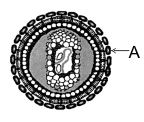
A
Lipid layer
B
Virus binding site
C
Receptor binding protein
D
Capsid
Solution
(C) The provided figure represents the structure of the $HIV$ virus. In this diagram,'$A$' points to the glycoprotein spikes (specifically gp120) on the surface of the viral envelope. These glycoproteins act as receptor-binding proteins that allow the virus to attach to the host cell's CD4 receptors. Therefore,the correct option is '$C$'.
0 likes
View Solution61
MediumMCQ
Assertion $A$: $AIDS$ is a severe,incurable,infectious,and fatal disease.
Reason $R$: $HIV$ causes deficiency of the immune system in the body.
Which option is correct for Assertion $A$ and Reason $R$?
Reason $R$: $HIV$ causes deficiency of the immune system in the body.
Which option is correct for Assertion $A$ and Reason $R$?
A
$A$ and $R$ are both true and $R$ is the correct explanation of $A$.
B
$A$ and $R$ are both true but $R$ is not the correct explanation of $A$.
C
$A$ is true and $R$ is false.
D
$A$ is false and $R$ is true.
Solution
(A) $AIDS$ (Acquired Immuno Deficiency Syndrome) is caused by the Human Immunodeficiency Virus $(HIV)$.
$HIV$ specifically targets and destroys helper $T$-lymphocytes,which are crucial components of the human immune system.
Due to the depletion of these cells,the body's immune system becomes severely compromised,leading to the development of various opportunistic infections and cancers.
Because the immune system is severely weakened,the disease is considered incurable and fatal,making $A$ a true statement.
Since the destruction of the immune system by $HIV$ is the direct biological reason why $AIDS$ is a fatal and severe condition,$R$ is the correct explanation for $A$.
$HIV$ specifically targets and destroys helper $T$-lymphocytes,which are crucial components of the human immune system.
Due to the depletion of these cells,the body's immune system becomes severely compromised,leading to the development of various opportunistic infections and cancers.
Because the immune system is severely weakened,the disease is considered incurable and fatal,making $A$ a true statement.
Since the destruction of the immune system by $HIV$ is the direct biological reason why $AIDS$ is a fatal and severe condition,$R$ is the correct explanation for $A$.
0 likes
View Solution62
EasyMCQ
The presence of $HIV$ can be detected by these methods:
$(i)$ $ELISA$
$(ii)$ $WB$ $Test$ (Western Blot)
$(iii)$ $VB$ $Test$
$(iv)$ $ALISA$
$(i)$ $ELISA$
$(ii)$ $WB$ $Test$ (Western Blot)
$(iii)$ $VB$ $Test$
$(iv)$ $ALISA$
A
$(i)$ and $(iii)$
B
$(i)$ and $(ii)$
C
$(ii)$ and $(iv)$
D
$(ii)$ and $(iii)$
Solution
(B) $HIV$ (Human Immunodeficiency Virus) is the causative agent of $AIDS$.
$1$. $ELISA$ (Enzyme-Linked Immunosorbent Assay) is the primary screening test used to detect $HIV$ antibodies in the blood.
$2$. $WB$ $Test$ (Western Blot) is a highly specific confirmatory test used to verify the presence of $HIV$ antibodies after a positive $ELISA$ result.
$3$. $VB$ $Test$ and $ALISA$ are not standard diagnostic procedures for $HIV$.
Therefore,the correct methods are $(i)$ and $(ii)$.
$1$. $ELISA$ (Enzyme-Linked Immunosorbent Assay) is the primary screening test used to detect $HIV$ antibodies in the blood.
$2$. $WB$ $Test$ (Western Blot) is a highly specific confirmatory test used to verify the presence of $HIV$ antibodies after a positive $ELISA$ result.
$3$. $VB$ $Test$ and $ALISA$ are not standard diagnostic procedures for $HIV$.
Therefore,the correct methods are $(i)$ and $(ii)$.
0 likes
View Solution63
EasyMCQ
What is a healthy person who is infected with $HIV$ called?
A
$HIV$ resistant
B
$HIV$ carrier
C
$HIV$ positive
D
$HIV$ collector
Solution
(B) An individual who is infected with $HIV$ but does not yet show symptoms of $AIDS$ is referred to as an $HIV$ carrier or an $HIV$ positive individual. In the context of the options provided,$HIV$ carrier is the most appropriate term for a person who harbors the virus and can transmit it to others while remaining asymptomatic.
0 likes
View Solution64
MediumMCQ
What is the correct sequence of events that occur after $HIV$ infection in a human body?
$(I)$ Viral $DNA$ enters the host $DNA$
$(II)$ Entry into $T_H$ lymphocytes and replication
$(III)$ Viral $RNA$ is converted into viral $DNA$ by reverse transcriptase
$(IV)$ $HIV$ enters into macrophages
$(V)$ Destruction of $T_H$ lymphocytes
$(VI)$ New virus particles are produced from the host cell
$(I)$ Viral $DNA$ enters the host $DNA$
$(II)$ Entry into $T_H$ lymphocytes and replication
$(III)$ Viral $RNA$ is converted into viral $DNA$ by reverse transcriptase
$(IV)$ $HIV$ enters into macrophages
$(V)$ Destruction of $T_H$ lymphocytes
$(VI)$ New virus particles are produced from the host cell
A
$II, III, V, IV, I, VI$
B
$IV, III, I, VI, II, V$
C
$I, III, VI, II, V, IV$
D
$II, V, IV, I, III, VI$
Solution
(B) The sequence of events in $HIV$ infection is as follows:
$1$. After entering the body,$HIV$ first enters into macrophages $(IV)$.
$2$. Inside the macrophages,the viral $RNA$ genome is replicated to form viral $DNA$ by the enzyme reverse transcriptase $(III)$.
$3$. This viral $DNA$ then gets incorporated into the host cell's $DNA$ $(I)$.
$4$. The macrophages continue to produce virus particles,acting like an $HIV$ factory $(VI)$.
$5$. Subsequently,the virus enters $T_H$ lymphocytes and replicates to produce progeny viruses $(II)$.
$6$. This leads to a progressive decrease in the number of $T_H$ lymphocytes in the body,eventually causing their destruction $(V)$.
Therefore,the correct sequence is $IV, III, I, VI, II, V$.
$1$. After entering the body,$HIV$ first enters into macrophages $(IV)$.
$2$. Inside the macrophages,the viral $RNA$ genome is replicated to form viral $DNA$ by the enzyme reverse transcriptase $(III)$.
$3$. This viral $DNA$ then gets incorporated into the host cell's $DNA$ $(I)$.
$4$. The macrophages continue to produce virus particles,acting like an $HIV$ factory $(VI)$.
$5$. Subsequently,the virus enters $T_H$ lymphocytes and replicates to produce progeny viruses $(II)$.
$6$. This leads to a progressive decrease in the number of $T_H$ lymphocytes in the body,eventually causing their destruction $(V)$.
Therefore,the correct sequence is $IV, III, I, VI, II, V$.
0 likes
View Solution65
EasyMCQ
Which of the following is $NOT$ consistent with $HIV$?
A
The viral genome replicates into viral $DNA$ in macrophages with the help of the enzyme reverse transcriptase.
B
It is responsible for $AIDS$.
C
It is a virus belonging to the retrovirus group.
D
It contains $DNA$ as its genetic material.
Solution
(D) $HIV$ (Human Immunodeficiency Virus) is a member of a group of viruses called retroviruses.
These viruses have an envelope enclosing the $RNA$ genome.
$HIV$ does not contain $DNA$ as its genetic material; instead,it contains $RNA$.
Upon infection,the viral $RNA$ is converted into viral $DNA$ by the enzyme reverse transcriptase,which then incorporates into the host cell's $DNA$ to direct the synthesis of new viral particles.
Therefore,the statement that it contains $DNA$ as its genetic material is incorrect.
These viruses have an envelope enclosing the $RNA$ genome.
$HIV$ does not contain $DNA$ as its genetic material; instead,it contains $RNA$.
Upon infection,the viral $RNA$ is converted into viral $DNA$ by the enzyme reverse transcriptase,which then incorporates into the host cell's $DNA$ to direct the synthesis of new viral particles.
Therefore,the statement that it contains $DNA$ as its genetic material is incorrect.
0 likes
View Solution66
EasyMCQ
What is the full form of $HIV$?
A
Human Immunodefence Virus
B
Human Immunological Virus
C
Human Immunodeficiency Virus
D
Homologous Immunological Virus
Solution
(C) $HIV$ stands for $Human$ $Immunodeficiency$ $Virus$.
It is the retrovirus that causes $AIDS$ ($Acquired$ $Immuno$ $Deficiency$ $Syndrome$).
This virus attacks the $CD4+$ $T$-helper cells of the human immune system,leading to a progressive decline in immune function.
It is the retrovirus that causes $AIDS$ ($Acquired$ $Immuno$ $Deficiency$ $Syndrome$).
This virus attacks the $CD4+$ $T$-helper cells of the human immune system,leading to a progressive decline in immune function.
0 likes
View Solution67
MediumMCQ
Which of the following is a virus belonging to the retrovirus group?
A
$HIV$
B
Hepatitis
C
Influenza
D
Adeno
Solution
(A) The $HIV$ (Human Immunodeficiency Virus) belongs to the group of viruses known as retroviruses.
Retroviruses are characterized by the presence of an $RNA$ genome that is reverse-transcribed into $DNA$ inside the host cell using the enzyme reverse transcriptase.
$HIV$ specifically targets $CD4+$ $T$-helper cells,leading to the progressive failure of the immune system,a condition known as $AIDS$ (Acquired Immuno Deficiency Syndrome).
Retroviruses are characterized by the presence of an $RNA$ genome that is reverse-transcribed into $DNA$ inside the host cell using the enzyme reverse transcriptase.
$HIV$ specifically targets $CD4+$ $T$-helper cells,leading to the progressive failure of the immune system,a condition known as $AIDS$ (Acquired Immuno Deficiency Syndrome).
0 likes
View Solution68
EasyMCQ
The $HIV$ virus attacks which cells of the immune system?
A
Helper $T$-lymphocytes
B
Macrophages
C
Monocytes
D
Erythrocytes
Solution
(A) The $HIV$ (Human Immunodeficiency Virus) primarily targets and enters helper $T$-lymphocytes ($CD4^+$ cells).
Once inside,the virus uses the cell's machinery to replicate,eventually leading to the destruction of these cells.
This depletion of helper $T$-cells severely weakens the immune system,making the body susceptible to opportunistic infections.
While $HIV$ can also infect macrophages,the primary and most significant impact on the immune system's function is the destruction of helper $T$-lymphocytes.
Once inside,the virus uses the cell's machinery to replicate,eventually leading to the destruction of these cells.
This depletion of helper $T$-cells severely weakens the immune system,making the body susceptible to opportunistic infections.
While $HIV$ can also infect macrophages,the primary and most significant impact on the immune system's function is the destruction of helper $T$-lymphocytes.
0 likes
View Solution69
MediumMCQ
$HIV$ virus affects which of the following cells in the human body?
$(i)$ $T_H$ cells
$(ii)$ $T_1$ cells
$(iii)$ Mast cells
$(iv)$ Macrophages
$(i)$ $T_H$ cells
$(ii)$ $T_1$ cells
$(iii)$ Mast cells
$(iv)$ Macrophages
A
$(i)$ and $(iv)$
B
$(i)$ and $(iii)$
C
$(ii)$ and $(iii)$
D
$(ii)$ and $(iv)$
Solution
(A) The $HIV$ (Human Immunodeficiency Virus) primarily targets the immune system of the human body.
Upon entering the body,the virus first infects macrophages,which act as a reservoir for the virus.
Subsequently,the virus enters $T_H$ cells (Helper $T$-cells),where it replicates and produces progeny viruses.
This leads to a progressive decrease in the number of $T_H$ cells in the body,severely weakening the immune system.
Therefore,the correct cells affected are $T_H$ cells $(i)$ and macrophages $(iv)$.
Upon entering the body,the virus first infects macrophages,which act as a reservoir for the virus.
Subsequently,the virus enters $T_H$ cells (Helper $T$-cells),where it replicates and produces progeny viruses.
This leads to a progressive decrease in the number of $T_H$ cells in the body,severely weakening the immune system.
Therefore,the correct cells affected are $T_H$ cells $(i)$ and macrophages $(iv)$.
0 likes
View Solution70
EasyMCQ
In India,the $HIV$ virus was first reported in:
A
Tamil Nadu
B
Kerala
C
Andhra Pradesh
D
Karnataka
Solution
(A) The first case of $HIV$ infection in India was reported in $1986$ among commercial sex workers in Chennai,Tamil Nadu. Since then,the virus has spread across various parts of the country.
0 likes
View Solution71
EasyMCQ
What is the full form of $AIDS$?
A
Acquired Immunodeficiency Syndrome
B
Auto Immunodeficiency Syndrome
C
At born Immunodeficiency Syndrome
D
Acquired Immunodefense System
Solution
(A) $AIDS$ stands for $Acquired$ $Immunodeficiency$ $Syndrome$.
It is a chronic,potentially life-threatening condition caused by the $Human$ $Immunodeficiency$ $Virus$ $(HIV)$.
$Acquired$ means it is not inherited but acquired during a person's lifetime.
$Immunodeficiency$ refers to the weakening of the immune system.
$Syndrome$ refers to a group of symptoms that occur together.
It is a chronic,potentially life-threatening condition caused by the $Human$ $Immunodeficiency$ $Virus$ $(HIV)$.
$Acquired$ means it is not inherited but acquired during a person's lifetime.
$Immunodeficiency$ refers to the weakening of the immune system.
$Syndrome$ refers to a group of symptoms that occur together.
0 likes
View Solution72
EasyMCQ
The spread of $AIDS$ occurs through.........
A
Handshaking.
B
Blood transfusion.
C
Transfusion of $HIV$-infected blood.
D
All of the above.
Solution
(C) $AIDS$ (Acquired Immuno Deficiency Syndrome) is a disease caused by the $HIV$ (Human Immunodeficiency Virus).
$AIDS$ spreads primarily through the following modes:
$1$. Unprotected sexual contact with an infected person.
$2$. Transfusion of $HIV$-contaminated blood or blood products.
$3$. Sharing of infected needles or syringes.
$4$. From an infected mother to the fetus through the placenta.
$AIDS$ does not spread through handshaking or casual social contact. Therefore,among the given options,the transfusion of $HIV$-infected blood is the most accurate answer.
$AIDS$ spreads primarily through the following modes:
$1$. Unprotected sexual contact with an infected person.
$2$. Transfusion of $HIV$-contaminated blood or blood products.
$3$. Sharing of infected needles or syringes.
$4$. From an infected mother to the fetus through the placenta.
$AIDS$ does not spread through handshaking or casual social contact. Therefore,among the given options,the transfusion of $HIV$-infected blood is the most accurate answer.
0 likes
View Solution73
EasyMCQ
$HIV$ causes a reduction in which of the following?
A
Helper $T$-cells only
B
Both $B$ and $T$-cells
C
All $T$-cells
D
$B$-cells only
Solution
(A) $HIV$ (Human Immunodeficiency Virus) primarily targets and infects helper $T$-lymphocytes (also known as $CD4^+$ $T$-cells).
Upon entering the body,the virus replicates inside these helper $T$-cells,leading to their progressive destruction.
As the number of helper $T$-cells decreases,the immune system becomes severely compromised,making the body susceptible to opportunistic infections.
Therefore,$HIV$ specifically causes a reduction in helper $T$-cells.
Upon entering the body,the virus replicates inside these helper $T$-cells,leading to their progressive destruction.
As the number of helper $T$-cells decreases,the immune system becomes severely compromised,making the body susceptible to opportunistic infections.
Therefore,$HIV$ specifically causes a reduction in helper $T$-cells.
0 likes
View Solution74
EasyMCQ
What happens when the number of $HIV$ increases in the blood?
A
The number of red blood cells decreases.
B
The number of $T_H$ cells decreases.
C
The number of killer-$T$ cells decreases.
D
The number of basophils decreases.
Solution
(B) $HIV$ (Human Immunodeficiency Virus) specifically targets and infects $T_H$ cells (Helper $T$-lymphocytes).
As the virus replicates within these cells,it leads to their destruction.
Consequently,the count of $T_H$ cells in the blood progressively decreases,which severely weakens the body's immune system,leading to the condition known as $AIDS$.
As the virus replicates within these cells,it leads to their destruction.
Consequently,the count of $T_H$ cells in the blood progressively decreases,which severely weakens the body's immune system,leading to the condition known as $AIDS$.
0 likes
View Solution75
MediumMCQ
In an $HIV$ infected person,the $HIV$ produced in macrophages enters which cells to replicate and produce its progeny?
A
Natural $T$ lymphocytes
B
Suppressor $T$ lymphocytes
C
Helper $T$ lymphocytes
D
$B$ lymphocytes
Solution
(C) After entering the body of the person,the $HIV$ virus enters into macrophages where $RNA$ genome of the virus replicates to form viral $DNA$ with the help of the enzyme reverse transcriptase.
This viral $DNA$ gets incorporated into the host cell's $DNA$ and directs the infected cells to produce virus particles.
The macrophages continue to produce virus and in this way acts like an $HIV$ factory.
Simultaneously,$HIV$ enters into helper $T$ lymphocytes ($T_H$ cells),replicates and produces progeny viruses.
The progeny viruses released in the blood attack other helper $T$ lymphocytes.
This leads to a progressive decrease in the number of helper $T$ lymphocytes in the body of the infected person.
This viral $DNA$ gets incorporated into the host cell's $DNA$ and directs the infected cells to produce virus particles.
The macrophages continue to produce virus and in this way acts like an $HIV$ factory.
Simultaneously,$HIV$ enters into helper $T$ lymphocytes ($T_H$ cells),replicates and produces progeny viruses.
The progeny viruses released in the blood attack other helper $T$ lymphocytes.
This leads to a progressive decrease in the number of helper $T$ lymphocytes in the body of the infected person.
0 likes
View Solution76
EasyMCQ
The cause of $AIDS$ is ..........
A
Destruction of helper $T$-lymphocytes
B
Autoimmunity
C
Destruction of killer $T$-cells
D
Decrease in interferons
Solution
(A) $AIDS$ (Acquired Immuno Deficiency Syndrome) is caused by the Human Immunodeficiency Virus $(HIV)$.
$HIV$ specifically targets and infects helper $T$-lymphocytes ($CD4^+$ cells).
As the virus replicates within these cells,it leads to the destruction of helper $T$-lymphocytes.
Since helper $T$-cells are crucial for coordinating the immune response,their depletion results in a severely compromised immune system,making the body susceptible to opportunistic infections.
$HIV$ specifically targets and infects helper $T$-lymphocytes ($CD4^+$ cells).
As the virus replicates within these cells,it leads to the destruction of helper $T$-lymphocytes.
Since helper $T$-cells are crucial for coordinating the immune response,their depletion results in a severely compromised immune system,making the body susceptible to opportunistic infections.
0 likes
View Solution77
EasyMCQ
Which of the following is a severe,incurable,infectious,and fatal disease?
A
Cancer
B
Typhoid
C
$AIDS$
D
Malaria
Solution
(C) $AIDS$ (Acquired Immuno Deficiency Syndrome) is caused by the Human Immunodeficiency Virus $(HIV)$.
It is a severe,incurable,infectious,and fatal disease that weakens the immune system by destroying $CD4+$ $T$-helper cells.
While cancer is severe and can be fatal,it is not infectious.
Typhoid and malaria are infectious but are curable with appropriate medical treatment.
It is a severe,incurable,infectious,and fatal disease that weakens the immune system by destroying $CD4+$ $T$-helper cells.
While cancer is severe and can be fatal,it is not infectious.
Typhoid and malaria are infectious but are curable with appropriate medical treatment.
0 likes
View Solution78
EasyMCQ
What is the full form of $AIDS$?
A
Acquired Immunodeficiency Syndrome
B
Acquired Immuno Syndrome
C
Acquired Immunodeficiency
D
Age Immune Deficiency Syndrome
Solution
(A) $AIDS$ stands for Acquired Immunodeficiency Syndrome.
It is a chronic, potentially life-threatening condition caused by the Human Immunodeficiency Virus $(HIV)$.
$HIV$ damages the immune system, interfering with the body's ability to fight infection and disease.
It is a chronic, potentially life-threatening condition caused by the Human Immunodeficiency Virus $(HIV)$.
$HIV$ damages the immune system, interfering with the body's ability to fight infection and disease.
0 likes
View Solution79
EasyMCQ
In which country was $AIDS$ first reported?
A
$USA$
B
India
C
China
D
Pakistan
Solution
(A) $AIDS$ (Acquired Immuno Deficiency Syndrome) was first reported in the $USA$ in the year $1981$. Since then,it has spread globally,becoming a major public health challenge.
0 likes
View Solution80
EasyMCQ
Approximately how many people have died worldwide due to $AIDS$ since its first report?
A
$25$ Lakhs
B
$50$ Million
C
$25$ Million
D
$100$ Million
Solution
(C) According to the $NCERT$ textbook for Class $12$ Biology (Chapter: Human Health and Disease),since the first report of $AIDS$ in $1981$,it has killed more than $25$ million people worldwide. Therefore,the correct option is $C$.
0 likes
View Solution81
EasyMCQ
In which state of India was the first case of $AIDS$ infection reported?
A
Maharashtra
B
Gujarat
C
Karnataka
D
Tamil Nadu
Solution
(D) The first case of $AIDS$ ($Acquired$ $Immuno$ $Deficiency$ $Syndrome$) in India was reported in the year $1986$ in the state of Tamil Nadu. It was identified among female sex workers in Chennai.
0 likes
View Solution82
EasyMCQ
In which year was the first case of $AIDS$ infection reported in India?
A
$1986$
B
$1981$
C
$1980$
D
$1984$
Solution
(A) The first case of $AIDS$ (Acquired Immuno Deficiency Syndrome) in India was reported in $1986$.
$AIDS$ is caused by the Human Immunodeficiency Virus $(HIV)$,
which attacks the body's immune system,specifically the $CD4$ positive $T$-helper cells.
Since its first detection in India,the government has taken various measures to control its spread through awareness programs and screening.
$AIDS$ is caused by the Human Immunodeficiency Virus $(HIV)$,
which attacks the body's immune system,specifically the $CD4$ positive $T$-helper cells.
Since its first detection in India,the government has taken various measures to control its spread through awareness programs and screening.
0 likes
View Solution83
EasyMCQ
Which disease is caused by a retrovirus?
A
Common cold
B
$AIDS$
C
Cancer
D
Malaria
Solution
(B) The causative agent of $AIDS$ (Acquired Immuno Deficiency Syndrome) is the Human Immunodeficiency Virus $(HIV)$. $HIV$ belongs to a group of viruses called retroviruses,which have an $RNA$ genome enclosed within a protein envelope. These viruses use the enzyme reverse transcriptase to convert their $RNA$ into $DNA$,which then integrates into the host cell's genome.
0 likes
View Solution84
EasyMCQ
What is the full form of $HIV$?
A
Human Individual Virus
B
Human Immunodeficiency Virus
C
Human Retrovirus
D
Human $AIDS$ Related Virus
Solution
(B) $HIV$ stands for Human Immunodeficiency Virus.
It is a retrovirus that attacks the human immune system,specifically targeting $CD4+$ $T$-helper cells.
Over time,the destruction of these cells leads to Acquired Immunodeficiency Syndrome $(AIDS)$.
It is a retrovirus that attacks the human immune system,specifically targeting $CD4+$ $T$-helper cells.
Over time,the destruction of these cells leads to Acquired Immunodeficiency Syndrome $(AIDS)$.
0 likes
View Solution85
EasyMCQ
After entering the body,which cell does $HIV$ primarily infect?
A
Macrophages
B
Red blood cells
C
Hepatocytes
D
Gastric cells
Solution
(A) After entering the human body,the $HIV$ virus first enters macrophages,where it replicates and produces viral progeny. These macrophages act as an $HIV$ factory. Subsequently,the virus enters helper $T$-lymphocytes ($T_H$ cells) in the blood,where it continues to replicate and produce viral progeny. This leads to a progressive decrease in the number of helper $T$-lymphocytes in the infected person's body.
0 likes
View Solution86
MediumMCQ
In macrophages,the viral genome replicates into $DNA$ with the help of which enzyme?
A
$RNA$ polymerase
B
$DNA$ polymerase-$III$
C
Transcriptase
D
Reverse transcriptase
Solution
(D) The question refers to the replication cycle of retroviruses (like $HIV$) within host cells such as macrophages.
Upon entering the macrophage,the viral $RNA$ genome is converted into $DNA$ by the enzyme $Reverse$ $transcriptase$.
This $DNA$ then incorporates into the host genome to direct the synthesis of new viral particles.
Therefore,the correct enzyme is $Reverse$ $transcriptase$.
Upon entering the macrophage,the viral $RNA$ genome is converted into $DNA$ by the enzyme $Reverse$ $transcriptase$.
This $DNA$ then incorporates into the host genome to direct the synthesis of new viral particles.
Therefore,the correct enzyme is $Reverse$ $transcriptase$.
0 likes
View Solution87
EasyMCQ
Which of the following is considered the factory for $HIV$?
A
Liver
B
Red blood cells
C
Macrophages
D
$T$-cells
Solution
(C) After entering the human body,the $HIV$ virus enters into macrophages.
In the macrophages,the $RNA$ genome of the virus replicates to form viral $DNA$ with the help of the enzyme reverse transcriptase.
These macrophages continue to produce virus particles and thus act like an $HIV$ factory.
Therefore,macrophages are known as the factory for $HIV$.
In the macrophages,the $RNA$ genome of the virus replicates to form viral $DNA$ with the help of the enzyme reverse transcriptase.
These macrophages continue to produce virus particles and thus act like an $HIV$ factory.
Therefore,macrophages are known as the factory for $HIV$.
0 likes
View Solution88
MediumMCQ
In which cells does $HIV$ enter,replicate,and produce progeny viruses?
A
Helper $T$-cells
B
Suppressor $T$-cells
C
$B$-cells
D
Macrophages
Solution
(A) After entering the human body,the $HIV$ virus enters into macrophages where $RNA$ genome of the virus replicates to form viral $DNA$ with the help of the enzyme reverse transcriptase.
This viral $DNA$ gets incorporated into the host cell's $DNA$ and directs the infected cells to produce virus particles.
The macrophages continue to produce virus and in this way act like an $HIV$ factory.
Simultaneously,$HIV$ enters into helper $T$-lymphocytes ($T_H$ cells),replicates,and produces progeny viruses.
The progeny viruses released in the blood attack other helper $T$-lymphocytes.
This leads to a progressive decrease in the number of helper $T$-lymphocytes in the body of the infected person.
This viral $DNA$ gets incorporated into the host cell's $DNA$ and directs the infected cells to produce virus particles.
The macrophages continue to produce virus and in this way act like an $HIV$ factory.
Simultaneously,$HIV$ enters into helper $T$-lymphocytes ($T_H$ cells),replicates,and produces progeny viruses.
The progeny viruses released in the blood attack other helper $T$-lymphocytes.
This leads to a progressive decrease in the number of helper $T$-lymphocytes in the body of the infected person.
0 likes
View Solution89
EasyMCQ
After being released into the blood,$HIV$ attacks which cells?
A
Red blood cells
B
Helper $T$-lymphocytes
C
Suppressor $T$-cells
D
$B$-cells
Solution
(B) After entering the human body,the $HIV$ virus enters macrophages where $RNA$ genome of the virus replicates to form viral $DNA$ with the help of the enzyme reverse transcriptase.
Macrophages continue to produce virus particles and thus act like an $HIV$ factory.
Simultaneously,$HIV$ enters helper $T$-lymphocytes ($T_H$ cells),replicates,and produces progeny viruses.
The progeny viruses released in the blood attack other helper $T$-lymphocytes.
This leads to a progressive decrease in the number of helper $T$-lymphocytes in the body of the infected person.
Macrophages continue to produce virus particles and thus act like an $HIV$ factory.
Simultaneously,$HIV$ enters helper $T$-lymphocytes ($T_H$ cells),replicates,and produces progeny viruses.
The progeny viruses released in the blood attack other helper $T$-lymphocytes.
This leads to a progressive decrease in the number of helper $T$-lymphocytes in the body of the infected person.
0 likes
View Solution90
MediumMCQ
Which of the following effects is observed in an individual infected with $HIV$?
A
Decrease in the number of $T$-lymphocytes
B
Prolonged fever
C
Weight loss
D
All of the above
Solution
(D) $HIV$ (Human Immunodeficiency Virus) primarily targets and infects $T$-helper lymphocytes ($CD4^+$ cells).
As the virus replicates within these cells,it leads to their destruction,causing a significant decrease in the number of $T$-lymphocytes.
This depletion of the immune system makes the body susceptible to various infections,leading to symptoms such as persistent fever,significant weight loss,and chronic diarrhea.
Therefore,all the listed effects are characteristic of an $HIV$ infection.
As the virus replicates within these cells,it leads to their destruction,causing a significant decrease in the number of $T$-lymphocytes.
This depletion of the immune system makes the body susceptible to various infections,leading to symptoms such as persistent fever,significant weight loss,and chronic diarrhea.
Therefore,all the listed effects are characteristic of an $HIV$ infection.
0 likes
View Solution91
EasyMCQ
How is $AIDS$ transmitted?
A
Through sexual contact with an $AIDS$ patient
B
Through transfusion of $HIV$-contaminated blood
C
Through transplantation of infected organs
D
All of the above
Solution
(D) $AIDS$ (Acquired Immuno Deficiency Syndrome) is caused by the $HIV$ virus. It is transmitted through the following ways:
$1$. Sexual contact with an infected person.
$2$. Transfusion of $HIV$-contaminated blood and blood products.
$3$. Sharing of infected needles or syringes.
$4$. From an infected mother to her child through the placenta.
$5$. Transplantation of infected organs.
Therefore,all the given options are correct modes of transmission.
$1$. Sexual contact with an infected person.
$2$. Transfusion of $HIV$-contaminated blood and blood products.
$3$. Sharing of infected needles or syringes.
$4$. From an infected mother to her child through the placenta.
$5$. Transplantation of infected organs.
Therefore,all the given options are correct modes of transmission.
0 likes
View Solution92
EasyMCQ
Which of the following is $NOT$ a mode of transmission for $AIDS$?
A
Sharing of used syringes or needles
B
Physical contact or sharing of clothes,utensils,etc.,with an infected person
C
Blood transfusion
D
Organ transplantation
Solution
(B) $AIDS$ is caused by the Human Immunodeficiency Virus $(HIV)$.
It is transmitted through the exchange of body fluids,specifically blood,semen,vaginal secretions,and breast milk.
$1$. Sharing of used syringes or needles,blood transfusion,and organ transplantation are known modes of transmission because they involve the direct transfer of infected blood or body fluids.
$2$. $AIDS$ does $NOT$ spread through casual physical contact,such as shaking hands,hugging,or sharing clothes,utensils,food,or living spaces with an infected person.
Therefore,option $B$ is the correct answer.
It is transmitted through the exchange of body fluids,specifically blood,semen,vaginal secretions,and breast milk.
$1$. Sharing of used syringes or needles,blood transfusion,and organ transplantation are known modes of transmission because they involve the direct transfer of infected blood or body fluids.
$2$. $AIDS$ does $NOT$ spread through casual physical contact,such as shaking hands,hugging,or sharing clothes,utensils,food,or living spaces with an infected person.
Therefore,option $B$ is the correct answer.
0 likes
View Solution93
MediumMCQ
Into how many categories can individuals infected with $HIV$ be classified?
A
$2$
B
$3$
C
$4$
D
$5$
Solution
(B) Individuals infected with $HIV$ are generally classified into $3$ clinical categories based on the progression of the disease and the $CD4+$ $T$-lymphocyte count:
$1$. Category $A$: Asymptomatic $HIV$ infection or persistent generalized lymphadenopathy.
$2$. Category $B$: Symptomatic conditions that are not included in category $C$ but are attributed to $HIV$ infection or indicate a defect in cell-mediated immunity.
$3$. Category $C$: $AIDS$-indicator conditions (severe immunosuppression).
$1$. Category $A$: Asymptomatic $HIV$ infection or persistent generalized lymphadenopathy.
$2$. Category $B$: Symptomatic conditions that are not included in category $C$ but are attributed to $HIV$ infection or indicate a defect in cell-mediated immunity.
$3$. Category $C$: $AIDS$-indicator conditions (severe immunosuppression).
0 likes
View Solution94
MediumMCQ
Which of the following symptoms is $NOT$ observed in $ARC$ ($AIDS$-Related Complex)?
A
Bloody diarrhea
B
Loss of appetite
C
Skin rashes
D
Significant weight loss
Solution
(A) $ARC$ ($AIDS$-Related Complex) refers to a clinical state that precedes the development of full-blown $AIDS$. Symptoms of $ARC$ typically include persistent fever,night sweats,chronic diarrhea,significant weight loss (often called wasting syndrome),and fatigue. Bloody diarrhea is generally associated with specific opportunistic infections (like amoebiasis or severe bacterial dysentery) rather than being a primary diagnostic symptom of $ARC$ itself. Therefore,bloody diarrhea is not considered a characteristic symptom of $ARC$.
0 likes
View Solution95
EasyMCQ
What does $ARC$ stand for in the context of $AIDS$?
A
$AIDS$-related complex
B
Advanced recovery condition
C
Acute respiratory condition
D
None of the above
Solution
(A) In the context of $AIDS$ (Acquired Immuno Deficiency Syndrome),$ARC$ stands for $AIDS$-related complex.
It refers to a condition where a patient exhibits symptoms of $HIV$ infection that are not severe enough to be classified as full-blown $AIDS$ but are more advanced than the initial asymptomatic stage.
These symptoms may include fever,weight loss,fatigue,and lymphadenopathy.
It refers to a condition where a patient exhibits symptoms of $HIV$ infection that are not severe enough to be classified as full-blown $AIDS$ but are more advanced than the initial asymptomatic stage.
These symptoms may include fever,weight loss,fatigue,and lymphadenopathy.
0 likes
View Solution96
EasyMCQ
What is the full form of $ARC$?
A
$AIDS$ Research Center
B
$AIDS$ Related Complex
C
$AIDS$ Related Corporation
D
$AIDS$ Retrovirus Complex
Solution
(B) $ARC$ stands for $AIDS$ Related Complex. It is a clinical condition that occurs in individuals infected with $HIV$ (Human Immunodeficiency Virus) before the progression to full-blown $AIDS$ (Acquired Immunodeficiency Syndrome). It is characterized by symptoms such as fever,weight loss,lymphadenopathy,and fatigue.
0 likes
View Solution97
MediumMCQ
Which of the following is a symptom of full-blown $AIDS$?
A
The individual appears healthy despite having $HIV$.
B
Fever and malaise persist for about four weeks.
C
Development of Kaposi's sarcoma (cancer of skin blood vessels).
D
Widespread rashes caused by persistent itching.
Solution
(C) Full-blown $AIDS$ (Acquired Immuno Deficiency Syndrome) occurs when the $HIV$ virus severely damages the immune system,specifically by depleting $CD4^+$ $T$-helper cells.
As the immune system weakens,the body becomes susceptible to opportunistic infections and specific cancers.
Kaposi's sarcoma,which is a cancer of the blood vessels in the skin,is a characteristic clinical manifestation of advanced or full-blown $AIDS$.
Options $A$ and $B$ describe early stages or initial infection symptoms,while $D$ is not a specific diagnostic symptom of full-blown $AIDS$.
As the immune system weakens,the body becomes susceptible to opportunistic infections and specific cancers.
Kaposi's sarcoma,which is a cancer of the blood vessels in the skin,is a characteristic clinical manifestation of advanced or full-blown $AIDS$.
Options $A$ and $B$ describe early stages or initial infection symptoms,while $D$ is not a specific diagnostic symptom of full-blown $AIDS$.
0 likes
View Solution98
EasyMCQ
Which of the following statements is $NOT$ correct for $AIDS$?
A
There is no vaccine for $AIDS$.
B
Interferons are used for its treatment.
C
$AIDS$ is a completely incurable disease.
D
$AIDS$ is a fatal disease.
Solution
(B) $AIDS$ $(Acquired \text{ } Immuno \text{ } Deficiency \text{ } Syndrome)$ is caused by the $HIV$ $(Human \text{ } Immunodeficiency \text{ } Virus)$.
Currently,there is no vaccine available for $AIDS$,making statement $A$ correct.
$AIDS$ is a fatal disease and is considered completely incurable,making statements $C$ and $D$ correct.
Interferons are proteins produced by the body to fight viral infections,but they are not used for the treatment of $AIDS$. Antiretroviral drugs are used to manage $AIDS$. Therefore,statement $B$ is not correct for $AIDS$.
Currently,there is no vaccine available for $AIDS$,making statement $A$ correct.
$AIDS$ is a fatal disease and is considered completely incurable,making statements $C$ and $D$ correct.
Interferons are proteins produced by the body to fight viral infections,but they are not used for the treatment of $AIDS$. Antiretroviral drugs are used to manage $AIDS$. Therefore,statement $B$ is not correct for $AIDS$.
0 likes
View Solution99
EasyMCQ
Which of the following organizations is working to create awareness about $AIDS$ among people?
A
$NACO$
B
$NGOs$
C
$WHO$
D
All of the above
Solution
(D) $NACO$ (National $AIDS$ Control Organization) is a government organization in India that works to control the spread of $AIDS$ and create public awareness.
$NGOs$ (Non-Governmental Organizations) also play a significant role in educating the public and providing support to $AIDS$ patients.
$WHO$ (World Health Organization) is an international body that sets global standards and guidelines for $AIDS$ prevention and control.
Therefore,all these organizations are involved in creating awareness about $AIDS$.
$NGOs$ (Non-Governmental Organizations) also play a significant role in educating the public and providing support to $AIDS$ patients.
$WHO$ (World Health Organization) is an international body that sets global standards and guidelines for $AIDS$ prevention and control.
Therefore,all these organizations are involved in creating awareness about $AIDS$.
0 likes
View Solution100
EasyMCQ
What is the full form of $NACO$?
A
National $AIDS$ Control Organization
B
National $AIDS$ Confirmation Organization
C
Non-$AIDS$ Corporation Organization
D
National $AIDS$ Center Organization
Solution
(A) $NACO$ stands for National $AIDS$ Control Organization. It is a division of the Ministry of Health and Family Welfare that provides leadership to the $HIV$/$AIDS$ control programme in India through $35$ $HIV$/$AIDS$ Prevention and Control Societies.
0 likes
View SolutionHuman Health and Disease — AIDS · Frequently Asked Questions
1Are these Human Health and Disease questions useful for JEE and NEET?
Yes. All questions in this section are mapped to JEE Main and NEET exam patterns. Previous year questions from JEE Main, NEET, GUJCET and state-level exams are included with full solutions.
2Can I switch to Hindi or Gujarati for these questions?
Yes. Use the language tabs in the hero section or the sidebar to view the same questions and solutions in English, Hindi or Gujarati.
3How do I generate a question paper from this subtopic?
Use the Vedclass Exam Paper Generator — select the chapter and subtopic, set difficulty, and generate Sets A, B, C, D automatically. First 3 chapters of every subject are free.
Vedclass Products
For Students
Vedclass Test Series
Mock tests in real JEE/NEET style with performance analysis. 5-day free trial.
Start Free TrialFor Teachers
Exam Paper Generator
Generate Set A/B/C/D papers from this chapter in 2 minutes. 3 chapters free.
Try FreeFor Institutes
Online Exam Module
Live online exams with unlimited students, 360° analytics & white-label branding.
See DemoFor Teachers & Institutes
Generate a Human Health and Disease Exam Paper in 2 Minutes
Select subtopic & difficulty — Sets A, B, C, D auto-generated with No Repeat logic.
First 3 chapters of every subject are free — no payment required.