
A English
AIDS Questions in English
Class 12 Biology · Human Health and Disease · AIDS
220+
Questions
English
Language
100%
With Solutions
Showing 50 of 220 questions in English
151
Easy
The immune system of a person is suppressed. In the $\text{ELISA}$ test,he was found positive to a pathogen.
$(a)$ Name the disease the patient is suffering from.
$(b)$ What is the causative organism?
$(c)$ Which cells of the body are affected by the pathogen?
$(a)$ Name the disease the patient is suffering from.
$(b)$ What is the causative organism?
$(c)$ Which cells of the body are affected by the pathogen?
Solution
(N/A) The patient is suffering from Acquired Immuno Deficiency Syndrome $(AIDS)$.
$(b)$ The causative agent is Human Immuno deficiency Virus $(HIV)$.
$(c)$ The pathogen specifically targets and affects Helper $T$-lymphocytes ($TH$ or $T4$ cells).
$(b)$ The causative agent is Human Immuno deficiency Virus $(HIV)$.
$(c)$ The pathogen specifically targets and affects Helper $T$-lymphocytes ($TH$ or $T4$ cells).
0 likes
View Solution152
Medium
If a patient is advised Anti Retroviral Therapy,which infection is he suffering from? Name the causative organism.
Solution
(N/A) The patient is suffering from $AIDS$ (Acquired Immuno Deficiency Syndrome).
Anti Retroviral Therapy $(ART)$ is specifically used to manage $HIV$ infections.
The causative organism for $AIDS$ is $HIV$ (Human Immunodeficiency Virus).
Anti Retroviral Therapy $(ART)$ is specifically used to manage $HIV$ infections.
The causative organism for $AIDS$ is $HIV$ (Human Immunodeficiency Virus).
0 likes
View Solution153
Medium
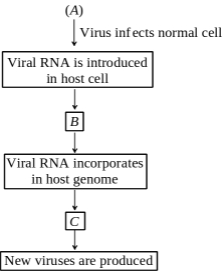
In the given flow diagram,the replication of a retrovirus in a host is shown. Observe and answer the following questions.
$(a)$ Fill in $(A)$ and $(B)$.
$(b)$ Why is the virus called a retrovirus?
$(c)$ Can the infected cell survive while viruses are being replicated and released?
$(a)$ Fill in $(A)$ and $(B)$.
$(b)$ Why is the virus called a retrovirus?
$(c)$ Can the infected cell survive while viruses are being replicated and released?
.jpg)
Solution
(N/A) : Viral $DNA$ is produced by reverse transcriptase.
$(B)$: New viral $RNA$ is produced by the infected cell.
$(b)$ $A$ virus is called a retrovirus because it possesses the enzyme reverse transcriptase,which allows it to synthesize $DNA$ from an $RNA$ template through a process known as reverse transcription.
$(c)$ Yes,the infected cell can continue to survive and function while the viruses are being replicated and released from it.
$(B)$: New viral $RNA$ is produced by the infected cell.
$(b)$ $A$ virus is called a retrovirus because it possesses the enzyme reverse transcriptase,which allows it to synthesize $DNA$ from an $RNA$ template through a process known as reverse transcription.
$(c)$ Yes,the infected cell can continue to survive and function while the viruses are being replicated and released from it.
0 likes
View Solution154
Easy
What are the full forms of $PMNL$ and $ARC$?
Solution
(N/A) $PMNL$ stands for Polymorphonuclear Leukocytes,which are a type of white blood cell characterized by a multi-lobed nucleus.
$ARC$ stands for $AIDS$-Related Complex,which refers to a clinical condition that is less severe than full-blown $AIDS$ but involves symptoms related to $HIV$ infection.
$ARC$ stands for $AIDS$-Related Complex,which refers to a clinical condition that is less severe than full-blown $AIDS$ but involves symptoms related to $HIV$ infection.
0 likes
View Solution155
MediumMCQ
Which virus undergoes rapid mutation?
A
$\phi \times 174$
B
$\lambda -$ phage
C
$HIV$ virus
D
$M-13$ phage
Solution
(C) The $HIV$ (Human Immunodeficiency Virus) is a retrovirus that contains $RNA$ as its genetic material.
Retroviruses possess the enzyme reverse transcriptase,which is highly error-prone during the process of reverse transcription.
This lack of proofreading activity leads to a very high rate of mutation,allowing the virus to evolve rapidly and evade the host's immune system.
Therefore,$HIV$ is known for its rapid mutation rate compared to the other options listed.
Retroviruses possess the enzyme reverse transcriptase,which is highly error-prone during the process of reverse transcription.
This lack of proofreading activity leads to a very high rate of mutation,allowing the virus to evolve rapidly and evade the host's immune system.
Therefore,$HIV$ is known for its rapid mutation rate compared to the other options listed.
0 likes
View Solution156
MediumMCQ
$AIDS$ is caused by which type of virus?
A
Reo virus
B
Retrovirus
C
$HBV$ virus
D
Both $A$ and $B$
Solution
(B) $AIDS$ (Acquired Immuno Deficiency Syndrome) is caused by the Human Immunodeficiency Virus $(HIV)$.
$HIV$ belongs to a group of viruses called Retroviruses.
Retroviruses are characterized by having an $RNA$ genome that is reverse-transcribed into $DNA$ inside the host cell using the enzyme reverse transcriptase.
$HIV$ belongs to a group of viruses called Retroviruses.
Retroviruses are characterized by having an $RNA$ genome that is reverse-transcribed into $DNA$ inside the host cell using the enzyme reverse transcriptase.
0 likes
View Solution157
MediumMCQ
What is the full form of $AIDS$?
A
Active Innate Deficiency Syndrome
B
Acute Immuno Deficiency Syndrome
C
Acquired Immuno Deficiency Syndrome
D
Active Immuno Deamination Syndrome
Solution
(C) $AIDS$ stands for $Acquired \text{ } Immuno \text{ } Deficiency \text{ } Syndrome$.
It is a chronic, potentially life-threatening condition caused by the $Human \text{ } Immunodeficiency \text{ } Virus$ $(HIV)$.
$HIV$ damages the immune system by destroying $CD4$ cells, which are crucial for fighting off infections and diseases.
It is a chronic, potentially life-threatening condition caused by the $Human \text{ } Immunodeficiency \text{ } Virus$ $(HIV)$.
$HIV$ damages the immune system by destroying $CD4$ cells, which are crucial for fighting off infections and diseases.
0 likes
View Solution158
MediumMCQ
Which of the following diseases is not congenital?
A
Diabetes
B
$AIDS$
C
Genetic disorder
D
None of these
Solution
(B) Congenital diseases are those that are present from birth,often due to genetic factors or developmental issues.
$AIDS$ (Acquired Immunodeficiency Syndrome) is an acquired disease caused by the $HIV$ virus,which is transmitted after birth through specific routes like sexual contact,blood transfusion,or from mother to child during childbirth.
Therefore,$AIDS$ is not a congenital disease.
$AIDS$ (Acquired Immunodeficiency Syndrome) is an acquired disease caused by the $HIV$ virus,which is transmitted after birth through specific routes like sexual contact,blood transfusion,or from mother to child during childbirth.
Therefore,$AIDS$ is not a congenital disease.
0 likes
View Solution159
MediumMCQ
What does the $HIV$ virus in a retrovirus contain as its genetic material?
A
$RNA$
B
Two copies of $ssRNA$
C
$DNA$
D
$dsDNA$
Solution
(B) The $HIV$ (Human Immunodeficiency Virus) belongs to the group of viruses known as retroviruses.
Retroviruses are characterized by having $RNA$ as their genetic material.
Specifically,the $HIV$ genome consists of two identical strands of single-stranded $RNA$ $(ssRNA)$.
Therefore,the correct answer is two copies of $ssRNA$.
Retroviruses are characterized by having $RNA$ as their genetic material.
Specifically,the $HIV$ genome consists of two identical strands of single-stranded $RNA$ $(ssRNA)$.
Therefore,the correct answer is two copies of $ssRNA$.
0 likes
View Solution160
MediumMCQ
Which glycoprotein is present on the outermost surface of the $HIV$ virus?
A
$GP\; 41$
B
$GP\; 120$
C
$P\; 24$
D
$P\; 17$
Solution
(B) The $HIV$ (Human Immunodeficiency Virus) envelope contains two major glycoproteins: $GP\; 120$ and $GP\; 41$.
$GP\; 120$ is the surface glycoprotein that forms the outer spikes and is responsible for binding to the $CD4$ receptors on host cells.
$GP\; 41$ is the transmembrane glycoprotein that anchors $GP\; 120$ to the viral envelope and facilitates the fusion of the viral membrane with the host cell membrane.
Since $GP\; 120$ is the outermost component that interacts with the host cell,it is considered the outermost glycoprotein.
$GP\; 120$ is the surface glycoprotein that forms the outer spikes and is responsible for binding to the $CD4$ receptors on host cells.
$GP\; 41$ is the transmembrane glycoprotein that anchors $GP\; 120$ to the viral envelope and facilitates the fusion of the viral membrane with the host cell membrane.
Since $GP\; 120$ is the outermost component that interacts with the host cell,it is considered the outermost glycoprotein.
0 likes
View Solution161
MediumMCQ
How many types of enzymes are present in the core protein of the $HIV$ virus?
A
$1$
B
$2$
C
$3$
D
$4$
Solution
(C) The $HIV$ (Human Immunodeficiency Virus) core contains the viral genome (two strands of $RNA$) and essential enzymes required for its replication cycle.
These enzymes are:
$1$. Reverse transcriptase: Converts viral $RNA$ into $DNA$.
$2$. Integrase: Integrates the viral $DNA$ into the host cell's genome.
$3$. Protease: Cleaves viral polyproteins into functional proteins.
Therefore,there are $3$ types of enzymes present in the core of the $HIV$ virus.
These enzymes are:
$1$. Reverse transcriptase: Converts viral $RNA$ into $DNA$.
$2$. Integrase: Integrates the viral $DNA$ into the host cell's genome.
$3$. Protease: Cleaves viral polyproteins into functional proteins.
Therefore,there are $3$ types of enzymes present in the core of the $HIV$ virus.
0 likes
View Solution162
EasyMCQ
Which test can be used for the diagnosis of $AIDS$?
A
$ELISA$
B
$Western Blot$ $(WB)$
C
$Pap$ smear
D
Both $A$ and $B$
Solution
(D) $AIDS$ (Acquired Immuno Deficiency Syndrome) is caused by the $HIV$ virus.
For the diagnosis of $AIDS$,$ELISA$ (Enzyme-Linked Immunosorbent Assay) is used as a primary screening test.
If the $ELISA$ test is positive,a confirmatory test called $Western Blot$ $(WB)$ is performed to confirm the presence of $HIV$ antibodies.
Therefore,both $ELISA$ and $Western Blot$ are used in the diagnostic process for $AIDS$.
For the diagnosis of $AIDS$,$ELISA$ (Enzyme-Linked Immunosorbent Assay) is used as a primary screening test.
If the $ELISA$ test is positive,a confirmatory test called $Western Blot$ $(WB)$ is performed to confirm the presence of $HIV$ antibodies.
Therefore,both $ELISA$ and $Western Blot$ are used in the diagnostic process for $AIDS$.
0 likes
View Solution163
MediumMCQ
Which cells does the $HIV$ virus primarily target in the blood to cause infection?
A
Macrophages,$T_H$ cells
B
Monocytes,$T_H$ cells
C
Macrophages,$T_S$ cells
D
Monocytes,$T_S$ cells
Solution
(A) After entering the human body,the $HIV$ virus first enters macrophages,where the viral $RNA$ genome replicates to form viral $DNA$ with the help of the enzyme reverse transcriptase.
Macrophages continue to produce virus particles and thus act as an $HIV$ factory.
Simultaneously,$HIV$ enters helper $T$-lymphocytes ($T_H$ cells),replicates,and produces progeny viruses.
The progeny viruses released into the blood attack other helper $T$-lymphocytes.
This leads to a progressive decrease in the number of helper $T$-lymphocytes in the body of the infected person.
Macrophages continue to produce virus particles and thus act as an $HIV$ factory.
Simultaneously,$HIV$ enters helper $T$-lymphocytes ($T_H$ cells),replicates,and produces progeny viruses.
The progeny viruses released into the blood attack other helper $T$-lymphocytes.
This leads to a progressive decrease in the number of helper $T$-lymphocytes in the body of the infected person.
0 likes
View Solution164
MediumMCQ
Which of the following can be considered as the factory of $HIV$?
A
$T_H$ cell
B
$B$-cell
C
Macrophage
D
Both $A$ and $C$
Solution
(D) After entering the human body,the $HIV$ virus enters into macrophages.
In the macrophages,the viral $RNA$ genome replicates to form viral $DNA$ with the help of the enzyme reverse transcriptase.
This viral $DNA$ gets incorporated into the host cell's $DNA$ and directs the infected cells to produce virus particles.
Thus,macrophages continue to produce the virus and act like an $HIV$ factory.
Later,the virus enters helper $T$-lymphocytes ($T_H$ cells),replicates,and produces progeny viruses,which are released into the blood,attacking other helper $T$-lymphocytes.
In the macrophages,the viral $RNA$ genome replicates to form viral $DNA$ with the help of the enzyme reverse transcriptase.
This viral $DNA$ gets incorporated into the host cell's $DNA$ and directs the infected cells to produce virus particles.
Thus,macrophages continue to produce the virus and act like an $HIV$ factory.
Later,the virus enters helper $T$-lymphocytes ($T_H$ cells),replicates,and produces progeny viruses,which are released into the blood,attacking other helper $T$-lymphocytes.
0 likes
View Solution165
MediumMCQ
The $HIV$ virus converts its $RNA$ into the host's $DNA$ at which location and by which enzyme?
A
Nucleus, $Reverse \text{ } Transcriptase$
B
Cytoplasm, $Reverse \text{ } Transcriptase$
C
Blood plasma, $Reverse \text{ } Transcriptase$
D
Nucleus, $Integrase$
Solution
(B) The $HIV$ virus is a retrovirus that contains $RNA$ as its genetic material.
Upon entering the host cell (specifically helper $T$-lymphocytes), the viral $RNA$ is converted into $DNA$ by the enzyme $Reverse \text{ } Transcriptase$ in the cytoplasm.
This newly formed viral $DNA$ then enters the host cell nucleus and integrates into the host genome with the help of the enzyme $Integrase$.
Therefore, the conversion of $RNA$ to $DNA$ occurs in the cytoplasm via $Reverse \text{ } Transcriptase$.
Upon entering the host cell (specifically helper $T$-lymphocytes), the viral $RNA$ is converted into $DNA$ by the enzyme $Reverse \text{ } Transcriptase$ in the cytoplasm.
This newly formed viral $DNA$ then enters the host cell nucleus and integrates into the host genome with the help of the enzyme $Integrase$.
Therefore, the conversion of $RNA$ to $DNA$ occurs in the cytoplasm via $Reverse \text{ } Transcriptase$.
0 likes
View Solution166
MediumMCQ
What is the full form of $NACO$?
A
National $AIDS$ Control Organization
B
National $AIDS$ Conting Organization
C
National Accute Control Organism
D
National $AIDS$ Control Organism
Solution
(A) $NACO$ stands for National $AIDS$ Control Organization. It is a division of the Ministry of Health and Family Welfare that provides leadership to $HIV$/$AIDS$ control programmes in India.
0 likes
View Solution167
EasyMCQ
On which day is World $AIDS$ Day observed?
A
$1$ January
B
$1$ December
C
$1$ July
D
$1$ February
Solution
(B) World $AIDS$ Day is observed globally on $1$ December every year. This day is dedicated to raising awareness about the $AIDS$ pandemic caused by the spread of $HIV$ infection and mourning those who have died of the disease.
0 likes
View Solution168
MediumMCQ
In full-blown $AIDS$,which other diseases are likely to occur?
A
Tuberculosis
B
All of the above
C
Candidiasis
D
Pneumonia
Solution
(B) $AIDS$ (Acquired Immuno Deficiency Syndrome) is caused by the $HIV$ virus,which attacks and destroys helper $T$-lymphocytes. As the immune system becomes severely compromised,the patient becomes susceptible to various opportunistic infections. These include $Tuberculosis$ (caused by Mycobacterium),$Pneumonia$ (often caused by Pneumocystis carinii),and fungal infections like $Candidiasis$. Therefore,all these diseases are likely to occur in a patient with full-blown $AIDS$.
0 likes
View Solution169
MediumMCQ
How many of the following statements regarding the transmission of $AIDS$ are correct?
$(a)$ $AIDS$ is transmitted by using the belongings of an infected person.
$(b)$ It can be transmitted through organ transplantation.
$(c)$ It can be transmitted through blood donation.
$(d)$ It can be transmitted from mother to child through the placenta.
$(e)$ It spreads through droplet infection via sneezing and coughing.
$(f)$ It is transmitted from a breastfeeding mother to her child.
$(g)$ It can be transmitted through the saliva of a patient.
$(a)$ $AIDS$ is transmitted by using the belongings of an infected person.
$(b)$ It can be transmitted through organ transplantation.
$(c)$ It can be transmitted through blood donation.
$(d)$ It can be transmitted from mother to child through the placenta.
$(e)$ It spreads through droplet infection via sneezing and coughing.
$(f)$ It is transmitted from a breastfeeding mother to her child.
$(g)$ It can be transmitted through the saliva of a patient.
A
$7$
B
$4$
C
$3$
D
$5$
Solution
(B) Let us evaluate each statement:
$(a)$ Incorrect: $AIDS$ is not transmitted by using the belongings of an infected person (e.g.,clothes,utensils).
$(b)$ Correct: $AIDS$ can be transmitted through infected organ transplantation.
$(c)$ Correct: $AIDS$ can be transmitted through the transfusion of infected blood.
$(d)$ Correct: $AIDS$ can be transmitted from an infected mother to her child through the placenta.
$(e)$ Incorrect: $AIDS$ is not a droplet infection; it is not spread by sneezing or coughing.
$(f)$ Correct: $AIDS$ can be transmitted from an infected breastfeeding mother to her child.
$(g)$ Incorrect: $AIDS$ is not transmitted through the saliva of a patient.
Therefore,the correct statements are $(b)$,$(c)$,$(d)$,and $(f)$.
Total number of correct statements = $4$.
$(a)$ Incorrect: $AIDS$ is not transmitted by using the belongings of an infected person (e.g.,clothes,utensils).
$(b)$ Correct: $AIDS$ can be transmitted through infected organ transplantation.
$(c)$ Correct: $AIDS$ can be transmitted through the transfusion of infected blood.
$(d)$ Correct: $AIDS$ can be transmitted from an infected mother to her child through the placenta.
$(e)$ Incorrect: $AIDS$ is not a droplet infection; it is not spread by sneezing or coughing.
$(f)$ Correct: $AIDS$ can be transmitted from an infected breastfeeding mother to her child.
$(g)$ Incorrect: $AIDS$ is not transmitted through the saliva of a patient.
Therefore,the correct statements are $(b)$,$(c)$,$(d)$,and $(f)$.
Total number of correct statements = $4$.
0 likes
View Solution170
MediumMCQ
Which enzyme is responsible for integrating the viral $DNA$ (formed after reverse transcription of viral $RNA$) into the host cell $DNA$?
A
Reverse transcriptase
B
Protease
C
Integrase
D
All of the above
Solution
(C) $1$. After the viral $RNA$ enters the host cell,it is converted into viral $DNA$ by the enzyme $Reverse\, transcriptase$.
$2$. The enzyme $Integrase$ then facilitates the integration of this newly formed viral $DNA$ into the host cell's genome $(DNA)$.
$3$. Once integrated,the viral $DNA$ uses the host's machinery to replicate and produce more viral particles.
$4$. Therefore,the correct enzyme responsible for the integration process is $Integrase$.
$2$. The enzyme $Integrase$ then facilitates the integration of this newly formed viral $DNA$ into the host cell's genome $(DNA)$.
$3$. Once integrated,the viral $DNA$ uses the host's machinery to replicate and produce more viral particles.
$4$. Therefore,the correct enzyme responsible for the integration process is $Integrase$.
0 likes
View Solution171
MediumMCQ
Which of the following symptoms are characteristic of an $AIDS$ patient?
A
Fever for months
B
Weight loss
C
Diarrhea
D
All of the above
Solution
(D) The $AIDS$ (Acquired Immuno Deficiency Syndrome) virus,$HIV$,attacks the immune system,specifically $T-helper$ cells.
As the immune system weakens,the patient becomes susceptible to various infections and exhibits several characteristic symptoms.
Common symptoms include:
$1$. Persistent fever lasting for months.
$2$. Significant weight loss.
$3$. Chronic diarrhea.
Since all these symptoms are associated with $AIDS$,the correct option is $D$.
As the immune system weakens,the patient becomes susceptible to various infections and exhibits several characteristic symptoms.
Common symptoms include:
$1$. Persistent fever lasting for months.
$2$. Significant weight loss.
$3$. Chronic diarrhea.
Since all these symptoms are associated with $AIDS$,the correct option is $D$.
0 likes
View Solution172
MediumMCQ
What is the normal count of $CD_4$ cells in a healthy human?
A
$ > 900 \times 10^{3} / \text{lit.}$
B
$ > 900 \times 10^{6} / \text{ml.}$
C
$ > 900 \times 10^{6} / \text{lit.}$
D
$ < 900 \times 10^{6} / \text{ml.}$
Solution
(C) In a healthy human, the normal count of $CD_4$ $T$-lymphocytes typically ranges between $500$ and $1500$ cells per microliter $(\mu L)$ of blood.
Since $1 \mu L = 10^{-6} \text{liters}$, $1 \text{liter} = 10^{6} \mu L$.
Therefore, the count per liter is approximately $500 \times 10^{6}$ to $1500 \times 10^{6}$ cells per liter.
Among the given options, the value representing a healthy range is $ > 900 \times 10^{6} / \text{lit.}$ (which is equivalent to $900$ cells per $\mu L$).
Since $1 \mu L = 10^{-6} \text{liters}$, $1 \text{liter} = 10^{6} \mu L$.
Therefore, the count per liter is approximately $500 \times 10^{6}$ to $1500 \times 10^{6}$ cells per liter.
Among the given options, the value representing a healthy range is $ > 900 \times 10^{6} / \text{lit.}$ (which is equivalent to $900$ cells per $\mu L$).
0 likes
View Solution173
EasyMCQ
Identify the correct match from the given statements.
A
$ELISA - AIDS$
B
$Western Blot - Cancer$
C
$Mantoux - Typhoid$
D
$HBV - Hepatitis B - Vaccine$
Solution
(A) $ELISA$ (Enzyme-Linked Immunosorbent Assay) is a widely used diagnostic test for $AIDS$ (Acquired Immuno Deficiency Syndrome).
$Western Blot$ is a confirmatory test for $HIV$ infection, not for cancer.
$Mantoux$ test is used for the diagnosis of $Tuberculosis$, not $Typhoid$.
$HBV$ (Hepatitis $B$ Virus) vaccine is a first-generation vaccine, but the statement format is less specific compared to the diagnostic test $ELISA$ for $AIDS$. Therefore, $ELISA - AIDS$ is the most standard and correct diagnostic association.
$Western Blot$ is a confirmatory test for $HIV$ infection, not for cancer.
$Mantoux$ test is used for the diagnosis of $Tuberculosis$, not $Typhoid$.
$HBV$ (Hepatitis $B$ Virus) vaccine is a first-generation vaccine, but the statement format is less specific compared to the diagnostic test $ELISA$ for $AIDS$. Therefore, $ELISA - AIDS$ is the most standard and correct diagnostic association.
0 likes
View Solution174
EasyMCQ
What is the full form of the $HAART$ method used in the treatment of the $HIV$ virus?
A
Highly accurate Active Reverse Transcriptase
B
Highly active Anti Retroviral Therapy
C
Highly accurate Anti Reverse Treatment
D
Highly active Accurate Reverse Transcription
Solution
(B) $HAART$ stands for $Highly$ $Active$ $Anti-Retroviral$ $Therapy$.
It is a combination of several antiretroviral medicines used to slow the rate at which $HIV$ makes copies of itself in the body.
By reducing the viral load,it helps the immune system recover and prevents the progression of $HIV$ to $AIDS$.
It is a combination of several antiretroviral medicines used to slow the rate at which $HIV$ makes copies of itself in the body.
By reducing the viral load,it helps the immune system recover and prevents the progression of $HIV$ to $AIDS$.
0 likes
View Solution175
MediumMCQ
How many of the following drugs can be used to prevent the spread of $AIDS$?
Stavudine,chloramphenicol,streptomycin,zidovudine,Raltegravir,azithromycin,Ritonavir,penicillin
Stavudine,chloramphenicol,streptomycin,zidovudine,Raltegravir,azithromycin,Ritonavir,penicillin
A
$8$
B
$4$
C
$6$
D
$3$
Solution
(B) The drugs used to treat $AIDS$ are called antiretroviral drugs. These drugs inhibit the replication of the $HIV$ virus.
Among the given list:
$1$. Stavudine: Antiretroviral (Nucleoside Reverse Transcriptase Inhibitor).
$2$. Zidovudine: Antiretroviral (Nucleoside Reverse Transcriptase Inhibitor).
$3$. Raltegravir: Antiretroviral (Integrase Inhibitor).
$4$. Ritonavir: Antiretroviral (Protease Inhibitor).
Chloramphenicol,streptomycin,azithromycin,and penicillin are antibiotics used for bacterial infections,not for $AIDS$.
Therefore,there are $4$ drugs (Stavudine,Zidovudine,Raltegravir,and Ritonavir) that can be used to treat $AIDS$.
Among the given list:
$1$. Stavudine: Antiretroviral (Nucleoside Reverse Transcriptase Inhibitor).
$2$. Zidovudine: Antiretroviral (Nucleoside Reverse Transcriptase Inhibitor).
$3$. Raltegravir: Antiretroviral (Integrase Inhibitor).
$4$. Ritonavir: Antiretroviral (Protease Inhibitor).
Chloramphenicol,streptomycin,azithromycin,and penicillin are antibiotics used for bacterial infections,not for $AIDS$.
Therefore,there are $4$ drugs (Stavudine,Zidovudine,Raltegravir,and Ritonavir) that can be used to treat $AIDS$.
0 likes
View Solution176
EasyMCQ
In which condition does the $CD_4$ count in the blood fall below $200 \times 10^{6}$ cells/$L$?
A
Cancer
B
$AIDS$
C
Typhoid
D
Pneumonia
Solution
(B) $AIDS$ (Acquired Immuno Deficiency Syndrome) is caused by the Human Immunodeficiency Virus $(HIV)$.
$HIV$ specifically targets and infects $CD_4^+$ $T$-helper lymphocytes.
As the infection progresses,the number of these $CD_4^+$ cells significantly decreases.
$A$ $CD_4$ count of less than $200 \times 10^{6}$ cells/$L$ (or $200$ cells/mm$^3$) is a clinical marker used to define the progression of $HIV$ infection to the stage of $AIDS$.
$HIV$ specifically targets and infects $CD_4^+$ $T$-helper lymphocytes.
As the infection progresses,the number of these $CD_4^+$ cells significantly decreases.
$A$ $CD_4$ count of less than $200 \times 10^{6}$ cells/$L$ (or $200$ cells/mm$^3$) is a clinical marker used to define the progression of $HIV$ infection to the stage of $AIDS$.
0 likes
View Solution177
EasyMCQ
World $AIDS$ Day and World Earth Day are celebrated on . . . . . . and . . . . . . respectively.
A
$22 \text{ April}, 1 \text{ December}$
B
$2 \text{ December}, 24 \text{ April}$
C
$1 \text{ December}, 22 \text{ April}$
D
$1 \text{ December}, 24 \text{ May}$
Solution
(C) World $AIDS$ Day is observed globally on $1$st December to raise awareness about the $AIDS$ pandemic caused by the spread of $HIV$ infection.
World Earth Day is celebrated annually on $22$nd April to demonstrate support for environmental protection.
Therefore,the correct sequence is $1$st December and $22$nd April.
World Earth Day is celebrated annually on $22$nd April to demonstrate support for environmental protection.
Therefore,the correct sequence is $1$st December and $22$nd April.
0 likes
View Solution178
MediumMCQ
Hepatitis-$B$ and $HIV$ spread through:
A
Sharing needles
B
Transfusion of blood
C
Infected mother to child
D
All of the above
Solution
(D) Hepatitis-$B$ and $HIV$ (the virus that causes $AIDS$) share similar modes of transmission. Both can be transmitted through the sharing of contaminated needles,the transfusion of infected blood or blood products,and from an infected mother to her child during pregnancy,childbirth,or breastfeeding. Therefore,all the listed options are correct.
0 likes
View Solution179
MediumMCQ
$NACO$ stands for
A
National Acid Control Organisation
B
National Assisted Control Organisation
C
National $AIDS$ Control Organisation
D
National $AIM$ for Control Organisation
Solution
(C) $NACO$ stands for National $AIDS$ Control Organisation. It was established in $1992$ by the Ministry of Health and Family Welfare in India to oversee the $AIDS$ control programme.
0 likes
View Solution180
EasyMCQ
$AIDS$ Day is observed on:
A
$11^{th} \; July$
B
$1^{st} \; December$
C
$1^{st} \; July$
D
$7^{th} \; April$
Solution
(B) $AIDS$ Day is observed globally on $1^{st} \; December$ every year to raise awareness about the $AIDS$ pandemic caused by the spread of $HIV$ infection.
$7^{th} \; April$ is celebrated as World Health Day.
$11^{th} \; July$ is celebrated as World Population Day.
$1^{st} \; July$ is celebrated as National Doctor's Day.
$7^{th} \; April$ is celebrated as World Health Day.
$11^{th} \; July$ is celebrated as World Population Day.
$1^{st} \; July$ is celebrated as National Doctor's Day.
0 likes
View Solution181
EasyMCQ
Which of the following cells are infected in a person suffering from $AIDS$?
A
$CD_{4}$ receptor cells
B
$CD_{8}$ receptor cells
C
Killer $T$ cells
D
Germ cells
Solution
(A) $AIDS$ is caused by the Human Immunodeficiency Virus $(HIV)$.
$HIV$ primarily targets and infects $T_{h}$ cells (Helper $T$ cells),which possess $CD_{4}$ receptors on their surface.
Upon entry,the virus uses these $CD_{4}$ receptors to attach to and enter the host cell via receptor-mediated endocytosis.
As the infection progresses,the number of $CD_{4}$ cells decreases significantly,leading to a weakened immune system.
$HIV$ primarily targets and infects $T_{h}$ cells (Helper $T$ cells),which possess $CD_{4}$ receptors on their surface.
Upon entry,the virus uses these $CD_{4}$ receptors to attach to and enter the host cell via receptor-mediated endocytosis.
As the infection progresses,the number of $CD_{4}$ cells decreases significantly,leading to a weakened immune system.
0 likes
View Solution182
MediumMCQ
Transmission of $HIV$ occurs by:
$I.$ Sexual contact with an infected person
$II.$ Transfusion of contaminated blood
$III.$ Sharing infected needles
$IV.$ From an infected mother to her baby through the placenta
Which of the statements given above are correct?
$I.$ Sexual contact with an infected person
$II.$ Transfusion of contaminated blood
$III.$ Sharing infected needles
$IV.$ From an infected mother to her baby through the placenta
Which of the statements given above are correct?
A
$I$ and $II$
B
$I$ and $III$
C
$II, III$ and $IV$
D
$I, II, III$ and $IV$
Solution
(D) Transmission of $HIV$ infection generally occurs through:
$1$. Sexual contact with an infected person.
$2$. Transfusion of contaminated blood and blood products.
$3$. Sharing infected needles,as seen in intravenous drug abusers.
$4$. From an infected mother to her child through the placenta.
Therefore,all the given statements are correct.
$1$. Sexual contact with an infected person.
$2$. Transfusion of contaminated blood and blood products.
$3$. Sharing infected needles,as seen in intravenous drug abusers.
$4$. From an infected mother to her child through the placenta.
Therefore,all the given statements are correct.
0 likes
View Solution183
EasyMCQ
World $AIDS$ Day is observed on:
A
$1^{st}$ May
B
$1^{st}$ December
C
$1^{st}$ June
D
$1^{st}$ January
Solution
(B) World $AIDS$ Day is observed globally on $1^{st}$ December every year.
This day is dedicated to raising awareness about the $AIDS$ pandemic caused by the spread of $HIV$ infection and mourning those who have died of the disease.
This day is dedicated to raising awareness about the $AIDS$ pandemic caused by the spread of $HIV$ infection and mourning those who have died of the disease.
0 likes
View Solution184
MediumMCQ
$HIV$ can be transmitted through which of the following?
A
Hugging
B
Sharing food
C
Using public toilets
D
Sharing needles
Solution
(D) $HIV$ is not transmitted through casual contact like hugging,sharing food,or using public toilets. It is transmitted through the exchange of specific bodily fluids. The primary modes of transmission include:
$1$. Sharing contaminated needles or syringes.
$2$. Unprotected sexual intercourse with an infected person (exchange of semen or vaginal secretions).
$3$. Transfusion of infected blood or blood products.
$4$. From an infected mother to her child during pregnancy,childbirth,or breastfeeding.
$1$. Sharing contaminated needles or syringes.
$2$. Unprotected sexual intercourse with an infected person (exchange of semen or vaginal secretions).
$3$. Transfusion of infected blood or blood products.
$4$. From an infected mother to her child during pregnancy,childbirth,or breastfeeding.
0 likes
View Solution185
MediumMCQ
Which tests are used for the diagnosis of $AIDS$?
A
$ELISA$ and Immunoblot
B
Northern blot and $ELISA$
C
$ELISA$ and Southern blot
D
Western blot and $ELISA$
Solution
(D) The diagnosis of $AIDS$ typically involves two main tests: $ELISA$ (Enzyme-Linked Immunosorbent Assay) and the Western blot test.
$ELISA$ is used as a primary screening test to detect $HIV$ antibodies.
Western blot is a more specific confirmatory test used to verify the presence of $HIV$ infection.
$ELISA$ is used as a primary screening test to detect $HIV$ antibodies.
Western blot is a more specific confirmatory test used to verify the presence of $HIV$ infection.
0 likes
View Solution186
EasyMCQ
The genetic material found in Human Immunodeficiency Virus $(HIV)$ is:
A
Double stranded $RNA$
B
Single stranded $RNA$
C
Double stranded $DNA$
D
Single stranded $DNA$
Solution
(B) Human Immunodeficiency Virus $(HIV)$ is the causative agent of $AIDS$ (Acquired Immuno Deficiency Syndrome).
It is a retrovirus belonging to the family $Retroviridae$.
The core of $HIV$ contains two identical molecules of single-stranded $RNA$ as its genetic material,along with the enzyme reverse transcriptase.
It is a retrovirus belonging to the family $Retroviridae$.
The core of $HIV$ contains two identical molecules of single-stranded $RNA$ as its genetic material,along with the enzyme reverse transcriptase.
0 likes
View Solution187
MediumMCQ
The World Health Organization has started a number of programmes to prevent the spreading of $HIV$ infection.
Few such steps include:
$I.$ Ensuring the use of disposable needles and syringes.
$II.$ Free distribution of condoms.
$III.$ Advocating safe sex.
$IV.$ Controlling drug abuse.
Which of the steps given above are correct?
Few such steps include:
$I.$ Ensuring the use of disposable needles and syringes.
$II.$ Free distribution of condoms.
$III.$ Advocating safe sex.
$IV.$ Controlling drug abuse.
Which of the steps given above are correct?
A
$I$ and $II$
B
$III$ and $IV$
C
$II, III$ and $IV$
D
$I, II, III$ and $IV$
Solution
(D) The World Health Organization $(WHO)$ has initiated several programs to prevent the spread of $HIV$ infection. These include:
$1.$ Ensuring that blood from blood banks is screened and safe from $HIV$.
$2.$ Ensuring the use of only disposable needles and syringes in public and private hospitals.
$3.$ Free distribution of condoms to promote safe sexual practices.
$4.$ Controlling drug abuse to prevent transmission through shared needles.
$5.$ Advocating for safe sex and promoting regular medical check-ups for $HIV$ detection.
Since all the listed steps ($I, II, III,$ and $IV$) are part of the preventive measures adopted by the $WHO$,the correct option is $D$.
$1.$ Ensuring that blood from blood banks is screened and safe from $HIV$.
$2.$ Ensuring the use of only disposable needles and syringes in public and private hospitals.
$3.$ Free distribution of condoms to promote safe sexual practices.
$4.$ Controlling drug abuse to prevent transmission through shared needles.
$5.$ Advocating for safe sex and promoting regular medical check-ups for $HIV$ detection.
Since all the listed steps ($I, II, III,$ and $IV$) are part of the preventive measures adopted by the $WHO$,the correct option is $D$.
0 likes
View Solution188
MediumMCQ
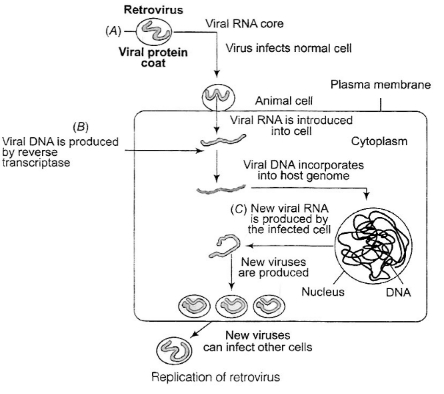
In the given flow chart,the replication of a retrovirus in a host cell is shown. Observe it carefully and fill in the blanks $A, B$,and $C$.
A
$A-$Retrovirus,$B-$Viral $DNA$ is produced,$C-$New viral $RNA$ is produced by the infected cell
B
$A-$Transcriptase,$B-$Bacterial $RNA$ is produced,$C-$New viral $DNA$ is produced by the infected cell
C
$A-$Reverse transcriptase,$B-$Viral $DNA$ is produced,$C-$New viral $RNA$ is produced by the infected cell
D
$A-$Reverse transcriptase,$B-$Bacterial $RNA$ is produced,$C-$New viral $DNA$ is produced by the infected cell
Solution
(A) The replication cycle of a retrovirus involves the following steps:
$A-$ The virus shown is a Retrovirus.
$B-$ Once the viral $RNA$ enters the host cell,the enzyme reverse transcriptase synthesizes viral $DNA$ from the viral $RNA$.
$C-$ The viral $DNA$ incorporates into the host genome,which then directs the host cell to produce new viral $RNA$ and proteins,leading to the production of new viruses.
Therefore,the correct labels are: $A-$Retrovirus,$B-$Viral $DNA$ is produced,$C-$New viral $RNA$ is produced by the infected cell.
$A-$ The virus shown is a Retrovirus.
$B-$ Once the viral $RNA$ enters the host cell,the enzyme reverse transcriptase synthesizes viral $DNA$ from the viral $RNA$.
$C-$ The viral $DNA$ incorporates into the host genome,which then directs the host cell to produce new viral $RNA$ and proteins,leading to the production of new viruses.
Therefore,the correct labels are: $A-$Retrovirus,$B-$Viral $DNA$ is produced,$C-$New viral $RNA$ is produced by the infected cell.
0 likes
View Solution189
MediumMCQ
Choose the wrong statement regarding $AIDS$.
A
$AIDS$ is an immunodeficiency disease.
B
It is caused by the retrovirus $HIV$.
C
$HIV$ selectively infects and kills $B-$lymphocytes.
D
Retroviruses have $RNA$ genomes that replicate via $DNA$ intermediate.
Solution
(C) $AIDS$ (Acquired Immuno Deficiency Syndrome) is caused by $HIV$ (Human Immunodeficiency Virus).
$HIV$ selectively infects and kills helper $T-$lymphocytes ($CD4^+$ cells),not $B-$lymphocytes.
As the number of helper $T-$lymphocytes decreases,the body's immune system breaks down,making the individual susceptible to various infections.
Therefore,the statement that $HIV$ infects $B-$lymphocytes is incorrect.
$HIV$ selectively infects and kills helper $T-$lymphocytes ($CD4^+$ cells),not $B-$lymphocytes.
As the number of helper $T-$lymphocytes decreases,the body's immune system breaks down,making the individual susceptible to various infections.
Therefore,the statement that $HIV$ infects $B-$lymphocytes is incorrect.
0 likes
View Solution190
MediumMCQ
Consider the following statements about $AIDS$.
$I.$ $AIDS$ patient become easily infected by bacteria,viruses and even parasites.
$II.$ The person is unable to protect himself against any infection.
$III.$ National $AIDS$ Control Organisation $(NACO)$ and non-governmental organizations are trying their best to educate people about $AIDS$.
Which of the statements given above are correct?
$I.$ $AIDS$ patient become easily infected by bacteria,viruses and even parasites.
$II.$ The person is unable to protect himself against any infection.
$III.$ National $AIDS$ Control Organisation $(NACO)$ and non-governmental organizations are trying their best to educate people about $AIDS$.
Which of the statements given above are correct?
A
$I$ and $II$
B
$I$ and $III$
C
$II$ and $III$
D
$I, II$ and $III$
Solution
(D) In $AIDS$ patients,the number of helper $T$-lymphocytes progressively decreases in the body.
With the decrease in the number of $T$-cells,the immune system is severely compromised.
Due to this,the person is unable to produce immunity even against common bacteria like $Mycobacterium$,parasites like $Toxoplasma$,viruses,and fungi.
National $AIDS$ Control Organisation $(NACO)$,established in $1991$,and other Non-Governmental Organizations $(NGOs)$ are actively working to educate people about $AIDS$ and its prevention.
Therefore,all three statements are correct.
With the decrease in the number of $T$-cells,the immune system is severely compromised.
Due to this,the person is unable to produce immunity even against common bacteria like $Mycobacterium$,parasites like $Toxoplasma$,viruses,and fungi.
National $AIDS$ Control Organisation $(NACO)$,established in $1991$,and other Non-Governmental Organizations $(NGOs)$ are actively working to educate people about $AIDS$ and its prevention.
Therefore,all three statements are correct.
0 likes
View Solution191
EasyMCQ
Human immunodeficiency virus is a/an
A
Adeno virus
B
$DNA$ retrovirus
C
$RNA$ retrovirus
D
Adeno retrovirus
Solution
(C) $HIV$ (Human Immunodeficiency Virus) is a retrovirus that contains $RNA$ as its genetic material. It uses the enzyme reverse transcriptase to synthesize $DNA$ from its $RNA$ template inside the host cell.
0 likes
View Solution192
MediumMCQ
$HIV$ decreases the natural immunity of the body by:
A
Destroying antibodies
B
Destroying erythrocytes
C
Attacking $T$-lymphocytes
D
Attacking $B$-lymphocytes
Solution
(C) $HIV$ (Human Immunodeficiency Virus) primarily targets and infects $T$-helper lymphocytes (also known as $CD4^+$ cells).
Once inside these cells,the virus replicates,leading to the destruction of the $T$-lymphocytes.
As the count of $T$-lymphocytes decreases significantly,the body's cell-mediated immunity is severely compromised.
This reduction in immune function makes the individual highly susceptible to opportunistic infections caused by various pathogens such as bacteria,viruses,fungi,and parasites.
Once inside these cells,the virus replicates,leading to the destruction of the $T$-lymphocytes.
As the count of $T$-lymphocytes decreases significantly,the body's cell-mediated immunity is severely compromised.
This reduction in immune function makes the individual highly susceptible to opportunistic infections caused by various pathogens such as bacteria,viruses,fungi,and parasites.
0 likes
View Solution193
EasyMCQ
The causative organism of $AIDS$ spreads by:
A
Sharing infected needles and syringes
B
Transfusion of infected blood
C
Unsafe sexual relationships
D
All of these
Solution
(D) $AIDS$ (Acquired Immuno Deficiency Syndrome) is caused by the Human Immunodeficiency Virus $(HIV)$.
It is a communicable disease that spreads through the following modes:
$1$. Unprotected sexual contact with an infected person.
$2$. Transfusion of blood or blood products contaminated with $HIV$.
$3$. Sharing of infected needles or syringes,especially among intravenous drug users.
$4$. From an infected mother to her child through the placenta.
Therefore,all the given options are correct modes of transmission.
It is a communicable disease that spreads through the following modes:
$1$. Unprotected sexual contact with an infected person.
$2$. Transfusion of blood or blood products contaminated with $HIV$.
$3$. Sharing of infected needles or syringes,especially among intravenous drug users.
$4$. From an infected mother to her child through the placenta.
Therefore,all the given options are correct modes of transmission.
0 likes
View Solution194
MediumMCQ
$A$: Vaccine against $AIDS$ has not been made in spite of repeated attempts.
$R$: $HIV$ has the ability to mutate to form several subtypes.
$R$: $HIV$ has the ability to mutate to form several subtypes.
A
Assertion and Reason both are correct and Reason is the correct explanation of Assertion.
B
Assertion and Reason both are correct but Reason is not the correct explanation of Assertion.
C
Assertion is correct,but Reason is incorrect.
D
Both Assertion and Reason are incorrect.
Solution
(A) The Assertion is correct because,despite extensive research,no effective vaccine against $AIDS$ has been developed yet.
The Reason is also correct because $HIV$ is a retrovirus with a high mutation rate,particularly in its envelope proteins $(gp120)$.
This rapid mutation leads to the formation of numerous genetic subtypes and variants,which makes it extremely difficult for the immune system to recognize the virus and for scientists to design a universal vaccine that can provide long-term protection.
Therefore,the Reason correctly explains why the development of an $AIDS$ vaccine is challenging.
The Reason is also correct because $HIV$ is a retrovirus with a high mutation rate,particularly in its envelope proteins $(gp120)$.
This rapid mutation leads to the formation of numerous genetic subtypes and variants,which makes it extremely difficult for the immune system to recognize the virus and for scientists to design a universal vaccine that can provide long-term protection.
Therefore,the Reason correctly explains why the development of an $AIDS$ vaccine is challenging.
0 likes
View Solution195
MediumMCQ
$A$ doctor,while operating on an $HIV$ patient,accidentally cut himself with a scalpel. He comes to you,suspecting that he may have contracted the virus. Which test will you advise him to perform to rule out or confirm his suspicion?
A
$PCR$
B
Routine urine examination
C
$TLC$
D
$DLC$
Solution
(A) $PCR$ (Polymerase Chain Reaction) is a highly sensitive molecular diagnostic technique used to detect the presence of $HIV$ in suspected patients,even when the viral load is very low. It amplifies the viral $DNA$ or $RNA$,making it the most reliable test for early detection of $HIV$ infection.
0 likes
View Solution196
MediumMCQ
The technique used to detect $HIV$ in a suspected $AIDS$ patient during the asymptomatic stage is
A
$PCR$
B
$Serum$ analysis
C
Both $(a)$ and $(b)$
D
$Urine$ analysis
Solution
(A) $PCR$ (Polymerase Chain Reaction) is a highly sensitive molecular diagnostic technique. It helps to detect very low concentrations of bacteria or viruses even when the symptoms of the disease are not yet visible,by amplifying their nucleic acid sequences. Therefore,it is used to detect $HIV$ in suspected $AIDS$ patients during the asymptomatic stage.
0 likes
View Solution197
MediumMCQ
$A$ doctor while operating on an $HIV$ positive patient accidentally cuts himself with a scalpel. In order to confirm whether he has contracted the virus,which of the following tests should be performed?
A
$Serum\; analysis$
B
$Urine\; analysis$
C
$Blood\; analysis$
D
$PCR$
Solution
(D) $PCR$ (Polymerase Chain Reaction) is the most effective diagnostic tool in this scenario.
It allows for the detection of very low concentrations of viral genetic material (nucleic acids) even before the symptoms of the disease become visible or before antibodies are produced in detectable amounts.
By amplifying the viral $DNA$/$RNA$,$PCR$ provides a highly sensitive and early confirmation of infection.
It allows for the detection of very low concentrations of viral genetic material (nucleic acids) even before the symptoms of the disease become visible or before antibodies are produced in detectable amounts.
By amplifying the viral $DNA$/$RNA$,$PCR$ provides a highly sensitive and early confirmation of infection.
0 likes
View Solution198
MediumMCQ
Which individuals are at higher risk of getting $HIV$ infection?
A
Individuals with multiple sexual partners
B
Drug addicts using intravenous needles
C
Individuals requiring repeated blood transfusions
D
All of the above
Solution
(D) The individuals at higher risk of getting $HIV$ infection include:
$1$. Individuals who have multiple sexual partners.
$2$. Drug addicts who take drugs intravenously by sharing needles.
$3$. Individuals who require repeated blood transfusions (e.g.,patients with thalassemia or hemophilia).
$4$. Children born to an $HIV$ infected mother.
$1$. Individuals who have multiple sexual partners.
$2$. Drug addicts who take drugs intravenously by sharing needles.
$3$. Individuals who require repeated blood transfusions (e.g.,patients with thalassemia or hemophilia).
$4$. Children born to an $HIV$ infected mother.
0 likes
View Solution199
MediumMCQ
How is $HIV$ infection diagnosed?
A
By $ELISA$ test
B
By Western Blot test
C
By $PCR$ test
D
All of the above
Solution
(D) $HIV$ infection is diagnosed using several diagnostic techniques.
$1$. $ELISA$ (Enzyme-Linked Immunosorbent Assay) is the most commonly used screening test for $HIV$.
$2$. Western Blot test is a confirmatory test used to verify positive $ELISA$ results.
$3$. $PCR$ (Polymerase Chain Reaction) test is used to detect the presence of viral genetic material $(RNA)$ in the blood.
Since all these methods are used for diagnosis,the correct answer is all of the above.
$1$. $ELISA$ (Enzyme-Linked Immunosorbent Assay) is the most commonly used screening test for $HIV$.
$2$. Western Blot test is a confirmatory test used to verify positive $ELISA$ results.
$3$. $PCR$ (Polymerase Chain Reaction) test is used to detect the presence of viral genetic material $(RNA)$ in the blood.
Since all these methods are used for diagnosis,the correct answer is all of the above.
0 likes
View Solution200
Medium
How can $AIDS$ be prevented?
Solution
(N/A) $AIDS$ can be prevented by the following measures:
$1$. Using barriers (condoms) during sexual acts with suspected partners.
$2$. Restricting sexual activity to one faithful partner.
$3$. Providing education and awareness about $AIDS$ to the public.
$4$. Ensuring blood in blood banks is screened and safe from $HIV$.
$5$. Ensuring the use of only disposable needles and syringes in all hospitals and clinics.
$6$. Promoting the free distribution of condoms.
$7$. Controlling drug abuse,especially the use of intravenous drugs.
$8$. Advocating for safe sex practices and promoting regular $HIV$ check-ups for susceptible populations.
$1$. Using barriers (condoms) during sexual acts with suspected partners.
$2$. Restricting sexual activity to one faithful partner.
$3$. Providing education and awareness about $AIDS$ to the public.
$4$. Ensuring blood in blood banks is screened and safe from $HIV$.
$5$. Ensuring the use of only disposable needles and syringes in all hospitals and clinics.
$6$. Promoting the free distribution of condoms.
$7$. Controlling drug abuse,especially the use of intravenous drugs.
$8$. Advocating for safe sex practices and promoting regular $HIV$ check-ups for susceptible populations.
0 likes
View SolutionHuman Health and Disease — AIDS · Frequently Asked Questions
1Are these Human Health and Disease questions useful for JEE and NEET?
Yes. All questions in this section are mapped to JEE Main and NEET exam patterns. Previous year questions from JEE Main, NEET, GUJCET and state-level exams are included with full solutions.
2Can I switch to Hindi or Gujarati for these questions?
Yes. Use the language tabs in the hero section or the sidebar to view the same questions and solutions in English, Hindi or Gujarati.
3How do I generate a question paper from this subtopic?
Use the Vedclass Exam Paper Generator — select the chapter and subtopic, set difficulty, and generate Sets A, B, C, D automatically. First 3 chapters of every subject are free.
Vedclass Products
For Students
Vedclass Test Series
Mock tests in real JEE/NEET style with performance analysis. 5-day free trial.
Start Free TrialFor Teachers
Exam Paper Generator
Generate Set A/B/C/D papers from this chapter in 2 minutes. 3 chapters free.
Try FreeFor Institutes
Online Exam Module
Live online exams with unlimited students, 360° analytics & white-label branding.
See DemoFor Teachers & Institutes
Generate a Human Health and Disease Exam Paper in 2 Minutes
Select subtopic & difficulty — Sets A, B, C, D auto-generated with No Repeat logic.
First 3 chapters of every subject are free — no payment required.