
A English
Evidences of Evolution Questions in English
Class 12 Biology · Evolution · Evidences of Evolution
396+
Questions
English
Language
100%
With Solutions
Showing 45 of 396 questions in English
201
MediumMCQ
In the evolutionary history of the human heart,it is observed that it passed through a two-chambered heart like that of fish,to a three-chambered heart like that of amphibians,and finally became a four-chambered heart. Which concept is closest to this statement?
A
Hardy-Weinberg principle
B
Lamarck's theory
C
Biogenetic law
D
Mendel's theory
Solution
(C) The statement describes the concept that 'ontogeny recapitulates phylogeny',which is known as the Biogenetic Law or Recapitulation Theory proposed by Ernst Haeckel.
This law suggests that the developmental stages of an embryo (ontogeny) reflect the evolutionary history of the species (phylogeny).
The development of the human heart from a two-chambered state (fish-like) to a three-chambered state (amphibian-like) and finally to a four-chambered state is a classic example used to support this theory.
This law suggests that the developmental stages of an embryo (ontogeny) reflect the evolutionary history of the species (phylogeny).
The development of the human heart from a two-chambered state (fish-like) to a three-chambered state (amphibian-like) and finally to a four-chambered state is a classic example used to support this theory.
0 likes
View Solution202
EasyMCQ
Which of the following is not a vestigial organ in humans?
A
Auricular muscles of the pinna
B
Finger nails
C
Third molars
D
Coccyx
Solution
(B) Vestigial organs are anatomical structures that have lost most or all of their original ancestral function through evolution.
$A$. Auricular muscles of the pinna are considered vestigial in humans as they are non-functional for moving the ears.
$B$. Finger nails are functional structures in humans used for protection and manipulation of objects; they are not vestigial.
$C$. Third molars (wisdom teeth) are often considered vestigial due to the reduction in jaw size in modern humans.
$D$. The coccyx (tailbone) is a vestigial remnant of the ancestral tail.
Therefore,finger nails are not vestigial organs.
$A$. Auricular muscles of the pinna are considered vestigial in humans as they are non-functional for moving the ears.
$B$. Finger nails are functional structures in humans used for protection and manipulation of objects; they are not vestigial.
$C$. Third molars (wisdom teeth) are often considered vestigial due to the reduction in jaw size in modern humans.
$D$. The coccyx (tailbone) is a vestigial remnant of the ancestral tail.
Therefore,finger nails are not vestigial organs.
0 likes
View Solution203
MediumMCQ
The presence of endemic species in South America and Australia is due to which of the following?
A
These species have become extinct in other regions.
B
Continental drift
C
There was a terrestrial route to these places.
D
Retrogressive evolution
Solution
(B) The presence of unique or endemic species in South America and Australia is primarily attributed to $Continental \text{ } drift$.
During the process of continental drift, large landmasses separated from each other, leading to the isolation of flora and fauna.
Because these regions remained isolated for millions of years, the species present there evolved independently, resulting in high levels of endemism.
During the process of continental drift, large landmasses separated from each other, leading to the isolation of flora and fauna.
Because these regions remained isolated for millions of years, the species present there evolved independently, resulting in high levels of endemism.
0 likes
View Solution204
EasyMCQ
The half-life of $C^{14}$ is approximately ..........
A
$500$ years
B
$5730$ years
C
$50$ years
D
$5 \times 10^4$ years
Solution
(B) The half-life of a radioactive isotope is the time required for half of the radioactive atoms in a sample to decay.
Carbon-$14$ $(C^{14})$ is a radioactive isotope of carbon used in radiocarbon dating to determine the age of organic materials.
The accepted scientific value for the half-life of $C^{14}$ is approximately $5730$ years.
Therefore,option $B$ is the correct answer.
Carbon-$14$ $(C^{14})$ is a radioactive isotope of carbon used in radiocarbon dating to determine the age of organic materials.
The accepted scientific value for the half-life of $C^{14}$ is approximately $5730$ years.
Therefore,option $B$ is the correct answer.
0 likes
View Solution205
MediumMCQ
Which of the following pairs represents analogous organs?
A
Wings of a bird and wings of a grasshopper
B
Wings of a bird (sparrow) and pectoral fins of a fish
C
Wings of a bat and wings of a butterfly
D
Legs of a frog and legs of a cockroach
Solution
(C) Analogous organs are those that have different anatomical structures and embryonic origins but perform similar functions due to convergent evolution.
$1$. Wings of a bat (mammal) and wings of a butterfly (insect) are classic examples of analogous organs.
$2$. While both are used for flight,their internal structures are entirely different (bat wings are modified forelimbs with skin membranes,while butterfly wings are extensions of the exoskeleton).
$3$. Options like bird wings and grasshopper wings are also analogous,but the most standard textbook example for this comparison is the bat and butterfly wings.
$1$. Wings of a bat (mammal) and wings of a butterfly (insect) are classic examples of analogous organs.
$2$. While both are used for flight,their internal structures are entirely different (bat wings are modified forelimbs with skin membranes,while butterfly wings are extensions of the exoskeleton).
$3$. Options like bird wings and grasshopper wings are also analogous,but the most standard textbook example for this comparison is the bat and butterfly wings.
0 likes
View Solution206
MediumMCQ
Which of the following correctly describes the structure of homologous organs?
A
Organs that appear only during embryonic development and disappear in the adult.
B
Organs that have similar internal structural anatomy but perform different functions.
C
Organs that have different internal structural anatomy but perform the same function.
D
Organs that currently perform no function but were important in their ancestors.
Solution
(B) Homologous organs are defined as those organs that share a common evolutionary origin and possess a similar basic anatomical structure,even though they may have evolved to perform different functions due to adaptation to different environments. This phenomenon is known as divergent evolution. For example,the forelimbs of whales,bats,cheetahs,and humans share the same structural plan of bones (humerus,radius,ulna,carpals,metacarpals,and phalanges) but are used for different purposes like swimming,flying,running,and grasping,respectively.
0 likes
View Solution207
MediumMCQ
Convergent evolution is typically represented by which of the following?
A
Dogfish and Whale
B
Rat and Dog
C
Bacteria and Protozoa
D
Starfish and Cuttlefish
Solution
(A) Convergent evolution occurs when unrelated species evolve similar traits as a result of having to adapt to similar environments or ecological niches.
Dogfish (a cartilaginous fish) and Whale (a marine mammal) both possess streamlined bodies adapted for swimming in an aquatic environment,despite belonging to completely different evolutionary lineages.
This similarity in body shape is an example of analogous organs,which are a result of convergent evolution.
Dogfish (a cartilaginous fish) and Whale (a marine mammal) both possess streamlined bodies adapted for swimming in an aquatic environment,despite belonging to completely different evolutionary lineages.
This similarity in body shape is an example of analogous organs,which are a result of convergent evolution.
0 likes
View Solution208
MediumMCQ
The age of fossils was traditionally determined by radio-carbon dating and other methods involving radioactive elements found in the rocks. More precise methods currently used for determining the evolutionary time of different groups of organisms include:
A
Study of carbohydrates/proteins in fossils
B
Study of the conditions under which fossils were formed
C
Electron Spin Resonance $(ESR)$ and $DNA$ analysis of fossils
D
Study of carbohydrates/proteins in rocks
Solution
(C) Modern methods for dating fossils and determining evolutionary timelines have moved beyond simple radio-carbon dating. $Electron$ $Spin$ $Resonance$ $(ESR)$ is a powerful technique used to date geological and archaeological materials by measuring the accumulation of trapped electrons. Additionally,the analysis of ancient $DNA$ $(aDNA)$ extracted from fossils provides precise information about the evolutionary relationships and divergence times of various organisms. Therefore,$ESR$ and $DNA$ analysis are the most accurate modern methods used in evolutionary biology.
0 likes
View Solution209
MediumMCQ
The presence of gills in the tadpole of a frog indicates that . . . . . . .
A
Fishes were amphibians in the past.
B
Fishes evolved from frog-like ancestors.
C
Frogs will have gills in the future.
D
Frogs evolved from gill-bearing ancestors.
Solution
(D) The presence of gills in the tadpole stage of a frog is an example of recapitulation or evolutionary evidence. According to the theory of evolution,organisms often show ancestral traits during their embryonic or larval development. Since frogs are amphibians that evolved from fish-like ancestors which possessed gills for respiration,the tadpole retains this ancestral feature. This indicates that frogs evolved from gill-bearing ancestors.
0 likes
View Solution210
MediumMCQ
Which of the following methods was considered the most accurate for determining the age of fossils?
A
Radio-carbon dating method
B
Potassium-Argon dating method
C
Electron spin resonance method
D
Uranium-Lead dating method
Solution
(B) The $Radio-carbon$ dating method is primarily used for relatively recent organic materials (up to $50,000$ years).
However,for determining the age of ancient fossils and geological strata,the $Potassium-Argon$ $(K-Ar)$ dating method is considered highly accurate and reliable.
It measures the decay of radioactive $Potassium-40$ into $Argon-40$ within volcanic rocks associated with the fossils,allowing scientists to date samples that are millions of years old.
However,for determining the age of ancient fossils and geological strata,the $Potassium-Argon$ $(K-Ar)$ dating method is considered highly accurate and reliable.
It measures the decay of radioactive $Potassium-40$ into $Argon-40$ within volcanic rocks associated with the fossils,allowing scientists to date samples that are millions of years old.
0 likes
View Solution211
MediumMCQ
The presence of ............. is an important evidence in favour of organic evolution.
A
Analogous and vestigial organs.
B
Only homologous organs.
C
Homologous and analogous organs.
D
Homologous and vestigial organs.
Solution
(D) Homologous organs are those that have the same structural origin but perform different functions,indicating common ancestry. Vestigial organs are remnants of structures that were functional in ancestors but are reduced or non-functional in the present organism. Both provide strong evidence for organic evolution by demonstrating descent with modification.
0 likes
View Solution212
MediumMCQ
Which of the following is $NOT$ a living fossil?
A
King Crab
B
Skeenadon
C
Archaeopteryx
D
Peripatus
Solution
(C) living fossil is an extant taxon that closely resembles related species known only from the fossil record.
$Archaeopteryx$ is an extinct genus of bird-like dinosaurs that serves as a transitional fossil between non-avian feathered dinosaurs and modern birds.
It is not a living fossil because it is completely extinct and does not have any living descendants that resemble it closely in the way living fossils do.
King Crab $(Limulus)$,$Skeenadon$ (a type of insect),and $Peripatus$ are all considered living fossils.
$Archaeopteryx$ is an extinct genus of bird-like dinosaurs that serves as a transitional fossil between non-avian feathered dinosaurs and modern birds.
It is not a living fossil because it is completely extinct and does not have any living descendants that resemble it closely in the way living fossils do.
King Crab $(Limulus)$,$Skeenadon$ (a type of insect),and $Peripatus$ are all considered living fossils.
0 likes
View Solution213
MediumMCQ
Which of the following statements is correct?
A
Stem cells are specialized cells.
B
There is no evidence of gill slits during mammalian embryonic development.
C
All plant and animal cells are totipotent.
D
Ontogeny recapitulates phylogeny.
Solution
(D) The statement 'Ontogeny recapitulates phylogeny' is known as the Biogenetic Law or Haeckel's Law. It suggests that the developmental stages of an individual organism (ontogeny) reflect the evolutionary history of its species (phylogeny). For example,the presence of gill slits in the embryos of all vertebrates,including humans,indicates a common aquatic ancestry.
0 likes
View Solution214
MediumMCQ
The thorn of $Bougainvillea$ and the tendril of $Cucurbita$ are examples of . . . . . . .
A
Analogous organs
B
Homologous organs
C
Vestigial organs
D
Convergent evolution
Solution
(B) Homologous organs are those that have the same fundamental structural plan and origin but perform different functions.
$Bougainvillea$ thorns and $Cucurbita$ tendrils are both modifications of axillary buds (stems).
They share a common evolutionary origin (homology) but have evolved to perform different functions: thorns provide protection,while tendrils provide support for climbing.
Therefore,they are classic examples of homologous organs,which provide evidence for divergent evolution.
$Bougainvillea$ thorns and $Cucurbita$ tendrils are both modifications of axillary buds (stems).
They share a common evolutionary origin (homology) but have evolved to perform different functions: thorns provide protection,while tendrils provide support for climbing.
Therefore,they are classic examples of homologous organs,which provide evidence for divergent evolution.
0 likes
View Solution215
MediumMCQ
The eye of an octopus and the eye of a cat show different internal structures, yet they perform similar functions. This is an example of:
A
Homologous organs that have evolved by convergent evolution.
B
Homologous organs that have evolved by divergent evolution.
C
Analogous organs that have evolved by convergent evolution.
D
Analogous organs that have evolved by divergent evolution.
Solution
(C) $1$. Organs that have similar functions but different anatomical structures and embryonic origins are called $Analogous$ $organs$.
$2$. The eye of an octopus (a mollusk) and the eye of a cat (a mammal) are classic examples of analogous organs because they evolved independently to perform the same function (vision) in different environments.
$3$. This phenomenon, where unrelated species evolve similar traits due to similar environmental pressures, is known as $Convergent$ $evolution$.
$4$. Therefore, the correct answer is $Analogous$ $organs$ $that$ $have$ $evolved$ $by$ $convergent$ $evolution$.
$2$. The eye of an octopus (a mollusk) and the eye of a cat (a mammal) are classic examples of analogous organs because they evolved independently to perform the same function (vision) in different environments.
$3$. This phenomenon, where unrelated species evolve similar traits due to similar environmental pressures, is known as $Convergent$ $evolution$.
$4$. Therefore, the correct answer is $Analogous$ $organs$ $that$ $have$ $evolved$ $by$ $convergent$ $evolution$.
0 likes
View Solution216
MediumMCQ
Which of the following is an example of analogous organs?
A
Wings of a bat and wings of a bird
B
Gills of a prawn and lungs of a human
C
Thorns of Bougainvillea and tendrils of Cucurbita
D
Flippers of a dolphin and legs of a horse
Solution
(B) Analogous organs are those that perform similar functions but have different evolutionary origins and anatomical structures.
$1$. Wings of a bat and wings of a bird are analogous because they both serve the purpose of flight but have different internal bone structures.
$2$. Gills of a prawn and lungs of a human are also analogous as they both perform respiration but have different developmental origins.
$3$. Thorns of Bougainvillea and tendrils of Cucurbita are examples of homologous organs (common origin,different function).
$4$. Flippers of a dolphin and legs of a horse are also homologous organs.
Since both $A$ and $B$ represent analogous organs,in the context of standard biology curriculum,the most classic example often cited for analogous structures is the wings of insects and birds,or the gills of prawns and lungs of humans. Given the options,$B$ is a classic textbook example of analogous organs.
$1$. Wings of a bat and wings of a bird are analogous because they both serve the purpose of flight but have different internal bone structures.
$2$. Gills of a prawn and lungs of a human are also analogous as they both perform respiration but have different developmental origins.
$3$. Thorns of Bougainvillea and tendrils of Cucurbita are examples of homologous organs (common origin,different function).
$4$. Flippers of a dolphin and legs of a horse are also homologous organs.
Since both $A$ and $B$ represent analogous organs,in the context of standard biology curriculum,the most classic example often cited for analogous structures is the wings of insects and birds,or the gills of prawns and lungs of humans. Given the options,$B$ is a classic textbook example of analogous organs.
0 likes
View Solution217
MediumMCQ
The forelimbs of a cat and a lizard are used for walking. The forelimb of a whale is used for swimming,and the forelimb of a bat is used for flying. These are examples of:
A
Analogous organs
B
Adaptive radiation
C
Homologous organs
D
Convergent evolution
Solution
(C) Homologous organs are those that have the same basic structural plan and embryonic origin but perform different functions in different organisms.
In this case,the forelimbs of a cat,lizard,whale,and bat share a similar underlying bone structure (humerus,radius,ulna,carpals,metacarpals,and phalanges),indicating a common ancestry.
Although they perform different functions like walking,swimming,and flying,their structural similarity classifies them as homologous organs.
Therefore,the correct answer is $C$.
In this case,the forelimbs of a cat,lizard,whale,and bat share a similar underlying bone structure (humerus,radius,ulna,carpals,metacarpals,and phalanges),indicating a common ancestry.
Although they perform different functions like walking,swimming,and flying,their structural similarity classifies them as homologous organs.
Therefore,the correct answer is $C$.
0 likes
View Solution218
MediumMCQ
The wings of birds and the wings of insects are $.........$.
A
Analogous organs indicating convergent evolution.
B
Homologous organs indicating divergent evolution.
C
Vestigial organs indicating evolutionary history.
D
Homologous organs indicating convergent evolution.
Solution
(A) The wings of birds and the wings of insects are structurally different but functionally similar,as both are used for flight.
Such organs are known as analogous organs.
Analogous organs are the result of convergent evolution,where organisms with different ancestral origins develop similar traits due to adaptation to similar environmental conditions.
Such organs are known as analogous organs.
Analogous organs are the result of convergent evolution,where organisms with different ancestral origins develop similar traits due to adaptation to similar environmental conditions.
0 likes
View Solution219
MediumMCQ
Which of the following structures is homologous to the wing of a bird?
A
Wing of a moth
B
Forelimb of a rabbit
C
Flipper of a whale
D
Dorsal fin of a shark
Solution
(B) Homologous structures are those that have the same anatomical origin and basic structural plan but may perform different functions.
$1$. The wing of a bird and the forelimb of a rabbit (or human/bat) share the same skeletal elements (humerus,radius,ulna,carpals,metacarpals,and phalanges),indicating a common ancestral origin.
$2$. Therefore,the forelimb of a rabbit is homologous to the wing of a bird.
$3$. Wings of a moth and wings of a bird are analogous structures as they perform the same function (flight) but have different evolutionary origins.
$4$. Flippers of a whale and dorsal fins of a shark are also examples of analogous structures.
$1$. The wing of a bird and the forelimb of a rabbit (or human/bat) share the same skeletal elements (humerus,radius,ulna,carpals,metacarpals,and phalanges),indicating a common ancestral origin.
$2$. Therefore,the forelimb of a rabbit is homologous to the wing of a bird.
$3$. Wings of a moth and wings of a bird are analogous structures as they perform the same function (flight) but have different evolutionary origins.
$4$. Flippers of a whale and dorsal fins of a shark are also examples of analogous structures.
0 likes
View Solution220
MediumMCQ
Analogous organs are the result of which of the following?
A
Convergent evolution
B
Common ancestry
C
Stabilizing selection
D
Divergent evolution
Solution
(A) Analogous organs are structures that perform similar functions but have different evolutionary origins and anatomical structures.
These organs arise due to convergent evolution,where different species independently evolve similar traits as a result of having to adapt to similar environments or ecological niches.
For example,the wings of a butterfly and the wings of a bird are analogous; they both serve the purpose of flight but have evolved from different ancestral structures.
Therefore,the correct answer is $A$.
These organs arise due to convergent evolution,where different species independently evolve similar traits as a result of having to adapt to similar environments or ecological niches.
For example,the wings of a butterfly and the wings of a bird are analogous; they both serve the purpose of flight but have evolved from different ancestral structures.
Therefore,the correct answer is $A$.
0 likes
View Solution221
EasyMCQ
Among the following sets of examples for divergent evolution,select the incorrect option:
A
Eye of octopus,bat and man
B
Forelimbs of man,bat and cheetah
C
Brain of bat,man and cheetah
D
Heart of bat,man and cheetah
Solution
(A) Divergent evolution occurs when species with a common ancestor evolve different traits to adapt to different environments,resulting in homologous organs.
Homologous organs are those that have the same structural origin and developmental pattern but may perform different functions.
$A$. The eye of an octopus (a mollusc) and the eye of a mammal (bat or man) are examples of convergent evolution,not divergent evolution. They perform similar functions but have different evolutionary origins.
$B$. The forelimbs of man,bat,and cheetah are classic examples of homologous organs,showing divergent evolution.
$C$. The brains of vertebrates like bats,humans,and cheetahs share a common structural plan,indicating divergent evolution.
$D$. The hearts of vertebrates like bats,humans,and cheetahs share a common structural plan,indicating divergent evolution.
Therefore,the incorrect option regarding divergent evolution is the eye of an octopus,bat,and man.
Homologous organs are those that have the same structural origin and developmental pattern but may perform different functions.
$A$. The eye of an octopus (a mollusc) and the eye of a mammal (bat or man) are examples of convergent evolution,not divergent evolution. They perform similar functions but have different evolutionary origins.
$B$. The forelimbs of man,bat,and cheetah are classic examples of homologous organs,showing divergent evolution.
$C$. The brains of vertebrates like bats,humans,and cheetahs share a common structural plan,indicating divergent evolution.
$D$. The hearts of vertebrates like bats,humans,and cheetahs share a common structural plan,indicating divergent evolution.
Therefore,the incorrect option regarding divergent evolution is the eye of an octopus,bat,and man.
0 likes
View Solution222
EasyMCQ
The similarity of bone structure in the forelimbs of many vertebrates is an example of
A
Adaptive radiation
B
Homology
C
Convergent evolution
D
Analogy
Solution
(B) The similarity in the bone structure of the forelimbs of many vertebrates (such as whales,bats,cheetahs,and humans) indicates that they share a common ancestry.
These structures perform different functions in different animals (e.g.,swimming,flying,running,grasping) but share the same anatomical origin and basic structural plan.
Such structures are called homologous organs,and the phenomenon is known as homology.
Homology is based on divergent evolution,where organisms with a common ancestor evolve different traits to adapt to different environments.
These structures perform different functions in different animals (e.g.,swimming,flying,running,grasping) but share the same anatomical origin and basic structural plan.
Such structures are called homologous organs,and the phenomenon is known as homology.
Homology is based on divergent evolution,where organisms with a common ancestor evolve different traits to adapt to different environments.
0 likes
View Solution223
MediumMCQ
The study of homologous structures in mature organisms provides evidence for the evolutionary relationships among certain groups of organisms. Which field of study includes this evidence of evolution?
A
Comparative cytology
B
Biochemistry
C
Geology
D
Comparative anatomy
Solution
(D) Comparative anatomy is the study of similarities and differences in the structures of different organisms. Homologous structures,which share a common evolutionary origin but may have different functions,are a key focus of this field.
Comparative cytology involves the examination of similarities in the cellular structures of different organisms.
Biochemistry compares $DNA$ sequences and proteins to determine evolutionary relationships.
Geology is the study of the Earth,its physical structure,and the processes acting upon it.
Comparative cytology involves the examination of similarities in the cellular structures of different organisms.
Biochemistry compares $DNA$ sequences and proteins to determine evolutionary relationships.
Geology is the study of the Earth,its physical structure,and the processes acting upon it.
0 likes
View Solution224
MediumMCQ
Wings of pigeon,mosquito,and bat show:
A
divergent evolution
B
atavism
C
convergent evolution
D
all of these
Solution
(C) Wings of pigeons (birds),mosquitoes (insects),and bats (mammals) are analogous organs,meaning they perform the same function (flight) but have different anatomical structures and embryonic origins.
This similarity in function,which has developed in distantly related groups,is an adaptation to the same environmental pressure (the need for flight).
Therefore,this phenomenon is known as analogy or convergent evolution.
This similarity in function,which has developed in distantly related groups,is an adaptation to the same environmental pressure (the need for flight).
Therefore,this phenomenon is known as analogy or convergent evolution.
0 likes
View Solution225
MediumMCQ
Thorn of Bougainvillea and tendril of Cucurbita are examples of
A
analogous organs
B
homologous organs
C
vestigial organs
D
retrogressive evolution
Solution
(B) Homologous organs are those that have the same fundamental structure and developmental origin but perform different functions.
Thorns of $Bougainvillea$ and tendrils of $Cucurbita$ both arise from axillary buds (same origin).
Thorns provide protection,while tendrils provide support for climbing (different functions).
Therefore,they are classic examples of homologous organs.
Thorns of $Bougainvillea$ and tendrils of $Cucurbita$ both arise from axillary buds (same origin).
Thorns provide protection,while tendrils provide support for climbing (different functions).
Therefore,they are classic examples of homologous organs.
0 likes
View Solution226
MediumMCQ
Forelimbs of cat,lizard used in walking; forelimbs of whale used in swimming and forelimbs of bats used in flying are an example of
A
Analogous organs
B
Adaptive radiation
C
Homologous organs
D
Convergent evolution
Solution
(C) Organs that share a common fundamental anatomical structure and similar embryonic origin,despite performing different functions,are known as homologous organs.
In the case of the forelimbs of a cat,lizard,whale,and bat,they all possess the same basic skeletal arrangement (humerus,radius,ulna,carpals,metacarpals,and phalanges).
Although these limbs are adapted for different functions like walking,swimming,or flying,their underlying structural similarity indicates a common evolutionary ancestry.
Therefore,they are classic examples of homologous organs.
In the case of the forelimbs of a cat,lizard,whale,and bat,they all possess the same basic skeletal arrangement (humerus,radius,ulna,carpals,metacarpals,and phalanges).
Although these limbs are adapted for different functions like walking,swimming,or flying,their underlying structural similarity indicates a common evolutionary ancestry.
Therefore,they are classic examples of homologous organs.
0 likes
View Solution227
MediumMCQ
Assertion: Comparative biochemistry provides strong evidence in favour of the common ancestry of living beings.
Reason: The genetic code is universal.
Reason: The genetic code is universal.
A
If both Assertion and Reason are correct and the Reason is a correct explanation of the Assertion.
B
If both Assertion and Reason are correct but Reason is not a correct explanation of the Assertion.
C
If the Assertion is correct but Reason is incorrect.
D
If both the Assertion and Reason are incorrect.
Solution
(A) Comparative biochemistry provides strong evidence for the common ancestry of living beings. The presence of similar biochemical molecules such as proteins,enzymes,hormones,and blood groups across diverse species suggests a shared evolutionary origin.
Furthermore,the genetic code is universal,meaning that the same codons specify the same amino acids in almost all living organisms,from bacteria to humans. This universality is a powerful piece of evidence supporting the theory that all life on Earth evolved from a common ancestor. Therefore,the Reason correctly explains the Assertion.
Furthermore,the genetic code is universal,meaning that the same codons specify the same amino acids in almost all living organisms,from bacteria to humans. This universality is a powerful piece of evidence supporting the theory that all life on Earth evolved from a common ancestor. Therefore,the Reason correctly explains the Assertion.
0 likes
View Solution228
Difficult
Find out from newspapers and popular science articles any new fossil discoveries or controversies about evolution.
Solution
(N/A) Fossils of dinosaurs have revealed the evolution of reptiles in the $Jurassic$ period. As a result of this,the evolution of other animals such as birds and mammals has also been discovered. However,two unusual fossils recently unearthed in $China$ have ignited a controversy over the evolution of birds. $Confuciusornis$ is one such genus of primitive birds that were crow-sized and lived during the $Cretaceous$ period in $China$.
0 likes
View Solution229
Medium
Provide the paleontological evidences of evolution.
Solution
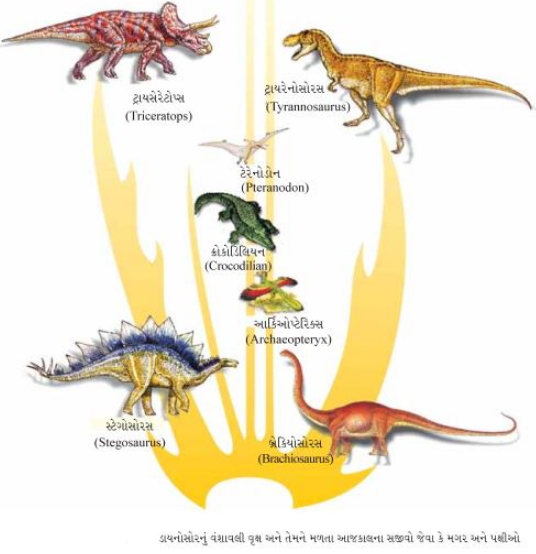
(N/A) Evidence that evolution of life forms has indeed taken place on Earth has come from many quarters. Fossils are remains of hard parts of life-forms found in rocks.
Rocks form sediments and a cross-section of Earth's crust indicates the arrangement of sediments one over the other during the long history of Earth.
Different sedimentary rocks contain fossils of different life-forms who died during the formation of the particular sediment. Some of them appear similar to modern organisms.
They represent extinct organisms (e.g.,dinosaurs). $A$ study of fossils in different sedimentary layers indicates the geological period in which they existed. The study shows that life-forms varied over time and certain life-forms are restricted to certain geological time-spans. Hence,new forms of life have arisen at different times in the history of Earth. All these are called paleontological evidences.
Rocks form sediments and a cross-section of Earth's crust indicates the arrangement of sediments one over the other during the long history of Earth.
Different sedimentary rocks contain fossils of different life-forms who died during the formation of the particular sediment. Some of them appear similar to modern organisms.
They represent extinct organisms (e.g.,dinosaurs). $A$ study of fossils in different sedimentary layers indicates the geological period in which they existed. The study shows that life-forms varied over time and certain life-forms are restricted to certain geological time-spans. Hence,new forms of life have arisen at different times in the history of Earth. All these are called paleontological evidences.
0 likes
View Solution230
Medium
Explain the embryological evidence for evolution.
Solution
(N/A) The embryological evidence for evolution was proposed by $Ernst \text{ } Haeckel$ based on the observation that certain features during the embryonic stage are common to all vertebrates but are absent in adults.
For example, all vertebrate embryos, including humans, develop a row of vestigial gill slits just behind the head.
However, these are functional only in fish and not in other adult vertebrates.
This proposal was later disapproved by the careful study conducted by $Karl \text{ } Ernst \text{ } Von \text{ } Baer$.
He noted that embryos never pass through the adult stages of other animals.
For example, all vertebrate embryos, including humans, develop a row of vestigial gill slits just behind the head.
However, these are functional only in fish and not in other adult vertebrates.
This proposal was later disapproved by the careful study conducted by $Karl \text{ } Ernst \text{ } Von \text{ } Baer$.
He noted that embryos never pass through the adult stages of other animals.
0 likes
View Solution231
Medium
Explain evolution based on comparative anatomy and morphology.
Solution
(A) Comparative anatomy and morphology show similarities and differences between organisms of today and those that existed years ago. These similarities suggest that modern organisms may have descended from common ancestors.
For example,the forelimbs of whales,bats,cheetahs,and humans (all mammals) share similarities in the pattern of bones. Although these forelimbs perform different functions,they share a similar anatomical structure. In all of them,the forelimbs consist of humerus,radius,ulna,carpals,metacarpals,and phalanges.
Thus,these animals developed organs with similar structures,but they adapted in different directions to meet different needs. This is called $divergent$ $evolution$,and these structures are $homologous$. Homology indicates common ancestry. Other examples include the hearts and brains of vertebrates.
In plants,the thorns of $Bougainvillea$ and the tendrils of $Cucurbita$ are homologous organs.
$Convergent$ $evolution$ occurs when different structures develop for similar functions,resulting in similarities. Other examples of analogy include the eyes of octopuses and mammals,or the flippers of penguins and dolphins. One could argue that similar habitats forced different groups of organisms to adopt similar adaptations for similar functions. Sweet potato (root modification) and potato (stem modification) are another example of analogous organs.
In this context,it can also be argued that the functional mechanisms of proteins and genes are similar across various organisms. This also points to a common ancestor. Biochemical similarities also suggest a common ancestry,just as structural similarities do among various organisms.
For example,the forelimbs of whales,bats,cheetahs,and humans (all mammals) share similarities in the pattern of bones. Although these forelimbs perform different functions,they share a similar anatomical structure. In all of them,the forelimbs consist of humerus,radius,ulna,carpals,metacarpals,and phalanges.
Thus,these animals developed organs with similar structures,but they adapted in different directions to meet different needs. This is called $divergent$ $evolution$,and these structures are $homologous$. Homology indicates common ancestry. Other examples include the hearts and brains of vertebrates.
In plants,the thorns of $Bougainvillea$ and the tendrils of $Cucurbita$ are homologous organs.
$Convergent$ $evolution$ occurs when different structures develop for similar functions,resulting in similarities. Other examples of analogy include the eyes of octopuses and mammals,or the flippers of penguins and dolphins. One could argue that similar habitats forced different groups of organisms to adopt similar adaptations for similar functions. Sweet potato (root modification) and potato (stem modification) are another example of analogous organs.
In this context,it can also be argued that the functional mechanisms of proteins and genes are similar across various organisms. This also points to a common ancestor. Biochemical similarities also suggest a common ancestry,just as structural similarities do among various organisms.
0 likes
View Solution232
Medium
Explain: $(a)$ Homology $(b)$ Analogy.
Solution
(N/A) Comparative anatomy and morphology show similarities and differences between organisms of today and those that existed years ago. These similarities help determine whether current organisms descended from common ancestors.
$(a)$ Homology: Whales,bats,cheetahs,and humans (all mammals) share similarities in the pattern of bones of their forelimbs. Although these forelimbs perform different functions in these animals,they have similar anatomical structures. In all of them,the forelimbs consist of humerus,radius,ulna,carpals,metacarpals,and phalanges. This is an example of divergent evolution,and these structures are called homologous organs. Homology indicates common ancestry.
$(b)$ Analogy: This refers to structures that perform similar functions but have different anatomical origins. This is a result of convergent evolution,where different groups of organisms adapt to similar habitats by developing similar adaptations for similar functions. Examples include the eyes of an octopus and mammals,or the flippers of penguins and dolphins. Another example is the sweet potato (root modification) and potato (stem modification),which are analogous organs.
$(a)$ Homology: Whales,bats,cheetahs,and humans (all mammals) share similarities in the pattern of bones of their forelimbs. Although these forelimbs perform different functions in these animals,they have similar anatomical structures. In all of them,the forelimbs consist of humerus,radius,ulna,carpals,metacarpals,and phalanges. This is an example of divergent evolution,and these structures are called homologous organs. Homology indicates common ancestry.
$(b)$ Analogy: This refers to structures that perform similar functions but have different anatomical origins. This is a result of convergent evolution,where different groups of organisms adapt to similar habitats by developing similar adaptations for similar functions. Examples include the eyes of an octopus and mammals,or the flippers of penguins and dolphins. Another example is the sweet potato (root modification) and potato (stem modification),which are analogous organs.
0 likes
View Solution233
Difficult
Briefly explain the significance of biochemical similarities in the study of evolution.
Solution
(N/A) Biochemical similarities refer to the presence of similar proteins,enzymes,and genetic material ($DNA$/$RNA$) across diverse organisms.
These similarities in metabolic pathways and molecular structures indicate a common ancestry.
For example,the universality of the genetic code and the presence of similar respiratory enzymes like cytochrome $c$ in organisms ranging from bacteria to humans suggest that these organisms evolved from a common ancestor.
Thus,biochemical evidence provides strong molecular support for the theory of organic evolution.
These similarities in metabolic pathways and molecular structures indicate a common ancestry.
For example,the universality of the genetic code and the presence of similar respiratory enzymes like cytochrome $c$ in organisms ranging from bacteria to humans suggest that these organisms evolved from a common ancestor.
Thus,biochemical evidence provides strong molecular support for the theory of organic evolution.
0 likes
View Solution234
Medium
Describe the phenomenon of moths observed in industrial areas of England that supports evolution by natural selection.
Solution
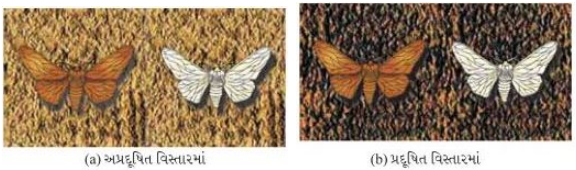
(N/A) An interesting observation supporting evolution by natural selection comes from England. In the $1850s$,i.e.,before industrialization,it was observed that there were more white-winged moths on trees than dark-winged or melanized moths. However,in the same area,but after industrialization,i.e.,in $1920$,there were more dark-winged moths in the same area,i.e.,the proportion was reversed.
This observation suggested that 'predators will spot a moth against a contrasting background'. During the post-industrialization period,the tree trunks became dark due to industrial smoke and soot. Under this condition,the white-winged moths could not survive due to predators,but the dark-winged or melanized moths survived.
Before industrialization,thick growth of almost white-colored lichens covered the trees - in that background,the white-winged moths survived but the dark-colored moths were picked out by predators. Lichens do not grow in polluted areas. Thus,moths that were able to camouflage themselves survived (Figure). This understanding is supported by the fact that in areas where industrialization did not occur,e.g.,in rural areas,the count of melanic moths was low. This shows that in a mixed population,those that can better adapt,survive and increase in population size.
This observation suggested that 'predators will spot a moth against a contrasting background'. During the post-industrialization period,the tree trunks became dark due to industrial smoke and soot. Under this condition,the white-winged moths could not survive due to predators,but the dark-winged or melanized moths survived.
Before industrialization,thick growth of almost white-colored lichens covered the trees - in that background,the white-winged moths survived but the dark-colored moths were picked out by predators. Lichens do not grow in polluted areas. Thus,moths that were able to camouflage themselves survived (Figure). This understanding is supported by the fact that in areas where industrialization did not occur,e.g.,in rural areas,the count of melanic moths was low. This shows that in a mixed population,those that can better adapt,survive and increase in population size.
0 likes
View Solution235
Easy
Distinguish between: Homologous organs and Analogous organs.
Solution
(N/A) Homologous organs: These organs have a similar anatomical structure and developmental origin,even if they perform different functions in different organisms.
They represent divergent evolution,where a common ancestral structure adapts to different environmental needs.
Example: The forelimbs of whales,bats,cheetahs,and humans share a similar pattern of bones (humerus,radius,ulna,carpals,metacarpals,and phalanges).
Analogous organs: These organs perform similar functions but do not share a common anatomical structure or evolutionary origin.
They represent convergent evolution,where different structures evolve to perform the same function due to similar environmental pressures.
Example: The wings of a butterfly and the wings of a bird,or the eyes of an octopus and the eyes of mammals.
They represent divergent evolution,where a common ancestral structure adapts to different environmental needs.
Example: The forelimbs of whales,bats,cheetahs,and humans share a similar pattern of bones (humerus,radius,ulna,carpals,metacarpals,and phalanges).
Analogous organs: These organs perform similar functions but do not share a common anatomical structure or evolutionary origin.
They represent convergent evolution,where different structures evolve to perform the same function due to similar environmental pressures.
Example: The wings of a butterfly and the wings of a bird,or the eyes of an octopus and the eyes of mammals.
0 likes
View Solution236
MediumMCQ
Provide the scientific reason for the statement: 'Ontogeny repeats phylogeny'.
A
Biogenetic Law proposed by Ernst Haeckel
B
Darwin's theory of natural selection
C
Lamarck's theory of inheritance of acquired characters
D
Mutation theory of Hugo de Vries
Solution
(A) The statement 'Ontogeny repeats phylogeny' is known as the Biogenetic Law or Recapitulation Theory,proposed by Ernst Haeckel.
It suggests that the embryonic development of an individual organism (ontogeny) reflects the evolutionary history of its species (phylogeny).
For example,all vertebrate embryos,including humans,develop vestigial gill slits behind the head during early embryonic stages,which are functional only in fish but disappear or transform in other adult vertebrates.
This provides embryological evidence for common ancestry among vertebrates.
It suggests that the embryonic development of an individual organism (ontogeny) reflects the evolutionary history of its species (phylogeny).
For example,all vertebrate embryos,including humans,develop vestigial gill slits behind the head during early embryonic stages,which are functional only in fish but disappear or transform in other adult vertebrates.
This provides embryological evidence for common ancestry among vertebrates.
0 likes
View Solution237
MediumMCQ
Define evolution and analogous organs.
A
Evolution is the change in the heritable characteristics of biological populations over successive generations. Analogous organs are structures in different species that perform the same function but have evolved separately,thus not sharing a common ancestor.
Solution
(N/A) Evolution is the process of gradual change in the inherited traits of a population over successive generations,leading to the diversity of life on Earth.
Analogous organs are structures in different organisms that perform similar functions but have different evolutionary origins and underlying anatomical structures.
For example,the wings of a butterfly and the wings of a bird perform the same function (flight) but are structurally different.
This phenomenon is a result of convergent evolution,where different species independently evolve similar traits as an adaptation to similar environmental pressures.
Analogous organs are structures in different organisms that perform similar functions but have different evolutionary origins and underlying anatomical structures.
For example,the wings of a butterfly and the wings of a bird perform the same function (flight) but are structurally different.
This phenomenon is a result of convergent evolution,where different species independently evolve similar traits as an adaptation to similar environmental pressures.
0 likes
View Solution238
Medium
Define homologous organs,recapitulation theory,and fossils.
Solution
(N/A) $1$. Homologous Organs: These are organs that share a common evolutionary origin and basic structural plan but may perform different functions in different organisms. For example,the forelimbs of whales,bats,cheetahs,and humans share the same anatomical structure (humerus,radius,ulna,carpals,metacarpals,and phalanges) but are adapted for different functions like swimming,flying,running,and grasping.
$2$. Recapitulation Theory (Biogenetic Law): Proposed by Ernst Haeckel,this theory states that 'ontogeny repeats phylogeny'. It suggests that the embryonic development of an individual organism (ontogeny) reflects the evolutionary history of its species (phylogeny).
$3$. Fossils: These are the preserved remains,impressions,or traces of organisms that lived in the past. They are found in sedimentary rocks and provide direct evidence of evolutionary changes over geological time.
$2$. Recapitulation Theory (Biogenetic Law): Proposed by Ernst Haeckel,this theory states that 'ontogeny repeats phylogeny'. It suggests that the embryonic development of an individual organism (ontogeny) reflects the evolutionary history of its species (phylogeny).
$3$. Fossils: These are the preserved remains,impressions,or traces of organisms that lived in the past. They are found in sedimentary rocks and provide direct evidence of evolutionary changes over geological time.
0 likes
View Solution239
Easy
Define/Explain the following terms:
$(1)$ Paleontology
$(2)$ Acquired traits
$(1)$ Paleontology
$(2)$ Acquired traits
Solution
(N/A) $(1)$ Paleontology: It is the branch of science concerned with the study of fossil remains of plants and animals to understand the history of life on Earth. Fossils provide direct evidence of evolution by showing the chronological sequence of organisms that existed in the past.
$(2)$ Acquired traits: These are the characteristics that an organism develops during its lifetime in response to environmental factors,such as physical injury,learning,or exercise. These traits are not encoded in the $DNA$ of the germ cells and,therefore,are not inherited by the offspring.
$(2)$ Acquired traits: These are the characteristics that an organism develops during its lifetime in response to environmental factors,such as physical injury,learning,or exercise. These traits are not encoded in the $DNA$ of the germ cells and,therefore,are not inherited by the offspring.
0 likes
View Solution240
MediumMCQ
What were the characteristics of life forms that had been fossilised?
A
Soft tissues only
B
Hard parts like bones and teeth
C
Only microorganisms
D
Only aquatic plants
Solution
(B) Fossils are primarily formed from the hard parts of organisms,such as bones,teeth,shells,or woody tissues,which are resistant to decay.
For fossilization to occur,the organism must be buried rapidly in a medium (like sedimentary rock or volcanic ash) that prevents oxidation and decomposition by microorganisms.
For fossilization to occur,the organism must be buried rapidly in a medium (like sedimentary rock or volcanic ash) that prevents oxidation and decomposition by microorganisms.
0 likes
View Solution241
Medium
Did aquatic life forms get fossilised? If yes,where do we come across such fossils?
Solution
(N/A) Yes,aquatic life forms get fossilised in the sediments of water bodies. In fact,there are more aquatic than terrestrial fossil organisms.
Such fossils of sea creatures are often found in mountains rather than just deep sea beds,preserved within sedimentary rocks.
Historically,these organisms lived at the bottom of ancient oceans. Over geological time,tectonic movements pushed these ocean sediments upward to form mountain ranges,exposing the fossils.
Such fossils of sea creatures are often found in mountains rather than just deep sea beds,preserved within sedimentary rocks.
Historically,these organisms lived at the bottom of ancient oceans. Over geological time,tectonic movements pushed these ocean sediments upward to form mountain ranges,exposing the fossils.
0 likes
View Solution242
MediumMCQ
Give an example of convergent evolution and identify the features towards which they are converging.
A
Wings of birds and butterflies; converging towards flight.
B
Sweet potato and potato; converging towards food storage.
C
Both $A$ and $B$.
D
None of the above.
Solution
(C) Convergent evolution is the process where organisms not closely related independently evolve similar traits as a result of having to adapt to similar environments or ecological niches.
- The wings of birds and butterflies are an example of convergent evolution. Although their anatomical structures are different (analogous organs),they have both converged towards the feature of flight (volant adaptation).
- Sweet potato (a root modification) and potato (a stem modification) are also examples of convergent evolution. They have both converged towards the function of food storage.
- The wings of birds and butterflies are an example of convergent evolution. Although their anatomical structures are different (analogous organs),they have both converged towards the feature of flight (volant adaptation).
- Sweet potato (a root modification) and potato (a stem modification) are also examples of convergent evolution. They have both converged towards the function of food storage.
0 likes
View Solution243
MediumMCQ
How do we compute the age of a fossil?
A
By measuring the amount of carbon-$14$ remaining in the fossil.
B
By using radioactive dating methods such as Uranium-Lead,Potassium-Argon,and Electron-Spin Resonance.
C
By observing the physical size of the fossil.
D
By comparing the fossil with living organisms.
Solution
(B) The age of a fossil is determined using radiometric dating techniques. These methods rely on the decay of radioactive isotopes present in the fossil or the surrounding rock layers.
$(i)$ Uranium-Lead Method: Used for dating very old rocks and fossils.
$(ii)$ Potassium-Argon Method: Used to date volcanic rocks associated with fossils.
$(iii)$ Electron-Spin Resonance $(ESR)$ Method: Used to measure the accumulation of trapped electrons in the crystal lattice of minerals over time.
These techniques allow scientists to calculate the absolute age of the fossil accurately.
$(i)$ Uranium-Lead Method: Used for dating very old rocks and fossils.
$(ii)$ Potassium-Argon Method: Used to date volcanic rocks associated with fossils.
$(iii)$ Electron-Spin Resonance $(ESR)$ Method: Used to measure the accumulation of trapped electrons in the crystal lattice of minerals over time.
These techniques allow scientists to calculate the absolute age of the fossil accurately.
0 likes
View Solution244
Medium
How do we compute the age of a rock?
Solution
(N/A) The age of a rock is determined using radiometric dating techniques,which measure the decay of radioactive isotopes.
$(i)$ Potassium-Argon dating: Used for dating volcanic rocks.
$(ii)$ Uranium-Lead dating: Used for dating very old rocks.
$(iii)$ Rubidium-Strontium dating: Used for dating igneous and metamorphic rocks.
$(i)$ Potassium-Argon dating: Used for dating volcanic rocks.
$(ii)$ Uranium-Lead dating: Used for dating very old rocks.
$(iii)$ Rubidium-Strontium dating: Used for dating igneous and metamorphic rocks.
0 likes
View Solution245
MediumMCQ
When we talk of functional macromolecules (e.g.,proteins as enzymes,hormones,receptors,antibodies,etc.),towards what are they evolving?
A
Towards increasing complexity
B
Towards common ancestry
C
Towards functional diversity
D
Towards structural simplicity
Solution
(B) Similarities in proteins and genes performing a given function among diverse organisms provide clues to common ancestry.
These biochemical similarities point to the same shared ancestry as structural similarities observed among diverse organisms.
For example,$Trypsin$ (an ancient enzyme) is present in organisms ranging from protozoa to mammals,indicating evolutionary conservation.
These biochemical similarities point to the same shared ancestry as structural similarities observed among diverse organisms.
For example,$Trypsin$ (an ancient enzyme) is present in organisms ranging from protozoa to mammals,indicating evolutionary conservation.
0 likes
View SolutionEvolution — Evidences of Evolution · Frequently Asked Questions
1Are these Evolution questions useful for JEE and NEET?
Yes. All questions in this section are mapped to JEE Main and NEET exam patterns. Previous year questions from JEE Main, NEET, GUJCET and state-level exams are included with full solutions.
2Can I switch to Hindi or Gujarati for these questions?
Yes. Use the language tabs in the hero section or the sidebar to view the same questions and solutions in English, Hindi or Gujarati.
3How do I generate a question paper from this subtopic?
Use the Vedclass Exam Paper Generator — select the chapter and subtopic, set difficulty, and generate Sets A, B, C, D automatically. First 3 chapters of every subject are free.
Vedclass Products
For Students
Vedclass Test Series
Mock tests in real JEE/NEET style with performance analysis. 5-day free trial.
Start Free TrialFor Teachers
Exam Paper Generator
Generate Set A/B/C/D papers from this chapter in 2 minutes. 3 chapters free.
Try FreeFor Institutes
Online Exam Module
Live online exams with unlimited students, 360° analytics & white-label branding.
See DemoFor Teachers & Institutes
Generate a Evolution Exam Paper in 2 Minutes
Select subtopic & difficulty — Sets A, B, C, D auto-generated with No Repeat logic.
First 3 chapters of every subject are free — no payment required.