
A English
Evidences of Evolution Questions in English
Class 12 Biology · Evolution · Evidences of Evolution
396+
Questions
English
Language
100%
With Solutions
Showing 50 of 396 questions in English
301
EasyMCQ
Which of the following is a vestigial organ in human beings?
A
Nictitating membrane
B
Spleen
C
Femur
D
Tibia
Solution
(A) Vestigial organs are structures that have lost their original ancestral function through evolution.
In humans,these organs are non-functional or have reduced function compared to their counterparts in ancestors.
There are approximately $90$ vestigial organs in the human body.
Examples include the coccyx (tailbone),nictitating membrane ($3^{rd}$ eyelid),caecum,vermiform appendix,canine teeth,wisdom teeth,and body hair.
Among the given options,the nictitating membrane is a well-known vestigial organ in humans.
In humans,these organs are non-functional or have reduced function compared to their counterparts in ancestors.
There are approximately $90$ vestigial organs in the human body.
Examples include the coccyx (tailbone),nictitating membrane ($3^{rd}$ eyelid),caecum,vermiform appendix,canine teeth,wisdom teeth,and body hair.
Among the given options,the nictitating membrane is a well-known vestigial organ in humans.
0 likes
View Solution302
EasyMCQ
The hand of a man,the wing of a bat,and the flipper of a seal represent:
A
Vestigial organs
B
Analogous organs
C
Evolutionary organs
D
Homologous organs
Solution
(D) Homologous organs are those organs that share a similar embryonic origin and basic anatomical structure (such as the pentadactyl limb pattern) but have evolved to perform different functions due to divergent evolution. The hand of a man,the wing of a bat,and the flipper of a seal are classic examples of homologous organs because they share the same skeletal architecture (humerus,radius,ulna,carpals,metacarpals,and phalanges) despite being adapted for different tasks like grasping,flying,and swimming.
0 likes
View Solution303
EasyMCQ
Connecting links are organisms that show characters of
A
Its phylum only
B
Two groups (phylums)
C
Its class only
D
Its order only
Solution
(B) Connecting links are organisms that possess characteristics of two different taxonomic groups.
These organisms serve as evidence for evolution by demonstrating the transition or evolutionary path between two distinct groups.
For example,$Peripatus$ is a connecting link between $Annelida$ and $Arthropoda$,while $Archaeopteryx$ is a connecting link between $Reptilia$ and $Aves$.
These organisms serve as evidence for evolution by demonstrating the transition or evolutionary path between two distinct groups.
For example,$Peripatus$ is a connecting link between $Annelida$ and $Arthropoda$,while $Archaeopteryx$ is a connecting link between $Reptilia$ and $Aves$.
0 likes
View Solution304
EasyMCQ
Fossil $X$ is older than fossil $Y$ if
A
$X$ was found deeper in sediment than $Y$
B
$Y$ was found deeper in sediment than $X$
C
$Y$ had fewer vestigial organs
D
Fossil $Y$ had homologous and analogous organs of $X$
Solution
(A) In sedimentary rocks,fossils are deposited in layers over time.
As time progresses,new layers are deposited on top of older ones.
Therefore,the deeper a fossil is found within the sedimentary strata,the older it is.
Thus,if fossil $X$ is found deeper than fossil $Y$,it indicates that $X$ is older than $Y$.
As time progresses,new layers are deposited on top of older ones.
Therefore,the deeper a fossil is found within the sedimentary strata,the older it is.
Thus,if fossil $X$ is found deeper than fossil $Y$,it indicates that $X$ is older than $Y$.
0 likes
View Solution305
MediumMCQ
Which of the following are the correct pair of homologous organs?
$I.$ Hands of man and wings of bat
$II.$ Wings of bat and wings of cockroach
$III.$ Wings of bird and wings of butterfly
$IV.$ Fins of fish and forelimbs of horse
$V.$ Forearm of human and forelimbs of horse
The correct combination is visible in option
$I.$ Hands of man and wings of bat
$II.$ Wings of bat and wings of cockroach
$III.$ Wings of bird and wings of butterfly
$IV.$ Fins of fish and forelimbs of horse
$V.$ Forearm of human and forelimbs of horse
The correct combination is visible in option
A
$I$ and $II$
B
$I$ and $V$
C
$III$ and $IV$
D
$IV$ and $V$
Solution
(B) Homologous organs are those that share a common evolutionary origin and structural plan,even if they perform different functions.
$I.$ Hands of man and wings of bat are homologous as they share the same pentadactyl limb structure.
$V.$ Forearm of human and forelimbs of horse are also homologous,sharing the same skeletal arrangement (humerus,radius,ulna,carpals,metacarpals,and phalanges).
$II.$ Wings of bat and wings of cockroach are analogous (different origin,similar function).
$III.$ Wings of bird and wings of butterfly are analogous.
$IV.$ Fins of fish and forelimbs of horse are not considered homologous in the same structural sense as the others.
Therefore,the correct pair is $I$ and $V$.
$I.$ Hands of man and wings of bat are homologous as they share the same pentadactyl limb structure.
$V.$ Forearm of human and forelimbs of horse are also homologous,sharing the same skeletal arrangement (humerus,radius,ulna,carpals,metacarpals,and phalanges).
$II.$ Wings of bat and wings of cockroach are analogous (different origin,similar function).
$III.$ Wings of bird and wings of butterfly are analogous.
$IV.$ Fins of fish and forelimbs of horse are not considered homologous in the same structural sense as the others.
Therefore,the correct pair is $I$ and $V$.
0 likes
View Solution306
MediumMCQ
Which set includes only analogous organs?
A
Thorn of Bougainvillea and tendril in Cucurbita
B
Forelimb of Man and Cheetah
C
Wings of Butterfly and wings of Bat and Birds
D
None
Solution
(C) Analogous organs are those that perform similar functions but have different anatomical structures and embryonic origins.
$1.$ Thorn of Bougainvillea and tendril of Cucurbita are homologous organs as they both arise from axillary buds.
$2.$ Forelimbs of Man and Cheetah are homologous organs as they share a similar skeletal structure (pentadactyl limb) despite different functions.
$3.$ Wings of a butterfly (invertebrate) and wings of a bat or bird (vertebrate) perform the same function of flight,but their internal structures are entirely different. Therefore,they are analogous organs.
$1.$ Thorn of Bougainvillea and tendril of Cucurbita are homologous organs as they both arise from axillary buds.
$2.$ Forelimbs of Man and Cheetah are homologous organs as they share a similar skeletal structure (pentadactyl limb) despite different functions.
$3.$ Wings of a butterfly (invertebrate) and wings of a bat or bird (vertebrate) perform the same function of flight,but their internal structures are entirely different. Therefore,they are analogous organs.
0 likes
View Solution307
MediumMCQ
Identify the vestigial organ in the given figure.
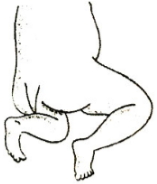
A
Vermiform appendix
B
Auricular muscles
C
Coccyx (short tail)
D
Plica semilunaris
Solution
(C) The figure shows a human infant with a vestigial tail,which is associated with the coccyx.
Atavism is the reappearance of certain ancestral characters that had either disappeared or were reduced during the course of evolution.
Some examples of atavism in human beings include the power of moving the pinna in some persons,developed canine teeth,exceptionally long dense hairs,a short tail in some babies (involving the coccyx),and the presence of additional mammae in some individuals.
Atavism is the reappearance of certain ancestral characters that had either disappeared or were reduced during the course of evolution.
Some examples of atavism in human beings include the power of moving the pinna in some persons,developed canine teeth,exceptionally long dense hairs,a short tail in some babies (involving the coccyx),and the presence of additional mammae in some individuals.
0 likes
View Solution308
MediumMCQ
The biochemical analysis of different chlorophyll pigments in plants would be most useful in determining
A
How plants reproduce asexually
B
How plants pass favourable traits to their offspring
C
Why some plants produce haemoglobin
D
Which plants might have a common ancestor
Solution
(D) Comparative biochemistry is the field of biology that deals with comparing similarities among different species' $DNA$ and proteins produced from the $DNA$. The more similar the $DNA$ or biochemical molecules (like chlorophyll pigments) of two different species are,the closer the evolutionary link,and the more recent the two species shared a common ancestor.
0 likes
View Solution309
MediumMCQ
$A$ good example for recapitulation theory is
A
Embryonic membranes of reptiles
B
Tadpole larva of frog
C
Placenta of mammals
D
Canine teeth of frog
Solution
(B) Recapitulation theory,also known as the Biogenetic Law,states that ontogeny recapitulates phylogeny. This means an organism's development (ontogeny) repeats the evolutionary history of its ancestors (phylogeny). The tadpole larva of a frog is a classic example because it possesses gills and a tail,reflecting the aquatic,fish-like ancestry of amphibians before undergoing metamorphosis into an adult frog.
0 likes
View Solution310
MediumMCQ
Fossils are useful in
A
Studying extinct organisms
B
Studying the history of organisms
C
Both $(a)$ and $(b)$
D
None of the above
Solution
(C) The correct answer is $(c)$.
Fossils are the remains of hard parts of life-forms found in rocks. The study of fossils is known as Palaeontology.
$1$. Palaeontological evidences (evidences from fossil records) are crucial for understanding evolutionary history.
$2$. Fossils allow us to study extinct organisms that no longer exist on Earth.
$3$. By examining different sedimentary layers,we can determine the geological time period in which specific organisms existed,thus helping us study the history of life on Earth.
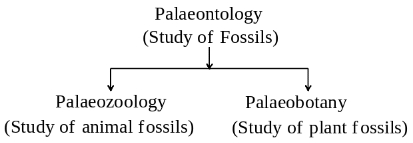
$4$. Palaeontology is further divided into Palaeozoology (study of animal fossils) and Palaeobotany (study of plant fossils).
Fossils are the remains of hard parts of life-forms found in rocks. The study of fossils is known as Palaeontology.
$1$. Palaeontological evidences (evidences from fossil records) are crucial for understanding evolutionary history.
$2$. Fossils allow us to study extinct organisms that no longer exist on Earth.
$3$. By examining different sedimentary layers,we can determine the geological time period in which specific organisms existed,thus helping us study the history of life on Earth.
$4$. Palaeontology is further divided into Palaeozoology (study of animal fossils) and Palaeobotany (study of plant fossils).
0 likes
View Solution311
EasyMCQ
$A$ baby has been born with a small tail. It is a case of exhibiting:
A
Retrogressive evolution
B
Mutation
C
Atavism
D
Metamorphosis
Solution
(C) The phenomenon of the sudden reappearance of ancestral features in an organism is called $Atavism$.
In humans,the appearance of vestigial or ancestral traits such as a short temporary tail,thick body hair,or additional nipples in a newborn is a classic example of $Atavism$.
This occurs due to the expression of genes that were active in distant ancestors but have been suppressed during the course of evolution.
In humans,the appearance of vestigial or ancestral traits such as a short temporary tail,thick body hair,or additional nipples in a newborn is a classic example of $Atavism$.
This occurs due to the expression of genes that were active in distant ancestors but have been suppressed during the course of evolution.
0 likes
View Solution312
MediumMCQ
Which of the given pairs are correct?
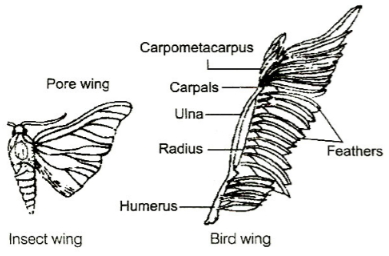
$I.$ Wings of insects and birds are homologous organs.
$II.$ Wings of bats and birds are homologous organs.
$III.$ Wings of insects and bats are analogous organs.
$IV.$ Wings of insects and birds are analogous organs.
Choose the correct option.
$I.$ Wings of insects and birds are homologous organs.
$II.$ Wings of bats and birds are homologous organs.
$III.$ Wings of insects and bats are analogous organs.
$IV.$ Wings of insects and birds are analogous organs.
Choose the correct option.
A
$I$ and $II$
B
$I$ and $III$
C
$III$ and $IV$
D
$II, III$ and $IV$
Solution
(D) $I.$ Wings of insects and birds are analogous organs because they perform the same function (flight) but have different embryonic origins. Thus,statement $I$ is incorrect.
$II.$ Wings of bats and birds are homologous organs because they share a common ancestral structural plan (forelimbs of tetrapods) despite performing similar functions. Thus,statement $II$ is correct.
$III.$ Wings of insects and bats are analogous organs because they have different origins but perform the same function. Thus,statement $III$ is correct.
$IV.$ Wings of insects and birds are analogous organs because they have different origins but perform the same function. Thus,statement $IV$ is correct.
Therefore,statements $II, III,$ and $IV$ are correct.
$II.$ Wings of bats and birds are homologous organs because they share a common ancestral structural plan (forelimbs of tetrapods) despite performing similar functions. Thus,statement $II$ is correct.
$III.$ Wings of insects and bats are analogous organs because they have different origins but perform the same function. Thus,statement $III$ is correct.
$IV.$ Wings of insects and birds are analogous organs because they have different origins but perform the same function. Thus,statement $IV$ is correct.
Therefore,statements $II, III,$ and $IV$ are correct.
0 likes
View Solution313
MediumMCQ
Krebs' cycle,glycolysis,lipogenesis,and enzymes indicate which of the following?
A
Biochemical evidence of evolution
B
Morphological evidence of evolution
C
Anatomical evidence of evolution
D
Biogeographical evidence of evolution
Solution
(A) Biochemical evidence of evolution is based on the similarities in proteins,genes,and metabolic pathways across diverse organisms,which suggests a common ancestry.
Many metabolic processes,such as the Krebs' cycle,glycolysis,and lipogenesis,utilize the same or similar enzymes in a wide variety of organisms.
These conserved biochemical pathways provide strong evidence that different species have evolved from a common ancestor.
Many metabolic processes,such as the Krebs' cycle,glycolysis,and lipogenesis,utilize the same or similar enzymes in a wide variety of organisms.
These conserved biochemical pathways provide strong evidence that different species have evolved from a common ancestor.
0 likes
View Solution314
MediumMCQ
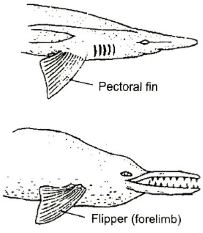
The diagram given below indicates:
A
Homologous organs
B
Analogous organs
C
Atavism
D
Divergent evolution
Solution
(B) The diagram shows the pectoral fin of a shark and the flipper (forelimb) of a dolphin.
Analogous organs are those that perform similar functions but have different anatomical structures and different developmental origins.
The pectoral fins of sharks and the flippers of dolphins are classic examples of analogous organs.
While both are adapted for swimming,their internal skeletal structures are fundamentally different; the shark's fin lacks the pentadactyl limb structure found in the dolphin's flipper.
Therefore,they represent convergent evolution,not divergent evolution.
Analogous organs are those that perform similar functions but have different anatomical structures and different developmental origins.
The pectoral fins of sharks and the flippers of dolphins are classic examples of analogous organs.
While both are adapted for swimming,their internal skeletal structures are fundamentally different; the shark's fin lacks the pentadactyl limb structure found in the dolphin's flipper.
Therefore,they represent convergent evolution,not divergent evolution.
0 likes
View Solution315
EasyMCQ
In human beings,vestigial organs are:
A
Wisdom teeth,coccyx,vermiform appendix,nail,eyelid
B
Wisdom teeth,coccyx,vermiform appendix,pancreas,elbow joint
C
Wisdom teeth,coccyx,vermiform appendix,nictitating membrane,auricular muscles
D
Coccyx,wisdom teeth,nail,auricular muscles
Solution
(C) Vestigial organs are anatomical structures that have lost their original ancestral function through evolution.
In humans,several such organs exist,including:
$(i)$ Wisdom teeth (third molars).
$(ii)$ Coccyx (tailbone).
$(iii)$ Vermiform appendix.
$(iv)$ Nictitating membrane (plica semilunaris in the eye).
$(v)$ Auricular muscles (muscles around the ear).
Therefore,option $C$ correctly lists these vestigial structures.
In humans,several such organs exist,including:
$(i)$ Wisdom teeth (third molars).
$(ii)$ Coccyx (tailbone).
$(iii)$ Vermiform appendix.
$(iv)$ Nictitating membrane (plica semilunaris in the eye).
$(v)$ Auricular muscles (muscles around the ear).
Therefore,option $C$ correctly lists these vestigial structures.
0 likes
View Solution316
MediumMCQ
Stings of honey bee and the stings of scorpion are
$I.$ analogous organs
$II.$ heterologous organs
$III.$ homologous organs
$IV.$ vestigial organs
The correct combination is
$I.$ analogous organs
$II.$ heterologous organs
$III.$ homologous organs
$IV.$ vestigial organs
The correct combination is
A
$III$ and $IV$
B
$II$ and $III$
C
$I$ and $II$
D
$I$ and $III$
Solution
(C) Analogous organs are those that perform similar functions but have different evolutionary origins and anatomical structures.
The sting of a honey bee is a modified ovipositor (an abdominal appendage),whereas the sting of a scorpion is a modified telson (the terminal segment of the abdomen).
Since both structures serve the same function (defense/offense) but arise from different embryonic tissues and anatomical parts,they are considered analogous organs.
Analogous organs are a result of convergent evolution,where unrelated organisms evolve similar traits to adapt to similar environmental pressures.
The sting of a honey bee is a modified ovipositor (an abdominal appendage),whereas the sting of a scorpion is a modified telson (the terminal segment of the abdomen).
Since both structures serve the same function (defense/offense) but arise from different embryonic tissues and anatomical parts,they are considered analogous organs.
Analogous organs are a result of convergent evolution,where unrelated organisms evolve similar traits to adapt to similar environmental pressures.
0 likes
View Solution317
MediumMCQ
The diagram given below indicates:
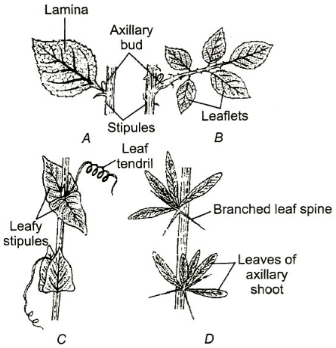
A
Analogous organs
B
Homologous organs
C
Convergent evolution
D
All of these
Solution
(B) The correct answer is $B$ (Homologous organs).
Homologous organs are those organs which share a common ancestral origin and have the same fundamental anatomical structure,but perform different functions due to adaptation to different environments.
In the provided diagram,the structures shown (such as thorns of Bougainvillea and tendrils of Cucurbita,or various leaf modifications) represent homologous structures because they all arise from the axillary position,indicating a common developmental origin despite their different functional modifications.
Homologous organs are the result of divergent evolution,where species with a common ancestor evolve different traits to adapt to diverse ecological niches.
Homologous organs are those organs which share a common ancestral origin and have the same fundamental anatomical structure,but perform different functions due to adaptation to different environments.
In the provided diagram,the structures shown (such as thorns of Bougainvillea and tendrils of Cucurbita,or various leaf modifications) represent homologous structures because they all arise from the axillary position,indicating a common developmental origin despite their different functional modifications.
Homologous organs are the result of divergent evolution,where species with a common ancestor evolve different traits to adapt to diverse ecological niches.
0 likes
View Solution318
MediumMCQ
Which one among the following is an example of homology?
A
Eye of Octopus and mammals
B
Tuber of sweet potato and potato
C
Wings of butterfly and birds
D
Thorn and tendrils of Bougainvillea and Cucurbita
Solution
(D) Homology indicates common ancestry and is based on divergent evolution.
In plants,the thorns of Bougainvillea and the tendrils of Cucurbita are homologous structures because they both arise from axillary buds,indicating a common evolutionary origin despite their different functions.
In plants,the thorns of Bougainvillea and the tendrils of Cucurbita are homologous structures because they both arise from axillary buds,indicating a common evolutionary origin despite their different functions.
0 likes
View Solution319
MediumMCQ
Separate the following into homologous and analogous organs:
$I.$ Sweet potato
$II.$ Potato
$III.$ Flippers of penguins and dolphins
$IV.$ Hearts of different vertebrates
$V.$ Forelimbs of whales,bats,and cheetahs
The correct option is:
$I.$ Sweet potato
$II.$ Potato
$III.$ Flippers of penguins and dolphins
$IV.$ Hearts of different vertebrates
$V.$ Forelimbs of whales,bats,and cheetahs
The correct option is:
A
Homologous Organs: $IV, V$; Analogous Organs: $I, II, III$
B
Homologous Organs: $IV, V, I$; Analogous Organs: $II, III$
C
Homologous Organs: $I, II$; Analogous Organs: $III, IV, V$
D
Homologous Organs: $III, IV, V$; Analogous Organs: $I, II$
Solution
(A) To classify these organs,we must understand the definitions:
$1.$ Homologous organs: These have a common origin and similar anatomical structure but perform different functions (e.g.,forelimbs of mammals,hearts of vertebrates).
$2.$ Analogous organs: These have different origins and anatomical structures but perform similar functions due to convergent evolution (e.g.,sweet potato (root modification) and potato (stem modification),flippers of penguins and dolphins).
Analysis:
- $I.$ Sweet potato (root) and $II.$ Potato (stem) are analogous as they both store food but have different origins.
- $III.$ Flippers of penguins (birds) and dolphins (mammals) are analogous as they are used for swimming but have different skeletal structures.
- $IV.$ Hearts of different vertebrates and $V.$ Forelimbs of whales,bats,and cheetahs are homologous as they share a common ancestral structural plan.
Therefore,Homologous organs are $IV$ and $V$,and Analogous organs are $I, II,$ and $III$.
$1.$ Homologous organs: These have a common origin and similar anatomical structure but perform different functions (e.g.,forelimbs of mammals,hearts of vertebrates).
$2.$ Analogous organs: These have different origins and anatomical structures but perform similar functions due to convergent evolution (e.g.,sweet potato (root modification) and potato (stem modification),flippers of penguins and dolphins).
Analysis:
- $I.$ Sweet potato (root) and $II.$ Potato (stem) are analogous as they both store food but have different origins.
- $III.$ Flippers of penguins (birds) and dolphins (mammals) are analogous as they are used for swimming but have different skeletal structures.
- $IV.$ Hearts of different vertebrates and $V.$ Forelimbs of whales,bats,and cheetahs are homologous as they share a common ancestral structural plan.
Therefore,Homologous organs are $IV$ and $V$,and Analogous organs are $I, II,$ and $III$.
0 likes
View Solution320
MediumMCQ
What is the use of Electronic Spin Resonance $(ESR)$ in fossil studies?
A
It helps to study the proteins in sedimentary fossils
B
It helps to revise the evolutionary period for different groups of organisms
C
It helps to study the enzymes present in sedimentary fossils
D
All of the above
Solution
(B) Electron Spin Resonance $(ESR)$ dating is a technique used to determine the age of materials found in archaeological sites.
Many materials at these sites trap electronic charges due to bombardment by radioactive radiation from the surrounding sediment.
The presence of these trapped charges can be detected using $(ESR)$ spectroscopy.
The intensity of the $(ESR)$ signal serves as a measure of the accumulated radiation dose,which is directly proportional to the age of the fossil.
Tooth enamel is commonly found at archaeological sites and is highly suitable for $(ESR)$ dating,offering a precision of about $10-20\, \%$.
This method is crucial for dating sites related to the biological and cultural evolution of modern humans,thereby helping to revise the evolutionary timeline for various groups of organisms.
Many materials at these sites trap electronic charges due to bombardment by radioactive radiation from the surrounding sediment.
The presence of these trapped charges can be detected using $(ESR)$ spectroscopy.
The intensity of the $(ESR)$ signal serves as a measure of the accumulated radiation dose,which is directly proportional to the age of the fossil.
Tooth enamel is commonly found at archaeological sites and is highly suitable for $(ESR)$ dating,offering a precision of about $10-20\, \%$.
This method is crucial for dating sites related to the biological and cultural evolution of modern humans,thereby helping to revise the evolutionary timeline for various groups of organisms.
0 likes
View Solution321
MediumMCQ
The given diagram depicts:
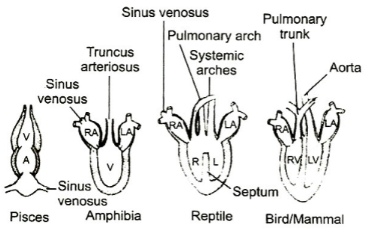
A
Evolutionary evidences from comparative anatomy and physiology
B
Evolutionary evidences from embryology
C
Evolutionary evidences from biochemistry and physiology
D
Evolutionary evidences from cytology
Solution
(A) The given diagram illustrates the comparative anatomy of the vertebrate heart,showing its evolutionary progression from the simple two-chambered heart in fishes to the complex four-chambered heart in birds and mammals. This serves as a classic example of evolutionary evidence derived from comparative anatomy and morphology,demonstrating how structural modifications have occurred over time to support more efficient circulation.
0 likes
View Solution322
MediumMCQ
Which of the following is not the result of convergent evolution?
A
Forelimbs of whales and bats
B
Flippers of penguins and dolphins
C
Potato and sweet potato
D
Eye of the octopus and mammals
Solution
(A) Convergent evolution occurs when different species evolve similar traits independently as an adaptation to similar environments.
$A$. Forelimbs of whales and bats are homologous organs,meaning they share a common ancestral structure but have adapted for different functions (swimming vs. flying). This is a result of divergent evolution,not convergent evolution.
$B$. Flippers of penguins (birds) and dolphins (mammals) are analogous organs,representing convergent evolution.
$C$. Potato (stem modification) and sweet potato (root modification) are analogous structures for storage,representing convergent evolution.
$D$. Eyes of the octopus and mammals are analogous structures,representing convergent evolution.
$A$. Forelimbs of whales and bats are homologous organs,meaning they share a common ancestral structure but have adapted for different functions (swimming vs. flying). This is a result of divergent evolution,not convergent evolution.
$B$. Flippers of penguins (birds) and dolphins (mammals) are analogous organs,representing convergent evolution.
$C$. Potato (stem modification) and sweet potato (root modification) are analogous structures for storage,representing convergent evolution.
$D$. Eyes of the octopus and mammals are analogous structures,representing convergent evolution.
0 likes
View Solution323
EasyMCQ
The palaeontological evidences are obtained from
A
Homologous structures
B
Analogous structures
C
Fossils
D
Lichens
Solution
(C) Palaeontology is the branch of science concerned with fossil animals and plants.
Fossils are the preserved remains or traces of organisms from the remote past.
Therefore,palaeontological evidences for evolution are obtained from the study of fossils.
Fossils are the preserved remains or traces of organisms from the remote past.
Therefore,palaeontological evidences for evolution are obtained from the study of fossils.
0 likes
View Solution324
EasyMCQ
Archaeopteryx is a connecting link between
A
Birds and reptiles
B
Reptiles and mammals
C
Annelids and arthropods
D
Amphibians and fishes
Solution
(A) Archaeopteryx is a fossil organism that serves as a connecting link between reptiles and birds.
It exhibits reptilian features such as a long tail,teeth in jaws,and claws on the forelimbs.
Simultaneously,it possesses avian features such as feathers and wings,indicating that birds evolved from reptilian ancestors.
It exhibits reptilian features such as a long tail,teeth in jaws,and claws on the forelimbs.
Simultaneously,it possesses avian features such as feathers and wings,indicating that birds evolved from reptilian ancestors.
0 likes
View Solution325
EasyMCQ
Fossils of $Archaeopteryx$ were found from:
A
Jurassic rocks
B
Triassic rocks
C
Cretaceous rocks
D
Cenozoic rocks
Solution
(A) $Archaeopteryx$ is a well-known fossil that serves as a connecting link between reptiles and birds.
It lived during the $Jurassic$ period of the Mesozoic Era.
The fossils of $Archaeopteryx$ were discovered in the Solnhofen Limestone deposits in Bavaria,Germany,which date back to the late $Jurassic$ period.
It lived during the $Jurassic$ period of the Mesozoic Era.
The fossils of $Archaeopteryx$ were discovered in the Solnhofen Limestone deposits in Bavaria,Germany,which date back to the late $Jurassic$ period.
0 likes
View Solution326
EasyMCQ
Replacement of original hard parts or even the soft tissues of the organisms by minerals is known as
A
Compression
B
Petrification
C
Moulds
D
Amber
Solution
(B) Petrification is the process where minerals replace the organic matter of an organism,turning it into stone.
Compression occurs when the internal structure is lost,leaving behind a thin carbon film; it is a common type of plant fossil.
Moulds are formed when the original structure decays,leaving behind an exact impression or cavity of the organism.
Amber is fossilized resin secreted from ancient pine trees.
Compression occurs when the internal structure is lost,leaving behind a thin carbon film; it is a common type of plant fossil.
Moulds are formed when the original structure decays,leaving behind an exact impression or cavity of the organism.
Amber is fossilized resin secreted from ancient pine trees.
0 likes
View Solution327
MediumMCQ
Which of the following is richest in fossils?
A
Basalt
B
Granite
C
Lava
D
Sedimentary rock
Solution
(D) Fossils are the preserved remains or traces of organisms from the past.
Sedimentary rocks are formed by the accumulation and compaction of sediments over long periods.
Because these rocks form in layers at relatively low temperatures and pressures,they are the only rock type that can preserve delicate biological structures without destroying them.
Igneous rocks like $Basalt$,$Granite$,and $Lava$ are formed from molten magma or lava,which would destroy any biological remains.
Sedimentary rocks are formed by the accumulation and compaction of sediments over long periods.
Because these rocks form in layers at relatively low temperatures and pressures,they are the only rock type that can preserve delicate biological structures without destroying them.
Igneous rocks like $Basalt$,$Granite$,and $Lava$ are formed from molten magma or lava,which would destroy any biological remains.
0 likes
View Solution328
EasyMCQ
Excreta preserved as a fossil is called as
A
Stromatolite
B
Compression fossil
C
Intact fossil
D
Coprolite
Solution
(D) $Coprolite$ is a fossilized form of animal feces or excreta. These fossils provide valuable information about the diet and digestive habits of ancient organisms.
$Stromatolites$ are layered structures formed by the growth of cyanobacterial mats.
$Compression$ $fossils$ are formed when an organism is flattened by pressure.
$Intact$ $fossils$ refer to organisms preserved in their entirety,such as in amber or ice.
$Stromatolites$ are layered structures formed by the growth of cyanobacterial mats.
$Compression$ $fossils$ are formed when an organism is flattened by pressure.
$Intact$ $fossils$ refer to organisms preserved in their entirety,such as in amber or ice.
0 likes
View Solution329
MediumMCQ
Convergent evolution is illustrated by
A
Rat and Dog
B
Bacterium and Protozoan
C
Star fish and Cuttle fish
D
Dog fish and Whale
Solution
(D) Convergent evolution refers to the process where organisms not closely related independently evolve similar traits as a result of having to adapt to similar environments or ecological niches.
$Dog$ $fish$ $(Scoliodon)$ is a cartilaginous fish (Pisces),while a $Whale$ is a mammal.
Both have evolved streamlined bodies and fins to adapt to an aquatic lifestyle,representing an example of convergent evolution.
$Dog$ $fish$ $(Scoliodon)$ is a cartilaginous fish (Pisces),while a $Whale$ is a mammal.
Both have evolved streamlined bodies and fins to adapt to an aquatic lifestyle,representing an example of convergent evolution.
0 likes
View Solution330
MediumMCQ
All the following are examples of homologous organs,except:
A
Arm of man and flipper of whale
B
Thorn of Bougainvillaea and tendril of Cucurbita
C
Eye of an octopus and eye of a mammal
D
Brain of frog and man
Solution
(C) Homologous organs are those that have a common ancestral origin and similar basic structural plan but perform different functions.
$A$,$B$,and $D$ represent homologous organs because they share a common evolutionary origin.
$C$ (Eye of an octopus and eye of a mammal) represents analogous organs. These structures perform similar functions (vision) but have evolved independently in different groups,which is an example of convergent evolution.
$A$,$B$,and $D$ represent homologous organs because they share a common evolutionary origin.
$C$ (Eye of an octopus and eye of a mammal) represents analogous organs. These structures perform similar functions (vision) but have evolved independently in different groups,which is an example of convergent evolution.
0 likes
View Solution331
MediumMCQ
Which of the following are homologous organs?
A
Wings of pigeon and housefly
B
Wings of housefly and bat
C
Wings of pigeon and forelimbs of man
D
Wings of butterfly,bat and housefly
Solution
(C) Homologous organs are those that have the same basic structural plan and embryonic origin but may perform different functions.
Wings of a pigeon and the forelimbs of a man share the same skeletal structure (humerus,radius,ulna,carpals,metacarpals,and phalanges),indicating a common evolutionary ancestry.
In contrast,wings of insects and birds are analogous organs because they perform the same function (flight) but have different structural origins.
Wings of a pigeon and the forelimbs of a man share the same skeletal structure (humerus,radius,ulna,carpals,metacarpals,and phalanges),indicating a common evolutionary ancestry.
In contrast,wings of insects and birds are analogous organs because they perform the same function (flight) but have different structural origins.
0 likes
View Solution332
EasyMCQ
Anatomically and structurally different,but functionally similar structures are called
A
Analogous
B
Divergent
C
Homologous
D
Convergent
Solution
(A) Structures that are anatomically and structurally different but perform similar functions are known as analogous structures.
These structures are a result of convergent evolution,where different species evolve similar traits to adapt to similar environmental pressures.
In contrast,homologous organs have a similar origin and anatomical structure but may perform different functions,representing divergent evolution.
These structures are a result of convergent evolution,where different species evolve similar traits to adapt to similar environmental pressures.
In contrast,homologous organs have a similar origin and anatomical structure but may perform different functions,representing divergent evolution.
0 likes
View Solution333
MediumMCQ
Organs which have similar origin and developmental plan,but different functions are called
A
Vestigial organs
B
Analogous organs
C
Homologous organs
D
Physiological organs
Solution
(C) Organs that share a similar evolutionary origin and developmental pattern but perform different functions are known as homologous organs.
Examples include the forelimbs of whales,bats,cheetahs,and humans,which share the same structural plan (humerus,radius,ulna,carpals,metacarpals,and phalanges) but are adapted for different functions like swimming,flying,running,or grasping.
In contrast,vestigial organs are non-functional remnants of structures that were functional in ancestors.
Examples include the forelimbs of whales,bats,cheetahs,and humans,which share the same structural plan (humerus,radius,ulna,carpals,metacarpals,and phalanges) but are adapted for different functions like swimming,flying,running,or grasping.
In contrast,vestigial organs are non-functional remnants of structures that were functional in ancestors.
0 likes
View Solution334
MediumMCQ
Find the odd one out.
A
Trunk of an elephant and hand of a chimpanzee
B
Ginger and sweet potato
C
Wings of bat and insect
D
Nails of human beings and claws of a cat
Solution
(D) The correct answer is $D$.
$A$,$B$,and $C$ represent analogous organs,which have different anatomical origins but perform similar functions.
$A$ (Trunk of an elephant and hand of a chimpanzee) are homologous organs.
$B$ (Ginger and sweet potato) are analogous organs (both are modified storage organs).
$C$ (Wings of bat and insect) are analogous organs.
$D$ (Nails of human beings and claws of a cat) are homologous structures as they share a common evolutionary origin and basic structural plan,making them the odd one out in the context of analogy.
$A$,$B$,and $C$ represent analogous organs,which have different anatomical origins but perform similar functions.
$A$ (Trunk of an elephant and hand of a chimpanzee) are homologous organs.
$B$ (Ginger and sweet potato) are analogous organs (both are modified storage organs).
$C$ (Wings of bat and insect) are analogous organs.
$D$ (Nails of human beings and claws of a cat) are homologous structures as they share a common evolutionary origin and basic structural plan,making them the odd one out in the context of analogy.
0 likes
View Solution335
MediumMCQ
The convergent evolution of two species is usually associated with
A
$A$ recent common ancestor
B
Analogous organ
C
Homologous organ
D
Different habitat
Solution
(B) Convergent evolution occurs when different species independently evolve similar traits as a result of having to adapt to similar environments or ecological niches.
This process leads to the development of analogous organs,which are structures that perform similar functions but do not share a common evolutionary origin.
In contrast,divergent evolution is associated with homologous organs,which share a common evolutionary origin but may perform different functions.
This process leads to the development of analogous organs,which are structures that perform similar functions but do not share a common evolutionary origin.
In contrast,divergent evolution is associated with homologous organs,which share a common evolutionary origin but may perform different functions.
0 likes
View Solution336
MediumMCQ
Find the odd one out with respect to evolution.
A
Seal's flipper
B
Bat's wing
C
Horse's foot
D
Butterfly's wings
Solution
(D) In the context of evolution,$A$,$B$,and $C$ (Seal's flipper,Bat's wing,and Horse's foot) are examples of homologous organs. These structures share a common anatomical origin (pentadactyl limb structure) but have evolved to perform different functions due to divergent evolution.
Butterfly's wings are analogous organs compared to the wings of birds or bats. They are anatomically different from the limbs of vertebrates,as they lack an internal bony skeleton,representing convergent evolution.
Butterfly's wings are analogous organs compared to the wings of birds or bats. They are anatomically different from the limbs of vertebrates,as they lack an internal bony skeleton,representing convergent evolution.
0 likes
View Solution337
MediumMCQ
Which of the following is not a vestigial organ in human beings?
A
Rudimentary ear muscles,third molars (wisdom teeth),and body hair
B
Coccygeal tail vertebrae and scalp muscles
C
Vermiform appendix and nictitating membrane of the eye
D
Ear pinna,patella,and olecranon process
Solution
(D) Vestigial organs are anatomical structures that have lost most or all of their ancestral function in a given species.
$A$,$B$,and $C$ contain examples of vestigial structures in humans,such as the appendix,wisdom teeth,and nictitating membrane.
$D$ is the correct answer because the ear pinna (external ear),patella (kneecap),and olecranon process (part of the ulna bone) are fully functional,non-vestigial structures in humans.
$A$,$B$,and $C$ contain examples of vestigial structures in humans,such as the appendix,wisdom teeth,and nictitating membrane.
$D$ is the correct answer because the ear pinna (external ear),patella (kneecap),and olecranon process (part of the ulna bone) are fully functional,non-vestigial structures in humans.
0 likes
View Solution338
EasyMCQ
Which of the following is a vestigial organ?
A
Vermiform appendix
B
Atlas
C
Premolars
D
Incisors
Solution
(A) vestigial organ is an anatomical structure that has lost most or all of its original function through the process of evolution.
In humans,the vermiform appendix is a classic example of a vestigial organ,as it is a remnant of the cecum which was used for cellulose digestion in our ancestors.
Atlas is the first cervical vertebra,premolars and incisors are functional teeth used for mastication.
In humans,the vermiform appendix is a classic example of a vestigial organ,as it is a remnant of the cecum which was used for cellulose digestion in our ancestors.
Atlas is the first cervical vertebra,premolars and incisors are functional teeth used for mastication.
0 likes
View Solution339
EasyMCQ
Which of the following is not a vestigial organ?
A
Scalp hair
B
Epiglottis
C
Vermiform appendix
D
Wisdom tooth
Solution
(B) vestigial organ is an anatomical structure that has lost most or all of its original function through evolution.
$A$. Scalp hair,$C$. Vermiform appendix,and $D$. Wisdom tooth are considered vestigial structures in humans.
$B$. Epiglottis is a functional flap of elastic cartilage that covers the glottis during swallowing to prevent food from entering the trachea. Therefore,it is not a vestigial organ.
$A$. Scalp hair,$C$. Vermiform appendix,and $D$. Wisdom tooth are considered vestigial structures in humans.
$B$. Epiglottis is a functional flap of elastic cartilage that covers the glottis during swallowing to prevent food from entering the trachea. Therefore,it is not a vestigial organ.
0 likes
View Solution340
EasyMCQ
The 'Recapitulation Theory' was put forth by
A
Haeckel
B
Cuvier
C
Wallace
D
Lamarck
Solution
(A) The 'Recapitulation Theory',also known as the Biogenetic Law,was proposed by Ernst Haeckel in $1866$.
It states that 'ontogeny repeats phylogeny',meaning the development of an individual organism (ontogeny) reflects the evolutionary history of its species (phylogeny).
Therefore,the correct answer is Haeckel.
It states that 'ontogeny repeats phylogeny',meaning the development of an individual organism (ontogeny) reflects the evolutionary history of its species (phylogeny).
Therefore,the correct answer is Haeckel.
0 likes
View Solution341
MediumMCQ
Gill clefts and notochord appear in the embryonic development of all vertebrates from fishes to mammals. This supports the theory of
A
Recapitulation
B
Metamorphosis
C
Biogenesis
D
Abiogenesis
Solution
(A) The presence of gill clefts and a notochord during the embryonic development of all vertebrates,from fishes to mammals,provides evidence for the theory of Recapitulation (also known as the Biogenetic Law).
This theory,proposed by Ernst Haeckel,states that 'Ontogeny repeats or recapitulates phylogeny',meaning that an organism's development (ontogeny) reflects the evolutionary history (phylogeny) of its ancestors.
This theory,proposed by Ernst Haeckel,states that 'Ontogeny repeats or recapitulates phylogeny',meaning that an organism's development (ontogeny) reflects the evolutionary history (phylogeny) of its ancestors.
0 likes
View Solution342
EasyMCQ
The presence of a tail and coarse hair in a human baby is an example of:
A
Radiation
B
Atavism
C
Mutation
D
Crossing over
Solution
(B) Atavism is a biological phenomenon where an organism exhibits ancestral traits that had disappeared or were suppressed in the course of evolution. The appearance of a vestigial tail or excessive body hair (hypertrichosis) in human infants are classic examples of atavism,reflecting the evolutionary history of humans.
0 likes
View Solution343
EasyMCQ
In $1938$,a coelacanth was found in
A
South America
B
South Africa
C
Australia
D
England
Solution
(B) In $1938$,a living coelacanth was discovered off the coast of South Africa. This fish was named $Latimeria$ and is considered a living fossil. It is significant in evolutionary biology as it represents a group that was thought to be extinct and is often discussed in the context of the transition from fishes to tetrapods (amphibians).
0 likes
View Solution344
MediumMCQ
The homologous structures are
A
Anatomically different
B
Functionally different,evolved from different ancestors
C
Functionally same
D
Anatomically same,but perform different functions
Solution
(D) Homologous structures are those that share a common evolutionary origin and have similar anatomical structures,but they may perform different functions due to divergent evolution. For example,the forelimbs of whales,bats,cheetahs,and humans have similar bone structures but perform different functions like swimming,flying,running,and grasping.
0 likes
View Solution345
MediumMCQ
Find the odd one out related to evolution.
A
Vertebrate hearts
B
Vertebrate brains
C
Wings of butterfly and of birds
D
Forelimbs of mammals
Solution
(C) Vertebrate hearts,vertebrate brains,and forelimbs of mammals are examples of homologous organs,which indicate divergent evolution.
Wings of butterfly and birds are analogous structures,which indicate convergent evolution.
Therefore,wings of butterfly and birds is the odd one out.
Wings of butterfly and birds are analogous structures,which indicate convergent evolution.
Therefore,wings of butterfly and birds is the odd one out.
0 likes
View Solution346
MediumMCQ
Hummingbirds and hawks illustrate:
A
Convergent evolution
B
Homology
C
Adaptive radiation
D
Parallel evolution
Solution
(A) Hummingbirds and hawks are examples of convergent evolution. Convergent evolution occurs when unrelated species evolve similar traits or adaptations to survive in similar environments or ecological niches. In this case,both birds have evolved wings for flight,despite having different ancestral origins.
0 likes
View Solution347
EasyMCQ
Which one provides direct and solid evidence in favour of organic evolution through ages?
A
Atavism
B
Palaeontology
C
Vestigial organs
D
Galapagos island fauna
Solution
(B) Palaeontology is the study of fossils. Fossils are the remains or impressions of hard parts of life forms found in rocks. They provide direct and solid evidence for organic evolution because they show the chronological sequence of life forms that existed in the past,allowing us to trace the evolutionary history of organisms over geological time.
0 likes
View Solution348
MediumMCQ
$A$: Archaeopteryx had free caudal vertebrae and a toothed beak with teeth like reptiles.
$R$: It is a missing link between reptiles and birds.
$R$: It is a missing link between reptiles and birds.
A
Assertion and Reason both are correct and Reason is the correct explanation of Assertion.
B
Assertion and Reason both are correct but Reason is not the correct explanation of Assertion.
C
Assertion is correct,but Reason is incorrect.
D
Both Assertion and Reason are incorrect.
Solution
(A) Archaeopteryx is considered a classic example of a connecting link between reptiles and birds.
It possessed reptilian characters such as a long tail with free caudal vertebrae,teeth in the jaws,and claws on the forelimbs.
It also possessed avian characters such as wings with feathers and a beak.
The term 'missing link' refers to an extinct organism that shows characteristics of two different groups,indicating an evolutionary transition.
Therefore,both the Assertion and the Reason are correct,and the Reason correctly explains why Archaeopteryx is significant in evolutionary biology.
It possessed reptilian characters such as a long tail with free caudal vertebrae,teeth in the jaws,and claws on the forelimbs.
It also possessed avian characters such as wings with feathers and a beak.
The term 'missing link' refers to an extinct organism that shows characteristics of two different groups,indicating an evolutionary transition.
Therefore,both the Assertion and the Reason are correct,and the Reason correctly explains why Archaeopteryx is significant in evolutionary biology.
0 likes
View Solution349
MediumMCQ
$A$: Blood group analysis shows that human beings are more closely related to apes than to monkeys.
$R$: The blood groups $A$ and $B$ are found in apes but not in monkeys.
$R$: The blood groups $A$ and $B$ are found in apes but not in monkeys.
A
Assertion and Reason both are correct and Reason is the correct explanation of Assertion.
B
Assertion and Reason both are correct but Reason is not the correct explanation of Assertion.
C
Assertion is correct,but Reason is incorrect.
D
Both Assertion and Reason are incorrect.
Solution
(A) The study of blood groups,specifically the $ABO$ blood group system,provides molecular evidence for evolutionary relationships.
Humans and apes (such as chimpanzees and gorillas) share the presence of $A$ and $B$ antigens in their blood,which are absent in monkeys.
This biochemical similarity indicates a closer evolutionary lineage between humans and apes compared to monkeys,supporting the theory of a common ancestor.
Therefore,both the Assertion and the Reason are correct,and the Reason provides the correct explanation for the Assertion.
Humans and apes (such as chimpanzees and gorillas) share the presence of $A$ and $B$ antigens in their blood,which are absent in monkeys.
This biochemical similarity indicates a closer evolutionary lineage between humans and apes compared to monkeys,supporting the theory of a common ancestor.
Therefore,both the Assertion and the Reason are correct,and the Reason provides the correct explanation for the Assertion.
0 likes
View Solution350
MediumMCQ
$A$: Similarities in proteins and genes performing a given function among diverse organisms give clues to common ancestry.
$R$: All groups of vertebrates arise from a common ancestor with great adaptation capability.
$R$: All groups of vertebrates arise from a common ancestor with great adaptation capability.
A
Assertion and Reason both are correct and Reason is the correct explanation of Assertion.
B
Assertion and Reason both are correct but Reason is not the correct explanation of Assertion.
C
Assertion is correct,but Reason is incorrect.
D
Both Assertion and Reason are incorrect.
Solution
(A) The Assertion is correct because molecular homology,such as similarities in proteins (e.g.,cytochrome $c$) and genes across diverse organisms,provides strong evidence for common ancestry.
The Reason is also correct because all vertebrates share a common ancestor and have evolved through adaptive radiation to occupy diverse niches,demonstrating great adaptation capability.
Since the molecular evidence mentioned in the Assertion is a fundamental way to establish the evolutionary relationships that confirm the common ancestry mentioned in the Reason,the Reason correctly explains the Assertion.
The Reason is also correct because all vertebrates share a common ancestor and have evolved through adaptive radiation to occupy diverse niches,demonstrating great adaptation capability.
Since the molecular evidence mentioned in the Assertion is a fundamental way to establish the evolutionary relationships that confirm the common ancestry mentioned in the Reason,the Reason correctly explains the Assertion.
0 likes
View SolutionEvolution — Evidences of Evolution · Frequently Asked Questions
1Are these Evolution questions useful for JEE and NEET?
Yes. All questions in this section are mapped to JEE Main and NEET exam patterns. Previous year questions from JEE Main, NEET, GUJCET and state-level exams are included with full solutions.
2Can I switch to Hindi or Gujarati for these questions?
Yes. Use the language tabs in the hero section or the sidebar to view the same questions and solutions in English, Hindi or Gujarati.
3How do I generate a question paper from this subtopic?
Use the Vedclass Exam Paper Generator — select the chapter and subtopic, set difficulty, and generate Sets A, B, C, D automatically. First 3 chapters of every subject are free.
Vedclass Products
For Students
Vedclass Test Series
Mock tests in real JEE/NEET style with performance analysis. 5-day free trial.
Start Free TrialFor Teachers
Exam Paper Generator
Generate Set A/B/C/D papers from this chapter in 2 minutes. 3 chapters free.
Try FreeFor Institutes
Online Exam Module
Live online exams with unlimited students, 360° analytics & white-label branding.
See DemoFor Teachers & Institutes
Generate a Evolution Exam Paper in 2 Minutes
Select subtopic & difficulty — Sets A, B, C, D auto-generated with No Repeat logic.
First 3 chapters of every subject are free — no payment required.