
A English
Evidences of Evolution Questions in English
Class 12 Biology · Evolution · Evidences of Evolution
396+
Questions
English
Language
100%
With Solutions
Showing 50 of 396 questions in English
251
Medium
How do paleontology,comparative anatomy,and morphology help in the study of evolution?
Solution
(N/A) Evidences that the evolution of life forms has indeed taken place on Earth have come from many sources.
$1$. Paleontological evidences: Paleontology is the study of fossils,which are the remains of hard parts of life forms found in rocks.
- Rocks form sediments,and a cross-section of the Earth's crust depicts the arrangement of these sediments one over the other during the long history of the Earth.
- Sediments of different aged rocks contain fossils of different life forms that lived and died during the formation of a particular segment.
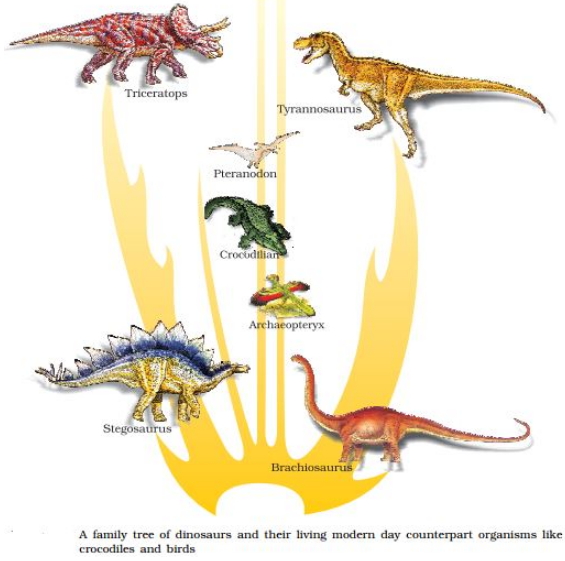
- Some of these appear similar to modern organisms,while others represent extinct organisms like dinosaurs.
- The study of fossils in different sedimentary layers indicates the geological period in which they existed.
- It shows that life forms varied over time and that certain life forms are restricted to specific geological time scales.
- Hence,new forms of life have evolved at different times in the history of the Earth.
$2$. Comparative anatomy and morphology: These provide evidence for evolution by comparing the structural similarities and differences among organisms.
- Homologous organs: Organs that have the same structural origin and developmental pattern but perform different functions (e.g.,the forelimbs of whales,bats,cheetahs,and humans). This indicates common ancestry (divergent evolution).
- Analogous organs: Organs that perform similar functions but have different structural origins (e.g.,the wings of a butterfly and a bird). This indicates convergent evolution,where different organisms adapt to similar environmental conditions.
$1$. Paleontological evidences: Paleontology is the study of fossils,which are the remains of hard parts of life forms found in rocks.
- Rocks form sediments,and a cross-section of the Earth's crust depicts the arrangement of these sediments one over the other during the long history of the Earth.
- Sediments of different aged rocks contain fossils of different life forms that lived and died during the formation of a particular segment.
- Some of these appear similar to modern organisms,while others represent extinct organisms like dinosaurs.
- The study of fossils in different sedimentary layers indicates the geological period in which they existed.
- It shows that life forms varied over time and that certain life forms are restricted to specific geological time scales.
- Hence,new forms of life have evolved at different times in the history of the Earth.
$2$. Comparative anatomy and morphology: These provide evidence for evolution by comparing the structural similarities and differences among organisms.
- Homologous organs: Organs that have the same structural origin and developmental pattern but perform different functions (e.g.,the forelimbs of whales,bats,cheetahs,and humans). This indicates common ancestry (divergent evolution).
- Analogous organs: Organs that perform similar functions but have different structural origins (e.g.,the wings of a butterfly and a bird). This indicates convergent evolution,where different organisms adapt to similar environmental conditions.
0 likes
View Solution252
Easy
Describe various biochemical or molecular evidences of evolution.
Solution
(N/A) - Similarities in proteins and genes performing common functions among diverse organisms indicate common ancestry.
- Metabolic processes in different organisms are also similar,which further points to a shared ancestry.
- Biochemical similarities provide evidence for evolution,just as structural similarities do.
- For example,the presence of similar enzymes (like cytochrome c) in various organisms suggests a common evolutionary origin.
- Molecular evidence,such as the universality of the genetic code and the conservation of $DNA$ sequences,strongly supports the theory of descent with modification.
- Metabolic processes in different organisms are also similar,which further points to a shared ancestry.
- Biochemical similarities provide evidence for evolution,just as structural similarities do.
- For example,the presence of similar enzymes (like cytochrome c) in various organisms suggests a common evolutionary origin.
- Molecular evidence,such as the universality of the genetic code and the conservation of $DNA$ sequences,strongly supports the theory of descent with modification.
0 likes
View Solution253
Medium
Tendrils of grapevines are homologous to the tendrils of pumpkins but are analogous to those of peas. Justify the above statement.
Solution
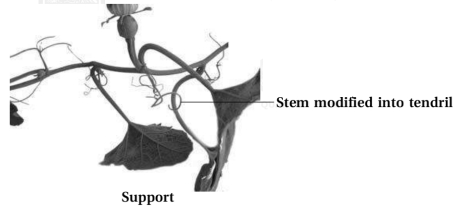
(N/A) $1$. Homologous Organs: These organs have the same evolutionary origin and structural plan but may perform different functions. In both grapevines and pumpkins,the tendrils are modifications of the axillary buds (stem origin). Since they share the same origin,they are considered homologous.
$2$. Analogous Organs: These organs have different evolutionary origins but perform similar functions. In peas,the tendrils are modifications of leaves (leaf origin). Although they perform the same function of climbing as the stem tendrils of grapevines,their structural origin is different. Therefore,they are considered analogous.
$3$. Conclusion: Because grape and pumpkin tendrils share a common stem-based origin,they are homologous. Because grape tendrils (stem-based) and pea tendrils (leaf-based) share a common function but have different origins,they are analogous.
$2$. Analogous Organs: These organs have different evolutionary origins but perform similar functions. In peas,the tendrils are modifications of leaves (leaf origin). Although they perform the same function of climbing as the stem tendrils of grapevines,their structural origin is different. Therefore,they are considered analogous.
$3$. Conclusion: Because grape and pumpkin tendrils share a common stem-based origin,they are homologous. Because grape tendrils (stem-based) and pea tendrils (leaf-based) share a common function but have different origins,they are analogous.
0 likes
View Solution254
EasyMCQ
Embryological support for evolution was disapproved by
A
Oparin
B
Karl Ernst von Baer
C
Alfred Wallace
D
Charles Darwin
Solution
(B) The embryological support for evolution,which was proposed by Ernst Haeckel (based on the observation of certain features during embryonic development),was disapproved by Karl Ernst von Baer. He noted that embryos never pass through the adult stages of other animals; rather,they share common embryonic features that diverge as development progresses.
0 likes
View Solution255
MediumMCQ
Flippers of Penguins and Dolphins are examples of:
A
Natural selection
B
Adaptive radiation
C
Convergent evolution
D
Industrial melanism
Solution
(C) The flippers of penguins (birds) and dolphins (mammals) are analogous organs.
These organs perform similar functions (swimming) but have different evolutionary origins and anatomical structures.
When different groups of organisms evolve similar traits due to adaptation to similar environmental pressures,it is known as convergent evolution.
These organs perform similar functions (swimming) but have different evolutionary origins and anatomical structures.
When different groups of organisms evolve similar traits due to adaptation to similar environmental pressures,it is known as convergent evolution.
0 likes
View Solution256
EasyMCQ
The embryological support for evolution was proposed by:
A
Karl Ernst von Baer
B
Alfred Russel Wallace
C
Charles Darwin
D
Alexander Oparin
Solution
(A) The embryological support for evolution,often referred to as the study of comparative embryology,was proposed by $Karl \ Ernst \ von \ Baer$. He observed that embryos of different vertebrates share common features during early stages of development,which suggests a common ancestry. This is often summarized by the observation that embryos do not pass through the adult stages of other animals,but rather share common embryonic characteristics.
0 likes
View Solution257
MediumMCQ
The flippers of penguins and dolphins are an example of ...........
A
Adaptive radiation
B
Industrial melanism
C
Convergent evolution
D
Natural selection
Solution
(C) The flippers of penguins (birds) and dolphins (mammals) are analogous organs.
These organs perform similar functions (swimming) but have different anatomical structures and embryonic origins.
When different species evolve similar traits independently as an adaptation to similar environmental pressures,it is known as convergent evolution.
Therefore,the flippers of penguins and dolphins represent convergent evolution.
These organs perform similar functions (swimming) but have different anatomical structures and embryonic origins.
When different species evolve similar traits independently as an adaptation to similar environmental pressures,it is known as convergent evolution.
Therefore,the flippers of penguins and dolphins represent convergent evolution.
0 likes
View Solution258
Easy
State the modifications of forelimb in animals as an example of homology.
Solution
(N/A) The forelimbs of vertebrates are pentadactyl,meaning they consist of the same basic bones: $humerus$,$radius$,$ulna$,$carpals$,$metacarpals$,and $phalanges$. However,these limbs differ in their function across different organisms due to divergent evolution.
The forelimbs of the following animals are modified as follows:
$(i)$ $Whale$: Modified for swimming.
$(ii)$ $Bat$ and $birds$: Modified for flying.
$(iii)$ $Horse$: Modified for running.
$(iv)$ $Frog$: Modified for leaping.
$(v)$ $Man$: Modified for grasping.
The forelimbs of the following animals are modified as follows:
$(i)$ $Whale$: Modified for swimming.
$(ii)$ $Bat$ and $birds$: Modified for flying.
$(iii)$ $Horse$: Modified for running.
$(iv)$ $Frog$: Modified for leaping.
$(v)$ $Man$: Modified for grasping.
0 likes
View Solution259
Medium
Describe the embryological support for evolution.
Solution
(N/A) Embryological support for evolution was proposed by $Ernst$ $Haeckel$ based on the observation of certain features during the embryonic stage that are common to all vertebrates but absent in adults.
For example,the embryos of all vertebrates,including humans,develop a row of vestigial gill slits just behind the head. However,these are functional organs only in fish and are not found in any other adult vertebrates.
$\rightarrow$ This proposal was later disapproved after a careful study performed by $Karl$ $Ernst$ $von$ $Baer$.
$\rightarrow$ He noted that embryos never pass through the adult stages of other animals; rather,they share common embryonic characteristics that reflect their evolutionary ancestry.
For example,the embryos of all vertebrates,including humans,develop a row of vestigial gill slits just behind the head. However,these are functional organs only in fish and are not found in any other adult vertebrates.
$\rightarrow$ This proposal was later disapproved after a careful study performed by $Karl$ $Ernst$ $von$ $Baer$.
$\rightarrow$ He noted that embryos never pass through the adult stages of other animals; rather,they share common embryonic characteristics that reflect their evolutionary ancestry.
0 likes
View Solution260
Medium
Give differences between homologous structures and analogous structures.
Solution
(N/A)
| Homologous structure | Analogous structure |
|---|---|
| $(1)$ Similar in anatomy. | $(1)$ Dissimilar in anatomy. |
| $(2)$ Perform dissimilar functions. | $(2)$ Perform similar functions. |
| $(3)$ Develop in related organisms. | $(3)$ Develop in unrelated organisms. |
| $(4)$ Inherited from a common ancestor. | $(4)$ Not inherited from a common ancestor. |
| $(5)$ Similar developmental pattern. | $(5)$ Developmental pattern is not similar. |
| $(6)$ Similar structure and origin. | $(6)$ Dissimilar in structure and origin. |
0 likes
View Solution261
Medium
Give differences: Divergent Evolution and Convergent Evolution.
Solution
(N/A)
| Divergent Evolution | Convergent Evolution |
|---|---|
| $(1)$ Development of different functional structures from a common ancestral form is called divergent evolution. | $(1)$ Development of similar adaptive functional structures in unrelated groups of organisms is called convergent evolution. |
| $(2)$ Homologous organs show divergent evolution. | $(2)$ Analogous organs show convergent evolution. |
| $(3)$ Examples: Darwin's finches,Australian marsupials,and forelimbs of mammals. | $(3)$ Examples: Australian marsupials and placental mammals,wings of insects,birds,and bats. |
0 likes
View Solution262
Easy
Define and explain the following terms: $1$. Analogous organs,$2$. Vestigial or rudimentary organs.
Solution
(N/A) $1$. Analogous organs: These organs have a similar appearance and perform the same function,but they develop in totally different groups and are completely different in their basic structure and developmental origin. For example,the wings of a butterfly (chitinous),a bird (feathered),a Pterodactyl,and a bat (skin fold) all serve the same purpose of flight but differ significantly in their anatomical structure.
$2$. Vestigial or rudimentary organs: These are the useless remnants of structures or organs that were likely large and functional in the ancestors. Examples include the vermiform appendix in humans,the nictitating membrane,auricular muscles,the vestigial tail in vertebrates,wisdom teeth,mammary glands in males,and body hair.
$2$. Vestigial or rudimentary organs: These are the useless remnants of structures or organs that were likely large and functional in the ancestors. Examples include the vermiform appendix in humans,the nictitating membrane,auricular muscles,the vestigial tail in vertebrates,wisdom teeth,mammary glands in males,and body hair.
0 likes
View Solution263
Easy
Provide definitions or explanations for the following: $1$. Recapitulation theory (Biogenetic law) and $2$. Palaeontology.
Solution
(N/A) $1$. Recapitulation theory (Biogenetic law): This theory states that "Ontogeny recapitulates phylogeny," meaning an individual organism repeats its evolutionary history during its embryonic development.
$2$. Palaeontology: This is the study of past life based on fossil records. It provides the most direct and reliable evidence for the process of evolution.
$2$. Palaeontology: This is the study of past life based on fossil records. It provides the most direct and reliable evidence for the process of evolution.
0 likes
View Solution264
Easy
Define the following terms: $Fossil$ and $Geological$ $time$.
Solution
(N/A) $Fossil$ refers to the petrified remains,impressions,or traces of organisms that lived in the past and were preserved in sedimentary rocks. Examples include bones,teeth,shells,imprints in soft mud,or moulds and casts of entire organisms.
$Geological$ $time$ refers to the chronological history of the Earth and the evolution of life,based on the study of fossils and rock strata. It is systematically divided into $Eras$,$Periods$,and $Epochs$ to organize the vast history of life on Earth.
$Geological$ $time$ refers to the chronological history of the Earth and the evolution of life,based on the study of fossils and rock strata. It is systematically divided into $Eras$,$Periods$,and $Epochs$ to organize the vast history of life on Earth.
0 likes
View Solution265
MediumMCQ
What is the study of the history of life forms on Earth called?
A
Biology
B
Evolutionary Biology
C
Paleontology
D
Zoology
Solution
(C) The study of the history of life forms on Earth is known as $Paleontology$.
$Paleontology$ involves the study of fossils,which are the remains or impressions of prehistoric organisms preserved in rock formations.
By examining these fossils,scientists can reconstruct the evolutionary history of life on Earth.
Therefore,the correct option is $C$.
$Paleontology$ involves the study of fossils,which are the remains or impressions of prehistoric organisms preserved in rock formations.
By examining these fossils,scientists can reconstruct the evolutionary history of life on Earth.
Therefore,the correct option is $C$.
0 likes
View Solution266
MediumMCQ
On which ship did Charles Darwin travel around the world?
A
$H$.$N$.$S$. Beagle
B
$H$.$S$.$N$. Beagle
C
$H$.$M$.$S$. Beagle
D
$H$.$S$.$M$. Beagle
Solution
(C) Charles Darwin,during his five-year voyage ($1831$-$1836$),traveled around the world on a ship named $H.M.S. Beagle$.
This voyage provided him with the observations and data that eventually led to the formulation of his theory of natural selection.
This voyage provided him with the observations and data that eventually led to the formulation of his theory of natural selection.
0 likes
View Solution267
MediumMCQ
The conclusion that 'life forms on Earth not only resemble each other but also resemble life forms that lived millions of years ago' is based on the observations of whom?
A
Charles Darwin
B
Oparin
C
Miller
D
Haldane
Solution
(A) The statement that life forms on Earth share similarities not only with each other but also with organisms that existed millions of years ago is a fundamental observation made by $Charles \ Darwin$.
During his voyage on the $HMS \ Beagle$,$Darwin$ observed various fossils and living organisms in different geographical locations.
He concluded that the present-day life forms share common ancestry with extinct species,which supports his theory of descent with modification and natural selection.
During his voyage on the $HMS \ Beagle$,$Darwin$ observed various fossils and living organisms in different geographical locations.
He concluded that the present-day life forms share common ancestry with extinct species,which supports his theory of descent with modification and natural selection.
0 likes
View Solution268
MediumMCQ
What are the hard parts of life forms found in rocks called?
A
Dead bodies
B
Fossils
C
Manure
D
Metals
Solution
(B) The hard parts of life forms (such as bones,shells,or teeth) that are preserved in sedimentary rocks over geological time are known as fossils.
These provide direct evidence for the history of life on Earth and the process of evolution.
These provide direct evidence for the history of life on Earth and the process of evolution.
0 likes
View Solution269
MediumMCQ
What is the origin of sedimentary rocks (fossils)?
A
Animals
B
Rocks
C
Sea
D
Plants
Solution
(B) Sedimentary rocks are formed by the accumulation and solidification of sediments over long periods. These sediments are derived from the weathering and erosion of pre-existing rocks. Fossils are primarily found in these sedimentary rocks,which provide evidence for evolution by showing the chronological sequence of life forms.
0 likes
View Solution270
MediumMCQ
What does the study of fossils in different sedimentary layers indicate?
A
Chemical composition of rocks of that time
B
Proportion of mineral elements at that time
C
Geological period of the organisms that existed at that time
D
All of the above
Solution
(C) The study of fossils in different sedimentary layers is known as paleontology.
By analyzing these layers,scientists can determine the chronological order of life forms.
Each sedimentary layer represents a specific geological time period.
Therefore,fossils found in these layers provide evidence about the geological period during which those specific organisms existed and evolved.
By analyzing these layers,scientists can determine the chronological order of life forms.
Each sedimentary layer represents a specific geological time period.
Therefore,fossils found in these layers provide evidence about the geological period during which those specific organisms existed and evolved.
0 likes
View Solution271
MediumMCQ
Select the appropriate option for the work done by $Ernst$ $Haeckel$.
A
Chemical basis of evolution
B
Embryological basis of evolution
C
Abiotic basis of evolution
D
Functional basis of evolution
Solution
(B) $Ernst$ $Haeckel$ proposed the $Biogenetic$ $Law$,which states that '$Ontogeny$ repeats $Phylogeny$'.
This law suggests that the developmental stages of an embryo (embryology) reflect the evolutionary history of the organism.
Therefore,his work provides an embryological basis for understanding evolution.
This law suggests that the developmental stages of an embryo (embryology) reflect the evolutionary history of the organism.
Therefore,his work provides an embryological basis for understanding evolution.
0 likes
View Solution272
MediumMCQ
Based on Haeckel's observations,during which stage are certain features common to all vertebrates?
A
Embryonic
B
Infant
C
Adult
D
Old
Solution
(A) Ernst Haeckel proposed the theory of recapitulation,also known as the biogenetic law.
He observed that embryos of all vertebrates,including humans,show certain common features during the early stages of development,such as gill slits,which are not found in the adult stages of many of these organisms.
These embryonic similarities suggest a common evolutionary ancestry among vertebrates.
Therefore,the correct stage is the embryonic stage.
He observed that embryos of all vertebrates,including humans,show certain common features during the early stages of development,such as gill slits,which are not found in the adult stages of many of these organisms.
These embryonic similarities suggest a common evolutionary ancestry among vertebrates.
Therefore,the correct stage is the embryonic stage.
0 likes
View Solution273
MediumMCQ
Which vestigial structure develops in the embryos of all vertebrates,including humans?
A
Lungs
B
Forelimbs
C
Hindlimbs
D
Gill slits
Solution
(D) In the early stages of embryonic development,all vertebrate embryos,including humans,exhibit the presence of gill slits (pharyngeal pouches).
These structures are functional in fish for respiration but become vestigial or transform into other structures (like parts of the ear and throat) in higher vertebrates like humans.
This is considered a strong embryological evidence for evolution,suggesting a common ancestry among all vertebrates.
These structures are functional in fish for respiration but become vestigial or transform into other structures (like parts of the ear and throat) in higher vertebrates like humans.
This is considered a strong embryological evidence for evolution,suggesting a common ancestry among all vertebrates.
0 likes
View Solution274
MediumMCQ
Who noted that embryos never pass through the adult stages of other animals?
A
Haeckel
B
von Baer
C
Hugo de Vries
D
Weinberg
Solution
(B) Karl Ernst von Baer proposed the laws of embryology,which are often referred to as von Baer's laws. He observed that embryos of different species share common characteristics in early developmental stages,but they do not pass through the adult stages of other animals. This observation contradicted the 'recapitulation theory' proposed by Ernst Haeckel,which suggested that ontogeny recapitulates phylogeny.
0 likes
View Solution275
MediumMCQ
Comparative $........$ and $............$ show similarities and differences between organisms existing in the present and those that existed in the past.
A
Chemical evolution and Embryology
B
Anatomy and Palaeontology
C
Anatomy and Morphology
D
Chemical evolution and Geology
Solution
(C) Comparative $Anatomy$ and $Morphology$ provide evidence for evolution by showing similarities and differences between organisms existing in the present and those that existed in the past. $Anatomy$ (study of internal structures) and $Morphology$ (study of external forms) allow scientists to compare homologous and analogous organs, which indicate common ancestry or convergent evolution.
0 likes
View Solution276
EasyMCQ
Select the appropriate option for homology.
A
Organs have similar functions but different internal structures.
B
Organs have similar internal structures but different functions.
C
Organs have both similar functions and similar internal structures.
D
None of the above.
Solution
(B) Homology refers to the similarity in the internal structure and embryonic origin of organs in different organisms,even if they perform different functions. This is a result of divergent evolution. For example,the forelimbs of whales,bats,cheetahs,and humans share a similar anatomical structure (humerus,radius,ulna,carpals,metacarpals,and phalanges) but are adapted for different functions like swimming,flying,running,and grasping,respectively.
0 likes
View Solution277
MediumMCQ
Homology is related to which type of evolution?
A
Convergent evolution
B
Divergent evolution
C
Geological evolution
D
Both $A$ and $B$
Solution
(B) Homology refers to the similarity in structures that have a common embryonic origin but perform different functions.
This phenomenon is a result of divergent evolution,where organisms with a common ancestor evolve to adapt to different environmental conditions.
Examples include the forelimbs of whales,bats,cheetahs,and humans,which share the same anatomical structure (humerus,radius,ulna,carpals,metacarpals,and phalanges) but are adapted for different functions like swimming,flying,running,or grasping.
This phenomenon is a result of divergent evolution,where organisms with a common ancestor evolve to adapt to different environmental conditions.
Examples include the forelimbs of whales,bats,cheetahs,and humans,which share the same anatomical structure (humerus,radius,ulna,carpals,metacarpals,and phalanges) but are adapted for different functions like swimming,flying,running,or grasping.
0 likes
View Solution278
MediumMCQ
What does homology indicate?
A
Common ancestry
B
Different ancestry
C
Convergent evolution
D
Analogy
Solution
(A) Homology refers to the similarity in the structural organization of organs in different organisms due to common ancestry,even if they perform different functions.
This phenomenon is a result of divergent evolution,where species with a common ancestor evolve different traits to adapt to various environments.
Therefore,homology is a clear indicator of common ancestry.
This phenomenon is a result of divergent evolution,where species with a common ancestor evolve different traits to adapt to various environments.
Therefore,homology is a clear indicator of common ancestry.
0 likes
View Solution279
MediumMCQ
Which of the following does $NOT$ represent homologous structures?
A
Eye of a mammal and eye of an octopus
B
Forelimbs of a cheetah and a whale
C
Heart and brain of vertebrates
D
Thorns of Bougainvillea and tendrils of Cucurbita
Solution
(A) Homologous structures are those that have a common evolutionary origin but may perform different functions.
$A$. The eye of a mammal and the eye of an octopus are analogous structures,as they evolved independently to perform the same function (vision) but have different embryonic origins.
$B$. The forelimbs of a cheetah and a whale are homologous,as they share the same skeletal structure (humerus,radius,ulna,carpals,metacarpals,and phalanges) despite different functions.
$C$. The heart and brain of vertebrates are homologous organs,as they share a common ancestral structural plan.
$D$. The thorns of Bougainvillea and tendrils of Cucurbita are homologous,as both are modified branches sharing a common origin.
Therefore,the eye of a mammal and the eye of an octopus represent convergent evolution and are $NOT$ homologous.
$A$. The eye of a mammal and the eye of an octopus are analogous structures,as they evolved independently to perform the same function (vision) but have different embryonic origins.
$B$. The forelimbs of a cheetah and a whale are homologous,as they share the same skeletal structure (humerus,radius,ulna,carpals,metacarpals,and phalanges) despite different functions.
$C$. The heart and brain of vertebrates are homologous organs,as they share a common ancestral structural plan.
$D$. The thorns of Bougainvillea and tendrils of Cucurbita are homologous,as both are modified branches sharing a common origin.
Therefore,the eye of a mammal and the eye of an octopus represent convergent evolution and are $NOT$ homologous.
0 likes
View Solution280
MediumMCQ
Homologous structures are based on which type of evolution?
A
Convergent
B
Divergent
C
Chemical
D
Abiotic
Solution
(B) Homologous structures are those organs that have the same basic structural plan and embryonic origin but perform different functions in different organisms.
This phenomenon is known as divergent evolution,where organisms with a common ancestor evolve to adapt to different environments,leading to structural modifications while retaining the underlying anatomical similarity.
This phenomenon is known as divergent evolution,where organisms with a common ancestor evolve to adapt to different environments,leading to structural modifications while retaining the underlying anatomical similarity.
0 likes
View Solution281
MediumMCQ
Select the correct option for analogy.
A
Organs with similar structure
B
Organs with similar function
C
Organs with similar structure and function
D
Organs with different structure and function
Solution
(B) Analogy refers to the similarity in the function of organs that have different evolutionary origins and anatomical structures.
For example,the wings of a butterfly and the wings of a bird perform the same function (flight) but have different structural designs.
Therefore,analogous organs are those that have similar functions but different underlying anatomical structures.
For example,the wings of a butterfly and the wings of a bird perform the same function (flight) but have different structural designs.
Therefore,analogous organs are those that have similar functions but different underlying anatomical structures.
0 likes
View Solution282
MediumMCQ
Which of the following is $NOT$ an example of analogous organs?
A
Eyes of octopus and mammals
B
Flippers of penguins and dolphins
C
Wings of butterflies and birds
D
Forelimbs of bats and humans
Solution
(D) Analogous organs are those that perform similar functions but have different anatomical structures and embryonic origins. They are a result of convergent evolution.
$1$. Eyes of octopus and mammals,flippers of penguins and dolphins,and wings of butterflies and birds are all examples of analogous organs because they perform similar functions (vision,swimming,and flight,respectively) but have different evolutionary origins.
$2$. The forelimbs of bats and humans are examples of homologous organs. They share a similar anatomical structure (pentadactyl limb pattern) and embryonic origin,indicating a common ancestor,but they perform different functions (flying in bats and grasping/manipulating in humans). This is a result of divergent evolution.
$1$. Eyes of octopus and mammals,flippers of penguins and dolphins,and wings of butterflies and birds are all examples of analogous organs because they perform similar functions (vision,swimming,and flight,respectively) but have different evolutionary origins.
$2$. The forelimbs of bats and humans are examples of homologous organs. They share a similar anatomical structure (pentadactyl limb pattern) and embryonic origin,indicating a common ancestor,but they perform different functions (flying in bats and grasping/manipulating in humans). This is a result of divergent evolution.
0 likes
View Solution283
MediumMCQ
Choose the correct option for fish-like reptiles.
A
Ichthyophis
B
Eel
C
Ichthyosaurus
D
Coelacanth
Solution
(C) During the course of evolution,some land reptiles went back into the water to live as fish-like reptiles.
$Ichthyosaurus$ is a well-known example of a fish-like reptile that lived in the sea about $200$ million years ago.
$Ichthyophis$ is an amphibian,$Eel$ is a bony fish,and $Coelacanth$ is a lobe-finned fish.
$Ichthyosaurus$ is a well-known example of a fish-like reptile that lived in the sea about $200$ million years ago.
$Ichthyophis$ is an amphibian,$Eel$ is a bony fish,and $Coelacanth$ is a lobe-finned fish.
0 likes
View Solution284
MediumMCQ
Select the incorrect statement.
A
Natural selection and branching descent are the key concepts of Darwinian theory of evolution.
B
The embryological support for evolution was proposed by Haeckel.
C
Karl Ernst von Baer supported Haeckel.
D
Alfred Wallace was a naturalist.
Solution
(C) The correct answer is $C$.
$1$. Natural selection and branching descent are indeed the two key concepts of Darwinian theory of evolution.
$2$. Ernst Haeckel proposed the embryological support for evolution based on the observation of certain features during embryonic stage common to all vertebrates that are absent in adult forms.
$3$. Karl Ernst von Baer disapproved of Haeckel's proposal. He noted that embryos never pass through the adult stages of other animals,thus contradicting Haeckel's biogenetic law.
$4$. Alfred Russel Wallace was a naturalist who worked in the Malay Archipelago and independently arrived at similar conclusions as Darwin regarding natural selection.
$1$. Natural selection and branching descent are indeed the two key concepts of Darwinian theory of evolution.
$2$. Ernst Haeckel proposed the embryological support for evolution based on the observation of certain features during embryonic stage common to all vertebrates that are absent in adult forms.
$3$. Karl Ernst von Baer disapproved of Haeckel's proposal. He noted that embryos never pass through the adult stages of other animals,thus contradicting Haeckel's biogenetic law.
$4$. Alfred Russel Wallace was a naturalist who worked in the Malay Archipelago and independently arrived at similar conclusions as Darwin regarding natural selection.
0 likes
View Solution285
MediumMCQ
Select the correct statement.
A
Animals showing divergent evolution have different ancestors.
B
Australian marsupials show convergent evolution.
C
Thorns of Bougainvillea and tendrils of Cucurbita are homologous structures.
D
Sweet potato and potato are homologous structures.
Solution
(C) $1$. Divergent evolution occurs when organisms with a common ancestor evolve different traits,leading to homologous structures. Thus,option $A$ is incorrect.
$2$. Australian marsupials and placental mammals show convergent evolution,as they evolved independently to adapt to similar environments. Thus,option $B$ is incorrect.
$3$. Thorns of $Bougainvillea$ and tendrils of $Cucurbita$ are examples of homologous structures because they both arise from the axillary bud,indicating a common origin despite different functions. Thus,option $C$ is correct.
$4$. Sweet potato (a root modification) and potato (a stem modification) are analogous structures because they perform the same function (storage of food) but have different origins. Thus,option $D$ is incorrect.
$2$. Australian marsupials and placental mammals show convergent evolution,as they evolved independently to adapt to similar environments. Thus,option $B$ is incorrect.
$3$. Thorns of $Bougainvillea$ and tendrils of $Cucurbita$ are examples of homologous structures because they both arise from the axillary bud,indicating a common origin despite different functions. Thus,option $C$ is correct.
$4$. Sweet potato (a root modification) and potato (a stem modification) are analogous structures because they perform the same function (storage of food) but have different origins. Thus,option $D$ is incorrect.
0 likes
View Solution286
EasyMCQ
Embryological support for evolution was proposed by
A
Alfred Wallace
B
Ernst Haeckel
C
Karl Ernst von Baer
D
Charles Darwin
Solution
(B) The correct answer is $B$. Embryological support for evolution was proposed by Ernst Haeckel,based on the observation of certain features during the embryonic stage that are common to all vertebrates but are absent in the adult forms.
Alfred Wallace was a naturalist who worked in the Malay Archipelago and concluded that natural selection acts as the mechanism of evolution.
Karl Ernst von Baer disapproved of the proposal given by Ernst Haeckel and proposed that embryos never pass through the adult stages of other animals.
Charles Darwin proposed natural selection as the mechanism of evolution.
Alfred Wallace was a naturalist who worked in the Malay Archipelago and concluded that natural selection acts as the mechanism of evolution.
Karl Ernst von Baer disapproved of the proposal given by Ernst Haeckel and proposed that embryos never pass through the adult stages of other animals.
Charles Darwin proposed natural selection as the mechanism of evolution.
0 likes
View Solution287
MediumMCQ
Choose the correct statements with reference to organic evolution.
$I.$ Flippers of whale and wings of bat exhibit analogy.
$II.$ Wings of butterfly and wings of bird exhibit homology.
$III.$ Organs with dissimilar structure are called analogous organs.
$IV.$ Organs with similar structure and origin are called homologous organs.
$I.$ Flippers of whale and wings of bat exhibit analogy.
$II.$ Wings of butterfly and wings of bird exhibit homology.
$III.$ Organs with dissimilar structure are called analogous organs.
$IV.$ Organs with similar structure and origin are called homologous organs.
A
$I$ and $IV$
B
$I$ and $III$
C
$III$ and $IV$
D
$II$ and $IV$
Solution
(C) Statement $I$ is incorrect because flippers of whales and wings of bats are homologous organs,as they share a common embryonic origin and basic skeletal structure.
Statement $II$ is incorrect because wings of butterflies and wings of birds are analogous organs; they perform the same function (flight) but have different developmental origins.
Statement $III$ is correct: Analogous organs are defined as structures that have different basic structures and developmental origins but perform similar functions.
Statement $IV$ is correct: Homologous organs are defined as structures that share a similar basic structure and embryonic origin,even if they perform different functions.
Therefore,statements $III$ and $IV$ are correct.
Statement $II$ is incorrect because wings of butterflies and wings of birds are analogous organs; they perform the same function (flight) but have different developmental origins.
Statement $III$ is correct: Analogous organs are defined as structures that have different basic structures and developmental origins but perform similar functions.
Statement $IV$ is correct: Homologous organs are defined as structures that share a similar basic structure and embryonic origin,even if they perform different functions.
Therefore,statements $III$ and $IV$ are correct.
0 likes
View Solution288
MediumMCQ
Modification of leaves as tendrils and thorns in plants are an example of:
A
Convergent evolution
B
Radiation
C
Divergent evolution
D
Co-evolution
Solution
(C) Leaves modified as thorns (e.g.,in $Bougainvillea$) and tendrils (e.g.,in $Cucurbita$) are considered homologous structures because they share a common ancestral origin but have evolved to perform different functions.
Homologous organs are a result of divergent evolution,where species with a common ancestor evolve different traits to adapt to various environments.
In contrast,analogous organs (which perform similar functions but have different origins) are a result of convergent evolution.
Co-evolution refers to the process where two or more species reciprocally affect each other's evolution.
Homologous organs are a result of divergent evolution,where species with a common ancestor evolve different traits to adapt to various environments.
In contrast,analogous organs (which perform similar functions but have different origins) are a result of convergent evolution.
Co-evolution refers to the process where two or more species reciprocally affect each other's evolution.
0 likes
View Solution289
EasyMCQ
Which of the set represents vestigial organs?
A
Vermiform appendix,body hair and patella
B
Wisdom teeth,body hair and atlas vertebrae
C
Ear muscles,cochlea and coccyx
D
Vermiform appendix,ear muscles and coccyx
Solution
(D) Vestigial organs are anatomical structures that have lost their original ancestral function through the course of evolution.
In humans,the vermiform appendix,ear muscles (auricular muscles),and the coccyx (tailbone) are classic examples of vestigial structures that were functional in our ancestors but are now largely non-functional.
In humans,the vermiform appendix,ear muscles (auricular muscles),and the coccyx (tailbone) are classic examples of vestigial structures that were functional in our ancestors but are now largely non-functional.
0 likes
View Solution290
EasyMCQ
Flippers of a seal are:
A
Modified forelimbs
B
Modified hindlimbs
C
Modified gills
D
Modified fins
Solution
(A) Flippers of a seal are modified forelimbs. They are an example of homologous organs,which share a common evolutionary origin but have adapted to perform different functions,such as swimming in seals.
0 likes
View Solution291
EasyMCQ
The age of fossils or dating of fossils can be best estimated by
A
Radioactive carbon $(C^{14})$ dating method
B
Radioactive nitrogen method
C
Radioactive clock method
D
None of the above
Solution
(A) Radioactive carbon $(C^{14})$ dating method is the most widely used technique to determine the age of organic fossils.
This method relies on the decay of the radioactive isotope carbon-$14$,which is absorbed by living organisms during their lifetime.
After the organism dies,the carbon-$14$ decays at a known constant rate,allowing scientists to calculate the time elapsed since the organism's death.
This method relies on the decay of the radioactive isotope carbon-$14$,which is absorbed by living organisms during their lifetime.
After the organism dies,the carbon-$14$ decays at a known constant rate,allowing scientists to calculate the time elapsed since the organism's death.
0 likes
View Solution292
EasyMCQ
Some persons can move their pinnae. This ability is imparted by
A
Recapitulation
B
Atavism
C
Over specialization
D
Regeneration
Solution
(B) The correct answer is $B$.
Atavism is the reappearance of certain ancestral characters that had either disappeared or were reduced during the course of evolution.
In humans,the ability to move the pinnae (external ear) using vestigial muscles is an example of atavism,as these muscles were functional in our ancestors.
Other examples of atavism in humans include the presence of a short tail (coccyx),exceptionally long dense hair,and additional mammae.
Atavism is the reappearance of certain ancestral characters that had either disappeared or were reduced during the course of evolution.
In humans,the ability to move the pinnae (external ear) using vestigial muscles is an example of atavism,as these muscles were functional in our ancestors.
Other examples of atavism in humans include the presence of a short tail (coccyx),exceptionally long dense hair,and additional mammae.
0 likes
View Solution293
MediumMCQ
Which of the following is not a living fossil?
A
King crab
B
Sphenodon
C
Archaeopteryx
D
Peripatus
Solution
(C) Living fossils are organisms that have remained unchanged over a long geological period and have few or no close living relatives.
$A.$ King crab $(Limulus)$ is considered a living fossil.
$B.$ $Sphenodon$ (Tuatara) is a classic example of a living fossil.
$C.$ $Archaeopteryx$ is an extinct transitional fossil between reptiles and birds,not a living fossil.
$D.$ $Peripatus$ is a living fossil that acts as a connecting link between Annelida and Arthropoda.
Therefore,$Archaeopteryx$ is the correct answer.
$A.$ King crab $(Limulus)$ is considered a living fossil.
$B.$ $Sphenodon$ (Tuatara) is a classic example of a living fossil.
$C.$ $Archaeopteryx$ is an extinct transitional fossil between reptiles and birds,not a living fossil.
$D.$ $Peripatus$ is a living fossil that acts as a connecting link between Annelida and Arthropoda.
Therefore,$Archaeopteryx$ is the correct answer.
0 likes
View Solution294
EasyMCQ
$Peripatus$ is a connecting link between:
A
Annelids and molluscs
B
Reptiles and mammals
C
Annelids and arthropods
D
Annelids and reptiles
Solution
(C) Connecting links are organisms that exhibit characteristics of two different taxonomic groups.
$Peripatus$ is a classic example of a connecting link between the phylum $Annelida$ and the phylum $Arthropoda$.
It possesses annelid-like features such as a segmented body,thin cuticle,and segmental nephridia,while also displaying arthropod-like features such as a tracheal system for respiration,an open circulatory system,and jointed appendages.
Therefore,it provides evidence for the evolutionary transition between these two groups.
$Peripatus$ is a classic example of a connecting link between the phylum $Annelida$ and the phylum $Arthropoda$.
It possesses annelid-like features such as a segmented body,thin cuticle,and segmental nephridia,while also displaying arthropod-like features such as a tracheal system for respiration,an open circulatory system,and jointed appendages.
Therefore,it provides evidence for the evolutionary transition between these two groups.
0 likes
View Solution295
MediumMCQ
What do homologous organs indicate?
A
Different ancestry
B
Common ancestry
C
Independent development
D
Dependent development
Solution
(B) Homologous organs indicate common ancestry.
Homologous organs are defined as organs that share the same fundamental anatomical structure and developmental origin but perform different functions. These organs follow the same basic plan of organization during embryonic development. However,in the adult stage,they are modified to perform diverse functions as an adaptation to different environments.
Homologous organs are the result of divergent evolution. Examples include the thorns of $Bougainvillea$ and the tendrils of $Cucurbita$,both of which arise in the axillary position.
Divergent evolution involves the accumulation of differences between groups,which can lead to the formation of new species. This typically occurs when populations of the same species disperse into different and isolated environments,blocking gene flow and allowing for the fixation of distinct characteristics through genetic drift and natural selection. The vertebrate limb is a classic example of divergent evolution,where limbs in different species share a common origin but have diverged in overall structure and function.
Homologous organs are defined as organs that share the same fundamental anatomical structure and developmental origin but perform different functions. These organs follow the same basic plan of organization during embryonic development. However,in the adult stage,they are modified to perform diverse functions as an adaptation to different environments.
Homologous organs are the result of divergent evolution. Examples include the thorns of $Bougainvillea$ and the tendrils of $Cucurbita$,both of which arise in the axillary position.
Divergent evolution involves the accumulation of differences between groups,which can lead to the formation of new species. This typically occurs when populations of the same species disperse into different and isolated environments,blocking gene flow and allowing for the fixation of distinct characteristics through genetic drift and natural selection. The vertebrate limb is a classic example of divergent evolution,where limbs in different species share a common origin but have diverged in overall structure and function.
0 likes
View Solution296
MediumMCQ
Wings of insects and birds are
A
Analogous
B
Homologous
C
Vestigial
D
Atavism
Solution
(A) Wings of insects and birds are different in their basic structure and embryonic origin.
An insect wing is an outgrowth of the integument (exoskeleton),whereas a bird wing is a modified forelimb with an internal bony structure.
However,they are considered analogous organs because they perform the same function,which is flight,and have evolved independently to adapt to the same environmental demand.
An insect wing is an outgrowth of the integument (exoskeleton),whereas a bird wing is a modified forelimb with an internal bony structure.
However,they are considered analogous organs because they perform the same function,which is flight,and have evolved independently to adapt to the same environmental demand.
0 likes
View Solution297
MediumMCQ
$Ornithorhynchus$ is a connecting link between:
A
Birds and reptiles
B
Reptiles and mammals
C
Birds and amphibians
D
Fishes and amphibians
Solution
(B) $Ornithorhynchus$ $anatinus$ (Duck-billed platypus) is a unique mammal belonging to the order Monotremata.
It serves as a connecting link between reptiles and mammals because it exhibits characteristics of both groups.
Like reptiles,it lays eggs (oviparous) and possesses a cloaca,which is a common opening for the digestive,urinary,and reproductive tracts.
Like mammals,it possesses mammary glands (though they lack nipples) and has fur on its body,which are defining mammalian characteristics.
It serves as a connecting link between reptiles and mammals because it exhibits characteristics of both groups.
Like reptiles,it lays eggs (oviparous) and possesses a cloaca,which is a common opening for the digestive,urinary,and reproductive tracts.
Like mammals,it possesses mammary glands (though they lack nipples) and has fur on its body,which are defining mammalian characteristics.
0 likes
View Solution298
EasyMCQ
Percentage of homology in the haemoglobin of man and gorilla is (in $, \%$)
A
$97$
B
$96$
C
$99$
D
$98$
Solution
(C) The correct answer is $99\, \%$.
Evidences for the common ancestry of great apes and humans are as follows:
$1$. Evidence from Blood Protein: It has been proven by blood protein tests that humans are most closely related to great apes (Chimpanzee and Gorilla),followed by Old World monkeys,New World monkeys,and tarsiers.
$2$. Evidence from Blood Group: In humans,four blood groups ($A, B, AB$,and $O$) occur. Blood groups $A$ and $B$ are found in apes but not in monkeys. This indicates that human beings are more closely related to apes than to monkeys.
$3$. Evidence from Haemoglobin: There is $99\, \%$ homology in the haemoglobin of humans and gorillas. This suggests that the two are closely related.
Evidences for the common ancestry of great apes and humans are as follows:
$1$. Evidence from Blood Protein: It has been proven by blood protein tests that humans are most closely related to great apes (Chimpanzee and Gorilla),followed by Old World monkeys,New World monkeys,and tarsiers.
$2$. Evidence from Blood Group: In humans,four blood groups ($A, B, AB$,and $O$) occur. Blood groups $A$ and $B$ are found in apes but not in monkeys. This indicates that human beings are more closely related to apes than to monkeys.
$3$. Evidence from Haemoglobin: There is $99\, \%$ homology in the haemoglobin of humans and gorillas. This suggests that the two are closely related.
0 likes
View Solution299
EasyMCQ
Links between organisms that show the branching pattern of evolutionary relationships are shown by
A
Living fossils
B
Comparative embryology
C
Phylogenetic trees
D
Two fossil layers
Solution
(C) phylogenetic tree or evolutionary tree is a branching diagram that shows the inferred evolutionary relationships among various biological species or other entities based upon similarities and differences in their physical and/or genetic characteristics.
The taxa joined together in the tree are implied to have descended from a common ancestor.
The taxa joined together in the tree are implied to have descended from a common ancestor.
0 likes
View Solution300
EasyMCQ
'Ontogeny Recapitulates Phylogeny' is narrated in which of the evidences for organic evolution?
A
Palaeontological evidence
B
Physiological evidence
C
Embryological evidence
D
Anatomical evidence
Solution
(C) Ernst Haeckel $(1866)$ proposed the recapitulation theory or biogenetic law,which states that 'ontogeny' (the development of an individual organism) is a recapitulation of 'phylogeny' (the evolutionary history of its ancestors).
This concept is narrated under embryological evidences for organic evolution.
Examples include the similarity in early embryonic development across various multicellular organisms and the resemblance among vertebrate embryos during their early stages.
This concept is narrated under embryological evidences for organic evolution.
Examples include the similarity in early embryonic development across various multicellular organisms and the resemblance among vertebrate embryos during their early stages.
0 likes
View SolutionEvolution — Evidences of Evolution · Frequently Asked Questions
1Are these Evolution questions useful for JEE and NEET?
Yes. All questions in this section are mapped to JEE Main and NEET exam patterns. Previous year questions from JEE Main, NEET, GUJCET and state-level exams are included with full solutions.
2Can I switch to Hindi or Gujarati for these questions?
Yes. Use the language tabs in the hero section or the sidebar to view the same questions and solutions in English, Hindi or Gujarati.
3How do I generate a question paper from this subtopic?
Use the Vedclass Exam Paper Generator — select the chapter and subtopic, set difficulty, and generate Sets A, B, C, D automatically. First 3 chapters of every subject are free.
Vedclass Products
For Students
Vedclass Test Series
Mock tests in real JEE/NEET style with performance analysis. 5-day free trial.
Start Free TrialFor Teachers
Exam Paper Generator
Generate Set A/B/C/D papers from this chapter in 2 minutes. 3 chapters free.
Try FreeFor Institutes
Online Exam Module
Live online exams with unlimited students, 360° analytics & white-label branding.
See DemoFor Teachers & Institutes
Generate a Evolution Exam Paper in 2 Minutes
Select subtopic & difficulty — Sets A, B, C, D auto-generated with No Repeat logic.
First 3 chapters of every subject are free — no payment required.