
A English
Evidences of Evolution Questions in English
Class 12 Biology · Evolution · Evidences of Evolution
396+
Questions
English
Language
100%
With Solutions
Showing 49 of 396 questions in English
151
MediumMCQ
Analogous organs are:
A
Similar in origin
B
Similar in structure
C
Non-functional
D
Similar in function
Solution
(D) Analogous organs are those that perform similar functions but have different evolutionary origins and anatomical structures. This phenomenon is known as convergent evolution. For example,the wings of a butterfly and the wings of a bird are analogous; they both serve the purpose of flight but have evolved independently from different ancestral structures.
0 likes
View Solution152
MediumMCQ
Which of the following groups does not represent homologous organs?
A
Wings of mosquito and butterfly
B
Wings of butterfly and bird
C
Mouthparts of cockroach and butterfly
D
None of these
Solution
(D) Homologous organs are those that have a common evolutionary origin and similar basic structure,even if they perform different functions.
$1$. Wings of mosquito and butterfly are analogous organs because they perform the same function (flight) but have different embryonic origins.
$2$. Wings of butterfly and bird are also analogous organs.
$3$. Mouthparts of cockroach and butterfly are analogous as they are adapted for different feeding mechanisms despite having similar structural components.
Since all the given pairs represent analogous organs rather than homologous organs,the correct answer is $D$.
$1$. Wings of mosquito and butterfly are analogous organs because they perform the same function (flight) but have different embryonic origins.
$2$. Wings of butterfly and bird are also analogous organs.
$3$. Mouthparts of cockroach and butterfly are analogous as they are adapted for different feeding mechanisms despite having similar structural components.
Since all the given pairs represent analogous organs rather than homologous organs,the correct answer is $D$.
0 likes
View Solution153
MediumMCQ
Which of the following represents homology?
A
Forelimbs of butterflies,birds,and horses
B
Flippers of whales,wings of bats,and forelimbs of humans
C
Tail of a monkey and tail of a bird
D
Sting of a scorpion and sting of an Apis
Solution
(B) Homology refers to structures that have a common evolutionary origin and similar anatomical structure,even if they perform different functions.
$1$. The flippers of whales,wings of bats,and forelimbs of humans are classic examples of homologous organs.
$2$. They all share a similar skeletal pattern (humerus,radius,ulna,carpals,metacarpals,and phalanges) inherited from a common ancestor,despite being adapted for different functions like swimming,flying,or grasping.
$3$. Butterflies and birds (wings) show analogy,not homology.
$4$. Scorpion sting and Apis sting are analogous structures.
$1$. The flippers of whales,wings of bats,and forelimbs of humans are classic examples of homologous organs.
$2$. They all share a similar skeletal pattern (humerus,radius,ulna,carpals,metacarpals,and phalanges) inherited from a common ancestor,despite being adapted for different functions like swimming,flying,or grasping.
$3$. Butterflies and birds (wings) show analogy,not homology.
$4$. Scorpion sting and Apis sting are analogous structures.
0 likes
View Solution154
MediumMCQ
Convergent evolution is associated with which of the following?
A
Analogous organs
B
Vestigial organs
C
Homologous organs
D
Different habitats
Solution
(A) Convergent evolution is the process whereby organisms not closely related independently evolve similar traits as a result of having to adapt to similar environments or ecological niches.
This process leads to the development of analogous organs,which are structures that perform similar functions but have different evolutionary origins and anatomical structures.
For example,the wings of a butterfly and the wings of a bird are analogous organs that evolved independently for flight.
Therefore,convergent evolution is associated with analogous organs.
This process leads to the development of analogous organs,which are structures that perform similar functions but have different evolutionary origins and anatomical structures.
For example,the wings of a butterfly and the wings of a bird are analogous organs that evolved independently for flight.
Therefore,convergent evolution is associated with analogous organs.
0 likes
View Solution155
MediumMCQ
Which of the following is $NOT$ considered a vestigial organ?
A
Third molar
B
Nails
C
Auricular muscles of the pinna
D
Caecum
Solution
(B) Vestigial organs are anatomical structures that have lost their original ancestral function through evolution.
$A$. The third molar (wisdom tooth) is a vestigial structure in humans.
$B$. Nails are functional structures used for protection and gripping; they are $NOT$ vestigial.
$C$. Auricular muscles (muscles of the pinna) are vestigial in humans as we cannot move our ears like other mammals.
$D$. The caecum is a vestigial structure in humans,as it is reduced compared to the large caecum found in herbivorous mammals.
$A$. The third molar (wisdom tooth) is a vestigial structure in humans.
$B$. Nails are functional structures used for protection and gripping; they are $NOT$ vestigial.
$C$. Auricular muscles (muscles of the pinna) are vestigial in humans as we cannot move our ears like other mammals.
$D$. The caecum is a vestigial structure in humans,as it is reduced compared to the large caecum found in herbivorous mammals.
0 likes
View Solution156
DifficultMCQ
Most of the fossils are found in:
A
Black soil
B
Flowing lava
C
Granite
D
Sedimentary rocks
Solution
(D) Fossils are the preserved remains or traces of ancient organisms. They are primarily found in sedimentary rocks. This is because sedimentary rocks are formed by the accumulation and compression of layers of sediment (sand,mud,and silt) over millions of years. When an organism dies,it can be buried by these sediments,and the pressure over time turns the sediment into rock,preserving the organism's structure as a fossil. Igneous rocks (like granite and lava) are formed from molten magma and are too hot to preserve organic remains,while metamorphic rocks often undergo intense heat and pressure that destroy fossils.
0 likes
View Solution157
MediumMCQ
Fossils are ..........
A
Burrowing animals
B
Remains of extinct animals and plants
C
Swimming organisms
D
Fast runners
Solution
(B) Fossils are the preserved remains,impressions,or traces of organisms from the remote past. They provide direct evidence of evolution by showing the existence of life forms that are now extinct. Therefore,fossils are defined as the remains of extinct animals and plants.
0 likes
View Solution158
MediumMCQ
What are potato and sweet potato?
A
Their edible parts are homologous organs.
B
Their edible parts are analogous organs.
C
They were introduced from the same place in India.
D
They are both species of the same genus.
Solution
(B) Potato ($Solanum$ $tuberosum$) is a modified stem (tuber),while sweet potato ($Ipomoea$ $batatas$) is a modified root (tuberous root).
Both perform the same function of food storage,but they have different anatomical origins (stem vs. root).
Organs that have different developmental origins but perform similar functions are known as analogous organs.
Therefore,the edible parts of potato and sweet potato are analogous organs.
Both perform the same function of food storage,but they have different anatomical origins (stem vs. root).
Organs that have different developmental origins but perform similar functions are known as analogous organs.
Therefore,the edible parts of potato and sweet potato are analogous organs.
0 likes
View Solution159
EasyMCQ
Which of the following sets contains vestigial organs in humans?
A
Coccyx,vermiform appendix,and ear muscles
B
Body hair,atlas vertebra,and ear muscles
C
Coccyx,wisdom teeth,and patella
D
Body hair,nictitating membrane,vermiform appendix,and tongue
Solution
(A) Vestigial organs are anatomical structures that have lost their original ancestral function through the course of evolution.
In humans,the $Coccyx$ (tailbone),$vermiform$ $appendix$,and $ear$ $muscles$ (auricular muscles) are classic examples of vestigial structures.
The $Coccyx$ is a remnant of the ancestral tail,the $vermiform$ $appendix$ is a reduced remnant of the caecum used for cellulose digestion in ancestors,and the $ear$ $muscles$ are remnants of muscles used to move the pinna.
Therefore,option $A$ is the correct set.
In humans,the $Coccyx$ (tailbone),$vermiform$ $appendix$,and $ear$ $muscles$ (auricular muscles) are classic examples of vestigial structures.
The $Coccyx$ is a remnant of the ancestral tail,the $vermiform$ $appendix$ is a reduced remnant of the caecum used for cellulose digestion in ancestors,and the $ear$ $muscles$ are remnants of muscles used to move the pinna.
Therefore,option $A$ is the correct set.
0 likes
View Solution160
MediumMCQ
What does branched descent represent?
A
Homology
B
Analogy
C
Vestigial organs
D
Atavism
Solution
(A) Branched descent is a fundamental concept in evolutionary biology,proposed by Charles Darwin. It explains that all living organisms share a common ancestry and have evolved over time through a process of branching,where one species gives rise to multiple new species. This concept is best represented by the evidence of homology,which refers to structures that share a common evolutionary origin but may perform different functions in different organisms.
0 likes
View Solution161
EasyMCQ
Archaeopteryx is a connecting link between which of the following?
A
Reptiles and birds
B
Birds and mammals
C
Amphibians and reptiles
D
None of the above
Solution
(A) Archaeopteryx is a well-known fossil that serves as a connecting link between reptiles and birds.
It exhibits characteristics of both groups: it possesses reptilian features such as teeth,a long tail,and claws on its forelimbs,while also displaying avian features like feathers and wings.
This fossil provides significant evidence for the evolutionary transition from reptiles to birds.
It exhibits characteristics of both groups: it possesses reptilian features such as teeth,a long tail,and claws on its forelimbs,while also displaying avian features like feathers and wings.
This fossil provides significant evidence for the evolutionary transition from reptiles to birds.
0 likes
View Solution162
MediumMCQ
The wings of an insect and the wings of a bird are examples of what?
A
Analogous organs
B
Homologous organs
C
Serology
D
Mimicry
Solution
(A) Analogous organs are those that perform similar functions but have different evolutionary origins and anatomical structures.
Insects and birds both use wings for flight,which is a similar function.
However,the structure of an insect wing (a thin membrane) is fundamentally different from the structure of a bird wing (a modified forelimb with bones and feathers).
Therefore,these are examples of convergent evolution,representing analogous organs.
Insects and birds both use wings for flight,which is a similar function.
However,the structure of an insect wing (a thin membrane) is fundamentally different from the structure of a bird wing (a modified forelimb with bones and feathers).
Therefore,these are examples of convergent evolution,representing analogous organs.
0 likes
View Solution163
MediumMCQ
Which of the following are $NOT$ analogous organs?
A
Fins of fishes and flippers of whales
B
Sting of honeybee and sting of scorpion
C
Thorns of Bougainvillea and tendrils of Cucurbita
D
Wings of insects and wings of birds
Solution
(C) Analogous organs are those that perform similar functions but have different evolutionary origins and anatomical structures.
$1$. Fins of fishes and flippers of whales are homologous organs because they share a common ancestral skeletal structure (pentadactyl limb pattern).
$2$. Sting of honeybee and sting of scorpion are analogous as they perform the same function of defense/offense but have different origins.
$3$. Thorns of Bougainvillea and tendrils of Cucurbita are homologous organs as both are modifications of axillary buds.
$4$. Wings of insects and wings of birds are analogous as they perform the function of flight but have different embryonic origins.
Therefore,the pair that is $NOT$ analogous (i.e.,they are homologous) is the fins of fishes and flippers of whales,and thorns of Bougainvillea and tendrils of Cucurbita. However,in the context of standard multiple-choice questions,the most distinct example of homologous organs (not analogous) is the thorns of Bougainvillea and tendrils of Cucurbita.
$1$. Fins of fishes and flippers of whales are homologous organs because they share a common ancestral skeletal structure (pentadactyl limb pattern).
$2$. Sting of honeybee and sting of scorpion are analogous as they perform the same function of defense/offense but have different origins.
$3$. Thorns of Bougainvillea and tendrils of Cucurbita are homologous organs as both are modifications of axillary buds.
$4$. Wings of insects and wings of birds are analogous as they perform the function of flight but have different embryonic origins.
Therefore,the pair that is $NOT$ analogous (i.e.,they are homologous) is the fins of fishes and flippers of whales,and thorns of Bougainvillea and tendrils of Cucurbita. However,in the context of standard multiple-choice questions,the most distinct example of homologous organs (not analogous) is the thorns of Bougainvillea and tendrils of Cucurbita.
0 likes
View Solution164
MediumMCQ
Which of the following are homologous organs?
A
Wings of birds and grasshoppers
B
Wings of bats and pectoral fins of fish
C
Wings of bats and butterflies
D
Legs of frogs and cockroaches
Solution
(B) Homologous organs are those that have a similar structural origin and developmental pattern but may perform different functions.
$1$. The wings of birds and the pectoral fins of fish share a common ancestral skeletal structure (pentadactyl limb plan),making them homologous.
$2$. Wings of birds and grasshoppers,wings of bats and butterflies,and legs of frogs and cockroaches are analogous organs,as they perform similar functions (like flying or walking) but have different evolutionary origins.
$1$. The wings of birds and the pectoral fins of fish share a common ancestral skeletal structure (pentadactyl limb plan),making them homologous.
$2$. Wings of birds and grasshoppers,wings of bats and butterflies,and legs of frogs and cockroaches are analogous organs,as they perform similar functions (like flying or walking) but have different evolutionary origins.
0 likes
View Solution165
MediumMCQ
Which of the following phenomena provides important evidence in favor of chemical evolution?
A
Homologous and vestigial organs
B
Analogous and vestigial organs
C
Homologous organs only
D
Homologous and analogous organs
Solution
(A) Chemical evolution refers to the origin of life from non-living organic molecules. While homologous and analogous organs provide evidence for biological evolution (descent with modification),they do not directly prove chemical evolution. However,in the context of standard biology curriculum questions regarding evidence for evolution,the question often implies evidence for 'organic evolution'. If the question specifically asks for evidence of chemical evolution,it usually refers to experiments like the Miller-Urey experiment. Given the options provided,this question is likely misphrased or refers to general evolutionary evidence. Based on standard competitive exam patterns,the question is often associated with the study of comparative anatomy. Note: None of the options directly prove 'chemical evolution' (abiogenesis). If the question intended to ask for evidence of 'biological evolution',the answer would be $A$.
0 likes
View Solution166
MediumMCQ
Divergent evolution is illustrated by which of the following?
A
Rat and Dog
B
Bacterium and Protozoan
C
Starfish and Cuttlefish
D
Dogfish and Whale
Solution
(A) Divergent evolution occurs when two or more species share a common ancestor but evolve different traits due to different environmental pressures. This is often evidenced by homologous organs,which have a similar structural origin but perform different functions. Among the given options,the rat and the dog are both mammals that share a common mammalian ancestor,and their limbs show homologous structures adapted for different modes of life. While 'Dogfish and Whale' is a classic example of convergent evolution (analogous organs),'Rat and Dog' represents divergent evolution from a common mammalian ancestor.
0 likes
View Solution167
EasyMCQ
How can the age of fossils be determined?
A
By analysis of fossils
B
By radioactive $C^{14}$ dating
C
By electron microscopy
D
By weighing the fossils
Solution
(B) The age of fossils is determined using radioactive dating techniques. Radioactive isotopes,such as $C^{14}$ (carbon dating),are used to measure the decay of radioactive elements within the fossil or the surrounding rock layers. This method allows scientists to calculate the time elapsed since the organism died,providing an accurate estimation of the fossil's age.
0 likes
View Solution168
MediumMCQ
Which of the following is responsible for the evolution of endemic species in South America and Australia?
A
Extinction of species from other regions
B
Continental drift
C
Absence of terrestrial pathways
D
Retrogressive evolution
Solution
(B) The evolution of endemic species in South America and Australia is primarily attributed to $Continental \text{ } drift$.
During the process of continental drift, large landmasses separated from each other, isolating the flora and fauna present on them.
South America and Australia were separated from the main landmasses for a long period, which prevented gene flow with other regions.
This isolation allowed the species present in these regions to evolve independently, leading to the development of unique endemic species that are not found anywhere else on Earth.
During the process of continental drift, large landmasses separated from each other, isolating the flora and fauna present on them.
South America and Australia were separated from the main landmasses for a long period, which prevented gene flow with other regions.
This isolation allowed the species present in these regions to evolve independently, leading to the development of unique endemic species that are not found anywhere else on Earth.
0 likes
View Solution169
DifficultMCQ
Sweet potato shows analogy with .........
A
Turnip
B
Potato
C
Colocasia
D
Ginger
Solution
(A) Analogy refers to structures that perform similar functions but have different evolutionary origins.
Sweet potato is a modified adventitious root used for food storage.
Turnip is a modified taproot also used for food storage.
Since both are roots that perform the same function of food storage,they are analogous structures.
Potato,Colocasia,and Ginger are modified stems.
Sweet potato is a modified adventitious root used for food storage.
Turnip is a modified taproot also used for food storage.
Since both are roots that perform the same function of food storage,they are analogous structures.
Potato,Colocasia,and Ginger are modified stems.
0 likes
View Solution170
MediumMCQ
Which of the following is a connecting link between reptiles and birds?
A
Archaeopteryx
B
Euglena
C
Neopilina
D
Latimeria
Solution
(A) $Archaeopteryx$ is considered a classic example of a connecting link between reptiles and birds. It exhibits characteristics of both groups: it had teeth,a long tail,and claws on its wings (reptilian features),as well as feathers and wings adapted for flight (avian features). This fossil provides evidence for the evolutionary transition from reptiles to birds.
0 likes
View Solution171
EasyMCQ
In humans,the nictitating membrane is a/an....
A
Absent
B
Vestigial organ
C
Non-functional
D
Functional
Solution
(B) The nictitating membrane is a transparent or translucent third eyelid that can be drawn across the eye for protection and to moisten it while maintaining vision. In humans,this structure is reduced to a small,pinkish fold of tissue located in the inner corner of the eye,known as the plica semilunaris. Because it no longer serves its original protective function in humans,it is considered a vestigial organ.
0 likes
View Solution172
MediumMCQ
In botany,which plant structure can be used to represent changes in terms of evolution and phylogeny?
A
Anatomy
B
Morphology
C
Physiology
D
Both $(A)$ and $(B)$
Solution
(D) In botany,both morphology (external structure) and anatomy (internal structure) are crucial for understanding evolutionary relationships and phylogeny.
Morphological characters provide evidence of adaptation to the environment,while anatomical characters reveal deeper evolutionary lineages and structural homologies.
Therefore,both $(A)$ and $(B)$ are used to represent evolutionary and phylogenetic changes.
Morphological characters provide evidence of adaptation to the environment,while anatomical characters reveal deeper evolutionary lineages and structural homologies.
Therefore,both $(A)$ and $(B)$ are used to represent evolutionary and phylogenetic changes.
0 likes
View Solution173
MediumMCQ
Sweet potato is homologous to
A
potato
B
Colocasia
C
ginger
D
turnip
Solution
(D) The correct answer is $D$.
Sweet potato is homologous to turnip because both share the same evolutionary origin,as they are both modified roots.
Homologous organs are those that have a similar developmental origin but may perform different functions.
In this case,both sweet potato and turnip are modifications of the taproot system primarily for food storage.
Sweet potato is homologous to turnip because both share the same evolutionary origin,as they are both modified roots.
Homologous organs are those that have a similar developmental origin but may perform different functions.
In this case,both sweet potato and turnip are modifications of the taproot system primarily for food storage.
0 likes
View Solution174
MediumMCQ
Which of the following structures is homologous to the wing of a bird?
A
Hindlimb of rabbit
B
Flipper of whale
C
Dorsal fin of a shark
D
Wing of a moth
Solution
(B) : Homologous organs are those that share a common ancestral origin and fundamental anatomical structure,even if they perform different functions.
The wing of a bird and the flipper of a whale are both modified forelimbs.
Both structures contain the same skeletal elements,including the humerus,radius-ulna,carpals,metacarpals,and digits.
While the bird's wing is adapted for flight,the whale's flipper is adapted for swimming,demonstrating divergent evolution.
The wing of a bird and the flipper of a whale are both modified forelimbs.
Both structures contain the same skeletal elements,including the humerus,radius-ulna,carpals,metacarpals,and digits.
While the bird's wing is adapted for flight,the whale's flipper is adapted for swimming,demonstrating divergent evolution.
0 likes
View Solution175
MediumMCQ
The wings of a bird and the wings of an insect are
A
phylogenetic structures and represent divergent evolution
B
homologous structures and represent convergent evolution
C
homologous structures and represent divergent evolution
D
analogous structures and represent convergent evolution.
Solution
(D) $(D) :$ Analogous organs are those that perform similar functions but differ in their structural details and evolutionary origin.
Analogous structures are the result of convergent evolution.
The wings of an insect and the wings of a bird are considered analogous because,while they both serve the function of flight,their basic anatomical structures are entirely different (insect wings are outgrowths of the exoskeleton,while bird wings are modified forelimbs).
Therefore,they represent convergent evolution.
Analogous structures are the result of convergent evolution.
The wings of an insect and the wings of a bird are considered analogous because,while they both serve the function of flight,their basic anatomical structures are entirely different (insect wings are outgrowths of the exoskeleton,while bird wings are modified forelimbs).
Therefore,they represent convergent evolution.
0 likes
View Solution176
MediumMCQ
Which one of the following are analogous structures?
A
Wings of bat and wings of pigeon
B
Gills of prawn and lungs of man
C
Thorns of Bougainvillea and tendrils of Cucurbita
D
Both $(a)$ and $(b)$
Solution
(D) : Analogous organs are those that perform similar functions but have different structural origins and developmental patterns.
Wings of a bat (mammal) and wings of a pigeon (bird) have different anatomical structures but both are adapted for flight,making them analogous.
Similarly,the gills of a prawn (crustacean) and the lungs of a man (mammal) are both respiratory organs used for gas exchange,yet they possess entirely different structural designs and evolutionary origins.
In contrast,thorns of Bougainvillea and tendrils of Cucurbita are examples of homologous structures,as they share a common origin (axillary buds) despite having different functions.
Wings of a bat (mammal) and wings of a pigeon (bird) have different anatomical structures but both are adapted for flight,making them analogous.
Similarly,the gills of a prawn (crustacean) and the lungs of a man (mammal) are both respiratory organs used for gas exchange,yet they possess entirely different structural designs and evolutionary origins.
In contrast,thorns of Bougainvillea and tendrils of Cucurbita are examples of homologous structures,as they share a common origin (axillary buds) despite having different functions.
0 likes
View Solution177
MediumMCQ
The eye of an octopus and the eye of a cat show different patterns of structure,yet they perform similar functions. This is an example of:
A
analogous organs that have evolved due to convergent evolution.
B
analogous organs that have evolved due to divergent evolution.
C
homologous organs that have evolved due to convergent evolution.
D
homologous organs that have evolved due to divergent evolution.
Solution
(A) The eye of an octopus (a mollusk) and the eye of a cat (a mammal) are anatomically different in their origin and structure.
However,both have evolved to perform the same function,which is vision.
Organs that have different developmental origins but perform similar functions are known as analogous organs.
This phenomenon,where unrelated organisms evolve similar traits to adapt to similar environmental pressures,is known as convergent evolution.
However,both have evolved to perform the same function,which is vision.
Organs that have different developmental origins but perform similar functions are known as analogous organs.
This phenomenon,where unrelated organisms evolve similar traits to adapt to similar environmental pressures,is known as convergent evolution.
0 likes
View Solution178
MediumMCQ
Which one of the following statements is correct?
A
There is no evidence of the existence of gills during embryogenesis of mammals.
B
All plant and animal cells are totipotent.
C
Ontogeny repeats phylogeny.
D
Stem cells are specialized cells.
Solution
(C) The correct statement is $(c)$.
Ernst Haeckel $(1866)$ proposed the Biogenetic Law, also known as the Recapitulation Theory.
This theory states that "Ontogeny repeats phylogeny," meaning the developmental history of an individual organism (ontogeny) reflects the evolutionary history of its species (phylogeny).
For example, during the embryonic development of vertebrates, embryos show features like gill slits that are characteristic of their ancestors.
Ernst Haeckel $(1866)$ proposed the Biogenetic Law, also known as the Recapitulation Theory.
This theory states that "Ontogeny repeats phylogeny," meaning the developmental history of an individual organism (ontogeny) reflects the evolutionary history of its species (phylogeny).
For example, during the embryonic development of vertebrates, embryos show features like gill slits that are characteristic of their ancestors.
0 likes
View Solution179
MediumMCQ
An important evidence in favour of organic evolution is the occurrence of
A
homologous and analogous organs
B
homologous and vestigial organs
C
analogous and vestigial organs
D
homologous organs only.
Solution
(B) : Homologous organs and vestigial organs provide important evidence in favour of organic evolution (the process by which changes in the genetic composition of populations of organisms occur in response to environmental changes).
Homologous organs are those that share a common ancestral origin but may perform different functions,indicating divergent evolution.
Vestigial organs are anatomical structures that have lost their original ancestral function through evolution,such as the human appendix,which is a vestige of the larger herbivorous caecum found in primate ancestors.
These structures demonstrate evolutionary relationships and the gradual modification of biological forms over time.
Homologous organs are those that share a common ancestral origin but may perform different functions,indicating divergent evolution.
Vestigial organs are anatomical structures that have lost their original ancestral function through evolution,such as the human appendix,which is a vestige of the larger herbivorous caecum found in primate ancestors.
These structures demonstrate evolutionary relationships and the gradual modification of biological forms over time.
0 likes
View Solution180
MediumMCQ
Which of the following is not an example of convergent evolution?
A
Eyes of mammals and octopus.
B
Flippers of penguins and dolphins.
C
Wings of butterflies and birds.
D
Thorns in Bougainvillea and tendrils in Cucurbita.
Solution
(D) Convergent evolution refers to the process where organisms not closely related independently evolve similar traits as a result of having to adapt to similar environments or ecological niches. These structures are known as analogous organs.
$1$. Eyes of mammals and octopus are analogous structures (convergent evolution).
$2$. Flippers of penguins and dolphins are analogous structures (convergent evolution).
$3$. Wings of butterflies and birds are analogous structures (convergent evolution).
$4$. Thorns in Bougainvillea and tendrils in Cucurbita are homologous organs. They arise from the same ancestral structure (axillary bud) but perform different functions (protection vs. support). This is an example of divergent evolution,not convergent evolution.
$1$. Eyes of mammals and octopus are analogous structures (convergent evolution).
$2$. Flippers of penguins and dolphins are analogous structures (convergent evolution).
$3$. Wings of butterflies and birds are analogous structures (convergent evolution).
$4$. Thorns in Bougainvillea and tendrils in Cucurbita are homologous organs. They arise from the same ancestral structure (axillary bud) but perform different functions (protection vs. support). This is an example of divergent evolution,not convergent evolution.
0 likes
View Solution181
MediumMCQ
What is correct for the given figure?
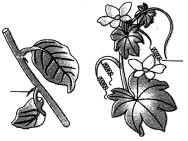
A
Analogous organs
B
Homologous organs
C
Convergent evolution
D
All are correct
Solution
(B) The figure shows the thorns of Bougainvillea and the tendrils of Cucurbita.
Both thorns and tendrils are modifications of the axillary bud,meaning they share a common anatomical origin (homology).
Homologous organs are structures that have a common evolutionary origin but perform different functions.
Therefore,these are examples of homologous organs,which represent divergent evolution,not convergent evolution.
Since option $B$ is correct and options $A$ and $C$ are incorrect,option $D$ cannot be correct. Thus,the correct answer is $B$.
Both thorns and tendrils are modifications of the axillary bud,meaning they share a common anatomical origin (homology).
Homologous organs are structures that have a common evolutionary origin but perform different functions.
Therefore,these are examples of homologous organs,which represent divergent evolution,not convergent evolution.
Since option $B$ is correct and options $A$ and $C$ are incorrect,option $D$ cannot be correct. Thus,the correct answer is $B$.
0 likes
View Solution182
MediumMCQ
Identify the correct pair.
A
Darwin - Mutation Theory
B
De Vries - Panspermia
C
Flippers of Penguin and Dolphin - Analogous organ
D
All correct
Solution
(C) . Darwin proposed the Theory of Natural Selection,not Mutation Theory. Mutation Theory was proposed by Hugo de Vries.
$B$. De Vries proposed Mutation Theory,not Panspermia. Panspermia is a hypothesis suggesting that life exists throughout the Universe.
$C$. Flippers of Penguins (birds) and Dolphins (mammals) are analogous organs. They perform the same function (swimming) but have different anatomical structures and embryonic origins,representing convergent evolution.
Therefore,the only correct pair is $C$.
$B$. De Vries proposed Mutation Theory,not Panspermia. Panspermia is a hypothesis suggesting that life exists throughout the Universe.
$C$. Flippers of Penguins (birds) and Dolphins (mammals) are analogous organs. They perform the same function (swimming) but have different anatomical structures and embryonic origins,representing convergent evolution.
Therefore,the only correct pair is $C$.
0 likes
View Solution183
MediumMCQ
Fossils are .........
A
Very soft parts of life forms.
B
Hard parts of life forms found in the uppermost layer of soil.
C
Remnants of hard parts of life forms found in rocks.
D
Very soft parts of life forms found in either upper or inner layers.
Solution
(C) Fossils are the preserved remains,impressions,or traces of organisms from the remote past.
They are typically formed when the hard parts of organisms,such as bones,shells,teeth,or woody tissues,are buried in sediment and eventually become embedded in rocks over geological time.
Therefore,fossils are defined as the remnants of hard parts of life forms found in rocks.
They are typically formed when the hard parts of organisms,such as bones,shells,teeth,or woody tissues,are buried in sediment and eventually become embedded in rocks over geological time.
Therefore,fossils are defined as the remnants of hard parts of life forms found in rocks.
0 likes
View Solution184
MediumMCQ
Which of the following is an example of convergent evolution?
A
Analogous structures; wings of butterfly and wings of birds.
B
Homologous structures; thorn and tendrils of Bougainvillea and Cucurbita.
C
Analogous structures; thorn and tendrils of Bougainvillea and Cucurbita.
D
Homologous structures; wings of butterfly and wings of birds.
Solution
(A) Convergent evolution refers to the process where organisms not closely related independently evolve similar traits as a result of having to adapt to similar environments or ecological niches.
This results in the formation of analogous structures,which are organs that have similar functions but different anatomical origins.
The wings of a butterfly (invertebrate) and the wings of a bird (vertebrate) perform the same function of flight but have different structural origins,making them analogous structures.
Therefore,the wings of a butterfly and birds represent convergent evolution.
This results in the formation of analogous structures,which are organs that have similar functions but different anatomical origins.
The wings of a butterfly (invertebrate) and the wings of a bird (vertebrate) perform the same function of flight but have different structural origins,making them analogous structures.
Therefore,the wings of a butterfly and birds represent convergent evolution.
0 likes
View Solution185
EasyMCQ
Sweet potato and potato are examples of:
A
Adaptive radiations
B
Homology
C
Divergent evolution
D
Analogy
Solution
(D) Sweet potato is a root modification,while potato is a stem modification.
Both perform the same function of food storage but have different anatomical origins.
Structures that perform similar functions but have different evolutionary origins are called analogous organs.
This phenomenon is known as analogy or convergent evolution.
Both perform the same function of food storage but have different anatomical origins.
Structures that perform similar functions but have different evolutionary origins are called analogous organs.
This phenomenon is known as analogy or convergent evolution.
0 likes
View Solution186
MediumMCQ
Choose the incorrect pair.
A
Divergent evolution - Homologous organs
B
Convergent evolution - Analogous organs
C
Natural selection - Heart of vertebrates
D
Analogous organs - Eyes of octopus and human
Solution
(C) The correct answer is $C$.
$1$. Divergent evolution leads to the development of homologous organs,which share a common ancestral origin but perform different functions (e.g.,forelimbs of whales,bats,cheetah,and humans).
$2$. Convergent evolution leads to the development of analogous organs,which perform similar functions but have different ancestral origins (e.g.,wings of butterfly and birds).
$3$. The eyes of an octopus and a human are a classic example of analogous organs because they perform the same function (vision) but have evolved independently.
$4$. The heart of vertebrates is an example of homologous organs,not natural selection. Natural selection is a mechanism of evolution,whereas the heart structure shows common ancestry among vertebrates.
$1$. Divergent evolution leads to the development of homologous organs,which share a common ancestral origin but perform different functions (e.g.,forelimbs of whales,bats,cheetah,and humans).
$2$. Convergent evolution leads to the development of analogous organs,which perform similar functions but have different ancestral origins (e.g.,wings of butterfly and birds).
$3$. The eyes of an octopus and a human are a classic example of analogous organs because they perform the same function (vision) but have evolved independently.
$4$. The heart of vertebrates is an example of homologous organs,not natural selection. Natural selection is a mechanism of evolution,whereas the heart structure shows common ancestry among vertebrates.
0 likes
View Solution187
MediumMCQ
Evidence that evolution of life forms has indeed taken place on Earth has come from:
A
Fossils study (palaeontological evidences)
B
Morphological and comparative anatomical study
C
Biochemical study
D
All of the above
Solution
(D) The evidence for the evolution of life forms on Earth is derived from multiple scientific disciplines:
$1$. Palaeontological evidences: The study of fossils provides direct evidence of past life forms and their gradual changes over geological time.
$2$. Morphological and comparative anatomical studies: Comparing the structures of different organisms (e.g.,homologous and analogous organs) reveals evolutionary relationships and common ancestry.
$3$. Biochemical and molecular studies: Similarities in $DNA$,$RNA$,proteins,and metabolic pathways across diverse species provide strong evidence for a common evolutionary origin.
Therefore,all these fields contribute to our understanding of evolution.
$1$. Palaeontological evidences: The study of fossils provides direct evidence of past life forms and their gradual changes over geological time.
$2$. Morphological and comparative anatomical studies: Comparing the structures of different organisms (e.g.,homologous and analogous organs) reveals evolutionary relationships and common ancestry.
$3$. Biochemical and molecular studies: Similarities in $DNA$,$RNA$,proteins,and metabolic pathways across diverse species provide strong evidence for a common evolutionary origin.
Therefore,all these fields contribute to our understanding of evolution.
0 likes
View Solution188
MediumMCQ
$A$ study of fossils in different sedimentary layers indicates:
A
Physiological period in which they existed
B
Geological period in which they existed
C
Conditions in which they were living
D
All of the above
Solution
(D) Fossils are the remains or impressions of organisms that lived in the past.
Sedimentary rocks are formed in layers,where the bottom layers are the oldest and the top layers are the youngest.
By studying fossils in these different layers,scientists can determine the geological time period during which the organisms lived.
Furthermore,the nature of the sedimentary rock and the associated fossils provide information about the environmental conditions (such as climate,water availability,etc.) in which these organisms existed.
Therefore,fossil studies provide insights into the geological period,the environmental conditions,and indirectly,the physiological adaptations required for those conditions.
Thus,the correct answer is $D$.
Sedimentary rocks are formed in layers,where the bottom layers are the oldest and the top layers are the youngest.
By studying fossils in these different layers,scientists can determine the geological time period during which the organisms lived.
Furthermore,the nature of the sedimentary rock and the associated fossils provide information about the environmental conditions (such as climate,water availability,etc.) in which these organisms existed.
Therefore,fossil studies provide insights into the geological period,the environmental conditions,and indirectly,the physiological adaptations required for those conditions.
Thus,the correct answer is $D$.
0 likes
View Solution189
MediumMCQ
Choose the homologous organs from the given options.
$(I)$ Vertebrate hearts.
$(II)$ Vertebrate brains.
$(III)$ Thorn and tendrils of Bougainvillea and Cucurbita respectively.
$(IV)$ Vertebrate limbs.
The correct combination is:
$(I)$ Vertebrate hearts.
$(II)$ Vertebrate brains.
$(III)$ Thorn and tendrils of Bougainvillea and Cucurbita respectively.
$(IV)$ Vertebrate limbs.
The correct combination is:
A
$I$ and $II$ only
B
$II$ and $III$ only
C
$III$ and $IV$ only
D
$I, II, III$ and $IV$
Solution
(D) Homologous organs are those which have the same basic structure and embryonic origin but perform different functions.
- Vertebrate hearts and brains show homology as they have a similar basic plan but have evolved to suit different needs.
- Thorns of Bougainvillea and tendrils of Cucurbita are homologous as both arise from axillary buds.
- Vertebrate limbs (e.g.,forelimbs of mammals,birds,reptiles) share the same pentadactyl structural plan.
Therefore,all the given options $(I), (II), (III)$,and $(IV)$ are examples of homologous organs.
- Vertebrate hearts and brains show homology as they have a similar basic plan but have evolved to suit different needs.
- Thorns of Bougainvillea and tendrils of Cucurbita are homologous as both arise from axillary buds.
- Vertebrate limbs (e.g.,forelimbs of mammals,birds,reptiles) share the same pentadactyl structural plan.
Therefore,all the given options $(I), (II), (III)$,and $(IV)$ are examples of homologous organs.
0 likes
View Solution190
MediumMCQ
All organisms share the same types of proteins and biochemical pathways. This supports the fact that:
A
Evolution occurs very fast
B
Life began on Earth a long time ago
C
All organisms have common ancestry
D
Evolution is an ongoing process
Solution
(C) The presence of similar proteins (such as cytochrome $c$) and identical biochemical pathways (like glycolysis and the Krebs cycle) across diverse groups of organisms provides strong evidence for evolutionary biology.
These molecular similarities indicate that these fundamental processes were inherited from a common ancestor.
This concept is known as molecular homology,which suggests that all life forms share a common origin,supporting the theory of common ancestry.
These molecular similarities indicate that these fundamental processes were inherited from a common ancestor.
This concept is known as molecular homology,which suggests that all life forms share a common origin,supporting the theory of common ancestry.
0 likes
View Solution191
MediumMCQ
The presence of gills in the tadpole of a frog indicates that . . . . . . .
A
Fishes were amphibians in the past.
B
Fishes evolved from amphibian-like ancestors.
C
Frogs will have gills in the future.
D
Frogs evolved from gill-bearing ancestors.
Solution
(D) The presence of gills in the tadpole stage of a frog is an example of recapitulation or evidence of evolutionary history. It indicates that frogs have evolved from aquatic,gill-bearing ancestors. This reflects the principle that ontogeny (development of an individual) often recapitulates phylogeny (evolutionary history of the species). Therefore,the tadpole stage serves as a link to the ancestral aquatic form.
0 likes
View Solution192
MediumMCQ
Which sequence is used to determine evolutionary relationships?
A
$m-RNA$
B
$r-RNA$
C
$t-RNA$
D
$DNA$
Solution
(B) The sequence of $r-RNA$ (ribosomal $RNA$),specifically the $16S$ $r-RNA$ in prokaryotes and $18S$ $r-RNA$ in eukaryotes,is highly conserved across different species.
Because these sequences change very slowly over evolutionary time,they are widely used as a molecular chronometer to determine evolutionary relationships and construct phylogenetic trees.
Because these sequences change very slowly over evolutionary time,they are widely used as a molecular chronometer to determine evolutionary relationships and construct phylogenetic trees.
0 likes
View Solution193
EasyMCQ
Who proposed the fundamental principle of embryonic development?
A
Von Baer
B
Weismann
C
Haeckel
D
Morgan
Solution
(A) The fundamental principle of embryonic development,often referred to as Von Baer's laws of embryology,was proposed by Karl Ernst von Baer.
These laws state that general characteristics of a group of animals appear in the embryo earlier than the specialized characteristics.
Therefore,the correct option is $A$.
These laws state that general characteristics of a group of animals appear in the embryo earlier than the specialized characteristics.
Therefore,the correct option is $A$.
0 likes
View Solution194
MediumMCQ
What is the study of fossils called?
A
Paleontology
B
Herpetology
C
Saurology
D
Organic Evolution
Solution
(A) The study of fossils is known as $Paleontology$. It involves the examination of plant and animal remains preserved in the Earth's crust to understand the history of life on Earth. $Herpetology$ is the study of amphibians and reptiles, $Saurology$ is the study of lizards, and $Organic \text{ } Evolution$ refers to the process of gradual change in organisms over time.
0 likes
View Solution195
MediumMCQ
Homologous organs are ............. .
A
Wings of insects and wings of bats
B
Gills of fish and lungs of rabbits
C
Flipper of whale and forelimbs of horse
D
Wings of grasshopper and wings of crow
Solution
(C) Homologous organs are those organs that have the same basic structural design and developmental origin but perform different functions.
These organs indicate divergent evolution.
The flipper of a whale and the forelimbs of a horse are homologous because they share the same skeletal structure (humerus,radius,ulna,carpals,metacarpals,and phalanges) despite being adapted for swimming and running,respectively.
In contrast,wings of insects and bats,or grasshoppers and crows,are analogous organs because they perform the same function (flight) but have different evolutionary origins.
These organs indicate divergent evolution.
The flipper of a whale and the forelimbs of a horse are homologous because they share the same skeletal structure (humerus,radius,ulna,carpals,metacarpals,and phalanges) despite being adapted for swimming and running,respectively.
In contrast,wings of insects and bats,or grasshoppers and crows,are analogous organs because they perform the same function (flight) but have different evolutionary origins.
0 likes
View Solution196
MediumMCQ
Homologous organs are those that show similarity in $..........$.
A
Size
B
Origin
C
Function
D
Appearance
Solution
(B) Homologous organs are defined as organs that share a common evolutionary origin and structural plan,even if they perform different functions in different organisms. $1.$ They arise from the same embryonic primordia. $2.$ They indicate divergent evolution. $3.$ Examples include the forelimbs of whales,bats,cheetahs,and humans,which share the same anatomical structure (humerus,radius,ulna,carpals,metacarpals,and phalanges) despite being used for swimming,flying,running,or grasping. Therefore,the correct answer is $B$ (Origin).
0 likes
View Solution197
MediumMCQ
The presence of gill slits in the embryos of all vertebrates supports which theory?
A
Biogenesis
B
Recapitulation theory
C
Metamorphosis
D
Organic evolution
Solution
(B) The presence of gill slits in the embryos of all vertebrates is a classic example of embryological evidence for evolution.
This observation supports the $Recapitulation$ $theory$ (also known as $von$ $Baer's$ $law$ or $Haeckel's$ $Biogenetic$ $law$),which states that 'ontogeny repeats phylogeny'.
This means that an individual organism's biological development,or ontogeny,parallels and summarizes its species' evolutionary development,or phylogeny.
This observation supports the $Recapitulation$ $theory$ (also known as $von$ $Baer's$ $law$ or $Haeckel's$ $Biogenetic$ $law$),which states that 'ontogeny repeats phylogeny'.
This means that an individual organism's biological development,or ontogeny,parallels and summarizes its species' evolutionary development,or phylogeny.
0 likes
View Solution198
EasyMCQ
Which of the following groups in human anatomy consists only of vestigial organs?
A
Body hair,olecranon process,coccyx,patella
B
Wisdom teeth,mammary glands,coccyx,patella
C
Coccyx,nictitating membrane,vermiform appendix,ear muscles
D
Coccyx,body hair,ear ossicles,vermiform appendix
Solution
(C) Vestigial organs are anatomical structures that have lost their original ancestral function through evolution.
In humans,the $coccyx$ (tailbone) is a remnant of an ancestral tail.
The $nictitating$ $membrane$ (plica semilunaris) is a vestigial fold of tissue in the corner of the eye.
The $vermiform$ $appendix$ is a vestigial structure related to the cecum,which was once used for cellulose digestion.
The $ear$ $muscles$ (auricular muscles) are vestigial muscles that were once used to move the pinna.
Therefore,the group containing only vestigial organs is $coccyx$,$nictitating$ $membrane$,$vermiform$ $appendix$,and $ear$ $muscles$.
In humans,the $coccyx$ (tailbone) is a remnant of an ancestral tail.
The $nictitating$ $membrane$ (plica semilunaris) is a vestigial fold of tissue in the corner of the eye.
The $vermiform$ $appendix$ is a vestigial structure related to the cecum,which was once used for cellulose digestion.
The $ear$ $muscles$ (auricular muscles) are vestigial muscles that were once used to move the pinna.
Therefore,the group containing only vestigial organs is $coccyx$,$nictitating$ $membrane$,$vermiform$ $appendix$,and $ear$ $muscles$.
0 likes
View Solution199
MediumMCQ
The common ancestry of humans and chimpanzees is best demonstrated by which of the following?
A
Banding patterns in chromosome numbers $3$ and $6$
B
Cranial capacity
C
Binocular vision
D
Dental formula
Solution
(A) The common ancestry of humans and chimpanzees is supported by molecular and cytogenetic evidence. Specifically,the banding patterns observed in chromosomes $3$ and $6$ of humans and chimpanzees show a high degree of similarity,indicating a shared evolutionary history. This chromosomal homology provides strong evidence for their close phylogenetic relationship.
0 likes
View SolutionEvolution — Evidences of Evolution · Frequently Asked Questions
1Are these Evolution questions useful for JEE and NEET?
Yes. All questions in this section are mapped to JEE Main and NEET exam patterns. Previous year questions from JEE Main, NEET, GUJCET and state-level exams are included with full solutions.
2Can I switch to Hindi or Gujarati for these questions?
Yes. Use the language tabs in the hero section or the sidebar to view the same questions and solutions in English, Hindi or Gujarati.
3How do I generate a question paper from this subtopic?
Use the Vedclass Exam Paper Generator — select the chapter and subtopic, set difficulty, and generate Sets A, B, C, D automatically. First 3 chapters of every subject are free.
Vedclass Products
For Students
Vedclass Test Series
Mock tests in real JEE/NEET style with performance analysis. 5-day free trial.
Start Free TrialFor Teachers
Exam Paper Generator
Generate Set A/B/C/D papers from this chapter in 2 minutes. 3 chapters free.
Try FreeFor Institutes
Online Exam Module
Live online exams with unlimited students, 360° analytics & white-label branding.
See DemoFor Teachers & Institutes
Generate a Evolution Exam Paper in 2 Minutes
Select subtopic & difficulty — Sets A, B, C, D auto-generated with No Repeat logic.
First 3 chapters of every subject are free — no payment required.