
A English
Mix Examples- Ecosystem Questions in English
Class 12 Biology · Ecosystem · Mix Examples- Ecosystem
256+
Questions
English
Language
100%
With Solutions
Showing 49 of 256 questions in English
101
MediumMCQ
Match the following columns.
| Column-$I$ | Column-$II$ |
| $(a)$ Phytoplankton,grass | $(p)$ First trophic level |
| $(b)$ Man,Lion | $(q)$ Herbivore |
| $(c)$ Zooplankton,Cow,Grasshopper | $(r)$ Third trophic level |
| $(d)$ Birds,Wolf | $(s)$ Top carnivore |
A
$a-p, b-s, c-q, d-r$
B
$a-s, b-r, c-q, d-p$
C
$a-p, b-r, c-q, d-s$
D
$a-p, b-s, c-q, d-r$
Solution
(D) The trophic levels in an ecosystem are organized as follows:
$1$. $(a)$ Phytoplankton and grass are producers,which occupy the $(p)$ First trophic level.
$2$. $(c)$ Zooplankton,Cow,and Grasshopper are primary consumers,which are $(q)$ Herbivores.
$3$. $(d)$ Birds and Wolf are secondary consumers,which occupy the $(r)$ Third trophic level.
$4$. $(b)$ Man and Lion are typically considered $(s)$ Top carnivores in many food chains.
Therefore,the correct matching is: $(a-p, b-s, c-q, d-r)$.
$1$. $(a)$ Phytoplankton and grass are producers,which occupy the $(p)$ First trophic level.
$2$. $(c)$ Zooplankton,Cow,and Grasshopper are primary consumers,which are $(q)$ Herbivores.
$3$. $(d)$ Birds and Wolf are secondary consumers,which occupy the $(r)$ Third trophic level.
$4$. $(b)$ Man and Lion are typically considered $(s)$ Top carnivores in many food chains.
Therefore,the correct matching is: $(a-p, b-s, c-q, d-r)$.
0 likes
View Solution102
MediumMCQ
Choose the correct sequence of True $(T)$ and False $(F)$ statements:
$(1)$ Zooplanktons are primary producers in an aquatic ecosystem.
$(2)$ Decomposition is largely an oxygen-requiring process.
$(3)$ In a natural ecosystem, fishes, wolf, etc., are carnivores.
$(4)$ The amount of energy decreases at each successive trophic level.
$(1)$ Zooplanktons are primary producers in an aquatic ecosystem.
$(2)$ Decomposition is largely an oxygen-requiring process.
$(3)$ In a natural ecosystem, fishes, wolf, etc., are carnivores.
$(4)$ The amount of energy decreases at each successive trophic level.
A
$TFFT$
B
$FTTF$
C
$FTTT$
D
$FFTT$
Solution
(C) $(1)$ False: Zooplanktons are primary consumers (herbivores) that feed on phytoplankton, which are the primary producers.
$(2)$ True: Decomposition is an aerobic process that requires oxygen for the breakdown of complex organic matter into inorganic substances.
$(3)$ True: Fishes and wolves are heterotrophs that consume other organisms, thus they are classified as carnivores.
$(4)$ True: According to the $10\%$ law of energy transfer, energy decreases as it moves from one trophic level to the next.
Therefore, the sequence is $F, T, T, T$.
$(2)$ True: Decomposition is an aerobic process that requires oxygen for the breakdown of complex organic matter into inorganic substances.
$(3)$ True: Fishes and wolves are heterotrophs that consume other organisms, thus they are classified as carnivores.
$(4)$ True: According to the $10\%$ law of energy transfer, energy decreases as it moves from one trophic level to the next.
Therefore, the sequence is $F, T, T, T$.
0 likes
View Solution103
MediumMCQ
Which of the following statements is true for an ecosystem?
A
Primary consumers are least dependent on producers.
B
Primary consumers are superior in number to producers.
C
Producers are more than primary consumers.
D
Secondary consumers are the largest and most powerful.
Solution
(C) In an ecosystem, the flow of energy always starts from producers (green plants). According to Lindeman's $10\%$ law, energy is lost at each trophic level, so the number and biomass of producers are always greater than primary consumers. Therefore, the statement that producers are more than primary consumers is true.
0 likes
View Solution104
MediumMCQ
Which of the following has the largest population in a food chain?
A
Decomposers
B
Producers
C
Primary consumers
D
Tertiary consumers
Solution
(B) In a typical ecosystem, the food chain follows the $10\%$ law of energy transfer, where energy decreases at each trophic level.
Producers (plants) occupy the first trophic level and possess the highest biomass and population size to support all subsequent levels.
As we move up the trophic levels from primary consumers to tertiary consumers, the number of individuals and the available energy significantly decrease.
Therefore, producers have the largest population in a food chain.
Producers (plants) occupy the first trophic level and possess the highest biomass and population size to support all subsequent levels.
As we move up the trophic levels from primary consumers to tertiary consumers, the number of individuals and the available energy significantly decrease.
Therefore, producers have the largest population in a food chain.
0 likes
View Solution105
MediumMCQ
Which of the following statements are correct regarding a food chain?
$(a)$ If $80\%$ of tigers are removed from an area,the growth of vegetation in that area increases.
$(b)$ If carnivores are removed from an area,the population growth of deer increases.
$(c)$ The length of a food chain is limited to $3$ to $4$ trophic levels because the amount of energy decreases in the ecosystem.
$(d)$ The length of a food chain is usually $2$ to $8$ trophic levels.
$(a)$ If $80\%$ of tigers are removed from an area,the growth of vegetation in that area increases.
$(b)$ If carnivores are removed from an area,the population growth of deer increases.
$(c)$ The length of a food chain is limited to $3$ to $4$ trophic levels because the amount of energy decreases in the ecosystem.
$(d)$ The length of a food chain is usually $2$ to $8$ trophic levels.
A
Statements $(b)$ and $(c)$ are correct.
B
Statements $(c)$ and $(d)$ are correct.
C
Statements $(a)$ and $(d)$ are correct.
D
Statements $(a)$ and $(b)$ are correct.
Solution
(A) Statement $(a)$ is incorrect because removing tigers (top predators) leads to an increase in herbivores,which in turn overgraze the vegetation,causing a decrease in plant growth.
Statement $(b)$ is correct because carnivores control the population of herbivores (like deer). Removing them leads to an unchecked increase in the deer population.
Statement $(c)$ is correct because,according to the $10\%$ law of energy transfer,only a small fraction of energy is passed to the next trophic level,limiting the number of levels in a food chain.
Statement $(d)$ is incorrect because food chains are typically limited to $3-5$ trophic levels,not $2-8$.
Statement $(b)$ is correct because carnivores control the population of herbivores (like deer). Removing them leads to an unchecked increase in the deer population.
Statement $(c)$ is correct because,according to the $10\%$ law of energy transfer,only a small fraction of energy is passed to the next trophic level,limiting the number of levels in a food chain.
Statement $(d)$ is incorrect because food chains are typically limited to $3-5$ trophic levels,not $2-8$.
0 likes
View Solution106
MediumMCQ
In a pond ecosystem,which organisms can occupy more than one trophic level?
A
Fish
B
Zooplankton
C
Frogs
D
Phytoplankton
Solution
(A) In a pond ecosystem,organisms like fish can occupy more than one trophic level.
For example,a fish may feed on phytoplankton (acting as a primary consumer at the second trophic level) or it may feed on zooplankton (acting as a secondary consumer at the third trophic level).
This phenomenon is common in complex food webs where organisms do not strictly belong to a single trophic level.
For example,a fish may feed on phytoplankton (acting as a primary consumer at the second trophic level) or it may feed on zooplankton (acting as a secondary consumer at the third trophic level).
This phenomenon is common in complex food webs where organisms do not strictly belong to a single trophic level.
0 likes
View Solution107
MediumMCQ
What is the correct sequence in a hydrosere (hydrarch succession)?
A
Volvox $\to$ Hydrilla $\to$ Pistia $\to$ Cyperus $\to$ Lantana $\to$ Oak
B
Pistia $\to$ Volvox $\to$ Cyperus $\to$ Hydrilla $\to$ Oak $\to$ Lantana
C
Oak $\to$ Lantana $\to$ Volvox $\to$ Hydrilla $\to$ Pistia $\to$ Cyperus
D
Oak $\to$ Lantana $\to$ Cyperus $\to$ Pistia $\to$ Hydrilla $\to$ Volvox
Solution
(A) Hydrarch succession (hydrosere) refers to the primary succession that occurs in an aquatic environment.
The sequence of stages is as follows:
$1$. Phytoplankton stage (e.g.,$Volvox$): These are the pioneer species.
$2$. Submerged plant stage (e.g.,$Hydrilla$): Rooted submerged plants appear.
$3$. Floating plant stage (e.g.,$Pistia$): Free-floating plants cover the surface.
$4$. Reed-swamp stage (e.g.,$Cyperus$): Emergent plants that can survive in shallow water.
$5$. Marsh-meadow stage: Grasses and sedges.
$6$. Scrub stage (e.g.,$Lantana$): Shrubs appear.
$7$. Forest stage (e.g.,$Oak$): The climax community.
Therefore,the correct sequence is $Volvox \to Hydrilla \to Pistia \to Cyperus \to Lantana \to Oak$.
The sequence of stages is as follows:
$1$. Phytoplankton stage (e.g.,$Volvox$): These are the pioneer species.
$2$. Submerged plant stage (e.g.,$Hydrilla$): Rooted submerged plants appear.
$3$. Floating plant stage (e.g.,$Pistia$): Free-floating plants cover the surface.
$4$. Reed-swamp stage (e.g.,$Cyperus$): Emergent plants that can survive in shallow water.
$5$. Marsh-meadow stage: Grasses and sedges.
$6$. Scrub stage (e.g.,$Lantana$): Shrubs appear.
$7$. Forest stage (e.g.,$Oak$): The climax community.
Therefore,the correct sequence is $Volvox \to Hydrilla \to Pistia \to Cyperus \to Lantana \to Oak$.
0 likes
View Solution108
MediumMCQ
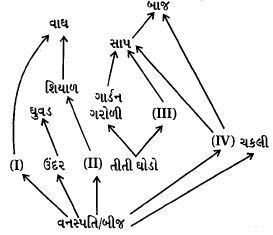
Identify the organisms $I, II, III$ and $IV$ in the given food web.
$I$ | $II$ | $III$ | $IV$
$I$ | $II$ | $III$ | $IV$
A
Deer | Rabbit | Frog | Mouse
B
Dog | Squirrel | Bat | Deer
C
Mouse | Dog | Turtle | Crow
D
Squirrel | Cat | Mouse | Pigeon
Solution
(D) Based on the provided food web diagram:
$1$. Organism $I$ consumes plants/seeds and is eaten by the tiger. In this context, it represents a herbivore like a squirrel.
$2$. Organism $II$ consumes plants/seeds and is eaten by the fox. It represents a herbivore like a cat (or similar small mammal).
$3$. Organism $III$ is eaten by the snake and consumes grasshoppers. It represents a predator like a mouse.
$4$. Organism $IV$ consumes plants/seeds and is eaten by the hawk. It represents a bird like a pigeon.
Therefore, the correct sequence is $I = \text{Squirrel}, II = \text{Cat}, III = \text{Mouse}, IV = \text{Pigeon}$.
$1$. Organism $I$ consumes plants/seeds and is eaten by the tiger. In this context, it represents a herbivore like a squirrel.
$2$. Organism $II$ consumes plants/seeds and is eaten by the fox. It represents a herbivore like a cat (or similar small mammal).
$3$. Organism $III$ is eaten by the snake and consumes grasshoppers. It represents a predator like a mouse.
$4$. Organism $IV$ consumes plants/seeds and is eaten by the hawk. It represents a bird like a pigeon.
Therefore, the correct sequence is $I = \text{Squirrel}, II = \text{Cat}, III = \text{Mouse}, IV = \text{Pigeon}$.
0 likes
View Solution109
MediumMCQ
Which of the following is $NOT$ a functional unit of an ecosystem?
A
Energy flow
B
Decomposition
C
Productivity
D
Stratification
Solution
(D) The functional units of an ecosystem are those processes that maintain the ecosystem's structure and dynamics. These include:
$1$. Productivity
$2$. Decomposition
$3$. Energy flow
$4$. Nutrient cycling
Stratification refers to the vertical distribution of different species occupying different levels in an ecosystem (e.g.,trees,shrubs,and herbs in a forest). It is a structural feature,not a functional unit.
$1$. Productivity
$2$. Decomposition
$3$. Energy flow
$4$. Nutrient cycling
Stratification refers to the vertical distribution of different species occupying different levels in an ecosystem (e.g.,trees,shrubs,and herbs in a forest). It is a structural feature,not a functional unit.
0 likes
View Solution110
EasyMCQ
Which of the following is $NOT$ a gaseous biogeochemical cycle in an ecosystem?
A
Oxygen cycle
B
Phosphorus cycle
C
Nitrogen cycle
D
Carbon cycle
Solution
(B) Biogeochemical cycles are broadly classified into two types based on the reservoir of the nutrient: gaseous cycles and sedimentary cycles.
$1$. Gaseous cycles: The reservoir for these elements is the atmosphere or hydrosphere. Examples include the $Carbon$,$Nitrogen$,and $Oxygen$ cycles.
$2$. Sedimentary cycles: The reservoir for these elements is the Earth's crust (rocks/soil). The $Phosphorus$ cycle is a classic example of a sedimentary cycle because phosphorus does not have a significant gaseous phase in the atmosphere under normal environmental conditions.
Therefore,the $Phosphorus$ cycle is not a gaseous cycle.
$1$. Gaseous cycles: The reservoir for these elements is the atmosphere or hydrosphere. Examples include the $Carbon$,$Nitrogen$,and $Oxygen$ cycles.
$2$. Sedimentary cycles: The reservoir for these elements is the Earth's crust (rocks/soil). The $Phosphorus$ cycle is a classic example of a sedimentary cycle because phosphorus does not have a significant gaseous phase in the atmosphere under normal environmental conditions.
Therefore,the $Phosphorus$ cycle is not a gaseous cycle.
0 likes
View Solution111
MediumMCQ
Match the following columns:
| Column-$I$ | Column-$II$ |
| $(a)$ Earthworm | $(i)$ Pioneer species |
| $(b)$ Succession | $(ii)$ Detritivores |
| $(c)$ Ecosystem service | $(iii)$ Birth rate |
| $(d)$ Population growth | $(iv)$ Pollination |
A
$(a-i), (b-ii), (c-iii), (d-iv)$
B
$(a-iv), (b-i), (c-iii), (d-ii)$
C
$(a-iii), (b-ii), (c-iv), (d-i)$
D
$(a-ii), (b-i), (c-iv), (d-iii)$
Solution
(D) The correct matches are as follows:
$(a)$ Earthworm is a detritivore as it feeds on decaying organic matter $(a-ii)$.
$(b)$ Pioneer species are the first organisms to colonize a barren area during ecological succession $(b-i)$.
$(c)$ Pollination is a vital ecosystem service provided by insects and other animals $(c-iv)$.
$(d)$ Birth rate (natality) is a key factor influencing population growth $(d-iii)$.
Therefore,the correct matching is $(a-ii), (b-i), (c-iv), (d-iii)$.
$(a)$ Earthworm is a detritivore as it feeds on decaying organic matter $(a-ii)$.
$(b)$ Pioneer species are the first organisms to colonize a barren area during ecological succession $(b-i)$.
$(c)$ Pollination is a vital ecosystem service provided by insects and other animals $(c-iv)$.
$(d)$ Birth rate (natality) is a key factor influencing population growth $(d-iii)$.
Therefore,the correct matching is $(a-ii), (b-i), (c-iv), (d-iii)$.
0 likes
View Solution112
MediumMCQ
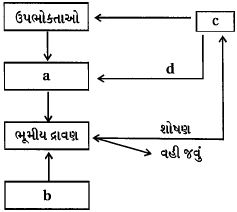
The following chart shows the phosphorus cycle in a terrestrial ecosystem. Select the correct option for the four labels $a, b, c$ and $d$ shown in the diagram.
$a$ - $b$ - $c$ - $d$
$a$ - $b$ - $c$ - $d$
A
Detritus - Rock minerals - Producers - Litter fall
B
Litter fall - Producers - Rock minerals - Detritus
C
Detritus - Rock minerals - Producers - Litter fall
D
Producers - Litter fall - Rock minerals - Detritus
Solution
(A) In the phosphorus cycle of a terrestrial ecosystem:
$1$. $c$ represents Producers (plants),which absorb phosphorus from the soil solution.
$2$. Producers contribute to the litter fall $(d)$ which adds to the detritus $(a)$.
$3$. Detritus $(a)$ decomposes and releases phosphorus back into the soil solution.
$4$. $b$ represents Rock minerals,which are the natural reservoir of phosphorus and release it into the soil solution through weathering.
Therefore,the correct sequence is $a$ = Detritus,$b$ = Rock minerals,$c$ = Producers,$d$ = Litter fall.
$1$. $c$ represents Producers (plants),which absorb phosphorus from the soil solution.
$2$. Producers contribute to the litter fall $(d)$ which adds to the detritus $(a)$.
$3$. Detritus $(a)$ decomposes and releases phosphorus back into the soil solution.
$4$. $b$ represents Rock minerals,which are the natural reservoir of phosphorus and release it into the soil solution through weathering.
Therefore,the correct sequence is $a$ = Detritus,$b$ = Rock minerals,$c$ = Producers,$d$ = Litter fall.
0 likes
View Solution113
MediumMCQ
Whale is
A
Primary producer
B
Carnivorous,secondary consumer
C
$A$ decomposer
D
Herbivorous
Solution
(B) Whales are carnivorous animals. They feed on primary consumers (such as krill or small fish) and occupy the third trophic level of the ecosystem.
0 likes
View Solution114
EasyMCQ
Which one of the following is not a function of an ecosystem?
A
Energy flow
B
Decomposition
C
Productivity
D
Stratification
Solution
(D) The four important functional aspects of an ecosystem are:
$(i)$ Productivity
$(ii)$ Decomposition
$(iii)$ Energy flow
$(iv)$ Nutrient cycling
Stratification refers to the vertical distribution of different species occupying different levels in an ecosystem,which is a structural feature rather than a functional one.
$(i)$ Productivity
$(ii)$ Decomposition
$(iii)$ Energy flow
$(iv)$ Nutrient cycling
Stratification refers to the vertical distribution of different species occupying different levels in an ecosystem,which is a structural feature rather than a functional one.
0 likes
View Solution115
MediumMCQ
Assertion : In tropical rain forests,$O-$ horizon and $A-$ horizon of soil profile are shallow and nutrient-poor.
Reason : Excessive growth of micro-organisms in the soil depletes its organic content.
Reason : Excessive growth of micro-organisms in the soil depletes its organic content.
A
If both Assertion and Reason are correct and the Reason is a correct explanation of the Assertion.
B
If both Assertion and Reason are correct but Reason is not a correct explanation of the Assertion.
C
If the Assertion is correct but Reason is incorrect.
D
If both the Assertion and Reason are incorrect.
Solution
(C) The Assertion is correct: In tropical rain forests,high temperature and heavy rainfall lead to rapid decomposition of organic matter and intense leaching of nutrients,resulting in shallow and nutrient-poor $O$ and $A$ horizons.
The Reason is incorrect: While micro-organisms are abundant,they do not deplete the organic content in a way that makes the soil nutrient-poor; rather,the rapid nutrient cycling and leaching are the primary causes of low soil fertility in these regions. The organic matter is decomposed and absorbed by plants almost immediately.
The Reason is incorrect: While micro-organisms are abundant,they do not deplete the organic content in a way that makes the soil nutrient-poor; rather,the rapid nutrient cycling and leaching are the primary causes of low soil fertility in these regions. The organic matter is decomposed and absorbed by plants almost immediately.
0 likes
View Solution116
MediumMCQ
Assertion : Secondary succession takes place in a recently denuded area.
Reason : It is caused due to the baring of an area.
Reason : It is caused due to the baring of an area.
A
If both Assertion and Reason are correct and the Reason is a correct explanation of the Assertion.
B
If both Assertion and Reason are correct but Reason is not a correct explanation of the Assertion.
C
If the Assertion is correct but Reason is incorrect.
D
If both the Assertion and Reason are incorrect.
Solution
(A) Ecological succession is the process by which the structure of a biological community evolves over time.
Primary succession occurs in areas where no living organisms have previously existed,such as bare rock or newly cooled lava.
Secondary succession occurs in areas where a pre-existing community has been destroyed or removed,such as after a forest fire,flood,or deforestation.
These areas still contain soil,organic debris,and biological propagules (seeds,spores,etc.) from the previous community.
The assertion is correct because secondary succession indeed occurs in recently denuded areas.
The reason is also correct because the process of secondary succession is initiated precisely because an area has been 'bared' (cleared) of its previous vegetation or community due to disturbances like fire or human activity.
Therefore,the reason correctly explains why secondary succession occurs in such areas.
Primary succession occurs in areas where no living organisms have previously existed,such as bare rock or newly cooled lava.
Secondary succession occurs in areas where a pre-existing community has been destroyed or removed,such as after a forest fire,flood,or deforestation.
These areas still contain soil,organic debris,and biological propagules (seeds,spores,etc.) from the previous community.
The assertion is correct because secondary succession indeed occurs in recently denuded areas.
The reason is also correct because the process of secondary succession is initiated precisely because an area has been 'bared' (cleared) of its previous vegetation or community due to disturbances like fire or human activity.
Therefore,the reason correctly explains why secondary succession occurs in such areas.
0 likes
View Solution117
EasyMCQ
Give scientific reasons: Even though plants are autotrophic,they cannot live alone.
A
They require pollinators for reproduction.
B
They depend on decomposers for nutrient recycling.
C
They rely on other organisms for seed dispersal.
D
All of the above.
Solution
(D) Plants are autotrophic,meaning they produce their own food through photosynthesis. However,they cannot live in isolation due to several ecological dependencies:
$1$. Nutrient Cycling: Plants depend on decomposers (bacteria and fungi) to break down organic matter into inorganic nutrients,which are then absorbed by the roots.
$2$. Pollination: Many flowering plants require biotic agents like insects,birds,or bats for cross-pollination to ensure successful reproduction.
$3$. Seed Dispersal: Plants often rely on animals to disperse their seeds to new locations,preventing overcrowding and competition.
$4$. Symbiosis: Many plants form symbiotic relationships with mycorrhizal fungi or nitrogen-fixing bacteria to obtain essential minerals like phosphorus and nitrogen.
Therefore,plants are an integral part of an ecosystem and depend on other organisms for their survival and propagation.
$1$. Nutrient Cycling: Plants depend on decomposers (bacteria and fungi) to break down organic matter into inorganic nutrients,which are then absorbed by the roots.
$2$. Pollination: Many flowering plants require biotic agents like insects,birds,or bats for cross-pollination to ensure successful reproduction.
$3$. Seed Dispersal: Plants often rely on animals to disperse their seeds to new locations,preventing overcrowding and competition.
$4$. Symbiosis: Many plants form symbiotic relationships with mycorrhizal fungi or nitrogen-fixing bacteria to obtain essential minerals like phosphorus and nitrogen.
Therefore,plants are an integral part of an ecosystem and depend on other organisms for their survival and propagation.
0 likes
View Solution118
Easy
Fill in the blanks.
$(a)$ Plants are called as . . . . . . because they fix carbon dioxide.
$(b)$ In an ecosystem dominated by trees,the pyramid (of numbers) is . . . . . . type.
$(c)$ In aquatic ecosystems,the limiting factor for the productivity is . . . . . . .
$(d)$ Common detritivores in our ecosystem are . . . . . . .
$(e)$ The major reservoir of carbon on earth is . . . . . . .
$(a)$ Plants are called as . . . . . . because they fix carbon dioxide.
$(b)$ In an ecosystem dominated by trees,the pyramid (of numbers) is . . . . . . type.
$(c)$ In aquatic ecosystems,the limiting factor for the productivity is . . . . . . .
$(d)$ Common detritivores in our ecosystem are . . . . . . .
$(e)$ The major reservoir of carbon on earth is . . . . . . .
Solution
(N/A) Plants are called as $\text{autotrophs}$ because they fix carbon dioxide.
$(b)$ In an ecosystem dominated by trees,the pyramid (of numbers) is $\text{inverted}$ type.
$(c)$ In aquatic ecosystems,the limiting factor for productivity is $\text{light}$.
$(d)$ Common detritivores in our ecosystem are $\text{earthworms}$.
$(e)$ The major reservoir of carbon on Earth is $\text{oceans}$.
$(b)$ In an ecosystem dominated by trees,the pyramid (of numbers) is $\text{inverted}$ type.
$(c)$ In aquatic ecosystems,the limiting factor for productivity is $\text{light}$.
$(d)$ Common detritivores in our ecosystem are $\text{earthworms}$.
$(e)$ The major reservoir of carbon on Earth is $\text{oceans}$.
0 likes
View Solution119
DifficultMCQ
Secondary producers are
A
Herbivores
B
Producers
C
Carnivores
D
None of the above
Solution
(D) None of the above.
Plants are the only organisms capable of producing organic compounds from inorganic substances through photosynthesis,hence they are called primary producers.
There is no such category as secondary producers in a food chain,as all subsequent trophic levels (herbivores,carnivores) are consumers.
Plants are the only organisms capable of producing organic compounds from inorganic substances through photosynthesis,hence they are called primary producers.
There is no such category as secondary producers in a food chain,as all subsequent trophic levels (herbivores,carnivores) are consumers.
0 likes
View Solution120
Medium
Distinguish between:
$(a)$ Grazing food chain and detritus food chain
$(b)$ Production and decomposition
$(a)$ Grazing food chain and detritus food chain
$(b)$ Production and decomposition
Solution
(N/A) Grazing food chain and detritus food chain
$(b)$ Production and decomposition
| Grazing food chain | Detritus food chain |
| $1$. In this food chain, energy is derived from the Sun. | $1$. In this food chain, energy comes from organic matter (or detritus) generated in trophic levels of the grazing food chain. |
| $2$. It begins with producers, present at the first trophic level. The plant biomass is then eaten by herbivores, which in turn are consumed by a variety of carnivores. | $2$. It begins with detritus such as dead bodies of animals or fallen leaves, which are then eaten by decomposers or detritivores. These detritivores are in turn consumed by their predators. |
| $3$. This food chain is usually large. | $3$. It is usually smaller as compared to the grazing food chain. |
$(b)$ Production and decomposition
| Production | Decomposition |
| $1$. It is the rate of producing organic matter (food) by producers. | $1$. It is the process of breaking down complex organic matter or biomass from the body of dead plants and animals with the help of decomposers into inorganic raw materials such as $CO_{2}, H_{2}O,$ and other nutrients. |
| $2$. It depends on the photosynthetic capacity of the producers. | $2$. It occurs with the help of decomposers. |
| $3$. Sunlight is required by plants for primary production. | $3$. Sunlight is not required for decomposition by decomposers. |
0 likes
View Solution121
Medium
Differentiate between Production and Decomposition.
Solution
(N/A)
| Production | Decomposition |
| $(1)$ Organic materials are synthesized in this process. | $(1)$ In this process,complex organic matter is broken down into simpler inorganic substances. |
| $(2)$ It depends on the photosynthesis performed by producers. | $(2)$ It depends on the activity of decomposers. |
| $(3)$ Sunlight is essential for primary productivity. | $(3)$ Sunlight is not required for the process of decomposition. |
| $(4)$ Example: Green plants. | $(4)$ Example: Bacteria,fungi. |
0 likes
View Solution122
EasyMCQ
Name an omnivore which occurs in both grazing food chain and the decomposer food chain.
A
Cockroach
B
Tiger
C
Grass
D
Earthworm
Solution
(A) An omnivore is an organism that consumes both plants and animals.
Cockroaches and crows are classic examples of omnivores.
They participate in the grazing food chain by consuming plant matter or small insects,and they also function in the decomposer food chain (detritus food chain) by feeding on dead and decaying organic matter.
Cockroaches and crows are classic examples of omnivores.
They participate in the grazing food chain by consuming plant matter or small insects,and they also function in the decomposer food chain (detritus food chain) by feeding on dead and decaying organic matter.
0 likes
View Solution123
MediumMCQ
Climax stage is achieved quickly in secondary succession as compared to primary succession. Why?
A
Secondary succession occurs in areas where life existed previously.
B
Primary succession involves the formation of soil from bare rock.
C
Soil and nutrients are already present in secondary succession.
D
All of the above.
Solution
(D) Secondary succession occurs in areas where life previously existed,meaning the soil is already present and rich in nutrients.
In contrast,primary succession begins on bare rock,where soil formation is a very slow process involving weathering and the accumulation of organic matter.
Because the substrate (soil) is already available in secondary succession,the colonization by plants and the subsequent progression toward a climax community occur much faster than in primary succession.
In contrast,primary succession begins on bare rock,where soil formation is a very slow process involving weathering and the accumulation of organic matter.
Because the substrate (soil) is already available in secondary succession,the colonization by plants and the subsequent progression toward a climax community occur much faster than in primary succession.
0 likes
View Solution124
EasyMCQ
According to $David \ Tilman$,greater the diversity,greater is the primary productivity. Can you think of a very low diversity man-made ecosystem that has high productivity?
A
Tropical rainforest
B
Wheat field
C
Coral reef
D
Estuary
Solution
(B) Agricultural fields,such as a wheat field or a paddy field,are examples of man-made ecosystems with very low diversity (monoculture).
Despite this low diversity,these ecosystems exhibit high primary productivity due to human intervention,such as the use of fertilizers,irrigation,and pest control,which optimize growth conditions for the specific crop.
Despite this low diversity,these ecosystems exhibit high primary productivity due to human intervention,such as the use of fertilizers,irrigation,and pest control,which optimize growth conditions for the specific crop.
0 likes
View Solution125
Medium
Provide information about the aquatic weed known as the 'Terror of Bengal'.
Solution
(N/A) The aquatic weed referred to as the 'Terror of Bengal' is water hyacinth $(Eichhornia crassipes)$.
It was introduced into India primarily for its beautiful flowers and leaf shape.
It grows at a phenomenal rate,much faster than our ability to remove it,which leads to the clogging of water bodies.
It causes ecological damage by depleting dissolved oxygen in the water,which leads to the death of fishes and other aquatic organisms,thereby disrupting the ecosystem dynamics.
It was introduced into India primarily for its beautiful flowers and leaf shape.
It grows at a phenomenal rate,much faster than our ability to remove it,which leads to the clogging of water bodies.
It causes ecological damage by depleting dissolved oxygen in the water,which leads to the death of fishes and other aquatic organisms,thereby disrupting the ecosystem dynamics.
0 likes
View Solution126
MediumMCQ
What will happen to an ecosystem if:
$(a)$ All producers are removed;
$(b)$ All organisms of herbivore level are eliminated; and
$(c)$ All top carnivore population is removed?
$(a)$ All producers are removed;
$(b)$ All organisms of herbivore level are eliminated; and
$(c)$ All top carnivore population is removed?
A
All producers are removed
B
All organisms of herbivore level are eliminated
C
All top carnivore population is removed
Solution
(N/A) If all producers are removed,primary productivity will cease. Consequently,there will be no biomass available for the next successive trophic levels,leading to the collapse of the entire food chain.
$(b)$ If all herbivores are removed,the biomass of producers will increase significantly due to the lack of grazing pressure. Conversely,carnivores will face extinction as their primary food source is eliminated.
$(c)$ If all top carnivores are removed,the population of herbivores will increase unchecked. This overpopulation will lead to overgrazing,which can destroy vegetation,deplete primary productivity,and potentially turn the area into a desert region.
$(b)$ If all herbivores are removed,the biomass of producers will increase significantly due to the lack of grazing pressure. Conversely,carnivores will face extinction as their primary food source is eliminated.
$(c)$ If all top carnivores are removed,the population of herbivores will increase unchecked. This overpopulation will lead to overgrazing,which can destroy vegetation,deplete primary productivity,and potentially turn the area into a desert region.
0 likes
View Solution127
EasyMCQ
Match the columns:
| Column-$I$ | Column-$II$ |
|---|---|
| $(a)$ Decomposers | $(i)$ Bacteria |
| $(b)$ Primary productivity | $(ii)$ Consumers |
| $(c)$ Natural ecosystem | $(iii)$ Producers |
| $(d)$ Secondary productivity | $(iv)$ Forest |
A
$a-i, b-iii, c-iv, d-ii$
B
$a-ii, b-i, c-iv, d-iii$
C
$a-i, b-iv, c-iii, d-ii$
D
$a-iii, b-i, c-ii, d-iv$
Solution
(A) The correct matching is as follows:
$(a)$ Decomposers are organisms like $(i)$ Bacteria and fungi that break down organic matter.
$(b)$ Primary productivity is associated with $(iii)$ Producers (plants/autotrophs) that fix solar energy.
$(c)$ $A$ $(iv)$ Forest is an example of a natural ecosystem.
$(d)$ Secondary productivity is the rate of formation of new organic matter by $(ii)$ Consumers.
Therefore,the correct sequence is $(a-i, b-iii, c-iv, d-ii)$.
$(a)$ Decomposers are organisms like $(i)$ Bacteria and fungi that break down organic matter.
$(b)$ Primary productivity is associated with $(iii)$ Producers (plants/autotrophs) that fix solar energy.
$(c)$ $A$ $(iv)$ Forest is an example of a natural ecosystem.
$(d)$ Secondary productivity is the rate of formation of new organic matter by $(ii)$ Consumers.
Therefore,the correct sequence is $(a-i, b-iii, c-iv, d-ii)$.
0 likes
View Solution128
Medium
Match the columns:
| Column-$I$ | Column-$II$ |
|---|---|
| $(i)$ Primary succession | $(i)$ Development of ecosystem |
| $(ii)$ Ecological succession | $(ii)$ Lichens |
| $(iii)$ Pioneer species on rocks | $(iii)$ Near to the equilibrium with the environment |
| $(iv)$ Climax community | $(iv)$ New species on bare environment |
Solution
(D) The correct matching is as follows:
$(i)$ Primary succession occurs on bare areas where no life existed previously,involving new species on a bare environment $(iv)$.
$(ii)$ Ecological succession is the gradual and predictable change in the species composition of a given area,leading to the development of an ecosystem $(i)$.
$(iii)$ Pioneer species on rocks are the first organisms to colonize a bare area,which are typically lichens $(ii)$.
$(iv)$ Climax community is the final stable community in a succession that is near to the equilibrium with the environment $(iii)$.
Therefore,the correct sequence is $(i-iv, ii-i, iii-ii, iv-iii)$.
$(i)$ Primary succession occurs on bare areas where no life existed previously,involving new species on a bare environment $(iv)$.
$(ii)$ Ecological succession is the gradual and predictable change in the species composition of a given area,leading to the development of an ecosystem $(i)$.
$(iii)$ Pioneer species on rocks are the first organisms to colonize a bare area,which are typically lichens $(ii)$.
$(iv)$ Climax community is the final stable community in a succession that is near to the equilibrium with the environment $(iii)$.
Therefore,the correct sequence is $(i-iv, ii-i, iii-ii, iv-iii)$.
0 likes
View Solution129
Medium
Distinguish between:
$(a)$ Upright and inverted pyramid
$(b)$ Food chain and Food web
$(a)$ Upright and inverted pyramid
$(b)$ Food chain and Food web
Solution
(N/A) Upright and inverted pyramid
$(b)$ Food chain and Food web
| Upright pyramid | Inverted pyramid |
|---|---|
| $1$. The pyramid of energy is always upright. | $1$. The pyramid of biomass and the pyramid of numbers can be inverted. |
| $2$. In an upright pyramid,the number and biomass of organisms at the producer level is the highest,decreasing at each successive trophic level. | $2$. In an inverted pyramid,the number and biomass of organisms at the producer level is the lowest,increasing at each successive trophic level. |
$(b)$ Food chain and Food web
| Food chain | Food web |
|---|---|
| $1$. It is a single linear sequence of organisms showing the flow of energy. | $1$. It is a complex network of many interconnected food chains. |
| $2$. Members at higher trophic levels feed on specific,limited types of organisms. | $2$. Organisms have multiple alternative food sources,providing greater stability. |
0 likes
View Solution130
EasyMCQ
Match the trophic levels with their correct species examples in a grassland ecosystem.
Select the correct option:
| $(a)$ Fourth trophic level | $(i)$ Crow |
| $(b)$ Second trophic level | $(ii)$ Vulture |
| $(c)$ First trophic level | $(iii)$ Rabbit |
| $(d)$ Third trophic level | $(iv)$ Grass |
Select the correct option:
A
$(i), (ii), (iii), (iv)$
B
$(ii), (iii), (iv), (i)$
C
$(iii), (ii), (i), (iv)$
D
$(iv), (iii), (ii), (i)$
Solution
(B) In a grassland ecosystem, the trophic levels are organized as follows:
$1$. First trophic level $(T_1)$: Producers (e.g., Grass) - $(c) - (iv)$
$2$. Second trophic level $(T_2)$: Primary consumers (e.g., Rabbit) - $(b) - (iii)$
$3$. Third trophic level $(T_3)$: Secondary consumers (e.g., Crow) - $(d) - (i)$
$4$. Fourth trophic level $(T_4)$: Tertiary consumers (e.g., Vulture) - $(a) - (ii)$
Therefore, the correct matching is $(a)-(ii), (b)-(iii), (c)-(iv), (d)-(i)$.
Thus, the correct option is $(B)$.
$1$. First trophic level $(T_1)$: Producers (e.g., Grass) - $(c) - (iv)$
$2$. Second trophic level $(T_2)$: Primary consumers (e.g., Rabbit) - $(b) - (iii)$
$3$. Third trophic level $(T_3)$: Secondary consumers (e.g., Crow) - $(d) - (i)$
$4$. Fourth trophic level $(T_4)$: Tertiary consumers (e.g., Vulture) - $(a) - (ii)$
Therefore, the correct matching is $(a)-(ii), (b)-(iii), (c)-(iv), (d)-(i)$.
Thus, the correct option is $(B)$.
0 likes
View Solution131
MediumMCQ
In a grassland ecosystem, match the trophic levels with their correct example species:
Select the correct option:
| $(a)$ Fourth trophic level | $(i)$ Crow |
| $(b)$ Second trophic level | $(ii)$ Vulture |
| $(c)$ First trophic level | $(iii)$ Rabbit |
| $(d)$ Third trophic level | $(iv)$ Grass |
Select the correct option:
A
$(ii), (iii), (iv), (i)$
B
$(iii), (ii), (i), (iv)$
C
$(iv), (iii), (ii), (i)$
D
$(i), (ii), (iii), (iv)$
Solution
(A) In a grassland ecosystem, the trophic levels are organized as follows:
$1$. First trophic level $(T_1)$: Producers (e.g., Grass) - $(c)-(iv)$.
$2$. Second trophic level $(T_2)$: Primary consumers (e.g., Rabbit) - $(b)-(iii)$.
$3$. Third trophic level $(T_3)$: Secondary consumers (e.g., Crow) - $(d)-(i)$.
$4$. Fourth trophic level $(T_4)$: Tertiary/Top consumers (e.g., Vulture) - $(a)-(ii)$.
Therefore, the correct matching is $(a)-(ii), (b)-(iii), (c)-(iv), (d)-(i)$.
$1$. First trophic level $(T_1)$: Producers (e.g., Grass) - $(c)-(iv)$.
$2$. Second trophic level $(T_2)$: Primary consumers (e.g., Rabbit) - $(b)-(iii)$.
$3$. Third trophic level $(T_3)$: Secondary consumers (e.g., Crow) - $(d)-(i)$.
$4$. Fourth trophic level $(T_4)$: Tertiary/Top consumers (e.g., Vulture) - $(a)-(ii)$.
Therefore, the correct matching is $(a)-(ii), (b)-(iii), (c)-(iv), (d)-(i)$.
0 likes
View Solution132
MediumMCQ
Which of the following exhibits scavenging?
A
Vulture
B
Jackal
C
Crow
D
All of the above
Solution
(D) Scavengers are organisms that primarily consume dead plant or animal material.
$A$. Vultures are well-known scavengers that feed on carcasses.
$B$. Jackals also act as scavengers by feeding on the remains of animals killed by predators.
$C$. Crows are omnivorous birds that frequently act as scavengers,feeding on organic waste and dead animals.
Since all three organisms exhibit scavenging behavior,the correct answer is $D$.
$A$. Vultures are well-known scavengers that feed on carcasses.
$B$. Jackals also act as scavengers by feeding on the remains of animals killed by predators.
$C$. Crows are omnivorous birds that frequently act as scavengers,feeding on organic waste and dead animals.
Since all three organisms exhibit scavenging behavior,the correct answer is $D$.
0 likes
View Solution133
MediumMCQ
The components of an ecosystem include .......... .
A
Productivity
B
Unidirectional flow of energy
C
Nutrient cycling
D
All of the above
Solution
(D) An ecosystem is a functional unit of nature where living organisms interact among themselves and with the surrounding physical environment. The functional aspects of an ecosystem are:
$1$. Productivity: The rate of biomass production.
$2$. Decomposition: The breakdown of complex organic matter.
$3$. Energy flow: The unidirectional movement of energy through trophic levels.
$4$. Nutrient cycling: The movement of nutrients through the biotic and abiotic components of the ecosystem.
Since all these processes are fundamental functional components of an ecosystem,the correct answer is $D$.
$1$. Productivity: The rate of biomass production.
$2$. Decomposition: The breakdown of complex organic matter.
$3$. Energy flow: The unidirectional movement of energy through trophic levels.
$4$. Nutrient cycling: The movement of nutrients through the biotic and abiotic components of the ecosystem.
Since all these processes are fundamental functional components of an ecosystem,the correct answer is $D$.
0 likes
View Solution134
MediumMCQ
Identify the basic components of an ecosystem.
A
Producers and decomposers
B
Unidirectional flow of energy and cycling of materials
C
Submerged and marginal plants
D
Both $A$ and $B$
Solution
(D) The structure of an ecosystem is defined by the interaction of its biotic and abiotic components.
Key functional aspects of an ecosystem include:
$1$. Productivity (Producers).
$2$. Decomposition (Decomposers).
$3$. Energy flow (Unidirectional flow of energy).
$4$. Nutrient cycling (Cycling of materials).
Since both options $A$ (Producers and decomposers) and $B$ (Unidirectional flow of energy and cycling of materials) represent fundamental components and functional aspects of an ecosystem,the correct answer is $D$.
Key functional aspects of an ecosystem include:
$1$. Productivity (Producers).
$2$. Decomposition (Decomposers).
$3$. Energy flow (Unidirectional flow of energy).
$4$. Nutrient cycling (Cycling of materials).
Since both options $A$ (Producers and decomposers) and $B$ (Unidirectional flow of energy and cycling of materials) represent fundamental components and functional aspects of an ecosystem,the correct answer is $D$.
0 likes
View Solution135
MediumMCQ
Identify the group of herbivores from the following that are included as primary consumers in an ecosystem.
A
Insects,birds,mammals,rabbits
B
Molluscs,mammals,grasshoppers,rats
C
Birds,molluscs,lizards,insects
D
All of the above
Solution
(D) In an ecosystem,herbivores are organisms that feed directly on plants and are classified as primary consumers.
$1$. Insects (e.g.,grasshoppers) feed on plant tissues.
$2$. Birds (many species) are herbivorous,feeding on seeds,fruits,or nectar.
$3$. Mammals such as rabbits,rats,and deer are classic herbivores.
$4$. Molluscs (e.g.,snails) are also known to feed on plant matter.
Since all the groups mentioned in the options contain organisms that function as primary consumers (herbivores) in various ecosystems,the correct answer is $D$.
$1$. Insects (e.g.,grasshoppers) feed on plant tissues.
$2$. Birds (many species) are herbivorous,feeding on seeds,fruits,or nectar.
$3$. Mammals such as rabbits,rats,and deer are classic herbivores.
$4$. Molluscs (e.g.,snails) are also known to feed on plant matter.
Since all the groups mentioned in the options contain organisms that function as primary consumers (herbivores) in various ecosystems,the correct answer is $D$.
0 likes
View Solution136
MediumMCQ
In an ecosystem, at which trophic level can a human consuming curd be placed?
A
Producers
B
Primary consumers (Herbivores)
C
Secondary consumers
D
Tertiary consumers
Solution
(C) $1$. In an ecosystem, the food chain starts with producers (plants) that capture solar energy.
$2$. Primary consumers (herbivores) feed directly on producers. For example, a cow eats grass.
$3$. Curd is a dairy product derived from milk, which is produced by a cow (a primary consumer).
$4$. When a human consumes curd, they are feeding on a product derived from a primary consumer.
$5$. Therefore, the human acts as a secondary consumer in this specific food chain $(Grass \rightarrow Cow \rightarrow Human)$.
$2$. Primary consumers (herbivores) feed directly on producers. For example, a cow eats grass.
$3$. Curd is a dairy product derived from milk, which is produced by a cow (a primary consumer).
$4$. When a human consumes curd, they are feeding on a product derived from a primary consumer.
$5$. Therefore, the human acts as a secondary consumer in this specific food chain $(Grass \rightarrow Cow \rightarrow Human)$.
0 likes
View Solution137
MediumMCQ
Identify the given food chain:
Grass $\rightarrow$ Grasshopper $\rightarrow$ Birds $\rightarrow$ Lion
Grass $\rightarrow$ Grasshopper $\rightarrow$ Birds $\rightarrow$ Lion
A
Grazing food chain
B
Terrestrial food chain
C
Aquatic food chain
D
Both $A$ and $B$
Solution
(D) The given food chain starts with a producer (Grass),which is a primary producer in a terrestrial ecosystem.
$1$. It is a Grazing Food Chain $(GFC)$ because it begins with green plants (producers) that are consumed by herbivores.
$2$. It is a Terrestrial Food Chain because the organisms involved (grass,grasshopper,birds,lion) are land-dwelling organisms.
Therefore,both $A$ and $B$ are correct.
$1$. It is a Grazing Food Chain $(GFC)$ because it begins with green plants (producers) that are consumed by herbivores.
$2$. It is a Terrestrial Food Chain because the organisms involved (grass,grasshopper,birds,lion) are land-dwelling organisms.
Therefore,both $A$ and $B$ are correct.
0 likes
View Solution138
MediumMCQ
What changes are observed in energy at successive trophic levels in a food chain?
A
Loss of energy during transfer
B
Decrease in the amount of energy
C
Organisms at each level depend on lower trophic levels for energy
D
All of the above
Solution
(D) In a food chain, energy flow follows the $10\%$ law of Lindeman.
$1$. As energy is transferred from one trophic level to the next, a significant portion is lost as heat during metabolic processes, which explains the loss of energy during transfer.
$2$. Due to this loss, the total amount of available energy decreases as we move up the trophic levels.
$3$. Consequently, organisms at higher trophic levels must rely on lower trophic levels for their energy requirements.
Therefore, all the given statements are correct.
$1$. As energy is transferred from one trophic level to the next, a significant portion is lost as heat during metabolic processes, which explains the loss of energy during transfer.
$2$. Due to this loss, the total amount of available energy decreases as we move up the trophic levels.
$3$. Consequently, organisms at higher trophic levels must rely on lower trophic levels for their energy requirements.
Therefore, all the given statements are correct.
0 likes
View Solution139
MediumMCQ
In a food chain,humans cannot be placed in which of the following trophic levels?
A
Primary trophic level
B
Secondary trophic level
C
Tertiary trophic level
D
Quaternary trophic level
Solution
(A) In a food chain,trophic levels are defined based on the source of nutrition.
$1$. The primary trophic level $(T_1)$ consists of producers (plants) that synthesize their own food.
$2$. Humans are heterotrophs and cannot synthesize their own food,so they cannot be producers.
$3$. Humans can act as primary consumers (eating plants,$T_2$),secondary consumers (eating herbivores,$T_3$),or tertiary consumers (eating carnivores,$T_4$).
$4$. Since humans are not producers,they cannot be placed in the primary trophic level $(T_1)$.
$1$. The primary trophic level $(T_1)$ consists of producers (plants) that synthesize their own food.
$2$. Humans are heterotrophs and cannot synthesize their own food,so they cannot be producers.
$3$. Humans can act as primary consumers (eating plants,$T_2$),secondary consumers (eating herbivores,$T_3$),or tertiary consumers (eating carnivores,$T_4$).
$4$. Since humans are not producers,they cannot be placed in the primary trophic level $(T_1)$.
0 likes
View Solution140
MediumMCQ
Ecological succession represents .........
A
Origin of adapted species
B
Extinction of certain species
C
New biotic community with a new habitat
D
All of the above
Solution
(D) Ecological succession is the gradual and predictable change in the species composition of a given area.
It involves the following processes:
$1$. The colonization of a new habitat by pioneer species.
$2$. The gradual replacement of one community by another (seral stages) until a stable climax community is established.
$3$. During this process,new species adapted to the changing environment emerge,some existing species may go extinct due to competition or habitat modification,and the overall biotic community structure changes significantly.
Therefore,all the given options are correct aspects of ecological succession.
It involves the following processes:
$1$. The colonization of a new habitat by pioneer species.
$2$. The gradual replacement of one community by another (seral stages) until a stable climax community is established.
$3$. During this process,new species adapted to the changing environment emerge,some existing species may go extinct due to competition or habitat modification,and the overall biotic community structure changes significantly.
Therefore,all the given options are correct aspects of ecological succession.
0 likes
View Solution141
MediumMCQ
Which of the following processes is faster?
A
Evolution
B
Secondary succession
C
Primary succession
D
All of the above
Solution
(B) Secondary succession is a process of ecological succession that occurs in areas where a previously existing community has been removed by a disturbance (e.g.,fire,flood,or deforestation) but the soil remains intact. Because the soil is already present and often contains a seed bank,the process of recolonization is much faster compared to primary succession,which starts on bare,lifeless rock where soil formation must occur first. Evolution is a very slow,long-term biological process. Therefore,secondary succession is the fastest among the given options.
0 likes
View Solution142
MediumMCQ
Identify the correct sequence of development of a stable community (climax community) starting from a new area (primary succession).
A
Lichens $\rightarrow$ Bryophytes $\rightarrow$ Pteridophytes $\rightarrow$ Forest community
B
Bryophytes $\rightarrow$ Lichens $\rightarrow$ Pteridophytes $\rightarrow$ Higher plant groups
C
Small plants $\rightarrow$ Lichens $\rightarrow$ Climax community $\rightarrow$ Grasslands
D
Lichens $\rightarrow$ Small bryophytes $\rightarrow$ Pteridophytes $\rightarrow$ Forest community
Solution
(A) Primary succession in a new area (like bare rock) follows a specific pattern of ecological succession.
$1$. The pioneer species are usually lichens,which can grow on bare rock.
$2$. Lichens secrete acids to dissolve rock,helping in soil formation,which allows small bryophytes (mosses) to establish.
$3$. As soil depth increases,larger plants like pteridophytes (ferns) and eventually shrubs and trees take over.
$4$. The final stable community is the climax community,which is typically a forest.
Therefore,the correct sequence is: Lichens $\rightarrow$ Bryophytes $\rightarrow$ Pteridophytes $\rightarrow$ Forest community.
$1$. The pioneer species are usually lichens,which can grow on bare rock.
$2$. Lichens secrete acids to dissolve rock,helping in soil formation,which allows small bryophytes (mosses) to establish.
$3$. As soil depth increases,larger plants like pteridophytes (ferns) and eventually shrubs and trees take over.
$4$. The final stable community is the climax community,which is typically a forest.
Therefore,the correct sequence is: Lichens $\rightarrow$ Bryophytes $\rightarrow$ Pteridophytes $\rightarrow$ Forest community.
0 likes
View Solution143
MediumMCQ
The 'Reed-swamp' stage refers to which of the following?
A
$A$ stage formed by an increase in the proportion of free-floating plants in succession.
B
$A$ successional stage showing a mixture of both terrestrial and aquatic conditions.
C
$A$ stage formed when an aquatic habitat is suddenly converted into a terrestrial habitat.
D
$A$ stage characterized by marshy,grassy meadows.
Solution
(B) In the process of hydrarch succession,the 'Reed-swamp' stage is characterized by the presence of plants like $Phragmites$ (reeds) and $Typha$.
These plants have extensive rhizomes that form a dense mat,which helps in trapping sediments and building up the soil.
This stage represents a transition where the water level becomes very shallow,and the environment shows a mixture of both aquatic and terrestrial conditions,eventually leading to the marsh-meadow stage.
These plants have extensive rhizomes that form a dense mat,which helps in trapping sediments and building up the soil.
This stage represents a transition where the water level becomes very shallow,and the environment shows a mixture of both aquatic and terrestrial conditions,eventually leading to the marsh-meadow stage.
0 likes
View Solution144
MediumMCQ
The energy obtained from fossil fuels is essentially a product of which of the following?
A
Energy released from the combustion of fuel
B
Photosynthetic product
C
Decomposition of inorganic elements in dead organisms
D
Inorganic compounds derived from organic compounds formed by photosynthesis
Solution
(B) Fossil fuels (coal,petroleum,and natural gas) are formed from the remains of ancient plants and animals that lived millions of years ago. These organisms originally captured solar energy through the process of photosynthesis to synthesize organic compounds. Over geological time,these organic materials were buried and transformed under high pressure and temperature into fossil fuels. Therefore,the energy stored in fossil fuels is essentially a trapped photosynthetic product.
0 likes
View Solution145
EasyMCQ
What is the approximate amount of carbon fixed in the biosphere annually through photosynthesis?
A
$2 \times 10^{13} \, kg$
B
$4 \times 10^{16} \, kg$
C
$4 \times 10^{13} \, kg$
D
$2 \times 10^{16} \, kg$
Solution
(C) The process of photosynthesis by plants and phytoplankton is the primary mechanism for carbon fixation in the biosphere.
According to ecological data,approximately $4 \times 10^{13} \, kg$ of carbon is fixed annually in the biosphere through the process of photosynthesis.
This carbon fixation is essential for maintaining the energy flow and chemical balance within global ecosystems.
According to ecological data,approximately $4 \times 10^{13} \, kg$ of carbon is fixed annually in the biosphere through the process of photosynthesis.
This carbon fixation is essential for maintaining the energy flow and chemical balance within global ecosystems.
0 likes
View Solution146
MediumMCQ
Which of the following characteristics of an ecosystem is naturally provided to human society?
A
Purification of air and water
B
Providing adaptation for pollination
C
Cycling of nutrients
D
All of the above
Solution
(D) Ecosystem services are the benefits that humans derive from the natural environment and from properly functioning ecosystems.
$1$. Purification of air and water: Ecosystems like forests and wetlands naturally filter pollutants from air and water.
$2$. Providing adaptation for pollination: Ecosystems support pollinators (like bees and birds) which are essential for the reproduction of many crops.
$3$. Cycling of nutrients: Ecosystems facilitate the decomposition of organic matter and the recycling of nutrients back into the soil,which is vital for plant growth.
Since all these processes are essential services provided by ecosystems to human society,the correct option is $D$.
$1$. Purification of air and water: Ecosystems like forests and wetlands naturally filter pollutants from air and water.
$2$. Providing adaptation for pollination: Ecosystems support pollinators (like bees and birds) which are essential for the reproduction of many crops.
$3$. Cycling of nutrients: Ecosystems facilitate the decomposition of organic matter and the recycling of nutrients back into the soil,which is vital for plant growth.
Since all these processes are essential services provided by ecosystems to human society,the correct option is $D$.
0 likes
View Solution147
MediumMCQ
Which of the following can be identified as secondary consumers?
A
Rabbit
B
Dog
C
Hawk
D
All of the above
Solution
(D) In an ecosystem,consumers are classified based on their trophic levels.
$1$. Primary consumers are herbivores that feed directly on producers (plants).
$2$. Secondary consumers are carnivores that feed on primary consumers.
$3$. $A$ rabbit is a herbivore (primary consumer).
$4$. $A$ dog is an omnivore,but in many food chains,it acts as a secondary consumer by eating herbivores.
$5$. $A$ hawk is a carnivore that feeds on smaller animals (like mice or small birds),which are primary consumers,making the hawk a secondary consumer.
Since both $B$ and $C$ can function as secondary consumers in various food chains,and the question asks for identification,the most appropriate answer in a general ecological context where multiple options fit is $D$.
$1$. Primary consumers are herbivores that feed directly on producers (plants).
$2$. Secondary consumers are carnivores that feed on primary consumers.
$3$. $A$ rabbit is a herbivore (primary consumer).
$4$. $A$ dog is an omnivore,but in many food chains,it acts as a secondary consumer by eating herbivores.
$5$. $A$ hawk is a carnivore that feeds on smaller animals (like mice or small birds),which are primary consumers,making the hawk a secondary consumer.
Since both $B$ and $C$ can function as secondary consumers in various food chains,and the question asks for identification,the most appropriate answer in a general ecological context where multiple options fit is $D$.
0 likes
View Solution148
MediumMCQ
Organisms that consume milk and curd can be classified as ........
A
Primary consumers
B
Secondary consumers
C
Primary producers
D
Both $A$ and $B$
Solution
(B) Milk is a product derived from animals (primary consumers like cows or buffaloes).
When an organism consumes milk or curd,it is feeding on a product obtained from a primary consumer.
In a food chain,organisms that feed on primary consumers are known as secondary consumers.
Therefore,organisms consuming milk or curd act as secondary consumers.
When an organism consumes milk or curd,it is feeding on a product obtained from a primary consumer.
In a food chain,organisms that feed on primary consumers are known as secondary consumers.
Therefore,organisms consuming milk or curd act as secondary consumers.
0 likes
View Solution149
MediumMCQ
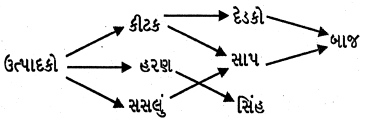
Observe the given chart and identify what it represents.
A
Aquatic food chain
B
Terrestrial food chain
C
Food web
D
Temporary ecosystem
Solution
(C) The provided chart shows multiple interconnected food chains where producers are consumed by various primary consumers,which in turn are consumed by multiple secondary and tertiary consumers.
In nature,food chains are rarely isolated; instead,they are interconnected to form a complex network known as a food web.
Since the chart depicts a network of multiple feeding relationships rather than a single linear pathway,it represents a food web.
In nature,food chains are rarely isolated; instead,they are interconnected to form a complex network known as a food web.
Since the chart depicts a network of multiple feeding relationships rather than a single linear pathway,it represents a food web.
0 likes
View SolutionEcosystem — Mix Examples- Ecosystem · Frequently Asked Questions
1Are these Ecosystem questions useful for JEE and NEET?
Yes. All questions in this section are mapped to JEE Main and NEET exam patterns. Previous year questions from JEE Main, NEET, GUJCET and state-level exams are included with full solutions.
2Can I switch to Hindi or Gujarati for these questions?
Yes. Use the language tabs in the hero section or the sidebar to view the same questions and solutions in English, Hindi or Gujarati.
3How do I generate a question paper from this subtopic?
Use the Vedclass Exam Paper Generator — select the chapter and subtopic, set difficulty, and generate Sets A, B, C, D automatically. First 3 chapters of every subject are free.
Vedclass Products
For Students
Vedclass Test Series
Mock tests in real JEE/NEET style with performance analysis. 5-day free trial.
Start Free TrialFor Teachers
Exam Paper Generator
Generate Set A/B/C/D papers from this chapter in 2 minutes. 3 chapters free.
Try FreeFor Institutes
Online Exam Module
Live online exams with unlimited students, 360° analytics & white-label branding.
See DemoFor Teachers & Institutes
Generate a Ecosystem Exam Paper in 2 Minutes
Select subtopic & difficulty — Sets A, B, C, D auto-generated with No Repeat logic.
First 3 chapters of every subject are free — no payment required.