
A English
Mix Examples- Ecosystem Questions in English
Class 12 Biology · Ecosystem · Mix Examples- Ecosystem
256+
Questions
English
Language
100%
With Solutions
Showing 50 of 256 questions in English
151
MediumMCQ
Which ecosystem is more stable?
A
River ecosystem
B
Pond ecosystem
C
Agricultural ecosystem
D
None of these
Solution
(A) Stability in an ecosystem is generally proportional to its complexity and biodiversity.
$A$ natural ecosystem like a river or a pond is more stable than an agricultural ecosystem.
Among the given options,a river ecosystem is typically considered more stable than a pond because it has a continuous flow of water,higher connectivity,and a more complex food web that allows it to recover from disturbances more effectively.
Agricultural ecosystems are artificial and highly unstable because they are maintained by human intervention and lack biodiversity.
$A$ natural ecosystem like a river or a pond is more stable than an agricultural ecosystem.
Among the given options,a river ecosystem is typically considered more stable than a pond because it has a continuous flow of water,higher connectivity,and a more complex food web that allows it to recover from disturbances more effectively.
Agricultural ecosystems are artificial and highly unstable because they are maintained by human intervention and lack biodiversity.
0 likes
View Solution152
MediumMCQ
Which of the following cannot be included in a sedimentary cycle?
A
$P$
B
$S$
C
$Ca$
D
$H$
Solution
(D) In a sedimentary cycle,the reservoir is the Earth's crust (rocks/soil).
Elements like Phosphorus $(P)$,Sulfur $(S)$,and Calcium $(Ca)$ have their primary reservoirs in the Earth's crust and are thus part of sedimentary cycles.
Hydrogen $(H)$,along with Carbon $(C)$,Nitrogen $(N)$,and Oxygen $(O)$,is part of a gaseous cycle,where the reservoir is the atmosphere or hydrosphere.
Therefore,$H$ cannot be included in a sedimentary cycle.
Elements like Phosphorus $(P)$,Sulfur $(S)$,and Calcium $(Ca)$ have their primary reservoirs in the Earth's crust and are thus part of sedimentary cycles.
Hydrogen $(H)$,along with Carbon $(C)$,Nitrogen $(N)$,and Oxygen $(O)$,is part of a gaseous cycle,where the reservoir is the atmosphere or hydrosphere.
Therefore,$H$ cannot be included in a sedimentary cycle.
0 likes
View Solution153
MediumMCQ
$A$ snake feeds on a rat,a hawk feeds on the snake,and the rat feeds on a grasshopper. In this food chain,what is the trophic level of the rat?
A
Primary consumer
B
Tertiary consumer
C
Secondary consumer
D
Quaternary consumer
Solution
(C) To determine the trophic level of the rat,let's analyze the food chain described:
$1$. Grasshopper (Primary consumer) feeds on producers (plants).
$2$. Rat (Secondary consumer) feeds on the grasshopper.
$3$. Snake (Tertiary consumer) feeds on the rat.
$4$. Hawk (Quaternary consumer) feeds on the snake.
Since the rat consumes the grasshopper (which is a primary consumer),the rat occupies the position of a secondary consumer.
$1$. Grasshopper (Primary consumer) feeds on producers (plants).
$2$. Rat (Secondary consumer) feeds on the grasshopper.
$3$. Snake (Tertiary consumer) feeds on the rat.
$4$. Hawk (Quaternary consumer) feeds on the snake.
Since the rat consumes the grasshopper (which is a primary consumer),the rat occupies the position of a secondary consumer.
0 likes
View Solution154
MediumMCQ
Which of the following processes occurs at a faster rate?
A
Primary succession
B
Secondary succession
C
Evolution
D
All of the above
Solution
(B) Primary succession is a very slow process that begins on bare,lifeless areas (e.g.,bare rock) where no soil exists. It takes a long time for soil to form and for pioneer species to colonize.
Secondary succession occurs in areas where a previously existing community has been cleared by a disturbance (e.g.,fire,flood,or deforestation) but soil remains intact. Because soil and nutrients are already present,the process of recolonization is significantly faster than primary succession.
Evolution is a biological process occurring over geological time scales,which is much slower than ecological succession.
Therefore,secondary succession occurs at a faster rate compared to primary succession and evolution.
Secondary succession occurs in areas where a previously existing community has been cleared by a disturbance (e.g.,fire,flood,or deforestation) but soil remains intact. Because soil and nutrients are already present,the process of recolonization is significantly faster than primary succession.
Evolution is a biological process occurring over geological time scales,which is much slower than ecological succession.
Therefore,secondary succession occurs at a faster rate compared to primary succession and evolution.
0 likes
View Solution155
EasyMCQ
What is the primary succession in freshwater called?
A
Xerosere
B
Lithosere
C
Hydrosere
D
Halosere
Solution
(C) Primary succession in freshwater environments is known as $Hydrosere$.
$Hydrosere$ involves a series of stages starting from open water and progressing through various plant communities (such as phytoplankton,submerged plants,floating plants,reed-swamp,marsh-meadow,and scrub) until it eventually reaches a climax forest community.
$Xerosere$ refers to succession in dry areas,$Lithosere$ refers to succession on bare rock,and $Halosere$ refers to succession in saline environments.
$Hydrosere$ involves a series of stages starting from open water and progressing through various plant communities (such as phytoplankton,submerged plants,floating plants,reed-swamp,marsh-meadow,and scrub) until it eventually reaches a climax forest community.
$Xerosere$ refers to succession in dry areas,$Lithosere$ refers to succession on bare rock,and $Halosere$ refers to succession in saline environments.
0 likes
View Solution156
MediumMCQ
What are the names of the successions occurring in saline water and on bare rocks,respectively?
A
Hydrarch,Xerarch
B
Hydrarch,Litharch
C
Halarch,Litharch
D
Halarch,Xerarch
Solution
(C) Ecological succession is the gradual and predictable change in the species composition of a given area.
$1$. Succession occurring in water is called $Hydrarch$ succession.
$2$. Succession occurring on bare rocks is called $Litharch$ succession (a type of $Xerarch$ succession).
However,in the context of specific terminology for saline water and bare rocks:
- Succession in saline water is known as $Halarch$ succession.
- Succession on bare rocks is known as $Litharch$ succession.
Therefore,the correct answer is $Halarch$ and $Litharch$.
$1$. Succession occurring in water is called $Hydrarch$ succession.
$2$. Succession occurring on bare rocks is called $Litharch$ succession (a type of $Xerarch$ succession).
However,in the context of specific terminology for saline water and bare rocks:
- Succession in saline water is known as $Halarch$ succession.
- Succession on bare rocks is known as $Litharch$ succession.
Therefore,the correct answer is $Halarch$ and $Litharch$.
0 likes
View Solution157
MediumMCQ
Which of the following characteristics can be observed in ecological succession?
A
Replacement of short-lived plants by long-lived plants
B
Parallel process of evolution
C
Continuous change in the community leading to a climax stage
D
All of the above
Solution
(D) Ecological succession is the gradual and predictable change in the species composition of a given area.
$1$. It involves the replacement of pioneer species (often short-lived) by more complex,long-lived species over time.
$2$. It is a process that occurs in parallel with the evolution of the ecosystem's structure and function.
$3$. The community undergoes continuous changes in species composition and structure until it reaches a stable,self-perpetuating state known as the climax community.
Therefore,all the given characteristics are observed in ecological succession.
$1$. It involves the replacement of pioneer species (often short-lived) by more complex,long-lived species over time.
$2$. It is a process that occurs in parallel with the evolution of the ecosystem's structure and function.
$3$. The community undergoes continuous changes in species composition and structure until it reaches a stable,self-perpetuating state known as the climax community.
Therefore,all the given characteristics are observed in ecological succession.
0 likes
View Solution158
MediumMCQ
The functional aspects of an ecosystem mainly include which of the following?
A
Unidirectional flow of energy
B
Productivity at producer or consumer levels
C
Decomposition
D
All of the above
Solution
(D) The functional aspects of an ecosystem are essential for its survival and maintenance. These include:
$1$. Productivity: The rate of biomass production by producers or consumers.
$2$. Decomposition: The breakdown of complex organic matter into simpler inorganic substances.
$3$. Energy flow: The unidirectional movement of energy through different trophic levels.
$4$. Nutrient cycling: The movement of nutrients through the biotic and abiotic components of the ecosystem.
Since options $A$,$B$,and $C$ are all fundamental functional components of an ecosystem,the correct answer is $D$.
$1$. Productivity: The rate of biomass production by producers or consumers.
$2$. Decomposition: The breakdown of complex organic matter into simpler inorganic substances.
$3$. Energy flow: The unidirectional movement of energy through different trophic levels.
$4$. Nutrient cycling: The movement of nutrients through the biotic and abiotic components of the ecosystem.
Since options $A$,$B$,and $C$ are all fundamental functional components of an ecosystem,the correct answer is $D$.
0 likes
View Solution159
MediumMCQ
In an aquatic food chain,at which trophic level can a whale be placed?
A
Primary consumer
B
Secondary consumer
C
Tertiary consumer
D
Apex predator
Solution
(D) In an aquatic ecosystem,the food chain typically starts with phytoplankton (producers),followed by zooplankton (primary consumers),small fish (secondary consumers),and larger organisms. Whales,specifically baleen whales,feed on krill and small fish,while toothed whales (like orcas) feed on larger fish,seals,or other marine mammals. Because they occupy the highest position in the food chain and have no natural predators,they are classified as $Apex$ $predators$.
0 likes
View Solution160
MediumMCQ
The dynamic system of an ecosystem depends on which of the following?
A
Constant interaction between biotic and abiotic components
B
Continuous consumption of producers by consumers and subsequent trophic levels
C
Decomposition of dead organic matter by bacteria at various trophic levels
D
All of the above
Solution
(D) An ecosystem is a dynamic system that functions through the following processes:
$1$. Constant interaction between biotic (living) and abiotic (non-living) components,which maintains the flow of energy and the cycling of nutrients.
$2$. Continuous consumption of energy stored by producers (green plants) by consumers (animals),which transfers energy from one trophic level to another.
$3$. Decomposition of dead organic matter by decomposers (bacteria and fungi),which releases nutrients back into the environment,thereby maintaining the balance of the ecosystem.
Therefore,all the given options are responsible for the dynamics of an ecosystem.
$1$. Constant interaction between biotic (living) and abiotic (non-living) components,which maintains the flow of energy and the cycling of nutrients.
$2$. Continuous consumption of energy stored by producers (green plants) by consumers (animals),which transfers energy from one trophic level to another.
$3$. Decomposition of dead organic matter by decomposers (bacteria and fungi),which releases nutrients back into the environment,thereby maintaining the balance of the ecosystem.
Therefore,all the given options are responsible for the dynamics of an ecosystem.
0 likes
View Solution161
MediumMCQ
Match the following Column-$I$ with Column-$II$:
| Column-$I$ | Column-$II$ |
| $(i)$ Sedimentary cycle | $(P)$ Primary consumer |
| $(ii)$ Gaseous cycle | $(Q)$ Carbon |
| $(iii)$ Herbivore | $(R)$ Tertiary consumer |
| $(iv)$ Top carnivore | $(S)$ Sulphur |
A
$i-Q, ii-S, iii-R, iv-P$
B
$i-Q, ii-S, iii-P, iv-R$
C
$i-S, ii-Q, iii-R, iv-P$
D
$i-S, ii-Q, iii-P, iv-R$
Solution
(D) The correct matching is as follows:
$(i)$ Sedimentary cycle: Sulphur $(S)$ is a classic example of a sedimentary nutrient cycle where the reservoir is the Earth's crust.
$(ii)$ Gaseous cycle: Carbon $(Q)$ is a gaseous nutrient cycle where the reservoir is the atmosphere.
$(iii)$ Herbivore: Herbivores are primary consumers $(P)$ that feed directly on plants.
$(iv)$ Top carnivore: Top carnivores are typically tertiary consumers $(R)$ in a food chain.
Therefore, the correct sequence is $(i-S, ii-Q, iii-P, iv-R)$.
$(i)$ Sedimentary cycle: Sulphur $(S)$ is a classic example of a sedimentary nutrient cycle where the reservoir is the Earth's crust.
$(ii)$ Gaseous cycle: Carbon $(Q)$ is a gaseous nutrient cycle where the reservoir is the atmosphere.
$(iii)$ Herbivore: Herbivores are primary consumers $(P)$ that feed directly on plants.
$(iv)$ Top carnivore: Top carnivores are typically tertiary consumers $(R)$ in a food chain.
Therefore, the correct sequence is $(i-S, ii-Q, iii-P, iv-R)$.
0 likes
View Solution162
MediumMCQ
Match the following columns correctly:
| Column-$I$ | Column-$II$ |
| $(i)$ Producers | $(P)$ Primary consumers |
| $(ii)$ Herbivores | $(Q)$ Net primary productivity |
| $(iii)$ Carnivores | $(R)$ Primary trophic level |
| $(iv)$ Top carnivores | $(S)$ Secondary productivity |
A
$i-P, ii-R, iii-Q, iv-S$
B
$i-R, ii-P, iii-S, iv-Q$
C
$i-P, ii-Q, iii-R, iv-S$
D
$i-Q, ii-S, iii-R, iv-P$
Solution
(B) The correct matching is as follows:
$(i)$ Producers represent the $(R)$ Primary trophic level.
$(ii)$ Herbivores are the $(P)$ Primary consumers.
$(iii)$ Carnivores represent the $(S)$ Secondary productivity (as they consume primary consumers).
$(iv)$ Top carnivores represent the $(Q)$ Net primary productivity (in terms of energy flow and biomass accumulation).
Therefore,the correct sequence is $i-R, ii-P, iii-S, iv-Q$.
$(i)$ Producers represent the $(R)$ Primary trophic level.
$(ii)$ Herbivores are the $(P)$ Primary consumers.
$(iii)$ Carnivores represent the $(S)$ Secondary productivity (as they consume primary consumers).
$(iv)$ Top carnivores represent the $(Q)$ Net primary productivity (in terms of energy flow and biomass accumulation).
Therefore,the correct sequence is $i-R, ii-P, iii-S, iv-Q$.
0 likes
View Solution163
MediumMCQ
Match the following columns:
| Column-$I$ | Column-$II$ |
| $(i)$ Ecosystem | $(P)$ Bacteria,Fungi |
| $(ii)$ Food chain | $(Q)$ Nutrient cycling |
| $(iii)$ Birds | $(R)$ Primary consumer |
| $(iv)$ Decomposers | $(S)$ Deer |
A
$i-Q, ii-S, iii-R, iv-P$
B
$i-Q, ii-R, iii-S, iv-P$
C
$i-S, ii-Q, iii-R, iv-P$
D
$i-R, ii-S, iii-P, iv-Q$
Solution
(A) The correct matching is as follows:
$(i)$ Ecosystem: It is a functional unit of nature where living organisms interact among themselves and with their physical environment,primarily characterized by nutrient cycling $(Q)$.
$(ii)$ Food chain: It represents the transfer of energy through various trophic levels. Deer $(S)$ is a primary consumer in a food chain.
$(iii)$ Birds: Many birds act as primary consumers $(R)$ in various ecosystems.
$(iv)$ Decomposers: Bacteria and Fungi $(P)$ are the primary decomposers that break down organic matter.
Therefore,the correct sequence is $(i-Q, ii-S, iii-R, iv-P)$.
$(i)$ Ecosystem: It is a functional unit of nature where living organisms interact among themselves and with their physical environment,primarily characterized by nutrient cycling $(Q)$.
$(ii)$ Food chain: It represents the transfer of energy through various trophic levels. Deer $(S)$ is a primary consumer in a food chain.
$(iii)$ Birds: Many birds act as primary consumers $(R)$ in various ecosystems.
$(iv)$ Decomposers: Bacteria and Fungi $(P)$ are the primary decomposers that break down organic matter.
Therefore,the correct sequence is $(i-Q, ii-S, iii-R, iv-P)$.
0 likes
View Solution164
MediumMCQ
Identify the mismatched pair from the given options.
A
Pond - Natural ecosystem
B
Consumer - Gross primary productivity
C
Sulfur - Gaseous cycle
D
Producers - Primary consumers
Solution
(B) $1$. $A$ pond is a classic example of a natural ecosystem. This is a correct pair.
$2$. Gross primary productivity is the rate at which producers capture solar energy,not consumers. Therefore,'Consumer - Gross primary productivity' is a mismatched pair.
$3$. Sulfur cycle is primarily a sedimentary cycle,but it has a gaseous component (e.g.,$H_2S$,$SO_2$). However,in the context of standard biology questions,it is often contrasted with purely gaseous cycles like Carbon or Nitrogen. Given the options,option $B$ is the most clearly incorrect definition.
$4$. Producers are the organisms that are consumed by primary consumers. This represents a trophic relationship.
$2$. Gross primary productivity is the rate at which producers capture solar energy,not consumers. Therefore,'Consumer - Gross primary productivity' is a mismatched pair.
$3$. Sulfur cycle is primarily a sedimentary cycle,but it has a gaseous component (e.g.,$H_2S$,$SO_2$). However,in the context of standard biology questions,it is often contrasted with purely gaseous cycles like Carbon or Nitrogen. Given the options,option $B$ is the most clearly incorrect definition.
$4$. Producers are the organisms that are consumed by primary consumers. This represents a trophic relationship.
0 likes
View Solution165
MediumMCQ
Identify the mismatched event from the following structures.
A
Hawk - Top carnivore
B
Pond - Lowest productivity
C
Climax community - Community adapted to the environment
D
Major part of dry weight of living body - Water
Solution
(B) $1$. $A$ hawk is a top carnivore in a food chain,which is correct.
$2$. $A$ pond is an aquatic ecosystem with high productivity,not the lowest. Deserts or deep oceans typically have the lowest productivity,making this the mismatched statement.
$3$. $A$ climax community is the final stable stage of succession that is well-adapted to the environment,which is correct.
$4$. Dry weight is defined as the total weight of an organism excluding water content. Therefore,water is not part of the dry weight,making this statement also factually incorrect in the context of biological definitions. However,in the context of typical multiple-choice questions on this topic,option $B$ is the most significant ecological mismatch regarding productivity levels.
$2$. $A$ pond is an aquatic ecosystem with high productivity,not the lowest. Deserts or deep oceans typically have the lowest productivity,making this the mismatched statement.
$3$. $A$ climax community is the final stable stage of succession that is well-adapted to the environment,which is correct.
$4$. Dry weight is defined as the total weight of an organism excluding water content. Therefore,water is not part of the dry weight,making this statement also factually incorrect in the context of biological definitions. However,in the context of typical multiple-choice questions on this topic,option $B$ is the most significant ecological mismatch regarding productivity levels.
0 likes
View Solution166
MediumMCQ
Identify the mismatched pair.
A
Sere - Developmental stages of a biotic succession
B
Decomposers - Primary source of energy in an ecosystem
C
Grassland - Climax community
D
Fossil fuels - Stored photosynthetic energy
Solution
(B) In an ecosystem, the primary source of energy is the $Sun$ (solar radiation), not decomposers. Decomposers are organisms that break down dead organic matter and recycle nutrients. Therefore, the pair $B$ is mismatched.
0 likes
View Solution167
MediumMCQ
Read the given statements and determine how many of them are correct.
$(1)$ Secondary succession depends on the condition of the soil and the availability of water.
$(2)$ Air,water,and land are abiotic factors of an ecosystem.
$(3)$ The structure of an ecosystem includes the cycling of nutrients and the unidirectional flow of energy.
$(4)$ The primary source of energy in an ecosystem is the sun.
$(1)$ Secondary succession depends on the condition of the soil and the availability of water.
$(2)$ Air,water,and land are abiotic factors of an ecosystem.
$(3)$ The structure of an ecosystem includes the cycling of nutrients and the unidirectional flow of energy.
$(4)$ The primary source of energy in an ecosystem is the sun.
A
$4$
B
$3$
C
$2$
D
$1$
Solution
(A) Let's analyze each statement:
$(1)$ Secondary succession occurs in areas where living organisms previously existed. It is faster than primary succession and depends on the soil condition and water availability. This statement is correct.
$(2)$ Air,water,and soil (land) are indeed the fundamental abiotic components of an ecosystem. This statement is correct.
$(3)$ The functional aspects of an ecosystem include productivity,decomposition,energy flow,and nutrient cycling. Energy flow is unidirectional,while nutrient cycling is cyclic. This statement is correct.
$(4)$ The sun is the ultimate and primary source of energy for all ecosystems on Earth (except for deep-sea hydrothermal ecosystems). This statement is correct.
Since all $4$ statements are correct,the answer is $4$.
$(1)$ Secondary succession occurs in areas where living organisms previously existed. It is faster than primary succession and depends on the soil condition and water availability. This statement is correct.
$(2)$ Air,water,and soil (land) are indeed the fundamental abiotic components of an ecosystem. This statement is correct.
$(3)$ The functional aspects of an ecosystem include productivity,decomposition,energy flow,and nutrient cycling. Energy flow is unidirectional,while nutrient cycling is cyclic. This statement is correct.
$(4)$ The sun is the ultimate and primary source of energy for all ecosystems on Earth (except for deep-sea hydrothermal ecosystems). This statement is correct.
Since all $4$ statements are correct,the answer is $4$.
0 likes
View Solution168
MediumMCQ
Read the following statements carefully and answer the question:
$(1)$ Pyramids of number and biomass can be upright or inverted in an ecosystem.
$(2)$ Phosphorus and sulfur are sedimentary cycles.
$(3)$ The largest reservoir of carbon on Earth is found in the oceans.
$(4)$ The structural and functional unit of ecology is the ecosystem.
Which of the above statements are correct?
$(1)$ Pyramids of number and biomass can be upright or inverted in an ecosystem.
$(2)$ Phosphorus and sulfur are sedimentary cycles.
$(3)$ The largest reservoir of carbon on Earth is found in the oceans.
$(4)$ The structural and functional unit of ecology is the ecosystem.
Which of the above statements are correct?
A
$1$ and $2$ only
B
$1, 2$ and $3$ only
C
$3$ and $4$ only
D
All statements are correct
Solution
(D) Statement $(1)$ is correct: In a grassland ecosystem,the pyramid of number is upright,while in a tree ecosystem,it is inverted. Similarly,the pyramid of biomass is generally upright but inverted in aquatic ecosystems.
Statement $(2)$ is correct: Phosphorus and sulfur cycles are classified as sedimentary cycles because their main reservoirs are in the Earth's crust (rocks/soil).
Statement $(3)$ is correct: Oceans contain the largest reservoir of carbon on Earth,holding approximately $38,000$ billion tons of carbon.
Statement $(4)$ is correct: An ecosystem is defined as the structural and functional unit of nature where living organisms interact among themselves and with their physical environment.
Therefore,all statements are correct.
Statement $(2)$ is correct: Phosphorus and sulfur cycles are classified as sedimentary cycles because their main reservoirs are in the Earth's crust (rocks/soil).
Statement $(3)$ is correct: Oceans contain the largest reservoir of carbon on Earth,holding approximately $38,000$ billion tons of carbon.
Statement $(4)$ is correct: An ecosystem is defined as the structural and functional unit of nature where living organisms interact among themselves and with their physical environment.
Therefore,all statements are correct.
0 likes
View Solution169
MediumMCQ
Read the following statements carefully and answer the question given below:
$(1)$ $NPP = GPP - R$
$(2)$ Productivity of an ecosystem can be measured in $g/m^2/yr$ or $kcal/m^2/day$.
$(3)$ The total amount of energy produced by all producers in an ecosystem is called Gross Primary Productivity $(GPP)$.
$(4)$ The net primary productivity of the oceans is $55$ billion tons.
State the number of correct statements.
$(1)$ $NPP = GPP - R$
$(2)$ Productivity of an ecosystem can be measured in $g/m^2/yr$ or $kcal/m^2/day$.
$(3)$ The total amount of energy produced by all producers in an ecosystem is called Gross Primary Productivity $(GPP)$.
$(4)$ The net primary productivity of the oceans is $55$ billion tons.
State the number of correct statements.
A
$2$
B
$3$
C
$4$
D
$1$
Solution
(A) Statement $(1)$ is correct: $NPP$ (Net Primary Productivity) is indeed $GPP$ (Gross Primary Productivity) minus $R$ (Respiration losses).
Statement $(2)$ is correct: Productivity is measured in terms of biomass $(g/m^2/yr)$ or energy $(kcal/m^2/yr)$. The units provided in the question are standard scientific representations for productivity.
Statement $(3)$ is incorrect: The total amount of energy produced by all producers is called Gross Primary Productivity $(GPP)$,not Net Primary Productivity $(NPP)$.
Statement $(4)$ is incorrect: The total annual net primary productivity of the whole biosphere is approximately $170$ billion tons (dry weight) of organic matter. Of this,the productivity of the oceans is only $55$ billion tons,but this refers to the total biomass production,not specifically the 'net primary productivity' in the context of the entire biosphere's comparison. However,more importantly,the statement defines it as 'net primary productivity' which is often confused with total production. In the context of $NCERT$,the total annual $NPP$ of the whole biosphere is $170$ billion tons,and the oceans contribute less than half of this.
Thus,only statements $(1)$ and $(2)$ are correct. The total number of correct statements is $2$.
Statement $(2)$ is correct: Productivity is measured in terms of biomass $(g/m^2/yr)$ or energy $(kcal/m^2/yr)$. The units provided in the question are standard scientific representations for productivity.
Statement $(3)$ is incorrect: The total amount of energy produced by all producers is called Gross Primary Productivity $(GPP)$,not Net Primary Productivity $(NPP)$.
Statement $(4)$ is incorrect: The total annual net primary productivity of the whole biosphere is approximately $170$ billion tons (dry weight) of organic matter. Of this,the productivity of the oceans is only $55$ billion tons,but this refers to the total biomass production,not specifically the 'net primary productivity' in the context of the entire biosphere's comparison. However,more importantly,the statement defines it as 'net primary productivity' which is often confused with total production. In the context of $NCERT$,the total annual $NPP$ of the whole biosphere is $170$ billion tons,and the oceans contribute less than half of this.
Thus,only statements $(1)$ and $(2)$ are correct. The total number of correct statements is $2$.
0 likes
View Solution170
MediumMCQ
Identify the correct statements from the following:
$(1)$ Succession occurring in dry areas is called xerarch succession.
$(2)$ The stage where plants can survive in open conditions throughout the year is the herb stage.
$(3)$ Ecological succession leads to a decrease in the net primary productivity of the community.
$(4)$ Primary succession takes an average of $1000$ years to complete.
$(1)$ Succession occurring in dry areas is called xerarch succession.
$(2)$ The stage where plants can survive in open conditions throughout the year is the herb stage.
$(3)$ Ecological succession leads to a decrease in the net primary productivity of the community.
$(4)$ Primary succession takes an average of $1000$ years to complete.
A
Only $1$ and $3$ are correct
B
Only $1$ and $2$ are correct
C
$1, 2, 3$ are correct
D
$1, 2, 3, 4$ are correct
Solution
(A) Statement $(1)$ is correct: Succession in dry areas is known as xerarch succession.
Statement $(2)$ is correct: The herb stage represents the initial colonization phase where plants can survive in open,exposed conditions.
Statement $(3)$ is incorrect: Ecological succession generally leads to an increase in biomass and net primary productivity as the community matures towards a climax state.
Statement $(4)$ is incorrect: Primary succession is a very slow process that typically takes hundreds to thousands of years,but it is not defined by a fixed average of $1000$ years for all cases.
Therefore,only statements $(1)$ and $(2)$ are correct.
Statement $(2)$ is correct: The herb stage represents the initial colonization phase where plants can survive in open,exposed conditions.
Statement $(3)$ is incorrect: Ecological succession generally leads to an increase in biomass and net primary productivity as the community matures towards a climax state.
Statement $(4)$ is incorrect: Primary succession is a very slow process that typically takes hundreds to thousands of years,but it is not defined by a fixed average of $1000$ years for all cases.
Therefore,only statements $(1)$ and $(2)$ are correct.
0 likes
View Solution171
MediumMCQ
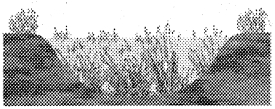
Which stage is represented by the given figure?
A
Submerged free-floating plant stage
B
Marsh-meadow stage
C
Reed-swamp stage
D
Both $B$ and $C$
Solution
(C) The provided figure shows a stage in hydrarch succession where the water level is very shallow and the area is dominated by plants like Typha,Phragmites,etc.,which have their roots in the mud but their shoots are exposed to the air. This is characteristic of the Reed-swamp stage. The Marsh-meadow stage follows this,where the area becomes swampy and is dominated by grasses and sedges. Since the image specifically depicts the dense growth of emergent vegetation typical of the Reed-swamp stage,option $C$ is the most accurate description.
0 likes
View Solution172
MediumMCQ
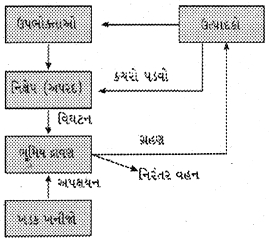
Which cycle is represented by the given figure?
A
Carbon cycle - Gaseous cycle
B
Sulfur cycle - Sedimentary cycle
C
Phosphorus cycle - Sedimentary cycle
D
Oxygen cycle - Gaseous cycle
Solution
(C) The provided figure illustrates the phosphorus cycle.
In the phosphorus cycle,the reservoir is the Earth's crust (rock minerals).
Phosphorus is released from rocks through weathering,enters the soil solution,is taken up by producers,moves to consumers,and returns to the soil through decomposition (detritus).
Since the reservoir is the Earth's crust and not the atmosphere,it is classified as a sedimentary cycle.
In the phosphorus cycle,the reservoir is the Earth's crust (rock minerals).
Phosphorus is released from rocks through weathering,enters the soil solution,is taken up by producers,moves to consumers,and returns to the soil through decomposition (detritus).
Since the reservoir is the Earth's crust and not the atmosphere,it is classified as a sedimentary cycle.
0 likes
View Solution173
EasyMCQ
Which plant was introduced in India due to its beautiful mauve-colored flowers?
A
Water hyacinth
B
Water lily
C
Wolffia
D
Vallisneria
Solution
The plant $\text{Eichhornia crassipes}$, commonly known as $\text{Water hyacinth}$, was introduced in India because of its beautiful mauve-colored flowers and uniquely shaped leaves.
It is the world's most problematic aquatic weed, also known as the $\text{Terror of Bengal}$.
It grows abundantly in eutrophic water bodies and leads to an imbalance in the ecosystem by causing the death of fishes and other aquatic organisms due to oxygen depletion.
It is the world's most problematic aquatic weed, also known as the $\text{Terror of Bengal}$.
It grows abundantly in eutrophic water bodies and leads to an imbalance in the ecosystem by causing the death of fishes and other aquatic organisms due to oxygen depletion.
0 likes
View Solution174
EasyMCQ
Which of the following statements is incorrect?
A
Energy content gradually decreases from first to fourth trophic level
B
Biomass decreases from first to fourth trophic level
C
Energy content gradually increases from first to fourth trophic level
D
Number of individuals decreases from first trophic level to fourth trophic level
Solution
(C) Energy content does not remain trapped permanently in any organism. It is passed on to various trophic levels in the food chain.
According to the $10\%$ law proposed by Lindemann, only about $10\%$ of the energy is transferred to the next trophic level.
Therefore, the energy content gradually decreases from the first $(T_1)$ to the fourth $(T_4)$ trophic level.
Thus, the statement that energy content increases is incorrect.
According to the $10\%$ law proposed by Lindemann, only about $10\%$ of the energy is transferred to the next trophic level.
Therefore, the energy content gradually decreases from the first $(T_1)$ to the fourth $(T_4)$ trophic level.
Thus, the statement that energy content increases is incorrect.
0 likes
View Solution175
MediumMCQ
Which of the following statements is incorrect regarding the phosphorus cycle?
A
It is a sedimentary cycle.
B
Phosphates are the major form of phosphorus reservoir.
C
Phosphorus solubilising bacteria facilitate the release of phosphorus from organic remains.
D
There is appreciable respiratory release of phosphorus into the atmosphere.
Solution
(D) The phosphorus cycle is a sedimentary cycle.
Rocks are the major reservoir of phosphorus.
Unlike the carbon cycle,there is no respiratory release of phosphorus into the atmosphere because phosphorus does not have a significant gaseous phase in its cycle.
Therefore,the statement regarding the respiratory release of phosphorus is incorrect.
Rocks are the major reservoir of phosphorus.
Unlike the carbon cycle,there is no respiratory release of phosphorus into the atmosphere because phosphorus does not have a significant gaseous phase in its cycle.
Therefore,the statement regarding the respiratory release of phosphorus is incorrect.
0 likes
View Solution176
MediumMCQ
Select the incorrect match.
$I.$ Sedimentary nutrient cycle-Nitrogen cycle
$II.$ Pioneer species-Lichens
$III.$ Secondary succession-Burned forests
$IV.$ Pyramid of biomass in sea-Upright
$I.$ Sedimentary nutrient cycle-Nitrogen cycle
$II.$ Pioneer species-Lichens
$III.$ Secondary succession-Burned forests
$IV.$ Pyramid of biomass in sea-Upright
A
$I$ and $IV$
B
$I$ and $III$
C
$II$ and $III$
D
$II$ and $IV$
Solution
(A) The Nitrogen cycle is a gaseous nutrient cycle because its reservoir pool is the atmosphere. Sedimentary cycles,such as the Phosphorus or Sulphur cycle,have the lithosphere as their reservoir pool.
The pyramid of biomass in an aquatic ecosystem like the sea is inverted because the biomass of phytoplankton is much lower than that of the zooplankton and fishes that feed on them.
Therefore,statements $I$ and $IV$ are incorrect.
The pyramid of biomass in an aquatic ecosystem like the sea is inverted because the biomass of phytoplankton is much lower than that of the zooplankton and fishes that feed on them.
Therefore,statements $I$ and $IV$ are incorrect.
0 likes
View Solution177
MediumMCQ
The bulk fixation of carbon through photosynthesis takes place in
A
Crop plants
B
Tropical rain forests
C
Ocean
D
Both $(A)$ and $(B)$
Solution
(C) The bulk of carbon fixation on Earth occurs in the oceans. This is primarily due to the vast surface area covered by oceans and the presence of a massive number of phytoplankton,which are the primary producers responsible for photosynthesis in marine ecosystems.
0 likes
View Solution178
MediumMCQ
$A$: The soil of tropical rain forests has a low base content.
$R$: Such soil shows less percolation and leaching.
$R$: Such soil shows less percolation and leaching.
A
Assertion and Reason both are correct and Reason is the correct explanation of Assertion.
B
Assertion and Reason both are correct but Reason is not the correct explanation of Assertion.
C
Assertion is correct,but Reason is incorrect.
D
Both Assertion and Reason are incorrect.
Solution
(C) Tropical rain forests receive high amounts of rainfall,which leads to intense leaching of nutrients from the soil.
Leaching is the process where water-soluble nutrients are washed away from the soil profile.
Due to this high rate of leaching,the soil in these regions typically has a low base content and is often acidic.
Therefore,the Assertion is correct because the soil has low base content,but the Reason is incorrect because these soils actually show high rates of percolation and leaching,not less.
Leaching is the process where water-soluble nutrients are washed away from the soil profile.
Due to this high rate of leaching,the soil in these regions typically has a low base content and is often acidic.
Therefore,the Assertion is correct because the soil has low base content,but the Reason is incorrect because these soils actually show high rates of percolation and leaching,not less.
0 likes
View Solution179
MediumMCQ
$A$: Estuary constitutes one of the most productive ecosystems.
$R$: It represents a transition zone between two populations of a species.
$R$: It represents a transition zone between two populations of a species.
A
Assertion and Reason both are correct and Reason is the correct explanation of Assertion.
B
Assertion and Reason both are correct but Reason is not the correct explanation of Assertion.
C
Assertion is correct,but Reason is incorrect.
D
Both Assertion and Reason are incorrect.
Solution
(C) An estuary is a semi-enclosed coastal body of water where freshwater from rivers or streams meets and mixes with saltwater from the ocean.
It is considered one of the most productive ecosystems on Earth due to the high nutrient availability and the mixing of water bodies.
The Reason statement is incorrect because an estuary is a transition zone between two different ecosystems (freshwater and marine),not merely a transition zone between two populations of a single species.
Therefore,the Assertion is correct,but the Reason is incorrect.
It is considered one of the most productive ecosystems on Earth due to the high nutrient availability and the mixing of water bodies.
The Reason statement is incorrect because an estuary is a transition zone between two different ecosystems (freshwater and marine),not merely a transition zone between two populations of a single species.
Therefore,the Assertion is correct,but the Reason is incorrect.
0 likes
View Solution180
EasyMCQ
The exchange pool in the carbon cycle is:
A
Fossil fuels
B
Sedimentary rock
C
Water
D
Atmosphere
Solution
(D) In the carbon cycle,which is a gaseous type of nutrient cycle,the atmosphere serves as the primary exchange pool or reservoir. Carbon dioxide $(CO_2)$ is exchanged between the atmosphere and living organisms through processes like photosynthesis and respiration.
0 likes
View Solution181
MediumMCQ
Which one of the following statements is incorrect for secondary succession?
A
It occurs on a deforested site
B
It follows primary succession
C
It is similar to primary succession except that it has a relatively fast pace
D
It begins on a bare rock
Solution
(D) Secondary succession is an ecological succession that occurs in areas where natural biotic communities have been destroyed,such as in abandoned farm lands,burned or cut forests,or lands that have been flooded.
Since the soil is already present,it is faster than primary succession.
Primary succession begins on a bare rock or a completely sterile area where no soil exists.
Therefore,the statement that secondary succession begins on a bare rock is incorrect,as this is a characteristic of primary succession.
Since the soil is already present,it is faster than primary succession.
Primary succession begins on a bare rock or a completely sterile area where no soil exists.
Therefore,the statement that secondary succession begins on a bare rock is incorrect,as this is a characteristic of primary succession.
0 likes
View Solution182
EasyMCQ
Broad-leaved forests of oak are found in
A
Tropical deciduous forest
B
Tropical evergreen forest
C
Temperate deciduous forest
D
North coniferous forest
Solution
(C) Oak trees $(Quercus)$ are characteristic species of temperate deciduous forests. These forests are found in regions with moderate climates where trees shed their leaves annually during the cold season. The broad-leaved nature of oak is a typical adaptation to the temperate climate,allowing for efficient photosynthesis during the growing season.
0 likes
View Solution183
MediumMCQ
In an ecosystem,the insectivorous plants are placed in
A
Herbivores
B
Primary producers
C
Predators
D
None of these
Solution
(B) Insectivorous plants are autotrophs because they possess chlorophyll and perform photosynthesis to produce their own food. They do not consume insects as a primary energy source; instead,they capture insects to obtain essential nutrients like nitrogen $(N)$ and phosphorus $(P)$,which are often deficient in the soil where they grow. Therefore,they are classified as primary producers in an ecosystem.
0 likes
View Solution184
MediumMCQ
$A$ person who eats vegetables acts as a:
A
primary producer
B
primary consumer
C
secondary consumer
D
tertiary consumer
Solution
(B) In an ecosystem,primary consumers are herbivores that feed directly on producers (green plants). Since a person eating vegetables consumes plant-based food directly,they function as a primary consumer.
0 likes
View Solution185
MediumMCQ
Which of the following are the essential sources for releasing $CO_{2}$ into the atmosphere?
$I.$ Burning of wood
$II.$ Volcanic activity
$III.$ Combustion of organic matter
$IV.$ Fossil fuels
Choose the correct option.
$I.$ Burning of wood
$II.$ Volcanic activity
$III.$ Combustion of organic matter
$IV.$ Fossil fuels
Choose the correct option.
A
$I, II$ and $III$
B
$II, III$ and $IV$
C
$I, III$ and $IV$
D
$I, II, III$ and $IV$
Solution
(D) The release of $CO_{2}$ into the atmosphere occurs through various natural and anthropogenic processes.
Burning of wood,forest fires,volcanic activity,combustion of organic matter,and the burning of fossil fuels are all primary sources that contribute to the increase of $CO_{2}$ levels in the atmosphere.
Therefore,all the listed options ($I, II, III$,and $IV$) are correct sources.
Burning of wood,forest fires,volcanic activity,combustion of organic matter,and the burning of fossil fuels are all primary sources that contribute to the increase of $CO_{2}$ levels in the atmosphere.
Therefore,all the listed options ($I, II, III$,and $IV$) are correct sources.
0 likes
View Solution186
MediumMCQ
Find out the correct order of succession levels in xerarch.
A
Lichen,moss stage,annual herb stage,perennial herb stage,scrub stage,forest
B
Annual herb stage,perennial herb stage,lichen,moss stage,scrub stage,forest
C
Perennial herb stage,annual herb stage,lichen,moss stage,scrub stage,forest
D
Scrub stage,forest,annual herb stage,perennial herb stage,lichen,moss stage
Solution
(A) The correct order of succession in xerarch (xerosere) is as follows:
$(i)$ Lichen stage: Crustose lichens followed by foliose lichens.
$(ii)$ Moss stage: Bryophytes like $Tortula$ and $Polytrichum$.
$(iii)$ Annual herb stage: Grasses like $Cymbopogon$.
$(iv)$ Perennial herb and shrub stage: Plants like $Rubus$,$Capparis$,and $Zizyphus$.
$(v)$ Forest stage: The climax community consisting of trees and shrubs.
Therefore,the correct sequence is: Lichen $\rightarrow$ Moss stage $\rightarrow$ Annual herb stage $\rightarrow$ Perennial herb stage $\rightarrow$ Scrub stage $\rightarrow$ Forest.
$(i)$ Lichen stage: Crustose lichens followed by foliose lichens.
$(ii)$ Moss stage: Bryophytes like $Tortula$ and $Polytrichum$.
$(iii)$ Annual herb stage: Grasses like $Cymbopogon$.
$(iv)$ Perennial herb and shrub stage: Plants like $Rubus$,$Capparis$,and $Zizyphus$.
$(v)$ Forest stage: The climax community consisting of trees and shrubs.
Therefore,the correct sequence is: Lichen $\rightarrow$ Moss stage $\rightarrow$ Annual herb stage $\rightarrow$ Perennial herb stage $\rightarrow$ Scrub stage $\rightarrow$ Forest.
0 likes
View Solution187
EasyMCQ
Which of the following is an example of a man-made ecosystem?
A
Herbarium
B
Aquarium
C
Tissue culture
D
Forest
Solution
(B) An ecosystem that is created and maintained by human beings is called an artificial or man-made ecosystem.
An aquarium is a classic example of a man-made ecosystem where humans control the biotic and abiotic components.
Herbarium and tissue culture are laboratory techniques,not ecosystems.
$A$ forest is a natural ecosystem.
An aquarium is a classic example of a man-made ecosystem where humans control the biotic and abiotic components.
Herbarium and tissue culture are laboratory techniques,not ecosystems.
$A$ forest is a natural ecosystem.
0 likes
View Solution188
EasyMCQ
How much carbon is dissolved in the oceans (in $; \%$)?
A
$71$
B
$61$
C
$81$
D
$51$
Solution
(A) Approximately $71 \; \%$ of the global carbon is found dissolved in the oceans. This oceanic reservoir plays a crucial role in regulating the concentration of carbon dioxide in the atmosphere.
0 likes
View Solution189
MediumMCQ
$A$ frog,which feeds on insects,is a
A
Primary consumer
B
Secondary consumer
C
Tertiary consumer
D
Decomposer
Solution
(B) The correct answer is Secondary consumer.
In a food chain,organisms are classified based on their trophic levels:
$1$. Producers (e.g.,Grass) synthesize their own food.
$2$. Primary consumers (e.g.,Grasshopper) feed directly on producers.
$3$. Secondary consumers (e.g.,Frog) feed on primary consumers (insects).
$4$. Tertiary consumers (e.g.,Snake) feed on secondary consumers.
$5$. Quaternary consumers (e.g.,Hawk) feed on tertiary consumers.
The food chain is represented as:
$Grass (Producer) \longrightarrow Grasshopper (Primary consumer) \longrightarrow Frog (Secondary consumer) \longrightarrow Snake (Tertiary consumer) \longrightarrow Hawk (Quaternary consumer)$
In a food chain,organisms are classified based on their trophic levels:
$1$. Producers (e.g.,Grass) synthesize their own food.
$2$. Primary consumers (e.g.,Grasshopper) feed directly on producers.
$3$. Secondary consumers (e.g.,Frog) feed on primary consumers (insects).
$4$. Tertiary consumers (e.g.,Snake) feed on secondary consumers.
$5$. Quaternary consumers (e.g.,Hawk) feed on tertiary consumers.
The food chain is represented as:
$Grass (Producer) \longrightarrow Grasshopper (Primary consumer) \longrightarrow Frog (Secondary consumer) \longrightarrow Snake (Tertiary consumer) \longrightarrow Hawk (Quaternary consumer)$

0 likes
View Solution190
MediumMCQ
$A$ bear that eats a fish that further ate bugs that ate algae is a
A
Primary producer
B
Primary consumer
C
Secondary consumer
D
Tertiary consumer
Solution
(D) The food chain is represented as follows:
Algae (Producer) $\rightarrow$ Bugs (Primary consumer) $\rightarrow$ Fish (Secondary consumer) $\rightarrow$ Bear (Tertiary consumer).
Since the bear occupies the fourth trophic level,it is a tertiary consumer.
Algae (Producer) $\rightarrow$ Bugs (Primary consumer) $\rightarrow$ Fish (Secondary consumer) $\rightarrow$ Bear (Tertiary consumer).
Since the bear occupies the fourth trophic level,it is a tertiary consumer.
0 likes
View Solution191
EasyMCQ
In ecological succession,the communities in near equilibrium with the environment are called:
A
Climax communities
B
Ecofriendly communities
C
Seral communities
D
Pioneer communities
Solution
(A) Climax community is the stable,self-perpetuating,and final biotic community that develops at the end of biotic succession and is in perfect harmony with the physical environment.
It is also termed as a climatic climax community.
It is also termed as a climatic climax community.
0 likes
View Solution192
MediumMCQ
Identify the correct type of food chain.
Dead animal $\rightarrow$ Blow fly maggots $\rightarrow$ Common frog $\rightarrow$ Snake
Dead animal $\rightarrow$ Blow fly maggots $\rightarrow$ Common frog $\rightarrow$ Snake
A
Grazing food chain
B
Detritus food chain
C
Decomposer food chain
D
Predator food chain
Solution
(B) Organic remains,such as dead plant parts,animal remains,and excretions,are collectively known as detritus.
$A$ food chain that begins with detritus or dead organic matter is defined as a detritus food chain.
In this specific example,the chain starts with a dead animal,which serves as the primary source of energy for detritivores (blow fly maggots),followed by secondary consumers (common frog) and tertiary consumers (snake).
Therefore,this is a classic example of a detritus food chain.
$A$ food chain that begins with detritus or dead organic matter is defined as a detritus food chain.
In this specific example,the chain starts with a dead animal,which serves as the primary source of energy for detritivores (blow fly maggots),followed by secondary consumers (common frog) and tertiary consumers (snake).
Therefore,this is a classic example of a detritus food chain.
0 likes
View Solution193
MediumMCQ
What is true about the phosphorus cycle?
$I.$ Rocks are the natural reservoirs of phosphorus.
$II.$ Weathering of sedimentary rocks makes phosphate available to the soil.
$III.$ Herbivores and carnivores obtain phosphorus from plants directly or indirectly.
Choose the correct option.
$I.$ Rocks are the natural reservoirs of phosphorus.
$II.$ Weathering of sedimentary rocks makes phosphate available to the soil.
$III.$ Herbivores and carnivores obtain phosphorus from plants directly or indirectly.
Choose the correct option.
A
$I$ and $II$
B
$I$ and $III$
C
$II$ and $III$
D
$I, II$ and $III$
Solution
(D) The phosphorus cycle is a sedimentary cycle,meaning it does not have a significant atmospheric component.
$I.$ The primary natural reservoirs of phosphorus are phosphate rocks and fossil bone deposits formed during past geological ages. This statement is correct.
$II.$ Weathering of these sedimentary rocks releases phosphate ions into the soil,making them available for uptake by plants. This statement is correct.
$III.$ Plants absorb inorganic phosphorus from the soil. Herbivores obtain this phosphorus by consuming plants,and carnivores obtain it by consuming herbivores. Thus,they obtain it directly or indirectly from plants. This statement is correct.
Since all three statements are true,the correct option is $D$.
$I.$ The primary natural reservoirs of phosphorus are phosphate rocks and fossil bone deposits formed during past geological ages. This statement is correct.
$II.$ Weathering of these sedimentary rocks releases phosphate ions into the soil,making them available for uptake by plants. This statement is correct.
$III.$ Plants absorb inorganic phosphorus from the soil. Herbivores obtain this phosphorus by consuming plants,and carnivores obtain it by consuming herbivores. Thus,they obtain it directly or indirectly from plants. This statement is correct.
Since all three statements are true,the correct option is $D$.
0 likes
View Solution194
EasyMCQ
Ecological succession is a
A
Long term process
B
Very fast process
C
Short term process
D
Migration
Solution
(A) Ecological succession is a gradual and predictable change in the species composition of a given area.
It is a long-term process that occurs over a significant period of time,leading to the development of a stable climax community.
Primary succession occurs on previously sterile or bare areas,such as newly cooled lava,bare rock,or sand dunes,and takes a very long time to reach the climax stage.
It is a long-term process that occurs over a significant period of time,leading to the development of a stable climax community.
Primary succession occurs on previously sterile or bare areas,such as newly cooled lava,bare rock,or sand dunes,and takes a very long time to reach the climax stage.
0 likes
View Solution195
MediumMCQ
Consider the following statements about food chain:
$I.$ The transfer of energy from producers to top consumers through a series of organisms is called a food chain.
$II.$ $A$ food chain is always straight and proceeds in a progressive straight line.
$III.$ In a food chain,there is a unidirectional flow of energy from the sun to producers and subsequently to a series of different types of consumers.
Which of the statements given above are correct?
$I.$ The transfer of energy from producers to top consumers through a series of organisms is called a food chain.
$II.$ $A$ food chain is always straight and proceeds in a progressive straight line.
$III.$ In a food chain,there is a unidirectional flow of energy from the sun to producers and subsequently to a series of different types of consumers.
Which of the statements given above are correct?
A
$I$ and $II$
B
$I$ and $III$
C
$II$ and $III$
D
$I, II$ and $III$
Solution
(D) Statement $I$ is correct: $A$ food chain represents the transfer of energy from producers to top consumers through a series of organisms.
Statement $II$ is correct: By definition,a food chain is a single,linear pathway of energy flow in an ecosystem.
Statement $III$ is correct: Energy flow in an ecosystem is always unidirectional,starting from solar radiation $\rightarrow$ Producers $\rightarrow$ Herbivores $\rightarrow$ Carnivores. It cannot flow in the reverse direction.
Therefore,all three statements are correct.
Statement $II$ is correct: By definition,a food chain is a single,linear pathway of energy flow in an ecosystem.
Statement $III$ is correct: Energy flow in an ecosystem is always unidirectional,starting from solar radiation $\rightarrow$ Producers $\rightarrow$ Herbivores $\rightarrow$ Carnivores. It cannot flow in the reverse direction.
Therefore,all three statements are correct.
0 likes
View Solution196
MediumMCQ
Some of the stages in the hydrarch succession are labelled as:
$I.$ Marsh meadow stage
$II.$ Reed swamp stage
$III.$ Submerged plant stage
$IV.$ Phytoplankton stage
$V.$ Submerged free floating plant stage
Identify the choice that represents the correct sequence of these stages.
$I.$ Marsh meadow stage
$II.$ Reed swamp stage
$III.$ Submerged plant stage
$IV.$ Phytoplankton stage
$V.$ Submerged free floating plant stage
Identify the choice that represents the correct sequence of these stages.
A
$IV, III, V, II, I$
B
$III, V, I, II, IV$
C
$II, IV, III, I, V$
D
$IV, V, III, II, I$
Solution
(A) The correct sequence of stages in hydrarch succession (succession in water) is as follows:
$1.$ Phytoplankton stage $(IV)$
$2.$ Submerged plant stage $(III)$
$3.$ Submerged free-floating plant stage $(V)$
$4.$ Reed swamp stage $(II)$
$5.$ Marsh meadow stage $(I)$
Therefore,the correct sequence is $IV, III, V, II, I$.
$1.$ Phytoplankton stage $(IV)$
$2.$ Submerged plant stage $(III)$
$3.$ Submerged free-floating plant stage $(V)$
$4.$ Reed swamp stage $(II)$
$5.$ Marsh meadow stage $(I)$
Therefore,the correct sequence is $IV, III, V, II, I$.
0 likes
View Solution197
MediumMCQ
Which of the following statements is false?
A
Quantity of biomass in a trophic level at a particular period is called as standing crop.
B
The energy content in a trophic level is determined by considering individuals of a species in that trophic level.
C
The succession that occurs in newly cooled lava is called primary succession.
D
Rate of succession is faster in secondary succession.
Solution
(B) The statement in option $B$ is false. The energy content or biomass in a trophic level is determined by considering the total mass or energy of all individuals of all species present in that trophic level,not just individuals of a single species. The other statements are correct: $A$ defines standing crop,$C$ describes primary succession on barren rock/lava,and $D$ is true because secondary succession occurs on pre-existing soil,making it faster than primary succession.
0 likes
View Solution198
MediumMCQ
Consider the following statements concerning food chains.
$I$. Removal of $80\; \%$ tigers from an area resulted in greatly increased growth of vegetation.
$II.$ Removal of most of the carnivores resulted in an increased population of deers.
$III.$ The length of food chains is generally limited to $3$ to $4$ trophic levels due to energy loss.
$IV.$ The length of food chains may vary from $2$ to $8$ trophic levels.
Which two of the above statements are correct?
$I$. Removal of $80\; \%$ tigers from an area resulted in greatly increased growth of vegetation.
$II.$ Removal of most of the carnivores resulted in an increased population of deers.
$III.$ The length of food chains is generally limited to $3$ to $4$ trophic levels due to energy loss.
$IV.$ The length of food chains may vary from $2$ to $8$ trophic levels.
Which two of the above statements are correct?
A
$II$ and $III$
B
$III$ and $IV$
C
$I$ and $IV$
D
$I$ and $II$
Solution
(A) Statement $I$ is incorrect because the removal of tigers (top predators) would lead to an increase in the herbivore population,which would subsequently overgraze and decrease the vegetation,not increase it.
Statement $II$ is correct because carnivores act as a check on the population of herbivores (like deer). Removing them leads to an unchecked increase in the herbivore population.
Statement $III$ is correct because,according to the $10\; \%$ law of energy transfer,a significant amount of energy is lost as heat at each trophic level,limiting the number of levels to $3-4$.
Statement $IV$ is incorrect as food chains are typically restricted to $3-4$ levels and do not reach $8$ levels in standard ecosystems.
Therefore,statements $II$ and $III$ are correct.
Statement $II$ is correct because carnivores act as a check on the population of herbivores (like deer). Removing them leads to an unchecked increase in the herbivore population.
Statement $III$ is correct because,according to the $10\; \%$ law of energy transfer,a significant amount of energy is lost as heat at each trophic level,limiting the number of levels to $3-4$.
Statement $IV$ is incorrect as food chains are typically restricted to $3-4$ levels and do not reach $8$ levels in standard ecosystems.
Therefore,statements $II$ and $III$ are correct.
0 likes
View Solution199
MediumMCQ
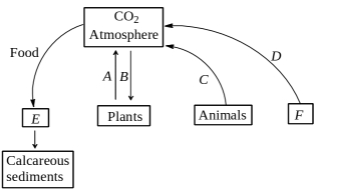
Complete the following model of the carbon cycle by filling in $A, B, C, D, E,$ and $F$.
A
$A-$Osmosis,$B-$Photosynthesis,$C-$Respiration,$D-$Burning of fuel wood,$E-$Forest food chain,$F-$Limestone
B
$A-$Photorespiration,$B-$Respiration,$C-$Respiration,$D-$Burning of organic debris,$E-$Pond food chain,$F-$Dolomite
C
$A-$Respiration,$B-$Photosynthesis,$C-$Respiration,$D-$Combustion of fossil fuels,$E-$Aquatic food chain,$F-$Coal,oil
D
$A-$Respiration,$B-$Photosynthesis,$C-$Respiration,$D-$Burning of forest,$E-$Terrestrial food chain,$F-$Forest
Solution
(C) In the carbon cycle:
$A$ represents Respiration by plants,which releases $CO_2$ into the atmosphere.
$B$ represents Photosynthesis,where plants absorb $CO_2$ from the atmosphere.
$C$ represents Respiration by animals,which releases $CO_2$ into the atmosphere.
$D$ represents the Combustion of fossil fuels,which releases stored carbon as $CO_2$ into the atmosphere.
$E$ represents the Aquatic food chain,where carbon is transferred to marine organisms and eventually forms calcareous sediments.
$F$ represents fossil fuel reservoirs like Coal and oil.
$A$ represents Respiration by plants,which releases $CO_2$ into the atmosphere.
$B$ represents Photosynthesis,where plants absorb $CO_2$ from the atmosphere.
$C$ represents Respiration by animals,which releases $CO_2$ into the atmosphere.
$D$ represents the Combustion of fossil fuels,which releases stored carbon as $CO_2$ into the atmosphere.
$E$ represents the Aquatic food chain,where carbon is transferred to marine organisms and eventually forms calcareous sediments.
$F$ represents fossil fuel reservoirs like Coal and oil.
0 likes
View Solution200
MediumMCQ
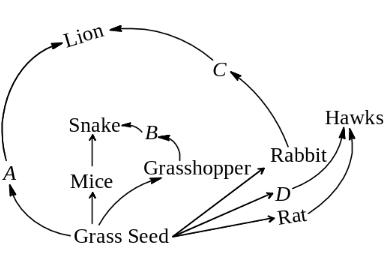
The given food web contains some missing organisms $A, B, C$ and $D$. Identify these organisms and select the correct answer.
A
$A-$Deer,$B-$Frog,$C-$Foxes,$D-$Sparrow
B
$A-$Dog,$B-$Squirrel,$C-$Deer,$D-$Hawks
C
$A-$Cat,$B-$Eagle,$C-$Cow,$D-$Rat
D
$A-$Eagle,$B-$Sparrow,$C-$Dog,$D-$Cat
Solution
(A) By analyzing the food web:
$1$. $A$ is a primary consumer that eats grass seeds and is eaten by a lion (e.g.,Deer).
$2$. $B$ is a primary consumer that eats grass seeds and is eaten by a snake (e.g.,Frog).
$3$. $C$ is a secondary consumer that eats rabbits and is eaten by a lion (e.g.,Foxes).
$4$. $D$ is a primary consumer that eats grass seeds and is eaten by hawks (e.g.,Sparrow).
Therefore,the correct identification is $A-$Deer,$B-$Frog,$C-$Foxes,$D-$Sparrow.
$1$. $A$ is a primary consumer that eats grass seeds and is eaten by a lion (e.g.,Deer).
$2$. $B$ is a primary consumer that eats grass seeds and is eaten by a snake (e.g.,Frog).
$3$. $C$ is a secondary consumer that eats rabbits and is eaten by a lion (e.g.,Foxes).
$4$. $D$ is a primary consumer that eats grass seeds and is eaten by hawks (e.g.,Sparrow).
Therefore,the correct identification is $A-$Deer,$B-$Frog,$C-$Foxes,$D-$Sparrow.
0 likes
View SolutionEcosystem — Mix Examples- Ecosystem · Frequently Asked Questions
1Are these Ecosystem questions useful for JEE and NEET?
Yes. All questions in this section are mapped to JEE Main and NEET exam patterns. Previous year questions from JEE Main, NEET, GUJCET and state-level exams are included with full solutions.
2Can I switch to Hindi or Gujarati for these questions?
Yes. Use the language tabs in the hero section or the sidebar to view the same questions and solutions in English, Hindi or Gujarati.
3How do I generate a question paper from this subtopic?
Use the Vedclass Exam Paper Generator — select the chapter and subtopic, set difficulty, and generate Sets A, B, C, D automatically. First 3 chapters of every subject are free.
Vedclass Products
For Students
Vedclass Test Series
Mock tests in real JEE/NEET style with performance analysis. 5-day free trial.
Start Free TrialFor Teachers
Exam Paper Generator
Generate Set A/B/C/D papers from this chapter in 2 minutes. 3 chapters free.
Try FreeFor Institutes
Online Exam Module
Live online exams with unlimited students, 360° analytics & white-label branding.
See DemoFor Teachers & Institutes
Generate a Ecosystem Exam Paper in 2 Minutes
Select subtopic & difficulty — Sets A, B, C, D auto-generated with No Repeat logic.
First 3 chapters of every subject are free — no payment required.