
A English
Mix Examples- Ecosystem Questions in English
Class 12 Biology · Ecosystem · Mix Examples- Ecosystem
256+
Questions
English
Language
100%
With Solutions
Showing 50 of 256 questions in English
201
MediumMCQ
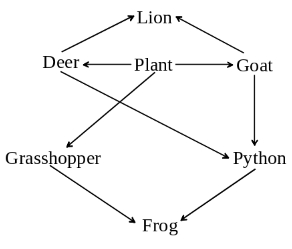
How many food chains are there in the food web shown above?
A
$2$
B
$3$
C
$5$
D
$7$
Solution
(C) To find the number of food chains,we trace all possible paths from the producer (Plant) to the top consumers:
$1$. Plant $\rightarrow$ Deer $\rightarrow$ Lion
$2$. Plant $\rightarrow$ Deer $\rightarrow$ Python $\rightarrow$ Frog
$3$. Plant $\rightarrow$ Goat $\rightarrow$ Lion
$4$. Plant $\rightarrow$ Goat $\rightarrow$ Python $\rightarrow$ Frog
$5$. Plant $\rightarrow$ Grasshopper $\rightarrow$ Frog
There are a total of $5$ distinct food chains in the given food web.
$1$. Plant $\rightarrow$ Deer $\rightarrow$ Lion
$2$. Plant $\rightarrow$ Deer $\rightarrow$ Python $\rightarrow$ Frog
$3$. Plant $\rightarrow$ Goat $\rightarrow$ Lion
$4$. Plant $\rightarrow$ Goat $\rightarrow$ Python $\rightarrow$ Frog
$5$. Plant $\rightarrow$ Grasshopper $\rightarrow$ Frog
There are a total of $5$ distinct food chains in the given food web.
0 likes
View Solution202
MediumMCQ
The changes that occur in successive seral stages to reach a climax community are:
$I.$ Changes in the diversity of species of organisms.
$II.$ Increase in the number of species and organisms.
$III.$ Increase in the total biomass.
Choose the correct option.
$I.$ Changes in the diversity of species of organisms.
$II.$ Increase in the number of species and organisms.
$III.$ Increase in the total biomass.
Choose the correct option.
A
$I$ and $II$
B
$I$ and $III$
C
$II$ and $III$
D
$I, II$ and $III$
Solution
(D) During ecological succession,the community undergoes a series of sequential changes known as seral stages until it reaches a stable climax community.
$1$. $I.$ Changes in species diversity occur as pioneer species are replaced by more complex organisms.
$2$. $II.$ There is a gradual increase in the number of species and the total number of organisms as the habitat becomes more favorable.
$3$. $III.$ As the community matures,the total biomass increases significantly due to the accumulation of organic matter and the development of complex vegetation structures.
Therefore,all three statements are correct.
$1$. $I.$ Changes in species diversity occur as pioneer species are replaced by more complex organisms.
$2$. $II.$ There is a gradual increase in the number of species and the total number of organisms as the habitat becomes more favorable.
$3$. $III.$ As the community matures,the total biomass increases significantly due to the accumulation of organic matter and the development of complex vegetation structures.
Therefore,all three statements are correct.
0 likes
View Solution203
MediumMCQ
If a single plant species is removed from a food web,then most likely
A
An animal species will fill the unoccupied niche
B
Other plants will produce enough food for herbivores
C
Dependent herbivores will have to find new food sources
D
Carnivores will be unaffected by the loss
Solution
(C) Herbivores are primary consumers that depend primarily on plants for their nutritional requirements. If a single plant species is removed from a food web,the herbivores that rely on that specific plant will be forced to seek alternative food sources to survive.
0 likes
View Solution204
MediumMCQ
Trees $\rightarrow$ Birds $\rightarrow$ Lice $\rightarrow$ Bacteria. Thus,the food chain is:
A
Predatory
B
Grazing
C
Detritus
D
Parasitic
Solution
(D) In the given food chain,trees are the producers. Birds feed on trees,lice are parasites on birds,and bacteria are hyper-parasites or decomposers feeding on lice. Since the size of the organisms decreases at each successive trophic level and the energy flows from a larger organism to a smaller parasitic organism,this is classified as a parasitic food chain.
0 likes
View Solution205
EasyMCQ
In hydrarch succession,the reed swamp stage is preceded by
A
Forest community
B
Scrub stage
C
Sedge meadow stage
D
Floating stage
Solution
(D) The sequence of hydrarch succession (Hydrosere) is as follows:
$1$. Phytoplankton stage
$2$. Submerged plant stage
$3$. Submerged free-floating plant stage
$4$. Reed swamp stage
$5$. Marsh meadow stage
$6$. Scrub stage
$7$. Forest stage
According to this sequence,the reed swamp stage is preceded by the floating stage (which includes both submerged free-floating and rooted floating plants).
$1$. Phytoplankton stage
$2$. Submerged plant stage
$3$. Submerged free-floating plant stage
$4$. Reed swamp stage
$5$. Marsh meadow stage
$6$. Scrub stage
$7$. Forest stage
According to this sequence,the reed swamp stage is preceded by the floating stage (which includes both submerged free-floating and rooted floating plants).
0 likes
View Solution206
EasyMCQ
The pioneer community established on a bare rock is:
A
Mosses
B
Lichens
C
Phytoplanktons
D
Higher plants
Solution
(B) The pioneer community that establishes itself on a bare rock is Lichens. These are the first colonizers in primary succession on a bare rock surface. They secrete acids to dissolve rock,helping in the process of weathering and soil formation,which eventually allows other plants like mosses to grow. Examples include $Graphis$ and $Rhizocarpon$.
0 likes
View Solution207
MediumMCQ
Succession proceeds from
A
Xeric $\rightarrow$ Mesic conditions
B
Hydric $\rightarrow$ Mesic conditions
C
Mesic $\rightarrow$ Xeric conditions
D
More than one option is correct
Solution
(D) Ecological succession is the process by which the structure of a biological community evolves over time.
In both primary and secondary succession,the community moves towards a stable climax community.
Succession occurring in dry areas (xeric) and succession occurring in water bodies (hydric) both eventually lead to a balanced environment with moderate moisture,known as mesic conditions.
Therefore,both xeric to mesic and hydric to mesic are correct pathways for succession.
In both primary and secondary succession,the community moves towards a stable climax community.
Succession occurring in dry areas (xeric) and succession occurring in water bodies (hydric) both eventually lead to a balanced environment with moderate moisture,known as mesic conditions.
Therefore,both xeric to mesic and hydric to mesic are correct pathways for succession.
0 likes
View Solution208
EasyMCQ
Carbon constitutes . . . . . . of dry weight of organisms and . . . . . . percentage is dissolved in oceans out of total global carbon.
A
$49\;\%, 71\;\%$
B
$71\;\%, 49\;\%$
C
$49\;\%, 49\;\%$
D
$71\;\%, 71\;\%$
Solution
(A) Carbon is a fundamental element for life and constitutes $49\;\%$ of the dry weight of organisms.
Out of the total global carbon,$71\;\%$ is dissolved in the oceans.
Therefore,the correct values are $49\;\%$ and $71\;\%$ respectively.
Out of the total global carbon,$71\;\%$ is dissolved in the oceans.
Therefore,the correct values are $49\;\%$ and $71\;\%$ respectively.
0 likes
View Solution209
MediumMCQ
Which of the following organisms convert plant matter into animal matter?
A
Earthworm
B
Goat
C
Termites
D
Frog
Solution
(B) In an ecosystem, primary consumers (herbivores) are the organisms that directly consume plant matter and convert it into animal biomass. Among the given options, the $Goat$ is a primary consumer (herbivore) that feeds on plants, whereas the others are either detritivores or carnivores.
0 likes
View Solution210
EasyMCQ
Amount of inorganic substances present in an ecosystem is . . . . . . Energy flow is a . . . . . . feature of ecosystem.
A
Standing crop,structural
B
Standing state,functional
C
Standing crop,functional
D
Standing state,structural
Solution
(B) The amount of inorganic substances (such as $C, N, P, Ca$, etc.) present in an ecosystem at any given time is referred to as the $Standing \, state$.
Energy flow, nutrient cycling, and productivity are considered functional aspects of an ecosystem because they describe the processes and dynamics occurring within the system.
Therefore, the correct answer is $Standing \, state$ and $functional$.
Energy flow, nutrient cycling, and productivity are considered functional aspects of an ecosystem because they describe the processes and dynamics occurring within the system.
Therefore, the correct answer is $Standing \, state$ and $functional$.
0 likes
View Solution211
MediumMCQ
Consider the following four statements $(A-D)$ and select the correct option stating which ones are true $(T)$ and which ones are false $(F)$.
Statements:
$(A)$ Vertical distribution of different species occupying different levels in a community is called stratification.
$(B)$ Net primary productivity minus respiration losses is the gross primary productivity.
$(C)$ Rate of biomass production is called decomposition.
$(D)$ Annual net primary productivity of oceans is $55$ billion tons.
Statements:
$(A)$ Vertical distribution of different species occupying different levels in a community is called stratification.
$(B)$ Net primary productivity minus respiration losses is the gross primary productivity.
$(C)$ Rate of biomass production is called decomposition.
$(D)$ Annual net primary productivity of oceans is $55$ billion tons.
A
| $F, T, F, T$ |
B
| $T, F, T, F$ |
C
| $T, F, F, T$ |
D
| $F, T, F, F$ |
Solution
(C) Statement $(A)$ is True: Stratification refers to the vertical distribution of different species occupying different levels in a community.
Statement $(B)$ is False: The correct relationship is $NPP = GPP - R$. Therefore,$GPP - R$ is Net Primary Productivity $(NPP)$,not Gross Primary Productivity $(GPP)$.
Statement $(C)$ is False: The rate of biomass production is called productivity,not decomposition.
Statement $(D)$ is True: The annual net primary productivity of the whole biosphere is approximately $170$ billion tons of organic matter,of which the oceans contribute only $55$ billion tons.
Thus,the correct sequence is $(A=T, B=F, C=F, D=T)$.
Statement $(B)$ is False: The correct relationship is $NPP = GPP - R$. Therefore,$GPP - R$ is Net Primary Productivity $(NPP)$,not Gross Primary Productivity $(GPP)$.
Statement $(C)$ is False: The rate of biomass production is called productivity,not decomposition.
Statement $(D)$ is True: The annual net primary productivity of the whole biosphere is approximately $170$ billion tons of organic matter,of which the oceans contribute only $55$ billion tons.
Thus,the correct sequence is $(A=T, B=F, C=F, D=T)$.
0 likes
View Solution212
MediumMCQ
Find an incorrect statement for $DFC$ (Detritus Food Chain).
A
Starts with solar energy
B
Terminates in $GFC$
C
Requires specific detritivores
D
Plays major role in terrestrial systems
Solution
(A) The $DFC$ (Detritus Food Chain) begins with dead organic matter (detritus),not solar energy. In contrast,the $GFC$ (Grazing Food Chain) begins with producers that capture solar energy. Therefore,the statement that $DFC$ starts with solar energy is incorrect. $DFC$ is often connected to $GFC$ at some levels,and it relies on detritivores for the decomposition of organic matter. It is the primary pathway for energy flow in terrestrial ecosystems.
0 likes
View Solution213
MediumMCQ
$A$ food web:
A
Increases variety of food at each trophic level
B
Delicately balances the interrelations amongst organisms
C
Decreases variety of food but increases quantity of food at each trophic level
D
Increases variety as well as quantity of food at each trophic level
Solution
(D) food web is a complex network of interconnected food chains.
By providing multiple pathways for energy flow,it ensures that organisms have access to a greater variety of food sources.
This interconnectedness also helps in maintaining the stability of the ecosystem by increasing the overall availability and quantity of food resources at each trophic level.
By providing multiple pathways for energy flow,it ensures that organisms have access to a greater variety of food sources.
This interconnectedness also helps in maintaining the stability of the ecosystem by increasing the overall availability and quantity of food resources at each trophic level.
0 likes
View Solution214
MediumMCQ
Mark the correct match.
A
Secondary consumer - Zooplankton
B
Primary coloniser - Viruses
C
Nanoecosystem - Valley and forest
D
Omnivores - Cockroaches, Crows
Solution
(D) The correct match is $Omnivores - Cockroaches, Crows$.
$1$. Omnivores are organisms that consume both plant and animal matter.
$2$. Cockroaches and crows are well-known examples of omnivores as they feed on a wide variety of food sources including plant materials and small animals or organic waste.
$1$. Omnivores are organisms that consume both plant and animal matter.
$2$. Cockroaches and crows are well-known examples of omnivores as they feed on a wide variety of food sources including plant materials and small animals or organic waste.
0 likes
View Solution215
MediumMCQ
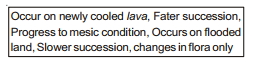
From the above given features,how many are associated with primary succession?
Features:
$1$. Occur on newly cooled lava
$2$. Faster succession
$3$. Progress to mesic condition
$4$. Occurs on flooded land
$5$. Slower succession
$6$. Changes in flora only
Features:
$1$. Occur on newly cooled lava
$2$. Faster succession
$3$. Progress to mesic condition
$4$. Occurs on flooded land
$5$. Slower succession
$6$. Changes in flora only
A
Two
B
Five
C
Four
D
Three
Solution
(D) Primary succession is the process of ecological succession that occurs in an area where no community previously existed.
Based on the provided features:
$1$. Occur on newly cooled lava: Correct (Primary succession starts on bare rock).
$2$. Faster succession: Incorrect (Primary succession is very slow).
$3$. Progress to mesic condition: Correct (Succession generally leads to a stable climax community,which is often mesic).
$4$. Occurs on flooded land: Incorrect (This is usually associated with secondary succession or specific aquatic succession).
$5$. Slower succession: Correct (It takes a long time to build soil).
$6$. Changes in flora only: Incorrect (Succession involves changes in both flora and fauna).
Therefore,there are $3$ features associated with primary succession: $(1)$,$(3)$,and $(5)$.
Based on the provided features:
$1$. Occur on newly cooled lava: Correct (Primary succession starts on bare rock).
$2$. Faster succession: Incorrect (Primary succession is very slow).
$3$. Progress to mesic condition: Correct (Succession generally leads to a stable climax community,which is often mesic).
$4$. Occurs on flooded land: Incorrect (This is usually associated with secondary succession or specific aquatic succession).
$5$. Slower succession: Correct (It takes a long time to build soil).
$6$. Changes in flora only: Incorrect (Succession involves changes in both flora and fauna).
Therefore,there are $3$ features associated with primary succession: $(1)$,$(3)$,and $(5)$.
0 likes
View Solution216
MediumMCQ
The phosphates remain outside the natural cycle for a long time:
A
When they form compounds with metals
B
When they are incorporated in bone and teeth
C
When the bodies of the organisms excrete and decompose
D
Both $(A)$ and $(B)$
Solution
(D) Phosphates are essential nutrients that circulate through the ecosystem.
They remain outside the natural cycle for a long period when they form insoluble compounds with metals (like calcium or iron) in the soil,or when they are sequestered in the skeletal structures (bones and teeth) of organisms,as these components do not decompose rapidly.
They remain outside the natural cycle for a long period when they form insoluble compounds with metals (like calcium or iron) in the soil,or when they are sequestered in the skeletal structures (bones and teeth) of organisms,as these components do not decompose rapidly.
0 likes
View Solution217
MediumMCQ
$A$: Successional process starts only in those areas where no living organisms ever existed.
$R$: These areas are not supported by physical environmental conditions.
$R$: These areas are not supported by physical environmental conditions.
A
Assertion and Reason both are correct and Reason is the correct explanation of Assertion.
B
Assertion and Reason both are correct but Reason is not the correct explanation of Assertion.
C
Assertion is correct,but Reason is incorrect.
D
Both Assertion and Reason are incorrect.
Solution
(D) The Assertion is incorrect because the successional process can occur in two ways: Primary succession and Secondary succession.
Primary succession occurs in areas where no living organisms ever existed (e.g.,bare rock,newly cooled lava).
Secondary succession occurs in areas where living organisms previously existed but were lost due to disturbances like fire,flood,or deforestation.
The Reason is also incorrect because areas where primary succession begins (like bare rock) are indeed supported by physical environmental conditions,although they may be harsh initially.
Primary succession occurs in areas where no living organisms ever existed (e.g.,bare rock,newly cooled lava).
Secondary succession occurs in areas where living organisms previously existed but were lost due to disturbances like fire,flood,or deforestation.
The Reason is also incorrect because areas where primary succession begins (like bare rock) are indeed supported by physical environmental conditions,although they may be harsh initially.
0 likes
View Solution218
MediumMCQ
$A$: Neither the community modifies the environment nor the environment forces the community to leave the place in the climax stage of succession.
$R$: Climax community is xerophytic in most of the types of succession.
$R$: Climax community is xerophytic in most of the types of succession.
A
Assertion and Reason both are correct and Reason is the correct explanation of Assertion.
B
Assertion and Reason both are correct but Reason is not the correct explanation of Assertion.
C
Assertion is correct,but Reason is incorrect.
D
Both Assertion and Reason are incorrect.
Solution
(C) In ecological succession,the climax community is the final stable stage that remains relatively unchanged unless disturbed. At this stage,the community is in equilibrium with the environment,meaning it does not significantly modify the environment,and the environment does not force the community to change. Therefore,the Assertion is correct.
However,the Reason is incorrect because the climax community is typically mesic (having moderate moisture conditions),not xerophytic. All successions,whether starting in water (hydrarch) or on bare rock (xerarch),eventually lead to a mesic climax community.
However,the Reason is incorrect because the climax community is typically mesic (having moderate moisture conditions),not xerophytic. All successions,whether starting in water (hydrarch) or on bare rock (xerarch),eventually lead to a mesic climax community.
0 likes
View Solution219
MediumMCQ
$A$: Niche becomes general and broader during biotic succession.
$R$: Species diversity increases but organic matter is decreased.
$R$: Species diversity increases but organic matter is decreased.
A
Assertion and Reason both are correct and Reason is the correct explanation of Assertion.
B
Assertion and Reason both are correct but Reason is not the correct explanation of Assertion.
C
Assertion is correct,but Reason is incorrect.
D
Both Assertion and Reason are incorrect.
Solution
(D) During biotic succession,the environment becomes more stable and complex. As the ecosystem matures,species become more specialized to utilize specific resources,which leads to niches becoming narrower and more specific rather than broader. Therefore,the Assertion is incorrect.
Regarding the Reason,species diversity does increase during succession,but the total organic matter (biomass) also increases significantly as the community progresses toward a climax stage. Therefore,the Reason is also incorrect.
Regarding the Reason,species diversity does increase during succession,but the total organic matter (biomass) also increases significantly as the community progresses toward a climax stage. Therefore,the Reason is also incorrect.
0 likes
View Solution220
MediumMCQ
$A$ : During succession,nutrient availability decreases while biomass level increases.
$R$ : $NCP$ (Net Community Productivity) remains same during succession.
$R$ : $NCP$ (Net Community Productivity) remains same during succession.
A
Assertion and Reason both are correct and Reason is the correct explanation of Assertion.
B
Assertion and Reason both are correct but Reason is not the correct explanation of Assertion.
C
Assertion is correct,but Reason is incorrect.
D
Both Assertion and Reason are incorrect.
Solution
(D) During ecological succession,the nutrient availability generally increases because the accumulation of organic matter (humus) improves soil fertility and nutrient cycling.
Therefore,the Assertion is incorrect.
During succession,as the community becomes more complex and reaches a climax state,the $NCP$ (Net Community Productivity) generally decreases because a larger portion of the gross primary productivity is consumed by the community for respiration and maintenance.
Therefore,the Reason is also incorrect.
Thus,both Assertion and Reason are incorrect.
Therefore,the Assertion is incorrect.
During succession,as the community becomes more complex and reaches a climax state,the $NCP$ (Net Community Productivity) generally decreases because a larger portion of the gross primary productivity is consumed by the community for respiration and maintenance.
Therefore,the Reason is also incorrect.
Thus,both Assertion and Reason are incorrect.
0 likes
View Solution221
MediumMCQ
$A$: Decomposers are excluded from the food chains.
$R$: They act on all trophic levels of a food chain.
$R$: They act on all trophic levels of a food chain.
A
Assertion and Reason both are correct and Reason is the correct explanation of Assertion.
B
Assertion and Reason both are correct but Reason is not the correct explanation of Assertion.
C
Assertion is correct,but Reason is incorrect.
D
Both Assertion and Reason are incorrect.
Solution
(A) Assertion $(A)$ is correct because food chains typically represent the flow of energy from producers to consumers,and decomposers are often omitted from these linear representations.
Reason $(R)$ is correct because decomposers (saprotrophs) break down dead organic matter from all trophic levels,including producers,herbivores,and carnivores.
Since decomposers operate at every level and are not restricted to a single linear path,they are excluded from the standard food chain models. Thus,the Reason correctly explains why they are excluded.
Reason $(R)$ is correct because decomposers (saprotrophs) break down dead organic matter from all trophic levels,including producers,herbivores,and carnivores.
Since decomposers operate at every level and are not restricted to a single linear path,they are excluded from the standard food chain models. Thus,the Reason correctly explains why they are excluded.
0 likes
View Solution222
MediumMCQ
$A$: In hydrosere,the reed swamp stage is followed by the floating plant stage.
$R$: The sedge meadow stage has amphibious herbaceous plants.
$R$: The sedge meadow stage has amphibious herbaceous plants.
A
Assertion and Reason both are correct and Reason is the correct explanation of Assertion.
B
Assertion and Reason both are correct but Reason is not the correct explanation of Assertion.
C
Assertion is correct,but Reason is incorrect.
D
Both Assertion and Reason are incorrect.
Solution
(C) In a hydrosere (succession in water),the sequence of stages is: Phytoplankton stage $\rightarrow$ Rooted submerged plant stage $\rightarrow$ Floating plant stage $\rightarrow$ Reed swamp stage $\rightarrow$ Sedge meadow stage $\rightarrow$ Woodland stage $\rightarrow$ Forest stage.
Therefore,the reed swamp stage is actually preceded by the floating plant stage,not followed by it. Thus,the Assertion is incorrect.
The Reason states that the sedge meadow stage has amphibious herbaceous plants,which is a correct biological fact.
Hence,the correct option is $C$.
Therefore,the reed swamp stage is actually preceded by the floating plant stage,not followed by it. Thus,the Assertion is incorrect.
The Reason states that the sedge meadow stage has amphibious herbaceous plants,which is a correct biological fact.
Hence,the correct option is $C$.
0 likes
View Solution223
MediumMCQ
Some of the nutrient cycles are labelled as below:
$I$. Sulphur cycle
$II$. Phosphorus cycle
$III$. Carbon cycle
$IV$. Nitrogen cycle
Of these,the sedimentary cycle is represented by:
$I$. Sulphur cycle
$II$. Phosphorus cycle
$III$. Carbon cycle
$IV$. Nitrogen cycle
Of these,the sedimentary cycle is represented by:
A
$I$ only
B
$II$ only
C
$III$ only
D
$I$ and $II$
Solution
(D) In a sedimentary cycle,the reservoir pool is the Earth's crust (lithosphere). The nutrients involved are typically non-gaseous in nature.
Examples of sedimentary cycles include the Phosphorus cycle $(II)$ and the Sulphur cycle $(I)$.
Carbon cycle $(III)$ and Nitrogen cycle $(IV)$ are examples of gaseous cycles where the reservoir pool is the atmosphere.
Examples of sedimentary cycles include the Phosphorus cycle $(II)$ and the Sulphur cycle $(I)$.
Carbon cycle $(III)$ and Nitrogen cycle $(IV)$ are examples of gaseous cycles where the reservoir pool is the atmosphere.
0 likes
View Solution224
MediumMCQ
$A$: $A$ stable community should show much variation in year-to-year productivity.
$R$: It must not be resilient to occasional disturbance.
$R$: It must not be resilient to occasional disturbance.
A
Assertion and Reason both are correct and Reason is the correct explanation of Assertion.
B
Assertion and Reason both are correct but Reason is not the correct explanation of Assertion.
C
Assertion is correct,but Reason is incorrect.
D
Both Assertion and Reason are incorrect.
Solution
(D) According to David Tilman's long-term ecosystem experiments,a stable community should not show too much variation in productivity from year to year.
Therefore,the Assertion $(A)$ is incorrect.
$A$ stable community must be resilient to occasional disturbances (either natural or man-made).
Therefore,the Reason $(R)$ is also incorrect.
Thus,both Assertion and Reason are incorrect.
Therefore,the Assertion $(A)$ is incorrect.
$A$ stable community must be resilient to occasional disturbances (either natural or man-made).
Therefore,the Reason $(R)$ is also incorrect.
Thus,both Assertion and Reason are incorrect.
0 likes
View Solution225
EasyMCQ
The world's most problematic aquatic weed is
A
Trapa
B
Azolla
C
Wolffia
D
Eichhornia
Solution
(D) $Eichhornia$ $crassipes$,commonly known as water hyacinth,is considered the world's most problematic aquatic weed.
It was introduced in India for its beautiful flowers but it grows very rapidly through vegetative propagation (offsets).
It causes environmental damage by clogging water bodies,depleting oxygen levels,and harming aquatic life,making it extremely difficult to eradicate.
It was introduced in India for its beautiful flowers but it grows very rapidly through vegetative propagation (offsets).
It causes environmental damage by clogging water bodies,depleting oxygen levels,and harming aquatic life,making it extremely difficult to eradicate.
0 likes
View Solution226
Medium
Give scientific reasons: Coral reefs are not found in the regions from West Bengal to Andhra Pradesh,but are found in Tamil Nadu and on the east coast of India.
Solution
(N/A) Coral reefs require specific environmental conditions to thrive,including high salinity,clear water,and a lack of excessive siltation.
In the regions from West Bengal to Andhra Pradesh,large rivers like the Ganges,Brahmaputra,Mahanadi,Godavari,and Krishna discharge massive amounts of fresh water and sediment (silt) into the Bay of Bengal.
This influx of fresh water lowers the salinity,and the high silt content increases turbidity,which blocks the sunlight necessary for the symbiotic algae (zooxanthellae) living within the coral polyps.
In contrast,the coastal regions of Tamil Nadu and certain other parts of the east coast have higher salinity,clearer water,and minimal freshwater inflow,providing the ideal conditions for coral reef development.
In the regions from West Bengal to Andhra Pradesh,large rivers like the Ganges,Brahmaputra,Mahanadi,Godavari,and Krishna discharge massive amounts of fresh water and sediment (silt) into the Bay of Bengal.
This influx of fresh water lowers the salinity,and the high silt content increases turbidity,which blocks the sunlight necessary for the symbiotic algae (zooxanthellae) living within the coral polyps.
In contrast,the coastal regions of Tamil Nadu and certain other parts of the east coast have higher salinity,clearer water,and minimal freshwater inflow,providing the ideal conditions for coral reef development.
0 likes
View Solution227
MediumMCQ
Match the following columns:
| Column-$I$ | Column-$II$ |
| $P$. Herbivores | $I$. Directly dependent on plants |
| $Q$. Carnivores | $II$. Indirectly dependent on plants |
| $R$. Saprophytes (Fungi) | $III$. Dependent on dead or decaying matter |
A
$(P-I), (Q-II), (R-III)$
B
$(P-II), (Q-I), (R-III)$
C
$(P-III), (Q-I), (R-II)$
D
$(P-III), (Q-II), (R-I)$
Solution
(A) The correct matching is as follows:
$P$. Herbivores are primary consumers that feed directly on plants,so $P-I$.
$Q$. Carnivores are secondary or tertiary consumers that feed on herbivores,making them indirectly dependent on plants,so $Q-II$.
$R$. Saprophytes (like Fungi) obtain nutrients from dead and decaying organic matter,so $R-III$.
Therefore,the correct sequence is $(P-I), (Q-II), (R-III)$.
$P$. Herbivores are primary consumers that feed directly on plants,so $P-I$.
$Q$. Carnivores are secondary or tertiary consumers that feed on herbivores,making them indirectly dependent on plants,so $Q-II$.
$R$. Saprophytes (like Fungi) obtain nutrients from dead and decaying organic matter,so $R-III$.
Therefore,the correct sequence is $(P-I), (Q-II), (R-III)$.
0 likes
View Solution228
MediumMCQ
Pisaster is a . . . . . . .
A
Species of moth
B
Species of starfish
C
Species of bird
D
Species of mammal
Solution
(B) Pisaster is a genus of sea stars (starfish) found along the rocky intertidal zones of the Pacific coast of North America.
It is a classic example of a keystone species used in ecological studies.
In an experiment conducted by Robert Paine,when all starfish (Pisaster) were removed from an enclosed intertidal area,more than $10$ species of invertebrates became extinct within a year due to interspecific competition.
It is a classic example of a keystone species used in ecological studies.
In an experiment conducted by Robert Paine,when all starfish (Pisaster) were removed from an enclosed intertidal area,more than $10$ species of invertebrates became extinct within a year due to interspecific competition.
0 likes
View Solution229
MediumMCQ
How many of the following organisms are decomposers in a pond ecosystem?
Some algae,fungi,bacteria,floating plants,submerged plants,flagellates.
Some algae,fungi,bacteria,floating plants,submerged plants,flagellates.
A
$1$
B
$2$
C
$3$
D
$4$
Solution
(C) In a pond ecosystem,decomposers are organisms that break down dead organic matter into simpler substances.
Among the given list:
$1$. Fungi: These are primary decomposers.
$2$. Bacteria: These are primary decomposers.
$3$. Flagellates: Some flagellates act as decomposers in aquatic environments.
Algae are producers,while floating and submerged plants are also producers.
Therefore,there are $3$ types of organisms (fungi,bacteria,and flagellates) that act as decomposers in this context.
Among the given list:
$1$. Fungi: These are primary decomposers.
$2$. Bacteria: These are primary decomposers.
$3$. Flagellates: Some flagellates act as decomposers in aquatic environments.
Algae are producers,while floating and submerged plants are also producers.
Therefore,there are $3$ types of organisms (fungi,bacteria,and flagellates) that act as decomposers in this context.
0 likes
View Solution230
MediumMCQ
Select the correct option for the following processes:
$P$ - Formation of organic components from inorganic components
$Q$ - Formation of inorganic components from organic components
Select the correct option for $P$ and $Q$.
$P$ - Formation of organic components from inorganic components
$Q$ - Formation of inorganic components from organic components
Select the correct option for $P$ and $Q$.
A
Decomposition,Photosynthesis
B
Photosynthesis,Decomposition
C
Decomposition,Fragmentation
D
Fragmentation,Decomposition
Solution
(B) $P$ represents the process of photosynthesis,where plants use inorganic substances like $CO_2$ and $H_2O$ to synthesize organic compounds (glucose) using solar energy.
$Q$ represents the process of decomposition,where decomposers break down complex organic matter (dead remains of plants and animals) into simpler inorganic substances like $CO_2$,$H_2O$,and nutrients.
$Q$ represents the process of decomposition,where decomposers break down complex organic matter (dead remains of plants and animals) into simpler inorganic substances like $CO_2$,$H_2O$,and nutrients.
0 likes
View Solution231
MediumMCQ
How many of the following are primary producers in a terrestrial ecosystem?
Herbaceous plants,Algae,Woody plants,Phytoplankton,Aquatic plants
Herbaceous plants,Algae,Woody plants,Phytoplankton,Aquatic plants
A
$1$
B
$2$
C
$3$
D
$4$
Solution
(B) In a terrestrial ecosystem,the primary producers are plants that grow on land.
$1$. Herbaceous plants: These are terrestrial producers.
$2$. Algae: These are primarily aquatic.
$3$. Woody plants: These are terrestrial producers.
$4$. Phytoplankton: These are aquatic producers.
$5$. Aquatic plants: These are aquatic producers.
Therefore,only Herbaceous plants and Woody plants are primary producers in a terrestrial ecosystem.
The total count is $2$.
$1$. Herbaceous plants: These are terrestrial producers.
$2$. Algae: These are primarily aquatic.
$3$. Woody plants: These are terrestrial producers.
$4$. Phytoplankton: These are aquatic producers.
$5$. Aquatic plants: These are aquatic producers.
Therefore,only Herbaceous plants and Woody plants are primary producers in a terrestrial ecosystem.
The total count is $2$.
1 likes
View Solution232
MediumMCQ
What type of food chain is the following?
Grass $\rightarrow$ Goat $\rightarrow$ Human
Grass $\rightarrow$ Goat $\rightarrow$ Human
A
Grazing food chain
B
Detritus food chain
C
Both
D
None of these
Solution
(A) The food chain Grass $\rightarrow$ Goat $\rightarrow$ Human starts with producers (grass) that are consumed by herbivores (goat),which are then consumed by carnivores/omnivores (human).
This type of food chain,which begins with green plants (producers) and proceeds through herbivores to carnivores,is known as a Grazing food chain $(GFC)$.
In contrast,a Detritus food chain $(DFC)$ begins with dead organic matter.
This type of food chain,which begins with green plants (producers) and proceeds through herbivores to carnivores,is known as a Grazing food chain $(GFC)$.
In contrast,a Detritus food chain $(DFC)$ begins with dead organic matter.
0 likes
View Solution233
MediumMCQ
Select the incorrect statement from the following.
A
In a terrestrial ecosystem,much more energy flows through the grazing food chain than through the detritus food chain.
B
The detritus food chain may be connected to the grazing food chain at some levels.
C
Animals like cockroaches,crows,and humans are omnivores.
D
The natural interconnection of food chains forms a food web.
Solution
(A) $1$. In a terrestrial ecosystem,the major conduit for energy flow is the detritus food chain $(DFC)$,not the grazing food chain $(GFC)$.
$2$. In an aquatic ecosystem,the grazing food chain $(GFC)$ is the major conduit for energy flow.
$3$. Therefore,the statement that 'much more energy flows through the grazing food chain than through the detritus food chain in a terrestrial ecosystem' is incorrect.
$4$. The detritus food chain is indeed connected to the grazing food chain at some levels (e.g.,organisms of the $DFC$ may become prey to the $GFC$ animals).
$5$. Organisms like cockroaches,crows,and humans are omnivores as they consume both plants and animals.
$6$. The natural interconnection of multiple food chains creates a complex network known as a food web.
$2$. In an aquatic ecosystem,the grazing food chain $(GFC)$ is the major conduit for energy flow.
$3$. Therefore,the statement that 'much more energy flows through the grazing food chain than through the detritus food chain in a terrestrial ecosystem' is incorrect.
$4$. The detritus food chain is indeed connected to the grazing food chain at some levels (e.g.,organisms of the $DFC$ may become prey to the $GFC$ animals).
$5$. Organisms like cockroaches,crows,and humans are omnivores as they consume both plants and animals.
$6$. The natural interconnection of multiple food chains creates a complex network known as a food web.
0 likes
View Solution234
DifficultMCQ
In an aquatic ecosystem,at which trophic level do detritivores belong?
A
$T_1$
B
$T_2$
C
$T_3$
D
$T_4$
Solution
(A) In an ecosystem,the trophic levels are defined based on the source of nutrition.
$T_1$ represents the producers (autotrophs).
$T_2$ represents the primary consumers (herbivores).
$T_3$ represents the secondary consumers (primary carnivores).
$T_4$ represents the tertiary consumers (secondary carnivores).
Detritivores (decomposers) feed on dead organic matter (detritus). In the context of energy flow models,they are often considered to operate at all trophic levels,but in standard ecological classification for food chains,they are frequently associated with the $T_1$ level or considered as a separate decomposer pathway. However,in many standard textbook contexts,detritivores are placed at the $T_1$ level because they derive energy from the breakdown of organic matter produced by primary producers.
$T_1$ represents the producers (autotrophs).
$T_2$ represents the primary consumers (herbivores).
$T_3$ represents the secondary consumers (primary carnivores).
$T_4$ represents the tertiary consumers (secondary carnivores).
Detritivores (decomposers) feed on dead organic matter (detritus). In the context of energy flow models,they are often considered to operate at all trophic levels,but in standard ecological classification for food chains,they are frequently associated with the $T_1$ level or considered as a separate decomposer pathway. However,in many standard textbook contexts,detritivores are placed at the $T_1$ level because they derive energy from the breakdown of organic matter produced by primary producers.
0 likes
View Solution235
MediumMCQ
Omnivores feed on members of which trophic levels?
A
$T_1$
B
$T_2$
C
$T_1$ and $T_2$
D
Decomposers
Solution
(C) Omnivores are organisms that consume both plants and animals.
In an ecosystem,$T_1$ represents the producers (plants) and $T_2$ represents the primary consumers (herbivores).
Since omnivores consume both producers (plants) and primary consumers (herbivores),they feed on members of both $T_1$ and $T_2$ trophic levels.
In an ecosystem,$T_1$ represents the producers (plants) and $T_2$ represents the primary consumers (herbivores).
Since omnivores consume both producers (plants) and primary consumers (herbivores),they feed on members of both $T_1$ and $T_2$ trophic levels.
0 likes
View Solution236
MediumMCQ
At which trophic level are carnivorous plants included?
A
$T_1$
B
$T_2$
C
$T_1$ and $T_3$
D
$T_1$ and $T_2$
Solution
(D) Carnivorous plants are unique because they are producers $(T_1)$ as they perform photosynthesis to synthesize their own food.
However,they also act as primary consumers $(T_2)$ because they trap and digest insects to supplement their nitrogen requirements in nutrient-poor soils.
Therefore,they occupy both the first trophic level $(T_1)$ and the second trophic level $(T_2)$.
However,they also act as primary consumers $(T_2)$ because they trap and digest insects to supplement their nitrogen requirements in nutrient-poor soils.
Therefore,they occupy both the first trophic level $(T_1)$ and the second trophic level $(T_2)$.
0 likes
View Solution237
MediumMCQ
Arrange the stages of hydrarch succession in the correct sequence.
A
Phytoplankton $\rightarrow$ Submerged free-floating plant stage $\rightarrow$ Submerged plant stage $\rightarrow$ Reed-swamp stage $\rightarrow$ Marsh-meadow stage $\rightarrow$ Scrub stage
B
Phytoplankton $\rightarrow$ Submerged plant stage $\rightarrow$ Submerged free-floating plant stage $\rightarrow$ Reed-swamp stage $\rightarrow$ Marsh-meadow stage $\rightarrow$ Scrub stage
C
Phytoplankton $\rightarrow$ Submerged plant stage $\rightarrow$ Submerged free-floating plant stage $\rightarrow$ Marsh-meadow stage $\rightarrow$ Reed-swamp stage $\rightarrow$ Scrub stage
D
Phytoplankton $\rightarrow$ Submerged plant stage $\rightarrow$ Submerged free-floating plant stage $\rightarrow$ Reed-swamp stage $\rightarrow$ Scrub stage $\rightarrow$ Marsh-meadow stage
Solution
(B) Hydrarch succession takes place in wetter areas and the successional series progress from hydric to the mesic conditions. The correct sequence of stages is:
$1$. Phytoplankton stage
$2$. Submerged plant stage
$3$. Submerged free-floating plant stage
$4$. Reed-swamp stage
$5$. Marsh-meadow stage
$6$. Scrub stage
$7$. Forest stage (Climax community)
Thus,the correct sequence is Phytoplankton $\rightarrow$ Submerged plant stage $\rightarrow$ Submerged free-floating plant stage $\rightarrow$ Reed-swamp stage $\rightarrow$ Marsh-meadow stage $\rightarrow$ Scrub stage.
$1$. Phytoplankton stage
$2$. Submerged plant stage
$3$. Submerged free-floating plant stage
$4$. Reed-swamp stage
$5$. Marsh-meadow stage
$6$. Scrub stage
$7$. Forest stage (Climax community)
Thus,the correct sequence is Phytoplankton $\rightarrow$ Submerged plant stage $\rightarrow$ Submerged free-floating plant stage $\rightarrow$ Reed-swamp stage $\rightarrow$ Marsh-meadow stage $\rightarrow$ Scrub stage.
0 likes
View Solution238
EasyMCQ
Select the correct option from the following.
A
Nutrients are never lost from the ecosystem,but they are recycled repeatedly.
B
The movement of nutrient elements through the various components of an ecosystem is called nutrient cycling.
C
Another name for nutrient cycling is biogeochemical cycle.
D
All of the above.
Solution
(D) Nutrient cycling is a fundamental process in an ecosystem.
$1$. Nutrients are never lost from the ecosystem; they are conserved and recycled repeatedly through biotic and abiotic components.
$2$. The movement of nutrient elements through the various components of an ecosystem is defined as nutrient cycling.
$3$. Since these cycles involve the movement of nutrients through living organisms (bio),geological processes (geo),and chemical processes (chemical),they are also known as biogeochemical cycles.
Therefore,all the given statements are correct.
$1$. Nutrients are never lost from the ecosystem; they are conserved and recycled repeatedly through biotic and abiotic components.
$2$. The movement of nutrient elements through the various components of an ecosystem is defined as nutrient cycling.
$3$. Since these cycles involve the movement of nutrients through living organisms (bio),geological processes (geo),and chemical processes (chemical),they are also known as biogeochemical cycles.
Therefore,all the given statements are correct.
0 likes
View Solution239
MediumMCQ
$X-$ Atmospheric input of phosphorus through rainfall is much smaller than carbon input.
$Y-$ The exchange of phosphorus between organisms and the environment is negligible.
$Y-$ The exchange of phosphorus between organisms and the environment is negligible.
A
Both $X$ and $Y$ are true.
B
Both $X$ and $Y$ are false.
C
$X$ is true but $Y$ is false.
D
$X$ is false but $Y$ is true.
Solution
(C) Statement $X$ is true because phosphorus is a sedimentary cycle,and its atmospheric input through rainfall is significantly lower compared to the carbon cycle,which relies heavily on atmospheric $CO_2$.
Statement $Y$ is false because the exchange of phosphorus between organisms and the environment is not negligible; it is a vital nutrient that cycles through food chains,decomposition,and weathering processes,although it lacks a significant gaseous phase.
Statement $Y$ is false because the exchange of phosphorus between organisms and the environment is not negligible; it is a vital nutrient that cycles through food chains,decomposition,and weathering processes,although it lacks a significant gaseous phase.
0 likes
View Solution240
MediumMCQ
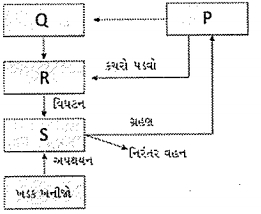
The following diagram shows the phosphorus cycle. Identify the producers in it.
A
$P$
B
$Q$
C
$R$
D
$S$
Solution
(B) In the phosphorus cycle,phosphorus is released from rocks through weathering. This phosphorus enters the soil solution $(S)$. Producers (plants) absorb this dissolved phosphorus from the soil $(S)$ to incorporate it into their biomass $(Q)$. Consumers then feed on these producers $(R)$. Finally,decomposers break down the organic matter to return phosphorus to the soil. Based on the provided diagram:
- $P$ represents the rock reservoir.
- $Q$ represents the producers (plants) that incorporate phosphorus.
- $R$ represents the consumers.
- $S$ represents the soil solution.
Therefore,$Q$ represents the producers.
- $P$ represents the rock reservoir.
- $Q$ represents the producers (plants) that incorporate phosphorus.
- $R$ represents the consumers.
- $S$ represents the soil solution.
Therefore,$Q$ represents the producers.
0 likes
View Solution241
MediumMCQ
Match the List-$I$ with List-$II$:
Choose the correct answer from the options given below:
| List-$I$ | List-$II$ |
|---|---|
| $a$. Carbon dissolved in oceans | $i$. $55$ billion tons |
| $b$. Annual fixation of carbon through photosynthesis | $ii$. $71 \%$ |
| $c$. $PAR$ captured by plants | $iii$. $4 \times 10^{13} \ kg$ |
| $d$. Productivity of oceans | $iv$. $2$ to $10 \%$ |
Choose the correct answer from the options given below:
A
$(a) - (ii), (b) - (iii), (c) - (iv), (d) - (i)$
B
$(a) - (iii), (b) - (iv), (c) - (ii), (d) - (i)$
C
$(a) - (ii), (b) - (iv), (c) - (iii), (d) - (i)$
D
$(a) - (iii), (b) - (ii), (c) - (i), (d) - (iv)$
Solution
(A) The correct matches based on ecological data provided in the $NCERT$ textbook are:
- $a$. Carbon dissolved in oceans: $71 \%$ of the global carbon is found dissolved in oceans $(ii)$.
- $b$. Annual fixation of carbon through photosynthesis: Approximately $4 \times 10^{13} \ kg$ of carbon is fixed annually by photosynthesis $(iii)$.
- $c$. $PAR$ (Photosynthetically Active Radiation) captured by plants: Plants capture only $2$ to $10 \%$ of the incident $PAR$ $(iv)$.
- $d$. Productivity of oceans: The annual net primary productivity of the oceans is approximately $55$ billion tons $(i)$.
Therefore,the correct sequence is $(a) - (ii), (b) - (iii), (c) - (iv), (d) - (i)$.
- $a$. Carbon dissolved in oceans: $71 \%$ of the global carbon is found dissolved in oceans $(ii)$.
- $b$. Annual fixation of carbon through photosynthesis: Approximately $4 \times 10^{13} \ kg$ of carbon is fixed annually by photosynthesis $(iii)$.
- $c$. $PAR$ (Photosynthetically Active Radiation) captured by plants: Plants capture only $2$ to $10 \%$ of the incident $PAR$ $(iv)$.
- $d$. Productivity of oceans: The annual net primary productivity of the oceans is approximately $55$ billion tons $(i)$.
Therefore,the correct sequence is $(a) - (ii), (b) - (iii), (c) - (iv), (d) - (i)$.
0 likes
View Solution242
DifficultMCQ
Given below are two statements:
Statement $I$: In an ecosystem,there is a unidirectional flow of energy from the sun through producers to consumers.
Statement $II$: Ecosystems are exempted from the $2^{nd}$ law of thermodynamics.
In the light of the above statements,choose the most appropriate answer from the options given below:
Statement $I$: In an ecosystem,there is a unidirectional flow of energy from the sun through producers to consumers.
Statement $II$: Ecosystems are exempted from the $2^{nd}$ law of thermodynamics.
In the light of the above statements,choose the most appropriate answer from the options given below:
A
Both statement $I$ and statement $II$ are correct
B
Both statement $I$ and statement $II$ are incorrect
C
Statement $I$ is correct but statement $II$ is incorrect
D
Statement $I$ is incorrect but statement $II$ is correct
Solution
(C) Statement $I$ is correct because energy flow in an ecosystem is always unidirectional,moving from the sun to producers and then to consumers,with energy being lost as heat at each trophic level.
Statement $II$ is incorrect because ecosystems are not exempted from the $2^{nd}$ law of thermodynamics. The $2^{nd}$ law states that energy transformation is never $100\%$ efficient,and some energy is always dissipated as heat,which is a fundamental principle governing energy flow in all ecosystems.
Statement $II$ is incorrect because ecosystems are not exempted from the $2^{nd}$ law of thermodynamics. The $2^{nd}$ law states that energy transformation is never $100\%$ efficient,and some energy is always dissipated as heat,which is a fundamental principle governing energy flow in all ecosystems.
0 likes
View Solution243
MediumMCQ
How many statements are correct?
$(a)$ Some animals like cockroaches,crows,etc.,are omnivores.
$(b)$ Detritus food chain $(DFC)$ begins with dead organic matter.
$(c)$ Each trophic level has a certain mass of living material at a particular time called as standing crop.
$(d)$ Species composition and stratification are two main structural features of an ecosystem.
$(a)$ Some animals like cockroaches,crows,etc.,are omnivores.
$(b)$ Detritus food chain $(DFC)$ begins with dead organic matter.
$(c)$ Each trophic level has a certain mass of living material at a particular time called as standing crop.
$(d)$ Species composition and stratification are two main structural features of an ecosystem.
A
$2$
B
$3$
C
$1$
D
All
Solution
(D) Statement $(a)$ is correct: Cockroaches and crows are indeed omnivores as they consume both plant and animal matter.
Statement $(b)$ is correct: The Detritus Food Chain $(DFC)$ begins with dead organic matter,which is decomposed by decomposers.
Statement $(c)$ is correct: The mass of living material at a particular time at each trophic level is defined as the standing crop.
Statement $(d)$ is correct: Species composition and stratification are the two primary structural features of an ecosystem.
Since all four statements are correct,the total number of correct statements is $4$.
Statement $(b)$ is correct: The Detritus Food Chain $(DFC)$ begins with dead organic matter,which is decomposed by decomposers.
Statement $(c)$ is correct: The mass of living material at a particular time at each trophic level is defined as the standing crop.
Statement $(d)$ is correct: Species composition and stratification are the two primary structural features of an ecosystem.
Since all four statements are correct,the total number of correct statements is $4$.
0 likes
View Solution244
MediumMCQ
Which of the following statements is incorrect?
A
In terrestrial ecosystem,$DFC$ is the major conduit for energy transfer.
B
In aquatic ecosystem,$GFC$ is the major conduit for energy flow.
C
Food web is less stable as compared to food chain.
D
Omnivores are responsible for forming food web.
Solution
(C) The correct answer is $C$.
$1$. In a terrestrial ecosystem,the Detritus Food Chain $(DFC)$ is the major conduit for energy flow,whereas in an aquatic ecosystem,the Grazing Food Chain $(GFC)$ is the major conduit for energy flow.
$2$. $A$ food web consists of many interconnected food chains. Because of this complexity and the presence of alternative pathways for energy flow,a food web is significantly more stable than a simple food chain.
$3$. Therefore,the statement that 'Food web is less stable as compared to food chain' is incorrect.
$4$. Omnivores feed on multiple trophic levels,which creates cross-links between different food chains,thereby forming a food web.
$1$. In a terrestrial ecosystem,the Detritus Food Chain $(DFC)$ is the major conduit for energy flow,whereas in an aquatic ecosystem,the Grazing Food Chain $(GFC)$ is the major conduit for energy flow.
$2$. $A$ food web consists of many interconnected food chains. Because of this complexity and the presence of alternative pathways for energy flow,a food web is significantly more stable than a simple food chain.
$3$. Therefore,the statement that 'Food web is less stable as compared to food chain' is incorrect.
$4$. Omnivores feed on multiple trophic levels,which creates cross-links between different food chains,thereby forming a food web.
0 likes
View Solution245
MediumMCQ
Assertion $(A):$ $A$ natural ecosystem is usually self-sustainable.
Reason $(R):$ An ecosystem having producers,decomposers,and a source of energy is self-sustainable. Select the correct answer from the options given below:
Reason $(R):$ An ecosystem having producers,decomposers,and a source of energy is self-sustainable. Select the correct answer from the options given below:
A
Both assertion and reason are true and reason is the correct explanation of assertion
B
Assertion is true but reason is false
C
Both assertion and reason are false
D
Both assertion and reason are true but reason is not the correct explanation of assertion
Solution
(A) natural ecosystem is defined as a self-regulating and self-sustainable unit of nature.
It is self-sustainable because it contains all the necessary functional components: producers (to capture solar energy),consumers (to transfer energy),and decomposers (to recycle nutrients).
The presence of these components ensures the continuous flow of energy and the cycling of nutrients,which allows the ecosystem to maintain its structure and function independently.
Therefore,both the assertion and the reason are true,and the reason provides the correct explanation for why a natural ecosystem is self-sustainable.
It is self-sustainable because it contains all the necessary functional components: producers (to capture solar energy),consumers (to transfer energy),and decomposers (to recycle nutrients).
The presence of these components ensures the continuous flow of energy and the cycling of nutrients,which allows the ecosystem to maintain its structure and function independently.
Therefore,both the assertion and the reason are true,and the reason provides the correct explanation for why a natural ecosystem is self-sustainable.
0 likes
View Solution246
MediumMCQ
Which of the following ecosystems is both man-made and aquatic?
A
River
B
Pond
C
Aquarium
D
Estuary
Solution
(C) An ecosystem is a functional unit of nature where living organisms interact among themselves and with the surrounding physical environment.
$1$. Ecosystems can be classified as natural (e.g.,forests,rivers,oceans) or man-made/artificial (e.g.,crop fields,aquariums).
$2$. An aquatic ecosystem is one that exists in a body of water.
$3$. $A$ river,pond,and estuary are examples of natural aquatic ecosystems.
$4$. An aquarium is a man-made (artificial) structure designed to house aquatic organisms,making it both man-made and aquatic.
Therefore,the correct option is $C$.
$1$. Ecosystems can be classified as natural (e.g.,forests,rivers,oceans) or man-made/artificial (e.g.,crop fields,aquariums).
$2$. An aquatic ecosystem is one that exists in a body of water.
$3$. $A$ river,pond,and estuary are examples of natural aquatic ecosystems.
$4$. An aquarium is a man-made (artificial) structure designed to house aquatic organisms,making it both man-made and aquatic.
Therefore,the correct option is $C$.
0 likes
View Solution247
MediumMCQ
Solar energy is converted into chemical energy by plants,and this chemical energy is converted into kinetic or heat energy in animals. This process demonstrates:
A
$1^{\text{st}}$ law of thermodynamics in a food chain
B
$2^{\text{nd}}$ law of thermodynamics in a food chain
C
Follows both laws of thermodynamics in a food chain
D
The above statement is not related to the laws of thermodynamics
Solution
(C) The flow of energy in an ecosystem follows the laws of thermodynamics.
$1$. The $1^{\text{st}}$ law of thermodynamics (Law of Conservation of Energy) states that energy can neither be created nor destroyed,only transformed from one form to another. Plants convert solar energy into chemical energy,and animals convert this chemical energy into kinetic or heat energy,which represents energy transformation.
$2$. The $2^{\text{nd}}$ law of thermodynamics states that energy transfer is never $100\%$ efficient; some energy is always lost as heat. In a food chain,energy is lost at each trophic level as heat during metabolic activities.
Since the statement describes the transformation of energy (1st law) and the conversion into heat (implying energy loss/entropy,2nd law),the entire process of energy flow in a food chain follows both laws of thermodynamics.
$1$. The $1^{\text{st}}$ law of thermodynamics (Law of Conservation of Energy) states that energy can neither be created nor destroyed,only transformed from one form to another. Plants convert solar energy into chemical energy,and animals convert this chemical energy into kinetic or heat energy,which represents energy transformation.
$2$. The $2^{\text{nd}}$ law of thermodynamics states that energy transfer is never $100\%$ efficient; some energy is always lost as heat. In a food chain,energy is lost at each trophic level as heat during metabolic activities.
Since the statement describes the transformation of energy (1st law) and the conversion into heat (implying energy loss/entropy,2nd law),the entire process of energy flow in a food chain follows both laws of thermodynamics.
0 likes
View Solution248
MediumMCQ
Which of the following statements are correct?
$(a)$ Net primary productivity is available biomass for consumption to heterotrophs.
$(b)$ Secondary productivity is defined as the rate of formation of new organic matter by heterotrophs.
$(c)$ The annual net primary productivity of the ocean is greater than that of land.
$(d)$ Warm and moist environment favours decomposition.
$(a)$ Net primary productivity is available biomass for consumption to heterotrophs.
$(b)$ Secondary productivity is defined as the rate of formation of new organic matter by heterotrophs.
$(c)$ The annual net primary productivity of the ocean is greater than that of land.
$(d)$ Warm and moist environment favours decomposition.
A
$a, b, c$ and $d$
B
$a, b$ and $c$
C
$a, b$ and $d$
D
$a$ and $c$
Solution
(C) Statement $(a)$ is correct: Net Primary Productivity $(NPP)$ is the amount of biomass available for consumption by heterotrophs (herbivores and decomposers).
Statement $(b)$ is correct: Secondary productivity is defined as the rate of formation of new organic matter by consumers (heterotrophs).
Statement $(c)$ is incorrect: The annual net primary productivity of the whole biosphere is approximately $170$ billion tons (dry weight) of organic matter. Of this,the productivity of the oceans is only $55$ billion tons,whereas land productivity is significantly higher.
Statement $(d)$ is correct: Warm and moist environments are ideal for the activity of decomposers,thus favouring the process of decomposition.
Statement $(b)$ is correct: Secondary productivity is defined as the rate of formation of new organic matter by consumers (heterotrophs).
Statement $(c)$ is incorrect: The annual net primary productivity of the whole biosphere is approximately $170$ billion tons (dry weight) of organic matter. Of this,the productivity of the oceans is only $55$ billion tons,whereas land productivity is significantly higher.
Statement $(d)$ is correct: Warm and moist environments are ideal for the activity of decomposers,thus favouring the process of decomposition.
0 likes
View Solution249
EasyMCQ
Time is a crucial factor for . . . . . . .
A
ecological succession
B
stratification
C
zonation
D
eutrophication
Solution
(A) Ecological succession is the gradual and predictable change in the species composition of a given area over a period of time.
It involves the development of a community from a pioneer stage to a climax community.
Since this process depends on the sequential colonization and replacement of species over long durations,time is a fundamental and crucial factor for ecological succession.
It involves the development of a community from a pioneer stage to a climax community.
Since this process depends on the sequential colonization and replacement of species over long durations,time is a fundamental and crucial factor for ecological succession.
0 likes
View Solution250
EasyMCQ
In which trophic level does the Sparrow belong as a consumer?
A
Only primary consumer
B
Only secondary consumer
C
Primary and secondary consumers
D
Secondary and Tertiary consumers
Solution
(C) The sparrow is an omnivorous bird. When it feeds on seeds,grains,or fruits,it acts as a primary consumer (herbivore) because it consumes producers directly. When it feeds on insects or small worms,it acts as a secondary consumer (carnivore) because it consumes primary consumers. Therefore,the sparrow can occupy both primary and secondary trophic levels depending on its diet.
0 likes
View SolutionEcosystem — Mix Examples- Ecosystem · Frequently Asked Questions
1Are these Ecosystem questions useful for JEE and NEET?
Yes. All questions in this section are mapped to JEE Main and NEET exam patterns. Previous year questions from JEE Main, NEET, GUJCET and state-level exams are included with full solutions.
2Can I switch to Hindi or Gujarati for these questions?
Yes. Use the language tabs in the hero section or the sidebar to view the same questions and solutions in English, Hindi or Gujarati.
3How do I generate a question paper from this subtopic?
Use the Vedclass Exam Paper Generator — select the chapter and subtopic, set difficulty, and generate Sets A, B, C, D automatically. First 3 chapters of every subject are free.
Vedclass Products
For Students
Vedclass Test Series
Mock tests in real JEE/NEET style with performance analysis. 5-day free trial.
Start Free TrialFor Teachers
Exam Paper Generator
Generate Set A/B/C/D papers from this chapter in 2 minutes. 3 chapters free.
Try FreeFor Institutes
Online Exam Module
Live online exams with unlimited students, 360° analytics & white-label branding.
See DemoFor Teachers & Institutes
Generate a Ecosystem Exam Paper in 2 Minutes
Select subtopic & difficulty — Sets A, B, C, D auto-generated with No Repeat logic.
First 3 chapters of every subject are free — no payment required.