
A English
Mix Examples- Ecosystem Questions in English
Class 12 Biology · Ecosystem · Mix Examples- Ecosystem
256+
Questions
English
Language
100%
With Solutions
Showing 50 of 256 questions in English
51
MediumMCQ
Phosphorus of the ocean becomes available to land plants due to:
A
Sea birds
B
Deep sea activities
C
Ocean spray
D
All of these
Solution
(D) The phosphorus cycle is a sedimentary cycle. Phosphorus from the ocean floor is brought to the surface through geological uplift or deep-sea activities. However,the phosphorus present in the ocean becomes available to land plants primarily through the excreta of sea birds (guano) and the weathering of rocks that were once part of the ocean floor. Therefore,all the mentioned processes contribute to the movement of phosphorus from the ocean to land ecosystems.
0 likes
View Solution52
MediumMCQ
Maximum contribution of $O_2$ is from
A
Phytoplankton
B
Grasslands
C
Herbs and shrubs
D
Dense forest
Solution
(A) The major source of $O_2$ liberation in the biosphere is the process of photosynthesis.
Approximately $90\%$ of the total global photosynthesis is carried out by phytoplankton present in oceans and aquatic ecosystems.
Therefore,phytoplankton are the primary contributors to the atmospheric oxygen supply.
Approximately $90\%$ of the total global photosynthesis is carried out by phytoplankton present in oceans and aquatic ecosystems.
Therefore,phytoplankton are the primary contributors to the atmospheric oxygen supply.
0 likes
View Solution53
MediumMCQ
Crystalline rocks are a natural source of which biogenetic element?
A
Calcium
B
Phosphorus
C
Magnesium
D
Potassium
Solution
(B) Phosphorus is a key biogenetic element that is primarily found in the Earth's crust within crystalline rocks,specifically in the form of phosphate minerals like apatite.
As these rocks undergo weathering,phosphorus is released into the soil,making it available for uptake by plants and subsequent entry into the food chain.
Unlike carbon or nitrogen,phosphorus does not have a significant gaseous phase in its cycle,making the weathering of rocks its primary natural source.
As these rocks undergo weathering,phosphorus is released into the soil,making it available for uptake by plants and subsequent entry into the food chain.
Unlike carbon or nitrogen,phosphorus does not have a significant gaseous phase in its cycle,making the weathering of rocks its primary natural source.
0 likes
View Solution54
EasyMCQ
Which of the following biochemical cycles has a gaseous phase?
A
Carbon
B
Sodium
C
Phosphorus
D
Magnesium
Solution
(A) Biogeochemical cycles are broadly classified into two types: gaseous and sedimentary cycles.
In gaseous cycles,the reservoir for the element is the atmosphere or hydrosphere (e.g.,Carbon,Nitrogen,Oxygen).
In sedimentary cycles,the reservoir is the Earth's crust (e.g.,Phosphorus,Sulfur,Calcium,Magnesium).
Carbon is a classic example of a gaseous cycle because it exists as $CO_2$ in the atmosphere.
Sodium,Phosphorus,and Magnesium are primarily sedimentary and lack a significant gaseous phase in their natural cycles.
In gaseous cycles,the reservoir for the element is the atmosphere or hydrosphere (e.g.,Carbon,Nitrogen,Oxygen).
In sedimentary cycles,the reservoir is the Earth's crust (e.g.,Phosphorus,Sulfur,Calcium,Magnesium).
Carbon is a classic example of a gaseous cycle because it exists as $CO_2$ in the atmosphere.
Sodium,Phosphorus,and Magnesium are primarily sedimentary and lack a significant gaseous phase in their natural cycles.
0 likes
View Solution55
MediumMCQ
In the phosphorus cycle, phosphate becomes available by weathering of rocks first to
A
Consumers
B
Producers
C
Decomposers
D
None of these
Solution
(B) In the phosphorus cycle, the primary reservoir is the Earth's crust.
Weathering of rocks releases phosphate ions into the soil solution.
These phosphate ions are then absorbed by plants, which are the $Producers$ in the ecosystem.
Therefore, phosphate becomes available to producers first.
Weathering of rocks releases phosphate ions into the soil solution.
These phosphate ions are then absorbed by plants, which are the $Producers$ in the ecosystem.
Therefore, phosphate becomes available to producers first.
0 likes
View Solution56
MediumMCQ
Grassland biome for its maintenance requires
A
Periodic fire
B
Intensive grazing
C
Mowing
D
All the above
Solution
(D) The maintenance of a grassland biome depends on factors that prevent the encroachment of woody plants (shrubs and trees).
Periodic fire,intensive grazing by herbivores,and mowing are all ecological disturbances that suppress the growth of woody species and maintain the dominance of grasses.
Therefore,all the mentioned factors contribute to the maintenance of the grassland ecosystem.
Periodic fire,intensive grazing by herbivores,and mowing are all ecological disturbances that suppress the growth of woody species and maintain the dominance of grasses.
Therefore,all the mentioned factors contribute to the maintenance of the grassland ecosystem.
0 likes
View Solution57
MediumMCQ
The hydrological cycle comprises two overlapping cycles.
A
Surface waters and atmospheric cycles
B
Oceanic and fresh water cycles
C
Ground water and atmospheric cycles
D
Global and smaller cycles
Solution
(D) The hydrological cycle is composed of two overlapping cycles:
$1$. The larger global water cycle,which consists of the continuous processes of evaporation and precipitation of water.
$2$. The smaller biological water cycle,which involves the entry of water into living organisms and its subsequent return to the physical environment.
$1$. The larger global water cycle,which consists of the continuous processes of evaporation and precipitation of water.
$2$. The smaller biological water cycle,which involves the entry of water into living organisms and its subsequent return to the physical environment.
0 likes
View Solution58
EasyMCQ
Which of the following is $NOT$ a major functional aspect of an ecosystem?
A
Productivity
B
Decomposition
C
Energy flow
D
Absorption
Solution
(D) The four major functional aspects of an ecosystem are:
$1$. Productivity
$2$. Decomposition
$3$. Energy flow
$4$. Nutrient cycling
'Absorption' is not considered a major functional aspect of an ecosystem in ecological studies. Therefore,the correct option is $D$.
$1$. Productivity
$2$. Decomposition
$3$. Energy flow
$4$. Nutrient cycling
'Absorption' is not considered a major functional aspect of an ecosystem in ecological studies. Therefore,the correct option is $D$.
0 likes
View Solution59
MediumMCQ
Maximum photosynthesis occurs through .......
A
Phytoplankton
B
Zooplankton
C
Marsh plants
D
Woody plants
Solution
(A) Photosynthesis is the process by which green plants,algae,and certain bacteria convert light energy into chemical energy.
In the global context,the majority of photosynthesis on Earth is carried out by aquatic organisms,specifically phytoplankton.
Phytoplankton are microscopic marine algae that drift in the upper layers of the ocean.
They are responsible for approximately $50\%$ to $80\%$ of the oxygen production on Earth,making them the primary contributors to global photosynthetic activity.
In the global context,the majority of photosynthesis on Earth is carried out by aquatic organisms,specifically phytoplankton.
Phytoplankton are microscopic marine algae that drift in the upper layers of the ocean.
They are responsible for approximately $50\%$ to $80\%$ of the oxygen production on Earth,making them the primary contributors to global photosynthetic activity.
0 likes
View Solution60
MediumMCQ
Which of the following statements is correct regarding secondary succession?
A
It begins on bare rocks.
B
It occurs in areas where natural biotic communities have been destroyed.
C
It follows primary succession.
D
It is similar to primary succession except that it has a relatively faster pace.
Solution
(D) Secondary succession occurs in areas where a previously existing community has been destroyed,such as in abandoned farm lands,burned or cut forests,or lands that have been flooded.
Since the soil is already present,the process of secondary succession is much faster than primary succession.
Primary succession begins on bare rocks or areas where no life existed previously,whereas secondary succession occurs on pre-existing soil.
Since the soil is already present,the process of secondary succession is much faster than primary succession.
Primary succession begins on bare rocks or areas where no life existed previously,whereas secondary succession occurs on pre-existing soil.
0 likes
View Solution61
MediumMCQ
$Mr. X$ is eating curd. What is his trophic level in the food chain for this food?
A
First trophic level
B
Second trophic level
C
Third trophic level
D
Fourth trophic level
Solution
(C) The food chain for this scenario is: $Grass (Producer) \rightarrow Cow (Primary Consumer) \rightarrow Curd (Derived from milk) \rightarrow Mr. X (Secondary Consumer)$.
$1$. The first trophic level $(T_1)$ consists of producers (plants/grass).
$2$. The second trophic level $(T_2)$ consists of primary consumers (herbivores like cows).
$3$. Since $Mr. X$ is consuming curd (a product derived from the primary consumer), he occupies the third trophic level $(T_3)$ in this specific food chain.
Therefore, the correct option is $C$.
$1$. The first trophic level $(T_1)$ consists of producers (plants/grass).
$2$. The second trophic level $(T_2)$ consists of primary consumers (herbivores like cows).
$3$. Since $Mr. X$ is consuming curd (a product derived from the primary consumer), he occupies the third trophic level $(T_3)$ in this specific food chain.
Therefore, the correct option is $C$.
0 likes
View Solution62
MediumMCQ
Which of the following animals occupies more than one trophic level in the same ecosystem at the same time?
A
Frog
B
Sparrow
C
Lion
D
Goat
Solution
(B) In an ecosystem,a trophic level represents the position an organism occupies in a food chain.
Most organisms occupy a single trophic level.
However,a sparrow can act as a primary consumer when it eats seeds,fruits,or grains (herbivore).
Simultaneously,it can act as a secondary consumer when it eats insects or worms (carnivore).
Therefore,a sparrow occupies more than one trophic level in the same ecosystem at the same time.
Most organisms occupy a single trophic level.
However,a sparrow can act as a primary consumer when it eats seeds,fruits,or grains (herbivore).
Simultaneously,it can act as a secondary consumer when it eats insects or worms (carnivore).
Therefore,a sparrow occupies more than one trophic level in the same ecosystem at the same time.
0 likes
View Solution63
MediumMCQ
Which of the following statements regarding food chains are considered correct?
$(1)$ Removal of $80\%$ of tigers from an area results in greatly increased growth of vegetation.
$(2)$ Removal of most carnivores results in an increased population of deer.
$(3)$ The length of food chains is generally limited to $3-4$ trophic levels due to energy loss.
$(4)$ The length of food chains can vary from $2$ to $8$ trophic levels.
$(1)$ Removal of $80\%$ of tigers from an area results in greatly increased growth of vegetation.
$(2)$ Removal of most carnivores results in an increased population of deer.
$(3)$ The length of food chains is generally limited to $3-4$ trophic levels due to energy loss.
$(4)$ The length of food chains can vary from $2$ to $8$ trophic levels.
A
$1, 4$
B
$1, 2$
C
$2, 3$
D
$3, 4$
Solution
(C) Statement $(1)$ is incorrect because removing tigers (top predators) leads to an increase in herbivores (like deer),which in turn overgraze the vegetation,leading to a decrease in plant growth.
Statement $(2)$ is correct; removing carnivores reduces predation pressure,leading to an increase in the population of herbivores like deer.
Statement $(3)$ is correct; according to the $10\%$ law of energy transfer,energy availability decreases significantly at each successive trophic level,limiting the chain length.
Statement $(4)$ is incorrect; while food chains can vary,they rarely exceed $4-5$ trophic levels in natural ecosystems due to the drastic loss of energy.
Therefore,statements $(2)$ and $(3)$ are correct.
Statement $(2)$ is correct; removing carnivores reduces predation pressure,leading to an increase in the population of herbivores like deer.
Statement $(3)$ is correct; according to the $10\%$ law of energy transfer,energy availability decreases significantly at each successive trophic level,limiting the chain length.
Statement $(4)$ is incorrect; while food chains can vary,they rarely exceed $4-5$ trophic levels in natural ecosystems due to the drastic loss of energy.
Therefore,statements $(2)$ and $(3)$ are correct.
0 likes
View Solution64
MediumMCQ
Which of the following is responsible for the high biomass in an aquatic ecosystem?
A
Nanoplankton,Blue-green algae,Green algae
B
Sea grasses and slime molds
C
Benthic and brown algae
D
Diatoms
Solution
(D) In an aquatic ecosystem,the primary producers are often microscopic organisms like phytoplankton. Among these,diatoms are highly significant. Diatoms are unicellular algae that possess a unique cell wall made of silica (frustule). They are extremely abundant in oceans and freshwater bodies and serve as the main source of food for many aquatic organisms. Due to their rapid rate of reproduction and massive population density,they contribute significantly to the total biomass of the aquatic ecosystem.
0 likes
View Solution65
MediumMCQ
Which of the following types of organisms occupies more than one trophic level in an aquatic ecosystem?
A
Frog
B
Phytoplanktons
C
Fish
D
Zooplanktons
Solution
(C) In an aquatic ecosystem,organisms like fish often occupy more than one trophic level.
For example,a small fish may feed on zooplanktons (primary consumer,trophic level $II$),while a larger fish may feed on smaller fish (secondary or tertiary consumer,trophic level $III$ or $IV$).
Phytoplanktons are producers (trophic level $I$),zooplanktons are primary consumers (trophic level $II$),and frogs typically occupy a specific niche as secondary or tertiary consumers depending on the food web structure,but fish are the most classic example of organisms that can shift trophic levels based on their size and diet.
For example,a small fish may feed on zooplanktons (primary consumer,trophic level $II$),while a larger fish may feed on smaller fish (secondary or tertiary consumer,trophic level $III$ or $IV$).
Phytoplanktons are producers (trophic level $I$),zooplanktons are primary consumers (trophic level $II$),and frogs typically occupy a specific niche as secondary or tertiary consumers depending on the food web structure,but fish are the most classic example of organisms that can shift trophic levels based on their size and diet.
0 likes
View Solution66
MediumMCQ
In an ecosystem, which of the following statements is true regarding trophic levels?
A
Primary producers are more abundant than primary consumers.
B
Primary consumers are larger than primary producers.
C
Secondary consumers are larger than primary producers.
D
Primary consumers are least dependent on primary producers.
Solution
(A) In a typical ecosystem, energy flows from primary producers (plants) to primary consumers (herbivores). According to the $10\%$ law of energy transfer, only $10\%$ of the energy is transferred to the next trophic level. Consequently, the biomass and number of primary producers must be significantly higher than those of primary consumers to support them. Therefore, primary producers are more abundant than primary consumers.
0 likes
View Solution67
MediumMCQ
The importance of an ecosystem lies in its function of:
A
Energy flow
B
Nutrient cycling
C
Both of the above
D
None of the above
Solution
(C) An ecosystem is a functional unit of nature where living organisms interact among themselves and with the surrounding physical environment. The functional aspects of an ecosystem are primarily characterized by:
$1$. Productivity (rate of biomass production).
$2$. Decomposition (breakdown of organic matter).
$3$. Energy flow (unidirectional movement of energy through trophic levels).
$4$. Nutrient cycling (biogeochemical cycles where nutrients move between biotic and abiotic components).
Therefore,both energy flow and nutrient cycling are fundamental functions of an ecosystem.
$1$. Productivity (rate of biomass production).
$2$. Decomposition (breakdown of organic matter).
$3$. Energy flow (unidirectional movement of energy through trophic levels).
$4$. Nutrient cycling (biogeochemical cycles where nutrients move between biotic and abiotic components).
Therefore,both energy flow and nutrient cycling are fundamental functions of an ecosystem.
0 likes
View Solution68
MediumMCQ
When a peacock eats a snake,which eats insects,and insects feed on green plants,the peacock is a/an:
A
Primary consumer
B
Primary decomposer
C
Final decomposer of plants
D
Apex of the food pyramid
Solution
(D) In the given food chain: Green plants (Producer) $\rightarrow$ Insects (Primary consumer) $\rightarrow$ Snake (Secondary consumer) $\rightarrow$ Peacock (Tertiary consumer).
Since the peacock occupies the highest trophic level in this specific food chain,it is considered the apex of the food pyramid.
Since the peacock occupies the highest trophic level in this specific food chain,it is considered the apex of the food pyramid.
0 likes
View Solution69
MediumMCQ
If a lake is polluted by $DDT$,its highest concentration will be found in:
A
Primary consumers
B
Secondary consumers
C
Tertiary consumers
D
None of these
Solution
(C) The phenomenon where the concentration of non-biodegradable pollutants (like $DDT$) increases at each successive trophic level is known as biomagnification.
Since tertiary consumers occupy the highest trophic level in a food chain,they accumulate the highest concentration of $DDT$ in their bodies.
This occurs because the pollutant is not metabolized or excreted,and it gets stored in the fatty tissues of organisms as it moves up the food chain.
Since tertiary consumers occupy the highest trophic level in a food chain,they accumulate the highest concentration of $DDT$ in their bodies.
This occurs because the pollutant is not metabolized or excreted,and it gets stored in the fatty tissues of organisms as it moves up the food chain.
0 likes
View Solution70
MediumMCQ
Assertion $A$: As a result of evolution,plant species have migrated from aquatic habitats to terrestrial habitats.
Reason $R$: Plants have undergone developmental changes while passing through various stages of succession.
Which option is correct for Assertion $A$ and Reason $R$?
Reason $R$: Plants have undergone developmental changes while passing through various stages of succession.
Which option is correct for Assertion $A$ and Reason $R$?
A
$A$ and $R$ are both true and $R$ is the correct explanation of $A$.
B
$A$ and $R$ are both true but $R$ is not the correct explanation of $A$.
C
$A$ is true and $R$ is false.
D
$A$ and $R$ are both false.
Solution
(A) Assertion $A$ is true because evolutionary history shows that plants originated in aquatic environments (like algae) and gradually adapted to terrestrial life (like bryophytes,pteridophytes,gymnosperms,and angiosperms).
Reason $R$ is also true because the process of ecological succession,particularly primary succession,involves the transition of communities from aquatic to terrestrial environments (hydrarch succession),which is driven by developmental and evolutionary changes in plant species.
Since the migration of plants from aquatic to terrestrial habitats is a fundamental aspect of their evolutionary history and is reflected in the stages of ecological succession,$R$ correctly explains $A$.
Reason $R$ is also true because the process of ecological succession,particularly primary succession,involves the transition of communities from aquatic to terrestrial environments (hydrarch succession),which is driven by developmental and evolutionary changes in plant species.
Since the migration of plants from aquatic to terrestrial habitats is a fundamental aspect of their evolutionary history and is reflected in the stages of ecological succession,$R$ correctly explains $A$.
0 likes
View Solution71
EasyMCQ
Which of the following are known as the 'pioneer species' in primary succession?
A
Fungi
B
Bryophytes
C
Lichens
D
Algae
Solution
(C) In ecological succession,the first group of organisms to colonize a bare area (like bare rock) are known as pioneer species. Lichens are the pioneer species in primary succession on bare rocks. They secrete acids to dissolve the rock,helping in the process of weathering and soil formation,which eventually allows other plants like bryophytes to grow.
0 likes
View Solution72
MediumMCQ
Which one of the following is a characteristic feature of a cropland ecosystem?
A
Absence of weeds
B
Ecological succession
C
Absence of soil organisms
D
Least genetic diversity
Solution
(D) The correct answer is $(d)$.
Cropland ecosystems are artificial or man-made terrestrial ecosystems that are created and maintained by humans for agricultural productivity.
Because these systems are designed to favor a specific crop species (monoculture),they exhibit the least genetic diversity compared to natural ecosystems.
Weeds are often present,soil organisms are essential for soil health,and ecological succession is typically suppressed by human intervention.
Cropland ecosystems are artificial or man-made terrestrial ecosystems that are created and maintained by humans for agricultural productivity.
Because these systems are designed to favor a specific crop species (monoculture),they exhibit the least genetic diversity compared to natural ecosystems.
Weeds are often present,soil organisms are essential for soil health,and ecological succession is typically suppressed by human intervention.
0 likes
View Solution73
MediumMCQ
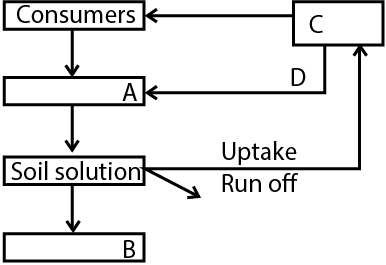
Given below is a simplified model of phosphorus cycling in a terrestrial ecosystem with four blanks $(A-D)$. Identify the blanks.
A
$A$-Rock minerals,$B$-Detritus,$C$-Litter fall,$D$-Producers
B
$A$-Litter fall,$B$-Producers,$C$-Rock minerals,$D$-Detritus
C
$A$-Detritus,$B$-Rock minerals,$C$-Producers,$D$-Litter fall
D
$A$-Producers,$B$-Litter fall,$C$-Rock minerals,$D$-Detritus
Solution
(C) In the phosphorus cycle of a terrestrial ecosystem:
$1$. Producers (plants) take up phosphorus from the soil solution.
$2$. Through litter fall,organic matter (detritus) is added to the soil.
$3$. Consumers feed on producers and contribute to the detritus pool.
$4$. Detritus decomposes to release phosphorus back into the soil solution.
$5$. Rock minerals act as the primary reservoir,weathering to add phosphorus to the soil solution.
Based on the provided diagram:
- $C$ represents Producers (which take up phosphorus).
- $D$ represents Litter fall (organic matter returning to the soil).
- $A$ represents Detritus (organic waste from consumers).
- $B$ represents Rock minerals (the source of phosphorus).
Therefore,the correct mapping is $A$-Detritus,$B$-Rock minerals,$C$-Producers,$D$-Litter fall.
$1$. Producers (plants) take up phosphorus from the soil solution.
$2$. Through litter fall,organic matter (detritus) is added to the soil.
$3$. Consumers feed on producers and contribute to the detritus pool.
$4$. Detritus decomposes to release phosphorus back into the soil solution.
$5$. Rock minerals act as the primary reservoir,weathering to add phosphorus to the soil solution.
Based on the provided diagram:
- $C$ represents Producers (which take up phosphorus).
- $D$ represents Litter fall (organic matter returning to the soil).
- $A$ represents Detritus (organic waste from consumers).
- $B$ represents Rock minerals (the source of phosphorus).
Therefore,the correct mapping is $A$-Detritus,$B$-Rock minerals,$C$-Producers,$D$-Litter fall.
0 likes
View Solution74
MediumMCQ
Which of the following is a primary consumer in a maize field ecosystem?
A
Grasshopper
B
Wolf
C
Phytoplankton
D
Lion
Solution
(A) The correct answer is $A$.
Primary consumers are herbivorous organisms that feed directly on producers (plants).
In a maize field ecosystem,maize plants act as producers.
Grasshoppers are herbivores that feed on these maize plants,making them primary consumers.
Wolf and lion are carnivores,which act as secondary or tertiary consumers.
Phytoplanktons are producers found in aquatic ecosystems,not in a maize field.
Primary consumers are herbivorous organisms that feed directly on producers (plants).
In a maize field ecosystem,maize plants act as producers.
Grasshoppers are herbivores that feed on these maize plants,making them primary consumers.
Wolf and lion are carnivores,which act as secondary or tertiary consumers.
Phytoplanktons are producers found in aquatic ecosystems,not in a maize field.
0 likes
View Solution75
MediumMCQ
Which one of the following is not a gaseous biogeochemical cycle in ecosystem?
A
Sulphur cycle
B
Phosphorus cycle
C
Nitrogen cycle
D
Carbon cycle
Solution
(B) : Biogeochemical cycles are of two types: gaseous and sedimentary.
In gaseous nutrient cycles,the materials involved in circulation between biotic and abiotic components of the biosphere are gases or vapours,and the reservoir pool is the atmosphere or hydrosphere,$e.g.$,carbon,hydrogen,oxygen,nitrogen,and water.
In sedimentary nutrient cycles,materials involved in circulation between biotic and abiotic components of the biosphere are non-gaseous,and the reservoir pool is the lithosphere,$e.g.$,phosphorus,calcium,and magnesium.
Sulphur has both sedimentary and gaseous nutrient cycles.
In gaseous nutrient cycles,the materials involved in circulation between biotic and abiotic components of the biosphere are gases or vapours,and the reservoir pool is the atmosphere or hydrosphere,$e.g.$,carbon,hydrogen,oxygen,nitrogen,and water.
In sedimentary nutrient cycles,materials involved in circulation between biotic and abiotic components of the biosphere are non-gaseous,and the reservoir pool is the lithosphere,$e.g.$,phosphorus,calcium,and magnesium.
Sulphur has both sedimentary and gaseous nutrient cycles.
0 likes
View Solution76
MediumMCQ
Identify the possible link $A$ in the following food chain.
Plant $\rightarrow$ Insect $\rightarrow$ Frog $\rightarrow$ $A$ $\rightarrow$ Eagle
Plant $\rightarrow$ Insect $\rightarrow$ Frog $\rightarrow$ $A$ $\rightarrow$ Eagle
A
Rabbit
B
Wolf
C
Cobra
D
Parrot
Solution
(C) In a food chain,energy flows from producers to consumers.
Plant (Producer) $\rightarrow$ Insect (Primary Consumer) $\rightarrow$ Frog (Secondary Consumer) $\rightarrow$ $A$ (Tertiary Consumer) $\rightarrow$ Eagle (Quaternary/Apex Consumer).
In this sequence,the organism $A$ must be a predator that feeds on frogs and is preyed upon by eagles. $A$ cobra (snake) is a common predator of frogs and is often preyed upon by eagles in such ecosystems. Therefore,$A$ is a cobra.
Plant (Producer) $\rightarrow$ Insect (Primary Consumer) $\rightarrow$ Frog (Secondary Consumer) $\rightarrow$ $A$ (Tertiary Consumer) $\rightarrow$ Eagle (Quaternary/Apex Consumer).
In this sequence,the organism $A$ must be a predator that feeds on frogs and is preyed upon by eagles. $A$ cobra (snake) is a common predator of frogs and is often preyed upon by eagles in such ecosystems. Therefore,$A$ is a cobra.
0 likes
View Solution77
MediumMCQ
Which one of the following is not a functional unit of an ecosystem?
A
Energy flow
B
Decomposition
C
Productivity
D
Stratification
Solution
(D) The four important functional aspects of an ecosystem are:
$1$. Productivity
$2$. Decomposition
$3$. Energy flow
$4$. Nutrient cycling
Stratification refers to the vertical distribution of different species occupying different levels in an ecosystem,which is a structural feature rather than a functional one. Therefore,$D$ is the correct answer.
$1$. Productivity
$2$. Decomposition
$3$. Energy flow
$4$. Nutrient cycling
Stratification refers to the vertical distribution of different species occupying different levels in an ecosystem,which is a structural feature rather than a functional one. Therefore,$D$ is the correct answer.
0 likes
View Solution78
MediumMCQ
Identify the likely organisms $(1), (2), (3)$ and $(4)$ in the food web shown below.
A
$(1)$-Deer,$(2)$-Rabbit,$(3)$-Frog,$(4)$-Rat
B
$(1)$-Dog,$(2)$-Squirrel,$(3)$-Bat,$(4)$-Deer
C
$(1)$-Rat,$(2)$-Dog,$(3)$-Tortoise,$(4)$-Crow
D
$(1)$-Squirrel,$(2)$-Cat,$(3)$-Rat,$(4)$-Pigeon
Solution
(A) In a typical terrestrial food web,organisms are categorized based on their trophic levels. Primary consumers (herbivores) feed directly on producers (plants).
$(1)$ and $(2)$ represent primary consumers such as Deer and Rabbit,which are strictly herbivorous.
$(3)$ and $(4)$ represent secondary or tertiary consumers such as Frog and Rat,which occupy higher trophic levels by feeding on insects or primary consumers.
Therefore,option $(A)$ provides the most ecologically accurate classification for these positions in a standard food web.
$(1)$ and $(2)$ represent primary consumers such as Deer and Rabbit,which are strictly herbivorous.
$(3)$ and $(4)$ represent secondary or tertiary consumers such as Frog and Rat,which occupy higher trophic levels by feeding on insects or primary consumers.
Therefore,option $(A)$ provides the most ecologically accurate classification for these positions in a standard food web.
0 likes
View Solution79
MediumMCQ
Which one of the following animals may occupy more than one trophic levels in the same ecosystem at the same time?
A
Sparrow
B
Lion
C
Goat
D
Frog
Solution
(A) The correct answer is $A$.
In an ecosystem,an organism is assigned a trophic level based on its position in the food chain.
$A$ sparrow can act as a primary consumer (herbivore) when it feeds on seeds,fruits,or grains.
Simultaneously,it can act as a secondary consumer (carnivore) when it feeds on insects or small worms.
Therefore,a sparrow occupies more than one trophic level in the same ecosystem at the same time.
In an ecosystem,an organism is assigned a trophic level based on its position in the food chain.
$A$ sparrow can act as a primary consumer (herbivore) when it feeds on seeds,fruits,or grains.
Simultaneously,it can act as a secondary consumer (carnivore) when it feeds on insects or small worms.
Therefore,a sparrow occupies more than one trophic level in the same ecosystem at the same time.
0 likes
View Solution80
MediumMCQ
Which one of the following types of organisms occupy more than one trophic level in a pond ecosystem?
A
Fish
B
Zooplankton
C
Frog
D
Phytoplankton
Solution
(A) The correct answer is $A$.
In an ecosystem,a single species can occupy more than one trophic level depending on its food source.
In a pond ecosystem,fish exhibit this characteristic.
Small fish often act as secondary consumers by feeding on primary consumers (zooplankton).
Larger fish act as tertiary consumers by feeding on smaller fish.
Therefore,fish occupy more than one trophic level.
In an ecosystem,a single species can occupy more than one trophic level depending on its food source.
In a pond ecosystem,fish exhibit this characteristic.
Small fish often act as secondary consumers by feeding on primary consumers (zooplankton).
Larger fish act as tertiary consumers by feeding on smaller fish.
Therefore,fish occupy more than one trophic level.
0 likes
View Solution81
MediumMCQ
Consider the following statements concerning food chains.
$A.$ Removal of $80\%$ tigers from an area resulted in greatly increased growth of vegetation.
$B.$ Removal of most of the carnivores resulted in an increased population of deers.
$C.$ The length of food chains is generally limited to $3-4$ trophic levels due to energy loss.
$D.$ The length of food chains may vary from $2$ to $8$ trophic levels.
Which two of the above statements are correct?
$A.$ Removal of $80\%$ tigers from an area resulted in greatly increased growth of vegetation.
$B.$ Removal of most of the carnivores resulted in an increased population of deers.
$C.$ The length of food chains is generally limited to $3-4$ trophic levels due to energy loss.
$D.$ The length of food chains may vary from $2$ to $8$ trophic levels.
Which two of the above statements are correct?
A
$A, D$
B
$A, B$
C
$B, C$
D
$C, D$
Solution
(C) Statement $A$ is incorrect: Removal of $80\%$ tigers (tertiary consumers) leads to an increase in herbivores (primary consumers),which in turn causes overgrazing and decreased vegetation growth.
Statement $B$ is correct: Carnivores regulate the population of herbivores (like deer). Their removal leads to an unchecked increase in the deer population.
Statement $C$ is correct: According to the $10\%$ law of energy transfer,energy loss at each trophic level is significant,limiting the length of food chains to typically $3-4$ trophic levels.
Statement $D$ is incorrect: Food chains are generally short and do not typically reach $8$ trophic levels due to the drastic reduction in available energy.
Therefore,statements $B$ and $C$ are correct.
Statement $B$ is correct: Carnivores regulate the population of herbivores (like deer). Their removal leads to an unchecked increase in the deer population.
Statement $C$ is correct: According to the $10\%$ law of energy transfer,energy loss at each trophic level is significant,limiting the length of food chains to typically $3-4$ trophic levels.
Statement $D$ is incorrect: Food chains are generally short and do not typically reach $8$ trophic levels due to the drastic reduction in available energy.
Therefore,statements $B$ and $C$ are correct.
0 likes
View Solution82
EasyMCQ
Zooplanktonic forms are
A
Primary producers
B
Carnivores
C
Primary consumers
D
Secondary consumers
Solution
(C) In an aquatic ecosystem,phytoplankton are the primary producers that synthesize food using sunlight.
Zooplankton feed on these phytoplankton.
Since zooplankton consume the primary producers (phytoplankton),they are classified as primary consumers in the food chain.
Zooplankton feed on these phytoplankton.
Since zooplankton consume the primary producers (phytoplankton),they are classified as primary consumers in the food chain.
0 likes
View Solution83
MediumMCQ
Choose the correct sentence.
A
Except for the deep sea hydrothermal ecosystem,the sun is the only source of energy for all ecosystems on Earth; of the incident solar radiation,more than $50$ percent is photosynthetically active radiation $(PAR)$.
B
Plants capture only $2-10$ percent of the $PAR$,and this small amount of energy sustains the entire living world.
C
All organisms are dependent for their food on producers.
D
Primary producers in an aquatic ecosystem are zooplanktons.
Solution
(A) Option $A$ is correct.
$1$. Except for deep-sea hydrothermal ecosystems,the sun is the only source of energy for all ecosystems on Earth.
$2$. Of the incident solar radiation,less than $50$ percent is photosynthetically active radiation $(PAR)$.
$3$. Plants capture only $2-10$ percent of the $PAR$,and this small amount of energy sustains the entire living world.
$4$. All organisms are dependent on producers for their food,either directly or indirectly.
$5$. Primary producers in an aquatic ecosystem are phytoplankton,algae,and higher plants,not zooplankton.
$1$. Except for deep-sea hydrothermal ecosystems,the sun is the only source of energy for all ecosystems on Earth.
$2$. Of the incident solar radiation,less than $50$ percent is photosynthetically active radiation $(PAR)$.
$3$. Plants capture only $2-10$ percent of the $PAR$,and this small amount of energy sustains the entire living world.
$4$. All organisms are dependent on producers for their food,either directly or indirectly.
$5$. Primary producers in an aquatic ecosystem are phytoplankton,algae,and higher plants,not zooplankton.
0 likes
View Solution84
EasyMCQ
Which is the primary colonizer in primary succession on rock?
A
Lichen
B
Bryophytes
C
Phytoplanktons
D
$A$ and $C$ both
Solution
(A) Primary succession on bare rock is known as lithosere.
In this process,the first organisms to colonize the bare rock are lichens.
Lichens secrete acids that help in the weathering of rocks,which leads to the formation of soil.
This soil then supports the growth of bryophytes,followed by other plant species.
Therefore,lichens are the pioneer or primary colonizers in primary succession on rocks.
In this process,the first organisms to colonize the bare rock are lichens.
Lichens secrete acids that help in the weathering of rocks,which leads to the formation of soil.
This soil then supports the growth of bryophytes,followed by other plant species.
Therefore,lichens are the pioneer or primary colonizers in primary succession on rocks.
0 likes
View Solution85
MediumMCQ
Choose the correct sentence regarding the carbon cycle.
A
In the composition of living organisms,carbon constitutes $49\%$ of the dry weight of organisms and is next only to water.
B
Fossil fuels do not represent a reservoir of carbon.
C
According to one estimate,$4 \times 10^{13} \text{ kg}$ of carbon is fixed in the biosphere through photosynthesis annually.
D
Rapid deforestation and massive burning of fossil fuels for energy and transport have significantly increased the rate of release of carbon dioxide into the atmosphere.
Solution
(D) $1$. Carbon constitutes $49\%$ of the dry weight of organisms,not $39\%$. Thus,option $A$ is incorrect.
$2$. Fossil fuels represent a major reservoir of carbon. Thus,option $B$ is incorrect.
$3$. According to estimates,approximately $4 \times 10^{13} \text{ kg}$ of carbon is fixed in the biosphere through photosynthesis annually,not $5 \times 10^{13} \text{ kg}$. Thus,option $C$ is incorrect.
$4$. Human activities such as rapid deforestation and the massive burning of fossil fuels for energy and transport have significantly increased the rate of release of carbon dioxide into the atmosphere,leading to global warming. Thus,option $D$ is correct.
$2$. Fossil fuels represent a major reservoir of carbon. Thus,option $B$ is incorrect.
$3$. According to estimates,approximately $4 \times 10^{13} \text{ kg}$ of carbon is fixed in the biosphere through photosynthesis annually,not $5 \times 10^{13} \text{ kg}$. Thus,option $C$ is incorrect.
$4$. Human activities such as rapid deforestation and the massive burning of fossil fuels for energy and transport have significantly increased the rate of release of carbon dioxide into the atmosphere,leading to global warming. Thus,option $D$ is correct.
0 likes
View Solution86
MediumMCQ
Choose the incorrect sentence from the following.
A
In $DFC$,parasitic decomposers like bacteria and fungi are included.
B
In the aquatic ecosystem,$DFC$ is the main pathway for energy flow.
C
$DFC$ is related to $GFC$ to some extent.
D
Some organisms of $DFC$ are prey to $GFC$ animals.
Solution
(A, B) The $DFC$ (Detritus Food Chain) begins with dead organic matter. Decomposers like bacteria and fungi are saprotrophs,not parasites. Therefore,statement $A$ is incorrect as they are saprotrophic decomposers. In aquatic ecosystems,the $GFC$ (Grazing Food Chain) is the major conduit for energy flow,whereas in terrestrial ecosystems,the $DFC$ is the major conduit. Thus,statement $B$ is also incorrect. $DFC$ and $GFC$ are interconnected because organisms of $DFC$ can serve as prey for $GFC$ animals,and $GFC$ waste enters the $DFC$.
0 likes
View Solution87
EasyMCQ
In the dry weight of living beings,$A$ $\%$ carbon is present. In the oceans,$B$ $\%$ of the total global carbon is dissolved. The total amount of carbon in the atmosphere is $C$ $\%$ of the total global carbon. Identify the correct values for $A, B,$ and $C$.
A
$49 - 71 - 1$
B
$71 - 49 - 1$
C
$49 - 71 - 0.003$
D
$40 - 75 - 0.003$
Solution
(A) According to the $NCERT$ textbook (Chapter: Ecosystem,Section: Nutrient Cycling),the distribution of carbon is as follows:
$1$. Carbon constitutes $49 \%$ of the dry weight of living organisms $(A = 49 \%)$.
$2$. Oceans contain $71 \%$ of the total global carbon $(B = 71 \%)$.
$3$. The atmosphere contains only about $1 \%$ of the total global carbon $(C = 1 \%)$.
Therefore,the correct sequence is $49 - 71 - 1$.
$1$. Carbon constitutes $49 \%$ of the dry weight of living organisms $(A = 49 \%)$.
$2$. Oceans contain $71 \%$ of the total global carbon $(B = 71 \%)$.
$3$. The atmosphere contains only about $1 \%$ of the total global carbon $(C = 1 \%)$.
Therefore,the correct sequence is $49 - 71 - 1$.
0 likes
View Solution88
MediumMCQ
Which of the following statements is incorrect regarding the phosphorus cycle?
A
Many animals also need large quantities of phosphorus to make shells,bones,and teeth.
B
Rocks are the natural reservoir of phosphorus.
C
Phosphorus is not released into the atmosphere during respiration,unlike the carbon cycle.
D
Atmospheric inputs of phosphorus through rainfall are much larger than carbon inputs.
Solution
(D) The phosphorus cycle is a sedimentary cycle,meaning its primary reservoir is the Earth's crust (rocks).
Unlike the carbon cycle,where carbon dioxide is released into the atmosphere through respiration,phosphorus does not have a significant gaseous phase in its cycle.
Therefore,phosphorus is not released into the atmosphere during respiration.
Statement $D$ is incorrect because atmospheric inputs of phosphorus through rainfall are actually very small compared to carbon inputs,as phosphorus does not circulate through the atmosphere in significant amounts.
Unlike the carbon cycle,where carbon dioxide is released into the atmosphere through respiration,phosphorus does not have a significant gaseous phase in its cycle.
Therefore,phosphorus is not released into the atmosphere during respiration.
Statement $D$ is incorrect because atmospheric inputs of phosphorus through rainfall are actually very small compared to carbon inputs,as phosphorus does not circulate through the atmosphere in significant amounts.
0 likes
View Solution89
MediumMCQ
Choose the incorrect statement.
A
Food webs exist in nature.
B
Food chains or food webs are formed because of interdependency (organisms depend on one another for food).
C
Primary consumers are herbivores.
D
$DFC$ begins with only dead plant matter.
Solution
(D) The correct answer is $D$.
$1$. Food webs exist in nature as complex interconnections of food chains,which is a correct statement.
$2$. Food chains and food webs are indeed formed due to the interdependency of organisms for energy and nutrients,which is a correct statement.
$3$. Primary consumers are organisms that feed directly on producers (plants),and they are classified as herbivores,which is a correct statement.
$4$. The Detritus Food Chain $(DFC)$ begins with dead organic matter,which includes both dead plant matter and dead animal remains (carcasses). Therefore,the statement that it begins with 'only' dead plant matter is incorrect.
$1$. Food webs exist in nature as complex interconnections of food chains,which is a correct statement.
$2$. Food chains and food webs are indeed formed due to the interdependency of organisms for energy and nutrients,which is a correct statement.
$3$. Primary consumers are organisms that feed directly on producers (plants),and they are classified as herbivores,which is a correct statement.
$4$. The Detritus Food Chain $(DFC)$ begins with dead organic matter,which includes both dead plant matter and dead animal remains (carcasses). Therefore,the statement that it begins with 'only' dead plant matter is incorrect.
0 likes
View Solution90
MediumMCQ
Match the following:
| Trophic levels | Examples |
|---|---|
| $A$. First | $a$. Man |
| $B$. Second | $b$. Wolf |
| $C$. Third | $c$. Cow |
| $D$. Fourth | $d$. Phytoplankton |
A
$(A-d), (B-c), (C-a), (D-b)$
B
$(A-d), (B-c), (C-b), (D-a)$
C
$(A-a), (B-b), (C-c), (D-d)$
D
$(A-b), (B-d), (C-c), (D-a)$
Solution
(A) The trophic levels in an ecosystem are defined by the position an organism occupies in a food chain:
$1$. First Trophic Level $(A)$: Consists of producers (autotrophs). In an aquatic ecosystem,these are phytoplankton $(d)$.
$2$. Second Trophic Level $(B)$: Consists of primary consumers (herbivores) that feed on producers. $A$ cow is a herbivore $(c)$.
$3$. Third Trophic Level $(C)$: Consists of secondary consumers (carnivores) that feed on herbivores. Man can act as a secondary consumer $(a)$.
$4$. Fourth Trophic Level $(D)$: Consists of tertiary consumers (top carnivores) that feed on secondary consumers. $A$ wolf is a carnivore that occupies this level $(b)$.
Therefore,the correct matching is $(A-d), (B-c), (C-a), (D-b)$.
$1$. First Trophic Level $(A)$: Consists of producers (autotrophs). In an aquatic ecosystem,these are phytoplankton $(d)$.
$2$. Second Trophic Level $(B)$: Consists of primary consumers (herbivores) that feed on producers. $A$ cow is a herbivore $(c)$.
$3$. Third Trophic Level $(C)$: Consists of secondary consumers (carnivores) that feed on herbivores. Man can act as a secondary consumer $(a)$.
$4$. Fourth Trophic Level $(D)$: Consists of tertiary consumers (top carnivores) that feed on secondary consumers. $A$ wolf is a carnivore that occupies this level $(b)$.
Therefore,the correct matching is $(A-d), (B-c), (C-a), (D-b)$.
0 likes
View Solution91
MediumMCQ
Given below are four statements $(a-d)$ each with one or two blanks. Select the option which correctly fills the blanks in two statements.
$(a)$ Ecological succession is a ...$(i)$... and fairly predictable change in the ...$(ii)$... of a given area.
$(b)$ In ecological succession,the entire sequence of communities that successively change in a given area is called ...$(i)$....
$(c)$ Primary succession occurs on ...$(i)$....
$(d)$ Secondary succession is ...$(i)$... than primary succession.
$(a)$ Ecological succession is a ...$(i)$... and fairly predictable change in the ...$(ii)$... of a given area.
$(b)$ In ecological succession,the entire sequence of communities that successively change in a given area is called ...$(i)$....
$(c)$ Primary succession occurs on ...$(i)$....
$(d)$ Secondary succession is ...$(i)$... than primary succession.
A
$(a)-(i)$ gradual,$(ii)$ species composition; $(b)-(i)$ Sere
B
$(b)-(i)$ Climax; $(c)-(i)$ Newly cooled lava,bare rock
C
$(a)-(i)$ fast,$(ii)$ species composition; $(c)-(i)$ Cut forests
D
$(c)-(i)$ Lands that have been flooded; $(d)-(i)$ slower
Solution
(A) Statement $(a)$: Ecological succession is a gradual and fairly predictable change in the species composition of a given area. Thus,$(i)$ is gradual and $(ii)$ is species composition.
Statement $(b)$: The entire sequence of communities that successively change in a given area is called a Sere. Thus,$(i)$ is Sere.
Statement $(c)$: Primary succession occurs on areas where no living organisms ever existed,such as newly cooled lava,bare rock,or a newly created pond. Thus,$(i)$ is newly cooled lava or bare rock.
Statement $(d)$: Secondary succession is faster than primary succession because the soil is already present. Thus,$(i)$ is faster.
Comparing the options: Option $(A)$ correctly identifies the blanks for statements $(a)$ and $(b)$.
Statement $(b)$: The entire sequence of communities that successively change in a given area is called a Sere. Thus,$(i)$ is Sere.
Statement $(c)$: Primary succession occurs on areas where no living organisms ever existed,such as newly cooled lava,bare rock,or a newly created pond. Thus,$(i)$ is newly cooled lava or bare rock.
Statement $(d)$: Secondary succession is faster than primary succession because the soil is already present. Thus,$(i)$ is faster.
Comparing the options: Option $(A)$ correctly identifies the blanks for statements $(a)$ and $(b)$.
0 likes
View Solution92
MediumMCQ
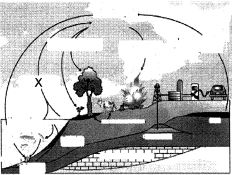
Identify $X$ from the figure:
A
Respiration and Decomposition
B
Detritus food chain
C
Organic sediments
D
Oil and gas
Solution
(A) The provided figure illustrates the carbon cycle in an ecosystem.
In the carbon cycle,carbon dioxide $(CO_2)$ is released into the atmosphere through various processes.
The arrow labeled $X$ represents the release of carbon dioxide into the atmosphere due to the biological processes of respiration by living organisms and the decomposition of organic matter by decomposers.
Therefore,$X$ corresponds to Respiration and Decomposition.
In the carbon cycle,carbon dioxide $(CO_2)$ is released into the atmosphere through various processes.
The arrow labeled $X$ represents the release of carbon dioxide into the atmosphere due to the biological processes of respiration by living organisms and the decomposition of organic matter by decomposers.
Therefore,$X$ corresponds to Respiration and Decomposition.
0 likes
View Solution93
MediumMCQ
Which of the following is a man-made ecosystem?
A
Estuary
B
Poultry farms
C
Grassland
D
Forest
Solution
(B) An ecosystem is a functional unit of nature where living organisms interact among themselves and with the surrounding physical environment.
Ecosystems are broadly classified into natural and man-made (artificial) ecosystems.
Natural ecosystems include forests,grasslands,and estuaries,which operate under natural conditions without significant human interference.
Poultry farms are created and maintained by humans for agricultural purposes,making them a classic example of a man-made or artificial ecosystem.
Ecosystems are broadly classified into natural and man-made (artificial) ecosystems.
Natural ecosystems include forests,grasslands,and estuaries,which operate under natural conditions without significant human interference.
Poultry farms are created and maintained by humans for agricultural purposes,making them a classic example of a man-made or artificial ecosystem.
0 likes
View Solution94
MediumMCQ
Which of the following is the correct sequence for primary succession in water (hydrarch succession)?
A
Phytoplankton $\rightarrow$ Rooted submerged plants $\rightarrow$ Free-floating plants $\rightarrow$ Rooted floating angiosperms $\rightarrow$ Reed swamps $\rightarrow$ Marsh meadow $\rightarrow$ Scrub $\rightarrow$ Trees
B
Phytoplankton $\rightarrow$ Rooted submerged plants $\rightarrow$ Free-floating plants $\rightarrow$ Rooted floating angiosperms $\rightarrow$ Reed swamps $\rightarrow$ Marsh meadow $\rightarrow$ Scrub $\rightarrow$ Trees
C
Phytoplankton $\rightarrow$ Rooted submerged plants $\rightarrow$ Free-floating plants $\rightarrow$ Rooted floating angiosperms $\rightarrow$ Marsh meadow $\rightarrow$ Reed swamps $\rightarrow$ Scrub $\rightarrow$ Trees
D
Phytoplankton $\rightarrow$ Rooted submerged plants $\rightarrow$ Free-floating plants $\rightarrow$ Rooted floating angiosperms $\rightarrow$ Reed swamps $\rightarrow$ Scrub $\rightarrow$ Marsh meadow $\rightarrow$ Trees
Solution
(A) Hydrarch succession (primary succession in water) takes place in wet areas and progresses from hydric (aquatic) to the mesic (moderate) condition.
The correct sequence is:
$1$. Phytoplankton: The pioneer species.
$2$. Rooted submerged plants: These grow in deeper water.
$3$. Free-floating plants: These appear as the water becomes shallower.
$4$. Rooted floating angiosperms: These occupy the next stage.
$5$. Reed-swamp stage: Plants like Typha and Phragmites appear.
$6$. Marsh-meadow stage: The area becomes swampy.
$7$. Scrub stage: Shrubs begin to grow.
$8$. Trees: The climax community,leading to a forest.
Therefore,the correct sequence is Phytoplankton $\rightarrow$ Rooted submerged plants $\rightarrow$ Free-floating plants $\rightarrow$ Rooted floating angiosperms $\rightarrow$ Reed swamps $\rightarrow$ Marsh meadow $\rightarrow$ Scrub $\rightarrow$ Trees.
The correct sequence is:
$1$. Phytoplankton: The pioneer species.
$2$. Rooted submerged plants: These grow in deeper water.
$3$. Free-floating plants: These appear as the water becomes shallower.
$4$. Rooted floating angiosperms: These occupy the next stage.
$5$. Reed-swamp stage: Plants like Typha and Phragmites appear.
$6$. Marsh-meadow stage: The area becomes swampy.
$7$. Scrub stage: Shrubs begin to grow.
$8$. Trees: The climax community,leading to a forest.
Therefore,the correct sequence is Phytoplankton $\rightarrow$ Rooted submerged plants $\rightarrow$ Free-floating plants $\rightarrow$ Rooted floating angiosperms $\rightarrow$ Reed swamps $\rightarrow$ Marsh meadow $\rightarrow$ Scrub $\rightarrow$ Trees.
0 likes
View Solution95
MediumMCQ
Which of the following are not primary producers in an aquatic ecosystem?
A
Phytoplankton
B
Algae
C
Higher plants
D
None
Solution
(D) In an aquatic ecosystem, primary producers are organisms that perform photosynthesis to produce organic matter.
$1$. Phytoplankton are the major primary producers in aquatic ecosystems.
$2$. Algae also act as primary producers in these ecosystems.
$3$. Higher plants (macrophytes) are also present in aquatic ecosystems and contribute to primary production.
Since all the options listed ($Phytoplankton$, $Algae$, and $Higher plants$) act as primary producers in an aquatic ecosystem, the correct answer is that none of the options are excluded from being primary producers.
$1$. Phytoplankton are the major primary producers in aquatic ecosystems.
$2$. Algae also act as primary producers in these ecosystems.
$3$. Higher plants (macrophytes) are also present in aquatic ecosystems and contribute to primary production.
Since all the options listed ($Phytoplankton$, $Algae$, and $Higher plants$) act as primary producers in an aquatic ecosystem, the correct answer is that none of the options are excluded from being primary producers.
0 likes
View Solution96
MediumMCQ
Which of the following represents a tertiary consumer and a secondary consumer,respectively?
A
Man,cow
B
Man,lion
C
Lion,grasshopper
D
Lion,wolf
Solution
(B) In an ecosystem,consumers are classified based on their trophic levels.
$1$. Primary consumers (herbivores) feed directly on producers (plants).
$2$. Secondary consumers feed on primary consumers.
$3$. Tertiary consumers feed on secondary consumers.
In option $B$,a lion is a tertiary consumer (as it feeds on secondary consumers like wolves or jackals),and a man is a secondary consumer (when eating herbivores like cows or goats). Therefore,the correct sequence is $B$.
$1$. Primary consumers (herbivores) feed directly on producers (plants).
$2$. Secondary consumers feed on primary consumers.
$3$. Tertiary consumers feed on secondary consumers.
In option $B$,a lion is a tertiary consumer (as it feeds on secondary consumers like wolves or jackals),and a man is a secondary consumer (when eating herbivores like cows or goats). Therefore,the correct sequence is $B$.
0 likes
View Solution97
MediumMCQ
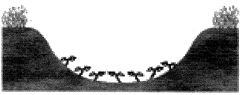
Identify the stage of hydrarch succession shown in the figure.
A
Reed-swamp stage
B
Marsh-meadow stage
C
Submerged plant stage
D
Scrub stage
Solution
(C) The figure shows the early stage of hydrarch succession where plants are completely submerged under water. This is known as the submerged plant stage. In this stage,the pond or lake is deep,and the vegetation consists of submerged hydrophytes like Hydrilla and Vallisneria.
0 likes
View Solution98
MediumMCQ
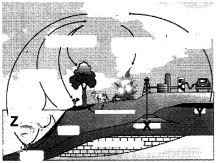
Identify $Z$ in the given figure representing the carbon cycle.
A
Reed-swamp stage
B
Marsh-meadow stage
C
Submerged plant stage
D
Dissolved $CO_2$ in water
Solution
(D) The provided figure illustrates the carbon cycle in an ecosystem. In the carbon cycle,carbon dioxide $(CO_2)$ is present in the atmosphere and is also dissolved in water bodies. The label $Z$ in the diagram points to the water body where carbon dioxide is dissolved,which is essential for aquatic photosynthesis. Therefore,$Z$ represents dissolved $CO_2$ in water.
0 likes
View Solution99
MediumMCQ
They are not included in decomposers.
A
Zooplankton
B
Bacteria
C
Fungi
D
Flagellated
Solution
(A) Decomposers are organisms that break down dead or decaying organic matter.
Bacteria and fungi are the primary decomposers in an ecosystem.
Zooplankton are heterotrophic organisms that feed on phytoplankton and are considered consumers,not decomposers.
Therefore,zooplankton are not included in the category of decomposers.
Bacteria and fungi are the primary decomposers in an ecosystem.
Zooplankton are heterotrophic organisms that feed on phytoplankton and are considered consumers,not decomposers.
Therefore,zooplankton are not included in the category of decomposers.
0 likes
View Solution100
MediumMCQ
How many sentences are correct?
$(1)$ The trophic levels in $GFC$ are unlimited.
$(2)$ Organisms at each trophic level depend on those at the higher trophic level for their energy demands.
$(3)$ Plants capture only $2-10$ percent of $PAR$.
$(4)$ All organisms are dependent for their food on producers, either directly or indirectly.
$(1)$ The trophic levels in $GFC$ are unlimited.
$(2)$ Organisms at each trophic level depend on those at the higher trophic level for their energy demands.
$(3)$ Plants capture only $2-10$ percent of $PAR$.
$(4)$ All organisms are dependent for their food on producers, either directly or indirectly.
A
$3$
B
$2$
C
$4$
D
$1$
Solution
(B) Statement $(1)$ is incorrect because trophic levels in a Grazing Food Chain $(GFC)$ are limited due to the $10\%$ law of energy transfer.
Statement $(2)$ is incorrect because organisms depend on the lower trophic level for energy, not the higher one.
Statement $(3)$ is correct as plants capture only $2-10\%$ of Photosynthetically Active Radiation $(PAR)$.
Statement $(4)$ is correct because all organisms rely on producers for energy, either directly (herbivores) or indirectly (carnivores).
Thus, only two statements ($(3)$ and $(4)$) are correct.
Statement $(2)$ is incorrect because organisms depend on the lower trophic level for energy, not the higher one.
Statement $(3)$ is correct as plants capture only $2-10\%$ of Photosynthetically Active Radiation $(PAR)$.
Statement $(4)$ is correct because all organisms rely on producers for energy, either directly (herbivores) or indirectly (carnivores).
Thus, only two statements ($(3)$ and $(4)$) are correct.
0 likes
View SolutionEcosystem — Mix Examples- Ecosystem · Frequently Asked Questions
1Are these Ecosystem questions useful for JEE and NEET?
Yes. All questions in this section are mapped to JEE Main and NEET exam patterns. Previous year questions from JEE Main, NEET, GUJCET and state-level exams are included with full solutions.
2Can I switch to Hindi or Gujarati for these questions?
Yes. Use the language tabs in the hero section or the sidebar to view the same questions and solutions in English, Hindi or Gujarati.
3How do I generate a question paper from this subtopic?
Use the Vedclass Exam Paper Generator — select the chapter and subtopic, set difficulty, and generate Sets A, B, C, D automatically. First 3 chapters of every subject are free.
Vedclass Products
For Students
Vedclass Test Series
Mock tests in real JEE/NEET style with performance analysis. 5-day free trial.
Start Free TrialFor Teachers
Exam Paper Generator
Generate Set A/B/C/D papers from this chapter in 2 minutes. 3 chapters free.
Try FreeFor Institutes
Online Exam Module
Live online exams with unlimited students, 360° analytics & white-label branding.
See DemoFor Teachers & Institutes
Generate a Ecosystem Exam Paper in 2 Minutes
Select subtopic & difficulty — Sets A, B, C, D auto-generated with No Repeat logic.
First 3 chapters of every subject are free — no payment required.