
A English
Mix Examples- Ecosystem Questions in English
Class 12 Biology · Ecosystem · Mix Examples- Ecosystem
256+
Questions
English
Language
100%
With Solutions
Showing 50 of 256 questions in English
1
MediumMCQ
If phytoplanktons are destroyed in the sea,then
A
No effect will be seen
B
Primary consumers will grow luxuriantly
C
It will affect the food chain
D
Algae will get more space to grow
Solution
(C) In the marine ecosystem,phytoplanktons act as the primary producers. They form the base of the aquatic food chain by converting solar energy into chemical energy through photosynthesis. If they are destroyed,the entire food chain will be disrupted because the primary consumers (like zooplanktons) will lack their food source,leading to a collapse of the higher trophic levels.
0 likes
View Solution2
MediumMCQ
Which light is transmitted by water?
A
Red
B
Yellow
C
Blue-green
D
Yellow-red
Solution
(C) Water acts as a filter for light. As light penetrates deeper into a water body,different wavelengths are absorbed at different rates. Red light is absorbed most rapidly,while blue and green light wavelengths are transmitted to greater depths. Therefore,blue-green light is the most effectively transmitted light in water.
0 likes
View Solution3
MediumMCQ
The maximum evolution of oxygen is by which of the following producers of organic matter?
A
Great land area
B
Crops
C
Phytoplankton of sea
D
Forests
Solution
(C) The Earth's oxygen supply is primarily maintained by marine ecosystems.
Phytoplankton,which are microscopic marine plants,are the largest producers of organic matter in the biosphere.
They perform a significant portion of global photosynthesis,thereby contributing to the maximum evolution of oxygen in the atmosphere.
Phytoplankton,which are microscopic marine plants,are the largest producers of organic matter in the biosphere.
They perform a significant portion of global photosynthesis,thereby contributing to the maximum evolution of oxygen in the atmosphere.
0 likes
View Solution4
MediumMCQ
As insecticides reach at higher trophic level in food chain,their concentration:
A
Increases
B
Becomes irregular
C
Remains constant
D
Decreases
Solution
(A) The phenomenon where toxic substances like insecticides or pesticides increase in concentration as they move up the food chain is known as biomagnification.
Since these substances are non-biodegradable and fat-soluble,they accumulate in the fatty tissues of organisms.
As a result,the concentration of insecticides is highest at the top trophic level (e.g.,in apex predators) compared to the lower trophic levels.
Since these substances are non-biodegradable and fat-soluble,they accumulate in the fatty tissues of organisms.
As a result,the concentration of insecticides is highest at the top trophic level (e.g.,in apex predators) compared to the lower trophic levels.
0 likes
View Solution5
MediumMCQ
If all the green plants were to disappear from the earth,what would happen?
A
All the animals will die
B
Only herbivores will die
C
Only carnivores will die
D
It will not matter to any animal
Solution
(A) The correct answer is $A$.
Plants are the primary producers in an ecosystem.
They capture solar energy and convert it into chemical energy through the process of photosynthesis,which serves as the base of the food chain for all heterotrophs.
Additionally,plants release oxygen as a byproduct of photosynthesis,which is essential for the respiration of almost all living organisms.
If all green plants were to disappear,the food supply would cease,and the oxygen levels would deplete,leading to the death of all animals.
Plants are the primary producers in an ecosystem.
They capture solar energy and convert it into chemical energy through the process of photosynthesis,which serves as the base of the food chain for all heterotrophs.
Additionally,plants release oxygen as a byproduct of photosynthesis,which is essential for the respiration of almost all living organisms.
If all green plants were to disappear,the food supply would cease,and the oxygen levels would deplete,leading to the death of all animals.
0 likes
View Solution6
MediumMCQ
The equilibrium of the species is disturbed by
A
Overgrazing
B
Farming
C
Selective grazing
D
All the above
Solution
(D) The equilibrium of species in an ecosystem is maintained by natural processes and balanced interactions. $A$. Overgrazing leads to the depletion of vegetation cover,causing soil erosion and loss of habitat. $B$. Farming involves clearing natural habitats,which disrupts the local biodiversity and ecological balance. $C$. Selective grazing by livestock can alter the competitive balance between plant species,favoring some and eliminating others. Since all these human-induced activities negatively impact the natural equilibrium of species,the correct answer is $D$.
0 likes
View Solution7
MediumMCQ
If carbon dioxide is withdrawn from the biosphere,which organism would first experience negative effects?
A
Primary producers
B
Producers
C
Secondary consumers
D
Tertiary consumers
Solution
(A) Primary producers are the organisms that perform photosynthesis to synthesize their own food.
Photosynthesis requires $CO_2$ as a fundamental raw material.
If $CO_2$ is withdrawn from the biosphere,primary producers will be unable to produce food,leading to an immediate cessation of their metabolic activities and growth.
Therefore,they would be the first to experience negative effects.
Photosynthesis requires $CO_2$ as a fundamental raw material.
If $CO_2$ is withdrawn from the biosphere,primary producers will be unable to produce food,leading to an immediate cessation of their metabolic activities and growth.
Therefore,they would be the first to experience negative effects.
0 likes
View Solution8
EasyMCQ
Succession on a secondary bare area is known as:
A
Primosere
B
Xerosere
C
Subsere
D
None of the above
Solution
(C) The correct answer is $C$.
Secondary succession,also known as $Subsere$,is a type of biotic succession that occurs in an area where a previously existing community has been destroyed by natural or human-induced disturbances (such as fire,flood,or deforestation),but the soil remains intact.
Secondary succession,also known as $Subsere$,is a type of biotic succession that occurs in an area where a previously existing community has been destroyed by natural or human-induced disturbances (such as fire,flood,or deforestation),but the soil remains intact.
0 likes
View Solution9
MediumMCQ
Water plants provide ....... to water animals.
A
$O_2$ and food
B
Water and $CO_2$
C
Food and water
D
Shelter and shade
Solution
(A) Water plants act as primary producers in an aquatic ecosystem.
They perform photosynthesis,which releases $O_2$ into the water,essential for the respiration of aquatic animals.
Additionally,these plants serve as a primary food source for many aquatic organisms.
Therefore,they provide both $O_2$ and food to water animals.
They perform photosynthesis,which releases $O_2$ into the water,essential for the respiration of aquatic animals.
Additionally,these plants serve as a primary food source for many aquatic organisms.
Therefore,they provide both $O_2$ and food to water animals.
0 likes
View Solution10
MediumMCQ
The first plants to reappear in a badly burned forest area will most probably be
A
Mosses
B
Liverworts
C
Ferns
D
Grasses
Solution
(D) In the process of ecological succession,specifically secondary succession,the first plants to colonize a disturbed area are known as pioneer species. In a forest area that has been badly burned,the soil is often rich in nutrients from the ash. Grasses are typically the first to reappear because they have rapid growth rates,produce large quantities of wind-dispersed seeds,and can quickly establish themselves in open,sunlit areas before larger plants or trees can take over.
0 likes
View Solution11
MediumMCQ
The primary succession in a sere is
A
Sub sere
B
Meso sere
C
Pioneer sere
D
None of the above
Solution
(D) Primary succession refers to the development of biotic communities in a previously barren area where no life existed before,such as bare rock or sand dunes. The entire sequence of communities that successively change in a given area is called a sere. The initial community that colonizes a bare area is known as the pioneer community. Since the question asks for the primary succession in a sere,and none of the provided options (Sub sere,Meso sere,Pioneer sere) correctly define the term 'primary succession' as a type of sere,the correct answer is 'None of the above'.
0 likes
View Solution12
MediumMCQ
Succession in a $6 \ m$ deep pond exhibits a sequence of
A
Submerged Plants $\rightarrow$ Reeds $\rightarrow$ Herbs $\rightarrow$ Floating Plants $\rightarrow$ Shrubs $\rightarrow$ Trees
B
Floating Plants $\rightarrow$ Submerged Plants $\rightarrow$ Reeds $\rightarrow$ Herbs $\rightarrow$ Shrubs $\rightarrow$ Trees
C
Shrubs $\rightarrow$ Trees $\rightarrow$ Submerged Plants $\rightarrow$ Floating Plants $\rightarrow$ Reeds $\rightarrow$ Herbs
D
Submerged Plants $\rightarrow$ Floating Plants $\rightarrow$ Reeds $\rightarrow$ Herbs $\rightarrow$ Shrubs $\rightarrow$ Trees
Solution
(D) The process of plant succession in a water body is known as hydrosere.
In a $6 \ m$ deep pond,the succession begins with the colonization of submerged plants.
As these plants die and decompose,they add organic matter to the bottom,making the water shallower.
This allows floating plants to establish,followed by reed-swamp stages,marsh-meadow stages (herbs),scrub stages (shrubs),and finally,the climax community,which is represented by trees.
The correct sequence is: Submerged Plants $\rightarrow$ Floating Plants $\rightarrow$ Reeds $\rightarrow$ Herbs $\rightarrow$ Shrubs $\rightarrow$ Trees.
In a $6 \ m$ deep pond,the succession begins with the colonization of submerged plants.
As these plants die and decompose,they add organic matter to the bottom,making the water shallower.
This allows floating plants to establish,followed by reed-swamp stages,marsh-meadow stages (herbs),scrub stages (shrubs),and finally,the climax community,which is represented by trees.
The correct sequence is: Submerged Plants $\rightarrow$ Floating Plants $\rightarrow$ Reeds $\rightarrow$ Herbs $\rightarrow$ Shrubs $\rightarrow$ Trees.
0 likes
View Solution13
EasyMCQ
Ecological succession on sand is known as:
A
Psammosere
B
Xerosere
C
Halosere
D
Hydrosere
Solution
(A) Ecological succession that begins on sandy areas,such as sand dunes or sandy deserts,is termed as $Psammosere$.
$Xerosere$ refers to succession starting in dry,xeric environments.
$Halosere$ refers to succession occurring in saline environments.
$Hydrosere$ refers to succession occurring in aquatic environments.
Therefore,the correct option is $A$.
$Xerosere$ refers to succession starting in dry,xeric environments.
$Halosere$ refers to succession occurring in saline environments.
$Hydrosere$ refers to succession occurring in aquatic environments.
Therefore,the correct option is $A$.
0 likes
View Solution14
MediumMCQ
Which of the following is a producer in the plant kingdom?
A
Melia
B
Ficus
C
Ziziphus
D
All of the above
Solution
(D) In an ecosystem,producers are organisms that can synthesize their own food through photosynthesis.
Plants are the primary producers in terrestrial ecosystems.
$Melia$ (a genus of trees),$Ficus$ (a genus of trees and shrubs),and $Ziziphus$ (a genus of small trees and shrubs) are all members of the plant kingdom capable of photosynthesis.
Therefore,all of the listed options are producers.
Plants are the primary producers in terrestrial ecosystems.
$Melia$ (a genus of trees),$Ficus$ (a genus of trees and shrubs),and $Ziziphus$ (a genus of small trees and shrubs) are all members of the plant kingdom capable of photosynthesis.
Therefore,all of the listed options are producers.
0 likes
View Solution15
MediumMCQ
Which group of living organisms given below is a link in the food chain between green plants and a hawk?
A
Grasshopper, frog and snake
B
Grasshopper, rat and snake
C
Millipedes, centipedes and sparrow
D
Earthworm, hen and rat
Solution
(A) The correct sequence is: $\text{Green plants} \rightarrow \text{Grasshopper} \rightarrow \text{Frog} \rightarrow \text{Snake} \rightarrow \text{Hawk}$.
In this food chain, the grasshopper is a primary consumer (herbivore) that feeds on green plants.
The frog is a secondary consumer that eats the grasshopper.
The snake is a tertiary consumer that eats the frog.
Finally, the hawk is the quaternary consumer that eats the snake.
Therefore, the group consisting of grasshopper, frog, and snake forms the link between green plants and the hawk.
In this food chain, the grasshopper is a primary consumer (herbivore) that feeds on green plants.
The frog is a secondary consumer that eats the grasshopper.
The snake is a tertiary consumer that eats the frog.
Finally, the hawk is the quaternary consumer that eats the snake.
Therefore, the group consisting of grasshopper, frog, and snake forms the link between green plants and the hawk.
0 likes
View Solution16
MediumMCQ
Which one statement is correct regarding man-made ecosystems?
A
They are highly efficient
B
They are poor in diversity
C
They are vulnerable to drought,floods,and diseases
D
All are correct
Solution
(D) Man-made ecosystems (also known as artificial ecosystems) such as croplands,gardens,and aquariums are characterized by the following features:
$1$. They are highly efficient in terms of energy conversion and productivity for human needs.
$2$. They have very low species diversity compared to natural ecosystems,often being monocultures.
$3$. Due to low diversity and lack of complex food webs,they are highly vulnerable to environmental stresses like drought,floods,and outbreaks of pests or diseases.
Therefore,all the given statements are correct.
$1$. They are highly efficient in terms of energy conversion and productivity for human needs.
$2$. They have very low species diversity compared to natural ecosystems,often being monocultures.
$3$. Due to low diversity and lack of complex food webs,they are highly vulnerable to environmental stresses like drought,floods,and outbreaks of pests or diseases.
Therefore,all the given statements are correct.
0 likes
View Solution17
MediumMCQ
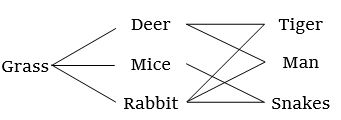
The provided diagram represents:
A
Food chain
B
Food web
C
$A$ population
D
Ecosystem
Solution
(B) The diagram shows multiple interconnected food chains.
In an ecosystem,food chains rarely exist in isolation.
Instead,various food chains are interconnected with each other,forming an complex,interlocked network known as a food web.
Therefore,the correct answer is $(B)$.
In an ecosystem,food chains rarely exist in isolation.
Instead,various food chains are interconnected with each other,forming an complex,interlocked network known as a food web.
Therefore,the correct answer is $(B)$.
0 likes
View Solution18
MediumMCQ
The dynamic aspect of an ecosystem is:
A
Producer and energy flow
B
Producer and mineral cycles
C
Consumer and mineral cycles
D
Energy flow and mineral cycles
Solution
(D) The dynamic aspect of an ecosystem refers to the processes that involve constant movement and transformation of materials and energy.
$1$. Energy flow: Energy enters the ecosystem from the sun and flows through different trophic levels,eventually being lost as heat. This is a unidirectional and continuous process.
$2$. Mineral cycles (Nutrient cycling): Nutrients are recycled between the biotic and abiotic components of the ecosystem. This ensures the continuous availability of essential elements for life.
Since both energy flow and nutrient cycling are continuous,active,and essential processes that maintain the ecosystem's function,they represent its dynamic aspect.
$1$. Energy flow: Energy enters the ecosystem from the sun and flows through different trophic levels,eventually being lost as heat. This is a unidirectional and continuous process.
$2$. Mineral cycles (Nutrient cycling): Nutrients are recycled between the biotic and abiotic components of the ecosystem. This ensures the continuous availability of essential elements for life.
Since both energy flow and nutrient cycling are continuous,active,and essential processes that maintain the ecosystem's function,they represent its dynamic aspect.
0 likes
View Solution19
MediumMCQ
If plants (producers) of an ecosystem die,then the system
A
Cannot produce food
B
Is seriously affected
C
Can have more producers
D
Is not much affected
Solution
(B) The correct answer is $B$.
Plants are the primary producers in an ecosystem,forming the first trophic level of every food chain.
They are responsible for converting solar energy into chemical energy through photosynthesis.
If producers die,the entire energy flow in the ecosystem is disrupted,leading to a collapse of higher trophic levels (consumers).
Therefore,the system is seriously affected.
Plants are the primary producers in an ecosystem,forming the first trophic level of every food chain.
They are responsible for converting solar energy into chemical energy through photosynthesis.
If producers die,the entire energy flow in the ecosystem is disrupted,leading to a collapse of higher trophic levels (consumers).
Therefore,the system is seriously affected.
0 likes
View Solution20
MediumMCQ
The order of organisms in an aquatic food chain is:
A
Bacteria $\rightarrow$ Seal $\rightarrow$ Diatom $\rightarrow$ Fish $\rightarrow$ Crustacea
B
Crustacea $\rightarrow$ Seal $\rightarrow$ Fish $\rightarrow$ Polar Bear $\rightarrow$ Diatom
C
Polar Bear $\rightarrow$ Diatom $\rightarrow$ Seal $\rightarrow$ Crustacea
D
Diatom $\rightarrow$ Crustacea $\rightarrow$ Fish $\rightarrow$ Seal $\rightarrow$ Bacteria
Solution
(D) The correct order is $Diatom \rightarrow Crustacea \rightarrow Fish \rightarrow Seal \rightarrow Bacteria$.
$1$. Diatoms are microscopic algae that act as producers in aquatic ecosystems.
$2$. Crustaceans are primary consumers that feed on diatoms.
$3$. Fish act as secondary consumers by feeding on crustaceans.
$4$. Seals are top consumers (tertiary or quaternary) that feed on fish.
$5$. Bacteria act as decomposers that break down organic matter from dead organisms,completing the cycle.
$1$. Diatoms are microscopic algae that act as producers in aquatic ecosystems.
$2$. Crustaceans are primary consumers that feed on diatoms.
$3$. Fish act as secondary consumers by feeding on crustaceans.
$4$. Seals are top consumers (tertiary or quaternary) that feed on fish.
$5$. Bacteria act as decomposers that break down organic matter from dead organisms,completing the cycle.
0 likes
View Solution21
MediumMCQ
Transfer of material and energy from one ecosystem to another ecosystem is best exemplified by:
A
Harvesting of fishes
B
Grazing of pastureland
C
Game hunting in Savannah
D
Silvicultural practices in a woodland
Solution
(A) The transfer of material and energy from one ecosystem to another is best exemplified by the harvesting of fishes. When fish are harvested from an aquatic ecosystem (like a lake or ocean) and consumed by humans in a terrestrial ecosystem,the biomass and energy stored in the fish are transferred across ecosystem boundaries. Other options like grazing or hunting typically occur within the same ecosystem or do not represent the same scale of inter-ecosystem transfer.
0 likes
View Solution22
MediumMCQ
Herbivores are called
A
Primary consumers
B
Secondary producers
C
Key industry animals
D
All the above
Solution
(D) In an ecosystem,organisms are classified based on their food source.
Producers (plants) are at the first trophic level.
Herbivores,which feed directly on producers,are known as primary consumers.
They are also referred to as 'key industry animals' because they convert plant biomass into animal biomass,which is then available to higher trophic levels (carnivores).
Producers (plants) are at the first trophic level.
Herbivores,which feed directly on producers,are known as primary consumers.
They are also referred to as 'key industry animals' because they convert plant biomass into animal biomass,which is then available to higher trophic levels (carnivores).
0 likes
View Solution23
MediumMCQ
In a food web,hyenas and vultures are:
A
Primary consumers
B
Predators
C
Scavengers
D
Decomposers
Solution
(C) Hyenas and vultures are organisms that feed on dead animals or carrion.
In ecological terms,organisms that consume dead organic matter,specifically animal remains,are classified as scavengers.
They play a crucial role in the ecosystem by cleaning up the environment and accelerating the process of nutrient recycling.
In ecological terms,organisms that consume dead organic matter,specifically animal remains,are classified as scavengers.
They play a crucial role in the ecosystem by cleaning up the environment and accelerating the process of nutrient recycling.
0 likes
View Solution24
MediumMCQ
If all the plants of the world die,all the animals will also die due to the shortage of:
A
Cold air
B
Water
C
Food
D
Timber
Solution
(C) Plants are the primary producers in an ecosystem. They convert solar energy into chemical energy through the process of photosynthesis. All animals,whether herbivores,carnivores,or omnivores,depend directly or indirectly on plants for their nutritional requirements. Therefore,if all plants die,the entire food chain would collapse,leading to the death of all animals due to the shortage of food.
0 likes
View Solution25
MediumMCQ
The first link in any food chain is a green plant because
A
Green plants can synthesize food
B
They can eat everything
C
They are fixed at one place
D
None of the above
Solution
(A) Green plants are known as producers because they possess the ability to synthesize their own food material through the process of photosynthesis in the presence of sunlight. Since they are autotrophs,they form the foundational trophic level of every food chain.
0 likes
View Solution26
MediumMCQ
In a typical terrestrial ecosystem,which of the following statements regarding population size is correct?
A
Primary producers are more than that of primary consumers
B
Secondary consumers are largest because they are powerful
C
Primary consumers outnumber primary producers
D
Primary consumers are least dependent upon primary producers
Solution
(A) In a typical terrestrial ecosystem,the pyramid of numbers is upright.
This means that the number of primary producers (plants) is significantly higher than the number of primary consumers (herbivores) that feed on them.
As we move up the trophic levels,the number of individuals generally decreases because energy is lost at each transfer,making it impossible to support a larger population of higher-level consumers.
Therefore,the population of primary producers is greater than that of primary consumers.
This means that the number of primary producers (plants) is significantly higher than the number of primary consumers (herbivores) that feed on them.
As we move up the trophic levels,the number of individuals generally decreases because energy is lost at each transfer,making it impossible to support a larger population of higher-level consumers.
Therefore,the population of primary producers is greater than that of primary consumers.
0 likes
View Solution27
MediumMCQ
Which is the correct sequence in the food chain in a grassland?
A
Grass $\rightarrow$ wolf $\rightarrow$ deer $\rightarrow$ buffalo
B
Bacteria $\rightarrow$ grass $\rightarrow$ rabbit $\rightarrow$ wolf
C
Grass $\rightarrow$ insect $\rightarrow$ birds $\rightarrow$ snakes
D
Grass $\rightarrow$ snake $\rightarrow$ insect $\rightarrow$ deer
Solution
(C) food chain represents the flow of energy from producers to consumers.
In a grassland ecosystem,the primary producers are grasses.
Primary consumers (herbivores) feed on grass,such as insects.
Secondary consumers (carnivores) feed on primary consumers,such as birds.
Tertiary consumers feed on secondary consumers,such as snakes.
Therefore,the correct sequence is: $\text{Grass} \rightarrow \text{insect} \rightarrow \text{birds} \rightarrow \text{snakes}$.
In a grassland ecosystem,the primary producers are grasses.
Primary consumers (herbivores) feed on grass,such as insects.
Secondary consumers (carnivores) feed on primary consumers,such as birds.
Tertiary consumers feed on secondary consumers,such as snakes.
Therefore,the correct sequence is: $\text{Grass} \rightarrow \text{insect} \rightarrow \text{birds} \rightarrow \text{snakes}$.
0 likes
View Solution28
MediumMCQ
Generally,the food chain has how many trophic levels?
A
One
B
Two
C
Three or Four
D
Three
Solution
(C) Plants represent the first trophic level,and herbivores make up the second trophic level. Primary carnivores constitute the third trophic level,and secondary carnivores,such as large fish or humans,constitute the fourth trophic level of an ecosystem. Therefore,a typical food chain generally consists of three or four trophic levels.
0 likes
View Solution29
MediumMCQ
Which of the following is the correct sequence in a food chain?
A
Fallen leaves $\rightarrow$ bacteria $\rightarrow$ insect larvae $\rightarrow$ birds
B
Phytoplankton $\rightarrow$ zooplankton $\rightarrow$ fish
C
Grasses $\rightarrow$ fox $\rightarrow$ rabbit
D
Grasses $\rightarrow$ chameleon $\rightarrow$ insects $\rightarrow$ birds
Solution
(B) The correct sequence is $(b)$ Phytoplankton $\rightarrow$ zooplankton $\rightarrow$ fish.
In an aquatic ecosystem,phytoplankton acts as the producer (primary trophic level).
Zooplankton feeds on phytoplankton (primary consumer).
Fish feeds on zooplankton (secondary consumer).
Option $(a)$ represents a detritus food chain,but the sequence is biologically inaccurate as birds do not typically consume insect larvae that feed on bacteria.
Options $(c)$ and $(d)$ are incorrect because the trophic levels are reversed or illogical (e.g.,foxes do not eat grasses,and chameleons are secondary consumers that eat insects,not primary producers).
In an aquatic ecosystem,phytoplankton acts as the producer (primary trophic level).
Zooplankton feeds on phytoplankton (primary consumer).
Fish feeds on zooplankton (secondary consumer).
Option $(a)$ represents a detritus food chain,but the sequence is biologically inaccurate as birds do not typically consume insect larvae that feed on bacteria.
Options $(c)$ and $(d)$ are incorrect because the trophic levels are reversed or illogical (e.g.,foxes do not eat grasses,and chameleons are secondary consumers that eat insects,not primary producers).
0 likes
View Solution30
MediumMCQ
In a food chain of a grassland ecosystem,the top consumers are
A
Carnivores
B
Herbivores
C
Either carnivores or herbivores
D
Bacteria
Solution
(A) In a grassland ecosystem,the food chain typically follows the sequence: Producers (grass) $\rightarrow$ Primary Consumers (herbivores) $\rightarrow$ Secondary Consumers (carnivores) $\rightarrow$ Top Consumers (carnivores).
Top consumers are organisms that occupy the highest trophic level in a food chain and are not preyed upon by other animals in that specific ecosystem.
Therefore,in a grassland ecosystem,the top consumers are carnivores.
Top consumers are organisms that occupy the highest trophic level in a food chain and are not preyed upon by other animals in that specific ecosystem.
Therefore,in a grassland ecosystem,the top consumers are carnivores.
0 likes
View Solution31
MediumMCQ
Biological equilibrium is an equilibrium among the
A
Producers
B
Producers and consumers
C
Decomposers and producers
D
Producers,consumers and decomposers
Solution
(D) Biological equilibrium,also known as ecological balance,refers to a state of dynamic equilibrium within a community of organisms in an ecosystem.
It is maintained by the interactions and interdependence between the three main functional components of an ecosystem:
$1$. Producers (autotrophs that synthesize food),
$2$. Consumers (heterotrophs that depend on producers),and
$3$. Decomposers (organisms that break down organic matter and recycle nutrients).
Therefore,the balance of an ecosystem relies on the harmonious functioning and interaction of all three groups.
It is maintained by the interactions and interdependence between the three main functional components of an ecosystem:
$1$. Producers (autotrophs that synthesize food),
$2$. Consumers (heterotrophs that depend on producers),and
$3$. Decomposers (organisms that break down organic matter and recycle nutrients).
Therefore,the balance of an ecosystem relies on the harmonious functioning and interaction of all three groups.
0 likes
View Solution32
MediumMCQ
The importance of an ecosystem lies in
A
Cycling of materials
B
Flow of energy
C
Both the above
D
None of the above
Solution
(C) The importance of an ecosystem is primarily defined by two fundamental processes:
$1$. The flow of energy: Energy enters the ecosystem from the sun and moves through various trophic levels,supporting life.
$2$. The cycling of materials: Nutrients and minerals are recycled between the biotic and abiotic components of the ecosystem.
Since both processes are essential for the maintenance and functioning of an ecosystem,the correct answer is $(c)$.
$1$. The flow of energy: Energy enters the ecosystem from the sun and moves through various trophic levels,supporting life.
$2$. The cycling of materials: Nutrients and minerals are recycled between the biotic and abiotic components of the ecosystem.
Since both processes are essential for the maintenance and functioning of an ecosystem,the correct answer is $(c)$.
0 likes
View Solution33
MediumMCQ
An ecosystem creates:
A
Food chain
B
Food web
C
Both the above
D
None of the above
Solution
(C) An ecosystem is a functional unit of nature where living organisms interact among themselves and with the surrounding physical environment.
In an ecosystem,energy flows through various trophic levels,which is represented by food chains.
Since multiple food chains are interconnected at various trophic levels to form a complex network of feeding relationships,an ecosystem creates both food chains and food webs.
In an ecosystem,energy flows through various trophic levels,which is represented by food chains.
Since multiple food chains are interconnected at various trophic levels to form a complex network of feeding relationships,an ecosystem creates both food chains and food webs.
0 likes
View Solution34
MediumMCQ
Carnivores are
A
Usually primary consumers
B
Usually secondary consumers
C
Usually secondary or tertiary consumers
D
Usually decomposers rather than consumers
Solution
(C) Carnivores are organisms that feed on other animals.
Primary consumers are herbivores that feed directly on producers (green plants).
Secondary consumers feed on primary consumers (herbivores),and tertiary consumers feed on secondary consumers.
Therefore,carnivores typically occupy the secondary or tertiary trophic levels in an ecosystem.
Primary consumers are herbivores that feed directly on producers (green plants).
Secondary consumers feed on primary consumers (herbivores),and tertiary consumers feed on secondary consumers.
Therefore,carnivores typically occupy the secondary or tertiary trophic levels in an ecosystem.
0 likes
View Solution35
MediumMCQ
In a food chain, which of the following is produced in the largest amount?
A
Producers
B
Decomposers
C
Tertiary consumers
D
Primary consumers
Solution
(A) In a typical ecosystem, energy flows from producers to various levels of consumers. According to the $10\%$ law of energy transfer, only about $10\%$ of the energy available at one trophic level is transferred to the next. Therefore, the biomass and energy are highest at the base of the food chain. Producers (autotrophs) occupy the first trophic level and constitute the largest amount of biomass and energy in the ecosystem to support all higher trophic levels.
0 likes
View Solution36
MediumMCQ
Biological equilibrium is found among the
A
Producer plants
B
Consumers and producers
C
Decomposers
D
Producers,consumers and decomposers
Solution
(D) Biological equilibrium or ecological balance is a state of dynamic equilibrium within a community of organisms in an ecosystem.
It is maintained by the interaction and interdependence of all three components: producers,consumers,and decomposers.
Producers (plants) synthesize food,consumers (animals) utilize this energy,and decomposers (microorganisms) break down organic matter to recycle nutrients back into the soil.
If any one of these components is removed or significantly altered,the balance of the ecosystem is disrupted,leading to instability.
It is maintained by the interaction and interdependence of all three components: producers,consumers,and decomposers.
Producers (plants) synthesize food,consumers (animals) utilize this energy,and decomposers (microorganisms) break down organic matter to recycle nutrients back into the soil.
If any one of these components is removed or significantly altered,the balance of the ecosystem is disrupted,leading to instability.
0 likes
View Solution37
MediumMCQ
Snakes are included under which category in a food chain?
A
Saprophytes
B
Primary consumers
C
Second trophic level
D
None of these
Solution
(D) In a typical food chain,snakes act as secondary or tertiary consumers depending on their prey.
Since they feed on primary consumers (like rats or insects),they occupy the third or higher trophic level.
Therefore,they are not saprophytes,primary consumers,or restricted to the second trophic level.
Thus,the correct option is $(d)$.
Since they feed on primary consumers (like rats or insects),they occupy the third or higher trophic level.
Therefore,they are not saprophytes,primary consumers,or restricted to the second trophic level.
Thus,the correct option is $(d)$.
0 likes
View Solution38
MediumMCQ
What happens if green plants are removed from an aquarium?
A
The fishes will not survive
B
Fishes will increase in size
C
Fishes will decrease in size
D
None of the above
Solution
(A) Green plants in an aquarium perform photosynthesis,which releases $O_2$ into the water.
Fishes require this dissolved $O_2$ for respiration.
If green plants are removed,the oxygen level in the water will gradually decrease due to the respiration of fishes and other microorganisms.
Eventually,the lack of oxygen will lead to the death of the fishes.
Therefore,the fishes will not survive.
Fishes require this dissolved $O_2$ for respiration.
If green plants are removed,the oxygen level in the water will gradually decrease due to the respiration of fishes and other microorganisms.
Eventually,the lack of oxygen will lead to the death of the fishes.
Therefore,the fishes will not survive.
0 likes
View Solution39
MediumMCQ
In an aquatic ecosystem,maximum biomagnification is seen among the
A
Fishes
B
Phytoplanktons
C
Zooplanktons
D
Macroscopic plants
Solution
(A) Biomagnification refers to the increase in concentration of toxic substances at successive trophic levels.
In an aquatic ecosystem,the food chain typically follows the sequence: $Phytoplanktons \rightarrow Zooplanktons \rightarrow Small \ Fishes \rightarrow Large \ Fishes$.
Since fishes occupy the higher trophic levels (tertiary or quaternary consumers),they accumulate the highest concentration of non-biodegradable pollutants compared to primary producers like phytoplanktons or primary consumers like zooplanktons.
Therefore,the correct answer is $A$ (Fishes).
In an aquatic ecosystem,the food chain typically follows the sequence: $Phytoplanktons \rightarrow Zooplanktons \rightarrow Small \ Fishes \rightarrow Large \ Fishes$.
Since fishes occupy the higher trophic levels (tertiary or quaternary consumers),they accumulate the highest concentration of non-biodegradable pollutants compared to primary producers like phytoplanktons or primary consumers like zooplanktons.
Therefore,the correct answer is $A$ (Fishes).
0 likes
View Solution40
EasyMCQ
$A$ food chain consists of:
A
Producer,consumer,and decomposer
B
Producer,carnivore,and decomposer
C
Producer and primary consumer
D
Producer,herbivore,and carnivore
Solution
(A) food chain is a linear sequence of organisms through which nutrients and energy pass as one organism eats another.
It typically consists of three main components:
$1$. Producers (autotrophs like plants) that produce energy.
$2$. Consumers (herbivores,carnivores,and omnivores) that consume other organisms.
$3$. Decomposers (saprotrophs like fungi and bacteria) that break down dead organic matter and recycle nutrients back into the ecosystem.
Therefore,a complete food chain cycle involves producers,consumers,and decomposers.
It typically consists of three main components:
$1$. Producers (autotrophs like plants) that produce energy.
$2$. Consumers (herbivores,carnivores,and omnivores) that consume other organisms.
$3$. Decomposers (saprotrophs like fungi and bacteria) that break down dead organic matter and recycle nutrients back into the ecosystem.
Therefore,a complete food chain cycle involves producers,consumers,and decomposers.
0 likes
View Solution41
MediumMCQ
Maximum biomass and variable organisms are found in
A
River
B
Pond
C
Lake
D
Estuary
Solution
(D) An estuary is a coastal body of water where freshwater from rivers and streams meets and mixes with saltwater from the ocean.
Due to the mixing of nutrients from both freshwater and marine sources,estuaries are among the most productive ecosystems on Earth.
They support a high level of biodiversity and exhibit a very high biomass compared to other aquatic ecosystems like rivers,ponds,or lakes.
Therefore,the correct answer is $D$.
Due to the mixing of nutrients from both freshwater and marine sources,estuaries are among the most productive ecosystems on Earth.
They support a high level of biodiversity and exhibit a very high biomass compared to other aquatic ecosystems like rivers,ponds,or lakes.
Therefore,the correct answer is $D$.
0 likes
View Solution42
MediumMCQ
$A$ man-made ecosystem is:
A
Less in diversity
B
More in diversity
C
Man does not make ecosystem
D
More stable than natural ecosystem
Solution
(A) man-made ecosystem,also known as an artificial ecosystem,is characterized by low species diversity compared to natural ecosystems.
These ecosystems are created and maintained by humans for specific purposes,such as agriculture (e.g.,crop fields).
Because they have low diversity,they lack the complex food webs found in natural ecosystems,making them more vulnerable to sudden environmental changes and pests.
These ecosystems are created and maintained by humans for specific purposes,such as agriculture (e.g.,crop fields).
Because they have low diversity,they lack the complex food webs found in natural ecosystems,making them more vulnerable to sudden environmental changes and pests.
0 likes
View Solution43
MediumMCQ
If less light falls on the pond's surface,what is the most likely consequence for the fish population?
A
Size of fishes becomes larger
B
The size of the fish population becomes smaller
C
The size of the fish population is not connected to the amount of light
D
Mutation will take place in fishes
Solution
(B) is the correct answer.
In a pond ecosystem,light is the primary energy source for producers such as algae and phytoplankton.
When less light falls on the pond's surface,the rate of photosynthesis decreases significantly.
This reduction in photosynthesis leads to a lower production of organic matter (food) and a decrease in the dissolved oxygen levels in the water.
Since fishes are consumers that depend on these producers for food and oxygen,a decrease in the primary productivity limits the carrying capacity of the ecosystem.
Consequently,the size of the fish population decreases due to the scarcity of resources.
In a pond ecosystem,light is the primary energy source for producers such as algae and phytoplankton.
When less light falls on the pond's surface,the rate of photosynthesis decreases significantly.
This reduction in photosynthesis leads to a lower production of organic matter (food) and a decrease in the dissolved oxygen levels in the water.
Since fishes are consumers that depend on these producers for food and oxygen,a decrease in the primary productivity limits the carrying capacity of the ecosystem.
Consequently,the size of the fish population decreases due to the scarcity of resources.
0 likes
View Solution44
MediumMCQ
Mr. $X$ is eating curd/yoghurt. For this food intake in a food chain,he should be considered as occupying:
A
First trophic level
B
Second trophic level
C
Third trophic level
D
Fourth trophic level
Solution
(C) In a food chain,the first trophic level is occupied by producers (plants).
The second trophic level is occupied by primary consumers (herbivores) that eat plants.
The third trophic level is occupied by secondary consumers (carnivores) that eat herbivores.
Since curd/yoghurt is a dairy product derived from milk (which comes from a herbivore like a cow),the cow occupies the second trophic level.
Therefore,Mr. $X$,by consuming the curd,acts as a secondary consumer,placing him at the third trophic level.
The second trophic level is occupied by primary consumers (herbivores) that eat plants.
The third trophic level is occupied by secondary consumers (carnivores) that eat herbivores.
Since curd/yoghurt is a dairy product derived from milk (which comes from a herbivore like a cow),the cow occupies the second trophic level.
Therefore,Mr. $X$,by consuming the curd,acts as a secondary consumer,placing him at the third trophic level.
0 likes
View Solution45
MediumMCQ
Maximum absorption of rainfall water is done by
A
Tropical deciduous forest
B
Tropical evergreen forest
C
Tropical savannah
D
Scrub forest
Solution
(B) is the correct answer. Tropical evergreen forests are found in equatorial or sub-equatorial regions where both rainfall and warmth are abundant.
These forests receive high annual rainfall,typically above $140 \text{ cm/yr}$,and often ranging between $200 \text{ cm/yr}$ and $500 \text{ cm/yr}$,sometimes reaching up to $1000 \text{ cm/yr}$.
Due to the dense canopy structure and high leaf litter accumulation,these forests have the highest capacity for water retention and absorption of rainfall compared to other biomes.
These forests receive high annual rainfall,typically above $140 \text{ cm/yr}$,and often ranging between $200 \text{ cm/yr}$ and $500 \text{ cm/yr}$,sometimes reaching up to $1000 \text{ cm/yr}$.
Due to the dense canopy structure and high leaf litter accumulation,these forests have the highest capacity for water retention and absorption of rainfall compared to other biomes.
0 likes
View Solution46
MediumMCQ
Which of the following contribute to the carbon cycle?
A
Photosynthesis
B
Respiration
C
Fossil fuel combustion
D
All of the above
Solution
(D) The correct answer is $D$. The carbon cycle involves the continuous movement of carbon between the atmosphere,biosphere,and geosphere.
$1$. Photosynthesis: Green plants and other autotrophs absorb $CO_2$ from the atmosphere and convert it into organic compounds like glucose,thereby incorporating carbon into the biotic system.
$2$. Respiration: Living organisms (plants and animals) break down glucose during cellular respiration,releasing $CO_2$ back into the atmosphere.
$3$. Fossil fuel combustion: The burning of biomass and fossil fuels (like coal,oil,and gas) releases significant amounts of stored carbon back into the atmosphere as $CO_2$. It is estimated that the burning of fossil fuels adds approximately $6 \times 10^{12} \text{ kg}$ of carbon into the atmosphere annually.
Since all these processes are integral parts of the carbon cycle,the correct option is $D$.
$1$. Photosynthesis: Green plants and other autotrophs absorb $CO_2$ from the atmosphere and convert it into organic compounds like glucose,thereby incorporating carbon into the biotic system.
$2$. Respiration: Living organisms (plants and animals) break down glucose during cellular respiration,releasing $CO_2$ back into the atmosphere.
$3$. Fossil fuel combustion: The burning of biomass and fossil fuels (like coal,oil,and gas) releases significant amounts of stored carbon back into the atmosphere as $CO_2$. It is estimated that the burning of fossil fuels adds approximately $6 \times 10^{12} \text{ kg}$ of carbon into the atmosphere annually.
Since all these processes are integral parts of the carbon cycle,the correct option is $D$.
0 likes
View Solution47
MediumMCQ
Biogeochemical cycles can be traced in
A
Ecosystems
B
Biomes
C
Only water
D
Both $(a)$ and $(b)$
Solution
(D) The term biogeochemical cycling refers to the movement and exchange of nutrients between the living (biotic) and non-living (abiotic) components of the biosphere.
Since ecosystems are the functional units of nature where these interactions occur,and biomes are large regional ecosystems,biogeochemical cycles are observed in both ecosystems and biomes.
Therefore,the correct option is $(d)$.
Since ecosystems are the functional units of nature where these interactions occur,and biomes are large regional ecosystems,biogeochemical cycles are observed in both ecosystems and biomes.
Therefore,the correct option is $(d)$.
0 likes
View Solution48
EasyMCQ
The reservoir pool of carbon is
A
Air and water
B
Fossil fuels
C
Rocks
D
All of these
Solution
(D) The correct answer is $D$. Carbon is present in the abiotic environment in the following forms:
$(i)$ $CO_2$ in the air or atmosphere.
$(ii)$ Dissolved $CO_2$ or carbonic acid and bicarbonate in water or hydrosphere.
$(iii)$ Carbonates and graphite in the rocks.
Since all these components act as reservoirs for carbon,the correct option is $D$.
$(i)$ $CO_2$ in the air or atmosphere.
$(ii)$ Dissolved $CO_2$ or carbonic acid and bicarbonate in water or hydrosphere.
$(iii)$ Carbonates and graphite in the rocks.
Since all these components act as reservoirs for carbon,the correct option is $D$.
0 likes
View Solution49
EasyMCQ
In the carbon cycle,the source of carbon for plants is:
A
Atmospheric $CO_2$
B
Carbonate rocks
C
Fossil fuels
D
All of these
Solution
(A) The correct answer is $A$.
In the carbon cycle,carbon is present in the atmosphere and hydrosphere as $CO_2$.
Plants (producers) absorb this atmospheric $CO_2$ during the process of photosynthesis.
Through photosynthesis,they convert inorganic $CO_2$ into organic compounds (glucose),which form the basis of the food chain.
In the carbon cycle,carbon is present in the atmosphere and hydrosphere as $CO_2$.
Plants (producers) absorb this atmospheric $CO_2$ during the process of photosynthesis.
Through photosynthesis,they convert inorganic $CO_2$ into organic compounds (glucose),which form the basis of the food chain.
0 likes
View Solution50
EasyMCQ
The process of evapo-transpiration and precipitation is known as
A
Carbon cycle
B
Hydrological cycle
C
Nitrogen cycle
D
All of these
Solution
(B) The movement of water through the Earth and atmosphere is called the Hydrological cycle or water cycle.
It involves processes such as evaporation,transpiration from plants,condensation,and precipitation.
These processes continuously circulate water between the Earth's surface and the atmosphere.
It involves processes such as evaporation,transpiration from plants,condensation,and precipitation.
These processes continuously circulate water between the Earth's surface and the atmosphere.
0 likes
View SolutionEcosystem — Mix Examples- Ecosystem · Frequently Asked Questions
1Are these Ecosystem questions useful for JEE and NEET?
Yes. All questions in this section are mapped to JEE Main and NEET exam patterns. Previous year questions from JEE Main, NEET, GUJCET and state-level exams are included with full solutions.
2Can I switch to Hindi or Gujarati for these questions?
Yes. Use the language tabs in the hero section or the sidebar to view the same questions and solutions in English, Hindi or Gujarati.
3How do I generate a question paper from this subtopic?
Use the Vedclass Exam Paper Generator — select the chapter and subtopic, set difficulty, and generate Sets A, B, C, D automatically. First 3 chapters of every subject are free.
Vedclass Products
For Students
Vedclass Test Series
Mock tests in real JEE/NEET style with performance analysis. 5-day free trial.
Start Free TrialFor Teachers
Exam Paper Generator
Generate Set A/B/C/D papers from this chapter in 2 minutes. 3 chapters free.
Try FreeFor Institutes
Online Exam Module
Live online exams with unlimited students, 360° analytics & white-label branding.
See DemoFor Teachers & Institutes
Generate a Ecosystem Exam Paper in 2 Minutes
Select subtopic & difficulty — Sets A, B, C, D auto-generated with No Repeat logic.
First 3 chapters of every subject are free — no payment required.