
A English
Tools of recombinant DNA technology Questions in English
Class 12 Biology · Biotechnology Principals and Process · Tools of recombinant DNA technology
564+
Questions
English
Language
100%
With Solutions
Showing 50 of 564 questions in English
501
MediumMCQ
Which lytic enzyme is used to isolate $\text{DNA}$ from a bacterial cell?
A
Lysozyme
B
Cellulase
C
Chitinase
D
Invertase
Solution
(A) To isolate $\text{DNA}$ from a bacterial cell,the cell wall must be broken down to release the cellular contents.
Bacterial cell walls are primarily composed of peptidoglycan.
Lysozyme is the specific enzyme that breaks down the peptidoglycan layer of the bacterial cell wall,allowing for the extraction of $\text{DNA}$.
Cellulase is used for plant cells,Chitinase for fungal cells,and Invertase is a carbohydrate-digesting enzyme.
Bacterial cell walls are primarily composed of peptidoglycan.
Lysozyme is the specific enzyme that breaks down the peptidoglycan layer of the bacterial cell wall,allowing for the extraction of $\text{DNA}$.
Cellulase is used for plant cells,Chitinase for fungal cells,and Invertase is a carbohydrate-digesting enzyme.
0 likes
View Solution502
EasyMCQ
How many of the following restriction enzymes produce blunt ends?
$EcoRI, Hind III, Bam HI, EcoR V, Hind II$
$EcoRI, Hind III, Bam HI, EcoR V, Hind II$
A
$4$
B
$5$
C
only $2$
D
only $3$
Solution
(C) Restriction enzymes are classified based on the type of ends they produce after cleavage.
$1$. $EcoRI$ produces sticky (cohesive) ends.
$2$. $Hind III$ produces sticky (cohesive) ends.
$3$. $Bam HI$ produces sticky (cohesive) ends.
$4$. $EcoR V$ produces blunt ends.
$5$. $Hind II$ produces blunt ends.
Therefore,out of the given list,only $2$ enzymes ($EcoR V$ and $Hind II$) produce blunt ends.
$1$. $EcoRI$ produces sticky (cohesive) ends.
$2$. $Hind III$ produces sticky (cohesive) ends.
$3$. $Bam HI$ produces sticky (cohesive) ends.
$4$. $EcoR V$ produces blunt ends.
$5$. $Hind II$ produces blunt ends.
Therefore,out of the given list,only $2$ enzymes ($EcoR V$ and $Hind II$) produce blunt ends.
0 likes
View Solution503
EasyMCQ
Ligation of foreign $\text{DNA}$ at which of the following site will result in loss of tetracycline resistance of $\text{pBR}^{322}$?
A
Pst $I$
B
Pvu $I$
C
EcoRI
D
Sal $I$
Solution
(D) The plasmid $\text{pBR}^{322}$ contains two antibiotic resistance genes: ampicillin resistance $(amp^R)$ and tetracycline resistance $(tet^R)$.
Restriction sites for $Pst I$ and $Pvu I$ are located within the ampicillin resistance gene $(amp^R)$.
Restriction sites for $BamHI$ and $Sal I$ are located within the tetracycline resistance gene $(tet^R)$.
Therefore,if foreign $\text{DNA}$ is ligated at the $Sal I$ site,it disrupts the $tet^R$ gene,leading to the loss of tetracycline resistance in the recombinant plasmid.
Restriction sites for $Pst I$ and $Pvu I$ are located within the ampicillin resistance gene $(amp^R)$.
Restriction sites for $BamHI$ and $Sal I$ are located within the tetracycline resistance gene $(tet^R)$.
Therefore,if foreign $\text{DNA}$ is ligated at the $Sal I$ site,it disrupts the $tet^R$ gene,leading to the loss of tetracycline resistance in the recombinant plasmid.
0 likes
View Solution504
MediumMCQ
Statement-$I$: Thermostable $\text{DNA}$ polymerase is isolated from $\text{Thermus aquaticus}$.
Statement-$II$: $\text{Taq}$ $\text{DNA}$ polymerase is inactive at high temperature $(72^{\circ}\text{C})$.
Statement-$II$: $\text{Taq}$ $\text{DNA}$ polymerase is inactive at high temperature $(72^{\circ}\text{C})$.
A
Both Statement-$I$ and Statement-$II$ are incorrect.
B
Statement-$I$ is correct but Statement-$II$ is incorrect.
C
Statement-$I$ is incorrect but Statement-$II$ is correct.
D
Both Statement-$I$ and Statement-$II$ are correct.
Solution
(B) Statement-$I$ is correct because the thermostable $\text{DNA}$ polymerase,known as $\text{Taq}$ polymerase,is indeed isolated from the thermophilic bacterium $\text{Thermus aquaticus}$.
Statement-$II$ is incorrect because $\text{Taq}$ polymerase is specifically used in the Polymerase Chain Reaction $(\text{PCR})$ because it remains active and stable at high temperatures,including the extension step at $72^{\circ}\text{C}$. It does not denature at these temperatures.
Statement-$II$ is incorrect because $\text{Taq}$ polymerase is specifically used in the Polymerase Chain Reaction $(\text{PCR})$ because it remains active and stable at high temperatures,including the extension step at $72^{\circ}\text{C}$. It does not denature at these temperatures.
0 likes
View Solution505
MediumMCQ
The sequence which is responsible for controlling the copy number of the linked $\text{DNA}$ is:
A
Coding sequence
B
Promoter sequence
C
Ori
D
Terminator sequence
Solution
(C) The sequence responsible for controlling the copy number of the linked $\text{DNA}$ is the Origin of replication,commonly abbreviated as $\text{Ori}$.
This is a specific sequence in the vector where replication starts.
Any piece of $\text{DNA}$ when linked to this sequence can be made to replicate within the host cells.
This sequence is also responsible for controlling the copy number of the linked $\text{DNA}$.
Therefore,if one wants to recover many copies of the target $\text{DNA}$,it should be cloned in a vector whose origin supports a high copy number.
This is a specific sequence in the vector where replication starts.
Any piece of $\text{DNA}$ when linked to this sequence can be made to replicate within the host cells.
This sequence is also responsible for controlling the copy number of the linked $\text{DNA}$.
Therefore,if one wants to recover many copies of the target $\text{DNA}$,it should be cloned in a vector whose origin supports a high copy number.
0 likes
View Solution506
EasyMCQ
The stickiness of the ends facilitates the action of which enzyme?
A
$DNA$ polymerase
B
$RNA$ polymerase
C
Alkaline phosphatase
D
$DNA$ ligase
Solution
(D) When $DNA$ molecules are cut by the same restriction endonuclease,they produce complementary single-stranded protrusions known as 'sticky ends'.
These sticky ends form hydrogen bonds with their complementary counterparts on another $DNA$ fragment.
$DNA$ ligase is the enzyme responsible for sealing the nicks in the sugar-phosphate backbone by forming phosphodiester bonds between the adjacent nucleotides.
Therefore,the stickiness of the ends facilitates the action of $DNA$ ligase in joining the $DNA$ fragments.
These sticky ends form hydrogen bonds with their complementary counterparts on another $DNA$ fragment.
$DNA$ ligase is the enzyme responsible for sealing the nicks in the sugar-phosphate backbone by forming phosphodiester bonds between the adjacent nucleotides.
Therefore,the stickiness of the ends facilitates the action of $DNA$ ligase in joining the $DNA$ fragments.
0 likes
View Solution507
MediumMCQ
Given below are two statements :-
Statement-$I$ : Restriction endonucleases recognize specific sequences to cut $\text{DNA}$ known as selectable nucleotide sequences.
Statement-$II$ : Restriction endonucleases cut the $\text{DNA}$ strand a little away from the centre of the palindromic site.
In the light of the above statements,choose the most appropriate answer from the options given below :-
Statement-$I$ : Restriction endonucleases recognize specific sequences to cut $\text{DNA}$ known as selectable nucleotide sequences.
Statement-$II$ : Restriction endonucleases cut the $\text{DNA}$ strand a little away from the centre of the palindromic site.
In the light of the above statements,choose the most appropriate answer from the options given below :-
A
Both statement-$I$ and statement-$II$ are incorrect
B
Statement-$I$ is correct but statement-$II$ is incorrect
C
Statement-$I$ is incorrect but statement-$II$ is correct
D
Both statement-$I$ and statement-$II$ are correct
Solution
(C) Statement-$I$ is incorrect because the specific sequences recognized by restriction endonucleases are called recognition sequences or palindromic sequences,not selectable nucleotide sequences. Selectable markers are genes used to identify transformed cells.
Statement-$II$ is correct because restriction endonucleases typically cut the $\text{DNA}$ duplex at specific points,often a little away from the centre of the palindromic site,which results in the formation of single-stranded overhanging stretches called sticky ends.
Statement-$II$ is correct because restriction endonucleases typically cut the $\text{DNA}$ duplex at specific points,often a little away from the centre of the palindromic site,which results in the formation of single-stranded overhanging stretches called sticky ends.
0 likes
View Solution508
MediumMCQ
Match Column-$I$ with Column-$II$ and choose the correct combination from the options given below:
| Column-$I$ | Column-$II$ |
|---|---|
| $(a)$ Cloning vector | $(i)$ Agrobacterium |
| $(b)$ Ti-$DNA$ | $(ii)$ pBR$322$ |
| $(c)$ Disarmed pathogen | $(iii)$ $GAATTC$ |
| $(d)$ Recognition sequence | $(iv)$ Transformation |
A
$a-ii, b-iv, c-i, d-iii$
B
$a-ii, b-iv, c-i, d-iii$
C
$a-ii, b-i, c-iv, d-iii$
D
$a-ii, b-i, c-iii, d-iv$
Solution
(A) The correct matches are as follows:
$(a)$ Cloning vector: pBR$322$ is a well-known cloning vector used in biotechnology. Thus,$(a)-(ii)$.
$(b)$ Ti-$DNA$: Ti-$DNA$ is the segment of $DNA$ that is transferred into the host plant cell,which leads to transformation. Thus,$(b)-(iv)$.
$(c)$ Disarmed pathogen: Agrobacterium tumefaciens is a pathogen that is disarmed (virulence genes removed) to be used as a vector for gene transfer. Thus,$(c)-(i)$.
$(d)$ Recognition sequence: $GAATTC$ is the specific recognition sequence for the restriction enzyme EcoRI. Thus,$(d)-(iii)$.
Therefore,the correct combination is $(a-ii, b-iv, c-i, d-iii)$.
$(a)$ Cloning vector: pBR$322$ is a well-known cloning vector used in biotechnology. Thus,$(a)-(ii)$.
$(b)$ Ti-$DNA$: Ti-$DNA$ is the segment of $DNA$ that is transferred into the host plant cell,which leads to transformation. Thus,$(b)-(iv)$.
$(c)$ Disarmed pathogen: Agrobacterium tumefaciens is a pathogen that is disarmed (virulence genes removed) to be used as a vector for gene transfer. Thus,$(c)-(i)$.
$(d)$ Recognition sequence: $GAATTC$ is the specific recognition sequence for the restriction enzyme EcoRI. Thus,$(d)-(iii)$.
Therefore,the correct combination is $(a-ii, b-iv, c-i, d-iii)$.
0 likes
View Solution509
MediumMCQ
Autonomously replicating circular extrachromosomal $\text{DNA}$ is called:
A
Chromatin
B
Plasmid
C
Palindromic nucleotide sequence
D
Nucleoid
Solution
(B) $\text{Plasmid}$ is a small,circular,double-stranded $\text{DNA}$ molecule that is distinct from a cell's chromosomal $\text{DNA}$.
Plasmids are naturally found in bacterial cells and some eukaryotes.
They are capable of autonomous replication,meaning they can replicate independently of the chromosomal $\text{DNA}$.
Because of this property,they are widely used as vectors in recombinant $\text{DNA}$ technology to carry foreign genes into host cells.
Plasmids are naturally found in bacterial cells and some eukaryotes.
They are capable of autonomous replication,meaning they can replicate independently of the chromosomal $\text{DNA}$.
Because of this property,they are widely used as vectors in recombinant $\text{DNA}$ technology to carry foreign genes into host cells.
0 likes
View Solution510
MediumMCQ
Identify true or false:
$(i)$ Restriction site is always a palindromic sequence.
$(ii)$ Palindromic sequence is always a restriction site.
$(i)$ Restriction site is always a palindromic sequence.
$(ii)$ Palindromic sequence is always a restriction site.
A
$(i) -$ true,$(ii) -$ false
B
$(i) -$ false,$(ii) -$ true
C
$(i) -$ true,$(ii) -$ true
D
$(i) -$ false,$(ii) -$ false
Solution
(A) $(i)$ Restriction endonucleases recognize specific $DNA$ sequences known as restriction sites. Most of these enzymes recognize palindromic sequences,which read the same forward and backward on the two strands of $DNA$.
$(ii)$ While many restriction sites are palindromic,not every palindromic sequence in a genome acts as a restriction site. $A$ palindromic sequence only becomes a restriction site if a specific restriction enzyme exists that recognizes and binds to that exact sequence.
Therefore,$(i)$ is true and $(ii)$ is false.
$(ii)$ While many restriction sites are palindromic,not every palindromic sequence in a genome acts as a restriction site. $A$ palindromic sequence only becomes a restriction site if a specific restriction enzyme exists that recognizes and binds to that exact sequence.
Therefore,$(i)$ is true and $(ii)$ is false.
0 likes
View Solution511
DifficultMCQ
Which of the following tools of recombinant $\text{DNA}$ technology is incorrectly paired with its use?
A
Restriction enzyme $-$ Production of blunt ends
B
$\text{DNA}$ ligase $-$ Creates sticky ends of restriction fragments
C
$\text{DNA}$ polymerase $-$ used in a $\text{PCR}$ to amplify section of $\text{DNA}$
D
Reverse transcriptase $-$ Production of $\text{cDNA}$ from $\text{mRNA}$
Solution
(B) The correct answer is $B$. $\text{DNA}$ ligase is an enzyme that acts as a 'molecular glue' to join two $\text{DNA}$ fragments by forming phosphodiester bonds between them. It does not create sticky ends; rather,it joins fragments that often already have complementary sticky ends or blunt ends. Restriction enzymes are responsible for creating sticky or blunt ends by cutting $\text{DNA}$ at specific recognition sequences. Therefore,the pairing in option $B$ is incorrect.
0 likes
View Solution512
EasyMCQ
Vehicle $DNA$ in rDNA technology is the common name given to . . . . . . .
A
r-$DNA$
B
c-$DNA$
C
Cloning vector
D
Passenger $DNA$
Solution
(C) In recombinant $DNA$ $(rDNA)$ technology,a cloning vector is a small piece of $DNA$,taken from a virus,a plasmid,or the cell of a higher organism,that can be stably maintained in an organism and into which a foreign $DNA$ fragment can be inserted for cloning purposes.
These vectors are often referred to as 'Vehicle $DNA$' because they act as a vehicle to transport the desired foreign $DNA$ (passenger $DNA$) into the host cell.
Common examples include plasmids and bacteriophages.
These vectors are often referred to as 'Vehicle $DNA$' because they act as a vehicle to transport the desired foreign $DNA$ (passenger $DNA$) into the host cell.
Common examples include plasmids and bacteriophages.
0 likes
View Solution513
EasyMCQ
Which one of the following is considered as molecular scissors in modern biotechnology?
A
Reverse transcriptases
B
Taq polymerases
C
Alkaline phosphatases
D
Restriction endonucleases
Solution
(D) Restriction enzymes are enzymes that cut $DNA$ at specific recognition sequences. Because of this ability to precisely cleave $DNA$ molecules,they are commonly referred to as molecular scissors in recombinant $DNA$ technology.
0 likes
View Solution514
EasyMCQ
In the gel electrophoresis method . . . . . . .
A
Fragments of $DNA$ can be seen without being stained.
B
$A$ natural polymer extracted from seaweed is used as the medium (gel).
C
Glowing orange bands of $DNA$ can be seen upon exposure to visible light on an ethidium bromide-stained gel.
D
The larger the size of the $DNA$ fragment in the agarose medium,the farther it will move.
Solution
(B) In gel electrophoresis,agarose,which is a natural polymer extracted from seaweeds (like Gelidium and Gracilaria),is used as the matrix or gel medium.
Option $A$ is incorrect because $DNA$ fragments are invisible without staining.
Option $C$ is incorrect because $DNA$ bands stained with ethidium bromide only glow under $UV$ light,not visible light.
Option $D$ is incorrect because,in gel electrophoresis,smaller $DNA$ fragments move faster and farther through the agarose matrix than larger fragments due to the sieving effect.
Option $A$ is incorrect because $DNA$ fragments are invisible without staining.
Option $C$ is incorrect because $DNA$ bands stained with ethidium bromide only glow under $UV$ light,not visible light.
Option $D$ is incorrect because,in gel electrophoresis,smaller $DNA$ fragments move faster and farther through the agarose matrix than larger fragments due to the sieving effect.
0 likes
View Solution515
EasyMCQ
$DNA$ polymerase which is used in $PCR$ is isolated from which of the following bacteria?
A
Bacillus thuringiensis
B
Escherichia coli
C
Thermus aquaticus
D
Agrobacterium tumefaciens
Solution
(C) The $DNA$ polymerase used in the Polymerase Chain Reaction $(PCR)$ is known as $Taq$ polymerase.
This enzyme is isolated from a thermophilic bacterium called $Thermus$ $aquaticus$.
$Taq$ polymerase is heat-stable,meaning it can withstand the high temperatures required for the denaturation step of $PCR$ without being denatured itself.
Therefore,the correct option is $C$.
This enzyme is isolated from a thermophilic bacterium called $Thermus$ $aquaticus$.
$Taq$ polymerase is heat-stable,meaning it can withstand the high temperatures required for the denaturation step of $PCR$ without being denatured itself.
Therefore,the correct option is $C$.
0 likes
View Solution516
EasyMCQ
Which of the following statements is correct regarding the gel electrophoresis technique?
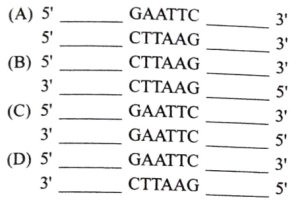
A
$DNA$ fragments can be visualized in visible light without staining.
B
The natural polymer used as a matrix is extracted from sea weeds.
C
Bright blue-coloured bands of $DNA$ are seen in an ethidium bromide-stained gel when exposed to visible light.
D
The larger the $DNA$ fragment size,the further it moves in the agarose matrix.
Solution
(B) In gel electrophoresis,$DNA$ fragments are separated based on their size. Agarose,a natural polymer extracted from sea weeds (red algae),is used as the matrix. $DNA$ fragments are negatively charged and move towards the anode. Smaller fragments move faster and further through the matrix than larger fragments. $DNA$ cannot be seen in visible light without staining; they must be stained with ethidium bromide and then exposed to $UV$ radiation to appear as bright orange-coloured bands.
0 likes
View Solution517
EasyMCQ
Identify the palindromic nucleotide sequence.
A
$5$'-$AGTCGA$-$3$'
B
$5$'-$TGCAGT$-$3$'
C
$5$'-$ACGTAG$-$3$'
D
$5$'-$GAATTC$-$3$'
Solution
(D) palindromic nucleotide sequence is a sequence of base pairs in $DNA$ that reads the same in the $5' \rightarrow 3'$ direction on one strand as it does in the $5' \rightarrow 3'$ direction on the complementary strand.
For option $D$,the sequence is $5'-GAATTC-3'$.
The complementary strand would be $3'-CTTAAG-5'$,which,when read from $5' \rightarrow 3'$,is $5'-GAATTC-3'$.
Since both strands read the same in the $5' \rightarrow 3'$ direction,this is a palindromic sequence.
For option $D$,the sequence is $5'-GAATTC-3'$.
The complementary strand would be $3'-CTTAAG-5'$,which,when read from $5' \rightarrow 3'$,is $5'-GAATTC-3'$.
Since both strands read the same in the $5' \rightarrow 3'$ direction,this is a palindromic sequence.
0 likes
View Solution518
EasyMCQ
Which enzyme is not used for $DNA$ isolation in animal cells?
A
Ribonuclease
B
Cellulase
C
Proteases
D
Proteases and ribonucleases
Solution
(B) In animal cells,the cell membrane is composed of lipids and proteins,but they lack a cell wall. Therefore,enzymes like $Proteases$ (to break down proteins) and $Ribonucleases$ (to remove $RNA$) are used during $DNA$ isolation. $Cellulase$ is an enzyme specifically used to break down the cellulose cell wall in plant cells. Since animal cells do not have a cellulose cell wall,$Cellulase$ is not required for $DNA$ isolation from them. Thus,the correct option is $B$.
0 likes
View Solution519
EasyMCQ
Which restriction site is present in the $amp^R$ gene in $pBR322$?
A
$EcoRI, Hind III$
B
$Pvu II, EcoRI$
C
$Pvu I, Pst I$
D
$Bam HI, Sal I$
Solution
(C) In the plasmid vector $pBR322$,the $amp^R$ (ampicillin resistance) gene contains the restriction sites for the enzymes $Pst I$ and $Pvu I$.
These sites are used to insert foreign $DNA$ into the plasmid,which results in insertional inactivation of the $amp^R$ gene,allowing for the selection of recombinant colonies.
These sites are used to insert foreign $DNA$ into the plasmid,which results in insertional inactivation of the $amp^R$ gene,allowing for the selection of recombinant colonies.
0 likes
View Solution520
EasyMCQ
The method for separating $DNA$ fragments is . . . . . . .
A
Gel electrophoresis
B
Micro injection
C
Gene gun
D
Biolistics
Solution
(A) The correct method for separating $DNA$ fragments based on their size is $Gel$ electrophoresis.
In this technique,$DNA$ fragments are separated by forcing them to move through a gel matrix (usually agarose) under an electric field.
Since $DNA$ molecules are negatively charged,they move towards the anode,and smaller fragments move faster than larger ones,allowing for their separation.
In this technique,$DNA$ fragments are separated by forcing them to move through a gel matrix (usually agarose) under an electric field.
Since $DNA$ molecules are negatively charged,they move towards the anode,and smaller fragments move faster than larger ones,allowing for their separation.
0 likes
View Solution521
EasyMCQ
Assertion $A$: $DNA$ cannot pass through the cell membrane.
Reason $R$: $DNA$ is a hydrophobic molecule.
Reason $R$: $DNA$ is a hydrophobic molecule.
A
Assertion-$A$ is correct and Reason $R$ is wrong.
B
Assertion-$A$ and Reason $R$ both are correct. But $R$ is not the correct explanation of $A$.
C
Assertion-$A$ is wrong and Reason $R$ is correct.
D
Assertion-$A$ and Reason $R$ both are correct. But $R$ is the correct explanation of $A$.
Solution
(A) $DNA$ is a hydrophilic molecule because it contains a negatively charged phosphate backbone,which makes it polar and water-soluble. Because of this hydrophilic nature,it cannot pass through the hydrophobic lipid bilayer of the cell membrane.
Therefore,Assertion $A$ is correct because $DNA$ cannot pass through the cell membrane.
Reason $R$ is incorrect because $DNA$ is hydrophilic,not hydrophobic.
Therefore,Assertion $A$ is correct because $DNA$ cannot pass through the cell membrane.
Reason $R$ is incorrect because $DNA$ is hydrophilic,not hydrophobic.
0 likes
View Solution522
EasyMCQ
Which of the following is the recognition sequence (target site) for the restriction enzyme $EcoRI$?
A
$5'\, GAGCTC\, 3'$
B
$5'\, GAATTC\, 3'$
C
$5'\, AAGCTT\, 3'$
D
$5'\, GATATC\, 3'$
Solution
(B) The restriction enzyme $EcoRI$ is derived from $Escherichia \text{ } coli \text{ } RY13$.
It recognizes a specific palindromic nucleotide sequence in $DNA$.
The recognition sequence for $EcoRI$ is $5'-GAATTC-3'$ on one strand, and its complementary strand is $3'-CTTAAG-5'$.
Therefore, the correct target range (recognition site) is $5'-GAATTC-3'$.
It recognizes a specific palindromic nucleotide sequence in $DNA$.
The recognition sequence for $EcoRI$ is $5'-GAATTC-3'$ on one strand, and its complementary strand is $3'-CTTAAG-5'$.
Therefore, the correct target range (recognition site) is $5'-GAATTC-3'$.
0 likes
View Solution523
EasyMCQ
Identify the antibiotic resistance gene from the following options.
A
BamH $I$
B
Hind $III$
C
Sal $I$
D
$amp^R$
Solution
(D) In the context of cloning vectors like $pBR322$,$BamH I$,$Hind III$,and $Sal I$ are specific restriction endonuclease recognition sites. The term $amp^R$ stands for ampicillin resistance,which is a gene that provides resistance to the antibiotic ampicillin. Therefore,$amp^R$ is the antibiotic resistance gene.
0 likes
View Solution524
EasyMCQ
$DNA$ can be studied after staining with . . . . . . in various fields.
A
Eosin
B
Ethidium Chloride
C
Ethidium Bromide
D
Fast Green
Solution
(C) The correct answer is $C$.
Ethidium Bromide $(EtBr)$ is a fluorescent dye used to stain $DNA$ in agarose gel electrophoresis.
When exposed to ultraviolet $(UV)$ light,the $EtBr$ molecules intercalate between the base pairs of the $DNA$,causing the $DNA$ bands to fluoresce orange,which allows for the visualization and study of $DNA$ fragments.
Ethidium Bromide $(EtBr)$ is a fluorescent dye used to stain $DNA$ in agarose gel electrophoresis.
When exposed to ultraviolet $(UV)$ light,the $EtBr$ molecules intercalate between the base pairs of the $DNA$,causing the $DNA$ bands to fluoresce orange,which allows for the visualization and study of $DNA$ fragments.
0 likes
View Solution525
EasyMCQ
Endonuclease . . . . . . .
A
It creates billion copies of $DNA$
B
It removes nucleotides from the ends of $DNA$
C
It joins the nucleotide in $DNA$
D
It makes cut at the specific position within the $DNA$
Solution
(D) Restriction endonucleases are enzymes that recognize specific nucleotide sequences in $DNA$ and make cuts at these specific positions within the $DNA$ molecule.
Option $A$ describes the function of $PCR$ (Polymerase Chain Reaction).
Option $B$ describes the function of exonucleases.
Option $C$ describes the function of $DNA$ ligase.
Therefore,the correct option is $D$.
Option $A$ describes the function of $PCR$ (Polymerase Chain Reaction).
Option $B$ describes the function of exonucleases.
Option $C$ describes the function of $DNA$ ligase.
Therefore,the correct option is $D$.
0 likes
View Solution526
EasyMCQ
Eco-$RI$ cuts the $DNA$ between . . . . . . only when the sequence $GAATTC$ is present in the $DNA$.
A
$G$ and $A$
B
$T$ and $C$
C
$A$ and $T$
D
$A$ and $A$
Solution
(A) The restriction endonuclease $EcoRI$ recognizes the specific palindromic sequence $5'-GAATTC-3'$.
It cleaves the phosphodiester bond between the bases $G$ (Guanine) and $A$ (Adenine) on both strands of the $DNA$ molecule.
This specific cleavage results in the formation of sticky ends or cohesive ends,which are essential for recombinant $DNA$ technology.
Therefore,the correct site of cleavage for $EcoRI$ is between $G$ and $A$.
It cleaves the phosphodiester bond between the bases $G$ (Guanine) and $A$ (Adenine) on both strands of the $DNA$ molecule.
This specific cleavage results in the formation of sticky ends or cohesive ends,which are essential for recombinant $DNA$ technology.
Therefore,the correct site of cleavage for $EcoRI$ is between $G$ and $A$.
0 likes
View Solution527
EasyMCQ
$pBR322$ contains the recognition sites for which of the following endonucleases at the $amp^R$ site?
A
$Pvu$ $II$ and $Pvu$ $I$
B
$Pst$ $I$ and $Pvu$ $I$
C
$Sal$ $I$ and $Bam$ $HI$
D
$Pst$ $I$ and $Sal$ $I$
Solution
(B) The plasmid $pBR322$ is a widely used cloning vector in $E. coli$.
It contains two antibiotic resistance genes: $amp^R$ (ampicillin resistance) and $tet^R$ (tetracycline resistance).
The $amp^R$ gene contains recognition sites for the restriction endonucleases $Pst$ $I$ and $Pvu$ $I$.
The $tet^R$ gene contains recognition sites for $Bam$ $HI$ and $Sal$ $I$.
Therefore,the correct option is $B$.
It contains two antibiotic resistance genes: $amp^R$ (ampicillin resistance) and $tet^R$ (tetracycline resistance).
The $amp^R$ gene contains recognition sites for the restriction endonucleases $Pst$ $I$ and $Pvu$ $I$.
The $tet^R$ gene contains recognition sites for $Bam$ $HI$ and $Sal$ $I$.
Therefore,the correct option is $B$.
0 likes
View Solution528
EasyMCQ
Which metals are used in a gene gun for the insertion of alien $DNA$ into a competent host?
A
Gold and Zinc
B
Gold and Tungsten
C
Copper and Gold
D
Tungsten and Iron
Solution
(B) In the gene gun method (also known as biolistics or microprojectile bombardment),cells are bombarded with high-velocity microparticles of gold or tungsten coated with $DNA$. These heavy metals are used because they are inert and do not react with the biological tissues,ensuring the safe delivery of the alien $DNA$ into the host cell. Therefore,the correct option is $B$.
0 likes
View Solution529
EasyMCQ
Select the correct option. The $E. coli$ cloning vector $pBR322$ contains antibiotic resistance genes.
A
Bam $HI$,Sal $I$
B
Hind $III$,$amp^R$
C
$amp^R$,$tet^R$
D
Pvu $II$,$tet^R$
Solution
(C) The cloning vector $pBR322$ is one of the most widely used $E. coli$ cloning vectors.
It contains two distinct antibiotic resistance genes,which serve as selectable markers.
These are the ampicillin resistance gene $(amp^R)$ and the tetracycline resistance gene $(tet^R)$.
Therefore,the correct option is $C$.
It contains two distinct antibiotic resistance genes,which serve as selectable markers.
These are the ampicillin resistance gene $(amp^R)$ and the tetracycline resistance gene $(tet^R)$.
Therefore,the correct option is $C$.
0 likes
View Solution530
EasyMCQ
Which of the following is not a palindromic $DNA$ sequence?
A
$5^{\prime}$-$GTCGTC$-$3^{\prime}$,$3^{\prime}$-$CAGCAG$-$5^{\prime}$
B
$5^{\prime}$-$GAATTC$-$3^{\prime}$,$3^{\prime}$-$CTTAAG$-$5^{\prime}$
C
$5^{\prime}$-$AAATTT$-$3^{\prime}$,$3^{\prime}$-$TTTAAA$-$5^{\prime}$
D
$5^{\prime}$-$GACCTC$-$3^{\prime}$,$3^{\prime}$-$CTGGAG$-$5^{\prime}$
Solution
(A) palindromic $DNA$ sequence is a sequence of base pairs that reads the same on the two strands when the orientation of reading is kept the same (e.g.,$5^{\prime} \rightarrow 3^{\prime}$).
$1$. Option $A$: $5^{\prime}$-$GTCGTC$-$3^{\prime}$ and its complement $3^{\prime}$-$CAGCAG$-$5^{\prime}$. Reading the complement in $5^{\prime} \rightarrow 3^{\prime}$ direction gives $5^{\prime}$-$GACGAC$-$3^{\prime}$,which is not the same as $5^{\prime}$-$GTCGTC$-$3^{\prime}$. Thus,it is not palindromic.
$2$. Option $B$: $5^{\prime}$-$GAATTC$-$3^{\prime}$ and $3^{\prime}$-$CTTAAG$-$5^{\prime}$. Reading the complement in $5^{\prime} \rightarrow 3^{\prime}$ gives $5^{\prime}$-$GAATTC$-$3^{\prime}$,which is palindromic.
$3$. Option $C$: $5^{\prime}$-$AAATTT$-$3^{\prime}$ and $3^{\prime}$-$TTTAAA$-$5^{\prime}$. Reading the complement in $5^{\prime} \rightarrow 3^{\prime}$ gives $5^{\prime}$-$AAATTT$-$3^{\prime}$,which is palindromic.
$4$. Option $D$: $5^{\prime}$-$GACCTC$-$3^{\prime}$ and $3^{\prime}$-$CTGGAG$-$5^{\prime}$. Reading the complement in $5^{\prime} \rightarrow 3^{\prime}$ gives $5^{\prime}$-$GACCTC$-$3^{\prime}$,which is palindromic.
Therefore,option $A$ is the correct answer.
$1$. Option $A$: $5^{\prime}$-$GTCGTC$-$3^{\prime}$ and its complement $3^{\prime}$-$CAGCAG$-$5^{\prime}$. Reading the complement in $5^{\prime} \rightarrow 3^{\prime}$ direction gives $5^{\prime}$-$GACGAC$-$3^{\prime}$,which is not the same as $5^{\prime}$-$GTCGTC$-$3^{\prime}$. Thus,it is not palindromic.
$2$. Option $B$: $5^{\prime}$-$GAATTC$-$3^{\prime}$ and $3^{\prime}$-$CTTAAG$-$5^{\prime}$. Reading the complement in $5^{\prime} \rightarrow 3^{\prime}$ gives $5^{\prime}$-$GAATTC$-$3^{\prime}$,which is palindromic.
$3$. Option $C$: $5^{\prime}$-$AAATTT$-$3^{\prime}$ and $3^{\prime}$-$TTTAAA$-$5^{\prime}$. Reading the complement in $5^{\prime} \rightarrow 3^{\prime}$ gives $5^{\prime}$-$AAATTT$-$3^{\prime}$,which is palindromic.
$4$. Option $D$: $5^{\prime}$-$GACCTC$-$3^{\prime}$ and $3^{\prime}$-$CTGGAG$-$5^{\prime}$. Reading the complement in $5^{\prime} \rightarrow 3^{\prime}$ gives $5^{\prime}$-$GACCTC$-$3^{\prime}$,which is palindromic.
Therefore,option $A$ is the correct answer.
0 likes
View Solution531
EasyMCQ
Where is $BamHI$ located in $pBR322$?
A
$tet^R$
B
$amp^R$
C
$ori$
D
$rop$
Solution
(A) In the plasmid vector $pBR322$,the restriction enzyme recognition site for $BamHI$ is located within the tetracycline resistance gene $(tet^R)$. This is significant because the insertion of foreign $DNA$ at this site inactivates the tetracycline resistance gene,allowing for the selection of recombinant colonies through insertional inactivation.
0 likes
View Solution532
EasyMCQ
From where is agarose gel derived?
A
Fungi
B
Bryophytes
C
Bacteria
D
Sea weed
Solution
(D) Agarose is a natural polymer extracted from sea weeds (marine red algae such as $Gelidium$ and $Gracilaria$). It is a polysaccharide used in gel electrophoresis to separate $DNA$ fragments based on their size.
0 likes
View Solution533
EasyMCQ
Which was the first restriction endonuclease isolated and identified?
A
Hind $II$
B
Ligase
C
Palindrome
D
Hind $I$
Solution
(A) The first restriction endonuclease to be isolated and identified was $Hind \ II$. It was discovered by Hamilton Smith and his colleagues in $1970$. It was found to always cut $DNA$ molecules at a particular point by recognizing a specific sequence of $6$ base pairs.
0 likes
View Solution534
EasyMCQ
Which restriction site is present in the $tet^{R}$ gene in $pBR322$?
A
$BamH I$
B
$Pvu I$
C
$Hind III$
D
$EcoR I$
Solution
(A) In the $pBR322$ cloning vector,the $tet^{R}$ (tetracycline resistance) gene contains restriction sites for $BamH I$ and $Sal I$.
The $amp^{R}$ (ampicillin resistance) gene contains restriction sites for $Pst I$ and $Pvu I$.
Therefore,$BamH I$ is the correct restriction site present in the $tet^{R}$ gene.
The $amp^{R}$ (ampicillin resistance) gene contains restriction sites for $Pst I$ and $Pvu I$.
Therefore,$BamH I$ is the correct restriction site present in the $tet^{R}$ gene.
0 likes
View Solution535
EasyMCQ
Which enzymes are responsible for the breakdown of bacterial,plant,and fungal cell walls,respectively?
A
Lysozyme,cellulase,chitinase
B
Cellulase,chitinase,lysozyme
C
Chitinase,cellulase,lysozyme
D
Lysozyme,chitinase,cellulase
Solution
(A) In biotechnology,the isolation of $DNA$ from cells requires the breakdown of the cell wall to release the genetic material.
$1$. Bacterial cell walls are composed of peptidoglycan,which is degraded by the enzyme $Lysozyme$.
$2$. Plant cell walls are composed of cellulose,which is degraded by the enzyme $Cellulase$.
$3$. Fungal cell walls are composed of chitin,which is degraded by the enzyme $Chitinase$.
Therefore,the correct sequence for bacterial,plant,and fungal cell wall breakdown is $Lysozyme$,$Cellulase$,and $Chitinase$ respectively.
$1$. Bacterial cell walls are composed of peptidoglycan,which is degraded by the enzyme $Lysozyme$.
$2$. Plant cell walls are composed of cellulose,which is degraded by the enzyme $Cellulase$.
$3$. Fungal cell walls are composed of chitin,which is degraded by the enzyme $Chitinase$.
Therefore,the correct sequence for bacterial,plant,and fungal cell wall breakdown is $Lysozyme$,$Cellulase$,and $Chitinase$ respectively.
0 likes
View Solution536
EasyMCQ
To isolate $DNA$ from fungal cells,bacterial cells,and plant cells,the enzymes required are respectively:
A
Chitinase,Lysozyme,and Cellulase
B
Cellulase,Protease,and Lysozyme
C
Lysozyme,Cellulase,and Chitinase
D
Lysozyme,Proteases,and Ribonuclease
Solution
(A) To isolate $DNA$ from cells,the cell wall must be broken down to release the genetic material.
$1$. Fungal cells have a cell wall made of chitin,which is broken down by the enzyme $Chitinase$.
$2$. Bacterial cells have a cell wall made of peptidoglycan,which is broken down by the enzyme $Lysozyme$.
$3$. Plant cells have a cell wall made of cellulose,which is broken down by the enzyme $Cellulase$.
Therefore,the correct sequence of enzymes is $Chitinase$,$Lysozyme$,and $Cellulase$.
$1$. Fungal cells have a cell wall made of chitin,which is broken down by the enzyme $Chitinase$.
$2$. Bacterial cells have a cell wall made of peptidoglycan,which is broken down by the enzyme $Lysozyme$.
$3$. Plant cells have a cell wall made of cellulose,which is broken down by the enzyme $Cellulase$.
Therefore,the correct sequence of enzymes is $Chitinase$,$Lysozyme$,and $Cellulase$.
0 likes
View Solution537
EasyMCQ
The $DNA$ polymerase of $Thermus$ $aquaticus$ is:
A
Thermolabile
B
Thermophobic
C
Exonuclease
D
Thermostable
Solution
(D) The correct answer is $D$.
$Thermus$ $aquaticus$ is a bacterium that lives in hot springs.
Its $DNA$ polymerase enzyme,known as $Taq$ polymerase,is thermostable.
This means it can withstand high temperatures without denaturing.
This property is crucial in the Polymerase Chain Reaction $(PCR)$ technique,as it remains active during the high-temperature denaturation step of the $DNA$ double strands.
$Thermus$ $aquaticus$ is a bacterium that lives in hot springs.
Its $DNA$ polymerase enzyme,known as $Taq$ polymerase,is thermostable.
This means it can withstand high temperatures without denaturing.
This property is crucial in the Polymerase Chain Reaction $(PCR)$ technique,as it remains active during the high-temperature denaturation step of the $DNA$ double strands.
0 likes
View Solution538
EasyMCQ
$A$ student while extracting $DNA$ from $Aspergillus$ fungus uses . . . . . . enzyme to break open the cell wall.
A
cellulase
B
lysozyme
C
pectinase
D
chitinase
Solution
(D) chitinase.
$Aspergillus$ is a fungus,and its cell wall has chitin as a structurally important component.
Thus,to break down the fungal cell wall,the enzyme chitinase is required.
$Aspergillus$ is a fungus,and its cell wall has chitin as a structurally important component.
Thus,to break down the fungal cell wall,the enzyme chitinase is required.
0 likes
View Solution539
EasyMCQ
The part of the plasmid that codes for proteins involved in the replication of the $pBR322$ plasmid is:
A
rop
B
cloning site
C
Ori site
D
Selectable marker
Solution
(A) The correct answer is $A$.
In the $pBR322$ plasmid,the $rop$ gene codes for proteins involved in the replication of the plasmid.
$rop$ stands for 'repressor of primer'.
It regulates the copy number of the plasmid.
In the $pBR322$ plasmid,the $rop$ gene codes for proteins involved in the replication of the plasmid.
$rop$ stands for 'repressor of primer'.
It regulates the copy number of the plasmid.
0 likes
View Solution540
EasyMCQ
Which of these enzymes is required to cleave a plasmid?
A
Ligase
B
Endonuclease
C
Exonuclease
D
Polymerase
Solution
(B) The correct answer is $B$.
Endonucleases are enzymes that cleave the phosphodiester bonds within a polynucleotide chain.
Specifically,restriction endonucleases are used in biotechnology to cut plasmid $DNA$ at specific recognition sequences,which is a crucial step in recombinant $DNA$ technology.
Endonucleases are enzymes that cleave the phosphodiester bonds within a polynucleotide chain.
Specifically,restriction endonucleases are used in biotechnology to cut plasmid $DNA$ at specific recognition sequences,which is a crucial step in recombinant $DNA$ technology.
0 likes
View Solution541
EasyMCQ
The term "Molecular Scissors" refers to
A
restriction enzyme
B
polymerase-$I$
C
taq polymerase
D
polymerase-$II$
Solution
(A) The term "Molecular Scissors" refers to restriction enzymes.
These enzymes are used in biotechnology to cut $DNA$ molecules at specific recognition sequences.
They act like biological scissors by cleaving the phosphodiester bonds within the $DNA$ backbone.
These enzymes are used in biotechnology to cut $DNA$ molecules at specific recognition sequences.
They act like biological scissors by cleaving the phosphodiester bonds within the $DNA$ backbone.
0 likes
View Solution542
EasyMCQ
An antibiotic resistance gene in a vector usually helps in the selection of
A
non-recombinant cells
B
competent cells
C
non-competent cells
D
transformed cells
Solution
(D) The correct answer is $D$.
In recombinant $DNA$ technology,vectors (such as plasmids) are engineered to contain selectable markers,which are typically antibiotic resistance genes (e.g.,$amp^R$,$tet^R$).
When host cells (like $E. coli$) are treated with the recombinant vector,only those cells that successfully take up the vector (transformed cells) will acquire the antibiotic resistance trait.
By plating these cells on a medium containing the specific antibiotic,only the transformed cells will survive and form colonies,while non-transformed cells will be killed.
In recombinant $DNA$ technology,vectors (such as plasmids) are engineered to contain selectable markers,which are typically antibiotic resistance genes (e.g.,$amp^R$,$tet^R$).
When host cells (like $E. coli$) are treated with the recombinant vector,only those cells that successfully take up the vector (transformed cells) will acquire the antibiotic resistance trait.
By plating these cells on a medium containing the specific antibiotic,only the transformed cells will survive and form colonies,while non-transformed cells will be killed.
0 likes
View Solution543
EasyMCQ
What does the sample of the given base sequence represent?
$5'-GAATTC-3'$
$3'-CTTAAG-5'$
$5'-GAATTC-3'$
$3'-CTTAAG-5'$
A
Completion of replication
B
Initiator codon at $5$' end
C
Palindromic sequence
D
Deletion mutation
Solution
(C) The given sequence $5'-GAATTC-3'$ and $3'-CTTAAG-5'$ is a palindromic sequence.
In molecular biology,a palindromic $DNA$ sequence is a sequence of nucleotides that reads the same in the $5'$ to $3'$ direction on one strand as it does in the $5'$ to $3'$ direction on the complementary strand.
This specific sequence is the recognition site for the restriction enzyme $EcoRI$.
In molecular biology,a palindromic $DNA$ sequence is a sequence of nucleotides that reads the same in the $5'$ to $3'$ direction on one strand as it does in the $5'$ to $3'$ direction on the complementary strand.
This specific sequence is the recognition site for the restriction enzyme $EcoRI$.
0 likes
View Solution544
EasyMCQ
The $rop$ gene,which codes for the proteins involved in the replication of the plasmid $pBR322$ in $E. coli$,is located at the restriction site of:
A
$Hind III$
B
$EcoRI$
C
$Pvu II$
D
$BamHI$
Solution
(C) The correct answer is $C$.
The $rop$ gene,which codes for the proteins involved in the replication of the plasmid $pBR322$ in $E. coli$,is located at the restriction site of $Pvu II$.
The repressor of primer $(rop)$ gene codes for the $rop$ protein,which regulates the copy number of the plasmid and modulates its replication process.
The $rop$ gene,which codes for the proteins involved in the replication of the plasmid $pBR322$ in $E. coli$,is located at the restriction site of $Pvu II$.
The repressor of primer $(rop)$ gene codes for the $rop$ protein,which regulates the copy number of the plasmid and modulates its replication process.
0 likes
View Solution545
EasyMCQ
Identify the labels $M$ and $N$ in the following agarose gel electrophoresis representation.
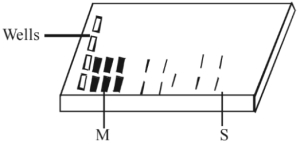
A
$M$-Smallest $DNA$ bands,$N$-Largest $DNA$ bands
B
$M$-Digested $DNA$ bands,$N$-Undigested $DNA$ bands
C
$M$-Hybridised $DNA$ bands,$N$-Unhybridised $DNA$
D
$M$-Largest $DNA$ bands,$N$-Smallest $DNA$ bands
Solution
(D) The correct answer is $D$.
In agarose gel electrophoresis,$DNA$ fragments are separated based on their size.
Since $DNA$ molecules are negatively charged,they move towards the anode $(+)$ when an electric field is applied.
The agarose gel acts as a molecular sieve,allowing smaller fragments to move faster and further through the gel matrix compared to larger fragments.
In the provided diagram,the bands closer to the wells are larger because they move slowly,while the bands further away from the wells are smaller because they move faster.
Therefore,$M$ represents the largest $DNA$ bands (closest to the wells),and $N$ (labeled as $S$ in the diagram) represents the smallest $DNA$ bands (farthest from the wells).
In agarose gel electrophoresis,$DNA$ fragments are separated based on their size.
Since $DNA$ molecules are negatively charged,they move towards the anode $(+)$ when an electric field is applied.
The agarose gel acts as a molecular sieve,allowing smaller fragments to move faster and further through the gel matrix compared to larger fragments.
In the provided diagram,the bands closer to the wells are larger because they move slowly,while the bands further away from the wells are smaller because they move faster.
Therefore,$M$ represents the largest $DNA$ bands (closest to the wells),and $N$ (labeled as $S$ in the diagram) represents the smallest $DNA$ bands (farthest from the wells).
0 likes
View Solution546
EasyMCQ
Biolistics method is suitable for gene transfer into . . . . . .
A
plant cells
B
viruses
C
animal cells
D
bacteria
Solution
(A) The correct answer is $A$.
Biolistics,also known as the gene gun method,is specifically designed for the transformation of plant cells.
In this technique,microparticles of gold or tungsten coated with foreign $DNA$ are bombarded into the target cells at high velocity.
These particles penetrate the rigid cell walls and membranes of plant cells to deliver the genetic material directly into the cytoplasm or nucleus without causing significant damage to the cell.
Biolistics,also known as the gene gun method,is specifically designed for the transformation of plant cells.
In this technique,microparticles of gold or tungsten coated with foreign $DNA$ are bombarded into the target cells at high velocity.
These particles penetrate the rigid cell walls and membranes of plant cells to deliver the genetic material directly into the cytoplasm or nucleus without causing significant damage to the cell.
0 likes
View Solution547
EasyMCQ
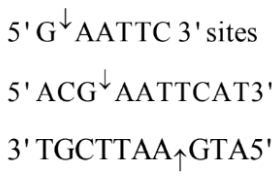
Identify the $DNA$ sequence which can be cut using $EcoRI$.
A
$5' TGCTTAAGTA 3'$
$3' ACGAATTCAT 5'$
$3' ACGAATTCAT 5'$
B
$5' ACGAATTCAT 3'$
$3' TGCTTAAGTA 5'$
$3' TGCTTAAGTA 5'$
C
$5' TACTTAAGCA 3'$
$3' ATGAATTCGT 5'$
$3' ATGAATTCGT 5'$
D
$3' ACGAATTCAT 5'$
$5' TGCTTAAGTA 3'$
$5' TGCTTAAGTA 3'$
Solution
(B) The restriction enzyme $EcoRI$ recognizes the specific palindromic sequence $5'-GAATTC-3'$ and cuts between $G$ and $A$.
Looking at the options,option $B$ contains the sequence $5'-ACGAATTCAT-3'$ which includes the recognition site $GAATTC$ on the top strand.
Specifically,the sequence is $5'-ACG(GAATTC)AT-3'$.
Therefore,the correct sequence is $5'-ACGAATTCAT-3'$ paired with $3'-TGCTTAAGTA-5'$.
Looking at the options,option $B$ contains the sequence $5'-ACGAATTCAT-3'$ which includes the recognition site $GAATTC$ on the top strand.
Specifically,the sequence is $5'-ACG(GAATTC)AT-3'$.
Therefore,the correct sequence is $5'-ACGAATTCAT-3'$ paired with $3'-TGCTTAAGTA-5'$.
0 likes
View Solution548
EasyMCQ
In cloning vectors,antibiotic resistant genes are helpful for
A
transfer of foreign gene to the host
B
selection of recombinants
C
making the host cells competent
D
cleaving of vector by $REN$
Solution
(B) . Selection of recombinants.
Antibiotic resistance genes present in the cloning vector are primarily used as selectable markers.
These genes allow for the identification and selection of transformed bacterial cells from non-transformed ones.
Cells that have taken up the recombinant vector will survive in a medium containing the specific antibiotic,whereas non-transformed cells will fail to grow.
Antibiotic resistance genes present in the cloning vector are primarily used as selectable markers.
These genes allow for the identification and selection of transformed bacterial cells from non-transformed ones.
Cells that have taken up the recombinant vector will survive in a medium containing the specific antibiotic,whereas non-transformed cells will fail to grow.
0 likes
View Solution549
EasyMCQ
Choose the bacterium which is not a source of $REN$.
A
Haemophilus influenzae
B
Escherichia coli
C
Agrobacterium tumefaciens
D
Bacillus amyloliquefaciens
Solution
(C) $Agrobacterium$ $tumefaciens$ is not a source of restriction endonucleases $(REN)$.
$Haemophilus$ $influenzae$ is the source of $HindIII$.
$Escherichia$ $coli$ is the source of $EcoRI$.
$Bacillus$ $amyloliquefaciens$ is the source of $BamHI$.
Therefore,the correct option is $C$.
$Haemophilus$ $influenzae$ is the source of $HindIII$.
$Escherichia$ $coli$ is the source of $EcoRI$.
$Bacillus$ $amyloliquefaciens$ is the source of $BamHI$.
Therefore,the correct option is $C$.
0 likes
View Solution550
EasyMCQ
Identify the palindromic sequence in the following base sequences.
A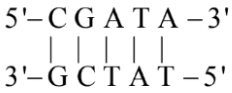
$5$'-$CGATA$-$3$'
$3$'-$GCTAT$-$5$'
$3$'-$GCTAT$-$5$'
B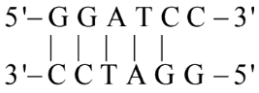
$5$'-$GGATCC$-$3$'
$3$'-$CCTAGG$-$5$'
$3$'-$CCTAGG$-$5$'
C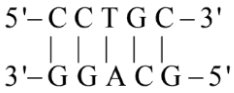
$5$'-$CCTGC$-$3$'
$3$'-$GGACG$-$5$'
$3$'-$GGACG$-$5$'
D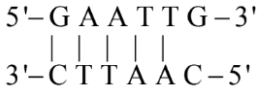
$5$'-$GAATTG$-$3$'
$3$'-$CTTAAC$-$5$'
$3$'-$CTTAAC$-$5$'
Solution
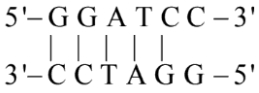
(B) The correct answer is $B$.
$A$ palindromic nucleotide sequence in a $DNA$ molecule is a sequence of base pairs that reads the same on the two strands when the orientation of reading is kept the same (i.e.,$5' \rightarrow 3'$ direction).
In option $B$:
$5'-GGATCC-3'$
$3'-CCTAGG-5'$
If we read the top strand in the $5' \rightarrow 3'$ direction,we get $G-G-A-T-C-C$.
If we read the bottom strand in the $5' \rightarrow 3'$ direction (from right to left),we get $G-G-A-T-C-C$.
Since both strands read the same in the $5' \rightarrow 3'$ direction,this is a palindromic sequence.
$A$ palindromic nucleotide sequence in a $DNA$ molecule is a sequence of base pairs that reads the same on the two strands when the orientation of reading is kept the same (i.e.,$5' \rightarrow 3'$ direction).
In option $B$:
$5'-GGATCC-3'$
$3'-CCTAGG-5'$
If we read the top strand in the $5' \rightarrow 3'$ direction,we get $G-G-A-T-C-C$.
If we read the bottom strand in the $5' \rightarrow 3'$ direction (from right to left),we get $G-G-A-T-C-C$.
Since both strands read the same in the $5' \rightarrow 3'$ direction,this is a palindromic sequence.
0 likes
View SolutionBiotechnology Principals and Process — Tools of recombinant DNA technology · Frequently Asked Questions
1Are these Biotechnology Principals and Process questions useful for JEE and NEET?
Yes. All questions in this section are mapped to JEE Main and NEET exam patterns. Previous year questions from JEE Main, NEET, GUJCET and state-level exams are included with full solutions.
2Can I switch to Hindi or Gujarati for these questions?
Yes. Use the language tabs in the hero section or the sidebar to view the same questions and solutions in English, Hindi or Gujarati.
3How do I generate a question paper from this subtopic?
Use the Vedclass Exam Paper Generator — select the chapter and subtopic, set difficulty, and generate Sets A, B, C, D automatically. First 3 chapters of every subject are free.
Vedclass Products
For Students
Vedclass Test Series
Mock tests in real JEE/NEET style with performance analysis. 5-day free trial.
Start Free TrialFor Teachers
Exam Paper Generator
Generate Set A/B/C/D papers from this chapter in 2 minutes. 3 chapters free.
Try FreeFor Institutes
Online Exam Module
Live online exams with unlimited students, 360° analytics & white-label branding.
See DemoFor Teachers & Institutes
Generate a Biotechnology Principals and Process Exam Paper in 2 Minutes
Select subtopic & difficulty — Sets A, B, C, D auto-generated with No Repeat logic.
First 3 chapters of every subject are free — no payment required.