
A English
Tools of recombinant DNA technology Questions in English
Class 12 Biology · Biotechnology Principals and Process · Tools of recombinant DNA technology
564+
Questions
English
Language
100%
With Solutions
Showing 49 of 564 questions in English
201
MediumMCQ
$A$ single-stranded nucleic acid tagged with a radioactive molecule is called a .............. .
A
Vector
B
Selectable marker
C
Plasmid
D
Probe
Solution
(D) $Probe$ is a single-stranded $DNA$ or $RNA$ molecule that is tagged with a radioactive isotope or a fluorescent molecule.
It is used to detect the presence of complementary sequences in a sample of $DNA$ or $RNA$ by the process of hybridization.
Since it is labeled,it allows for the identification of specific gene sequences in techniques like Southern blotting or colony hybridization.
It is used to detect the presence of complementary sequences in a sample of $DNA$ or $RNA$ by the process of hybridization.
Since it is labeled,it allows for the identification of specific gene sequences in techniques like Southern blotting or colony hybridization.
0 likes
View Solution202
MediumMCQ
The given figure represents the cloning vector $pBR322$ of $E. coli$. Which of the following options correctly identifies its components?
A
$ori$ - Original restriction enzyme
B
$rop$ - Reduced osmotic pressure
C
$Hind III, Eco RI$ - Selectable markers
D
$amp^R, tet^R$ - Antibiotic resistance genes
Solution
(D) The plasmid $pBR322$ is a widely used cloning vector in $E. coli$.
$1$. $ori$ stands for the origin of replication,which is the sequence where replication starts.
$2$. $rop$ codes for the proteins involved in the replication of the plasmid.
$3$. $Hind III$ and $Eco RI$ are restriction sites (recognition sites) for specific restriction enzymes,not selectable markers.
$4$. $amp^R$ (ampicillin resistance) and $tet^R$ (tetracycline resistance) are the selectable markers that help in identifying and eliminating non-transformants and selectively permitting the growth of the transformants.
$1$. $ori$ stands for the origin of replication,which is the sequence where replication starts.
$2$. $rop$ codes for the proteins involved in the replication of the plasmid.
$3$. $Hind III$ and $Eco RI$ are restriction sites (recognition sites) for specific restriction enzymes,not selectable markers.
$4$. $amp^R$ (ampicillin resistance) and $tet^R$ (tetracycline resistance) are the selectable markers that help in identifying and eliminating non-transformants and selectively permitting the growth of the transformants.
0 likes
View Solution203
MediumMCQ
Which vector can clone small pieces of $DNA$?
A
Bacterial Artificial Chromosome $(BAC)$
B
Yeast Artificial Chromosome $(YAC)$
C
Plasmid
D
Cosmid
Solution
(C) Plasmids are small,circular,extrachromosomal $DNA$ molecules found in bacteria that are widely used as vectors in genetic engineering.
They are ideal for cloning small fragments of $DNA$ (typically up to $10 \ kb$).
In contrast,$BAC$s and $YAC$s are used for cloning large $DNA$ inserts,and cosmids are used for intermediate sizes.
Therefore,the correct option is $C$.
They are ideal for cloning small fragments of $DNA$ (typically up to $10 \ kb$).
In contrast,$BAC$s and $YAC$s are used for cloning large $DNA$ inserts,and cosmids are used for intermediate sizes.
Therefore,the correct option is $C$.
0 likes
View Solution204
MediumMCQ
What is the term for a molecule that carries a desired gene into a host cell for cloning?
A
Carrier
B
Transformer
C
Vector
D
Template
Solution
(C) In recombinant $DNA$ technology,a $Vector$ is a $DNA$ molecule used as a vehicle to artificially carry foreign genetic material into another cell,where it can be replicated and/or expressed. Common examples of vectors include plasmids and bacteriophages.
0 likes
View Solution205
EasyMCQ
The discovery of which of the following has made it possible to cut $DNA$ at specific locations?
A
Ligase
B
Restriction enzymes
C
Probes ($DNA$ fragments)
D
Selectable markers
Solution
(B) Restriction enzymes,also known as 'molecular scissors',are enzymes that cut $DNA$ molecules at specific nucleotide sequences called recognition sites. This discovery was a fundamental breakthrough in recombinant $DNA$ technology,allowing scientists to isolate specific genes and insert them into vectors.
0 likes
View Solution206
MediumMCQ
When foreign $DNA$ and a plasmid are cut by the same restriction endonuclease,which enzyme is used to join them to form a recombinant plasmid?
A
$DNA$ polymerase-$III$
B
$DNA$ ligase
C
Eco $RI$
D
Taq polymerase
Solution
(B) $1$. When a foreign $DNA$ fragment and a plasmid vector are cut with the same restriction endonuclease,they produce complementary sticky ends.
$2$. These complementary sticky ends allow the foreign $DNA$ to base-pair with the plasmid vector.
$3$. However,the sugar-phosphate backbone of the $DNA$ remains broken at the nicks.
$4$. The enzyme $DNA$ ligase is responsible for catalyzing the formation of phosphodiester bonds between the adjacent nucleotides,thereby sealing the nicks and creating a stable recombinant $DNA$ molecule.
$2$. These complementary sticky ends allow the foreign $DNA$ to base-pair with the plasmid vector.
$3$. However,the sugar-phosphate backbone of the $DNA$ remains broken at the nicks.
$4$. The enzyme $DNA$ ligase is responsible for catalyzing the formation of phosphodiester bonds between the adjacent nucleotides,thereby sealing the nicks and creating a stable recombinant $DNA$ molecule.
0 likes
View Solution207
MediumMCQ
Which of the following restriction enzymes produces blunt ends?
A
$Xho-I$
B
$Hind-III$
C
$Sal-I$
D
$Eco-RV$
Solution
(D) Restriction enzymes are classified based on the type of ends they produce after $DNA$ cleavage.
$1$. Sticky ends (cohesive ends) are produced by enzymes like $Eco-RI$,$Hind-III$,$Xho-I$,and $Sal-I$,which create staggered cuts.
$2$. Blunt ends (flush ends) are produced by enzymes that cut both strands of $DNA$ at the same position,typically in the center of the recognition site.
$3$. $Eco-RV$ is a well-known restriction enzyme that recognizes the sequence $5'-GATATC-3'$ and cuts between the $T$ and $A$ residues,resulting in blunt ends.
Therefore,the correct option is $D$.
$1$. Sticky ends (cohesive ends) are produced by enzymes like $Eco-RI$,$Hind-III$,$Xho-I$,and $Sal-I$,which create staggered cuts.
$2$. Blunt ends (flush ends) are produced by enzymes that cut both strands of $DNA$ at the same position,typically in the center of the recognition site.
$3$. $Eco-RV$ is a well-known restriction enzyme that recognizes the sequence $5'-GATATC-3'$ and cuts between the $T$ and $A$ residues,resulting in blunt ends.
Therefore,the correct option is $D$.
0 likes
View Solution208
MediumMCQ
Which of the following is known as a restriction endonuclease?
A
Protease
B
DNase-$I$
C
RNase
D
Hind-$II$
Solution
(D) Restriction endonucleases are enzymes that cut $DNA$ at specific recognition sequences.
$Hind-II$ was the first restriction endonuclease to be isolated and characterized.
Proteases are enzymes that break down proteins.
DNase-$I$ and RNase are enzymes that degrade $DNA$ and $RNA$,respectively,but they are not restriction endonucleases.
$Hind-II$ was the first restriction endonuclease to be isolated and characterized.
Proteases are enzymes that break down proteins.
DNase-$I$ and RNase are enzymes that degrade $DNA$ and $RNA$,respectively,but they are not restriction endonucleases.
0 likes
View Solution209
MediumMCQ
Which of the following is $NOT$ a characteristic of a plasmid?
A
Circular structure
B
Transferable
C
Single-stranded
D
Autonomous replication
Solution
(C) Plasmids are small,circular,double-stranded $DNA$ molecules that are distinct from a cell's chromosomal $DNA$.
They are found primarily in bacteria and can replicate independently of the chromosomal $DNA$.
They are often used as vectors in genetic engineering because they can be transferred between cells.
Since plasmids are double-stranded,the statement that they are 'single-stranded' is incorrect.
They are found primarily in bacteria and can replicate independently of the chromosomal $DNA$.
They are often used as vectors in genetic engineering because they can be transferred between cells.
Since plasmids are double-stranded,the statement that they are 'single-stranded' is incorrect.
0 likes
View Solution210
MediumMCQ
From which organism is the $Taq$ polymerase enzyme isolated?
A
$Thiobacillus$ $ferrooxidans$
B
$Bacillus$ $subtilis$
C
$Pseudomonas$ $putida$
D
$Thermus$ $aquaticus$
Solution
(D) The $Taq$ polymerase enzyme is isolated from a thermophilic bacterium called $Thermus$ $aquaticus$.
This bacterium thrives in high-temperature environments such as hot springs.
Because of its origin,the $Taq$ polymerase enzyme is thermostable,meaning it can withstand the high temperatures required during the denaturation step of the Polymerase Chain Reaction $(PCR)$ process.
Therefore,it is widely used in $PCR$ to amplify $DNA$ segments.
This bacterium thrives in high-temperature environments such as hot springs.
Because of its origin,the $Taq$ polymerase enzyme is thermostable,meaning it can withstand the high temperatures required during the denaturation step of the Polymerase Chain Reaction $(PCR)$ process.
Therefore,it is widely used in $PCR$ to amplify $DNA$ segments.
1 likes
View Solution211
MediumMCQ
The gene whose expression helps to identify the transformed cell is known as........
A
Selectable marker
B
Vector
C
Plasmid
D
Structural gene
Solution
(A) $Selectable marker$ is a gene introduced into a cell, especially a bacterium or to cells in culture, that confers a trait suitable for artificial selection.
In recombinant $DNA$ technology, it helps in identifying and eliminating non-transformants and selectively permitting the growth of the transformants.
Examples include genes encoding resistance to antibiotics such as $ampicillin$, $chloramphenicol$, $tetracycline$, or $kanamycin$.
In recombinant $DNA$ technology, it helps in identifying and eliminating non-transformants and selectively permitting the growth of the transformants.
Examples include genes encoding resistance to antibiotics such as $ampicillin$, $chloramphenicol$, $tetracycline$, or $kanamycin$.
0 likes
View Solution212
MediumMCQ
Following statements describe the characteristics of the enzyme Restriction endonuclease. Identify the Incorrect statement.
A
The enzyme cuts $DNA$ molecule at identified position within the $DNA$.
B
The enzyme binds $DNA$ at specific sites and cuts only one of the two strands.
C
The enzyme cuts the sugar-phosphate backbone at specific sites on each strand.
D
The enzyme recognizes a specific palindromic nucleotide sequence in the $DNA$.
Solution
(B) Restriction endonucleases are enzymes that recognize specific palindromic nucleotide sequences in $DNA$ and cut the sugar-phosphate backbone at specific sites on both strands of the $DNA$ molecule.
Option $A$ is correct because these enzymes act at specific internal positions.
Option $B$ is incorrect because restriction endonucleases cut both strands of the $DNA$ double helix,not just one.
Option $C$ is correct as they cleave the phosphodiester bonds in the sugar-phosphate backbone.
Option $D$ is correct as they identify specific palindromic sequences.
Option $A$ is correct because these enzymes act at specific internal positions.
Option $B$ is incorrect because restriction endonucleases cut both strands of the $DNA$ double helix,not just one.
Option $C$ is correct as they cleave the phosphodiester bonds in the sugar-phosphate backbone.
Option $D$ is correct as they identify specific palindromic sequences.
0 likes
View Solution213
MediumMCQ
Which one of the following represents a palindromic sequence in $DNA$?
A
$5' - GAATTC - 3'$
$3' - CTTAAG - 5'$
$3' - CTTAAG - 5'$
B
$5' - CCAATG - 3'$
$3' - GAATCC - 5'$
$3' - GAATCC - 5'$
C
$5' - CATTAG - 3'$
$3' - GATAAC - 5'$
$3' - GATAAC - 5'$
D
$5' - GATACC - 3'$
$3' - CCTAAG - 5'$
$3' - CCTAAG - 5'$
Solution
(A) palindromic sequence is a nucleic acid sequence ($DNA$ or $RNA$) that is the same when read $5'$ to $3'$ on one strand and $5'$ to $3'$ on the complementary strand.
In the option $A$:
$5' - GAATTC - 3'$
$3' - CTTAAG - 5'$
Reading the top strand from $5'$ to $3'$ gives $GAATTC$. Reading the bottom strand from $5'$ to $3'$ (which is right to left in the representation) also gives $GAATTC$.
This is a classic palindromic sequence recognized by the restriction enzyme $EcoRI$.
In the option $A$:
$5' - GAATTC - 3'$
$3' - CTTAAG - 5'$
Reading the top strand from $5'$ to $3'$ gives $GAATTC$. Reading the bottom strand from $5'$ to $3'$ (which is right to left in the representation) also gives $GAATTC$.
This is a classic palindromic sequence recognized by the restriction enzyme $EcoRI$.
0 likes
View Solution214
EasyMCQ
The polymerase chain reaction $(PCR)$ technology was discovered by
A
Kary Mullis
B
Saiki et al.
C
Craig Venter
D
Maxam and Gilbert
Solution
(A) Developed in $1984$ by Kary Mullis,$PCR$ is now a common and often indispensable technique used in medical and biological research labs for a variety of applications.
These include $DNA$ cloning for sequencing,$DNA$-based phylogeny,or functional analysis of genes; the diagnosis of hereditary diseases; the identification of genetic fingerprints (used in forensic sciences and paternity testing); and the detection and diagnosis of infectious diseases.
In $1993$,Mullis won the Nobel Prize in Chemistry for his work on $PCR$.
These include $DNA$ cloning for sequencing,$DNA$-based phylogeny,or functional analysis of genes; the diagnosis of hereditary diseases; the identification of genetic fingerprints (used in forensic sciences and paternity testing); and the detection and diagnosis of infectious diseases.
In $1993$,Mullis won the Nobel Prize in Chemistry for his work on $PCR$.
0 likes
View Solution215
MediumMCQ
Genes of interest can be selected from a genomic library by using
A
Restriction enzymes
B
Cloning vectors
C
$DNA$ probes
D
Gene targets
Solution
(C) hybridization probe is a fragment of $DNA$ of variable length which is used in $DNA$ samples to detect the presence of nucleotide sequences (the $DNA$ target) that are complementary to the sequence in the probe.
The probe hybridizes to single-stranded $DNA$ whose base sequence allows probe-target base-pairing due to complementarity between the probe and the target.
Therefore,$DNA$ probes are specifically used to identify and select genes of interest from a genomic library.
The probe hybridizes to single-stranded $DNA$ whose base sequence allows probe-target base-pairing due to complementarity between the probe and the target.
Therefore,$DNA$ probes are specifically used to identify and select genes of interest from a genomic library.
0 likes
View Solution216
MediumMCQ
Which one of the following palindromic base sequences in $DNA$ can be easily cut at about the middle by some particular restriction enzyme?
A
$5'-CGTTCG-3'$
$3'-GCAAGC-5'$
$3'-GCAAGC-5'$
B
$5'-GATATG-3'$
$3'-CTATAC-5'$
$3'-CTATAC-5'$
C
$5'-GAATTC-3'$
$3'-CTTAAG-5'$
$3'-CTTAAG-5'$
D
$5'-CACGTA-3'$
$3'-GTGCAT-5'$
$3'-GTGCAT-5'$
Solution
(C) palindromic sequence in $DNA$ is a sequence of base pairs that reads the same on the two strands when the orientation of reading is kept the same (e.g.,$5' \rightarrow 3'$).
Restriction enzymes recognize specific palindromic sequences to cut the $DNA$.
In option $(c)$,the sequence $5'-GAATTC-3'$ on one strand corresponds to $3'-CTTAAG-5'$ on the complementary strand.
When read in the $5' \rightarrow 3'$ direction,both strands yield the sequence $GAATTC$,which is a classic recognition site for the restriction enzyme $EcoRI$.
Restriction enzymes recognize specific palindromic sequences to cut the $DNA$.
In option $(c)$,the sequence $5'-GAATTC-3'$ on one strand corresponds to $3'-CTTAAG-5'$ on the complementary strand.
When read in the $5' \rightarrow 3'$ direction,both strands yield the sequence $GAATTC$,which is a classic recognition site for the restriction enzyme $EcoRI$.
0 likes
View Solution217
MediumMCQ
Which of the following statements is not correct about a cloning vector?
A
$Ori$ is a sequence responsible for controlling the copy number of the linked $DNA$.
B
Selectable marker selectively permitting the growth of the non-transformants.
C
In order to link the alien $DNA$,the vector needs to have a single recognition site for the commonly used restriction enzymes.
D
The ligation of alien $DNA$ is carried out at a restriction site present in one of the two antibiotic resistance genes.
Solution
(B) selectable marker is a gene that facilitates the selection of transformants (cells that have taken up the recombinant vector) by eliminating non-transformants. Option $B$ is incorrect because a selectable marker permits the growth of transformants,not non-transformants.
0 likes
View Solution218
MediumMCQ
Assertion : Plasmids are extrachromosomal $DNA$.
Reason : Plasmids are found in bacteria and are useful in genetic engineering.
Reason : Plasmids are found in bacteria and are useful in genetic engineering.
A
If both Assertion and Reason are correct and the Reason is a correct explanation of the Assertion.
B
If both Assertion and Reason are correct but Reason is not a correct explanation of the Assertion.
C
If the Assertion is correct but Reason is incorrect.
D
If both the Assertion and Reason are incorrect.
Solution
(A) Plasmids are small,circular,double-stranded $DNA$ molecules that are distinct from a cell's chromosomal $DNA$.
They are naturally found in bacteria and some eukaryotes.
Because they can replicate independently and carry specific genes,they are widely used as vectors in recombinant $DNA$ technology (genetic engineering) to transfer foreign genes into host cells.
Both the assertion and the reason are correct,and the reason explains why plasmids are significant in the context of their biological nature and utility.
They are naturally found in bacteria and some eukaryotes.
Because they can replicate independently and carry specific genes,they are widely used as vectors in recombinant $DNA$ technology (genetic engineering) to transfer foreign genes into host cells.
Both the assertion and the reason are correct,and the reason explains why plasmids are significant in the context of their biological nature and utility.
0 likes
View Solution219
MediumMCQ
Assertion : Restriction enzymes cut the strand of $DNA$ to produce sticky ends.
Reason : Stickiness of the ends facilitates the action of the enzyme $DNA$ polymerase.
Reason : Stickiness of the ends facilitates the action of the enzyme $DNA$ polymerase.
A
If both Assertion and Reason are correct and the Reason is a correct explanation of the Assertion.
B
If both Assertion and Reason are correct but Reason is not a correct explanation of the Assertion.
C
If the Assertion is correct but Reason is incorrect.
D
If both the Assertion and Reason are incorrect.
Solution
(C) Restriction enzymes,a type of endonuclease,function by inspecting the length of a $DNA$ sequence.
Once they find a specific recognition sequence,they bind to it and cut each of the two strands of the double helix at specific points,leaving single-stranded portions at the ends.
This results in overhanging stretches called sticky ends.
These are named so because they form hydrogen bonds with their complementary counterparts; i.e.,they can join similar complementary ends of $DNA$ fragments from other sources with the help of the enzyme $DNA$ ligase.
Therefore,the stickiness of the ends facilitates the action of the enzyme $DNA$ ligase,not $DNA$ polymerase.
Thus,the Assertion is correct,but the Reason is incorrect.
Once they find a specific recognition sequence,they bind to it and cut each of the two strands of the double helix at specific points,leaving single-stranded portions at the ends.
This results in overhanging stretches called sticky ends.
These are named so because they form hydrogen bonds with their complementary counterparts; i.e.,they can join similar complementary ends of $DNA$ fragments from other sources with the help of the enzyme $DNA$ ligase.
Therefore,the stickiness of the ends facilitates the action of the enzyme $DNA$ ligase,not $DNA$ polymerase.
Thus,the Assertion is correct,but the Reason is incorrect.
0 likes
View Solution220
MediumMCQ
Match the following enzymes with their functions:
Select the correct option from the following:
| $(a)$ Restriction endonuclease | $(i)$ Joins the $DNA$ fragments |
| $(b)$ Restriction exonuclease | $(ii)$ Extends primers on genomic $DNA$ template |
| $(c)$ $DNA$ ligase | $(iii)$ Cuts $DNA$ at specific positions |
| $(d)$ $Taq$ polymerase | $(iv)$ Removes nucleotides from the ends of $DNA$ |
Select the correct option from the following:
A
$a-iii, b-i, c-iv, d-ii$
B
$a-iii, b-iv, c-i, d-ii$
C
$a-iv, b-iii, c-i, d-ii$
D
$a-ii, b-iv, c-i, d-iii$
Solution
(B) The correct matching is as follows:
$(a)$ Restriction endonuclease: These enzymes cut $DNA$ at specific recognition sequences within the molecule. Thus, $(a) - (iii)$.
$(b)$ Restriction exonuclease: These enzymes remove nucleotides from the ends of $DNA$ molecules. Thus, $(b) - (iv)$.
$(c)$ $DNA$ ligase: This enzyme acts as molecular glue, joining $DNA$ fragments by forming phosphodiester bonds. Thus, $(c) - (i)$.
$(d)$ $Taq$ polymerase: This is a thermostable enzyme used in $PCR$ to extend primers on a genomic $DNA$ template. Thus, $(d) - (ii)$.
Therefore, the correct sequence is $a-iii, b-iv, c-i, d-ii$.
$(a)$ Restriction endonuclease: These enzymes cut $DNA$ at specific recognition sequences within the molecule. Thus, $(a) - (iii)$.
$(b)$ Restriction exonuclease: These enzymes remove nucleotides from the ends of $DNA$ molecules. Thus, $(b) - (iv)$.
$(c)$ $DNA$ ligase: This enzyme acts as molecular glue, joining $DNA$ fragments by forming phosphodiester bonds. Thus, $(c) - (i)$.
$(d)$ $Taq$ polymerase: This is a thermostable enzyme used in $PCR$ to extend primers on a genomic $DNA$ template. Thus, $(d) - (ii)$.
Therefore, the correct sequence is $a-iii, b-iv, c-i, d-ii$.
0 likes
View Solution221
EasyMCQ
The two antibiotic resistance genes on vector $pBR322$ are for
A
Ampicillin and Tetracycline
B
Ampicillin and Chloramphenicol
C
Chloramphenicol and Tetracycline
D
Tetracycline and Kanamycin
Solution
(A) The plasmid vector $pBR322$ is one of the most commonly used cloning vectors in biotechnology.
It contains two distinct antibiotic resistance genes,which serve as selectable markers.
These genes are the $amp^R$ gene,which provides resistance to Ampicillin,and the $tet^R$ gene,which provides resistance to Tetracycline.
These markers allow for the identification and selection of recombinant cells from non-recombinant ones during the cloning process.
It contains two distinct antibiotic resistance genes,which serve as selectable markers.
These genes are the $amp^R$ gene,which provides resistance to Ampicillin,and the $tet^R$ gene,which provides resistance to Tetracycline.
These markers allow for the identification and selection of recombinant cells from non-recombinant ones during the cloning process.
0 likes
View Solution222
MediumMCQ
$A$ selectable marker is used to
A
help in eliminating the non-transformants,so that the transformants can be regenerated
B
identify the gene for a desired trait in an alien organism
C
select a suitable vector for transformation in a specific crop
D
mark a gene on a chromosome for isolation using restriction enzyme
Solution
(A) selectable marker is a gene introduced into a cell,especially a bacterium or to cells in culture,that confers a trait suitable for artificial selection.
In recombinant $DNA$ technology,selectable markers (such as antibiotic resistance genes) are used to identify and eliminate non-transformants (cells that have not taken up the recombinant $DNA$) and selectively permit the growth of transformants (cells that have successfully taken up the recombinant $DNA$).
This ensures that only the desired transformed cells are regenerated or cultured.
In recombinant $DNA$ technology,selectable markers (such as antibiotic resistance genes) are used to identify and eliminate non-transformants (cells that have not taken up the recombinant $DNA$) and selectively permit the growth of transformants (cells that have successfully taken up the recombinant $DNA$).
This ensures that only the desired transformed cells are regenerated or cultured.
0 likes
View Solution223
MediumMCQ
An enzyme catalysing the removal of nucleotides from the ends of $DNA$ is:
A
$DNA$ ligase
B
Endonuclease
C
Exonuclease
D
Protease
Solution
(C) Exonucleases are enzymes that remove nucleotides from the ends of $DNA$ molecules.
In contrast,endonucleases make cuts at specific positions within the $DNA$ molecule.
$DNA$ ligase is an enzyme that joins $DNA$ fragments together.
Proteases are enzymes that break down proteins.
Therefore,the correct enzyme for removing nucleotides from the ends of $DNA$ is Exonuclease.
In contrast,endonucleases make cuts at specific positions within the $DNA$ molecule.
$DNA$ ligase is an enzyme that joins $DNA$ fragments together.
Proteases are enzymes that break down proteins.
Therefore,the correct enzyme for removing nucleotides from the ends of $DNA$ is Exonuclease.
0 likes
View Solution224
EasyMCQ
Give any two microbes that are useful in biotechnology.
A
Escherichia coli and Bacillus thuringiensis
B
Lactobacillus and Saccharomyces cerevisiae
C
Penicillium and Aspergillus
D
Rhizobium and Azotobacter
Solution
(A) $E. coli$ is a bacterium whose plasmid is widely used as a cloning vector to introduce foreign $DNA$ segments into host cells.
$Bacillus thuringiensis$ is a bacterium from which a specific gene is isolated and inserted into cotton plants to produce insect-resistant plants,commonly known as $Bt$ cotton.
$Bacillus thuringiensis$ is a bacterium from which a specific gene is isolated and inserted into cotton plants to produce insect-resistant plants,commonly known as $Bt$ cotton.
0 likes
View Solution225
MediumMCQ
What is the source organism for $\text{EcoRI}$,a restriction endonuclease?
A
Escherichia coli RY13
B
Escherichia coli R13
C
Entamoeba coli RY13
D
Escherichia coli RY1
Solution
(A) The restriction endonuclease $\text{EcoRI}$ is derived from the bacterium $\text{Escherichia coli}$ strain $\text{RY13}$.
In the name $\text{EcoRI}$,the first letter '$E$' comes from the genus $\text{Escherichia}$,and the next two letters 'co' come from the species $\text{coli}$.
The letter '$R$' is derived from the strain name $\text{RY13}$,and the Roman numeral '$I$' indicates the order in which the enzyme was isolated from that bacterial strain.
In the name $\text{EcoRI}$,the first letter '$E$' comes from the genus $\text{Escherichia}$,and the next two letters 'co' come from the species $\text{coli}$.
The letter '$R$' is derived from the strain name $\text{RY13}$,and the Roman numeral '$I$' indicates the order in which the enzyme was isolated from that bacterial strain.
0 likes
View Solution226
Medium
Create a chart (with diagrammatic representation) showing a restriction enzyme,the substrate $DNA$ on which it acts,the site at which it cuts $DNA$,and the product it produces.
Solution
(N/A) The restriction endonuclease enzyme used is $BamHI$.
It recognizes the specific palindromic sequence $5'-GGATCC-3'$.
The enzyme cleaves the $DNA$ between the $G$ and $G$ residues on both strands.
Diagrammatic representation:
$5'-G \downarrow GATCC-3'$
$3'-CCTAG \uparrow G-5'$
Products produced:
$5'-G-3'$ and $5'-GATCC-3'$
$3'-CCTAG-5'$ and $3'-G-5'$
This results in the formation of 'sticky ends' or 'cohesive ends' which are essential for recombinant $DNA$ technology.
It recognizes the specific palindromic sequence $5'-GGATCC-3'$.
The enzyme cleaves the $DNA$ between the $G$ and $G$ residues on both strands.
Diagrammatic representation:
$5'-G \downarrow GATCC-3'$
$3'-CCTAG \uparrow G-5'$
Products produced:
$5'-G-3'$ and $5'-GATCC-3'$
$3'-CCTAG-5'$ and $3'-G-5'$
This results in the formation of 'sticky ends' or 'cohesive ends' which are essential for recombinant $DNA$ technology.
0 likes
View Solution227
Medium
Do eukaryotic cells have restriction endonucleases? Justify your answer.
Solution
(N/A) No,eukaryotic cells do not possess restriction endonucleases. In eukaryotic cells,the $DNA$ is heavily methylated by specific enzymes known as methylases. This methylation process serves as a protective mechanism,preventing the $DNA$ from being cleaved by restriction enzymes. Restriction endonucleases are naturally occurring enzymes found exclusively in various strains of bacteria or prokaryotic cells,where they function as part of a defense mechanism against invading viral $DNA$.
0 likes
View Solution228
Medium
Collect $5$ examples of palindromic $DNA$ sequences by consulting your teacher. Better try to create a palindromic sequence by following base-pair rules.
Solution
(N/A) Palindrome nucleotide sequences in $DNA$ molecules are base pairs that read the same in both the $5^{\prime} \rightarrow 3^{\prime}$ and $3^{\prime} \rightarrow 5^{\prime}$ directions. These sequences serve as recognition sites for restriction endonucleases.
Five examples of palindromic $DNA$ sequences are:
$(i)$ $5^{\prime}-GAATTC-3^{\prime}$ / $3^{\prime}-CTTAAG-5^{\prime}$
$(ii)$ $5^{\prime}-GGATCC-3^{\prime}$ / $3^{\prime}-CCTAGG-5^{\prime}$
$(iii)$ $5^{\prime}-AAGCTT-3^{\prime}$ / $3^{\prime}-TTCGAA-5^{\prime}$
$(iv)$ $5^{\prime}-ACGCGT-3^{\prime}$ / $3^{\prime}-TGCGCA-5^{\prime}$
$(v)$ $5^{\prime}-ACTAGT-3^{\prime}$ / $3^{\prime}-TGATCA-5^{\prime}$
Five examples of palindromic $DNA$ sequences are:
$(i)$ $5^{\prime}-GAATTC-3^{\prime}$ / $3^{\prime}-CTTAAG-5^{\prime}$
$(ii)$ $5^{\prime}-GGATCC-3^{\prime}$ / $3^{\prime}-CCTAGG-5^{\prime}$
$(iii)$ $5^{\prime}-AAGCTT-3^{\prime}$ / $3^{\prime}-TTCGAA-5^{\prime}$
$(iv)$ $5^{\prime}-ACGCGT-3^{\prime}$ / $3^{\prime}-TGCGCA-5^{\prime}$
$(v)$ $5^{\prime}-ACTAGT-3^{\prime}$ / $3^{\prime}-TGATCA-5^{\prime}$
0 likes
View Solution229
Medium
Explain the following terms in the context of Biotechnology:
$(a)$ $PCR$
$(b)$ Restriction enzymes and $DNA$
$(c)$ Chitinase
$(a)$ $PCR$
$(b)$ Restriction enzymes and $DNA$
$(c)$ Chitinase
Solution
(N/A) $PCR$ - Polymerase Chain Reaction (in vitro method) is a molecular biological technique for the enzymatic amplification of a single small strand or a few copies of a segment of $DNA$ into millions of copies of that specific $DNA$ sequence in a short time period (approx $2$ hours).
$3$ steps in $PCR$ are:
$(i)$ Denaturation (at $96\,^{\circ}C$): Separation of desired double-stranded $DNA$ into single-stranded $DNA$ $(ssDNA)$.
$(ii)$ Annealing (at $55-65\,^{\circ}C$): Binding of primers to the $ssDNA$ template.
$(iii)$ Extension (at $72\,^{\circ}C$): Synthesis of new $DNA$ strands by Taq $DNA$ polymerase,isolated from the bacterium $Thermus$ $aquaticus$.
Uses: Amplification of a desired gene or gene cloning.
$(b)$ Restriction enzymes and $DNA$ - Restriction enzymes are a group of enzymes used to cleave or cut $DNA$ strands. Each enzyme recognizes a specific characteristic base sequence known as a recognition site or restriction site.
$(i)$ They restrict foreign $DNA$ from entering a cell by digesting it at specific recognition sites. These sites are typically palindromic.
$(ii)$ They include both endonuclease and exonuclease types.
$(iii)$ They often produce sticky ends. Restriction enzymes are believed to be a defense mechanism evolved by bacteria to resist viral attacks.
$(c)$ Chitinase - Chitinase is a hydrolytic enzyme that digests or breaks down glycosidic bonds in chitin. It is used to break down the cell walls of fungal cells to facilitate the extraction of $DNA$ or other cellular components.
$3$ steps in $PCR$ are:
$(i)$ Denaturation (at $96\,^{\circ}C$): Separation of desired double-stranded $DNA$ into single-stranded $DNA$ $(ssDNA)$.
$(ii)$ Annealing (at $55-65\,^{\circ}C$): Binding of primers to the $ssDNA$ template.
$(iii)$ Extension (at $72\,^{\circ}C$): Synthesis of new $DNA$ strands by Taq $DNA$ polymerase,isolated from the bacterium $Thermus$ $aquaticus$.
Uses: Amplification of a desired gene or gene cloning.
$(b)$ Restriction enzymes and $DNA$ - Restriction enzymes are a group of enzymes used to cleave or cut $DNA$ strands. Each enzyme recognizes a specific characteristic base sequence known as a recognition site or restriction site.
$(i)$ They restrict foreign $DNA$ from entering a cell by digesting it at specific recognition sites. These sites are typically palindromic.
$(ii)$ They include both endonuclease and exonuclease types.
$(iii)$ They often produce sticky ends. Restriction enzymes are believed to be a defense mechanism evolved by bacteria to resist viral attacks.
$(c)$ Chitinase - Chitinase is a hydrolytic enzyme that digests or breaks down glycosidic bonds in chitin. It is used to break down the cell walls of fungal cells to facilitate the extraction of $DNA$ or other cellular components.
0 likes
View Solution230
Medium
Discuss with your teacher and find out how to distinguish between (Any two):
$(a)$ Plasmid $DNA$ and Chromosomal $DNA$
$(b)$ $RNA$ and $DNA$
$(c)$ Exonuclease and Endonuclease
$(a)$ Plasmid $DNA$ and Chromosomal $DNA$
$(b)$ $RNA$ and $DNA$
$(c)$ Exonuclease and Endonuclease
Solution
(N/A) Plasmid $DNA$ and Chromosomal $DNA$
$(b)$ $RNA$ and $DNA$
$(c)$ Exonuclease and Endonuclease
| $1$. Plasmid $DNA$ is autonomously replicable, whereas Chromosomal $DNA$ replicates under nuclear control. |
| $2$. Plasmid $DNA$ is double-stranded and circular, while Chromosomal $DNA$ can be double-stranded, circular, or linear. |
| $3$. Plasmid $DNA$ is not associated with histones, whereas Chromosomal $DNA$ is associated with histone proteins. |
| $4$. Plasmid $DNA$ contains few genes for traits like antibiotic resistance, while Chromosomal $DNA$ contains genes for essential metabolic functions. |
$(b)$ $RNA$ and $DNA$
| $1$. $RNA$ contains ribose sugar, whereas $DNA$ contains deoxyribose sugar. |
| $2$. $RNA$ is typically single-stranded, while $DNA$ is double-stranded. |
| $3$. $RNA$ contains uracil, whereas $DNA$ contains thymine. |
| $4$. $RNA$ is less stable due to the $2'-OH$ group, while $DNA$ is more stable. |
$(c)$ Exonuclease and Endonuclease
| $1$. Exonucleases remove nucleotides from the ends of $DNA$, whereas Endonucleases cut $DNA$ at specific internal sites. |
| $2$. Exonucleases often produce blunt ends, while Endonucleases can produce sticky ends. |
0 likes
View Solution231
Medium
Explain restriction enzymes and their nomenclature.
Solution
(N/A) In the year $1963$,two enzymes responsible for restricting the growth of bacteriophage in $Escherichia$ $coli$ were isolated. One of these added methyl groups to $DNA$,while the other cut $DNA$.
The enzymes which cut $DNA$ are called restriction endonucleases.
$Hind-II$ was the first restriction endonuclease enzyme discovered.
$Hind-II$ always cuts $DNA$ molecules at a particular point by recognizing a specific sequence of six base pairs. This specific base sequence is known as the recognition sequence for $Hind-II$.
Besides $Hind-II$,today we know more than $900$ restriction enzymes that have been isolated from over $230$ strains of bacteria.
Nomenclature: The naming of these enzymes is based on the bacteria from which they are isolated. The name consists of three or four letters.
For example,in $EcoRI$:
- The first letter '$E$' comes from the genus $Escherichia$.
- The next two letters '$co$' come from the species $coli$.
- The letter '$R$' is derived from the name of the strain $(RY13)$.
- The Roman numeral '$I$' indicates the order in which the enzymes were isolated from that strain of bacteria.
The enzymes which cut $DNA$ are called restriction endonucleases.
$Hind-II$ was the first restriction endonuclease enzyme discovered.
$Hind-II$ always cuts $DNA$ molecules at a particular point by recognizing a specific sequence of six base pairs. This specific base sequence is known as the recognition sequence for $Hind-II$.
Besides $Hind-II$,today we know more than $900$ restriction enzymes that have been isolated from over $230$ strains of bacteria.
Nomenclature: The naming of these enzymes is based on the bacteria from which they are isolated. The name consists of three or four letters.
For example,in $EcoRI$:
- The first letter '$E$' comes from the genus $Escherichia$.
- The next two letters '$co$' come from the species $coli$.
- The letter '$R$' is derived from the name of the strain $(RY13)$.
- The Roman numeral '$I$' indicates the order in which the enzymes were isolated from that strain of bacteria.
0 likes
View Solution232
Easy
Give the types and functions of the Nuclease enzyme.
Solution
(N/A) Restriction enzymes belong to a larger class of enzymes called nucleases.
$(i)$ Exonuclease enzymes: They remove nucleotides from the ends of the $DNA$.
$(ii)$ Endonuclease enzymes: Endonucleases make cuts at specific positions within the $DNA$.
Each restriction endonuclease functions by inspecting the length of a $DNA$ sequence. Once it finds the specific recognition sequence,it will bind to the $DNA$.
It then cuts each of the two strands of the double helix at specific points in their sugar-phosphate backbones.
- Each restriction endonuclease recognizes a specific palindromic nucleotide sequence in the $DNA$.
- The palindrome in $DNA$ is a sequence of base pairs that reads the same on the two strands when the orientation of reading is kept the same.
$(i)$ Exonuclease enzymes: They remove nucleotides from the ends of the $DNA$.
$(ii)$ Endonuclease enzymes: Endonucleases make cuts at specific positions within the $DNA$.
Each restriction endonuclease functions by inspecting the length of a $DNA$ sequence. Once it finds the specific recognition sequence,it will bind to the $DNA$.
It then cuts each of the two strands of the double helix at specific points in their sugar-phosphate backbones.
- Each restriction endonuclease recognizes a specific palindromic nucleotide sequence in the $DNA$.
- The palindrome in $DNA$ is a sequence of base pairs that reads the same on the two strands when the orientation of reading is kept the same.
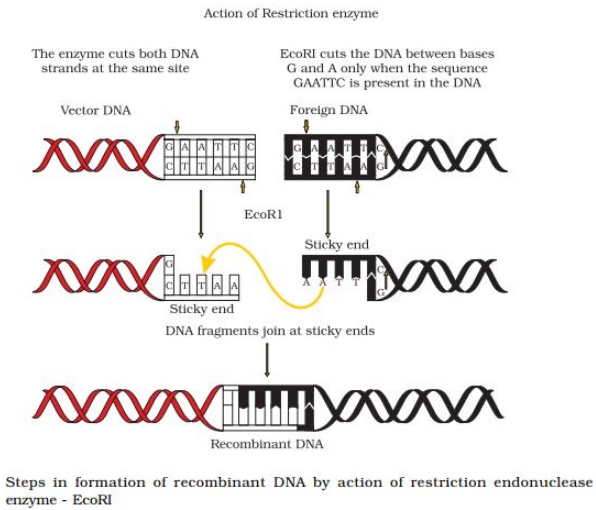
0 likes
View Solution233
Medium
Explain the process of cutting $DNA$ in recombinant $DNA$ technology.
Solution
(N/A) The process of cutting $DNA$ involves the following steps:
$1$. Restriction enzyme digestions are performed by incubating purified $DNA$ molecules with specific restriction enzymes under optimal conditions (temperature,$pH$,and buffer).
$2$. Agarose gel electrophoresis is employed to check the progression and completion of the restriction enzyme digestion.
$3$. Since $DNA$ is a negatively charged molecule,it moves towards the positive electrode (anode) during electrophoresis.
$4$. The same procedure is repeated with the vector $DNA$ using the same restriction enzyme to ensure complementary sticky ends.
$5$. Finally,the cut 'gene of interest' from the source $DNA$ and the linearized vector $DNA$ are mixed,and the enzyme $DNA$ ligase is added to join them,resulting in the formation of recombinant $DNA$.
$1$. Restriction enzyme digestions are performed by incubating purified $DNA$ molecules with specific restriction enzymes under optimal conditions (temperature,$pH$,and buffer).
$2$. Agarose gel electrophoresis is employed to check the progression and completion of the restriction enzyme digestion.
$3$. Since $DNA$ is a negatively charged molecule,it moves towards the positive electrode (anode) during electrophoresis.
$4$. The same procedure is repeated with the vector $DNA$ using the same restriction enzyme to ensure complementary sticky ends.
$5$. Finally,the cut 'gene of interest' from the source $DNA$ and the linearized vector $DNA$ are mixed,and the enzyme $DNA$ ligase is added to join them,resulting in the formation of recombinant $DNA$.
0 likes
View Solution234
Medium
Differentiate between Restriction Endonuclease and Restriction Exonuclease.
Solution
(N/A)
| Restriction Endonuclease | Restriction Exonuclease |
|---|---|
| $(1)$ Endonucleases cut $DNA$ molecules at specific internal positions. | $(1)$ Exonucleases remove nucleotides sequentially from the ends of the $DNA$ molecule. |
| $(2)$ They often produce sticky or blunt ends depending on the enzyme. | $(2)$ They generally do not produce sticky ends as they act on the termini. |
| $(3)$ They are essential tools in recombinant $DNA$ technology for creating gene fragments. | $(3)$ They are primarily involved in $DNA$ repair and degradation processes. |
| $(4)$ Examples include $BamHI$, $HindIII$, $EcoRI$. | $(4)$ Examples include $Exonuclease III$, $RecJ$. |
0 likes
View Solution235
Medium
Give scientific reasons: In recombinant $DNA$ technology,the use of endonuclease is more proper than exonuclease.
Solution
(N/A) In recombinant $DNA$ technology,the fragment of desired $DNA$ must be joined with a vector or amplified. For this,precise cutting of both the vector and the desired $DNA$ is essential.
Endonucleases cut $DNA$ at specific internal sites,often producing 'sticky' or cohesive ends.
Exonucleases remove nucleotides from the ends of $DNA$ molecules,typically resulting in 'blunt' ends.
Sticky ends are necessary for the efficient annealing and ligation of the desired $DNA$ fragment into the vector.
Therefore,endonucleases are more suitable than exonucleases for recombinant $DNA$ technology.
Endonucleases cut $DNA$ at specific internal sites,often producing 'sticky' or cohesive ends.
Exonucleases remove nucleotides from the ends of $DNA$ molecules,typically resulting in 'blunt' ends.
Sticky ends are necessary for the efficient annealing and ligation of the desired $DNA$ fragment into the vector.
Therefore,endonucleases are more suitable than exonucleases for recombinant $DNA$ technology.
0 likes
View Solution236
MediumMCQ
Would you choose an exonuclease while producing a recombinant $DNA$ molecule?
A
Yes,because it creates sticky ends.
B
No,because it degrades the $DNA$ from the ends.
C
Yes,because it cuts $DNA$ at specific sites.
D
No,because it only works on circular $DNA$.
Solution
(B) No,an exonuclease would not be chosen. Exonucleases act on the free ends of a linear $DNA$ molecule by removing nucleotides one by one.
Instead of producing $DNA$ fragments with sticky ends suitable for ligation,an exonuclease would shorten or completely degrade the $DNA$ fragment containing the gene of interest.
Furthermore,a circular plasmid (vector) lacks free ends,so an exonuclease would not be able to cut it at all.
Therefore,restriction endonucleases are preferred as they cut $DNA$ at specific internal sites to produce sticky or blunt ends.
Instead of producing $DNA$ fragments with sticky ends suitable for ligation,an exonuclease would shorten or completely degrade the $DNA$ fragment containing the gene of interest.
Furthermore,a circular plasmid (vector) lacks free ends,so an exonuclease would not be able to cut it at all.
Therefore,restriction endonucleases are preferred as they cut $DNA$ at specific internal sites to produce sticky or blunt ends.
0 likes
View Solution237
EasyMCQ
What do '$H$','$in$','$d$',and '$III$' refer to in the enzyme $\text{Hind III}$?
A
$H$ = Haemophilus,$in$ = influenza,$d$ = strain $Rd$,$III$ = order of isolation
B
$H$ = Human,$in$ = intestine,$d$ = strain $D$,$III$ = order of isolation
C
$H$ = Haemophilus,$in$ = infection,$d$ = strain $D$,$III$ = order of isolation
D
$H$ = Hybrid,$in$ = influenza,$d$ = strain $Rd$,$III$ = order of discovery
Solution
(A) The naming convention for restriction enzymes follows specific rules:
$1$. The first letter '$H$' is derived from the genus name,which is $\text{Haemophilus}$.
$2$. The next two letters '$in$' are derived from the species name,which is $\text{influenza}$.
$3$. The letter '$d$' is derived from the specific strain of the bacteria,which is $\text{Rd}$.
$4$. The Roman numeral '$III$' indicates the order in which the enzyme was isolated from that specific strain of bacteria.
$1$. The first letter '$H$' is derived from the genus name,which is $\text{Haemophilus}$.
$2$. The next two letters '$in$' are derived from the species name,which is $\text{influenza}$.
$3$. The letter '$d$' is derived from the specific strain of the bacteria,which is $\text{Rd}$.
$4$. The Roman numeral '$III$' indicates the order in which the enzyme was isolated from that specific strain of bacteria.
0 likes
View Solution238
Medium
Restriction enzymes should not have more than one site of action in the cloning site of a vector. Comment.
Solution
(N/A) vector is designed to have a unique recognition site for a specific restriction enzyme within its cloning site. If a restriction enzyme has multiple recognition sites within the vector,the vector $DNA$ will be cleaved into multiple fragments upon treatment with that enzyme. This would disrupt the integrity of the vector,making it impossible to insert the gene of interest and successfully create a recombinant $DNA$ molecule.
0 likes
View Solution239
MediumMCQ
What modification is done on the $Ti$ plasmid of Agrobacterium tumefaciens to convert it into a cloning vector?
A
Removal of the $T-DNA$ region
B
Addition of a new origin of replication
C
Insertion of antibiotic resistance genes
D
Removal of the virulence $(vir)$ genes
Solution
(A) The tumor-inducing $(Ti)$ plasmid of $Agrobacterium$ $tumefaciens$ is modified by removing the $T-DNA$ region,which is responsible for tumor formation in plants.
This process is known as 'disarming' the plasmid.
By removing the $T-DNA$ and replacing it with the gene of interest,the plasmid becomes a non-pathogenic cloning vector.
It retains the ability to transfer the desired gene into plant cells using its natural $vir$ $(virulence)$ gene machinery.
This process is known as 'disarming' the plasmid.
By removing the $T-DNA$ and replacing it with the gene of interest,the plasmid becomes a non-pathogenic cloning vector.
It retains the ability to transfer the desired gene into plant cells using its natural $vir$ $(virulence)$ gene machinery.
0 likes
View Solution240
Medium
What are plasmids? Describe their role in bacteria.
Solution
(N/A) Plasmids are small,circular,double-stranded $DNA$ molecules that are distinct from a cell's chromosomal $DNA$.
They are found in the cytoplasm of bacterial cells and are capable of autonomous replication.
Role in bacteria:
$1$. Antibiotic Resistance: Plasmids often carry genes that provide resistance to antibiotics,allowing bacteria to survive in hostile environments.
$2$. Genetic Exchange: They facilitate horizontal gene transfer between bacteria through processes like conjugation.
$3$. Virulence Factors: Some plasmids carry genes that enhance the pathogenicity or virulence of the bacteria.
$4$. Metabolic Functions: They may contain genes for the degradation of complex organic compounds,aiding in bacterial metabolism.
They are found in the cytoplasm of bacterial cells and are capable of autonomous replication.
Role in bacteria:
$1$. Antibiotic Resistance: Plasmids often carry genes that provide resistance to antibiotics,allowing bacteria to survive in hostile environments.
$2$. Genetic Exchange: They facilitate horizontal gene transfer between bacteria through processes like conjugation.
$3$. Virulence Factors: Some plasmids carry genes that enhance the pathogenicity or virulence of the bacteria.
$4$. Metabolic Functions: They may contain genes for the degradation of complex organic compounds,aiding in bacterial metabolism.
0 likes
View Solution241
MediumMCQ
Restriction enzymes that are used in the construction of recombinant $DNA$ are endonucleases which cut the $DNA$ at 'specific-recognition sequence'. What would be the disadvantage if they do not cut the $DNA$ at specific-recognition sequence?
A
The $DNA$ fragments would be too large to be cloned.
B
The $DNA$ fragments would not have complementary sticky ends,making recombinant $DNA$ construction impossible.
C
The $DNA$ would be degraded completely by the enzymes.
D
The $DNA$ would not be able to replicate inside the host cell.
Solution
(B) Restriction enzymes,specifically Type $II$ endonucleases,recognize and cut $DNA$ at specific palindromic sequences.
This process generates fragments with single-stranded overhangs known as 'sticky ends'.
These sticky ends are crucial because they allow the $DNA$ fragment to base-pair with a complementary vector $DNA$ cut by the same enzyme.
If the enzymes cut at random sites,the resulting fragments would lack these specific sticky ends,making it impossible to join the gene of interest with the vector to form a recombinant $DNA$ molecule.
This process generates fragments with single-stranded overhangs known as 'sticky ends'.
These sticky ends are crucial because they allow the $DNA$ fragment to base-pair with a complementary vector $DNA$ cut by the same enzyme.
If the enzymes cut at random sites,the resulting fragments would lack these specific sticky ends,making it impossible to join the gene of interest with the vector to form a recombinant $DNA$ molecule.
0 likes
View Solution242
Medium
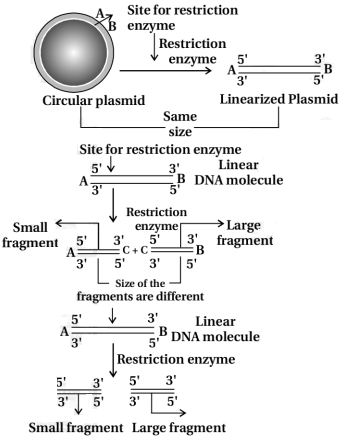
$A$ plasmid $DNA$ and a linear $DNA$ (both are of the same size) have one site for a restriction endonuclease. When cut and separated on agarose gel electrophoresis,the plasmid shows one $DNA$ band while the linear $DNA$ shows two fragments. Explain.
Solution
(N/A) The reason for this observation is the structural difference between the two $DNA$ molecules:
$1$. $A$ plasmid is a circular $DNA$ molecule. When it is cut with a restriction enzyme at a single site,it becomes linearized but remains a single continuous molecule. Therefore,it appears as a single band on the agarose gel.
$2$. $A$ linear $DNA$ molecule,when cut at a single site,is cleaved into two separate fragments. Since these fragments have different sizes,they appear as two distinct bands on the agarose gel.
Thus,the circular nature of the plasmid prevents fragmentation upon a single cut,whereas the linear $DNA$ is physically separated into two pieces.
$1$. $A$ plasmid is a circular $DNA$ molecule. When it is cut with a restriction enzyme at a single site,it becomes linearized but remains a single continuous molecule. Therefore,it appears as a single band on the agarose gel.
$2$. $A$ linear $DNA$ molecule,when cut at a single site,is cleaved into two separate fragments. Since these fragments have different sizes,they appear as two distinct bands on the agarose gel.
Thus,the circular nature of the plasmid prevents fragmentation upon a single cut,whereas the linear $DNA$ is physically separated into two pieces.
0 likes
View Solution243
MediumMCQ
$A$ plasmid without a selectable marker was chosen as a vector for cloning a gene. How does this affect the experiment?
A
The recombinant $DNA$ will not be formed.
B
The host cell will not be able to replicate the plasmid.
C
It will be difficult to identify and select the transformants from non-transformants.
D
The gene of interest will not be expressed.
Solution
(C) selectable marker is a gene that helps in identifying and eliminating non-transformants and selectively permitting the growth of the transformants.
If a plasmid lacks a selectable marker,it becomes impossible to distinguish between cells that have taken up the plasmid (transformants) and those that have not (non-transformants).
Therefore,the experiment is negatively affected because the researcher cannot isolate the successfully transformed host cells from the population.
If a plasmid lacks a selectable marker,it becomes impossible to distinguish between cells that have taken up the plasmid (transformants) and those that have not (non-transformants).
Therefore,the experiment is negatively affected because the researcher cannot isolate the successfully transformed host cells from the population.
0 likes
View Solution244
Medium
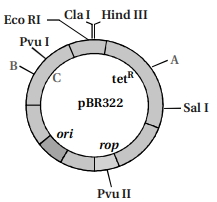
Identify the regions marked as $A$,$B$,and $C$ in the given diagram of the cloning vector $pBR322$.
Solution
(N/A) Based on the standard map of the cloning vector $pBR322$:
$A$ represents the restriction site for $Bam HI$.
$B$ represents the restriction site for $Pst I$.
$C$ represents the gene for ampicillin resistance,denoted as $amp^{R}$.
$A$ represents the restriction site for $Bam HI$.
$B$ represents the restriction site for $Pst I$.
$C$ represents the gene for ampicillin resistance,denoted as $amp^{R}$.
0 likes
View Solution245
Medium
Describe the role of Agrobacterium tumefaciens in transforming a plant cell.
Solution
(N/A) The tumor-inducing $(Ti)$ plasmid of $Agrobacterium$ $tumefaciens$ has been modified into a cloning vector. This modified plasmid is no longer pathogenic to plants but retains the ability to use its natural mechanism to deliver genes of interest into a variety of plant cells. This process is widely used in genetic engineering to create transgenic plants.
0 likes
View Solution246
Medium
Explain the 'cloning sites' in cloning vectors.
Solution
(N/A) $(iii)$ Cloning Sites: To link the alien $DNA$,the vector needs to have very few,preferably single,recognition sites for the commonly used restriction enzymes. Presence of more than one recognition site within the vector will generate several fragments,which will complicate the gene cloning process.
The ligation of alien $DNA$ is carried out at a restriction site present in one of the two antibiotic resistance genes. For example,you can ligate a foreign $DNA$ at the $BamHI$ site of the tetracycline resistance gene in the vector $pBR322$.
The recombinant plasmids will lose tetracycline resistance due to the insertion of foreign $DNA$,but can still be selected out from non-recombinant ones by plating the transformants on an ampicillin-containing medium.
The transformants growing on the ampicillin-containing medium are then transferred to a medium containing tetracycline. The recombinants will grow in the ampicillin-containing medium but not on that containing tetracycline. But non-recombinants will grow on the medium containing both the antibiotics.
In this case,one antibiotic resistance gene helps in selecting the transformants,whereas the other antibiotic resistance gene gets 'inactivated' due to the insertion of alien $DNA$,and helps in the selection of recombinants.
The ligation of alien $DNA$ is carried out at a restriction site present in one of the two antibiotic resistance genes. For example,you can ligate a foreign $DNA$ at the $BamHI$ site of the tetracycline resistance gene in the vector $pBR322$.
The recombinant plasmids will lose tetracycline resistance due to the insertion of foreign $DNA$,but can still be selected out from non-recombinant ones by plating the transformants on an ampicillin-containing medium.
The transformants growing on the ampicillin-containing medium are then transferred to a medium containing tetracycline. The recombinants will grow in the ampicillin-containing medium but not on that containing tetracycline. But non-recombinants will grow on the medium containing both the antibiotics.
In this case,one antibiotic resistance gene helps in selecting the transformants,whereas the other antibiotic resistance gene gets 'inactivated' due to the insertion of alien $DNA$,and helps in the selection of recombinants.
0 likes
View Solution247
MediumMCQ
Match the columns:
| Column-$I$ | Column-$II$ |
|---|---|
| $(a)$ Ligase | $(i)$ It removes nucleotides from $DNA$ ends. |
| $(b)$ Endonuclease | $(ii)$ Connects parts of $DNA$. |
| $(c)$ Exonuclease | $(iii)$ Removes phosphates from $DNA$. |
| $(d)$ $DNA$ Polymerase | $(iv)$ It produces sticky ends in $DNA$. |
| $(v)$ Useful for repeated amplification. |
A
$a-ii, b-iv, c-i, d-v$
B
$a-ii, b-i, c-iv, d-v$
C
$a-i, b-iv, c-ii, d-v$
D
$a-v, b-iv, c-i, d-ii$
Solution
(A) The correct matching is as follows:
$(a)$ Ligase: It acts as a molecular glue that connects parts of $DNA$ by forming phosphodiester bonds $(ii)$.
$(b)$ Endonuclease: These enzymes cut $DNA$ at specific internal sites,often producing sticky ends $(iv)$.
$(c)$ Exonuclease: These enzymes remove nucleotides one by one from the ends of $DNA$ molecules $(i)$.
$(d)$ $DNA$ Polymerase: This enzyme is essential for synthesizing new $DNA$ strands and is used in $PCR$ for repeated amplification of $DNA$ sequences $(v)$.
Therefore,the correct sequence is $(a-ii, b-iv, c-i, d-v)$.
$(a)$ Ligase: It acts as a molecular glue that connects parts of $DNA$ by forming phosphodiester bonds $(ii)$.
$(b)$ Endonuclease: These enzymes cut $DNA$ at specific internal sites,often producing sticky ends $(iv)$.
$(c)$ Exonuclease: These enzymes remove nucleotides one by one from the ends of $DNA$ molecules $(i)$.
$(d)$ $DNA$ Polymerase: This enzyme is essential for synthesizing new $DNA$ strands and is used in $PCR$ for repeated amplification of $DNA$ sequences $(v)$.
Therefore,the correct sequence is $(a-ii, b-iv, c-i, d-v)$.
0 likes
View Solution248
Medium
Name the five key tools for accomplishing the tasks of recombinant $DNA$ technology. Also mention the functions of each tool.
Solution
(N/A) The five key tools for recombinant $DNA$ technology are:
$1$. Restriction endonucleases: These enzymes are used to cut $DNA$ molecules at specific recognition sequences.
$2$. Gel electrophoresis: This technique is used for separating $DNA$ fragments based on their size and charge.
$3$. Ligase enzymes: These enzymes are used to join or ligate $DNA$ fragments to create recombinant $DNA$ molecules.
$4$. $DNA$ delivery systems: Methods such as electroporation,microinjection,and the gene gun method are used to introduce recombinant $DNA$ into host cells.
$5$. Competent host: Organisms like bacteria or yeast are used as hosts to take up and replicate the recombinant $DNA$.
$1$. Restriction endonucleases: These enzymes are used to cut $DNA$ molecules at specific recognition sequences.
$2$. Gel electrophoresis: This technique is used for separating $DNA$ fragments based on their size and charge.
$3$. Ligase enzymes: These enzymes are used to join or ligate $DNA$ fragments to create recombinant $DNA$ molecules.
$4$. $DNA$ delivery systems: Methods such as electroporation,microinjection,and the gene gun method are used to introduce recombinant $DNA$ into host cells.
$5$. Competent host: Organisms like bacteria or yeast are used as hosts to take up and replicate the recombinant $DNA$.
0 likes
View Solution249
EasyMCQ
The specific palindromic sequence which is recognized by $EcoRI$ is:
A
$5^{\prime}-GGATCC-3^{\prime}$
$3^{\prime}-CCTAGG-5^{\prime}$
$3^{\prime}-CCTAGG-5^{\prime}$
B
$5^{\prime}-GAATTC-3^{\prime}$
$3^{\prime}-CTTAAG-5^{\prime}$
$3^{\prime}-CTTAAG-5^{\prime}$
C
$5^{\prime}-GGAACC-3^{\prime}$
$3^{\prime}-CCTTGG-5^{\prime}$
$3^{\prime}-CCTTGG-5^{\prime}$
D
$5^{\prime}-CTTAAG-3^{\prime}$
$3^{\prime}-GAATTC-5^{\prime}$
$3^{\prime}-GAATTC-5^{\prime}$
Solution
(B) The restriction endonuclease $EcoRI$ recognizes the specific palindromic sequence $5^{\prime}-GAATTC-3^{\prime}$ and $3^{\prime}-CTTAAG-5^{\prime}$.
This sequence is read the same in both directions when the orientation of the strands is $5^{\prime}$ to $3^{\prime}$.
This sequence is read the same in both directions when the orientation of the strands is $5^{\prime}$ to $3^{\prime}$.
0 likes
View SolutionBiotechnology Principals and Process — Tools of recombinant DNA technology · Frequently Asked Questions
1Are these Biotechnology Principals and Process questions useful for JEE and NEET?
Yes. All questions in this section are mapped to JEE Main and NEET exam patterns. Previous year questions from JEE Main, NEET, GUJCET and state-level exams are included with full solutions.
2Can I switch to Hindi or Gujarati for these questions?
Yes. Use the language tabs in the hero section or the sidebar to view the same questions and solutions in English, Hindi or Gujarati.
3How do I generate a question paper from this subtopic?
Use the Vedclass Exam Paper Generator — select the chapter and subtopic, set difficulty, and generate Sets A, B, C, D automatically. First 3 chapters of every subject are free.
Vedclass Products
For Students
Vedclass Test Series
Mock tests in real JEE/NEET style with performance analysis. 5-day free trial.
Start Free TrialFor Teachers
Exam Paper Generator
Generate Set A/B/C/D papers from this chapter in 2 minutes. 3 chapters free.
Try FreeFor Institutes
Online Exam Module
Live online exams with unlimited students, 360° analytics & white-label branding.
See DemoFor Teachers & Institutes
Generate a Biotechnology Principals and Process Exam Paper in 2 Minutes
Select subtopic & difficulty — Sets A, B, C, D auto-generated with No Repeat logic.
First 3 chapters of every subject are free — no payment required.