
A English
Biotechnological Applications in Medicine Questions in English
Class 12 Biology · Biotechnology and its Application · Biotechnological Applications in Medicine
262+
Questions
English
Language
100%
With Solutions
Showing 50 of 262 questions in English
101
Medium
Name a recombinant vaccine that is currently being used in a vaccination program.
Solution
(N/A) The Hepatitis $B$ recombinant vaccine (e.g.,Engerix-$B$) is a widely used vaccine produced using recombinant $DNA$ technology. It is prepared by inserting the gene encoding the Hepatitis $B$ surface antigen $(HBsAg)$ into yeast cells,which then produce the antigen. This antigen is purified and used as a vaccine to induce an immune response against the Hepatitis $B$ virus.
0 likes
View Solution102
Medium
What are transgenic bacteria? Illustrate using any one example.
Solution
(N/A) Transgenic bacteria are those that contain a foreign gene intentionally introduced into their genome.
They are genetically manipulated to express a desirable gene for the production of various commercially important products.
An example of transgenic bacteria is $E. coli$. In the plasmid of $E. coli$,two $DNA$ sequences corresponding to the $A$ and $B$ chains of human insulin are inserted to produce the respective human insulin chains.
After the insertion of the insulin gene into the bacterium,it becomes transgenic and starts producing chains of human insulin.
Later,these chains are extracted from $E. coli$ and combined to form mature human insulin.
They are genetically manipulated to express a desirable gene for the production of various commercially important products.
An example of transgenic bacteria is $E. coli$. In the plasmid of $E. coli$,two $DNA$ sequences corresponding to the $A$ and $B$ chains of human insulin are inserted to produce the respective human insulin chains.
After the insertion of the insulin gene into the bacterium,it becomes transgenic and starts producing chains of human insulin.
Later,these chains are extracted from $E. coli$ and combined to form mature human insulin.
0 likes
View Solution103
Difficult
What is gene therapy? Illustrate using the example of adenosine deaminase $(ADA)$ deficiency.
Solution
(N/A) Gene therapy is a technique for correcting a defective gene through gene manipulation. It involves the delivery of a normal gene into the individual to replace the defective gene,for example,the introduction of the gene for adenosine deaminase $(ADA)$ in an $ADA$-deficient individual.
The adenosine deaminase enzyme is crucial for the normal functioning of the immune system. Individuals suffering from this disorder can be treated by the transplantation of bone marrow cells.
The process involves the following steps:
$1$. Extraction of lymphocytes from the patient's bone marrow.
$2$. Introduction of a functional $ADA$ gene into these lymphocytes using a retroviral vector.
$3$. Re-introduction of these genetically modified lymphocytes into the patient's bone marrow.
Once inside,the gene gets activated,producing functional $T$-lymphocytes and restoring the patient's immune system.
The adenosine deaminase enzyme is crucial for the normal functioning of the immune system. Individuals suffering from this disorder can be treated by the transplantation of bone marrow cells.
The process involves the following steps:
$1$. Extraction of lymphocytes from the patient's bone marrow.
$2$. Introduction of a functional $ADA$ gene into these lymphocytes using a retroviral vector.
$3$. Re-introduction of these genetically modified lymphocytes into the patient's bone marrow.
Once inside,the gene gets activated,producing functional $T$-lymphocytes and restoring the patient's immune system.
0 likes
View Solution104
Medium
Consult internet and find out how to make orally active protein pharmaceutical. What is the major problem to be encountered?
Solution
(N/A) Orally active protein pharmaceuticals involve the use of biologically active materials such as peptides,proteins,antibodies,or polymeric beads.
These are administered orally using specialized delivery systems like encapsulation in liposomes or the use of penetration enhancers to improve absorption.
The major problem encountered with oral administration is the degradation of these proteins by digestive enzymes.
Once ingested,the proteases present in the stomach and intestinal juices denature the protein structure,rendering them biologically inactive.
Therefore,to be effective,these therapeutic proteins must be protected from the harsh digestive environment,which is why many are currently administered via injection directly into the bloodstream or target tissues.
These are administered orally using specialized delivery systems like encapsulation in liposomes or the use of penetration enhancers to improve absorption.
The major problem encountered with oral administration is the degradation of these proteins by digestive enzymes.
Once ingested,the proteases present in the stomach and intestinal juices denature the protein structure,rendering them biologically inactive.
Therefore,to be effective,these therapeutic proteins must be protected from the harsh digestive environment,which is why many are currently administered via injection directly into the bloodstream or target tissues.
0 likes
View Solution105
Easy
Give information about the production of Genetically Engineered Insulin.
Solution
(N/A) Management of adult-onset diabetes is possible by taking insulin at regular time intervals.
Insulin used for diabetes was earlier extracted from the pancreas of slaughtered cattle and pigs.
Insulin from an animal source caused some patients to develop allergies or other types of reactions to the foreign protein.
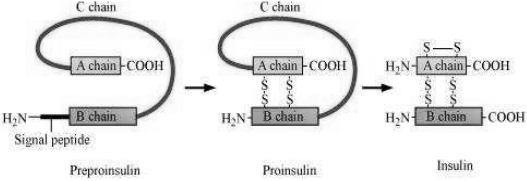
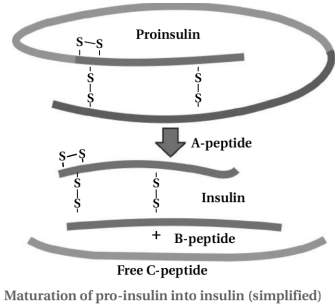
$\Rightarrow$ Insulin consists of two short polypeptide chains: chain $A$ and chain $B$.
Chain $A$ and chain $B$ are linked together by disulphide bridges.
In mammals,including humans,insulin is synthesized as a pro-hormone which contains an extra stretch called the $C$-peptide.
This $C$-peptide is not present in the mature insulin and is removed during maturation into insulin.
The main challenge for the production of insulin using $rDNA$ techniques was getting insulin assembled into a mature form.
In $1983$,Eli Lilly,an American company,prepared two $DNA$ sequences corresponding to $A$ and $B$ chains of human insulin and introduced them into plasmids of $E. coli$ to produce insulin chains. Chains $A$ and $B$ were produced separately,extracted,and combined by creating disulfide bonds to form human insulin.
Insulin used for diabetes was earlier extracted from the pancreas of slaughtered cattle and pigs.
Insulin from an animal source caused some patients to develop allergies or other types of reactions to the foreign protein.
$\Rightarrow$ Insulin consists of two short polypeptide chains: chain $A$ and chain $B$.
Chain $A$ and chain $B$ are linked together by disulphide bridges.
In mammals,including humans,insulin is synthesized as a pro-hormone which contains an extra stretch called the $C$-peptide.
This $C$-peptide is not present in the mature insulin and is removed during maturation into insulin.
The main challenge for the production of insulin using $rDNA$ techniques was getting insulin assembled into a mature form.
In $1983$,Eli Lilly,an American company,prepared two $DNA$ sequences corresponding to $A$ and $B$ chains of human insulin and introduced them into plasmids of $E. coli$ to produce insulin chains. Chains $A$ and $B$ were produced separately,extracted,and combined by creating disulfide bonds to form human insulin.
0 likes
View Solution106
Medium
How is gene therapy useful for the treatment of various diseases?
Solution
(N/A) Gene therapy is a technique used to treat hereditary diseases by correcting a gene defect that has been diagnosed in a child or embryo.
In this process,functional genes are inserted into a person's cells and tissues to treat the underlying cause of a disease.
The first clinical gene therapy was administered in $1990$ to a $4$-year-old girl suffering from adenosine deaminase $(ADA)$ deficiency. This enzyme is crucial for the proper functioning of the immune system,and the disorder is caused by the deletion of the gene responsible for producing it.
While $ADA$ deficiency can sometimes be treated by bone marrow transplantation or enzyme replacement therapy (where functional $ADA$ is injected),these methods are not completely curative.
As a step toward permanent gene therapy,lymphocytes from the patient's blood are grown in a culture outside the body.
$A$ functional $ADA$-$cDNA$ is then introduced into these lymphocytes using a retroviral vector,and the modified cells are returned to the patient. Since these cells are not immortal,the patient requires periodic infusions of these genetically engineered lymphocytes.
However,if the gene isolated from marrow cells producing $ADA$ is introduced into cells at early embryonic stages,it could provide a permanent cure.
In this process,functional genes are inserted into a person's cells and tissues to treat the underlying cause of a disease.
The first clinical gene therapy was administered in $1990$ to a $4$-year-old girl suffering from adenosine deaminase $(ADA)$ deficiency. This enzyme is crucial for the proper functioning of the immune system,and the disorder is caused by the deletion of the gene responsible for producing it.
While $ADA$ deficiency can sometimes be treated by bone marrow transplantation or enzyme replacement therapy (where functional $ADA$ is injected),these methods are not completely curative.
As a step toward permanent gene therapy,lymphocytes from the patient's blood are grown in a culture outside the body.
$A$ functional $ADA$-$cDNA$ is then introduced into these lymphocytes using a retroviral vector,and the modified cells are returned to the patient. Since these cells are not immortal,the patient requires periodic infusions of these genetically engineered lymphocytes.
However,if the gene isolated from marrow cells producing $ADA$ is introduced into cells at early embryonic stages,it could provide a permanent cure.
0 likes
View Solution107
Medium
Explain the molecular diagnosis methods for the diagnosis of diseases.
Solution
(N/A) For effective treatment of a disease,early diagnosis and understanding its pathophysiology are very important.
Recombinant $DNA$ technology,$PCR$ (Polymerase Chain Reaction),and $ELISA$ (Enzyme-Linked Immunosorbent Assay) are some of the techniques that serve the purpose of early diagnosis.
Presence of a pathogen (bacteria,viruses,etc.) is normally suspected only when the pathogen has produced disease symptoms.
However,a very low concentration of bacteria or viruses can be detected by the amplification of their nucleic acid by $PCR$.
$PCR$ is now routinely used to detect $HIV$ in suspected $AIDS$ patients. It is also used to detect mutations in genes in suspected cancer patients. It is a powerful technique to identify many other genetic disorders.
In another method,a single-stranded $DNA$ or $RNA$ tagged with a radioactive molecule (probe) is allowed to hybridize to its complementary $DNA$ in a clone of cells,followed by detection using autoradiography.
The clone having the mutated gene will not appear on the photographic film because the probe will not have complementarity with the mutated gene.
$ELISA$ is based on the principle of antigen-antibody interaction.
Infection by a pathogen can be detected by the presence of antigens (proteins,glycoproteins,etc.) or by detecting the antibodies synthesized against the pathogen.
Recombinant $DNA$ technology,$PCR$ (Polymerase Chain Reaction),and $ELISA$ (Enzyme-Linked Immunosorbent Assay) are some of the techniques that serve the purpose of early diagnosis.
Presence of a pathogen (bacteria,viruses,etc.) is normally suspected only when the pathogen has produced disease symptoms.
However,a very low concentration of bacteria or viruses can be detected by the amplification of their nucleic acid by $PCR$.
$PCR$ is now routinely used to detect $HIV$ in suspected $AIDS$ patients. It is also used to detect mutations in genes in suspected cancer patients. It is a powerful technique to identify many other genetic disorders.
In another method,a single-stranded $DNA$ or $RNA$ tagged with a radioactive molecule (probe) is allowed to hybridize to its complementary $DNA$ in a clone of cells,followed by detection using autoradiography.
The clone having the mutated gene will not appear on the photographic film because the probe will not have complementarity with the mutated gene.
$ELISA$ is based on the principle of antigen-antibody interaction.
Infection by a pathogen can be detected by the presence of antigens (proteins,glycoproteins,etc.) or by detecting the antibodies synthesized against the pathogen.
0 likes
View Solution108
Easy
Give scientific reasons: In earlier times,insulin was extracted from the pancreas of slaughtered cattle.
Solution
(N/A) Insulin is a hormone produced by the $\beta$-cells of the pancreas that regulates blood glucose levels. In the human body,it is produced in limited quantities. Before the advent of modern biotechnology,there was no method to synthesize human insulin in large quantities. Therefore,to treat patients suffering from diabetes,insulin was extracted from the pancreas of slaughtered cattle and pigs. However,this insulin often caused allergic reactions in some patients because it was not identical to human insulin.
0 likes
View Solution109
Medium
Differentiate between diagnostics and therapeutics. Give one example for each category.
Solution
(N/A) Diagnostics refer to techniques used to identify the presence,cause,and nature of a disease. Example: $ELISA$ (Enzyme-Linked Immunosorbent Assay) is a diagnostic test used to detect $HIV$ infection.
Therapeutics refer to agents or methods used in the treatment and management of a disease. Example: Antibiotics are therapeutic agents used to treat bacterial infections.
Therapeutics refer to agents or methods used in the treatment and management of a disease. Example: Antibiotics are therapeutic agents used to treat bacterial infections.
0 likes
View Solution110
Medium
Many proteins are secreted in their inactive form. This is also true of many toxic proteins produced by microorganisms. Explain how this mechanism is useful for the organism producing the toxin?
Solution
(N/A) Many proteins,including certain toxins,are secreted in their inactive form (pro-toxins). They become activated only when exposed to a specific trigger,such as a specific $pH$ level,temperature,or enzymatic cleavage. This mechanism is highly advantageous to the microorganism producing the toxin because it prevents the toxin from damaging or killing the host cell itself. By keeping the protein inactive until it reaches the target environment,the organism ensures its own survival while effectively targeting its prey or competitors.
0 likes
View Solution111
Easy
How was insulin obtained before the advent of $rDNA$ technology? What were the problems encountered?
Solution
(N/A) Before the advent of $rDNA$ technology,insulin used for the treatment of diabetes was extracted from the pancreas of slaughtered cattle and pigs.
The major problem encountered was that insulin obtained from animal sources was not identical to human insulin.
Because it was a foreign protein,it caused some patients to develop allergies or other types of immune reactions.
The major problem encountered was that insulin obtained from animal sources was not identical to human insulin.
Because it was a foreign protein,it caused some patients to develop allergies or other types of immune reactions.
0 likes
View Solution112
Medium
What is a recombinant $DNA$ vaccine? Give two examples.
Solution
(N/A) recombinant vaccine is a vaccine produced through recombinant $DNA$ technology. This involves inserting the $DNA$ encoding an antigen that stimulates an immune response into bacterial or mammalian cells. Recombinant $DNA$ technology has allowed the production of antigenic polypeptides of pathogens in bacteria or yeast. Vaccines produced using this approach allow large-scale production and hence greater availability for immunization. Examples include:
$1$. Hepatitis $B$ vaccine (e.g.,$Recombivax$ $HB$) produced from yeast.
$2$. Japanese encephalitis vaccine (e.g.,$IMOJEV$) which is a $DNA$ vaccine.
$1$. Hepatitis $B$ vaccine (e.g.,$Recombivax$ $HB$) produced from yeast.
$2$. Japanese encephalitis vaccine (e.g.,$IMOJEV$) which is a $DNA$ vaccine.
0 likes
View Solution113
Medium
Give the full form of $CT$ and $MRI$. How are they different from each other? Where are they used?
Solution
(N/A) $CT$ stands for Computed Tomography and $MRI$ stands for Magnetic Resonance Imaging.
Differences:
$1$. $CT$ scan uses $X$-rays (ionizing radiation) to generate images,whereas $MRI$ uses strong magnetic fields and non-ionizing radio waves.
$2$. $CT$ is generally faster and better for bone imaging,while $MRI$ provides superior contrast for soft tissues.
Uses:
$1$. $CT$ is used to detect internal injuries,tumors,and diseases of the brain,chest,and abdomen.
$2$. $MRI$ is used to accurately detect pathological and physiological changes in soft tissues,such as tumors,muscular disorders,and internal hemorrhages.
Differences:
$1$. $CT$ scan uses $X$-rays (ionizing radiation) to generate images,whereas $MRI$ uses strong magnetic fields and non-ionizing radio waves.
$2$. $CT$ is generally faster and better for bone imaging,while $MRI$ provides superior contrast for soft tissues.
Uses:
$1$. $CT$ is used to detect internal injuries,tumors,and diseases of the brain,chest,and abdomen.
$2$. $MRI$ is used to accurately detect pathological and physiological changes in soft tissues,such as tumors,muscular disorders,and internal hemorrhages.
0 likes
View Solution114
Medium
Who was the first patient who was given gene therapy? Why was the given treatment recurrent in nature?
Solution
(A) The first patient to receive gene therapy was a $4$-year-old girl named Ashanti DeSilva.
She was suffering from Adenosine Deaminase $(ADA)$ deficiency.
This enzyme is crucial for the proper functioning of the immune system.
The disorder is caused by the deletion of the gene responsible for producing Adenosine Deaminase.
In some children,$ADA$ deficiency can be cured by bone marrow transplantation; in others,it can be treated by enzyme replacement therapy,where functional $ADA$ is administered via injection.
However,both these approaches are not completely curative.
As a first step towards gene therapy,lymphocytes from the patient's blood are grown in a culture outside the body.
$A$ functional $ADA$ $cDNA$ (using a retroviral vector) is then introduced into these lymphocytes,which are subsequently returned to the patient.
Since these cells are not immortal,the patient requires periodic infusion of such genetically engineered lymphocytes.
If the gene isolated from marrow cells producing $ADA$ is introduced into cells at early embryonic stages,it could provide a permanent cure.
Process flow:
$1$. Through cloning,several $ADA$ gene copies are produced.
$2$. The viral genes are replaced by $ADA$ genes in the modified retrovirus.
$3$. From the bone marrow of the patient,lymphocytes are obtained and cultured in vitro.
$4$. These lymphocytes are infected by recombinant retroviruses.
$5$. $ADA$ gene is expressed in these infected lymphocytes.
$6$. Infected lymphocytes are injected back into the patient's body.
$7$. $ADA$ gene is expressed,and the deficiency is partially corrected.
She was suffering from Adenosine Deaminase $(ADA)$ deficiency.
This enzyme is crucial for the proper functioning of the immune system.
The disorder is caused by the deletion of the gene responsible for producing Adenosine Deaminase.
In some children,$ADA$ deficiency can be cured by bone marrow transplantation; in others,it can be treated by enzyme replacement therapy,where functional $ADA$ is administered via injection.
However,both these approaches are not completely curative.
As a first step towards gene therapy,lymphocytes from the patient's blood are grown in a culture outside the body.
$A$ functional $ADA$ $cDNA$ (using a retroviral vector) is then introduced into these lymphocytes,which are subsequently returned to the patient.
Since these cells are not immortal,the patient requires periodic infusion of such genetically engineered lymphocytes.
If the gene isolated from marrow cells producing $ADA$ is introduced into cells at early embryonic stages,it could provide a permanent cure.
Process flow:
$1$. Through cloning,several $ADA$ gene copies are produced.
$2$. The viral genes are replaced by $ADA$ genes in the modified retrovirus.
$3$. From the bone marrow of the patient,lymphocytes are obtained and cultured in vitro.
$4$. These lymphocytes are infected by recombinant retroviruses.
$5$. $ADA$ gene is expressed in these infected lymphocytes.
$6$. Infected lymphocytes are injected back into the patient's body.
$7$. $ADA$ gene is expressed,and the deficiency is partially corrected.
0 likes
View Solution115
MediumMCQ
$ELISA$ technique is based on the principles of antigen-antibody interaction. Can this technique be used in the molecular diagnosis of a genetic disorder,such as phenylketonuria?
A
Yes,it can be used to detect the presence of the specific enzyme protein.
B
No,it is only used for viral infections.
C
No,it cannot detect genetic disorders.
D
Yes,it can be used to detect the gene directly.
Solution
(A) Yes. $ELISA$ (Enzyme-Linked Immunosorbent Assay) is based on the principle of antigen-antibody interaction.
In the case of phenylketonuria,the disorder is caused by the deficiency of the enzyme phenylalanine hydroxylase.
One can develop an $ELISA$-based diagnostic technique using antibodies specific to this enzyme protein.
If the enzyme protein is absent in the patient's sample,the $ELISA$ test will yield a negative result compared to a normal individual who possesses the enzyme.
In the case of phenylketonuria,the disorder is caused by the deficiency of the enzyme phenylalanine hydroxylase.
One can develop an $ELISA$-based diagnostic technique using antibodies specific to this enzyme protein.
If the enzyme protein is absent in the patient's sample,the $ELISA$ test will yield a negative result compared to a normal individual who possesses the enzyme.
0 likes
View Solution116
MediumMCQ
How is a mature,functional insulin hormone different from its prohormone form?
A
The prohormone contains an extra $C$-peptide chain.
B
The mature insulin contains an extra $C$-peptide chain.
C
The prohormone is shorter than the mature insulin.
D
There is no difference between the two forms.
Solution
(A) Insulin is synthesized as a prohormone (pro-insulin),which contains an extra stretch of amino acids called the $C$-peptide.
This $C$-peptide is not present in the mature,functional insulin hormone.
During the maturation process,the $C$-peptide is removed,and the remaining $A$ and $B$ polypeptide chains are linked by disulfide bridges to form the active hormone.
The main challenge in the production of insulin using $rDNA$ technology was getting the two chains assembled into a mature,functional form.
This $C$-peptide is not present in the mature,functional insulin hormone.
During the maturation process,the $C$-peptide is removed,and the remaining $A$ and $B$ polypeptide chains are linked by disulfide bridges to form the active hormone.
The main challenge in the production of insulin using $rDNA$ technology was getting the two chains assembled into a mature,functional form.
0 likes
View Solution117
Medium
Gene therapy is an attempt to correct a genetic defect by providing a normal gene into the individual. By this,the normal function can be restored. An alternate method would be to provide the gene product (protein/enzyme) known as enzyme replacement therapy,which would also restore the function. Which in your opinion is a better option? Give reason for your answer.
Solution
(A) Gene therapy is considered a better option because it aims to cure the patient completely by introducing a functional gene into the individual's cells,allowing the body to produce the required protein or enzyme naturally. In contrast,enzyme replacement therapy is a temporary solution that requires regular administration of the gene product (protein/enzyme),making it a lifelong and often costly treatment.
0 likes
View Solution118
Medium
$A$ patient is suffering from $ADA$ deficiency. Can he be cured? How?
Solution
(N/A) Yes,a patient suffering from $ADA$ deficiency can be treated. $ADA$ deficiency is caused by the deletion of the gene for adenosine deaminase,which is essential for the immune system.
$1$. Bone Marrow Transplantation: In some children,the disease can be cured by transplanting healthy bone marrow.
$2$. Enzyme Replacement Therapy: Functional $ADA$ enzyme is injected into the patient. However,this is not a permanent cure as it requires repeated administration.
$3$. Gene Therapy: This is the most promising approach. Lymphocytes from the patient's blood are grown in a culture outside the body. $A$ functional $ADA$ $cDNA$ is introduced into these lymphocytes using a retroviral vector. These genetically engineered cells are then returned to the patient. Since these cells are not immortal,periodic infusions are required. $A$ permanent cure is possible if the gene is introduced into cells at early embryonic stages.
$1$. Bone Marrow Transplantation: In some children,the disease can be cured by transplanting healthy bone marrow.
$2$. Enzyme Replacement Therapy: Functional $ADA$ enzyme is injected into the patient. However,this is not a permanent cure as it requires repeated administration.
$3$. Gene Therapy: This is the most promising approach. Lymphocytes from the patient's blood are grown in a culture outside the body. $A$ functional $ADA$ $cDNA$ is introduced into these lymphocytes using a retroviral vector. These genetically engineered cells are then returned to the patient. Since these cells are not immortal,periodic infusions are required. $A$ permanent cure is possible if the gene is introduced into cells at early embryonic stages.
0 likes
View Solution119
Medium
List the disadvantages of insulin obtained from the pancreas of slaughtered cows and pigs.
Solution
(N/A) $(i)$ Insulin,being a hormone,is produced in very small amounts in the body. Hence,many animals need to be slaughtered to obtain even small quantities of insulin,making the cost very high due to the demand being much higher than the supply.
$(ii)$ The slaughtering of animals for medical purposes is considered unethical by many.
$(iii)$ There is a potential for an immune response in humans against the administered animal-derived insulin.
$(iv)$ There is a possibility that the slaughtered animals may be infested with infectious microorganisms,which could contaminate the insulin.
$(v)$ This type of insulin may cause allergic reactions in some patients.
$(ii)$ The slaughtering of animals for medical purposes is considered unethical by many.
$(iii)$ There is a potential for an immune response in humans against the administered animal-derived insulin.
$(iv)$ There is a possibility that the slaughtered animals may be infested with infectious microorganisms,which could contaminate the insulin.
$(v)$ This type of insulin may cause allergic reactions in some patients.
0 likes
View Solution120
Easy
List the advantages of recombinant insulin.
Solution
(N/A) $1$. Ethical Advantage: There is no need to sacrifice animals (cattle and pigs) to extract insulin,which was the traditional method.
$2$. Reduced Immunogenicity: Insulin extracted from animals often caused allergies or immune reactions in patients due to the presence of foreign proteins. Recombinant human insulin is identical to natural human insulin,minimizing these reactions.
$3$. Purity and Availability: Recombinant $DNA$ technology allows for the mass production of pure human insulin in $E. coli$,ensuring a consistent supply and reducing the risk of contamination.
$4$. Cost-Effectiveness: While initial development was complex,the large-scale production of Humulin is efficient and cost-effective compared to the extraction process from animal pancreases.
$2$. Reduced Immunogenicity: Insulin extracted from animals often caused allergies or immune reactions in patients due to the presence of foreign proteins. Recombinant human insulin is identical to natural human insulin,minimizing these reactions.
$3$. Purity and Availability: Recombinant $DNA$ technology allows for the mass production of pure human insulin in $E. coli$,ensuring a consistent supply and reducing the risk of contamination.
$4$. Cost-Effectiveness: While initial development was complex,the large-scale production of Humulin is efficient and cost-effective compared to the extraction process from animal pancreases.
0 likes
View Solution121
Medium
Match the columns:
| Column-$I$ | Column-$II$ |
|---|---|
| $(1)$ Diabetes | $(a)$ $ADA$ |
| $(2)$ Enzyme replacement therapy | $(b)$ Alpha-lactalbumin |
| $(3)$ Emphysema | $(c)$ Insulin |
| $(4)$ Rosie cow | $(d)$ $\alpha-1$-Antitrypsin |
| $(e)$ Typhoid |
Solution
(C) The correct matches are as follows:
$(1)$ Diabetes is treated using $(c)$ Insulin.
$(2)$ Enzyme replacement therapy is used for $(a)$ $ADA$ (Adenosine Deaminase) deficiency.
$(3)$ Emphysema is treated using $(d)$ $\alpha-1$-Antitrypsin.
$(4)$ Rosie cow is a transgenic cow that produces $(b)$ Alpha-lactalbumin enriched milk.
Therefore,the correct sequence is $(1-c), (2-a), (3-d), (4-b)$.
$(1)$ Diabetes is treated using $(c)$ Insulin.
$(2)$ Enzyme replacement therapy is used for $(a)$ $ADA$ (Adenosine Deaminase) deficiency.
$(3)$ Emphysema is treated using $(d)$ $\alpha-1$-Antitrypsin.
$(4)$ Rosie cow is a transgenic cow that produces $(b)$ Alpha-lactalbumin enriched milk.
Therefore,the correct sequence is $(1-c), (2-a), (3-d), (4-b)$.
0 likes
View Solution122
Medium
What are recombinant $DNA$ vaccines? Give two examples of such vaccines. Discuss their advantages.
Solution
(N/A) recombinant vaccine is a vaccine produced through recombinant $DNA$ technology.
This involves inserting the $DNA$ encoding an antigen that stimulates an immune response into bacterial or mammalian cells.
Recombinant $DNA$ technology has allowed the production of antigenic polypeptides of pathogens in bacteria or yeast.
Vaccines produced using this approach allow large-scale production and hence greater availability for immunization,e.g.,Hepatitis $B$ vaccine (Recombivax $HB$) produced from yeast.
Another example is the Japanese encephalitis vaccine $(IMOJEV)$,which is a recombinant live-attenuated vaccine.
Advantages of recombinant $DNA$ vaccines:
$(1)$ There is no risk of infection as they do not contain live pathogens.
$(2)$ Ease of development and large-scale production.
$(3)$ High stability for storage and shipping.
$(4)$ Cost-effective compared to traditional methods.
$(5)$ Efficient expression and purification of recombinant proteins.
$(6)$ Long-term persistence of the immunogen in the body.
$(7)$ In vivo expression ensures the protein closely resembles the normal eukaryotic structure,including necessary post-translational modifications.
This involves inserting the $DNA$ encoding an antigen that stimulates an immune response into bacterial or mammalian cells.
Recombinant $DNA$ technology has allowed the production of antigenic polypeptides of pathogens in bacteria or yeast.
Vaccines produced using this approach allow large-scale production and hence greater availability for immunization,e.g.,Hepatitis $B$ vaccine (Recombivax $HB$) produced from yeast.
Another example is the Japanese encephalitis vaccine $(IMOJEV)$,which is a recombinant live-attenuated vaccine.
Advantages of recombinant $DNA$ vaccines:
$(1)$ There is no risk of infection as they do not contain live pathogens.
$(2)$ Ease of development and large-scale production.
$(3)$ High stability for storage and shipping.
$(4)$ Cost-effective compared to traditional methods.
$(5)$ Efficient expression and purification of recombinant proteins.
$(6)$ Long-term persistence of the immunogen in the body.
$(7)$ In vivo expression ensures the protein closely resembles the normal eukaryotic structure,including necessary post-translational modifications.
0 likes
View Solution123
EasyMCQ
Which of the following statements is not correct?
A
Genetically engineered insulin is produced in $E. coli$.
B
In humans,insulin is synthesized as a proinsulin.
C
The proinsulin has an extra peptide called $C-peptide$.
D
The functional insulin has $A$ and $B$ chains linked together by hydrogen bonds.
Solution
(D) The correct statement is that functional insulin has $A$ and $B$ chains linked together by disulfide bonds,not hydrogen bonds.
Proinsulin consists of $A$,$B$,and $C$ peptides.
During maturation,the $C-peptide$ is removed to form functional insulin.
Therefore,the statement claiming that chains are linked by hydrogen bonds is incorrect.
Proinsulin consists of $A$,$B$,and $C$ peptides.
During maturation,the $C-peptide$ is removed to form functional insulin.
Therefore,the statement claiming that chains are linked by hydrogen bonds is incorrect.
0 likes
View Solution124
MediumMCQ
Which of the following statements is $NOT$ correct?
A
Insulin in humans is synthesized as proinsulin.
B
Proinsulin contains an extra peptide called the $C$-peptide.
C
Active insulin consists of $A$ and $B$ chains linked together by hydrogen bonds.
D
Genetically engineered insulin is produced in $E. coli$.
Solution
(C) In humans,insulin is synthesized as a precursor called proinsulin,which contains an extra stretch called the $C$-peptide. This $C$-peptide is removed during the maturation of proinsulin into mature insulin. Mature insulin consists of two short polypeptide chains,chain $A$ and chain $B$,which are linked together by disulfide bridges,not hydrogen bonds. Therefore,the statement that they are linked by hydrogen bonds is incorrect.
0 likes
View Solution125
MediumMCQ
The vaccine for Hepatitis-$B$ is produced from ...... by ...... .
A
Yeast, $r-DNA$ technology
B
Bacteria, recombinant $DNA$ technology
C
Virus, passive immunity
D
Bacteria, $CDRI$
Solution
(A) The vaccine for Hepatitis-$B$ is a second-generation vaccine.
It is produced using recombinant $DNA$ technology.
In this process, the gene encoding the Hepatitis-$B$ surface antigen $(HBsAg)$ is inserted into yeast cells $(Saccharomyces \text{ } cerevisiae)$.
The yeast cells then produce the antigen, which is purified and used as a vaccine.
It is produced using recombinant $DNA$ technology.
In this process, the gene encoding the Hepatitis-$B$ surface antigen $(HBsAg)$ is inserted into yeast cells $(Saccharomyces \text{ } cerevisiae)$.
The yeast cells then produce the antigen, which is purified and used as a vaccine.
1 likes
View Solution126
MediumMCQ
Which therapy can be used to treat the genetic disorder $S.C.I.D.$?
A
$ADA$ enzyme replacement therapy
B
Gene therapy
C
Reducing the number of thymocytes
D
Both $A$ and $B$
Solution
(D) $S.C.I.D.$ stands for Severe Combined Immunodeficiency,which is caused by a deficiency of the enzyme Adenosine Deaminase $(ADA)$.
Treatment options for $S.C.I.D.$ include:
$1$. $ADA$ enzyme replacement therapy: In this method,the functional $ADA$ enzyme is injected into the patient.
$2$. Gene therapy: In this method,lymphocytes from the patient's blood are grown in a culture,and a functional $ADA$ $cDNA$ is introduced into these lymphocytes using a retroviral vector,which are then returned to the patient.
Since both methods are valid treatments,the correct option is $D$.
Treatment options for $S.C.I.D.$ include:
$1$. $ADA$ enzyme replacement therapy: In this method,the functional $ADA$ enzyme is injected into the patient.
$2$. Gene therapy: In this method,lymphocytes from the patient's blood are grown in a culture,and a functional $ADA$ $cDNA$ is introduced into these lymphocytes using a retroviral vector,which are then returned to the patient.
Since both methods are valid treatments,the correct option is $D$.
0 likes
View Solution127
MediumMCQ
Which of the following is used for gene transfer in animals?
A
Retroviruses
B
$Ti$ plasmid
C
$pBR322$
D
Bacteriophage
Solution
(A) Retroviruses have the ability to transform normal cells into cancerous cells. In biotechnology,these viruses are disarmed (made non-pathogenic) and used as vectors to deliver desirable genes into animal cells. $Ti$ plasmid is used for plants,while $pBR322$ is a cloning vector for bacteria.
0 likes
View Solution128
MediumMCQ
In the $RNAi$ method,what is the source of the complementary double-stranded $RNA$?
A
Bacteria containing $DNA$ genomes and transposons
B
Mycobacteria containing $RNA$ genomes and transposons
C
Fungi containing $DNA$ genomes and transposons
D
Viruses containing $RNA$ genomes and transposons
Solution
(D) $RNA$ interference $(RNAi)$ is a cellular defense mechanism used by eukaryotic organisms to protect against viral infections and transposons.
In this process,the source of the complementary double-stranded $RNA$ $(dsRNA)$ is typically the replication of $RNA$ viruses or the transcription of mobile genetic elements known as transposons.
These $dsRNA$ molecules are processed into small interfering $RNA$ $(siRNA)$ molecules,which then guide the silencing of specific target genes.
In this process,the source of the complementary double-stranded $RNA$ $(dsRNA)$ is typically the replication of $RNA$ viruses or the transcription of mobile genetic elements known as transposons.
These $dsRNA$ molecules are processed into small interfering $RNA$ $(siRNA)$ molecules,which then guide the silencing of specific target genes.
0 likes
View Solution129
MediumMCQ
At present,about $X$ recombinant therapeutics have been approved for human use the world over. Out of these,$Y$ are being marketed in India.
A
$X=30, Y=12$
B
$X=28, Y=22$
C
$X=40, Y=20$
D
$X=32, Y=22$
Solution
(A) According to the $NCERT$ textbook for Class $12$ Biology,Chapter $12$ (Biotechnology and its Applications),there are about $30$ recombinant therapeutics that have been approved for human use the world over. Out of these,$12$ are presently being marketed in India. Therefore,$X=30$ and $Y=12$.
0 likes
View Solution130
MediumMCQ
From which organism was insulin extracted in earlier times?
A
Bacteria
B
Plants
C
Pigs
D
Horses
Solution
(C) In earlier times,insulin used for the treatment of human diabetes was extracted from the pancreas of slaughtered cattle and pigs. This insulin was known as animal insulin. However,it often caused allergic reactions or other complications in some patients because it was not identical to human insulin. Later,recombinant $DNA$ technology was used to produce human insulin $(Humulin)$ in $E. coli$ bacteria.
0 likes
View Solution131
MediumMCQ
Which company first produced human insulin?
A
Eli Lilly
B
Intas
C
Pfizer
D
Unison
Solution
(A) In $1983$,the American company $Eli \ Lilly$ successfully produced human insulin using recombinant $DNA$ technology.
They prepared two $DNA$ sequences corresponding to $A$ and $B$ chains of human insulin and introduced them in plasmids of $E. \ coli$ to produce insulin chains.
These chains were then extracted and combined by creating disulfide bonds to form mature human insulin.
They prepared two $DNA$ sequences corresponding to $A$ and $B$ chains of human insulin and introduced them in plasmids of $E. \ coli$ to produce insulin chains.
These chains were then extracted and combined by creating disulfide bonds to form mature human insulin.
0 likes
View Solution132
MediumMCQ
How many polypeptide chains is human insulin composed of?
A
One
B
Two
C
Three
D
Four
Solution
(B) Human insulin consists of two short polypeptide chains: chain $A$ and chain $B$.
These two chains are linked together by disulfide bridges.
In its pro-insulin form,it contains an extra stretch called the $C$-peptide,which is removed during maturation to form mature insulin.
These two chains are linked together by disulfide bridges.
In its pro-insulin form,it contains an extra stretch called the $C$-peptide,which is removed during maturation to form mature insulin.
0 likes
View Solution133
MediumMCQ
Which country's company first produced human insulin?
A
Australia
B
America
C
India
D
Russia
Solution
(B) The first genetically engineered human insulin,known as $Humulin$,was produced by the American company $Eli \ Lilly$ and $Company$ in $1983$. This was achieved by inserting the $DNA$ sequences corresponding to the $A$ and $B$ chains of human insulin into $E. \ coli$ plasmids to produce the insulin chains separately,which were then combined to form the functional hormone.
0 likes
View Solution134
MediumMCQ
What side effect was observed in some patients due to the use of animal-derived insulin?
A
Allergy
B
Poor digestion
C
Infertility
D
Heart attack
Solution
(A) Historically,insulin used for diabetes was extracted from the pancreas of slaughtered cattle and pigs.
Some patients developed allergies or other types of reactions to this foreign protein because it was not identical to human insulin.
This led to the development of recombinant $DNA$ technology to produce human insulin in bacteria,which is identical to the insulin produced by the human pancreas.
Some patients developed allergies or other types of reactions to this foreign protein because it was not identical to human insulin.
This led to the development of recombinant $DNA$ technology to produce human insulin in bacteria,which is identical to the insulin produced by the human pancreas.
0 likes
View Solution135
MediumMCQ
In which year did the company Eli Lilly prepare two $DNA$ sequences corresponding to $A$ and $B$ chains of human insulin?
A
$1892$
B
$1992$
C
$1880$
D
$1983$
Solution
(D) In $1983$, the American company Eli Lilly prepared two $DNA$ sequences corresponding to $A$ and $B$ chains of human insulin.
These sequences were introduced into plasmids of $Escherichia \text{ } coli$ to produce insulin chains.
These chains were then extracted and combined by creating disulfide bonds to form human insulin.
These sequences were introduced into plasmids of $Escherichia \text{ } coli$ to produce insulin chains.
These chains were then extracted and combined by creating disulfide bonds to form human insulin.
0 likes
View Solution136
EasyMCQ
Which type of bond connects the $A$ and $B$ chains of human insulin?
A
Phosphodiester bond
B
Glycosidic bond
C
Disulfide bond
D
Hydrophobic bond
Solution
(C) Human insulin consists of two short polypeptide chains: chain $A$ and chain $B$.
These two chains are linked together by disulfide bridges (disulfide bonds).
In the pro-insulin form,these chains are connected by a $C$-peptide,which is removed during maturation to form mature insulin.
Therefore,the correct answer is disulfide bond.
These two chains are linked together by disulfide bridges (disulfide bonds).
In the pro-insulin form,these chains are connected by a $C$-peptide,which is removed during maturation to form mature insulin.
Therefore,the correct answer is disulfide bond.
0 likes
View Solution137
MediumMCQ
In what form is human insulin synthesized,and what does it contain?
A
Proinsulin and $B$-peptide
B
Propeptide and $A$-peptide
C
Proinsulin and $C$-peptide
D
Proenzyme and $D$-peptide
Solution
(C) Human insulin is synthesized as a pro-hormone called proinsulin.
Proinsulin consists of three chains: $A$,$B$,and $C$.
The $C$-peptide is an extra stretch of amino acids that is present in proinsulin but is removed during the maturation process to form mature,functional insulin.
Therefore,proinsulin contains the $A$ and $B$ chains linked by disulfide bonds,along with the $C$-peptide.
Proinsulin consists of three chains: $A$,$B$,and $C$.
The $C$-peptide is an extra stretch of amino acids that is present in proinsulin but is removed during the maturation process to form mature,functional insulin.
Therefore,proinsulin contains the $A$ and $B$ chains linked by disulfide bonds,along with the $C$-peptide.
0 likes
View Solution138
EasyMCQ
In $1983$, Eli Lilly, an American company, prepared two $DNA$ sequences corresponding to $A$ and $B$ chains of human insulin and introduced them in plasmids of which organism to produce insulin chains?
A
Human
B
Pig
C
Escherichia coli
D
Virus
Solution
(C) In $1983$, the American company Eli Lilly produced human insulin by using recombinant $DNA$ technology. They prepared two $DNA$ sequences corresponding to the $A$ and $B$ chains of human insulin and introduced them into the plasmids of $Escherichia$ $coli$ $(E. coli)$ to produce insulin chains. These chains were then extracted and combined by creating disulfide bonds to form human insulin.
0 likes
View Solution139
MediumMCQ
What is absent in mature insulin?
A
$A$-chain
B
$C$-peptide
C
$B$-chain
D
Disulfide bonds
Solution
(B) Insulin is synthesized in the pancreas as a pro-hormone,which contains an extra stretch called the $C$-peptide.
During the maturation process,this $C$-peptide is removed to form mature insulin.
Therefore,mature insulin consists of only the $A$-chain and $B$-chain linked together by disulfide bonds,and it lacks the $C$-peptide.
During the maturation process,this $C$-peptide is removed to form mature insulin.
Therefore,mature insulin consists of only the $A$-chain and $B$-chain linked together by disulfide bonds,and it lacks the $C$-peptide.
0 likes
View Solution140
MediumMCQ
Which of the following is used for the treatment of genetic disorders?
A
Gene therapy
B
Antibiotics
C
$ELISA$
D
Vaccines
Solution
(A) Gene therapy is a technique that modifies a person's genes to treat or cure disease. It is specifically designed to correct defective genes responsible for genetic disorders.
$ELISA$ is a diagnostic tool used to detect antibodies or antigens.
Antibiotics are used to treat bacterial infections.
Vaccines are used to prevent infectious diseases.
Therefore,gene therapy is the correct method for treating genetic disorders.
$ELISA$ is a diagnostic tool used to detect antibodies or antigens.
Antibiotics are used to treat bacterial infections.
Vaccines are used to prevent infectious diseases.
Therefore,gene therapy is the correct method for treating genetic disorders.
0 likes
View Solution141
MediumMCQ
When and on whom was the first clinical gene therapy experiment performed?
A
$1880$,a four-year-old girl
B
$1990$,a four-year-old boy
C
$1880$,a four-year-old boy
D
$1990$,a four-year-old girl
Solution
(D) The first clinical gene therapy was given in $1990$ to a $4$-year-old girl with adenosine deaminase $(ADA)$ deficiency.
This deficiency causes Severe Combined Immunodeficiency $(SCID)$,which results in a lack of functional $T$-lymphocytes.
The treatment involved collecting lymphocytes from the patient's blood,growing them in a culture,and introducing a functional $ADA$ cDNA into these lymphocytes using a retroviral vector.
These modified cells were then returned to the patient's body.
This deficiency causes Severe Combined Immunodeficiency $(SCID)$,which results in a lack of functional $T$-lymphocytes.
The treatment involved collecting lymphocytes from the patient's blood,growing them in a culture,and introducing a functional $ADA$ cDNA into these lymphocytes using a retroviral vector.
These modified cells were then returned to the patient's body.
0 likes
View Solution142
MediumMCQ
The first clinical gene therapy was given in $1990$ to a $4$-year-old girl for the treatment of which disease?
A
Adenosine Deaminase $(ADA)$ deficiency
B
Cancer
C
Sickle cell anemia
D
Tuberculosis
Solution
(A) The first clinical gene therapy was performed in $1990$ on a $4$-year-old girl suffering from Adenosine Deaminase $(ADA)$ deficiency.
$ADA$ enzyme is crucial for the proper functioning of the immune system.
In this therapy,lymphocytes from the patient's blood were grown in a culture outside the body.
$A$ functional $ADA$ $cDNA$ was then introduced into these lymphocytes using a retroviral vector.
These genetically engineered lymphocytes were subsequently returned to the patient's body.
Since these cells are not immortal,the patient requires periodic infusion of such genetically engineered lymphocytes.
$ADA$ enzyme is crucial for the proper functioning of the immune system.
In this therapy,lymphocytes from the patient's blood were grown in a culture outside the body.
$A$ functional $ADA$ $cDNA$ was then introduced into these lymphocytes using a retroviral vector.
These genetically engineered lymphocytes were subsequently returned to the patient's body.
Since these cells are not immortal,the patient requires periodic infusion of such genetically engineered lymphocytes.
0 likes
View Solution143
MediumMCQ
What is the full form of $ADA$?
A
Adenine dioxygenase
B
Adenosine deaminase
C
Aspartate decarboxylase
D
Acetyl coenzyme $A$ decarboxylase
Solution
(B) $ADA$ stands for Adenosine deaminase.
It is an enzyme involved in purine metabolism.
$A$ deficiency in this enzyme leads to Severe Combined Immunodeficiency $(SCID)$, a condition where the immune system is severely compromised.
It is an enzyme involved in purine metabolism.
$A$ deficiency in this enzyme leads to Severe Combined Immunodeficiency $(SCID)$, a condition where the immune system is severely compromised.
0 likes
View Solution144
MediumMCQ
Which of the following methods,other than gene therapy,has been used for the treatment of $ADA$ deficiency?
A
Bone marrow transplantation
B
Enzyme replacement therapy
C
$ELISA$
D
Both $A$ and $B$
Solution
(D) Adenosine deaminase $(ADA)$ deficiency is a genetic disorder caused by the deletion of the gene for adenosine deaminase.
For patients who cannot be cured by gene therapy,two other methods are commonly used:
$1$. Bone marrow transplantation: This involves replacing the patient's defective bone marrow with healthy bone marrow from a donor.
$2$. Enzyme replacement therapy: In this method,functional $ADA$ is injected into the patient.
Therefore,both bone marrow transplantation and enzyme replacement therapy are valid treatment methods for $ADA$ deficiency.
For patients who cannot be cured by gene therapy,two other methods are commonly used:
$1$. Bone marrow transplantation: This involves replacing the patient's defective bone marrow with healthy bone marrow from a donor.
$2$. Enzyme replacement therapy: In this method,functional $ADA$ is injected into the patient.
Therefore,both bone marrow transplantation and enzyme replacement therapy are valid treatment methods for $ADA$ deficiency.
0 likes
View Solution145
MediumMCQ
In gene therapy,which cells of the patient are cultured?
A
Lymphocytes
B
Red blood cells
C
Basophils
D
Eosinophils
Solution
(A) Gene therapy is a technique used to correct a genetic defect that has been diagnosed in a child or embryo.
In the first clinical gene therapy trial conducted in $1990$ for Adenosine Deaminase $(ADA)$ deficiency,lymphocytes were extracted from the patient's blood.
These lymphocytes were grown in a culture medium outside the body.
$A$ functional $ADA$ cDNA was then introduced into these lymphocytes using a retroviral vector.
Finally,these genetically engineered lymphocytes were returned to the patient.
Therefore,the correct answer is Lymphocytes.
In the first clinical gene therapy trial conducted in $1990$ for Adenosine Deaminase $(ADA)$ deficiency,lymphocytes were extracted from the patient's blood.
These lymphocytes were grown in a culture medium outside the body.
$A$ functional $ADA$ cDNA was then introduced into these lymphocytes using a retroviral vector.
Finally,these genetically engineered lymphocytes were returned to the patient.
Therefore,the correct answer is Lymphocytes.
0 likes
View Solution146
MediumMCQ
Which of the following is used as a vector in gene therapy?
A
Agrobacterium tumefaciens
B
$pBR322$ plasmid
C
Retrovirus
D
Bacteriophage
Solution
(C) Gene therapy involves the introduction of a functional gene into a patient's cells to correct a genetic disorder.
Retroviruses are commonly used as vectors in gene therapy because they have the ability to infect host cells and integrate their genetic material into the host genome.
By modifying the retrovirus to remove its pathogenic genes and inserting the therapeutic gene,it can effectively deliver the desired gene into the target cells.
Therefore,the correct option is $C$.
Retroviruses are commonly used as vectors in gene therapy because they have the ability to infect host cells and integrate their genetic material into the host genome.
By modifying the retrovirus to remove its pathogenic genes and inserting the therapeutic gene,it can effectively deliver the desired gene into the target cells.
Therefore,the correct option is $C$.
0 likes
View Solution147
MediumMCQ
In which therapeutic method is the functional $ADA-cDNA$ introduced into the patient's lymphocytes?
A
Bone marrow transplantation
B
Enzyme replacement therapy
C
Gene therapy
D
Vaccination
Solution
(C) Gene therapy is a collection of methods that allows correction of a gene defect that has been diagnosed in a child or embryo. In the case of Adenosine Deaminase $(ADA)$ deficiency,the first clinical gene therapy was given in $1990$ to a $4$-year-old girl. In this method,lymphocytes from the blood of the patient are grown in a culture outside the body. $A$ functional $ADA-cDNA$ (using a retroviral vector) is then introduced into these lymphocytes,which are subsequently returned to the patient. Since these cells are not immortal,the patient requires periodic infusion of such genetically engineered lymphocytes.
0 likes
View Solution148
MediumMCQ
In which treatment method is functional $ADA$ (Adenosine Deaminase) injected into the patient via a syringe?
A
Bone marrow transplantation
B
Enzyme replacement therapy
C
Gene therapy
D
Vaccination
Solution
(B) Enzyme replacement therapy is a medical treatment where a missing or deficient enzyme is replaced in a patient.
In the case of $ADA$ deficiency (which causes Severe Combined Immunodeficiency or $SCID$),the patient is treated by injecting functional $ADA$ enzyme directly into the body via a syringe.
However,this method is not curative and requires periodic injections of the enzyme.
In the case of $ADA$ deficiency (which causes Severe Combined Immunodeficiency or $SCID$),the patient is treated by injecting functional $ADA$ enzyme directly into the body via a syringe.
However,this method is not curative and requires periodic injections of the enzyme.
0 likes
View Solution149
MediumMCQ
Choose the correct option regarding $ELISA$.
A
Enterokinase Linked Immunoglobulin Sorbent Assay
B
Enzyme Linked Immunosorbent Assay
C
Extra Linked Immunoassay
D
Alzheimer Linked Immunoglobulin Sorbent Assay
Solution
(B) $ELISA$ stands for $Enzyme-Linked Immunosorbent Assay$.
It is a diagnostic technique based on the principle of antigen-antibody interaction.
In this method,an enzyme is linked to an antibody or antigen,and the reaction is detected by the change in color produced by the enzyme's action on a specific substrate.
It is widely used for the detection of infections like $HIV$ and other pathogens.
It is a diagnostic technique based on the principle of antigen-antibody interaction.
In this method,an enzyme is linked to an antibody or antigen,and the reaction is detected by the change in color produced by the enzyme's action on a specific substrate.
It is widely used for the detection of infections like $HIV$ and other pathogens.
0 likes
View Solution150
MediumMCQ
What does the conventional method of diagnosis include?
A
$r-DNA$ technology
B
Polymerase Chain Reaction $(PCR)$
C
Enzyme-Linked Immunosorbent Assay $(ELISA)$
D
Serum and urine analysis
Solution
(D) Conventional methods of diagnosis include serum and urine analysis to detect the presence of pathogens or disease markers.
Modern diagnostic techniques,such as $r-DNA$ technology,$PCR$,and $ELISA$,allow for early detection of diseases,which is not always possible with conventional methods.
Modern diagnostic techniques,such as $r-DNA$ technology,$PCR$,and $ELISA$,allow for early detection of diseases,which is not always possible with conventional methods.
0 likes
View SolutionBiotechnology and its Application — Biotechnological Applications in Medicine · Frequently Asked Questions
1Are these Biotechnology and its Application questions useful for JEE and NEET?
Yes. All questions in this section are mapped to JEE Main and NEET exam patterns. Previous year questions from JEE Main, NEET, GUJCET and state-level exams are included with full solutions.
2Can I switch to Hindi or Gujarati for these questions?
Yes. Use the language tabs in the hero section or the sidebar to view the same questions and solutions in English, Hindi or Gujarati.
3How do I generate a question paper from this subtopic?
Use the Vedclass Exam Paper Generator — select the chapter and subtopic, set difficulty, and generate Sets A, B, C, D automatically. First 3 chapters of every subject are free.
Vedclass Products
For Students
Vedclass Test Series
Mock tests in real JEE/NEET style with performance analysis. 5-day free trial.
Start Free TrialFor Teachers
Exam Paper Generator
Generate Set A/B/C/D papers from this chapter in 2 minutes. 3 chapters free.
Try FreeFor Institutes
Online Exam Module
Live online exams with unlimited students, 360° analytics & white-label branding.
See DemoFor Teachers & Institutes
Generate a Biotechnology and its Application Exam Paper in 2 Minutes
Select subtopic & difficulty — Sets A, B, C, D auto-generated with No Repeat logic.
First 3 chapters of every subject are free — no payment required.