
A English
Biotechnological Applications in Medicine Questions in English
Class 12 Biology · Biotechnology and its Application · Biotechnological Applications in Medicine
262+
Questions
English
Language
100%
With Solutions
Showing 50 of 262 questions in English
201
EasyMCQ
Which of the following genetically engineered microbes is used in the scavenging of oil spills by digesting hydrocarbons of crude oil?
A
Pseudomonas fluorescens
B
Rhizobium meliloti
C
Pseudomonas putida
D
Trichoderma
Solution
(C) $Pseudomonas \text{ } putida$ is a genetically engineered bacterium, often referred to as a "super bug".
It possesses the unique ability to break down complex hydrocarbons found in crude oil.
This property makes it highly effective in the bioremediation of oil spills in marine and terrestrial environments.
It possesses the unique ability to break down complex hydrocarbons found in crude oil.
This property makes it highly effective in the bioremediation of oil spills in marine and terrestrial environments.
0 likes
View Solution202
MediumMCQ
An example of gene therapy is
A
Production of antibodies and vaccines in transgenic plants like banana and tomato
B
Delay in flower senescence and fruit ripening in Flavr Savr transgenic tomatoes which have longer shelf life
C
Introduction of the gene for the synthesis of $ADA$ (adenosine deaminase) into a person suffering with $SCID$
D
Transfer of nitrogen fixing genes ($nif$ genes) into plants that are unable to fix atmospheric nitrogen,example cereals
Solution
(C) Gene therapy is a technique that modifies a person's genes to treat or cure disease.
Option $(A)$ refers to the production of edible vaccines using transgenic plants.
Option $(B)$ refers to the use of antisense $RNA$ technology to delay ripening.
Option $(C)$ is the correct example of gene therapy,where a functional gene for $ADA$ (adenosine deaminase) is introduced into the cells of a patient suffering from $SCID$ (Severe Combined Immunodeficiency) to replace the defective gene.
Option $(D)$ refers to the genetic modification of crops for nitrogen fixation.
Option $(A)$ refers to the production of edible vaccines using transgenic plants.
Option $(B)$ refers to the use of antisense $RNA$ technology to delay ripening.
Option $(C)$ is the correct example of gene therapy,where a functional gene for $ADA$ (adenosine deaminase) is introduced into the cells of a patient suffering from $SCID$ (Severe Combined Immunodeficiency) to replace the defective gene.
Option $(D)$ refers to the genetic modification of crops for nitrogen fixation.
0 likes
View Solution203
MediumMCQ
Eli Lilly,an American company,is famous for:
A
Producing $GH$ (growth hormone) synthesized by recombinant $DNA$ technology
B
Preparing two $DNA$ sequences corresponding to $A$ and $B$ chains of human insulin and introducing them into the plasmids of $E. coli$ to produce insulin chains
C
Producing pest-resistant plants by $RNA$ interference
D
Producing vitamin $A$ enriched rice
Solution
(B) In $1983$,Eli Lilly,an American company,prepared two $DNA$ sequences corresponding to $A$ and $B$ chains of human insulin.
These sequences were introduced into the plasmids of $E. coli$ to produce insulin chains.
These chains were then extracted and combined by creating disulfide bonds to form human insulin (Humulin).
These sequences were introduced into the plasmids of $E. coli$ to produce insulin chains.
These chains were then extracted and combined by creating disulfide bonds to form human insulin (Humulin).
0 likes
View Solution204
MediumMCQ
$A$: Recombinant $DNA$ technology is less effective in therapeutic drug production.
$R$: Recombinant therapeutics induce unwanted immunological responses.
$R$: Recombinant therapeutics induce unwanted immunological responses.
A
Assertion and Reason both are correct and Reason is the correct explanation of Assertion.
B
Assertion and Reason both are correct but Reason is not the correct explanation of Assertion.
C
Assertion is correct,but Reason is incorrect.
D
Both Assertion and Reason are incorrect.
Solution
(D) The Assertion is incorrect because recombinant $DNA$ technology has been highly effective in producing therapeutic drugs,such as human insulin.
The Reason is also incorrect because recombinant therapeutics are designed to be identical to human proteins,thereby minimizing or preventing unwanted immunological responses that were common with non-human derived therapeutics.
Therefore,both the Assertion and the Reason are incorrect.
The Reason is also incorrect because recombinant therapeutics are designed to be identical to human proteins,thereby minimizing or preventing unwanted immunological responses that were common with non-human derived therapeutics.
Therefore,both the Assertion and the Reason are incorrect.
0 likes
View Solution205
MediumMCQ
When a gene is targeted to correct a disease by amplifying the gene,what is this process called?
A
Biopiracy
B
Gene therapy
C
Molecular diagnosis
D
Safety testing
Solution
(B) Gene therapy is a collection of methods that allows correction of a gene defect that has been diagnosed in a child or embryo. Here,genes are inserted into a person's cells and tissues to treat a disease. Correction of a genetic defect involves the delivery of a normal gene into the individual or embryo to take over the function of and compensate for the non-functional gene.
0 likes
View Solution206
DifficultMCQ
With regard to insulin,choose the correct options.
$(a)$ $C$-peptide is not present in mature insulin.
$(b)$ The insulin produced by $rDNA$ technology has $C$-peptide.
$(c)$ The pro-insulin has $C$-peptide.
$(d)$ $A$-peptide and $B$-peptide of insulin are interconnected by disulphide bridges.
Choose the correct answer from the options given below.
$(a)$ $C$-peptide is not present in mature insulin.
$(b)$ The insulin produced by $rDNA$ technology has $C$-peptide.
$(c)$ The pro-insulin has $C$-peptide.
$(d)$ $A$-peptide and $B$-peptide of insulin are interconnected by disulphide bridges.
Choose the correct answer from the options given below.
A
$(b)$ and $(d)$ only
B
$(b)$ and $(c)$ only
C
$(a), (c)$ and $(d)$ only
D
$(a)$ and $(d)$ only
Solution
(C) $1$. Mature insulin consists of two short polypeptide chains,chain $A$ and chain $B$,that are linked together by disulphide bridges. Thus,statement $(d)$ is correct.
$2$. Insulin is synthesized as a pro-hormone (pro-insulin),which contains an extra stretch called the $C$-peptide. This $C$-peptide is removed during maturation into insulin. Thus,statement $(a)$ is correct and statement $(c)$ is correct.
$3$. The insulin produced by $rDNA$ technology (e.g.,Humulin) is synthesized as separate $A$ and $B$ chains in $E. coli$,which are then combined to form mature insulin. It does not contain the $C$-peptide. Thus,statement $(b)$ is incorrect.
$4$. Therefore,statements $(a), (c),$ and $(d)$ are correct.
$2$. Insulin is synthesized as a pro-hormone (pro-insulin),which contains an extra stretch called the $C$-peptide. This $C$-peptide is removed during maturation into insulin. Thus,statement $(a)$ is correct and statement $(c)$ is correct.
$3$. The insulin produced by $rDNA$ technology (e.g.,Humulin) is synthesized as separate $A$ and $B$ chains in $E. coli$,which are then combined to form mature insulin. It does not contain the $C$-peptide. Thus,statement $(b)$ is incorrect.
$4$. Therefore,statements $(a), (c),$ and $(d)$ are correct.
0 likes
View Solution207
MediumMCQ
The Adenosine deaminase deficiency results into:
A
Dysfunction of Immune system
B
Parkinson's disease
C
Digestive disorder
D
Addison's disease
Solution
(A) Adenosine deaminase $(ADA)$ is an enzyme that is crucial for the proper functioning of the immune system.
Deficiency of this enzyme leads to Severe Combined Immunodeficiency $(SCID)$.
In $SCID$,the body's immune system is unable to fight off infections effectively because the $T$-lymphocytes and $B$-lymphocytes do not function properly.
Therefore,$ADA$ deficiency results in the dysfunction of the immune system.
Deficiency of this enzyme leads to Severe Combined Immunodeficiency $(SCID)$.
In $SCID$,the body's immune system is unable to fight off infections effectively because the $T$-lymphocytes and $B$-lymphocytes do not function properly.
Therefore,$ADA$ deficiency results in the dysfunction of the immune system.
0 likes
View Solution208
Medium
Mention the importance of Recombinant $DNA$ technology in terms of vaccination.
Solution
(N/A) Recombinant $DNA$ technology has allowed the production of antigenic polypeptides of pathogens in bacteria or yeast.
Vaccines produced using this approach allow for large-scale production and,consequently,greater availability for immunization.
For example,the hepatitis $B$ vaccine is produced from yeast.
Vaccines produced using this approach allow for large-scale production and,consequently,greater availability for immunization.
For example,the hepatitis $B$ vaccine is produced from yeast.
0 likes
View Solution209
MediumMCQ
In gene therapy of Adenosine Deaminase $(ADA)$ deficiency,the patient requires periodic infusion of genetically engineered lymphocytes because
A
Gene isolated from marrow cells producing $ADA$ is introduced into cells at embryonic stages.
B
Lymphocytes from patient's blood are grown in culture,outside the body.
C
Genetically engineered lymphocytes are not immortal cells.
D
Retroviral vector is introduced into these lymphocytes.
Solution
(C) In gene therapy for $ADA$ deficiency,functional $ADA$ genes are introduced into the patient's lymphocytes.
These lymphocytes are cultured outside the body and then re-infused into the patient.
However,these genetically engineered lymphocytes are not immortal; they have a finite lifespan and eventually die.
Therefore,the patient requires periodic infusions of these cells to maintain the production of the $ADA$ enzyme.
These lymphocytes are cultured outside the body and then re-infused into the patient.
However,these genetically engineered lymphocytes are not immortal; they have a finite lifespan and eventually die.
Therefore,the patient requires periodic infusions of these cells to maintain the production of the $ADA$ enzyme.
0 likes
View Solution210
MediumMCQ
Statements related to human insulin are given below. Which statement$(s)$ is/are correct about genetically engineered insulin?
$(a)$ Pro-hormone insulin contains an extra stretch of $C$-peptide.
$(b)$ $A$-peptide and $B$-peptide chains of insulin were produced separately in $E. coli$,extracted,and combined by creating disulfide bonds between them.
$(c)$ Insulin used for treating diabetes was extracted from cattle and pigs.
$(d)$ Pro-hormone insulin needs to be processed for converting into a mature and functional hormone.
$(e)$ Some patients develop allergic reactions to the foreign insulin.
Choose the most appropriate answer from the options given below:
$(a)$ Pro-hormone insulin contains an extra stretch of $C$-peptide.
$(b)$ $A$-peptide and $B$-peptide chains of insulin were produced separately in $E. coli$,extracted,and combined by creating disulfide bonds between them.
$(c)$ Insulin used for treating diabetes was extracted from cattle and pigs.
$(d)$ Pro-hormone insulin needs to be processed for converting into a mature and functional hormone.
$(e)$ Some patients develop allergic reactions to the foreign insulin.
Choose the most appropriate answer from the options given below:
A
$(b)$ only
B
$(c)$ and $(d)$ only
C
$(c), (d)$ and $(e)$ only
D
$(a), (b)$ and $(d)$ only
Solution
(D) The correct answer is $(d)$.
$(a)$ Pro-insulin consists of $A$ and $B$ chains linked by a $C$-peptide. This is correct.
$(b)$ In genetically engineered insulin (Humulin),$A$ and $B$ chains are produced separately in $E. coli$ and linked by disulfide bonds. This is correct.
$(c)$ This statement describes the historical source of insulin,not the nature of genetically engineered insulin. While true as a historical fact,it is not a characteristic of the engineered product itself.
$(d)$ Pro-insulin must undergo processing (removal of $C$-peptide) to become mature insulin. This is correct.
$(e)$ This refers to the side effects of animal-derived insulin,not the nature of genetically engineered insulin.
Therefore,statements $(a), (b),$ and $(d)$ are the correct descriptions regarding the production and nature of genetically engineered insulin.
$(a)$ Pro-insulin consists of $A$ and $B$ chains linked by a $C$-peptide. This is correct.
$(b)$ In genetically engineered insulin (Humulin),$A$ and $B$ chains are produced separately in $E. coli$ and linked by disulfide bonds. This is correct.
$(c)$ This statement describes the historical source of insulin,not the nature of genetically engineered insulin. While true as a historical fact,it is not a characteristic of the engineered product itself.
$(d)$ Pro-insulin must undergo processing (removal of $C$-peptide) to become mature insulin. This is correct.
$(e)$ This refers to the side effects of animal-derived insulin,not the nature of genetically engineered insulin.
Therefore,statements $(a), (b),$ and $(d)$ are the correct descriptions regarding the production and nature of genetically engineered insulin.
0 likes
View Solution211
MediumMCQ
The vaccine for Hepatitis-$B$ is produced from ...........
A
Yeast
B
Bacteria
C
Virus
D
Animal
Solution
(A) The Hepatitis-$B$ vaccine is a recombinant $DNA$ vaccine.
It is produced using genetic engineering techniques.
The gene coding for the Hepatitis-$B$ surface antigen $(HBsAg)$ is inserted into the genome of yeast cells (typically $Saccharomyces$ $cerevisiae$).
These yeast cells then express the antigen, which is harvested and purified to create the vaccine.
Therefore, the correct source is yeast.
It is produced using genetic engineering techniques.
The gene coding for the Hepatitis-$B$ surface antigen $(HBsAg)$ is inserted into the genome of yeast cells (typically $Saccharomyces$ $cerevisiae$).
These yeast cells then express the antigen, which is harvested and purified to create the vaccine.
Therefore, the correct source is yeast.
0 likes
View Solution212
MediumMCQ
$MRI$ uses .......... .
A
Strong magnetic fields and ionizing radiations
B
Strong magnetic fields and non-ionizing radiations
C
Weak magnetic fields and ionizing radiations
D
Weak magnetic fields and non-ionizing radiations
Solution
(B) $MRI$ stands for Magnetic Resonance Imaging.
It utilizes strong magnetic fields and non-ionizing radiations (radio waves) to generate detailed images of the internal structures of the body.
Unlike $X$-rays or $CT$ scans,$MRI$ does not use ionizing radiation,making it a safer diagnostic tool for detecting pathological or physiological changes in living tissues.
It utilizes strong magnetic fields and non-ionizing radiations (radio waves) to generate detailed images of the internal structures of the body.
Unlike $X$-rays or $CT$ scans,$MRI$ does not use ionizing radiation,making it a safer diagnostic tool for detecting pathological or physiological changes in living tissues.
0 likes
View Solution213
EasyMCQ
Which types of genetically modified organisms are used in biotechnology for the industrial-scale production of biopharmaceuticals and biological products?
A
Microorganisms
B
Fungi
C
Plants and animals
D
All of the above
Solution
(D) Biotechnology involves the use of genetically modified organisms $(GMOs)$ to produce biological products on an industrial scale.
These organisms include microorganisms (like bacteria and yeast),fungi,and genetically modified plants and animals.
By manipulating the genetic material of these organisms,scientists can make them produce specific proteins,enzymes,hormones,or vaccines required for medical and industrial purposes.
Therefore,all the listed categories are used in modern biotechnology.
These organisms include microorganisms (like bacteria and yeast),fungi,and genetically modified plants and animals.
By manipulating the genetic material of these organisms,scientists can make them produce specific proteins,enzymes,hormones,or vaccines required for medical and industrial purposes.
Therefore,all the listed categories are used in modern biotechnology.
0 likes
View Solution214
EasyMCQ
At present,about ........ recombinant therapeutics have been approved for human use the world over. Out of these,........ are being marketed in India.
A
$30, 12$
B
$32, 10$
C
$40, 22$
D
$42, 20$
Solution
(A) According to the $NCERT$ textbook for Class $12$ Biology,Chapter $12$ (Biotechnology and its Applications),there are about $30$ recombinant therapeutics that have been approved for human use the world over.
Out of these,$12$ are presently being marketed in India.
Therefore,the correct option is $A$.
Out of these,$12$ are presently being marketed in India.
Therefore,the correct option is $A$.
0 likes
View Solution215
EasyMCQ
Which human medicine was the first to be produced using recombinant $DNA$ technology?
A
Insulin
B
Erythropoietin
C
Glucocorticoid
D
$ADA$ enzyme
Solution
(A) The first human medicine produced using recombinant $DNA$ technology is insulin. In $1983$,Eli Lilly,an American company,prepared two $DNA$ sequences corresponding to $A$ and $B$ chains of human insulin and introduced them in plasmids of $E. coli$ to produce insulin chains. These chains were then extracted and combined by creating disulfide bonds to form human insulin,known as Humulin.
0 likes
View Solution216
MediumMCQ
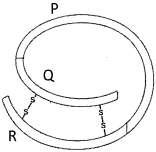
The given figure represents pro-insulin. Identify the $A, B$ and $C$ peptides corresponding to $P, Q$ and $R$ respectively.
A
$A$ peptide,$B$ peptide,$C$ peptide
B
$C$ peptide,$A$ peptide,$B$ peptide
C
$A$ peptide,$C$ peptide,$B$ peptide
D
$B$ peptide,$A$ peptide,$C$ peptide
Solution
(C) Pro-insulin is synthesized as a pro-hormone which contains an extra stretch called the $C$-peptide.
In the given figure,$P$ represents the $A$-peptide,$Q$ represents the $C$-peptide,and $R$ represents the $B$-peptide.
$A$ and $B$ peptides are linked together by disulfide bridges to form mature insulin,while the $C$-peptide is removed during maturation.
Therefore,the correct sequence is $A, C, B$.
In the given figure,$P$ represents the $A$-peptide,$Q$ represents the $C$-peptide,and $R$ represents the $B$-peptide.
$A$ and $B$ peptides are linked together by disulfide bridges to form mature insulin,while the $C$-peptide is removed during maturation.
Therefore,the correct sequence is $A, C, B$.
0 likes
View Solution217
EasyMCQ
Mature insulin does not contain ........
A
$A$-peptide
B
$B$-peptide
C
$C$-peptide
D
None of these
Solution
(C) Insulin is synthesized in the human body as a pro-hormone,which contains an extra stretch called the $C$-peptide.
During the maturation process,this $C$-peptide is removed from the pro-insulin to form mature insulin.
Therefore,mature insulin consists only of the $A$ and $B$ polypeptide chains linked by disulfide bridges,and it lacks the $C$-peptide.
During the maturation process,this $C$-peptide is removed from the pro-insulin to form mature insulin.
Therefore,mature insulin consists only of the $A$ and $B$ polypeptide chains linked by disulfide bridges,and it lacks the $C$-peptide.
0 likes
View Solution218
MediumMCQ
In the earlier times,the insulin used for diabetic patients was:
A
Extracted from the pancreas of slaughtered cattle and pigs.
B
Caused allergies in some patients due to the insulin obtained from animals.
C
Caused other reactions due to the foreign protein.
D
All of the above.
0 likes
View Solution219
EasyMCQ
In $1983$,an $.........$ company named $Eli$ $Lilly$ prepared two $DNA$ sequences corresponding to $A$ and $B$,chains of human insulin.
A
African company
B
Australian company
C
American company
D
Indian company
Solution
(C) In $1983$,the American company $Eli$ $Lilly$ produced two $DNA$ sequences corresponding to $A$ and $B$ chains of human insulin and introduced them in plasmids of $Escherichia$ $coli$ to produce insulin chains. These chains were then extracted and combined by creating disulfide bonds to form human insulin.
0 likes
View Solution220
EasyMCQ
The first clinical gene therapy was given in $1990$ to a $4$-year-old girl to treat deficiency of:
A
Insulin
B
Adenosine deaminase
C
Lactic dehydrogenase
D
Glutamate dehydrogenase
Solution
(B) The first clinical gene therapy was performed in $1990$ on a $4$-year-old girl suffering from Adenosine Deaminase $(ADA)$ deficiency.
$ADA$ deficiency is caused by the deletion of the gene for adenosine deaminase,which is crucial for the proper functioning of the immune system.
This condition leads to Severe Combined Immunodeficiency $(SCID)$,where the patient lacks functional $T$-lymphocytes.
Therefore,the correct option is $B$.
$ADA$ deficiency is caused by the deletion of the gene for adenosine deaminase,which is crucial for the proper functioning of the immune system.
This condition leads to Severe Combined Immunodeficiency $(SCID)$,where the patient lacks functional $T$-lymphocytes.
Therefore,the correct option is $B$.
0 likes
View Solution221
MediumMCQ
Which of the following treatments cannot completely cure $ADA$ deficiency?
A
Enzyme replacement therapy
B
Bone marrow transplantation
C
Gene therapy
D
Both $A$ and $B$
Solution
(A) $ADA$ deficiency (Adenosine Deaminase deficiency) is a genetic disorder caused by the deletion of the gene for adenosine deaminase.
$1$. Enzyme replacement therapy involves the periodic injection of functional $ADA$ into the patient. It does not provide a permanent cure because the patient's own cells do not produce the enzyme.
$2$. Bone marrow transplantation can be curative if performed early,but it is not always successful due to the difficulty in finding a suitable donor.
$3$. Gene therapy is considered a potential permanent cure because it involves introducing functional $ADA$ cDNA into the patient's lymphocytes,which are then cultured and returned to the patient.
Since enzyme replacement therapy requires repeated administration and is not a permanent cure,it is the primary answer in this context.
$1$. Enzyme replacement therapy involves the periodic injection of functional $ADA$ into the patient. It does not provide a permanent cure because the patient's own cells do not produce the enzyme.
$2$. Bone marrow transplantation can be curative if performed early,but it is not always successful due to the difficulty in finding a suitable donor.
$3$. Gene therapy is considered a potential permanent cure because it involves introducing functional $ADA$ cDNA into the patient's lymphocytes,which are then cultured and returned to the patient.
Since enzyme replacement therapy requires repeated administration and is not a permanent cure,it is the primary answer in this context.
0 likes
View Solution222
MediumMCQ
Identify the function of the enzyme Adenosine Deaminase $(ADA)$.
A
Maintains calcium levels in the blood.
B
Maintains blood sugar levels.
C
Essential for the immune system.
D
Maintains the normal metabolic rate in the body.
Solution
(C) Adenosine Deaminase $(ADA)$ is an enzyme that is crucial for the proper functioning of the immune system.
It is responsible for the breakdown of adenosine into deoxyadenosine in the body.
$A$ deficiency of this enzyme leads to a disorder known as Severe Combined Immunodeficiency $(SCID)$,which results in a lack of functional $T$-lymphocytes and $B$-lymphocytes,making the individual highly susceptible to infections.
Therefore,$ADA$ is essential for the immune system.
It is responsible for the breakdown of adenosine into deoxyadenosine in the body.
$A$ deficiency of this enzyme leads to a disorder known as Severe Combined Immunodeficiency $(SCID)$,which results in a lack of functional $T$-lymphocytes and $B$-lymphocytes,making the individual highly susceptible to infections.
Therefore,$ADA$ is essential for the immune system.
0 likes
View Solution223
MediumMCQ
Why are genetically engineered lymphocytes periodically introduced into the patient in the treatment of $ADA$ deficiency?
A
These cells have a short lifespan.
B
These cells are immortal.
C
The gene can be lost from these cells.
D
$A$ and $C$
Solution
(D) In the treatment of $ADA$ (Adenosine Deaminase) deficiency,lymphocytes are extracted from the patient's blood and a functional $ADA$ gene is introduced into them. These genetically engineered cells are not immortal and have a limited lifespan. Furthermore,over time,the introduced gene may be lost from these cells or the cells may die. Therefore,to provide continuous treatment,these genetically engineered lymphocytes must be periodically reintroduced into the patient's body. Thus,the correct option is $D$.
0 likes
View Solution224
MediumMCQ
How is a permanent cure for $ADA$ deficiency possible?
A
Enzyme replacement therapy
B
Bone marrow transplantation
C
Introducing $ADA$ producing genes into cells at early embryonic stages
D
All of the above
Solution
(C) The permanent cure for $ADA$ (Adenosine Deaminase) deficiency is gene therapy.
In this method,lymphocytes from the blood of the patient are grown in a culture outside the body.
$A$ functional $ADA$ $cDNA$ is then introduced into these lymphocytes using a retroviral vector.
These genetically engineered cells are then returned to the patient.
However,since these cells are not immortal,the patient requires periodic infusion of such genetically engineered lymphocytes.
If the gene isolate from marrow cells producing $ADA$ is introduced into cells at early embryonic stages,it could be a permanent cure.
In this method,lymphocytes from the blood of the patient are grown in a culture outside the body.
$A$ functional $ADA$ $cDNA$ is then introduced into these lymphocytes using a retroviral vector.
These genetically engineered cells are then returned to the patient.
However,since these cells are not immortal,the patient requires periodic infusion of such genetically engineered lymphocytes.
If the gene isolate from marrow cells producing $ADA$ is introduced into cells at early embryonic stages,it could be a permanent cure.
0 likes
View Solution225
MediumMCQ
$P -$ Methods capable of early diagnosis
$Q -$ Methods not capable of early diagnosis
$I - rDNA$ technology $\quad II -$ Serum analysis $\quad III - PCR$
$IV -$ Urine analysis $\quad V - ELISA$
Select the correct option for $P$ and $Q$.
$P\quad\quad Q$
$Q -$ Methods not capable of early diagnosis
$I - rDNA$ technology $\quad II -$ Serum analysis $\quad III - PCR$
$IV -$ Urine analysis $\quad V - ELISA$
Select the correct option for $P$ and $Q$.
$P\quad\quad Q$
A
$IV, V\quad I, II, III$
B
$II, IV\quad I, III, V$
C
$I, III, V\quad II, IV$
D
$I, II, III\quad IV, V$
Solution
(C) Early diagnosis is essential for the effective treatment of diseases. Conventional methods of diagnosis like serum and urine analysis generally do not detect diseases until symptoms become visible.
Modern molecular diagnostic techniques such as $rDNA$ technology,$PCR$ (Polymerase Chain Reaction),and $ELISA$ (Enzyme-Linked Immunosorbent Assay) allow for the early detection of pathogens and genetic disorders even before symptoms appear.
Therefore,$P$ (Early diagnosis) includes $I, III, V$ and $Q$ (Not capable of early diagnosis) includes $II, IV$.
Modern molecular diagnostic techniques such as $rDNA$ technology,$PCR$ (Polymerase Chain Reaction),and $ELISA$ (Enzyme-Linked Immunosorbent Assay) allow for the early detection of pathogens and genetic disorders even before symptoms appear.
Therefore,$P$ (Early diagnosis) includes $I, III, V$ and $Q$ (Not capable of early diagnosis) includes $II, IV$.
0 likes
View Solution226
EasyMCQ
.......... works on the principle of antigen-antibody interactions.
A
$PCR$
B
$ELISA$
C
Serum analysis
D
Both $A$ and $B$
Solution
(B) $ELISA$ (Enzyme-Linked Immunosorbent Assay) is a diagnostic technique that relies on the principle of antigen-antibody interactions.
In this method,the presence of a pathogen is detected by the presence of antigens (proteins,glycoproteins,etc.) or by detecting antibodies synthesized against the pathogen.
$PCR$ (Polymerase Chain Reaction) works on the principle of $DNA$ amplification,not antigen-antibody interaction.
In this method,the presence of a pathogen is detected by the presence of antigens (proteins,glycoproteins,etc.) or by detecting antibodies synthesized against the pathogen.
$PCR$ (Polymerase Chain Reaction) works on the principle of $DNA$ amplification,not antigen-antibody interaction.
0 likes
View Solution227
EasyMCQ
Which protein is used for the treatment of emphysema?
A
$ADA$ enzyme
B
Alpha-lactalbumin
C
Phenylalanine hydroxylase
D
$\alpha-1-$antitrypsin
Solution
(D) Emphysema is a chronic respiratory disorder caused by the deficiency of the protein $\alpha-1-$antitrypsin.
This protein inhibits the activity of elastase,an enzyme that breaks down the alveolar walls in the lungs.
In patients with emphysema,the lack of this inhibitor leads to the destruction of lung tissue.
Therefore,$\alpha-1-$antitrypsin is used as a therapeutic protein to treat this condition.
This protein inhibits the activity of elastase,an enzyme that breaks down the alveolar walls in the lungs.
In patients with emphysema,the lack of this inhibitor leads to the destruction of lung tissue.
Therefore,$\alpha-1-$antitrypsin is used as a therapeutic protein to treat this condition.
0 likes
View Solution228
MediumMCQ
Which one of the following techniques does not serve the purpose of early diagnosis of a disease for its early treatment?
A
Enzyme Linked Immuno-Sorbent Assay $(ELISA)$ technique
B
Serum and Urine analysis
C
Recombinant $DNA$ Technology
D
Polymerase Chain Reaction $(PCR)$ technique
Solution
(C) The correct answer is option $C$ because conventional methods of diagnosis,such as serum and urine analysis,are not sensitive enough to detect pathogens or diseases at very low concentrations,thus failing to aid in early diagnosis.
In contrast,modern molecular diagnostic techniques like Recombinant $DNA$ Technology,Polymerase Chain Reaction $(PCR)$,and Enzyme Linked Immuno-Sorbent Assay $(ELISA)$ are highly sensitive and specific,allowing for the detection of diseases long before symptoms appear,which is crucial for early treatment.
In contrast,modern molecular diagnostic techniques like Recombinant $DNA$ Technology,Polymerase Chain Reaction $(PCR)$,and Enzyme Linked Immuno-Sorbent Assay $(ELISA)$ are highly sensitive and specific,allowing for the detection of diseases long before symptoms appear,which is crucial for early treatment.
0 likes
View Solution229
MediumMCQ
Match List-$I$ with List-$II$:
Choose the correct answer from the options given below:
| List-$I$ | List-$II$ |
| $A. \alpha-1$ antitrypsin | $I. \text{Cotton bollworm}$ |
| $B. \text{Cry } IAb$ | $II. ADA \text{ deficiency}$ |
| $C. \text{Cry } IAc$ | $III. \text{Emphysema}$ |
| $D. \text{Enzyme replacement therapy}$ | $IV. \text{Corn borer}$ |
Choose the correct answer from the options given below:
A
$A-III, B-I, C-II, D-IV$
B
$A-III, B-IV, C-I, D-II$
C
$A-II, B-IV, C-I, D-III$
D
$A-II, B-I, C-IV, D-III$
Solution
(B) The correct matches are as follows:
$A. \alpha-1$ antitrypsin is a protein used to treat $III. \text{Emphysema}$.
$B. \text{Cry } IAb$ is a gene used to control $IV. \text{Corn borer}$.
$C. \text{Cry } IAc$ is a gene used to control $I. \text{Cotton bollworm}$.
$D. \text{Enzyme replacement therapy}$ is a treatment method used for $II. ADA \text{ deficiency}$.
Therefore, the correct sequence is $A-III, B-IV, C-I, D-II$.
$A. \alpha-1$ antitrypsin is a protein used to treat $III. \text{Emphysema}$.
$B. \text{Cry } IAb$ is a gene used to control $IV. \text{Corn borer}$.
$C. \text{Cry } IAc$ is a gene used to control $I. \text{Cotton bollworm}$.
$D. \text{Enzyme replacement therapy}$ is a treatment method used for $II. ADA \text{ deficiency}$.
Therefore, the correct sequence is $A-III, B-IV, C-I, D-II$.
0 likes
View Solution230
MediumMCQ
Which of the following genetically engineered organisms was used by Eli Lilly to prepare human insulin?
A
Bacterium
B
Yeast
C
Virus
D
Phage
Solution
(A) In $1983$, the American company Eli Lilly prepared two $DNA$ sequences corresponding to $A$ and $B$ chains of human insulin and introduced them in plasmids of $Escherichia \text{ } coli$ to produce insulin chains. $E. \text{ } coli$ is a bacterium. These chains were produced separately, extracted, and combined by creating disulfide bonds to form human insulin (Humulin).
0 likes
View Solution231
MediumMCQ
Why can't insulin be given orally to diabetic patients?
A
Human body will elicit strong immune response
B
It will be digested in Gastro-Intestinal $(GI)$ tract
C
Because of structural variation
D
Its bioavailability will be increased
Solution
(B) Insulin is a peptide hormone composed of amino acids.
When insulin is taken orally,it enters the digestive system where it is exposed to various proteolytic enzymes (such as pepsin and trypsin) in the stomach and small intestine.
These enzymes break down the peptide bonds of the insulin molecule,effectively digesting it into its constituent amino acids before it can be absorbed into the bloodstream.
Therefore,oral administration renders insulin ineffective,necessitating its delivery via injection.
When insulin is taken orally,it enters the digestive system where it is exposed to various proteolytic enzymes (such as pepsin and trypsin) in the stomach and small intestine.
These enzymes break down the peptide bonds of the insulin molecule,effectively digesting it into its constituent amino acids before it can be absorbed into the bloodstream.
Therefore,oral administration renders insulin ineffective,necessitating its delivery via injection.
0 likes
View Solution232
DifficultMCQ
How many of the following statements are correct?
$(i)$ Mature insulin is made up of $A, B$ and $C$ peptides.
$(ii)$ Removal of $C$-peptide helps in the maturation of insulin.
$(iii)$ In mature insulin,$C$-peptide is present.
$(iv)$ In insulin,chains $A$ and $B$ are linked by disulphide bonds.
$(i)$ Mature insulin is made up of $A, B$ and $C$ peptides.
$(ii)$ Removal of $C$-peptide helps in the maturation of insulin.
$(iii)$ In mature insulin,$C$-peptide is present.
$(iv)$ In insulin,chains $A$ and $B$ are linked by disulphide bonds.
A
$1$
B
$2$
C
$3$
D
$4$
Solution
(B) Statement $(i)$ is incorrect because mature insulin consists only of chain $A$ and chain $B$. The $C$-peptide is removed during maturation.
Statement $(ii)$ is correct. Proinsulin contains an extra stretch called the $C$-peptide,which is removed during the maturation process to form mature insulin.
Statement $(iii)$ is incorrect. Mature insulin does not contain the $C$-peptide.
Statement $(iv)$ is correct. The two polypeptide chains,$A$ and $B$,are linked together by disulphide bridges.
Therefore,only statements $(ii)$ and $(iv)$ are correct. The total number of correct statements is $2$.
Statement $(ii)$ is correct. Proinsulin contains an extra stretch called the $C$-peptide,which is removed during the maturation process to form mature insulin.
Statement $(iii)$ is incorrect. Mature insulin does not contain the $C$-peptide.
Statement $(iv)$ is correct. The two polypeptide chains,$A$ and $B$,are linked together by disulphide bridges.
Therefore,only statements $(ii)$ and $(iv)$ are correct. The total number of correct statements is $2$.
0 likes
View Solution233
MediumMCQ
Statement-$I$: At present,$30$ recombinant therapeutics have been approved for human use the world over.
Statement-$II$: Recombinant therapeutics do not induce unwanted immunological responses,as is common in the case of similar products isolated from non-human sources.
Choose the correct answer from the options given below:
Statement-$II$: Recombinant therapeutics do not induce unwanted immunological responses,as is common in the case of similar products isolated from non-human sources.
Choose the correct answer from the options given below:
A
Statement-$I$ and $II$ both are correct
B
Statement-$I$ and $II$ both are incorrect
C
Statement-$I$ is correct & Statement-$II$ is incorrect
D
Statement-$I$ is incorrect & Statement-$II$ is correct
Solution
(D) Statement-$I$ is incorrect because,as per the $NCERT$ textbook,there are about $30$ recombinant therapeutics that have been approved for human use the world over,not specifically in India.
Statement-$II$ is correct because recombinant $DNA$ technology allows for the production of human-identical proteins,which do not trigger the unwanted immunological responses often seen with proteins isolated from non-human sources (like animal-derived insulin).
Therefore,Statement-$I$ is incorrect and Statement-$II$ is correct.
Statement-$II$ is correct because recombinant $DNA$ technology allows for the production of human-identical proteins,which do not trigger the unwanted immunological responses often seen with proteins isolated from non-human sources (like animal-derived insulin).
Therefore,Statement-$I$ is incorrect and Statement-$II$ is correct.
0 likes
View Solution234
MediumMCQ
How many of the following statements are incorrect?
$I.$ Genes of Agrobacterium are used to produce humulin.
$II.$ Indian government has set up $\text{GEAC}$.
$III.$ $\alpha-1$-antitrypsin is used to treat $\text{PKU}$.
$IV.$ $\text{ELISA}$ serves the purpose of early diagnosis.
$V.$ Flavr-savr is a variety of pomato.
$I.$ Genes of Agrobacterium are used to produce humulin.
$II.$ Indian government has set up $\text{GEAC}$.
$III.$ $\alpha-1$-antitrypsin is used to treat $\text{PKU}$.
$IV.$ $\text{ELISA}$ serves the purpose of early diagnosis.
$V.$ Flavr-savr is a variety of pomato.
A
$1$
B
$2$
C
$3$
D
$4$
Solution
(C) Let us analyze each statement:
$I.$ Incorrect: Humulin (human insulin) is produced by inserting human insulin genes into $E. coli$,not $Agrobacterium$.
$II.$ Correct: The Indian government has set up the Genetic Engineering Approval Committee $(\text{GEAC})$ to make decisions regarding the validity of $GM$ research and the safety of introducing $GM$ organisms for public services.
$III.$ Incorrect: $\alpha-1$-antitrypsin is used to treat emphysema,not $\text{PKU}$ (Phenylketonuria).
$IV.$ Correct: $\text{ELISA}$ (Enzyme-Linked Immunosorbent Assay) is based on the principle of antigen-antibody interaction and is used for the early diagnosis of diseases.
$V.$ Incorrect: Flavr-savr is a genetically modified variety of tomato,not pomato.
Therefore,statements $I$,$III$,and $V$ are incorrect. The total number of incorrect statements is $3$.
$I.$ Incorrect: Humulin (human insulin) is produced by inserting human insulin genes into $E. coli$,not $Agrobacterium$.
$II.$ Correct: The Indian government has set up the Genetic Engineering Approval Committee $(\text{GEAC})$ to make decisions regarding the validity of $GM$ research and the safety of introducing $GM$ organisms for public services.
$III.$ Incorrect: $\alpha-1$-antitrypsin is used to treat emphysema,not $\text{PKU}$ (Phenylketonuria).
$IV.$ Correct: $\text{ELISA}$ (Enzyme-Linked Immunosorbent Assay) is based on the principle of antigen-antibody interaction and is used for the early diagnosis of diseases.
$V.$ Incorrect: Flavr-savr is a genetically modified variety of tomato,not pomato.
Therefore,statements $I$,$III$,and $V$ are incorrect. The total number of incorrect statements is $3$.
0 likes
View Solution235
MediumMCQ
Statement-$I$: In vitro fertilisation leading to a test tube baby is a part of biotechnology.
Statement-$II$: Developing a $\text{DNA}$ vaccine is a part of biotechnology.
Statement-$II$: Developing a $\text{DNA}$ vaccine is a part of biotechnology.
A
Both Statement $I$ and Statement $II$ are incorrect.
B
Statement $I$ is correct but Statement $II$ is incorrect.
C
Statement $I$ is incorrect but Statement $II$ is correct.
D
Both Statement $I$ and Statement $II$ are correct.
Solution
(D) Biotechnology is defined as the integration of natural science and organisms,cells,parts thereof,and molecular analogues for products and services.
Statement-$I$ is correct: In vitro fertilisation $(IVF)$ involves the manipulation of gametes and embryos outside the body,which falls under the scope of biotechnology.
Statement-$II$ is correct: The development of $\text{DNA}$ vaccines involves genetic engineering techniques to introduce specific genetic material into the body to trigger an immune response,which is a core application of biotechnology.
Therefore,both statements are correct.
Statement-$I$ is correct: In vitro fertilisation $(IVF)$ involves the manipulation of gametes and embryos outside the body,which falls under the scope of biotechnology.
Statement-$II$ is correct: The development of $\text{DNA}$ vaccines involves genetic engineering techniques to introduce specific genetic material into the body to trigger an immune response,which is a core application of biotechnology.
Therefore,both statements are correct.
0 likes
View Solution236
MediumMCQ
Which enzyme was targeted during the first clinical gene therapy given in $1990$ to a $4$ year old girl?
A
Monoamine oxidase
B
Tyrosine oxidase
C
Adenosine deaminase
D
Pyruvate dehydrogenase
Solution
(C) The first clinical gene therapy was given in $1990$ to a $4$-year-old girl suffering from Adenosine Deaminase $(ADA)$ deficiency.
$ADA$ deficiency is caused by the deletion of the gene for adenosine deaminase.
This enzyme is crucial for the proper functioning of the immune system.
In this therapy,lymphocytes from the patient's blood were grown in a culture outside the body,and a functional $ADA$ $cDNA$ was introduced into these lymphocytes,which were then returned to the patient.
$ADA$ deficiency is caused by the deletion of the gene for adenosine deaminase.
This enzyme is crucial for the proper functioning of the immune system.
In this therapy,lymphocytes from the patient's blood were grown in a culture outside the body,and a functional $ADA$ $cDNA$ was introduced into these lymphocytes,which were then returned to the patient.
0 likes
View Solution237
MediumMCQ
Match List-$I$ with List-$II$:
Choose the correct answer from the options given below:
| List-$I$ | List-$II$ |
|---|---|
| $A$. Genetically engineered Human Insulin | $I$. Gene therapy |
| $B$. $\text{GM}$ Cotton | $II$. $\text{E. coli}$ |
| $C$. $\text{ADA}$ Deficiency | $III$. Antigen-antibody interaction |
| $D$. $\text{ELISA}$ | $IV$. $\text{Bacillus thuringiensis}$ |
Choose the correct answer from the options given below:
A
$A-III, B-II, C-IV, D-I$
B
$A-II, B-I, C-IV, D-III$
C
$A-IV, B-III, C-I, D-II$
D
$A-II, B-IV, C-I, D-III$
Solution
(D) The correct matches are as follows:
$1$. Genetically engineered Human Insulin is produced using $\text{E. coli}$ bacteria $(A-II)$.
$2$. $\text{GM}$ Cotton (Bt Cotton) is engineered using the bacterium $\text{Bacillus thuringiensis}$ $(B-IV)$.
$3$. $\text{ADA}$ (Adenosine Deaminase) deficiency is treated using Gene therapy $(C-I)$.
$4$. $\text{ELISA}$ (Enzyme-Linked Immunosorbent Assay) is a diagnostic technique based on the principle of Antigen-antibody interaction $(D-III)$.
Therefore,the correct sequence is $A-II, B-IV, C-I, D-III$.
$1$. Genetically engineered Human Insulin is produced using $\text{E. coli}$ bacteria $(A-II)$.
$2$. $\text{GM}$ Cotton (Bt Cotton) is engineered using the bacterium $\text{Bacillus thuringiensis}$ $(B-IV)$.
$3$. $\text{ADA}$ (Adenosine Deaminase) deficiency is treated using Gene therapy $(C-I)$.
$4$. $\text{ELISA}$ (Enzyme-Linked Immunosorbent Assay) is a diagnostic technique based on the principle of Antigen-antibody interaction $(D-III)$.
Therefore,the correct sequence is $A-II, B-IV, C-I, D-III$.
0 likes
View Solution238
MediumMCQ
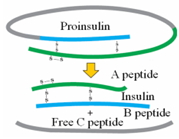
The diagram below shows:
A
maturation of proinsulin into insulin
B
method of proinsulin formation
C
gene therapy
D
enzyme replacement therapy
Solution
(A) The diagram illustrates the process of maturation of proinsulin into functional insulin.
Proinsulin consists of three polypeptide chains: $A$,$B$,and $C$.
The $C$-peptide is an extra stretch of amino acids that is removed during the maturation process to form mature insulin,which consists of two polypeptide chains,$A$ and $B$,linked together by disulfide bridges.
Proinsulin consists of three polypeptide chains: $A$,$B$,and $C$.
The $C$-peptide is an extra stretch of amino acids that is removed during the maturation process to form mature insulin,which consists of two polypeptide chains,$A$ and $B$,linked together by disulfide bridges.
0 likes
View Solution239
MediumMCQ
The Indian Parliament recently cleared which amendment of the Indian Patent Bill?
A
First amendment
B
Second amendment
C
Third amendment
D
Fourth amendment
Solution
(C) The Indian Parliament cleared the $Third$ amendment of the Indian Patent Bill. This amendment was significant in the context of biotechnology and intellectual property rights,as it addresses issues related to patent terms and emergency provisions,which are crucial for the regulation of biological resources and biotechnological inventions.
0 likes
View Solution240
MediumMCQ
$\text{ELISA}$ is :-
A
Technique of disease diagnosis based on $\text{PCR}$
B
Technique of gene therapy based on antigen-antibody interaction.
C
Technique of molecular diagnosis based on antigen-antibody interaction
D
Technique of conventional diagnosis
Solution
(C) $\text{ELISA}$ stands for $\text{Enzyme-Linked Immunosorbent Assay}$.
It is a widely used molecular diagnostic technique.
It is based on the principle of antigen-antibody interaction.
In this technique,an enzyme is linked to an antibody,and the presence of an antigen or antibody is detected by the color change produced by the enzyme's action on a substrate.
Therefore,option $C$ is the correct description.
It is a widely used molecular diagnostic technique.
It is based on the principle of antigen-antibody interaction.
In this technique,an enzyme is linked to an antibody,and the presence of an antigen or antibody is detected by the color change produced by the enzyme's action on a substrate.
Therefore,option $C$ is the correct description.
0 likes
View Solution241
MediumMCQ
Match the following and choose the correct option$-$
| Column $I$ | Column $II$ |
|---|---|
| $(a)$ Eli Lilly | $(i)$ Bacillus thuringiensis |
| $(b)$ Bt | $(ii)$ Human insulin |
| $(c)$ Gene therapy | $(iii)$ Meloidogyne incognita |
| $(d)$ $\text{RNAi}$ | $(iv)$ Adenosine deaminase deficiency |
A
$a-i, b-ii, c-iii, d-iv$
B
$a-ii, b-i, c-iv, d-iii$
C
$a-iv, b-iii, c-ii, d-i$
D
$a-i, b-iii, c-iv, d-ii$
Solution
(B) The correct matching is as follows:
$(a)$ Eli Lilly is a company that produced human insulin (Humulin) using recombinant $DNA$ technology. Thus,$a-ii$.
$(b)$ $Bt$ stands for Bacillus thuringiensis,a bacterium used in genetic engineering for pest resistance. Thus,$b-i$.
$(c)$ Gene therapy is used to treat genetic disorders like Adenosine deaminase $(ADA)$ deficiency. Thus,$c-iv$.
$(d)$ $\text{RNAi}$ ($RNA$ interference) is a method used to protect plants from nematodes like Meloidogyne incognita. Thus,$d-iii$.
Therefore,the correct sequence is $a-ii, b-i, c-iv, d-iii$.
$(a)$ Eli Lilly is a company that produced human insulin (Humulin) using recombinant $DNA$ technology. Thus,$a-ii$.
$(b)$ $Bt$ stands for Bacillus thuringiensis,a bacterium used in genetic engineering for pest resistance. Thus,$b-i$.
$(c)$ Gene therapy is used to treat genetic disorders like Adenosine deaminase $(ADA)$ deficiency. Thus,$c-iv$.
$(d)$ $\text{RNAi}$ ($RNA$ interference) is a method used to protect plants from nematodes like Meloidogyne incognita. Thus,$d-iii$.
Therefore,the correct sequence is $a-ii, b-i, c-iv, d-iii$.
0 likes
View Solution242
MediumMCQ
Assertion: $C$-peptide is not present in the mature insulin.
Reason: Insulin used for diabetes was earlier extracted from the pancreas of slaughtered cattle and pigs.
Reason: Insulin used for diabetes was earlier extracted from the pancreas of slaughtered cattle and pigs.
A
Both Assertion and Reason are True and the Reason is a correct explanation of the Assertion.
B
Both Assertion and Reason are True but Reason is not a correct explanation of the Assertion.
C
Assertion is True but the Reason is False.
D
Both Assertion and Reason are False.
Solution
(B) The Assertion is True. Mature insulin is formed from pro-insulin,which contains an extra stretch called the $C$-peptide. During maturation,this $C$-peptide is removed to form functional insulin.
The Reason is also True. Historically,insulin for diabetic patients was extracted from the pancreas of slaughtered cattle and pigs. However,this method had limitations,such as causing allergic reactions in some patients.
While both statements are factually correct,the Reason does not explain why $C$-peptide is absent in mature insulin. The absence of $C$-peptide is due to the post-translational processing of pro-insulin,not because of the source of insulin extraction. Therefore,the Reason is not the correct explanation for the Assertion.
The Reason is also True. Historically,insulin for diabetic patients was extracted from the pancreas of slaughtered cattle and pigs. However,this method had limitations,such as causing allergic reactions in some patients.
While both statements are factually correct,the Reason does not explain why $C$-peptide is absent in mature insulin. The absence of $C$-peptide is due to the post-translational processing of pro-insulin,not because of the source of insulin extraction. Therefore,the Reason is not the correct explanation for the Assertion.
0 likes
View Solution243
EasyMCQ
$ELISA$ system is based on which of the following principles?
A
Antigen-Antibody interaction
B
Polymerase Chain Reaction
C
Autoradiography
D
Enzyme replacement therapy
Solution
(A) $ELISA$ stands for Enzyme-Linked Immunosorbent Assay.
It is a diagnostic technique used to detect the presence of specific antigens or antibodies in a sample.
The fundamental principle of $ELISA$ is the specific interaction between an antigen and an antibody.
In this process,an enzyme is linked to an antibody or antigen,and the reaction produces a detectable signal (usually a color change) when the target molecule is present.
It is a diagnostic technique used to detect the presence of specific antigens or antibodies in a sample.
The fundamental principle of $ELISA$ is the specific interaction between an antigen and an antibody.
In this process,an enzyme is linked to an antibody or antigen,and the reaction produces a detectable signal (usually a color change) when the target molecule is present.
0 likes
View Solution244
EasyMCQ
In some children,deficiency can be cured by which transplantation?
A
Bone marrow
B
Liver
C
Kidney
D
Spleen
Solution
(A) The deficiency referred to is $Adenosine$ $Deaminase$ $(ADA)$ deficiency,which causes Severe Combined Immunodeficiency $(SCID)$.
This condition can be cured by bone marrow transplantation,where the patient's defective immune cells are replaced by healthy stem cells from a donor.
Therefore,the correct option is $A$.
This condition can be cured by bone marrow transplantation,where the patient's defective immune cells are replaced by healthy stem cells from a donor.
Therefore,the correct option is $A$.
0 likes
View Solution245
EasyMCQ
In which disease is $\alpha-1$ antitrypsin used for treatment?
A
Asthma
B
Common cold
C
Pneumonia
D
Emphysema
Solution
(D) The correct answer is $D$. $\alpha-1$ antitrypsin is a proteinase inhibitor used to treat emphysema. Emphysema is a chronic respiratory disorder in which alveolar walls are damaged due to which respiratory surface is decreased. This protein is produced through transgenic animals (specifically sheep) to treat this deficiency.
0 likes
View Solution246
EasyMCQ
In mature insulin,chain $A$ and chain $B$ are interlinked by which bond?
A
Peptide bond
B
Hydrogen bond
C
Glycosidic bond
D
Disulphide bond
Solution
(D) Mature insulin consists of two short polypeptide chains: chain $A$ and chain $B$.
These two chains are linked together by two inter-chain disulphide bonds.
Additionally,there is an intra-chain disulphide bond within chain $A$.
Therefore,the correct answer is $D$.
These two chains are linked together by two inter-chain disulphide bonds.
Additionally,there is an intra-chain disulphide bond within chain $A$.
Therefore,the correct answer is $D$.
0 likes
View Solution247
EasyMCQ
In the treatment of $ADA$ deficiency during gene therapy,which cells are collected from the patient's blood?
A
Leukocytes
B
Red blood cells
C
Lymphocytes
D
Platelets
Solution
(C) The correct answer is $C$. In the treatment of $ADA$ (Adenosine Deaminase) deficiency using gene therapy,lymphocytes are extracted from the patient's blood. These cells are then cultured in vitro,and a functional $ADA$ $cDNA$ is introduced into them using a retroviral vector. The genetically modified lymphocytes are then returned to the patient's body. Since these cells are not immortal,the patient requires periodic infusions of such genetically engineered lymphocytes.
0 likes
View Solution248
EasyMCQ
The first human hormone prepared by using recombinant $DNA$ technology is?
A
Insulin
B
Estrogen
C
Thyroxine
D
Progesterone
Solution
(A) The first human hormone produced using recombinant $DNA$ technology is $Insulin$.
In $1983$,an American company named $Eli$ $Lilly$ prepared two $DNA$ sequences corresponding to $A$ and $B$ chains of human insulin and introduced them in plasmids of $E. coli$ to produce insulin chains.
These chains were then extracted and combined by creating disulfide bonds to form human insulin,which is commercially known as $Humulin$.
In $1983$,an American company named $Eli$ $Lilly$ prepared two $DNA$ sequences corresponding to $A$ and $B$ chains of human insulin and introduced them in plasmids of $E. coli$ to produce insulin chains.
These chains were then extracted and combined by creating disulfide bonds to form human insulin,which is commercially known as $Humulin$.
0 likes
View Solution249
EasyMCQ
$ELISA$ method works on which of the following principles?
A
Gel electrophoresis
B
Antigen-antibody interaction
C
$R$-$DNA$ technology
D
$PCR$
Solution
(B) The $ELISA$ $(Enzyme-Linked Immunosorbent Assay)$ method is a diagnostic technique used to detect the presence of specific antigens or antibodies in a sample.
It is based on the principle of $Antigen-Antibody$ interaction,where an enzyme-linked antibody binds to a specific antigen,and the subsequent enzymatic reaction produces a detectable signal (usually a color change).
Therefore,the correct principle is $Antigen-Antibody$ interaction.
It is based on the principle of $Antigen-Antibody$ interaction,where an enzyme-linked antibody binds to a specific antigen,and the subsequent enzymatic reaction produces a detectable signal (usually a color change).
Therefore,the correct principle is $Antigen-Antibody$ interaction.
0 likes
View Solution250
EasyMCQ
Which peptide is not present in mature insulin?
A
$A$-peptide
B
$B$-peptide
C
$C$-peptide
D
Glycosidic bond
Solution
(C) In mammals,including humans,insulin is synthesized as a pro-hormone called pro-insulin.
Pro-insulin consists of three polypeptide chains: $A$,$B$,and $C$.
The $C$-peptide is an extra stretch of amino acids that is removed during the maturation process of pro-insulin into mature insulin.
Therefore,mature insulin consists only of $A$ and $B$ polypeptide chains linked by disulfide bridges,and the $C$-peptide is absent.
Pro-insulin consists of three polypeptide chains: $A$,$B$,and $C$.
The $C$-peptide is an extra stretch of amino acids that is removed during the maturation process of pro-insulin into mature insulin.
Therefore,mature insulin consists only of $A$ and $B$ polypeptide chains linked by disulfide bridges,and the $C$-peptide is absent.
0 likes
View SolutionBiotechnology and its Application — Biotechnological Applications in Medicine · Frequently Asked Questions
1Are these Biotechnology and its Application questions useful for JEE and NEET?
Yes. All questions in this section are mapped to JEE Main and NEET exam patterns. Previous year questions from JEE Main, NEET, GUJCET and state-level exams are included with full solutions.
2Can I switch to Hindi or Gujarati for these questions?
Yes. Use the language tabs in the hero section or the sidebar to view the same questions and solutions in English, Hindi or Gujarati.
3How do I generate a question paper from this subtopic?
Use the Vedclass Exam Paper Generator — select the chapter and subtopic, set difficulty, and generate Sets A, B, C, D automatically. First 3 chapters of every subject are free.
Vedclass Products
For Students
Vedclass Test Series
Mock tests in real JEE/NEET style with performance analysis. 5-day free trial.
Start Free TrialFor Teachers
Exam Paper Generator
Generate Set A/B/C/D papers from this chapter in 2 minutes. 3 chapters free.
Try FreeFor Institutes
Online Exam Module
Live online exams with unlimited students, 360° analytics & white-label branding.
See DemoFor Teachers & Institutes
Generate a Biotechnology and its Application Exam Paper in 2 Minutes
Select subtopic & difficulty — Sets A, B, C, D auto-generated with No Repeat logic.
First 3 chapters of every subject are free — no payment required.