
A English
Work Done by Spring and Potential Energy of Spring Questions in English
Class 11 Physics · Work, Energy, Power and Collision · Work Done by Spring and Potential Energy of Spring
121+
Questions
English
Language
100%
With Solutions
Showing 49 of 121 questions in English
51
EasyMCQ
The work done in stretching a spring of force constant $5 \times 10^3 \ N/m$ from $5 \ cm$ to $10 \ cm$ is ...... $N-m$.
A
$6.25$
B
$12.50$
C
$18.75$
D
$25$
Solution
(C) The work done $W$ in stretching a spring from an initial extension $x_1$ to a final extension $x_2$ is given by the formula:
$W = \frac{1}{2}k(x_2^2 - x_1^2)$
Given:
Force constant $k = 5 \times 10^3 \ N/m$
Initial extension $x_1 = 5 \ cm = 5 \times 10^{-2} \ m$
Final extension $x_2 = 10 \ cm = 10 \times 10^{-2} \ m$
Substituting the values:
$W = \frac{1}{2} \times (5 \times 10^3) \times [(10 \times 10^{-2})^2 - (5 \times 10^{-2})^2]$
$W = \frac{1}{2} \times 5000 \times [100 \times 10^{-4} - 25 \times 10^{-4}]$
$W = 2500 \times 75 \times 10^{-4}$
$W = 2500 \times 0.0075 = 18.75 \ J$ (or $N-m$).
$W = \frac{1}{2}k(x_2^2 - x_1^2)$
Given:
Force constant $k = 5 \times 10^3 \ N/m$
Initial extension $x_1 = 5 \ cm = 5 \times 10^{-2} \ m$
Final extension $x_2 = 10 \ cm = 10 \times 10^{-2} \ m$
Substituting the values:
$W = \frac{1}{2} \times (5 \times 10^3) \times [(10 \times 10^{-2})^2 - (5 \times 10^{-2})^2]$
$W = \frac{1}{2} \times 5000 \times [100 \times 10^{-4} - 25 \times 10^{-4}]$
$W = 2500 \times 75 \times 10^{-4}$
$W = 2500 \times 0.0075 = 18.75 \ J$ (or $N-m$).
0 likes
View Solution52
MediumMCQ
When equal forces are applied to two springs with spring constants $1500 \, N/m$ and $3000 \, N/m$,what is the ratio of their stored potential energies?
A
$4 : 1$
B
$1 : 4$
C
$2 : 1$
D
$1 : 2$
Solution
(C) The potential energy $U$ stored in a spring with spring constant $k$ under an applied force $F$ is given by the formula: $U = \frac{F^2}{2k}$.
Given that the applied force $F$ is the same for both springs,the potential energy is inversely proportional to the spring constant: $U \propto \frac{1}{k}$.
Therefore,the ratio of the potential energies is: $\frac{U_1}{U_2} = \frac{k_2}{k_1}$.
Substituting the given values $k_1 = 1500 \, N/m$ and $k_2 = 3000 \, N/m$:
$\frac{U_1}{U_2} = \frac{3000}{1500} = \frac{2}{1}$.
Thus,the ratio is $2 : 1$.
Given that the applied force $F$ is the same for both springs,the potential energy is inversely proportional to the spring constant: $U \propto \frac{1}{k}$.
Therefore,the ratio of the potential energies is: $\frac{U_1}{U_2} = \frac{k_2}{k_1}$.
Substituting the given values $k_1 = 1500 \, N/m$ and $k_2 = 3000 \, N/m$:
$\frac{U_1}{U_2} = \frac{3000}{1500} = \frac{2}{1}$.
Thus,the ratio is $2 : 1$.
0 likes
View Solution53
MediumMCQ
The potential energy of a long spring when stretched by $2 \ cm$ is $U$. If the spring is stretched by $8 \ cm$,the potential energy stored in it is:
A
$U/4$
B
$4U$
C
$8U$
D
$16U$
Solution
(D) The potential energy $(U)$ stored in a spring stretched by a distance $(x)$ is given by the formula: $U = \frac{1}{2} k x^2$,where $k$ is the force constant of the spring.
From this relation,we can see that $U \propto x^2$.
Given that for an extension $x_1 = 2 \ cm$,the potential energy is $U_1 = U$.
For an extension $x_2 = 8 \ cm$,let the potential energy be $U_2$.
Using the ratio: $\frac{U_2}{U_1} = \left( \frac{x_2}{x_1} \right)^2$.
Substituting the values: $\frac{U_2}{U} = \left( \frac{8 \ cm}{2 \ cm} \right)^2 = (4)^2 = 16$.
Therefore,$U_2 = 16U$.
From this relation,we can see that $U \propto x^2$.
Given that for an extension $x_1 = 2 \ cm$,the potential energy is $U_1 = U$.
For an extension $x_2 = 8 \ cm$,let the potential energy be $U_2$.
Using the ratio: $\frac{U_2}{U_1} = \left( \frac{x_2}{x_1} \right)^2$.
Substituting the values: $\frac{U_2}{U} = \left( \frac{8 \ cm}{2 \ cm} \right)^2 = (4)^2 = 16$.
Therefore,$U_2 = 16U$.
0 likes
View Solution54
MediumMCQ
Two similar springs $P$ and $Q$ have spring constants $K_P$ and $K_Q$,such that $K_P > K_Q$. They are stretched first by the same amount (case $a$),then by the same force (case $b$). The work done by the springs $W_P$ and $W_Q$ are related as,in case $(a)$ and case $(b)$ respectively:
A
$W_P > W_Q, W_P < W_Q$
B
$W_P = W_Q, W_P = W_Q$
C
$W_P > W_Q, W_Q > W_P$
D
$W_P < W_Q, W_Q < W_P$
Solution
(C) Case $(a)$: When stretched by the same amount $x$,the work done is $W = \frac{1}{2} K x^2$. Since $K_P > K_Q$ and $x$ is the same,$W_P = \frac{1}{2} K_P x^2$ and $W_Q = \frac{1}{2} K_Q x^2$. Therefore,$W_P > W_Q$.
Case $(b)$: When stretched by the same force $F$,the work done is $W = \frac{F^2}{2K}$. Since $K_P > K_Q$ and $F$ is the same,$W_P = \frac{F^2}{2K_P}$ and $W_Q = \frac{F^2}{2K_Q}$. Since $K_P > K_Q$,it follows that $\frac{1}{K_P} < \frac{1}{K_Q}$,therefore $W_P < W_Q$ or $W_Q > W_P$.
Case $(b)$: When stretched by the same force $F$,the work done is $W = \frac{F^2}{2K}$. Since $K_P > K_Q$ and $F$ is the same,$W_P = \frac{F^2}{2K_P}$ and $W_Q = \frac{F^2}{2K_Q}$. Since $K_P > K_Q$,it follows that $\frac{1}{K_P} < \frac{1}{K_Q}$,therefore $W_P < W_Q$ or $W_Q > W_P$.
0 likes
View Solution55
MediumMCQ
The work done in joules in increasing the extension of a spring of stiffness $10\, N/cm$ from $4\, cm$ to $6\, cm$ is:
A
$1$
B
$10$
C
$50$
D
$100$
Solution
(A) Given: Spring stiffness $K = 10\, N/cm = 1000\, N/m$.
Initial extension $x_1 = 4\, cm = 0.04\, m$.
Final extension $x_2 = 6\, cm = 0.06\, m$.
The work done $W$ to stretch a spring is given by the change in elastic potential energy:
$W = \frac{1}{2} K (x_2^2 - x_1^2)$
$W = \frac{1}{2} \times 1000 \times ((0.06)^2 - (0.04)^2)$
$W = 500 \times (0.0036 - 0.0016)$
$W = 500 \times 0.0020$
$W = 1.0\, J$.
Initial extension $x_1 = 4\, cm = 0.04\, m$.
Final extension $x_2 = 6\, cm = 0.06\, m$.
The work done $W$ to stretch a spring is given by the change in elastic potential energy:
$W = \frac{1}{2} K (x_2^2 - x_1^2)$
$W = \frac{1}{2} \times 1000 \times ((0.06)^2 - (0.04)^2)$
$W = 500 \times (0.0036 - 0.0016)$
$W = 500 \times 0.0020$
$W = 1.0\, J$.
0 likes
View Solution56
MediumMCQ
The $P.E.$ of a certain spring when stretched from natural length through a distance $0.3\, m$ is $10\, J$. The amount of work in joule that must be done on this spring to stretch it through an additional distance $0.15\, m$ will be ................ $J$.
A
$10$
B
$20$
C
$7.5$
D
$12.5$
Solution
(D) The initial potential energy of the spring is given by the formula $U = \frac{1}{2} k x^2$.
Given $U_1 = 10\, J$ for $x_1 = 0.3\, m$,we have $10 = \frac{1}{2} k (0.3)^2$.
Solving for the spring constant $k$: $k = \frac{20}{0.09} = \frac{2000}{9}\, N/m$.
The spring is stretched an additional $0.15\, m$,so the new total extension is $x_2 = 0.3 + 0.15 = 0.45\, m$.
The final potential energy is $U_2 = \frac{1}{2} k x_2^2 = \frac{1}{2} \times \frac{2000}{9} \times (0.45)^2$.
$U_2 = \frac{1000}{9} \times 0.2025 = 1000 \times 0.0225 = 22.5\, J$.
The work done to stretch the spring further is the change in potential energy: $W = U_2 - U_1 = 22.5\, J - 10\, J = 12.5\, J$.
Given $U_1 = 10\, J$ for $x_1 = 0.3\, m$,we have $10 = \frac{1}{2} k (0.3)^2$.
Solving for the spring constant $k$: $k = \frac{20}{0.09} = \frac{2000}{9}\, N/m$.
The spring is stretched an additional $0.15\, m$,so the new total extension is $x_2 = 0.3 + 0.15 = 0.45\, m$.
The final potential energy is $U_2 = \frac{1}{2} k x_2^2 = \frac{1}{2} \times \frac{2000}{9} \times (0.45)^2$.
$U_2 = \frac{1000}{9} \times 0.2025 = 1000 \times 0.0225 = 22.5\, J$.
The work done to stretch the spring further is the change in potential energy: $W = U_2 - U_1 = 22.5\, J - 10\, J = 12.5\, J$.
0 likes
View Solution57
MediumMCQ
$A$ block of mass $m$ moving with a velocity $v_0$ on a smooth horizontal surface strikes and compresses a spring of stiffness $k$ until the mass comes to rest,as shown in the figure. This phenomenon is observed by two observers:
$A$: standing on the horizontal surface
$B$: standing on the block
To an observer $A$,the work done by the spring force is
$A$: standing on the horizontal surface
$B$: standing on the block
To an observer $A$,the work done by the spring force is

A
negative but nothing can be said about its magnitude
B
$ - \frac{1}{2}mv_0^2$
C
positive but nothing can be said about its magnitude
D
$ + \frac{1}{2}mv_0^2$
Solution
(B) According to the work-energy theorem,the work done by all forces acting on a body is equal to the change in its kinetic energy.
For observer $A$ (ground frame),the initial kinetic energy of the block is $K_i = \frac{1}{2}mv_0^2$ and the final kinetic energy is $K_f = 0$ (since the block comes to rest).
The only force doing work on the block in the horizontal direction is the spring force $(F_s)$.
Therefore,$W_{spring} = K_f - K_i = 0 - \frac{1}{2}mv_0^2 = -\frac{1}{2}mv_0^2$.
Thus,the work done by the spring force as observed by $A$ is $-\frac{1}{2}mv_0^2$.
For observer $A$ (ground frame),the initial kinetic energy of the block is $K_i = \frac{1}{2}mv_0^2$ and the final kinetic energy is $K_f = 0$ (since the block comes to rest).
The only force doing work on the block in the horizontal direction is the spring force $(F_s)$.
Therefore,$W_{spring} = K_f - K_i = 0 - \frac{1}{2}mv_0^2 = -\frac{1}{2}mv_0^2$.
Thus,the work done by the spring force as observed by $A$ is $-\frac{1}{2}mv_0^2$.
0 likes
View Solution58
AdvancedMCQ
The system of the wedge and the block connected by a massless spring as shown in the figure is released with the spring in its natural length. Friction is absent. The maximum elongation in the spring will be:
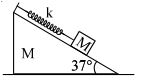
A
$\frac{3Mg}{5k}$
B
$\frac{6Mg}{5k}$
C
$\frac{4Mg}{5k}$
D
$\frac{8Mg}{5k}$
Solution
(B) Since the wedge is fixed,we can apply the principle of conservation of mechanical energy for the block of mass $M$.
Let $x_m$ be the maximum elongation in the spring.
At maximum elongation,the velocity of the block is zero.
The loss in gravitational potential energy of the block is equal to the gain in elastic potential energy of the spring.
$M g (x_m \sin \theta) = \frac{1}{2} k x_m^2$
Solving for $x_m$:
$x_m = \frac{2 M g \sin \theta}{k}$
Given $\theta = 37^\circ$,we know $\sin 37^\circ = \frac{3}{5}$.
Substituting the value of $\sin 37^\circ$:
$x_m = \frac{2 M g (3/5)}{k} = \frac{6 M g}{5 k}$
Let $x_m$ be the maximum elongation in the spring.
At maximum elongation,the velocity of the block is zero.
The loss in gravitational potential energy of the block is equal to the gain in elastic potential energy of the spring.
$M g (x_m \sin \theta) = \frac{1}{2} k x_m^2$
Solving for $x_m$:
$x_m = \frac{2 M g \sin \theta}{k}$
Given $\theta = 37^\circ$,we know $\sin 37^\circ = \frac{3}{5}$.
Substituting the value of $\sin 37^\circ$:
$x_m = \frac{2 M g (3/5)}{k} = \frac{6 M g}{5 k}$
0 likes
View Solution59
MediumMCQ
This question has Statement $1$ and Statement $2$. Of the four choices given after the Statements,choose the one that best describes the two Statements.
If two springs $S_1$ and $S_2$ of force constants $k_1$ and $k_2$,respectively,are stretched by the same force,it is found that more work is done on spring $S_1$ than on spring $S_2$.
Statement $1$: If stretched by the same amount,the work done on $S_1$ is more than on $S_2$.
Statement $2$: $k_1 < k_2$.
If two springs $S_1$ and $S_2$ of force constants $k_1$ and $k_2$,respectively,are stretched by the same force,it is found that more work is done on spring $S_1$ than on spring $S_2$.
Statement $1$: If stretched by the same amount,the work done on $S_1$ is more than on $S_2$.
Statement $2$: $k_1 < k_2$.
A
Statement $1$ is true,Statement $2$ is true,Statement $2$ is not the correct explanation for Statement $1$
B
Statement $1$ is false,Statement $2$ is true
C
Statement $1$ is true,Statement $2$ is false
D
Statement $1$ is true,Statement $2$ is true,Statement $2$ is the correct explanation for Statement $1$
Solution
(B) The work done in stretching a spring by force $F$ is given by $W = \frac{F^2}{2k}$.
Given that for the same force $F$,$W_1 > W_2$,we have $\frac{F^2}{2k_1} > \frac{F^2}{2k_2}$,which implies $k_1 < k_2$. Thus,Statement $2$ is true.
When the springs are stretched by the same extension $x$,the work done is $W = \frac{1}{2}kx^2$.
Since $k_1 < k_2$,for the same extension $x$,$W_1 = \frac{1}{2}k_1x^2$ and $W_2 = \frac{1}{2}k_2x^2$. Therefore,$W_1 < W_2$.
Statement $1$ claims $W_1 > W_2$ for the same extension,which is false.
Thus,Statement $1$ is false and Statement $2$ is true.
Given that for the same force $F$,$W_1 > W_2$,we have $\frac{F^2}{2k_1} > \frac{F^2}{2k_2}$,which implies $k_1 < k_2$. Thus,Statement $2$ is true.
When the springs are stretched by the same extension $x$,the work done is $W = \frac{1}{2}kx^2$.
Since $k_1 < k_2$,for the same extension $x$,$W_1 = \frac{1}{2}k_1x^2$ and $W_2 = \frac{1}{2}k_2x^2$. Therefore,$W_1 < W_2$.
Statement $1$ claims $W_1 > W_2$ for the same extension,which is false.
Thus,Statement $1$ is false and Statement $2$ is true.
0 likes
View Solution60
AdvancedMCQ
Two particles with mass $m_1 = 16 \ kg$ and $m_2 = 2 \ kg$ slide as a unit with a common velocity of $12 \ ms^{-1}$ on a level frictionless surface. Between them is a compressed massless spring with spring constant $k = 100 \ Nm^{-1}$. The spring,originally compressed by $25 \ cm$,is suddenly released,sending the two masses,which are connected to the spring,flying apart from each other. The orientation of the spring w.r.t. the initial velocity is shown in the diagram. What is the relative velocity of separation in $ms^{-1}$,after the particles lose contact?
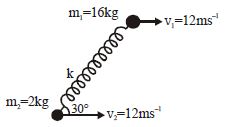
A
$3.88$
B
$22$
C
$1.88$
D
$0$
Solution
(C) The potential energy stored in the compressed spring is converted into the kinetic energy of the particles in the center of mass frame.
Let the relative velocity of separation be $v_{rel}$.
The reduced mass of the system is $\mu = \frac{m_1 m_2}{m_1 + m_2} = \frac{16 \times 2}{16 + 2} = \frac{32}{18} = \frac{16}{9} \ kg$.
The energy conservation equation is $\frac{1}{2} kx^2 = \frac{1}{2} \mu v_{rel}^2$.
Given $k = 100 \ Nm^{-1}$ and $x = 25 \ cm = 0.25 \ m = \frac{1}{4} \ m$.
Substituting the values: $\frac{1}{2} \times 100 \times (\frac{1}{4})^2 = \frac{1}{2} \times \frac{16}{9} \times v_{rel}^2$.
$100 \times \frac{1}{16} = \frac{16}{9} \times v_{rel}^2$.
$v_{rel}^2 = \frac{100}{16} \times \frac{9}{16} = \frac{900}{256}$.
$v_{rel} = \sqrt{\frac{900}{256}} = \frac{30}{16} = 1.875 \ ms^{-1}$.
Rounding to two decimal places,we get $v_{rel} \approx 1.88 \ ms^{-1}$.
Let the relative velocity of separation be $v_{rel}$.
The reduced mass of the system is $\mu = \frac{m_1 m_2}{m_1 + m_2} = \frac{16 \times 2}{16 + 2} = \frac{32}{18} = \frac{16}{9} \ kg$.
The energy conservation equation is $\frac{1}{2} kx^2 = \frac{1}{2} \mu v_{rel}^2$.
Given $k = 100 \ Nm^{-1}$ and $x = 25 \ cm = 0.25 \ m = \frac{1}{4} \ m$.
Substituting the values: $\frac{1}{2} \times 100 \times (\frac{1}{4})^2 = \frac{1}{2} \times \frac{16}{9} \times v_{rel}^2$.
$100 \times \frac{1}{16} = \frac{16}{9} \times v_{rel}^2$.
$v_{rel}^2 = \frac{100}{16} \times \frac{9}{16} = \frac{900}{256}$.
$v_{rel} = \sqrt{\frac{900}{256}} = \frac{30}{16} = 1.875 \ ms^{-1}$.
Rounding to two decimal places,we get $v_{rel} \approx 1.88 \ ms^{-1}$.
0 likes
View Solution61
MediumMCQ
$A$ block of mass $m$ is hung vertically from an elastic thread of force constant $\frac{2mg}{a}$. Initially,the thread is at its natural length and the block is allowed to fall freely. The work done on the block by the Earth when it passes through the equilibrium position will be:
A
zero
B
$\frac{mga}{2}$
C
$mga$
D
$\frac{mga}{4}$
Solution
(B) At the equilibrium position,the spring force balances the gravitational force: $kx = mg$.
Given the force constant $k = \frac{2mg}{a}$,we substitute this into the equilibrium equation:
$\frac{2mg}{a} \cdot x = mg$
Solving for the displacement $x$:
$x = \frac{a}{2}$.
The work done by the Earth (gravitational force) on the block is given by $W = F \cdot d = mgx$.
Substituting the value of $x$:
$W = mg \left( \frac{a}{2} \right) = \frac{mga}{2}$.
Given the force constant $k = \frac{2mg}{a}$,we substitute this into the equilibrium equation:
$\frac{2mg}{a} \cdot x = mg$
Solving for the displacement $x$:
$x = \frac{a}{2}$.
The work done by the Earth (gravitational force) on the block is given by $W = F \cdot d = mgx$.
Substituting the value of $x$:
$W = mg \left( \frac{a}{2} \right) = \frac{mga}{2}$.
0 likes
View Solution62
MediumMCQ
$A$ block of mass $m$ is pushed against a spring with spring constant $k$,which is fixed at one end to a wall. The block can slide on a frictionless table as shown in the figure. If the natural length of the spring is $L_0$ and it is compressed to half its length when the block is released,find the velocity of the block when the spring reaches its natural length.
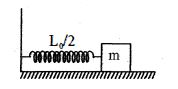
A
$\sqrt {\frac{m}{k}} .\frac{{{L_0}}}{2}$
B
$\sqrt {\frac{k}{m}} .\frac{{{L_0}}}{2}$
C
$\sqrt {\frac{k}{m}} .{L_0}$
D
$\sqrt {\frac{{k{L_0}}}{m}} $
Solution
(B) The potential energy stored in the spring when it is compressed by an amount $x$ is given by $U = \frac{1}{2}kx^2$.
Here,the natural length is $L_0$ and it is compressed to $L_0/2$,so the compression $x = L_0 - L_0/2 = L_0/2$.
By the principle of conservation of mechanical energy,the potential energy stored in the spring is converted into the kinetic energy of the block when the spring returns to its natural length.
$\frac{1}{2}mv^2 = \frac{1}{2}k\left(\frac{L_0}{2}\right)^2$
$mv^2 = k\frac{L_0^2}{4}$
$v^2 = \frac{k}{m} \cdot \frac{L_0^2}{4}$
$v = \sqrt{\frac{k}{m}} \cdot \frac{L_0}{2}$
Here,the natural length is $L_0$ and it is compressed to $L_0/2$,so the compression $x = L_0 - L_0/2 = L_0/2$.
By the principle of conservation of mechanical energy,the potential energy stored in the spring is converted into the kinetic energy of the block when the spring returns to its natural length.
$\frac{1}{2}mv^2 = \frac{1}{2}k\left(\frac{L_0}{2}\right)^2$
$mv^2 = k\frac{L_0^2}{4}$
$v^2 = \frac{k}{m} \cdot \frac{L_0^2}{4}$
$v = \sqrt{\frac{k}{m}} \cdot \frac{L_0}{2}$
0 likes
View Solution63
AdvancedMCQ
$A$ bungee jumper is jumping with the help of an elastic ideal rope (force constant $K$). The jumper steps off the bridge and falls from rest towards the river below. He does not hit the water. The mass of the jumper is $m$,and the natural length of the rope is $l$. Gravity is $g$. Assuming everything is ideal,choose the incorrect option.
A
Jumper comes to rest for the first time after falling a distance $S = \frac{(Kl + mg) + \sqrt{2mgKl + m^2g^2}}{K}$
B
Maximum speed attained is $v = \sqrt{2gl + \frac{mg^2}{K}}$
C
Time of free fall from rest $= \sqrt{\frac{2l}{g}}$
D
Time to come to rest for the first time $= \left( \sqrt{\frac{2l}{g}} + \sqrt{\frac{m}{K}} \left( \frac{\pi}{2} + \arcsin\left( \frac{mg}{mg + Kl} \right) \right) \right)$
Solution
(D) $1$. For the jumper to come to rest at distance $S$,the loss in gravitational potential energy equals the gain in elastic potential energy: $mgS = \frac{1}{2}K(S-l)^2$. Solving this quadratic equation $KS^2 - 2(Kl+mg)S + Kl^2 = 0$ gives $S = \frac{(Kl+mg) + \sqrt{2mgKl + m^2g^2}}{K}$. Thus,option $A$ is correct.
$2$. Maximum speed occurs at the equilibrium position where the net force is zero: $mg = Kx_{eq} \Rightarrow x_{eq} = \frac{mg}{K}$. The total distance fallen is $l + \frac{mg}{K}$. By conservation of energy: $mg(l + \frac{mg}{K}) = \frac{1}{2}mv^2 + \frac{1}{2}K(\frac{mg}{K})^2$. Solving for $v$ gives $v = \sqrt{2gl + \frac{mg^2}{K}}$. Thus,option $B$ is correct.
$3$. The time of free fall for distance $l$ is $t_1 = \sqrt{\frac{2l}{g}}$. Thus,option $C$ is correct.
$4$. The motion after the rope becomes taut is a simple harmonic motion starting from the natural length position with an initial downward velocity $v_0 = \sqrt{2gl}$. The time to reach the lowest point is not simply $\frac{\pi}{2}\sqrt{\frac{m}{K}} + \sqrt{\frac{2l}{g}}$. Therefore,option $D$ is the incorrect statement.
$2$. Maximum speed occurs at the equilibrium position where the net force is zero: $mg = Kx_{eq} \Rightarrow x_{eq} = \frac{mg}{K}$. The total distance fallen is $l + \frac{mg}{K}$. By conservation of energy: $mg(l + \frac{mg}{K}) = \frac{1}{2}mv^2 + \frac{1}{2}K(\frac{mg}{K})^2$. Solving for $v$ gives $v = \sqrt{2gl + \frac{mg^2}{K}}$. Thus,option $B$ is correct.
$3$. The time of free fall for distance $l$ is $t_1 = \sqrt{\frac{2l}{g}}$. Thus,option $C$ is correct.
$4$. The motion after the rope becomes taut is a simple harmonic motion starting from the natural length position with an initial downward velocity $v_0 = \sqrt{2gl}$. The time to reach the lowest point is not simply $\frac{\pi}{2}\sqrt{\frac{m}{K}} + \sqrt{\frac{2l}{g}}$. Therefore,option $D$ is the incorrect statement.
0 likes
View Solution64
DifficultMCQ
$A$ $1\, kg$ block moves towards a light spring with a velocity of $8\, m/s$. When the spring is compressed by $3\, m$,its momentum becomes half of the original momentum. The spring constant of the spring is:
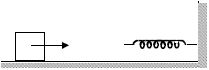
A
$18/3\, N/m$
B
$16/3\, N/m$
C
$3\, N/m$
D
$8\, N/m$
Solution
(B) Given: Mass $m = 1\, kg$,initial velocity $v_1 = 8\, m/s$,compression $x = 3\, m$.
Initial momentum $P_1 = m v_1 = 1 \times 8 = 8\, kg\cdot m/s$.
Final momentum $P_2 = P_1 / 2 = 4\, kg\cdot m/s$.
Since $P_2 = m v_2$,we have $v_2 = P_2 / m = 4 / 1 = 4\, m/s$.
By the law of conservation of energy,the loss in kinetic energy is equal to the potential energy stored in the spring:
$\frac{1}{2} m v_1^2 - \frac{1}{2} m v_2^2 = \frac{1}{2} k x^2$
$m(v_1^2 - v_2^2) = k x^2$
$1 \times (8^2 - 4^2) = k \times 3^2$
$1 \times (64 - 16) = 9k$
$48 = 9k$
$k = 48 / 9 = 16 / 3\, N/m$.
Initial momentum $P_1 = m v_1 = 1 \times 8 = 8\, kg\cdot m/s$.
Final momentum $P_2 = P_1 / 2 = 4\, kg\cdot m/s$.
Since $P_2 = m v_2$,we have $v_2 = P_2 / m = 4 / 1 = 4\, m/s$.
By the law of conservation of energy,the loss in kinetic energy is equal to the potential energy stored in the spring:
$\frac{1}{2} m v_1^2 - \frac{1}{2} m v_2^2 = \frac{1}{2} k x^2$
$m(v_1^2 - v_2^2) = k x^2$
$1 \times (8^2 - 4^2) = k \times 3^2$
$1 \times (64 - 16) = 9k$
$48 = 9k$
$k = 48 / 9 = 16 / 3\, N/m$.
0 likes
View Solution65
MediumMCQ
Two springs have their force constants as $k_1$ and $k_2$ $(k_1 > k_2)$. When they are stretched by the same force $F$,which of the following statements is true regarding the work done?
A
No work is done in case of both the springs.
B
Equal work is done in case of both the springs.
C
More work is done in case of the second spring.
D
More work is done in case of the first spring.
Solution
(C) The work done $W$ in stretching a spring by a force $F$ is given by the formula $W = \frac{1}{2} k x^2$.
Since the restoring force is $F = kx$,we have $x = \frac{F}{k}$.
Substituting $x$ into the work equation: $W = \frac{1}{2} k \left(\frac{F}{k}\right)^2 = \frac{F^2}{2k}$.
For a constant force $F$,the work done is inversely proportional to the force constant $k$ $(W \propto \frac{1}{k})$.
Given $k_1 > k_2$,it follows that $W_1 < W_2$.
Therefore,more work is done in the case of the second spring $(k_2)$.
Since the restoring force is $F = kx$,we have $x = \frac{F}{k}$.
Substituting $x$ into the work equation: $W = \frac{1}{2} k \left(\frac{F}{k}\right)^2 = \frac{F^2}{2k}$.
For a constant force $F$,the work done is inversely proportional to the force constant $k$ $(W \propto \frac{1}{k})$.
Given $k_1 > k_2$,it follows that $W_1 < W_2$.
Therefore,more work is done in the case of the second spring $(k_2)$.
0 likes
View Solution66
MediumMCQ
$A$ block of mass $m$ moving at a speed $v$ compresses a spring through a distance $x$ before its speed becomes one fourth. Find the spring constant of the spring.
A
$\frac{3mv^2}{4x^2}$
B
$\frac{7mv^2}{8x^2}$
C
$\frac{15mv^2}{16x^2}$
D
$\frac{5mv^2}{6x^2}$
Solution
(C) According to the Work-Energy Theorem,the work done by the spring force is equal to the change in kinetic energy of the block.
The work done by the spring force is $W_s = -\frac{1}{2}kx^2$.
The change in kinetic energy is $\Delta K = K_f - K_i = \frac{1}{2}m(v_f^2 - v_i^2)$.
Given the final speed $v_f = \frac{v}{4}$ and initial speed $v_i = v$,we have:
$-\frac{1}{2}kx^2 = \frac{1}{2}m\left(\left(\frac{v}{4}\right)^2 - v^2\right)$
$-\frac{1}{2}kx^2 = \frac{1}{2}m\left(\frac{v^2}{16} - v^2\right)$
$-\frac{1}{2}kx^2 = \frac{1}{2}m\left(-\frac{15v^2}{16}\right)$
$kx^2 = \frac{15mv^2}{16}$
$k = \frac{15mv^2}{16x^2}$
The work done by the spring force is $W_s = -\frac{1}{2}kx^2$.
The change in kinetic energy is $\Delta K = K_f - K_i = \frac{1}{2}m(v_f^2 - v_i^2)$.
Given the final speed $v_f = \frac{v}{4}$ and initial speed $v_i = v$,we have:
$-\frac{1}{2}kx^2 = \frac{1}{2}m\left(\left(\frac{v}{4}\right)^2 - v^2\right)$
$-\frac{1}{2}kx^2 = \frac{1}{2}m\left(\frac{v^2}{16} - v^2\right)$
$-\frac{1}{2}kx^2 = \frac{1}{2}m\left(-\frac{15v^2}{16}\right)$
$kx^2 = \frac{15mv^2}{16}$
$k = \frac{15mv^2}{16x^2}$
0 likes
View Solution67
DifficultMCQ
Two masses $m_1 = 2\,kg$ and $m_2 = 5\,kg$ are moving on a frictionless surface with velocities $10\,m/s$ and $3\,m/s$ respectively. An ideal spring with spring constant $K = 1120\,N/m$ is attached to the back of $m_2$. The maximum compression of the spring will be ............... $m$.
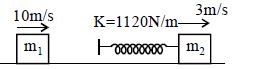
A
$0.51$
B
$0.062$
C
$0.25$
D
$0.72$
Solution
(C) At the time of maximum compression,both masses will have the same velocity $v_0$.
From the law of conservation of linear momentum:
$m_1 u_1 + m_2 u_2 = (m_1 + m_2) v_0$
$2 \times 10 + 5 \times 3 = (2 + 5) v_0$
$20 + 15 = 7 v_0$
$35 = 7 v_0 \Rightarrow v_0 = 5\,m/s$
From the law of conservation of energy,the initial kinetic energy equals the final kinetic energy plus the potential energy stored in the spring:
$\frac{1}{2} m_1 u_1^2 + \frac{1}{2} m_2 u_2^2 = \frac{1}{2} (m_1 + m_2) v_0^2 + \frac{1}{2} K x^2$
$\frac{1}{2} (2) (10)^2 + \frac{1}{2} (5) (3)^2 = \frac{1}{2} (2 + 5) (5)^2 + \frac{1}{2} (1120) x^2$
$100 + 22.5 = 87.5 + 560 x^2$
$122.5 = 87.5 + 560 x^2$
$35 = 560 x^2$
$x^2 = \frac{35}{560} = \frac{1}{16}$
$x = \sqrt{\frac{1}{16}} = 0.25\,m$.
From the law of conservation of linear momentum:
$m_1 u_1 + m_2 u_2 = (m_1 + m_2) v_0$
$2 \times 10 + 5 \times 3 = (2 + 5) v_0$
$20 + 15 = 7 v_0$
$35 = 7 v_0 \Rightarrow v_0 = 5\,m/s$
From the law of conservation of energy,the initial kinetic energy equals the final kinetic energy plus the potential energy stored in the spring:
$\frac{1}{2} m_1 u_1^2 + \frac{1}{2} m_2 u_2^2 = \frac{1}{2} (m_1 + m_2) v_0^2 + \frac{1}{2} K x^2$
$\frac{1}{2} (2) (10)^2 + \frac{1}{2} (5) (3)^2 = \frac{1}{2} (2 + 5) (5)^2 + \frac{1}{2} (1120) x^2$
$100 + 22.5 = 87.5 + 560 x^2$
$122.5 = 87.5 + 560 x^2$
$35 = 560 x^2$
$x^2 = \frac{35}{560} = \frac{1}{16}$
$x = \sqrt{\frac{1}{16}} = 0.25\,m$.
0 likes
View Solution68
MediumMCQ
This question has Statement $-1$ and Statement $-2$. Of the four choices given after the statements,choose the one that best describes the two statements.
If two springs $S_1$ and $S_2$ of force constants $k_1$ and $k_2$,respectively,are stretched by the same force,it is found that more work is done on spring $S_1$ than on spring $S_2$.
Statement $-1$: If stretched by the same amount,work done on $S_1$ will be more than that on $S_2$.
Statement $-2$: $k_1 < k_2$.
If two springs $S_1$ and $S_2$ of force constants $k_1$ and $k_2$,respectively,are stretched by the same force,it is found that more work is done on spring $S_1$ than on spring $S_2$.
Statement $-1$: If stretched by the same amount,work done on $S_1$ will be more than that on $S_2$.
Statement $-2$: $k_1 < k_2$.
A
Statement $-1$ is true,Statement $-2$ is true and Statement $-2$ is not the correct explanation of Statement $-1$.
B
Statement $-1$ is false,Statement $-2$ is true.
C
Statement $-1$ is true,Statement $-2$ is false.
D
Statement $-1$ is true,Statement $-2$ is true and Statement $-2$ is the correct explanation of Statement $-1$.
Solution
(B) The work done on a spring stretched by force $F$ is $W = \frac{F^2}{2k}$. Since $W_1 > W_2$ for the same force $F$,we have $\frac{F^2}{2k_1} > \frac{F^2}{2k_2}$,which implies $k_1 < k_2$. Thus,Statement $-2$ is true.
When stretched by the same displacement $x$,the work done is $W = \frac{1}{2}kx^2$. Since $k_1 < k_2$,it follows that $\frac{1}{2}k_1x^2 < \frac{1}{2}k_2x^2$. Therefore,the work done on $S_1$ is less than that on $S_2$. Thus,Statement $-1$ is false.
When stretched by the same displacement $x$,the work done is $W = \frac{1}{2}kx^2$. Since $k_1 < k_2$,it follows that $\frac{1}{2}k_1x^2 < \frac{1}{2}k_2x^2$. Therefore,the work done on $S_1$ is less than that on $S_2$. Thus,Statement $-1$ is false.
0 likes
View Solution69
DifficultMCQ
$A$ ring of mass $m$ is attached to a horizontal spring of spring constant $k$ and natural length $l_0$. The other end of the spring is fixed,and the ring can slide on a smooth horizontal rod as shown. Now,the ring is shifted to position $B$ and released. The speed of the ring when the spring attains its natural length is:
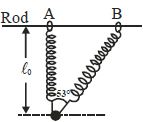
A
$\frac{2l_0}{3}\sqrt{\frac{k}{m}}$
B
$\frac{l_0}{3}\sqrt{\frac{k}{m}}$
C
$\frac{3l_0}{2}\sqrt{\frac{k}{m}}$
D
$l_0\sqrt{\frac{k}{m}}$
Solution
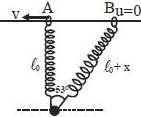
(A) Let the vertical distance from the rod to the fixed end of the spring be $h$. From the geometry at position $B$,we have $\cos 53^{\circ} = \frac{h}{l_0+x}$ and $h = l_0$.
Thus,$\frac{3}{5} = \frac{l_0}{l_0+x}$.
Solving for $x$,we get $3(l_0+x) = 5l_0$,which implies $3x = 2l_0$,or $x = \frac{2}{3}l_0$.
By the law of conservation of mechanical energy,the potential energy stored in the spring at position $B$ is converted into the kinetic energy of the ring at position $A$ (where the spring length is $l_0$ and potential energy is zero).
$\frac{1}{2}kx^2 = \frac{1}{2}mv^2$.
$v = x\sqrt{\frac{k}{m}} = \left(\frac{2}{3}l_0\right)\sqrt{\frac{k}{m}}$.
Thus,$\frac{3}{5} = \frac{l_0}{l_0+x}$.
Solving for $x$,we get $3(l_0+x) = 5l_0$,which implies $3x = 2l_0$,or $x = \frac{2}{3}l_0$.
By the law of conservation of mechanical energy,the potential energy stored in the spring at position $B$ is converted into the kinetic energy of the ring at position $A$ (where the spring length is $l_0$ and potential energy is zero).
$\frac{1}{2}kx^2 = \frac{1}{2}mv^2$.
$v = x\sqrt{\frac{k}{m}} = \left(\frac{2}{3}l_0\right)\sqrt{\frac{k}{m}}$.
0 likes
View Solution70
DifficultMCQ
$A$ ball of mass $m$ is dropped from a height $h$ on a platform fixed at the top of a vertical spring,as shown in the figure. The platform is depressed by a distance $x$. Then the spring constant is
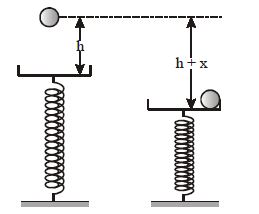
A
$\frac{mg}{(h + x)}$
B
$\frac{mg}{(h + 2x)}$
C
$\frac{2mg(h + x)}{x^2}$
D
$\frac{mg}{(2h + x)}$
Solution
(C) According to the Law of Conservation of Mechanical Energy $(COME)$,the total mechanical energy of the system remains constant.
Let the initial position of the ball be the reference level for gravitational potential energy $(PE = 0)$.
Initial state: The ball is at height $h$ above the platform. The spring is at its natural length. Initial kinetic energy $(KE_i)$ is $0$,and initial potential energy $(PE_i)$ is $0$ (if we measure from the release point).
Final state: The ball and the platform have moved down by a distance $x$. The ball is now at a vertical position $- (h + x)$ relative to the release point. The spring is compressed by $x$. Final kinetic energy $(KE_f)$ is $0$ (at the point of maximum compression).
Applying the principle of conservation of energy:
$PE_i + KE_i = PE_f + KE_f$
$0 + 0 = -mg(h + x) + \frac{1}{2}kx^2$
Rearranging the equation to solve for the spring constant $k$:
$mg(h + x) = \frac{1}{2}kx^2$
$k = \frac{2mg(h + x)}{x^2}$
Let the initial position of the ball be the reference level for gravitational potential energy $(PE = 0)$.
Initial state: The ball is at height $h$ above the platform. The spring is at its natural length. Initial kinetic energy $(KE_i)$ is $0$,and initial potential energy $(PE_i)$ is $0$ (if we measure from the release point).
Final state: The ball and the platform have moved down by a distance $x$. The ball is now at a vertical position $- (h + x)$ relative to the release point. The spring is compressed by $x$. Final kinetic energy $(KE_f)$ is $0$ (at the point of maximum compression).
Applying the principle of conservation of energy:
$PE_i + KE_i = PE_f + KE_f$
$0 + 0 = -mg(h + x) + \frac{1}{2}kx^2$
Rearranging the equation to solve for the spring constant $k$:
$mg(h + x) = \frac{1}{2}kx^2$
$k = \frac{2mg(h + x)}{x^2}$
0 likes
View Solution71
MediumMCQ
$A$ block of mass $m$ moving with speed $v$ compresses a spring through distance $x$ before its speed is halved. What is the value of the spring constant $k$?
A
$\frac{3mv^2}{4x^2}$
B
$\frac{mv^2}{4x^2}$
C
$\frac{mv^2}{2x^2}$
D
$\frac{2mv^2}{x^2}$
Solution
(A) According to the work-energy theorem,the work done by the spring force is equal to the change in kinetic energy of the block.
The initial kinetic energy is $K_i = \frac{1}{2}mv^2$.
The final kinetic energy when the speed is halved $(v' = v/2)$ is $K_f = \frac{1}{2}m(v/2)^2 = \frac{1}{8}mv^2$.
The work done by the spring force is $W = -\Delta PE = -\frac{1}{2}kx^2$.
By the work-energy theorem,$W = K_f - K_i$.
$-\frac{1}{2}kx^2 = \frac{1}{8}mv^2 - \frac{1}{2}mv^2$.
$-\frac{1}{2}kx^2 = \frac{mv^2 - 4mv^2}{8} = -\frac{3mv^2}{8}$.
$\frac{1}{2}kx^2 = \frac{3mv^2}{8}$.
$k = \frac{3mv^2}{4x^2}$.
The initial kinetic energy is $K_i = \frac{1}{2}mv^2$.
The final kinetic energy when the speed is halved $(v' = v/2)$ is $K_f = \frac{1}{2}m(v/2)^2 = \frac{1}{8}mv^2$.
The work done by the spring force is $W = -\Delta PE = -\frac{1}{2}kx^2$.
By the work-energy theorem,$W = K_f - K_i$.
$-\frac{1}{2}kx^2 = \frac{1}{8}mv^2 - \frac{1}{2}mv^2$.
$-\frac{1}{2}kx^2 = \frac{mv^2 - 4mv^2}{8} = -\frac{3mv^2}{8}$.
$\frac{1}{2}kx^2 = \frac{3mv^2}{8}$.
$k = \frac{3mv^2}{4x^2}$.
0 likes
View Solution72
MediumMCQ
$A$ long spring, when stretched by a distance $x$, has the potential energy $u$. On increasing the stretching to $nx$, the potential energy of the spring will be:
A
$\frac{u}{n}$
B
$nu$
C
$n^2u$
D
$\frac{u}{n^2}$
Solution
(C) The potential energy $U$ stored in a spring stretched by a distance $x$ is given by the formula $U = \frac{1}{2} K x^2$, where $K$ is the spring constant.
From this formula, it is clear that $U \propto x^2$.
When the stretch is increased from $x$ to $nx$, the new potential energy $U'$ becomes:
$U' = \frac{1}{2} K (nx)^2$
$U' = \frac{1}{2} K n^2 x^2$
$U' = n^2 (\frac{1}{2} K x^2)$
Since $U = \frac{1}{2} K x^2$, we have $U' = n^2 u$.
From this formula, it is clear that $U \propto x^2$.
When the stretch is increased from $x$ to $nx$, the new potential energy $U'$ becomes:
$U' = \frac{1}{2} K (nx)^2$
$U' = \frac{1}{2} K n^2 x^2$
$U' = n^2 (\frac{1}{2} K x^2)$
Since $U = \frac{1}{2} K x^2$, we have $U' = n^2 u$.
0 likes
View Solution73
MediumMCQ
In stretching a spring by $2 \, cm$,the energy stored is $U$. If the spring is stretched by an additional $10 \, cm$,the total energy stored will be:
A
$U$
B
$25U$
C
$\frac{U}{25}$
D
$36U$
Solution
(D) The potential energy stored in a spring is given by $U = \frac{1}{2} k x^2$,where $k$ is the spring constant and $x$ is the displacement.
This implies $U \propto x^2$.
Initially,the displacement is $x_1 = 2 \, cm$,so $U = C(2)^2 = 4C$,where $C$ is a constant.
When the spring is stretched by an additional $10 \, cm$,the new total displacement becomes $x_2 = 2 \, cm + 10 \, cm = 12 \, cm$.
The new energy stored is $U' = C(12)^2 = 144C$.
Taking the ratio of the new energy to the initial energy:
$\frac{U'}{U} = \frac{144C}{4C} = 36$.
Therefore,the new energy stored is $U' = 36U$.
This implies $U \propto x^2$.
Initially,the displacement is $x_1 = 2 \, cm$,so $U = C(2)^2 = 4C$,where $C$ is a constant.
When the spring is stretched by an additional $10 \, cm$,the new total displacement becomes $x_2 = 2 \, cm + 10 \, cm = 12 \, cm$.
The new energy stored is $U' = C(12)^2 = 144C$.
Taking the ratio of the new energy to the initial energy:
$\frac{U'}{U} = \frac{144C}{4C} = 36$.
Therefore,the new energy stored is $U' = 36U$.
0 likes
View Solution74
MediumMCQ
$A$ spring of force constant $k$ is cut into two parts at one-third of its length. When both parts are stretched by the same amount,the work done in the two parts will be:
A
equal in both
B
greater for the longer part
C
greater for the shorter part
D
data insufficient
Solution
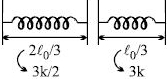
(C) Let the original spring have length $\ell_0$ and force constant $k$. The spring constant is inversely proportional to the length,i.e.,$k \propto 1/\ell$.
When the spring is cut into two parts of lengths $\ell_1 = \ell_0/3$ and $\ell_2 = 2\ell_0/3$,their new spring constants are:
$k_1 = k \cdot (\ell_0 / \ell_1) = k \cdot (\ell_0 / (\ell_0/3)) = 3k$
$k_2 = k \cdot (\ell_0 / \ell_2) = k \cdot (\ell_0 / (2\ell_0/3)) = 1.5k = 3k/2$
Work done in stretching a spring by an amount $x$ is given by $W = \frac{1}{2} k x^2$.
Since both parts are stretched by the same amount $x$,the work done is directly proportional to the spring constant $(W \propto k)$.
For the shorter part (length $\ell_0/3$),$W_1 = \frac{1}{2} (3k) x^2 = 1.5 k x^2$.
For the longer part (length $2\ell_0/3$),$W_2 = \frac{1}{2} (1.5k) x^2 = 0.75 k x^2$.
Since $W_1 > W_2$,the work done is greater for the shorter part.
When the spring is cut into two parts of lengths $\ell_1 = \ell_0/3$ and $\ell_2 = 2\ell_0/3$,their new spring constants are:
$k_1 = k \cdot (\ell_0 / \ell_1) = k \cdot (\ell_0 / (\ell_0/3)) = 3k$
$k_2 = k \cdot (\ell_0 / \ell_2) = k \cdot (\ell_0 / (2\ell_0/3)) = 1.5k = 3k/2$
Work done in stretching a spring by an amount $x$ is given by $W = \frac{1}{2} k x^2$.
Since both parts are stretched by the same amount $x$,the work done is directly proportional to the spring constant $(W \propto k)$.
For the shorter part (length $\ell_0/3$),$W_1 = \frac{1}{2} (3k) x^2 = 1.5 k x^2$.
For the longer part (length $2\ell_0/3$),$W_2 = \frac{1}{2} (1.5k) x^2 = 0.75 k x^2$.
Since $W_1 > W_2$,the work done is greater for the shorter part.
0 likes
View Solution75
MediumMCQ
$A$ block of mass $m$ moving with speed $v$ compresses a spring through distance $x$ before its speed is halved. What is the value of the spring constant $k$?
A
$\frac{3mv^2}{4x^2}$
B
$\frac{mv^2}{4x^2}$
C
$\frac{mv^2}{2x^2}$
D
$\frac{2mv^2}{x^2}$
Solution
(A) According to the work-energy theorem,the change in kinetic energy is equal to the work done by the spring force.
The initial kinetic energy is $K_i = \frac{1}{2}mv^2$.
The final speed is $v_f = \frac{v}{2}$,so the final kinetic energy is $K_f = \frac{1}{2}m(\frac{v}{2})^2 = \frac{1}{8}mv^2$.
The work done by the spring force when it is compressed by distance $x$ is $W = -\frac{1}{2}kx^2$.
Applying the theorem: $K_f - K_i = W$.
$\frac{1}{8}mv^2 - \frac{1}{2}mv^2 = -\frac{1}{2}kx^2$.
Multiplying by $8$: $mv^2 - 4mv^2 = -4kx^2$.
$-3mv^2 = -4kx^2$.
Solving for $k$: $k = \frac{3mv^2}{4x^2}$.
The initial kinetic energy is $K_i = \frac{1}{2}mv^2$.
The final speed is $v_f = \frac{v}{2}$,so the final kinetic energy is $K_f = \frac{1}{2}m(\frac{v}{2})^2 = \frac{1}{8}mv^2$.
The work done by the spring force when it is compressed by distance $x$ is $W = -\frac{1}{2}kx^2$.
Applying the theorem: $K_f - K_i = W$.
$\frac{1}{8}mv^2 - \frac{1}{2}mv^2 = -\frac{1}{2}kx^2$.
Multiplying by $8$: $mv^2 - 4mv^2 = -4kx^2$.
$-3mv^2 = -4kx^2$.
Solving for $k$: $k = \frac{3mv^2}{4x^2}$.
0 likes
View Solution76
DifficultMCQ
$A$ $15\, g$ ball is shot from a spring gun whose spring has a force constant of $600\, N/m$. The spring is compressed by $3\, cm$. The greatest possible velocity of the ball for this compression is ............. $m/s$ $(g = 10\, m/s^2)$.
A
$6$
B
$12$
C
$10$
D
$8$
Solution
(A) According to the law of conservation of mechanical energy,the potential energy stored in the compressed spring is converted into the kinetic energy of the ball.
The potential energy of the spring is given by $U = \frac{1}{2} kx^2$.
The kinetic energy of the ball is given by $K = \frac{1}{2} mv^2$.
Given:
Mass $m = 15\, g = 15 \times 10^{-3}\, kg$
Force constant $k = 600\, N/m$
Compression $x = 3\, cm = 3 \times 10^{-2}\, m$
Equating the energies:
$\frac{1}{2} kx^2 = \frac{1}{2} mv^2$
$kx^2 = mv^2$
$v^2 = \frac{k}{m} x^2$
$v = x \sqrt{\frac{k}{m}}$
Substituting the values:
$v = (3 \times 10^{-2}) \sqrt{\frac{600}{15 \times 10^{-3}}}$
$v = (3 \times 10^{-2}) \sqrt{\frac{600000}{15}}$
$v = (3 \times 10^{-2}) \sqrt{40000}$
$v = (3 \times 10^{-2}) \times 200$
$v = 6\, m/s$
The potential energy of the spring is given by $U = \frac{1}{2} kx^2$.
The kinetic energy of the ball is given by $K = \frac{1}{2} mv^2$.
Given:
Mass $m = 15\, g = 15 \times 10^{-3}\, kg$
Force constant $k = 600\, N/m$
Compression $x = 3\, cm = 3 \times 10^{-2}\, m$
Equating the energies:
$\frac{1}{2} kx^2 = \frac{1}{2} mv^2$
$kx^2 = mv^2$
$v^2 = \frac{k}{m} x^2$
$v = x \sqrt{\frac{k}{m}}$
Substituting the values:
$v = (3 \times 10^{-2}) \sqrt{\frac{600}{15 \times 10^{-3}}}$
$v = (3 \times 10^{-2}) \sqrt{\frac{600000}{15}}$
$v = (3 \times 10^{-2}) \sqrt{40000}$
$v = (3 \times 10^{-2}) \times 200$
$v = 6\, m/s$
0 likes
View Solution77
MediumMCQ
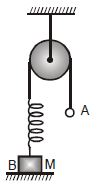
In the figure,the ball $A$ is released from rest when the spring is at its natural (unstretched) length. For the block $B$ of mass $M$ to leave contact with the ground at some stage,the minimum mass of $A$ must be
A
$2M$
B
$M$
C
$M/2$
D
$A$ function of $M$ and the force constant of the spring
Solution
(C) Let $m$ be the mass of ball $A$. When ball $A$ is released from rest,it moves downwards,stretching the spring. Let the spring stretch by a distance $x$ at the lowest point of the ball's motion.
By the law of conservation of energy,the loss in gravitational potential energy of ball $A$ is equal to the gain in elastic potential energy of the spring:
$mgx = \frac{1}{2}kx^2$
$mg = \frac{1}{2}kx$
$kx = 2mg$ ... $(1)$
For block $B$ of mass $M$ to leave contact with the ground,the upward spring force must be at least equal to the weight of block $B$:
$kx \ge Mg$ ... $(2)$
Substituting the value of $kx$ from equation $(1)$ into equation $(2)$:
$2mg \ge Mg$
$m \ge M/2$
Thus,the minimum mass of $A$ required is $M/2$.
By the law of conservation of energy,the loss in gravitational potential energy of ball $A$ is equal to the gain in elastic potential energy of the spring:
$mgx = \frac{1}{2}kx^2$
$mg = \frac{1}{2}kx$
$kx = 2mg$ ... $(1)$
For block $B$ of mass $M$ to leave contact with the ground,the upward spring force must be at least equal to the weight of block $B$:
$kx \ge Mg$ ... $(2)$
Substituting the value of $kx$ from equation $(1)$ into equation $(2)$:
$2mg \ge Mg$
$m \ge M/2$
Thus,the minimum mass of $A$ required is $M/2$.
0 likes
View Solution78
EasyMCQ
$A$ mass of $1\, kg$ is hanging from a spring of spring constant $1\, N/m$. If Saroj pulls the mass down by $2\, m$,the work done by Saroj is......$J$.
A
$1$
B
$2$
C
$3$
D
$4$
Solution
(B) The work done by an external agent in stretching a spring is equal to the change in the elastic potential energy of the spring.
Given,spring constant $k = 1\, N/m$ and displacement $x = 2\, m$.
The work done $W$ is given by the formula:
$W = \int_{0}^{x} kx\, dx = \frac{1}{2} k x^2$
Substituting the values:
$W = \frac{1}{2} \times 1\, N/m \times (2\, m)^2$
$W = \frac{1}{2} \times 1 \times 4 = 2\, J$.
Therefore,the work done by Saroj is $2\, J$.
Given,spring constant $k = 1\, N/m$ and displacement $x = 2\, m$.
The work done $W$ is given by the formula:
$W = \int_{0}^{x} kx\, dx = \frac{1}{2} k x^2$
Substituting the values:
$W = \frac{1}{2} \times 1\, N/m \times (2\, m)^2$
$W = \frac{1}{2} \times 1 \times 4 = 2\, J$.
Therefore,the work done by Saroj is $2\, J$.
1 likes
View Solution79
EasyMCQ
$Assertion$ : Graph between potential energy of a spring versus the extension or compression of the spring is a straight line.
$Reason$ : Potential energy of a stretched or compressed spring is proportional to the square of extension or compression.
$Reason$ : Potential energy of a stretched or compressed spring is proportional to the square of extension or compression.
A
If both $Assertion$ and $Reason$ are correct and the $Reason$ is a correct explanation of the $Assertion$.
B
If both $Assertion$ and $Reason$ are correct but $Reason$ is not a correct explanation of the $Assertion$.
C
If both the $Assertion$ and $Reason$ are incorrect.
D
If the $Assertion$ is incorrect but $Reason$ is correct.
Solution
(D) The potential energy $U$ of a spring is given by the formula $U = \frac{1}{2} K x^2$,where $K$ is the spring constant and $x$ is the extension or compression.
This equation shows that $U \propto x^2$.
The graph of $U$ versus $x$ represents a parabola,not a straight line.
Therefore,the $Assertion$ is incorrect because the relationship is quadratic,not linear.
The $Reason$ is correct because it correctly states that the potential energy is proportional to the square of the extension or compression $(U \propto x^2)$.
This equation shows that $U \propto x^2$.
The graph of $U$ versus $x$ represents a parabola,not a straight line.
Therefore,the $Assertion$ is incorrect because the relationship is quadratic,not linear.
The $Reason$ is correct because it correctly states that the potential energy is proportional to the square of the extension or compression $(U \propto x^2)$.
0 likes
View Solution80
MediumMCQ
To simulate car accidents,auto manufacturers study the collisions of moving cars with mounted springs of different spring constants. Consider a typical simulation with a car of mass $1000 \; kg$ moving with a speed $18.0 \; km/h$ on a smooth road and colliding with a horizontally mounted spring of spring constant $6.25 \times 10^{3} \; N m^{-1}$. What is the maximum compression of the spring in $m$?
A
$0.5$
B
$1$
C
$1.5$
D
$2$
Solution
(D) At maximum compression,the kinetic energy of the car is converted entirely into the potential energy of the spring.
First,convert the speed from $km/h$ to $m/s$:
$v = 18.0 \; km/h = 18.0 \times \frac{5}{18} \; m/s = 5 \; m/s$.
The kinetic energy $K$ of the moving car is:
$K = \frac{1}{2} m v^2 = \frac{1}{2} \times 1000 \; kg \times (5 \; m/s)^2 = 500 \times 25 = 1.25 \times 10^4 \; J$.
According to the law of conservation of mechanical energy,at maximum compression $x_m$,the potential energy $V$ of the spring equals the kinetic energy $K$ of the car:
$V = \frac{1}{2} k x_m^2 = K$.
Substituting the values:
$\frac{1}{2} \times (6.25 \times 10^3) \times x_m^2 = 1.25 \times 10^4$.
$x_m^2 = \frac{2 \times 1.25 \times 10^4}{6.25 \times 10^3} = \frac{2.5 \times 10^4}{6.25 \times 10^3} = 0.4 \times 10 = 4$.
$x_m = \sqrt{4} = 2 \; m$.
First,convert the speed from $km/h$ to $m/s$:
$v = 18.0 \; km/h = 18.0 \times \frac{5}{18} \; m/s = 5 \; m/s$.
The kinetic energy $K$ of the moving car is:
$K = \frac{1}{2} m v^2 = \frac{1}{2} \times 1000 \; kg \times (5 \; m/s)^2 = 500 \times 25 = 1.25 \times 10^4 \; J$.
According to the law of conservation of mechanical energy,at maximum compression $x_m$,the potential energy $V$ of the spring equals the kinetic energy $K$ of the car:
$V = \frac{1}{2} k x_m^2 = K$.
Substituting the values:
$\frac{1}{2} \times (6.25 \times 10^3) \times x_m^2 = 1.25 \times 10^4$.
$x_m^2 = \frac{2 \times 1.25 \times 10^4}{6.25 \times 10^3} = \frac{2.5 \times 10^4}{6.25 \times 10^3} = 0.4 \times 10 = 4$.
$x_m = \sqrt{4} = 2 \; m$.
0 likes
View Solution81
Difficult
Explain the elastic potential energy of a spring and obtain an expression for this energy.
Solution
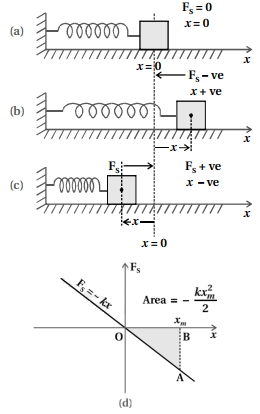
(N/A) Consider an elastic spring,obeying Hooke's law with negligible mass,whose one end is tied rigidly to a wall as shown in the figure. At the other end of the spring,a block is attached,resting on a smooth horizontal surface.
We shall,for the sake of simplicity,restrict the motion of the block to the $X$-direction.
In the normal position of the spring,the position of the block is taken as $x=0$,as shown in figure $(a)$.
When the block is pulled and the length of the spring increases by $x$,a restoring force $F_{S}$ is produced in the spring which tries to bring the spring back to its normal position. The restoring force (spring force) is also produced when the spring is compressed. This is shown in figures $(b)$ and $(c)$. The restoring force is directly proportional to the change in the length of the spring and is in the direction opposite to the change in length. This law of force for the spring is called Hooke's law: $F_{S} = -kx$,where $k$ is the spring constant or force constant of the spring.
Spring constant $k = \frac{|F_{S}|}{|x|}$,its unit is $N/m$.
The spring is said to be stiff if $k$ is large and soft if $k$ is small.
Suppose the block is pulled outwards as in figure $(b)$. If the extension is $x_{m}$,the work done by the spring force is:
$W_{S} = \int_{0}^{x_{m}} F_{S} dx = \int_{0}^{x_{m}} (-kx) dx$
$W_{S} = -k \left[ \frac{x^{2}}{2} \right]_{0}^{x_{m}} = -\frac{1}{2} k x_{m}^{2}$
The potential energy $V(x)$ of the spring is defined as the work done by an external force to stretch or compress it,which is the negative of the work done by the spring force:
$V(x) = -W_{S} = \frac{1}{2} k x^{2}$
We shall,for the sake of simplicity,restrict the motion of the block to the $X$-direction.
In the normal position of the spring,the position of the block is taken as $x=0$,as shown in figure $(a)$.
When the block is pulled and the length of the spring increases by $x$,a restoring force $F_{S}$ is produced in the spring which tries to bring the spring back to its normal position. The restoring force (spring force) is also produced when the spring is compressed. This is shown in figures $(b)$ and $(c)$. The restoring force is directly proportional to the change in the length of the spring and is in the direction opposite to the change in length. This law of force for the spring is called Hooke's law: $F_{S} = -kx$,where $k$ is the spring constant or force constant of the spring.
Spring constant $k = \frac{|F_{S}|}{|x|}$,its unit is $N/m$.
The spring is said to be stiff if $k$ is large and soft if $k$ is small.
Suppose the block is pulled outwards as in figure $(b)$. If the extension is $x_{m}$,the work done by the spring force is:
$W_{S} = \int_{0}^{x_{m}} F_{S} dx = \int_{0}^{x_{m}} (-kx) dx$
$W_{S} = -k \left[ \frac{x^{2}}{2} \right]_{0}^{x_{m}} = -\frac{1}{2} k x_{m}^{2}$
The potential energy $V(x)$ of the spring is defined as the work done by an external force to stretch or compress it,which is the negative of the work done by the spring force:
$V(x) = -W_{S} = \frac{1}{2} k x^{2}$
0 likes
View Solution82
Medium
Show that the law of conservation of mechanical energy is obeyed by pulling or compressing the block tied at the end of a spring.
Solution
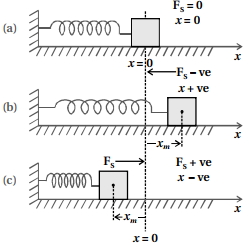
(N/A) Consider a block of mass $m$ attached to a spring of spring constant $k$ on a frictionless horizontal surface. Let $x=0$ be the equilibrium position.
When the block is pulled to a displacement $x_m$ and released,it oscillates between $-x_m$ and $+x_m$. At any displacement $x$,the total mechanical energy $E$ is the sum of kinetic energy $K$ and potential energy $U$:
$E = K + U = \frac{1}{2}mv^2 + \frac{1}{2}kx^2$
At the extreme position $x = x_m$,the velocity $v = 0$,so the total energy is purely potential:
$E = \frac{1}{2}kx_m^2$
Since the system is conservative,the total energy remains constant at any position $x$:
$\frac{1}{2}kx_m^2 = \frac{1}{2}mv^2 + \frac{1}{2}kx^2$
At the equilibrium position $x=0$,the potential energy is zero,and the kinetic energy is maximum,where $v = v_m$:
$\frac{1}{2}mv_m^2 = \frac{1}{2}kx_m^2$
Solving for $v_m$:
$v_m^2 = \frac{k}{m}x_m^2 \implies v_m = \sqrt{\frac{k}{m}}x_m$
This confirms that the kinetic energy is converted into potential energy and vice versa,while the total mechanical energy remains constant throughout the motion.
When the block is pulled to a displacement $x_m$ and released,it oscillates between $-x_m$ and $+x_m$. At any displacement $x$,the total mechanical energy $E$ is the sum of kinetic energy $K$ and potential energy $U$:
$E = K + U = \frac{1}{2}mv^2 + \frac{1}{2}kx^2$
At the extreme position $x = x_m$,the velocity $v = 0$,so the total energy is purely potential:
$E = \frac{1}{2}kx_m^2$
Since the system is conservative,the total energy remains constant at any position $x$:
$\frac{1}{2}kx_m^2 = \frac{1}{2}mv^2 + \frac{1}{2}kx^2$
At the equilibrium position $x=0$,the potential energy is zero,and the kinetic energy is maximum,where $v = v_m$:
$\frac{1}{2}mv_m^2 = \frac{1}{2}kx_m^2$
Solving for $v_m$:
$v_m^2 = \frac{k}{m}x_m^2 \implies v_m = \sqrt{\frac{k}{m}}x_m$
This confirms that the kinetic energy is converted into potential energy and vice versa,while the total mechanical energy remains constant throughout the motion.
0 likes
View Solution83
Difficult
What is the spring constant? On what factors does the work done by a spring depend?
Solution
(N/A) The spring constant $(k)$ is a measure of the stiffness of a spring. It is defined as the force required to produce a unit extension or compression in the spring. According to Hooke's Law,$F = -kx$,where $F$ is the restoring force,$x$ is the displacement from the mean position,and $k$ is the spring constant. Its $SI$ unit is $N/m$.
The work done by a spring when it is displaced from position $x_1$ to $x_2$ is given by the formula: $W = -\frac{1}{2} k (x_2^2 - x_1^2)$.
From this expression,we can conclude that the work done by a spring depends on:
$1$. The spring constant $(k)$,which represents the stiffness of the spring.
$2$. The initial position $(x_1)$ of the spring.
$3$. The final position $(x_2)$ of the spring.
The work done by a spring when it is displaced from position $x_1$ to $x_2$ is given by the formula: $W = -\frac{1}{2} k (x_2^2 - x_1^2)$.
From this expression,we can conclude that the work done by a spring depends on:
$1$. The spring constant $(k)$,which represents the stiffness of the spring.
$2$. The initial position $(x_1)$ of the spring.
$3$. The final position $(x_2)$ of the spring.
0 likes
View Solution84
MediumMCQ
What is the work done by a spring force in a cyclic process?
A
Positive
B
Negative
C
Zero
D
Depends on the path
Solution
(C) The spring force is a conservative force.
By definition,the work done by a conservative force in a closed path or a cyclic process is always zero.
Since the spring force $F = -kx$ depends only on the displacement from the equilibrium position,the total work done over a complete cycle where the spring returns to its initial position is $\oint F \cdot dx = 0$.
By definition,the work done by a conservative force in a closed path or a cyclic process is always zero.
Since the spring force $F = -kx$ depends only on the displacement from the equilibrium position,the total work done over a complete cycle where the spring returns to its initial position is $\oint F \cdot dx = 0$.
0 likes
View Solution85
EasyMCQ
When an elastic spring is stretched or compressed,does its potential energy increase or decrease?
A
Increase
B
Decrease
C
Remains constant
D
Becomes zero
Solution
(A) When an elastic spring is stretched or compressed,work is done against the restoring force of the spring.
According to the work-energy theorem,the work done by an external agent is stored in the spring in the form of elastic potential energy.
The potential energy of a spring is given by $U = \frac{1}{2} k x^2$,where $k$ is the spring constant and $x$ is the displacement from the equilibrium position.
Since the potential energy depends on the square of the displacement $(x^2)$,any displacement (whether stretching or compressing) results in an increase in potential energy.
According to the work-energy theorem,the work done by an external agent is stored in the spring in the form of elastic potential energy.
The potential energy of a spring is given by $U = \frac{1}{2} k x^2$,where $k$ is the spring constant and $x$ is the displacement from the equilibrium position.
Since the potential energy depends on the square of the displacement $(x^2)$,any displacement (whether stretching or compressing) results in an increase in potential energy.
0 likes
View Solution86
MediumMCQ
Does the energy stored in a spring change when it is stretched or compressed?
A
Yes,it increases.
B
Yes,it decreases.
C
No,it remains the same.
D
It becomes zero.
Solution
(A) When a spring is stretched or compressed by a displacement $x$ from its equilibrium position,work is done against the restoring force $F = -kx$. This work is stored in the spring as elastic potential energy. The potential energy $U$ is given by the formula $U = \frac{1}{2}kx^2$,where $k$ is the spring constant. Since $U$ is proportional to the square of the displacement $x^2$,any non-zero displacement (whether positive for stretching or negative for compression) results in an increase in the stored potential energy compared to the equilibrium state $(x=0)$.
0 likes
View Solution87
MediumMCQ
Is the work done by the stretching force in a stretched spring positive or negative?
A
Positive
B
Negative
C
Zero
D
Cannot be determined
Solution
(A) The work done by the stretching force is positive.
When a spring is stretched,the external stretching force is applied in the direction of the displacement of the spring's end.
Since the force $F$ and the displacement $dx$ are in the same direction,the work done $W = \int F \cdot dx$ is positive.
When a spring is stretched,the external stretching force is applied in the direction of the displacement of the spring's end.
Since the force $F$ and the displacement $dx$ are in the same direction,the work done $W = \int F \cdot dx$ is positive.
0 likes
View Solution88
Difficult
An engine is attached to a wagon through a shock absorber of length $1.5 \, m$. The system with a total mass of $50,000 \, kg$ is moving with a speed of $36 \, km \, h^{-1}$ when the brakes are applied to bring it to rest. In the process of the system being brought to rest,the spring of the shock absorber gets compressed by $1.0 \, m$. If $90 \%$ of the energy of the wagon is lost due to friction,calculate the spring constant.
Solution
(C) Given mass $m = 50,000 \, kg$ and initial velocity $v = 36 \, km/h = 10 \, m/s$.
The initial kinetic energy $K$ is given by $K = \frac{1}{2} m v^2 = \frac{1}{2} \times 50,000 \times (10)^2 = 2.5 \times 10^6 \, J$.
Since $90 \%$ of the kinetic energy is lost due to friction,only $10 \%$ of the energy is stored in the spring of the shock absorber.
Energy stored in the spring $\Delta E = \frac{1}{2} k x^2$,where $x = 1.0 \, m$ is the compression.
According to the problem,$\Delta E = 10 \% \text{ of } K = 0.10 \times 2.5 \times 10^6 \, J = 2.5 \times 10^5 \, J$.
Equating the two expressions for energy: $\frac{1}{2} k (1.0)^2 = 2.5 \times 10^5 \, J$.
Solving for $k$: $k = 2 \times 2.5 \times 10^5 = 5.0 \times 10^5 \, N/m$.
The initial kinetic energy $K$ is given by $K = \frac{1}{2} m v^2 = \frac{1}{2} \times 50,000 \times (10)^2 = 2.5 \times 10^6 \, J$.
Since $90 \%$ of the kinetic energy is lost due to friction,only $10 \%$ of the energy is stored in the spring of the shock absorber.
Energy stored in the spring $\Delta E = \frac{1}{2} k x^2$,where $x = 1.0 \, m$ is the compression.
According to the problem,$\Delta E = 10 \% \text{ of } K = 0.10 \times 2.5 \times 10^6 \, J = 2.5 \times 10^5 \, J$.
Equating the two expressions for energy: $\frac{1}{2} k (1.0)^2 = 2.5 \times 10^5 \, J$.
Solving for $k$: $k = 2 \times 2.5 \times 10^5 = 5.0 \times 10^5 \, N/m$.
0 likes
View Solution89
EasyMCQ
Fill in the blank: $A$ spring is stretched by $3 \, cm$,its potential energy is $U_1$. If the spring is stretched by $6 \, cm$,its potential energy stored in it is $U_2 = ...... U_1$.
A
$2$
B
$4$
C
$8$
D
$16$
Solution
(B) The potential energy $U$ stored in a spring stretched by a distance $y$ is given by $U = \frac{1}{2} k y^2$,where $k$ is the spring constant.
For the first case,$y_1 = 3 \, cm$,so $U_1 = \frac{1}{2} k (3)^2 = \frac{9}{2} k$.
For the second case,$y_2 = 6 \, cm$,so $U_2 = \frac{1}{2} k (6)^2 = \frac{36}{2} k$.
Taking the ratio of the two energies: $\frac{U_2}{U_1} = \frac{\frac{1}{2} k (6)^2}{\frac{1}{2} k (3)^2} = \frac{36}{9} = 4$.
Therefore,$U_2 = 4 U_1$.
For the first case,$y_1 = 3 \, cm$,so $U_1 = \frac{1}{2} k (3)^2 = \frac{9}{2} k$.
For the second case,$y_2 = 6 \, cm$,so $U_2 = \frac{1}{2} k (6)^2 = \frac{36}{2} k$.
Taking the ratio of the two energies: $\frac{U_2}{U_1} = \frac{\frac{1}{2} k (6)^2}{\frac{1}{2} k (3)^2} = \frac{36}{9} = 4$.
Therefore,$U_2 = 4 U_1$.
0 likes
View Solution90
MediumMCQ
Find the maximum tension in the spring if the spring is initially at its natural length when the block of mass $m$ is released from rest.

A
$4 \, mg$
B
$\frac{mg}{2}$
C
$\frac{3 \, mg}{2}$
D
$2 \, mg$
Solution
(D) Let $x_{max}$ be the maximum extension of the spring.
By the law of conservation of energy,the loss in gravitational potential energy of the block is equal to the gain in elastic potential energy of the spring.
$mg x_{max} = \frac{1}{2} k x_{max}^2$
Solving for $x_{max}$ (assuming $x_{max} \neq 0$):
$x_{max} = \frac{2mg}{k}$
The maximum tension in the spring is given by Hooke's Law:
$T_{max} = k x_{max}$
Substituting the value of $x_{max}$:
$T_{max} = k \left( \frac{2mg}{k} \right) = 2mg$
By the law of conservation of energy,the loss in gravitational potential energy of the block is equal to the gain in elastic potential energy of the spring.
$mg x_{max} = \frac{1}{2} k x_{max}^2$
Solving for $x_{max}$ (assuming $x_{max} \neq 0$):
$x_{max} = \frac{2mg}{k}$
The maximum tension in the spring is given by Hooke's Law:
$T_{max} = k x_{max}$
Substituting the value of $x_{max}$:
$T_{max} = k \left( \frac{2mg}{k} \right) = 2mg$
0 likes
View Solution91
MediumMCQ
$A$ ball of mass $4\, kg$,moving with a velocity of $10\, ms^{-1}$,collides with a spring of length $8\, m$ and force constant $100\, Nm^{-1}$. The length of the compressed spring is $x\, m$. The value of $x$,to the nearest integer,is ........ .
A
$4$
B
$9$
C
$6$
D
$12$
Solution
(C) According to the law of conservation of mechanical energy,the kinetic energy of the ball is converted into the potential energy of the spring at the point of maximum compression.
Let the compression in the spring be $y$.
By the work-energy theorem or conservation of energy:
$\frac{1}{2} mv^2 = \frac{1}{2} ky^2$
Substituting the given values: $m = 4\, kg$,$v = 10\, ms^{-1}$,$k = 100\, Nm^{-1}$.
$\frac{1}{2} \times 4 \times (10)^2 = \frac{1}{2} \times 100 \times y^2$
$2 \times 100 = 50 \times y^2$
$200 = 50 \times y^2$
$y^2 = 4$
$y = 2\, m$
The initial length of the spring is $8\, m$. The compressed length $x$ is given by:
$x = \text{Initial length} - \text{Compression}$
$x = 8 - 2 = 6\, m$.
Thus,the value of $x$ is $6$.
Let the compression in the spring be $y$.
By the work-energy theorem or conservation of energy:
$\frac{1}{2} mv^2 = \frac{1}{2} ky^2$
Substituting the given values: $m = 4\, kg$,$v = 10\, ms^{-1}$,$k = 100\, Nm^{-1}$.
$\frac{1}{2} \times 4 \times (10)^2 = \frac{1}{2} \times 100 \times y^2$
$2 \times 100 = 50 \times y^2$
$200 = 50 \times y^2$
$y^2 = 4$
$y = 2\, m$
The initial length of the spring is $8\, m$. The compressed length $x$ is given by:
$x = \text{Initial length} - \text{Compression}$
$x = 8 - 2 = 6\, m$.
Thus,the value of $x$ is $6$.
0 likes
View Solution92
MediumMCQ
$A$ ball of mass $100 \, g$ is dropped from a height $h = 10 \, cm$ onto a platform fixed at the top of a vertical spring (as shown in the figure). The ball stays on the platform and the platform is depressed by a distance $\frac{h}{2}$. The spring constant is .......... $N \, m^{-1}$. (Use $g = 10 \, m \, s^{-2}$)
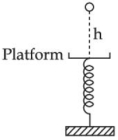
A
$122$
B
$129$
C
$127$
D
$120$
Solution
(D) Let the mass of the ball be $m = 100 \, g = 0.1 \, kg$. The height from which it is dropped is $h = 10 \, cm = 0.1 \, m$. The compression in the spring is $x = \frac{h}{2} = 5 \, cm = 0.05 \, m$.
By the principle of conservation of mechanical energy,the loss in gravitational potential energy of the ball equals the gain in elastic potential energy of the spring.
The total vertical displacement of the ball is $h + x = h + \frac{h}{2} = \frac{3h}{2}$.
Therefore,$mg \left( h + \frac{h}{2} \right) = \frac{1}{2} kx^2$.
Substituting the values: $0.1 \times 10 \times \left( 0.1 + 0.05 \right) = \frac{1}{2} \times k \times (0.05)^2$.
$1 \times 0.15 = \frac{1}{2} \times k \times 0.0025$.
$0.15 = k \times 0.00125$.
$k = \frac{0.15}{0.00125} = \frac{150000}{1250} = 120 \, N \, m^{-1}$.
By the principle of conservation of mechanical energy,the loss in gravitational potential energy of the ball equals the gain in elastic potential energy of the spring.
The total vertical displacement of the ball is $h + x = h + \frac{h}{2} = \frac{3h}{2}$.
Therefore,$mg \left( h + \frac{h}{2} \right) = \frac{1}{2} kx^2$.
Substituting the values: $0.1 \times 10 \times \left( 0.1 + 0.05 \right) = \frac{1}{2} \times k \times (0.05)^2$.
$1 \times 0.15 = \frac{1}{2} \times k \times 0.0025$.
$0.15 = k \times 0.00125$.
$k = \frac{0.15}{0.00125} = \frac{150000}{1250} = 120 \, N \, m^{-1}$.
0 likes
View Solution93
DifficultMCQ
As per the given figure,two blocks each of mass $250\,g$ are connected to a spring of spring constant $2\,N/m$. If both are given velocity $V$ in opposite directions,then the maximum elongation of the spring is:
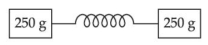
A
$V \sqrt{\frac{m}{k}}$
B
$V \sqrt{\frac{m}{2k}}$
C
$V \sqrt{\frac{2m}{k}}$
D
$V \sqrt{\frac{m}{4k}}$
Solution
(B) Let the mass of each block be $m = 250\,g = 0.25\,kg$ and the spring constant be $k = 2\,N/m$.
At the moment of maximum elongation $x$,both blocks momentarily come to rest in the center-of-mass frame.
By the law of conservation of energy,the initial kinetic energy of the system is converted into the elastic potential energy of the spring at maximum elongation.
The total initial kinetic energy is $K_i = \frac{1}{2}mv^2 + \frac{1}{2}mv^2 = mv^2$.
The potential energy stored in the spring at maximum elongation $x$ is $U_f = \frac{1}{2}kx^2$.
Equating the two: $mv^2 = \frac{1}{2}kx^2$.
Solving for $x$: $x^2 = \frac{2mv^2}{k} \implies x = v \sqrt{\frac{2m}{k}}$.
Substituting the given values $m = 0.25\,kg$ and $k = 2\,N/m$:
$x = V \sqrt{\frac{2 \times 0.25}{2}} = V \sqrt{0.25} = 0.5V = \frac{V}{2}$.
At the moment of maximum elongation $x$,both blocks momentarily come to rest in the center-of-mass frame.
By the law of conservation of energy,the initial kinetic energy of the system is converted into the elastic potential energy of the spring at maximum elongation.
The total initial kinetic energy is $K_i = \frac{1}{2}mv^2 + \frac{1}{2}mv^2 = mv^2$.
The potential energy stored in the spring at maximum elongation $x$ is $U_f = \frac{1}{2}kx^2$.
Equating the two: $mv^2 = \frac{1}{2}kx^2$.
Solving for $x$: $x^2 = \frac{2mv^2}{k} \implies x = v \sqrt{\frac{2m}{k}}$.
Substituting the given values $m = 0.25\,kg$ and $k = 2\,N/m$:
$x = V \sqrt{\frac{2 \times 0.25}{2}} = V \sqrt{0.25} = 0.5V = \frac{V}{2}$.
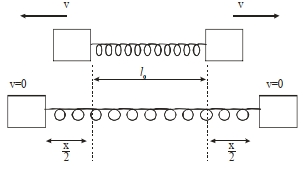
1 likes
View Solution94
DifficultMCQ
$A$ spring of force constant $K$ is first stretched by distance $a$ from its natural length and then further by distance $b$. The work done in stretching the part $b$ is .............
A
$\frac{1}{2} K a(a-b)$
B
$\frac{1}{2} K a(a+b)$
C
$\frac{1}{2} K b(2 a+b)$
D
$\frac{1}{2} K b(a-b)$
Solution
(C) The work done in stretching a spring by a distance $x$ is given by the potential energy stored,$U = \frac{1}{2} K x^2$.
Initial work done to stretch the spring by distance $a$ is $W_1 = \frac{1}{2} K a^2$.
Total work done to stretch the spring by a total distance of $(a+b)$ is $W_2 = \frac{1}{2} K (a+b)^2$.
The work done in stretching the spring further by distance $b$ is the difference between the total work and the initial work:
$\Delta W = W_2 - W_1$
$\Delta W = \frac{1}{2} K (a+b)^2 - \frac{1}{2} K a^2$
$\Delta W = \frac{1}{2} K (a^2 + 2ab + b^2 - a^2)$
$\Delta W = \frac{1}{2} K (2ab + b^2)$
$\Delta W = \frac{1}{2} K b(2a + b)$.
Initial work done to stretch the spring by distance $a$ is $W_1 = \frac{1}{2} K a^2$.
Total work done to stretch the spring by a total distance of $(a+b)$ is $W_2 = \frac{1}{2} K (a+b)^2$.
The work done in stretching the spring further by distance $b$ is the difference between the total work and the initial work:
$\Delta W = W_2 - W_1$
$\Delta W = \frac{1}{2} K (a+b)^2 - \frac{1}{2} K a^2$
$\Delta W = \frac{1}{2} K (a^2 + 2ab + b^2 - a^2)$
$\Delta W = \frac{1}{2} K (2ab + b^2)$
$\Delta W = \frac{1}{2} K b(2a + b)$.
0 likes
View Solution95
MediumMCQ
An elastic string of unstretched length $L$ and force constant $k$ is stretched by a small length $x$. It is further stretched by another small length $y$. The work done in the second stretching is
A
$\frac{1}{2} ky^2$
B
$\frac{1}{2} ky(2x+y)$
C
$\frac{1}{2} k(x^2+y^2)$
D
$\frac{1}{2} k(x+y)^2$
Solution
(B) The elastic force is a conservative force. The work done by an external agent to stretch a spring is equal to the change in its potential energy.
The potential energy of a spring stretched by a length $x$ is given by $U = \frac{1}{2} kx^2$.
Initially,the string is stretched by length $x$. The initial potential energy is $U_i = \frac{1}{2} kx^2$.
After stretching it further by length $y$,the total extension becomes $(x+y)$. The final potential energy is $U_f = \frac{1}{2} k(x+y)^2$.
The work done by the external agent in the second stretching is the change in potential energy:
$W = U_f - U_i$
$W = \frac{1}{2} k(x+y)^2 - \frac{1}{2} kx^2$
$W = \frac{1}{2} k(x^2 + y^2 + 2xy) - \frac{1}{2} kx^2$
$W = \frac{1}{2} kx^2 + \frac{1}{2} ky^2 + kxy - \frac{1}{2} kx^2$
$W = \frac{1}{2} ky^2 + kxy$
$W = \frac{1}{2} ky(y + 2x)$
Thus,the work done is $\frac{1}{2} ky(2x+y)$.
The potential energy of a spring stretched by a length $x$ is given by $U = \frac{1}{2} kx^2$.
Initially,the string is stretched by length $x$. The initial potential energy is $U_i = \frac{1}{2} kx^2$.
After stretching it further by length $y$,the total extension becomes $(x+y)$. The final potential energy is $U_f = \frac{1}{2} k(x+y)^2$.
The work done by the external agent in the second stretching is the change in potential energy:
$W = U_f - U_i$
$W = \frac{1}{2} k(x+y)^2 - \frac{1}{2} kx^2$
$W = \frac{1}{2} k(x^2 + y^2 + 2xy) - \frac{1}{2} kx^2$
$W = \frac{1}{2} kx^2 + \frac{1}{2} ky^2 + kxy - \frac{1}{2} kx^2$
$W = \frac{1}{2} ky^2 + kxy$
$W = \frac{1}{2} ky(y + 2x)$
Thus,the work done is $\frac{1}{2} ky(2x+y)$.
0 likes
View Solution96
EasyMCQ
The potential energy of a long spring when stretched by $2\,cm$ is $U$. If the spring is stretched by $8\,cm$,the potential energy stored in it will be $.......\,U$.
A
$16$
B
$2$
C
$4$
D
$8$
Solution
(A) The potential energy $U$ stored in a spring stretched by a distance $x$ is given by the formula $U = \frac{1}{2} k x^2$,where $k$ is the spring constant.
For the initial stretch $x_1 = 2\,cm$,the potential energy is $U = \frac{1}{2} k (2)^2 = 2k$.
For the final stretch $x_2 = 8\,cm$,the new potential energy $U'$ is $U' = \frac{1}{2} k (8)^2 = 32k$.
Dividing the two equations:
$\frac{U'}{U} = \frac{\frac{1}{2} k (8)^2}{\frac{1}{2} k (2)^2} = \left(\frac{8}{2}\right)^2 = (4)^2 = 16$.
Therefore,$U' = 16\,U$.
For the initial stretch $x_1 = 2\,cm$,the potential energy is $U = \frac{1}{2} k (2)^2 = 2k$.
For the final stretch $x_2 = 8\,cm$,the new potential energy $U'$ is $U' = \frac{1}{2} k (8)^2 = 32k$.
Dividing the two equations:
$\frac{U'}{U} = \frac{\frac{1}{2} k (8)^2}{\frac{1}{2} k (2)^2} = \left(\frac{8}{2}\right)^2 = (4)^2 = 16$.
Therefore,$U' = 16\,U$.
0 likes
View Solution97
AdvancedMCQ
$A$ block $B$ is attached to two unstretched springs $S1$ and $S2$ with spring constants $k$ and $4k$,respectively (see figure $I$). The other ends are attached to identical supports $M1$ and $M2$ which are not attached to the walls. The springs and supports have negligible mass. There is no friction anywhere. The block $B$ is displaced towards wall $1$ by a small distance $x$ (figure $II$) and released. The block returns and moves a maximum distance $y$ towards wall $2$. Displacements $x$ and $y$ are measured with respect to the equilibrium position of the block $B$. The ratio $\frac{y}{x}$ is:
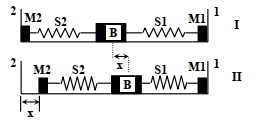
A
$4$
B
$2$
C
$\frac{1}{2}$
D
$\frac{1}{4}$
Solution
(C) When the block $B$ is displaced by a distance $x$ towards wall $1$,spring $S1$ is compressed by $x$,while spring $S2$ remains unstretched because support $M2$ is not fixed to the wall and moves with the block. The potential energy stored in the system is $U_i = \frac{1}{2} k x^2$.
When the block is released,it moves towards the equilibrium position and then towards wall $2$. When it moves towards wall $2$ by a distance $y$,spring $S2$ is compressed by $y$,while spring $S1$ remains unstretched. The potential energy stored in the system is $U_f = \frac{1}{2} (4k) y^2$.
Since there is no friction and the supports have negligible mass,the total mechanical energy is conserved.
Equating the initial and final potential energies: $\frac{1}{2} k x^2 = \frac{1}{2} (4k) y^2$.
Simplifying this,we get $x^2 = 4y^2$,which implies $y^2 = \frac{x^2}{4}$.
Taking the square root,we find $y = \frac{x}{2}$.
Therefore,the ratio $\frac{y}{x} = \frac{1}{2}$.
When the block is released,it moves towards the equilibrium position and then towards wall $2$. When it moves towards wall $2$ by a distance $y$,spring $S2$ is compressed by $y$,while spring $S1$ remains unstretched. The potential energy stored in the system is $U_f = \frac{1}{2} (4k) y^2$.
Since there is no friction and the supports have negligible mass,the total mechanical energy is conserved.
Equating the initial and final potential energies: $\frac{1}{2} k x^2 = \frac{1}{2} (4k) y^2$.
Simplifying this,we get $x^2 = 4y^2$,which implies $y^2 = \frac{x^2}{4}$.
Taking the square root,we find $y = \frac{x}{2}$.
Therefore,the ratio $\frac{y}{x} = \frac{1}{2}$.
0 likes
View Solution98
EasyMCQ
Two springs have spring constants $k_{A}$ and $k_{B}$ such that $k_{A} > k_{B}$. If both springs are stretched by the same extension $x$,the work required will be:
A
more in spring $A$
B
more in spring $B$
C
equal in both
D
nothing can be said
Solution
(A) The work done $W$ in stretching a spring by an extension $x$ is given by the formula $W = \frac{1}{2} k x^2$.
Since the extension $x$ is the same for both springs,the work done is directly proportional to the spring constant $k$ $(W \propto k)$.
Given that $k_{A} > k_{B}$,it follows that $W_{A} > W_{B}$.
Therefore,more work is required to stretch spring $A$.
Since the extension $x$ is the same for both springs,the work done is directly proportional to the spring constant $k$ $(W \propto k)$.
Given that $k_{A} > k_{B}$,it follows that $W_{A} > W_{B}$.
Therefore,more work is required to stretch spring $A$.
0 likes
View Solution99
EasyMCQ
When a long spring of $4 \ cm$ is stretched by $1 \ cm$,the potential energy stored in the spring is $U$. If it is stretched by $4 \ cm$,the potential energy stored in it is (in $U$)
A
$4$
B
$16$
C
$9$
D
$25$
Solution
(B) The potential energy $U$ stored in a spring is given by the formula $U = \frac{1}{2} K x^2$,where $K$ is the spring constant and $x$ is the extension.
For the first case,$x_1 = 1 \ cm$,so $U = \frac{1}{2} K (1)^2 = \frac{1}{2} K$.
For the second case,$x_2 = 4 \ cm$,so the new potential energy $U'$ is $U' = \frac{1}{2} K (4)^2 = 16 \times (\frac{1}{2} K)$.
Substituting $U$ into the equation for $U'$,we get $U' = 16 U$.
For the first case,$x_1 = 1 \ cm$,so $U = \frac{1}{2} K (1)^2 = \frac{1}{2} K$.
For the second case,$x_2 = 4 \ cm$,so the new potential energy $U'$ is $U' = \frac{1}{2} K (4)^2 = 16 \times (\frac{1}{2} K)$.
Substituting $U$ into the equation for $U'$,we get $U' = 16 U$.
0 likes
View SolutionWork, Energy, Power and Collision — Work Done by Spring and Potential Energy of Spring · Frequently Asked Questions
1Are these Work, Energy, Power and Collision questions useful for JEE and NEET?
Yes. All questions in this section are mapped to JEE Main and NEET exam patterns. Previous year questions from JEE Main, NEET, GUJCET and state-level exams are included with full solutions.
2Can I switch to Hindi or Gujarati for these questions?
Yes. Use the language tabs in the hero section or the sidebar to view the same questions and solutions in English, Hindi or Gujarati.
3How do I generate a question paper from this subtopic?
Use the Vedclass Exam Paper Generator — select the chapter and subtopic, set difficulty, and generate Sets A, B, C, D automatically. First 3 chapters of every subject are free.
Vedclass Products
For Students
Vedclass Test Series
Mock tests in real JEE/NEET style with performance analysis. 5-day free trial.
Start Free TrialFor Teachers
Exam Paper Generator
Generate Set A/B/C/D papers from this chapter in 2 minutes. 3 chapters free.
Try FreeFor Institutes
Online Exam Module
Live online exams with unlimited students, 360° analytics & white-label branding.
See DemoFor Teachers & Institutes
Generate a Work, Energy, Power and Collision Exam Paper in 2 Minutes
Select subtopic & difficulty — Sets A, B, C, D auto-generated with No Repeat logic.
First 3 chapters of every subject are free — no payment required.