
A English
Conservative and Non-Conservative forces and Potential Energy Questions in English
Class 11 Physics · Work, Energy, Power and Collision · Conservative and Non-Conservative forces and Potential Energy
63+
Questions
English
Language
100%
With Solutions
Showing 13 of 63 questions in English
51
EasyMCQ
When a conservative force does positive work on a body,then the
A
Potential energy of body decreases
B
Potential energy of body increases
C
Total mechanical energy of body increases
D
Total mechanical energy of body decreases
Solution
(A) The relationship between a conservative force $F$ and the potential energy $U$ is given by $F = -\frac{dU}{dr}$.
Work done by a conservative force is defined as $W = -\Delta U = -(U_f - U_i) = U_i - U_f$.
If the work done $W$ is positive,then $U_i - U_f > 0$,which implies $U_i > U_f$.
Therefore,the potential energy of the body decreases.
Work done by a conservative force is defined as $W = -\Delta U = -(U_f - U_i) = U_i - U_f$.
If the work done $W$ is positive,then $U_i - U_f > 0$,which implies $U_i > U_f$.
Therefore,the potential energy of the body decreases.
1 likes
View Solution52
EasyMCQ
Potential energy is defined ............
A
Only in conservative fields
B
As the negative of work done by conservative forces
C
As the negative of work done by external forces when $\Delta K = 0$
D
All of these
Solution
(D) Potential energy is a property of a system in a conservative force field.
$1$. It is defined only in conservative fields because the work done by conservative forces is path-independent.
$2$. The change in potential energy $\Delta U$ is defined as the negative of the work done by conservative forces: $\Delta U = -W_c$.
$3$. It can also be defined as the work done by an external agent to move a system from one configuration to another without any change in kinetic energy $(\Delta K = 0)$,which equals the change in potential energy.
Therefore,all the given statements are correct. The correct option is $D$.
$1$. It is defined only in conservative fields because the work done by conservative forces is path-independent.
$2$. The change in potential energy $\Delta U$ is defined as the negative of the work done by conservative forces: $\Delta U = -W_c$.
$3$. It can also be defined as the work done by an external agent to move a system from one configuration to another without any change in kinetic energy $(\Delta K = 0)$,which equals the change in potential energy.
Therefore,all the given statements are correct. The correct option is $D$.
0 likes
View Solution53
MediumMCQ
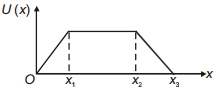
The variation of potential energy $U$ of a system is shown in the figure. The force acting on the system is best represented by:
A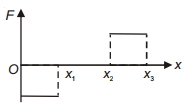
B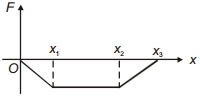
C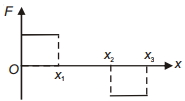
D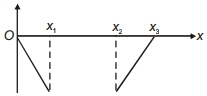
Solution
(D) The relationship between force $F$ and potential energy $U$ is given by $F = -\frac{dU}{dx}$.
This means the force is the negative of the slope of the $U-x$ graph.
$1$. For the interval $0 \rightarrow x_1$: The slope of the $U-x$ graph is positive and constant. Therefore, the force $F = -(\text{positive constant})$ is negative and constant.
$2$. For the interval $x_1 \rightarrow x_2$: The potential energy $U$ is constant, so the slope is zero. Therefore, the force $F = 0$.
$3$. For the interval $x_2 \rightarrow x_3$: The slope of the $U-x$ graph is negative and constant. Therefore, the force $F = -(\text{negative constant})$ is positive and constant.
Comparing this with the given options, the graph in option $D$ correctly represents a negative constant force, followed by zero force, and then a positive constant force.
This means the force is the negative of the slope of the $U-x$ graph.
$1$. For the interval $0 \rightarrow x_1$: The slope of the $U-x$ graph is positive and constant. Therefore, the force $F = -(\text{positive constant})$ is negative and constant.
$2$. For the interval $x_1 \rightarrow x_2$: The potential energy $U$ is constant, so the slope is zero. Therefore, the force $F = 0$.
$3$. For the interval $x_2 \rightarrow x_3$: The slope of the $U-x$ graph is negative and constant. Therefore, the force $F = -(\text{negative constant})$ is positive and constant.
Comparing this with the given options, the graph in option $D$ correctly represents a negative constant force, followed by zero force, and then a positive constant force.
0 likes
View Solution54
DifficultMCQ
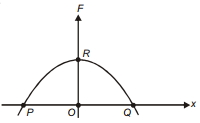
The variation of force $F$ acting on a body moving along the $x$-axis with respect to its position $(x)$ is shown in the figure. The body is in a stable equilibrium state at:
A
$P$
B
$Q$
C
$R$
D
Both $P$ and $Q$
Solution
(B) For a body to be in equilibrium,the net force $F$ acting on it must be zero. From the graph,the force $F$ is zero at points $P$ and $Q$.
For stable equilibrium,the potential energy $U$ must be at a minimum,which implies $\frac{d^2 U}{d x^2} > 0$.
Since $F = -\frac{d U}{d x}$,we have $\frac{d F}{d x} = -\frac{d^2 U}{d x^2}$.
Therefore,for stable equilibrium,$\frac{d F}{d x} < 0$,which means the slope of the $F-x$ graph must be negative.
At point $P$,the slope of the $F-x$ curve is positive.
At point $Q$,the slope of the $F-x$ curve is negative.
Thus,the body is in a stable equilibrium state at point $Q$.
For stable equilibrium,the potential energy $U$ must be at a minimum,which implies $\frac{d^2 U}{d x^2} > 0$.
Since $F = -\frac{d U}{d x}$,we have $\frac{d F}{d x} = -\frac{d^2 U}{d x^2}$.
Therefore,for stable equilibrium,$\frac{d F}{d x} < 0$,which means the slope of the $F-x$ graph must be negative.
At point $P$,the slope of the $F-x$ curve is positive.
At point $Q$,the slope of the $F-x$ curve is negative.
Thus,the body is in a stable equilibrium state at point $Q$.
0 likes
View Solution55
MediumMCQ
Given below are two statements: one is labelled as Assertion $A$ and the other is labelled as Reason $R$.
Assertion $A$: In a central force field,the work done is independent of the path chosen.
Reason $R$: Every force encountered in mechanics does not have an associated potential energy.
In the light of the above statements,choose the most appropriate answer from the options given below:
Assertion $A$: In a central force field,the work done is independent of the path chosen.
Reason $R$: Every force encountered in mechanics does not have an associated potential energy.
In the light of the above statements,choose the most appropriate answer from the options given below:
A
$A$ is true but $R$ is false
B
Both $A$ and $R$ are true but $R$ is $\text{NOT}$ the correct explanation of $A$
C
Both $A$ and $R$ are true and $R$ is the correct explanation of $A$
D
$A$ is false but $R$ is true
Solution
(B) Assertion $A$ is true because a central force (like gravitational or electrostatic force) is a conservative force. By definition,the work done by a conservative force is independent of the path taken and depends only on the initial and final positions.
Reason $R$ is also true because non-conservative forces (like friction or air resistance) do not have an associated potential energy function.
However,the fact that some forces do not have potential energy is not the reason why central forces are path-independent. Path independence is a fundamental property of conservative forces themselves. Therefore,$R$ is not the correct explanation of $A$.
Reason $R$ is also true because non-conservative forces (like friction or air resistance) do not have an associated potential energy function.
However,the fact that some forces do not have potential energy is not the reason why central forces are path-independent. Path independence is a fundamental property of conservative forces themselves. Therefore,$R$ is not the correct explanation of $A$.
0 likes
View Solution56
MediumMCQ
Which one of the following forces cannot be expressed in terms of potential energy?
A
Coulomb's force
B
Gravitational force
C
Frictional force
D
Restoring force
Solution
(C) Potential energy is defined only for conservative forces.
Conservative forces are those for which the work done in moving a particle between two points is independent of the path taken.
Examples of conservative forces include gravitational force,electrostatic (Coulomb's) force,and spring (restoring) force.
Frictional force is a non-conservative force because the work done against it depends on the path taken.
Therefore,potential energy cannot be defined for frictional force.
Conservative forces are those for which the work done in moving a particle between two points is independent of the path taken.
Examples of conservative forces include gravitational force,electrostatic (Coulomb's) force,and spring (restoring) force.
Frictional force is a non-conservative force because the work done against it depends on the path taken.
Therefore,potential energy cannot be defined for frictional force.
0 likes
View Solution57
EasyMCQ
Assertion $(A) :-$ If work done by the force depends on the path,then the force is said to be non-conservative.
Reason $(R) :-$ All conservative forces are central forces.
Reason $(R) :-$ All conservative forces are central forces.
A
Both $(A)$ and $(R)$ are correct but $(R)$ is not the correct explanation of $(A)$
B
$(A)$ is correct but $(R)$ is not correct
C
$(A)$ is incorrect but $(R)$ is correct
D
Both $(A)$ and $(R)$ are correct and $(R)$ is the correct explanation of $(A)$
Solution
(A) $1$. Assertion $(A)$ is correct. By definition,a force is non-conservative if the work done by it depends on the path taken between two points. Conversely,for a conservative force,the work done is independent of the path and depends only on the initial and final positions.
$2$. Reason $(R)$ is also correct. $A$ central force is a force that acts along the line joining the centers of two objects. All conservative forces (like gravitational force and electrostatic force) are central forces.
$3$. However,the fact that conservative forces are central forces does not explain why a force is non-conservative based on path dependence. Therefore,$(R)$ is not the correct explanation of $(A)$.
$2$. Reason $(R)$ is also correct. $A$ central force is a force that acts along the line joining the centers of two objects. All conservative forces (like gravitational force and electrostatic force) are central forces.
$3$. However,the fact that conservative forces are central forces does not explain why a force is non-conservative based on path dependence. Therefore,$(R)$ is not the correct explanation of $(A)$.
0 likes
View Solution58
MediumMCQ
In the case of non-conservative forces,the following statement is correct.
A
The work done by non-conservative force in a closed path is zero.
B
The work done by non-conservative forces does not depend on the path.
C
The work done by non-conservative forces depend on the path.
D
There is no energy loss in case of non-conservative forces.
Solution
(C) non-conservative force is a force for which the work done depends on the path taken between the initial and final positions.
Unlike conservative forces,the work done by a non-conservative force over a closed path is not zero.
Therefore,the statement that the work done by non-conservative forces depends on the path is correct.
Unlike conservative forces,the work done by a non-conservative force over a closed path is not zero.
Therefore,the statement that the work done by non-conservative forces depends on the path is correct.
0 likes
View Solution59
DifficultMCQ
Which of the following is not a correct statement?
A
Work done by conservative force is equal to negative change in potential energy
B
Total energy of system is always conserved
C
Work done by non-conservative force in a closed path is equal to zero
D
In stable equilibrium,the potential energy is minimum
Solution
(C) The work done by a conservative force is defined as $W_c = -\Delta U$,which is the negative change in potential energy. Thus,option $A$ is correct.
Total energy of a system is conserved only if the system is isolated (no external work or heat transfer). In general,the total energy of a system is not always conserved if external forces act on it. Thus,option $B$ is a general statement that is often considered incorrect in the context of non-isolated systems.
Non-conservative forces (like friction) dissipate energy. The work done by a non-conservative force in a closed path is not zero. Thus,option $C$ is definitely an incorrect statement.
In stable equilibrium,the potential energy $U$ is at a local minimum,meaning $dU/dx = 0$ and $d^2U/dx^2 > 0$. Thus,option $D$ is correct.
Comparing $B$ and $C$,$C$ is a fundamental property of non-conservative forces (they are path-dependent),making it explicitly false. Therefore,$C$ is the intended incorrect statement.
Total energy of a system is conserved only if the system is isolated (no external work or heat transfer). In general,the total energy of a system is not always conserved if external forces act on it. Thus,option $B$ is a general statement that is often considered incorrect in the context of non-isolated systems.
Non-conservative forces (like friction) dissipate energy. The work done by a non-conservative force in a closed path is not zero. Thus,option $C$ is definitely an incorrect statement.
In stable equilibrium,the potential energy $U$ is at a local minimum,meaning $dU/dx = 0$ and $d^2U/dx^2 > 0$. Thus,option $D$ is correct.
Comparing $B$ and $C$,$C$ is a fundamental property of non-conservative forces (they are path-dependent),making it explicitly false. Therefore,$C$ is the intended incorrect statement.
0 likes
View Solution60
EasyMCQ
The potential energy of an object is $U(x) = (5x^2 - 4x^3) \ J$,where $x$ is the position in meters. The position at which the force becomes zero is
A
$1/2 \ m$
B
$5/6 \ m$
C
$1/3 \ m$
D
$2/3 \ m$
Solution
(B) For a conservative force,the relationship between force $F$ and potential energy $U$ is given by $F = -\frac{dU}{dx}$.
Given $U(x) = 5x^2 - 4x^3$.
To find the position where the force is zero,we set $F = 0$:
$0 = -\frac{d}{dx}(5x^2 - 4x^3)$
$0 = -(10x - 12x^2)$
$12x^2 - 10x = 0$
$2x(6x - 5) = 0$
This gives two solutions: $x = 0 \ m$ or $x = 5/6 \ m$.
Comparing this with the given options,the correct position is $5/6 \ m$.
Given $U(x) = 5x^2 - 4x^3$.
To find the position where the force is zero,we set $F = 0$:
$0 = -\frac{d}{dx}(5x^2 - 4x^3)$
$0 = -(10x - 12x^2)$
$12x^2 - 10x = 0$
$2x(6x - 5) = 0$
This gives two solutions: $x = 0 \ m$ or $x = 5/6 \ m$.
Comparing this with the given options,the correct position is $5/6 \ m$.
0 likes
View Solution61
MediumMCQ
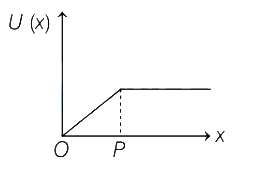
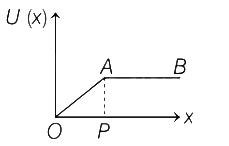
The graph of potential energy $U(x)$ versus distance $x$ is shown in the following figure. The force $F$ versus distance $x$ graph will be represented by (assume that the force is conservative):
A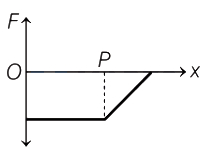
B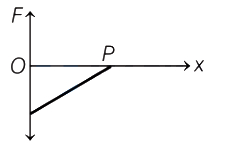
C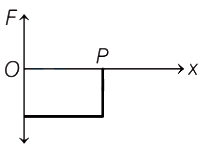
D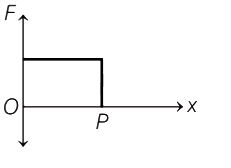
Solution
(A) The relationship between conservative force $F$ and potential energy $U(x)$ is given by $F = -\frac{dU}{dx}$.
This means the force is equal to the negative of the slope of the $U(x)$ versus $x$ graph.
For the region $OA$ (from $x=0$ to $x=P$),the graph is a straight line with a positive constant slope. Let the slope be $k > 0$. Thus,$F = -k$,which is a negative constant.
For the region $AB$ (for $x > P$),the graph is a horizontal straight line. The slope of this line is $0$. Thus,$F = -(0) = 0$.
Comparing this with the given options,the graph that shows a negative constant force for $x < P$ and zero force for $x > P$ is represented by option $A$.
This means the force is equal to the negative of the slope of the $U(x)$ versus $x$ graph.
For the region $OA$ (from $x=0$ to $x=P$),the graph is a straight line with a positive constant slope. Let the slope be $k > 0$. Thus,$F = -k$,which is a negative constant.
For the region $AB$ (for $x > P$),the graph is a horizontal straight line. The slope of this line is $0$. Thus,$F = -(0) = 0$.
Comparing this with the given options,the graph that shows a negative constant force for $x < P$ and zero force for $x > P$ is represented by option $A$.
0 likes
View Solution62
EasyMCQ
Conservative forces are defined as the force for which,
A
work done depends only on the initial and final positions.
B
work done depends on the initial and final positions and also on the path taken.
C
work done depends only on the path taken.
D
work done depends only on the initial position.
Solution
(A) conservative force is defined as a force where the total work done in moving a particle between two points is independent of the path taken.
It depends solely on the initial and final positions of the particle.
Mathematically,the work done by a conservative force around any closed path is zero.
Therefore,the correct option is $A$.
It depends solely on the initial and final positions of the particle.
Mathematically,the work done by a conservative force around any closed path is zero.
Therefore,the correct option is $A$.
0 likes
View Solution63
MediumMCQ
Given below are two statements:
Statement $I$: An object moves from position $r_{1}$ to position $r_{2}$ under a conservative force field $\vec{F}$. The work done by the force is $W = -\int_{r_{1}}^{r_{2}} \vec{F} \cdot d\vec{r}$.
Statement $II$: Any object moving from one location to another location can follow an infinite number of paths. Therefore,the amount of work done by the object changes with the path it follows for a conservative force.
In the light of the above statements,choose the correct answer from the options given below:
Statement $I$: An object moves from position $r_{1}$ to position $r_{2}$ under a conservative force field $\vec{F}$. The work done by the force is $W = -\int_{r_{1}}^{r_{2}} \vec{F} \cdot d\vec{r}$.
Statement $II$: Any object moving from one location to another location can follow an infinite number of paths. Therefore,the amount of work done by the object changes with the path it follows for a conservative force.
In the light of the above statements,choose the correct answer from the options given below:
A
Both Statement $I$ and Statement $II$ are true
B
Statement $I$ is false but Statement $II$ is true
C
Statement $I$ is true but Statement $II$ is false
D
Both Statement $I$ and Statement $II$ are false
Solution
(D) Statement-$I$: Incorrect.
The work done by a force $\vec{F}$ is defined as $W = \int_{r_{1}}^{r_{2}} \vec{F} \cdot d\vec{r}$. The potential energy change $\Delta U$ is defined as $-\int_{r_{1}}^{r_{2}} \vec{F} \cdot d\vec{r}$. Thus,the given expression for work is incorrect.
Statement-$II$: Incorrect.
$A$ conservative force is defined as a force for which the work done is independent of the path taken between two points. Therefore,the work done does not change with the path followed.
The work done by a force $\vec{F}$ is defined as $W = \int_{r_{1}}^{r_{2}} \vec{F} \cdot d\vec{r}$. The potential energy change $\Delta U$ is defined as $-\int_{r_{1}}^{r_{2}} \vec{F} \cdot d\vec{r}$. Thus,the given expression for work is incorrect.
Statement-$II$: Incorrect.
$A$ conservative force is defined as a force for which the work done is independent of the path taken between two points. Therefore,the work done does not change with the path followed.
0 likes
View SolutionWork, Energy, Power and Collision — Conservative and Non-Conservative forces and Potential Energy · Frequently Asked Questions
1Are these Work, Energy, Power and Collision questions useful for JEE and NEET?
Yes. All questions in this section are mapped to JEE Main and NEET exam patterns. Previous year questions from JEE Main, NEET, GUJCET and state-level exams are included with full solutions.
2Can I switch to Hindi or Gujarati for these questions?
Yes. Use the language tabs in the hero section or the sidebar to view the same questions and solutions in English, Hindi or Gujarati.
3How do I generate a question paper from this subtopic?
Use the Vedclass Exam Paper Generator — select the chapter and subtopic, set difficulty, and generate Sets A, B, C, D automatically. First 3 chapters of every subject are free.
Vedclass Products
For Students
Vedclass Test Series
Mock tests in real JEE/NEET style with performance analysis. 5-day free trial.
Start Free TrialFor Teachers
Exam Paper Generator
Generate Set A/B/C/D papers from this chapter in 2 minutes. 3 chapters free.
Try FreeFor Institutes
Online Exam Module
Live online exams with unlimited students, 360° analytics & white-label branding.
See DemoFor Teachers & Institutes
Generate a Work, Energy, Power and Collision Exam Paper in 2 Minutes
Select subtopic & difficulty — Sets A, B, C, D auto-generated with No Repeat logic.
First 3 chapters of every subject are free — no payment required.