
A English
Refrigerator Questions in English
Class 11 Physics · Thermodynamics · Refrigerator
69+
Questions
English
Language
100%
With Solutions
Showing 19 of 69 questions in English
51
EasyMCQ
Which of the following can be the coefficient of performance of a refrigerator?
A
$1$
B
$0.5$
C
$9$
D
All of these
Solution
(D) The coefficient of performance $(\beta)$ of a refrigerator is defined as the ratio of the heat extracted from the cold reservoir $(Q_2)$ to the work done on the system $(W)$: $\beta = \frac{Q_2}{W}$.
Since $W = Q_1 - Q_2$, we have $\beta = \frac{Q_2}{Q_1 - Q_2}$.
Dividing numerator and denominator by $Q_1$, we get $\beta = \frac{Q_2/Q_1}{1 - Q_2/Q_1}$.
Using the efficiency of a Carnot engine $\eta = 1 - \frac{Q_2}{Q_1}$, we can write $\frac{Q_2}{Q_1} = 1 - \eta$.
Substituting this into the expression for $\beta$: $\beta = \frac{1 - \eta}{\eta} = \frac{1}{\eta} - 1$.
Since the efficiency $\eta$ of any heat engine is always less than $1$, the term $\frac{1}{\eta}$ is always greater than $1$.
Therefore, $\beta = \frac{1}{\eta} - 1$ can take any positive value greater than $0$.
Since $1$, $0.5$, and $9$ are all positive values, all of these can be the coefficient of performance of a refrigerator.
Since $W = Q_1 - Q_2$, we have $\beta = \frac{Q_2}{Q_1 - Q_2}$.
Dividing numerator and denominator by $Q_1$, we get $\beta = \frac{Q_2/Q_1}{1 - Q_2/Q_1}$.
Using the efficiency of a Carnot engine $\eta = 1 - \frac{Q_2}{Q_1}$, we can write $\frac{Q_2}{Q_1} = 1 - \eta$.
Substituting this into the expression for $\beta$: $\beta = \frac{1 - \eta}{\eta} = \frac{1}{\eta} - 1$.
Since the efficiency $\eta$ of any heat engine is always less than $1$, the term $\frac{1}{\eta}$ is always greater than $1$.
Therefore, $\beta = \frac{1}{\eta} - 1$ can take any positive value greater than $0$.
Since $1$, $0.5$, and $9$ are all positive values, all of these can be the coefficient of performance of a refrigerator.
0 likes
View Solution52
MediumMCQ
The temperatures inside and outside a refrigerator are $273 \, K$ and $300 \, K$ respectively. Assuming that the refrigerator cycle is reversible,for every joule of work done,the heat delivered to the surrounding will be nearly ........ $J$.
A
$11$
B
$22$
C
$33$
D
$50$
Solution
(A) Given: Temperature inside the refrigerator $T_2 = 273 \, K$,Temperature outside (surrounding) $T_1 = 300 \, K$.
For a reversible refrigerator,the coefficient of performance $\beta$ is given by $\beta = \frac{T_2}{T_1 - T_2}$.
Substituting the values: $\beta = \frac{273}{300 - 273} = \frac{273}{27} \approx 10.11$.
The coefficient of performance is also defined as $\beta = \frac{Q_2}{W}$,where $Q_2$ is the heat extracted from the cold reservoir and $W$ is the work done.
Given $W = 1 \, J$,we have $Q_2 = \beta \times W = 10.11 \times 1 = 10.11 \, J$.
The heat delivered to the surrounding $Q_1$ is given by $Q_1 = Q_2 + W$.
$Q_1 = 10.11 \, J + 1 \, J = 11.11 \, J$.
Rounding to the nearest integer,the heat delivered is approximately $11 \, J$.
For a reversible refrigerator,the coefficient of performance $\beta$ is given by $\beta = \frac{T_2}{T_1 - T_2}$.
Substituting the values: $\beta = \frac{273}{300 - 273} = \frac{273}{27} \approx 10.11$.
The coefficient of performance is also defined as $\beta = \frac{Q_2}{W}$,where $Q_2$ is the heat extracted from the cold reservoir and $W$ is the work done.
Given $W = 1 \, J$,we have $Q_2 = \beta \times W = 10.11 \times 1 = 10.11 \, J$.
The heat delivered to the surrounding $Q_1$ is given by $Q_1 = Q_2 + W$.
$Q_1 = 10.11 \, J + 1 \, J = 11.11 \, J$.
Rounding to the nearest integer,the heat delivered is approximately $11 \, J$.
0 likes
View Solution53
EasyMCQ
By opening the door of a refrigerator placed inside a room,you:
A
Can cool the room to a certain degree
B
Can cool it to the temperature inside the refrigerator
C
Ultimately warm the room slightly
D
Can neither cool nor warm the room
Solution
(C) The correct option is $C$.
$A$ refrigerator works as a heat pump that extracts heat from its interior and rejects it into the surrounding environment (the room).
When the door is open,the refrigerator continues to extract heat from the room air and releases it back into the room along with the heat generated by the electrical work done by the compressor.
Since the compressor performs work on the system,the total energy released into the room is the sum of the heat extracted and the work done by the motor.
Therefore,the net effect is an increase in the total thermal energy of the room,which ultimately warms the room slightly.
$A$ refrigerator works as a heat pump that extracts heat from its interior and rejects it into the surrounding environment (the room).
When the door is open,the refrigerator continues to extract heat from the room air and releases it back into the room along with the heat generated by the electrical work done by the compressor.
Since the compressor performs work on the system,the total energy released into the room is the sum of the heat extracted and the work done by the motor.
Therefore,the net effect is an increase in the total thermal energy of the room,which ultimately warms the room slightly.
0 likes
View Solution54
MediumMCQ
An ideal refrigerator has a freezer at a temperature of $-13^{\circ} C$. The coefficient of performance of the refrigerator is $5$. The temperature of the air (to which heat is rejected) is:
A
$320^{\circ} C$
B
$39^{\circ} C$
C
$325 K$
D
$325^{\circ} C$
Solution
(B) The coefficient of performance $(COP)$,$\beta$,for an ideal refrigerator is given by the formula: $\beta = \frac{T_2}{T_1 - T_2}$,where $T_2$ is the temperature of the freezer and $T_1$ is the temperature of the surroundings (sink).
Given: $\beta = 5$ and $T_2 = -13^{\circ} C = (-13 + 273) K = 260 K$.
Substituting the values into the formula:
$5 = \frac{260}{T_1 - 260}$
$5(T_1 - 260) = 260$
$5T_1 - 1300 = 260$
$5T_1 = 1560$
$T_1 = 312 K$
Converting back to Celsius: $T_1 = (312 - 273)^{\circ} C = 39^{\circ} C$.
Given: $\beta = 5$ and $T_2 = -13^{\circ} C = (-13 + 273) K = 260 K$.
Substituting the values into the formula:
$5 = \frac{260}{T_1 - 260}$
$5(T_1 - 260) = 260$
$5T_1 - 1300 = 260$
$5T_1 = 1560$
$T_1 = 312 K$
Converting back to Celsius: $T_1 = (312 - 273)^{\circ} C = 39^{\circ} C$.
0 likes
View Solution55
MediumMCQ
If $\alpha$ is the coefficient of performance of a refrigerator and $Q_1$ is the heat released to the hot reservoir,then the heat extracted from the cold reservoir $Q_2$ is
A
$\frac{\alpha Q_1}{\alpha-1}$
B
$\frac{\alpha-1}{\alpha} Q_1$
C
$\frac{\alpha Q_1}{1+\alpha}$
D
$\frac{1+\alpha}{\alpha} Q_1$
Solution
(C) The coefficient of performance $\alpha$ of a refrigerator is defined as the ratio of heat extracted from the cold reservoir $(Q_2)$ to the work done $(W)$ on the system: $\alpha = \frac{Q_2}{W}$.
Since $W = Q_1 - Q_2$,where $Q_1$ is the heat released to the hot reservoir,we have $\alpha = \frac{Q_2}{Q_1 - Q_2}$.
Cross-multiplying gives: $\alpha(Q_1 - Q_2) = Q_2$.
Expanding the equation: $\alpha Q_1 - \alpha Q_2 = Q_2$.
Rearranging to solve for $Q_2$: $\alpha Q_1 = Q_2 + \alpha Q_2 = Q_2(1 + \alpha)$.
Therefore,$Q_2 = \frac{\alpha Q_1}{1 + \alpha}$.
Since $W = Q_1 - Q_2$,where $Q_1$ is the heat released to the hot reservoir,we have $\alpha = \frac{Q_2}{Q_1 - Q_2}$.
Cross-multiplying gives: $\alpha(Q_1 - Q_2) = Q_2$.
Expanding the equation: $\alpha Q_1 - \alpha Q_2 = Q_2$.
Rearranging to solve for $Q_2$: $\alpha Q_1 = Q_2 + \alpha Q_2 = Q_2(1 + \alpha)$.
Therefore,$Q_2 = \frac{\alpha Q_1}{1 + \alpha}$.
0 likes
View Solution56
MediumMCQ
If a refrigerator of coefficient of performance of $5$ has a freezer at a temperature of $-13^{\circ} C$,then the room temperature is (in $^{\circ} C$)
A
$325$
B
$225$
C
$39$
D
$29$
Solution
(C) The coefficient of performance $(COP)$ of a refrigerator is given by the formula: $COP = \frac{T_L}{T_H - T_L}$,where $T_L$ is the temperature of the freezer and $T_H$ is the room temperature in Kelvin.
Given: $COP = 5$,$T_L = -13^{\circ} C = (-13 + 273) K = 260 K$.
Substituting the values into the formula: $5 = \frac{260}{T_H - 260}$.
Multiplying both sides by $(T_H - 260)$: $5(T_H - 260) = 260$.
$T_H - 260 = \frac{260}{5} = 52$.
$T_H = 260 + 52 = 312 K$.
Converting back to Celsius: $T_H = (312 - 273)^{\circ} C = 39^{\circ} C$.
Given: $COP = 5$,$T_L = -13^{\circ} C = (-13 + 273) K = 260 K$.
Substituting the values into the formula: $5 = \frac{260}{T_H - 260}$.
Multiplying both sides by $(T_H - 260)$: $5(T_H - 260) = 260$.
$T_H - 260 = \frac{260}{5} = 52$.
$T_H = 260 + 52 = 312 K$.
Converting back to Celsius: $T_H = (312 - 273)^{\circ} C = 39^{\circ} C$.
0 likes
View Solution57
MediumMCQ
$A$ refrigerator of coefficient of performance $5$ that extracts heat from the cooling compartment at the rate of $250 \ J$ per cycle is placed in a room. The heat released per cycle to the room by the refrigerator is (in $J$)
A
$250$
B
$50$
C
$200$
D
$300$
Solution
(D) The coefficient of performance $(\beta)$ of a refrigerator is given by the formula: $\beta = \frac{Q_2}{W}$, where $Q_2$ is the heat extracted from the cold reservoir and $W$ is the work done on the system.
Given: $\beta = 5$ and $Q_2 = 250 \ J$.
Substituting the values: $5 = \frac{250}{W} \implies W = \frac{250}{5} = 50 \ J$.
The heat released to the room $(Q_1)$ is the sum of the heat extracted and the work done: $Q_1 = Q_2 + W$.
$Q_1 = 250 \ J + 50 \ J = 300 \ J$.
Therefore, the heat released per cycle to the room is $300 \ J$.
Given: $\beta = 5$ and $Q_2 = 250 \ J$.
Substituting the values: $5 = \frac{250}{W} \implies W = \frac{250}{5} = 50 \ J$.
The heat released to the room $(Q_1)$ is the sum of the heat extracted and the work done: $Q_1 = Q_2 + W$.
$Q_1 = 250 \ J + 50 \ J = 300 \ J$.
Therefore, the heat released per cycle to the room is $300 \ J$.
0 likes
View Solution58
EasyMCQ
$A$ Carnot heat engine has an efficiency of $10 \%$. If the same engine is worked backward to obtain a refrigerator,then the coefficient of performance of the refrigerator is
A
$8$
B
$9$
C
$5$
D
$6$
Solution
(B) The efficiency of a Carnot heat engine is given by $\eta = 10 \% = 0.1$.
When the same engine operates as a refrigerator,the coefficient of performance $(COP)_R$ is related to the efficiency $\eta$ of the heat engine by the formula:
$(COP)_R = \frac{1 - \eta}{\eta}$.
Substituting the value of $\eta = 0.1$ into the formula:
$(COP)_R = \frac{1 - 0.1}{0.1} = \frac{0.9}{0.1} = 9$.
Thus,the coefficient of performance of the refrigerator is $9$.
When the same engine operates as a refrigerator,the coefficient of performance $(COP)_R$ is related to the efficiency $\eta$ of the heat engine by the formula:
$(COP)_R = \frac{1 - \eta}{\eta}$.
Substituting the value of $\eta = 0.1$ into the formula:
$(COP)_R = \frac{1 - 0.1}{0.1} = \frac{0.9}{0.1} = 9$.
Thus,the coefficient of performance of the refrigerator is $9$.
0 likes
View Solution59
EasyMCQ
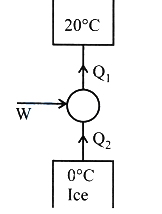
In a cold storage,ice melts at the rate of $2 \ kg$ per hour when the external temperature is $20^{\circ} C$. The minimum power output of the motor used to drive the refrigerator which just prevents the ice from melting is (latent heat of fusion of ice $= 80 \ cal \ g^{-1}$) (in $W$)
A
$28.5$
B
$13.6$
C
$9.75$
D
$16.4$
Solution
(B) The rate of heat entering the cold storage is $Q_2 = \frac{mL}{t} = \frac{2 \times 10^3 \ g \times 80 \ cal/g}{3600 \ s} = \frac{160000}{3600} \ cal/s = \frac{400}{9} \ cal/s$.
Converting to Joules per second (Watts): $Q_2 = \frac{400}{9} \times 4.2 \ J/s = 186.67 \ W$.
The coefficient of performance $(COP)$ of a Carnot refrigerator is given by $\text{COP} = \frac{T_2}{T_1 - T_2} = \frac{Q_2}{W}$.
Here,$T_2 = 0^{\circ} C = 273 \ K$ and $T_1 = 20^{\circ} C = 293 \ K$.
So,$\frac{273}{293 - 273} = \frac{186.67}{W}$.
$\frac{273}{20} = \frac{186.67}{W}$.
$W = \frac{186.67 \times 20}{273} \approx 13.67 \ W$.
Thus,the minimum power output is approximately $13.6 \ W$.
Converting to Joules per second (Watts): $Q_2 = \frac{400}{9} \times 4.2 \ J/s = 186.67 \ W$.
The coefficient of performance $(COP)$ of a Carnot refrigerator is given by $\text{COP} = \frac{T_2}{T_1 - T_2} = \frac{Q_2}{W}$.
Here,$T_2 = 0^{\circ} C = 273 \ K$ and $T_1 = 20^{\circ} C = 293 \ K$.
So,$\frac{273}{293 - 273} = \frac{186.67}{W}$.
$\frac{273}{20} = \frac{186.67}{W}$.
$W = \frac{186.67 \times 20}{273} \approx 13.67 \ W$.
Thus,the minimum power output is approximately $13.6 \ W$.
0 likes
View Solution60
EasyMCQ
$A$ refrigerator with a coefficient of performance $0.25$ releases $250 \, J$ of heat to a hot reservoir. The work done on the working substance is
A
$100/3 \, J$
B
$150 \, J$
C
$200 \, J$
D
$50 \, J$
Solution
(C) The coefficient of performance $(\beta)$ of a refrigerator is defined as $\beta = \frac{Q_2}{W}$, where $Q_2$ is the heat extracted from the cold reservoir and $W$ is the work done on the system.
Given $\beta = 0.25 = \frac{1}{4}$, so $Q_2 = \frac{W}{4}$.
The heat released to the hot reservoir is $Q_1 = Q_2 + W$.
Substituting $Q_2 = \frac{W}{4}$, we get $Q_1 = \frac{W}{4} + W = \frac{5W}{4}$.
Given $Q_1 = 250 \, J$, we have $250 = \frac{5W}{4}$.
Solving for $W$, $W = 250 \times \frac{4}{5} = 200 \, J$.
Given $\beta = 0.25 = \frac{1}{4}$, so $Q_2 = \frac{W}{4}$.
The heat released to the hot reservoir is $Q_1 = Q_2 + W$.
Substituting $Q_2 = \frac{W}{4}$, we get $Q_1 = \frac{W}{4} + W = \frac{5W}{4}$.
Given $Q_1 = 250 \, J$, we have $250 = \frac{5W}{4}$.
Solving for $W$, $W = 250 \times \frac{4}{5} = 200 \, J$.
0 likes
View Solution61
MediumMCQ
$A$ Carnot engine having an efficiency of $1/5$ as a heat engine is used as a refrigerator. If the work done on the system is $50 \ J$,then the amount of energy absorbed from the reservoir at the lower temperature is (in $J$)
A
$90$
B
$99$
C
$200$
D
$1$
Solution
(C) The efficiency of a Carnot engine is given by $\eta = 1/5$.
When this engine is used as a refrigerator,its coefficient of performance $\beta$ is related to the efficiency $\eta$ by the formula: $\beta = \frac{1 - \eta}{\eta}$.
Substituting the value of $\eta$: $\beta = \frac{1 - 1/5}{1/5} = \frac{4/5}{1/5} = 4$.
The coefficient of performance is also defined as the ratio of heat absorbed from the cold reservoir $(Q)$ to the work done on the system $(W)$: $\beta = \frac{Q}{W}$.
Given $W = 50 \ J$,we have $4 = \frac{Q}{50}$.
Therefore,$Q = 4 \times 50 = 200 \ J$.
When this engine is used as a refrigerator,its coefficient of performance $\beta$ is related to the efficiency $\eta$ by the formula: $\beta = \frac{1 - \eta}{\eta}$.
Substituting the value of $\eta$: $\beta = \frac{1 - 1/5}{1/5} = \frac{4/5}{1/5} = 4$.
The coefficient of performance is also defined as the ratio of heat absorbed from the cold reservoir $(Q)$ to the work done on the system $(W)$: $\beta = \frac{Q}{W}$.
Given $W = 50 \ J$,we have $4 = \frac{Q}{50}$.
Therefore,$Q = 4 \times 50 = 200 \ J$.
0 likes
View Solution62
EasyMCQ
The door of an operating refrigerator is kept open. As a result,the temperature of the room will
A
remain unchanged
B
increase
C
decrease
D
depend on the contents inside the refrigerator
Solution
(B) refrigerator is a device that extracts heat from a low-temperature reservoir (the inside) and transfers it to a high-temperature reservoir (the room) by performing work on the system.
When the door of an operating refrigerator is kept open,the refrigerator continuously extracts heat from the room and releases it back into the room along with the heat generated by the work done by the compressor.
Since the compressor consumes electrical energy and converts it into heat,the total heat rejected into the room is greater than the heat extracted from it.
Therefore,the net effect is an increase in the total thermal energy of the room,causing the room temperature to increase.
When the door of an operating refrigerator is kept open,the refrigerator continuously extracts heat from the room and releases it back into the room along with the heat generated by the work done by the compressor.
Since the compressor consumes electrical energy and converts it into heat,the total heat rejected into the room is greater than the heat extracted from it.
Therefore,the net effect is an increase in the total thermal energy of the room,causing the room temperature to increase.
0 likes
View Solution63
EasyMCQ
An ideal heat engine has an efficiency $\eta$. The coefficient of performance of the engine when driven backward will be
A
$1-\left(\frac{1}{\eta}\right)$
B
$\eta-\left(\frac{1}{\eta}\right)$
C
$\left(\frac{1}{\eta}\right)-1$
D
$\frac{1}{1-\eta}$
Solution
(C) For an ideal heat engine,efficiency $\eta$ is given by:
$\eta = \frac{W}{Q_1} = \frac{Q_1 - Q_2}{Q_1} = 1 - \frac{Q_2}{Q_1} = 1 - \frac{T_2}{T_1}$
From this,we get:
$\frac{T_2}{T_1} = 1 - \eta$
$\frac{T_1}{T_2} = \frac{1}{1 - \eta} \quad \dots (i)$
When the heat engine is operated in the backward direction,it acts as a refrigerator. The coefficient of performance $\beta$ is given by:
$\beta = \frac{Q_2}{W} = \frac{Q_2}{Q_1 - Q_2} = \frac{T_2}{T_1 - T_2}$
Dividing the numerator and denominator by $T_2$:
$\beta = \frac{1}{\frac{T_1}{T_2} - 1}$
Substituting the value from equation $(i)$:
$\beta = \frac{1}{\frac{1}{1 - \eta} - 1} = \frac{1}{\frac{1 - (1 - \eta)}{1 - \eta}} = \frac{1 - \eta}{\eta} = \frac{1}{\eta} - 1$
$\eta = \frac{W}{Q_1} = \frac{Q_1 - Q_2}{Q_1} = 1 - \frac{Q_2}{Q_1} = 1 - \frac{T_2}{T_1}$
From this,we get:
$\frac{T_2}{T_1} = 1 - \eta$
$\frac{T_1}{T_2} = \frac{1}{1 - \eta} \quad \dots (i)$
When the heat engine is operated in the backward direction,it acts as a refrigerator. The coefficient of performance $\beta$ is given by:
$\beta = \frac{Q_2}{W} = \frac{Q_2}{Q_1 - Q_2} = \frac{T_2}{T_1 - T_2}$
Dividing the numerator and denominator by $T_2$:
$\beta = \frac{1}{\frac{T_1}{T_2} - 1}$
Substituting the value from equation $(i)$:
$\beta = \frac{1}{\frac{1}{1 - \eta} - 1} = \frac{1}{\frac{1 - (1 - \eta)}{1 - \eta}} = \frac{1 - \eta}{\eta} = \frac{1}{\eta} - 1$
0 likes
View Solution64
MediumMCQ
An electrical refrigerator with $\beta=5$ extracts $5000 \,J$ from the contents of the refrigerator. During this process, find the electrical energy utilised by its motor. (in $\,kJ$)
A
$1$
B
$0.5$
C
$0.8$
D
$1.2$
Solution
(A) The coefficient of performance $(\beta)$ of a refrigerator is defined as the ratio of the heat extracted from the cold reservoir $(Q)$ to the work done on the system $(W)$:
$\beta = \frac{Q}{W}$
Given:
$\beta = 5$
$Q = 5000 \,J$
We need to find the electrical energy utilised by the motor, which is equal to the work done $(W)$:
$W = \frac{Q}{\beta}$
$W = \frac{5000 \,J}{5} = 1000 \,J$
Since $1000 \,J = 1 \,kJ$, the electrical energy utilised is $1 \,kJ$.
$\beta = \frac{Q}{W}$
Given:
$\beta = 5$
$Q = 5000 \,J$
We need to find the electrical energy utilised by the motor, which is equal to the work done $(W)$:
$W = \frac{Q}{\beta}$
$W = \frac{5000 \,J}{5} = 1000 \,J$
Since $1000 \,J = 1 \,kJ$, the electrical energy utilised is $1 \,kJ$.
0 likes
View Solution65
EasyMCQ
Freezing compartment of a refrigerator is at $0^{\circ} C$ and room temperature is $27.3^{\circ} C$. Work done by the refrigerator to freeze $1 \ g$ of water at $0^{\circ} C$ is $(L_{\text{ice}} = 80 \ cal \ g^{-1})$. (in $J$)
A
$336$
B
$33.6$
C
$3.36$
D
$40$
Solution
(B) The coefficient of performance $(COP)$ of a refrigerator is given by $\beta = \frac{T_2}{T_1 - T_2}$.
Here,$T_2 = 0^{\circ} C = 273 \ K$ and $T_1 = 27.3^{\circ} C = 273 + 27.3 = 300.3 \ K \approx 300 \ K$.
Thus,$\beta = \frac{273}{300 - 273} = \frac{273}{27} \approx 10.11$.
Using the relation $\beta = \frac{Q_2}{W}$,where $Q_2$ is the heat extracted to freeze $1 \ g$ of water.
$Q_2 = m \times L_{\text{ice}} = 1 \ g \times 80 \ cal/g = 80 \ cal$.
Converting $Q_2$ to Joules: $Q_2 = 80 \times 4.2 \ J = 336 \ J$.
Therefore,the work done $W = \frac{Q_2}{\beta} = \frac{336}{10.11} \approx 33.23 \ J$.
Given the options,the closest value is $33.6 \ J$ (calculated using $\beta = 10$).
So,$W = 336 / 10 = 33.6 \ J$.
Here,$T_2 = 0^{\circ} C = 273 \ K$ and $T_1 = 27.3^{\circ} C = 273 + 27.3 = 300.3 \ K \approx 300 \ K$.
Thus,$\beta = \frac{273}{300 - 273} = \frac{273}{27} \approx 10.11$.
Using the relation $\beta = \frac{Q_2}{W}$,where $Q_2$ is the heat extracted to freeze $1 \ g$ of water.
$Q_2 = m \times L_{\text{ice}} = 1 \ g \times 80 \ cal/g = 80 \ cal$.
Converting $Q_2$ to Joules: $Q_2 = 80 \times 4.2 \ J = 336 \ J$.
Therefore,the work done $W = \frac{Q_2}{\beta} = \frac{336}{10.11} \approx 33.23 \ J$.
Given the options,the closest value is $33.6 \ J$ (calculated using $\beta = 10$).
So,$W = 336 / 10 = 33.6 \ J$.
0 likes
View Solution66
EasyMCQ
Assertion $(A)$: $A$ room can be cooled by opening the door of a refrigerator in it.
Reason $(R)$: Heat always flows from a body at higher temperature to a body at lower temperature.
Reason $(R)$: Heat always flows from a body at higher temperature to a body at lower temperature.
A
$(A)$ and $(R)$ are true and $(R)$ is the correct explanation of $(A)$.
B
$(A)$ and $(R)$ are true and $(R)$ is not the correct explanation of $(A)$.
C
$(A)$ is true but $(R)$ is false.
D
$(A)$ is false but $(R)$ is true.
Solution
(D) When the door of a refrigerator is opened,the refrigerator extracts heat from the inside and releases it into the room. Additionally,the work done by the compressor to run the refrigerator is also converted into heat and released into the room. Therefore,the net effect is an increase in the room's temperature rather than cooling it. Thus,Assertion $(A)$ is false.
The Reason $(R)$ states that heat flows from a higher temperature body to a lower temperature body,which is a fundamental principle of thermodynamics (Second Law of Thermodynamics). Thus,Reason $(R)$ is true.
The Reason $(R)$ states that heat flows from a higher temperature body to a lower temperature body,which is a fundamental principle of thermodynamics (Second Law of Thermodynamics). Thus,Reason $(R)$ is true.
0 likes
View Solution67
MediumMCQ
The freezing compartment of a refrigerator is at $0^{\circ} C$ and the room temperature is $27.3^{\circ} C$. Calculate the work done by the refrigerator to freeze $1 \ g$ of water at $0^{\circ} C$. (Given: $L_{\text{ice}} = 80 \ cal \ g^{-1}$) (in $J$)
A
$336$
B
$33.6$
C
$3.36$
D
$40$
Solution
(B) The heat extracted from the water to freeze it is $Q_2 = m L = 1 \ g \times 80 \ cal/g = 80 \ cal$.
Converting this to Joules: $Q_2 = 80 \times 4.2 \ J = 336 \ J$.
The coefficient of performance $(K)$ of a refrigerator is given by $K = \frac{Q_2}{W} = \frac{T_2}{T_1 - T_2}$.
Here,$T_2 = 0^{\circ} C = 273 \ K$ and $T_1 = 27.3^{\circ} C = 273 + 27.3 = 300.3 \ K$.
Substituting the values: $\frac{336}{W} = \frac{273}{300.3 - 273} = \frac{273}{27.3} = 10$.
Therefore,$W = \frac{336}{10} = 33.6 \ J$.
Converting this to Joules: $Q_2 = 80 \times 4.2 \ J = 336 \ J$.
The coefficient of performance $(K)$ of a refrigerator is given by $K = \frac{Q_2}{W} = \frac{T_2}{T_1 - T_2}$.
Here,$T_2 = 0^{\circ} C = 273 \ K$ and $T_1 = 27.3^{\circ} C = 273 + 27.3 = 300.3 \ K$.
Substituting the values: $\frac{336}{W} = \frac{273}{300.3 - 273} = \frac{273}{27.3} = 10$.
Therefore,$W = \frac{336}{10} = 33.6 \ J$.
0 likes
View Solution68
MediumMCQ
The efficiency of a reversible heat engine working between two temperatures is $50 \%$. The coefficient of performance of a refrigerator working between the same two temperatures but in reverse direction is
A
$1$
B
$2$
C
$3$
D
$4$
Solution
(A) The efficiency of a reversible heat engine is given by $\eta = 1 - \frac{T_2}{T_1} = 0.5$.
From this,we find $\frac{T_2}{T_1} = 1 - 0.5 = 0.5$.
The coefficient of performance $(COP)$ of a refrigerator working between the same temperatures is given by $\beta = \frac{T_2}{T_1 - T_2}$.
Dividing the numerator and denominator by $T_1$,we get $\beta = \frac{T_2/T_1}{1 - T_2/T_1}$.
Substituting the value $\frac{T_2}{T_1} = 0.5$,we get $\beta = \frac{0.5}{1 - 0.5} = \frac{0.5}{0.5} = 1$.
From this,we find $\frac{T_2}{T_1} = 1 - 0.5 = 0.5$.
The coefficient of performance $(COP)$ of a refrigerator working between the same temperatures is given by $\beta = \frac{T_2}{T_1 - T_2}$.
Dividing the numerator and denominator by $T_1$,we get $\beta = \frac{T_2/T_1}{1 - T_2/T_1}$.
Substituting the value $\frac{T_2}{T_1} = 0.5$,we get $\beta = \frac{0.5}{1 - 0.5} = \frac{0.5}{0.5} = 1$.
0 likes
View Solution69
MediumMCQ
The power of a refrigerator that can make $15 \ kg$ of ice at $0^{\circ}C$ from water at $30^{\circ}C$ in one hour is: (in $W$)
A
$6600$
B
$1925$
C
$1925$
D
$2200$
Solution
(B) The total heat to be removed $(Q)$ consists of two parts: cooling the water from $30^{\circ}C$ to $0^{\circ}C$ and freezing the water at $0^{\circ}C$ into ice.
$1$. Heat to cool water: $Q_1 = m \cdot c \cdot \Delta T = 15 \ kg \times 4200 \ J/(kg \cdot K) \times 30 \ K = 1,890,000 \ J$.
$2$. Heat to freeze water: $Q_2 = m \cdot L_f = 15 \ kg \times 3.36 \times 10^5 \ J/kg = 5,040,000 \ J$.
Total heat $Q = Q_1 + Q_2 = 1,890,000 + 5,040,000 = 6,930,000 \ J$.
Time $t = 1 \ hour = 3600 \ s$.
Power $P = Q / t = 6,930,000 / 3600 = 1925 \ W$.
$1$. Heat to cool water: $Q_1 = m \cdot c \cdot \Delta T = 15 \ kg \times 4200 \ J/(kg \cdot K) \times 30 \ K = 1,890,000 \ J$.
$2$. Heat to freeze water: $Q_2 = m \cdot L_f = 15 \ kg \times 3.36 \times 10^5 \ J/kg = 5,040,000 \ J$.
Total heat $Q = Q_1 + Q_2 = 1,890,000 + 5,040,000 = 6,930,000 \ J$.
Time $t = 1 \ hour = 3600 \ s$.
Power $P = Q / t = 6,930,000 / 3600 = 1925 \ W$.
0 likes
View SolutionThermodynamics — Refrigerator · Frequently Asked Questions
1Are these Thermodynamics questions useful for JEE and NEET?
Yes. All questions in this section are mapped to JEE Main and NEET exam patterns. Previous year questions from JEE Main, NEET, GUJCET and state-level exams are included with full solutions.
2Can I switch to Hindi or Gujarati for these questions?
Yes. Use the language tabs in the hero section or the sidebar to view the same questions and solutions in English, Hindi or Gujarati.
3How do I generate a question paper from this subtopic?
Use the Vedclass Exam Paper Generator — select the chapter and subtopic, set difficulty, and generate Sets A, B, C, D automatically. First 3 chapters of every subject are free.
Vedclass Products
For Students
Vedclass Test Series
Mock tests in real JEE/NEET style with performance analysis. 5-day free trial.
Start Free TrialFor Teachers
Exam Paper Generator
Generate Set A/B/C/D papers from this chapter in 2 minutes. 3 chapters free.
Try FreeFor Institutes
Online Exam Module
Live online exams with unlimited students, 360° analytics & white-label branding.
See DemoFor Teachers & Institutes
Generate a Thermodynamics Exam Paper in 2 Minutes
Select subtopic & difficulty — Sets A, B, C, D auto-generated with No Repeat logic.
First 3 chapters of every subject are free — no payment required.