
A English
Polytropic Process Questions in English
Class 11 Physics · Thermodynamics · Polytropic Process
65+
Questions
English
Language
100%
With Solutions
Showing 14 of 65 questions in English
51
DifficultMCQ
An ideal gas expands according to the law $P^2 V = \text{constant}$. The internal energy of the gas
A
Increases continuously
B
Decreases continuously
C
Remains constant
D
First increases and then decreases
Solution
(A) Given the process law: $P^2 V = K$ (where $K$ is a constant).
Using the ideal gas equation $PV = nRT$, we can write $P = \frac{nRT}{V}$.
Substituting this into the given law: $(\frac{nRT}{V})^2 V = K \Rightarrow \frac{n^2 R^2 T^2}{V^2} V = K \Rightarrow T^2 V^{-1} = \text{constant}$.
This implies $T^2 \propto V$.
Since the gas is expanding, the volume $V$ increases.
As $V$ increases, $T^2$ must increase, which means the temperature $T$ of the gas increases.
The internal energy $U$ of an ideal gas is given by $U = n C_V T$.
Since $U \propto T$, as the temperature $T$ increases, the internal energy $U$ of the gas also increases continuously.
Using the ideal gas equation $PV = nRT$, we can write $P = \frac{nRT}{V}$.
Substituting this into the given law: $(\frac{nRT}{V})^2 V = K \Rightarrow \frac{n^2 R^2 T^2}{V^2} V = K \Rightarrow T^2 V^{-1} = \text{constant}$.
This implies $T^2 \propto V$.
Since the gas is expanding, the volume $V$ increases.
As $V$ increases, $T^2$ must increase, which means the temperature $T$ of the gas increases.
The internal energy $U$ of an ideal gas is given by $U = n C_V T$.
Since $U \propto T$, as the temperature $T$ increases, the internal energy $U$ of the gas also increases continuously.
0 likes
View Solution52
DifficultMCQ
An ideal gas undergoes a polytropic process given by the equation $PV^n = \text{constant}$. If the molar heat capacity of the gas during this process is the arithmetic mean of its molar heat capacity at constant pressure $(C_P)$ and constant volume $(C_V)$, then the value of $n$ is ..............
A
$0$
B
$-1$
C
$+1$
D
$\gamma$
Solution
(B) For a polytropic process $PV^n = \text{constant}$, the molar heat capacity $C$ is given by the formula:
$C = C_V + \frac{R}{1-n} = \frac{R}{\gamma-1} + \frac{R}{1-n}$
According to the problem, the molar heat capacity $C$ is the arithmetic mean of $C_P$ and $C_V$:
$C = \frac{C_P + C_V}{2}$
Since $C_P = C_V + R$, we can write:
$C = \frac{(C_V + R) + C_V}{2} = \frac{2C_V + R}{2} = C_V + \frac{R}{2}$
Equating the two expressions for $C$:
$C_V + \frac{R}{1-n} = C_V + \frac{R}{2}$
Subtracting $C_V$ from both sides:
$\frac{R}{1-n} = \frac{R}{2}$
This implies:
$1 - n = 2$
$n = 1 - 2 = -1$
Therefore, the value of $n$ is $-1$.
$C = C_V + \frac{R}{1-n} = \frac{R}{\gamma-1} + \frac{R}{1-n}$
According to the problem, the molar heat capacity $C$ is the arithmetic mean of $C_P$ and $C_V$:
$C = \frac{C_P + C_V}{2}$
Since $C_P = C_V + R$, we can write:
$C = \frac{(C_V + R) + C_V}{2} = \frac{2C_V + R}{2} = C_V + \frac{R}{2}$
Equating the two expressions for $C$:
$C_V + \frac{R}{1-n} = C_V + \frac{R}{2}$
Subtracting $C_V$ from both sides:
$\frac{R}{1-n} = \frac{R}{2}$
This implies:
$1 - n = 2$
$n = 1 - 2 = -1$
Therefore, the value of $n$ is $-1$.
0 likes
View Solution53
MediumMCQ
An ideal gas follows a process described by the equation $PV^2 = C$ from the initial $(P_1, V_1, T_1)$ to final $(P_2, V_2, T_2)$ thermodynamic states,where $C$ is a constant. Then:
A
If $P_1 > P_2$ then $T_1 < T_2$
B
If $V_2 > V_1$ then $T_2 > T_1$
C
If $V_2 > V_1$ then $T_2 < T_1$
D
If $P_1 > P_2$ then $V_1 > V_2$
Solution
(C) The given process equation is $PV^2 = C$.
Using the ideal gas law $PV = nRT$,we can write $P = \frac{nRT}{V}$.
Substituting this into the process equation: $(\frac{nRT}{V})V^2 = C$.
This simplifies to $nRTV = C$,or $TV = \text{constant}$ (since $nR$ and $C$ are constants).
Therefore,$T_1 V_1 = T_2 V_2$,which implies $\frac{T_1}{T_2} = \frac{V_2}{V_1}$.
If $V_2 > V_1$,then $\frac{V_2}{V_1} > 1$,which means $\frac{T_1}{T_2} > 1$,so $T_1 > T_2$ or $T_2 < T_1$.
Thus,option $C$ is correct.
Using the ideal gas law $PV = nRT$,we can write $P = \frac{nRT}{V}$.
Substituting this into the process equation: $(\frac{nRT}{V})V^2 = C$.
This simplifies to $nRTV = C$,or $TV = \text{constant}$ (since $nR$ and $C$ are constants).
Therefore,$T_1 V_1 = T_2 V_2$,which implies $\frac{T_1}{T_2} = \frac{V_2}{V_1}$.
If $V_2 > V_1$,then $\frac{V_2}{V_1} > 1$,which means $\frac{T_1}{T_2} > 1$,so $T_1 > T_2$ or $T_2 < T_1$.
Thus,option $C$ is correct.
1 likes
View Solution54
DifficultMCQ
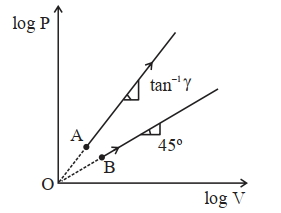
Two thermodynamic processes are shown in the figure. The molar heat capacities for processes $A$ and $B$ are $C_A$ and $C_B$. The molar heat capacities at constant pressure and constant volume are represented by $C_P$ and $C_V$,respectively. Choose the correct statement.
A
$C_A = 0, C_B = \infty$
B
$C_A = \infty, C_B = 0$
C
$C_P > C_B > C_A > C_V$
D
$C_A > C_P > C_V > C_B$
Solution
(C) The equation of a polytropic process is $PV^x = \text{constant}$,which can be written as $\log P + x \log V = \text{constant}$,or $\log P = -x \log V + \text{constant}$.
Comparing this with the equation of a line $y = mx + c$,the slope $m = -x$.
For process $A$,the slope is $\tan(\theta_A) = \gamma$. Thus,$-x_A = \gamma$,so $x_A = -\gamma$.
The molar heat capacity for a polytropic process is $C = C_V + \frac{R}{1-x}$.
For process $A$,$C_A = C_V + \frac{R}{1 - (-\gamma)} = C_V + \frac{R}{1+\gamma}$. Since $\gamma > 1$,$C_A$ is a finite positive value.
For process $B$,the slope is $\tan(45^\circ) = 1$. Thus,$-x_B = 1$,so $x_B = -1$.
For process $B$,$C_B = C_V + \frac{R}{1 - (-1)} = C_V + \frac{R}{2}$.
Comparing the values:
$C_P = C_V + R$
$C_B = C_V + 0.5R$
$C_A = C_V + \frac{R}{1+\gamma}$ (where $1 < \gamma < 1.67$,so $0.37R < \frac{R}{1+\gamma} < 0.5R$)
Thus,$C_P > C_B > C_A > C_V$.
Comparing this with the equation of a line $y = mx + c$,the slope $m = -x$.
For process $A$,the slope is $\tan(\theta_A) = \gamma$. Thus,$-x_A = \gamma$,so $x_A = -\gamma$.
The molar heat capacity for a polytropic process is $C = C_V + \frac{R}{1-x}$.
For process $A$,$C_A = C_V + \frac{R}{1 - (-\gamma)} = C_V + \frac{R}{1+\gamma}$. Since $\gamma > 1$,$C_A$ is a finite positive value.
For process $B$,the slope is $\tan(45^\circ) = 1$. Thus,$-x_B = 1$,so $x_B = -1$.
For process $B$,$C_B = C_V + \frac{R}{1 - (-1)} = C_V + \frac{R}{2}$.
Comparing the values:
$C_P = C_V + R$
$C_B = C_V + 0.5R$
$C_A = C_V + \frac{R}{1+\gamma}$ (where $1 < \gamma < 1.67$,so $0.37R < \frac{R}{1+\gamma} < 0.5R$)
Thus,$C_P > C_B > C_A > C_V$.
0 likes
View Solution55
DifficultMCQ
The pressure and volume of an ideal gas are related as $PV^{3/2} = K$ (constant). The work done when the gas is taken from state $A(P_1, V_1, T_1)$ to state $B(P_2, V_2, T_2)$ is:
A
$2(P_1 V_1 - P_2 V_2)$
B
$2(P_2 V_2 - P_1 V_1)$
C
$2(\sqrt{P_1} V_1 - \sqrt{P_2} V_2)$
D
$2(P_2 \sqrt{V_2} - P_1 \sqrt{V_1})$
Solution
(A) For a polytropic process $PV^x = K$,the work done by the gas is given by the formula:
$W = \int_{V_1}^{V_2} P \, dV = \int_{V_1}^{V_2} K V^{-x} \, dV$
$W = \frac{K V_2^{1-x} - K V_1^{1-x}}{1-x}$
Since $P_1 V_1^x = K$ and $P_2 V_2^x = K$,we can write:
$W = \frac{P_2 V_2^x V_2^{1-x} - P_1 V_1^x V_1^{1-x}}{1-x} = \frac{P_2 V_2 - P_1 V_1}{1-x}$
Given $x = 3/2$,we substitute this into the equation:
$W = \frac{P_2 V_2 - P_1 V_1}{1 - 3/2} = \frac{P_2 V_2 - P_1 V_1}{-1/2}$
$W = -2(P_2 V_2 - P_1 V_1) = 2(P_1 V_1 - P_2 V_2)$
Thus,the correct option is $A$.
$W = \int_{V_1}^{V_2} P \, dV = \int_{V_1}^{V_2} K V^{-x} \, dV$
$W = \frac{K V_2^{1-x} - K V_1^{1-x}}{1-x}$
Since $P_1 V_1^x = K$ and $P_2 V_2^x = K$,we can write:
$W = \frac{P_2 V_2^x V_2^{1-x} - P_1 V_1^x V_1^{1-x}}{1-x} = \frac{P_2 V_2 - P_1 V_1}{1-x}$
Given $x = 3/2$,we substitute this into the equation:
$W = \frac{P_2 V_2 - P_1 V_1}{1 - 3/2} = \frac{P_2 V_2 - P_1 V_1}{-1/2}$
$W = -2(P_2 V_2 - P_1 V_1) = 2(P_1 V_1 - P_2 V_2)$
Thus,the correct option is $A$.
0 likes
View Solution56
MediumMCQ
$A$ monatomic ideal gas undergoes a process in which the ratio of $P$ to $V$ at any instant is constant and equals to $1$. What is the molar heat capacity of the gas?
A
$4 R / 2$
B
$3 R / 2$
C
$5 R / 2$
D
$0$
Solution
(A) For a monatomic ideal gas, the molar heat capacity $C$ for a polytropic process $PV^x = \text{constant}$ is given by $C = C_V + \frac{R}{1-x}$.
Given the process is $P/V = 1$, which implies $P = V^1$, or $PV^{-1} = \text{constant}$.
Comparing this with $PV^x = \text{constant}$, we get $x = -1$.
For a monatomic gas, the molar heat capacity at constant volume is $C_V = \frac{3R}{2}$.
Substituting the values into the formula: $C = \frac{3R}{2} + \frac{R}{1 - (-1)}$.
$C = \frac{3R}{2} + \frac{R}{2} = \frac{4R}{2} = 2R$.
Given the process is $P/V = 1$, which implies $P = V^1$, or $PV^{-1} = \text{constant}$.
Comparing this with $PV^x = \text{constant}$, we get $x = -1$.
For a monatomic gas, the molar heat capacity at constant volume is $C_V = \frac{3R}{2}$.
Substituting the values into the formula: $C = \frac{3R}{2} + \frac{R}{1 - (-1)}$.
$C = \frac{3R}{2} + \frac{R}{2} = \frac{4R}{2} = 2R$.
0 likes
View Solution57
MediumMCQ
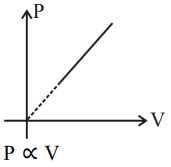
The $P-V$ diagram of a monoatomic gas is a straight line passing through the origin. The molar heat capacity of the gas in this process will be:
A
$4 R$
B
$2 R$
C
$3 R$
D
$\frac{4 R}{3}$
Solution
(B) For a straight line passing through the origin in a $P-V$ diagram,the relationship is $P \propto V$,which means $P = kV$ or $\frac{P}{V} = \text{constant}$.
This can be written as $P V^{-1} = \text{constant}$.
Comparing this with the polytropic process equation $P V^x = \text{constant}$,we get $x = -1$.
The molar heat capacity $C$ for a polytropic process is given by $C = C_V + \frac{R}{1-x}$.
For a monoatomic gas,$C_V = \frac{3}{2} R$.
Substituting the values,$C = \frac{3}{2} R + \frac{R}{1 - (-1)} = \frac{3}{2} R + \frac{R}{2} = \frac{4 R}{2} = 2 R$.
This can be written as $P V^{-1} = \text{constant}$.
Comparing this with the polytropic process equation $P V^x = \text{constant}$,we get $x = -1$.
The molar heat capacity $C$ for a polytropic process is given by $C = C_V + \frac{R}{1-x}$.
For a monoatomic gas,$C_V = \frac{3}{2} R$.
Substituting the values,$C = \frac{3}{2} R + \frac{R}{1 - (-1)} = \frac{3}{2} R + \frac{R}{2} = \frac{4 R}{2} = 2 R$.
0 likes
View Solution58
EasyMCQ
$A$ gas expands in such a way that its pressure and volume satisfy the condition $PV^2 = \text{constant}$. Then the temperature of the gas
A
will decrease.
B
will increase.
C
will not change.
D
may increase or decrease depending upon the values of pressure and volume.
Solution
(A) The ideal gas equation is given by $PV = nRT$.
From this, we can write $P = \frac{nRT}{V}$.
Given the condition for the process is $PV^2 = \text{constant}$.
Substituting the expression for $P$ into the given condition:
$\left(\frac{nRT}{V}\right) V^2 = \text{constant}$
$nRT V = \text{constant}$
Since $n$ and $R$ are constants, we get $TV = \text{constant}$, which implies $T \propto \frac{1}{V}$.
As the gas expands, the volume $V$ increases.
Since $T$ is inversely proportional to $V$, an increase in volume leads to a decrease in the temperature of the gas.
From this, we can write $P = \frac{nRT}{V}$.
Given the condition for the process is $PV^2 = \text{constant}$.
Substituting the expression for $P$ into the given condition:
$\left(\frac{nRT}{V}\right) V^2 = \text{constant}$
$nRT V = \text{constant}$
Since $n$ and $R$ are constants, we get $TV = \text{constant}$, which implies $T \propto \frac{1}{V}$.
As the gas expands, the volume $V$ increases.
Since $T$ is inversely proportional to $V$, an increase in volume leads to a decrease in the temperature of the gas.
0 likes
View Solution59
MediumMCQ
During an experiment, an ideal gas is found to obey an additional law $VP^2 = \text{constant}$. The gas is initially at temperature $T$ and volume $V$. What will be the temperature of the gas when it expands to a volume $2V$?
A
$\sqrt{3} T$
B
$\sqrt{\frac{1}{2}} T$
C
$\sqrt{2} T$
D
$\sqrt{3} T$
Solution
(C) From the ideal gas law, $PV = nRT$, we have $P = \frac{nRT}{V}$.
Given the process law $VP^2 = \text{constant}$.
Substituting $P$ in the given law: $V \left(\frac{nRT}{V}\right)^2 = \text{constant}$.
This simplifies to $V \cdot \frac{n^2 R^2 T^2}{V^2} = \text{constant}$, which means $\frac{T^2}{V} = \text{constant}$.
Therefore, $\frac{T_1^2}{V_1} = \frac{T_2^2}{V_2}$.
Given $T_1 = T$, $V_1 = V$, and $V_2 = 2V$.
Substituting these values: $\frac{T^2}{V} = \frac{T_2^2}{2V}$.
$T_2^2 = 2T^2$.
$T_2 = \sqrt{2} T$.
Given the process law $VP^2 = \text{constant}$.
Substituting $P$ in the given law: $V \left(\frac{nRT}{V}\right)^2 = \text{constant}$.
This simplifies to $V \cdot \frac{n^2 R^2 T^2}{V^2} = \text{constant}$, which means $\frac{T^2}{V} = \text{constant}$.
Therefore, $\frac{T_1^2}{V_1} = \frac{T_2^2}{V_2}$.
Given $T_1 = T$, $V_1 = V$, and $V_2 = 2V$.
Substituting these values: $\frac{T^2}{V} = \frac{T_2^2}{2V}$.
$T_2^2 = 2T^2$.
$T_2 = \sqrt{2} T$.
0 likes
View Solution60
MediumMCQ
An ideal gas is found to obey $Pv^{\frac{3}{2}} = \text{constant}$ during an adiabatic process. If such a gas initially at a temperature $T$ is adiabatically compressed to $\frac{1}{4}$th of its volume,then its final temperature is
A
$\sqrt{3} T$
B
$\sqrt{2} T$
C
$2 T$
D
$3 T$
Solution
(C) Given the adiabatic process equation: $Pv^{\frac{3}{2}} = \text{constant}$ ... $(i)$
From the ideal gas law: $PV = nRT$,we have $P = \frac{nRT}{V}$ ... (ii)
Substituting (ii) into $(i)$:
$\left(\frac{nRT}{V}\right) V^{\frac{3}{2}} = \text{constant}$
$T V^{\frac{1}{2}} = \text{constant}$
Therefore,$T_1 V_1^{\frac{1}{2}} = T_2 V_2^{\frac{1}{2}}$
Given initial temperature $T_1 = T$ and final volume $V_2 = \frac{V_1}{4}$:
$T V_1^{\frac{1}{2}} = T_2 \left(\frac{V_1}{4}\right)^{\frac{1}{2}}$
$T = T_2 \left(\frac{1}{4}\right)^{\frac{1}{2}}$
$T = T_2 \left(\frac{1}{2}\right)$
$T_2 = 2T$
From the ideal gas law: $PV = nRT$,we have $P = \frac{nRT}{V}$ ... (ii)
Substituting (ii) into $(i)$:
$\left(\frac{nRT}{V}\right) V^{\frac{3}{2}} = \text{constant}$
$T V^{\frac{1}{2}} = \text{constant}$
Therefore,$T_1 V_1^{\frac{1}{2}} = T_2 V_2^{\frac{1}{2}}$
Given initial temperature $T_1 = T$ and final volume $V_2 = \frac{V_1}{4}$:
$T V_1^{\frac{1}{2}} = T_2 \left(\frac{V_1}{4}\right)^{\frac{1}{2}}$
$T = T_2 \left(\frac{1}{4}\right)^{\frac{1}{2}}$
$T = T_2 \left(\frac{1}{2}\right)$
$T_2 = 2T$
0 likes
View Solution61
MediumMCQ
Hydrogen gas is undergoing a process given by $PV^2 = \text{constant}$. The ratio of work done by the gas to the change in its internal energy is
A
$2/3$
B
$0.4$
C
$1.5$
D
$-0.4$
Solution
(D) For a polytropic process $PV^n = \text{constant}$, the work done $W$ is given by $W = \frac{nR\Delta T}{1-n}$.
For a diatomic gas like Hydrogen, the molar heat capacity at constant volume is $C_V = \frac{5}{2}R$.
The change in internal energy is $\Delta U = nC_V\Delta T = n(\frac{5}{2}R)\Delta T$.
Given the process $PV^2 = \text{constant}$, we have $n = 2$.
The work done is $W = \frac{nR\Delta T}{1-2} = -nR\Delta T$.
The ratio of work done to the change in internal energy is $\frac{W}{\Delta U} = \frac{-nR\Delta T}{n(\frac{5}{2}R)\Delta T} = \frac{-1}{2.5} = -0.4$.
For a diatomic gas like Hydrogen, the molar heat capacity at constant volume is $C_V = \frac{5}{2}R$.
The change in internal energy is $\Delta U = nC_V\Delta T = n(\frac{5}{2}R)\Delta T$.
Given the process $PV^2 = \text{constant}$, we have $n = 2$.
The work done is $W = \frac{nR\Delta T}{1-2} = -nR\Delta T$.
The ratio of work done to the change in internal energy is $\frac{W}{\Delta U} = \frac{-nR\Delta T}{n(\frac{5}{2}R)\Delta T} = \frac{-1}{2.5} = -0.4$.
0 likes
View Solution62
EasyMCQ
One mole of an ideal gas undergoes a process $PV^3 = \text{constant}$, where $P$ and $V$ are pressure and volume respectively. Let $W$ be the work done by the gas as its temperature is increased by $\Delta T$. The value of $|W|$ is ($R$ is the universal gas constant).
A
$R \Delta T$
B
$\frac{1}{4} R \Delta T$
C
$R^3 \Delta T$
D
$\frac{R}{2} \Delta T$
Solution
(D) For a polytropic process $PV^x = \text{constant}$, the work done $W$ is given by $W = \frac{nR(T_1 - T_2)}{x - 1}$.
Given $n = 1$ and $x = 3$.
The temperature change is $\Delta T = T_2 - T_1$, so $T_1 - T_2 = -\Delta T$.
Substituting these values into the formula:
$W = \frac{1 \cdot R \cdot (-\Delta T)}{3 - 1}$
$W = \frac{-R \Delta T}{2}$
The magnitude of the work done is $|W| = \left| \frac{-R \Delta T}{2} \right| = \frac{R \Delta T}{2}$.
Given $n = 1$ and $x = 3$.
The temperature change is $\Delta T = T_2 - T_1$, so $T_1 - T_2 = -\Delta T$.
Substituting these values into the formula:
$W = \frac{1 \cdot R \cdot (-\Delta T)}{3 - 1}$
$W = \frac{-R \Delta T}{2}$
The magnitude of the work done is $|W| = \left| \frac{-R \Delta T}{2} \right| = \frac{R \Delta T}{2}$.
0 likes
View Solution63
DifficultMCQ
Work done to increase the temperature of one mole of an ideal gas by $30^{\circ} C$,if it is expanding under the condition $V \propto T^{2/3}$ is,$(R = 8.314 \ J/mol \cdot K)$ (in $J$)
A
$116.2$
B
$136.2$
C
$166.2$
D
$186.2$
Solution
(C) Given the condition $V \propto T^{2/3}$.
Using the ideal gas equation $PV = nRT$,we have $P = \frac{nRT}{V}$.
Since $V \propto T^{2/3}$,we can write $V = cT^{2/3}$,which implies $T \propto V^{3/2}$.
Substituting this into the ideal gas equation: $P \propto \frac{T}{V} \propto \frac{V^{3/2}}{V} = V^{1/2}$.
Thus,$P = kV^{1/2}$ for some constant $k$.
The work done $W$ is given by $W = \int_{V_1}^{V_2} P \, dV = \int_{V_1}^{V_2} kV^{1/2} \, dV$.
$W = k \left[ \frac{V^{3/2}}{3/2} \right]_{V_1}^{V_2} = \frac{2}{3} [kV_2^{3/2} - kV_1^{3/2}] = \frac{2}{3} [P_2V_2 - P_1V_1]$.
Using $PV = nRT$,we get $W = \frac{2}{3} nR(T_2 - T_1) = \frac{2}{3} nR \Delta T$.
Given $n = 1 \ mol$,$\Delta T = 30 \ K$,and $R = 8.314 \ J/mol \cdot K$ (approximated as $8.3$ in calculation).
$W = \frac{2}{3} \times 1 \times 8.314 \times 30 = 20 \times 8.314 = 166.28 \ J$.
Rounding to the nearest option,$W = 166.2 \ J$.
Using the ideal gas equation $PV = nRT$,we have $P = \frac{nRT}{V}$.
Since $V \propto T^{2/3}$,we can write $V = cT^{2/3}$,which implies $T \propto V^{3/2}$.
Substituting this into the ideal gas equation: $P \propto \frac{T}{V} \propto \frac{V^{3/2}}{V} = V^{1/2}$.
Thus,$P = kV^{1/2}$ for some constant $k$.
The work done $W$ is given by $W = \int_{V_1}^{V_2} P \, dV = \int_{V_1}^{V_2} kV^{1/2} \, dV$.
$W = k \left[ \frac{V^{3/2}}{3/2} \right]_{V_1}^{V_2} = \frac{2}{3} [kV_2^{3/2} - kV_1^{3/2}] = \frac{2}{3} [P_2V_2 - P_1V_1]$.
Using $PV = nRT$,we get $W = \frac{2}{3} nR(T_2 - T_1) = \frac{2}{3} nR \Delta T$.
Given $n = 1 \ mol$,$\Delta T = 30 \ K$,and $R = 8.314 \ J/mol \cdot K$ (approximated as $8.3$ in calculation).
$W = \frac{2}{3} \times 1 \times 8.314 \times 30 = 20 \times 8.314 = 166.28 \ J$.
Rounding to the nearest option,$W = 166.2 \ J$.
0 likes
View Solution64
DifficultMCQ
One mole of an ideal monoatomic gas expands along the polytropic process $PV^3 = \text{constant}$ from volume $V_1$ to $V_2$. The molar specific heat capacity for this process is given by $C = C_V + \frac{R}{1-n}$. The total heat absorbed during the process can be expressed as:
A
$P_1 V_1 \left( \frac{V_1^2}{V_2^2} + 1 \right)$
B
$P_1 V_1 \left( \frac{V_1^2}{V_2^2} - 1 \right)$
C
$P_1 V_1 \left( \frac{V_1^3}{V_2^2} - 1 \right)$
D
$P_1 V_1 \left( \frac{V_1}{V_2^2} - 1 \right)$
Solution
(B) For a polytropic process $PV^n = \text{constant}$, the molar heat capacity is $C = C_V + \frac{R}{1-n}$.
Given $n = 3$ and $C_V = \frac{3R}{2}$ for a monoatomic gas.
Thus, $C = \frac{3R}{2} + \frac{R}{1-3} = \frac{3R}{2} - \frac{R}{2} = R$.
From the ideal gas law $PV = RT$ (for $1$ mole), we have $T = \frac{PV}{R}$.
Initial state: $T_1 = \frac{P_1 V_1}{R}$.
Final state: Since $P_1 V_1^3 = P_2 V_2^3$, we have $P_2 = P_1 \left( \frac{V_1}{V_2} \right)^3$.
$T_2 = \frac{P_2 V_2}{R} = \frac{P_1 V_1^3}{R V_2^2}$.
The heat absorbed is $Q = n C \Delta T = 1 \cdot R \cdot (T_2 - T_1)$.
$Q = R \left( \frac{P_1 V_1^3}{R V_2^2} - \frac{P_1 V_1}{R} \right) = P_1 V_1 \left( \frac{V_1^2}{V_2^2} - 1 \right)$.
Given $n = 3$ and $C_V = \frac{3R}{2}$ for a monoatomic gas.
Thus, $C = \frac{3R}{2} + \frac{R}{1-3} = \frac{3R}{2} - \frac{R}{2} = R$.
From the ideal gas law $PV = RT$ (for $1$ mole), we have $T = \frac{PV}{R}$.
Initial state: $T_1 = \frac{P_1 V_1}{R}$.
Final state: Since $P_1 V_1^3 = P_2 V_2^3$, we have $P_2 = P_1 \left( \frac{V_1}{V_2} \right)^3$.
$T_2 = \frac{P_2 V_2}{R} = \frac{P_1 V_1^3}{R V_2^2}$.
The heat absorbed is $Q = n C \Delta T = 1 \cdot R \cdot (T_2 - T_1)$.
$Q = R \left( \frac{P_1 V_1^3}{R V_2^2} - \frac{P_1 V_1}{R} \right) = P_1 V_1 \left( \frac{V_1^2}{V_2^2} - 1 \right)$.
0 likes
View SolutionThermodynamics — Polytropic Process · Frequently Asked Questions
1Are these Thermodynamics questions useful for JEE and NEET?
Yes. All questions in this section are mapped to JEE Main and NEET exam patterns. Previous year questions from JEE Main, NEET, GUJCET and state-level exams are included with full solutions.
2Can I switch to Hindi or Gujarati for these questions?
Yes. Use the language tabs in the hero section or the sidebar to view the same questions and solutions in English, Hindi or Gujarati.
3How do I generate a question paper from this subtopic?
Use the Vedclass Exam Paper Generator — select the chapter and subtopic, set difficulty, and generate Sets A, B, C, D automatically. First 3 chapters of every subject are free.
Vedclass Products
For Students
Vedclass Test Series
Mock tests in real JEE/NEET style with performance analysis. 5-day free trial.
Start Free TrialFor Teachers
Exam Paper Generator
Generate Set A/B/C/D papers from this chapter in 2 minutes. 3 chapters free.
Try FreeFor Institutes
Online Exam Module
Live online exams with unlimited students, 360° analytics & white-label branding.
See DemoFor Teachers & Institutes
Generate a Thermodynamics Exam Paper in 2 Minutes
Select subtopic & difficulty — Sets A, B, C, D auto-generated with No Repeat logic.
First 3 chapters of every subject are free — no payment required.