
A English
Rotational Kinetic Energy Questions in English
Class 11 Physics · System of Particles and Rotational Motion · Rotational Kinetic Energy
70+
Questions
English
Language
100%
With Solutions
Showing 19 of 70 questions in English
51
EasyMCQ
The rotational kinetic energy and translational kinetic energy of a rolling body are the same. The body is:
A
disc
B
sphere
C
cylinder
D
ring
Solution
(D) Let $m$ be the mass,$v$ be the velocity of the center of mass,$R$ be the radius,and $I$ be the moment of inertia of the body.
The translational kinetic energy is $KE_{\text{trans}} = \frac{1}{2} mv^2$.
The rotational kinetic energy is $KE_{\text{rot}} = \frac{1}{2} I \omega^2$.
Since the body is rolling without slipping,$v = \omega R$,so $\omega = \frac{v}{R}$.
Substituting this into the rotational kinetic energy formula: $KE_{\text{rot}} = \frac{1}{2} I \left(\frac{v}{R}\right)^2 = \frac{1}{2} \left(\frac{I}{R^2}\right) v^2$.
Given $KE_{\text{trans}} = KE_{\text{rot}}$,we have $\frac{1}{2} mv^2 = \frac{1}{2} \left(\frac{I}{R^2}\right) v^2$.
This implies $m = \frac{I}{R^2}$,or $I = mR^2$.
The moment of inertia $I = mR^2$ corresponds to a ring (or a thin hollow cylinder) about its central axis.
The translational kinetic energy is $KE_{\text{trans}} = \frac{1}{2} mv^2$.
The rotational kinetic energy is $KE_{\text{rot}} = \frac{1}{2} I \omega^2$.
Since the body is rolling without slipping,$v = \omega R$,so $\omega = \frac{v}{R}$.
Substituting this into the rotational kinetic energy formula: $KE_{\text{rot}} = \frac{1}{2} I \left(\frac{v}{R}\right)^2 = \frac{1}{2} \left(\frac{I}{R^2}\right) v^2$.
Given $KE_{\text{trans}} = KE_{\text{rot}}$,we have $\frac{1}{2} mv^2 = \frac{1}{2} \left(\frac{I}{R^2}\right) v^2$.
This implies $m = \frac{I}{R^2}$,or $I = mR^2$.
The moment of inertia $I = mR^2$ corresponds to a ring (or a thin hollow cylinder) about its central axis.
0 likes
View Solution52
MediumMCQ
$A$ body is rotating about its own axis. Its rotational kinetic energy is $x$ and its angular momentum is $y$. Hence,its moment of inertia about the axis is
A
$\frac{x^2}{2 y}$
B
$\frac{y}{2 x}$
C
$\frac{x}{2 y}$
D
$\frac{y^2}{2 x}$
Solution
(D) The rotational kinetic energy of a body is given by $x = \frac{1}{2} I \omega^2$.
The angular momentum of a body is given by $y = I \omega$.
We can express the kinetic energy in terms of angular momentum as:
$x = \frac{(I \omega)^2}{2 I} = \frac{y^2}{2 I}$.
Rearranging this equation to solve for the moment of inertia $I$,we get:
$I = \frac{y^2}{2 x}$.
The angular momentum of a body is given by $y = I \omega$.
We can express the kinetic energy in terms of angular momentum as:
$x = \frac{(I \omega)^2}{2 I} = \frac{y^2}{2 I}$.
Rearranging this equation to solve for the moment of inertia $I$,we get:
$I = \frac{y^2}{2 x}$.
0 likes
View Solution53
MediumMCQ
$A$ body is rotating about its own axis. Its rotational kinetic energy is $x$ and its angular momentum is $y$. Hence,its moment of inertia about its own axis is:
A
$\frac{x^2}{2y}$
B
$\frac{y^2}{2x}$
C
$\frac{x}{2y}$
D
$\frac{y}{2x}$
Solution
(B) The rotational kinetic energy $K$ of a body rotating with angular velocity $\omega$ and moment of inertia $I$ is given by $K = \frac{1}{2} I \omega^2$.
The angular momentum $L$ is given by $L = I \omega$.
We can express the kinetic energy in terms of angular momentum as:
$K = \frac{1}{2} I \left( \frac{L}{I} \right)^2 = \frac{L^2}{2I}$.
Given $K = x$ and $L = y$,we have $x = \frac{y^2}{2I}$.
Rearranging for the moment of inertia $I$,we get $I = \frac{y^2}{2x}$.
Therefore,the correct option is $B$.
The angular momentum $L$ is given by $L = I \omega$.
We can express the kinetic energy in terms of angular momentum as:
$K = \frac{1}{2} I \left( \frac{L}{I} \right)^2 = \frac{L^2}{2I}$.
Given $K = x$ and $L = y$,we have $x = \frac{y^2}{2I}$.
Rearranging for the moment of inertia $I$,we get $I = \frac{y^2}{2x}$.
Therefore,the correct option is $B$.
0 likes
View Solution54
MediumMCQ
$A$ solid sphere of mass $m$ and radius $R$ is rotating about its diameter. $A$ solid cylinder of the same mass and same radius is also rotating about its geometrical axis with angular speed twice that of the sphere. The ratio of the kinetic energy of the sphere to the kinetic energy of the cylinder will be:
A
$1: 4$
B
$1: 5$
C
$3: 1$
D
$2: 3$
Solution
(B) The moment of inertia of a solid sphere about its diameter is $I_s = \frac{2}{5} mR^2$.
The moment of inertia of a solid cylinder about its geometrical axis is $I_c = \frac{1}{2} mR^2$.
Let the angular speed of the sphere be $\omega$. Then the angular speed of the cylinder is $2\omega$.
The rotational kinetic energy is given by $K = \frac{1}{2} I \omega^2$.
Kinetic energy of the sphere: $K_s = \frac{1}{2} I_s \omega^2 = \frac{1}{2} (\frac{2}{5} mR^2) \omega^2 = \frac{1}{5} mR^2 \omega^2$.
Kinetic energy of the cylinder: $K_c = \frac{1}{2} I_c (2\omega)^2 = \frac{1}{2} (\frac{1}{2} mR^2) (4\omega^2) = mR^2 \omega^2$.
The ratio of kinetic energy of the sphere to the cylinder is $\frac{K_s}{K_c} = \frac{\frac{1}{5} mR^2 \omega^2}{mR^2 \omega^2} = \frac{1}{5}$.
Thus,the ratio is $1: 5$.
The moment of inertia of a solid cylinder about its geometrical axis is $I_c = \frac{1}{2} mR^2$.
Let the angular speed of the sphere be $\omega$. Then the angular speed of the cylinder is $2\omega$.
The rotational kinetic energy is given by $K = \frac{1}{2} I \omega^2$.
Kinetic energy of the sphere: $K_s = \frac{1}{2} I_s \omega^2 = \frac{1}{2} (\frac{2}{5} mR^2) \omega^2 = \frac{1}{5} mR^2 \omega^2$.
Kinetic energy of the cylinder: $K_c = \frac{1}{2} I_c (2\omega)^2 = \frac{1}{2} (\frac{1}{2} mR^2) (4\omega^2) = mR^2 \omega^2$.
The ratio of kinetic energy of the sphere to the cylinder is $\frac{K_s}{K_c} = \frac{\frac{1}{5} mR^2 \omega^2}{mR^2 \omega^2} = \frac{1}{5}$.
Thus,the ratio is $1: 5$.
0 likes
View Solution55
MediumMCQ
$A$ solid cylinder of mass $M$ and radius $R$ is rotating about its geometrical axis. $A$ solid sphere of same mass and same radius is also rotating about its diameter with an angular speed half that of the cylinder. The ratio of the kinetic energy of rotation of the sphere to that of the cylinder will be
A
$2: 5$
B
$5: 12$
C
$1: 5$
D
$5: 1$
Solution
(C) The rotational kinetic energy is given by $K = \frac{1}{2} I \omega^2$.
For a solid cylinder rotating about its geometrical axis,the moment of inertia is $I_c = \frac{1}{2} M R^2$.
Let the angular speed of the cylinder be $\omega_c = \omega$.
So,$K_c = \frac{1}{2} (\frac{1}{2} M R^2) \omega^2 = \frac{1}{4} M R^2 \omega^2$.
For a solid sphere rotating about its diameter,the moment of inertia is $I_s = \frac{2}{5} M R^2$.
The angular speed of the sphere is $\omega_s = \frac{\omega}{2}$.
So,$K_s = \frac{1}{2} (\frac{2}{5} M R^2) (\frac{\omega}{2})^2 = \frac{1}{5} M R^2 (\frac{\omega^2}{4}) = \frac{1}{20} M R^2 \omega^2$.
The ratio of the kinetic energy of the sphere to that of the cylinder is $\frac{K_s}{K_c} = \frac{\frac{1}{20} M R^2 \omega^2}{\frac{1}{4} M R^2 \omega^2} = \frac{1}{20} \times \frac{4}{1} = \frac{4}{20} = \frac{1}{5}$.
For a solid cylinder rotating about its geometrical axis,the moment of inertia is $I_c = \frac{1}{2} M R^2$.
Let the angular speed of the cylinder be $\omega_c = \omega$.
So,$K_c = \frac{1}{2} (\frac{1}{2} M R^2) \omega^2 = \frac{1}{4} M R^2 \omega^2$.
For a solid sphere rotating about its diameter,the moment of inertia is $I_s = \frac{2}{5} M R^2$.
The angular speed of the sphere is $\omega_s = \frac{\omega}{2}$.
So,$K_s = \frac{1}{2} (\frac{2}{5} M R^2) (\frac{\omega}{2})^2 = \frac{1}{5} M R^2 (\frac{\omega^2}{4}) = \frac{1}{20} M R^2 \omega^2$.
The ratio of the kinetic energy of the sphere to that of the cylinder is $\frac{K_s}{K_c} = \frac{\frac{1}{20} M R^2 \omega^2}{\frac{1}{4} M R^2 \omega^2} = \frac{1}{20} \times \frac{4}{1} = \frac{4}{20} = \frac{1}{5}$.
0 likes
View Solution56
MediumMCQ
$A$ solid cylinder of mass $M$ and radius $R$ is rotating about its geometrical axis. $A$ solid sphere of the same mass and same radius is also rotating about its diameter with an angular speed half that of the cylinder. The ratio of the kinetic energy of rotation of the sphere to that of the cylinder will be
A
$1: 4$
B
$1: 5$
C
$2: 3$
D
$3: 2$
Solution
(B) The moment of inertia of a solid sphere about its diameter is $I_S = \frac{2}{5} M R^2$.
The moment of inertia of a solid cylinder about its geometrical axis is $I_C = \frac{1}{2} M R^2$.
Let $\omega_C$ be the angular speed of the cylinder and $\omega_S$ be the angular speed of the sphere.
Given that $\omega_S = \frac{\omega_C}{2}$.
The rotational kinetic energy is given by $K.E. = \frac{1}{2} I \omega^2$.
The ratio of the kinetic energy of the sphere to that of the cylinder is:
$\frac{K.E._S}{K.E._C} = \frac{\frac{1}{2} I_S \omega_S^2}{\frac{1}{2} I_C \omega_C^2} = \frac{I_S}{I_C} \times \left( \frac{\omega_S}{\omega_C} \right)^2$.
Substituting the values:
$\frac{K.E._S}{K.E._C} = \frac{\frac{2}{5} M R^2}{\frac{1}{2} M R^2} \times \left( \frac{\omega_C / 2}{\omega_C} \right)^2 = \frac{2/5}{1/2} \times \left( \frac{1}{2} \right)^2 = \frac{4}{5} \times \frac{1}{4} = \frac{1}{5}$.
Thus,the ratio is $1: 5$.
The moment of inertia of a solid cylinder about its geometrical axis is $I_C = \frac{1}{2} M R^2$.
Let $\omega_C$ be the angular speed of the cylinder and $\omega_S$ be the angular speed of the sphere.
Given that $\omega_S = \frac{\omega_C}{2}$.
The rotational kinetic energy is given by $K.E. = \frac{1}{2} I \omega^2$.
The ratio of the kinetic energy of the sphere to that of the cylinder is:
$\frac{K.E._S}{K.E._C} = \frac{\frac{1}{2} I_S \omega_S^2}{\frac{1}{2} I_C \omega_C^2} = \frac{I_S}{I_C} \times \left( \frac{\omega_S}{\omega_C} \right)^2$.
Substituting the values:
$\frac{K.E._S}{K.E._C} = \frac{\frac{2}{5} M R^2}{\frac{1}{2} M R^2} \times \left( \frac{\omega_C / 2}{\omega_C} \right)^2 = \frac{2/5}{1/2} \times \left( \frac{1}{2} \right)^2 = \frac{4}{5} \times \frac{1}{4} = \frac{1}{5}$.
Thus,the ratio is $1: 5$.
0 likes
View Solution57
MediumMCQ
Two bodies $A$ and $B$ have their moments of inertia $I_1$ and $I_2$ respectively about their axis of rotation. If their kinetic energies of rotation are equal and their angular momenta $L_1$ and $L_2$ respectively are in the ratio $1 : \sqrt{3}$,then $I_2$ will be
A
$\frac{1}{3} I_1$
B
$\sqrt{3} I_1$
C
$2 I_1$
D
$3 I_1$
Solution
(D) Given that the rotational kinetic energies are equal:
$(K.E.)_A = (K.E.)_B$
$\frac{1}{2} I_1 \omega_1^2 = \frac{1}{2} I_2 \omega_2^2$
$\frac{I_1}{I_2} = \frac{\omega_2^2}{\omega_1^2} \implies \frac{\omega_2}{\omega_1} = \sqrt{\frac{I_1}{I_2}} \quad ...(i)$
Also,rotational kinetic energy is given by $K.E. = \frac{L^2}{2I}$. Since kinetic energies are equal:
$\frac{L_1^2}{2I_1} = \frac{L_2^2}{2I_2}$
$\frac{I_2}{I_1} = \frac{L_2^2}{L_1^2}$
Given the ratio of angular momenta $\frac{L_1}{L_2} = \frac{1}{\sqrt{3}}$,we have $\frac{L_2}{L_1} = \sqrt{3}$.
Therefore,$\frac{I_2}{I_1} = (\sqrt{3})^2 = 3$.
Thus,$I_2 = 3 I_1$.
$(K.E.)_A = (K.E.)_B$
$\frac{1}{2} I_1 \omega_1^2 = \frac{1}{2} I_2 \omega_2^2$
$\frac{I_1}{I_2} = \frac{\omega_2^2}{\omega_1^2} \implies \frac{\omega_2}{\omega_1} = \sqrt{\frac{I_1}{I_2}} \quad ...(i)$
Also,rotational kinetic energy is given by $K.E. = \frac{L^2}{2I}$. Since kinetic energies are equal:
$\frac{L_1^2}{2I_1} = \frac{L_2^2}{2I_2}$
$\frac{I_2}{I_1} = \frac{L_2^2}{L_1^2}$
Given the ratio of angular momenta $\frac{L_1}{L_2} = \frac{1}{\sqrt{3}}$,we have $\frac{L_2}{L_1} = \sqrt{3}$.
Therefore,$\frac{I_2}{I_1} = (\sqrt{3})^2 = 3$.
Thus,$I_2 = 3 I_1$.
0 likes
View Solution58
MediumMCQ
$A$ solid sphere of mass $M$ and radius $R$ is rotating about its diameter. $A$ solid cylinder of the same mass and radius is also rotating about its geometrical axis with an angular speed twice that of the sphere. The ratio of their kinetic energies of rotation ($K_{\text{sphere}}$ to $K_{\text{cylinder}}$) will be:
A
$1: 8$
B
$1: 6$
C
$1: 3$
D
$1: 5$
Solution
(D) The moment of inertia of a solid sphere about its diameter is $I_{\text{sphere}} = \frac{2}{5} M R^2$. The rotational kinetic energy is $K_{\text{sphere}} = \frac{1}{2} I_{\text{sphere}} \omega_{\text{sphere}}^2 = \frac{1}{2} \times \frac{2}{5} M R^2 \omega_{\text{sphere}}^2 = \frac{1}{5} M R^2 \omega_{\text{sphere}}^2$.
The moment of inertia of a solid cylinder about its geometrical axis is $I_{\text{cylinder}} = \frac{1}{2} M R^2$. Given the angular speed $\omega_{\text{cylinder}} = 2 \omega_{\text{sphere}}$,the rotational kinetic energy is $K_{\text{cylinder}} = \frac{1}{2} I_{\text{cylinder}} \omega_{\text{cylinder}}^2 = \frac{1}{2} \times \frac{1}{2} M R^2 (2 \omega_{\text{sphere}})^2 = \frac{1}{4} M R^2 (4 \omega_{\text{sphere}}^2) = M R^2 \omega_{\text{sphere}}^2$.
The ratio of their kinetic energies is $\frac{K_{\text{sphere}}}{K_{\text{cylinder}}} = \frac{\frac{1}{5} M R^2 \omega_{\text{sphere}}^2}{M R^2 \omega_{\text{sphere}}^2} = \frac{1}{5}$.
The moment of inertia of a solid cylinder about its geometrical axis is $I_{\text{cylinder}} = \frac{1}{2} M R^2$. Given the angular speed $\omega_{\text{cylinder}} = 2 \omega_{\text{sphere}}$,the rotational kinetic energy is $K_{\text{cylinder}} = \frac{1}{2} I_{\text{cylinder}} \omega_{\text{cylinder}}^2 = \frac{1}{2} \times \frac{1}{2} M R^2 (2 \omega_{\text{sphere}})^2 = \frac{1}{4} M R^2 (4 \omega_{\text{sphere}}^2) = M R^2 \omega_{\text{sphere}}^2$.
The ratio of their kinetic energies is $\frac{K_{\text{sphere}}}{K_{\text{cylinder}}} = \frac{\frac{1}{5} M R^2 \omega_{\text{sphere}}^2}{M R^2 \omega_{\text{sphere}}^2} = \frac{1}{5}$.
0 likes
View Solution59
EasyMCQ
Two identical particles each of mass $m$ are separated by a distance $d$. The axis of rotation passes through the midpoint of $d$ and is perpendicular to the length $d$. If $K$ is the rotational kinetic energy of the system,then the angular frequency $\omega$ is:
A
$2d \sqrt{\frac{m}{K}}$
B
$\frac{d}{2} \sqrt{\frac{K}{m}}$
C
$\frac{2}{d} \sqrt{\frac{K}{m}}$
D
$\frac{d}{4} \sqrt{\frac{m}{K}}$
Solution
(C) The moment of inertia $I$ of the system about the axis passing through the midpoint is given by $I = m(\frac{d}{2})^2 + m(\frac{d}{2})^2 = 2m(\frac{d^2}{4}) = \frac{md^2}{2}$.
Rotational kinetic energy is given by $K = \frac{1}{2} I \omega^2$.
Substituting the value of $I$,we get $K = \frac{1}{2} (\frac{md^2}{2}) \omega^2 = \frac{md^2 \omega^2}{4}$.
Rearranging for $\omega^2$,we get $\omega^2 = \frac{4K}{md^2}$.
Taking the square root on both sides,we get $\omega = \sqrt{\frac{4K}{md^2}} = \frac{2}{d} \sqrt{\frac{K}{m}}$.
Rotational kinetic energy is given by $K = \frac{1}{2} I \omega^2$.
Substituting the value of $I$,we get $K = \frac{1}{2} (\frac{md^2}{2}) \omega^2 = \frac{md^2 \omega^2}{4}$.
Rearranging for $\omega^2$,we get $\omega^2 = \frac{4K}{md^2}$.
Taking the square root on both sides,we get $\omega = \sqrt{\frac{4K}{md^2}} = \frac{2}{d} \sqrt{\frac{K}{m}}$.
0 likes
View Solution60
MediumMCQ
$A$ molecule consists of two atoms each of mass $m$ and separated by a distance $d$. At room temperature,if the average rotational kinetic energy is $E$,then the angular frequency is:
A
$\frac{2}{d} \sqrt{\frac{E}{m}}$
B
$\frac{d}{2} \sqrt{\frac{m}{E}}$
C
$\sqrt{\frac{Ed}{m}}$
D
$\sqrt{\frac{m}{Ed}}$
Solution
(A) The rotational kinetic energy $E$ of a rigid body is given by $E = \frac{1}{2} I \omega^2$,where $I$ is the moment of inertia and $\omega$ is the angular frequency.
For a molecule consisting of two atoms of mass $m$ separated by a distance $d$,the moment of inertia about an axis passing through the center of mass and perpendicular to the line joining the atoms is $I = m(\frac{d}{2})^2 + m(\frac{d}{2})^2 = 2m(\frac{d^2}{4}) = \frac{md^2}{2}$.
Substituting $I$ into the energy equation: $E = \frac{1}{2} (\frac{md^2}{2}) \omega^2 = \frac{md^2}{4} \omega^2$.
Solving for $\omega^2$: $\omega^2 = \frac{4E}{md^2}$.
Taking the square root: $\omega = \sqrt{\frac{4E}{md^2}} = \frac{2}{d} \sqrt{\frac{E}{m}}$.
For a molecule consisting of two atoms of mass $m$ separated by a distance $d$,the moment of inertia about an axis passing through the center of mass and perpendicular to the line joining the atoms is $I = m(\frac{d}{2})^2 + m(\frac{d}{2})^2 = 2m(\frac{d^2}{4}) = \frac{md^2}{2}$.
Substituting $I$ into the energy equation: $E = \frac{1}{2} (\frac{md^2}{2}) \omega^2 = \frac{md^2}{4} \omega^2$.
Solving for $\omega^2$: $\omega^2 = \frac{4E}{md^2}$.
Taking the square root: $\omega = \sqrt{\frac{4E}{md^2}} = \frac{2}{d} \sqrt{\frac{E}{m}}$.
0 likes
View Solution61
EasyMCQ
The moment of inertia of a body about a given axis,rotating with an angular velocity of $1 \ rad/s$,is numerically equal to '$P$' times its rotational kinetic energy. The value of '$P$' is:
A
$1/4$
B
$1/2$
C
$2$
D
$1$
Solution
(C) The rotational kinetic energy $(K)$ of a body is given by the formula: $K = \frac{1}{2} I \omega^2$.
Given that the angular velocity $\omega = 1 \ rad/s$,we substitute this into the formula: $K = \frac{1}{2} I (1)^2 = \frac{1}{2} I$.
According to the problem,the moment of inertia $(I)$ is numerically equal to '$P$' times the rotational kinetic energy $(K)$: $I = P \cdot K$.
Substituting the expression for $K$: $I = P \cdot (\frac{1}{2} I)$.
Dividing both sides by $I$ (assuming $I \neq 0$): $1 = P \cdot \frac{1}{2}$.
Therefore,$P = 2$.
Given that the angular velocity $\omega = 1 \ rad/s$,we substitute this into the formula: $K = \frac{1}{2} I (1)^2 = \frac{1}{2} I$.
According to the problem,the moment of inertia $(I)$ is numerically equal to '$P$' times the rotational kinetic energy $(K)$: $I = P \cdot K$.
Substituting the expression for $K$: $I = P \cdot (\frac{1}{2} I)$.
Dividing both sides by $I$ (assuming $I \neq 0$): $1 = P \cdot \frac{1}{2}$.
Therefore,$P = 2$.
0 likes
View Solution62
MediumMCQ
$A$ solid sphere of mass $M$ and radius $R$ is rotating about its diameter. $A$ disc of the same mass and radius is also rotating about an axis passing through its centre and perpendicular to the plane,but its angular speed is twice that of the sphere. The ratio of the kinetic energy of the disc to that of the sphere is: (in $: 1$)
A
$5$
B
$6$
C
$4$
D
$3$
Solution
(A) The rotational kinetic energy is given by $K = \frac{1}{2} I \omega^2$.
For a solid sphere rotating about its diameter,the moment of inertia is $I_s = \frac{2}{5} MR^2$.
Let the angular speed of the sphere be $\omega_s = \omega$.
Thus,the kinetic energy of the sphere is $K_s = \frac{1}{2} (\frac{2}{5} MR^2) \omega^2 = \frac{1}{5} MR^2 \omega^2$.
For a disc rotating about an axis passing through its centre and perpendicular to its plane,the moment of inertia is $I_d = \frac{1}{2} MR^2$.
The angular speed of the disc is given as $\omega_d = 2\omega$.
Thus,the kinetic energy of the disc is $K_d = \frac{1}{2} (\frac{1}{2} MR^2) (2\omega)^2 = \frac{1}{4} MR^2 (4\omega^2) = MR^2 \omega^2$.
The ratio of the kinetic energy of the disc to that of the sphere is $\frac{K_d}{K_s} = \frac{MR^2 \omega^2}{\frac{1}{5} MR^2 \omega^2} = 5$.
Therefore,the ratio is $5: 1$.
For a solid sphere rotating about its diameter,the moment of inertia is $I_s = \frac{2}{5} MR^2$.
Let the angular speed of the sphere be $\omega_s = \omega$.
Thus,the kinetic energy of the sphere is $K_s = \frac{1}{2} (\frac{2}{5} MR^2) \omega^2 = \frac{1}{5} MR^2 \omega^2$.
For a disc rotating about an axis passing through its centre and perpendicular to its plane,the moment of inertia is $I_d = \frac{1}{2} MR^2$.
The angular speed of the disc is given as $\omega_d = 2\omega$.
Thus,the kinetic energy of the disc is $K_d = \frac{1}{2} (\frac{1}{2} MR^2) (2\omega)^2 = \frac{1}{4} MR^2 (4\omega^2) = MR^2 \omega^2$.
The ratio of the kinetic energy of the disc to that of the sphere is $\frac{K_d}{K_s} = \frac{MR^2 \omega^2}{\frac{1}{5} MR^2 \omega^2} = 5$.
Therefore,the ratio is $5: 1$.
0 likes
View Solution63
MediumMCQ
$A$ molecule consists of two atoms each of mass $m$ and separated by a distance $d$. At room temperature,the average rotational kinetic energy is $E$. What is its angular frequency?
A
$\frac{2}{d} \sqrt{\frac{E}{m}}$
B
$\sqrt{\frac{m}{E d}}$
C
$\frac{d}{2} \sqrt{\frac{m}{E}}$
D
$\sqrt{\frac{E d}{m}}$
Solution
(A) The moment of inertia $I$ of a diatomic molecule consisting of two atoms of mass $m$ separated by a distance $d$ about an axis passing through its center of mass and perpendicular to the line joining the atoms is given by:
$I = m(d/2)^2 + m(d/2)^2 = 2m(d^2/4) = \frac{md^2}{2}$.
The rotational kinetic energy $E$ is given by $E = \frac{1}{2} I \omega^2$,where $\omega$ is the angular frequency.
Substituting the value of $I$ into the energy equation:
$E = \frac{1}{2} (\frac{md^2}{2}) \omega^2 = \frac{md^2}{4} \omega^2$.
Solving for $\omega$:
$\omega^2 = \frac{4E}{md^2}$.
$\omega = \sqrt{\frac{4E}{md^2}} = \frac{2}{d} \sqrt{\frac{E}{m}}$.
$I = m(d/2)^2 + m(d/2)^2 = 2m(d^2/4) = \frac{md^2}{2}$.
The rotational kinetic energy $E$ is given by $E = \frac{1}{2} I \omega^2$,where $\omega$ is the angular frequency.
Substituting the value of $I$ into the energy equation:
$E = \frac{1}{2} (\frac{md^2}{2}) \omega^2 = \frac{md^2}{4} \omega^2$.
Solving for $\omega$:
$\omega^2 = \frac{4E}{md^2}$.
$\omega = \sqrt{\frac{4E}{md^2}} = \frac{2}{d} \sqrt{\frac{E}{m}}$.
0 likes
View Solution64
MediumMCQ
$A$ body having a moment of inertia about its axis of rotation equal to $3 \ kg \ m^{2}$ is rotating with an angular velocity of $3 \ rad \ s^{-1}$. The kinetic energy of this rotating body is the same as that of a body of mass $27 \ kg$ moving with velocity $v$. The value of $v$ is: (in $m \ s^{-1}$)
A
$1$
B
$0.5$
C
$2$
D
$1.5$
Solution
(A) Given: Moment of inertia $I = 3 \ kg \ m^{2}$,angular velocity $\omega = 3 \ rad \ s^{-1}$,and mass $m = 27 \ kg$.
The rotational kinetic energy of the body is given by $K_{rot} = \frac{1}{2} I \omega^{2}$.
The translational kinetic energy of the second body is given by $K_{trans} = \frac{1}{2} m v^{2}$.
According to the problem,$K_{rot} = K_{trans}$.
Therefore,$\frac{1}{2} I \omega^{2} = \frac{1}{2} m v^{2}$.
$I \omega^{2} = m v^{2}$.
$v^{2} = \frac{I \omega^{2}}{m}$.
$v = \omega \sqrt{\frac{I}{m}}$.
Substituting the values: $v = 3 \times \sqrt{\frac{3}{27}} = 3 \times \sqrt{\frac{1}{9}} = 3 \times \frac{1}{3} = 1 \ m \ s^{-1}$.
The rotational kinetic energy of the body is given by $K_{rot} = \frac{1}{2} I \omega^{2}$.
The translational kinetic energy of the second body is given by $K_{trans} = \frac{1}{2} m v^{2}$.
According to the problem,$K_{rot} = K_{trans}$.
Therefore,$\frac{1}{2} I \omega^{2} = \frac{1}{2} m v^{2}$.
$I \omega^{2} = m v^{2}$.
$v^{2} = \frac{I \omega^{2}}{m}$.
$v = \omega \sqrt{\frac{I}{m}}$.
Substituting the values: $v = 3 \times \sqrt{\frac{3}{27}} = 3 \times \sqrt{\frac{1}{9}} = 3 \times \frac{1}{3} = 1 \ m \ s^{-1}$.
0 likes
View Solution65
EasyMCQ
$A$ circular disc of mass $20 \ kg$ and radius $1 \ m$ is rotating about an axis passing through its center and perpendicular to its plane with an angular velocity of $2 \ rad \ s^{-1}$. Then the rotational kinetic energy of the disc is (in $J$)
A
$100$
B
$50$
C
$75$
D
$20$
Solution
(D) The moment of inertia $I$ of a circular disc about an axis passing through its center and perpendicular to its plane is given by $I = \frac{1}{2}MR^2$.
Given: Mass $M = 20 \ kg$,Radius $R = 1 \ m$,Angular velocity $\omega = 2 \ rad \ s^{-1}$.
Calculating the moment of inertia: $I = \frac{1}{2} \times 20 \times (1)^2 = 10 \ kg \ m^2$.
The rotational kinetic energy $K_{rot}$ is given by $K_{rot} = \frac{1}{2}I\omega^2$.
Substituting the values: $K_{rot} = \frac{1}{2} \times 10 \times (2)^2 = 5 \times 4 = 20 \ J$.
Given: Mass $M = 20 \ kg$,Radius $R = 1 \ m$,Angular velocity $\omega = 2 \ rad \ s^{-1}$.
Calculating the moment of inertia: $I = \frac{1}{2} \times 20 \times (1)^2 = 10 \ kg \ m^2$.
The rotational kinetic energy $K_{rot}$ is given by $K_{rot} = \frac{1}{2}I\omega^2$.
Substituting the values: $K_{rot} = \frac{1}{2} \times 10 \times (2)^2 = 5 \times 4 = 20 \ J$.
0 likes
View Solution66
MediumMCQ
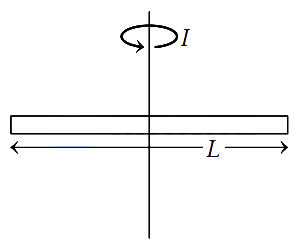
$A$ rod of length $L$ revolves in a horizontal plane about an axis passing through its centre and perpendicular to its length. The angular velocity of the rod is $\omega$. If $A$ is the area of cross-section of the rod and $\rho$ is its density,then the rotational kinetic energy of the rod is
A
$\frac{1}{3} A L^3 \rho \omega^2$
B
$\frac{1}{2} A L^3 \rho \omega^2$
C
$\frac{1}{24} A L^3 \rho \omega^2$
D
$\frac{1}{18} A L^3 \rho \omega^2$
Solution
(C) The rotational kinetic energy of a rod is given by the formula:
$K_{rot} = \frac{1}{2} I \omega^2$
For a rod of mass $M$ and length $L$ rotating about an axis passing through its center and perpendicular to its length,the moment of inertia is:
$I = \frac{M L^2}{12}$
Substituting this into the kinetic energy formula:
$K_{rot} = \frac{1}{2} \left( \frac{M L^2}{12} \right) \omega^2 = \frac{1}{24} M L^2 \omega^2$ $(i)$
The mass $M$ of the rod can be expressed in terms of its volume and density:
$M = \text{Volume} \times \text{Density} = (A \times L) \times \rho = A L \rho$ $(ii)$
Substituting equation $(ii)$ into equation $(i)$:
$K_{rot} = \frac{1}{24} (A L \rho) L^2 \omega^2 = \frac{1}{24} A L^3 \rho \omega^2$
$K_{rot} = \frac{1}{2} I \omega^2$
For a rod of mass $M$ and length $L$ rotating about an axis passing through its center and perpendicular to its length,the moment of inertia is:
$I = \frac{M L^2}{12}$
Substituting this into the kinetic energy formula:
$K_{rot} = \frac{1}{2} \left( \frac{M L^2}{12} \right) \omega^2 = \frac{1}{24} M L^2 \omega^2$ $(i)$
The mass $M$ of the rod can be expressed in terms of its volume and density:
$M = \text{Volume} \times \text{Density} = (A \times L) \times \rho = A L \rho$ $(ii)$
Substituting equation $(ii)$ into equation $(i)$:
$K_{rot} = \frac{1}{24} (A L \rho) L^2 \omega^2 = \frac{1}{24} A L^3 \rho \omega^2$
0 likes
View Solution67
EasyMCQ
$A$ thin circular disc of mass $12 \,kg$ and radius $0.5 \,m$ rotates with an angular velocity of $100 \,rad/s$. The rotational kinetic energy of the disc is (in $\,kJ$)
A
$12.2$
B
$5.5$
C
$9.2$
D
$7.5$
Solution
(D) Given,mass of a circular disc,$M = 12 \,kg$,
radius,$R = 0.5 \,m$,
angular velocity,$\omega = 100 \,rad/s$.
The moment of inertia of a thin circular disc about its central axis is $I = \frac{1}{2} MR^2$.
The rotational kinetic energy $K$ is given by $K = \frac{1}{2} I \omega^2$.
Substituting the value of $I$ in the formula,we get $K = \frac{1}{2} (\frac{1}{2} MR^2) \omega^2 = \frac{1}{4} MR^2 \omega^2$.
Now,substituting the given values:
$K = \frac{1}{4} \times 12 \,kg \times (0.5 \,m)^2 \times (100 \,rad/s)^2$
$K = 3 \times 0.25 \times 10000 \,J$
$K = 0.75 \times 10000 \,J = 7500 \,J$.
Since $1 \,kJ = 1000 \,J$,we have $K = 7.5 \,kJ$.
Therefore,the rotational kinetic energy of the disc is $7.5 \,kJ$.
radius,$R = 0.5 \,m$,
angular velocity,$\omega = 100 \,rad/s$.
The moment of inertia of a thin circular disc about its central axis is $I = \frac{1}{2} MR^2$.
The rotational kinetic energy $K$ is given by $K = \frac{1}{2} I \omega^2$.
Substituting the value of $I$ in the formula,we get $K = \frac{1}{2} (\frac{1}{2} MR^2) \omega^2 = \frac{1}{4} MR^2 \omega^2$.
Now,substituting the given values:
$K = \frac{1}{4} \times 12 \,kg \times (0.5 \,m)^2 \times (100 \,rad/s)^2$
$K = 3 \times 0.25 \times 10000 \,J$
$K = 0.75 \times 10000 \,J = 7500 \,J$.
Since $1 \,kJ = 1000 \,J$,we have $K = 7.5 \,kJ$.
Therefore,the rotational kinetic energy of the disc is $7.5 \,kJ$.
0 likes
View Solution68
MediumMCQ
Two metallic spheres of equal outer radii are found to have the same moment of inertia about their respective diameters. Which of the following statement$(s)$ is/are true?
A
The two spheres have equal masses.
B
The ratio of their masses is nearly $1.67: 1$.
C
The spheres are made of different materials.
D
Their rotational kinetic energies will be equal when rotated with equal uniform angular speed about their respective diameters.
Solution
(D) The moment of inertia $(I)$ of a sphere about its diameter is given by $I = \frac{2}{5}MR^2$,where $M$ is the mass and $R$ is the radius.
Since the spheres have equal outer radii $(R_1 = R_2 = R)$ and equal moments of inertia $(I_1 = I_2)$,it follows that $\frac{2}{5}M_1R^2 = \frac{2}{5}M_2R^2$,which implies $M_1 = M_2$.
However,if the spheres are hollow or have different internal structures,they could have the same moment of inertia despite different masses if their mass distributions differ.
Given the problem states they have the same moment of inertia,the rotational kinetic energy $(K_r)$ is defined as $K_r = \frac{1}{2}I\omega^2$.
Since $I_1 = I_2$ and both are rotated with the same angular speed $(\omega_1 = \omega_2 = \omega)$,their rotational kinetic energies must be equal $(K_{r1} = K_{r2} = \frac{1}{2}I\omega^2)$.
Thus,option $(D)$ is the correct statement.
Since the spheres have equal outer radii $(R_1 = R_2 = R)$ and equal moments of inertia $(I_1 = I_2)$,it follows that $\frac{2}{5}M_1R^2 = \frac{2}{5}M_2R^2$,which implies $M_1 = M_2$.
However,if the spheres are hollow or have different internal structures,they could have the same moment of inertia despite different masses if their mass distributions differ.
Given the problem states they have the same moment of inertia,the rotational kinetic energy $(K_r)$ is defined as $K_r = \frac{1}{2}I\omega^2$.
Since $I_1 = I_2$ and both are rotated with the same angular speed $(\omega_1 = \omega_2 = \omega)$,their rotational kinetic energies must be equal $(K_{r1} = K_{r2} = \frac{1}{2}I\omega^2)$.
Thus,option $(D)$ is the correct statement.
0 likes
View Solution69
MediumMCQ
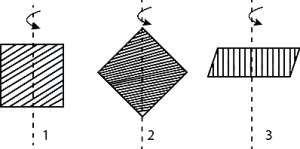
Three identical square plates rotate about the axes shown in the figure in such a way that their kinetic energies are equal. Each of the rotation axes passes through the centre of the square. Then the ratio of angular speeds $\omega_{1}: \omega_{2}: \omega_{3}$ is
A
$1: 1: 1$
B
$\sqrt{2}: \sqrt{2}: 1$
C
$1: \sqrt{2}: 1$
D
$1: 2: \sqrt{2}$
Solution
(B) The rotational kinetic energy $K$ is given by $K = \frac{1}{2} I \omega^{2}$.
Since the kinetic energies are equal,we have $I_{1} \omega_{1}^{2} = I_{2} \omega_{2}^{2} = I_{3} \omega_{3}^{2}$,which implies $\omega \propto \frac{1}{\sqrt{I}}$.
For a square plate of side $a$ and mass $M$:
$1$. For axis $1$ (passing through the center and parallel to sides),$I_{1} = \frac{Ma^{2}}{12}$.
$2$. For axis $2$ (passing through the center and parallel to the diagonal),$I_{2} = \frac{Ma^{2}}{12}$.
$3$. For axis $3$ (passing through the center and perpendicular to the plane of the plate),by the perpendicular axis theorem,$I_{3} = I_{x} + I_{y} = \frac{Ma^{2}}{12} + \frac{Ma^{2}}{12} = \frac{Ma^{2}}{6}$.
Thus,the moments of inertia are in the ratio $I_{1}: I_{2}: I_{3} = \frac{1}{12}: \frac{1}{12}: \frac{1}{6} = 1: 1: 2$.
The ratio of angular speeds is $\omega_{1}: \omega_{2}: \omega_{3} = \frac{1}{\sqrt{I_{1}}}: \frac{1}{\sqrt{I_{2}}}: \frac{1}{\sqrt{I_{3}}} = \frac{1}{\sqrt{1}}: \frac{1}{\sqrt{1}}: \frac{1}{\sqrt{2}} = 1: 1: \frac{1}{\sqrt{2}} = \sqrt{2}: \sqrt{2}: 1$.
Since the kinetic energies are equal,we have $I_{1} \omega_{1}^{2} = I_{2} \omega_{2}^{2} = I_{3} \omega_{3}^{2}$,which implies $\omega \propto \frac{1}{\sqrt{I}}$.
For a square plate of side $a$ and mass $M$:
$1$. For axis $1$ (passing through the center and parallel to sides),$I_{1} = \frac{Ma^{2}}{12}$.
$2$. For axis $2$ (passing through the center and parallel to the diagonal),$I_{2} = \frac{Ma^{2}}{12}$.
$3$. For axis $3$ (passing through the center and perpendicular to the plane of the plate),by the perpendicular axis theorem,$I_{3} = I_{x} + I_{y} = \frac{Ma^{2}}{12} + \frac{Ma^{2}}{12} = \frac{Ma^{2}}{6}$.
Thus,the moments of inertia are in the ratio $I_{1}: I_{2}: I_{3} = \frac{1}{12}: \frac{1}{12}: \frac{1}{6} = 1: 1: 2$.
The ratio of angular speeds is $\omega_{1}: \omega_{2}: \omega_{3} = \frac{1}{\sqrt{I_{1}}}: \frac{1}{\sqrt{I_{2}}}: \frac{1}{\sqrt{I_{3}}} = \frac{1}{\sqrt{1}}: \frac{1}{\sqrt{1}}: \frac{1}{\sqrt{2}} = 1: 1: \frac{1}{\sqrt{2}} = \sqrt{2}: \sqrt{2}: 1$.
0 likes
View SolutionSystem of Particles and Rotational Motion — Rotational Kinetic Energy · Frequently Asked Questions
1Are these System of Particles and Rotational Motion questions useful for JEE and NEET?
Yes. All questions in this section are mapped to JEE Main and NEET exam patterns. Previous year questions from JEE Main, NEET, GUJCET and state-level exams are included with full solutions.
2Can I switch to Hindi or Gujarati for these questions?
Yes. Use the language tabs in the hero section or the sidebar to view the same questions and solutions in English, Hindi or Gujarati.
3How do I generate a question paper from this subtopic?
Use the Vedclass Exam Paper Generator — select the chapter and subtopic, set difficulty, and generate Sets A, B, C, D automatically. First 3 chapters of every subject are free.
Vedclass Products
For Students
Vedclass Test Series
Mock tests in real JEE/NEET style with performance analysis. 5-day free trial.
Start Free TrialFor Teachers
Exam Paper Generator
Generate Set A/B/C/D papers from this chapter in 2 minutes. 3 chapters free.
Try FreeFor Institutes
Online Exam Module
Live online exams with unlimited students, 360° analytics & white-label branding.
See DemoFor Teachers & Institutes
Generate a System of Particles and Rotational Motion Exam Paper in 2 Minutes
Select subtopic & difficulty — Sets A, B, C, D auto-generated with No Repeat logic.
First 3 chapters of every subject are free — no payment required.