
A English
Young’s Modulus Questions in English
Class 11 Physics · Mechanical Properties of Solids · Young’s Modulus
394+
Questions
English
Language
100%
With Solutions
Showing 50 of 394 questions in English
1
MediumMCQ
Young's modulus of a material has the same units as
A
Pressure
B
Strain
C
Compressibility
D
Force
Solution
(A) The formula for Young's modulus $(Y)$ is defined as the ratio of stress to strain: $Y = \frac{\text{Stress}}{\text{Strain}}$.
Since strain is a dimensionless quantity (ratio of change in length to original length),the units of Young's modulus are the same as the units of stress.
Stress is defined as force per unit area: $\text{Stress} = \frac{\text{Force}}{\text{Area}}$.
Pressure is also defined as force per unit area: $\text{Pressure} = \frac{\text{Force}}{\text{Area}}$.
Therefore,Young's modulus has the same units as pressure,which is $N/m^2$ or Pascal $(Pa)$.
Since strain is a dimensionless quantity (ratio of change in length to original length),the units of Young's modulus are the same as the units of stress.
Stress is defined as force per unit area: $\text{Stress} = \frac{\text{Force}}{\text{Area}}$.
Pressure is also defined as force per unit area: $\text{Pressure} = \frac{\text{Force}}{\text{Area}}$.
Therefore,Young's modulus has the same units as pressure,which is $N/m^2$ or Pascal $(Pa)$.
0 likes
View Solution2
EasyMCQ
Which one of the following is not a unit of Young's modulus?
A
$N m^{-1}$
B
$N m^{-2}$
C
$Dyne cm^{-2}$
D
Mega Pascal
Solution
(A) Young's modulus $(Y)$ is defined as the ratio of stress to strain: $Y = \frac{\text{Stress}}{\text{Strain}}$.
Since strain is a dimensionless quantity,the unit of Young's modulus is the same as the unit of stress.
Stress is defined as force per unit area,so its $SI$ unit is $N m^{-2}$ (or Pascal,$Pa$) and its $CGS$ unit is $Dyne cm^{-2}$.
$N m^{-1}$ is the unit of force constant or surface tension,not stress or Young's modulus.
Therefore,$N m^{-1}$ is not a unit of Young's modulus.
Since strain is a dimensionless quantity,the unit of Young's modulus is the same as the unit of stress.
Stress is defined as force per unit area,so its $SI$ unit is $N m^{-2}$ (or Pascal,$Pa$) and its $CGS$ unit is $Dyne cm^{-2}$.
$N m^{-1}$ is the unit of force constant or surface tension,not stress or Young's modulus.
Therefore,$N m^{-1}$ is not a unit of Young's modulus.
0 likes
View Solution3
EasyMCQ
The unit of Young's modulus is
A
$N m^2$
B
$N m^{-2}$
C
$N m$
D
$N m^{-1}$
Solution
(B) Young's modulus $(Y)$ is defined as the ratio of stress to strain:
$Y = \frac{\text{Stress}}{\text{Strain}}$
Stress is defined as force per unit area,so its unit is $N/m^2$ or $N m^{-2}$.
Strain is a dimensionless quantity because it is the ratio of change in dimension to the original dimension.
Therefore,the unit of Young's modulus is the same as the unit of stress,which is $N m^{-2}$.
$Y = \frac{\text{Stress}}{\text{Strain}}$
Stress is defined as force per unit area,so its unit is $N/m^2$ or $N m^{-2}$.
Strain is a dimensionless quantity because it is the ratio of change in dimension to the original dimension.
Therefore,the unit of Young's modulus is the same as the unit of stress,which is $N m^{-2}$.
0 likes
View Solution4
MediumMCQ
The dimensional formula for Young's modulus is
A
$M L^{-1} T^{-2}$
B
$M^0 L T^{-2}$
C
$M L T^{-2}$
D
$M L^2 T^{-2}$
Solution
(A) Young's modulus $Y$ is defined as the ratio of stress to strain.
$Y = \frac{\text{Stress}}{\text{Strain}}$
Since strain is a dimensionless quantity,the dimensions of Young's modulus are the same as those of stress.
Stress = $\frac{\text{Force}}{\text{Area}} = \frac{[M L T^{-2}]}{[L^2]} = [M L^{-1} T^{-2}]$
Therefore,the dimensional formula for Young's modulus is $[M L^{-1} T^{-2}]$.
$Y = \frac{\text{Stress}}{\text{Strain}}$
Since strain is a dimensionless quantity,the dimensions of Young's modulus are the same as those of stress.
Stress = $\frac{\text{Force}}{\text{Area}} = \frac{[M L T^{-2}]}{[L^2]} = [M L^{-1} T^{-2}]$
Therefore,the dimensional formula for Young's modulus is $[M L^{-1} T^{-2}]$.
0 likes
View Solution5
MediumMCQ
Which of the following graphs correctly depicts the spring constant $k$ versus the length $l$ of the spring?
A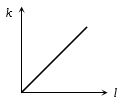
B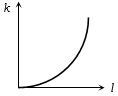
C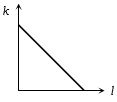
D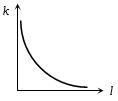
Solution
(D) The spring constant $k$ of a spring is inversely proportional to its natural length $l$,given by the relation $k \propto \frac{1}{l}$.
This is because for a given material and cross-sectional area,the stiffness of a spring decreases as its length increases.
Mathematically,if $Y$ is Young's modulus and $A$ is the cross-sectional area,$k = \frac{YA}{l}$.
Since $Y$ and $A$ are constants for a given spring,we have $k \propto \frac{1}{l}$.
The graph of $k$ versus $l$ represents a rectangular hyperbola,which is correctly depicted in graph $D$.
This is because for a given material and cross-sectional area,the stiffness of a spring decreases as its length increases.
Mathematically,if $Y$ is Young's modulus and $A$ is the cross-sectional area,$k = \frac{YA}{l}$.
Since $Y$ and $A$ are constants for a given spring,we have $k \propto \frac{1}{l}$.
The graph of $k$ versus $l$ represents a rectangular hyperbola,which is correctly depicted in graph $D$.
0 likes
View Solution6
EasyMCQ
The length of an iron wire is $L$ and the area of cross-section is $A$. The increase in length is $l$ upon applying a force $F$ on its two ends. Which of the following statements is correct?
A
Increase in length is inversely proportional to its length $L$.
B
Increase in length is proportional to the area of cross-section $A$.
C
Increase in length is inversely proportional to $A$.
D
Increase in length is proportional to Young's modulus.
Solution
(C) The formula for Young's modulus $(Y)$ is given by $Y = \frac{\text{Stress}}{\text{Strain}} = \frac{F/A}{l/L} = \frac{FL}{Al}$.
Rearranging this formula to solve for the increase in length $(l)$,we get:
$l = \frac{FL}{YA}$.
From this expression,it is clear that the increase in length $(l)$ is directly proportional to the force $(F)$ and the original length $(L)$,and inversely proportional to the Young's modulus $(Y)$ and the area of cross-section $(A)$.
Therefore,$l \propto \frac{1}{A}$.
Thus,the correct statement is that the increase in length is inversely proportional to $A$.
Rearranging this formula to solve for the increase in length $(l)$,we get:
$l = \frac{FL}{YA}$.
From this expression,it is clear that the increase in length $(l)$ is directly proportional to the force $(F)$ and the original length $(L)$,and inversely proportional to the Young's modulus $(Y)$ and the area of cross-section $(A)$.
Therefore,$l \propto \frac{1}{A}$.
Thus,the correct statement is that the increase in length is inversely proportional to $A$.
0 likes
View Solution7
MediumMCQ
The dimensions of four wires of the same material are given below. In which wire will the increase in length be maximum when the same tension is applied?
A
Length $100 \, cm$,Diameter $1 \, mm$
B
Length $200 \, cm$,Diameter $2 \, mm$
C
Length $300 \, cm$,Diameter $3 \, mm$
D
Length $50 \, cm$,Diameter $0.5 \, mm$
Solution
(D) The formula for Young's modulus is $Y = \frac{F \cdot L}{A \cdot \Delta L}$,where $F$ is the force,$L$ is the original length,$A$ is the cross-sectional area,and $\Delta L$ is the change in length.
Rearranging for $\Delta L$,we get $\Delta L = \frac{F \cdot L}{A \cdot Y}$.
Since the material is the same,$Y$ is constant. For the same tension $F$,we have $\Delta L \propto \frac{L}{A}$.
Since $A = \pi \cdot r^2 = \pi \cdot (d/2)^2 = \frac{\pi \cdot d^2}{4}$,we have $\Delta L \propto \frac{L}{d^2}$.
Calculating the ratio $\frac{L}{d^2}$ for each option:
$(a)$ $\frac{100}{1^2} = 100$
$(b)$ $\frac{200}{2^2} = \frac{200}{4} = 50$
$(c)$ $\frac{300}{3^2} = \frac{300}{9} \approx 33.33$
$(d)$ $\frac{50}{0.5^2} = \frac{50}{0.25} = 200$
Since the ratio is maximum for option $(d)$,the increase in length is maximum for wire $(d)$.
Rearranging for $\Delta L$,we get $\Delta L = \frac{F \cdot L}{A \cdot Y}$.
Since the material is the same,$Y$ is constant. For the same tension $F$,we have $\Delta L \propto \frac{L}{A}$.
Since $A = \pi \cdot r^2 = \pi \cdot (d/2)^2 = \frac{\pi \cdot d^2}{4}$,we have $\Delta L \propto \frac{L}{d^2}$.
Calculating the ratio $\frac{L}{d^2}$ for each option:
$(a)$ $\frac{100}{1^2} = 100$
$(b)$ $\frac{200}{2^2} = \frac{200}{4} = 50$
$(c)$ $\frac{300}{3^2} = \frac{300}{9} \approx 33.33$
$(d)$ $\frac{50}{0.5^2} = \frac{50}{0.25} = 200$
Since the ratio is maximum for option $(d)$,the increase in length is maximum for wire $(d)$.
0 likes
View Solution8
EasyMCQ
The Young's modulus of a wire of length $L$ and radius $r$ is $Y \ N/m^2$. If the length and radius are reduced to $L/2$ and $r/2,$ then its Young's modulus will be
A
$Y/2$
B
$Y$
C
$2Y$
D
$4Y$
Solution
(B) The Young's modulus $(Y)$ is an intrinsic property of the material of the wire.
It depends only on the nature of the material and the temperature,not on the dimensions of the wire such as its length $(L)$ or radius $(r)$.
Therefore,even if the length and radius are changed,the Young's modulus remains constant.
Thus,the new Young's modulus will be $Y$.
It depends only on the nature of the material and the temperature,not on the dimensions of the wire such as its length $(L)$ or radius $(r)$.
Therefore,even if the length and radius are changed,the Young's modulus remains constant.
Thus,the new Young's modulus will be $Y$.
0 likes
View Solution9
MediumMCQ
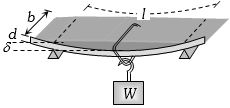
$A$ beam of metal supported at the two ends is loaded at the centre. The depression at the centre is proportional to
A
$Y^2$
B
$Y$
C
$1/Y$
D
$1/Y^2$
Solution
(C) The depression $\delta$ at the centre of a beam of length $L$,breadth $b$,and depth $d$,supported at its two ends and loaded with a weight $W$ at the centre,is given by the formula:
$\delta = \frac{WL^3}{4Ybd^3}$
Where $Y$ is the Young's modulus of the material of the beam.
From this relation,it is clear that the depression $\delta$ is inversely proportional to the Young's modulus $Y$ of the material.
Therefore,$\delta \propto \frac{1}{Y}$.
$\delta = \frac{WL^3}{4Ybd^3}$
Where $Y$ is the Young's modulus of the material of the beam.
From this relation,it is clear that the depression $\delta$ is inversely proportional to the Young's modulus $Y$ of the material.
Therefore,$\delta \propto \frac{1}{Y}$.
0 likes
View Solution10
MediumMCQ
When a certain weight is suspended from a long uniform wire,its length increases by $1 \ cm$. If the same weight is suspended from another wire of the same material and length but having a diameter half of the first one,then the increase in length will be ........ $cm$.
A
$0.5$
B
$2$
C
$4$
D
$8$
Solution
(C) The elongation $l$ of a wire is given by the formula $l = \frac{FL}{AY}$,where $F$ is the force,$L$ is the original length,$A$ is the cross-sectional area,and $Y$ is Young's modulus.
Since $A = \pi r^2 = \pi (d/2)^2$,we have $A \propto d^2$.
Given that $F$,$L$,and $Y$ are constant,the elongation $l$ is inversely proportional to the square of the diameter: $l \propto \frac{1}{d^2}$.
Let $l_1 = 1 \ cm$ and $d_1 = d$. For the second wire,$d_2 = d/2$.
Using the ratio: $\frac{l_2}{l_1} = \left( \frac{d_1}{d_2} \right)^2 = \left( \frac{d}{d/2} \right)^2 = (2)^2 = 4$.
Therefore,$l_2 = 4 \times l_1 = 4 \times 1 \ cm = 4 \ cm$.
Since $A = \pi r^2 = \pi (d/2)^2$,we have $A \propto d^2$.
Given that $F$,$L$,and $Y$ are constant,the elongation $l$ is inversely proportional to the square of the diameter: $l \propto \frac{1}{d^2}$.
Let $l_1 = 1 \ cm$ and $d_1 = d$. For the second wire,$d_2 = d/2$.
Using the ratio: $\frac{l_2}{l_1} = \left( \frac{d_1}{d_2} \right)^2 = \left( \frac{d}{d/2} \right)^2 = (2)^2 = 4$.
Therefore,$l_2 = 4 \times l_1 = 4 \times 1 \ cm = 4 \ cm$.
0 likes
View Solution11
EasyMCQ
$A$ wire is loaded by $6 \ kg$ at its one end,the increase in length is $12 \ mm$. If the radius of the wire is doubled and all other magnitudes are unchanged,then the increase in length will be ......... $mm$.
A
$6$
B
$3$
C
$24$
D
$48$
Solution
(B) The Young's modulus $Y$ is given by the formula $Y = \frac{F L}{A \Delta L}$,where $A = \pi r^2$.
Rearranging for the change in length $\Delta L$,we get $\Delta L = \frac{F L}{\pi r^2 Y}$.
Since the force $F$,original length $L$,and Young's modulus $Y$ remain constant,the relationship is $\Delta L \propto \frac{1}{r^2}$.
Given the initial radius is $r_1$ and the new radius is $r_2 = 2r_1$,the new change in length $\Delta L_2$ is related to the initial change $\Delta L_1 = 12 \ mm$ by:
$\frac{\Delta L_2}{\Delta L_1} = \left( \frac{r_1}{r_2} \right)^2 = \left( \frac{r_1}{2r_1} \right)^2 = \frac{1}{4}$.
Therefore,$\Delta L_2 = \frac{\Delta L_1}{4} = \frac{12 \ mm}{4} = 3 \ mm$.
Rearranging for the change in length $\Delta L$,we get $\Delta L = \frac{F L}{\pi r^2 Y}$.
Since the force $F$,original length $L$,and Young's modulus $Y$ remain constant,the relationship is $\Delta L \propto \frac{1}{r^2}$.
Given the initial radius is $r_1$ and the new radius is $r_2 = 2r_1$,the new change in length $\Delta L_2$ is related to the initial change $\Delta L_1 = 12 \ mm$ by:
$\frac{\Delta L_2}{\Delta L_1} = \left( \frac{r_1}{r_2} \right)^2 = \left( \frac{r_1}{2r_1} \right)^2 = \frac{1}{4}$.
Therefore,$\Delta L_2 = \frac{\Delta L_1}{4} = \frac{12 \ mm}{4} = 3 \ mm$.
0 likes
View Solution12
MediumMCQ
The area of cross-section of a wire of length $1.1 \, m$ is $1 \, mm^2$. It is loaded with $1 \, kg$. If Young's modulus of copper is $1.1 \times 10^{11} \, N/m^2$,then the increase in length will be ......... $mm$ (Take $g = 10 \, m/s^2$)
A
$0.01$
B
$0.075$
C
$0.1$
D
$0.15$
Solution
(C) Given:
Length of wire $L = 1.1 \, m$
Area of cross-section $A = 1 \, mm^2 = 1 \times 10^{-6} \, m^2$
Mass $m = 1 \, kg$
Young's modulus $Y = 1.1 \times 10^{11} \, N/m^2$
Acceleration due to gravity $g = 10 \, m/s^2$
The formula for Young's modulus is $Y = \frac{F \cdot L}{A \cdot \Delta L}$,where $F = mg$.
Rearranging for the change in length $\Delta L$:
$\Delta L = \frac{mgL}{AY}$
Substituting the values:
$\Delta L = \frac{1 \times 10 \times 1.1}{(1 \times 10^{-6}) \times (1.1 \times 10^{11})}$
$\Delta L = \frac{11}{1.1 \times 10^5} = \frac{10}{10^5} = 10^{-4} \, m$
Converting to $mm$:
$\Delta L = 10^{-4} \times 10^3 \, mm = 0.1 \, mm$.
Length of wire $L = 1.1 \, m$
Area of cross-section $A = 1 \, mm^2 = 1 \times 10^{-6} \, m^2$
Mass $m = 1 \, kg$
Young's modulus $Y = 1.1 \times 10^{11} \, N/m^2$
Acceleration due to gravity $g = 10 \, m/s^2$
The formula for Young's modulus is $Y = \frac{F \cdot L}{A \cdot \Delta L}$,where $F = mg$.
Rearranging for the change in length $\Delta L$:
$\Delta L = \frac{mgL}{AY}$
Substituting the values:
$\Delta L = \frac{1 \times 10 \times 1.1}{(1 \times 10^{-6}) \times (1.1 \times 10^{11})}$
$\Delta L = \frac{11}{1.1 \times 10^5} = \frac{10}{10^5} = 10^{-4} \, m$
Converting to $mm$:
$\Delta L = 10^{-4} \times 10^3 \, mm = 0.1 \, mm$.
0 likes
View Solution13
MediumMCQ
On increasing the length by $0.5\, mm$ in a steel wire of length $2\, m$ and area of cross-section $2\, mm^2$,the force required is ($Y$ for steel $= 2.2 \times 10^{11}\, N/m^2$).
A
$1.1 \times 10^5\, N$
B
$1.1 \times 10^4\, N$
C
$1.1 \times 10^3\, N$
D
$1.1 \times 10^2\, N$
Solution
(D) Given:
Length of wire $L = 2\, m$
Change in length $\Delta L = 0.5\, mm = 0.5 \times 10^{-3}\, m$
Area of cross-section $A = 2\, mm^2 = 2 \times 10^{-6}\, m^2$
Young's modulus $Y = 2.2 \times 10^{11}\, N/m^2$
Formula for Young's modulus is $Y = \frac{F \cdot L}{A \cdot \Delta L}$.
Rearranging for force $F$:
$F = \frac{Y \cdot A \cdot \Delta L}{L}$
Substituting the values:
$F = \frac{(2.2 \times 10^{11}) \times (2 \times 10^{-6}) \times (0.5 \times 10^{-3})}{2}$
$F = \frac{2.2 \times 10^{11} \times 1 \times 10^{-9}}{2}$
$F = \frac{2.2 \times 10^2}{2} = 1.1 \times 10^2\, N$.
Length of wire $L = 2\, m$
Change in length $\Delta L = 0.5\, mm = 0.5 \times 10^{-3}\, m$
Area of cross-section $A = 2\, mm^2 = 2 \times 10^{-6}\, m^2$
Young's modulus $Y = 2.2 \times 10^{11}\, N/m^2$
Formula for Young's modulus is $Y = \frac{F \cdot L}{A \cdot \Delta L}$.
Rearranging for force $F$:
$F = \frac{Y \cdot A \cdot \Delta L}{L}$
Substituting the values:
$F = \frac{(2.2 \times 10^{11}) \times (2 \times 10^{-6}) \times (0.5 \times 10^{-3})}{2}$
$F = \frac{2.2 \times 10^{11} \times 1 \times 10^{-9}}{2}$
$F = \frac{2.2 \times 10^2}{2} = 1.1 \times 10^2\, N$.
0 likes
View Solution14
MediumMCQ
If Young's modulus of iron is $2 \times 10^{11} \ N/m^2$ and the interatomic spacing between two molecules is $3 \times 10^{-10} \ m$,the interatomic force constant is ......... $N/m$.
A
$60$
B
$120$
C
$30$
D
$180$
Solution
(A) The interatomic force constant $K$ is related to Young's modulus $Y$ and the interatomic spacing $r_0$ by the formula $K = Y \times r_0$.
Given:
Young's modulus $Y = 2 \times 10^{11} \ N/m^2$.
Interatomic spacing $r_0 = 3 \times 10^{-10} \ m$.
Substituting these values into the formula:
$K = (2 \times 10^{11} \ N/m^2) \times (3 \times 10^{-10} \ m)$
$K = 6 \times 10^{1} \ N/m$
$K = 60 \ N/m$.
Therefore,the interatomic force constant is $60 \ N/m$.
Given:
Young's modulus $Y = 2 \times 10^{11} \ N/m^2$.
Interatomic spacing $r_0 = 3 \times 10^{-10} \ m$.
Substituting these values into the formula:
$K = (2 \times 10^{11} \ N/m^2) \times (3 \times 10^{-10} \ m)$
$K = 6 \times 10^{1} \ N/m$
$K = 60 \ N/m$.
Therefore,the interatomic force constant is $60 \ N/m$.
0 likes
View Solution15
EasyMCQ
In the $CGS$ system,the Young's modulus of a steel wire is $2 \times 10^{12} \text{ dyn/cm}^2$. To double the length of a wire of unit cross-sectional area,the force required is:
A
$4 \times 10^6 \text{ dynes}$
B
$2 \times 10^{12} \text{ dynes}$
C
$2 \times 10^{12} \text{ newtons}$
D
$2 \times 10^8 \text{ dynes}$
Solution
(B) Young's modulus $(Y)$ is defined as the ratio of longitudinal stress to longitudinal strain: $Y = \frac{\text{Stress}}{\text{Strain}} = \frac{F/A}{\Delta L/L}$.
Given that the length is to be doubled,the change in length $\Delta L = L$,so the strain $\frac{\Delta L}{L} = 1$.
Substituting the values,we get $Y = \frac{F/A}{1}$,which implies $F = Y \times A$.
Given $Y = 2 \times 10^{12} \text{ dyn/cm}^2$ and unit cross-sectional area $A = 1 \text{ cm}^2$.
Therefore,$F = (2 \times 10^{12} \text{ dyn/cm}^2) \times (1 \text{ cm}^2) = 2 \times 10^{12} \text{ dynes}$.
Given that the length is to be doubled,the change in length $\Delta L = L$,so the strain $\frac{\Delta L}{L} = 1$.
Substituting the values,we get $Y = \frac{F/A}{1}$,which implies $F = Y \times A$.
Given $Y = 2 \times 10^{12} \text{ dyn/cm}^2$ and unit cross-sectional area $A = 1 \text{ cm}^2$.
Therefore,$F = (2 \times 10^{12} \text{ dyn/cm}^2) \times (1 \text{ cm}^2) = 2 \times 10^{12} \text{ dynes}$.
1 likes
View Solution16
MediumMCQ
The diameter of a brass rod is $4 \ mm$ and Young's modulus of brass is $9 \times 10^{10} \ N/m^2$. The force required to stretch it by $0.1\%$ of its original length is:
A
$360\pi \ N$
B
$36 \ N$
C
$144\pi \times 10^3 \ N$
D
$36\pi \times 10^5 \ N$
Solution
(A) Given: Diameter $d = 4 \ mm = 4 \times 10^{-3} \ m$.
Radius $r = 2 \times 10^{-3} \ m$.
Area $A = \pi r^2 = \pi (2 \times 10^{-3})^2 = 4\pi \times 10^{-6} \ m^2$.
Young's modulus $Y = 9 \times 10^{10} \ N/m^2$.
Strain $\frac{\Delta L}{L} = 0.1\% = \frac{0.1}{100} = 10^{-3}$.
Using the formula for Young's modulus: $Y = \frac{F/A}{\Delta L/L}$.
Rearranging for force: $F = Y \cdot A \cdot \left( \frac{\Delta L}{L} \right)$.
Substituting the values: $F = (9 \times 10^{10}) \times (4\pi \times 10^{-6}) \times (10^{-3})$.
$F = 36\pi \times 10^{10-6-3} = 36\pi \times 10^1 = 360\pi \ N$.
Radius $r = 2 \times 10^{-3} \ m$.
Area $A = \pi r^2 = \pi (2 \times 10^{-3})^2 = 4\pi \times 10^{-6} \ m^2$.
Young's modulus $Y = 9 \times 10^{10} \ N/m^2$.
Strain $\frac{\Delta L}{L} = 0.1\% = \frac{0.1}{100} = 10^{-3}$.
Using the formula for Young's modulus: $Y = \frac{F/A}{\Delta L/L}$.
Rearranging for force: $F = Y \cdot A \cdot \left( \frac{\Delta L}{L} \right)$.
Substituting the values: $F = (9 \times 10^{10}) \times (4\pi \times 10^{-6}) \times (10^{-3})$.
$F = 36\pi \times 10^{10-6-3} = 36\pi \times 10^1 = 360\pi \ N$.
0 likes
View Solution17
EasyMCQ
In a wire of length $L,$ the increase in its length is $l.$ If the length is reduced to half,the increase in its length will be
A
$l$
B
$2l$
C
$\frac{l}{2}$
D
None of the above
Solution
(C) The elongation $l$ of a wire under a load $F$ is given by the formula $l = \frac{FL}{AY},$ where $A$ is the cross-sectional area and $Y$ is Young's modulus.
Since $F,$ $A,$ and $Y$ are constant,the elongation $l$ is directly proportional to the original length $L$ of the wire $(l \propto L)$.
If the length $L$ is reduced to half (i.e.,$L' = \frac{L}{2}$),the new increase in length $l'$ will be $l' = \frac{Fl'}{AY} = \frac{F(L/2)}{AY} = \frac{1}{2} \left( \frac{FL}{AY} \right) = \frac{l}{2}.$
Since $F,$ $A,$ and $Y$ are constant,the elongation $l$ is directly proportional to the original length $L$ of the wire $(l \propto L)$.
If the length $L$ is reduced to half (i.e.,$L' = \frac{L}{2}$),the new increase in length $l'$ will be $l' = \frac{Fl'}{AY} = \frac{F(L/2)}{AY} = \frac{1}{2} \left( \frac{FL}{AY} \right) = \frac{l}{2}.$
0 likes
View Solution18
MediumMCQ
The Young's modulus of a rubber string $8\, cm$ long and density $1.5\, kg/m^3$ is $5 \times 10^8\, N/m^2$. If it is suspended from the ceiling in a room,the increase in length due to its own weight will be:
A
$9.6 \times 10^{-5}\, m$
B
$9.6 \times 10^{-11}\, m$
C
$9.6 \times 10^{-3}\, m$
D
$9.6\, m$
Solution
(B) The elongation $\Delta L$ of a string of length $L$,density $d$,and Young's modulus $Y$ due to its own weight is given by the formula: $\Delta L = \frac{L^2 dg}{2Y}$.
Given values are: $L = 8\, cm = 8 \times 10^{-2}\, m$,$d = 1.5\, kg/m^3$,$Y = 5 \times 10^8\, N/m^2$,and $g = 9.8\, m/s^2$.
Substituting these values into the formula:
$\Delta L = \frac{(8 \times 10^{-2})^2 \times 1.5 \times 9.8}{2 \times 5 \times 10^8}$
$\Delta L = \frac{64 \times 10^{-4} \times 14.7}{10^9}$
$\Delta L = \frac{940.8 \times 10^{-4}}{10^9} = 940.8 \times 10^{-13} = 9.408 \times 10^{-11}\, m$.
Rounding to the nearest provided option,the result is $9.6 \times 10^{-11}\, m$.
Given values are: $L = 8\, cm = 8 \times 10^{-2}\, m$,$d = 1.5\, kg/m^3$,$Y = 5 \times 10^8\, N/m^2$,and $g = 9.8\, m/s^2$.
Substituting these values into the formula:
$\Delta L = \frac{(8 \times 10^{-2})^2 \times 1.5 \times 9.8}{2 \times 5 \times 10^8}$
$\Delta L = \frac{64 \times 10^{-4} \times 14.7}{10^9}$
$\Delta L = \frac{940.8 \times 10^{-4}}{10^9} = 940.8 \times 10^{-13} = 9.408 \times 10^{-11}\, m$.
Rounding to the nearest provided option,the result is $9.6 \times 10^{-11}\, m$.
0 likes
View Solution19
EasyMCQ
To double the length of an iron wire having $0.5 \, cm^2$ area of cross-section,the required force will be $(Y = 10^{12} \, dyne/cm^2)$.
A
$1.0 \times 10^{-7} \, N$
B
$1.0 \times 10^7 \, N$
C
$0.5 \times 10^{-7} \, N$
D
$0.5 \times 10^{12} \, dyne$
Solution
(D) The formula for Young's modulus is $Y = \frac{\text{Stress}}{\text{Strain}} = \frac{F/A}{\Delta L/L}$.
Given that the length is doubled,the change in length $\Delta L = L_{final} - L_{initial} = 2L - L = L$.
Therefore,the strain is $\frac{\Delta L}{L} = \frac{L}{L} = 1$.
Substituting the values into the formula: $Y = \frac{F/A}{1} \implies F = Y \times A$.
Given $Y = 10^{12} \, dyne/cm^2$ and $A = 0.5 \, cm^2$.
$F = 10^{12} \times 0.5 = 0.5 \times 10^{12} \, dyne$.
Given that the length is doubled,the change in length $\Delta L = L_{final} - L_{initial} = 2L - L = L$.
Therefore,the strain is $\frac{\Delta L}{L} = \frac{L}{L} = 1$.
Substituting the values into the formula: $Y = \frac{F/A}{1} \implies F = Y \times A$.
Given $Y = 10^{12} \, dyne/cm^2$ and $A = 0.5 \, cm^2$.
$F = 10^{12} \times 0.5 = 0.5 \times 10^{12} \, dyne$.
0 likes
View Solution20
MediumMCQ
Two wires of equal lengths are made of the same material. Wire $A$ has a diameter that is twice as that of wire $B$. If identical weights are suspended from the ends of these wires,the increase in length is
A
Four times for wire $A$ as for wire $B$
B
Twice for wire $A$ as for wire $B$
C
Half for wire $A$ as for wire $B$
D
One-fourth for wire $A$ as for wire $B$
Solution
(D) The formula for the extension in a wire is given by $l = \frac{FL}{AY}$,where $F$ is the force,$L$ is the length,$A$ is the cross-sectional area,and $Y$ is Young's modulus.
Since the wires are made of the same material,$Y$ is the same. Given that $F$ and $L$ are also identical,we have $l \propto \frac{1}{A}$.
Since $A = \pi r^2$,where $r$ is the radius,we get $l \propto \frac{1}{r^2}$.
Given that the diameter of wire $A$ is twice that of wire $B$,the radius $r_A = 2r_B$.
Therefore,$\frac{l_A}{l_B} = \left( \frac{r_B}{r_A} \right)^2 = \left( \frac{r_B}{2r_B} \right)^2 = \left( \frac{1}{2} \right)^2 = \frac{1}{4}$.
This implies $l_A = \frac{1}{4} l_B$,which means the increase in length for wire $A$ is one-fourth that of wire $B$.
Since the wires are made of the same material,$Y$ is the same. Given that $F$ and $L$ are also identical,we have $l \propto \frac{1}{A}$.
Since $A = \pi r^2$,where $r$ is the radius,we get $l \propto \frac{1}{r^2}$.
Given that the diameter of wire $A$ is twice that of wire $B$,the radius $r_A = 2r_B$.
Therefore,$\frac{l_A}{l_B} = \left( \frac{r_B}{r_A} \right)^2 = \left( \frac{r_B}{2r_B} \right)^2 = \left( \frac{1}{2} \right)^2 = \frac{1}{4}$.
This implies $l_A = \frac{1}{4} l_B$,which means the increase in length for wire $A$ is one-fourth that of wire $B$.
0 likes
View Solution21
EasyMCQ
Why are springs made of steel instead of copper?
A
Copper is more costly than steel.
B
Copper is more elastic than steel.
C
Steel is more elastic than copper.
D
None of the above.
Solution
(C) spring is considered better if it develops a large restoring force upon being deformed. This property depends on the elasticity of the material. Since the Young's modulus of elasticity of steel is greater than that of copper,steel is preferred for making springs.
0 likes
View Solution22
MediumMCQ
Steel and copper wires of the same length are stretched by the same weight one after the other. The Young's modulus of steel and copper are $2 \times 10^{11} \, N/m^2$ and $1.2 \times 10^{11} \, N/m^2$,respectively. What is the ratio of the increase in their lengths?
A
$2/5$
B
$3/5$
C
$5/4$
D
$5/2$
Solution
(B) The formula for the extension $l$ of a wire is given by $l = \frac{FL}{AY}$,where $F$ is the applied force,$L$ is the original length,$A$ is the cross-sectional area,and $Y$ is the Young's modulus.
Since the wires have the same length $(L)$,are stretched by the same weight $(F)$,and assuming they have the same cross-sectional area $(A)$,the extension $l$ is inversely proportional to the Young's modulus $(Y)$: $l \propto \frac{1}{Y}$.
Therefore,the ratio of the increase in length of steel $(l_S)$ to copper $(l_{Cu})$ is $\frac{l_S}{l_{Cu}} = \frac{Y_{Cu}}{Y_S}$.
Substituting the given values: $\frac{l_S}{l_{Cu}} = \frac{1.2 \times 10^{11}}{2 \times 10^{11}} = \frac{1.2}{2} = \frac{12}{20} = \frac{3}{5}$.
Since the wires have the same length $(L)$,are stretched by the same weight $(F)$,and assuming they have the same cross-sectional area $(A)$,the extension $l$ is inversely proportional to the Young's modulus $(Y)$: $l \propto \frac{1}{Y}$.
Therefore,the ratio of the increase in length of steel $(l_S)$ to copper $(l_{Cu})$ is $\frac{l_S}{l_{Cu}} = \frac{Y_{Cu}}{Y_S}$.
Substituting the given values: $\frac{l_S}{l_{Cu}} = \frac{1.2 \times 10^{11}}{2 \times 10^{11}} = \frac{1.2}{2} = \frac{12}{20} = \frac{3}{5}$.
0 likes
View Solution23
EasyMCQ
An area of cross-section of a rubber string is $2 \, cm^2$. Its length is doubled when stretched with a linear force of $2 \times 10^5 \, dynes$. The Young's modulus of the rubber in $dyne/cm^2$ will be:
A
$4 \times 10^5$
B
$1 \times 10^5$
C
$2 \times 10^5$
D
$1 \times 10^4$
Solution
(B) Given:
Area of cross-section $A = 2 \, cm^2$
Force $F = 2 \times 10^5 \, dynes$
Initial length $= L$
Final length $= 2L$
Change in length $\Delta L = 2L - L = L$
Strain $= \frac{\Delta L}{L} = \frac{L}{L} = 1$
Young's modulus $Y = \frac{\text{Stress}}{\text{Strain}} = \frac{F/A}{\Delta L/L}$
Substituting the values:
$Y = \frac{(2 \times 10^5) / 2}{1} = 10^5 \, dyne/cm^2$
Therefore,the correct option is $B$.
Area of cross-section $A = 2 \, cm^2$
Force $F = 2 \times 10^5 \, dynes$
Initial length $= L$
Final length $= 2L$
Change in length $\Delta L = 2L - L = L$
Strain $= \frac{\Delta L}{L} = \frac{L}{L} = 1$
Young's modulus $Y = \frac{\text{Stress}}{\text{Strain}} = \frac{F/A}{\Delta L/L}$
Substituting the values:
$Y = \frac{(2 \times 10^5) / 2}{1} = 10^5 \, dyne/cm^2$
Therefore,the correct option is $B$.
0 likes
View Solution24
MediumMCQ
Increase in length of a wire is $1 \, mm$ when suspended by a weight. If the same weight is suspended on a wire of double its length and double its radius,the increase in length will be ........ $mm$.
A
$2$
B
$0.5$
C
$4$
D
$0.25$
Solution
(B) The formula for the extension of a wire is given by $\Delta L = \frac{FL}{AY} = \frac{FL}{\pi r^2 Y}$.
Since the weight $F$ and Young's modulus $Y$ remain constant,the extension $\Delta L$ is proportional to $\frac{L}{r^2}$.
Let the initial length be $L_1 = L$ and initial radius be $r_1 = r$. The initial extension is $\Delta L_1 = 1 \, mm$.
For the second wire,the length is $L_2 = 2L$ and the radius is $r_2 = 2r$.
Using the proportionality $\frac{\Delta L_2}{\Delta L_1} = \frac{L_2}{L_1} \times \left( \frac{r_1}{r_2} \right)^2$.
Substituting the values: $\frac{\Delta L_2}{1} = \frac{2L}{L} \times \left( \frac{r}{2r} \right)^2 = 2 \times \left( \frac{1}{2} \right)^2 = 2 \times \frac{1}{4} = 0.5$.
Therefore,the increase in length is $0.5 \, mm$.
Since the weight $F$ and Young's modulus $Y$ remain constant,the extension $\Delta L$ is proportional to $\frac{L}{r^2}$.
Let the initial length be $L_1 = L$ and initial radius be $r_1 = r$. The initial extension is $\Delta L_1 = 1 \, mm$.
For the second wire,the length is $L_2 = 2L$ and the radius is $r_2 = 2r$.
Using the proportionality $\frac{\Delta L_2}{\Delta L_1} = \frac{L_2}{L_1} \times \left( \frac{r_1}{r_2} \right)^2$.
Substituting the values: $\frac{\Delta L_2}{1} = \frac{2L}{L} \times \left( \frac{r}{2r} \right)^2 = 2 \times \left( \frac{1}{2} \right)^2 = 2 \times \frac{1}{4} = 0.5$.
Therefore,the increase in length is $0.5 \, mm$.
0 likes
View Solution25
EasyMCQ
$A$ rod of length $l$ and area of cross-section $A$ is heated from $0^{\circ}C$ to $100^{\circ}C$. The rod is so placed that it is not allowed to increase in length,then the force developed is proportional to
A
$l$
B
$l^{-1}$
C
$A$
D
$A^{-1}$
Solution
(C) When a rod is heated,it tends to expand. If it is prevented from expanding,a thermal stress is developed in the rod.
The thermal strain is given by $\frac{\Delta l}{l} = \alpha \Delta \theta$,where $\alpha$ is the coefficient of linear expansion and $\Delta \theta$ is the change in temperature.
From the definition of Young's modulus $Y = \frac{\text{Stress}}{\text{Strain}} = \frac{F/A}{\Delta l/l}$.
Therefore,the force $F$ developed is $F = YA \left( \frac{\Delta l}{l} \right) = YA \alpha \Delta \theta$.
Since $Y$,$\alpha$,and $\Delta \theta$ are constant for the given rod,we have $F \propto A$.
The thermal strain is given by $\frac{\Delta l}{l} = \alpha \Delta \theta$,where $\alpha$ is the coefficient of linear expansion and $\Delta \theta$ is the change in temperature.
From the definition of Young's modulus $Y = \frac{\text{Stress}}{\text{Strain}} = \frac{F/A}{\Delta l/l}$.
Therefore,the force $F$ developed is $F = YA \left( \frac{\Delta l}{l} \right) = YA \alpha \Delta \theta$.
Since $Y$,$\alpha$,and $\Delta \theta$ are constant for the given rod,we have $F \propto A$.
0 likes
View Solution26
MediumMCQ
An aluminum rod (Young's modulus $Y = 7 \times 10^9 \, N/m^2$) has a breaking strain of $0.2\%$. The minimum cross-sectional area of the rod required to support a load of $10^4 \, N$ is:
A
$1 \times 10^{-2} \, m^2$
B
$1.4 \times 10^{-3} \, m^2$
C
$3.5 \times 10^{-3} \, m^2$
D
$7.1 \times 10^{-4} \, m^2$
Solution
(D) The formula for Young's modulus is $Y = \frac{\text{Stress}}{\text{Strain}} = \frac{F/A}{\text{Strain}}$.
Rearranging for the cross-sectional area $A$,we get $A = \frac{F}{Y \times \text{Strain}}$.
Given: Load $F = 10^4 \, N$,Young's modulus $Y = 7 \times 10^9 \, N/m^2$,and breaking strain $= 0.2\% = 0.002$.
Substituting the values: $A = \frac{10^4}{7 \times 10^9 \times 0.002}$.
$A = \frac{10^4}{1.4 \times 10^7} = \frac{1}{1400} \approx 7.14 \times 10^{-4} \, m^2$.
Thus,the minimum cross-sectional area is $7.1 \times 10^{-4} \, m^2$.
Rearranging for the cross-sectional area $A$,we get $A = \frac{F}{Y \times \text{Strain}}$.
Given: Load $F = 10^4 \, N$,Young's modulus $Y = 7 \times 10^9 \, N/m^2$,and breaking strain $= 0.2\% = 0.002$.
Substituting the values: $A = \frac{10^4}{7 \times 10^9 \times 0.002}$.
$A = \frac{10^4}{1.4 \times 10^7} = \frac{1}{1400} \approx 7.14 \times 10^{-4} \, m^2$.
Thus,the minimum cross-sectional area is $7.1 \times 10^{-4} \, m^2$.
0 likes
View Solution27
MediumMCQ
Two wires of copper having the lengths in the ratio $4:1$ and their radii in the ratio $1:4$ are stretched by the same force. The ratio of longitudinal strain in the two will be
A
$1:16$
B
$16:1$
C
$1:64$
D
$64:1$
Solution
(B) The longitudinal strain is given by $\text{strain} = \frac{\Delta L}{L} = \frac{\text{stress}}{Y} = \frac{F}{A \cdot Y}$,where $F$ is the force,$A$ is the cross-sectional area,and $Y$ is Young's modulus.
Since both wires are made of copper,$Y$ is the same for both.
Given the same force $F$,the strain is inversely proportional to the area $A$: $\text{strain} \propto \frac{1}{A}$.
Since $A = \pi r^2$,we have $\text{strain} \propto \frac{1}{r^2}$.
Therefore,the ratio of strain is $\frac{\text{strain}_1}{\text{strain}_2} = \frac{r_2^2}{r_1^2} = \left( \frac{r_2}{r_1} \right)^2$.
Given $\frac{r_1}{r_2} = \frac{1}{4}$,we have $\frac{r_2}{r_1} = 4$.
Thus,the ratio of strain is $(4)^2 = 16$,which is $16:1$.
Since both wires are made of copper,$Y$ is the same for both.
Given the same force $F$,the strain is inversely proportional to the area $A$: $\text{strain} \propto \frac{1}{A}$.
Since $A = \pi r^2$,we have $\text{strain} \propto \frac{1}{r^2}$.
Therefore,the ratio of strain is $\frac{\text{strain}_1}{\text{strain}_2} = \frac{r_2^2}{r_1^2} = \left( \frac{r_2}{r_1} \right)^2$.
Given $\frac{r_1}{r_2} = \frac{1}{4}$,we have $\frac{r_2}{r_1} = 4$.
Thus,the ratio of strain is $(4)^2 = 16$,which is $16:1$.
0 likes
View Solution28
EasyMCQ
$A$ weight of $200 \, kg$ is suspended by a vertical wire of length $600.5 \, cm$. The area of cross-section of the wire is $1 \, mm^2$. When the load is removed,the wire contracts by $0.5 \, cm$. The Young's modulus of the material of the wire will be:
A
$2.35 \times 10^{12} \, N/m^2$
B
$1.35 \times 10^{10} \, N/m^2$
C
$13.5 \times 10^{11} \, N/m^2$
D
$23.5 \times 10^9 \, N/m^2$
Solution
(A) Given: Force $F = mg = 200 \, kg \times 9.8 \, m/s^2 \approx 2000 \, N$ (taking $g = 10 \, m/s^2$ for standard calculation),
Original length $L = 600.5 \, cm - 0.5 \, cm = 600 \, cm = 6 \, m$,
Change in length $\Delta L = 0.5 \, cm = 0.5 \times 10^{-2} \, m$,
Area $A = 1 \, mm^2 = 10^{-6} \, m^2$.
Using the formula for Young's modulus $Y = \frac{F \cdot L}{A \cdot \Delta L}$:
$Y = \frac{2000 \times 6}{10^{-6} \times 0.5 \times 10^{-2}}$
$Y = \frac{12000}{0.5 \times 10^{-8}} = 24000 \times 10^8 = 2.4 \times 10^{12} \, N/m^2$.
Considering the provided options,the closest value is $2.35 \times 10^{12} \, N/m^2$.
Original length $L = 600.5 \, cm - 0.5 \, cm = 600 \, cm = 6 \, m$,
Change in length $\Delta L = 0.5 \, cm = 0.5 \times 10^{-2} \, m$,
Area $A = 1 \, mm^2 = 10^{-6} \, m^2$.
Using the formula for Young's modulus $Y = \frac{F \cdot L}{A \cdot \Delta L}$:
$Y = \frac{2000 \times 6}{10^{-6} \times 0.5 \times 10^{-2}}$
$Y = \frac{12000}{0.5 \times 10^{-8}} = 24000 \times 10^8 = 2.4 \times 10^{12} \, N/m^2$.
Considering the provided options,the closest value is $2.35 \times 10^{12} \, N/m^2$.
0 likes
View Solution29
MediumMCQ
The ratio of diameters of two wires of the same material is $n : 1$. The length of each wire is $4 \ m$. On applying the same load,the increase in length of the thin wire will be:
A
$n^2$ times
B
$n$ times
C
$2n$ times
D
None of the above
Solution
(A) The formula for the extension $(l)$ of a wire is given by $l = \frac{FL}{AY} = \frac{FL}{\pi r^2 Y}$.
Since the material is the same,$Y$ is constant. Given that the load $(F)$ and the length $(L)$ are also constant,we have $l \propto \frac{1}{r^2}$.
Let $d_1$ and $d_2$ be the diameters of the two wires. We are given $\frac{d_1}{d_2} = n : 1$,which implies $\frac{r_1}{r_2} = n$.
For the thin wire (wire $2$),the extension $l_2$ relative to the thick wire (wire $1$) is given by $\frac{l_2}{l_1} = \left( \frac{r_1}{r_2} \right)^2 = n^2$.
Therefore,$l_2 = n^2 l_1$.
Since the material is the same,$Y$ is constant. Given that the load $(F)$ and the length $(L)$ are also constant,we have $l \propto \frac{1}{r^2}$.
Let $d_1$ and $d_2$ be the diameters of the two wires. We are given $\frac{d_1}{d_2} = n : 1$,which implies $\frac{r_1}{r_2} = n$.
For the thin wire (wire $2$),the extension $l_2$ relative to the thick wire (wire $1$) is given by $\frac{l_2}{l_1} = \left( \frac{r_1}{r_2} \right)^2 = n^2$.
Therefore,$l_2 = n^2 l_1$.
0 likes
View Solution30
MediumMCQ
Longitudinal stress of $1\,kg/mm^2$ is applied on a wire. The percentage increase in length is $(Y = 10^{11}\,N/m^2)$. (in $\%$)
A
$0.002$
B
$0.01$
C
$0.003$
D
$0.001$
Solution
(B) Given: Stress $\sigma = 1\,kg/mm^2 = 10^6\,kg/m^2$.
Converting to $N/m^2$ (taking $g = 10\,m/s^2$): $\sigma = 10^6 \times 10 = 10^7\,N/m^2$.
Young's Modulus $Y = 10^{11}\,N/m^2$.
Longitudinal strain $\frac{\Delta L}{L} = \frac{\sigma}{Y} = \frac{10^7}{10^{11}} = 10^{-4}$.
Percentage increase in length $= \frac{\Delta L}{L} \times 100 = 10^{-4} \times 100 = 0.01\%$.
Converting to $N/m^2$ (taking $g = 10\,m/s^2$): $\sigma = 10^6 \times 10 = 10^7\,N/m^2$.
Young's Modulus $Y = 10^{11}\,N/m^2$.
Longitudinal strain $\frac{\Delta L}{L} = \frac{\sigma}{Y} = \frac{10^7}{10^{11}} = 10^{-4}$.
Percentage increase in length $= \frac{\Delta L}{L} \times 100 = 10^{-4} \times 100 = 0.01\%$.
0 likes
View Solution31
EasyMCQ
$A$ steel wire is stretched with a definite load. If the Young's modulus of the wire is $Y$,how can the value of $Y$ be decreased?
A
Radius is to be decreased
B
Radius is to be increased
C
Length is to be increased
D
None of the above
Solution
(D) The Young's modulus $(Y)$ is an intrinsic material property of a substance at a given temperature. It depends on the nature of the material and the temperature,not on the dimensions of the wire such as its length or radius. Therefore,changing the radius or the length of the wire will not change the value of $Y$. The value of $Y$ can only be changed by varying the temperature of the material. Thus,none of the given options are correct.
0 likes
View Solution32
MediumMCQ
The interatomic distance for a metal is $3 \times 10^{-10} \ m$. If the interatomic force constant is $3.6 \times 10^{-9} \ N/\mathring{A}$,then the Young's modulus in $N/m^2$ will be:
A
$1.2 \times 10^{11}$
B
$4.2 \times 10^{11}$
C
$10.8 \times 10^{-19}$
D
$2.4 \times 10^{10}$
Solution
(A) The Young's modulus $Y$ can be expressed in terms of the interatomic force constant $k$ and the interatomic distance $r$ as $Y = \frac{k}{r}$.
Given:
Interatomic distance $r = 3 \times 10^{-10} \ m$.
Interatomic force constant $k = 3.6 \times 10^{-9} \ N/\mathring{A}$.
Since $1 \mathring{A} = 10^{-10} \ m$,we have $k = 3.6 \times 10^{-9} \ N / (10^{-10} \ m) = 36 \ N/m$.
Now,substituting the values into the formula:
$Y = \frac{36 \ N/m}{3 \times 10^{-10} \ m} = 12 \times 10^{9} \ N/m^2 = 1.2 \times 10^{11} \ N/m^2$.
Therefore,the correct option is $A$.
Given:
Interatomic distance $r = 3 \times 10^{-10} \ m$.
Interatomic force constant $k = 3.6 \times 10^{-9} \ N/\mathring{A}$.
Since $1 \mathring{A} = 10^{-10} \ m$,we have $k = 3.6 \times 10^{-9} \ N / (10^{-10} \ m) = 36 \ N/m$.
Now,substituting the values into the formula:
$Y = \frac{36 \ N/m}{3 \times 10^{-10} \ m} = 12 \times 10^{9} \ N/m^2 = 1.2 \times 10^{11} \ N/m^2$.
Therefore,the correct option is $A$.
0 likes
View Solution33
MediumMCQ
The force constant of a wire does not depend on
A
Nature of the material
B
Radius of the wire
C
Length of the wire
D
None of the above
Solution
(D) The force constant $K$ of a wire is given by the formula $K = \frac{YA}{L}$,where $Y$ is Young's modulus,$A$ is the cross-sectional area,and $L$ is the length of the wire.
Substituting $A = \pi r^2$,we get $K = \frac{Y \pi r^2}{L}$.
From this relation,it is clear that $K$ depends on:
$1$. The nature of the material (represented by $Y$).
$2$. The radius of the wire $(r)$.
$3$. The length of the wire $(L)$.
Since the force constant depends on all these factors,the correct option is $(d)$.
Substituting $A = \pi r^2$,we get $K = \frac{Y \pi r^2}{L}$.
From this relation,it is clear that $K$ depends on:
$1$. The nature of the material (represented by $Y$).
$2$. The radius of the wire $(r)$.
$3$. The length of the wire $(L)$.
Since the force constant depends on all these factors,the correct option is $(d)$.
0 likes
View Solution34
MediumMCQ
$A$ force of $200\, N$ is applied at one end of a wire of length $2\, m$ and having area of cross-section $10^{-2}\, cm^2$. The other end of the wire is rigidly fixed. If the coefficient of linear expansion of the wire is $\alpha = 8 \times 10^{-6}\, ^\circ C^{-1}$,Young's modulus is $Y = 2.2 \times 10^{11}\, N/m^2$,and its temperature is increased by $5\, ^\circ C$,then the increase in the tension of the wire will be ........ $N$.
A
$4.2$
B
$4.4$
C
$2.4$
D
$8.8$
Solution
(D) The thermal stress developed in a wire when its expansion is prevented is given by $\sigma = Y \alpha \Delta \theta$.
Since stress $\sigma = \frac{F}{A}$,the increase in tension $\Delta F$ is given by $\Delta F = YA \alpha \Delta \theta$.
Given:
$Y = 2.2 \times 10^{11}\, N/m^2$
$A = 10^{-2}\, cm^2 = 10^{-2} \times 10^{-4}\, m^2 = 10^{-6}\, m^2$
$\alpha = 8 \times 10^{-6}\, ^\circ C^{-1}$
$\Delta \theta = 5\, ^\circ C$
Substituting these values:
$\Delta F = (2.2 \times 10^{11}) \times (10^{-6}) \times (8 \times 10^{-6}) \times 5$
$\Delta F = 2.2 \times 8 \times 5 \times 10^{11-6-6}$
$\Delta F = 88 \times 10^{-1} = 8.8\, N$.
Since stress $\sigma = \frac{F}{A}$,the increase in tension $\Delta F$ is given by $\Delta F = YA \alpha \Delta \theta$.
Given:
$Y = 2.2 \times 10^{11}\, N/m^2$
$A = 10^{-2}\, cm^2 = 10^{-2} \times 10^{-4}\, m^2 = 10^{-6}\, m^2$
$\alpha = 8 \times 10^{-6}\, ^\circ C^{-1}$
$\Delta \theta = 5\, ^\circ C$
Substituting these values:
$\Delta F = (2.2 \times 10^{11}) \times (10^{-6}) \times (8 \times 10^{-6}) \times 5$
$\Delta F = 2.2 \times 8 \times 5 \times 10^{11-6-6}$
$\Delta F = 88 \times 10^{-1} = 8.8\, N$.
0 likes
View Solution35
EasyMCQ
If the density of the material increases,the value of Young's modulus
A
Increases
B
Decreases
C
First increases then decreases
D
First decreases then increases
Solution
(A) Young's modulus $(Y)$ is defined as the ratio of longitudinal stress to longitudinal strain.
For a given material,as the density increases,the interatomic forces typically become stronger due to closer packing of atoms.
This implies that a greater force (stress) is required to produce the same amount of deformation (strain).
Since $Y = \frac{\text{Stress}}{\text{Strain}}$,an increase in the required stress for a constant strain results in an increase in the value of Young's modulus.
For a given material,as the density increases,the interatomic forces typically become stronger due to closer packing of atoms.
This implies that a greater force (stress) is required to produce the same amount of deformation (strain).
Since $Y = \frac{\text{Stress}}{\text{Strain}}$,an increase in the required stress for a constant strain results in an increase in the value of Young's modulus.
0 likes
View Solution36
MediumMCQ
Young's modulus of rubber is $10^4 \ N/m^2$ and the area of cross-section is $2 \ cm^2$. If a force of $2 \times 10^5 \ dynes$ is applied along its length,then its initial length $L$ becomes:
A
$3L$
B
$4L$
C
$2L$
D
None of the above
Solution
(C) Given: Young's modulus $Y = 10^4 \ N/m^2$,Area $A = 2 \ cm^2 = 2 \times 10^{-4} \ m^2$,Force $F = 2 \times 10^5 \ dynes = 2 \ N$.
The formula for elongation $\Delta L$ is given by $\Delta L = \frac{FL}{AY}$.
Substituting the values: $\Delta L = \frac{2 \times L}{(2 \times 10^{-4}) \times 10^4} = \frac{2L}{2} = L$.
The final length is the sum of the initial length and the elongation: $L_{final} = L + \Delta L = L + L = 2L$.
The formula for elongation $\Delta L$ is given by $\Delta L = \frac{FL}{AY}$.
Substituting the values: $\Delta L = \frac{2 \times L}{(2 \times 10^{-4}) \times 10^4} = \frac{2L}{2} = L$.
The final length is the sum of the initial length and the elongation: $L_{final} = L + \Delta L = L + L = 2L$.
0 likes
View Solution37
EasyMCQ
If Young's modulus for a material is zero,then the state of material should be
A
Solid
B
Solid but powder
C
Gas
D
None of the above
Solution
(B) Young's modulus $(Y)$ is defined as the ratio of longitudinal stress to longitudinal strain.
For a solid material,$Y$ has a finite positive value.
However,for a powder,the material does not offer resistance to deformation in the same way a continuous solid does,effectively making the Young's modulus $Y = 0$.
Therefore,the correct state of the material is a solid in powder form.
For a solid material,$Y$ has a finite positive value.
However,for a powder,the material does not offer resistance to deformation in the same way a continuous solid does,effectively making the Young's modulus $Y = 0$.
Therefore,the correct state of the material is a solid in powder form.
0 likes
View Solution38
MediumMCQ
$A$ wire of length $L$ and radius $r$ is rigidly fixed at one end. On stretching the other end of the wire with a force $F$,the increase in its length is $l$. If another wire of same material but of length $2L$ and radius $2r$ is stretched with a force of $2F$,the increase in its length will be
A
$l$
B
$2l$
C
$\frac{l}{2}$
D
$\frac{l}{4}$
Solution
(A) The formula for the extension $l$ in a wire is given by $l = \frac{FL}{AY}$,where $A = \pi r^2$ is the cross-sectional area and $Y$ is the Young's modulus.
Thus,$l = \frac{FL}{\pi r^2 Y}$.
Since the material is the same,$Y$ is constant. Therefore,$l \propto \frac{FL}{r^2}$.
For the first wire: $l_1 = l$,$F_1 = F$,$L_1 = L$,$r_1 = r$.
For the second wire: $F_2 = 2F$,$L_2 = 2L$,$r_2 = 2r$.
Taking the ratio: $\frac{l_2}{l_1} = \left( \frac{F_2}{F_1} \right) \times \left( \frac{L_2}{L_1} \right) \times \left( \frac{r_1}{r_2} \right)^2$.
Substituting the values: $\frac{l_2}{l} = \left( \frac{2F}{F} \right) \times \left( \frac{2L}{L} \right) \times \left( \frac{r}{2r} \right)^2 = 2 \times 2 \times \left( \frac{1}{4} \right) = 1$.
Therefore,$l_2 = l$.
Thus,$l = \frac{FL}{\pi r^2 Y}$.
Since the material is the same,$Y$ is constant. Therefore,$l \propto \frac{FL}{r^2}$.
For the first wire: $l_1 = l$,$F_1 = F$,$L_1 = L$,$r_1 = r$.
For the second wire: $F_2 = 2F$,$L_2 = 2L$,$r_2 = 2r$.
Taking the ratio: $\frac{l_2}{l_1} = \left( \frac{F_2}{F_1} \right) \times \left( \frac{L_2}{L_1} \right) \times \left( \frac{r_1}{r_2} \right)^2$.
Substituting the values: $\frac{l_2}{l} = \left( \frac{2F}{F} \right) \times \left( \frac{2L}{L} \right) \times \left( \frac{r}{2r} \right)^2 = 2 \times 2 \times \left( \frac{1}{4} \right) = 1$.
Therefore,$l_2 = l$.
0 likes
View Solution39
EasyMCQ
In steel,the Young's modulus and the strain at the breaking point are $2 \times 10^{11} \, N/m^2$ and $0.15$ respectively. The stress at the breaking point for steel is therefore:
A
$1.33 \times 10^{11} \, N/m^2$
B
$1.33 \times 10^{12} \, N/m^2$
C
$7.5 \times 10^{-13} \, N/m^2$
D
$3 \times 10^{10} \, N/m^2$
Solution
(D) The relationship between stress,strain,and Young's modulus $(Y)$ is given by Hooke's Law: $Y = \frac{\text{stress}}{\text{strain}}$.
Therefore,the breaking stress is calculated as: $\text{Breaking stress} = Y \times \text{strain}$.
Given: $Y = 2 \times 10^{11} \, N/m^2$ and $\text{strain} = 0.15$.
$\text{Breaking stress} = (2 \times 10^{11}) \times 0.15 = 0.30 \times 10^{11} = 3 \times 10^{10} \, N/m^2$.
Therefore,the breaking stress is calculated as: $\text{Breaking stress} = Y \times \text{strain}$.
Given: $Y = 2 \times 10^{11} \, N/m^2$ and $\text{strain} = 0.15$.
$\text{Breaking stress} = (2 \times 10^{11}) \times 0.15 = 0.30 \times 10^{11} = 3 \times 10^{10} \, N/m^2$.
0 likes
View Solution40
EasyMCQ
The force required to stretch a steel wire of $1\,cm^2$ cross-section to $1.1$ times its original length is $(Y = 2 \times 10^{11}\,N/m^2)$.
A
$2 \times 10^6\,N$
B
$2 \times 10^3\,N$
C
$2 \times 10^{-6}\,N$
D
$2 \times 10^{-7}\,N$
Solution
(A) Given:
Area of cross-section $A = 1\,cm^2 = 1 \times 10^{-4}\,m^2$.
Young's modulus $Y = 2 \times 10^{11}\,N/m^2$.
Final length $L' = 1.1L$,so the change in length $\Delta L = L' - L = 0.1L$.
Strain $= \frac{\Delta L}{L} = 0.1$.
Using the formula for Young's modulus: $Y = \frac{F/A}{\Delta L/L}$.
Rearranging for force: $F = Y \times A \times \text{Strain}$.
$F = (2 \times 10^{11}\,N/m^2) \times (1 \times 10^{-4}\,m^2) \times (0.1)$.
$F = 2 \times 10^{11} \times 10^{-4} \times 10^{-1} = 2 \times 10^6\,N$.
Area of cross-section $A = 1\,cm^2 = 1 \times 10^{-4}\,m^2$.
Young's modulus $Y = 2 \times 10^{11}\,N/m^2$.
Final length $L' = 1.1L$,so the change in length $\Delta L = L' - L = 0.1L$.
Strain $= \frac{\Delta L}{L} = 0.1$.
Using the formula for Young's modulus: $Y = \frac{F/A}{\Delta L/L}$.
Rearranging for force: $F = Y \times A \times \text{Strain}$.
$F = (2 \times 10^{11}\,N/m^2) \times (1 \times 10^{-4}\,m^2) \times (0.1)$.
$F = 2 \times 10^{11} \times 10^{-4} \times 10^{-1} = 2 \times 10^6\,N$.
0 likes
View Solution41
MediumMCQ
Which one of the following substances possesses the highest elasticity?
A
Steel
B
Glass
C
Rubber
D
Copper
Solution
(A) Elasticity is measured by the Young's modulus ($Y$ or $E$). $A$ higher value of Young's modulus indicates that the material is more elastic (i.e.,it requires more stress to produce a given strain).
The approximate values of Young's modulus for the given materials are:
$1$. Glass: $50 - 90 \, GPa$
$2$. Rubber: $0.01 - 0.1 \, GPa$
$3$. Steel: $200 \, GPa$
$4$. Copper: $117 \, GPa$
Comparing these values,Steel has the highest Young's modulus. Therefore,Steel is the most elastic substance among the given options.
The approximate values of Young's modulus for the given materials are:
$1$. Glass: $50 - 90 \, GPa$
$2$. Rubber: $0.01 - 0.1 \, GPa$
$3$. Steel: $200 \, GPa$
$4$. Copper: $117 \, GPa$
Comparing these values,Steel has the highest Young's modulus. Therefore,Steel is the most elastic substance among the given options.
0 likes
View Solution42
EasyMCQ
$A$ copper wire and a steel wire of the same diameter and length are connected end to end and a force is applied,which stretches their combined length by $1 \ cm$. The two wires will have
A
Different stresses and strains
B
The same stress and strain
C
The same strain but different stresses
D
The same stress but different strains
Solution
(D) The stress is defined as $\text{Stress} = \frac{F}{A}$.
Since both wires are connected in series,the same force $F$ is transmitted through both wires. Given that they have the same diameter,their cross-sectional area $A$ is also the same. Therefore,the stress in both wires is the same.
The strain is defined as $\text{Strain} = \frac{\text{Stress}}{Y}$,where $Y$ is the Young's modulus of the material.
Since the Young's modulus of steel $(Y_s)$ is greater than that of copper $(Y_c)$,and the stress is the same for both,the strain in the steel wire will be less than the strain in the copper wire.
Thus,the two wires will have the same stress but different strains.
Since both wires are connected in series,the same force $F$ is transmitted through both wires. Given that they have the same diameter,their cross-sectional area $A$ is also the same. Therefore,the stress in both wires is the same.
The strain is defined as $\text{Strain} = \frac{\text{Stress}}{Y}$,where $Y$ is the Young's modulus of the material.
Since the Young's modulus of steel $(Y_s)$ is greater than that of copper $(Y_c)$,and the stress is the same for both,the strain in the steel wire will be less than the strain in the copper wire.
Thus,the two wires will have the same stress but different strains.
1 likes
View Solution43
MediumMCQ
$A$ wire extends by $1 \ mm$ when a force is applied. If double the force is applied to another wire of the same material and length but half the radius of the cross-section,what will be the elongation of the wire in $mm$?
A
$8$
B
$4$
C
$2$
D
$1$
Solution
(A) The elongation $l$ of a wire is given by the formula $l = \frac{FL}{AY} = \frac{FL}{\pi r^2 Y}$.
Since the material $(Y)$ and the length $(L)$ are constant,we have the proportionality $l \propto \frac{F}{r^2}$.
Let the initial force be $F_1 = F$,initial radius be $r_1 = r$,and initial elongation be $l_1 = 1 \ mm$.
For the second wire,the force is $F_2 = 2F$ and the radius is $r_2 = \frac{r}{2}$.
Using the ratio: $\frac{l_2}{l_1} = \frac{F_2}{F_1} \times \left( \frac{r_1}{r_2} \right)^2$.
Substituting the values: $\frac{l_2}{1} = \frac{2F}{F} \times \left( \frac{r}{r/2} \right)^2 = 2 \times (2)^2 = 2 \times 4 = 8$.
Therefore,the elongation $l_2 = 8 \ mm$.
Since the material $(Y)$ and the length $(L)$ are constant,we have the proportionality $l \propto \frac{F}{r^2}$.
Let the initial force be $F_1 = F$,initial radius be $r_1 = r$,and initial elongation be $l_1 = 1 \ mm$.
For the second wire,the force is $F_2 = 2F$ and the radius is $r_2 = \frac{r}{2}$.
Using the ratio: $\frac{l_2}{l_1} = \frac{F_2}{F_1} \times \left( \frac{r_1}{r_2} \right)^2$.
Substituting the values: $\frac{l_2}{1} = \frac{2F}{F} \times \left( \frac{r}{r/2} \right)^2 = 2 \times (2)^2 = 2 \times 4 = 8$.
Therefore,the elongation $l_2 = 8 \ mm$.
0 likes
View Solution44
MediumMCQ
$A$ force of $10^3 \ N$ stretches the length of a hanging wire by $1 \ mm$. The force required to stretch a wire of the same material and length,but having four times the diameter,by $1 \ mm$ is:
A
$4 \times 10^3 \ N$
B
$16 \times 10^3 \ N$
C
$\frac{1}{4} \times 10^3 \ N$
D
$\frac{1}{16} \times 10^3 \ N$
Solution
(B) The formula for Young's Modulus $Y$ is given by $Y = \frac{F \cdot L}{A \cdot \Delta l}$,where $F$ is the force,$L$ is the original length,$A$ is the cross-sectional area,and $\Delta l$ is the change in length.
Rearranging for force,we get $F = \frac{Y \cdot A \cdot \Delta l}{L}$.
Since $A = \pi r^2 = \pi (D/2)^2 = \frac{\pi D^2}{4}$,we have $F \propto D^2$ (where $D$ is the diameter,and $Y, L, \Delta l$ are constant).
Given the initial force $F_1 = 10^3 \ N$ and initial diameter $D_1 = D$,the new diameter is $D_2 = 4D$.
Therefore,the ratio of forces is $\frac{F_2}{F_1} = \left(\frac{D_2}{D_1}\right)^2 = (4)^2 = 16$.
Thus,$F_2 = 16 \times F_1 = 16 \times 10^3 \ N$.
Rearranging for force,we get $F = \frac{Y \cdot A \cdot \Delta l}{L}$.
Since $A = \pi r^2 = \pi (D/2)^2 = \frac{\pi D^2}{4}$,we have $F \propto D^2$ (where $D$ is the diameter,and $Y, L, \Delta l$ are constant).
Given the initial force $F_1 = 10^3 \ N$ and initial diameter $D_1 = D$,the new diameter is $D_2 = 4D$.
Therefore,the ratio of forces is $\frac{F_2}{F_1} = \left(\frac{D_2}{D_1}\right)^2 = (4)^2 = 16$.
Thus,$F_2 = 16 \times F_1 = 16 \times 10^3 \ N$.
0 likes
View Solution45
MediumMCQ
The density of a rubber cord is $d$. $A$ thick rubber cord of length $L$ and cross-sectional area $A$ undergoes elongation under its own weight when suspended vertically. This elongation is proportional to:
A
$dL$
B
$Ad/L$
C
$Ad/L^2$
D
$dL^2$
Solution
(D) Let the length of the rubber cord be $L$,cross-sectional area be $A$,and density be $d$. The mass of the cord is $M = A \cdot L \cdot d$.
When the cord is suspended vertically,the weight acts at the center of mass (at $L/2$).
The stress at a distance $x$ from the free end is due to the weight of the portion below it.
The elongation $l$ is given by the integration of strain over the length: $l = \int_{0}^{L} \frac{F(x) dx}{AY}$,where $F(x) = (A \cdot x \cdot d)g$.
Substituting $F(x)$,we get $l = \int_{0}^{L} \frac{Axdg}{AY} dx = \frac{dg}{Y} \int_{0}^{L} x dx = \frac{dg}{Y} [ \frac{x^2}{2} ]_{0}^{L} = \frac{L^2 dg}{2Y}$.
Since $g$ and $Y$ (Young's modulus) are constants,the elongation $l$ is proportional to $dL^2$.
When the cord is suspended vertically,the weight acts at the center of mass (at $L/2$).
The stress at a distance $x$ from the free end is due to the weight of the portion below it.
The elongation $l$ is given by the integration of strain over the length: $l = \int_{0}^{L} \frac{F(x) dx}{AY}$,where $F(x) = (A \cdot x \cdot d)g$.
Substituting $F(x)$,we get $l = \int_{0}^{L} \frac{Axdg}{AY} dx = \frac{dg}{Y} \int_{0}^{L} x dx = \frac{dg}{Y} [ \frac{x^2}{2} ]_{0}^{L} = \frac{L^2 dg}{2Y}$.
Since $g$ and $Y$ (Young's modulus) are constants,the elongation $l$ is proportional to $dL^2$.
0 likes
View Solution46
MediumMCQ
$A$ wire of cross-sectional area $3 \, mm^2$ is first stretched between two fixed points at a temperature of $20^{\circ}C$. Determine the tension in the wire when the temperature falls to $10^{\circ}C$. Given: Coefficient of linear expansion $\alpha = 10^{-5} \, ^{\circ}C^{-1}$ and Young's modulus $Y = 2 \times 10^{11} \, N/m^2$.
A
$20$
B
$30$
C
$60$
D
$120$
Solution
(C) The thermal stress developed in a wire fixed at both ends when cooled is given by the formula: $F = Y A \alpha \Delta T$.
Given:
Cross-sectional area $A = 3 \, mm^2 = 3 \times 10^{-6} \, m^2$.
Young's modulus $Y = 2 \times 10^{11} \, N/m^2$.
Coefficient of linear expansion $\alpha = 10^{-5} \, ^{\circ}C^{-1}$.
Change in temperature $\Delta T = 20^{\circ}C - 10^{\circ}C = 10^{\circ}C$.
Substituting these values into the formula:
$F = (2 \times 10^{11} \, N/m^2) \times (3 \times 10^{-6} \, m^2) \times (10^{-5} \, ^{\circ}C^{-1}) \times (10^{\circ}C)$.
$F = 2 \times 3 \times 10^{11 - 6 - 5 + 1} \, N$.
$F = 6 \times 10^1 \, N = 60 \, N$.
Therefore,the tension in the wire is $60 \, N$.
Given:
Cross-sectional area $A = 3 \, mm^2 = 3 \times 10^{-6} \, m^2$.
Young's modulus $Y = 2 \times 10^{11} \, N/m^2$.
Coefficient of linear expansion $\alpha = 10^{-5} \, ^{\circ}C^{-1}$.
Change in temperature $\Delta T = 20^{\circ}C - 10^{\circ}C = 10^{\circ}C$.
Substituting these values into the formula:
$F = (2 \times 10^{11} \, N/m^2) \times (3 \times 10^{-6} \, m^2) \times (10^{-5} \, ^{\circ}C^{-1}) \times (10^{\circ}C)$.
$F = 2 \times 3 \times 10^{11 - 6 - 5 + 1} \, N$.
$F = 6 \times 10^1 \, N = 60 \, N$.
Therefore,the tension in the wire is $60 \, N$.
0 likes
View Solution47
MediumMCQ
$A$ wire is stretched by $0.01 \ m$ by a certain force $F$. Another wire of the same material whose diameter and length are double that of the original wire is stretched by the same force. Then its elongation will be (in $m$)
A
$0.005$
B
$0.01$
C
$0.02$
D
$0.002$
Solution
(A) The elongation $l$ of a wire is given by the formula $l = \frac{FL}{AY} = \frac{FL}{\pi r^2 Y}$.
Since the force $F$ and Young's modulus $Y$ are constant,we have $l \propto \frac{L}{r^2}$.
Let the original length be $L_1 = L$ and radius be $r_1 = r$. The elongation is $l_1 = 0.01 \ m$.
For the second wire,the length $L_2 = 2L$ and the diameter is doubled,so the radius $r_2 = 2r$.
Using the proportionality: $\frac{l_2}{l_1} = \frac{L_2}{L_1} \times \left( \frac{r_1}{r_2} \right)^2$.
Substituting the values: $\frac{l_2}{l_1} = \left( \frac{2L}{L} \right) \times \left( \frac{r}{2r} \right)^2 = 2 \times \left( \frac{1}{2} \right)^2 = 2 \times \frac{1}{4} = \frac{1}{2}$.
Therefore,$l_2 = \frac{l_1}{2} = \frac{0.01 \ m}{2} = 0.005 \ m$.
Since the force $F$ and Young's modulus $Y$ are constant,we have $l \propto \frac{L}{r^2}$.
Let the original length be $L_1 = L$ and radius be $r_1 = r$. The elongation is $l_1 = 0.01 \ m$.
For the second wire,the length $L_2 = 2L$ and the diameter is doubled,so the radius $r_2 = 2r$.
Using the proportionality: $\frac{l_2}{l_1} = \frac{L_2}{L_1} \times \left( \frac{r_1}{r_2} \right)^2$.
Substituting the values: $\frac{l_2}{l_1} = \left( \frac{2L}{L} \right) \times \left( \frac{r}{2r} \right)^2 = 2 \times \left( \frac{1}{2} \right)^2 = 2 \times \frac{1}{4} = \frac{1}{2}$.
Therefore,$l_2 = \frac{l_1}{2} = \frac{0.01 \ m}{2} = 0.005 \ m$.
0 likes
View Solution48
MediumMCQ
The extension of a wire by the application of load is $3 \ mm$. The extension in a wire of the same material and length but half the radius by the same load is..... $mm$.
A
$12$
B
$0.75$
C
$15$
D
$6$
Solution
(A) The formula for the extension $(l)$ of a wire is given by $l = \frac{FL}{AY}$,where $F$ is the applied load,$L$ is the original length,$A$ is the cross-sectional area,and $Y$ is Young's modulus.
Since $A = \pi r^2$,we have $l = \frac{FL}{\pi r^2 Y}$.
Given that the material $(Y)$,length $(L)$,and load $(F)$ are constant,the extension is inversely proportional to the square of the radius: $l \propto \frac{1}{r^2}$.
Let $l_1 = 3 \ mm$ and $r_1 = r$. Then $r_2 = \frac{r}{2}$.
Using the ratio: $\frac{l_2}{l_1} = \left(\frac{r_1}{r_2}\right)^2 = \left(\frac{r}{r/2}\right)^2 = (2)^2 = 4$.
Therefore,$l_2 = 4 \times l_1 = 4 \times 3 \ mm = 12 \ mm$.
Since $A = \pi r^2$,we have $l = \frac{FL}{\pi r^2 Y}$.
Given that the material $(Y)$,length $(L)$,and load $(F)$ are constant,the extension is inversely proportional to the square of the radius: $l \propto \frac{1}{r^2}$.
Let $l_1 = 3 \ mm$ and $r_1 = r$. Then $r_2 = \frac{r}{2}$.
Using the ratio: $\frac{l_2}{l_1} = \left(\frac{r_1}{r_2}\right)^2 = \left(\frac{r}{r/2}\right)^2 = (2)^2 = 4$.
Therefore,$l_2 = 4 \times l_1 = 4 \times 3 \ mm = 12 \ mm$.
0 likes
View Solution49
MediumMCQ
In which case is there maximum extension in the wire,if the same force is applied to each wire?
A
$L = 500 \, cm, d = 0.05 \, mm$
B
$L = 200 \, cm, d = 0.02 \, mm$
C
$L = 300 \, cm, d = 0.03 \, mm$
D
$L = 400 \, cm, d = 0.01 \, mm$
Solution
(D) The formula for extension $\Delta L$ in a wire is given by $\Delta L = \frac{FL}{AY}$,where $F$ is the force,$L$ is the original length,$A$ is the cross-sectional area,and $Y$ is Young's modulus.
Since $A = \pi r^2 = \pi (d/2)^2$,we have $\Delta L = \frac{4FL}{\pi d^2 Y}$.
Given that $F$ and $Y$ are constant for all wires,the extension $\Delta L \propto \frac{L}{d^2}$.
We calculate the ratio $\frac{L}{d^2}$ for each case:
$(a)$ $\frac{500}{(0.05)^2} = \frac{500}{0.0025} = 200,000$
$(b)$ $\frac{200}{(0.02)^2} = \frac{200}{0.0004} = 500,000$
$(c)$ $\frac{300}{(0.03)^2} = \frac{300}{0.0009} \approx 333,333$
$(d)$ $\frac{400}{(0.01)^2} = \frac{400}{0.0001} = 4,000,000$
Comparing the values,the ratio is maximum for case $(d)$. Therefore,the wire in case $(d)$ experiences the maximum extension.
Since $A = \pi r^2 = \pi (d/2)^2$,we have $\Delta L = \frac{4FL}{\pi d^2 Y}$.
Given that $F$ and $Y$ are constant for all wires,the extension $\Delta L \propto \frac{L}{d^2}$.
We calculate the ratio $\frac{L}{d^2}$ for each case:
$(a)$ $\frac{500}{(0.05)^2} = \frac{500}{0.0025} = 200,000$
$(b)$ $\frac{200}{(0.02)^2} = \frac{200}{0.0004} = 500,000$
$(c)$ $\frac{300}{(0.03)^2} = \frac{300}{0.0009} \approx 333,333$
$(d)$ $\frac{400}{(0.01)^2} = \frac{400}{0.0001} = 4,000,000$
Comparing the values,the ratio is maximum for case $(d)$. Therefore,the wire in case $(d)$ experiences the maximum extension.
0 likes
View Solution50
EasyMCQ
$A$ force $F$ is applied on a wire of radius $r$ and length $L$,and the change in the length of the wire is $l$. If the same force $F$ is applied on a wire of the same material with radius $2r$ and length $2L$,then what is the change in the length of the second wire?
A
$l$
B
$2l$
C
$l/2$
D
$4l$
Solution
(C) The formula for the change in length $l$ of a wire is given by $l = \frac{FL}{AY}$,where $A = \pi r^2$ is the cross-sectional area.
Since the material is the same,the Young's modulus $Y$ is constant. Given that the force $F$ is also constant,we have $l \propto \frac{L}{r^2}$.
For the first wire: $l_1 = l$,$L_1 = L$,$r_1 = r$.
For the second wire: $L_2 = 2L$,$r_2 = 2r$.
Taking the ratio: $\frac{l_2}{l_1} = \frac{L_2}{L_1} \times \left( \frac{r_1}{r_2} \right)^2$.
Substituting the values: $\frac{l_2}{l} = \frac{2L}{L} \times \left( \frac{r}{2r} \right)^2 = 2 \times \left( \frac{1}{2} \right)^2 = 2 \times \frac{1}{4} = \frac{1}{2}$.
Therefore,the change in length of the second wire is $l_2 = \frac{l}{2}$.
Since the material is the same,the Young's modulus $Y$ is constant. Given that the force $F$ is also constant,we have $l \propto \frac{L}{r^2}$.
For the first wire: $l_1 = l$,$L_1 = L$,$r_1 = r$.
For the second wire: $L_2 = 2L$,$r_2 = 2r$.
Taking the ratio: $\frac{l_2}{l_1} = \frac{L_2}{L_1} \times \left( \frac{r_1}{r_2} \right)^2$.
Substituting the values: $\frac{l_2}{l} = \frac{2L}{L} \times \left( \frac{r}{2r} \right)^2 = 2 \times \left( \frac{1}{2} \right)^2 = 2 \times \frac{1}{4} = \frac{1}{2}$.
Therefore,the change in length of the second wire is $l_2 = \frac{l}{2}$.
0 likes
View SolutionMechanical Properties of Solids — Young’s Modulus · Frequently Asked Questions
1Are these Mechanical Properties of Solids questions useful for JEE and NEET?
Yes. All questions in this section are mapped to JEE Main and NEET exam patterns. Previous year questions from JEE Main, NEET, GUJCET and state-level exams are included with full solutions.
2Can I switch to Hindi or Gujarati for these questions?
Yes. Use the language tabs in the hero section or the sidebar to view the same questions and solutions in English, Hindi or Gujarati.
3How do I generate a question paper from this subtopic?
Use the Vedclass Exam Paper Generator — select the chapter and subtopic, set difficulty, and generate Sets A, B, C, D automatically. First 3 chapters of every subject are free.
Vedclass Products
For Students
Vedclass Test Series
Mock tests in real JEE/NEET style with performance analysis. 5-day free trial.
Start Free TrialFor Teachers
Exam Paper Generator
Generate Set A/B/C/D papers from this chapter in 2 minutes. 3 chapters free.
Try FreeFor Institutes
Online Exam Module
Live online exams with unlimited students, 360° analytics & white-label branding.
See DemoFor Teachers & Institutes
Generate a Mechanical Properties of Solids Exam Paper in 2 Minutes
Select subtopic & difficulty — Sets A, B, C, D auto-generated with No Repeat logic.
First 3 chapters of every subject are free — no payment required.