
A English
Gas Laws (Charles, Boyle's, Avagadro's, Gay Lussacs and Dalton's law) and Ideal gas Equation Questions in English
Class 11 Physics · Kinetic Theory of Gases · Gas Laws (Charles, Boyle's, Avagadro's, Gay Lussacs and Dalton's law) and Ideal gas Equation
391+
Questions
English
Language
100%
With Solutions
Showing 50 of 391 questions in English
301
AdvancedMCQ
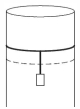
$A$ long cylindrical pipe of radius $20 \,cm$ is closed at its upper end and has an airtight piston of negligible mass as shown. When a $50 \,kg$ mass is attached to the piston,it moves down. If the air in the enclosure is cooled from temperature $T$ to $T-\Delta T$,the piston moves back to its original position. Then $\Delta T / T$ is close to (Assuming air to be an ideal gas,$g=10 \,m/s^2$,atmospheric pressure is $10^5 \,Pa$)
A
$0.01$
B
$0.02$
C
$0.04$
D
$0.09$
Solution
(C) Let the initial pressure of the air inside be $p_0$ (atmospheric pressure) and initial volume be $V_i$. When a mass $m$ is attached to the piston,the piston moves down and the pressure of the gas becomes $p_f = p_0 - \frac{mg}{A}$,where $A$ is the cross-sectional area of the pipe.
Since the temperature remains constant during this expansion,we use Boyle's Law: $p_i V_i = p_f V_f$.
$p_0 V_i = (p_0 - \frac{mg}{A}) V_f$
$\frac{V_f}{V_i} = \frac{p_0}{p_0 - \frac{mg}{A}} = \frac{1}{1 - \frac{mg}{p_0 A}}$
Using the binomial approximation $(1-x)^{-1} \approx 1+x$ for small $x = \frac{mg}{p_0 A}$,we get $\frac{V_f}{V_i} \approx 1 + \frac{mg}{p_0 A}$.
Thus,$\frac{\Delta V}{V_i} = \frac{V_f - V_i}{V_i} = \frac{mg}{p_0 A}$.
When the gas is cooled from $T$ to $T-\Delta T$,it returns to its original volume $V_i$. For a constant pressure process (isobaric),$\frac{V}{T} = \text{constant}$,so $\frac{\Delta V}{V_f} = \frac{\Delta T}{T}$.
Therefore,$\frac{\Delta T}{T} = \frac{\Delta V}{V_f} \approx \frac{\Delta V}{V_i} = \frac{mg}{p_0 A}$.
Given $m = 50 \,kg$,$g = 10 \,m/s^2$,$p_0 = 10^5 \,Pa$,and $r = 0.2 \,m$ $(A = \pi r^2 = 3.14 \times 0.04 = 0.1256 \,m^2)$:
$\frac{\Delta T}{T} = \frac{50 \times 10}{10^5 \times 0.1256} = \frac{500}{12560} \approx 0.0398 \approx 0.04$.
Since the temperature remains constant during this expansion,we use Boyle's Law: $p_i V_i = p_f V_f$.
$p_0 V_i = (p_0 - \frac{mg}{A}) V_f$
$\frac{V_f}{V_i} = \frac{p_0}{p_0 - \frac{mg}{A}} = \frac{1}{1 - \frac{mg}{p_0 A}}$
Using the binomial approximation $(1-x)^{-1} \approx 1+x$ for small $x = \frac{mg}{p_0 A}$,we get $\frac{V_f}{V_i} \approx 1 + \frac{mg}{p_0 A}$.
Thus,$\frac{\Delta V}{V_i} = \frac{V_f - V_i}{V_i} = \frac{mg}{p_0 A}$.
When the gas is cooled from $T$ to $T-\Delta T$,it returns to its original volume $V_i$. For a constant pressure process (isobaric),$\frac{V}{T} = \text{constant}$,so $\frac{\Delta V}{V_f} = \frac{\Delta T}{T}$.
Therefore,$\frac{\Delta T}{T} = \frac{\Delta V}{V_f} \approx \frac{\Delta V}{V_i} = \frac{mg}{p_0 A}$.
Given $m = 50 \,kg$,$g = 10 \,m/s^2$,$p_0 = 10^5 \,Pa$,and $r = 0.2 \,m$ $(A = \pi r^2 = 3.14 \times 0.04 = 0.1256 \,m^2)$:
$\frac{\Delta T}{T} = \frac{50 \times 10}{10^5 \times 0.1256} = \frac{500}{12560} \approx 0.0398 \approx 0.04$.
0 likes
View Solution302
MediumMCQ
The number of air molecules in a $(5 \,m \times 5 \,m \times 4 \,m)$ room at standard temperature and pressure is of the order of
A
$6 \times 10^{23}$
B
$3 \times 10^{24}$
C
$3 \times 10^{27}$
D
$6 \times 10^{30}$
Solution
(C) The volume of the room is $V = 5 \,m \times 5 \,m \times 4 \,m = 100 \,m^3$.
At standard temperature and pressure $(STP)$,the pressure $p = 1.013 \times 10^5 \,Pa \approx 10^5 \,Pa$ and temperature $T = 273 \,K$.
The Boltzmann constant $k_B = 1.38 \times 10^{-23} \,J/K$.
Using the ideal gas equation $pV = Nk_BT$,the number of molecules $N$ is given by $N = \frac{pV}{k_BT}$.
Substituting the values: $N = \frac{10^5 \times 100}{1.38 \times 10^{-23} \times 273} \approx \frac{10^7}{3.7674 \times 10^{-21}} \approx 2.65 \times 10^{27}$.
Rounding to the nearest order of magnitude,$N \approx 3 \times 10^{27}$ molecules.
At standard temperature and pressure $(STP)$,the pressure $p = 1.013 \times 10^5 \,Pa \approx 10^5 \,Pa$ and temperature $T = 273 \,K$.
The Boltzmann constant $k_B = 1.38 \times 10^{-23} \,J/K$.
Using the ideal gas equation $pV = Nk_BT$,the number of molecules $N$ is given by $N = \frac{pV}{k_BT}$.
Substituting the values: $N = \frac{10^5 \times 100}{1.38 \times 10^{-23} \times 273} \approx \frac{10^7}{3.7674 \times 10^{-21}} \approx 2.65 \times 10^{27}$.
Rounding to the nearest order of magnitude,$N \approx 3 \times 10^{27}$ molecules.
0 likes
View Solution303
AdvancedMCQ
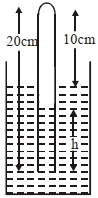
$A$ $20 \,cm$ long tube is closed at one end. It is held vertically,and its open end is dipped in water until only half of it is outside the water surface. Consequently,water rises in it by height $h$ as shown in the figure. The value of $h$ is closest to (assume that the temperature remains constant,$P_{\text{atm}} = 10^5 \,N/m^2$,density of water $\rho = 10^3 \,kg/m^3$,and acceleration due to gravity $g = 10 \,m/s^2$): (in $,cm$)
A
$2$
B
$1$
C
$0.4$
D
$0.2$
Solution
(D) Let the initial pressure inside the tube be $P_0 = 10^5 \,N/m^2$ and the initial volume be $V_1 = A \times 20 \,cm$,where $A$ is the cross-sectional area of the tube.
When the tube is dipped such that $10 \,cm$ is outside the water,the air column inside the tube is compressed. Let the new length of the air column be $L = (20 - h) \,cm$. The new volume is $V_2 = A \times (20 - h) \,cm$.
Since the temperature is constant,we apply Boyle's Law: $P_1 V_1 = P_2 V_2$.
$10^5 \times 20 = P \times (20 - h) \quad \dots(1)$
The pressure $P$ inside the tube at the water level is given by the atmospheric pressure plus the pressure due to the water column outside the tube relative to the air-water interface inside the tube. The depth of the interface below the outer water surface is $(10 - h) \,cm = \frac{10 - h}{100} \,m$.
$P = P_0 + \rho g \Delta y = 10^5 + 10^3 \times 10 \times \frac{10 - h}{100} = 10^5 + 100(10 - h) = 10^5 + 1000 - 100h \quad \dots(2)$
Substituting $(2)$ into $(1)$:
$20 \times 10^5 = (10^5 + 1000 - 100h)(20 - h)$
$20 \times 10^5 = 20 \times 10^5 - 10^5 h + 20000 - 1000h - 2000h + 100h^2$
$0 = 100h^2 - 103000h + 20000$
Dividing by $100$:
$h^2 - 1030h + 200 = 0$
Since $h$ is very small,$h^2 \approx 0$,so $1030h \approx 200 \implies h \approx \frac{200}{1030} \approx 0.194 \,cm$.
This is closest to $0.2 \,cm$.
When the tube is dipped such that $10 \,cm$ is outside the water,the air column inside the tube is compressed. Let the new length of the air column be $L = (20 - h) \,cm$. The new volume is $V_2 = A \times (20 - h) \,cm$.
Since the temperature is constant,we apply Boyle's Law: $P_1 V_1 = P_2 V_2$.
$10^5 \times 20 = P \times (20 - h) \quad \dots(1)$
The pressure $P$ inside the tube at the water level is given by the atmospheric pressure plus the pressure due to the water column outside the tube relative to the air-water interface inside the tube. The depth of the interface below the outer water surface is $(10 - h) \,cm = \frac{10 - h}{100} \,m$.
$P = P_0 + \rho g \Delta y = 10^5 + 10^3 \times 10 \times \frac{10 - h}{100} = 10^5 + 100(10 - h) = 10^5 + 1000 - 100h \quad \dots(2)$
Substituting $(2)$ into $(1)$:
$20 \times 10^5 = (10^5 + 1000 - 100h)(20 - h)$
$20 \times 10^5 = 20 \times 10^5 - 10^5 h + 20000 - 1000h - 2000h + 100h^2$
$0 = 100h^2 - 103000h + 20000$
Dividing by $100$:
$h^2 - 1030h + 200 = 0$
Since $h$ is very small,$h^2 \approx 0$,so $1030h \approx 200 \implies h \approx \frac{200}{1030} \approx 0.194 \,cm$.
This is closest to $0.2 \,cm$.
0 likes
View Solution304
MediumMCQ
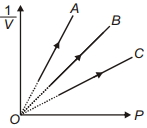
The figure shows the isotherms of a fixed mass of an ideal gas at three temperatures $T_A, T_B$ and $T_C$. Then:
A
$T_A > T_B > T_C$
B
$T_A < T_B < T_C$
C
$T_B < T_A < T_C$
D
$T_A = T_B = T_C$
Solution
(B) From the ideal gas equation,$PV = nRT$,we can write:
$\frac{1}{V} = \frac{P}{nRT}$
For a fixed mass of gas,$n$ is constant. Thus,$\frac{1}{V} = \left(\frac{1}{nRT}\right)P$.
This represents a straight line passing through the origin with a slope $m = \frac{1}{nRT}$.
Since the slope $m$ is inversely proportional to temperature $T$ $(m \propto \frac{1}{T})$,the line with the largest slope corresponds to the lowest temperature.
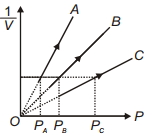
Looking at the graph,the slope of line $A$ is the greatest,followed by $B$,and then $C$ (i.e.,$m_A > m_B > m_C$).
Therefore,the temperatures must follow the order $T_A < T_B < T_C$.
$\frac{1}{V} = \frac{P}{nRT}$
For a fixed mass of gas,$n$ is constant. Thus,$\frac{1}{V} = \left(\frac{1}{nRT}\right)P$.
This represents a straight line passing through the origin with a slope $m = \frac{1}{nRT}$.
Since the slope $m$ is inversely proportional to temperature $T$ $(m \propto \frac{1}{T})$,the line with the largest slope corresponds to the lowest temperature.
Looking at the graph,the slope of line $A$ is the greatest,followed by $B$,and then $C$ (i.e.,$m_A > m_B > m_C$).
Therefore,the temperatures must follow the order $T_A < T_B < T_C$.
0 likes
View Solution305
EasyMCQ
$A$ hydrogen cylinder is designed to withstand an internal pressure of $100 \,atm$. At $27^{\circ} C$,hydrogen is pumped into the cylinder which exerts a pressure of $20 \,atm$. At what temperature does the danger of explosion first set in? (in $K$)
A
$500$
B
$1500$
C
$1000$
D
$2000$
Solution
(B) The process occurs at a constant volume because the cylinder is rigid.
According to Gay-Lussac's Law,for a fixed amount of gas at constant volume,the pressure is directly proportional to the absolute temperature: $P \propto T$ or $\frac{P_1}{T_1} = \frac{P_2}{T_2}$.
Given:
Initial pressure $P_1 = 20 \,atm$
Initial temperature $T_1 = 27^{\circ} C = 27 + 273 = 300 \,K$
Maximum pressure the cylinder can withstand $P_2 = 100 \,atm$
We need to find the temperature $T_2$ at which the pressure reaches $100 \,atm$.
Substituting the values into the formula:
$\frac{20}{300} = \frac{100}{T_2}$
$T_2 = \frac{100 \times 300}{20}$
$T_2 = 5 \times 300 = 1500 \,K$
Thus,the danger of explosion sets in at $1500 \,K$.
According to Gay-Lussac's Law,for a fixed amount of gas at constant volume,the pressure is directly proportional to the absolute temperature: $P \propto T$ or $\frac{P_1}{T_1} = \frac{P_2}{T_2}$.
Given:
Initial pressure $P_1 = 20 \,atm$
Initial temperature $T_1 = 27^{\circ} C = 27 + 273 = 300 \,K$
Maximum pressure the cylinder can withstand $P_2 = 100 \,atm$
We need to find the temperature $T_2$ at which the pressure reaches $100 \,atm$.
Substituting the values into the formula:
$\frac{20}{300} = \frac{100}{T_2}$
$T_2 = \frac{100 \times 300}{20}$
$T_2 = 5 \times 300 = 1500 \,K$
Thus,the danger of explosion sets in at $1500 \,K$.
0 likes
View Solution306
MediumMCQ
An ideal gas is enclosed in a container of volume $V$ at a pressure $P$. It is being pumped out of the container by using a pump with stroke volume $v$. What is the final pressure in the container after $n$ strokes of the pump? (Assume temperature remains constant.)
A
$P\left(\frac{V}{V+v}\right)^n$
B
$\frac{P V}{(V-v)^n}$
C
$P \frac{V^n}{v^n}$
D
$P\left(\frac{V}{V-v}\right)^n$
Solution
(A) Since the temperature remains constant, we use Boyle's Law, $PV = \text{constant}$.
Initially, the gas occupies volume $V$ at pressure $P$. When the pump performs one stroke, the gas expands to fill the total volume $(V + v)$.
Let $P_1$ be the pressure after the first stroke:
$P \cdot V = P_1 \cdot (V + v)$
$P_1 = P \left( \frac{V}{V + v} \right)$
After the second stroke, the gas at pressure $P_1$ in volume $V$ expands to volume $(V + v)$:
$P_1 \cdot V = P_2 \cdot (V + v)$
$P_2 = P_1 \left( \frac{V}{V + v} \right) = P \left( \frac{V}{V + v} \right)^2$
Following this pattern, after $n$ strokes, the pressure $P_n$ will be:
$P_n = P \left( \frac{V}{V + v} \right)^n$
Initially, the gas occupies volume $V$ at pressure $P$. When the pump performs one stroke, the gas expands to fill the total volume $(V + v)$.
Let $P_1$ be the pressure after the first stroke:
$P \cdot V = P_1 \cdot (V + v)$
$P_1 = P \left( \frac{V}{V + v} \right)$
After the second stroke, the gas at pressure $P_1$ in volume $V$ expands to volume $(V + v)$:
$P_1 \cdot V = P_2 \cdot (V + v)$
$P_2 = P_1 \left( \frac{V}{V + v} \right) = P \left( \frac{V}{V + v} \right)^2$
Following this pattern, after $n$ strokes, the pressure $P_n$ will be:
$P_n = P \left( \frac{V}{V + v} \right)^n$
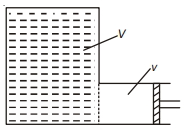
0 likes
View Solution307
EasyMCQ
$A$ container contains $32 \,g$ of $O_2$ at a temperature $T$. The pressure of the gas is $P$. An identical container containing $4 \,g$ of $H_2$ at a temperature $2T$ has a pressure of ............
A
$8P$
B
$4P$
C
$P$
D
$P/8$
Solution
(B) The ideal gas equation is given by $PV = nRT$,where $n = \frac{m}{M}$ is the number of moles.
For the first container: $m(O_2) = 32 \,g$,$M(O_2) = 32 \,g/mol$. Thus,$n_1 = \frac{32}{32} = 1 \,mol$.
The pressure is $P = \frac{n_1 RT}{V} = \frac{1 \cdot RT}{V} = \frac{RT}{V}$.
For the second container: $m(H_2) = 4 \,g$,$M(H_2) = 2 \,g/mol$. Thus,$n_2 = \frac{4}{2} = 2 \,mol$.
The temperature is $2T$. The pressure $P'$ is given by $P' = \frac{n_2 R(2T)}{V} = \frac{2 \cdot R(2T)}{V} = \frac{4RT}{V}$.
Substituting $\frac{RT}{V} = P$,we get $P' = 4P$.
For the first container: $m(O_2) = 32 \,g$,$M(O_2) = 32 \,g/mol$. Thus,$n_1 = \frac{32}{32} = 1 \,mol$.
The pressure is $P = \frac{n_1 RT}{V} = \frac{1 \cdot RT}{V} = \frac{RT}{V}$.
For the second container: $m(H_2) = 4 \,g$,$M(H_2) = 2 \,g/mol$. Thus,$n_2 = \frac{4}{2} = 2 \,mol$.
The temperature is $2T$. The pressure $P'$ is given by $P' = \frac{n_2 R(2T)}{V} = \frac{2 \cdot R(2T)}{V} = \frac{4RT}{V}$.
Substituting $\frac{RT}{V} = P$,we get $P' = 4P$.
0 likes
View Solution308
MediumMCQ
Nitrogen gas $N_2$ of mass $28 \,g$ is kept in a vessel at a pressure of $10 \,atm$ and temperature $57^{\circ} C$. Due to leakage of $N_2$ gas,its pressure falls to $5 \,atm$ and temperature to $27^{\circ} C$. The amount of $N_2$ gas leaked out is .......... $g$.
A
$5/63$
B
$63/5$
C
$28/63$
D
$63/28$
Solution
(B) Using the ideal gas equation $PV = nRT$,where $n = \frac{m}{M}$ (mass/molar mass).
Since the volume $V$ and molar mass $M$ are constant,we have $P = \frac{m}{M} \frac{RT}{V}$,which implies $P \propto m \cdot T$ or $m \propto \frac{P}{T}$.
Initial state: $m_i = 28 \,g$,$P_i = 10 \,atm$,$T_i = 57 + 273 = 330 \,K$.
Final state: $m_f$,$P_f = 5 \,atm$,$T_f = 27 + 273 = 300 \,K$.
Taking the ratio: $\frac{m_f}{m_i} = \frac{P_f}{P_i} \times \frac{T_i}{T_f}$.
$\frac{m_f}{28} = \frac{5}{10} \times \frac{330}{300} = \frac{1}{2} \times \frac{11}{10} = \frac{11}{20}$.
$m_f = 28 \times \frac{11}{20} = 15.4 \,g$.
The amount of gas leaked out is $\Delta m = m_i - m_f = 28 - 15.4 = 12.6 \,g$.
$12.6 \,g = \frac{126}{10} = \frac{63}{5} \,g$.
Since the volume $V$ and molar mass $M$ are constant,we have $P = \frac{m}{M} \frac{RT}{V}$,which implies $P \propto m \cdot T$ or $m \propto \frac{P}{T}$.
Initial state: $m_i = 28 \,g$,$P_i = 10 \,atm$,$T_i = 57 + 273 = 330 \,K$.
Final state: $m_f$,$P_f = 5 \,atm$,$T_f = 27 + 273 = 300 \,K$.
Taking the ratio: $\frac{m_f}{m_i} = \frac{P_f}{P_i} \times \frac{T_i}{T_f}$.
$\frac{m_f}{28} = \frac{5}{10} \times \frac{330}{300} = \frac{1}{2} \times \frac{11}{10} = \frac{11}{20}$.
$m_f = 28 \times \frac{11}{20} = 15.4 \,g$.
The amount of gas leaked out is $\Delta m = m_i - m_f = 28 - 15.4 = 12.6 \,g$.
$12.6 \,g = \frac{126}{10} = \frac{63}{5} \,g$.
0 likes
View Solution309
MediumMCQ
$A$ narrow glass tube,$80 \,cm$ long and open at both ends,is half-immersed in mercury. Now,the top of the tube is closed and it is taken out of the mercury. $A$ column of mercury $20 \,cm$ long remains in the tube. Find the atmospheric pressure.
A
$20 \,cm$ of air column
B
$60 \,cm$ of $Hg$ column
C
$60 \,cm$ of air column
D
$20 \,cm$ of $Hg$ column
Solution
(B) Let $P_0$ be the atmospheric pressure.
Initially,the tube is half-immersed,so $40 \,cm$ of the tube is inside the mercury. The air trapped inside the tube at the top has a length of $40 \,cm$ at pressure $P_0$.
When the tube is taken out,$20 \,cm$ of mercury remains. The total length of the tube is $80 \,cm$. Since $20 \,cm$ is occupied by mercury,the remaining length for the air column is $80 - 20 = 60 \,cm$.
Using Boyle's Law $(P_1 V_1 = P_2 V_2)$:
$P_0 \times 40 = P_1 \times 60 \Rightarrow P_1 = \frac{2}{3} P_0$.
The pressure inside the tube $P_1$ is related to atmospheric pressure by the mercury column height: $P_0 = P_1 + h$,where $h = 20 \,cm$.
Substituting $P_1$: $P_0 = \frac{2}{3} P_0 + 20$.
$\frac{1}{3} P_0 = 20 \Rightarrow P_0 = 60 \,cm$ of $Hg$.
Initially,the tube is half-immersed,so $40 \,cm$ of the tube is inside the mercury. The air trapped inside the tube at the top has a length of $40 \,cm$ at pressure $P_0$.
When the tube is taken out,$20 \,cm$ of mercury remains. The total length of the tube is $80 \,cm$. Since $20 \,cm$ is occupied by mercury,the remaining length for the air column is $80 - 20 = 60 \,cm$.
Using Boyle's Law $(P_1 V_1 = P_2 V_2)$:
$P_0 \times 40 = P_1 \times 60 \Rightarrow P_1 = \frac{2}{3} P_0$.
The pressure inside the tube $P_1$ is related to atmospheric pressure by the mercury column height: $P_0 = P_1 + h$,where $h = 20 \,cm$.
Substituting $P_1$: $P_0 = \frac{2}{3} P_0 + 20$.
$\frac{1}{3} P_0 = 20 \Rightarrow P_0 = 60 \,cm$ of $Hg$.
0 likes
View Solution310
EasyMCQ
$A$ bicycle tyre is filled with air having pressure of $270\,kPa$ at $27^{\circ}C$. The approximate pressure of the air in the tyre when the temperature increases to $36^{\circ}C$ is $............kPa$.
A
$270$
B
$262$
C
$278$
D
$360$
Solution
(C) Assuming the volume of the tyre remains constant,we use Gay-Lussac's Law: $\frac{P_1}{T_1} = \frac{P_2}{T_2}$.
Given:
$P_1 = 270\,kPa$
$T_1 = 27^{\circ}C = 27 + 273 = 300\,K$
$T_2 = 36^{\circ}C = 36 + 273 = 309\,K$
Substituting the values:
$P_2 = \frac{P_1 \times T_2}{T_1} = \frac{270 \times 309}{300}$.
$P_2 = 0.9 \times 309 = 278.1\,kPa$.
Rounding to the nearest integer,the pressure is $278\,kPa$.
Given:
$P_1 = 270\,kPa$
$T_1 = 27^{\circ}C = 27 + 273 = 300\,K$
$T_2 = 36^{\circ}C = 36 + 273 = 309\,K$
Substituting the values:
$P_2 = \frac{P_1 \times T_2}{T_1} = \frac{270 \times 309}{300}$.
$P_2 = 0.9 \times 309 = 278.1\,kPa$.
Rounding to the nearest integer,the pressure is $278\,kPa$.
1 likes
View Solution311
DifficultMCQ
The pressure $(P)$ and temperature $(T)$ relationship of an ideal gas obeys the equation $PT^2 = \text{constant}$. The volume expansion coefficient of the gas will be:
A
$3T^2$
B
$\frac{3}{T^2}$
C
$\frac{3}{T^3}$
D
$\frac{3}{T}$
Solution
(D) Given the relation $PT^2 = C$ (where $C$ is a constant).
Using the ideal gas law $PV = nRT$, we can write $P = \frac{nRT}{V}$.
Substituting $P$ into the given equation: $\left(\frac{nRT}{V}\right)T^2 = C$.
This simplifies to $\frac{nRT^3}{V} = C$, which implies $V = \left(\frac{nR}{C}\right)T^3$.
Let $K = \frac{nR}{C}$, so $V = KT^3$.
The volume expansion coefficient $\gamma$ is defined as $\gamma = \frac{1}{V} \frac{dV}{dT}$.
Differentiating $V$ with respect to $T$: $\frac{dV}{dT} = 3KT^2$.
Now, substitute into the formula for $\gamma$: $\gamma = \frac{1}{KT^3} \times (3KT^2) = \frac{3}{T}$.
Using the ideal gas law $PV = nRT$, we can write $P = \frac{nRT}{V}$.
Substituting $P$ into the given equation: $\left(\frac{nRT}{V}\right)T^2 = C$.
This simplifies to $\frac{nRT^3}{V} = C$, which implies $V = \left(\frac{nR}{C}\right)T^3$.
Let $K = \frac{nR}{C}$, so $V = KT^3$.
The volume expansion coefficient $\gamma$ is defined as $\gamma = \frac{1}{V} \frac{dV}{dT}$.
Differentiating $V$ with respect to $T$: $\frac{dV}{dT} = 3KT^2$.
Now, substitute into the formula for $\gamma$: $\gamma = \frac{1}{KT^3} \times (3KT^2) = \frac{3}{T}$.
0 likes
View Solution312
MediumMCQ
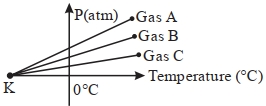
For three low density gases $A, B, C$,pressure versus temperature graphs are plotted while keeping them at constant volume,as shown in the figure. The temperature corresponding to the point '$K$' is $...........\,{}^{\circ}\,C$.
A
$-273$
B
$-100$
C
$-373$
D
$-40$
Solution
(A) For an isochoric process (constant volume),the ideal gas equation is given by $PV = nRT$,which can be rearranged as $P = (\frac{nR}{V})T$.
Here,$T$ is the absolute temperature in Kelvin,which is related to the temperature $t$ in Celsius by $T = t + 273.15$.
Substituting this into the equation,we get $P = (\frac{nR}{V})(t + 273.15)$.
This represents a straight line equation of the form $y = mx + c$,where the intercept on the temperature axis occurs when pressure $P = 0$.
Setting $P = 0$,we get $0 = (\frac{nR}{V})(t + 273.15)$,which implies $t + 273.15 = 0$,or $t = -273.15^{\circ}\,C$.
Rounding to the nearest integer,the temperature at point '$K$' is $-273^{\circ}\,C$,which represents absolute zero.
Here,$T$ is the absolute temperature in Kelvin,which is related to the temperature $t$ in Celsius by $T = t + 273.15$.
Substituting this into the equation,we get $P = (\frac{nR}{V})(t + 273.15)$.
This represents a straight line equation of the form $y = mx + c$,where the intercept on the temperature axis occurs when pressure $P = 0$.
Setting $P = 0$,we get $0 = (\frac{nR}{V})(t + 273.15)$,which implies $t + 273.15 = 0$,or $t = -273.15^{\circ}\,C$.
Rounding to the nearest integer,the temperature at point '$K$' is $-273^{\circ}\,C$,which represents absolute zero.
0 likes
View Solution313
DifficultMCQ
Two vessels $A$ and $B$ are of the same size and are at the same temperature. Vessel $A$ contains $1 \ g$ of hydrogen and vessel $B$ contains $1 \ g$ of oxygen. If $P_{A}$ and $P_{B}$ are the pressures of the gases in $A$ and $B$ respectively,then the ratio $\frac{P_{A}}{P_{B}}$ is:
A
$16$
B
$8$
C
$4$
D
$32$
Solution
(A) From the ideal gas equation,$PV = nRT$,where $n = \frac{m}{M}$ is the number of moles.
Since the vessels have the same size $(V_A = V_B)$ and are at the same temperature $(T_A = T_B)$,the pressure $P$ is directly proportional to the number of moles $n$ $(P \propto n)$.
Therefore,$\frac{P_A}{P_B} = \frac{n_A}{n_B}$.
The molar mass of hydrogen $(H_2)$ is $M_A = 2 \ g/mol$,and the molar mass of oxygen $(O_2)$ is $M_B = 32 \ g/mol$.
The number of moles in vessel $A$ is $n_A = \frac{1 \ g}{2 \ g/mol} = 0.5 \ mol$.
The number of moles in vessel $B$ is $n_B = \frac{1 \ g}{32 \ g/mol} = \frac{1}{32} \ mol$.
Thus,$\frac{P_A}{P_B} = \frac{0.5}{1/32} = 0.5 \times 32 = 16$.
Since the vessels have the same size $(V_A = V_B)$ and are at the same temperature $(T_A = T_B)$,the pressure $P$ is directly proportional to the number of moles $n$ $(P \propto n)$.
Therefore,$\frac{P_A}{P_B} = \frac{n_A}{n_B}$.
The molar mass of hydrogen $(H_2)$ is $M_A = 2 \ g/mol$,and the molar mass of oxygen $(O_2)$ is $M_B = 32 \ g/mol$.
The number of moles in vessel $A$ is $n_A = \frac{1 \ g}{2 \ g/mol} = 0.5 \ mol$.
The number of moles in vessel $B$ is $n_B = \frac{1 \ g}{32 \ g/mol} = \frac{1}{32} \ mol$.
Thus,$\frac{P_A}{P_B} = \frac{0.5}{1/32} = 0.5 \times 32 = 16$.
0 likes
View Solution314
DifficultMCQ
The temperature of a gas having $2.0 \times 10^{25}$ molecules per cubic meter at $1.38 \text{ atm}$ (Given,$k = 1.38 \times 10^{-23} \text{ J K}^{-1}$) is: (in $\text{ K}$)
A
$500$
B
$200$
C
$100$
D
$300$
Solution
(A) The ideal gas equation in terms of number density $n = N/V$ is given by $P = nkT$.
Given:
Number density $n = 2.0 \times 10^{25} \text{ m}^{-3}$
Pressure $P = 1.38 \text{ atm} = 1.38 \times 1.01325 \times 10^5 \text{ Pa} \approx 1.4 \times 10^5 \text{ Pa}$
Boltzmann constant $k = 1.38 \times 10^{-23} \text{ J K}^{-1}$
Using the formula $P = nkT$:
$T = \frac{P}{nk}$
$T = \frac{1.38 \times 1.01325 \times 10^5}{2.0 \times 10^{25} \times 1.38 \times 10^{-23}}$
$T = \frac{1.01325 \times 10^5}{2.0 \times 10^2}$
$T = \frac{101325}{200} \approx 506.6 \text{ K}$
Rounding to the nearest given option,the temperature is approximately $500 \text{ K}$.
Given:
Number density $n = 2.0 \times 10^{25} \text{ m}^{-3}$
Pressure $P = 1.38 \text{ atm} = 1.38 \times 1.01325 \times 10^5 \text{ Pa} \approx 1.4 \times 10^5 \text{ Pa}$
Boltzmann constant $k = 1.38 \times 10^{-23} \text{ J K}^{-1}$
Using the formula $P = nkT$:
$T = \frac{P}{nk}$
$T = \frac{1.38 \times 1.01325 \times 10^5}{2.0 \times 10^{25} \times 1.38 \times 10^{-23}}$
$T = \frac{1.01325 \times 10^5}{2.0 \times 10^2}$
$T = \frac{101325}{200} \approx 506.6 \text{ K}$
Rounding to the nearest given option,the temperature is approximately $500 \text{ K}$.
0 likes
View Solution315
DifficultMCQ
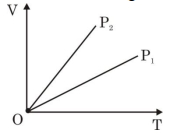
The given figure represents two isobaric processes for the same mass of an ideal gas. Then:
A
$P_2 \geq P_1$
B
$P_2 > P_1$
C
$P_1 = P_2$
D
$P_1 > P_2$
Solution
(D) For an ideal gas,the equation of state is $PV = nRT$.
Rearranging for $V$ as a function of $T$,we get $V = \left(\frac{nR}{P}\right)T$.
Comparing this with the equation of a straight line $y = mx$,where $y = V$ and $x = T$,the slope of the $V-T$ graph is given by $\text{Slope} = \frac{nR}{P}$.
Since $n$ and $R$ are constants,the slope is inversely proportional to the pressure,i.e.,$\text{Slope} \propto \frac{1}{P}$.
From the given figure,the slope of the line corresponding to $P_2$ is greater than the slope of the line corresponding to $P_1$,i.e.,$(\text{Slope})_2 > (\text{Slope})_1$.
Since $\text{Slope} \propto \frac{1}{P}$,a higher slope implies a lower pressure. Therefore,$P_2 < P_1$ or $P_1 > P_2$.
Rearranging for $V$ as a function of $T$,we get $V = \left(\frac{nR}{P}\right)T$.
Comparing this with the equation of a straight line $y = mx$,where $y = V$ and $x = T$,the slope of the $V-T$ graph is given by $\text{Slope} = \frac{nR}{P}$.
Since $n$ and $R$ are constants,the slope is inversely proportional to the pressure,i.e.,$\text{Slope} \propto \frac{1}{P}$.
From the given figure,the slope of the line corresponding to $P_2$ is greater than the slope of the line corresponding to $P_1$,i.e.,$(\text{Slope})_2 > (\text{Slope})_1$.
Since $\text{Slope} \propto \frac{1}{P}$,a higher slope implies a lower pressure. Therefore,$P_2 < P_1$ or $P_1 > P_2$.
0 likes
View Solution316
DifficultMCQ
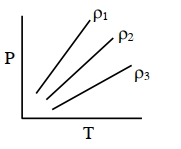
The $P-T$ diagram of an ideal gas having three different densities $\rho_1, \rho_2, \rho_3$ (in three different cases) is shown in the figure. Which of the following is correct?
A
$\rho_2 < \rho_3$
B
$\rho_1 > \rho_2$
C
$\rho_1 < \rho_2$
D
$\rho_1 = \rho_2 = \rho_3$
Solution
(B) For an ideal gas,the equation of state is given by:
$PV = nRT$
Since $n = \frac{m}{M}$,where $m$ is the mass and $M$ is the molar mass,we have:
$PV = \frac{m}{M} RT$
Rearranging for pressure $P$:
$P = \left( \frac{m}{V} \right) \frac{RT}{M}$
Since density $\rho = \frac{m}{V}$,we get:
$P = \left( \frac{\rho R}{M} \right) T$
This represents a straight line passing through the origin in a $P-T$ graph,where the slope is $\frac{\rho R}{M}$.
For a constant temperature $T$,from the graph,we can see that $P_1 > P_2 > P_3$.
Since $P \propto \rho$ for a constant $T$ and $M$,it follows that $\rho_1 > \rho_2 > \rho_3$.
Therefore,the correct option is $\rho_1 > \rho_2$.
$PV = nRT$
Since $n = \frac{m}{M}$,where $m$ is the mass and $M$ is the molar mass,we have:
$PV = \frac{m}{M} RT$
Rearranging for pressure $P$:
$P = \left( \frac{m}{V} \right) \frac{RT}{M}$
Since density $\rho = \frac{m}{V}$,we get:
$P = \left( \frac{\rho R}{M} \right) T$
This represents a straight line passing through the origin in a $P-T$ graph,where the slope is $\frac{\rho R}{M}$.
For a constant temperature $T$,from the graph,we can see that $P_1 > P_2 > P_3$.
Since $P \propto \rho$ for a constant $T$ and $M$,it follows that $\rho_1 > \rho_2 > \rho_3$.
Therefore,the correct option is $\rho_1 > \rho_2$.
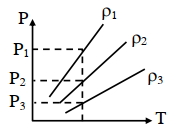
0 likes
View Solution317
MediumMCQ
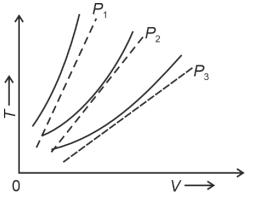
The following graph represents the $T-V$ curves of an ideal gas (where $T$ is the temperature and $V$ is the volume) at three pressures $P_1, P_2$ and $P_3$ compared with those of Charles's law represented as dotted lines. Then the correct relation is:
A
$P_1 > P_3 > P_2$
B
$P_2 > P_1 > P_3$
C
$P_1 > P_2 > P_3$
D
$P_3 > P_2 > P_1$
Solution
(C) From the ideal gas equation,$PV = nRT$,we have $T = (P/nR)V$.
For a fixed amount of gas ($n$ is constant),the slope of the $T-V$ graph is given by $m = P/nR$.
Since $n$ and $R$ are constants,the slope $m$ is directly proportional to the pressure $P$.
Therefore,a steeper slope in the $T-V$ graph corresponds to a higher pressure.
Looking at the graph,the slope of the curve for $P_1$ is the steepest,followed by $P_2$,and then $P_3$.
Thus,the correct relation is $P_1 > P_2 > P_3$.
For a fixed amount of gas ($n$ is constant),the slope of the $T-V$ graph is given by $m = P/nR$.
Since $n$ and $R$ are constants,the slope $m$ is directly proportional to the pressure $P$.
Therefore,a steeper slope in the $T-V$ graph corresponds to a higher pressure.
Looking at the graph,the slope of the curve for $P_1$ is the steepest,followed by $P_2$,and then $P_3$.
Thus,the correct relation is $P_1 > P_2 > P_3$.
0 likes
View Solution318
EasyMCQ
An ideal gas is expanding such that $PT^2 = \text{constant}$. The coefficient of volume expansion of the gas is
A
$\frac{1}{T}$
B
$\frac{2}{T}$
C
$\frac{3}{T}$
D
$\frac{4}{T}$
Solution
(C) The coefficient of volume expansion is defined as $\gamma = \frac{1}{V} \left( \frac{dV}{dT} \right)$.
Given the process equation: $PT^2 = \text{constant}$.
Using the ideal gas law $PV = nRT$, we can write $P = \frac{nRT}{V}$.
Substituting $P$ into the process equation: $\left( \frac{nRT}{V} \right) T^2 = \text{constant}$.
This simplifies to $\frac{T^3}{V} = \text{constant}$, or $V = k T^3$ (where $k$ is a constant).
Differentiating $V$ with respect to $T$: $\frac{dV}{dT} = 3k T^2$.
Now, substitute these into the expression for $\gamma$:
$\gamma = \frac{1}{V} \left( \frac{dV}{dT} \right) = \frac{1}{kT^3} (3kT^2) = \frac{3}{T}$.
Given the process equation: $PT^2 = \text{constant}$.
Using the ideal gas law $PV = nRT$, we can write $P = \frac{nRT}{V}$.
Substituting $P$ into the process equation: $\left( \frac{nRT}{V} \right) T^2 = \text{constant}$.
This simplifies to $\frac{T^3}{V} = \text{constant}$, or $V = k T^3$ (where $k$ is a constant).
Differentiating $V$ with respect to $T$: $\frac{dV}{dT} = 3k T^2$.
Now, substitute these into the expression for $\gamma$:
$\gamma = \frac{1}{V} \left( \frac{dV}{dT} \right) = \frac{1}{kT^3} (3kT^2) = \frac{3}{T}$.
0 likes
View Solution319
MediumMCQ
$A$ container of fixed volume contains a gas at $27^{\circ} C$. To double the pressure of the gas,the temperature of the gas should be raised to . . . . . . ${ }^{\circ} {C}$.
A
$127$
B
$327$
C
$447$
D
$256$
Solution
(B) For a gas in a container of fixed volume,the volume $V$ is constant. According to Gay-Lussac's Law,for a fixed amount of gas at constant volume,the pressure $P$ is directly proportional to the absolute temperature $T$ ($P \propto T$ or $\frac{P_1}{T_1} = \frac{P_2}{T_2}$).
Given initial temperature $T_1 = 27^{\circ} C = 27 + 273 = 300 \ K$.
Let the initial pressure be $P_1 = P$.
We want the final pressure to be $P_2 = 2P$.
Using the relation $\frac{P_1}{T_1} = \frac{P_2}{T_2}$:
$\frac{P}{300} = \frac{2P}{T_2}$
$T_2 = 2 \times 300 = 600 \ K$.
To convert the temperature back to Celsius: $T_2(^{\circ} C) = 600 - 273 = 327^{\circ} C$.
Given initial temperature $T_1 = 27^{\circ} C = 27 + 273 = 300 \ K$.
Let the initial pressure be $P_1 = P$.
We want the final pressure to be $P_2 = 2P$.
Using the relation $\frac{P_1}{T_1} = \frac{P_2}{T_2}$:
$\frac{P}{300} = \frac{2P}{T_2}$
$T_2 = 2 \times 300 = 600 \ K$.
To convert the temperature back to Celsius: $T_2(^{\circ} C) = 600 - 273 = 327^{\circ} C$.
0 likes
View Solution320
MediumMCQ
Pressure of an ideal gas,contained in a closed vessel,is increased by $0.4 \%$ when heated by $1^{\circ} C$. Its initial temperature must be
A
$25^{\circ} C$
B
$2500 \ K$
C
$250 \ K$
D
$250^{\circ} C$
Solution
(C) For an ideal gas in a closed vessel,the volume $V$ remains constant,which represents an isochoric process.
According to Gay-Lussac's Law,for a constant volume,the pressure $P$ is directly proportional to the absolute temperature $T$ $(P \propto T)$.
This implies $\frac{P_2}{P_1} = \frac{T_2}{T_1}$,or in terms of small changes,$\frac{\Delta P}{P} = \frac{\Delta T}{T}$.
Given that the pressure increases by $0.4 \%$,we have $\frac{\Delta P}{P} = \frac{0.4}{100}$.
The change in temperature is given as $\Delta T = 1 \ K$ (since a change of $1^{\circ} C$ is equivalent to a change of $1 \ K$).
Substituting these values into the equation: $\frac{0.4}{100} = \frac{1}{T}$.
Solving for $T$,we get $T = \frac{100}{0.4} = 250 \ K$.
According to Gay-Lussac's Law,for a constant volume,the pressure $P$ is directly proportional to the absolute temperature $T$ $(P \propto T)$.
This implies $\frac{P_2}{P_1} = \frac{T_2}{T_1}$,or in terms of small changes,$\frac{\Delta P}{P} = \frac{\Delta T}{T}$.
Given that the pressure increases by $0.4 \%$,we have $\frac{\Delta P}{P} = \frac{0.4}{100}$.
The change in temperature is given as $\Delta T = 1 \ K$ (since a change of $1^{\circ} C$ is equivalent to a change of $1 \ K$).
Substituting these values into the equation: $\frac{0.4}{100} = \frac{1}{T}$.
Solving for $T$,we get $T = \frac{100}{0.4} = 250 \ K$.
0 likes
View Solution321
MediumMCQ
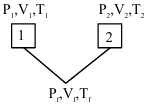
There are two vessels filled with an ideal gas where the volume of one is double the volume of the other. The large vessel contains the gas at $8 \ kPa$ at $1000 \ K$,while the smaller vessel contains the gas at $7 \ kPa$ at $500 \ K$. If the vessels are connected to each other by a thin tube allowing the gas to flow and the temperature of both vessels is maintained at $600 \ K$,at steady state the pressure in the vessels will be (in $kPa$).
A
$4.4$
B
$6$
C
$24$
D
$18$
Solution
(B) The total number of moles of the gas remains constant because the system is closed.
Let the volume of the smaller vessel be $V$ and the volume of the larger vessel be $2V$.
Initial moles in the larger vessel: $n_1 = \frac{P_1 V_1}{R T_1} = \frac{8 \times 2V}{R \times 1000} = \frac{16V}{1000R}$.
Initial moles in the smaller vessel: $n_2 = \frac{P_2 V_2}{R T_2} = \frac{7 \times V}{R \times 500} = \frac{14V}{1000R}$.
Total initial moles: $n_{total} = n_1 + n_2 = \frac{16V + 14V}{1000R} = \frac{30V}{1000R}$.
At steady state,the total volume is $V_f = V + 2V = 3V$ and the temperature is $T_f = 600 \ K$.
Using the ideal gas law for the final state: $n_{total} = \frac{P_f V_f}{R T_f}$.
$\frac{30V}{1000R} = \frac{P_f \times 3V}{R \times 600}$.
Canceling $V$ and $R$ from both sides:
$\frac{30}{1000} = \frac{3 P_f}{600}$.
$\frac{30}{1000} = \frac{P_f}{200}$.
$P_f = \frac{30 \times 200}{1000} = 6 \ kPa$.
Let the volume of the smaller vessel be $V$ and the volume of the larger vessel be $2V$.
Initial moles in the larger vessel: $n_1 = \frac{P_1 V_1}{R T_1} = \frac{8 \times 2V}{R \times 1000} = \frac{16V}{1000R}$.
Initial moles in the smaller vessel: $n_2 = \frac{P_2 V_2}{R T_2} = \frac{7 \times V}{R \times 500} = \frac{14V}{1000R}$.
Total initial moles: $n_{total} = n_1 + n_2 = \frac{16V + 14V}{1000R} = \frac{30V}{1000R}$.
At steady state,the total volume is $V_f = V + 2V = 3V$ and the temperature is $T_f = 600 \ K$.
Using the ideal gas law for the final state: $n_{total} = \frac{P_f V_f}{R T_f}$.
$\frac{30V}{1000R} = \frac{P_f \times 3V}{R \times 600}$.
Canceling $V$ and $R$ from both sides:
$\frac{30}{1000} = \frac{3 P_f}{600}$.
$\frac{30}{1000} = \frac{P_f}{200}$.
$P_f = \frac{30 \times 200}{1000} = 6 \ kPa$.
0 likes
View Solution322
MediumMCQ
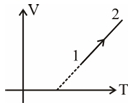
$A$ graph between volume $V$ and absolute temperature $T$ is obtained when a given mass of a gas is heated. During the heating process from state-$1$ to state-$2$,the pressure
A
remained same
B
decreased
C
increased
D
none of above
Solution
(B) From the ideal gas equation,$PV = nRT$,we can write $V = (\frac{nR}{P})T$.
Comparing this with the equation of a straight line $y = mx$,where $y = V$ and $x = T$,the slope $m = \frac{nR}{P}$.
Since $n$ and $R$ are constants,the slope is inversely proportional to pressure,i.e.,$\text{slope} \propto \frac{1}{P}$.
In the given $V-T$ graph,the line representing the process from state-$1$ to state-$2$ is steeper than the line passing through the origin to state-$1$.
This means the slope increases as we move from state-$1$ to state-$2$.
Since $\text{slope} \propto \frac{1}{P}$,an increase in slope implies a decrease in pressure.
Therefore,the pressure decreased.
Comparing this with the equation of a straight line $y = mx$,where $y = V$ and $x = T$,the slope $m = \frac{nR}{P}$.
Since $n$ and $R$ are constants,the slope is inversely proportional to pressure,i.e.,$\text{slope} \propto \frac{1}{P}$.
In the given $V-T$ graph,the line representing the process from state-$1$ to state-$2$ is steeper than the line passing through the origin to state-$1$.
This means the slope increases as we move from state-$1$ to state-$2$.
Since $\text{slope} \propto \frac{1}{P}$,an increase in slope implies a decrease in pressure.
Therefore,the pressure decreased.
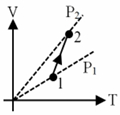
0 likes
View Solution323
MediumMCQ
$A$ vessel has $8 \ g$ of oxygen at pressure $P$ and temperature $400 \ K$. $A$ small hole is made in it so that oxygen leaks out. How many grams of oxygen leak out if the final pressure is $P/4$ and the temperature is $200 \ K$?
A
$3$
B
$2$
C
$4$
D
$5$
Solution
(C) The volume $V$ of the vessel remains constant.
Using the ideal gas equation $PV = nRT$,where $n = \frac{m}{M}$ ($m$ is the mass of gas,$M$ is the molar mass).
Since $V$ and $M$ are constant,we have $\frac{P}{mT} = \text{constant}$.
Therefore,$\frac{P_1}{m_1 T_1} = \frac{P_2}{m_2 T_2}$.
Given: $P_1 = P$,$m_1 = 8 \ g$,$T_1 = 400 \ K$,$P_2 = P/4$,$T_2 = 200 \ K$.
Substituting the values: $\frac{P}{8 \times 400} = \frac{P/4}{m_2 \times 200}$.
$\frac{1}{3200} = \frac{1}{800 \times m_2}$.
$m_2 = \frac{3200}{800} = 4 \ g$.
The mass of oxygen that leaked out is $\Delta m = m_1 - m_2 = 8 \ g - 4 \ g = 4 \ g$.
Using the ideal gas equation $PV = nRT$,where $n = \frac{m}{M}$ ($m$ is the mass of gas,$M$ is the molar mass).
Since $V$ and $M$ are constant,we have $\frac{P}{mT} = \text{constant}$.
Therefore,$\frac{P_1}{m_1 T_1} = \frac{P_2}{m_2 T_2}$.
Given: $P_1 = P$,$m_1 = 8 \ g$,$T_1 = 400 \ K$,$P_2 = P/4$,$T_2 = 200 \ K$.
Substituting the values: $\frac{P}{8 \times 400} = \frac{P/4}{m_2 \times 200}$.
$\frac{1}{3200} = \frac{1}{800 \times m_2}$.
$m_2 = \frac{3200}{800} = 4 \ g$.
The mass of oxygen that leaked out is $\Delta m = m_1 - m_2 = 8 \ g - 4 \ g = 4 \ g$.
0 likes
View Solution324
MediumMCQ
The $PV$ versus $T$ graph for equal masses of $H_2, He$,and $O_2$ is shown in the figure. Choose the correct alternative:
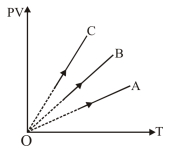
A
$A$ corresponds to $H_2, B$ to $He$ and $C$ to $O_2$
B
$A$ corresponds to $He, B$ to $H_2$ and $C$ to $O_2$
C
$A$ corresponds to $He, B$ to $O_2$ and $C$ to $H_2$
D
$A$ corresponds to $O_2, B$ to $He$ and $C$ to $H_2$
Solution
(D) From the ideal gas equation,$PV = \mu RT$,where $\mu$ is the number of moles.
Rearranging this,we get $PV = (\mu R)T$.
Comparing this with the equation of a straight line $y = mx$,where $y = PV$ and $x = T$,the slope of the graph is $m = \mu R$.
Since $R$ is a universal gas constant,the slope is directly proportional to the number of moles $\mu$.
For a given mass $m$,the number of moles is $\mu = \frac{m}{M}$,where $M$ is the molar mass.
Thus,$\mu \propto \frac{1}{M}$.
The molar masses are $M(H_2) = 2 \text{ g/mol}$,$M(He) = 4 \text{ g/mol}$,and $M(O_2) = 32 \text{ g/mol}$.
Since $M(H_2) < M(He) < M(O_2)$,the number of moles follows the order $\mu(H_2) > \mu(He) > \mu(O_2)$.
Consequently,the slopes follow the order $\text{Slope}(H_2) > \text{Slope}(He) > \text{Slope}(O_2)$.
Looking at the graph,the slope of line $C$ is the greatest,followed by $B$,and then $A$.
Therefore,$C$ corresponds to $H_2$,$B$ corresponds to $He$,and $A$ corresponds to $O_2$.
This matches option $D$.
Rearranging this,we get $PV = (\mu R)T$.
Comparing this with the equation of a straight line $y = mx$,where $y = PV$ and $x = T$,the slope of the graph is $m = \mu R$.
Since $R$ is a universal gas constant,the slope is directly proportional to the number of moles $\mu$.
For a given mass $m$,the number of moles is $\mu = \frac{m}{M}$,where $M$ is the molar mass.
Thus,$\mu \propto \frac{1}{M}$.
The molar masses are $M(H_2) = 2 \text{ g/mol}$,$M(He) = 4 \text{ g/mol}$,and $M(O_2) = 32 \text{ g/mol}$.
Since $M(H_2) < M(He) < M(O_2)$,the number of moles follows the order $\mu(H_2) > \mu(He) > \mu(O_2)$.
Consequently,the slopes follow the order $\text{Slope}(H_2) > \text{Slope}(He) > \text{Slope}(O_2)$.
Looking at the graph,the slope of line $C$ is the greatest,followed by $B$,and then $A$.
Therefore,$C$ corresponds to $H_2$,$B$ corresponds to $He$,and $A$ corresponds to $O_2$.
This matches option $D$.
0 likes
View Solution325
MediumMCQ
When the pressure of the gas contained in a closed vessel is increased by $2.5 \%$,the temperature of the gas increases by $4 \ K$. The initial temperature of the gas is (in $K$)
A
$80$
B
$150$
C
$160$
D
$320$
Solution
(C) For a gas in a closed vessel,the volume $V$ remains constant. According to Gay-Lussac's Law,$P \propto T$,which means $\frac{P_1}{T_1} = \frac{P_2}{T_2}$.
Let the initial pressure be $P$ and the initial temperature be $T$. Then $P_1 = P$ and $T_1 = T$.
The pressure is increased by $2.5 \%$,so $P_2 = P + 0.025P = 1.025P$.
The temperature increases by $4 \ K$,so $T_2 = T + 4$.
Substituting these into the relation $\frac{P}{T} = \frac{1.025P}{T + 4}$:
$T + 4 = 1.025T$
$4 = 1.025T - T$
$4 = 0.025T$
$T = \frac{4}{0.025} = \frac{4000}{25} = 160 \ K$.
Thus,the initial temperature of the gas is $160 \ K$.
Let the initial pressure be $P$ and the initial temperature be $T$. Then $P_1 = P$ and $T_1 = T$.
The pressure is increased by $2.5 \%$,so $P_2 = P + 0.025P = 1.025P$.
The temperature increases by $4 \ K$,so $T_2 = T + 4$.
Substituting these into the relation $\frac{P}{T} = \frac{1.025P}{T + 4}$:
$T + 4 = 1.025T$
$4 = 1.025T - T$
$4 = 0.025T$
$T = \frac{4}{0.025} = \frac{4000}{25} = 160 \ K$.
Thus,the initial temperature of the gas is $160 \ K$.
0 likes
View Solution326
MediumMCQ
The pressure $P$,volume $V$,and temperature $T$ of a gas in jar $A$ are given. The gas in another jar $B$ is at pressure $2P$,volume $V/4$,and temperature $T/4$. What is the ratio of the number of molecules in jar $A$ to jar $B$?
A
$1: 1$
B
$1: 2$
C
$2: 1$
D
$4: 1$
Solution
(B) From the ideal gas equation,$PV = nRT$,where $n$ is the number of moles. The number of molecules $N$ is given by $N = nN_A$,where $N_A$ is Avogadro's number.
Thus,$N = \frac{PV}{RT} N_A$.
For jar $A$: $N_A = \frac{PV}{RT} N_A$.
For jar $B$: $N_B = \frac{(2P)(V/4)}{(T/4)} N_A = \frac{2PV/4}{T/4} N_A = \frac{2PV}{T} N_A = 2 \left( \frac{PV}{RT} \right) N_A = 2N_A$.
Therefore,the ratio of the number of molecules in jar $A$ to jar $B$ is $N_A / N_B = 1 / 2$,which is $1: 2$.
Thus,$N = \frac{PV}{RT} N_A$.
For jar $A$: $N_A = \frac{PV}{RT} N_A$.
For jar $B$: $N_B = \frac{(2P)(V/4)}{(T/4)} N_A = \frac{2PV/4}{T/4} N_A = \frac{2PV}{T} N_A = 2 \left( \frac{PV}{RT} \right) N_A = 2N_A$.
Therefore,the ratio of the number of molecules in jar $A$ to jar $B$ is $N_A / N_B = 1 / 2$,which is $1: 2$.
0 likes
View Solution327
MediumMCQ
How much should the pressure be increased in order to reduce the volume of a given mass of gas by $5 \%$ at a constant temperature (in $\%$)?
A
$5$
B
$10$
C
$5.26$
D
$4$
Solution
(C) According to Boyle's Law,for a given mass of gas at a constant temperature,$P_1 V_1 = P_2 V_2$.
Let the initial pressure be $P_1 = P$ and the initial volume be $V_1 = V$.
The volume is reduced by $5 \%$,so the final volume $V_2 = V - 0.05V = 0.95V$.
Substituting these into the equation: $P \times V = P_2 \times 0.95V$.
Solving for $P_2$: $P_2 = P / 0.95 = (100/95)P = (20/19)P \approx 1.0526P$.
The increase in pressure is $\Delta P = P_2 - P = 1.0526P - P = 0.0526P$.
The percentage increase in pressure is $(\Delta P / P) \times 100 = 0.0526 \times 100 = 5.26 \%$.
Let the initial pressure be $P_1 = P$ and the initial volume be $V_1 = V$.
The volume is reduced by $5 \%$,so the final volume $V_2 = V - 0.05V = 0.95V$.
Substituting these into the equation: $P \times V = P_2 \times 0.95V$.
Solving for $P_2$: $P_2 = P / 0.95 = (100/95)P = (20/19)P \approx 1.0526P$.
The increase in pressure is $\Delta P = P_2 - P = 1.0526P - P = 0.0526P$.
The percentage increase in pressure is $(\Delta P / P) \times 100 = 0.0526 \times 100 = 5.26 \%$.
0 likes
View Solution328
EasyMCQ
The volume of a given mass of a gas is increased by $7 \%$ at constant temperature. The pressure should be decreased by (in $\%$)
A
$7$
B
$14$
C
$6.54$
D
$14.52$
Solution
(C) According to Boyle's Law,for a given mass of gas at constant temperature,$P_1 V_1 = P_2 V_2$.
Let the initial volume be $V_1 = V$.
The volume is increased by $7 \%$,so the final volume $V_2 = V + 0.07V = 1.07V$.
Substituting these into the equation: $P_1 V = P_2 (1.07V)$.
$P_2 = \frac{P_1}{1.07} \approx 0.9346 P_1$.
The decrease in pressure is $\Delta P = P_1 - P_2 = P_1 - 0.9346 P_1 = 0.0654 P_1$.
To express this as a percentage: $\frac{\Delta P}{P_1} \times 100 = 0.0654 \times 100 = 6.54 \%$.
Let the initial volume be $V_1 = V$.
The volume is increased by $7 \%$,so the final volume $V_2 = V + 0.07V = 1.07V$.
Substituting these into the equation: $P_1 V = P_2 (1.07V)$.
$P_2 = \frac{P_1}{1.07} \approx 0.9346 P_1$.
The decrease in pressure is $\Delta P = P_1 - P_2 = P_1 - 0.9346 P_1 = 0.0654 P_1$.
To express this as a percentage: $\frac{\Delta P}{P_1} \times 100 = 0.0654 \times 100 = 6.54 \%$.
0 likes
View Solution329
MediumMCQ
For a gas,as shown in the $P-T$ graph,the densities at points $A$ and $B$ are $\varrho_0$ and $\frac{4}{3} \varrho_0$ respectively. The value of $Y$ on the pressure $(P)$ axis is
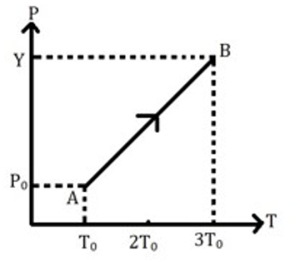
A
$\frac{3}{2} P_0$
B
$\frac{4}{3} P_0$
C
$3 P_0$
D
$4 P_0$
Solution
(D) From the ideal gas equation,$PV = nRT = \frac{m}{M} RT$,where $m$ is the mass and $M$ is the molar mass.
Since density $\varrho = \frac{m}{V}$,we can write $P = \frac{\varrho RT}{M}$,which implies $P \propto \varrho T$.
At point $A$: $P_A = P_0$,$T_A = T_0$,and $\varrho_A = \varrho_0$. Thus,$P_0 = k \cdot \varrho_0 T_0$ (where $k = \frac{R}{M}$).
At point $B$: $P_B = Y$,$T_B = 3T_0$,and $\varrho_B = \frac{4}{3} \varrho_0$.
Taking the ratio of the two equations:
$\frac{P_B}{P_A} = \frac{\varrho_B T_B}{\varrho_A T_A}$
$\frac{Y}{P_0} = \frac{(\frac{4}{3} \varrho_0) (3T_0)}{\varrho_0 T_0}$
$\frac{Y}{P_0} = \frac{4}{3} \times 3 = 4$
Therefore,$Y = 4 P_0$.
Since density $\varrho = \frac{m}{V}$,we can write $P = \frac{\varrho RT}{M}$,which implies $P \propto \varrho T$.
At point $A$: $P_A = P_0$,$T_A = T_0$,and $\varrho_A = \varrho_0$. Thus,$P_0 = k \cdot \varrho_0 T_0$ (where $k = \frac{R}{M}$).
At point $B$: $P_B = Y$,$T_B = 3T_0$,and $\varrho_B = \frac{4}{3} \varrho_0$.
Taking the ratio of the two equations:
$\frac{P_B}{P_A} = \frac{\varrho_B T_B}{\varrho_A T_A}$
$\frac{Y}{P_0} = \frac{(\frac{4}{3} \varrho_0) (3T_0)}{\varrho_0 T_0}$
$\frac{Y}{P_0} = \frac{4}{3} \times 3 = 4$
Therefore,$Y = 4 P_0$.
0 likes
View Solution330
EasyMCQ
According to Boyle's law,the product $PV$ remains constant. The unit of $PV$ is the same as that of
A
energy
B
force
C
impulse
D
momentum
Solution
(A) The units of $PV$ can be calculated as follows:
Pressure $(P)$ is defined as force per unit area,so its $SI$ unit is $N/m^2$ or $kg \cdot m^{-1} \cdot s^{-2}$.
Volume $(V)$ has the $SI$ unit of $m^3$.
Therefore,the unit of the product $PV$ is:
Unit $= (kg \cdot m^{-1} \cdot s^{-2}) \times (m^3) = kg \cdot m^2 \cdot s^{-2}$.
Since $1 \text{ Joule} = 1 \text{ kg} \cdot m^2 \cdot s^{-2}$,this unit is equivalent to the unit of energy (or work).
Pressure $(P)$ is defined as force per unit area,so its $SI$ unit is $N/m^2$ or $kg \cdot m^{-1} \cdot s^{-2}$.
Volume $(V)$ has the $SI$ unit of $m^3$.
Therefore,the unit of the product $PV$ is:
Unit $= (kg \cdot m^{-1} \cdot s^{-2}) \times (m^3) = kg \cdot m^2 \cdot s^{-2}$.
Since $1 \text{ Joule} = 1 \text{ kg} \cdot m^2 \cdot s^{-2}$,this unit is equivalent to the unit of energy (or work).
0 likes
View Solution331
EasyMCQ
Which one of the following represents correctly the variation of volume $(V)$ of an ideal gas with temperature $(T)$ under constant pressure conditions?
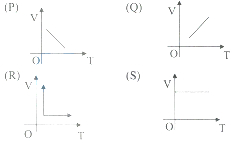
A
$P$
B
$Q$
C
$R$
D
$S$
Solution
(B) According to Charles's Law,the volume $(V)$ of a fixed mass of an ideal gas is directly proportional to its absolute temperature $(T)$ when the pressure is held constant.
Mathematically,this is expressed as $V \propto T$ or $V = kT$,where $k$ is a constant.
This relationship represents a straight line passing through the origin on a $V$ versus $T$ graph.
Among the given options,graph $Q$ shows a straight line passing through the origin,which correctly represents the variation of volume with temperature at constant pressure.
Mathematically,this is expressed as $V \propto T$ or $V = kT$,where $k$ is a constant.
This relationship represents a straight line passing through the origin on a $V$ versus $T$ graph.
Among the given options,graph $Q$ shows a straight line passing through the origin,which correctly represents the variation of volume with temperature at constant pressure.
0 likes
View Solution332
EasyMCQ
$A$ sample of oxygen gas and a sample of hydrogen gas both have the same mass,same volume,and the same pressure. The ratio of their absolute temperatures is
A
$1: 4$
B
$4: 1$
C
$1: 16$
D
$16: 1$
Solution
(D) The ideal gas equation is given by $PV = nRT$,where $n = \frac{m}{M}$.
For oxygen gas $(O_2)$: $P_1 V_1 = \frac{m_1}{M_1} RT_1$ ... $(i)$
For hydrogen gas $(H_2)$: $P_2 V_2 = \frac{m_2}{M_2} RT_2$ ... (ii)
Given that $P_1 = P_2$,$V_1 = V_2$,and $m_1 = m_2$,dividing equation $(i)$ by (ii) gives:
$\frac{P_1 V_1}{P_2 V_2} = \frac{m_1 / M_1}{m_2 / M_2} \cdot \frac{T_1}{T_2}$
$1 = \frac{M_2}{M_1} \cdot \frac{T_1}{T_2}$
$\frac{T_1}{T_2} = \frac{M_1}{M_2}$
Substituting the molar masses $M_1 (O_2) = 32 \text{ g/mol}$ and $M_2 (H_2) = 2 \text{ g/mol}$:
$\frac{T_1}{T_2} = \frac{32}{2} = \frac{16}{1}$
Therefore,the ratio of their absolute temperatures is $16: 1$.
For oxygen gas $(O_2)$: $P_1 V_1 = \frac{m_1}{M_1} RT_1$ ... $(i)$
For hydrogen gas $(H_2)$: $P_2 V_2 = \frac{m_2}{M_2} RT_2$ ... (ii)
Given that $P_1 = P_2$,$V_1 = V_2$,and $m_1 = m_2$,dividing equation $(i)$ by (ii) gives:
$\frac{P_1 V_1}{P_2 V_2} = \frac{m_1 / M_1}{m_2 / M_2} \cdot \frac{T_1}{T_2}$
$1 = \frac{M_2}{M_1} \cdot \frac{T_1}{T_2}$
$\frac{T_1}{T_2} = \frac{M_1}{M_2}$
Substituting the molar masses $M_1 (O_2) = 32 \text{ g/mol}$ and $M_2 (H_2) = 2 \text{ g/mol}$:
$\frac{T_1}{T_2} = \frac{32}{2} = \frac{16}{1}$
Therefore,the ratio of their absolute temperatures is $16: 1$.
0 likes
View Solution333
EasyMCQ
The quantity $\frac{PV}{kT}$ represents ($k=$ Boltzmann constant).
A
number of moles of gas.
B
kinetic energy of gas.
C
mass of the gas.
D
number of molecules of gas.
Solution
(D) From the ideal gas equation,we have $PV = nRT$.
Here,$n$ is the number of moles,$R$ is the universal gas constant,and $T$ is the temperature.
We know that the number of moles $n = \frac{N}{N_A}$,where $N$ is the total number of molecules and $N_A$ is Avogadro's number.
Substituting this into the ideal gas equation: $PV = \left(\frac{N}{N_A}\right) RT$.
Rearranging the terms,we get $PV = N \left(\frac{R}{N_A}\right) T$.
Since the Boltzmann constant $k = \frac{R}{N_A}$,the equation becomes $PV = NkT$.
Therefore,$\frac{PV}{kT} = N$,which represents the total number of molecules of the gas.
Here,$n$ is the number of moles,$R$ is the universal gas constant,and $T$ is the temperature.
We know that the number of moles $n = \frac{N}{N_A}$,where $N$ is the total number of molecules and $N_A$ is Avogadro's number.
Substituting this into the ideal gas equation: $PV = \left(\frac{N}{N_A}\right) RT$.
Rearranging the terms,we get $PV = N \left(\frac{R}{N_A}\right) T$.
Since the Boltzmann constant $k = \frac{R}{N_A}$,the equation becomes $PV = NkT$.
Therefore,$\frac{PV}{kT} = N$,which represents the total number of molecules of the gas.
0 likes
View Solution334
EasyMCQ
We have a sample of gas characterized by $P, V$ and $T$ and another sample of gas characterized by $2P, V/4$ and $2T$. What is the ratio of the number of molecules in the first and second samples (in $: 1$)?
A
$2$
B
$4$
C
$8$
D
$16$
Solution
(B) The ideal gas equation is given by $PV = nRT$,where $n$ is the number of moles. Since the number of molecules $N$ is proportional to the number of moles $(N = nN_A)$,the ratio of the number of molecules is equal to the ratio of the number of moles.
For the first sample: $P_1 = P, V_1 = V, T_1 = T$. Thus,$n_1 = \frac{PV}{RT}$.
For the second sample: $P_2 = 2P, V_2 = V/4, T_2 = 2T$. Thus,$n_2 = \frac{(2P)(V/4)}{R(2T)} = \frac{PV/2}{2RT} = \frac{PV}{4RT}$.
The ratio of the number of molecules is $\frac{N_1}{N_2} = \frac{n_1}{n_2} = \frac{PV/RT}{PV/4RT} = \frac{1}{1/4} = 4:1$.
For the first sample: $P_1 = P, V_1 = V, T_1 = T$. Thus,$n_1 = \frac{PV}{RT}$.
For the second sample: $P_2 = 2P, V_2 = V/4, T_2 = 2T$. Thus,$n_2 = \frac{(2P)(V/4)}{R(2T)} = \frac{PV/2}{2RT} = \frac{PV}{4RT}$.
The ratio of the number of molecules is $\frac{N_1}{N_2} = \frac{n_1}{n_2} = \frac{PV/RT}{PV/4RT} = \frac{1}{1/4} = 4:1$.
0 likes
View Solution335
MediumMCQ
The equation of state for $2 \ g$ of oxygen at a pressure $P$ and temperature $T$,when occupying a volume $V$,will be:
A
$PV = \frac{1}{16} RT$
B
$PV = RT$
C
$PV = 16 RT$
D
$PV = 2 RT$
Solution
(A) The ideal gas equation is given by $PV = \mu RT$,where $\mu$ is the number of moles of the gas.
$\mu = \frac{\text{Given mass}}{\text{Molecular mass}} = \frac{m}{M}$.
Given,$m = 2 \ g$ and for oxygen $(O_2)$,$M = 32 \ g/mol$.
Substituting these values into the ideal gas equation:
$PV = \left( \frac{2}{32} \right) RT$.
$PV = \frac{1}{16} RT$.
$\mu = \frac{\text{Given mass}}{\text{Molecular mass}} = \frac{m}{M}$.
Given,$m = 2 \ g$ and for oxygen $(O_2)$,$M = 32 \ g/mol$.
Substituting these values into the ideal gas equation:
$PV = \left( \frac{2}{32} \right) RT$.
$PV = \frac{1}{16} RT$.
0 likes
View Solution336
EasyMCQ
The average force applied on the wall of a closed container depends as $T^{x}$ where $T$ is the temperature of an ideal gas. The value of $x$ is
A
$0.5$
B
$1$
C
$2$
D
$1.5$
Solution
(B) The pressure $P$ exerted by an ideal gas on the wall of a container is defined as the force $F$ per unit area $A$,given by $P = F/A$.
Since the area $A$ of the container wall is constant,we have $P \propto F$.
From the ideal gas equation,$PV = nRT$,where $n$ is the number of moles,$R$ is the universal gas constant,$T$ is the temperature,and $V$ is the volume.
For a closed container,the volume $V$ is constant. Thus,$P = (nR/V)T$,which implies $P \propto T$.
Comparing the two relations,$F \propto P$ and $P \propto T$,we get $F \propto T^1$.
Therefore,comparing this with $F \propto T^x$,we find that $x = 1$.
Since the area $A$ of the container wall is constant,we have $P \propto F$.
From the ideal gas equation,$PV = nRT$,where $n$ is the number of moles,$R$ is the universal gas constant,$T$ is the temperature,and $V$ is the volume.
For a closed container,the volume $V$ is constant. Thus,$P = (nR/V)T$,which implies $P \propto T$.
Comparing the two relations,$F \propto P$ and $P \propto T$,we get $F \propto T^1$.
Therefore,comparing this with $F \propto T^x$,we find that $x = 1$.
0 likes
View Solution337
MediumMCQ
We have a jar filled with gas characterized by parameters $P, V, T$ and another jar $B$ filled with gas having parameters $2P, V/4, 2T$,where symbols have their usual meaning. The ratio of the number of molecules in jar $A$ to those in jar $B$ is
A
$1: 1$
B
$1: 2$
C
$2: 1$
D
$4: 1$
Solution
(D) According to the ideal gas equation,$PV = Nk_B T$,where $N$ is the number of molecules and $k_B$ is the Boltzmann constant.
For jar $A$: $PV = N_A k_B T$ --- $(i)$
For jar $B$: $(2P) \times (V/4) = N_B k_B (2T)$
Simplifying the left side: $(1/2) PV = N_B k_B (2T)$
$PV = 4 N_B k_B T$ --- $(ii)$
Equating $(i)$ and $(ii)$: $N_A k_B T = 4 N_B k_B T$
$N_A = 4 N_B$
Therefore,the ratio $N_A / N_B = 4/1$ or $4: 1$.
For jar $A$: $PV = N_A k_B T$ --- $(i)$
For jar $B$: $(2P) \times (V/4) = N_B k_B (2T)$
Simplifying the left side: $(1/2) PV = N_B k_B (2T)$
$PV = 4 N_B k_B T$ --- $(ii)$
Equating $(i)$ and $(ii)$: $N_A k_B T = 4 N_B k_B T$
$N_A = 4 N_B$
Therefore,the ratio $N_A / N_B = 4/1$ or $4: 1$.
0 likes
View Solution338
MediumMCQ
For an ideal gas,the density of the gas is $\rho_0$ when the temperature and pressure of the gas are $T_0$ and $P_0$ respectively. When the temperature of the gas is $2 T_0$,its pressure becomes $3 P_0$. The new density will be:
A
$\frac{3}{2} \rho_0$
B
$\frac{4}{3} \rho_0$
C
$\frac{3}{4} \rho_0$
D
$\frac{2}{3} \rho_0$
Solution
(A) From the ideal gas equation,$PV = nRT$,where $n = m/M$ (mass/molar mass).
Substituting $n$,we get $PV = (m/M)RT$.
Since density $\rho = m/V$,we can write $P = (\rho/M)RT$,which implies $\rho = (PM)/(RT)$.
Therefore,$\rho \propto P/T$.
Given: Initial state is $(\rho_0, P_0, T_0)$ and final state is $(\rho', 3P_0, 2T_0)$.
Using the proportionality $\rho' / \rho_0 = (P'/P_0) \times (T_0/T')$,we get:
$\rho' = \rho_0 \times (3P_0 / P_0) \times (T_0 / 2T_0)$.
$\rho' = \rho_0 \times 3 \times (1/2) = \frac{3}{2} \rho_0$.
Substituting $n$,we get $PV = (m/M)RT$.
Since density $\rho = m/V$,we can write $P = (\rho/M)RT$,which implies $\rho = (PM)/(RT)$.
Therefore,$\rho \propto P/T$.
Given: Initial state is $(\rho_0, P_0, T_0)$ and final state is $(\rho', 3P_0, 2T_0)$.
Using the proportionality $\rho' / \rho_0 = (P'/P_0) \times (T_0/T')$,we get:
$\rho' = \rho_0 \times (3P_0 / P_0) \times (T_0 / 2T_0)$.
$\rho' = \rho_0 \times 3 \times (1/2) = \frac{3}{2} \rho_0$.
0 likes
View Solution339
MediumMCQ
An ideal gas at pressure $P$ and temperature $T$ is enclosed in a vessel of volume $V$. Some gas leaks through a hole from the vessel and the pressure of the enclosed gas falls to $P^{\prime}$. Assuming that the temperature of the gas remains constant during the leakage,the number of moles of the gas that have leaked is
A
$\frac{2 V}{RT}(P-P^{\prime})$
B
$\frac{V}{RT}(P-P^{\prime})$
C
$\frac{V}{RT}(P+P^{\prime})$
D
$\frac{V}{2 RT}(P+P^{\prime})$
Solution
(B) Using the ideal gas equation $PV = nRT$,we can find the initial and final number of moles of the gas.
Initial number of moles,$n_1 = \frac{PV}{RT}$.
Final number of moles,$n_2 = \frac{P^{\prime}V}{RT}$.
The number of moles that have leaked is the difference between the initial and final moles: $\Delta n = n_1 - n_2$.
Substituting the values,$\Delta n = \frac{PV}{RT} - \frac{P^{\prime}V}{RT} = \frac{V}{RT}(P - P^{\prime})$.
Thus,the correct option is $B$.
Initial number of moles,$n_1 = \frac{PV}{RT}$.
Final number of moles,$n_2 = \frac{P^{\prime}V}{RT}$.
The number of moles that have leaked is the difference between the initial and final moles: $\Delta n = n_1 - n_2$.
Substituting the values,$\Delta n = \frac{PV}{RT} - \frac{P^{\prime}V}{RT} = \frac{V}{RT}(P - P^{\prime})$.
Thus,the correct option is $B$.
0 likes
View Solution340
EasyMCQ
$A$ tyre of a vehicle is filled with air having pressure $270 \text{ kPa}$ at $27^{\circ}C$. The air pressure in the tyre when the temperature increases to $37^{\circ}C$ is (in $\text{ kPa}$)
A
$282$
B
$270$
C
$265$
D
$279$
Solution
(D) Given: Initial pressure $P_1 = 270 \text{ kPa}$,Initial temperature $T_1 = 27^{\circ}C = 27 + 273 = 300 \text{ K}$.
Final temperature $T_2 = 37^{\circ}C = 37 + 273 = 310 \text{ K}$.
Assuming the volume of the tyre remains constant,according to Gay-Lussac's Law,$\frac{P_1}{T_1} = \frac{P_2}{T_2}$.
Substituting the values: $\frac{270}{300} = \frac{P_2}{310}$.
$P_2 = \frac{270 \times 310}{300} = 0.9 \times 310 = 279 \text{ kPa}$.
Therefore,the final pressure is $279 \text{ kPa}$.
Final temperature $T_2 = 37^{\circ}C = 37 + 273 = 310 \text{ K}$.
Assuming the volume of the tyre remains constant,according to Gay-Lussac's Law,$\frac{P_1}{T_1} = \frac{P_2}{T_2}$.
Substituting the values: $\frac{270}{300} = \frac{P_2}{310}$.
$P_2 = \frac{270 \times 310}{300} = 0.9 \times 310 = 279 \text{ kPa}$.
Therefore,the final pressure is $279 \text{ kPa}$.
0 likes
View Solution341
EasyMCQ
For an ideal gas,the density of the gas is $\varrho_0$ when temperature and pressure of the gas are $T_0$ and $P_0$ respectively. When the temperature of the gas is $2 T_0$,its pressure becomes $3 P_0$. The new density will be
A
$\frac{2}{3} \varrho_0$
B
$\frac{3}{4} \varrho_0$
C
$\frac{4}{3} \varrho_0$
D
$\frac{3}{2} \varrho_0$
Solution
(D) The ideal gas equation is given by $PV = nRT$.
Since $n = \frac{m}{M}$,where $m$ is the mass and $M$ is the molar mass,we have $PV = \frac{m}{M} RT$.
Rearranging this,we get $P = \frac{m}{V} \frac{RT}{M} = \varrho \frac{RT}{M}$,where $\varrho$ is the density.
Thus,$\varrho = \frac{PM}{RT}$.
For the initial state: $\varrho_0 = \frac{P_0 M}{R T_0}$.
For the final state: $\varrho' = \frac{P' M}{R T'} = \frac{(3 P_0) M}{R (2 T_0)}$.
Substituting $\varrho_0$ into the expression for $\varrho'$,we get $\varrho' = \frac{3}{2} \left( \frac{P_0 M}{R T_0} \right) = \frac{3}{2} \varrho_0$.
Since $n = \frac{m}{M}$,where $m$ is the mass and $M$ is the molar mass,we have $PV = \frac{m}{M} RT$.
Rearranging this,we get $P = \frac{m}{V} \frac{RT}{M} = \varrho \frac{RT}{M}$,where $\varrho$ is the density.
Thus,$\varrho = \frac{PM}{RT}$.
For the initial state: $\varrho_0 = \frac{P_0 M}{R T_0}$.
For the final state: $\varrho' = \frac{P' M}{R T'} = \frac{(3 P_0) M}{R (2 T_0)}$.
Substituting $\varrho_0$ into the expression for $\varrho'$,we get $\varrho' = \frac{3}{2} \left( \frac{P_0 M}{R T_0} \right) = \frac{3}{2} \varrho_0$.
0 likes
View Solution342
EasyMCQ
$A$ sample of oxygen gas and a sample of hydrogen gas both have the same mass,same volume,and the same pressure. The ratio of their absolute temperatures is (Molecular weights of $O_2$ and $H_2$ are $32$ and $2$ respectively).
A
$1: 4$
B
$1: 8$
C
$16: 1$
D
$12: 1$
Solution
(C) The ideal gas equation is given by $PV = nRT$,where $n = \frac{m}{M}$.
For oxygen $(O_2)$: $PV = \frac{m}{M_{O_2}} RT_{O_2}$ --- $(i)$
For hydrogen $(H_2)$: $PV = \frac{m}{M_{H_2}} RT_{H_2}$ --- $(ii)$
Since $P$,$V$,and $m$ are the same for both gases,we equate the two expressions:
$\frac{m}{M_{O_2}} RT_{O_2} = \frac{m}{M_{H_2}} RT_{H_2}$
$\frac{T_{O_2}}{M_{O_2}} = \frac{T_{H_2}}{M_{H_2}}$
$\frac{T_{O_2}}{T_{H_2}} = \frac{M_{O_2}}{M_{H_2}}$
Given $M_{O_2} = 32$ and $M_{H_2} = 2$:
$\frac{T_{O_2}}{T_{H_2}} = \frac{32}{2} = \frac{16}{1}$
Therefore,the ratio of their absolute temperatures is $16: 1$.
For oxygen $(O_2)$: $PV = \frac{m}{M_{O_2}} RT_{O_2}$ --- $(i)$
For hydrogen $(H_2)$: $PV = \frac{m}{M_{H_2}} RT_{H_2}$ --- $(ii)$
Since $P$,$V$,and $m$ are the same for both gases,we equate the two expressions:
$\frac{m}{M_{O_2}} RT_{O_2} = \frac{m}{M_{H_2}} RT_{H_2}$
$\frac{T_{O_2}}{M_{O_2}} = \frac{T_{H_2}}{M_{H_2}}$
$\frac{T_{O_2}}{T_{H_2}} = \frac{M_{O_2}}{M_{H_2}}$
Given $M_{O_2} = 32$ and $M_{H_2} = 2$:
$\frac{T_{O_2}}{T_{H_2}} = \frac{32}{2} = \frac{16}{1}$
Therefore,the ratio of their absolute temperatures is $16: 1$.
0 likes
View Solution343
EasyMCQ
$A$ gas is contained in a closed vessel. The initial temperature of the gas is $100^{\circ} C$. If the pressure of the gas is increased by $4 \%$,what is the increase in the temperature of the gas (in $^{\circ} C$)?
A
$4$
B
$14.92$
C
$15.92$
D
$10.92$
Solution
(B) Given: Initial temperature $T_1 = 100^{\circ} C = 373 \ K$. The volume is constant in a closed vessel. According to Gay-Lussac's Law,for a fixed mass of gas at constant volume,$P \propto T$.
Therefore,$\frac{P_2}{P_1} = \frac{T_2}{T_1}$.
Given that the pressure increases by $4 \%$,$P_2 = P_1 + 0.04 P_1 = 1.04 P_1$.
Substituting this into the ratio: $\frac{T_2}{T_1} = 1.04$.
$T_2 = 1.04 \times 373 \ K = 387.92 \ K$.
The increase in temperature $\Delta T = T_2 - T_1 = 387.92 \ K - 373 \ K = 14.92 \ K$.
Since a change in temperature in Kelvin is equal to a change in temperature in Celsius,$\Delta T = 14.92^{\circ} C$.
Therefore,$\frac{P_2}{P_1} = \frac{T_2}{T_1}$.
Given that the pressure increases by $4 \%$,$P_2 = P_1 + 0.04 P_1 = 1.04 P_1$.
Substituting this into the ratio: $\frac{T_2}{T_1} = 1.04$.
$T_2 = 1.04 \times 373 \ K = 387.92 \ K$.
The increase in temperature $\Delta T = T_2 - T_1 = 387.92 \ K - 373 \ K = 14.92 \ K$.
Since a change in temperature in Kelvin is equal to a change in temperature in Celsius,$\Delta T = 14.92^{\circ} C$.
0 likes
View Solution344
EasyMCQ
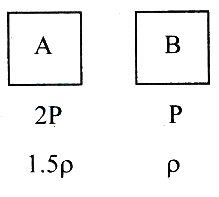
Two vessels separately contain two ideal gases $A$ and $B$ at the same temperature. The pressure of $A$ is twice that of $B$. Under these conditions,the density of $A$ is found to be $1.5$ times the density of $B$. The ratio of the molecular weights of $A$ and $B$ is:
A
$1: 2$
B
$2: 3$
C
$3: 4$
D
$2: 1$
Solution
(C) For an ideal gas,the equation of state is $PV = nRT$. Since $n = \frac{m}{M}$,we have $PV = \frac{m}{M}RT$.
Rearranging this,we get $P = \frac{m}{V} \cdot \frac{RT}{M} = \rho \frac{RT}{M}$,where $\rho$ is the density and $M$ is the molecular weight.
Thus,$M = \frac{\rho RT}{P}$.
Since the temperature $T$ is the same for both gases,we have:
$\frac{M_A}{M_B} = \frac{\rho_A}{\rho_B} \times \frac{P_B}{P_A}$
Given that $P_A = 2P_B$ and $\rho_A = 1.5\rho_B = \frac{3}{2}\rho_B$,we substitute these values:
$\frac{M_A}{M_B} = \frac{1.5\rho_B}{\rho_B} \times \frac{P_B}{2P_B} = 1.5 \times \frac{1}{2} = \frac{3}{2} \times \frac{1}{2} = \frac{3}{4}$
Therefore,the ratio of the molecular weights of $A$ and $B$ is $3: 4$.
Rearranging this,we get $P = \frac{m}{V} \cdot \frac{RT}{M} = \rho \frac{RT}{M}$,where $\rho$ is the density and $M$ is the molecular weight.
Thus,$M = \frac{\rho RT}{P}$.
Since the temperature $T$ is the same for both gases,we have:
$\frac{M_A}{M_B} = \frac{\rho_A}{\rho_B} \times \frac{P_B}{P_A}$
Given that $P_A = 2P_B$ and $\rho_A = 1.5\rho_B = \frac{3}{2}\rho_B$,we substitute these values:
$\frac{M_A}{M_B} = \frac{1.5\rho_B}{\rho_B} \times \frac{P_B}{2P_B} = 1.5 \times \frac{1}{2} = \frac{3}{2} \times \frac{1}{2} = \frac{3}{4}$
Therefore,the ratio of the molecular weights of $A$ and $B$ is $3: 4$.
0 likes
View Solution345
EasyMCQ
Temperature remaining constant,the pressure of a gas is decreased by $20 \%$. What is the percentage change in volume?
A
increases by $29 \%$
B
decreases by $20 \%$
C
increases by $25 \%$
D
decreases by $25 \%$
Solution
(C) Since the temperature is constant,we use Boyle's Law: $P_1 V_1 = P_2 V_2$.
Let the initial pressure be $P$ and initial volume be $V$.
The pressure is decreased by $20 \%$,so the new pressure $P_2 = P - 0.20P = 0.80P$.
Substituting into the equation: $P \times V = 0.80P \times V_2$.
Solving for $V_2$: $V_2 = \frac{V}{0.80} = 1.25V$.
The change in volume is $\Delta V = V_2 - V = 1.25V - V = 0.25V$.
The percentage change in volume is $\frac{\Delta V}{V} \times 100 = 0.25 \times 100 = 25 \%$.
Since the result is positive,the volume increases by $25 \%$.
Let the initial pressure be $P$ and initial volume be $V$.
The pressure is decreased by $20 \%$,so the new pressure $P_2 = P - 0.20P = 0.80P$.
Substituting into the equation: $P \times V = 0.80P \times V_2$.
Solving for $V_2$: $V_2 = \frac{V}{0.80} = 1.25V$.
The change in volume is $\Delta V = V_2 - V = 1.25V - V = 0.25V$.
The percentage change in volume is $\frac{\Delta V}{V} \times 100 = 0.25 \times 100 = 25 \%$.
Since the result is positive,the volume increases by $25 \%$.
0 likes
View Solution346
DifficultMCQ
$A$ jar $P$ is filled with a gas having pressure,volume,and temperature $P, V, T$ respectively. Another gas jar $Q$ is filled with a gas having pressure $2P$,volume $\frac{V}{4}$,and temperature $2T$. The ratio of the number of molecules in jar $P$ to those in jar $Q$ is:
A
$1:1$
B
$1:2$
C
$2:1$
D
$4:1$
Solution
(D) According to the ideal gas equation,$PV = Nk_B T$,where $N$ is the number of molecules and $k_B$ is the Boltzmann constant.
For jar $P$,the equation is: $PV = N_P k_B T$ ... $(i)$
For jar $Q$,the equation is: $(2P) \left( \frac{V}{4} \right) = N_Q k_B (2T)$
Simplifying the left side: $\frac{PV}{2} = N_Q k_B (2T)$
$\Rightarrow PV = 4 N_Q k_B T$ ... $(ii)$
Comparing equations $(i)$ and $(ii)$:
$N_P k_B T = 4 N_Q k_B T$
$N_P = 4 N_Q$
Therefore,the ratio of the number of molecules in jar $P$ to those in jar $Q$ is $\frac{N_P}{N_Q} = 4:1$.
For jar $P$,the equation is: $PV = N_P k_B T$ ... $(i)$
For jar $Q$,the equation is: $(2P) \left( \frac{V}{4} \right) = N_Q k_B (2T)$
Simplifying the left side: $\frac{PV}{2} = N_Q k_B (2T)$
$\Rightarrow PV = 4 N_Q k_B T$ ... $(ii)$
Comparing equations $(i)$ and $(ii)$:
$N_P k_B T = 4 N_Q k_B T$
$N_P = 4 N_Q$
Therefore,the ratio of the number of molecules in jar $P$ to those in jar $Q$ is $\frac{N_P}{N_Q} = 4:1$.
0 likes
View Solution347
DifficultMCQ
At constant temperature,increasing the pressure of a gas by $5 \%$ its volume will decrease by (in $\%$)
A
$5$
B
$5.26$
C
$4.20$
D
$4.76$
Solution
(D) According to Boyle's Law at constant temperature,$P \propto \frac{1}{V}$,which implies $P_1 V_1 = P_2 V_2$.
Let the initial pressure be $P_1 = P$.
The new pressure is $P_2 = P + 0.05P = 1.05P$.
Substituting these into the equation: $P V_1 = 1.05P V_2$.
Solving for the new volume: $V_2 = \frac{V_1}{1.05} \approx 0.9524 V_1$.
The change in volume is $\Delta V = V_2 - V_1 = 0.9524 V_1 - V_1 = -0.0476 V_1$.
The percentage decrease in volume is $\frac{|\Delta V|}{V_1} \times 100 = 0.0476 \times 100 = 4.76 \%$.
Let the initial pressure be $P_1 = P$.
The new pressure is $P_2 = P + 0.05P = 1.05P$.
Substituting these into the equation: $P V_1 = 1.05P V_2$.
Solving for the new volume: $V_2 = \frac{V_1}{1.05} \approx 0.9524 V_1$.
The change in volume is $\Delta V = V_2 - V_1 = 0.9524 V_1 - V_1 = -0.0476 V_1$.
The percentage decrease in volume is $\frac{|\Delta V|}{V_1} \times 100 = 0.0476 \times 100 = 4.76 \%$.
0 likes
View Solution348
EasyMCQ
$A$ container $A$ contains an ideal gas at pressure $P$,volume $V$,and temperature $T$. $A$ second container $B$ contains the same gas at pressure $2P$,volume $2V$,and temperature $\frac{T}{2}$. The ratio of the mass of gas in $A$ to that in $B$ is:
A
$1: 4$
B
$1: 8$
C
$1: 1$
D
$1: 2$
Solution
(B) The ideal gas equation is given by $PV = nRT$,where $n = \frac{m}{M}$.
Thus,$PV = \frac{m}{M}RT$,which implies $m = \frac{PVM}{RT}$.
For container $A$:
$m_A = \frac{PVM}{RT} \quad (1)$
For container $B$:
$m_B = \frac{(2P)(2V)M}{R(T/2)} = \frac{4PVM}{RT/2} = \frac{8PVM}{RT} \quad (2)$
Taking the ratio of $m_A$ to $m_B$:
$\frac{m_A}{m_B} = \frac{PVM/RT}{8PVM/RT} = \frac{1}{8}$.
Therefore,the ratio is $1: 8$.
Thus,$PV = \frac{m}{M}RT$,which implies $m = \frac{PVM}{RT}$.
For container $A$:
$m_A = \frac{PVM}{RT} \quad (1)$
For container $B$:
$m_B = \frac{(2P)(2V)M}{R(T/2)} = \frac{4PVM}{RT/2} = \frac{8PVM}{RT} \quad (2)$
Taking the ratio of $m_A$ to $m_B$:
$\frac{m_A}{m_B} = \frac{PVM/RT}{8PVM/RT} = \frac{1}{8}$.
Therefore,the ratio is $1: 8$.
0 likes
View Solution349
EasyMCQ
At constant temperature, the pressure of a gas is decreased by $20 \%$. What is the percentage change in volume?
A
increase by $29 \%$
B
decreases by $25 \%$
C
increases by $25 \%$
D
decreases by $20 \%$
Solution
(C) According to Boyle's Law, at constant temperature, $PV = \text{constant}$.
Let the initial pressure be $P_1 = P$ and the initial volume be $V_1 = V$.
If the pressure is decreased by $20 \%$, the new pressure $P_2$ is $P - 0.20P = 0.8P$.
Using the relation $P_1 V_1 = P_2 V_2$:
$P \cdot V = (0.8P) \cdot V_2$
$V_2 = \frac{PV}{0.8P} = \frac{V}{0.8} = 1.25V$.
The change in volume is $\Delta V = V_2 - V_1 = 1.25V - V = 0.25V$.
The percentage change in volume is $\frac{\Delta V}{V_1} \times 100 = \frac{0.25V}{V} \times 100 = 25 \%$.
Since the value is positive, the volume increases by $25 \%$.
Let the initial pressure be $P_1 = P$ and the initial volume be $V_1 = V$.
If the pressure is decreased by $20 \%$, the new pressure $P_2$ is $P - 0.20P = 0.8P$.
Using the relation $P_1 V_1 = P_2 V_2$:
$P \cdot V = (0.8P) \cdot V_2$
$V_2 = \frac{PV}{0.8P} = \frac{V}{0.8} = 1.25V$.
The change in volume is $\Delta V = V_2 - V_1 = 1.25V - V = 0.25V$.
The percentage change in volume is $\frac{\Delta V}{V_1} \times 100 = \frac{0.25V}{V} \times 100 = 25 \%$.
Since the value is positive, the volume increases by $25 \%$.
0 likes
View Solution350
MediumMCQ
$A$ vessel is filled with an ideal gas at a pressure of $10 \text{ atm}$ and temperature $27^{\circ} C$. Half of the mass is removed from the vessel and the temperature of the remaining gas is increased to $87^{\circ} C$. Then the pressure of the gas in the vessel will be (in $\text{ atm}$)
A
$5$
B
$6$
C
$7$
D
$8$
Solution
(B) The ideal gas equation is given by $PV = nRT$,where $n = \frac{m}{M}$.
Thus,$\frac{PV}{T} = \frac{m}{M}R$.
Initially,$P_1 = 10 \text{ atm}$,$T_1 = 27 + 273 = 300 \text{ K}$,and mass is $m$.
So,$\frac{10V}{300} = \frac{m}{M}R \implies \frac{m}{M}R = \frac{10V}{300} = \frac{V}{30}$.
After removing half the mass,the new mass is $m' = \frac{m}{2}$.
The new temperature is $T_2 = 87 + 273 = 360 \text{ K}$.
Using the gas equation for the final state: $P_2 V = n' R T_2 = \frac{m}{2M} R T_2$.
Substituting $\frac{m}{M}R = \frac{V}{30}$:
$P_2 V = \frac{1}{2} \left( \frac{V}{30} \right) \times 360$.
$P_2 = \frac{360}{60} = 6 \text{ atm}$.
Thus,$\frac{PV}{T} = \frac{m}{M}R$.
Initially,$P_1 = 10 \text{ atm}$,$T_1 = 27 + 273 = 300 \text{ K}$,and mass is $m$.
So,$\frac{10V}{300} = \frac{m}{M}R \implies \frac{m}{M}R = \frac{10V}{300} = \frac{V}{30}$.
After removing half the mass,the new mass is $m' = \frac{m}{2}$.
The new temperature is $T_2 = 87 + 273 = 360 \text{ K}$.
Using the gas equation for the final state: $P_2 V = n' R T_2 = \frac{m}{2M} R T_2$.
Substituting $\frac{m}{M}R = \frac{V}{30}$:
$P_2 V = \frac{1}{2} \left( \frac{V}{30} \right) \times 360$.
$P_2 = \frac{360}{60} = 6 \text{ atm}$.
0 likes
View SolutionKinetic Theory of Gases — Gas Laws (Charles, Boyle's, Avagadro's, Gay Lussacs and Dalton's law) and Ideal gas Equation · Frequently Asked Questions
1Are these Kinetic Theory of Gases questions useful for JEE and NEET?
Yes. All questions in this section are mapped to JEE Main and NEET exam patterns. Previous year questions from JEE Main, NEET, GUJCET and state-level exams are included with full solutions.
2Can I switch to Hindi or Gujarati for these questions?
Yes. Use the language tabs in the hero section or the sidebar to view the same questions and solutions in English, Hindi or Gujarati.
3How do I generate a question paper from this subtopic?
Use the Vedclass Exam Paper Generator — select the chapter and subtopic, set difficulty, and generate Sets A, B, C, D automatically. First 3 chapters of every subject are free.
Vedclass Products
For Students
Vedclass Test Series
Mock tests in real JEE/NEET style with performance analysis. 5-day free trial.
Start Free TrialFor Teachers
Exam Paper Generator
Generate Set A/B/C/D papers from this chapter in 2 minutes. 3 chapters free.
Try FreeFor Institutes
Online Exam Module
Live online exams with unlimited students, 360° analytics & white-label branding.
See DemoFor Teachers & Institutes
Generate a Kinetic Theory of Gases Exam Paper in 2 Minutes
Select subtopic & difficulty — Sets A, B, C, D auto-generated with No Repeat logic.
First 3 chapters of every subject are free — no payment required.