
A English
Escape Velocity and Escape Energy Questions in English
Class 11 Physics · Gravitation · Escape Velocity and Escape Energy
234+
Questions
English
Language
100%
With Solutions
Showing 50 of 234 questions in English
51
MediumMCQ
There are two planets. The ratio of the radii of the two planets is $K$,and the ratio of the acceleration due to gravity of both planets is $g$. What will be the ratio of their escape velocities?
A
$(Kg)^{1/2}$
B
$(Kg)^{-1/2}$
C
$(Kg)^2$
D
$(Kg)^{-2}$
Solution
(A) The formula for escape velocity is $v = \sqrt{2gR}$.
Given the ratio of radii $\frac{R_1}{R_2} = K$ and the ratio of acceleration due to gravity $\frac{g_1}{g_2} = g$.
The ratio of their escape velocities is $\frac{v_1}{v_2} = \sqrt{\frac{g_1}{g_2} \times \frac{R_1}{R_2}}$.
Substituting the given values,we get $\frac{v_1}{v_2} = \sqrt{g \times K} = (Kg)^{1/2}$.
Given the ratio of radii $\frac{R_1}{R_2} = K$ and the ratio of acceleration due to gravity $\frac{g_1}{g_2} = g$.
The ratio of their escape velocities is $\frac{v_1}{v_2} = \sqrt{\frac{g_1}{g_2} \times \frac{R_1}{R_2}}$.
Substituting the given values,we get $\frac{v_1}{v_2} = \sqrt{g \times K} = (Kg)^{1/2}$.
0 likes
View Solution52
MediumMCQ
If ${v_e}$ and ${v_o}$ represent the escape velocity and orbital velocity of a satellite corresponding to a circular orbit of radius $R$,then
A
${v_e} = {v_o}$
B
$\sqrt{2} {v_o} = {v_e}$
C
${v_e} = \frac{{v_o}}{\sqrt{2}}$
D
${v_e}$ and ${v_o}$ are not related
Solution
(B) The escape velocity of a body from the surface of the Earth is given by the formula: ${v_e} = \sqrt{\frac{2GM}{R}} = \sqrt{2gR}$.
The orbital velocity of a satellite in a circular orbit of radius $R$ is given by the formula: ${v_o} = \sqrt{\frac{GM}{R}} = \sqrt{gR}$.
By comparing the two expressions,we can see that:
${v_e} = \sqrt{2} \times \sqrt{gR}$
${v_e} = \sqrt{2} {v_o}$.
Therefore,the correct relation is $\sqrt{2} {v_o} = {v_e}$.
The orbital velocity of a satellite in a circular orbit of radius $R$ is given by the formula: ${v_o} = \sqrt{\frac{GM}{R}} = \sqrt{gR}$.
By comparing the two expressions,we can see that:
${v_e} = \sqrt{2} \times \sqrt{gR}$
${v_e} = \sqrt{2} {v_o}$.
Therefore,the correct relation is $\sqrt{2} {v_o} = {v_e}$.
0 likes
View Solution53
EasyMCQ
For a satellite,the escape velocity is $11 \ km/s$. If the satellite is launched at an angle of $60^\circ$ with the vertical,then the escape velocity will be ........... $km/s$.
A
$11$
B
$11\sqrt{3}$
C
$\frac{11}{\sqrt{3}}$
D
$33$
Solution
(A) The escape velocity of a body from the surface of a planet is given by the formula $v_e = \sqrt{\frac{2GM}{R}}$.
This expression depends only on the mass of the planet $(M)$ and the radius of the planet $(R)$.
It is independent of the mass of the object being launched and the angle of projection.
Therefore,regardless of the angle at which the satellite is launched,the escape velocity remains constant at $11 \ km/s$.
This expression depends only on the mass of the planet $(M)$ and the radius of the planet $(R)$.
It is independent of the mass of the object being launched and the angle of projection.
Therefore,regardless of the angle at which the satellite is launched,the escape velocity remains constant at $11 \ km/s$.
0 likes
View Solution54
EasyMCQ
$A$ satellite with kinetic energy $E_k$ is revolving around the Earth in a circular orbit. How much more kinetic energy should be given to it so that it may just escape into outer space?
A
$E_k$
B
$2E_k$
C
$\frac{1}{2}E_k$
D
$3E_k$
Solution
(A) For a satellite in a circular orbit of radius $r$ around the Earth of mass $M$,the gravitational potential energy is $U = -\frac{GMm}{r}$ and the kinetic energy is $E_k = \frac{GMm}{2r}$.
The total mechanical energy of the satellite is $E = E_k + U = \frac{GMm}{2r} - \frac{GMm}{r} = -\frac{GMm}{2r} = -E_k$.
To escape into outer space,the total energy of the satellite must become at least $0$.
Let the additional kinetic energy required be $\Delta E$. Then,$E + \Delta E = 0$.
Substituting the value of $E$,we get $-E_k + \Delta E = 0$,which implies $\Delta E = E_k$.
Therefore,an additional kinetic energy equal to $E_k$ must be provided to the satellite.
The total mechanical energy of the satellite is $E = E_k + U = \frac{GMm}{2r} - \frac{GMm}{r} = -\frac{GMm}{2r} = -E_k$.
To escape into outer space,the total energy of the satellite must become at least $0$.
Let the additional kinetic energy required be $\Delta E$. Then,$E + \Delta E = 0$.
Substituting the value of $E$,we get $-E_k + \Delta E = 0$,which implies $\Delta E = E_k$.
Therefore,an additional kinetic energy equal to $E_k$ must be provided to the satellite.
0 likes
View Solution55
MediumMCQ
The condition for a uniform spherical mass $m$ of radius $r$ to be a black hole is [$G=$ gravitational constant and $c=$ speed of light]
A
$(2Gm/r)^{1/2} \le c$
B
$(2Gm/r)^{1/2} = c$
C
$(2Gm/r)^{1/2} \ge c$
D
$(Gm/r)^{1/2} \ge c$
Solution
(C) The escape velocity $v_e$ from the surface of a spherical mass $m$ of radius $r$ is given by the formula: $v_e = \sqrt{\frac{2Gm}{r}}$.
For an object to be a black hole,not even light can escape its gravitational pull.
Therefore,the escape velocity must be greater than or equal to the speed of light $c$.
Thus,the condition is $\sqrt{\frac{2Gm}{r}} \ge c$ or $(2Gm/r)^{1/2} \ge c$.
For an object to be a black hole,not even light can escape its gravitational pull.
Therefore,the escape velocity must be greater than or equal to the speed of light $c$.
Thus,the condition is $\sqrt{\frac{2Gm}{r}} \ge c$ or $(2Gm/r)^{1/2} \ge c$.
0 likes
View Solution56
DifficultMCQ
$A$ projectile is projected with velocity $k{v_e}$ in the vertically upward direction from the ground into space. (${v_e}$ is the escape velocity and $k < 1$). If air resistance is considered to be negligible,then the maximum height from the center of the Earth to which it can go will be: ($R$ = radius of Earth)
A
$\frac{R}{k^2 + 1}$
B
$\frac{R}{k^2 - 1}$
C
$\frac{R}{1 - k^2}$
D
$\frac{R}{k + 1}$
Solution
(C) According to the law of conservation of energy,the total energy at the surface of the Earth is equal to the total energy at the maximum height $h$ from the surface.
Total energy at surface = $-\frac{GMm}{R} + \frac{1}{2}m(kv_e)^2$
Total energy at maximum height = $-\frac{GMm}{R+h} + 0$
Since $v_e = \sqrt{\frac{2GM}{R}}$,we have $v_e^2 = \frac{2GM}{R}$.
Equating the energies: $-\frac{GMm}{R} + \frac{1}{2}m k^2 \left(\frac{2GM}{R}\right) = -\frac{GMm}{R+h}$
Dividing by $GMm$: $-\frac{1}{R} + \frac{k^2}{R} = -\frac{1}{R+h}$
$\frac{k^2 - 1}{R} = -\frac{1}{R+h} \implies \frac{1 - k^2}{R} = \frac{1}{R+h}$
$R+h = \frac{R}{1 - k^2}$
Thus,the distance from the center of the Earth is $r = R+h = \frac{R}{1 - k^2}$.
Total energy at surface = $-\frac{GMm}{R} + \frac{1}{2}m(kv_e)^2$
Total energy at maximum height = $-\frac{GMm}{R+h} + 0$
Since $v_e = \sqrt{\frac{2GM}{R}}$,we have $v_e^2 = \frac{2GM}{R}$.
Equating the energies: $-\frac{GMm}{R} + \frac{1}{2}m k^2 \left(\frac{2GM}{R}\right) = -\frac{GMm}{R+h}$
Dividing by $GMm$: $-\frac{1}{R} + \frac{k^2}{R} = -\frac{1}{R+h}$
$\frac{k^2 - 1}{R} = -\frac{1}{R+h} \implies \frac{1 - k^2}{R} = \frac{1}{R+h}$
$R+h = \frac{R}{1 - k^2}$
Thus,the distance from the center of the Earth is $r = R+h = \frac{R}{1 - k^2}$.
0 likes
View Solution57
EasyMCQ
There is no atmosphere on the moon because
A
There is no vegetation
B
The escape velocity at its surface is very low
C
Diffusion constant of gases is high
D
There is vacuum in space
Solution
(B) The atmosphere of a planet or moon is retained due to its gravitational pull. For a gas molecule to be retained,its root mean square velocity $(v_{rms})$ must be significantly less than the escape velocity $(v_e)$ of the celestial body. On the moon,the acceleration due to gravity is very low,which results in a very low escape velocity (approximately $2.38 \ km/s$). The thermal velocity of gas molecules at the moon's surface temperature is higher than this escape velocity. Consequently,gas molecules escape into space,preventing the formation of an atmosphere. Therefore,the correct option is $B$.
0 likes
View Solution58
DifficultMCQ
$A$ boy can jump to a height $h$ on the surface of a planet. If the density of the planet is $d$,what should be its radius $R$ so that the boy can escape from the gravitational pull of the planet?
A
$[\frac{4\pi}{3} \frac{Gd}{gh}]^{1/2}$
B
$[\frac{4\pi}{3} \frac{gh}{Gd}]^{1/2}$
C
$[\frac{3}{4\pi} \frac{gh}{Gd}]^{1/2}$
D
$[\frac{3}{4\pi} \frac{Gd}{gh}]^{1/2}$
Solution
(C) The velocity $v$ required to jump to a height $h$ is given by $v = \sqrt{2gh}$.
To escape the gravitational pull,the boy's jump velocity must be equal to the escape velocity $v_e$ of the planet.
The escape velocity is given by $v_e = \sqrt{\frac{2GM}{R}}$.
Substituting the mass $M = \frac{4}{3}\pi R^3 d$,we get $v_e = \sqrt{\frac{2G}{R} \cdot \frac{4}{3}\pi R^3 d} = \sqrt{\frac{8}{3}\pi G R^2 d} = R \sqrt{\frac{8}{3}\pi Gd}$.
Equating $v = v_e$,we have $\sqrt{2gh} = R \sqrt{\frac{8}{3}\pi Gd}$.
Squaring both sides: $2gh = R^2 (\frac{8}{3}\pi Gd)$.
Solving for $R^2$: $R^2 = \frac{2gh \cdot 3}{8\pi Gd} = \frac{3gh}{4\pi Gd}$.
Therefore,$R = [\frac{3}{4\pi} \frac{gh}{Gd}]^{1/2}$.
To escape the gravitational pull,the boy's jump velocity must be equal to the escape velocity $v_e$ of the planet.
The escape velocity is given by $v_e = \sqrt{\frac{2GM}{R}}$.
Substituting the mass $M = \frac{4}{3}\pi R^3 d$,we get $v_e = \sqrt{\frac{2G}{R} \cdot \frac{4}{3}\pi R^3 d} = \sqrt{\frac{8}{3}\pi G R^2 d} = R \sqrt{\frac{8}{3}\pi Gd}$.
Equating $v = v_e$,we have $\sqrt{2gh} = R \sqrt{\frac{8}{3}\pi Gd}$.
Squaring both sides: $2gh = R^2 (\frac{8}{3}\pi Gd)$.
Solving for $R^2$: $R^2 = \frac{2gh \cdot 3}{8\pi Gd} = \frac{3gh}{4\pi Gd}$.
Therefore,$R = [\frac{3}{4\pi} \frac{gh}{Gd}]^{1/2}$.
0 likes
View Solution59
MediumMCQ
The escape velocity of a body projected vertically from the surface of the Earth is $11 \, km/s$. If the body is projected at an angle of $60^\circ$ with the vertical,the escape velocity will be ......... $km/s$.
A
$11$
B
$11\sqrt{3}$
C
$11/\sqrt{3}$
D
$33$
Solution
(A) The escape velocity of a body from the surface of the Earth is given by the formula $v_e = \sqrt{\frac{2GM}{R}}$.
This expression shows that the escape velocity depends only on the mass of the planet $(M)$ and the radius of the planet $(R)$.
It is independent of the angle of projection or the mass of the body being projected.
Therefore,even if the body is projected at an angle of $60^\circ$ with the vertical,the escape velocity remains the same as the vertical escape velocity.
Thus,the escape velocity is $11 \, km/s$.
This expression shows that the escape velocity depends only on the mass of the planet $(M)$ and the radius of the planet $(R)$.
It is independent of the angle of projection or the mass of the body being projected.
Therefore,even if the body is projected at an angle of $60^\circ$ with the vertical,the escape velocity remains the same as the vertical escape velocity.
Thus,the escape velocity is $11 \, km/s$.
0 likes
View Solution60
MediumMCQ
The escape velocity for the Earth is $11 \ km/s$. The escape velocity for a planet having twice the radius and the same density as the Earth is .......... $km/s$.
A
$22$
B
$11$
C
$5.5$
D
$15.5$
Solution
(A) The formula for escape velocity is given by $v_e = \sqrt{\frac{2GM}{R}}$.
Since $M = \rho V = \rho (\frac{4}{3}\pi R^3)$,we substitute this into the formula:
$v_e = \sqrt{\frac{2G(\frac{4}{3}\pi \rho R^3)}{R}} = \sqrt{\frac{8}{3}\pi \rho G R^2} = R \sqrt{\frac{8}{3}\pi \rho G}$.
Given that the density $\rho$ is the same,we have $v_e \propto R$.
Let $v_{e1} = 11 \ km/s$ and $R_1 = R$. For the new planet,$R_2 = 2R$.
Therefore,$\frac{v_{e2}}{v_{e1}} = \frac{R_2}{R_1} = \frac{2R}{R} = 2$.
$v_{e2} = 2 \times v_{e1} = 2 \times 11 \ km/s = 22 \ km/s$.
Since $M = \rho V = \rho (\frac{4}{3}\pi R^3)$,we substitute this into the formula:
$v_e = \sqrt{\frac{2G(\frac{4}{3}\pi \rho R^3)}{R}} = \sqrt{\frac{8}{3}\pi \rho G R^2} = R \sqrt{\frac{8}{3}\pi \rho G}$.
Given that the density $\rho$ is the same,we have $v_e \propto R$.
Let $v_{e1} = 11 \ km/s$ and $R_1 = R$. For the new planet,$R_2 = 2R$.
Therefore,$\frac{v_{e2}}{v_{e1}} = \frac{R_2}{R_1} = \frac{2R}{R} = 2$.
$v_{e2} = 2 \times v_{e1} = 2 \times 11 \ km/s = 22 \ km/s$.
0 likes
View Solution61
DifficultMCQ
$A$ body is projected vertically upwards from the surface of the earth with a speed of $k{v_e}$,where $k < 1$ and ${v_e}$ is the escape velocity of the earth. What is the maximum height from the center of the earth that the body will reach? (Given: $R$ is the radius of the earth)
A
$\frac{R}{{{k^2} + 1}}$
B
$\frac{R}{{{k^2} - 1}}$
C
$\frac{R}{{1 - {k^2}}}$
D
$\frac{R}{{1 + k}}$
Solution
(C) According to the law of conservation of energy,the total energy at the surface equals the total energy at the maximum height $h$ from the surface.
Initial energy at surface: $E_i = -\frac{GMm}{R} + \frac{1}{2}m(k{v_e})^2$
Final energy at maximum height: $E_f = -\frac{GMm}{R+h}$
Since ${v_e} = \sqrt{\frac{2GM}{R}}$,we have ${v_e}^2 = \frac{2GM}{R}$.
Setting $E_i = E_f$:
$-\frac{GMm}{R} + \frac{1}{2}m k^2 \left(\frac{2GM}{R}\right) = -\frac{GMm}{R+h}$
$-\frac{GMm}{R} + \frac{GMm k^2}{R} = -\frac{GMm}{R+h}$
$-\frac{1}{R}(1 - k^2) = -\frac{1}{R+h}$
$R+h = \frac{R}{1-k^2}$
Thus,the maximum distance from the center of the earth is $r = R+h = \frac{R}{1-k^2}$.
Initial energy at surface: $E_i = -\frac{GMm}{R} + \frac{1}{2}m(k{v_e})^2$
Final energy at maximum height: $E_f = -\frac{GMm}{R+h}$
Since ${v_e} = \sqrt{\frac{2GM}{R}}$,we have ${v_e}^2 = \frac{2GM}{R}$.
Setting $E_i = E_f$:
$-\frac{GMm}{R} + \frac{1}{2}m k^2 \left(\frac{2GM}{R}\right) = -\frac{GMm}{R+h}$
$-\frac{GMm}{R} + \frac{GMm k^2}{R} = -\frac{GMm}{R+h}$
$-\frac{1}{R}(1 - k^2) = -\frac{1}{R+h}$
$R+h = \frac{R}{1-k^2}$
Thus,the maximum distance from the center of the earth is $r = R+h = \frac{R}{1-k^2}$.
0 likes
View Solution62
MediumMCQ
What is the escape energy of an object of mass $m$ at a height of $4R_e$ from the surface of the Earth? ($R_e$ = radius of the Earth)
A
$mgR_e$
B
$2mgR_e$
C
$\frac{mgR_e}{5}$
D
$\frac{mgR_e}{16}$
Solution
(C) The gravitational potential energy $U$ of an object of mass $m$ at a height $h$ above the Earth's surface is given by $U = -\frac{GMm}{R_e + h}$.
Since $g = \frac{GM}{R_e^2}$,we have $GM = gR_e^2$.
Substituting this into the potential energy formula: $U = -\frac{gR_e^2 m}{R_e + h} = -\frac{mgR_e}{1 + h/R_e}$.
Given $h = 4R_e$,the potential energy is $U = -\frac{mgR_e}{1 + 4} = -\frac{mgR_e}{5}$.
The escape energy is the energy required to bring the object to infinity (where potential energy is $0$),which is $E = 0 - U = \frac{mgR_e}{5}$.
Since $g = \frac{GM}{R_e^2}$,we have $GM = gR_e^2$.
Substituting this into the potential energy formula: $U = -\frac{gR_e^2 m}{R_e + h} = -\frac{mgR_e}{1 + h/R_e}$.
Given $h = 4R_e$,the potential energy is $U = -\frac{mgR_e}{1 + 4} = -\frac{mgR_e}{5}$.
The escape energy is the energy required to bring the object to infinity (where potential energy is $0$),which is $E = 0 - U = \frac{mgR_e}{5}$.
0 likes
View Solution63
DifficultMCQ
The escape velocity for a planet is $v_e$. $A$ tunnel is dug along a diameter of the planet and a small body is dropped into it at the surface. When the body reaches the centre of the planet,its speed will be
A
$v_e$
B
$\frac{v_e}{\sqrt{2}}$
C
$\frac{v_e}{2}$
D
$0$
Solution
(B) The gravitational potential at the surface of the planet is $V_s = -\frac{GM}{R}$.
The gravitational potential at the center of the planet is $V_c = -\frac{3GM}{2R}$.
Using the law of conservation of energy,the kinetic energy gained by the body equals the loss in potential energy: $\frac{1}{2}mv^2 = m(V_s - V_c)$.
Substituting the values: $\frac{1}{2}mv^2 = m\left(-\frac{GM}{R} - (-\frac{3GM}{2R})\right)$.
$\frac{1}{2}v^2 = \frac{3GM}{2R} - \frac{GM}{R} = \frac{GM}{2R}$.
$v^2 = \frac{GM}{R}$.
Since the escape velocity is $v_e = \sqrt{\frac{2GM}{R}}$,we have $v_e^2 = \frac{2GM}{R}$,which implies $\frac{GM}{R} = \frac{v_e^2}{2}$.
Therefore,$v^2 = \frac{v_e^2}{2}$,which gives $v = \frac{v_e}{\sqrt{2}}$.
The gravitational potential at the center of the planet is $V_c = -\frac{3GM}{2R}$.
Using the law of conservation of energy,the kinetic energy gained by the body equals the loss in potential energy: $\frac{1}{2}mv^2 = m(V_s - V_c)$.
Substituting the values: $\frac{1}{2}mv^2 = m\left(-\frac{GM}{R} - (-\frac{3GM}{2R})\right)$.
$\frac{1}{2}v^2 = \frac{3GM}{2R} - \frac{GM}{R} = \frac{GM}{2R}$.
$v^2 = \frac{GM}{R}$.
Since the escape velocity is $v_e = \sqrt{\frac{2GM}{R}}$,we have $v_e^2 = \frac{2GM}{R}$,which implies $\frac{GM}{R} = \frac{v_e^2}{2}$.
Therefore,$v^2 = \frac{v_e^2}{2}$,which gives $v = \frac{v_e}{\sqrt{2}}$.
0 likes
View Solution64
MediumMCQ
The Earth is assumed to be a sphere of radius $R$. $A$ platform is arranged at a height $R$ from the surface of the Earth. The escape velocity of a body from this platform is $fv$,where $v$ is its escape velocity from the surface of the Earth. The value of $f$ is
A
$\frac{1}{2}$
B
$\sqrt{2}$
C
$\frac{1}{\sqrt{2}}$
D
$\frac{1}{3}$
Solution
(C) The escape velocity from the surface of the Earth is given by $v = \sqrt{\frac{2GM}{R}} = \sqrt{2gR}$.
For a body at a height $h = R$ from the surface,the distance from the center of the Earth is $r = R + h = 2R$.
The total energy required to escape from this distance must be zero:
$-\frac{GMm}{2R} + \frac{1}{2}m(fv)^2 = 0$.
Solving for the escape velocity at height $R$ $(v')$:
$\frac{1}{2}m(v')^2 = \frac{GMm}{2R} \Rightarrow v' = \sqrt{\frac{GM}{R}}$.
Since $v = \sqrt{\frac{2GM}{R}}$,we can write $v' = \frac{1}{\sqrt{2}} \sqrt{\frac{2GM}{R}} = \frac{v}{\sqrt{2}}$.
Given that the escape velocity from the platform is $fv$,we have $fv = \frac{v}{\sqrt{2}}$.
Therefore,$f = \frac{1}{\sqrt{2}}$.
For a body at a height $h = R$ from the surface,the distance from the center of the Earth is $r = R + h = 2R$.
The total energy required to escape from this distance must be zero:
$-\frac{GMm}{2R} + \frac{1}{2}m(fv)^2 = 0$.
Solving for the escape velocity at height $R$ $(v')$:
$\frac{1}{2}m(v')^2 = \frac{GMm}{2R} \Rightarrow v' = \sqrt{\frac{GM}{R}}$.
Since $v = \sqrt{\frac{2GM}{R}}$,we can write $v' = \frac{1}{\sqrt{2}} \sqrt{\frac{2GM}{R}} = \frac{v}{\sqrt{2}}$.
Given that the escape velocity from the platform is $fv$,we have $fv = \frac{v}{\sqrt{2}}$.
Therefore,$f = \frac{1}{\sqrt{2}}$.
0 likes
View Solution65
MediumMCQ
$A$ particle of mass $m$ is thrown upwards from the surface of the earth with a velocity $u$. The mass and the radius of the earth are $M$ and $R$, respectively. $G$ is the gravitational constant and $g$ is the acceleration due to gravity on the surface of the earth. The minimum value of $u$ so that the particle does not return back to earth is:
A
$(\frac{GM}{R})^{1/2}$
B
$(\frac{8GM}{R})^{1/2}$
C
$(\frac{2GM}{R})^{1/2}$
D
$(\frac{4GM}{R})^{1/2}$
Solution
(C) To ensure the particle does not return to Earth, its total mechanical energy must be at least zero at infinity.
According to the law of conservation of mechanical energy:
$E_{initial} = E_{final}$
$\frac{1}{2}mu^2 - \frac{GMm}{R} = 0 + 0$
$\frac{1}{2}mu^2 = \frac{GMm}{R}$
$u^2 = \frac{2GM}{R}$
$u = \sqrt{\frac{2GM}{R}}$
Since $g = \frac{GM}{R^2}$, we can also write $u = \sqrt{2gR}$.
According to the law of conservation of mechanical energy:
$E_{initial} = E_{final}$
$\frac{1}{2}mu^2 - \frac{GMm}{R} = 0 + 0$
$\frac{1}{2}mu^2 = \frac{GMm}{R}$
$u^2 = \frac{2GM}{R}$
$u = \sqrt{\frac{2GM}{R}}$
Since $g = \frac{GM}{R^2}$, we can also write $u = \sqrt{2gR}$.
0 likes
View Solution66
MediumMCQ
If $v_e$ is escape velocity and $v_0$ is orbital velocity of a satellite for an orbit close to the earth's surface,then these are related by:
A
$v_0 = \sqrt{2} v_e$
B
$v_e = v_0$
C
$v_e = \sqrt{2v_0}$
D
$v_e = \sqrt{2} v_0$
Solution
(D) The escape velocity of an object from the earth's surface is given by the formula:
$v_e = \sqrt{\frac{2GM}{R}} \quad ...(i)$
Where $M$ is the mass of the earth and $R$ is the radius of the earth.
The orbital velocity of a satellite orbiting close to the earth's surface is given by:
$v_0 = \sqrt{\frac{GM}{R}} \quad ...(ii)$
Comparing equation $(i)$ and equation $(ii)$,we can substitute $\sqrt{\frac{GM}{R}}$ with $v_0$ in the expression for $v_e$:
$v_e = \sqrt{2} \times \sqrt{\frac{GM}{R}}$
$v_e = \sqrt{2} v_0$
$v_e = \sqrt{\frac{2GM}{R}} \quad ...(i)$
Where $M$ is the mass of the earth and $R$ is the radius of the earth.
The orbital velocity of a satellite orbiting close to the earth's surface is given by:
$v_0 = \sqrt{\frac{GM}{R}} \quad ...(ii)$
Comparing equation $(i)$ and equation $(ii)$,we can substitute $\sqrt{\frac{GM}{R}}$ with $v_0$ in the expression for $v_e$:
$v_e = \sqrt{2} \times \sqrt{\frac{GM}{R}}$
$v_e = \sqrt{2} v_0$
0 likes
View Solution67
MediumMCQ
$A$ black hole is an object whose gravitational field is so strong that even light cannot escape from it. To what approximate radius would Earth (mass $= 5.98 \times 10^{24} \, kg$) have to be compressed to be a black hole?
A
$10^{-9} \, m$
B
$10^{-6} \, m$
C
$10^{-2} \, m$
D
$100 \, m$
Solution
(C) For an object to become a black hole,its escape velocity must be equal to the speed of light $(c)$.
The formula for escape velocity is $v_{esc} = \sqrt{\frac{2GM}{R}}$.
Setting $v_{esc} = c$,we get $c = \sqrt{\frac{2GM}{R}}$,which implies $R = \frac{2GM}{c^2}$.
Given $G = 6.67 \times 10^{-11} \, N \cdot m^2/kg^2$,$M = 5.98 \times 10^{24} \, kg$,and $c = 3 \times 10^8 \, m/s$:
$R = \frac{2 \times 6.67 \times 10^{-11} \times 5.98 \times 10^{24}}{(3 \times 10^8)^2}$
$R = \frac{79.77 \times 10^{13}}{9 \times 10^{16}}$
$R \approx 8.86 \times 10^{-3} \, m \approx 10^{-2} \, m$.
The formula for escape velocity is $v_{esc} = \sqrt{\frac{2GM}{R}}$.
Setting $v_{esc} = c$,we get $c = \sqrt{\frac{2GM}{R}}$,which implies $R = \frac{2GM}{c^2}$.
Given $G = 6.67 \times 10^{-11} \, N \cdot m^2/kg^2$,$M = 5.98 \times 10^{24} \, kg$,and $c = 3 \times 10^8 \, m/s$:
$R = \frac{2 \times 6.67 \times 10^{-11} \times 5.98 \times 10^{24}}{(3 \times 10^8)^2}$
$R = \frac{79.77 \times 10^{13}}{9 \times 10^{16}}$
$R \approx 8.86 \times 10^{-3} \, m \approx 10^{-2} \, m$.
0 likes
View Solution68
MediumMCQ
The ratio of escape velocity at earth $(v_e)$ to the escape velocity at a planet $(v_p)$ whose radius and mean density are twice as that of earth is:
A
$1 : 2\sqrt{2}$
B
$1 : 4$
C
$1 : \sqrt{2}$
D
$1 : 2$
Solution
(A) The formula for escape velocity is $v = \sqrt{\frac{2GM}{R}}$.
Since mass $M = \rho \times V = \rho \times \frac{4}{3}\pi R^3$,we substitute this into the formula:
$v = \sqrt{\frac{2G}{R} \times \frac{4}{3}\pi R^3 \rho} = R \sqrt{\frac{8\pi G \rho}{3}}$.
Thus,the escape velocity is proportional to $R\sqrt{\rho}$,i.e.,$v \propto R\sqrt{\rho}$.
Given for the planet: $R_p = 2R_e$ and $\rho_p = 2\rho_e$.
Therefore,the ratio is:
$\frac{v_e}{v_p} = \frac{R_e}{R_p} \times \sqrt{\frac{\rho_e}{\rho_p}} = \frac{R_e}{2R_e} \times \sqrt{\frac{\rho_e}{2\rho_e}} = \frac{1}{2} \times \frac{1}{\sqrt{2}} = \frac{1}{2\sqrt{2}}$.
Hence,the ratio is $1 : 2\sqrt{2}$.
Since mass $M = \rho \times V = \rho \times \frac{4}{3}\pi R^3$,we substitute this into the formula:
$v = \sqrt{\frac{2G}{R} \times \frac{4}{3}\pi R^3 \rho} = R \sqrt{\frac{8\pi G \rho}{3}}$.
Thus,the escape velocity is proportional to $R\sqrt{\rho}$,i.e.,$v \propto R\sqrt{\rho}$.
Given for the planet: $R_p = 2R_e$ and $\rho_p = 2\rho_e$.
Therefore,the ratio is:
$\frac{v_e}{v_p} = \frac{R_e}{R_p} \times \sqrt{\frac{\rho_e}{\rho_p}} = \frac{R_e}{2R_e} \times \sqrt{\frac{\rho_e}{2\rho_e}} = \frac{1}{2} \times \frac{1}{\sqrt{2}} = \frac{1}{2\sqrt{2}}$.
Hence,the ratio is $1 : 2\sqrt{2}$.
0 likes
View Solution69
EasyMCQ
There is no atmosphere on the moon because
A
It is closer to the earth
B
It revolves round the earth
C
It gets light from the sun
D
The escape velocity of gas molecules is lesser than their root mean square velocity here
Solution
(D) The atmosphere of a planet or satellite is retained if the escape velocity $(v_e)$ is significantly greater than the root mean square velocity $(v_{rms})$ of the gas molecules present in its vicinity.
On the moon,the acceleration due to gravity is very low,which results in a low escape velocity $(v_e \approx 2.38 \ km/s)$.
At the surface temperature of the moon,the root mean square velocity $(v_{rms})$ of gas molecules (like $O_2$,$N_2$,etc.) is higher than this escape velocity.
Consequently,the gas molecules easily overcome the gravitational pull of the moon and escape into space.
Therefore,the correct reason is that the escape velocity of gas molecules is lesser than their root mean square velocity on the moon.
On the moon,the acceleration due to gravity is very low,which results in a low escape velocity $(v_e \approx 2.38 \ km/s)$.
At the surface temperature of the moon,the root mean square velocity $(v_{rms})$ of gas molecules (like $O_2$,$N_2$,etc.) is higher than this escape velocity.
Consequently,the gas molecules easily overcome the gravitational pull of the moon and escape into space.
Therefore,the correct reason is that the escape velocity of gas molecules is lesser than their root mean square velocity on the moon.
0 likes
View Solution70
EasyMCQ
The ratio of the radius of the Earth to that of the Moon is $10$. The ratio of acceleration due to gravity on the Earth and on the Moon is $6$. The ratio of the escape velocity from the Earth's surface to that from the Moon is
A
$10$
B
$6$
C
Nearly $8$
D
$1.66$
Solution
(C) The formula for escape velocity is $v_e = \sqrt{2gR}$.
Therefore,the ratio of escape velocity from the Earth $(v_e)$ to that from the Moon $(v_m)$ is given by:
$\frac{v_e}{v_m} = \sqrt{\frac{g_e}{g_m} \times \frac{R_e}{R_m}}$
Given that $\frac{R_e}{R_m} = 10$ and $\frac{g_e}{g_m} = 6$,we substitute these values:
$\frac{v_e}{v_m} = \sqrt{6 \times 10} = \sqrt{60}$
Since $\sqrt{60} \approx 7.74$,the ratio is nearly $8$.
Therefore,the ratio of escape velocity from the Earth $(v_e)$ to that from the Moon $(v_m)$ is given by:
$\frac{v_e}{v_m} = \sqrt{\frac{g_e}{g_m} \times \frac{R_e}{R_m}}$
Given that $\frac{R_e}{R_m} = 10$ and $\frac{g_e}{g_m} = 6$,we substitute these values:
$\frac{v_e}{v_m} = \sqrt{6 \times 10} = \sqrt{60}$
Since $\sqrt{60} \approx 7.74$,the ratio is nearly $8$.
0 likes
View Solution71
EasyMCQ
The escape velocity from the moon's surface is less than that on the earth's surface,because:
A
The moon has no atmosphere while the earth has.
B
The radius of the moon is less than that of the earth.
C
The moon is nearer to the sun.
D
The moon is attracted by other planets.
Solution
(B) The formula for escape velocity is given by $v_e = \sqrt{\frac{2GM}{R}}$,where $G$ is the gravitational constant,$M$ is the mass of the planet/moon,and $R$ is its radius.
Since the mass of the moon $(M_m \approx 7.35 \times 10^{22} \ kg)$ is much smaller than the mass of the earth $(M_e \approx 5.97 \times 10^{24} \ kg)$ and its radius $(R_m \approx 1.74 \times 10^6 \ m)$ is also smaller than the earth's radius $(R_e \approx 6.37 \times 10^6 \ m)$,the ratio $\frac{M}{R}$ for the moon is significantly smaller than that for the earth.
Consequently,the escape velocity from the moon's surface is approximately $2.38 \ km/s$,which is much less than the earth's escape velocity of approximately $11.2 \ km/s$.
Therefore,the correct reason is that the moon's mass and radius result in a smaller gravitational potential at its surface compared to the earth.
Since the mass of the moon $(M_m \approx 7.35 \times 10^{22} \ kg)$ is much smaller than the mass of the earth $(M_e \approx 5.97 \times 10^{24} \ kg)$ and its radius $(R_m \approx 1.74 \times 10^6 \ m)$ is also smaller than the earth's radius $(R_e \approx 6.37 \times 10^6 \ m)$,the ratio $\frac{M}{R}$ for the moon is significantly smaller than that for the earth.
Consequently,the escape velocity from the moon's surface is approximately $2.38 \ km/s$,which is much less than the earth's escape velocity of approximately $11.2 \ km/s$.
Therefore,the correct reason is that the moon's mass and radius result in a smaller gravitational potential at its surface compared to the earth.
0 likes
View Solution72
MediumMCQ
The ratio of the radius of a planet $A$ to that of planet $B$ is $r$. The ratio of acceleration due to gravity on the planets is $x$. The ratio of the escape velocities from the two planets is
A
$xr$
B
$\sqrt{\frac{r}{x}}$
C
$\sqrt{rx}$
D
$\sqrt{\frac{x}{r}}$
Solution
(C) The formula for escape velocity is given by $v_e = \sqrt{2gR}$,where $g$ is the acceleration due to gravity and $R$ is the radius of the planet.
Given the ratio of radii $\frac{R_A}{R_B} = r$ and the ratio of acceleration due to gravity $\frac{g_A}{g_B} = x$.
The ratio of escape velocities is $\frac{v_A}{v_B} = \sqrt{\frac{2g_A R_A}{2g_B R_B}} = \sqrt{\frac{g_A}{g_B} \times \frac{R_A}{R_B}}$.
Substituting the given ratios,we get $\frac{v_A}{v_B} = \sqrt{x \times r} = \sqrt{rx}$.
Given the ratio of radii $\frac{R_A}{R_B} = r$ and the ratio of acceleration due to gravity $\frac{g_A}{g_B} = x$.
The ratio of escape velocities is $\frac{v_A}{v_B} = \sqrt{\frac{2g_A R_A}{2g_B R_B}} = \sqrt{\frac{g_A}{g_B} \times \frac{R_A}{R_B}}$.
Substituting the given ratios,we get $\frac{v_A}{v_B} = \sqrt{x \times r} = \sqrt{rx}$.
0 likes
View Solution73
DifficultMCQ
$A$ spherical uniform planet is rotating about its axis. The velocity of a point on its equator is $V$. Due to the rotation of the planet about its axis,the acceleration due to gravity $g$ at the equator is $1/2$ of $g$ at the poles. Find the escape velocity of a particle on the planet in terms of $V$.
A
$V_e = 2V$
B
$V_e = V$
C
$V_e = V / 2$
D
$V_e = \sqrt{3} V$
Solution
(A) The acceleration due to gravity at the equator $(g_e)$ is related to the acceleration due to gravity at the poles $(g_p)$ by the formula: $g_e = g_p - R\omega^2$.
Given that $g_e = g_p / 2$,we have: $g_p / 2 = g_p - R\omega^2$.
This simplifies to: $R\omega^2 = g_p / 2$.
Since the velocity of a point on the equator is $V = R\omega$,we have $V^2 = R^2\omega^2 = R(R\omega^2) = R(g_p / 2)$.
Thus,$V^2 = g_p R / 2$,which implies $g_p R = 2V^2$.
The escape velocity $V_e$ is given by the formula: $V_e = \sqrt{2g_p R}$.
Substituting $g_p R = 2V^2$ into the escape velocity formula:
$V_e = \sqrt{2(2V^2)} = \sqrt{4V^2} = 2V$.
Given that $g_e = g_p / 2$,we have: $g_p / 2 = g_p - R\omega^2$.
This simplifies to: $R\omega^2 = g_p / 2$.
Since the velocity of a point on the equator is $V = R\omega$,we have $V^2 = R^2\omega^2 = R(R\omega^2) = R(g_p / 2)$.
Thus,$V^2 = g_p R / 2$,which implies $g_p R = 2V^2$.
The escape velocity $V_e$ is given by the formula: $V_e = \sqrt{2g_p R}$.
Substituting $g_p R = 2V^2$ into the escape velocity formula:
$V_e = \sqrt{2(2V^2)} = \sqrt{4V^2} = 2V$.
0 likes
View Solution74
MediumMCQ
Two planets $A$ and $B$ have the same material density. If the radius of $A$ is twice that of $B,$ then the ratio of the escape velocity $\frac{V_A}{V_B}$ is
A
$2$
B
$\sqrt{2}$
C
$\frac{1}{\sqrt{2}}$
D
$\frac{1}{2}$
Solution
(A) The escape velocity $V_e$ of a planet is given by the formula $V_e = \sqrt{\frac{2GM}{R}}$.
Since the density $\rho$ is the same for both planets,we can express the mass $M$ as $M = \rho \times \text{Volume} = \rho \times \frac{4}{3} \pi R^3$.
Substituting this into the escape velocity formula:
$V_e = \sqrt{\frac{2G}{R} \times \frac{4}{3} \pi R^3 \rho} = \sqrt{\frac{8}{3} \pi G \rho} \times R$.
This shows that $V_e \propto R$ when the density $\rho$ is constant.
Therefore,the ratio of the escape velocities is $\frac{V_A}{V_B} = \frac{R_A}{R_B}$.
Given that $R_A = 2R_B$,we have $\frac{V_A}{V_B} = \frac{2R_B}{R_B} = 2$.
Since the density $\rho$ is the same for both planets,we can express the mass $M$ as $M = \rho \times \text{Volume} = \rho \times \frac{4}{3} \pi R^3$.
Substituting this into the escape velocity formula:
$V_e = \sqrt{\frac{2G}{R} \times \frac{4}{3} \pi R^3 \rho} = \sqrt{\frac{8}{3} \pi G \rho} \times R$.
This shows that $V_e \propto R$ when the density $\rho$ is constant.
Therefore,the ratio of the escape velocities is $\frac{V_A}{V_B} = \frac{R_A}{R_B}$.
Given that $R_A = 2R_B$,we have $\frac{V_A}{V_B} = \frac{2R_B}{R_B} = 2$.
0 likes
View Solution75
DifficultMCQ
$A$ ball $A$ of mass $m$ falls to the surface of the earth from infinity. Another ball $B$ of mass $2m$ falls to the earth from a height equal to six times the radius of the earth. The ratio of the velocities of $A$ and $B$ on reaching the earth is:
A
$\sqrt{\frac{6}{5}}$
B
$\sqrt{\frac{5}{6}}$
C
$1$
D
$\sqrt{\frac{7}{6}}$
Solution
(D) For ball $A$ falling from infinity,the velocity $v_A$ upon reaching the earth's surface is the escape velocity:
$v_A = \sqrt{\frac{2GM}{R}}$
For ball $B$ falling from a height $h = 6R$,we use the conservation of energy:
$\frac{1}{2}mv_B^2 - \frac{GMm}{R+h} = 0 - \frac{GMm}{R}$
$\frac{1}{2}v_B^2 = GM \left( \frac{1}{R} - \frac{1}{7R} \right) = GM \left( \frac{6}{7R} \right)$
$v_B = \sqrt{\frac{12GM}{7R}}$
Now,the ratio of the velocities of $A$ and $B$ is:
$\frac{v_A}{v_B} = \frac{\sqrt{\frac{2GM}{R}}}{\sqrt{\frac{12GM}{7R}}} = \sqrt{\frac{2GM}{R} \times \frac{7R}{12GM}} = \sqrt{\frac{14}{12}} = \sqrt{\frac{7}{6}}$
Thus,the ratio of the velocity of $A$ to $B$ is $\sqrt{\frac{7}{6}}$.
$v_A = \sqrt{\frac{2GM}{R}}$
For ball $B$ falling from a height $h = 6R$,we use the conservation of energy:
$\frac{1}{2}mv_B^2 - \frac{GMm}{R+h} = 0 - \frac{GMm}{R}$
$\frac{1}{2}v_B^2 = GM \left( \frac{1}{R} - \frac{1}{7R} \right) = GM \left( \frac{6}{7R} \right)$
$v_B = \sqrt{\frac{12GM}{7R}}$
Now,the ratio of the velocities of $A$ and $B$ is:
$\frac{v_A}{v_B} = \frac{\sqrt{\frac{2GM}{R}}}{\sqrt{\frac{12GM}{7R}}} = \sqrt{\frac{2GM}{R} \times \frac{7R}{12GM}} = \sqrt{\frac{14}{12}} = \sqrt{\frac{7}{6}}$
Thus,the ratio of the velocity of $A$ to $B$ is $\sqrt{\frac{7}{6}}$.
0 likes
View Solution76
MediumMCQ
$A$ rocket is launched straight up from the surface of the earth. When its altitude is one-fourth of the radius of the earth,its fuel runs out and it coasts. What is the minimum velocity the rocket must have when it starts to coast if it is to escape from the gravitational pull of the earth? (Escape velocity on the surface of the earth is $11.2 \ km/s$)
A
$1$
B
$5$
C
$10$
D
$15$
Solution
(C) Let $R$ be the radius of the earth and $M$ be its mass. The escape velocity at the surface is $v_e = \sqrt{\frac{2GM}{R}} = 11.2 \ km/s$.
When the rocket is at an altitude $h = \frac{R}{4}$,its distance from the center of the earth is $r = R + h = R + \frac{R}{4} = \frac{5R}{4}$.
To escape the earth's gravitational pull from this point,the rocket must have a velocity $v'$ such that its total energy is at least zero.
Using the conservation of energy: $\frac{1}{2}mv'^2 - \frac{GMm}{r} = 0$.
$v' = \sqrt{\frac{2GM}{r}} = \sqrt{\frac{2GM}{5R/4}} = \sqrt{\frac{8GM}{5R}} = \sqrt{\frac{4}{5}} \times \sqrt{\frac{2GM}{R}}$.
Substituting $v_e = 11.2 \ km/s$:
$v' = \sqrt{0.8} \times 11.2 \approx 0.8944 \times 11.2 \approx 10.02 \ km/s$.
Thus,the minimum velocity is approximately $10 \ km/s$.
When the rocket is at an altitude $h = \frac{R}{4}$,its distance from the center of the earth is $r = R + h = R + \frac{R}{4} = \frac{5R}{4}$.
To escape the earth's gravitational pull from this point,the rocket must have a velocity $v'$ such that its total energy is at least zero.
Using the conservation of energy: $\frac{1}{2}mv'^2 - \frac{GMm}{r} = 0$.
$v' = \sqrt{\frac{2GM}{r}} = \sqrt{\frac{2GM}{5R/4}} = \sqrt{\frac{8GM}{5R}} = \sqrt{\frac{4}{5}} \times \sqrt{\frac{2GM}{R}}$.
Substituting $v_e = 11.2 \ km/s$:
$v' = \sqrt{0.8} \times 11.2 \approx 0.8944 \times 11.2 \approx 10.02 \ km/s$.
Thus,the minimum velocity is approximately $10 \ km/s$.
0 likes
View Solution77
DifficultMCQ
The escape velocity for a planet is $v_e$. $A$ tunnel is dug along a diameter of the planet and a small body is dropped into it at the surface. When the body reaches the centre of the planet,its speed will be
A
$v_e$
B
$\frac{v_e}{\sqrt{2}}$
C
$\frac{v_e}{2}$
D
zero
Solution
(B) The escape velocity of a planet is given by $v_e = \sqrt{\frac{2GM}{R}}$.
Using the principle of conservation of energy,the total energy at the surface equals the total energy at the center.
The gravitational potential at the surface is $V_S = -\frac{GM}{R}$.
The gravitational potential at the center is $V_C = -\frac{3GM}{2R}$.
Loss in potential energy = Gain in kinetic energy:
$m(V_S - V_C) = \frac{1}{2}mv^2$
$m\left(-\frac{GM}{R} - (-\frac{3GM}{2R})\right) = \frac{1}{2}mv^2$
$m\left(\frac{3GM}{2R} - \frac{2GM}{2R}\right) = \frac{1}{2}mv^2$
$\frac{GM}{2R} = \frac{1}{2}v^2$
$v^2 = \frac{GM}{R}$
Since $v_e^2 = \frac{2GM}{R}$,we have $\frac{GM}{R} = \frac{v_e^2}{2}$.
Therefore,$v^2 = \frac{v_e^2}{2}$,which gives $v = \frac{v_e}{\sqrt{2}}$.
Using the principle of conservation of energy,the total energy at the surface equals the total energy at the center.
The gravitational potential at the surface is $V_S = -\frac{GM}{R}$.
The gravitational potential at the center is $V_C = -\frac{3GM}{2R}$.
Loss in potential energy = Gain in kinetic energy:
$m(V_S - V_C) = \frac{1}{2}mv^2$
$m\left(-\frac{GM}{R} - (-\frac{3GM}{2R})\right) = \frac{1}{2}mv^2$
$m\left(\frac{3GM}{2R} - \frac{2GM}{2R}\right) = \frac{1}{2}mv^2$
$\frac{GM}{2R} = \frac{1}{2}v^2$
$v^2 = \frac{GM}{R}$
Since $v_e^2 = \frac{2GM}{R}$,we have $\frac{GM}{R} = \frac{v_e^2}{2}$.
Therefore,$v^2 = \frac{v_e^2}{2}$,which gives $v = \frac{v_e}{\sqrt{2}}$.
0 likes
View Solution78
MediumMCQ
$A$ planet in a distant solar system is $10$ times more massive than the earth and its radius is $10$ times smaller. Given that the escape velocity from the earth is $11 \ km/s$,the escape velocity from the surface of the planet would be ........ $km/s$.
A
$1.1$
B
$11$
C
$110$
D
$0.11$
Solution
(C) The formula for escape velocity is $v_e = \sqrt{\frac{2GM}{R}}$.
Let $M_e$ and $R_e$ be the mass and radius of the Earth,and $M_p$ and $R_p$ be the mass and radius of the planet.
Given: $M_p = 10 M_e$ and $R_p = \frac{R_e}{10}$.
The ratio of escape velocities is given by:
$\frac{(v_e)_p}{(v_e)_e} = \sqrt{\frac{M_p}{M_e} \times \frac{R_e}{R_p}}$
Substituting the given values:
$\frac{(v_e)_p}{(v_e)_e} = \sqrt{\frac{10 M_e}{M_e} \times \frac{R_e}{R_e/10}} = \sqrt{10 \times 10} = \sqrt{100} = 10$.
Therefore,$(v_e)_p = 10 \times (v_e)_e = 10 \times 11 \ km/s = 110 \ km/s$.
Let $M_e$ and $R_e$ be the mass and radius of the Earth,and $M_p$ and $R_p$ be the mass and radius of the planet.
Given: $M_p = 10 M_e$ and $R_p = \frac{R_e}{10}$.
The ratio of escape velocities is given by:
$\frac{(v_e)_p}{(v_e)_e} = \sqrt{\frac{M_p}{M_e} \times \frac{R_e}{R_p}}$
Substituting the given values:
$\frac{(v_e)_p}{(v_e)_e} = \sqrt{\frac{10 M_e}{M_e} \times \frac{R_e}{R_e/10}} = \sqrt{10 \times 10} = \sqrt{100} = 10$.
Therefore,$(v_e)_p = 10 \times (v_e)_e = 10 \times 11 \ km/s = 110 \ km/s$.
0 likes
View Solution79
MediumMCQ
The mass of a spaceship is $1000 \ kg$. It is to be launched from the earth's surface out into free space. The value of $g$ and $R$ (radius of earth) are $10 \ m/s^2$ and $6400 \ km$ respectively. The required energy for this work will be
A
$6.4 \times 10^{10} \ J$
B
$6.4 \times 10^{11} \ J$
C
$6.4 \times 10^8 \ J$
D
$6.4 \times 10^9 \ J$
Solution
(A) The energy required to launch an object of mass $m$ from the earth's surface to infinity (free space) is equal to the gravitational potential energy at the surface,which is given by the formula: $E = \frac{GMm}{R}$.
Since the acceleration due to gravity at the surface is $g = \frac{GM}{R^2}$,we can write $GM = gR^2$.
Substituting this into the energy equation: $E = \frac{(gR^2)m}{R} = mgR$.
Given values: $m = 1000 \ kg$,$g = 10 \ m/s^2$,and $R = 6400 \ km = 6.4 \times 10^6 \ m$.
Calculating the energy: $E = 1000 \times 10 \times 6.4 \times 10^6 = 6.4 \times 10^{10} \ J$.
Since the acceleration due to gravity at the surface is $g = \frac{GM}{R^2}$,we can write $GM = gR^2$.
Substituting this into the energy equation: $E = \frac{(gR^2)m}{R} = mgR$.
Given values: $m = 1000 \ kg$,$g = 10 \ m/s^2$,and $R = 6400 \ km = 6.4 \times 10^6 \ m$.
Calculating the energy: $E = 1000 \times 10 \times 6.4 \times 10^6 = 6.4 \times 10^{10} \ J$.
0 likes
View Solution80
DifficultMCQ
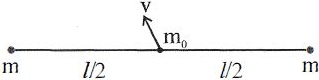
$A$ particle of mass $m_0$ is projected from the midpoint of the line joining two fixed particles,each of mass $m$. If the separation between the fixed particles is $l$,the minimum velocity of projection of the particle so as to escape is equal to:
A
$\sqrt{\frac{Gm}{l}}$
B
$\sqrt{\frac{Gm}{2l}}$
C
$\sqrt{\frac{2Gm}{l}}$
D
$2\sqrt{\frac{2Gm}{l}}$
Solution
(D) Let the mass of the projected particle be $m_0$. The distance of the particle from each fixed mass $m$ is $l/2$.
The gravitational potential energy $U$ of the particle $m_0$ at the midpoint is given by:
$U = -\frac{Gmm_0}{l/2} - \frac{Gmm_0}{l/2} = -\frac{2Gmm_0}{l} - \frac{2Gmm_0}{l} = -\frac{4Gmm_0}{l}$.
For the particle to escape to infinity,its total mechanical energy must be at least zero.
$E_{total} = KE + PE = 0$
$\frac{1}{2}m_0v^2 + U = 0$
$\frac{1}{2}m_0v^2 - \frac{4Gmm_0}{l} = 0$
$\frac{1}{2}m_0v^2 = \frac{4Gmm_0}{l}$
$v^2 = \frac{8Gm}{l}$
$v = \sqrt{\frac{8Gm}{l}} = 2\sqrt{\frac{2Gm}{l}}$.
The gravitational potential energy $U$ of the particle $m_0$ at the midpoint is given by:
$U = -\frac{Gmm_0}{l/2} - \frac{Gmm_0}{l/2} = -\frac{2Gmm_0}{l} - \frac{2Gmm_0}{l} = -\frac{4Gmm_0}{l}$.
For the particle to escape to infinity,its total mechanical energy must be at least zero.
$E_{total} = KE + PE = 0$
$\frac{1}{2}m_0v^2 + U = 0$
$\frac{1}{2}m_0v^2 - \frac{4Gmm_0}{l} = 0$
$\frac{1}{2}m_0v^2 = \frac{4Gmm_0}{l}$
$v^2 = \frac{8Gm}{l}$
$v = \sqrt{\frac{8Gm}{l}} = 2\sqrt{\frac{2Gm}{l}}$.
0 likes
View Solution81
DifficultMCQ
The masses and radii of the Earth and the Moon are $M_1, R_1$ and $M_2, R_2$ respectively. Their centres are at a distance $d$ apart. The minimum speed with which a particle of mass $m$ should be projected from a point midway between the two centres so as to escape to infinity is
A
$v = \sqrt {\frac{{4g({M_1} + {M_2})}}{d}} $
B
$v = \sqrt {\frac{{4G({M_1} + {M_2})}}{d}} $
C
$v = \sqrt {4G({M_1 M_2})} $
D
$v = \sqrt {4Gd({M_1} + {M_2})} $
Solution
(B) The potential energy $(PE)$ of a particle of mass $m$ placed at a point midway between the Earth and the Moon is given by:
$U = -\left(\frac{GM_1 m}{d/2} + \frac{GM_2 m}{d/2}\right) = -\frac{2Gm(M_1 + M_2)}{d}$
The particle will escape to infinity if its total energy becomes at least zero.
By the law of conservation of energy,$U + K = 0$,where $K$ is the kinetic energy $\frac{1}{2}mv^2$.
$-\frac{2Gm(M_1 + M_2)}{d} + \frac{1}{2}mv^2 = 0$
$\frac{1}{2}mv^2 = \frac{2Gm(M_1 + M_2)}{d}$
$v^2 = \frac{4G(M_1 + M_2)}{d}$
$v = \sqrt{\frac{4G(M_1 + M_2)}{d}}$
$U = -\left(\frac{GM_1 m}{d/2} + \frac{GM_2 m}{d/2}\right) = -\frac{2Gm(M_1 + M_2)}{d}$
The particle will escape to infinity if its total energy becomes at least zero.
By the law of conservation of energy,$U + K = 0$,where $K$ is the kinetic energy $\frac{1}{2}mv^2$.
$-\frac{2Gm(M_1 + M_2)}{d} + \frac{1}{2}mv^2 = 0$
$\frac{1}{2}mv^2 = \frac{2Gm(M_1 + M_2)}{d}$
$v^2 = \frac{4G(M_1 + M_2)}{d}$
$v = \sqrt{\frac{4G(M_1 + M_2)}{d}}$
0 likes
View Solution82
DifficultMCQ
Gravitational acceleration on the surface of a planet is $\frac{\sqrt{6}}{11}g$,where $g$ is the gravitational acceleration on the surface of the earth. The average mass density of the planet is $\frac{2}{3}$ times that of the earth. If the escape speed on the surface of the earth is taken to be $11 \ km/s$,the escape speed on the surface of the planet in $km/s$ will be:
A
$2$
B
$3$
C
$4$
D
$6$
Solution
(B) The gravitational acceleration on the surface of a planet is given by $g = \frac{GM}{R^2} = \frac{G}{R^2} \cdot \frac{4}{3} \pi R^3 \rho = \frac{4}{3} \pi G R \rho$.
Thus,the ratio of gravitational acceleration is $\frac{g_p}{g_e} = \frac{R_p \rho_p}{R_e \rho_e}$.
Given $\frac{g_p}{g_e} = \frac{\sqrt{6}}{11}$ and $\frac{\rho_p}{\rho_e} = \frac{2}{3}$,we have $\frac{R_p}{R_e} = \frac{g_p}{g_e} \cdot \frac{\rho_e}{\rho_p} = \frac{\sqrt{6}}{11} \cdot \frac{3}{2} = \frac{3\sqrt{6}}{22}$.
The escape velocity is $v_e = \sqrt{2gR}$.
Therefore,$\frac{v_p}{v_e} = \sqrt{\frac{g_p R_p}{g_e R_e}} = \sqrt{\frac{g_p}{g_e} \cdot \frac{R_p}{R_e}} = \sqrt{\frac{\sqrt{6}}{11} \cdot \frac{3\sqrt{6}}{22}} = \sqrt{\frac{3 \cdot 6}{11 \cdot 22}} = \sqrt{\frac{18}{242}} = \sqrt{\frac{9}{121}} = \frac{3}{11}$.
Given $v_e = 11 \ km/s$,we get $v_p = \frac{3}{11} \times 11 = 3 \ km/s$.
Thus,the ratio of gravitational acceleration is $\frac{g_p}{g_e} = \frac{R_p \rho_p}{R_e \rho_e}$.
Given $\frac{g_p}{g_e} = \frac{\sqrt{6}}{11}$ and $\frac{\rho_p}{\rho_e} = \frac{2}{3}$,we have $\frac{R_p}{R_e} = \frac{g_p}{g_e} \cdot \frac{\rho_e}{\rho_p} = \frac{\sqrt{6}}{11} \cdot \frac{3}{2} = \frac{3\sqrt{6}}{22}$.
The escape velocity is $v_e = \sqrt{2gR}$.
Therefore,$\frac{v_p}{v_e} = \sqrt{\frac{g_p R_p}{g_e R_e}} = \sqrt{\frac{g_p}{g_e} \cdot \frac{R_p}{R_e}} = \sqrt{\frac{\sqrt{6}}{11} \cdot \frac{3\sqrt{6}}{22}} = \sqrt{\frac{3 \cdot 6}{11 \cdot 22}} = \sqrt{\frac{18}{242}} = \sqrt{\frac{9}{121}} = \frac{3}{11}$.
Given $v_e = 11 \ km/s$,we get $v_p = \frac{3}{11} \times 11 = 3 \ km/s$.
0 likes
View Solution83
MediumMCQ
$A$ spaceship moves from the Earth to the Moon and back. The greatest energy required for the spaceship is to overcome the difficulty in:
A
entering the Earth's gravitational field
B
take-off from the Earth's field
C
take-off from Moon's field
D
entering the Moon's lunar surface
Solution
(B) The forces acting on the spaceship are the gravitational pull due to the Earth and the gravitational pull due to the Moon.
Since the mass of the Earth $(M_E)$ is significantly greater than the mass of the Moon $(M_M)$,the gravitational potential energy required to escape the Earth's gravitational field is much higher than that required for the Moon.
Specifically,the escape velocity from the Earth is approximately $11.2 \ km/s$,whereas from the Moon it is only about $2.38 \ km/s$.
Therefore,the spaceship requires the greatest amount of energy to overcome the gravitational pull during take-off from the Earth's surface.
Since the mass of the Earth $(M_E)$ is significantly greater than the mass of the Moon $(M_M)$,the gravitational potential energy required to escape the Earth's gravitational field is much higher than that required for the Moon.
Specifically,the escape velocity from the Earth is approximately $11.2 \ km/s$,whereas from the Moon it is only about $2.38 \ km/s$.
Therefore,the spaceship requires the greatest amount of energy to overcome the gravitational pull during take-off from the Earth's surface.
0 likes
View Solution84
DifficultMCQ
Masses and radii of Earth and Moon are $M_1, M_2$ and $R_1, R_2$ respectively. The distance between their centers is $d$. The minimum velocity given to a mass $m$ from the midpoint of the line joining their centers so that it escapes the gravitational field of both is:
A
$\sqrt{\frac{4G(M_1 + M_2)}{d}}$
B
$\sqrt{\frac{4G}{d} \frac{M_1 M_2}{(M_1 + M_2)}}$
C
$\sqrt{\frac{2G}{d} \left(\frac{M_1 + M_2}{M_1 M_2}\right)}$
D
$\sqrt{\frac{2G}{d} (M_1 + M_2)}$
Solution
(A) The gravitational potential energy $U$ of a mass $m$ placed at the midpoint between $M_1$ and $M_2$ is the sum of the potentials due to both masses:
$U = -\frac{G M_1 m}{d/2} - \frac{G M_2 m}{d/2} = -\frac{2 G m}{d} (M_1 + M_2)$
To escape the system,the total energy must be at least zero. By the law of conservation of energy,the kinetic energy provided must equal the magnitude of the potential energy:
$\frac{1}{2} m v_e^2 = |U| = \frac{2 G m}{d} (M_1 + M_2)$
Solving for the escape velocity $v_e$:
$v_e^2 = \frac{4 G (M_1 + M_2)}{d}$
$v_e = \sqrt{\frac{4 G (M_1 + M_2)}{d}}$
$U = -\frac{G M_1 m}{d/2} - \frac{G M_2 m}{d/2} = -\frac{2 G m}{d} (M_1 + M_2)$
To escape the system,the total energy must be at least zero. By the law of conservation of energy,the kinetic energy provided must equal the magnitude of the potential energy:
$\frac{1}{2} m v_e^2 = |U| = \frac{2 G m}{d} (M_1 + M_2)$
Solving for the escape velocity $v_e$:
$v_e^2 = \frac{4 G (M_1 + M_2)}{d}$
$v_e = \sqrt{\frac{4 G (M_1 + M_2)}{d}}$
0 likes
View Solution85
MediumMCQ
$A$ satellite is moving with a constant speed $v$ in a circular orbit around the Earth. An object of mass $m$ is ejected from the satellite such that it just escapes from the gravitational pull of the Earth. At the time of ejection,the kinetic energy of the object is
A
$2mv^2$
B
$mv^2$
C
$\frac{1}{2}mv^2$
D
$\frac{3}{2}mv^2$
Solution
(B) For a satellite in a circular orbit of radius $r$,the orbital speed $v$ is given by $v = \sqrt{\frac{GM_e}{r}}$,which implies $v^2 = \frac{GM_e}{r}$.
The potential energy of the object of mass $m$ at distance $r$ is $U = -\frac{GM_em}{r}$.
For the object to just escape the gravitational pull of the Earth,its total mechanical energy must be zero at infinity,meaning its total energy at the point of ejection must also be zero.
Let $K$ be the kinetic energy of the object at the time of ejection.
Total energy $E = K + U = 0$.
$K - \frac{GM_em}{r} = 0$.
$K = \frac{GM_em}{r}$.
Substituting $\frac{GM_e}{r} = v^2$,we get $K = mv^2$.
The potential energy of the object of mass $m$ at distance $r$ is $U = -\frac{GM_em}{r}$.
For the object to just escape the gravitational pull of the Earth,its total mechanical energy must be zero at infinity,meaning its total energy at the point of ejection must also be zero.
Let $K$ be the kinetic energy of the object at the time of ejection.
Total energy $E = K + U = 0$.
$K - \frac{GM_em}{r} = 0$.
$K = \frac{GM_em}{r}$.
Substituting $\frac{GM_e}{r} = v^2$,we get $K = mv^2$.
0 likes
View Solution86
MediumMCQ
Two stars of masses $3\times10^{31} \ kg$ each,and at distance $2\times10^{11} \ m$ rotate in a plane about their common centre of mass $O$. $A$ meteorite passes through $O$ moving perpendicular to the star's rotation plane. In order to escape from the gravitational field of this double star,the minimum speed that the meteorite should have at $O$ is: (Take Gravitational constant $G = 6.67\times10^{-11} \ Nm^2 \ kg^{-2}$)
A
$2.4\times10^4 \ m/s$
B
$1.4\times10^5 \ m/s$
C
$3.8\times10^4 \ m/s$
D
$2.8\times10^5 \ m/s$
Solution
(D) Let the mass of the meteorite be $m$. The distance of each star from the center of mass $O$ is $r = d/2 = (2\times10^{11} \ m)/2 = 1\times10^{11} \ m$.
The gravitational potential energy of the meteorite at point $O$ due to the two stars is $U = -\frac{GMm}{r} - \frac{GMm}{r} = -\frac{2GMm}{r}$.
To escape the gravitational field,the total mechanical energy of the meteorite at $O$ must be at least zero. By the law of conservation of energy:
$\frac{1}{2}mv^2 + U = 0$
$\frac{1}{2}mv^2 - \frac{2GMm}{r} = 0$
Solving for $v$:
$v^2 = \frac{4GM}{r}$
$v = \sqrt{\frac{4 \times 6.67\times10^{-11} \times 3\times10^{31}}{1\times10^{11}}}$
$v = \sqrt{4 \times 6.67 \times 3 \times 10^9}$
$v = \sqrt{80.04 \times 10^9} = \sqrt{8.004 \times 10^{10}}$
$v \approx 2.83 \times 10^5 \ m/s$.
The gravitational potential energy of the meteorite at point $O$ due to the two stars is $U = -\frac{GMm}{r} - \frac{GMm}{r} = -\frac{2GMm}{r}$.
To escape the gravitational field,the total mechanical energy of the meteorite at $O$ must be at least zero. By the law of conservation of energy:
$\frac{1}{2}mv^2 + U = 0$
$\frac{1}{2}mv^2 - \frac{2GMm}{r} = 0$
Solving for $v$:
$v^2 = \frac{4GM}{r}$
$v = \sqrt{\frac{4 \times 6.67\times10^{-11} \times 3\times10^{31}}{1\times10^{11}}}$
$v = \sqrt{4 \times 6.67 \times 3 \times 10^9}$
$v = \sqrt{80.04 \times 10^9} = \sqrt{8.004 \times 10^{10}}$
$v \approx 2.83 \times 10^5 \ m/s$.
0 likes
View Solution87
DifficultMCQ
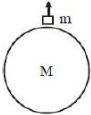
$A$ rocket has to be launched from the Earth in such a way that it never returns. If $E$ is the minimum energy delivered by the rocket launcher,what should be the minimum energy that the launcher should have if the same rocket is to be launched from the surface of the Moon? Assume that the density of the Earth and the Moon are equal and that the Earth's volume is $64$ times the volume of the Moon.
A
$\frac{E}{32}$
B
$\frac{E}{16}$
C
$\frac{E}{64}$
D
$\frac{E}{4}$
Solution
(B) The minimum energy required to escape the gravitational field of a planet is equal to the magnitude of the gravitational potential energy of the object at the surface: $E = \frac{GMm}{R}$.
Given that the densities $\rho$ of the Earth and the Moon are equal,we have $M = \rho V = \rho \cdot \frac{4}{3}\pi R^3$.
Since $V_e = 64 V_m$,we have $R_e^3 = 64 R_m^3$,which implies $R_e = 4 R_m$.
Also,$M_e = \rho V_e = 64 \rho V_m = 64 M_m$.
The energy required is $E = \frac{GMm}{R}$.
Therefore,$\frac{E_m}{E_e} = \frac{M_m}{M_e} \cdot \frac{R_e}{R_m} = \frac{1}{64} \cdot \frac{4}{1} = \frac{1}{16}$.
Thus,$E_m = \frac{E}{16}$.
Given that the densities $\rho$ of the Earth and the Moon are equal,we have $M = \rho V = \rho \cdot \frac{4}{3}\pi R^3$.
Since $V_e = 64 V_m$,we have $R_e^3 = 64 R_m^3$,which implies $R_e = 4 R_m$.
Also,$M_e = \rho V_e = 64 \rho V_m = 64 M_m$.
The energy required is $E = \frac{GMm}{R}$.
Therefore,$\frac{E_m}{E_e} = \frac{M_m}{M_e} \cdot \frac{R_e}{R_m} = \frac{1}{64} \cdot \frac{4}{1} = \frac{1}{16}$.
Thus,$E_m = \frac{E}{16}$.
0 likes
View Solution88
DifficultMCQ
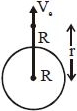
$A$ particle is kept at rest at a distance $R$ from the surface of the Earth (of radius $R$). The minimum speed with which it should be projected so that it does not return is
A
$\sqrt{\frac{GM}{4R}}$
B
$\sqrt{\frac{GM}{2R}}$
C
$\sqrt{\frac{GM}{R}}$
D
$\sqrt{\frac{2GM}{R}}$
Solution
(C) The escape velocity $v_e$ at a distance $r$ from the center of the Earth is given by the formula $v_e = \sqrt{\frac{2GM}{r}}$.
Here,the particle is at a distance $R$ from the surface of the Earth,so its distance from the center of the Earth is $r = R + R = 2R$.
Substituting $r = 2R$ into the formula,we get:
$v_e = \sqrt{\frac{2GM}{2R}}$
$v_e = \sqrt{\frac{GM}{R}}$
Thus,the minimum speed required is $\sqrt{\frac{GM}{R}}$.
Here,the particle is at a distance $R$ from the surface of the Earth,so its distance from the center of the Earth is $r = R + R = 2R$.
Substituting $r = 2R$ into the formula,we get:
$v_e = \sqrt{\frac{2GM}{2R}}$
$v_e = \sqrt{\frac{GM}{R}}$
Thus,the minimum speed required is $\sqrt{\frac{GM}{R}}$.
0 likes
View Solution89
MediumMCQ
$A$ spaceship moves from the Earth to the Moon and back. The greatest energy required for the spaceship is to overcome the difficulty in:
A
entering the Earth's gravitational field
B
take-off from the Earth's field
C
take-off from the Moon's field
D
entering the Moon's lunar surface
Solution
(B) The forces acting on the spaceship are the gravitational pull due to the Earth and the gravitational pull due to the Moon.
Since the mass of the Earth $(M_E)$ is significantly greater than the mass of the Moon $(M_M)$,the gravitational potential energy and the gravitational force at the Earth's surface are much higher than at the Moon's surface.
To escape the Earth's gravitational influence,the spaceship must overcome a much larger gravitational potential barrier compared to the Moon.
Therefore,the greatest energy is required to perform a take-off from the Earth's gravitational field.
Since the mass of the Earth $(M_E)$ is significantly greater than the mass of the Moon $(M_M)$,the gravitational potential energy and the gravitational force at the Earth's surface are much higher than at the Moon's surface.
To escape the Earth's gravitational influence,the spaceship must overcome a much larger gravitational potential barrier compared to the Moon.
Therefore,the greatest energy is required to perform a take-off from the Earth's gravitational field.
0 likes
View Solution90
MediumMCQ
The kinetic energy needed to project a body of mass $m$ from the earth's surface (radius $R$) to infinity is
A
$\frac{mgR}{2}$
B
$2mgR$
C
$mgR$
D
$\frac{mgR}{4}$
Solution
(C) The total energy of a body at the earth's surface is the sum of its kinetic energy $(K.E.)$ and gravitational potential energy $(U)$.
$U = -\frac{GM_E m}{R}$
To project the body to infinity,the final total energy must be at least zero.
By the law of conservation of energy: $K.E. + U = 0$
$K.E. - \frac{GM_E m}{R} = 0$
$K.E. = \frac{GM_E m}{R}$
Since the acceleration due to gravity at the surface is $g = \frac{GM_E}{R^2}$,we can write $GM_E = gR^2$.
Substituting this into the expression for kinetic energy:
$K.E. = \frac{(gR^2)m}{R} = mgR$
$U = -\frac{GM_E m}{R}$
To project the body to infinity,the final total energy must be at least zero.
By the law of conservation of energy: $K.E. + U = 0$
$K.E. - \frac{GM_E m}{R} = 0$
$K.E. = \frac{GM_E m}{R}$
Since the acceleration due to gravity at the surface is $g = \frac{GM_E}{R^2}$,we can write $GM_E = gR^2$.
Substituting this into the expression for kinetic energy:
$K.E. = \frac{(gR^2)m}{R} = mgR$
0 likes
View Solution91
MediumMCQ
If $v_e$ is escape velocity and $v_0$ is orbital velocity of a satellite for an orbit close to the earth's surface,then these are related by:
A
$v_0 = \sqrt{2} v_e$
B
$v_0 = v_e$
C
$v_e = v_0 / 2$
D
$v_e = \sqrt{2} v_0$
Solution
(D) The escape velocity $v_e$ from the surface of the Earth is given by the formula:
$v_e = \sqrt{\frac{2GM}{R}}$
The orbital velocity $v_0$ of a satellite in a circular orbit close to the Earth's surface is given by the formula:
$v_0 = \sqrt{\frac{GM}{R}}$
By comparing the two expressions,we can see that:
$v_e = \sqrt{2} \times \sqrt{\frac{GM}{R}}$
$v_e = \sqrt{2} v_0$
Thus,the correct relation is $v_e = \sqrt{2} v_0$.
$v_e = \sqrt{\frac{2GM}{R}}$
The orbital velocity $v_0$ of a satellite in a circular orbit close to the Earth's surface is given by the formula:
$v_0 = \sqrt{\frac{GM}{R}}$
By comparing the two expressions,we can see that:
$v_e = \sqrt{2} \times \sqrt{\frac{GM}{R}}$
$v_e = \sqrt{2} v_0$
Thus,the correct relation is $v_e = \sqrt{2} v_0$.
0 likes
View Solution92
MediumMCQ
The escape velocity of a body from the earth's surface is $v_e$. The escape velocity of the same body from a height equal to $R$ from the earth's surface will be
A
$\frac{v_e}{\sqrt{2}}$
B
$\frac{v_e}{2}$
C
$\frac{v_e}{2\sqrt{2}}$
D
$\frac{v_e}{4}$
Solution
(A) The escape velocity from the surface of the earth is given by $v_e = \sqrt{\frac{2GM}{R}}$.
At a height $h = R$ from the surface,the distance from the center of the earth is $r = R + h = R + R = 2R$.
The escape velocity $v'$ at this height is given by $v' = \sqrt{\frac{2GM}{r}} = \sqrt{\frac{2GM}{2R}}$.
Simplifying this,we get $v' = \sqrt{\frac{1}{2} \cdot \frac{2GM}{R}} = \frac{1}{\sqrt{2}} \sqrt{\frac{2GM}{R}}$.
Substituting $v_e$ into the equation,we get $v' = \frac{v_e}{\sqrt{2}}$.
At a height $h = R$ from the surface,the distance from the center of the earth is $r = R + h = R + R = 2R$.
The escape velocity $v'$ at this height is given by $v' = \sqrt{\frac{2GM}{r}} = \sqrt{\frac{2GM}{2R}}$.
Simplifying this,we get $v' = \sqrt{\frac{1}{2} \cdot \frac{2GM}{R}} = \frac{1}{\sqrt{2}} \sqrt{\frac{2GM}{R}}$.
Substituting $v_e$ into the equation,we get $v' = \frac{v_e}{\sqrt{2}}$.
0 likes
View Solution93
DifficultMCQ
$A$ body of mass $m$ is situated at a distance equal to $2R$ ($R$ is the radius of the Earth) from the Earth's surface. The minimum energy required to be given to the body so that it may escape out of the Earth's gravitational field is:
A
$mgR$
B
$\frac{mgR}{3}$
C
$\frac{mgR}{2}$
D
$\frac{mgR}{4}$
Solution
(B) The distance of the body from the center of the Earth is $r = R + 2R = 3R$.
The gravitational potential energy $(PE)$ of the body at this distance is given by $PE = -\frac{GMm}{r} = -\frac{GMm}{3R}$.
Since $g = \frac{GM}{R^2}$,we have $GM = gR^2$.
Substituting this into the potential energy expression: $PE = -\frac{(gR^2)m}{3R} = -\frac{mgR}{3}$.
The energy required to escape the gravitational field is equal to the magnitude of the potential energy,which is the binding energy: $E_{escape} = -PE = \frac{mgR}{3}$.
The gravitational potential energy $(PE)$ of the body at this distance is given by $PE = -\frac{GMm}{r} = -\frac{GMm}{3R}$.
Since $g = \frac{GM}{R^2}$,we have $GM = gR^2$.
Substituting this into the potential energy expression: $PE = -\frac{(gR^2)m}{3R} = -\frac{mgR}{3}$.
The energy required to escape the gravitational field is equal to the magnitude of the potential energy,which is the binding energy: $E_{escape} = -PE = \frac{mgR}{3}$.
0 likes
View Solution94
DifficultMCQ
$A$ body of mass $m$ is situated at a distance $4R_e$ above the Earth's surface,where $R_e$ is the radius of Earth. How much minimum energy must be given to the body so that it may escape?
A
$mgR_e$
B
$2mgR_e$
C
$\frac{mgR_e}{5}$
D
$\frac{mgR_e}{16}$
Solution
(C) The gravitational potential energy $U$ of a body of mass $m$ at a height $h$ above the Earth's surface is given by $U = -\frac{GMm}{R_e + h}$.
Given $h = 4R_e$,the potential energy is $U = -\frac{GMm}{R_e + 4R_e} = -\frac{GMm}{5R_e}$.
Since $g = \frac{GM}{R_e^2}$,we have $GM = gR_e^2$.
Substituting this into the expression for $U$,we get $U = -\frac{(gR_e^2)m}{5R_e} = -\frac{mgR_e}{5}$.
To escape the Earth's gravitational field,the total energy of the body must be at least zero. Therefore,the minimum energy required is $E = -U = \frac{mgR_e}{5}$.
Given $h = 4R_e$,the potential energy is $U = -\frac{GMm}{R_e + 4R_e} = -\frac{GMm}{5R_e}$.
Since $g = \frac{GM}{R_e^2}$,we have $GM = gR_e^2$.
Substituting this into the expression for $U$,we get $U = -\frac{(gR_e^2)m}{5R_e} = -\frac{mgR_e}{5}$.
To escape the Earth's gravitational field,the total energy of the body must be at least zero. Therefore,the minimum energy required is $E = -U = \frac{mgR_e}{5}$.
0 likes
View Solution95
DifficultMCQ
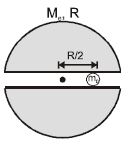
$A$ very small groove is made in the earth,and a particle of mass $m_0$ is placed at $\frac{R}{2}$ distance from the centre. Find the escape speed of the particle from that place.
A
$\sqrt{\frac{4GM}{R}}$
B
$\sqrt{\frac{2GM}{R}}$
C
$\sqrt{\frac{GM}{4R}}$
D
$\sqrt{\frac{11GM}{4R}}$
Solution
(D) The gravitational potential $V$ at a distance $r = \frac{R}{2}$ inside a uniform sphere of mass $M$ and radius $R$ is given by:
$V = -\frac{GM}{2R^3} (3R^2 - r^2)$
Substituting $r = \frac{R}{2}$:
$V = -\frac{GM}{2R^3} (3R^2 - \frac{R^2}{4}) = -\frac{GM}{2R^3} (\frac{11R^2}{4}) = -\frac{11GM}{8R}$
The total energy of the particle of mass $m_0$ at this position is $E_i = K_i + U_i = \frac{1}{2}m_0 v_e^2 + m_0 V$.
For the particle to escape,the final total energy $E_f$ at infinity must be at least $0$.
$E_i = E_f \implies \frac{1}{2}m_0 v_e^2 - \frac{11GMm_0}{8R} = 0$
$\frac{1}{2} v_e^2 = \frac{11GM}{8R}$
$v_e^2 = \frac{11GM}{4R}$
$v_e = \sqrt{\frac{11GM}{4R}}$
$V = -\frac{GM}{2R^3} (3R^2 - r^2)$
Substituting $r = \frac{R}{2}$:
$V = -\frac{GM}{2R^3} (3R^2 - \frac{R^2}{4}) = -\frac{GM}{2R^3} (\frac{11R^2}{4}) = -\frac{11GM}{8R}$
The total energy of the particle of mass $m_0$ at this position is $E_i = K_i + U_i = \frac{1}{2}m_0 v_e^2 + m_0 V$.
For the particle to escape,the final total energy $E_f$ at infinity must be at least $0$.
$E_i = E_f \implies \frac{1}{2}m_0 v_e^2 - \frac{11GMm_0}{8R} = 0$
$\frac{1}{2} v_e^2 = \frac{11GM}{8R}$
$v_e^2 = \frac{11GM}{4R}$
$v_e = \sqrt{\frac{11GM}{4R}}$
0 likes
View Solution96
DifficultMCQ
$A$ certain object is projected vertically from the surface of the earth of radius $R$ with a velocity equal to half the escape velocity. The maximum height attained by the object will be
A
$R/3$
B
$2R$
C
$3R$
D
$6R$
Solution
(A) Let $h$ be the maximum height reached by the object. According to the law of conservation of energy,the total energy at the surface of the earth is equal to the total energy at the maximum height $h$.
Total energy at the surface: $E_i = KE_i + PE_i = \frac{1}{2} m v_p^2 - \frac{GMm}{R}$,where $v_p$ is the projection velocity.
Given that the projection velocity is half the escape velocity: $v_p = \frac{1}{2} v_e = \frac{1}{2} \sqrt{\frac{2GM}{R}}$.
Thus,$KE_i = \frac{1}{2} m (\frac{1}{2} \sqrt{\frac{2GM}{R}})^2 = \frac{1}{2} m (\frac{1}{4} \cdot \frac{2GM}{R}) = \frac{GMm}{4R}$.
Total energy at the surface: $E_i = \frac{GMm}{4R} - \frac{GMm}{R} = -\frac{3GMm}{4R}$.
At maximum height $h$,the velocity is zero,so $KE_f = 0$. The potential energy is $PE_f = -\frac{GMm}{R+h}$.
Equating initial and final energies: $-\frac{3GMm}{4R} = -\frac{GMm}{R+h}$.
$\frac{3}{4R} = \frac{1}{R+h} \implies 3(R+h) = 4R \implies 3R + 3h = 4R \implies 3h = R \implies h = R/3$.
Total energy at the surface: $E_i = KE_i + PE_i = \frac{1}{2} m v_p^2 - \frac{GMm}{R}$,where $v_p$ is the projection velocity.
Given that the projection velocity is half the escape velocity: $v_p = \frac{1}{2} v_e = \frac{1}{2} \sqrt{\frac{2GM}{R}}$.
Thus,$KE_i = \frac{1}{2} m (\frac{1}{2} \sqrt{\frac{2GM}{R}})^2 = \frac{1}{2} m (\frac{1}{4} \cdot \frac{2GM}{R}) = \frac{GMm}{4R}$.
Total energy at the surface: $E_i = \frac{GMm}{4R} - \frac{GMm}{R} = -\frac{3GMm}{4R}$.
At maximum height $h$,the velocity is zero,so $KE_f = 0$. The potential energy is $PE_f = -\frac{GMm}{R+h}$.
Equating initial and final energies: $-\frac{3GMm}{4R} = -\frac{GMm}{R+h}$.
$\frac{3}{4R} = \frac{1}{R+h} \implies 3(R+h) = 4R \implies 3R + 3h = 4R \implies 3h = R \implies h = R/3$.
0 likes
View Solution97
DifficultMCQ
Escape velocity at the surface of the Earth is $11.2 \, km/s$. If the radius of a planet is double that of the Earth but its mean density is the same as that of the Earth,then the escape velocity will be ........ $km/s$.
A
$11.2$
B
$5.5$
C
$15.5$
D
$22.4$
Solution
(D) The formula for escape velocity $V_e$ is given by $V_e = \sqrt{\frac{2GM}{R}}$.
Since mass $M = \text{density} (\rho) \times \text{volume} (V) = \rho \times \frac{4}{3} \pi R^3$,we substitute $M$ into the formula:
$V_e = \sqrt{\frac{2G(\rho \cdot \frac{4}{3} \pi R^3)}{R}} = \sqrt{\frac{8}{3} \pi G \rho R^2} = R \sqrt{\frac{8}{3} \pi G \rho}$.
This shows that $V_e \propto R$ when density $\rho$ is constant.
Given $R' = 2R$ and $\rho' = \rho$,the new escape velocity $V_e'$ is:
$\frac{V_e'}{V_e} = \frac{R'}{R} = \frac{2R}{R} = 2$.
Therefore,$V_e' = 2 \times V_e = 2 \times 11.2 \, km/s = 22.4 \, km/s$.
Since mass $M = \text{density} (\rho) \times \text{volume} (V) = \rho \times \frac{4}{3} \pi R^3$,we substitute $M$ into the formula:
$V_e = \sqrt{\frac{2G(\rho \cdot \frac{4}{3} \pi R^3)}{R}} = \sqrt{\frac{8}{3} \pi G \rho R^2} = R \sqrt{\frac{8}{3} \pi G \rho}$.
This shows that $V_e \propto R$ when density $\rho$ is constant.
Given $R' = 2R$ and $\rho' = \rho$,the new escape velocity $V_e'$ is:
$\frac{V_e'}{V_e} = \frac{R'}{R} = \frac{2R}{R} = 2$.
Therefore,$V_e' = 2 \times V_e = 2 \times 11.2 \, km/s = 22.4 \, km/s$.
0 likes
View Solution98
DifficultMCQ
Maximum height reached by an object projected perpendicular to the surface of the earth with a speed equal to $50\%$ of the escape velocity from the earth's surface is - ($R =$ Radius of Earth)
A
$\frac{R}{2}$
B
$\frac{16R}{9}$
C
$\frac{R}{3}$
D
$\frac{R}{8}$
Solution
(C) The escape velocity from the surface of the Earth is given by $v_e = \sqrt{2gR}$.
Given that the initial speed of the object is $v = 50\% \text{ of } v_e = \frac{v_e}{2} = \frac{\sqrt{2gR}}{2}$.
Using the principle of conservation of energy,the total energy at the surface equals the total energy at the maximum height $h$:
$\frac{1}{2}mv^2 - \frac{GMm}{R} = 0 - \frac{GMm}{R+h}$.
Substituting $v = \frac{\sqrt{2gR}}{2}$ and $GM = gR^2$:
$\frac{1}{2}m \left(\frac{2gR}{4}\right) - \frac{mgR^2}{R} = - \frac{mgR^2}{R+h}$.
$\frac{mgR}{4} - mgR = - \frac{mgR^2}{R+h}$.
$-\frac{3}{4}mgR = - \frac{mgR^2}{R+h}$.
$\frac{3}{4} = \frac{R}{R+h}$.
$3(R+h) = 4R \Rightarrow 3R + 3h = 4R \Rightarrow 3h = R \Rightarrow h = \frac{R}{3}$.
Given that the initial speed of the object is $v = 50\% \text{ of } v_e = \frac{v_e}{2} = \frac{\sqrt{2gR}}{2}$.
Using the principle of conservation of energy,the total energy at the surface equals the total energy at the maximum height $h$:
$\frac{1}{2}mv^2 - \frac{GMm}{R} = 0 - \frac{GMm}{R+h}$.
Substituting $v = \frac{\sqrt{2gR}}{2}$ and $GM = gR^2$:
$\frac{1}{2}m \left(\frac{2gR}{4}\right) - \frac{mgR^2}{R} = - \frac{mgR^2}{R+h}$.
$\frac{mgR}{4} - mgR = - \frac{mgR^2}{R+h}$.
$-\frac{3}{4}mgR = - \frac{mgR^2}{R+h}$.
$\frac{3}{4} = \frac{R}{R+h}$.
$3(R+h) = 4R \Rightarrow 3R + 3h = 4R \Rightarrow 3h = R \Rightarrow h = \frac{R}{3}$.
0 likes
View Solution99
MediumMCQ
$A$ geostationary satellite is revolving around the $Earth$. To make it escape from the gravitational field of the $Earth$,its velocity must be increased by ........ $\%$
A
$100$
B
$41.4$
C
$50$
D
$59.6$
Solution
(B) The orbital velocity of a satellite is given by $v_{0}$.
The escape velocity required to leave the gravitational field is $v_{e} = \sqrt{2} v_{0} \approx 1.414 v_{0}$.
To find the required percentage increase in velocity,we calculate the fractional change:
$\frac{\Delta v}{v_{0}} = \frac{v_{e} - v_{0}}{v_{0}} = \frac{1.414 v_{0} - v_{0}}{v_{0}} = 0.414$.
Therefore,the percentage increase required is $0.414 \times 100 \% = 41.4 \%$.
The escape velocity required to leave the gravitational field is $v_{e} = \sqrt{2} v_{0} \approx 1.414 v_{0}$.
To find the required percentage increase in velocity,we calculate the fractional change:
$\frac{\Delta v}{v_{0}} = \frac{v_{e} - v_{0}}{v_{0}} = \frac{1.414 v_{0} - v_{0}}{v_{0}} = 0.414$.
Therefore,the percentage increase required is $0.414 \times 100 \% = 41.4 \%$.
0 likes
View Solution100
DifficultMCQ
$A$ rocket is projected in the vertically upwards direction with a velocity $kv_e$,where $v_e$ is the escape velocity and $k < 1$. The distance from the centre of the Earth up to which the rocket will reach is:
A
$R_e(1 - k^2)$
B
$\frac{1 - k^2}{R_e}$
C
$\sqrt{R_e}(1 - k^2)$
D
$\frac{R_e}{1 - k^2}$
Solution
(D) According to the law of conservation of mechanical energy,the total energy at the surface of the Earth is equal to the total energy at the maximum height $r$ reached by the rocket.
At the surface: $K_1 + U_1 = \frac{1}{2}m(kv_e)^2 - \frac{GMm}{R_e}$
At maximum height $r$: $K_2 + U_2 = 0 - \frac{GMm}{r}$ (since velocity at maximum height is zero).
We know that the escape velocity $v_e = \sqrt{\frac{2GM}{R_e}}$,so $v_e^2 = \frac{2GM}{R_e}$.
Substituting this into the energy equation:
$\frac{1}{2}m k^2 (\frac{2GM}{R_e}) - \frac{GMm}{R_e} = - \frac{GMm}{r}$
Dividing by $GMm$:
$\frac{k^2}{R_e} - \frac{1}{R_e} = - \frac{1}{r}$
$\frac{k^2 - 1}{R_e} = - \frac{1}{r}$
$\frac{1 - k^2}{R_e} = \frac{1}{r}$
Therefore,$r = \frac{R_e}{1 - k^2}$.
At the surface: $K_1 + U_1 = \frac{1}{2}m(kv_e)^2 - \frac{GMm}{R_e}$
At maximum height $r$: $K_2 + U_2 = 0 - \frac{GMm}{r}$ (since velocity at maximum height is zero).
We know that the escape velocity $v_e = \sqrt{\frac{2GM}{R_e}}$,so $v_e^2 = \frac{2GM}{R_e}$.
Substituting this into the energy equation:
$\frac{1}{2}m k^2 (\frac{2GM}{R_e}) - \frac{GMm}{R_e} = - \frac{GMm}{r}$
Dividing by $GMm$:
$\frac{k^2}{R_e} - \frac{1}{R_e} = - \frac{1}{r}$
$\frac{k^2 - 1}{R_e} = - \frac{1}{r}$
$\frac{1 - k^2}{R_e} = \frac{1}{r}$
Therefore,$r = \frac{R_e}{1 - k^2}$.
0 likes
View SolutionGravitation — Escape Velocity and Escape Energy · Frequently Asked Questions
1Are these Gravitation questions useful for JEE and NEET?
Yes. All questions in this section are mapped to JEE Main and NEET exam patterns. Previous year questions from JEE Main, NEET, GUJCET and state-level exams are included with full solutions.
2Can I switch to Hindi or Gujarati for these questions?
Yes. Use the language tabs in the hero section or the sidebar to view the same questions and solutions in English, Hindi or Gujarati.
3How do I generate a question paper from this subtopic?
Use the Vedclass Exam Paper Generator — select the chapter and subtopic, set difficulty, and generate Sets A, B, C, D automatically. First 3 chapters of every subject are free.
Vedclass Products
For Students
Vedclass Test Series
Mock tests in real JEE/NEET style with performance analysis. 5-day free trial.
Start Free TrialFor Teachers
Exam Paper Generator
Generate Set A/B/C/D papers from this chapter in 2 minutes. 3 chapters free.
Try FreeFor Institutes
Online Exam Module
Live online exams with unlimited students, 360° analytics & white-label branding.
See DemoFor Teachers & Institutes
Generate a Gravitation Exam Paper in 2 Minutes
Select subtopic & difficulty — Sets A, B, C, D auto-generated with No Repeat logic.
First 3 chapters of every subject are free — no payment required.