
A English
Escape Velocity and Escape Energy Questions in English
Class 11 Physics · Gravitation · Escape Velocity and Escape Energy
234+
Questions
English
Language
100%
With Solutions
Showing 49 of 234 questions in English
151
MediumMCQ
$A$ spaceship of mass $2 \times 10^4 \, kg$ is launched into a circular orbit close to the Earth's surface. The additional velocity to be imparted to the spaceship in the orbit to overcome the gravitational pull will be $......$ (given $g = 10 \, m/s^2$ and radius of Earth $R = 6400 \, km$).
A
$11.2(\sqrt{2}-1) \, km/s$
B
$7.9(\sqrt{2}-1) \, km/s$
C
$8(\sqrt{2}-1) \, km/s$
D
$7.4(\sqrt{2}-1) \, km/s$
Solution
(C) The orbital velocity of a satellite close to the Earth's surface is given by $v_{\text{orbit}} = \sqrt{gR}$.
Substituting the values: $v_{\text{orbit}} = \sqrt{10 \times 6.4 \times 10^6} = \sqrt{64 \times 10^6} = 8000 \, m/s = 8 \, km/s$.
The escape velocity from the Earth's surface is given by $v_{\text{escape}} = \sqrt{2gR} = \sqrt{2} \times v_{\text{orbit}}$.
Substituting the value: $v_{\text{escape}} = 8\sqrt{2} \, km/s$.
The additional velocity required to overcome the gravitational pull is $\Delta v = v_{\text{escape}} - v_{\text{orbit}}$.
$\Delta v = 8\sqrt{2} - 8 = 8(\sqrt{2}-1) \, km/s$.
Substituting the values: $v_{\text{orbit}} = \sqrt{10 \times 6.4 \times 10^6} = \sqrt{64 \times 10^6} = 8000 \, m/s = 8 \, km/s$.
The escape velocity from the Earth's surface is given by $v_{\text{escape}} = \sqrt{2gR} = \sqrt{2} \times v_{\text{orbit}}$.
Substituting the value: $v_{\text{escape}} = 8\sqrt{2} \, km/s$.
The additional velocity required to overcome the gravitational pull is $\Delta v = v_{\text{escape}} - v_{\text{orbit}}$.
$\Delta v = 8\sqrt{2} - 8 = 8(\sqrt{2}-1) \, km/s$.
0 likes
View Solution152
MediumMCQ
The ratio of the escape velocity of a planet to the escape velocity of the Earth will be: Given: Mass of the planet is $16$ times the mass of the Earth and the radius of the planet is $4$ times the radius of the Earth.
A
$4:1$
B
$2:1$
C
$1: \sqrt{2}$
D
$1: 4$
Solution
(B) The formula for escape velocity is $V_e = \sqrt{\frac{2GM}{R}}$.
Let $M_E$ and $R_E$ be the mass and radius of the Earth,and $M_P$ and $R_P$ be the mass and radius of the planet.
Given: $M_P = 16 M_E$ and $R_P = 4 R_E$.
The escape velocity of the planet is $V_P = \sqrt{\frac{2GM_P}{R_P}} = \sqrt{\frac{2G(16M_E)}{4R_E}} = \sqrt{4 \times \frac{2GM_E}{R_E}} = 2 \sqrt{\frac{2GM_E}{R_E}}$.
Since $V_E = \sqrt{\frac{2GM_E}{R_E}}$,we have $V_P = 2 V_E$.
Therefore,the ratio $\frac{V_P}{V_E} = \frac{2}{1}$,which is $2:1$.
Let $M_E$ and $R_E$ be the mass and radius of the Earth,and $M_P$ and $R_P$ be the mass and radius of the planet.
Given: $M_P = 16 M_E$ and $R_P = 4 R_E$.
The escape velocity of the planet is $V_P = \sqrt{\frac{2GM_P}{R_P}} = \sqrt{\frac{2G(16M_E)}{4R_E}} = \sqrt{4 \times \frac{2GM_E}{R_E}} = 2 \sqrt{\frac{2GM_E}{R_E}}$.
Since $V_E = \sqrt{\frac{2GM_E}{R_E}}$,we have $V_P = 2 V_E$.
Therefore,the ratio $\frac{V_P}{V_E} = \frac{2}{1}$,which is $2:1$.
0 likes
View Solution153
MediumMCQ
$A$ planet having mass $9 M_e$ and radius $4 R_e$,where $M_e$ and $R_e$ are the mass and radius of the Earth respectively,has an escape velocity in $km/s$ given by: (Given escape velocity on Earth $V_e = 11.2 \times 10^3 \, m/s$)
A
$67.2$
B
$16.8$
C
$33.6$
D
$11.2$
Solution
(B) The formula for escape velocity is $V = \sqrt{\frac{2GM}{R}}$.
For Earth,$V_e = \sqrt{\frac{2GM_e}{R_e}} = 11.2 \, km/s$.
For the planet,$V_p = \sqrt{\frac{2G(9M_e)}{4R_e}} = \sqrt{\frac{9}{4}} \times \sqrt{\frac{2GM_e}{R_e}}$.
$V_p = \frac{3}{2} \times V_e$.
Substituting the value of $V_e = 11.2 \, km/s$:
$V_p = 1.5 \times 11.2 \, km/s = 16.8 \, km/s$.
For Earth,$V_e = \sqrt{\frac{2GM_e}{R_e}} = 11.2 \, km/s$.
For the planet,$V_p = \sqrt{\frac{2G(9M_e)}{4R_e}} = \sqrt{\frac{9}{4}} \times \sqrt{\frac{2GM_e}{R_e}}$.
$V_p = \frac{3}{2} \times V_e$.
Substituting the value of $V_e = 11.2 \, km/s$:
$V_p = 1.5 \times 11.2 \, km/s = 16.8 \, km/s$.
0 likes
View Solution154
MediumMCQ
Given below are two statements:
Statement $I:$ For a planet,if the ratio of mass of the planet to its radius increases,the escape velocity from the planet also increases.
Statement $II:$ Escape velocity is independent of the radius of the planet.
In the light of the above statements,choose the most appropriate answer from the options given below:
Statement $I:$ For a planet,if the ratio of mass of the planet to its radius increases,the escape velocity from the planet also increases.
Statement $II:$ Escape velocity is independent of the radius of the planet.
In the light of the above statements,choose the most appropriate answer from the options given below:
A
Both Statement $I$ and Statement $II$ are incorrect.
B
Statement $I$ is correct but Statement $II$ is incorrect.
C
Statement $I$ is incorrect but Statement $II$ is correct.
D
Both Statement $I$ and Statement $II$ are correct.
Solution
(B) The formula for escape velocity $V_e$ is given by $V_e = \sqrt{\frac{2GM}{R}}$,where $G$ is the gravitational constant,$M$ is the mass of the planet,and $R$ is its radius.
From the formula,we can see that $V_e \propto \sqrt{\frac{M}{R}}$.
Therefore,if the ratio $\frac{M}{R}$ increases,the escape velocity $V_e$ must also increase. Thus,Statement $I$ is correct.
Furthermore,since $V_e = \sqrt{\frac{2GM}{R}}$,it is clear that $V_e$ depends on the radius $R$ of the planet $(V_e \propto \frac{1}{\sqrt{R}})$. Therefore,Statement $II$ is incorrect.
From the formula,we can see that $V_e \propto \sqrt{\frac{M}{R}}$.
Therefore,if the ratio $\frac{M}{R}$ increases,the escape velocity $V_e$ must also increase. Thus,Statement $I$ is correct.
Furthermore,since $V_e = \sqrt{\frac{2GM}{R}}$,it is clear that $V_e$ depends on the radius $R$ of the planet $(V_e \propto \frac{1}{\sqrt{R}})$. Therefore,Statement $II$ is incorrect.
0 likes
View Solution155
DifficultMCQ
The escape velocity of a body from the Earth is $11.2 \,km/s$. If the radius of a planet is one-third the radius of the Earth and its mass is one-sixth that of the Earth, the escape velocity from the planet is: (in $\,km/s$)
A
$11.2$
B
$8.4$
C
$4.2$
D
$7.9$
Solution
(D) The formula for escape velocity is $V_e = \sqrt{\frac{2GM}{R}}$.
Given for Earth: $V_E = 11.2 \,km/s$, $M_E$, and $R_E$.
For the planet: $M_P = \frac{M_E}{6}$ and $R_P = \frac{R_E}{3}$.
The escape velocity for the planet is $V_P = \sqrt{\frac{2GM_P}{R_P}}$.
Substituting the values: $V_P = \sqrt{\frac{2G(M_E/6)}{(R_E/3)}} = \sqrt{\frac{2GM_E}{R_E} \times \frac{3}{6}} = \sqrt{\frac{2GM_E}{R_E} \times \frac{1}{2}}$.
Since $V_E = \sqrt{\frac{2GM_E}{R_E}} = 11.2 \,km/s$, we have $V_P = \frac{V_E}{\sqrt{2}}$.
$V_P = \frac{11.2}{1.414} \approx 7.9 \,km/s$.
Given for Earth: $V_E = 11.2 \,km/s$, $M_E$, and $R_E$.
For the planet: $M_P = \frac{M_E}{6}$ and $R_P = \frac{R_E}{3}$.
The escape velocity for the planet is $V_P = \sqrt{\frac{2GM_P}{R_P}}$.
Substituting the values: $V_P = \sqrt{\frac{2G(M_E/6)}{(R_E/3)}} = \sqrt{\frac{2GM_E}{R_E} \times \frac{3}{6}} = \sqrt{\frac{2GM_E}{R_E} \times \frac{1}{2}}$.
Since $V_E = \sqrt{\frac{2GM_E}{R_E}} = 11.2 \,km/s$, we have $V_P = \frac{V_E}{\sqrt{2}}$.
$V_P = \frac{11.2}{1.414} \approx 7.9 \,km/s$.
0 likes
View Solution156
DifficultMCQ
The mass of the moon is $1/144$ times the mass of a planet and its diameter is $1/16$ times the diameter of a planet. If the escape velocity on the planet is $v$,the escape velocity on the moon will be:
A
$v/3$
B
$v/4$
C
$v/12$
D
$v/6$
Solution
(A) The formula for escape velocity is $V_e = \sqrt{\frac{2GM}{R}}$.
Let $M_p$ and $R_p$ be the mass and radius of the planet,and $M_m$ and $R_m$ be the mass and radius of the moon.
Given: $M_m = \frac{M_p}{144}$ and $D_m = \frac{D_p}{16}$,which implies $R_m = \frac{R_p}{16}$.
Escape velocity on the planet is $V_p = \sqrt{\frac{2GM_p}{R_p}} = v$.
Escape velocity on the moon is $V_m = \sqrt{\frac{2GM_m}{R_m}} = \sqrt{\frac{2G(M_p/144)}{(R_p/16)}} = \sqrt{\frac{2GM_p}{R_p} \times \frac{16}{144}} = \sqrt{\frac{2GM_p}{R_p} \times \frac{1}{9}}$.
Substituting $V_p = v$,we get $V_m = \sqrt{\frac{v^2}{9}} = \frac{v}{3}$.
Let $M_p$ and $R_p$ be the mass and radius of the planet,and $M_m$ and $R_m$ be the mass and radius of the moon.
Given: $M_m = \frac{M_p}{144}$ and $D_m = \frac{D_p}{16}$,which implies $R_m = \frac{R_p}{16}$.
Escape velocity on the planet is $V_p = \sqrt{\frac{2GM_p}{R_p}} = v$.
Escape velocity on the moon is $V_m = \sqrt{\frac{2GM_m}{R_m}} = \sqrt{\frac{2G(M_p/144)}{(R_p/16)}} = \sqrt{\frac{2GM_p}{R_p} \times \frac{16}{144}} = \sqrt{\frac{2GM_p}{R_p} \times \frac{1}{9}}$.
Substituting $V_p = v$,we get $V_m = \sqrt{\frac{v^2}{9}} = \frac{v}{3}$.
0 likes
View Solution157
DifficultMCQ
To project a body of mass $m$ from Earth's surface to infinity,the required kinetic energy is (assume,the radius of Earth is $R_E$,$g =$ acceleration due to gravity on the surface of Earth):
A
$2 mgR_{E}$
B
$mgR_{E}$
C
$\frac{1}{2} mgR_{E}$
D
$4 mgR_{E}$
Solution
(B) The escape velocity $v_e$ is given by the formula $v_e = \sqrt{\frac{2GM}{R_E}}$.
To project a body to infinity,the kinetic energy $K$ must be equal to the magnitude of the gravitational potential energy at the surface of the Earth.
$K = \frac{GMm}{R_E}$.
We know that the acceleration due to gravity on the surface of the Earth is $g = \frac{GM}{R_E^2}$,which implies $GM = gR_E^2$.
Substituting $GM$ into the kinetic energy expression:
$K = \frac{(gR_E^2)m}{R_E} = mgR_E$.
Therefore,the required kinetic energy is $mgR_E$.
To project a body to infinity,the kinetic energy $K$ must be equal to the magnitude of the gravitational potential energy at the surface of the Earth.
$K = \frac{GMm}{R_E}$.
We know that the acceleration due to gravity on the surface of the Earth is $g = \frac{GM}{R_E^2}$,which implies $GM = gR_E^2$.
Substituting $GM$ into the kinetic energy expression:
$K = \frac{(gR_E^2)m}{R_E} = mgR_E$.
Therefore,the required kinetic energy is $mgR_E$.
0 likes
View Solution158
AdvancedMCQ
$A$ rocket is launched normal to the surface of the Earth,away from the Sun,along the line joining the Sun and the Earth. The Sun is $3 \times 10^5$ times heavier than the Earth and is at a distance $2.5 \times 10^4$ times larger than the radius of the Earth. The escape velocity from the Earth's gravitational field is $v_e = 11.2 \text{ km s}^{-1}$. The minimum initial velocity $(v_s)$ required for the rocket to be able to leave the Sun-Earth system is closest to:
(Ignore the rotation and revolution of the Earth and the presence of any other planet)
(Ignore the rotation and revolution of the Earth and the presence of any other planet)
A
$v_s = 22 \text{ km s}^{-1}$
B
$v_s = 42 \text{ km s}^{-1}$
C
$v_s = 62 \text{ km s}^{-1}$
D
$v_s = 72 \text{ km s}^{-1}$
Solution
(B) Let $M$ be the mass of the Earth and $R$ be its radius. The mass of the Sun is $M_s = 3 \times 10^5 M$ and the distance of the Sun from the Earth is $d = 2.5 \times 10^4 R$.
The total energy of the rocket at the surface of the Earth is $E = \frac{1}{2}mv_s^2 - \frac{GMm}{R} - \frac{GM_sm}{d}$.
For the rocket to escape the system,the final energy must be at least $0$.
$\frac{1}{2}mv_s^2 = \frac{GMm}{R} + \frac{G(3 \times 10^5 M)m}{2.5 \times 10^4 R}$.
Since $v_e^2 = \frac{2GM}{R}$,we have $\frac{GM}{R} = \frac{v_e^2}{2}$.
Substituting this into the energy equation: $\frac{1}{2}v_s^2 = \frac{v_e^2}{2} + \frac{3 \times 10^5}{2.5 \times 10^4} \times \frac{v_e^2}{2}$.
$v_s^2 = v_e^2 + 12 v_e^2 = 13 v_e^2$.
$v_s = v_e \sqrt{13} = 11.2 \times 3.605 \approx 40.38 \text{ km s}^{-1}$.
The closest value is $42 \text{ km s}^{-1}$.
The total energy of the rocket at the surface of the Earth is $E = \frac{1}{2}mv_s^2 - \frac{GMm}{R} - \frac{GM_sm}{d}$.
For the rocket to escape the system,the final energy must be at least $0$.
$\frac{1}{2}mv_s^2 = \frac{GMm}{R} + \frac{G(3 \times 10^5 M)m}{2.5 \times 10^4 R}$.
Since $v_e^2 = \frac{2GM}{R}$,we have $\frac{GM}{R} = \frac{v_e^2}{2}$.
Substituting this into the energy equation: $\frac{1}{2}v_s^2 = \frac{v_e^2}{2} + \frac{3 \times 10^5}{2.5 \times 10^4} \times \frac{v_e^2}{2}$.
$v_s^2 = v_e^2 + 12 v_e^2 = 13 v_e^2$.
$v_s = v_e \sqrt{13} = 11.2 \times 3.605 \approx 40.38 \text{ km s}^{-1}$.
The closest value is $42 \text{ km s}^{-1}$.
0 likes
View Solution159
DifficultMCQ
Gravitational acceleration on the surface of a planet is $\frac{\sqrt{6}}{11} g$,where $g$ is the gravitational acceleration on the surface of the earth. The average mass density of the planet is $\frac{2}{3}$ times that of the earth. If the escape speed on the surface of the earth is taken to be $11 \ km/s$,the escape speed on the surface of the planet in $km/s$ will be:
A
$2$
B
$3$
C
$8$
D
$9$
Solution
(B) The gravitational acceleration is given by $g = \frac{4}{3} \pi G \rho R$.
Thus,$\frac{g'}{g} = \frac{\rho' R'}{\rho R}$.
Given $\frac{g'}{g} = \frac{\sqrt{6}}{11}$ and $\frac{\rho'}{\rho} = \frac{2}{3}$,we have $\frac{\sqrt{6}}{11} = \frac{2}{3} \cdot \frac{R'}{R}$,which implies $\frac{R'}{R} = \frac{3\sqrt{6}}{22}$.
The escape velocity is $v_e = \sqrt{2gR} = \sqrt{2 (\frac{4}{3} \pi G \rho R) R} = R \sqrt{\frac{8}{3} \pi G \rho}$.
Therefore,$\frac{v_e'}{v_e} = \frac{R'}{R} \sqrt{\frac{\rho'}{\rho}} = \left( \frac{3\sqrt{6}}{22} \right) \sqrt{\frac{2}{3}} = \frac{3\sqrt{6}}{22} \cdot \frac{\sqrt{2}}{\sqrt{3}} = \frac{3\sqrt{2}\sqrt{3}}{22} \cdot \frac{\sqrt{2}}{\sqrt{3}} = \frac{3 \cdot 2}{22} = \frac{6}{22} = \frac{3}{11}$.
Given $v_e = 11 \ km/s$,we get $v_e' = 11 \cdot \frac{3}{11} = 3 \ km/s$.
Thus,$\frac{g'}{g} = \frac{\rho' R'}{\rho R}$.
Given $\frac{g'}{g} = \frac{\sqrt{6}}{11}$ and $\frac{\rho'}{\rho} = \frac{2}{3}$,we have $\frac{\sqrt{6}}{11} = \frac{2}{3} \cdot \frac{R'}{R}$,which implies $\frac{R'}{R} = \frac{3\sqrt{6}}{22}$.
The escape velocity is $v_e = \sqrt{2gR} = \sqrt{2 (\frac{4}{3} \pi G \rho R) R} = R \sqrt{\frac{8}{3} \pi G \rho}$.
Therefore,$\frac{v_e'}{v_e} = \frac{R'}{R} \sqrt{\frac{\rho'}{\rho}} = \left( \frac{3\sqrt{6}}{22} \right) \sqrt{\frac{2}{3}} = \frac{3\sqrt{6}}{22} \cdot \frac{\sqrt{2}}{\sqrt{3}} = \frac{3\sqrt{2}\sqrt{3}}{22} \cdot \frac{\sqrt{2}}{\sqrt{3}} = \frac{3 \cdot 2}{22} = \frac{6}{22} = \frac{3}{11}$.
Given $v_e = 11 \ km/s$,we get $v_e' = 11 \cdot \frac{3}{11} = 3 \ km/s$.
0 likes
View Solution160
DifficultMCQ
$A$ satellite is moving with a constant speed '$V$' in a circular orbit about the Earth. An object of mass '$m$' is ejected from the satellite such that it just escapes from the gravitational pull of the Earth. At the time of its ejection,the kinetic energy of the object is
A
$1/2 m V^2$
B
$m V^2$
C
$3/2 m V^2$
D
$2 m V^2$
Solution
(B) Let the radius of the circular orbit be $r$. The orbital speed of the satellite is given by $V = \sqrt{\frac{GM}{r}}$,which implies $V^2 = \frac{GM}{r}$.
For an object to just escape the gravitational pull of the Earth,its total mechanical energy at the point of ejection must be equal to its total mechanical energy at infinity,which is $0$.
Let $K$ be the kinetic energy of the object of mass $m$ at the time of ejection.
The potential energy of the object at distance $r$ from the center of the Earth is $U = -\frac{GMm}{r}$.
According to the law of conservation of energy: $K + U = 0$.
$K - \frac{GMm}{r} = 0$.
$K = \frac{GMm}{r}$.
Substituting $\frac{GM}{r} = V^2$,we get $K = m V^2$.
For an object to just escape the gravitational pull of the Earth,its total mechanical energy at the point of ejection must be equal to its total mechanical energy at infinity,which is $0$.
Let $K$ be the kinetic energy of the object of mass $m$ at the time of ejection.
The potential energy of the object at distance $r$ from the center of the Earth is $U = -\frac{GMm}{r}$.
According to the law of conservation of energy: $K + U = 0$.
$K - \frac{GMm}{r} = 0$.
$K = \frac{GMm}{r}$.
Substituting $\frac{GM}{r} = V^2$,we get $K = m V^2$.
0 likes
View Solution161
AdvancedMCQ
Two spherical planets $P$ and $Q$ have the same uniform density $\rho$,masses $M_P$ and $M_Q$,and surface areas $A$ and $4A$,respectively. $A$ spherical planet $R$ also has uniform density $\rho$ and its mass is $(M_P + M_Q)$. The escape velocities from the planets $P, Q,$ and $R$ are $V_P, V_Q,$ and $V_R$ respectively. Then:
A
$(B, D)$
B
$(B, C)$
C
$(A, D)$
D
$(C, D)$
Solution
(A) The escape velocity $V_e$ is given by $V_e = \sqrt{\frac{2GM}{R}}$. Since $M = \rho \cdot \frac{4}{3}\pi R^3$,we have $V_e = \sqrt{\frac{2G}{R} \cdot \rho \cdot \frac{4}{3}\pi R^3} = \sqrt{\frac{8\pi G \rho}{3}} R$. Thus,$V_e \propto R$.
Given surface area $A_P = A = 4\pi R_P^2$ and $A_Q = 4A = 4\pi R_Q^2$. This implies $R_Q^2 = 4R_P^2$,so $R_Q = 2R_P$.
For planet $R$,$M_R = M_P + M_Q$. Since density $\rho$ is uniform,$\frac{4}{3}\pi R_R^3 \rho = \frac{4}{3}\pi R_P^3 \rho + \frac{4}{3}\pi R_Q^3 \rho$.
Thus,$R_R^3 = R_P^3 + R_Q^3 = R_P^3 + (2R_P)^3 = R_P^3 + 8R_P^3 = 9R_P^3$.
So,$R_R = 9^{1/3} R_P$.
Comparing radii: $R_R = 9^{1/3} R_P \approx 2.08 R_P$,$R_Q = 2 R_P$,and $R_P = R_P$.
Therefore,$R_R > R_Q > R_P$,which implies $V_R > V_Q > V_P$. This confirms statement $(B)$ is correct.
For statement $(D)$,$\frac{V_P}{V_Q} = \frac{R_P}{R_Q} = \frac{R_P}{2R_P} = \frac{1}{2}$. This confirms statement $(D)$ is correct.
Given surface area $A_P = A = 4\pi R_P^2$ and $A_Q = 4A = 4\pi R_Q^2$. This implies $R_Q^2 = 4R_P^2$,so $R_Q = 2R_P$.
For planet $R$,$M_R = M_P + M_Q$. Since density $\rho$ is uniform,$\frac{4}{3}\pi R_R^3 \rho = \frac{4}{3}\pi R_P^3 \rho + \frac{4}{3}\pi R_Q^3 \rho$.
Thus,$R_R^3 = R_P^3 + R_Q^3 = R_P^3 + (2R_P)^3 = R_P^3 + 8R_P^3 = 9R_P^3$.
So,$R_R = 9^{1/3} R_P$.
Comparing radii: $R_R = 9^{1/3} R_P \approx 2.08 R_P$,$R_Q = 2 R_P$,and $R_P = R_P$.
Therefore,$R_R > R_Q > R_P$,which implies $V_R > V_Q > V_P$. This confirms statement $(B)$ is correct.
For statement $(D)$,$\frac{V_P}{V_Q} = \frac{R_P}{R_Q} = \frac{R_P}{2R_P} = \frac{1}{2}$. This confirms statement $(D)$ is correct.
0 likes
View Solution162
DifficultMCQ
$A$ bullet is fired vertically upwards with velocity $v$ from the surface of a spherical planet. When it reaches its maximum height,its acceleration due to the planet's gravity is $1/4$ of its value at the surface of the planet. If the escape velocity from the planet is $v_{esc} = v \sqrt{N}$,then the value of $N$ is (ignore energy loss due to atmosphere).
A
$1$
B
$2$
C
$3$
D
$4$
Solution
(B) Let $R$ be the radius of the planet and $M$ be its mass. The acceleration due to gravity at the surface is $g = GM/R^2$.
At a height $h$ above the surface,the acceleration due to gravity is $g' = GM/(R+h)^2$.
Given $g' = g/4$,we have $GM/(R+h)^2 = (1/4) \cdot (GM/R^2)$,which implies $(R+h)^2 = 4R^2$,so $R+h = 2R$,or $h = R$.
Using the conservation of energy at the surface and at the maximum height $h=R$:
$-(GMm/R) + (1/2)mv^2 = -(GMm/(R+R))$
$-(GMm/R) + (1/2)mv^2 = -(GMm/2R)$
$(1/2)mv^2 = GMm/2R \implies v^2 = GM/R$.
The escape velocity is defined as $v_{esc} = \sqrt{2GM/R}$.
Substituting $GM/R = v^2$,we get $v_{esc} = \sqrt{2v^2} = v\sqrt{2}$.
Comparing this with $v_{esc} = v\sqrt{N}$,we find $N = 2$.
At a height $h$ above the surface,the acceleration due to gravity is $g' = GM/(R+h)^2$.
Given $g' = g/4$,we have $GM/(R+h)^2 = (1/4) \cdot (GM/R^2)$,which implies $(R+h)^2 = 4R^2$,so $R+h = 2R$,or $h = R$.
Using the conservation of energy at the surface and at the maximum height $h=R$:
$-(GMm/R) + (1/2)mv^2 = -(GMm/(R+R))$
$-(GMm/R) + (1/2)mv^2 = -(GMm/2R)$
$(1/2)mv^2 = GMm/2R \implies v^2 = GM/R$.
The escape velocity is defined as $v_{esc} = \sqrt{2GM/R}$.
Substituting $GM/R = v^2$,we get $v_{esc} = \sqrt{2v^2} = v\sqrt{2}$.
Comparing this with $v_{esc} = v\sqrt{N}$,we find $N = 2$.
0 likes
View Solution163
AdvancedMCQ
Two spherical stars $A$ and $B$ have densities $\rho_A$ and $\rho_B$,respectively. $A$ and $B$ have the same radius,and their masses $M_A$ and $M_B$ are related by $M_B = 2M_A$. Due to an interaction process,star $A$ loses some of its mass,so that its radius is halved,while its spherical shape is retained,and its density remains $\rho_A$. The entire mass lost by $A$ is deposited as a thick spherical shell on $B$ with the density of the shell being $\rho_A$. If $v_A$ and $v_B$ are the escape velocities from $A$ and $B$ after the interaction process,the ratio $\frac{v_B}{v_A} = \sqrt{\frac{10n}{15^{1/3}}}$. The value of $n$ is. . . . .
A
$2.30$
B
$2.35$
C
$2.40$
D
$2.45$
Solution
(A) Initial state: $R_A = R_B = R$,$M_A = M$,$M_B = 2M = 2M_A$. Density $\rho_A = \frac{M_A}{\frac{4}{3}\pi R^3}$.
After interaction,star $A$ has radius $R_A' = R/2$. Since density $\rho_A$ is constant,the new mass $M_A' = \rho_A \cdot \frac{4}{3}\pi (R/2)^3 = M_A/8$.
The escape velocity $v_A = \sqrt{\frac{2GM_A'}{R_A'}} = \sqrt{\frac{2G(M_A/8)}{R/2}} = \sqrt{\frac{GM_A}{2R}}$.
Mass lost by $A$ is $\Delta M = M_A - M_A/8 = \frac{7}{8}M_A$. This mass is added to $B$ as a shell of density $\rho_A$. Let the new radius of $B$ be $R_B'$.
Volume of shell = $\frac{4}{3}\pi(R_B'^3 - R^3) = \frac{\Delta M}{\rho_A} = \frac{7/8 M_A}{\rho_A} = \frac{7}{8} \cdot \frac{4}{3}\pi R^3$.
$R_B'^3 - R^3 = \frac{7}{8}R^3 \Rightarrow R_B'^3 = \frac{15}{8}R^3 \Rightarrow R_B' = R \left(\frac{15}{8}\right)^{1/3}$.
The new mass of $B$ is $M_B' = M_B + \Delta M = 2M_A + \frac{7}{8}M_A = \frac{23}{8}M_A$.
The escape velocity $v_B = \sqrt{\frac{2GM_B'}{R_B'}} = \sqrt{\frac{2G(23/8)M_A}{R(15/8)^{1/3}}} = \sqrt{\frac{23GM_A}{4R(15/8)^{1/3}}} = \sqrt{\frac{23GM_A}{2R(15^{1/3})}}$.
Ratio $\frac{v_B}{v_A} = \sqrt{\frac{23GM_A}{2R(15^{1/3})} \cdot \frac{2R}{GM_A}} = \sqrt{\frac{23}{15^{1/3}}} = \sqrt{\frac{10 \times 2.3}{15^{1/3}}}$.
Comparing with $\sqrt{\frac{10n}{15^{1/3}}}$,we get $n = 2.30$.
After interaction,star $A$ has radius $R_A' = R/2$. Since density $\rho_A$ is constant,the new mass $M_A' = \rho_A \cdot \frac{4}{3}\pi (R/2)^3 = M_A/8$.
The escape velocity $v_A = \sqrt{\frac{2GM_A'}{R_A'}} = \sqrt{\frac{2G(M_A/8)}{R/2}} = \sqrt{\frac{GM_A}{2R}}$.
Mass lost by $A$ is $\Delta M = M_A - M_A/8 = \frac{7}{8}M_A$. This mass is added to $B$ as a shell of density $\rho_A$. Let the new radius of $B$ be $R_B'$.
Volume of shell = $\frac{4}{3}\pi(R_B'^3 - R^3) = \frac{\Delta M}{\rho_A} = \frac{7/8 M_A}{\rho_A} = \frac{7}{8} \cdot \frac{4}{3}\pi R^3$.
$R_B'^3 - R^3 = \frac{7}{8}R^3 \Rightarrow R_B'^3 = \frac{15}{8}R^3 \Rightarrow R_B' = R \left(\frac{15}{8}\right)^{1/3}$.
The new mass of $B$ is $M_B' = M_B + \Delta M = 2M_A + \frac{7}{8}M_A = \frac{23}{8}M_A$.
The escape velocity $v_B = \sqrt{\frac{2GM_B'}{R_B'}} = \sqrt{\frac{2G(23/8)M_A}{R(15/8)^{1/3}}} = \sqrt{\frac{23GM_A}{4R(15/8)^{1/3}}} = \sqrt{\frac{23GM_A}{2R(15^{1/3})}}$.
Ratio $\frac{v_B}{v_A} = \sqrt{\frac{23GM_A}{2R(15^{1/3})} \cdot \frac{2R}{GM_A}} = \sqrt{\frac{23}{15^{1/3}}} = \sqrt{\frac{10 \times 2.3}{15^{1/3}}}$.
Comparing with $\sqrt{\frac{10n}{15^{1/3}}}$,we get $n = 2.30$.
0 likes
View Solution164
MediumMCQ
Earth has mass $8$ times and radius $2$ times that of a planet. If the escape velocity from the Earth is $11.2 \ km/s$,the escape velocity in $km/s$ from the planet will be:
A
$11.2$
B
$5.6$
C
$2.8$
D
$8.4$
Solution
(B) The formula for escape velocity is $V_e = \sqrt{\frac{2GM}{R}}$.
Given: $M_E = 8M_P$ and $R_E = 2R_P$,where $E$ denotes Earth and $P$ denotes the planet.
Therefore,the ratio of escape velocities is:
$\frac{V_P}{V_E} = \sqrt{\frac{M_P}{M_E} \times \frac{R_E}{R_P}}$
Substituting the given values:
$\frac{V_P}{V_E} = \sqrt{\frac{M_P}{8M_P} \times \frac{2R_P}{R_P}} = \sqrt{\frac{1}{8} \times 2} = \sqrt{\frac{1}{4}} = \frac{1}{2}$.
Thus,$V_P = \frac{1}{2} V_E = \frac{1}{2} \times 11.2 \ km/s = 5.6 \ km/s$.
Given: $M_E = 8M_P$ and $R_E = 2R_P$,where $E$ denotes Earth and $P$ denotes the planet.
Therefore,the ratio of escape velocities is:
$\frac{V_P}{V_E} = \sqrt{\frac{M_P}{M_E} \times \frac{R_E}{R_P}}$
Substituting the given values:
$\frac{V_P}{V_E} = \sqrt{\frac{M_P}{8M_P} \times \frac{2R_P}{R_P}} = \sqrt{\frac{1}{8} \times 2} = \sqrt{\frac{1}{4}} = \frac{1}{2}$.
Thus,$V_P = \frac{1}{2} V_E = \frac{1}{2} \times 11.2 \ km/s = 5.6 \ km/s$.
0 likes
View Solution165
MediumMCQ
Given below are two statements: one is labelled as Assertion $A$ and the other is labelled as Reason $R$.
Assertion $A$: The kinetic energy needed to project a body of mass $m$ from the Earth's surface to infinity is $\frac{1}{2} mgR$,where $R$ is the radius of the Earth.
Reason $R$: The maximum potential energy of a body is zero when it is projected to infinity from the Earth's surface.
In the light of the above statements,choose the correct answer from the options given below.
Assertion $A$: The kinetic energy needed to project a body of mass $m$ from the Earth's surface to infinity is $\frac{1}{2} mgR$,where $R$ is the radius of the Earth.
Reason $R$: The maximum potential energy of a body is zero when it is projected to infinity from the Earth's surface.
In the light of the above statements,choose the correct answer from the options given below.
A
$A$ is false but $R$ is true.
B
Both $A$ and $R$ are true and $R$ is the correct explanation of $A$.
C
$A$ is true but $R$ is false.
D
Both $A$ and $R$ are true but $R$ is $\text{NOT}$ the correct explanation of $A$.
Solution
(A) The escape velocity of a body from the Earth's surface is given by $v_e = \sqrt{\frac{2GM}{R}} = \sqrt{2gR}$.
The kinetic energy required to project the body to infinity is $KE = \frac{1}{2}mv_e^2 = \frac{1}{2}m(2gR) = mgR$.
Since the assertion states the energy is $\frac{1}{2}mgR$,the Assertion $A$ is false.
The potential energy of a body at infinity is defined as zero,which is the maximum value of potential energy for a body in the Earth's gravitational field. Thus,Reason $R$ is true.
The kinetic energy required to project the body to infinity is $KE = \frac{1}{2}mv_e^2 = \frac{1}{2}m(2gR) = mgR$.
Since the assertion states the energy is $\frac{1}{2}mgR$,the Assertion $A$ is false.
The potential energy of a body at infinity is defined as zero,which is the maximum value of potential energy for a body in the Earth's gravitational field. Thus,Reason $R$ is true.
0 likes
View Solution166
MediumMCQ
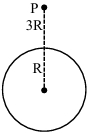
An object is kept at rest at a distance of $3R$ above the earth's surface,where $R$ is the earth's radius. The minimum speed with which it must be projected so that it does not return to earth is (Assume $M =$ mass of earth,$G =$ Universal gravitational constant).
A
$\sqrt{\frac{GM}{2R}}$
B
$\sqrt{\frac{GM}{R}}$
C
$\sqrt{\frac{3GM}{R}}$
D
$\sqrt{\frac{2GM}{R}}$
Solution
(A) To ensure the object does not return to Earth,its total mechanical energy at infinity must be at least zero.
Let $m$ be the mass of the object.
The distance of the object from the center of the Earth is $r = R + 3R = 4R$.
The potential energy at this point is $U = -\frac{GMm}{4R}$.
Let $v$ be the projection speed. The kinetic energy is $K = \frac{1}{2}mv^2$.
By the law of conservation of energy:
$K_i + U_i = K_f + U_f$
$\frac{1}{2}mv^2 - \frac{GMm}{4R} = 0 + 0$
$\frac{1}{2}mv^2 = \frac{GMm}{4R}$
$v^2 = \frac{GM}{2R}$
$v = \sqrt{\frac{GM}{2R}}$
Let $m$ be the mass of the object.
The distance of the object from the center of the Earth is $r = R + 3R = 4R$.
The potential energy at this point is $U = -\frac{GMm}{4R}$.
Let $v$ be the projection speed. The kinetic energy is $K = \frac{1}{2}mv^2$.
By the law of conservation of energy:
$K_i + U_i = K_f + U_f$
$\frac{1}{2}mv^2 - \frac{GMm}{4R} = 0 + 0$
$\frac{1}{2}mv^2 = \frac{GMm}{4R}$
$v^2 = \frac{GM}{2R}$
$v = \sqrt{\frac{GM}{2R}}$
0 likes
View Solution167
MediumMCQ
$A$ body is projected vertically upward from the surface of the earth with a velocity equal to half the escape velocity. If $R$ is the radius of the earth,the maximum height attained by the body is:
A
$R / 6$
B
$R / 3$
C
$2 R / 3$
D
$R$
Solution
(B) Apply the principle of conservation of mechanical energy.
Total energy at the surface of the earth = Total energy at the maximum height $h$.
$\frac{-GMm}{R} + \frac{1}{2}m\left(\frac{v_e}{2}\right)^2 = \frac{-GMm}{R+h} + 0$
Since the escape velocity $v_e = \sqrt{\frac{2GM}{R}}$,we have $v_e^2 = \frac{2GM}{R}$.
Substituting this into the energy equation:
$\frac{-GMm}{R} + \frac{1}{2}m \left(\frac{1}{4} \cdot \frac{2GM}{R}\right) = \frac{-GMm}{R+h}$
$\frac{-GMm}{R} + \frac{GMm}{4R} = \frac{-GMm}{R+h}$
$-\frac{3GMm}{4R} = \frac{-GMm}{R+h}$
$\frac{3}{4R} = \frac{1}{R+h}$
$3(R+h) = 4R$
$3R + 3h = 4R$
$3h = R$
$h = \frac{R}{3}$
Total energy at the surface of the earth = Total energy at the maximum height $h$.
$\frac{-GMm}{R} + \frac{1}{2}m\left(\frac{v_e}{2}\right)^2 = \frac{-GMm}{R+h} + 0$
Since the escape velocity $v_e = \sqrt{\frac{2GM}{R}}$,we have $v_e^2 = \frac{2GM}{R}$.
Substituting this into the energy equation:
$\frac{-GMm}{R} + \frac{1}{2}m \left(\frac{1}{4} \cdot \frac{2GM}{R}\right) = \frac{-GMm}{R+h}$
$\frac{-GMm}{R} + \frac{GMm}{4R} = \frac{-GMm}{R+h}$
$-\frac{3GMm}{4R} = \frac{-GMm}{R+h}$
$\frac{3}{4R} = \frac{1}{R+h}$
$3(R+h) = 4R$
$3R + 3h = 4R$
$3h = R$
$h = \frac{R}{3}$
0 likes
View Solution168
EasyMCQ
The escape velocity of a satellite from the surface of the Earth does $NOT$ depend on
A
mass of the Earth.
B
mass of the object to be projected.
C
radius of the Earth.
D
gravitational constant.
Solution
(B) The formula for the escape velocity $(v_e)$ of an object from the surface of the Earth is given by:
$v_e = \sqrt{\frac{2GM}{R}}$
where:
$G$ is the gravitational constant,
$M$ is the mass of the Earth,
$R$ is the radius of the Earth.
From this formula,it is clear that the escape velocity depends only on the mass of the Earth $(M)$,the radius of the Earth $(R)$,and the gravitational constant $(G)$.
It does not depend on the mass of the object $(m)$ being projected.
Therefore,the correct option is $B$.
$v_e = \sqrt{\frac{2GM}{R}}$
where:
$G$ is the gravitational constant,
$M$ is the mass of the Earth,
$R$ is the radius of the Earth.
From this formula,it is clear that the escape velocity depends only on the mass of the Earth $(M)$,the radius of the Earth $(R)$,and the gravitational constant $(G)$.
It does not depend on the mass of the object $(m)$ being projected.
Therefore,the correct option is $B$.
0 likes
View Solution169
MediumMCQ
$A$ body is projected vertically from earth's surface with $\left(\frac{1}{3}\right)^{\text{rd}}$ of escape velocity. The maximum height reached by the body is ($R=$ radius of earth).
A
$\frac{R}{4}$
B
$\frac{R}{8}$
C
$\frac{R}{9}$
D
$\frac{R}{6}$
Solution
(B) The escape velocity from the earth's surface is given by $v_e = \sqrt{\frac{2GM}{R}}$.
The initial velocity of projection is $v = \frac{1}{3} v_e = \frac{1}{3} \sqrt{\frac{2GM}{R}}$.
Using the law of conservation of energy between the surface of the earth and the maximum height $h$:
Total energy at surface = Total energy at maximum height $h$.
$-\frac{GMm}{R} + \frac{1}{2}mv^2 = -\frac{GMm}{R+h} + 0$.
Substituting $v^2 = \frac{1}{9} \left(\frac{2GM}{R}\right) = \frac{2GM}{9R}$:
$-\frac{GMm}{R} + \frac{1}{2}m \left(\frac{2GM}{9R}\right) = -\frac{GMm}{R+h}$.
$-\frac{GMm}{R} + \frac{GMm}{9R} = -\frac{GMm}{R+h}$.
Dividing by $-GMm$: $\frac{1}{R} - \frac{1}{9R} = \frac{1}{R+h}$.
$\frac{8}{9R} = \frac{1}{R+h}$.
$8(R+h) = 9R \implies 8R + 8h = 9R$.
$8h = R \implies h = \frac{R}{8}$.
The initial velocity of projection is $v = \frac{1}{3} v_e = \frac{1}{3} \sqrt{\frac{2GM}{R}}$.
Using the law of conservation of energy between the surface of the earth and the maximum height $h$:
Total energy at surface = Total energy at maximum height $h$.
$-\frac{GMm}{R} + \frac{1}{2}mv^2 = -\frac{GMm}{R+h} + 0$.
Substituting $v^2 = \frac{1}{9} \left(\frac{2GM}{R}\right) = \frac{2GM}{9R}$:
$-\frac{GMm}{R} + \frac{1}{2}m \left(\frac{2GM}{9R}\right) = -\frac{GMm}{R+h}$.
$-\frac{GMm}{R} + \frac{GMm}{9R} = -\frac{GMm}{R+h}$.
Dividing by $-GMm$: $\frac{1}{R} - \frac{1}{9R} = \frac{1}{R+h}$.
$\frac{8}{9R} = \frac{1}{R+h}$.
$8(R+h) = 9R \implies 8R + 8h = 9R$.
$8h = R \implies h = \frac{R}{8}$.
0 likes
View Solution170
DifficultMCQ
Earth has mass $M_1$ and radius $R_1$,and the moon has mass $M_2$ and radius $R_2$. The distance between their centers is $r$. $A$ body of mass $M$ is placed on the line joining them at a distance $r/3$ from the center of the Earth. To project the mass $M$ to escape to infinity,the minimum speed required is:
A
$\left[\frac{2 G}{r}\left(M_2+\frac{M_1}{2}\right)\right]^{1 / 2}$
B
$\left[\frac{4 G}{r}\left(M_1+\frac{M_2}{2}\right)\right]^{1 / 2}$
C
$\left[\frac{3 G}{r}\left(M_1+M_2\right)\right]^{1 / 2}$
D
$\left[\frac{6 G}{r}\left(M_1+\frac{M_2}{2}\right)\right]^{1 / 2}$
Solution
(D) The gravitational potential energy $U$ of the body of mass $M$ at a distance $r/3$ from the Earth and $2r/3$ from the moon is given by:
$U = -\frac{G M_1 M}{r/3} - \frac{G M_2 M}{2r/3} = -\frac{3 G M_1 M}{r} - \frac{3 G M_2 M}{2r} = -\frac{3 G M}{r} \left( M_1 + \frac{M_2}{2} \right)$.
To escape to infinity,the total energy must be at least zero. If $v$ is the required escape speed,the kinetic energy is $\frac{1}{2} M v^2$.
By conservation of energy: $\frac{1}{2} M v^2 + U = 0$.
$\frac{1}{2} M v^2 = \frac{3 G M}{r} \left( M_1 + \frac{M_2}{2} \right)$.
Solving for $v$:
$v^2 = \frac{6 G}{r} \left( M_1 + \frac{M_2}{2} \right)$.
$v = \left[ \frac{6 G}{r} \left( M_1 + \frac{M_2}{2} \right) \right]^{1/2}$.
$U = -\frac{G M_1 M}{r/3} - \frac{G M_2 M}{2r/3} = -\frac{3 G M_1 M}{r} - \frac{3 G M_2 M}{2r} = -\frac{3 G M}{r} \left( M_1 + \frac{M_2}{2} \right)$.
To escape to infinity,the total energy must be at least zero. If $v$ is the required escape speed,the kinetic energy is $\frac{1}{2} M v^2$.
By conservation of energy: $\frac{1}{2} M v^2 + U = 0$.
$\frac{1}{2} M v^2 = \frac{3 G M}{r} \left( M_1 + \frac{M_2}{2} \right)$.
Solving for $v$:
$v^2 = \frac{6 G}{r} \left( M_1 + \frac{M_2}{2} \right)$.
$v = \left[ \frac{6 G}{r} \left( M_1 + \frac{M_2}{2} \right) \right]^{1/2}$.
0 likes
View Solution171
EasyMCQ
The escape velocity from the Earth's surface is $11 \,km/s$. The escape velocity from a planet having twice the radius and the same mean density as the Earth is: (in $\,km/s$)
A
$22$
B
$11$
C
$5.5$
D
$15.5$
Solution
(A) The escape velocity $v_e$ is given by the formula: $v_e = \sqrt{\frac{2GM}{R}}$.
Since the mass $M$ of a planet can be expressed in terms of its density $\rho$ and radius $R$ as $M = \frac{4}{3} \pi R^3 \rho$, we substitute this into the formula:
$v_e = \sqrt{\frac{2G}{R} \cdot \frac{4}{3} \pi R^3 \rho} = \sqrt{\frac{8}{3} G \pi \rho R^2} = R \sqrt{\frac{8}{3} G \pi \rho}$.
Given that the density $\rho$ is the same for both the Earth and the planet, we have $v_e \propto R$.
Let $v_e$ be the escape velocity of Earth and $v_e'$ be the escape velocity of the planet.
Given $R' = 2R$, we have:
$\frac{v_e'}{v_e} = \frac{R'}{R} = \frac{2R}{R} = 2$.
Therefore, $v_e' = 2 \times v_e = 2 \times 11 \,km/s = 22 \,km/s$.
Since the mass $M$ of a planet can be expressed in terms of its density $\rho$ and radius $R$ as $M = \frac{4}{3} \pi R^3 \rho$, we substitute this into the formula:
$v_e = \sqrt{\frac{2G}{R} \cdot \frac{4}{3} \pi R^3 \rho} = \sqrt{\frac{8}{3} G \pi \rho R^2} = R \sqrt{\frac{8}{3} G \pi \rho}$.
Given that the density $\rho$ is the same for both the Earth and the planet, we have $v_e \propto R$.
Let $v_e$ be the escape velocity of Earth and $v_e'$ be the escape velocity of the planet.
Given $R' = 2R$, we have:
$\frac{v_e'}{v_e} = \frac{R'}{R} = \frac{2R}{R} = 2$.
Therefore, $v_e' = 2 \times v_e = 2 \times 11 \,km/s = 22 \,km/s$.
0 likes
View Solution172
MediumMCQ
The radius of the planet is double that of the earth,but their average densities are same. $V_{p}$ and $V_E$ are the escape velocities of planet and earth respectively. If $\frac{V_p}{V_E}=x$,the value of '$x$' is
A
$1/4$
B
$1/2$
C
$2$
D
$4$
Solution
(C) The escape velocity $v_e$ of a planet is given by the formula: $v_e = \sqrt{\frac{2GM}{R}}$.
Since the mass $M$ of a planet can be expressed in terms of its density $\rho$ and radius $R$ as $M = \frac{4}{3}\pi R^3 \rho$,we substitute this into the escape velocity formula:
$v_e = \sqrt{\frac{2G}{R} \cdot \frac{4}{3}\pi R^3 \rho} = \sqrt{\frac{8}{3}G\pi\rho R^2} = R \sqrt{\frac{8}{3}G\pi\rho}$.
Given that the densities $\rho$ are the same for both the planet and the earth,the escape velocity is directly proportional to the radius: $v_e \propto R$.
Therefore,the ratio of the escape velocities is: $\frac{V_p}{V_E} = \frac{R_p}{R_E}$.
Given that the radius of the planet is double that of the earth $(R_p = 2R_E)$,we have:
$\frac{V_p}{V_E} = \frac{2R_E}{R_E} = 2$.
Thus,the value of $x$ is $2$.
Since the mass $M$ of a planet can be expressed in terms of its density $\rho$ and radius $R$ as $M = \frac{4}{3}\pi R^3 \rho$,we substitute this into the escape velocity formula:
$v_e = \sqrt{\frac{2G}{R} \cdot \frac{4}{3}\pi R^3 \rho} = \sqrt{\frac{8}{3}G\pi\rho R^2} = R \sqrt{\frac{8}{3}G\pi\rho}$.
Given that the densities $\rho$ are the same for both the planet and the earth,the escape velocity is directly proportional to the radius: $v_e \propto R$.
Therefore,the ratio of the escape velocities is: $\frac{V_p}{V_E} = \frac{R_p}{R_E}$.
Given that the radius of the planet is double that of the earth $(R_p = 2R_E)$,we have:
$\frac{V_p}{V_E} = \frac{2R_E}{R_E} = 2$.
Thus,the value of $x$ is $2$.
0 likes
View Solution173
DifficultMCQ
The radius and mean density of a planet are four times that of the Earth. The ratio of the escape velocity on the Earth to the escape velocity on the planet is:
A
$1: \sqrt{8}$
B
$1: 8$
C
$1: \sqrt{3}$
D
$1: 4$
Solution
(B) The escape velocity $v_e$ is given by the formula $v_e = \sqrt{\frac{2GM}{R}}$.
Substituting $M = \frac{4}{3} \pi R^3 \rho$,we get $v_e = \sqrt{\frac{2G}{R} \cdot \frac{4}{3} \pi R^3 \rho} = R \sqrt{\frac{8}{3} \pi G \rho}$.
This implies $v_e \propto R \sqrt{\rho}$.
Given $R_p = 4R_E$ and $\rho_p = 4\rho_E$,the ratio of escape velocity on Earth $(v_E)$ to that on the planet $(v_p)$ is:
$\frac{v_E}{v_p} = \frac{R_E \sqrt{\rho_E}}{R_p \sqrt{\rho_p}} = \frac{R_E \sqrt{\rho_E}}{(4R_E) \sqrt{4\rho_E}} = \frac{1}{4 \times 2} = \frac{1}{8}$.
Thus,the ratio is $1: 8$.
Substituting $M = \frac{4}{3} \pi R^3 \rho$,we get $v_e = \sqrt{\frac{2G}{R} \cdot \frac{4}{3} \pi R^3 \rho} = R \sqrt{\frac{8}{3} \pi G \rho}$.
This implies $v_e \propto R \sqrt{\rho}$.
Given $R_p = 4R_E$ and $\rho_p = 4\rho_E$,the ratio of escape velocity on Earth $(v_E)$ to that on the planet $(v_p)$ is:
$\frac{v_E}{v_p} = \frac{R_E \sqrt{\rho_E}}{R_p \sqrt{\rho_p}} = \frac{R_E \sqrt{\rho_E}}{(4R_E) \sqrt{4\rho_E}} = \frac{1}{4 \times 2} = \frac{1}{8}$.
Thus,the ratio is $1: 8$.
0 likes
View Solution174
DifficultMCQ
$A$ body is projected vertically upward from the surface of the earth of radius $R$ into space with velocity $n V_e$ (where $n < 1$ and $V_e$ is the escape velocity). The maximum height from the surface of the earth to which the body can reach is
A
$\frac{n^2 R}{(1 - n^2)}$
B
$\frac{n^2 R^2}{(1 - n)}$
C
$\frac{nR^2}{(1 + n^2)}$
D
$\frac{n^2 R^2}{(1 + n)}$
Solution
(A) According to the law of conservation of energy:
$(K.E + P.E)_{\text{surface}} = (K.E + P.E)_{\text{max height}}$
Since the velocity at maximum height is $0$,we have:
$-\frac{GMm}{R} + \frac{1}{2} m(n V_e)^2 = -\frac{GMm}{R + h} + 0$
We know that the escape velocity $V_e = \sqrt{\frac{2GM}{R}}$,so $V_e^2 = \frac{2GM}{R}$.
Substituting this into the equation:
$\frac{1}{2} m n^2 \left( \frac{2GM}{R} \right) = GMm \left( \frac{1}{R} - \frac{1}{R + h} \right)$
$\frac{n^2 GMm}{R} = GMm \left( \frac{R + h - R}{R(R + h)} \right)$
$\frac{n^2}{R} = \frac{h}{R(R + h)}$
$n^2 = \frac{h}{R + h}$
$n^2(R + h) = h$
$n^2 R + n^2 h = h$
$n^2 R = h(1 - n^2)$
$h = \frac{n^2 R}{1 - n^2}$
$(K.E + P.E)_{\text{surface}} = (K.E + P.E)_{\text{max height}}$
Since the velocity at maximum height is $0$,we have:
$-\frac{GMm}{R} + \frac{1}{2} m(n V_e)^2 = -\frac{GMm}{R + h} + 0$
We know that the escape velocity $V_e = \sqrt{\frac{2GM}{R}}$,so $V_e^2 = \frac{2GM}{R}$.
Substituting this into the equation:
$\frac{1}{2} m n^2 \left( \frac{2GM}{R} \right) = GMm \left( \frac{1}{R} - \frac{1}{R + h} \right)$
$\frac{n^2 GMm}{R} = GMm \left( \frac{R + h - R}{R(R + h)} \right)$
$\frac{n^2}{R} = \frac{h}{R(R + h)}$
$n^2 = \frac{h}{R + h}$
$n^2(R + h) = h$
$n^2 R + n^2 h = h$
$n^2 R = h(1 - n^2)$
$h = \frac{n^2 R}{1 - n^2}$
0 likes
View Solution175
EasyMCQ
$A$ body is projected vertically from the Earth's surface with a velocity equal to half the escape velocity. The maximum height reached by the body is ($R =$ radius of the Earth).
A
$R$
B
$\frac{R}{2}$
C
$\frac{R}{3}$
D
$\frac{R}{4}$
Solution
(C) According to the law of conservation of energy,the total energy at the surface equals the total energy at the maximum height $h$.
At the surface: $E_i = K + U = \frac{1}{2}mv^2 - \frac{GMm}{R}$.
Given $v = \frac{v_e}{2}$,where $v_e = \sqrt{\frac{2GM}{R}}$,so $v^2 = \frac{v_e^2}{4} = \frac{2GM}{4R} = \frac{GM}{2R}$.
$E_i = \frac{1}{2}m(\frac{GM}{2R}) - \frac{GMm}{R} = \frac{GMm}{4R} - \frac{GMm}{R} = -\frac{3GMm}{4R}$.
At maximum height $h$,velocity is $0$,so $E_f = 0 - \frac{GMm}{R+h}$.
Equating $E_i = E_f$: $-\frac{3GMm}{4R} = -\frac{GMm}{R+h}$.
$\frac{3}{4R} = \frac{1}{R+h} \implies 3R + 3h = 4R \implies 3h = R \implies h = \frac{R}{3}$.
At the surface: $E_i = K + U = \frac{1}{2}mv^2 - \frac{GMm}{R}$.
Given $v = \frac{v_e}{2}$,where $v_e = \sqrt{\frac{2GM}{R}}$,so $v^2 = \frac{v_e^2}{4} = \frac{2GM}{4R} = \frac{GM}{2R}$.
$E_i = \frac{1}{2}m(\frac{GM}{2R}) - \frac{GMm}{R} = \frac{GMm}{4R} - \frac{GMm}{R} = -\frac{3GMm}{4R}$.
At maximum height $h$,velocity is $0$,so $E_f = 0 - \frac{GMm}{R+h}$.
Equating $E_i = E_f$: $-\frac{3GMm}{4R} = -\frac{GMm}{R+h}$.
$\frac{3}{4R} = \frac{1}{R+h} \implies 3R + 3h = 4R \implies 3h = R \implies h = \frac{R}{3}$.
0 likes
View Solution176
MediumMCQ
The escape velocity of a body from the surface of the earth is $11.2 \,km/s$. The escape velocity of a body from a planet having the same mean density as the earth but twice the radius of earth is: (in $\,km/s$)
A
$5.5$
B
$33.6$
C
$22.4$
D
$11.2$
Solution
(C) The formula for escape velocity is given by $v_e = \sqrt{\frac{2GM}{R}}$.
Since the mass $M$ of a planet can be expressed in terms of its density $\rho$ and radius $R$ as $M = \frac{4}{3} \pi R^3 \rho$,we substitute this into the formula:
$v_e = \sqrt{\frac{2G(\frac{4}{3} \pi R^3 \rho)}{R}} = \sqrt{\frac{8}{3} G \pi R^2 \rho} = R \sqrt{\frac{8}{3} G \pi \rho}$.
From this expression,we see that $v_e \propto R$ when the density $\rho$ is constant.
Given that the planet has the same density as the earth but twice the radius $(R' = 2R_e)$,the new escape velocity $v_e'$ is:
$v_e' = 2 \times v_e = 2 \times 11.2 \,km/s = 22.4 \,km/s$.
Since the mass $M$ of a planet can be expressed in terms of its density $\rho$ and radius $R$ as $M = \frac{4}{3} \pi R^3 \rho$,we substitute this into the formula:
$v_e = \sqrt{\frac{2G(\frac{4}{3} \pi R^3 \rho)}{R}} = \sqrt{\frac{8}{3} G \pi R^2 \rho} = R \sqrt{\frac{8}{3} G \pi \rho}$.
From this expression,we see that $v_e \propto R$ when the density $\rho$ is constant.
Given that the planet has the same density as the earth but twice the radius $(R' = 2R_e)$,the new escape velocity $v_e'$ is:
$v_e' = 2 \times v_e = 2 \times 11.2 \,km/s = 22.4 \,km/s$.
0 likes
View Solution177
EasyMCQ
The escape velocity for a planet whose mass is six times the mass of Earth and whose radius is twice the radius of Earth will be (where $V_{e}$ is the escape velocity from the Earth).
A
$\sqrt{2} V_{e}$
B
$\frac{1}{2} V_{e}$
C
$\sqrt{3} V_{e}$
D
$2 \sqrt{2} V_{e}$
Solution
(C) The escape velocity $V_{e}$ from the surface of a planet of mass $M$ and radius $R$ is given by the formula: $V_{e} = \sqrt{\frac{2GM}{R}}$.
For Earth,$V_{e} = \sqrt{\frac{2GM}{R}}$.
For the given planet,the mass $M' = 6M$ and the radius $R' = 2R$.
The escape velocity $V_{e}'$ for this planet is:
$V_{e}' = \sqrt{\frac{2G(6M)}{2R}}$
$V_{e}' = \sqrt{3 \times \frac{2GM}{R}}$
$V_{e}' = \sqrt{3} \times \sqrt{\frac{2GM}{R}}$
$V_{e}' = \sqrt{3} V_{e}$.
For Earth,$V_{e} = \sqrt{\frac{2GM}{R}}$.
For the given planet,the mass $M' = 6M$ and the radius $R' = 2R$.
The escape velocity $V_{e}'$ for this planet is:
$V_{e}' = \sqrt{\frac{2G(6M)}{2R}}$
$V_{e}' = \sqrt{3 \times \frac{2GM}{R}}$
$V_{e}' = \sqrt{3} \times \sqrt{\frac{2GM}{R}}$
$V_{e}' = \sqrt{3} V_{e}$.
0 likes
View Solution178
DifficultMCQ
The mass and radius of the earth and moon are $M, R$ and $m, r$ respectively. The distance between their centers is $d$. The minimum velocity with which a particle of mass $m_0$ should be projected from the midpoint between them so that it could reach infinity is
A
$2 \sqrt{\frac{G}{d}(M+m)}$
B
$2 \sqrt{\frac{G m}{d}(M+m)}$
C
$2 \sqrt{\frac{2 G}{d}(M+m)}$
D
$2 \sqrt{\frac{G m(M+m)}{d(R+r)}}$
Solution
(A) The gravitational potential energy $U$ of a particle of mass $m_0$ at the midpoint between the earth and the moon is given by the sum of potentials due to both bodies:
$U = -\frac{G M m_0}{d/2} - \frac{G m m_0}{d/2} = -\frac{2 G m_0}{d} (M + m)$
To reach infinity,the total energy of the particle must be at least zero. Let $V$ be the minimum projection velocity.
Applying the principle of conservation of energy:
$K_i + U_i = K_f + U_f$
$\frac{1}{2} m_0 V^2 - \frac{2 G m_0}{d} (M + m) = 0 + 0$
$\frac{1}{2} m_0 V^2 = \frac{2 G m_0}{d} (M + m)$
$V^2 = \frac{4 G}{d} (M + m)$
$V = 2 \sqrt{\frac{G(M+m)}{d}}$
$U = -\frac{G M m_0}{d/2} - \frac{G m m_0}{d/2} = -\frac{2 G m_0}{d} (M + m)$
To reach infinity,the total energy of the particle must be at least zero. Let $V$ be the minimum projection velocity.
Applying the principle of conservation of energy:
$K_i + U_i = K_f + U_f$
$\frac{1}{2} m_0 V^2 - \frac{2 G m_0}{d} (M + m) = 0 + 0$
$\frac{1}{2} m_0 V^2 = \frac{2 G m_0}{d} (M + m)$
$V^2 = \frac{4 G}{d} (M + m)$
$V = 2 \sqrt{\frac{G(M+m)}{d}}$
0 likes
View Solution179
DifficultMCQ
$A$ body is projected vertically upwards from the Earth's surface with velocity $2 V_e$,where $V_e$ is the escape velocity from the Earth's surface. The velocity when the body escapes the gravitational pull is
A
$\sqrt{3} V_e$
B
$V_e$
C
$\sqrt{2} V_e$
D
$\frac{V_e}{\sqrt{3}}$
Solution
(A) The escape velocity $V_e$ is given by $V_e = \sqrt{\frac{2GM}{R}}$.
Applying the law of conservation of energy between the Earth's surface and infinity:
Total energy at surface = Total energy at infinity
$-\frac{GMm}{R} + \frac{1}{2}m(2V_e)^2 = 0 + \frac{1}{2}mV^2$
Here,$V$ is the final velocity at infinity.
Substituting $V_e^2 = \frac{2GM}{R}$,we get:
$-\frac{GM}{R} + \frac{1}{2}(4 \cdot \frac{2GM}{R}) = \frac{1}{2}V^2$
$-\frac{GM}{R} + \frac{4GM}{R} = \frac{1}{2}V^2$
$\frac{3GM}{R} = \frac{1}{2}V^2$
$V^2 = \frac{6GM}{R} = 3 \left( \frac{2GM}{R} \right) = 3V_e^2$
$V = \sqrt{3}V_e$
Applying the law of conservation of energy between the Earth's surface and infinity:
Total energy at surface = Total energy at infinity
$-\frac{GMm}{R} + \frac{1}{2}m(2V_e)^2 = 0 + \frac{1}{2}mV^2$
Here,$V$ is the final velocity at infinity.
Substituting $V_e^2 = \frac{2GM}{R}$,we get:
$-\frac{GM}{R} + \frac{1}{2}(4 \cdot \frac{2GM}{R}) = \frac{1}{2}V^2$
$-\frac{GM}{R} + \frac{4GM}{R} = \frac{1}{2}V^2$
$\frac{3GM}{R} = \frac{1}{2}V^2$
$V^2 = \frac{6GM}{R} = 3 \left( \frac{2GM}{R} \right) = 3V_e^2$
$V = \sqrt{3}V_e$
0 likes
View Solution180
DifficultMCQ
The mass and radius of the Earth and Moon are $M_1, R_1$ and $M_2, R_2$ respectively. Their centres are at a distance $d$ apart. The minimum speed with which a body of mass $m$ should be projected from a distance $\frac{2d}{3}$ from the centre of $M_1$ so as to escape to infinity is:
A
$\left[\frac{3 G(M_1+2 M_2)}{d}\right]^{\frac{1}{2}}$
B
$\left[\frac{3 G(M_1-M_2)}{2 d}\right]^{\frac{1}{2}}$
C
$\left[\frac{6 G(M_1-M_2)}{2 d}\right]^{\frac{1}{2}}$
D
$\left[\frac{6 G(M_1+M_2)}{d}\right]^{\frac{1}{2}}$
Solution
(A) Let the mass $m$ be at a distance $r_1 = \frac{2d}{3}$ from the centre of $M_1$. Then,its distance from the centre of $M_2$ is $r_2 = d - \frac{2d}{3} = \frac{d}{3}$.
To escape the gravitational influence of the system,the total energy of the body must be at least zero at infinity.
By the law of conservation of energy,the kinetic energy provided at the initial position must equal the magnitude of the gravitational potential energy at that position:
$\frac{1}{2} m v_e^2 = \frac{G M_1 m}{r_1} + \frac{G M_2 m}{r_2}$
Substituting the values of $r_1$ and $r_2$:
$\frac{1}{2} m v_e^2 = \frac{G M_1 m}{(2d/3)} + \frac{G M_2 m}{(d/3)}$
$\frac{1}{2} m v_e^2 = \frac{3 G M_1 m}{2d} + \frac{3 G M_2 m}{d}$
$\frac{1}{2} m v_e^2 = \frac{3 G m}{2d} (M_1 + 2 M_2)$
$v_e^2 = \frac{3 G (M_1 + 2 M_2)}{d}$
$v_e = \left[\frac{3 G (M_1 + 2 M_2)}{d}\right]^{\frac{1}{2}}$
To escape the gravitational influence of the system,the total energy of the body must be at least zero at infinity.
By the law of conservation of energy,the kinetic energy provided at the initial position must equal the magnitude of the gravitational potential energy at that position:
$\frac{1}{2} m v_e^2 = \frac{G M_1 m}{r_1} + \frac{G M_2 m}{r_2}$
Substituting the values of $r_1$ and $r_2$:
$\frac{1}{2} m v_e^2 = \frac{G M_1 m}{(2d/3)} + \frac{G M_2 m}{(d/3)}$
$\frac{1}{2} m v_e^2 = \frac{3 G M_1 m}{2d} + \frac{3 G M_2 m}{d}$
$\frac{1}{2} m v_e^2 = \frac{3 G m}{2d} (M_1 + 2 M_2)$
$v_e^2 = \frac{3 G (M_1 + 2 M_2)}{d}$
$v_e = \left[\frac{3 G (M_1 + 2 M_2)}{d}\right]^{\frac{1}{2}}$
0 likes
View Solution181
EasyMCQ
$A$ body of mass $m$ is dropped from a height $h = \frac{R}{2}$ above the surface of the Earth,where $R$ is the radius of the Earth. Find its speed when it hits the Earth's surface. (Given: $v_e$ is the escape velocity from the Earth's surface).
A
$\sqrt{2} v_e$
B
$\frac{v_e}{\sqrt{3}}$
C
$\frac{v_e}{\sqrt{2}}$
D
$\sqrt{3} v_e$
Solution
(B) According to the law of conservation of mechanical energy,the total energy at the height $h = \frac{R}{2}$ is equal to the total energy at the Earth's surface.
Total energy at height $h = \frac{R}{2}$:
$E_i = K_i + U_i = 0 + \left( -\frac{GMm}{R + \frac{R}{2}} \right) = -\frac{GMm}{\frac{3R}{2}} = -\frac{2GMm}{3R}$
Total energy at the Earth's surface:
$E_f = K_f + U_f = \frac{1}{2}mv^2 + \left( -\frac{GMm}{R} \right)$
Equating $E_i = E_f$:
$-\frac{2GMm}{3R} = \frac{1}{2}mv^2 - \frac{GMm}{R}$
$\frac{1}{2}mv^2 = \frac{GMm}{R} - \frac{2GMm}{3R} = \frac{GMm}{3R}$
$v^2 = \frac{2GM}{3R}$
Since the escape velocity $v_e = \sqrt{\frac{2GM}{R}}$,we have $v_e^2 = \frac{2GM}{R}$.
Substituting this into the expression for $v^2$:
$v^2 = \frac{v_e^2}{3}$
$v = \frac{v_e}{\sqrt{3}}$
Total energy at height $h = \frac{R}{2}$:
$E_i = K_i + U_i = 0 + \left( -\frac{GMm}{R + \frac{R}{2}} \right) = -\frac{GMm}{\frac{3R}{2}} = -\frac{2GMm}{3R}$
Total energy at the Earth's surface:
$E_f = K_f + U_f = \frac{1}{2}mv^2 + \left( -\frac{GMm}{R} \right)$
Equating $E_i = E_f$:
$-\frac{2GMm}{3R} = \frac{1}{2}mv^2 - \frac{GMm}{R}$
$\frac{1}{2}mv^2 = \frac{GMm}{R} - \frac{2GMm}{3R} = \frac{GMm}{3R}$
$v^2 = \frac{2GM}{3R}$
Since the escape velocity $v_e = \sqrt{\frac{2GM}{R}}$,we have $v_e^2 = \frac{2GM}{R}$.
Substituting this into the expression for $v^2$:
$v^2 = \frac{v_e^2}{3}$
$v = \frac{v_e}{\sqrt{3}}$
0 likes
View Solution182
MediumMCQ
$A$ body is projected from the earth's surface with thrice the escape velocity. What will be its velocity when it escapes the gravitational pull?
A
$2 \,V_{e}$
B
$4 \,V_{e}$
C
$2 \sqrt{2} \,V_{e}$
D
$\frac{V_e}{2}$
Solution
(C) The energy required to escape the earth's gravitational field is $E_{esc} = \frac{1}{2} m V_{e}^2$.
The initial kinetic energy given to the body is $K_i = \frac{1}{2} m (3 V_{e})^2 = \frac{9}{2} m V_{e}^2$.
According to the law of conservation of energy, the final kinetic energy $K_f$ after escaping the gravitational pull is the difference between the initial energy and the energy required to escape:
$K_f = K_i - E_{esc}$
$\frac{1}{2} m V^2 = \frac{9}{2} m V_{e}^2 - \frac{1}{2} m V_{e}^2$
$\frac{1}{2} m V^2 = 4 m V_{e}^2$
$V^2 = 8 V_{e}^2$
$V = \sqrt{8} V_{e} = 2 \sqrt{2} V_{e}$.
The initial kinetic energy given to the body is $K_i = \frac{1}{2} m (3 V_{e})^2 = \frac{9}{2} m V_{e}^2$.
According to the law of conservation of energy, the final kinetic energy $K_f$ after escaping the gravitational pull is the difference between the initial energy and the energy required to escape:
$K_f = K_i - E_{esc}$
$\frac{1}{2} m V^2 = \frac{9}{2} m V_{e}^2 - \frac{1}{2} m V_{e}^2$
$\frac{1}{2} m V^2 = 4 m V_{e}^2$
$V^2 = 8 V_{e}^2$
$V = \sqrt{8} V_{e} = 2 \sqrt{2} V_{e}$.
0 likes
View Solution183
EasyMCQ
$A$ particle of mass $m$ is kept at rest at a height $3R$ from the surface of the Earth,where $R$ is the radius of the Earth and $M$ is the mass of the Earth. The minimum speed with which it should be projected upward so that it does not return back is ($g$ = acceleration due to gravity on the Earth's surface).
A
$[\frac{GM}{2R}]^{1/2}$
B
$[\frac{gR}{4}]^{1/2}$
C
$[\frac{2g}{R}]^{1/2}$
D
$[\frac{GM}{R}]^{1/2}$
Solution
(A) To ensure the particle does not return,its total mechanical energy at infinity must be at least zero.
Let $v$ be the projection speed at height $h = 3R$ from the surface.
The distance from the center of the Earth is $r = R + 3R = 4R$.
Using the law of conservation of energy: $K_i + U_i = K_f + U_f$.
Here,$K_i = \frac{1}{2}mv^2$,$U_i = -\frac{GMm}{4R}$,$K_f = 0$,and $U_f = 0$.
$\frac{1}{2}mv^2 - \frac{GMm}{4R} = 0$.
$\frac{1}{2}v^2 = \frac{GM}{4R}$.
$v^2 = \frac{GM}{2R}$.
$v = [\frac{GM}{2R}]^{1/2}$.
Let $v$ be the projection speed at height $h = 3R$ from the surface.
The distance from the center of the Earth is $r = R + 3R = 4R$.
Using the law of conservation of energy: $K_i + U_i = K_f + U_f$.
Here,$K_i = \frac{1}{2}mv^2$,$U_i = -\frac{GMm}{4R}$,$K_f = 0$,and $U_f = 0$.
$\frac{1}{2}mv^2 - \frac{GMm}{4R} = 0$.
$\frac{1}{2}v^2 = \frac{GM}{4R}$.
$v^2 = \frac{GM}{2R}$.
$v = [\frac{GM}{2R}]^{1/2}$.
0 likes
View Solution184
MediumMCQ
The mass of a planet is six times that of the earth. The radius of the planet is twice that of the earth. If the escape velocity from the earth is $V_{e}$,then the escape velocity from the planet is:
A
$\sqrt{3} V_{e}$
B
$\sqrt{2} V_{e}$
C
$V_{e}$
D
$\sqrt{5} V_{e}$
Solution
(A) The formula for escape velocity is $V = \sqrt{\frac{2GM}{R}}$.
For Earth,the escape velocity is $V_e = \sqrt{\frac{2GM}{R}}$.
For the planet,the mass is $M_p = 6M$ and the radius is $R_p = 2R$.
Thus,the escape velocity from the planet is $V_p = \sqrt{\frac{2G(6M)}{2R}} = \sqrt{3 \times \frac{2GM}{R}}$.
Substituting $V_e$ into the equation,we get $V_p = \sqrt{3} V_e$.
For Earth,the escape velocity is $V_e = \sqrt{\frac{2GM}{R}}$.
For the planet,the mass is $M_p = 6M$ and the radius is $R_p = 2R$.
Thus,the escape velocity from the planet is $V_p = \sqrt{\frac{2G(6M)}{2R}} = \sqrt{3 \times \frac{2GM}{R}}$.
Substituting $V_e$ into the equation,we get $V_p = \sqrt{3} V_e$.
0 likes
View Solution185
MediumMCQ
The ratio of the acceleration due to gravity on two planets $P_1$ and $P_2$ is $K_1$. The ratio of their respective radii is $K_2$. The ratio of their respective escape velocities is
A
$\sqrt{K_1 K_2}$
B
$\sqrt{2 K_1 K_2}$
C
$\sqrt{\frac{K_1}{K_2}}$
D
$\sqrt{\frac{K_2}{K_1}}$
Solution
(A) The escape velocity $v_e$ from the surface of a planet is given by the formula $v_e = \sqrt{2 g R}$,where $g$ is the acceleration due to gravity and $R$ is the radius of the planet.
Given the ratio of acceleration due to gravity $\frac{g_1}{g_2} = K_1$ and the ratio of radii $\frac{R_1}{R_2} = K_2$.
The ratio of escape velocities is $\frac{v_{e1}}{v_{e2}} = \sqrt{\frac{2 g_1 R_1}{2 g_2 R_2}}$.
Substituting the given ratios,we get $\frac{v_{e1}}{v_{e2}} = \sqrt{\frac{g_1}{g_2} \cdot \frac{R_1}{R_2}} = \sqrt{K_1 K_2}$.
Given the ratio of acceleration due to gravity $\frac{g_1}{g_2} = K_1$ and the ratio of radii $\frac{R_1}{R_2} = K_2$.
The ratio of escape velocities is $\frac{v_{e1}}{v_{e2}} = \sqrt{\frac{2 g_1 R_1}{2 g_2 R_2}}$.
Substituting the given ratios,we get $\frac{v_{e1}}{v_{e2}} = \sqrt{\frac{g_1}{g_2} \cdot \frac{R_1}{R_2}} = \sqrt{K_1 K_2}$.
0 likes
View Solution186
MediumMCQ
The radius of a planet is twice the radius of the Earth. Both have almost equal average mass densities. If $V_P$ and $V_E$ are the escape velocities of the planet and the Earth respectively,then:
A
$V_{E}=1.5 V_{P}$
B
$V_{P}=1.5 V_{E}$
C
$V_{P}=2 V_{E}$
D
$V_{E}=3 V_{P}$
Solution
(C) The formula for escape velocity is $v = \sqrt{\frac{2GM}{R}}$.
Since mass $M = \text{Volume} \times \text{density} = \frac{4}{3} \pi R^3 \rho$,we substitute this into the formula:
$v = \sqrt{\frac{2G}{R} \cdot \frac{4}{3} \pi R^3 \rho} = \sqrt{\frac{8}{3} \pi G \rho R^2} = R \sqrt{\frac{8 \pi G \rho}{3}}$.
Thus,$v \propto R \sqrt{\rho}$.
Given that the average mass densities $\rho$ are equal,the escape velocity is directly proportional to the radius: $v \propto R$.
Therefore,$\frac{V_P}{V_E} = \frac{R_P}{R_E}$.
Given $R_P = 2 R_E$,we get $\frac{V_P}{V_E} = 2$,which implies $V_P = 2 V_E$.
Since mass $M = \text{Volume} \times \text{density} = \frac{4}{3} \pi R^3 \rho$,we substitute this into the formula:
$v = \sqrt{\frac{2G}{R} \cdot \frac{4}{3} \pi R^3 \rho} = \sqrt{\frac{8}{3} \pi G \rho R^2} = R \sqrt{\frac{8 \pi G \rho}{3}}$.
Thus,$v \propto R \sqrt{\rho}$.
Given that the average mass densities $\rho$ are equal,the escape velocity is directly proportional to the radius: $v \propto R$.
Therefore,$\frac{V_P}{V_E} = \frac{R_P}{R_E}$.
Given $R_P = 2 R_E$,we get $\frac{V_P}{V_E} = 2$,which implies $V_P = 2 V_E$.
0 likes
View Solution187
MediumMCQ
$A$ body is projected vertically upwards from the Earth's surface with a velocity $2 v_{e}$,where $v_{e}$ is the escape velocity from the Earth's surface. The velocity of the body when it escapes the gravitational pull is
A
$\sqrt{7} v_{e}$
B
$\sqrt{3} v_{e}$
C
$\sqrt{5} v_{e}$
D
$2 v_{e}$
Solution
(B) According to the law of conservation of energy,the total energy at the surface equals the total energy at infinity.
Initial energy at the surface: $E_i = K_i + U_i = \frac{1}{2} m(2 v_e)^2 - \frac{G M m}{R} = 2 m v_e^2 - m v_e^2 = m v_e^2$ (since $v_e^2 = \frac{2 G M}{R}$).
Final energy at infinity: $E_f = K_f + U_f = \frac{1}{2} m v^2 + 0$.
Equating $E_i = E_f$:
$m v_e^2 = \frac{1}{2} m v^2$
$v^2 = 2 v_e^2$
$v = \sqrt{2} v_e$ is incorrect based on the standard energy balance approach. Let's re-evaluate: The energy provided is $K_i = \frac{1}{2} m (2 v_e)^2 = 2 m v_e^2$. The energy required to escape is $K_{req} = \frac{1}{2} m v_e^2$. The remaining kinetic energy at infinity is $K_f = K_i - K_{req} = 2 m v_e^2 - 0.5 m v_e^2 = 1.5 m v_e^2$.
Thus,$\frac{1}{2} m v^2 = \frac{3}{2} m v_e^2$,which gives $v^2 = 3 v_e^2$,so $v = \sqrt{3} v_e$.
Initial energy at the surface: $E_i = K_i + U_i = \frac{1}{2} m(2 v_e)^2 - \frac{G M m}{R} = 2 m v_e^2 - m v_e^2 = m v_e^2$ (since $v_e^2 = \frac{2 G M}{R}$).
Final energy at infinity: $E_f = K_f + U_f = \frac{1}{2} m v^2 + 0$.
Equating $E_i = E_f$:
$m v_e^2 = \frac{1}{2} m v^2$
$v^2 = 2 v_e^2$
$v = \sqrt{2} v_e$ is incorrect based on the standard energy balance approach. Let's re-evaluate: The energy provided is $K_i = \frac{1}{2} m (2 v_e)^2 = 2 m v_e^2$. The energy required to escape is $K_{req} = \frac{1}{2} m v_e^2$. The remaining kinetic energy at infinity is $K_f = K_i - K_{req} = 2 m v_e^2 - 0.5 m v_e^2 = 1.5 m v_e^2$.
Thus,$\frac{1}{2} m v^2 = \frac{3}{2} m v_e^2$,which gives $v^2 = 3 v_e^2$,so $v = \sqrt{3} v_e$.
0 likes
View Solution188
EasyMCQ
The escape velocity from the surface of Earth of mass $M$ and radius $R$ is $V_{e}$. The escape velocity from the surface of a planet whose mass and radius are $3$ times that of the Earth will be:
A
$V_{e}$
B
$3 V_{e}$
C
$\sqrt{3} V_{e}$
D
$9 V_{e}$
Solution
(A) The formula for escape velocity from the surface of a planet of mass $M$ and radius $R$ is given by $V_{e} = \sqrt{\frac{2GM}{R}}$.
For the Earth,$V_{e} = \sqrt{\frac{2GM}{R}}$.
For the new planet,the mass $M^{\prime} = 3M$ and the radius $R^{\prime} = 3R$.
The escape velocity $V_{e}^{\prime}$ for this planet is $V_{e}^{\prime} = \sqrt{\frac{2G(3M)}{3R}}$.
Simplifying the expression,we get $V_{e}^{\prime} = \sqrt{\frac{2GM}{R}} = V_{e}$.
Therefore,the escape velocity remains the same.
For the Earth,$V_{e} = \sqrt{\frac{2GM}{R}}$.
For the new planet,the mass $M^{\prime} = 3M$ and the radius $R^{\prime} = 3R$.
The escape velocity $V_{e}^{\prime}$ for this planet is $V_{e}^{\prime} = \sqrt{\frac{2G(3M)}{3R}}$.
Simplifying the expression,we get $V_{e}^{\prime} = \sqrt{\frac{2GM}{R}} = V_{e}$.
Therefore,the escape velocity remains the same.
0 likes
View Solution189
MediumMCQ
The escape velocity of a body from a planet whose mass is $6$ times the mass of Earth and radius is $2$ times the radius of Earth will be (where $V_{e}$ is the escape velocity of a body from the Earth's surface).
A
$\sqrt{3} V_{e}$
B
$2 V_{e}$
C
$\frac{3}{2} V_{e}$
D
$\sqrt{3} V_{e}$
Solution
(A) The formula for escape velocity is $V_{e} = \sqrt{\frac{2GM}{R}}$.
For the Earth,$V_{e} = \sqrt{\frac{2GM}{R}}$.
For the given planet,the mass $M' = 6M$ and the radius $R' = 2R$.
The escape velocity $V_{e}'$ for this planet is:
$V_{e}' = \sqrt{\frac{2G(6M)}{2R}}$
$V_{e}' = \sqrt{3 \times \frac{2GM}{R}}$
$V_{e}' = \sqrt{3} V_{e}$.
For the Earth,$V_{e} = \sqrt{\frac{2GM}{R}}$.
For the given planet,the mass $M' = 6M$ and the radius $R' = 2R$.
The escape velocity $V_{e}'$ for this planet is:
$V_{e}' = \sqrt{\frac{2G(6M)}{2R}}$
$V_{e}' = \sqrt{3 \times \frac{2GM}{R}}$
$V_{e}' = \sqrt{3} V_{e}$.
0 likes
View Solution190
MediumMCQ
If the radius of a planet is $R$ and density is $\rho$,then the escape velocity $v_{e}$ of any body from its surface will be proportional to:
A
$R$
B
$\frac{\sqrt{\rho}}{R}$
C
$R \sqrt{\rho}$
D
$\frac{R}{\sqrt{\rho}}$
Solution
(C) The formula for escape velocity is $v_{e} = \sqrt{\frac{2GM}{R}}$.
Since the mass $M$ of a planet can be expressed in terms of its density $\rho$ and radius $R$ as $M = \text{Volume} \times \text{density} = \frac{4}{3} \pi R^{3} \rho$.
Substituting this into the escape velocity formula:
$v_{e} = \sqrt{\frac{2G}{R} \times \frac{4}{3} \pi R^{3} \rho} = \sqrt{\frac{8}{3} G \pi R^{2} \rho}$.
Simplifying the expression,we get $v_{e} = R \sqrt{\frac{8}{3} G \pi \rho}$.
Since $\frac{8}{3}$,$G$,and $\pi$ are constants,we find that $v_{e} \propto R \sqrt{\rho}$.
Since the mass $M$ of a planet can be expressed in terms of its density $\rho$ and radius $R$ as $M = \text{Volume} \times \text{density} = \frac{4}{3} \pi R^{3} \rho$.
Substituting this into the escape velocity formula:
$v_{e} = \sqrt{\frac{2G}{R} \times \frac{4}{3} \pi R^{3} \rho} = \sqrt{\frac{8}{3} G \pi R^{2} \rho}$.
Simplifying the expression,we get $v_{e} = R \sqrt{\frac{8}{3} G \pi \rho}$.
Since $\frac{8}{3}$,$G$,and $\pi$ are constants,we find that $v_{e} \propto R \sqrt{\rho}$.
0 likes
View Solution191
MediumMCQ
$A$ body is projected vertically upwards from the Earth's surface. If the velocity of projection is $\left(\frac{1}{3}\right)$ of the escape velocity,then the height up to which the body rises is $(R = \text{radius of Earth})$
A
$2 R$
B
$\frac{R}{8}$
C
$\frac{R}{2}$
D
$R$
Solution
(B) The escape velocity is given by $v_e = \sqrt{\frac{2GM}{R}}$.
Given that the projection velocity $v = \frac{1}{3} v_e = \frac{1}{3} \sqrt{\frac{2GM}{R}}$.
Using the law of conservation of energy,the total energy at the surface equals the total energy at the maximum height $h$:
$TE_{\text{surface}} = TE_{\text{height } h}$
$-\frac{GMm}{R} + \frac{1}{2}mv^2 = -\frac{GMm}{R+h} + 0$
Substituting $v^2 = \frac{1}{9} \times \frac{2GM}{R}$:
$-\frac{GMm}{R} + \frac{1}{2}m \left( \frac{2GM}{9R} \right) = -\frac{GMm}{R+h}$
$-\frac{GMm}{R} + \frac{GMm}{9R} = -\frac{GMm}{R+h}$
$-\frac{8GMm}{9R} = -\frac{GMm}{R+h}$
$\frac{8}{9R} = \frac{1}{R+h}$
$8(R+h) = 9R$
$8R + 8h = 9R$
$8h = R$
$h = \frac{R}{8}$
Given that the projection velocity $v = \frac{1}{3} v_e = \frac{1}{3} \sqrt{\frac{2GM}{R}}$.
Using the law of conservation of energy,the total energy at the surface equals the total energy at the maximum height $h$:
$TE_{\text{surface}} = TE_{\text{height } h}$
$-\frac{GMm}{R} + \frac{1}{2}mv^2 = -\frac{GMm}{R+h} + 0$
Substituting $v^2 = \frac{1}{9} \times \frac{2GM}{R}$:
$-\frac{GMm}{R} + \frac{1}{2}m \left( \frac{2GM}{9R} \right) = -\frac{GMm}{R+h}$
$-\frac{GMm}{R} + \frac{GMm}{9R} = -\frac{GMm}{R+h}$
$-\frac{8GMm}{9R} = -\frac{GMm}{R+h}$
$\frac{8}{9R} = \frac{1}{R+h}$
$8(R+h) = 9R$
$8R + 8h = 9R$
$8h = R$
$h = \frac{R}{8}$
0 likes
View Solution192
MediumMCQ
$A$ body is projected vertically from the surface of the earth of radius $R$ with a velocity equal to half of the escape velocity. The maximum height reached by the body is
A
$R/5$
B
$R/3$
C
$R/2$
D
$R/4$
Solution
(B) Let the mass of the body be $m$ and the mass of the earth be $M$. The escape velocity is $v_e = \sqrt{\frac{2GM}{R}}$.
The initial velocity of the body is $v = \frac{v_e}{2} = \frac{1}{2} \sqrt{\frac{2GM}{R}}$.
Using the law of conservation of mechanical energy between the surface of the earth and the maximum height $h$ (where final velocity is $0$):
$K_i + U_i = K_f + U_f$
$\frac{1}{2}mv^2 - \frac{GMm}{R} = 0 - \frac{GMm}{R+h}$
Substituting $v^2 = \frac{1}{4} \cdot \frac{2GM}{R} = \frac{GM}{2R}$:
$\frac{1}{2}m \left( \frac{GM}{2R} \right) - \frac{GMm}{R} = - \frac{GMm}{R+h}$
$\frac{GMm}{4R} - \frac{GMm}{R} = - \frac{GMm}{R+h}$
$-\frac{3GMm}{4R} = - \frac{GMm}{R+h}$
$\frac{3}{4R} = \frac{1}{R+h}$
$3(R+h) = 4R$
$3R + 3h = 4R$
$3h = R$
$h = R/3$
The initial velocity of the body is $v = \frac{v_e}{2} = \frac{1}{2} \sqrt{\frac{2GM}{R}}$.
Using the law of conservation of mechanical energy between the surface of the earth and the maximum height $h$ (where final velocity is $0$):
$K_i + U_i = K_f + U_f$
$\frac{1}{2}mv^2 - \frac{GMm}{R} = 0 - \frac{GMm}{R+h}$
Substituting $v^2 = \frac{1}{4} \cdot \frac{2GM}{R} = \frac{GM}{2R}$:
$\frac{1}{2}m \left( \frac{GM}{2R} \right) - \frac{GMm}{R} = - \frac{GMm}{R+h}$
$\frac{GMm}{4R} - \frac{GMm}{R} = - \frac{GMm}{R+h}$
$-\frac{3GMm}{4R} = - \frac{GMm}{R+h}$
$\frac{3}{4R} = \frac{1}{R+h}$
$3(R+h) = 4R$
$3R + 3h = 4R$
$3h = R$
$h = R/3$
0 likes
View Solution193
EasyMCQ
The mass of the Earth is $81$ times that of the Moon and the radius of the Earth is $3.5$ times that of the Moon. The ratio of the escape velocity on the surface of the Earth to that on the surface of the Moon will be:
A
$0.2$
B
$2.57$
C
$4.81$
D
$0.39$
Solution
(C) The formula for escape velocity is $v_{e} = \sqrt{\frac{2GM}{R}}$.
Let $M_{e}$ and $R_{e}$ be the mass and radius of the Earth,and $M_{m}$ and $R_{m}$ be the mass and radius of the Moon.
Given: $M_{e} = 81 M_{m}$ and $R_{e} = 3.5 R_{m}$.
The ratio of escape velocity on Earth $(v_{e})$ to that on the Moon $(v_{m})$ is:
$\frac{v_{e}}{v_{m}} = \sqrt{\frac{M_{e}}{R_{e}} \times \frac{R_{m}}{M_{m}}}$
Substituting the given values:
$\frac{v_{e}}{v_{m}} = \sqrt{\frac{81 M_{m}}{3.5 R_{m}} \times \frac{R_{m}}{M_{m}}}$
$\frac{v_{e}}{v_{m}} = \sqrt{\frac{81}{3.5}} = \sqrt{23.14} \approx 4.81$.
Let $M_{e}$ and $R_{e}$ be the mass and radius of the Earth,and $M_{m}$ and $R_{m}$ be the mass and radius of the Moon.
Given: $M_{e} = 81 M_{m}$ and $R_{e} = 3.5 R_{m}$.
The ratio of escape velocity on Earth $(v_{e})$ to that on the Moon $(v_{m})$ is:
$\frac{v_{e}}{v_{m}} = \sqrt{\frac{M_{e}}{R_{e}} \times \frac{R_{m}}{M_{m}}}$
Substituting the given values:
$\frac{v_{e}}{v_{m}} = \sqrt{\frac{81 M_{m}}{3.5 R_{m}} \times \frac{R_{m}}{M_{m}}}$
$\frac{v_{e}}{v_{m}} = \sqrt{\frac{81}{3.5}} = \sqrt{23.14} \approx 4.81$.
0 likes
View Solution194
MediumMCQ
$A$ space station is at a height equal to the radius of the Earth. If $V_{E}$ is the escape velocity on the surface of the Earth,the escape velocity on the space station is __ times $V_{E}$.
A
$1/2$
B
$1/4$
C
$1/\sqrt{2}$
D
$1/\sqrt{3}$
Solution
(C) The escape velocity $v$ at a distance $r$ from the center of the Earth is given by the formula $v = \sqrt{\frac{2GM}{r}}$.
For the surface of the Earth,the distance $r = R$,so the escape velocity is $V_{E} = \sqrt{\frac{2GM}{R}}$.
For a space station at a height $h = R$ above the surface,the distance from the center of the Earth is $r = R + h = R + R = 2R$.
The escape velocity $v_{s}$ at the space station is $v_{s} = \sqrt{\frac{2GM}{2R}} = \sqrt{\frac{GM}{R}}$.
Comparing $v_{s}$ with $V_{E}$:
$v_{s} = \frac{1}{\sqrt{2}} \sqrt{\frac{2GM}{R}} = \frac{1}{\sqrt{2}} V_{E}$.
Thus,the escape velocity on the space station is $\frac{1}{\sqrt{2}}$ times $V_{E}$.
For the surface of the Earth,the distance $r = R$,so the escape velocity is $V_{E} = \sqrt{\frac{2GM}{R}}$.
For a space station at a height $h = R$ above the surface,the distance from the center of the Earth is $r = R + h = R + R = 2R$.
The escape velocity $v_{s}$ at the space station is $v_{s} = \sqrt{\frac{2GM}{2R}} = \sqrt{\frac{GM}{R}}$.
Comparing $v_{s}$ with $V_{E}$:
$v_{s} = \frac{1}{\sqrt{2}} \sqrt{\frac{2GM}{R}} = \frac{1}{\sqrt{2}} V_{E}$.
Thus,the escape velocity on the space station is $\frac{1}{\sqrt{2}}$ times $V_{E}$.
0 likes
View Solution195
DifficultMCQ
$A$ satellite is orbiting close to the Earth and has a kinetic energy $K$. The minimum extra kinetic energy required by it to just overcome the gravitational pull of the Earth is
A
$ \sqrt{3} K $
B
$ K $
C
$ 2 \sqrt{2} K $
D
$ 2 K $
Solution
(B) The orbital velocity of a satellite orbiting close to the Earth is given by $v_0 = \sqrt{\frac{GM}{R}}$.
The kinetic energy of the satellite in this orbit is $K = \frac{1}{2}mv_0^2 = \frac{GMm}{2R}$.
To escape the gravitational pull of the Earth,the satellite must reach the escape velocity,which is $v_e = \sqrt{\frac{2GM}{R}} = \sqrt{2}v_0$.
The required kinetic energy to escape is $K_e = \frac{1}{2}mv_e^2 = \frac{1}{2}m(2v_0^2) = 2(\frac{1}{2}mv_0^2) = 2K$.
The extra kinetic energy required is $\Delta K = K_e - K = 2K - K = K$.
The kinetic energy of the satellite in this orbit is $K = \frac{1}{2}mv_0^2 = \frac{GMm}{2R}$.
To escape the gravitational pull of the Earth,the satellite must reach the escape velocity,which is $v_e = \sqrt{\frac{2GM}{R}} = \sqrt{2}v_0$.
The required kinetic energy to escape is $K_e = \frac{1}{2}mv_e^2 = \frac{1}{2}m(2v_0^2) = 2(\frac{1}{2}mv_0^2) = 2K$.
The extra kinetic energy required is $\Delta K = K_e - K = 2K - K = K$.
0 likes
View Solution196
MediumMCQ
$A$ body is projected vertically upwards from the surface of the earth with a velocity sufficient to carry it to infinity. The time taken by it to reach a height of three times the radius of the earth is (acceleration due to gravity $g = 9.8 \ m/s^2$ and radius of the earth $R = 6400 \ km$). (in $min$)
A
$44.44$
B
$22.22$
C
$18.76$
D
$37.52$
Solution
(A) Let the body be at a distance $r$ from the centre of the earth with velocity $v$. By the law of conservation of mechanical energy:
$(TE)_{\text{at surface}} = (TE)_{\text{at distance } r}$
$\frac{1}{2} m v_e^2 - \frac{GMm}{R} = \frac{1}{2} m v^2 - \frac{GMm}{r}$
Since $v_e = \sqrt{\frac{2GM}{R}}$,we have $\frac{1}{2} v_e^2 = \frac{GM}{R} = gR$.
Substituting this,$\frac{1}{2} v^2 = gR - gR + \frac{GM}{r} = \frac{GM}{r} = \frac{gR^2}{r}$.
Thus,$v = \frac{dr}{dt} = R \sqrt{\frac{2g}{r}}$.
Rearranging and integrating from $r = R$ to $r = R + h = 4R$:
$\int_0^t dt = \int_R^{4R} \sqrt{\frac{r}{2gR^2}} dr = \frac{1}{R\sqrt{2g}} \int_R^{4R} r^{1/2} dr$
$t = \frac{1}{R\sqrt{2g}} \left[ \frac{2}{3} r^{3/2} \right]_R^{4R} = \frac{2}{3R\sqrt{2g}} \left[ (4R)^{3/2} - R^{3/2} \right]$
$t = \frac{2}{3R\sqrt{2g}} R^{3/2} [8 - 1] = \frac{2}{3} \sqrt{\frac{R}{2g}} \times 7 = \frac{7}{3} \sqrt{\frac{2R}{g}}$
Substituting $R = 6.4 \times 10^6 \ m$ and $g = 9.8 \ m/s^2$:
$t = \frac{7}{3} \sqrt{\frac{2 \times 6.4 \times 10^6}{9.8}} = \frac{7}{3} \sqrt{1.306 \times 10^6} \approx \frac{7}{3} \times 1142.8 \approx 2666.5 \ s$
$t = \frac{2666.5}{60} \approx 44.44 \ min$.
$(TE)_{\text{at surface}} = (TE)_{\text{at distance } r}$
$\frac{1}{2} m v_e^2 - \frac{GMm}{R} = \frac{1}{2} m v^2 - \frac{GMm}{r}$
Since $v_e = \sqrt{\frac{2GM}{R}}$,we have $\frac{1}{2} v_e^2 = \frac{GM}{R} = gR$.
Substituting this,$\frac{1}{2} v^2 = gR - gR + \frac{GM}{r} = \frac{GM}{r} = \frac{gR^2}{r}$.
Thus,$v = \frac{dr}{dt} = R \sqrt{\frac{2g}{r}}$.
Rearranging and integrating from $r = R$ to $r = R + h = 4R$:
$\int_0^t dt = \int_R^{4R} \sqrt{\frac{r}{2gR^2}} dr = \frac{1}{R\sqrt{2g}} \int_R^{4R} r^{1/2} dr$
$t = \frac{1}{R\sqrt{2g}} \left[ \frac{2}{3} r^{3/2} \right]_R^{4R} = \frac{2}{3R\sqrt{2g}} \left[ (4R)^{3/2} - R^{3/2} \right]$
$t = \frac{2}{3R\sqrt{2g}} R^{3/2} [8 - 1] = \frac{2}{3} \sqrt{\frac{R}{2g}} \times 7 = \frac{7}{3} \sqrt{\frac{2R}{g}}$
Substituting $R = 6.4 \times 10^6 \ m$ and $g = 9.8 \ m/s^2$:
$t = \frac{7}{3} \sqrt{\frac{2 \times 6.4 \times 10^6}{9.8}} = \frac{7}{3} \sqrt{1.306 \times 10^6} \approx \frac{7}{3} \times 1142.8 \approx 2666.5 \ s$
$t = \frac{2666.5}{60} \approx 44.44 \ min$.

0 likes
View Solution197
MediumMCQ
$A$ mass of $6 \times 10^{24} \,kg$ is to be compressed in the form of a solid sphere such that the escape velocity from its surface is $3 \times 10^4 \,ms^{-1}$. The radius of the sphere is (Universal gravitational constant $G = 6.66 \times 10^{-11} \,N \,m^2 \,kg^{-2}$) (in $\,km$)
A
$483$
B
$575$
C
$789$
D
$888$
Solution
(D) The formula for escape velocity $v_e$ from the surface of a sphere of mass $M$ and radius $R$ is given by:
$v_e = \sqrt{\frac{2GM}{R}}$
Squaring both sides,we get:
$v_e^2 = \frac{2GM}{R}$
Rearranging to solve for $R$:
$R = \frac{2GM}{v_e^2}$
Given values:
$M = 6 \times 10^{24} \,kg$
$v_e = 3 \times 10^4 \,ms^{-1}$
$G = 6.66 \times 10^{-11} \,N \,m^2 \,kg^{-2}$
Substituting the values:
$R = \frac{2 \times 6.66 \times 10^{-11} \times 6 \times 10^{24}}{(3 \times 10^4)^2}$
$R = \frac{79.92 \times 10^{13}}{9 \times 10^8}$
$R = 8.88 \times 10^5 \,m$
Converting to kilometers:
$R = 888 \,km$
Thus,the correct option is $D$.
$v_e = \sqrt{\frac{2GM}{R}}$
Squaring both sides,we get:
$v_e^2 = \frac{2GM}{R}$
Rearranging to solve for $R$:
$R = \frac{2GM}{v_e^2}$
Given values:
$M = 6 \times 10^{24} \,kg$
$v_e = 3 \times 10^4 \,ms^{-1}$
$G = 6.66 \times 10^{-11} \,N \,m^2 \,kg^{-2}$
Substituting the values:
$R = \frac{2 \times 6.66 \times 10^{-11} \times 6 \times 10^{24}}{(3 \times 10^4)^2}$
$R = \frac{79.92 \times 10^{13}}{9 \times 10^8}$
$R = 8.88 \times 10^5 \,m$
Converting to kilometers:
$R = 888 \,km$
Thus,the correct option is $D$.
0 likes
View Solution198
MediumMCQ
The escape velocity of a body from a planet of mass $M$ and radius $R$ is $14 \,km \,s^{-1}$. The escape velocity of the body from another planet having same mass and diameter $8R$ (in $km \,s^{-1}$) is
A
$7$
B
$10.5$
C
$14$
D
$28$
Solution
(A) The formula for escape velocity $v_e$ is given by $v_e = \sqrt{\frac{2GM}{R}}$.
Given for the first planet: $v_{e1} = \sqrt{\frac{2GM}{R}} = 14 \,km \,s^{-1}$.
For the second planet,the mass is $M$ and the diameter is $8R$,so the radius $R' = \frac{8R}{2} = 4R$.
The escape velocity for the second planet is $v_{e2} = \sqrt{\frac{2GM}{R'}} = \sqrt{\frac{2GM}{4R}}$.
This can be written as $v_{e2} = \frac{1}{\sqrt{4}} \sqrt{\frac{2GM}{R}} = \frac{1}{2} v_{e1}$.
Substituting the value of $v_{e1}$: $v_{e2} = \frac{14}{2} = 7 \,km \,s^{-1}$.
Given for the first planet: $v_{e1} = \sqrt{\frac{2GM}{R}} = 14 \,km \,s^{-1}$.
For the second planet,the mass is $M$ and the diameter is $8R$,so the radius $R' = \frac{8R}{2} = 4R$.
The escape velocity for the second planet is $v_{e2} = \sqrt{\frac{2GM}{R'}} = \sqrt{\frac{2GM}{4R}}$.
This can be written as $v_{e2} = \frac{1}{\sqrt{4}} \sqrt{\frac{2GM}{R}} = \frac{1}{2} v_{e1}$.
Substituting the value of $v_{e1}$: $v_{e2} = \frac{14}{2} = 7 \,km \,s^{-1}$.
0 likes
View Solution199
EasyMCQ
Maximum height reached by a rocket fired with a speed equal to $50 \%$ of the escape speed from the surface of the earth is ($R$ - Radius of the earth).
A
$\frac{R}{2}$
B
$\frac{16 R}{9}$
C
$\frac{R}{3}$
D
$\frac{R}{8}$
Solution
(C) The initial speed of the rocket is $v_i = 0.5 v_e = \frac{1}{2} \sqrt{\frac{2GM}{R}}$.
At maximum height $h$,the final velocity $v_f = 0$.
Applying the law of conservation of mechanical energy:
$K_i + U_i = K_f + U_f$
$\frac{1}{2} m v_i^2 - \frac{GMm}{R} = 0 - \frac{GMm}{R+h}$
Substituting $v_i^2 = \frac{1}{4} \left( \frac{2GM}{R} \right) = \frac{GM}{2R}$:
$\frac{1}{2} m \left( \frac{GM}{2R} \right) - \frac{GMm}{R} = - \frac{GMm}{R+h}$
$\frac{GMm}{4R} - \frac{GMm}{R} = - \frac{GMm}{R+h}$
$-\frac{3GMm}{4R} = - \frac{GMm}{R+h}$
$\frac{3}{4R} = \frac{1}{R+h}$
$3(R+h) = 4R$
$3R + 3h = 4R$
$3h = R$
$h = \frac{R}{3}$
At maximum height $h$,the final velocity $v_f = 0$.
Applying the law of conservation of mechanical energy:
$K_i + U_i = K_f + U_f$
$\frac{1}{2} m v_i^2 - \frac{GMm}{R} = 0 - \frac{GMm}{R+h}$
Substituting $v_i^2 = \frac{1}{4} \left( \frac{2GM}{R} \right) = \frac{GM}{2R}$:
$\frac{1}{2} m \left( \frac{GM}{2R} \right) - \frac{GMm}{R} = - \frac{GMm}{R+h}$
$\frac{GMm}{4R} - \frac{GMm}{R} = - \frac{GMm}{R+h}$
$-\frac{3GMm}{4R} = - \frac{GMm}{R+h}$
$\frac{3}{4R} = \frac{1}{R+h}$
$3(R+h) = 4R$
$3R + 3h = 4R$
$3h = R$
$h = \frac{R}{3}$
0 likes
View SolutionGravitation — Escape Velocity and Escape Energy · Frequently Asked Questions
1Are these Gravitation questions useful for JEE and NEET?
Yes. All questions in this section are mapped to JEE Main and NEET exam patterns. Previous year questions from JEE Main, NEET, GUJCET and state-level exams are included with full solutions.
2Can I switch to Hindi or Gujarati for these questions?
Yes. Use the language tabs in the hero section or the sidebar to view the same questions and solutions in English, Hindi or Gujarati.
3How do I generate a question paper from this subtopic?
Use the Vedclass Exam Paper Generator — select the chapter and subtopic, set difficulty, and generate Sets A, B, C, D automatically. First 3 chapters of every subject are free.
Vedclass Products
For Students
Vedclass Test Series
Mock tests in real JEE/NEET style with performance analysis. 5-day free trial.
Start Free TrialFor Teachers
Exam Paper Generator
Generate Set A/B/C/D papers from this chapter in 2 minutes. 3 chapters free.
Try FreeFor Institutes
Online Exam Module
Live online exams with unlimited students, 360° analytics & white-label branding.
See DemoFor Teachers & Institutes
Generate a Gravitation Exam Paper in 2 Minutes
Select subtopic & difficulty — Sets A, B, C, D auto-generated with No Repeat logic.
First 3 chapters of every subject are free — no payment required.