
A English
Escape Velocity and Escape Energy Questions in English
Class 11 Physics · Gravitation · Escape Velocity and Escape Energy
234+
Questions
English
Language
100%
With Solutions
Showing 50 of 234 questions in English
101
MediumMCQ
The value of escape velocity on a certain planet is $2 \, km/s$. Then the value of orbital speed for a satellite orbiting close to its surface is
A
$12 \, km/s$
B
$1 \, km/s$
C
$\sqrt{2} \, km/s$
D
$2\sqrt{2} \, km/s$
Solution
(C) The relationship between escape velocity $(v_e)$ and orbital velocity $(v_o)$ for a satellite orbiting close to the surface of a planet is given by the formula: $v_e = \sqrt{2} \cdot v_o$.
Rearranging this for orbital velocity,we get: $v_o = \frac{v_e}{\sqrt{2}}$.
Given that the escape velocity $v_e = 2 \, km/s$,we substitute this value into the equation:
$v_o = \frac{2}{\sqrt{2}} = \sqrt{2} \, km/s$.
Rearranging this for orbital velocity,we get: $v_o = \frac{v_e}{\sqrt{2}}$.
Given that the escape velocity $v_e = 2 \, km/s$,we substitute this value into the equation:
$v_o = \frac{2}{\sqrt{2}} = \sqrt{2} \, km/s$.
0 likes
View Solution102
MediumMCQ
The escape velocity for a body projected vertically upwards from the surface of the Earth is $11 \ km/s$. If the body is projected at an angle of $45^o$ with the vertical,the escape velocity will be ........... $km/s$.
A
$22$
B
$11$
C
$\frac{11}{\sqrt{2}}$
D
$11\sqrt{2}$
Solution
(B) The escape velocity of a body from the surface of the Earth is given by the formula $v_e = \sqrt{\frac{2GM}{R_e}}$,where $G$ is the gravitational constant,$M$ is the mass of the Earth,and $R_e$ is the radius of the Earth.
This expression shows that the escape velocity depends only on the mass and radius of the planet (or the body from which the object is being projected).
It is independent of the angle of projection.
Therefore,if the body is projected at an angle of $45^o$ with the vertical,the escape velocity remains the same,i.e.,$11 \ km/s$.
This expression shows that the escape velocity depends only on the mass and radius of the planet (or the body from which the object is being projected).
It is independent of the angle of projection.
Therefore,if the body is projected at an angle of $45^o$ with the vertical,the escape velocity remains the same,i.e.,$11 \ km/s$.
0 likes
View Solution103
MediumMCQ
$Assertion$: The escape speed does not depend on the direction in which the projectile is fired.
$Reason$: Attaining the escape speed is easier if a projectile is fired in the direction the launch site is moving as the Earth rotates about its axis.
$Reason$: Attaining the escape speed is easier if a projectile is fired in the direction the launch site is moving as the Earth rotates about its axis.
A
If both $Assertion$ and $Reason$ are correct and the $Reason$ is a correct explanation of the $Assertion$.
B
If both $Assertion$ and $Reason$ are correct but $Reason$ is not a correct explanation of the $Assertion$.
C
If the $Assertion$ is correct but $Reason$ is incorrect.
D
If both the $Assertion$ and $Reason$ are incorrect.
Solution
(B) The escape speed from the surface of the Earth is given by the formula $v_e = \sqrt{\frac{2GM}{R}}$. This formula depends only on the gravitational constant $G$,the mass of the Earth $M$,and the radius of the Earth $R$. It does not depend on the direction of projection. Thus,the $Assertion$ is correct.
The $Reason$ states that it is easier to attain escape speed if fired in the direction of Earth's rotation. This is true because the rotation of the Earth provides an initial tangential velocity to the projectile. However,this initial velocity effectively reduces the amount of additional velocity required to reach the escape speed relative to the Earth's surface,but it does not change the value of the escape speed itself. Therefore,the $Reason$ is a correct statement,but it does not explain why the escape speed (a fixed physical constant for a given planet) is independent of direction. Thus,the $Reason$ is not the correct explanation of the $Assertion$.
The $Reason$ states that it is easier to attain escape speed if fired in the direction of Earth's rotation. This is true because the rotation of the Earth provides an initial tangential velocity to the projectile. However,this initial velocity effectively reduces the amount of additional velocity required to reach the escape speed relative to the Earth's surface,but it does not change the value of the escape speed itself. Therefore,the $Reason$ is a correct statement,but it does not explain why the escape speed (a fixed physical constant for a given planet) is independent of direction. Thus,the $Reason$ is not the correct explanation of the $Assertion$.
0 likes
View Solution104
MediumMCQ
Planet $A$ has mass $M$ and radius $R$. Planet $B$ has half the mass and half the radius of Planet $A$. If the escape velocities from the Planets $A$ and $B$ are $v_{A}$ and $v_{B}$ respectively,then $\frac{v_{A}}{v_{B}}=\frac{n}{4}$. The value of $n$ is
A
$4$
B
$1$
C
$2$
D
$3$
Solution
(A) The formula for escape velocity is $v_{e} = \sqrt{\frac{2GM}{R}}$.
For Planet $A$,the escape velocity is $v_{A} = \sqrt{\frac{2GM}{R}}$.
For Planet $B$,the mass is $M' = \frac{M}{2}$ and the radius is $R' = \frac{R}{2}$.
Thus,the escape velocity for Planet $B$ is $v_{B} = \sqrt{\frac{2G(M/2)}{R/2}} = \sqrt{\frac{2GM}{R}}$.
Comparing the two,we get $\frac{v_{A}}{v_{B}} = \frac{\sqrt{2GM/R}}{\sqrt{2GM/R}} = 1$.
Given that $\frac{v_{A}}{v_{B}} = \frac{n}{4}$,we have $1 = \frac{n}{4}$,which implies $n = 4$.
For Planet $A$,the escape velocity is $v_{A} = \sqrt{\frac{2GM}{R}}$.
For Planet $B$,the mass is $M' = \frac{M}{2}$ and the radius is $R' = \frac{R}{2}$.
Thus,the escape velocity for Planet $B$ is $v_{B} = \sqrt{\frac{2G(M/2)}{R/2}} = \sqrt{\frac{2GM}{R}}$.
Comparing the two,we get $\frac{v_{A}}{v_{B}} = \frac{\sqrt{2GM/R}}{\sqrt{2GM/R}} = 1$.
Given that $\frac{v_{A}}{v_{B}} = \frac{n}{4}$,we have $1 = \frac{n}{4}$,which implies $n = 4$.
0 likes
View Solution105
Medium
Does the escape speed of a body from the Earth depend on:
$(a)$ the mass of the body,
$(b)$ the location from where it is projected,
$(c)$ the direction of projection,
$(d)$ the height of the location from where the body is launched?
$(a)$ the mass of the body,
$(b)$ the location from where it is projected,
$(c)$ the direction of projection,
$(d)$ the height of the location from where the body is launched?
Solution
(D) No.
$(b)$ No.
$(c)$ No.
$(d)$ Yes.
The escape velocity $v_{esc}$ of a body from the Earth is given by the formula:
$v_{esc} = \sqrt{\frac{2GM}{R+h}}$
where $G$ is the gravitational constant,$M$ is the mass of the Earth,$R$ is the radius of the Earth,and $h$ is the height of the location from the surface.
$1$. It is clear from the formula that $v_{esc}$ is independent of the mass of the body $(m)$.
$2$. It is independent of the direction of projection as long as it is not directed into the Earth.
$3$. It depends on the location $(R+h)$ from where the body is launched. As the height $h$ increases,the escape velocity decreases.
$(b)$ No.
$(c)$ No.
$(d)$ Yes.
The escape velocity $v_{esc}$ of a body from the Earth is given by the formula:
$v_{esc} = \sqrt{\frac{2GM}{R+h}}$
where $G$ is the gravitational constant,$M$ is the mass of the Earth,$R$ is the radius of the Earth,and $h$ is the height of the location from the surface.
$1$. It is clear from the formula that $v_{esc}$ is independent of the mass of the body $(m)$.
$2$. It is independent of the direction of projection as long as it is not directed into the Earth.
$3$. It depends on the location $(R+h)$ from where the body is launched. As the height $h$ increases,the escape velocity decreases.
0 likes
View Solution106
MediumMCQ
The escape speed of a projectile on the earth's surface is $11.2 \; km/s$. $A$ body is projected out with thrice this speed. What is the speed (in $km/s$) of the body far away from the earth? Ignore the presence of the sun and other planets.
A
$15.36$
B
$31.68$
C
$26.85$
D
$40.65$
Solution
(B) The escape velocity of a projectile from the Earth is $v_{esc} = 11.2 \; km/s$.
The projection velocity of the projectile is $v_p = 3 v_{esc}$.
Let the mass of the projectile be $m$.
According to the law of conservation of energy,the total energy at the Earth's surface equals the total energy far away from the Earth (where gravitational potential energy is zero).
$\frac{1}{2} m v_p^2 - \frac{G M m}{R} = \frac{1}{2} m v_f^2 + 0$
Since the escape velocity is defined as $v_{esc} = \sqrt{\frac{2GM}{R}}$,we have $\frac{GM}{R} = \frac{v_{esc}^2}{2}$.
Substituting this into the energy equation: $\frac{1}{2} m v_p^2 - \frac{1}{2} m v_{esc}^2 = \frac{1}{2} m v_f^2$.
$v_f = \sqrt{v_p^2 - v_{esc}^2} = \sqrt{(3 v_{esc})^2 - v_{esc}^2} = \sqrt{8 v_{esc}^2} = v_{esc} \sqrt{8}$.
$v_f = 11.2 \times 2.828 = 31.68 \; km/s$.
The projection velocity of the projectile is $v_p = 3 v_{esc}$.
Let the mass of the projectile be $m$.
According to the law of conservation of energy,the total energy at the Earth's surface equals the total energy far away from the Earth (where gravitational potential energy is zero).
$\frac{1}{2} m v_p^2 - \frac{G M m}{R} = \frac{1}{2} m v_f^2 + 0$
Since the escape velocity is defined as $v_{esc} = \sqrt{\frac{2GM}{R}}$,we have $\frac{GM}{R} = \frac{v_{esc}^2}{2}$.
Substituting this into the energy equation: $\frac{1}{2} m v_p^2 - \frac{1}{2} m v_{esc}^2 = \frac{1}{2} m v_f^2$.
$v_f = \sqrt{v_p^2 - v_{esc}^2} = \sqrt{(3 v_{esc})^2 - v_{esc}^2} = \sqrt{8 v_{esc}^2} = v_{esc} \sqrt{8}$.
$v_f = 11.2 \times 2.828 = 31.68 \; km/s$.
0 likes
View Solution107
MediumMCQ
$A$ spaceship is stationed on Mars. How much energy must be expended on the spaceship to launch it out of the solar system? Mass of the spaceship $= 1000 \; kg$,mass of the Sun $= 2 \times 10^{30} \; kg$,mass of Mars $= 6.4 \times 10^{23} \; kg$,radius of Mars $= 3395 \; km$,radius of the orbit of Mars $= 2.28 \times 10^{8} \; km$,$G = 6.67 \times 10^{-11} \; N m^{2} kg^{-2}$.
A
$7 \times 10^{13} \; J$
B
$4 \times 10^{12} \; J$
C
$5 \times 10^{10} \; J$
D
$6 \times 10^{11} \; J$
Solution
(D) Mass of the spaceship,$m_{s} = 1000 \; kg$.
Mass of the Sun,$M = 2 \times 10^{30} \; kg$.
Mass of Mars,$m_{m} = 6.4 \times 10^{23} \; kg$.
Orbital radius of Mars,$R = 2.28 \times 10^{8} \; km = 2.28 \times 10^{11} \; m$.
Radius of Mars,$r = 3395 \; km = 3.395 \times 10^{6} \; m$.
Gravitational constant,$G = 6.67 \times 10^{-11} \; N m^{2} kg^{-2}$.
Total potential energy of the spaceship is the sum of potential energy due to the Sun and Mars: $U = -\frac{GMm_{s}}{R} - \frac{Gm_{m}m_{s}}{r}$.
Since the spaceship is stationary on Mars,its kinetic energy is zero.
Total energy $E = -Gm_{s} \left( \frac{M}{R} + \frac{m_{m}}{r} \right)$.
Energy required to escape the solar system is $E_{req} = -E = Gm_{s} \left( \frac{M}{R} + \frac{m_{m}}{r} \right)$.
$E_{req} = 6.67 \times 10^{-11} \times 1000 \times \left( \frac{2 \times 10^{30}}{2.28 \times 10^{11}} + \frac{6.4 \times 10^{23}}{3.395 \times 10^{6}} \right)$.
$E_{req} = 6.67 \times 10^{-8} \times (8.772 \times 10^{18} + 1.885 \times 10^{17}) \approx 6.67 \times 10^{-8} \times 8.96 \times 10^{18} \approx 5.97 \times 10^{11} \; J \approx 6 \times 10^{11} \; J$.
Mass of the Sun,$M = 2 \times 10^{30} \; kg$.
Mass of Mars,$m_{m} = 6.4 \times 10^{23} \; kg$.
Orbital radius of Mars,$R = 2.28 \times 10^{8} \; km = 2.28 \times 10^{11} \; m$.
Radius of Mars,$r = 3395 \; km = 3.395 \times 10^{6} \; m$.
Gravitational constant,$G = 6.67 \times 10^{-11} \; N m^{2} kg^{-2}$.
Total potential energy of the spaceship is the sum of potential energy due to the Sun and Mars: $U = -\frac{GMm_{s}}{R} - \frac{Gm_{m}m_{s}}{r}$.
Since the spaceship is stationary on Mars,its kinetic energy is zero.
Total energy $E = -Gm_{s} \left( \frac{M}{R} + \frac{m_{m}}{r} \right)$.
Energy required to escape the solar system is $E_{req} = -E = Gm_{s} \left( \frac{M}{R} + \frac{m_{m}}{r} \right)$.
$E_{req} = 6.67 \times 10^{-11} \times 1000 \times \left( \frac{2 \times 10^{30}}{2.28 \times 10^{11}} + \frac{6.4 \times 10^{23}}{3.395 \times 10^{6}} \right)$.
$E_{req} = 6.67 \times 10^{-8} \times (8.772 \times 10^{18} + 1.885 \times 10^{17}) \approx 6.67 \times 10^{-8} \times 8.96 \times 10^{18} \approx 5.97 \times 10^{11} \; J \approx 6 \times 10^{11} \; J$.
0 likes
View Solution108
Medium
Explain escape energy and provide its definition. Also, explain escape speed.
Solution
(N/A) If we throw a stone upwards, it reaches a certain height and then falls back towards the Earth due to gravity.
If it is thrown with a higher initial speed, it reaches a greater height.
If a stone is thrown with a specific initial speed such that it reaches an infinite distance from the Earth's gravitational field, it will never return. In this state, there is no gravitational attraction acting on it from the Earth.
Consider a body at a distance $r$ from the center of the Earth. If the body is stationary, its total energy $E_i$ is:
$E_i = \text{Kinetic Energy} + \text{Potential Energy} = 0 + \left(-\frac{GM_E m}{r}\right) = -\frac{GM_E m}{R_E + h}$
At an infinite distance, the total energy of the body is considered to be zero. If energy equal to $+\frac{GM_E m}{R_E + h}$ is supplied to the body, its total energy becomes zero, and it escapes the Earth's gravitational field. This required energy is known as escape energy.
To provide this energy as kinetic energy, we must give the body an initial speed $v_e$, known as the escape speed:
$\frac{1}{2} m v_e^2 = \frac{GM_E m}{R_E + h}$
Thus, the escape speed is:
$v_e = \sqrt{\frac{2GM_E}{R_E + h}}$
If the body is on the surface of the Earth, $h = 0$, so:
$v_e = \sqrt{\frac{2GM_E}{R_E}} = \sqrt{2gR_E}$
If it is thrown with a higher initial speed, it reaches a greater height.
If a stone is thrown with a specific initial speed such that it reaches an infinite distance from the Earth's gravitational field, it will never return. In this state, there is no gravitational attraction acting on it from the Earth.
Consider a body at a distance $r$ from the center of the Earth. If the body is stationary, its total energy $E_i$ is:
$E_i = \text{Kinetic Energy} + \text{Potential Energy} = 0 + \left(-\frac{GM_E m}{r}\right) = -\frac{GM_E m}{R_E + h}$
At an infinite distance, the total energy of the body is considered to be zero. If energy equal to $+\frac{GM_E m}{R_E + h}$ is supplied to the body, its total energy becomes zero, and it escapes the Earth's gravitational field. This required energy is known as escape energy.
To provide this energy as kinetic energy, we must give the body an initial speed $v_e$, known as the escape speed:
$\frac{1}{2} m v_e^2 = \frac{GM_E m}{R_E + h}$
Thus, the escape speed is:
$v_e = \sqrt{\frac{2GM_E}{R_E + h}}$
If the body is on the surface of the Earth, $h = 0$, so:
$v_e = \sqrt{\frac{2GM_E}{R_E}} = \sqrt{2gR_E}$
0 likes
View Solution109
Easy
Why is there no atmosphere on the Moon? Explain it in terms of escape velocity.
Solution
(N/A) The escape velocity of a body on the surface of a planet is given by $v_{e} = \sqrt{\frac{2GM}{R}}$.
For the Moon,the escape velocity is $(v_{e})_{\text{moon}} = \sqrt{\frac{2GM_{m}}{R_{m}}}$.
Given the mass of the Moon $M_{m} \approx 7.36 \times 10^{22} \text{ kg}$ and its radius $R_{m} \approx 1.74 \times 10^{6} \text{ m}$,the escape velocity is calculated as:
$(v_{e})_{\text{moon}} \approx 2.38 \text{ km/s}$.
The root mean square velocity of gas molecules at the surface temperature of the Moon is higher than this escape velocity. Because the thermal velocity of the gas molecules exceeds the escape velocity of the Moon,the gas molecules easily escape the Moon's gravitational pull. Consequently,the Moon cannot retain an atmosphere.
For the Moon,the escape velocity is $(v_{e})_{\text{moon}} = \sqrt{\frac{2GM_{m}}{R_{m}}}$.
Given the mass of the Moon $M_{m} \approx 7.36 \times 10^{22} \text{ kg}$ and its radius $R_{m} \approx 1.74 \times 10^{6} \text{ m}$,the escape velocity is calculated as:
$(v_{e})_{\text{moon}} \approx 2.38 \text{ km/s}$.
The root mean square velocity of gas molecules at the surface temperature of the Moon is higher than this escape velocity. Because the thermal velocity of the gas molecules exceeds the escape velocity of the Moon,the gas molecules easily escape the Moon's gravitational pull. Consequently,the Moon cannot retain an atmosphere.
0 likes
View Solution110
Medium
Define escape energy. Write its unit and dimensional formula.
Solution
(N/A) Escape energy is defined as the minimum amount of energy required to be provided to an object of mass $m$ on the surface of a planet so that it can escape the gravitational field of the planet and reach infinity.
Mathematically,it is given by $E_e = \frac{GMm}{R}$,where $G$ is the universal gravitational constant,$M$ is the mass of the planet,$m$ is the mass of the object,and $R$ is the radius of the planet.
Since energy is a form of work,its $SI$ unit is the Joule $(J)$.
The dimensional formula for energy is $[ML^2T^{-2}]$.
Mathematically,it is given by $E_e = \frac{GMm}{R}$,where $G$ is the universal gravitational constant,$M$ is the mass of the planet,$m$ is the mass of the object,and $R$ is the radius of the planet.
Since energy is a form of work,its $SI$ unit is the Joule $(J)$.
The dimensional formula for energy is $[ML^2T^{-2}]$.
0 likes
View Solution111
Medium
Explain the escape energy of a body of mass $m$ lying on the surface of the Earth.
Solution
(N/A) The escape energy of a body is defined as the minimum energy required to move the body from the surface of the Earth to infinity,such that its final kinetic energy at infinity is zero.
The gravitational potential energy $U$ of a body of mass $m$ at the surface of the Earth (at distance $R_E$ from the center) is given by:
$U = -\frac{GM_Em}{R_E}$
To move the body to infinity,where the potential energy is zero,we must provide an amount of energy equal to the magnitude of this potential energy.
Therefore,the escape energy $E_e$ is:
$E_e = -U = -\left(-\frac{GM_Em}{R_E}\right) = +\frac{GM_Em}{R_E}$
This energy is typically provided in the form of kinetic energy to the body to allow it to escape the Earth's gravitational pull.
The gravitational potential energy $U$ of a body of mass $m$ at the surface of the Earth (at distance $R_E$ from the center) is given by:
$U = -\frac{GM_Em}{R_E}$
To move the body to infinity,where the potential energy is zero,we must provide an amount of energy equal to the magnitude of this potential energy.
Therefore,the escape energy $E_e$ is:
$E_e = -U = -\left(-\frac{GM_Em}{R_E}\right) = +\frac{GM_Em}{R_E}$
This energy is typically provided in the form of kinetic energy to the body to allow it to escape the Earth's gravitational pull.
0 likes
View Solution112
Medium
Explain escape speed. On what factors does escape velocity not depend?
Solution
(N/A) Escape speed is defined as the minimum speed required for an object to be projected vertically upwards from the surface of a planet or moon so that it escapes the gravitational influence of that body and never returns to the surface.
The formula for escape velocity $(v_e)$ is given by:
$v_e = \sqrt{\frac{2GM}{R}}$
where $G$ is the universal gravitational constant,$M$ is the mass of the planet,and $R$ is the radius of the planet.
Escape velocity does not depend on the following factors:
$1$. The mass of the object being projected $(m)$.
$2$. The direction of projection (as long as it is not directed into the planet).
$3$. The location on the planet's surface from where it is projected.
The formula for escape velocity $(v_e)$ is given by:
$v_e = \sqrt{\frac{2GM}{R}}$
where $G$ is the universal gravitational constant,$M$ is the mass of the planet,and $R$ is the radius of the planet.
Escape velocity does not depend on the following factors:
$1$. The mass of the object being projected $(m)$.
$2$. The direction of projection (as long as it is not directed into the planet).
$3$. The location on the planet's surface from where it is projected.
0 likes
View Solution113
EasyMCQ
What is the value of escape velocity of a body lying on the surface of Earth and Moon?
A
Earth: $11.2 \text{ km/s}$,Moon: $2.38 \text{ km/s}$
B
Earth: $9.8 \text{ km/s}$,Moon: $1.6 \text{ km/s}$
C
Earth: $11.2 \text{ m/s}$,Moon: $2.38 \text{ m/s}$
D
Earth: $2.38 \text{ km/s}$,Moon: $11.2 \text{ km/s}$
Solution
(A) The escape velocity $v_e$ of a body from the surface of a planet is given by the formula $v_e = \sqrt{\frac{2GM}{R}}$,where $G$ is the gravitational constant,$M$ is the mass of the planet,and $R$ is its radius.
For Earth,the mass $M_e \approx 5.97 \times 10^{24} \text{ kg}$ and radius $R_e \approx 6.37 \times 10^6 \text{ m}$. Substituting these values,we get $v_e \approx 11.2 \text{ km/s}$.
For the Moon,the mass $M_m \approx 7.35 \times 10^{22} \text{ kg}$ and radius $R_m \approx 1.74 \times 10^6 \text{ m}$. Substituting these values,we get $v_e \approx 2.38 \text{ km/s}$.
For Earth,the mass $M_e \approx 5.97 \times 10^{24} \text{ kg}$ and radius $R_e \approx 6.37 \times 10^6 \text{ m}$. Substituting these values,we get $v_e \approx 11.2 \text{ km/s}$.
For the Moon,the mass $M_m \approx 7.35 \times 10^{22} \text{ kg}$ and radius $R_m \approx 1.74 \times 10^6 \text{ m}$. Substituting these values,we get $v_e \approx 2.38 \text{ km/s}$.
0 likes
View Solution114
Medium
"The value of the escape velocity $v_e$ for a stationary object on the surface of a planet is directly proportional to the mass and radius of the planet." Is this statement correct? If not,correct it.
Solution
(N/A) This statement is incorrect.
The correct statement is: "The value of the escape velocity $v_e$ for a stationary object on the surface of a planet is directly proportional to the square root of the ratio of the planet's mass to its radius."
Explanation: The formula for escape velocity is $v_e = \sqrt{\frac{2GM}{R}}$,where $G$ is the gravitational constant,$M$ is the mass of the planet,and $R$ is the radius of the planet. Thus,$v_e \propto \sqrt{\frac{M}{R}}$.
The correct statement is: "The value of the escape velocity $v_e$ for a stationary object on the surface of a planet is directly proportional to the square root of the ratio of the planet's mass to its radius."
Explanation: The formula for escape velocity is $v_e = \sqrt{\frac{2GM}{R}}$,where $G$ is the gravitational constant,$M$ is the mass of the planet,and $R$ is the radius of the planet. Thus,$v_e \propto \sqrt{\frac{M}{R}}$.
0 likes
View Solution115
EasyMCQ
If the escape velocity of a body of mass $1\,kg$ from the surface of the Earth is $11.2\,km/s$,then what is the escape velocity for a body of mass $10\,kg$?
A
$1.12\,km/s$
B
$11.2\,km/s$
C
$112\,km/s$
D
$11.2/\sqrt{10}\,km/s$
Solution
(B) The escape velocity $v_e$ of a body from the surface of a planet is given by the formula $v_e = \sqrt{\frac{2GM}{R}}$,where $G$ is the universal gravitational constant,$M$ is the mass of the planet,and $R$ is the radius of the planet.
From this formula,it is clear that the escape velocity $v_e$ is independent of the mass of the body being projected.
Therefore,the escape velocity remains the same regardless of the mass of the object.
Since the escape velocity for a $1\,kg$ mass is $11.2\,km/s$,the escape velocity for a $10\,kg$ mass will also be $11.2\,km/s$.
From this formula,it is clear that the escape velocity $v_e$ is independent of the mass of the body being projected.
Therefore,the escape velocity remains the same regardless of the mass of the object.
Since the escape velocity for a $1\,kg$ mass is $11.2\,km/s$,the escape velocity for a $10\,kg$ mass will also be $11.2\,km/s$.
0 likes
View Solution116
MediumMCQ
For an object projected from the Earth,on which two factors does the escape velocity $NOT$ depend?
A
Mass of the object
B
Angle of projection
C
Mass of the Earth
D
Radius of the Earth
Solution
(A, B) The formula for escape velocity is given by $v_e = \sqrt{\frac{2GM}{R}}$,where $G$ is the gravitational constant,$M$ is the mass of the Earth,and $R$ is the radius of the Earth.
From this formula,it is clear that the escape velocity depends only on the mass and radius of the planet (or celestial body) from which the object is projected.
It does not depend on the mass of the object being projected $(m)$ or the angle of projection $( \theta)$.
From this formula,it is clear that the escape velocity depends only on the mass and radius of the planet (or celestial body) from which the object is projected.
It does not depend on the mass of the object being projected $(m)$ or the angle of projection $( \theta)$.
0 likes
View Solution117
MediumMCQ
Is it necessary to provide an initial speed of $11.2 \, km/s$ to a rocket launched from Earth?
A
Yes,it is the escape velocity.
B
No,a rocket can be launched with any initial speed.
C
Yes,otherwise it will fall back to Earth.
D
No,it depends on the mass of the rocket.
Solution
(B) No,it is not necessary to provide an initial speed of $11.2 \, km/s$ to a rocket.
Escape velocity is the speed required for an object to escape Earth's gravitational pull without any further propulsion.
$A$ rocket,however,is a self-propelled vehicle.
It carries fuel that burns to produce thrust,which continuously increases its speed and allows it to overcome gravity gradually,even if it starts with a much lower initial speed.
Escape velocity is the speed required for an object to escape Earth's gravitational pull without any further propulsion.
$A$ rocket,however,is a self-propelled vehicle.
It carries fuel that burns to produce thrust,which continuously increases its speed and allows it to overcome gravity gradually,even if it starts with a much lower initial speed.
0 likes
View Solution118
Easy
State two factors that determine whether a planet will have an atmosphere or not.
Solution
(N/A) The two factors responsible for the presence of an atmosphere on a planet are:
$(i)$ The acceleration due to gravity on the planet.
$(ii)$ The temperature on the surface of the planet.
This is because the speed of gas molecules depends on the temperature of the planet.
$(i)$ The acceleration due to gravity on the planet.
$(ii)$ The temperature on the surface of the planet.
This is because the speed of gas molecules depends on the temperature of the planet.
0 likes
View Solution119
MediumMCQ
For a satellite orbiting very close to the surface of the Earth,what is the relationship between its escape velocity $(v_{e})$ and its orbital velocity $(v_{0})$?
A
$v_{e} = v_{0}$
B
$v_{e} = \sqrt{2} v_{0}$
C
$v_{e} = 2 v_{0}$
D
$v_{e} = \frac{v_{0}}{\sqrt{2}}$
Solution
(B) The orbital velocity of a satellite orbiting close to the Earth's surface is given by $v_{0} = \sqrt{\frac{GM_{e}}{R_{e}}}$.
The escape velocity from the Earth's surface is given by $v_{e} = \sqrt{\frac{2GM_{e}}{R_{e}}}$.
Dividing the expression for escape velocity by the expression for orbital velocity:
$\frac{v_{e}}{v_{0}} = \frac{\sqrt{\frac{2GM_{e}}{R_{e}}}}{\sqrt{\frac{GM_{e}}{R_{e}}}} = \sqrt{2}$.
Therefore,the relationship is $v_{e} = \sqrt{2} v_{0}$.
The escape velocity from the Earth's surface is given by $v_{e} = \sqrt{\frac{2GM_{e}}{R_{e}}}$.
Dividing the expression for escape velocity by the expression for orbital velocity:
$\frac{v_{e}}{v_{0}} = \frac{\sqrt{\frac{2GM_{e}}{R_{e}}}}{\sqrt{\frac{GM_{e}}{R_{e}}}} = \sqrt{2}$.
Therefore,the relationship is $v_{e} = \sqrt{2} v_{0}$.
0 likes
View Solution120
MediumMCQ
Find the kinetic energy required to project an object of mass $m$ from the surface of the Earth to infinity.
A
$mgR$
B
$2mgR$
C
$\frac{1}{2}mgR$
D
$\frac{3}{2}mgR$
Solution
(A) The kinetic energy required to project an object to infinity is equal to the magnitude of its gravitational potential energy at the surface of the Earth.
The gravitational potential energy at the surface of the Earth is $U = -\frac{GMm}{R}$.
Since $g = \frac{GM}{R^2}$,we have $GM = gR^2$.
Substituting this into the potential energy expression: $U = -\frac{(gR^2)m}{R} = -mgR$.
Therefore,the required kinetic energy $K = |U| = mgR$.
The gravitational potential energy at the surface of the Earth is $U = -\frac{GMm}{R}$.
Since $g = \frac{GM}{R^2}$,we have $GM = gR^2$.
Substituting this into the potential energy expression: $U = -\frac{(gR^2)m}{R} = -mgR$.
Therefore,the required kinetic energy $K = |U| = mgR$.
0 likes
View Solution121
DifficultMCQ
What is the escape velocity for the surface of a black hole?
A
Equal to the speed of light $(c)$
B
Less than the speed of light $(c)$
C
Greater than the speed of light $(c)$
D
Zero
Solution
(C) The escape velocity $(v_{e})$ from the surface of a celestial body is given by the formula $v_{e} = \sqrt{\frac{2GM}{R}}$.
For a black hole,the gravitational pull is so intense that not even light can escape its surface.
By definition,the escape velocity at the event horizon of a black hole must be equal to or greater than the speed of light $(c)$.
Therefore,for a black hole,$v_{e} \geq c$.
For a black hole,the gravitational pull is so intense that not even light can escape its surface.
By definition,the escape velocity at the event horizon of a black hole must be equal to or greater than the speed of light $(c)$.
Therefore,for a black hole,$v_{e} \geq c$.
0 likes
View Solution122
EasyMCQ
The potential energy of a satellite is $-8 \times 10^9 \ J$. What is its binding energy (escape energy)?
A
$8 \times 10^9 \ J$
B
$-8 \times 10^9 \ J$
C
$4 \times 10^9 \ J$
D
$-4 \times 10^9 \ J$
Solution
(A) The potential energy $(U)$ of a satellite in orbit is given as $-8 \times 10^9 \ J$.
Binding energy $(BE)$ is defined as the minimum energy required to remove the satellite from its orbit to infinity,where the total energy becomes zero.
$BE = -U$
$BE = -(-8 \times 10^9 \ J)$
$BE = 8 \times 10^9 \ J$
Therefore,the binding energy is $8 \times 10^9 \ J$.
Binding energy $(BE)$ is defined as the minimum energy required to remove the satellite from its orbit to infinity,where the total energy becomes zero.
$BE = -U$
$BE = -(-8 \times 10^9 \ J)$
$BE = 8 \times 10^9 \ J$
Therefore,the binding energy is $8 \times 10^9 \ J$.
0 likes
View Solution123
MediumMCQ
On which two factors does the escape velocity of an object projected from the Earth $NOT$ depend?
A
Mass of the object and angle of projection
B
Mass of the Earth and radius of the Earth
C
Gravitational constant and mass of the Earth
D
Radius of the Earth and mass of the object
Solution
(A) The formula for escape velocity is $v_e = \sqrt{\frac{2GM}{R}}$.
Here,$G$ is the gravitational constant,$M$ is the mass of the Earth,and $R$ is the radius of the Earth.
From the formula,it is clear that the escape velocity depends only on the mass and radius of the planet (Earth).
It does not depend on the mass of the object being projected $(m)$ or the angle of projection $(\theta)$.
Here,$G$ is the gravitational constant,$M$ is the mass of the Earth,and $R$ is the radius of the Earth.
From the formula,it is clear that the escape velocity depends only on the mass and radius of the planet (Earth).
It does not depend on the mass of the object being projected $(m)$ or the angle of projection $(\theta)$.
0 likes
View Solution124
EasyMCQ
Why does a rocket not have escape energy?
A
Because it is a self-propelled system.
B
Because it consumes fuel to gain velocity.
C
Because it is not a passive particle.
D
All of the above.
Solution
(D) Escape energy is defined as the minimum energy required by a passive particle (like a projectile) to escape the gravitational field of a planet.
$A$ rocket is not a passive particle; it is a self-propelled system.
As the rocket burns fuel,it continuously gains momentum and kinetic energy through the ejection of gases.
Therefore,it does not rely on an initial 'escape energy' to overcome gravity; it can escape the gravitational field even with a lower initial velocity by continuously burning fuel.
$A$ rocket is not a passive particle; it is a self-propelled system.
As the rocket burns fuel,it continuously gains momentum and kinetic energy through the ejection of gases.
Therefore,it does not rely on an initial 'escape energy' to overcome gravity; it can escape the gravitational field even with a lower initial velocity by continuously burning fuel.
0 likes
View Solution125
MediumMCQ
Match Column-$I$ with Column-$II$.
| Column-$I$ | Column-$II$ |
|---|---|
| $(1)$ Value of escape velocity on the surface of the Earth | $(a)$ $2.38 \, km \, s^{-1}$ |
| $(2)$ Value of escape velocity on the surface of the Moon | $(b)$ $7.92 \, km \, s^{-1}$ |
| $(c)$ $11.2 \, km \, s^{-1}$ |
A
$(1-a), (2-b)$
B
$(1-c), (2-b)$
C
$(1-b), (2-a)$
D
$(1-c), (2-a)$
Solution
(D) The escape velocity $v_e$ is given by the formula $v_e = \sqrt{\frac{2GM}{R}}$.
For the Earth,the escape velocity is approximately $11.2 \, km \, s^{-1}$. Thus,$(1)$ matches with $(c)$.
For the Moon,the escape velocity is approximately $2.38 \, km \, s^{-1}$. Thus,$(2)$ matches with $(a)$.
Therefore,the correct matching is $(1-c), (2-a)$.
For the Earth,the escape velocity is approximately $11.2 \, km \, s^{-1}$. Thus,$(1)$ matches with $(c)$.
For the Moon,the escape velocity is approximately $2.38 \, km \, s^{-1}$. Thus,$(2)$ matches with $(a)$.
Therefore,the correct matching is $(1-c), (2-a)$.
0 likes
View Solution126
MediumMCQ
The radius in kilometer to which the present radius of earth $(R = 6400 \ km)$ must be compressed so that the escape velocity is increased $10$ times is ............ $km$.
A
$64$
B
$36$
C
$72$
D
$81$
Solution
(A) The formula for escape velocity is $V_e = \sqrt{\frac{2GM}{R}}$.
Let the new radius be $R'$ such that the new escape velocity $V_e' = 10V_e$.
Thus,$10V_e = \sqrt{\frac{2GM}{R'}}$.
Dividing the two equations,we get $10 = \sqrt{\frac{R}{R'}}$.
Squaring both sides,$100 = \frac{R}{R'}$.
Therefore,$R' = \frac{R}{100}$.
Given $R = 6400 \ km$,we have $R' = \frac{6400}{100} = 64 \ km$.
Let the new radius be $R'$ such that the new escape velocity $V_e' = 10V_e$.
Thus,$10V_e = \sqrt{\frac{2GM}{R'}}$.
Dividing the two equations,we get $10 = \sqrt{\frac{R}{R'}}$.
Squaring both sides,$100 = \frac{R}{R'}$.
Therefore,$R' = \frac{R}{100}$.
Given $R = 6400 \ km$,we have $R' = \frac{6400}{100} = 64 \ km$.
0 likes
View Solution127
MediumMCQ
Given below are two statements: one is labelled as Assertion $A$ and the other is labelled as Reason $R$.
Assertion $A :$ The escape velocities of planet $A$ and $B$ are same. But $A$ and $B$ are of unequal mass.
Reason $R :$ The product of their mass and radius must be same,$M_{1}R_{1} = M_{2}R_{2}$.
In the light of the above statements,choose the most appropriate answer from the options given below.
Assertion $A :$ The escape velocities of planet $A$ and $B$ are same. But $A$ and $B$ are of unequal mass.
Reason $R :$ The product of their mass and radius must be same,$M_{1}R_{1} = M_{2}R_{2}$.
In the light of the above statements,choose the most appropriate answer from the options given below.
A
Both $A$ and $R$ are correct but $R$ is $NOT$ the correct explanation of $A$.
B
$A$ is correct but $R$ is not correct.
C
Both $A$ and $R$ are correct and $R$ is the correct explanation of $A$.
D
$A$ is not correct but $R$ is correct.
Solution
(B) The escape velocity $V_{e}$ of a planet is given by the formula $V_{e} = \sqrt{\frac{2GM}{R}}$,where $G$ is the gravitational constant,$M$ is the mass of the planet,and $R$ is its radius.
If the escape velocities of two planets $A$ and $B$ are equal,then $\sqrt{\frac{2GM_{1}}{R_{1}}} = \sqrt{\frac{2GM_{2}}{R_{2}}}$.
Squaring both sides,we get $\frac{M_{1}}{R_{1}} = \frac{M_{2}}{R_{2}}$,which implies $\frac{M_{1}}{M_{2}} = \frac{R_{1}}{R_{2}}$.
This condition allows for different masses $(M_{1} \neq M_{2})$ as long as their radii are also different in the same proportion. Thus,Assertion $A$ is correct.
Reason $R$ states that the product $M_{1}R_{1} = M_{2}R_{2}$ must be the same,which is mathematically incorrect for the given condition. Therefore,$R$ is incorrect.
If the escape velocities of two planets $A$ and $B$ are equal,then $\sqrt{\frac{2GM_{1}}{R_{1}}} = \sqrt{\frac{2GM_{2}}{R_{2}}}$.
Squaring both sides,we get $\frac{M_{1}}{R_{1}} = \frac{M_{2}}{R_{2}}$,which implies $\frac{M_{1}}{M_{2}} = \frac{R_{1}}{R_{2}}$.
This condition allows for different masses $(M_{1} \neq M_{2})$ as long as their radii are also different in the same proportion. Thus,Assertion $A$ is correct.
Reason $R$ states that the product $M_{1}R_{1} = M_{2}R_{2}$ must be the same,which is mathematically incorrect for the given condition. Therefore,$R$ is incorrect.
0 likes
View Solution128
DifficultMCQ
The initial velocity $v_{i}$ required to project a body vertically upward from the surface of the earth to reach a height of $10 R$,where $R$ is the radius of the earth,may be described in terms of escape velocity $v_{e}$ such that $v_{i} = \sqrt{\frac{x}{y}} \times v_{e}$. The value of $x$ will be ...... .
A
$20$
B
$40$
C
$10$
D
$25$
Solution
(C) Using the law of conservation of energy between the surface of the earth and the maximum height $h = 10 R$:
Total energy at surface = Total energy at height $h$.
$-\frac{GMm}{R} + \frac{1}{2}mv_{i}^{2} = -\frac{GMm}{R+h} + 0$.
Since $h = 10R$,the total distance from the center is $R + 10R = 11R$.
$-\frac{GMm}{R} + \frac{1}{2}mv_{i}^{2} = -\frac{GMm}{11R}$.
$\frac{1}{2}mv_{i}^{2} = GMm \left( \frac{1}{R} - \frac{1}{11R} \right) = GMm \left( \frac{10}{11R} \right)$.
$v_{i}^{2} = \frac{20GM}{11R}$.
We know the escape velocity $v_{e} = \sqrt{\frac{2GM}{R}}$,so $v_{e}^{2} = \frac{2GM}{R}$.
Substituting this into the equation for $v_{i}^{2}$:
$v_{i}^{2} = \frac{10}{11} \times \left( \frac{2GM}{R} \right) = \frac{10}{11} v_{e}^{2}$.
Comparing this with $v_{i} = \sqrt{\frac{x}{y}} v_{e}$,we get $\frac{x}{y} = \frac{10}{11}$.
Thus,$x = 10$.
Total energy at surface = Total energy at height $h$.
$-\frac{GMm}{R} + \frac{1}{2}mv_{i}^{2} = -\frac{GMm}{R+h} + 0$.
Since $h = 10R$,the total distance from the center is $R + 10R = 11R$.
$-\frac{GMm}{R} + \frac{1}{2}mv_{i}^{2} = -\frac{GMm}{11R}$.
$\frac{1}{2}mv_{i}^{2} = GMm \left( \frac{1}{R} - \frac{1}{11R} \right) = GMm \left( \frac{10}{11R} \right)$.
$v_{i}^{2} = \frac{20GM}{11R}$.
We know the escape velocity $v_{e} = \sqrt{\frac{2GM}{R}}$,so $v_{e}^{2} = \frac{2GM}{R}$.
Substituting this into the equation for $v_{i}^{2}$:
$v_{i}^{2} = \frac{10}{11} \times \left( \frac{2GM}{R} \right) = \frac{10}{11} v_{e}^{2}$.
Comparing this with $v_{i} = \sqrt{\frac{x}{y}} v_{e}$,we get $\frac{x}{y} = \frac{10}{11}$.
Thus,$x = 10$.
0 likes
View Solution129
DifficultMCQ
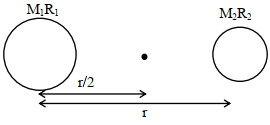
The masses and radii of the earth and moon are $(M_1, R_1)$ and $(M_2, R_2)$ respectively. Their centers are at a distance $r$ apart. Find the minimum escape velocity for a particle of mass $m$ to be projected from the midpoint between these two masses.
A
$V = \frac{1}{2} \sqrt{\frac{4G(M_1 + M_2)}{r}}$
B
$V = \sqrt{\frac{4G(M_1 + M_2)}{r}}$
C
$V = \frac{1}{2} \sqrt{\frac{2G(M_1 + M_2)}{r}}$
D
$V = \frac{\sqrt{2G}(M_1 + M_2)}{r}$
Solution
(B) To escape the gravitational influence of both masses,the particle must reach a point where the total gravitational potential energy is zero,which is at infinity. By the law of conservation of energy,the total energy at the midpoint must be equal to the total energy at infinity (which is $0$).
At the midpoint,the distance from each mass is $r/2$.
The total energy at the midpoint is the sum of kinetic energy and gravitational potential energy:
$E_i = \frac{1}{2}mV^2 - \frac{GM_1m}{r/2} - \frac{GM_2m}{r/2}$
Setting the total energy to zero:
$\frac{1}{2}mV^2 - \frac{2GM_1m}{r} - \frac{2GM_2m}{r} = 0$
$\frac{1}{2}mV^2 = \frac{2Gm}{r}(M_1 + M_2)$
$V^2 = \frac{4G(M_1 + M_2)}{r}$
$V = \sqrt{\frac{4G(M_1 + M_2)}{r}}$
At the midpoint,the distance from each mass is $r/2$.
The total energy at the midpoint is the sum of kinetic energy and gravitational potential energy:
$E_i = \frac{1}{2}mV^2 - \frac{GM_1m}{r/2} - \frac{GM_2m}{r/2}$
Setting the total energy to zero:
$\frac{1}{2}mV^2 - \frac{2GM_1m}{r} - \frac{2GM_2m}{r} = 0$
$\frac{1}{2}mV^2 = \frac{2Gm}{r}(M_1 + M_2)$
$V^2 = \frac{4G(M_1 + M_2)}{r}$
$V = \sqrt{\frac{4G(M_1 + M_2)}{r}}$
0 likes
View Solution130
MediumMCQ
The escape velocity from the Earth's surface is $v$. The escape velocity from the surface of another planet having a radius four times that of Earth and the same mass density is:
A
$v$
B
$2 v$
C
$3 v$
D
$4 v$
Solution
(D) The formula for escape velocity is $v_{e} = \sqrt{\frac{2GM}{R}}$.
Since mass $M = \text{Volume} \times \text{Density} = \frac{4}{3} \pi R^{3} \rho$,we substitute this into the formula:
$v_{e} = \sqrt{\frac{2G}{R} \times \frac{4}{3} \pi R^{3} \rho} = \sqrt{\frac{8 \pi G \rho}{3} R^{2}} = R \sqrt{\frac{8 \pi G \rho}{3}}$.
This shows that $v_{e} \propto R$ when the density $\rho$ is constant.
Given the radius of the new planet is $R' = 4R$,the new escape velocity $v'$ will be:
$v' = 4 \times v_{e} = 4v$.
Since mass $M = \text{Volume} \times \text{Density} = \frac{4}{3} \pi R^{3} \rho$,we substitute this into the formula:
$v_{e} = \sqrt{\frac{2G}{R} \times \frac{4}{3} \pi R^{3} \rho} = \sqrt{\frac{8 \pi G \rho}{3} R^{2}} = R \sqrt{\frac{8 \pi G \rho}{3}}$.
This shows that $v_{e} \propto R$ when the density $\rho$ is constant.
Given the radius of the new planet is $R' = 4R$,the new escape velocity $v'$ will be:
$v' = 4 \times v_{e} = 4v$.
1 likes
View Solution131
DifficultMCQ
$A$ particle of mass $m$ is projected with a velocity $v = k V_{e}$ $(k < 1)$ from the surface of the earth. $(V_{e} = \text{escape velocity})$. The maximum height above the surface reached by the particle is:
A
$R \left( \frac{k^2}{1-k^2} \right)$
B
$R \left( \frac{k}{1+k} \right)^2$
C
$\frac{R^2 k}{1+k}$
D
$\frac{R k^2}{1-k^2}$
Solution
(D) By the law of conservation of energy, the total energy at the surface equals the total energy at the maximum height $r$ where velocity is zero.
$-\frac{GMm}{R} + \frac{1}{2} m v^2 = -\frac{GMm}{r}$
Given $v = k V_{e}$ and $V_{e} = \sqrt{\frac{2GM}{R}}$, we have $v^2 = k^2 \frac{2GM}{R}$.
Substituting this into the energy equation:
$-\frac{GMm}{R} + \frac{1}{2} m \left( k^2 \frac{2GM}{R} \right) = -\frac{GMm}{r}$
Dividing by $GMm$:
$-\frac{1}{R} + \frac{k^2}{R} = -\frac{1}{r}$
$\frac{1}{r} = \frac{1}{R} - \frac{k^2}{R} = \frac{1-k^2}{R}$
$r = \frac{R}{1-k^2}$
Since $r = R + h$, the maximum height $h$ is:
$h = r - R = \frac{R}{1-k^2} - R = R \left( \frac{1 - (1-k^2)}{1-k^2} \right) = \frac{R k^2}{1-k^2}$.
$-\frac{GMm}{R} + \frac{1}{2} m v^2 = -\frac{GMm}{r}$
Given $v = k V_{e}$ and $V_{e} = \sqrt{\frac{2GM}{R}}$, we have $v^2 = k^2 \frac{2GM}{R}$.
Substituting this into the energy equation:
$-\frac{GMm}{R} + \frac{1}{2} m \left( k^2 \frac{2GM}{R} \right) = -\frac{GMm}{r}$
Dividing by $GMm$:
$-\frac{1}{R} + \frac{k^2}{R} = -\frac{1}{r}$
$\frac{1}{r} = \frac{1}{R} - \frac{k^2}{R} = \frac{1-k^2}{R}$
$r = \frac{R}{1-k^2}$
Since $r = R + h$, the maximum height $h$ is:
$h = r - R = \frac{R}{1-k^2} - R = R \left( \frac{1 - (1-k^2)}{1-k^2} \right) = \frac{R k^2}{1-k^2}$.
0 likes
View Solution132
DifficultMCQ
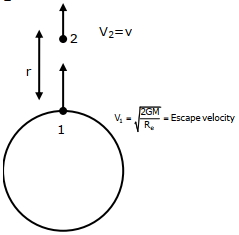
$A$ body is projected vertically upwards from the surface of the Earth with a velocity sufficient enough to carry it to infinity. The time taken by it to reach height $h$ is $....\,S.$
A
$\frac{1}{3} \sqrt{\frac{2 R_{e}}{g}}\left[\left(1+\frac{h}{R_{e}}\right)^{3 / 2}-1\right]$
B
$\sqrt{\frac{2 R_{e}}{g}}\left[\left(1+\frac{h}{R_{e}}\right)^{3 / 2}-1\right]$
C
$\frac{1}{3} \sqrt{\frac{R_{e}}{g}}\left[\left(1+\frac{h}{R_{e}}\right)^{3 / 2}-1\right]$
D
$\sqrt{\frac{R_{e}}{g}}\left[\left(1+\frac{h}{R_{e}}\right)^{3 / 2}-1\right]$
Solution
(A) The body is projected with escape velocity $v_e = \sqrt{\frac{2GM}{R_e}}$.
By conservation of energy at the surface and at a distance $r$ from the center of the Earth:
$\frac{1}{2}mv^2 - \frac{GMm}{r} = 0$ (since total energy is zero for escape velocity).
$\frac{1}{2}mv^2 = \frac{GMm}{r} \Rightarrow v = \sqrt{\frac{2GM}{r}} = \frac{dr}{dt}$.
Separating variables: $dt = \frac{dr}{\sqrt{2GM}} \cdot \sqrt{r}$.
Integrating from $t=0$ at $r=R_e$ to time $t$ at $r=R_e+h$:
$t = \frac{1}{\sqrt{2GM}} \int_{R_e}^{R_e+h} r^{1/2} dr = \frac{1}{\sqrt{2GM}} \cdot \frac{2}{3} [r^{3/2}]_{R_e}^{R_e+h}$.
$t = \frac{2}{3\sqrt{2GM}} [ (R_e+h)^{3/2} - R_e^{3/2} ] = \frac{2}{3\sqrt{2GM}} R_e^{3/2} [ (1 + \frac{h}{R_e})^{3/2} - 1 ]$.
Since $GM = gR_e^2$,we have $\sqrt{GM} = \sqrt{g}R_e$.
Substituting this: $t = \frac{2 R_e^{3/2}}{3 \sqrt{2} \sqrt{g} R_e} [ (1 + \frac{h}{R_e})^{3/2} - 1 ] = \frac{1}{3} \sqrt{\frac{2R_e}{g}} [ (1 + \frac{h}{R_e})^{3/2} - 1 ]$.
By conservation of energy at the surface and at a distance $r$ from the center of the Earth:
$\frac{1}{2}mv^2 - \frac{GMm}{r} = 0$ (since total energy is zero for escape velocity).
$\frac{1}{2}mv^2 = \frac{GMm}{r} \Rightarrow v = \sqrt{\frac{2GM}{r}} = \frac{dr}{dt}$.
Separating variables: $dt = \frac{dr}{\sqrt{2GM}} \cdot \sqrt{r}$.
Integrating from $t=0$ at $r=R_e$ to time $t$ at $r=R_e+h$:
$t = \frac{1}{\sqrt{2GM}} \int_{R_e}^{R_e+h} r^{1/2} dr = \frac{1}{\sqrt{2GM}} \cdot \frac{2}{3} [r^{3/2}]_{R_e}^{R_e+h}$.
$t = \frac{2}{3\sqrt{2GM}} [ (R_e+h)^{3/2} - R_e^{3/2} ] = \frac{2}{3\sqrt{2GM}} R_e^{3/2} [ (1 + \frac{h}{R_e})^{3/2} - 1 ]$.
Since $GM = gR_e^2$,we have $\sqrt{GM} = \sqrt{g}R_e$.
Substituting this: $t = \frac{2 R_e^{3/2}}{3 \sqrt{2} \sqrt{g} R_e} [ (1 + \frac{h}{R_e})^{3/2} - 1 ] = \frac{1}{3} \sqrt{\frac{2R_e}{g}} [ (1 + \frac{h}{R_e})^{3/2} - 1 ]$.
0 likes
View Solution133
MediumMCQ
The escape velocity of a body on a planet $A$ is $12 \, km/s$. The escape velocity of the body on another planet $B$,whose density is four times and radius is half of the planet $A$,is ................... $km/s$.
A
$12$
B
$24$
C
$36$
D
$6$
Solution
(A) The formula for escape velocity is $V_e = \sqrt{\frac{2GM}{R}}$.
Since mass $M = \rho \times \text{Volume} = \rho \times \frac{4}{3} \pi R^3$,we can write $V_e = \sqrt{\frac{2G \rho \frac{4}{3} \pi R^3}{R}} = \sqrt{\frac{8}{3} G \pi \rho R^2}$.
This implies $V_e \propto R \sqrt{\rho}$.
Given for planet $B$: $\rho_B = 4\rho_A$ and $R_B = \frac{1}{2}R_A$.
Therefore,$\frac{V_{eB}}{V_{eA}} = \frac{R_B}{R_A} \sqrt{\frac{\rho_B}{\rho_A}} = \left(\frac{1}{2}\right) \sqrt{4} = \frac{1}{2} \times 2 = 1$.
Thus,$V_{eB} = V_{eA} = 12 \, km/s$.
Since mass $M = \rho \times \text{Volume} = \rho \times \frac{4}{3} \pi R^3$,we can write $V_e = \sqrt{\frac{2G \rho \frac{4}{3} \pi R^3}{R}} = \sqrt{\frac{8}{3} G \pi \rho R^2}$.
This implies $V_e \propto R \sqrt{\rho}$.
Given for planet $B$: $\rho_B = 4\rho_A$ and $R_B = \frac{1}{2}R_A$.
Therefore,$\frac{V_{eB}}{V_{eA}} = \frac{R_B}{R_A} \sqrt{\frac{\rho_B}{\rho_A}} = \left(\frac{1}{2}\right) \sqrt{4} = \frac{1}{2} \times 2 = 1$.
Thus,$V_{eB} = V_{eA} = 12 \, km/s$.
0 likes
View Solution134
DifficultMCQ
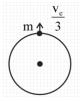
$A$ body is projected vertically upwards from the surface of the Earth with a velocity equal to one-third of the escape velocity. The maximum height attained by the body will be $...... \ km$. (Take radius of Earth $R = 6400 \ km$ and $g = 10 \ m/s^2$)
A
$800$
B
$1600$
C
$2133$
D
$4800$
Solution
(A) Let $v_e$ be the escape velocity,given by $v_e = \sqrt{\frac{2GM}{R}}$.
According to the law of conservation of energy,the total energy at the surface of the Earth equals the total energy at the maximum height $h$.
At the surface: $E_i = -\frac{GMm}{R} + \frac{1}{2}m v^2$,where $v = \frac{v_e}{3}$.
At maximum height $h$: $E_f = -\frac{GMm}{R+h}$.
Equating $E_i = E_f$:
$-\frac{GMm}{R} + \frac{1}{2}m \left(\frac{v_e}{3}\right)^2 = -\frac{GMm}{R+h}$
$-\frac{GMm}{R} + \frac{1}{2}m \left(\frac{2GM}{9R}\right) = -\frac{GMm}{R+h}$
$-\frac{GMm}{R} + \frac{GMm}{9R} = -\frac{GMm}{R+h}$
$-\frac{8GMm}{9R} = -\frac{GMm}{R+h}$
$\frac{8}{9R} = \frac{1}{R+h}$
$8(R+h) = 9R$
$8R + 8h = 9R$
$8h = R$
$h = \frac{R}{8} = \frac{6400 \ km}{8} = 800 \ km$.
According to the law of conservation of energy,the total energy at the surface of the Earth equals the total energy at the maximum height $h$.
At the surface: $E_i = -\frac{GMm}{R} + \frac{1}{2}m v^2$,where $v = \frac{v_e}{3}$.
At maximum height $h$: $E_f = -\frac{GMm}{R+h}$.
Equating $E_i = E_f$:
$-\frac{GMm}{R} + \frac{1}{2}m \left(\frac{v_e}{3}\right)^2 = -\frac{GMm}{R+h}$
$-\frac{GMm}{R} + \frac{1}{2}m \left(\frac{2GM}{9R}\right) = -\frac{GMm}{R+h}$
$-\frac{GMm}{R} + \frac{GMm}{9R} = -\frac{GMm}{R+h}$
$-\frac{8GMm}{9R} = -\frac{GMm}{R+h}$
$\frac{8}{9R} = \frac{1}{R+h}$
$8(R+h) = 9R$
$8R + 8h = 9R$
$8h = R$
$h = \frac{R}{8} = \frac{6400 \ km}{8} = 800 \ km$.
0 likes
View Solution135
DifficultMCQ
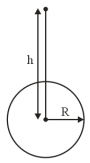
$A$ body of mass $m$ is projected with velocity $\lambda v_{e}$ in a vertically upward direction from the surface of the earth into space. It is given that $v_{e}$ is the escape velocity and $\lambda < 1$. If air resistance is considered to be negligible,then the maximum height from the center of the earth,to which the body can go,will be: ($R$: radius of earth)
A
$\frac{R}{1+\lambda^{2}}$
B
$\frac{R}{1-\lambda^{2}}$
C
$\frac{R}{1-\lambda}$
D
$\frac{\lambda^{2} R}{1-\lambda^{2}}$
Solution
(B) According to the law of conservation of energy,the total energy at the surface of the earth is equal to the total energy at the maximum height $h$ from the center of the earth.
Total energy at surface = Total energy at height $h$
$-\frac{GMm}{R} + \frac{1}{2}m(\lambda v_{e})^{2} = -\frac{GMm}{h} + 0$
Since the escape velocity $v_{e} = \sqrt{\frac{2GM}{R}}$,we have $v_{e}^{2} = \frac{2GM}{R}$.
Substituting this into the equation:
$-\frac{GMm}{R} + \frac{1}{2}m\lambda^{2}(\frac{2GM}{R}) = -\frac{GMm}{h}$
$-\frac{GMm}{R} + \frac{\lambda^{2}GMm}{R} = -\frac{GMm}{h}$
Dividing both sides by $-GMm$:
$\frac{1}{R} - \frac{\lambda^{2}}{R} = \frac{1}{h}$
$\frac{1-\lambda^{2}}{R} = \frac{1}{h}$
$h = \frac{R}{1-\lambda^{2}}$
Total energy at surface = Total energy at height $h$
$-\frac{GMm}{R} + \frac{1}{2}m(\lambda v_{e})^{2} = -\frac{GMm}{h} + 0$
Since the escape velocity $v_{e} = \sqrt{\frac{2GM}{R}}$,we have $v_{e}^{2} = \frac{2GM}{R}$.
Substituting this into the equation:
$-\frac{GMm}{R} + \frac{1}{2}m\lambda^{2}(\frac{2GM}{R}) = -\frac{GMm}{h}$
$-\frac{GMm}{R} + \frac{\lambda^{2}GMm}{R} = -\frac{GMm}{h}$
Dividing both sides by $-GMm$:
$\frac{1}{R} - \frac{\lambda^{2}}{R} = \frac{1}{h}$
$\frac{1-\lambda^{2}}{R} = \frac{1}{h}$
$h = \frac{R}{1-\lambda^{2}}$
0 likes
View Solution136
DifficultMCQ
$A$ small asteroid is orbiting around the sun in a circular orbit of radius $r_0$ with speed $v_0$. $A$ rocket is launched from the asteroid with speed $v = \alpha v_0$,where $v$ is the speed relative to the sun. The highest value of $\alpha$ for which the rocket will remain bound to the solar system is (ignoring gravity due to the asteroid and effects of other planets).
A
$\sqrt{2}$
B
$2$
C
$\sqrt{3}$
D
$1$
Solution
(A) The total energy of the rocket at the instant of launch must be less than or equal to zero for it to remain bound to the solar system.
The orbital speed of the asteroid is given by $v_0 = \sqrt{\frac{GM}{r_0}}$,which implies $v_0^2 = \frac{GM}{r_0}$.
The total energy $E$ of the rocket relative to the sun is the sum of its gravitational potential energy and its kinetic energy:
$E = -\frac{GMm}{r_0} + \frac{1}{2}mv^2$
Given that the speed of the rocket relative to the sun is $v = \alpha v_0$,we substitute this into the energy equation:
$E = -\frac{GMm}{r_0} + \frac{1}{2}m(\alpha v_0)^2$
For the rocket to remain bound,$E \leq 0$:
$-\frac{GMm}{r_0} + \frac{1}{2}m \alpha^2 v_0^2 \leq 0$
Substituting $v_0^2 = \frac{GM}{r_0}$:
$-\frac{GMm}{r_0} + \frac{1}{2}m \alpha^2 \left(\frac{GM}{r_0}\right) \leq 0$
Dividing by $\frac{GMm}{r_0}$:
$-1 + \frac{1}{2} \alpha^2 \leq 0$
$\frac{1}{2} \alpha^2 \leq 1$
$\alpha^2 \leq 2$
$\alpha \leq \sqrt{2}$
Wait,re-evaluating the launch condition: If the rocket is launched *from* the asteroid,its initial velocity relative to the sun is the vector sum of the asteroid's orbital velocity and the launch velocity. However,the problem states $v = \alpha v_0$ is the speed relative to the sun. Thus,the condition for being bound is $E \leq 0$,leading to $\alpha \leq \sqrt{2}$. The highest value is $\sqrt{2}$.
The orbital speed of the asteroid is given by $v_0 = \sqrt{\frac{GM}{r_0}}$,which implies $v_0^2 = \frac{GM}{r_0}$.
The total energy $E$ of the rocket relative to the sun is the sum of its gravitational potential energy and its kinetic energy:
$E = -\frac{GMm}{r_0} + \frac{1}{2}mv^2$
Given that the speed of the rocket relative to the sun is $v = \alpha v_0$,we substitute this into the energy equation:
$E = -\frac{GMm}{r_0} + \frac{1}{2}m(\alpha v_0)^2$
For the rocket to remain bound,$E \leq 0$:
$-\frac{GMm}{r_0} + \frac{1}{2}m \alpha^2 v_0^2 \leq 0$
Substituting $v_0^2 = \frac{GM}{r_0}$:
$-\frac{GMm}{r_0} + \frac{1}{2}m \alpha^2 \left(\frac{GM}{r_0}\right) \leq 0$
Dividing by $\frac{GMm}{r_0}$:
$-1 + \frac{1}{2} \alpha^2 \leq 0$
$\frac{1}{2} \alpha^2 \leq 1$
$\alpha^2 \leq 2$
$\alpha \leq \sqrt{2}$
Wait,re-evaluating the launch condition: If the rocket is launched *from* the asteroid,its initial velocity relative to the sun is the vector sum of the asteroid's orbital velocity and the launch velocity. However,the problem states $v = \alpha v_0$ is the speed relative to the sun. Thus,the condition for being bound is $E \leq 0$,leading to $\alpha \leq \sqrt{2}$. The highest value is $\sqrt{2}$.
0 likes
View Solution137
MediumMCQ
Let the escape velocity of a body kept at the surface of a planet be $u$. If it is projected at a speed of $200 \%$ more than the escape speed,then its speed in interstellar space will be ...........
A
$u$
B
$\sqrt{3} u$
C
$2 u$
D
$2 \sqrt{2} u$
Solution
(D) Given: Escape velocity $= u$.
The initial velocity of the projectile is $200 \%$ more than the escape velocity.
$V_{\text{initial}} = u + (200/100)u = u + 2u = 3u$.
According to the Law of Conservation of Energy:
$\frac{1}{2} m V_{\text{initial}}^2 + (P.E.)_{\text{initial}} = \frac{1}{2} m V_{\text{final}}^2 + (P.E.)_{\text{final}}$.
At the surface of the planet,the potential energy is $P.E. = -\frac{GMm}{R} = -m u^2$ (since $u = \sqrt{\frac{2GM}{R}}$,so $u^2 = \frac{2GM}{R}$,which implies $\frac{GM}{R} = \frac{u^2}{2}$,thus $P.E. = -\frac{m u^2}{2}$).
In interstellar space,the potential energy is $0$.
$\frac{1}{2} m (3u)^2 - \frac{1}{2} m u^2 = \frac{1}{2} m V_{\text{final}}^2$.
$\frac{9}{2} u^2 - \frac{1}{2} u^2 = \frac{1}{2} V_{\text{final}}^2$.
$8 u^2 = V_{\text{final}}^2$.
$V_{\text{final}} = \sqrt{8} u = 2\sqrt{2} u$.
The initial velocity of the projectile is $200 \%$ more than the escape velocity.
$V_{\text{initial}} = u + (200/100)u = u + 2u = 3u$.
According to the Law of Conservation of Energy:
$\frac{1}{2} m V_{\text{initial}}^2 + (P.E.)_{\text{initial}} = \frac{1}{2} m V_{\text{final}}^2 + (P.E.)_{\text{final}}$.
At the surface of the planet,the potential energy is $P.E. = -\frac{GMm}{R} = -m u^2$ (since $u = \sqrt{\frac{2GM}{R}}$,so $u^2 = \frac{2GM}{R}$,which implies $\frac{GM}{R} = \frac{u^2}{2}$,thus $P.E. = -\frac{m u^2}{2}$).
In interstellar space,the potential energy is $0$.
$\frac{1}{2} m (3u)^2 - \frac{1}{2} m u^2 = \frac{1}{2} m V_{\text{final}}^2$.
$\frac{9}{2} u^2 - \frac{1}{2} u^2 = \frac{1}{2} V_{\text{final}}^2$.
$8 u^2 = V_{\text{final}}^2$.
$V_{\text{final}} = \sqrt{8} u = 2\sqrt{2} u$.
0 likes
View Solution138
MediumMCQ
The escape velocity of an atmospheric particle which is $1000 \, km$ above the Earth's surface is .......... $km/s$ (radius of Earth is $6400 \, km$ and $g = 9.8 \, m/s^2$).
A
$6.5$
B
$8$
C
$10.4$
D
$11.2$
Solution
(C) The escape velocity $V_e$ at a height $h$ from the Earth's surface is given by the formula: $V_e = \sqrt{\frac{2GM}{R+h}}$.
We know that the escape velocity at the Earth's surface $(h=0)$ is $V_0 = \sqrt{\frac{2GM}{R}} \approx 11.2 \, km/s$.
Therefore,the escape velocity at height $h$ is $V_h = V_0 \sqrt{\frac{R}{R+h}}$.
Given $R = 6400 \, km$ and $h = 1000 \, km$,we have $R+h = 7400 \, km$.
Substituting the values: $V_h = 11.2 \times \sqrt{\frac{6400}{7400}}$.
$V_h = 11.2 \times \sqrt{\frac{64}{74}} = 11.2 \times \sqrt{0.8648} \approx 11.2 \times 0.93 = 10.416 \, km/s$.
Rounding to the nearest option,we get $10.4 \, km/s$.
We know that the escape velocity at the Earth's surface $(h=0)$ is $V_0 = \sqrt{\frac{2GM}{R}} \approx 11.2 \, km/s$.
Therefore,the escape velocity at height $h$ is $V_h = V_0 \sqrt{\frac{R}{R+h}}$.
Given $R = 6400 \, km$ and $h = 1000 \, km$,we have $R+h = 7400 \, km$.
Substituting the values: $V_h = 11.2 \times \sqrt{\frac{6400}{7400}}$.
$V_h = 11.2 \times \sqrt{\frac{64}{74}} = 11.2 \times \sqrt{0.8648} \approx 11.2 \times 0.93 = 10.416 \, km/s$.
Rounding to the nearest option,we get $10.4 \, km/s$.
0 likes
View Solution139
MediumMCQ
The ratio of the kinetic energy required to be given to a satellite to escape from the Earth's surface to the kinetic energy required to be given to the same satellite to revolve around the Earth in an orbit just above the Earth's surface is ...........
A
$1: 1$
B
$2: 1$
C
$\sqrt{2}: 1$
D
$4: 1$
Solution
(B) Let $m$ be the mass of the satellite and $M$ be the mass of the Earth. The radius of the Earth is $R$.
$1$. Kinetic energy required for escape $(E_1)$: The escape velocity is $v_e = \sqrt{\frac{2GM}{R}}$. Thus,$E_1 = \frac{1}{2} m v_e^2 = \frac{1}{2} m \left(\frac{2GM}{R}\right) = \frac{GMm}{R}$.
$2$. Kinetic energy required for orbital motion just above the surface $(E_2)$: The orbital velocity is $v_0 = \sqrt{\frac{GM}{R}}$. Thus,$E_2 = \frac{1}{2} m v_0^2 = \frac{1}{2} m \left(\frac{GM}{R}\right) = \frac{GMm}{2R}$.
$3$. The ratio is $\frac{E_1}{E_2} = \frac{GMm/R}{GMm/2R} = 2:1$.
$1$. Kinetic energy required for escape $(E_1)$: The escape velocity is $v_e = \sqrt{\frac{2GM}{R}}$. Thus,$E_1 = \frac{1}{2} m v_e^2 = \frac{1}{2} m \left(\frac{2GM}{R}\right) = \frac{GMm}{R}$.
$2$. Kinetic energy required for orbital motion just above the surface $(E_2)$: The orbital velocity is $v_0 = \sqrt{\frac{GM}{R}}$. Thus,$E_2 = \frac{1}{2} m v_0^2 = \frac{1}{2} m \left(\frac{GM}{R}\right) = \frac{GMm}{2R}$.
$3$. The ratio is $\frac{E_1}{E_2} = \frac{GMm/R}{GMm/2R} = 2:1$.
0 likes
View Solution140
EasyMCQ
The magnitude of potential energy per unit mass of an object at the surface of the Earth is $E$. Then,the escape velocity of the object is ..........
A
$\sqrt{2 E}$
B
$4 E^2$
C
$\sqrt{E}$
D
$2 E$
Solution
(A) The gravitational potential energy $(U)$ of an object of mass $m$ at the surface of the Earth (mass $M$,radius $R$) is given by $U = -\frac{G M m}{R}$.
The potential energy per unit mass is defined as $\frac{U}{m} = -\frac{G M}{R}$.
The magnitude of this value is given as $E = \frac{G M}{R}$.
The formula for escape velocity $(v_e)$ is $v_e = \sqrt{\frac{2 G M}{R}}$.
Substituting $E = \frac{G M}{R}$ into the escape velocity formula,we get $v_e = \sqrt{2 E}$.
The potential energy per unit mass is defined as $\frac{U}{m} = -\frac{G M}{R}$.
The magnitude of this value is given as $E = \frac{G M}{R}$.
The formula for escape velocity $(v_e)$ is $v_e = \sqrt{\frac{2 G M}{R}}$.
Substituting $E = \frac{G M}{R}$ into the escape velocity formula,we get $v_e = \sqrt{2 E}$.
0 likes
View Solution141
DifficultMCQ
$A$ particle is projected vertically up with velocity $v = \sqrt{\frac{4 g R_e}{3}}$ from the Earth's surface. The velocity of the particle at a height equal to half of the maximum height reached by it is .........
A
$\sqrt{\frac{g R_e}{2}}$
B
$\sqrt{\frac{g R_e}{3}}$
C
$\sqrt{g R_e}$
D
$\sqrt{\frac{2 g R_e}{3}}$
Solution
(B) Using the conservation of mechanical energy between the Earth's surface $(r = R_e)$ and the maximum height $(r = r_{max})$:
$U_i + K_i = U_f + K_f$
$-\frac{G M m}{R_e} + \frac{1}{2} m v^2 = -\frac{G M m}{r_{max}} + 0$
Given $v^2 = \frac{4 g R_e}{3}$ and $g = \frac{G M}{R_e^2}$,so $v^2 = \frac{4 G M}{3 R_e}$.
$-\frac{G M m}{R_e} + \frac{1}{2} m (\frac{4 G M}{3 R_e}) = -\frac{G M m}{r_{max}}$
$-\frac{G M m}{R_e} + \frac{2 G M m}{3 R_e} = -\frac{G M m}{r_{max}}$
$-\frac{1}{3} \frac{G M m}{R_e} = -\frac{G M m}{r_{max}} \Rightarrow r_{max} = 3 R_e$.
The maximum height $h_{max} = r_{max} - R_e = 2 R_e$.
We need the velocity $v'$ at height $h = \frac{h_{max}}{2} = R_e$,which corresponds to $r = 2 R_e$.
Applying conservation of energy again:
$-\frac{G M m}{R_e} + \frac{1}{2} m v^2 = -\frac{G M m}{2 R_e} + \frac{1}{2} m (v')^2$
$-\frac{G M m}{R_e} + \frac{2 G M m}{3 R_e} = -\frac{G M m}{2 R_e} + \frac{1}{2} m (v')^2$
$-\frac{1}{3} \frac{G M m}{R_e} + \frac{1}{2} \frac{G M m}{R_e} = \frac{1}{2} m (v')^2$
$\frac{1}{6} \frac{G M m}{R_e} = \frac{1}{2} m (v')^2$
$(v')^2 = \frac{G M}{3 R_e} = \frac{g R_e}{3} \Rightarrow v' = \sqrt{\frac{g R_e}{3}}$.
$U_i + K_i = U_f + K_f$
$-\frac{G M m}{R_e} + \frac{1}{2} m v^2 = -\frac{G M m}{r_{max}} + 0$
Given $v^2 = \frac{4 g R_e}{3}$ and $g = \frac{G M}{R_e^2}$,so $v^2 = \frac{4 G M}{3 R_e}$.
$-\frac{G M m}{R_e} + \frac{1}{2} m (\frac{4 G M}{3 R_e}) = -\frac{G M m}{r_{max}}$
$-\frac{G M m}{R_e} + \frac{2 G M m}{3 R_e} = -\frac{G M m}{r_{max}}$
$-\frac{1}{3} \frac{G M m}{R_e} = -\frac{G M m}{r_{max}} \Rightarrow r_{max} = 3 R_e$.
The maximum height $h_{max} = r_{max} - R_e = 2 R_e$.
We need the velocity $v'$ at height $h = \frac{h_{max}}{2} = R_e$,which corresponds to $r = 2 R_e$.
Applying conservation of energy again:
$-\frac{G M m}{R_e} + \frac{1}{2} m v^2 = -\frac{G M m}{2 R_e} + \frac{1}{2} m (v')^2$
$-\frac{G M m}{R_e} + \frac{2 G M m}{3 R_e} = -\frac{G M m}{2 R_e} + \frac{1}{2} m (v')^2$
$-\frac{1}{3} \frac{G M m}{R_e} + \frac{1}{2} \frac{G M m}{R_e} = \frac{1}{2} m (v')^2$
$\frac{1}{6} \frac{G M m}{R_e} = \frac{1}{2} m (v')^2$
$(v')^2 = \frac{G M}{3 R_e} = \frac{g R_e}{3} \Rightarrow v' = \sqrt{\frac{g R_e}{3}}$.
0 likes
View Solution142
MediumMCQ
When the total energy of a satellite-planet system is positive,the satellite will .......
A
Move around the planet in a circular orbit
B
Move around the planet in an elliptical orbit
C
Escape out with minimum speed
D
Escape out with a speed greater than the escape velocity
Solution
(D) The total energy $E$ of a satellite-planet system is given by $E = K + U$,where $K$ is the kinetic energy and $U$ is the potential energy.
If $E < 0$,the satellite is in a bound state (circular or elliptical orbit).
If $E = 0$,the satellite is at the threshold of escaping the gravitational field (it moves with escape velocity $v_e$).
If $E > 0$,the kinetic energy is greater than the magnitude of the potential energy,meaning the satellite has excess energy.
Therefore,the satellite will escape the gravitational field of the planet with a speed greater than the escape velocity.
If $E < 0$,the satellite is in a bound state (circular or elliptical orbit).
If $E = 0$,the satellite is at the threshold of escaping the gravitational field (it moves with escape velocity $v_e$).
If $E > 0$,the kinetic energy is greater than the magnitude of the potential energy,meaning the satellite has excess energy.
Therefore,the satellite will escape the gravitational field of the planet with a speed greater than the escape velocity.
0 likes
View Solution143
DifficultMCQ
If an object is projected vertically upwards with a speed equal to half the escape speed of Earth,then the maximum height attained by it is ($R$ is the radius of Earth).
A
$R$
B
$\frac{R}{2}$
C
$2 R$
D
$\frac{R}{3}$
Solution
(D) The escape speed of Earth is given by $v_e = \sqrt{\frac{2GM}{R}}$.
Given that the projection speed $v = \frac{1}{2} v_e = \frac{1}{2} \sqrt{\frac{2GM}{R}}$.
Using the law of conservation of mechanical energy between the surface of the Earth and the maximum height $H$ (where the final velocity is zero):
$E_i = E_f$
$-\frac{GMm}{R} + \frac{1}{2}mv^2 = -\frac{GMm}{R+H} + 0$
Substituting $v^2 = \frac{1}{4} \left(\frac{2GM}{R}\right) = \frac{GM}{2R}$:
$-\frac{GMm}{R} + \frac{1}{2}m \left(\frac{GM}{2R}\right) = -\frac{GMm}{R+H}$
$-\frac{GMm}{R} + \frac{GMm}{4R} = -\frac{GMm}{R+H}$
$-\frac{3GMm}{4R} = -\frac{GMm}{R+H}$
$\frac{3}{4R} = \frac{1}{R+H}$
$3(R+H) = 4R$
$3R + 3H = 4R$
$3H = R$
$H = \frac{R}{3}$
Given that the projection speed $v = \frac{1}{2} v_e = \frac{1}{2} \sqrt{\frac{2GM}{R}}$.
Using the law of conservation of mechanical energy between the surface of the Earth and the maximum height $H$ (where the final velocity is zero):
$E_i = E_f$
$-\frac{GMm}{R} + \frac{1}{2}mv^2 = -\frac{GMm}{R+H} + 0$
Substituting $v^2 = \frac{1}{4} \left(\frac{2GM}{R}\right) = \frac{GM}{2R}$:
$-\frac{GMm}{R} + \frac{1}{2}m \left(\frac{GM}{2R}\right) = -\frac{GMm}{R+H}$
$-\frac{GMm}{R} + \frac{GMm}{4R} = -\frac{GMm}{R+H}$
$-\frac{3GMm}{4R} = -\frac{GMm}{R+H}$
$\frac{3}{4R} = \frac{1}{R+H}$
$3(R+H) = 4R$
$3R + 3H = 4R$
$3H = R$
$H = \frac{R}{3}$
0 likes
View Solution144
MediumMCQ
$A$ body is thrown with a velocity equal to $n$ times the escape velocity $(v_e)$. What will be the velocity of the body at a large distance away?
A
$v_e \sqrt{n^2-1}$
B
$v_e \sqrt{n^2+1}$
C
$v_e \sqrt{1-n^2}$
D
None of these
Solution
(A) According to the principle of conservation of mechanical energy,the total energy at the surface of the Earth must equal the total energy at a large distance (infinity) from the Earth.
Let $m$ be the mass of the body,$M$ be the mass of the Earth,and $R$ be the radius of the Earth.
At the surface of the Earth,the velocity is $v = n v_e$,where $v_e = \sqrt{\frac{2GM}{R}}$.
Total energy at the surface: $E_i = \frac{1}{2} m (n v_e)^2 - \frac{GMm}{R}$.
At a large distance,the potential energy is $0$. Let the final velocity be $v_f$.
Total energy at a large distance: $E_f = \frac{1}{2} m v_f^2$.
Equating $E_i = E_f$:
$\frac{1}{2} m n^2 v_e^2 - \frac{GMm}{R} = \frac{1}{2} m v_f^2$.
Since $v_e^2 = \frac{2GM}{R}$,we have $\frac{GM}{R} = \frac{v_e^2}{2}$.
Substituting this into the equation:
$\frac{1}{2} m n^2 v_e^2 - m \left(\frac{v_e^2}{2}\right) = \frac{1}{2} m v_f^2$.
Dividing by $\frac{1}{2} m$:
$n^2 v_e^2 - v_e^2 = v_f^2$.
$v_f^2 = v_e^2 (n^2 - 1)$.
$v_f = v_e \sqrt{n^2 - 1}$.
Let $m$ be the mass of the body,$M$ be the mass of the Earth,and $R$ be the radius of the Earth.
At the surface of the Earth,the velocity is $v = n v_e$,where $v_e = \sqrt{\frac{2GM}{R}}$.
Total energy at the surface: $E_i = \frac{1}{2} m (n v_e)^2 - \frac{GMm}{R}$.
At a large distance,the potential energy is $0$. Let the final velocity be $v_f$.
Total energy at a large distance: $E_f = \frac{1}{2} m v_f^2$.
Equating $E_i = E_f$:
$\frac{1}{2} m n^2 v_e^2 - \frac{GMm}{R} = \frac{1}{2} m v_f^2$.
Since $v_e^2 = \frac{2GM}{R}$,we have $\frac{GM}{R} = \frac{v_e^2}{2}$.
Substituting this into the equation:
$\frac{1}{2} m n^2 v_e^2 - m \left(\frac{v_e^2}{2}\right) = \frac{1}{2} m v_f^2$.
Dividing by $\frac{1}{2} m$:
$n^2 v_e^2 - v_e^2 = v_f^2$.
$v_f^2 = v_e^2 (n^2 - 1)$.
$v_f = v_e \sqrt{n^2 - 1}$.
0 likes
View Solution145
DifficultMCQ
The escape velocity of a body from the Earth is about $11.2 \, km/s$. Assuming the mass and radius of the Earth to be about $81$ and $4$ times the mass and radius of the Moon,respectively,the escape velocity in $km/s$ from the surface of the Moon will be .......
A
$0.54$
B
$2.48$
C
$11$
D
$49.5$
Solution
(B) The formula for escape velocity is $V_e = \sqrt{\frac{2GM}{R}}$.
Given that the mass of the Earth $(M_e)$ is $81$ times the mass of the Moon $(M_m)$,so $M_e = 81 M_m$.
The radius of the Earth $(R_e)$ is $4$ times the radius of the Moon $(R_m)$,so $R_e = 4 R_m$.
The ratio of escape velocities is given by:
$\frac{V_{e,e}}{V_{e,m}} = \sqrt{\frac{M_e}{M_m} \times \frac{R_m}{R_e}} = \sqrt{81 \times \frac{1}{4}} = \sqrt{\frac{81}{4}} = \frac{9}{2} = 4.5$.
Therefore,the escape velocity from the Moon is $V_{e,m} = \frac{V_{e,e}}{4.5} = \frac{11.2}{4.5} \approx 2.48 \, km/s$.
Given that the mass of the Earth $(M_e)$ is $81$ times the mass of the Moon $(M_m)$,so $M_e = 81 M_m$.
The radius of the Earth $(R_e)$ is $4$ times the radius of the Moon $(R_m)$,so $R_e = 4 R_m$.
The ratio of escape velocities is given by:
$\frac{V_{e,e}}{V_{e,m}} = \sqrt{\frac{M_e}{M_m} \times \frac{R_m}{R_e}} = \sqrt{81 \times \frac{1}{4}} = \sqrt{\frac{81}{4}} = \frac{9}{2} = 4.5$.
Therefore,the escape velocity from the Moon is $V_{e,m} = \frac{V_{e,e}}{4.5} = \frac{11.2}{4.5} \approx 2.48 \, km/s$.
0 likes
View Solution146
MediumMCQ
If $M$ is the mass of a planet and $R$ is its radius,then in order to become a black hole (where $c$ is the speed of light),which condition must be satisfied?
A
$\sqrt{\frac{G M}{R}} \leq c$
B
$\sqrt{\frac{G M}{2 R}} \geq c$
C
$\sqrt{\frac{2 G M}{R}} \geq c$
D
$\sqrt{\frac{2 G M}{R}} \leq c$
Solution
(C) The escape velocity $v_e$ of an object from the surface of a planet is given by the formula $v_e = \sqrt{\frac{2 G M}{R}}$.
$A$ black hole is defined as a celestial object from which even light cannot escape due to its intense gravitational field.
For light to be unable to escape,the escape velocity of the planet must be greater than or equal to the speed of light $c$.
Therefore,the condition is $v_e \geq c$.
Substituting the expression for $v_e$,we get $\sqrt{\frac{2 G M}{R}} \geq c$.
$A$ black hole is defined as a celestial object from which even light cannot escape due to its intense gravitational field.
For light to be unable to escape,the escape velocity of the planet must be greater than or equal to the speed of light $c$.
Therefore,the condition is $v_e \geq c$.
Substituting the expression for $v_e$,we get $\sqrt{\frac{2 G M}{R}} \geq c$.
0 likes
View Solution147
MediumMCQ
When the speed of a satellite is increased by $x$ percentage,it will escape from its orbit,where the value of $x$ is ....... $\%$
A
$11.2$
B
$41.4$
C
$27.5$
D
$34.4$
Solution
(B) For a satellite in a circular orbit near the Earth's surface,the orbital speed is given by $v_0 = \sqrt{\frac{GM_e}{R_e}}$.
The escape velocity required to leave the Earth's gravitational field is $v_e = \sqrt{\frac{2GM_e}{R_e}}$.
Comparing these two expressions,we find that $v_e = \sqrt{2} v_0$.
Since $\sqrt{2} \approx 1.414$,the required escape velocity is $1.414$ times the orbital velocity.
The percentage increase $x$ required is given by $x = \left( \frac{v_e - v_0}{v_0} \right) \times 100$.
Substituting the values: $x = (\sqrt{2} - 1) \times 100 = (1.414 - 1) \times 100 = 41.4 \%$.
The escape velocity required to leave the Earth's gravitational field is $v_e = \sqrt{\frac{2GM_e}{R_e}}$.
Comparing these two expressions,we find that $v_e = \sqrt{2} v_0$.
Since $\sqrt{2} \approx 1.414$,the required escape velocity is $1.414$ times the orbital velocity.
The percentage increase $x$ required is given by $x = \left( \frac{v_e - v_0}{v_0} \right) \times 100$.
Substituting the values: $x = (\sqrt{2} - 1) \times 100 = (1.414 - 1) \times 100 = 41.4 \%$.
0 likes
View Solution148
MediumMCQ
$A$ particle released at a large distance from a planet reaches the planet only under gravitational attraction and passes through a smooth tunnel through its centre. If $v_e$ is the escape velocity of a body at the planet,then the particle's speed at the centre of the planet is
A
$\sqrt{1.5} v_e$
B
$v_e$
C
$1.5 v_e$
D
$2 v_e$
Solution
(A) Let the mass of the particle be $m$,the mass of the planet be $M$,and its radius be $R$.
Taking the gravitational potential at a large distance (infinity) as zero,the total energy of the particle at infinity is $E_i = 0$.
The gravitational potential at the centre of the planet is $V_c = -\frac{3GM}{2R}$.
By the law of conservation of energy,the total energy at infinity equals the total energy at the centre of the planet:
$K_i + U_i = K_c + U_c$
$0 + 0 = \frac{1}{2}mv^2 + m(-\frac{3GM}{2R})$
$\frac{1}{2}mv^2 = \frac{3GMm}{2R}$
$v^2 = \frac{3GM}{R}$
$v = \sqrt{\frac{3GM}{R}}$.
We know that the escape velocity at the surface of the planet is $v_e = \sqrt{\frac{2GM}{R}}$,which implies $\frac{GM}{R} = \frac{v_e^2}{2}$.
Substituting this into the expression for $v$:
$v = \sqrt{3 \cdot \frac{v_e^2}{2}} = \sqrt{1.5} v_e$.
Taking the gravitational potential at a large distance (infinity) as zero,the total energy of the particle at infinity is $E_i = 0$.
The gravitational potential at the centre of the planet is $V_c = -\frac{3GM}{2R}$.
By the law of conservation of energy,the total energy at infinity equals the total energy at the centre of the planet:
$K_i + U_i = K_c + U_c$
$0 + 0 = \frac{1}{2}mv^2 + m(-\frac{3GM}{2R})$
$\frac{1}{2}mv^2 = \frac{3GMm}{2R}$
$v^2 = \frac{3GM}{R}$
$v = \sqrt{\frac{3GM}{R}}$.
We know that the escape velocity at the surface of the planet is $v_e = \sqrt{\frac{2GM}{R}}$,which implies $\frac{GM}{R} = \frac{v_e^2}{2}$.
Substituting this into the expression for $v$:
$v = \sqrt{3 \cdot \frac{v_e^2}{2}} = \sqrt{1.5} v_e$.
0 likes
View Solution149
MediumMCQ
If the Earth has a mass nine times and a radius twice that of a planet $P$. Then $\frac{v_e}{3} \sqrt{x} \; ms^{-1}$ will be the minimum velocity required by a rocket to escape the gravitational force of $P$,where $v_e$ is the escape velocity on Earth. The value of $x$ is
A
$2$
B
$3$
C
$18$
D
$1$
Solution
(A) The escape velocity of a planet is given by $v = \sqrt{\frac{2GM}{R}}$.
Let $M_e$ and $R_e$ be the mass and radius of the Earth,and $M_p$ and $R_p$ be the mass and radius of planet $P$.
Given: $M_e = 9M_p$ (so $M_p = \frac{M_e}{9}$) and $R_e = 2R_p$ (so $R_p = \frac{R_e}{2}$).
The escape velocity on Earth is $v_e = \sqrt{\frac{2GM_e}{R_e}}$.
The escape velocity on planet $P$ is $v_p = \sqrt{\frac{2GM_p}{R_p}} = \sqrt{\frac{2G(M_e/9)}{(R_e/2)}} = \sqrt{\frac{4GM_e}{9R_e}} = \frac{2}{3} \sqrt{\frac{GM_e}{R_e}}$.
Since $v_e = \sqrt{\frac{2GM_e}{R_e}}$,we have $\sqrt{\frac{GM_e}{R_e}} = \frac{v_e}{\sqrt{2}}$.
Substituting this into the expression for $v_p$: $v_p = \frac{2}{3} \left( \frac{v_e}{\sqrt{2}} \right) = \frac{\sqrt{2} v_e}{3} = \frac{v_e}{3} \sqrt{2}$.
Comparing this with $\frac{v_e}{3} \sqrt{x}$,we get $x = 2$.
Let $M_e$ and $R_e$ be the mass and radius of the Earth,and $M_p$ and $R_p$ be the mass and radius of planet $P$.
Given: $M_e = 9M_p$ (so $M_p = \frac{M_e}{9}$) and $R_e = 2R_p$ (so $R_p = \frac{R_e}{2}$).
The escape velocity on Earth is $v_e = \sqrt{\frac{2GM_e}{R_e}}$.
The escape velocity on planet $P$ is $v_p = \sqrt{\frac{2GM_p}{R_p}} = \sqrt{\frac{2G(M_e/9)}{(R_e/2)}} = \sqrt{\frac{4GM_e}{9R_e}} = \frac{2}{3} \sqrt{\frac{GM_e}{R_e}}$.
Since $v_e = \sqrt{\frac{2GM_e}{R_e}}$,we have $\sqrt{\frac{GM_e}{R_e}} = \frac{v_e}{\sqrt{2}}$.
Substituting this into the expression for $v_p$: $v_p = \frac{2}{3} \left( \frac{v_e}{\sqrt{2}} \right) = \frac{\sqrt{2} v_e}{3} = \frac{v_e}{3} \sqrt{2}$.
Comparing this with $\frac{v_e}{3} \sqrt{x}$,we get $x = 2$.
0 likes
View Solution150
MediumMCQ
Given below are two statements: one is labelled as Assertion $A$ and the other is labelled as Reason $R$.
Assertion $A$: Earth has an atmosphere,whereas the Moon does not have any atmosphere.
Reason $R$: The escape velocity on the Moon is very small compared to that on the Earth.
In the light of the above statements,choose the correct answer from the options given below:
Assertion $A$: Earth has an atmosphere,whereas the Moon does not have any atmosphere.
Reason $R$: The escape velocity on the Moon is very small compared to that on the Earth.
In the light of the above statements,choose the correct answer from the options given below:
A
$A$ is true but $R$ is false.
B
$A$ is false but $R$ is true.
C
Both $A$ and $R$ are correct,but $R$ is $NOT$ the correct explanation of $A$.
D
Both $A$ and $R$ are correct,and $R$ is the correct explanation of $A$.
Solution
(D) The escape velocity of a planet is given by $v_e = \sqrt{2gR}$.
Since the Moon has a much smaller mass and radius compared to the Earth,its escape velocity is significantly lower (approx $2.38 \ km/s$) than that of the Earth (approx $11.2 \ km/s$).
Because the escape velocity on the Moon is low,the thermal velocity (rms velocity) of gas molecules at the Moon's surface temperature exceeds the escape velocity.
Consequently,gas molecules escape from the Moon's gravitational pull,preventing the formation of an atmosphere.
Therefore,both Assertion $A$ and Reason $R$ are correct,and $R$ is the correct explanation of $A$.
Since the Moon has a much smaller mass and radius compared to the Earth,its escape velocity is significantly lower (approx $2.38 \ km/s$) than that of the Earth (approx $11.2 \ km/s$).
Because the escape velocity on the Moon is low,the thermal velocity (rms velocity) of gas molecules at the Moon's surface temperature exceeds the escape velocity.
Consequently,gas molecules escape from the Moon's gravitational pull,preventing the formation of an atmosphere.
Therefore,both Assertion $A$ and Reason $R$ are correct,and $R$ is the correct explanation of $A$.
0 likes
View SolutionGravitation — Escape Velocity and Escape Energy · Frequently Asked Questions
1Are these Gravitation questions useful for JEE and NEET?
Yes. All questions in this section are mapped to JEE Main and NEET exam patterns. Previous year questions from JEE Main, NEET, GUJCET and state-level exams are included with full solutions.
2Can I switch to Hindi or Gujarati for these questions?
Yes. Use the language tabs in the hero section or the sidebar to view the same questions and solutions in English, Hindi or Gujarati.
3How do I generate a question paper from this subtopic?
Use the Vedclass Exam Paper Generator — select the chapter and subtopic, set difficulty, and generate Sets A, B, C, D automatically. First 3 chapters of every subject are free.
Vedclass Products
For Students
Vedclass Test Series
Mock tests in real JEE/NEET style with performance analysis. 5-day free trial.
Start Free TrialFor Teachers
Exam Paper Generator
Generate Set A/B/C/D papers from this chapter in 2 minutes. 3 chapters free.
Try FreeFor Institutes
Online Exam Module
Live online exams with unlimited students, 360° analytics & white-label branding.
See DemoFor Teachers & Institutes
Generate a Gravitation Exam Paper in 2 Minutes
Select subtopic & difficulty — Sets A, B, C, D auto-generated with No Repeat logic.
First 3 chapters of every subject are free — no payment required.