
A English
Basic Maths Questions in English
Class 11 Physics · Basic Maths · Basic Maths
46+
Questions
English
Language
100%
With Solutions
Showing 46 of 46 questions in English
1
MediumMCQ
The value of $\frac{d}{dx} (\cos 4x^2)$ is .......
A
$-2x \sin 4x^5$
B
$-5x \sin 3x^2$
C
$-7x \sin 4x^3$
D
$-8x \sin 4x^2$
Solution
(D) To find the derivative of $\cos 4x^2$ with respect to $x$,we use the chain rule.
Let $u = 4x^2$,then $\frac{d}{dx} (\cos u) = -\sin u \cdot \frac{du}{dx}$.
$\frac{d}{dx} (\cos 4x^2) = -\sin(4x^2) \cdot \frac{d}{dx}(4x^2)$.
Since $\frac{d}{dx}(4x^2) = 4 \cdot 2x = 8x$,
we get $\frac{d}{dx} (\cos 4x^2) = -\sin(4x^2) \cdot 8x = -8x \sin 4x^2$.
Let $u = 4x^2$,then $\frac{d}{dx} (\cos u) = -\sin u \cdot \frac{du}{dx}$.
$\frac{d}{dx} (\cos 4x^2) = -\sin(4x^2) \cdot \frac{d}{dx}(4x^2)$.
Since $\frac{d}{dx}(4x^2) = 4 \cdot 2x = 8x$,
we get $\frac{d}{dx} (\cos 4x^2) = -\sin(4x^2) \cdot 8x = -8x \sin 4x^2$.
0 likes
View Solution2
DifficultMCQ
The value of the definite integral $\int_{0}^{\pi/4} \sin(2x) \, dx$ is:
A
$1/4$
B
$1$
C
$0$
D
$1/2$
Solution
(D) To evaluate the integral $I = \int_{0}^{\pi/4} \sin(2x) \, dx$,we use the standard integration formula $\int \sin(ax) \, dx = -\frac{\cos(ax)}{a} + C$.
Applying this to the given definite integral:
$I = \left[ -\frac{\cos(2x)}{2} \right]_{0}^{\pi/4}$
Substitute the upper and lower limits:
$I = -\frac{1}{2} \left[ \cos(2 \cdot \frac{\pi}{4}) - \cos(2 \cdot 0) \right]$
$I = -\frac{1}{2} \left[ \cos(\frac{\pi}{2}) - \cos(0) \right]$
Since $\cos(\frac{\pi}{2}) = 0$ and $\cos(0) = 1$:
$I = -\frac{1}{2} [0 - 1]$
$I = -\frac{1}{2} [-1] = \frac{1}{2}$.
Applying this to the given definite integral:
$I = \left[ -\frac{\cos(2x)}{2} \right]_{0}^{\pi/4}$
Substitute the upper and lower limits:
$I = -\frac{1}{2} \left[ \cos(2 \cdot \frac{\pi}{4}) - \cos(2 \cdot 0) \right]$
$I = -\frac{1}{2} \left[ \cos(\frac{\pi}{2}) - \cos(0) \right]$
Since $\cos(\frac{\pi}{2}) = 0$ and $\cos(0) = 1$:
$I = -\frac{1}{2} [0 - 1]$
$I = -\frac{1}{2} [-1] = \frac{1}{2}$.
0 likes
View Solution3
EasyMCQ
The value of $\frac{d}{dx}(\log_e x)$ is:
A
$\frac{1}{x}$
B
$-\frac{1}{x}$
C
$0$
D
$\frac{1}{x^2}$
Solution
(A) The derivative of the natural logarithm function $\log_e x$ (also written as $\ln x$) with respect to $x$ is a standard result in calculus.
By the power rule and definition of logarithmic differentiation,$\frac{d}{dx}(\log_e x) = \frac{1}{x}$.
Therefore,the correct option is $A$.
By the power rule and definition of logarithmic differentiation,$\frac{d}{dx}(\log_e x) = \frac{1}{x}$.
Therefore,the correct option is $A$.
0 likes
View Solution4
MediumMCQ
The value of $\cos\, 120^{\circ}$ is .....
A
$0$
B
$1$
C
$-1$
D
$-0.5$
Solution
(D) The value of the trigonometric function $\cos\, \theta$ at $\theta = 120^{\circ}$ can be calculated using the identity $\cos(180^{\circ} - \theta) = -\cos\, \theta$.
Here,$\cos\, 120^{\circ} = \cos(180^{\circ} - 60^{\circ})$.
Using the identity,this becomes $-\cos\, 60^{\circ}$.
Since $\cos\, 60^{\circ} = 0.5$,we have $\cos\, 120^{\circ} = -0.5$.
Here,$\cos\, 120^{\circ} = \cos(180^{\circ} - 60^{\circ})$.
Using the identity,this becomes $-\cos\, 60^{\circ}$.
Since $\cos\, 60^{\circ} = 0.5$,we have $\cos\, 120^{\circ} = -0.5$.
0 likes
View Solution5
MediumMCQ
The value of $\frac{d^2}{dx^2} (4x^3 - 3x^2 + 2x + 1)$ is ..... (in $x - 6$)
A
$12$
B
$24$
C
$6$
D
$18$
Solution
(B) Let $f(x) = 4x^3 - 3x^2 + 2x + 1$.
First derivative: $\frac{d}{dx} (4x^3 - 3x^2 + 2x + 1) = 12x^2 - 6x + 2$.
Second derivative: $\frac{d}{dx} (12x^2 - 6x + 2) = 24x - 6$.
First derivative: $\frac{d}{dx} (4x^3 - 3x^2 + 2x + 1) = 12x^2 - 6x + 2$.
Second derivative: $\frac{d}{dx} (12x^2 - 6x + 2) = 24x - 6$.
0 likes
View Solution6
DifficultMCQ
The value of the integral $\int_{-1}^{+1} \frac{1}{t^3} \, dt$ is:
A
$0$
B
$1$
C
$-1$
D
The integral does not exist
Solution
(A) The integral is given by $I = \int_{-1}^{+1} t^{-3} \, dt$.
Applying the power rule for integration,$\int t^n \, dt = \frac{t^{n+1}}{n+1}$,we get:
$I = \left[ \frac{t^{-2}}{-2} \right]_{-1}^{+1} = \left[ -\frac{1}{2t^2} \right]_{-1}^{+1}$.
Evaluating at the limits:
$I = \left( -\frac{1}{2(1)^2} \right) - \left( -\frac{1}{2(-1)^2} \right)$.
$I = -\frac{1}{2} - (-\frac{1}{2}) = -\frac{1}{2} + \frac{1}{2} = 0$.
However,note that the function $f(t) = \frac{1}{t^3}$ has an infinite discontinuity at $t = 0$,which lies within the interval $[-1, 1]$. Therefore,the definite integral is technically divergent. Given the standard options provided in many contexts,$0$ is often the expected result due to the odd symmetry of the function,but mathematically,the integral does not exist.
Applying the power rule for integration,$\int t^n \, dt = \frac{t^{n+1}}{n+1}$,we get:
$I = \left[ \frac{t^{-2}}{-2} \right]_{-1}^{+1} = \left[ -\frac{1}{2t^2} \right]_{-1}^{+1}$.
Evaluating at the limits:
$I = \left( -\frac{1}{2(1)^2} \right) - \left( -\frac{1}{2(-1)^2} \right)$.
$I = -\frac{1}{2} - (-\frac{1}{2}) = -\frac{1}{2} + \frac{1}{2} = 0$.
However,note that the function $f(t) = \frac{1}{t^3}$ has an infinite discontinuity at $t = 0$,which lies within the interval $[-1, 1]$. Therefore,the definite integral is technically divergent. Given the standard options provided in many contexts,$0$ is often the expected result due to the odd symmetry of the function,but mathematically,the integral does not exist.
0 likes
View Solution7
DifficultMCQ
$\int \frac{dx}{{(2ax - x^2)}^{1/2}} = a^n \sin^{-1} \left( \frac{x}{a} - 1 \right)$. In this formula,$n =$ . . . . . . .
A
$1$
B
$-1$
C
$0$
D
$\frac{1}{2}$
Solution
(C) The given integral is $I = \int \frac{dx}{\sqrt{2ax - x^2}}$.
Completing the square in the denominator: $2ax - x^2 = -(x^2 - 2ax) = -(x^2 - 2ax + a^2 - a^2) = a^2 - (x - a)^2$.
So,$I = \int \frac{dx}{\sqrt{a^2 - (x - a)^2}} = \int \frac{dx}{a \sqrt{1 - (\frac{x-a}{a})^2}}$.
Let $u = \frac{x-a}{a} = \frac{x}{a} - 1$,then $du = \frac{dx}{a}$,so $dx = a \, du$.
Substituting these,$I = \int \frac{a \, du}{a \sqrt{1 - u^2}} = \int \frac{du}{\sqrt{1 - u^2}} = \sin^{-1}(u) + C = \sin^{-1} \left( \frac{x}{a} - 1 \right) + C$.
Comparing this with the given formula $a^n \sin^{-1} \left( \frac{x}{a} - 1 \right)$,we see that $a^n = 1$,which implies $a^n = a^0$.
Therefore,$n = 0$.
Completing the square in the denominator: $2ax - x^2 = -(x^2 - 2ax) = -(x^2 - 2ax + a^2 - a^2) = a^2 - (x - a)^2$.
So,$I = \int \frac{dx}{\sqrt{a^2 - (x - a)^2}} = \int \frac{dx}{a \sqrt{1 - (\frac{x-a}{a})^2}}$.
Let $u = \frac{x-a}{a} = \frac{x}{a} - 1$,then $du = \frac{dx}{a}$,so $dx = a \, du$.
Substituting these,$I = \int \frac{a \, du}{a \sqrt{1 - u^2}} = \int \frac{du}{\sqrt{1 - u^2}} = \sin^{-1}(u) + C = \sin^{-1} \left( \frac{x}{a} - 1 \right) + C$.
Comparing this with the given formula $a^n \sin^{-1} \left( \frac{x}{a} - 1 \right)$,we see that $a^n = 1$,which implies $a^n = a^0$.
Therefore,$n = 0$.
0 likes
View Solution8
EasyMCQ
What is the value of $\frac{1}{2}$?
A
$0.5$
B
$0.25$
C
$1.0$
D
$2.0$
Solution
(A) The fraction $\frac{1}{2}$ represents one part out of two equal parts.
To convert this fraction into a decimal,we divide the numerator $(1)$ by the denominator $(2)$.
$1 \div 2 = 0.5$.
Therefore,the value is $0.5$.
To convert this fraction into a decimal,we divide the numerator $(1)$ by the denominator $(2)$.
$1 \div 2 = 0.5$.
Therefore,the value is $0.5$.
0 likes
View Solution9
MediumMCQ
If $log_{10} (xy) = 2$,then the value of $xy$ is
A
$500$
B
$300$
C
$100$
D
$400$
Solution
(C) Given the logarithmic equation: $log_{10} (xy) = 2$.
By the definition of a logarithm,if $log_b (a) = c$,then $a = b^c$.
Applying this to the given equation where the base $b = 10$,$a = xy$,and $c = 2$:
$xy = 10^2$.
Calculating the value: $xy = 100$.
By the definition of a logarithm,if $log_b (a) = c$,then $a = b^c$.
Applying this to the given equation where the base $b = 10$,$a = xy$,and $c = 2$:
$xy = 10^2$.
Calculating the value: $xy = 100$.
0 likes
View Solution10
MediumMCQ
$\frac{d}{dx}(\sin 30^\circ)$ is equal to
A
$\cos 30^\circ$
B
$\csc 30^\circ$
C
$0$
D
$\sin 30^\circ$
Solution
(C) The expression $\sin 30^\circ$ represents a constant value,specifically $\frac{1}{2}$.
Since the derivative of any constant with respect to $x$ is $0$,we have $\frac{d}{dx}(\sin 30^\circ) = 0$.
Since the derivative of any constant with respect to $x$ is $0$,we have $\frac{d}{dx}(\sin 30^\circ) = 0$.
0 likes
View Solution11
MediumMCQ
$\frac{d}{dx} {\left( \sqrt{x} + \frac{1}{\sqrt{x}} \right)}^2$ is equal to
A
$1 + \frac{1}{x^2}$
B
$-1 + \frac{1}{x^2}$
C
$1 - \frac{1}{x^2}$
D
$x^2 - 1$
Solution
(C) Let $y = {\left( \sqrt{x} + \frac{1}{\sqrt{x}} \right)}^2$.
Expanding the square using the identity ${(a+b)}^2 = a^2 + b^2 + 2ab$:
$y = {(\sqrt{x})}^2 + {\left( \frac{1}{\sqrt{x}} \right)}^2 + 2(\sqrt{x})\left( \frac{1}{\sqrt{x}} \right)$
$y = x + \frac{1}{x} + 2$.
Now,differentiate with respect to $x$:
$\frac{dy}{dx} = \frac{d}{dx}(x) + \frac{d}{dx}(x^{-1}) + \frac{d}{dx}(2)$
$\frac{dy}{dx} = 1 + (-1)x^{-2} + 0$
$\frac{dy}{dx} = 1 - \frac{1}{x^2}$.
Expanding the square using the identity ${(a+b)}^2 = a^2 + b^2 + 2ab$:
$y = {(\sqrt{x})}^2 + {\left( \frac{1}{\sqrt{x}} \right)}^2 + 2(\sqrt{x})\left( \frac{1}{\sqrt{x}} \right)$
$y = x + \frac{1}{x} + 2$.
Now,differentiate with respect to $x$:
$\frac{dy}{dx} = \frac{d}{dx}(x) + \frac{d}{dx}(x^{-1}) + \frac{d}{dx}(2)$
$\frac{dy}{dx} = 1 + (-1)x^{-2} + 0$
$\frac{dy}{dx} = 1 - \frac{1}{x^2}$.
0 likes
View Solution12
DifficultMCQ
$\int\limits_0^{\frac{\pi }{4}} {\sin 2x} \,dx$ is equal to
A
$0$
B
$1$
C
$0.5$
D
$-1$
Solution
(C) We need to evaluate the definite integral $I = \int\limits_0^{\frac{\pi }{4}} \sin 2x \,dx$.
Using the integration formula $\int \sin(ax) \,dx = -\frac{1}{a} \cos(ax) + C$,we get:
$I = \left[ -\frac{\cos 2x}{2} \right]_0^{\frac{\pi }{4}}$
Applying the limits:
$I = -\frac{1}{2} \left[ \cos(2 \cdot \frac{\pi }{4}) - \cos(2 \cdot 0) \right]$
$I = -\frac{1}{2} \left[ \cos(\frac{\pi }{2}) - \cos(0) \right]$
Since $\cos(\frac{\pi }{2}) = 0$ and $\cos(0) = 1$:
$I = -\frac{1}{2} [0 - 1] = -\frac{1}{2} (-1) = 0.5$.
Using the integration formula $\int \sin(ax) \,dx = -\frac{1}{a} \cos(ax) + C$,we get:
$I = \left[ -\frac{\cos 2x}{2} \right]_0^{\frac{\pi }{4}}$
Applying the limits:
$I = -\frac{1}{2} \left[ \cos(2 \cdot \frac{\pi }{4}) - \cos(2 \cdot 0) \right]$
$I = -\frac{1}{2} \left[ \cos(\frac{\pi }{2}) - \cos(0) \right]$
Since $\cos(\frac{\pi }{2}) = 0$ and $\cos(0) = 1$:
$I = -\frac{1}{2} [0 - 1] = -\frac{1}{2} (-1) = 0.5$.
0 likes
View Solution13
MediumMCQ
If $xy = c^2$ where $c$ is a constant,then $\frac{dy}{dx}$ is equal to
A
$\frac{x}{y}$
B
$\frac{y}{x}$
C
$\frac{-x}{y}$
D
$\frac{-y}{x}$
Solution
(D) Given the equation $xy = c^2$,where $c$ is a constant.
We can express $y$ in terms of $x$ as $y = c^2 x^{-1}$.
Now,differentiate both sides with respect to $x$ using the power rule:
$\frac{dy}{dx} = c^2 \cdot (-1) \cdot x^{-2} = -\frac{c^2}{x^2}$.
Since $c^2 = xy$,substitute this back into the expression:
$\frac{dy}{dx} = -\frac{xy}{x^2} = -\frac{y}{x}$.
We can express $y$ in terms of $x$ as $y = c^2 x^{-1}$.
Now,differentiate both sides with respect to $x$ using the power rule:
$\frac{dy}{dx} = c^2 \cdot (-1) \cdot x^{-2} = -\frac{c^2}{x^2}$.
Since $c^2 = xy$,substitute this back into the expression:
$\frac{dy}{dx} = -\frac{xy}{x^2} = -\frac{y}{x}$.
0 likes
View Solution14
MediumMCQ
The greatest value of the function $-5\, \sin\, \theta + 12\, \cos\, \theta$ is
A
$12$
B
$13$
C
$7$
D
$17$
Solution
(B) The expression is of the form $a\, \sin\, \theta + b\, \cos\, \theta$,where $a = -5$ and $b = 12$.
The maximum value of the function $f(\theta) = a\, \sin\, \theta + b\, \cos\, \theta$ is given by the formula $\sqrt{a^2 + b^2}$.
Substituting the values,we get:
Max value $= \sqrt{(-5)^2 + (12)^2}$
Max value $= \sqrt{25 + 144}$
Max value $= \sqrt{169}$
Max value $= 13$.
The maximum value of the function $f(\theta) = a\, \sin\, \theta + b\, \cos\, \theta$ is given by the formula $\sqrt{a^2 + b^2}$.
Substituting the values,we get:
Max value $= \sqrt{(-5)^2 + (12)^2}$
Max value $= \sqrt{25 + 144}$
Max value $= \sqrt{169}$
Max value $= 13$.
0 likes
View Solution15
MediumMCQ
If $\tan \theta = \frac{1}{\sqrt{5}}$ and $\theta$ lies in the first quadrant,the value of $\cos \theta$ is
A
$\sqrt{\frac{5}{6}}$
B
$-\sqrt{\frac{5}{6}}$
C
$\frac{1}{\sqrt{6}}$
D
$-\frac{1}{\sqrt{6}}$
Solution
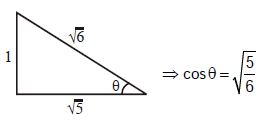
(A) Given that $\tan \theta = \frac{1}{\sqrt{5}}$.
We know that $\tan \theta = \frac{\text{opposite}}{\text{adjacent}}$.
Let the opposite side be $1$ and the adjacent side be $\sqrt{5}$.
Using the Pythagorean theorem,the hypotenuse is $\sqrt{1^2 + (\sqrt{5})^2} = \sqrt{1 + 5} = \sqrt{6}$.
Since $\theta$ lies in the first quadrant,all trigonometric ratios are positive.
Therefore,$\cos \theta = \frac{\text{adjacent}}{\text{hypotenuse}} = \frac{\sqrt{5}}{\sqrt{6}} = \sqrt{\frac{5}{6}}$.
We know that $\tan \theta = \frac{\text{opposite}}{\text{adjacent}}$.
Let the opposite side be $1$ and the adjacent side be $\sqrt{5}$.
Using the Pythagorean theorem,the hypotenuse is $\sqrt{1^2 + (\sqrt{5})^2} = \sqrt{1 + 5} = \sqrt{6}$.
Since $\theta$ lies in the first quadrant,all trigonometric ratios are positive.
Therefore,$\cos \theta = \frac{\text{adjacent}}{\text{hypotenuse}} = \frac{\sqrt{5}}{\sqrt{6}} = \sqrt{\frac{5}{6}}$.
0 likes
View Solution16
MediumMCQ
The slope of the tangent to the curve $y = \ln(\cos x)$ at $x = \frac{3\pi}{4}$ is
A
$1$
B
$-1$
C
$\ln \sqrt{2}$
D
$\frac{1}{\sqrt{2}}$
Solution
(A) The slope of the tangent to the curve $y = f(x)$ is given by the derivative $\frac{dy}{dx}$.
Given the function $y = \ln(\cos x)$.
Differentiating with respect to $x$ using the chain rule:
$\frac{dy}{dx} = \frac{1}{\cos x} \cdot \frac{d}{dx}(\cos x)$
$\frac{dy}{dx} = \frac{1}{\cos x} \cdot (-\sin x) = -\tan x$.
Now,evaluate the derivative at $x = \frac{3\pi}{4}$:
$\left(\frac{dy}{dx}\right)_{x = 3\pi/4} = -\tan\left(\frac{3\pi}{4}\right)$.
Since $\tan\left(\frac{3\pi}{4}\right) = -1$,we have:
$-\tan\left(\frac{3\pi}{4}\right) = -(-1) = 1$.
Thus,the slope of the tangent is $1$.
Given the function $y = \ln(\cos x)$.
Differentiating with respect to $x$ using the chain rule:
$\frac{dy}{dx} = \frac{1}{\cos x} \cdot \frac{d}{dx}(\cos x)$
$\frac{dy}{dx} = \frac{1}{\cos x} \cdot (-\sin x) = -\tan x$.
Now,evaluate the derivative at $x = \frac{3\pi}{4}$:
$\left(\frac{dy}{dx}\right)_{x = 3\pi/4} = -\tan\left(\frac{3\pi}{4}\right)$.
Since $\tan\left(\frac{3\pi}{4}\right) = -1$,we have:
$-\tan\left(\frac{3\pi}{4}\right) = -(-1) = 1$.
Thus,the slope of the tangent is $1$.
0 likes
View Solution17
MediumMCQ
Given that $y = \frac{10}{\sin x + \sqrt{3} \cos x}$. The minimum value of $y$ is
A
$0$
B
$2$
C
$5$
D
$10 / (1 + \sqrt{3})$
Solution
(C) The given expression is $y = \frac{10}{\sin x + \sqrt{3} \cos x}$.
To find the minimum value of $y$,we need to find the maximum value of the denominator $t = \sin x + \sqrt{3} \cos x$.
The expression $a \sin x + b \cos x$ has a maximum value of $\sqrt{a^2 + b^2}$.
Here,$a = 1$ and $b = \sqrt{3}$.
So,$t_{\max} = \sqrt{1^2 + (\sqrt{3})^2} = \sqrt{1 + 3} = \sqrt{4} = 2$.
Therefore,$y_{\min} = \frac{10}{t_{\max}} = \frac{10}{2} = 5$.
To find the minimum value of $y$,we need to find the maximum value of the denominator $t = \sin x + \sqrt{3} \cos x$.
The expression $a \sin x + b \cos x$ has a maximum value of $\sqrt{a^2 + b^2}$.
Here,$a = 1$ and $b = \sqrt{3}$.
So,$t_{\max} = \sqrt{1^2 + (\sqrt{3})^2} = \sqrt{1 + 3} = \sqrt{4} = 2$.
Therefore,$y_{\min} = \frac{10}{t_{\max}} = \frac{10}{2} = 5$.
0 likes
View Solution18
MediumMCQ
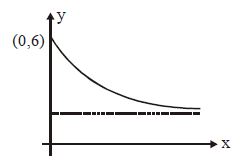
The graph of an exponential function $y = 2 + ae^{-x}$ is shown in the figure. What is the value of $a$?
A
$4$
B
$2.71$
C
$6$
D
$0$
Solution
(A) From the given graph,we can observe that the curve passes through the point $(0, 6)$.
This means that when $x = 0$,$y = 6$.
Substituting these values into the given equation $y = 2 + ae^{-x}$:
$6 = 2 + ae^{-0}$
Since $e^0 = 1$,we have:
$6 = 2 + a(1)$
$6 = 2 + a$
$a = 6 - 2$
$a = 4$
Therefore,the value of $a$ is $4$.
This means that when $x = 0$,$y = 6$.
Substituting these values into the given equation $y = 2 + ae^{-x}$:
$6 = 2 + ae^{-0}$
Since $e^0 = 1$,we have:
$6 = 2 + a(1)$
$6 = 2 + a$
$a = 6 - 2$
$a = 4$
Therefore,the value of $a$ is $4$.
0 likes
View Solution19
MediumMCQ
At point $P$ on the given curve,the value of $\frac{dy}{dx}$ is:

A
Zero
B
Positive
C
Negative
D
Infinite
Solution
(A) The derivative $\frac{dy}{dx}$ represents the slope of the tangent to the curve at a given point.
At point $P$,which is the minimum point of the parabola-like curve,the tangent is a horizontal line.
The slope of a horizontal line is $0$.
Therefore,at point $P$,the value of $\frac{dy}{dx} = 0$.
At point $P$,which is the minimum point of the parabola-like curve,the tangent is a horizontal line.
The slope of a horizontal line is $0$.
Therefore,at point $P$,the value of $\frac{dy}{dx} = 0$.
0 likes
View Solution20
MediumMCQ
If $F = \frac{2}{\sin \theta + \sqrt{3} \cos \theta}$,then the minimum value of $F$ is
A
$0$
B
$-2$
C
$1$
D
$2$
Solution
(C) The expression in the denominator is $f(\theta) = \sin \theta + \sqrt{3} \cos \theta$.
We can rewrite this as $f(\theta) = 2 \left( \frac{1}{2} \sin \theta + \frac{\sqrt{3}}{2} \cos \theta \right) = 2 \sin(\theta + 60^\circ)$.
The range of $\sin(\theta + 60^\circ)$ is $[-1, 1]$.
Therefore,the range of the denominator $f(\theta)$ is $[-2, 2]$.
For $F$ to be minimum,the denominator must be at its maximum positive value,which is $2$.
Thus,$F_{\min} = \frac{2}{2} = 1$.
We can rewrite this as $f(\theta) = 2 \left( \frac{1}{2} \sin \theta + \frac{\sqrt{3}}{2} \cos \theta \right) = 2 \sin(\theta + 60^\circ)$.
The range of $\sin(\theta + 60^\circ)$ is $[-1, 1]$.
Therefore,the range of the denominator $f(\theta)$ is $[-2, 2]$.
For $F$ to be minimum,the denominator must be at its maximum positive value,which is $2$.
Thus,$F_{\min} = \frac{2}{2} = 1$.
0 likes
View Solution21
DifficultMCQ
The value of $\int\limits_0^{\frac{\pi }{{2\omega }}} {5\,\sin \omega t} \,dt$ is
A
$10\,\omega $
B
$\frac{5}{\omega }$
C
$\frac{10\pi }{\omega }$
D
$5\,\omega $
Solution
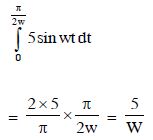
(B) To evaluate the integral $I = \int\limits_0^{\frac{\pi }{{2\omega }}} {5\,\sin \omega t} \,dt$,we proceed as follows:
First,pull the constant $5$ out of the integral:
$I = 5 \int\limits_0^{\frac{\pi }{{2\omega }}} \sin \omega t \,dt$
Recall that the integral of $\sin \omega t$ with respect to $t$ is $-\frac{\cos \omega t}{\omega}$:
$I = 5 \left[ -\frac{\cos \omega t}{\omega} \right]_0^{\frac{\pi }{{2\omega }}}$
$I = -\frac{5}{\omega} \left[ \cos \omega t \right]_0^{\frac{\pi }{{2\omega }}}$
Now,substitute the limits:
$I = -\frac{5}{\omega} \left[ \cos \left( \omega \cdot \frac{\pi}{2\omega} \right) - \cos(0) \right]$
$I = -\frac{5}{\omega} \left[ \cos \left( \frac{\pi}{2} \right) - \cos(0) \right]$
Since $\cos \left( \frac{\pi}{2} \right) = 0$ and $\cos(0) = 1$:
$I = -\frac{5}{\omega} [0 - 1]$
$I = -\frac{5}{\omega} [-1]$
$I = \frac{5}{\omega}$
First,pull the constant $5$ out of the integral:
$I = 5 \int\limits_0^{\frac{\pi }{{2\omega }}} \sin \omega t \,dt$
Recall that the integral of $\sin \omega t$ with respect to $t$ is $-\frac{\cos \omega t}{\omega}$:
$I = 5 \left[ -\frac{\cos \omega t}{\omega} \right]_0^{\frac{\pi }{{2\omega }}}$
$I = -\frac{5}{\omega} \left[ \cos \omega t \right]_0^{\frac{\pi }{{2\omega }}}$
Now,substitute the limits:
$I = -\frac{5}{\omega} \left[ \cos \left( \omega \cdot \frac{\pi}{2\omega} \right) - \cos(0) \right]$
$I = -\frac{5}{\omega} \left[ \cos \left( \frac{\pi}{2} \right) - \cos(0) \right]$
Since $\cos \left( \frac{\pi}{2} \right) = 0$ and $\cos(0) = 1$:
$I = -\frac{5}{\omega} [0 - 1]$
$I = -\frac{5}{\omega} [-1]$
$I = \frac{5}{\omega}$
0 likes
View Solution22
EasyMCQ
What is the value of $\alpha$ if $\alpha = \frac{25}{50}$?
A
$0.25$
B
$0.5$
C
$0.75$
D
$1.0$
Solution
(B) Given the expression $\alpha = \frac{25}{50}$.
To find the value of $\alpha$,divide the numerator by the denominator.
$\alpha = \frac{25}{50} = \frac{1}{2} = 0.5$.
Therefore,the value of $\alpha$ is $0.5$.
To find the value of $\alpha$,divide the numerator by the denominator.
$\alpha = \frac{25}{50} = \frac{1}{2} = 0.5$.
Therefore,the value of $\alpha$ is $0.5$.
0 likes
View Solution23
MediumMCQ
$\frac{d}{dx} \log(\log x) = $
A
$\frac{x}{\log x}$
B
$\frac{\log x}{x}$
C
$(x \log x)^{-1}$
D
None of these
Solution
(C) To find the derivative of $\log(\log x)$ with respect to $x$,we use the chain rule.
Let $u = \log x$. Then the expression becomes $\frac{d}{dx} \log(u)$.
By the chain rule,$\frac{d}{dx} \log(u) = \frac{d}{du} \log(u) \cdot \frac{du}{dx}$.
We know that $\frac{d}{du} \log(u) = \frac{1}{u}$ and $\frac{du}{dx} = \frac{d}{dx} \log x = \frac{1}{x}$.
Substituting these values back,we get $\frac{1}{\log x} \cdot \frac{1}{x} = \frac{1}{x \log x}$.
This can be written as $(x \log x)^{-1}$.
Therefore,the correct option is $C$.
Let $u = \log x$. Then the expression becomes $\frac{d}{dx} \log(u)$.
By the chain rule,$\frac{d}{dx} \log(u) = \frac{d}{du} \log(u) \cdot \frac{du}{dx}$.
We know that $\frac{d}{du} \log(u) = \frac{1}{u}$ and $\frac{du}{dx} = \frac{d}{dx} \log x = \frac{1}{x}$.
Substituting these values back,we get $\frac{1}{\log x} \cdot \frac{1}{x} = \frac{1}{x \log x}$.
This can be written as $(x \log x)^{-1}$.
Therefore,the correct option is $C$.
0 likes
View Solution24
MediumMCQ
If $y = x + \frac{1}{x}$,then
A
$x^2 \frac{dy}{dx} + xy = 0$
B
$x^2 \frac{dy}{dx} + xy + 2 = 0$
C
$x^2 \frac{dy}{dx} - xy + 2 = 0$
D
None of these
Solution
(C) Given $y = x + \frac{1}{x}$.
Differentiating both sides with respect to $x$:
$\frac{dy}{dx} = \frac{d}{dx}(x) + \frac{d}{dx}(x^{-1})$
$\frac{dy}{dx} = 1 - x^{-2} = 1 - \frac{1}{x^2}$.
Now,multiply both sides by $x^2$:
$x^2 \frac{dy}{dx} = x^2(1 - \frac{1}{x^2}) = x^2 - 1$.
We know $y = x + \frac{1}{x}$,so $xy = x(x + \frac{1}{x}) = x^2 + 1$.
From this,$x^2 = xy - 1$.
Substituting $x^2$ into the equation $x^2 \frac{dy}{dx} = x^2 - 1$:
$x^2 \frac{dy}{dx} = (xy - 1) - 1$
$x^2 \frac{dy}{dx} = xy - 2$
$x^2 \frac{dy}{dx} - xy + 2 = 0$.
Differentiating both sides with respect to $x$:
$\frac{dy}{dx} = \frac{d}{dx}(x) + \frac{d}{dx}(x^{-1})$
$\frac{dy}{dx} = 1 - x^{-2} = 1 - \frac{1}{x^2}$.
Now,multiply both sides by $x^2$:
$x^2 \frac{dy}{dx} = x^2(1 - \frac{1}{x^2}) = x^2 - 1$.
We know $y = x + \frac{1}{x}$,so $xy = x(x + \frac{1}{x}) = x^2 + 1$.
From this,$x^2 = xy - 1$.
Substituting $x^2$ into the equation $x^2 \frac{dy}{dx} = x^2 - 1$:
$x^2 \frac{dy}{dx} = (xy - 1) - 1$
$x^2 \frac{dy}{dx} = xy - 2$
$x^2 \frac{dy}{dx} - xy + 2 = 0$.
0 likes
View Solution25
DifficultMCQ
$\frac{d}{dx}\left( \frac{1}{x^4 \sec x} \right) = $
A
$\frac{x \sin x + 4 \cos x}{x^5}$
B
$\frac{-(x \sin x + 4 \cos x)}{x^5}$
C
$\frac{4 \cos x - x \sin x}{x^5}$
D
None of these
Solution
(B) We know that $\frac{1}{\sec x} = \cos x$.
Therefore,the expression becomes $\frac{d}{dx}\left( \frac{\cos x}{x^4} \right)$.
Using the quotient rule $\frac{d}{dx}\left( \frac{u}{v} \right) = \frac{v u' - u v'}{v^2}$,where $u = \cos x$ and $v = x^4$:
$\frac{d}{dx}\left( \frac{\cos x}{x^4} \right) = \frac{x^4(-\sin x) - \cos x(4x^3)}{(x^4)^2}$
$= \frac{-x^4 \sin x - 4x^3 \cos x}{x^8}$
$= \frac{-x^3(x \sin x + 4 \cos x)}{x^8}$
$= \frac{-(x \sin x + 4 \cos x)}{x^5}$.
Therefore,the expression becomes $\frac{d}{dx}\left( \frac{\cos x}{x^4} \right)$.
Using the quotient rule $\frac{d}{dx}\left( \frac{u}{v} \right) = \frac{v u' - u v'}{v^2}$,where $u = \cos x$ and $v = x^4$:
$\frac{d}{dx}\left( \frac{\cos x}{x^4} \right) = \frac{x^4(-\sin x) - \cos x(4x^3)}{(x^4)^2}$
$= \frac{-x^4 \sin x - 4x^3 \cos x}{x^8}$
$= \frac{-x^3(x \sin x + 4 \cos x)}{x^8}$
$= \frac{-(x \sin x + 4 \cos x)}{x^5}$.
0 likes
View Solution26
MediumMCQ
If $y = 1 + x + \frac{x^2}{2!} + \frac{x^3}{3!} + \dots + \frac{x^n}{n!}$,then $\frac{dy}{dx} = $
A
$y$
B
$y + \frac{x^n}{n!}$
C
$y - \frac{x^n}{n!}$
D
$y - 1 - \frac{x^n}{n!}$
Solution
(C) Given the expression: $y = 1 + x + \frac{x^2}{2!} + \frac{x^3}{3!} + \dots + \frac{x^n}{n!}$.
To find $\frac{dy}{dx}$,we differentiate each term with respect to $x$:
$\frac{dy}{dx} = \frac{d}{dx}(1) + \frac{d}{dx}(x) + \frac{d}{dx}\left(\frac{x^2}{2!}\right) + \frac{d}{dx}\left(\frac{x^3}{3!}\right) + \dots + \frac{d}{dx}\left(\frac{x^n}{n!}\right)$.
Using the power rule $\frac{d}{dx}(x^k) = kx^{k-1}$:
$\frac{dy}{dx} = 0 + 1 + \frac{2x}{2!} + \frac{3x^2}{3!} + \dots + \frac{nx^{n-1}}{n!}$.
Since $k! = k \times (k-1)!$,we have $\frac{k}{k!} = \frac{1}{(k-1)!}$:
$\frac{dy}{dx} = 1 + x + \frac{x^2}{2!} + \dots + \frac{x^{n-1}}{(n-1)!}$.
Comparing this to the original expression for $y$,we see that the sum is equal to $y$ minus the last term of the original series:
$\frac{dy}{dx} = y - \frac{x^n}{n!}$.
To find $\frac{dy}{dx}$,we differentiate each term with respect to $x$:
$\frac{dy}{dx} = \frac{d}{dx}(1) + \frac{d}{dx}(x) + \frac{d}{dx}\left(\frac{x^2}{2!}\right) + \frac{d}{dx}\left(\frac{x^3}{3!}\right) + \dots + \frac{d}{dx}\left(\frac{x^n}{n!}\right)$.
Using the power rule $\frac{d}{dx}(x^k) = kx^{k-1}$:
$\frac{dy}{dx} = 0 + 1 + \frac{2x}{2!} + \frac{3x^2}{3!} + \dots + \frac{nx^{n-1}}{n!}$.
Since $k! = k \times (k-1)!$,we have $\frac{k}{k!} = \frac{1}{(k-1)!}$:
$\frac{dy}{dx} = 1 + x + \frac{x^2}{2!} + \dots + \frac{x^{n-1}}{(n-1)!}$.
Comparing this to the original expression for $y$,we see that the sum is equal to $y$ minus the last term of the original series:
$\frac{dy}{dx} = y - \frac{x^n}{n!}$.
0 likes
View Solution27
MediumMCQ
If $y = 1 + x + \frac{x^2}{2!} + \frac{x^3}{3!} + .....\infty$,then $\frac{dy}{dx} = $
A
$y$
B
$y - 1$
C
$y + 1$
D
None of these
Solution
(A) The given series is the Maclaurin series expansion for the exponential function $e^x$.
Thus,$y = 1 + x + \frac{x^2}{2!} + \frac{x^3}{3!} + .....\infty = e^x$.
Differentiating both sides with respect to $x$,we get $\frac{dy}{dx} = \frac{d}{dx}(e^x)$.
Since the derivative of $e^x$ is $e^x$,we have $\frac{dy}{dx} = e^x$.
Substituting the original expression for $y$,we get $\frac{dy}{dx} = y$.
Thus,$y = 1 + x + \frac{x^2}{2!} + \frac{x^3}{3!} + .....\infty = e^x$.
Differentiating both sides with respect to $x$,we get $\frac{dy}{dx} = \frac{d}{dx}(e^x)$.
Since the derivative of $e^x$ is $e^x$,we have $\frac{dy}{dx} = e^x$.
Substituting the original expression for $y$,we get $\frac{dy}{dx} = y$.
0 likes
View Solution28
MediumMCQ
If $y = \frac{1}{a - z}$,then $\frac{dz}{dy} = $
A
$(z - a)^2$
B
$-(z - a)^2$
C
$(z + a)^2$
D
$-(z + a)^2$
Solution
(A) Given the equation $y = \frac{1}{a - z}$.
To find $\frac{dz}{dy}$,we first differentiate $y$ with respect to $z$ using the chain rule or power rule.
$y = (a - z)^{-1}$.
Applying the derivative with respect to $z$:
$\frac{dy}{dz} = -1 \cdot (a - z)^{-2} \cdot \frac{d}{dz}(a - z)$.
$\frac{dy}{dz} = -1 \cdot (a - z)^{-2} \cdot (-1) = (a - z)^{-2} = \frac{1}{(a - z)^2}$.
Since $\frac{dz}{dy} = \frac{1}{\frac{dy}{dz}}$,we have:
$\frac{dz}{dy} = (a - z)^2$.
Since $(a - z)^2 = (z - a)^2$,the final result is $\frac{dz}{dy} = (z - a)^2$.
To find $\frac{dz}{dy}$,we first differentiate $y$ with respect to $z$ using the chain rule or power rule.
$y = (a - z)^{-1}$.
Applying the derivative with respect to $z$:
$\frac{dy}{dz} = -1 \cdot (a - z)^{-2} \cdot \frac{d}{dz}(a - z)$.
$\frac{dy}{dz} = -1 \cdot (a - z)^{-2} \cdot (-1) = (a - z)^{-2} = \frac{1}{(a - z)^2}$.
Since $\frac{dz}{dy} = \frac{1}{\frac{dy}{dz}}$,we have:
$\frac{dz}{dy} = (a - z)^2$.
Since $(a - z)^2 = (z - a)^2$,the final result is $\frac{dz}{dy} = (z - a)^2$.
0 likes
View Solution29
MediumMCQ
If $y = x \sin x$,then
A
$\frac{1}{y} \frac{dy}{dx} = \frac{1}{x} + \cot x$
B
$\frac{dy}{dx} = \frac{1}{x} + \cot x$
C
$\frac{1}{y} \frac{dy}{dx} = \frac{1}{x} - \cot x$
D
None of these
Solution
(A) Given the function $y = x \sin x$.
Taking the natural logarithm on both sides: $\ln y = \ln(x \sin x)$.
Using the property $\ln(ab) = \ln a + \ln b$,we get $\ln y = \ln x + \ln(\sin x)$.
Differentiating both sides with respect to $x$: $\frac{d}{dx}(\ln y) = \frac{d}{dx}(\ln x) + \frac{d}{dx}(\ln(\sin x))$.
Applying the chain rule: $\frac{1}{y} \frac{dy}{dx} = \frac{1}{x} + \frac{1}{\sin x} \cdot \cos x$.
Simplifying the expression: $\frac{1}{y} \frac{dy}{dx} = \frac{1}{x} + \cot x$.
Taking the natural logarithm on both sides: $\ln y = \ln(x \sin x)$.
Using the property $\ln(ab) = \ln a + \ln b$,we get $\ln y = \ln x + \ln(\sin x)$.
Differentiating both sides with respect to $x$: $\frac{d}{dx}(\ln y) = \frac{d}{dx}(\ln x) + \frac{d}{dx}(\ln(\sin x))$.
Applying the chain rule: $\frac{1}{y} \frac{dy}{dx} = \frac{1}{x} + \frac{1}{\sin x} \cdot \cos x$.
Simplifying the expression: $\frac{1}{y} \frac{dy}{dx} = \frac{1}{x} + \cot x$.
0 likes
View Solution30
MediumMCQ
${d \over {dx}}({x^2}{e^x}\sin x) = $
A
$x\,{e^x}(2\sin x + x\sin x + x\cos x)$
B
$x\,{e^x}(2\sin x + x\sin x - \cos x)$
C
$x\,{e^x}(2\sin x + x\sin x + \cos x)$
D
None of these
Solution
(A) To find the derivative of the product of three functions,we use the product rule: $\frac{d}{dx}(uvw) = u'vw + uv'w + uvw'$.
Let $u = x^2$,$v = e^x$,and $w = \sin x$.
Then $u' = 2x$,$v' = e^x$,and $w' = \cos x$.
Applying the rule:
$\frac{d}{dx}(x^2 e^x \sin x) = (2x)(e^x \sin x) + (x^2)(e^x \sin x) + (x^2)(e^x \cos x)$.
Factor out $x e^x$ from the expression:
$= x e^x (2 \sin x + x \sin x + x \cos x)$.
Let $u = x^2$,$v = e^x$,and $w = \sin x$.
Then $u' = 2x$,$v' = e^x$,and $w' = \cos x$.
Applying the rule:
$\frac{d}{dx}(x^2 e^x \sin x) = (2x)(e^x \sin x) + (x^2)(e^x \sin x) + (x^2)(e^x \cos x)$.
Factor out $x e^x$ from the expression:
$= x e^x (2 \sin x + x \sin x + x \cos x)$.
0 likes
View Solution31
MediumMCQ
As $\theta$ increases from $0^{\circ}$ to $90^{\circ}$,the value of $\cos \theta$ :-
A
Increases
B
Decreases
C
Remains constant
D
First decreases then increases.
Solution
(B) The cosine function,$\cos \theta$,is a trigonometric function that represents the ratio of the adjacent side to the hypotenuse in a right-angled triangle.
At $\theta = 0^{\circ}$,$\cos 0^{\circ} = 1$.
At $\theta = 90^{\circ}$,$\cos 90^{\circ} = 0$.
As the angle $\theta$ increases from $0^{\circ}$ to $90^{\circ}$,the value of $\cos \theta$ changes from $1$ to $0$.
Since $1 > 0$,the value of $\cos \theta$ decreases as $\theta$ increases in this interval.
At $\theta = 0^{\circ}$,$\cos 0^{\circ} = 1$.
At $\theta = 90^{\circ}$,$\cos 90^{\circ} = 0$.
As the angle $\theta$ increases from $0^{\circ}$ to $90^{\circ}$,the value of $\cos \theta$ changes from $1$ to $0$.
Since $1 > 0$,the value of $\cos \theta$ decreases as $\theta$ increases in this interval.
0 likes
View Solution32
MediumMCQ
The greatest value of the function $-5 \sin \theta + 12 \cos \theta$ is
A
$12$
B
$13$
C
$7$
D
$17$
Solution
(B) The expression is of the form $a \sin \theta + b \cos \theta$.
The maximum value of this expression is given by the formula $\sqrt{a^2 + b^2}$.
Here,$a = -5$ and $b = 12$.
Substituting these values into the formula:
Maximum value $= \sqrt{(-5)^2 + (12)^2}$
$= \sqrt{25 + 144}$
$= \sqrt{169}$
$= 13$.
Therefore,the greatest value is $13$.
The maximum value of this expression is given by the formula $\sqrt{a^2 + b^2}$.
Here,$a = -5$ and $b = 12$.
Substituting these values into the formula:
Maximum value $= \sqrt{(-5)^2 + (12)^2}$
$= \sqrt{25 + 144}$
$= \sqrt{169}$
$= 13$.
Therefore,the greatest value is $13$.
0 likes
View Solution33
MediumMCQ
If $\tan \theta = \frac{1}{\sqrt{5}}$ and $\theta$ lies in the first quadrant,the value of $\cos \theta$ is:
A
$\sqrt{\frac{5}{6}}$
B
$-\sqrt{\frac{5}{6}}$
C
$\frac{1}{\sqrt{6}}$
D
$-\frac{1}{\sqrt{6}}$
Solution
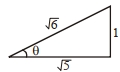
(A) Given $\tan \theta = \frac{\text{opposite}}{\text{adjacent}} = \frac{1}{\sqrt{5}}$.
Using the Pythagorean theorem,the hypotenuse is $\sqrt{1^2 + (\sqrt{5})^2} = \sqrt{1 + 5} = \sqrt{6}$.
Since $\theta$ is in the first quadrant,all trigonometric ratios are positive.
Therefore,$\cos \theta = \frac{\text{adjacent}}{\text{hypotenuse}} = \frac{\sqrt{5}}{\sqrt{6}} = \sqrt{\frac{5}{6}}$.
Using the Pythagorean theorem,the hypotenuse is $\sqrt{1^2 + (\sqrt{5})^2} = \sqrt{1 + 5} = \sqrt{6}$.
Since $\theta$ is in the first quadrant,all trigonometric ratios are positive.
Therefore,$\cos \theta = \frac{\text{adjacent}}{\text{hypotenuse}} = \frac{\sqrt{5}}{\sqrt{6}} = \sqrt{\frac{5}{6}}$.
0 likes
View Solution34
MediumMCQ
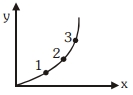
The slope of the graph as shown in the figure at points $1, 2$ and $3$ is $m_1, m_2$ and $m_3$ respectively. Then:
A
$m_1 > m_2 > m_3$
B
$m_1 < m_2 < m_3$
C
$m_1 = m_2 = m_3$
D
$m_1 = m_3 > m_2$
Solution
(B) The slope of a curve at any point is given by the tangent of the angle $\theta$ that the tangent line at that point makes with the positive $x$-axis,i.e.,$m = \tan \theta$.
As we move along the curve from point $1$ to point $3$,the tangent line becomes steeper.
This means the angle $\theta$ that the tangent makes with the positive $x$-axis increases as we move from point $1$ to point $3$ (i.e.,$\theta_1 < \theta_2 < \theta_3$).
Since the function $\tan \theta$ is an increasing function for $0^\circ < \theta < 90^\circ$,it follows that $\tan \theta_1 < \tan \theta_2 < \tan \theta_3$.
Therefore,$m_1 < m_2 < m_3$.
As we move along the curve from point $1$ to point $3$,the tangent line becomes steeper.
This means the angle $\theta$ that the tangent makes with the positive $x$-axis increases as we move from point $1$ to point $3$ (i.e.,$\theta_1 < \theta_2 < \theta_3$).
Since the function $\tan \theta$ is an increasing function for $0^\circ < \theta < 90^\circ$,it follows that $\tan \theta_1 < \tan \theta_2 < \tan \theta_3$.
Therefore,$m_1 < m_2 < m_3$.
0 likes
View Solution35
MediumMCQ
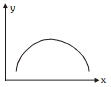
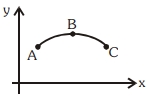
What is the behavior of the magnitude of the slope of the shown graph?
A
First decreases then increases
B
First increases then decreases
C
Increases
D
Decreases
Solution
(A) The slope of a graph at any point is given by $\tan \theta$,where $\theta$ is the angle the tangent at that point makes with the positive $x$-axis.
$1$. From $A$ to $B$: The tangent makes an acute angle with the $x$-axis. As we move from $A$ to $B$,the angle $\theta$ decreases from a positive value towards $0$ at the peak $B$. Since $\tan \theta$ is positive and decreasing in this interval,the magnitude of the slope decreases.
$2$. At point $B$: The tangent is horizontal,so $\theta = 0^\circ$ and the slope is $0$.
$3$. From $B$ to $C$: The tangent makes an obtuse angle with the $x$-axis. As we move from $B$ to $C$,the angle $\theta$ increases from $0^\circ$ towards $90^\circ$. The slope $(\tan \theta)$ is negative,but its magnitude $|\tan \theta|$ increases as the angle becomes more obtuse.
Therefore,the magnitude of the slope first decreases (from $A$ to $B$) and then increases (from $B$ to $C$).
The correct option is $A$.
$1$. From $A$ to $B$: The tangent makes an acute angle with the $x$-axis. As we move from $A$ to $B$,the angle $\theta$ decreases from a positive value towards $0$ at the peak $B$. Since $\tan \theta$ is positive and decreasing in this interval,the magnitude of the slope decreases.
$2$. At point $B$: The tangent is horizontal,so $\theta = 0^\circ$ and the slope is $0$.
$3$. From $B$ to $C$: The tangent makes an obtuse angle with the $x$-axis. As we move from $B$ to $C$,the angle $\theta$ increases from $0^\circ$ towards $90^\circ$. The slope $(\tan \theta)$ is negative,but its magnitude $|\tan \theta|$ increases as the angle becomes more obtuse.
Therefore,the magnitude of the slope first decreases (from $A$ to $B$) and then increases (from $B$ to $C$).
The correct option is $A$.
0 likes
View Solution36
MediumMCQ
The equation of a curve is given as $y = x^2 - 3x + 2$. The curve intersects the $x$-axis at
A
$(1, 0)$
B
$(2, 0)$
C
Both $(1, 0)$ and $(2, 0)$
D
Nowhere
Solution
(C) To find the points where the curve intersects the $x$-axis,we set $y = 0$.
Given the equation: $x^2 - 3x + 2 = 0$.
Factoring the quadratic equation: $x^2 - 2x - x + 2 = 0$.
$x(x - 2) - 1(x - 2) = 0$.
$(x - 1)(x - 2) = 0$.
This gives the roots $x = 1$ and $x = 2$.
Therefore,the curve intersects the $x$-axis at the points $(1, 0)$ and $(2, 0)$.
Given the equation: $x^2 - 3x + 2 = 0$.
Factoring the quadratic equation: $x^2 - 2x - x + 2 = 0$.
$x(x - 2) - 1(x - 2) = 0$.
$(x - 1)(x - 2) = 0$.
This gives the roots $x = 1$ and $x = 2$.
Therefore,the curve intersects the $x$-axis at the points $(1, 0)$ and $(2, 0)$.
0 likes
View Solution37
MediumMCQ
$A$ particular straight line passes through the origin and a point whose abscissa is double the ordinate of the point. The equation of such a straight line is:
A
$y = \frac{x}{2}$
B
$y = 2x$
C
$y = -4x$
D
$y = -\frac{x}{4}$
Solution
(A) The equation of a straight line passing through the origin is given by $y = mx$,where $m$ is the slope.
Let the coordinates of the point be $(x, y)$.
According to the problem,the abscissa $(x)$ is double the ordinate $(y)$.
Therefore,$x = 2y$.
Rearranging this equation to solve for $y$,we get $y = \frac{x}{2}$.
Thus,the equation of the line is $y = \frac{x}{2}$.
Let the coordinates of the point be $(x, y)$.
According to the problem,the abscissa $(x)$ is double the ordinate $(y)$.
Therefore,$x = 2y$.
Rearranging this equation to solve for $y$,we get $y = \frac{x}{2}$.
Thus,the equation of the line is $y = \frac{x}{2}$.
0 likes
View Solution38
MediumMCQ
The side of a square is increasing at the rate of $0.2\,cm/s$. The rate of increase of perimeter with respect to time is $...........\,cm/s$.
A
$0.2$
B
$0.4$
C
$0.6$
D
$0.8$
Solution
(D) Let the side of the square be $a$. The perimeter $P$ of a square is given by $P = 4a$.
To find the rate of increase of the perimeter with respect to time $t$,we differentiate $P$ with respect to $t$:
$\frac{dP}{dt} = \frac{d}{dt}(4a) = 4 \left( \frac{da}{dt} \right)$.
Given that the rate of increase of the side is $\frac{da}{dt} = 0.2\,cm/s$.
Substituting this value into the equation:
$\frac{dP}{dt} = 4 \times 0.2 = 0.8\,cm/s$.
Therefore,the rate of increase of the perimeter is $0.8\,cm/s$.
To find the rate of increase of the perimeter with respect to time $t$,we differentiate $P$ with respect to $t$:
$\frac{dP}{dt} = \frac{d}{dt}(4a) = 4 \left( \frac{da}{dt} \right)$.
Given that the rate of increase of the side is $\frac{da}{dt} = 0.2\,cm/s$.
Substituting this value into the equation:
$\frac{dP}{dt} = 4 \times 0.2 = 0.8\,cm/s$.
Therefore,the rate of increase of the perimeter is $0.8\,cm/s$.
0 likes
View Solution39
MediumMCQ
The sum of the series $1 + \frac{1}{4} + \frac{1}{16} + \frac{1}{64} + \dots \infty$ is
A
$\frac{8}{7}$
B
$\frac{6}{5}$
C
$\frac{5}{4}$
D
$\frac{4}{3}$
Solution
(D) The given series is an infinite geometric progression $(GP)$ with the first term $a = 1$ and common ratio $r = \frac{1}{4}$.
Since $|r| < 1$,the sum of an infinite $GP$ is given by the formula $S_{\infty} = \frac{a}{1 - r}$.
Substituting the values,we get $S_{\infty} = \frac{1}{1 - 1/4}$.
$S_{\infty} = \frac{1}{3/4} = \frac{4}{3}$.
Since $|r| < 1$,the sum of an infinite $GP$ is given by the formula $S_{\infty} = \frac{a}{1 - r}$.
Substituting the values,we get $S_{\infty} = \frac{1}{1 - 1/4}$.
$S_{\infty} = \frac{1}{3/4} = \frac{4}{3}$.
0 likes
View Solution40
MediumMCQ
In the given figure,each box represents a function machine. $A$ function machine illustrates what it does with the input. Which of the following statements is correct?

A
$z=2x+3$
B
$z=2(x+3)$
C
$z=\sqrt{2x+3}$
D
$z=\sqrt{2(x+3)}$
Solution
(C) The first function machine takes the input $x$,doubles it,and adds $3$. This results in the intermediate value $2x + 3$.
The second function machine takes this intermediate value as its input and calculates its square root.
Therefore,the final output $z$ is given by $z = \sqrt{2x + 3}$.
Thus,option $(C)$ is correct.
The second function machine takes this intermediate value as its input and calculates its square root.
Therefore,the final output $z$ is given by $z = \sqrt{2x + 3}$.
Thus,option $(C)$ is correct.
0 likes
View Solution41
DifficultMCQ
If $x^3+3xy+y^3=1$,then the correct option$(s)$ is/are:-
$(A) \left(\frac{dy}{dx}\right)_{(1,1)}=-1$
$(B) \left(\frac{dy}{dx}\right)_{(1,1)}=-2$
$(C) \left(\frac{dy}{dx}\right)_{(1,0)}=-1$
$(D) \left(\frac{dy}{dx}\right)_{(1,0)}=-3$
$(A) \left(\frac{dy}{dx}\right)_{(1,1)}=-1$
$(B) \left(\frac{dy}{dx}\right)_{(1,1)}=-2$
$(C) \left(\frac{dy}{dx}\right)_{(1,0)}=-1$
$(D) \left(\frac{dy}{dx}\right)_{(1,0)}=-3$
A
$A$ and $B$
B
$B$ and $D$
C
$A$ and $C$
D
$B$ and $C$
Solution
(C) Given equation: $x^3+3xy+y^3=1$
Differentiating both sides with respect to $x$:
$\frac{d}{dx}(x^3) + \frac{d}{dx}(3xy) + \frac{d}{dx}(y^3) = \frac{d}{dx}(1)$
$3x^2 + 3(y + x\frac{dy}{dx}) + 3y^2\frac{dy}{dx} = 0$
Dividing by $3$: $x^2 + y + x\frac{dy}{dx} + y^2\frac{dy}{dx} = 0$
$\frac{dy}{dx}(x + y^2) = -(x^2 + y)$
$\frac{dy}{dx} = -\frac{x^2+y}{x+y^2}$
At point $(1,1)$: $\frac{dy}{dx} = -\frac{1^2+1}{1+1^2} = -\frac{2}{2} = -1$. (Option $A$ is correct).
At point $(1,0)$: $\frac{dy}{dx} = -\frac{1^2+0}{1+0^2} = -\frac{1}{1} = -1$. (Option $C$ is correct).
Thus,options $A$ and $C$ are correct.
Differentiating both sides with respect to $x$:
$\frac{d}{dx}(x^3) + \frac{d}{dx}(3xy) + \frac{d}{dx}(y^3) = \frac{d}{dx}(1)$
$3x^2 + 3(y + x\frac{dy}{dx}) + 3y^2\frac{dy}{dx} = 0$
Dividing by $3$: $x^2 + y + x\frac{dy}{dx} + y^2\frac{dy}{dx} = 0$
$\frac{dy}{dx}(x + y^2) = -(x^2 + y)$
$\frac{dy}{dx} = -\frac{x^2+y}{x+y^2}$
At point $(1,1)$: $\frac{dy}{dx} = -\frac{1^2+1}{1+1^2} = -\frac{2}{2} = -1$. (Option $A$ is correct).
At point $(1,0)$: $\frac{dy}{dx} = -\frac{1^2+0}{1+0^2} = -\frac{1}{1} = -1$. (Option $C$ is correct).
Thus,options $A$ and $C$ are correct.
0 likes
View Solution42
EasyMCQ
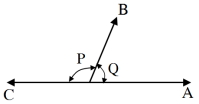
If $\angle P - \angle Q = 50^{\circ}$,then find the values of $\angle P$ and $\angle Q$.
A
$115^{\circ}, 65^{\circ}$
B
$105^{\circ}, 65^{\circ}$
C
$115^{\circ}, 55^{\circ}$
D
$65^{\circ}, 115^{\circ}$
Solution
(A) From the given figure,$\angle P$ and $\angle Q$ form a linear pair on a straight line.
Therefore,$\angle P + \angle Q = 180^{\circ}$.
We are given that $\angle P - \angle Q = 50^{\circ}$.
Adding the two equations:
$(\angle P + \angle Q) + (\angle P - \angle Q) = 180^{\circ} + 50^{\circ}$
$2\angle P = 230^{\circ}$
$\angle P = 115^{\circ}$.
Substituting the value of $\angle P$ in the first equation:
$115^{\circ} + \angle Q = 180^{\circ}$
$\angle Q = 180^{\circ} - 115^{\circ} = 65^{\circ}$.
Thus,$\angle P = 115^{\circ}$ and $\angle Q = 65^{\circ}$.
Therefore,$\angle P + \angle Q = 180^{\circ}$.
We are given that $\angle P - \angle Q = 50^{\circ}$.
Adding the two equations:
$(\angle P + \angle Q) + (\angle P - \angle Q) = 180^{\circ} + 50^{\circ}$
$2\angle P = 230^{\circ}$
$\angle P = 115^{\circ}$.
Substituting the value of $\angle P$ in the first equation:
$115^{\circ} + \angle Q = 180^{\circ}$
$\angle Q = 180^{\circ} - 115^{\circ} = 65^{\circ}$.
Thus,$\angle P = 115^{\circ}$ and $\angle Q = 65^{\circ}$.
0 likes
View Solution43
MediumMCQ
Which of the following relation$(s)$ is/are correct?
$(A)\ \sin (90^{\circ}+\theta)=\cos (-\theta)$
$(B)\ \sin (180^{\circ}-\theta)=\cos (90^{\circ}-\theta)$
$(C)\ \sin (360^{\circ}-\theta)=\cos (360^{\circ}-\theta)$
$(D)\ \sin (180^{\circ}+\theta)=\cos (90^{\circ}-\theta)$
$(A)\ \sin (90^{\circ}+\theta)=\cos (-\theta)$
$(B)\ \sin (180^{\circ}-\theta)=\cos (90^{\circ}-\theta)$
$(C)\ \sin (360^{\circ}-\theta)=\cos (360^{\circ}-\theta)$
$(D)\ \sin (180^{\circ}+\theta)=\cos (90^{\circ}-\theta)$
A
$A, B$ and $C$
B
$A$ and $B$
C
$A, B, C$ and $D$
D
Only $B$
Solution
(B) Let us evaluate each relation using trigonometric identities:
$(A)\ \sin (90^{\circ}+\theta) = \cos \theta$ and $\cos (-\theta) = \cos \theta$. Thus,$\cos \theta = \cos \theta$. This is correct.
$(B)\ \sin (180^{\circ}-\theta) = \sin \theta$ and $\cos (90^{\circ}-\theta) = \sin \theta$. Thus,$\sin \theta = \sin \theta$. This is correct.
$(C)\ \sin (360^{\circ}-\theta) = -\sin \theta$ and $\cos (360^{\circ}-\theta) = \cos \theta$. Since $-\sin \theta \neq \cos \theta$,this is incorrect.
$(D)\ \sin (180^{\circ}+\theta) = -\sin \theta$ and $\cos (90^{\circ}-\theta) = \sin \theta$. Since $-\sin \theta \neq \sin \theta$,this is incorrect.
Therefore,only relations $(A)$ and $(B)$ are correct.
$(A)\ \sin (90^{\circ}+\theta) = \cos \theta$ and $\cos (-\theta) = \cos \theta$. Thus,$\cos \theta = \cos \theta$. This is correct.
$(B)\ \sin (180^{\circ}-\theta) = \sin \theta$ and $\cos (90^{\circ}-\theta) = \sin \theta$. Thus,$\sin \theta = \sin \theta$. This is correct.
$(C)\ \sin (360^{\circ}-\theta) = -\sin \theta$ and $\cos (360^{\circ}-\theta) = \cos \theta$. Since $-\sin \theta \neq \cos \theta$,this is incorrect.
$(D)\ \sin (180^{\circ}+\theta) = -\sin \theta$ and $\cos (90^{\circ}-\theta) = \sin \theta$. Since $-\sin \theta \neq \sin \theta$,this is incorrect.
Therefore,only relations $(A)$ and $(B)$ are correct.
0 likes
View Solution44
MediumMCQ
The value of $1+\frac{1}{4}+\frac{1}{16}+\frac{1}{64}+\ldots$ up to $\infty$ is
A
$\frac{5}{4}$
B
$\frac{4}{3}$
C
$\frac{6}{5}$
D
$\frac{7}{6}$
Solution
(B) The given series is an infinite geometric progression $(GP)$ with the first term $a = 1$ and common ratio $r = \frac{1}{4}$.
Since $|r| < 1$,the sum to infinity $S_{\infty}$ is given by the formula $S_{\infty} = \frac{a}{1 - r}$.
Substituting the values,we get $S_{\infty} = \frac{1}{1 - 1/4} = \frac{1}{3/4} = \frac{4}{3}$.
Since $|r| < 1$,the sum to infinity $S_{\infty}$ is given by the formula $S_{\infty} = \frac{a}{1 - r}$.
Substituting the values,we get $S_{\infty} = \frac{1}{1 - 1/4} = \frac{1}{3/4} = \frac{4}{3}$.
0 likes
View Solution45
MediumMCQ
$\frac{d}{dx} \sqrt{\sin 2x}$ is equal to
A
$(\sin 2x)^{-1/2}$
B
$\cos 2x(\sin 2x)^{-1/2}$
C
$2 \cos 2x(\sin 2x)^{-1/2}$
D
$\cos 2x(\sin 2x)^{1/2}$
Solution
(B) To find the derivative of $\sqrt{\sin 2x}$,we use the chain rule.
Let $y = \sqrt{\sin 2x} = (\sin 2x)^{1/2}$.
Applying the chain rule: $\frac{dy}{dx} = \frac{d}{d(\sin 2x)} (\sin 2x)^{1/2} \cdot \frac{d}{dx} (\sin 2x)$.
$\frac{dy}{dx} = \frac{1}{2}(\sin 2x)^{-1/2} \cdot \frac{d}{dx}(\sin 2x)$.
Since $\frac{d}{dx}(\sin 2x) = \cos 2x \cdot 2$,we substitute this back:
$\frac{dy}{dx} = \frac{1}{2}(\sin 2x)^{-1/2} \cdot (2 \cos 2x)$.
The $2$ in the numerator and the $2$ in the denominator cancel out.
$\frac{dy}{dx} = \cos 2x(\sin 2x)^{-1/2}$.
Let $y = \sqrt{\sin 2x} = (\sin 2x)^{1/2}$.
Applying the chain rule: $\frac{dy}{dx} = \frac{d}{d(\sin 2x)} (\sin 2x)^{1/2} \cdot \frac{d}{dx} (\sin 2x)$.
$\frac{dy}{dx} = \frac{1}{2}(\sin 2x)^{-1/2} \cdot \frac{d}{dx}(\sin 2x)$.
Since $\frac{d}{dx}(\sin 2x) = \cos 2x \cdot 2$,we substitute this back:
$\frac{dy}{dx} = \frac{1}{2}(\sin 2x)^{-1/2} \cdot (2 \cos 2x)$.
The $2$ in the numerator and the $2$ in the denominator cancel out.
$\frac{dy}{dx} = \cos 2x(\sin 2x)^{-1/2}$.
0 likes
View Solution46
MediumMCQ
$\int \frac{3}{(2-x)^2} \, dx$ is equal to $:-$
A
$\frac{3}{(2-x)}+C$
B
$\frac{5}{(2-x)}+C$
C
$\frac{3}{2-x^2}+C$
D
$\frac{-3}{(2-x)}+C$
Solution
(A) To evaluate the integral $\int \frac{3}{(2-x)^2} \, dx$,we use the substitution method.
Let $t = 2-x$.
Then,$dt = -dx$,which implies $dx = -dt$.
Substituting these into the integral:
$\int \frac{3}{t^2} (-dt) = -3 \int t^{-2} \, dt$.
Using the power rule $\int t^n \, dt = \frac{t^{n+1}}{n+1} + C$:
$-3 \left( \frac{t^{-2+1}}{-2+1} \right) + C = -3 \left( \frac{t^{-1}}{-1} \right) + C$.
$= 3t^{-1} + C = \frac{3}{t} + C$.
Substituting back $t = 2-x$,we get $\frac{3}{2-x} + C$.
Let $t = 2-x$.
Then,$dt = -dx$,which implies $dx = -dt$.
Substituting these into the integral:
$\int \frac{3}{t^2} (-dt) = -3 \int t^{-2} \, dt$.
Using the power rule $\int t^n \, dt = \frac{t^{n+1}}{n+1} + C$:
$-3 \left( \frac{t^{-2+1}}{-2+1} \right) + C = -3 \left( \frac{t^{-1}}{-1} \right) + C$.
$= 3t^{-1} + C = \frac{3}{t} + C$.
Substituting back $t = 2-x$,we get $\frac{3}{2-x} + C$.
0 likes
View SolutionBasic Maths — Basic Maths · Frequently Asked Questions
1Are these Basic Maths questions useful for JEE and NEET?
Yes. All questions in this section are mapped to JEE Main and NEET exam patterns. Previous year questions from JEE Main, NEET, GUJCET and state-level exams are included with full solutions.
2Can I switch to Hindi or Gujarati for these questions?
Yes. Use the language tabs in the hero section or the sidebar to view the same questions and solutions in English, Hindi or Gujarati.
3How do I generate a question paper from this subtopic?
Use the Vedclass Exam Paper Generator — select the chapter and subtopic, set difficulty, and generate Sets A, B, C, D automatically. First 3 chapters of every subject are free.
Vedclass Products
For Students
Vedclass Test Series
Mock tests in real JEE/NEET style with performance analysis. 5-day free trial.
Start Free TrialFor Teachers
Exam Paper Generator
Generate Set A/B/C/D papers from this chapter in 2 minutes. 3 chapters free.
Try FreeFor Institutes
Online Exam Module
Live online exams with unlimited students, 360° analytics & white-label branding.
See DemoFor Teachers & Institutes
Generate a Basic Maths Exam Paper in 2 Minutes
Select subtopic & difficulty — Sets A, B, C, D auto-generated with No Repeat logic.
First 3 chapters of every subject are free — no payment required.