
A English
Spectral Emissive Power and Wien's Displacement Law Questions in English
Class 11 Physics · 10-2.Heat Transfer · Spectral Emissive Power and Wien's Displacement Law
146+
Questions
English
Language
100%
With Solutions
Showing 43 of 146 questions in English
101
MediumMCQ
The black body spectrum of an object $O_1$ is such that its radiant intensity (i.e.,intensity per unit wavelength interval) is maximum at a wavelength of $200\,nm$. Another object $O_2$ has the maximum radiant intensity at $600\,nm$. The ratio of power emitted per unit area by source $O_1$ to that of source $O_2$ is
A
$1:81$
B
$1:9$
C
$9:1$
D
$81:1$
Solution
(D) According to Wien's displacement law,the wavelength $\lambda_{\max}$ at which the radiant intensity is maximum is inversely proportional to the absolute temperature $T$ of the black body:
$\lambda_{\max} T = b$ (where $b$ is Wien's constant).
For object $O_1$: $\lambda_1 = 200\,nm$,so $T_1 = \frac{b}{200}$.
For object $O_2$: $\lambda_2 = 600\,nm$,so $T_2 = \frac{b}{600}$.
According to the Stefan-Boltzmann law,the power emitted per unit area (emissive power) $E$ is proportional to the fourth power of the absolute temperature:
$E \propto T^4$.
Therefore,the ratio of power emitted per unit area by $O_1$ to that of $O_2$ is:
$\frac{E_1}{E_2} = \left( \frac{T_1}{T_2} \right)^4 = \left( \frac{b/200}{b/600} \right)^4 = \left( \frac{600}{200} \right)^4 = (3)^4 = 81$.
Thus,the ratio is $81:1$.
$\lambda_{\max} T = b$ (where $b$ is Wien's constant).
For object $O_1$: $\lambda_1 = 200\,nm$,so $T_1 = \frac{b}{200}$.
For object $O_2$: $\lambda_2 = 600\,nm$,so $T_2 = \frac{b}{600}$.
According to the Stefan-Boltzmann law,the power emitted per unit area (emissive power) $E$ is proportional to the fourth power of the absolute temperature:
$E \propto T^4$.
Therefore,the ratio of power emitted per unit area by $O_1$ to that of $O_2$ is:
$\frac{E_1}{E_2} = \left( \frac{T_1}{T_2} \right)^4 = \left( \frac{b/200}{b/600} \right)^4 = \left( \frac{600}{200} \right)^4 = (3)^4 = 81$.
Thus,the ratio is $81:1$.
0 likes
View Solution102
AdvancedMCQ
Two spherical bodies $A$ (radius $6 \,cm$) and $B$ (radius $18 \,cm$) are at temperatures $T_1$ and $T_2$,respectively. The maximum intensity in the emission spectrum of $A$ is at $500 \,nm$ and in that of $B$ is at $1500 \,nm$. Considering them to be black bodies,what will be the ratio of the rate of total energy radiated by $A$ to that of $B$?
A
$9$
B
$8$
C
$6$
D
$5$
Solution
(A) According to Wien's displacement law,$\lambda_m T = \text{constant}$,so $\lambda_A T_A = \lambda_B T_B$.
Given $\lambda_A = 500 \,nm$ and $\lambda_B = 1500 \,nm$,we have $500 T_A = 1500 T_B$,which implies $T_A / T_B = 3$.
The rate of total energy radiated by a black body is given by $P = \sigma A T^4 = \sigma (4 \pi r^2) T^4$.
Therefore,the ratio of the power radiated by $A$ to that of $B$ is $\frac{P_A}{P_B} = \left( \frac{r_A}{r_B} \right)^2 \left( \frac{T_A}{T_B} \right)^4$.
Substituting the values: $\frac{P_A}{P_B} = \left( \frac{6}{18} \right)^2 \times (3)^4 = \left( \frac{1}{3} \right)^2 \times 81 = \frac{1}{9} \times 81 = 9$.
Given $\lambda_A = 500 \,nm$ and $\lambda_B = 1500 \,nm$,we have $500 T_A = 1500 T_B$,which implies $T_A / T_B = 3$.
The rate of total energy radiated by a black body is given by $P = \sigma A T^4 = \sigma (4 \pi r^2) T^4$.
Therefore,the ratio of the power radiated by $A$ to that of $B$ is $\frac{P_A}{P_B} = \left( \frac{r_A}{r_B} \right)^2 \left( \frac{T_A}{T_B} \right)^4$.
Substituting the values: $\frac{P_A}{P_B} = \left( \frac{6}{18} \right)^2 \times (3)^4 = \left( \frac{1}{3} \right)^2 \times 81 = \frac{1}{9} \times 81 = 9$.
0 likes
View Solution103
MediumMCQ
Two spherical stars $A$ and $B$ emit blackbody radiation. The radius of $A$ is $400$ times that of $B$ and $A$ emits $10^4$ times the power emitted from $B$. The ratio $(\lambda_A / \lambda_B)$ of their wavelengths $\lambda_A$ and $\lambda_B$ at which the peaks occur in their respective radiation curves is
A
$1$
B
$2$
C
$3$
D
$4$
Solution
(B) According to the Stefan-Boltzmann law,the power radiated by a blackbody is given by $P = \sigma A T^4 = \sigma (4\pi R^2) T^4$.
Given that $R_A = 400 R_B$ and $P_A = 10^4 P_B$.
Substituting these into the power ratio equation: $\frac{P_A}{P_B} = \left(\frac{R_A}{R_B}\right)^2 \left(\frac{T_A}{T_B}\right)^4$.
$10^4 = (400)^2 \left(\frac{T_A}{T_B}\right)^4$.
$10^4 = 160000 \left(\frac{T_A}{T_B}\right)^4 = 1.6 \times 10^5 \left(\frac{T_A}{T_B}\right)^4$.
$\left(\frac{T_A}{T_B}\right)^4 = \frac{10^4}{1.6 \times 10^5} = \frac{1}{16}$.
Taking the fourth root,$\frac{T_A}{T_B} = \frac{1}{2}$,which implies $T_B = 2 T_A$.
According to Wien's displacement law,$\lambda T = \text{constant}$,so $\lambda_A T_A = \lambda_B T_B$.
Therefore,$\frac{\lambda_A}{\lambda_B} = \frac{T_B}{T_A} = 2$.
Given that $R_A = 400 R_B$ and $P_A = 10^4 P_B$.
Substituting these into the power ratio equation: $\frac{P_A}{P_B} = \left(\frac{R_A}{R_B}\right)^2 \left(\frac{T_A}{T_B}\right)^4$.
$10^4 = (400)^2 \left(\frac{T_A}{T_B}\right)^4$.
$10^4 = 160000 \left(\frac{T_A}{T_B}\right)^4 = 1.6 \times 10^5 \left(\frac{T_A}{T_B}\right)^4$.
$\left(\frac{T_A}{T_B}\right)^4 = \frac{10^4}{1.6 \times 10^5} = \frac{1}{16}$.
Taking the fourth root,$\frac{T_A}{T_B} = \frac{1}{2}$,which implies $T_B = 2 T_A$.
According to Wien's displacement law,$\lambda T = \text{constant}$,so $\lambda_A T_A = \lambda_B T_B$.
Therefore,$\frac{\lambda_A}{\lambda_B} = \frac{T_B}{T_A} = 2$.
0 likes
View Solution104
MediumMCQ
$A$ black body radiates maximum energy at wavelength $\lambda$ and its emissive power is $E$. Now,due to a change in the temperature of that body,it radiates maximum energy at wavelength $\frac{2\lambda}{3}$. At that new temperature,the emissive power is:
A
$\frac{81}{16} E$
B
$\frac{27}{32} E$
C
$\frac{18}{10} E$
D
$\frac{9}{4} E$
Solution
(A) According to Wien's displacement law,$\lambda_{\max} T = b$ (constant),which implies $T \propto \frac{1}{\lambda}$.
According to Stefan-Boltzmann's law,the emissive power $E$ (or power radiated per unit area) is given by $E = \sigma T^4$.
Substituting $T \propto \frac{1}{\lambda}$ into the Stefan-Boltzmann law,we get $E \propto \left(\frac{1}{\lambda}\right)^4$,or $E \propto \lambda^{-4}$.
Let the initial state be $(\lambda_1, E_1)$ and the final state be $(\lambda_2, E_2)$.
Given $\lambda_1 = \lambda$ and $\lambda_2 = \frac{2\lambda}{3}$.
Then,$\frac{E_2}{E_1} = \left(\frac{\lambda_1}{\lambda_2}\right)^4 = \left(\frac{\lambda}{\frac{2\lambda}{3}}\right)^4 = \left(\frac{3}{2}\right)^4 = \frac{81}{16}$.
Therefore,$E_2 = \frac{81}{16} E$.
According to Stefan-Boltzmann's law,the emissive power $E$ (or power radiated per unit area) is given by $E = \sigma T^4$.
Substituting $T \propto \frac{1}{\lambda}$ into the Stefan-Boltzmann law,we get $E \propto \left(\frac{1}{\lambda}\right)^4$,or $E \propto \lambda^{-4}$.
Let the initial state be $(\lambda_1, E_1)$ and the final state be $(\lambda_2, E_2)$.
Given $\lambda_1 = \lambda$ and $\lambda_2 = \frac{2\lambda}{3}$.
Then,$\frac{E_2}{E_1} = \left(\frac{\lambda_1}{\lambda_2}\right)^4 = \left(\frac{\lambda}{\frac{2\lambda}{3}}\right)^4 = \left(\frac{3}{2}\right)^4 = \frac{81}{16}$.
Therefore,$E_2 = \frac{81}{16} E$.
0 likes
View Solution105
EasyMCQ
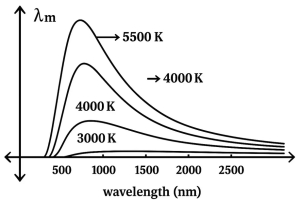
The following graph represents the radiant power versus wavelength of a black body. The area under the curve represents:
A
the maximum wavelength emitted by the object.
B
the minimum wavelength emitted by the object.
C
the total energy emitted per unit time by the black body at some particular wavelength.
D
the total energy emitted per unit time per unit area by the black body at all wavelengths.
Solution
(D) The graph shows the spectral emissive power $(E_{\lambda})$ on the y-axis and wavelength $(\lambda)$ on the x-axis.
The area under the curve is given by the integral $\int_{0}^{\infty} E_{\lambda} d\lambda$.
According to the definition of spectral emissive power,this integral represents the total radiant energy emitted per unit time per unit surface area of the black body across all possible wavelengths.
This is consistent with the Stefan-Boltzmann Law,which states that the total power radiated per unit area is proportional to the fourth power of the absolute temperature $(E = \sigma T^4)$.
The area under the curve is given by the integral $\int_{0}^{\infty} E_{\lambda} d\lambda$.
According to the definition of spectral emissive power,this integral represents the total radiant energy emitted per unit time per unit surface area of the black body across all possible wavelengths.
This is consistent with the Stefan-Boltzmann Law,which states that the total power radiated per unit area is proportional to the fourth power of the absolute temperature $(E = \sigma T^4)$.
0 likes
View Solution106
MediumMCQ
Black bodies $A$ and $B$ radiate maximum energy with wavelength difference $4 \mu m$. The absolute temperature of body $A$ is $3$ times that of $B$. The wavelength at which body $B$ radiates maximum energy is (in $\mu m$)
A
$4$
B
$6$
C
$2$
D
$8$
Solution
(B) According to Wien's displacement law,the wavelength $\lambda_m$ at which a black body radiates maximum energy is inversely proportional to its absolute temperature $T$,i.e.,$\lambda_m T = b$ (constant).
Let $\lambda_A$ and $\lambda_B$ be the wavelengths of maximum emission for bodies $A$ and $B$ respectively,and $T_A$ and $T_B$ be their temperatures.
Given: $T_A = 3T_B$.
From Wien's law: $\lambda_A T_A = \lambda_B T_B$.
Substituting $T_A$: $\lambda_A (3T_B) = \lambda_B T_B$,which implies $\lambda_B = 3\lambda_A$.
Given the difference in wavelengths: $\lambda_B - \lambda_A = 4 \mu m$.
Substituting $\lambda_B = 3\lambda_A$: $3\lambda_A - \lambda_A = 4 \mu m$,so $2\lambda_A = 4 \mu m$,which gives $\lambda_A = 2 \mu m$.
Therefore,$\lambda_B = 3 \times 2 \mu m = 6 \mu m$.
Let $\lambda_A$ and $\lambda_B$ be the wavelengths of maximum emission for bodies $A$ and $B$ respectively,and $T_A$ and $T_B$ be their temperatures.
Given: $T_A = 3T_B$.
From Wien's law: $\lambda_A T_A = \lambda_B T_B$.
Substituting $T_A$: $\lambda_A (3T_B) = \lambda_B T_B$,which implies $\lambda_B = 3\lambda_A$.
Given the difference in wavelengths: $\lambda_B - \lambda_A = 4 \mu m$.
Substituting $\lambda_B = 3\lambda_A$: $3\lambda_A - \lambda_A = 4 \mu m$,so $2\lambda_A = 4 \mu m$,which gives $\lambda_A = 2 \mu m$.
Therefore,$\lambda_B = 3 \times 2 \mu m = 6 \mu m$.
0 likes
View Solution107
EasyMCQ
$A$ black body emits radiation of maximum intensity at wavelength $\lambda$ at temperature $T \ K$. Its corresponding wavelength at temperature $1.5 \ T \ K$ will be
A
$\frac{2 \lambda}{3}$
B
$\frac{4 \lambda}{3}$
C
$\frac{16 \lambda}{81}$
D
$\frac{81 \lambda}{16}$
Solution
(A) According to Wien's Displacement Law,the wavelength $\lambda_m$ corresponding to maximum intensity of radiation emitted by a black body is inversely proportional to its absolute temperature $T$.
Mathematically,$\lambda_m T = \text{constant}$,or $\lambda_1 T_1 = \lambda_2 T_2$.
Given: $\lambda_1 = \lambda$,$T_1 = T$,and $T_2 = 1.5 \ T = \frac{3}{2} \ T$.
Substituting these values into the equation:
$\lambda \cdot T = \lambda_2 \cdot (1.5 \ T)$
$\lambda_2 = \frac{\lambda \cdot T}{1.5 \ T} = \frac{\lambda}{1.5} = \frac{\lambda}{3/2} = \frac{2 \lambda}{3}$.
Therefore,the new wavelength is $\frac{2 \lambda}{3}$.
Mathematically,$\lambda_m T = \text{constant}$,or $\lambda_1 T_1 = \lambda_2 T_2$.
Given: $\lambda_1 = \lambda$,$T_1 = T$,and $T_2 = 1.5 \ T = \frac{3}{2} \ T$.
Substituting these values into the equation:
$\lambda \cdot T = \lambda_2 \cdot (1.5 \ T)$
$\lambda_2 = \frac{\lambda \cdot T}{1.5 \ T} = \frac{\lambda}{1.5} = \frac{\lambda}{3/2} = \frac{2 \lambda}{3}$.
Therefore,the new wavelength is $\frac{2 \lambda}{3}$.
0 likes
View Solution108
EasyMCQ
$A$ black body has a maximum wavelength $\lambda_{m}$ at a temperature of $2000 \ K$. Its maximum wavelength at $3000 \ K$ will be:
A
$\frac{3}{2} \lambda_{m}$
B
$\frac{16}{81} \lambda_{m}$
C
$\frac{81}{16} \lambda_{m}$
D
$\frac{2}{3} \lambda_{m}$
Solution
(D) According to Wien's displacement law,the product of the temperature $T$ and the wavelength $\lambda_{m}$ corresponding to maximum spectral emissive power is a constant.
$\lambda_{m} T = b$ (constant)
Given:
$T_1 = 2000 \ K$
$T_2 = 3000 \ K$
Let the wavelength at $T_2$ be $\lambda'_{m}$.
Then,$\lambda_{m} T_1 = \lambda'_{m} T_2$
$\lambda'_{m} = \lambda_{m} \times \frac{T_1}{T_2}$
$\lambda'_{m} = \lambda_{m} \times \frac{2000}{3000}$
$\lambda'_{m} = \frac{2}{3} \lambda_{m}$
Therefore,the correct option is $D$.
$\lambda_{m} T = b$ (constant)
Given:
$T_1 = 2000 \ K$
$T_2 = 3000 \ K$
Let the wavelength at $T_2$ be $\lambda'_{m}$.
Then,$\lambda_{m} T_1 = \lambda'_{m} T_2$
$\lambda'_{m} = \lambda_{m} \times \frac{T_1}{T_2}$
$\lambda'_{m} = \lambda_{m} \times \frac{2000}{3000}$
$\lambda'_{m} = \frac{2}{3} \lambda_{m}$
Therefore,the correct option is $D$.
0 likes
View Solution109
MediumMCQ
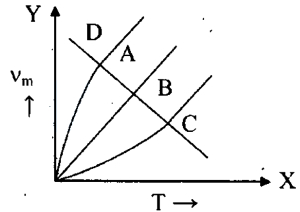
The frequency ' $\nu_m$ ' corresponding to which the energy emitted by a black body is maximum may vary with the temperature ' $T$ ' of the body as shown by the curves ' $A$ ',' $B$ ',' $C$ ' and ' $D$ ' in the figure. Which one of these represents the correct variation?
A
straight line $D$
B
curve $C$
C
straight line $B$
D
curve $A$
Solution
(C) According to Wien's displacement law,the wavelength $\lambda_m$ corresponding to maximum energy emission is inversely proportional to the absolute temperature $T$ of the black body:
$\lambda_m \propto \frac{1}{T}$
Since the frequency $\nu_m$ is related to the wavelength by the relation $\nu_m = \frac{c}{\lambda_m}$,where $c$ is the speed of light,we can substitute $\lambda_m = \frac{c}{\nu_m}$ into the proportionality:
$\frac{c}{\nu_m} \propto \frac{1}{T}$
$\nu_m \propto T$
This indicates that the frequency $\nu_m$ is directly proportional to the temperature $T$. $A$ direct proportionality between two variables is represented by a straight line passing through the origin. In the given figure,the straight line $B$ represents this linear relationship.
$\lambda_m \propto \frac{1}{T}$
Since the frequency $\nu_m$ is related to the wavelength by the relation $\nu_m = \frac{c}{\lambda_m}$,where $c$ is the speed of light,we can substitute $\lambda_m = \frac{c}{\nu_m}$ into the proportionality:
$\frac{c}{\nu_m} \propto \frac{1}{T}$
$\nu_m \propto T$
This indicates that the frequency $\nu_m$ is directly proportional to the temperature $T$. $A$ direct proportionality between two variables is represented by a straight line passing through the origin. In the given figure,the straight line $B$ represents this linear relationship.
0 likes
View Solution110
MediumMCQ
$A$ black body radiates power $P$ and maximum energy is radiated by it at a wavelength $\lambda_0$. The temperature of the black body is now changed such that it radiates maximum energy at the wavelength $\frac{\lambda_0}{4}$. The power radiated by it at the new temperature is (in $P$)
A
$64$
B
$256$
C
$4$
D
$16$
Solution
(B) According to Wien's displacement law,$\lambda_{\text{max}} T = \text{constant}$.
Therefore,$\frac{T_1}{T_2} = \frac{\lambda_{\text{max}2}}{\lambda_{\text{max}1}} = \frac{\lambda_0 / 4}{\lambda_0} = \frac{1}{4}$,which implies $T_2 = 4T_1$.
According to the Stefan-Boltzmann law,the power radiated by a black body is $P = \sigma A T^4$.
Therefore,the ratio of power radiated is $\frac{P_2}{P_1} = \left(\frac{T_2}{T_1}\right)^4$.
Substituting the values,$\frac{P_2}{P_1} = (4)^4 = 256$.
Thus,the new power radiated is $P_2 = 256 P$.
Therefore,$\frac{T_1}{T_2} = \frac{\lambda_{\text{max}2}}{\lambda_{\text{max}1}} = \frac{\lambda_0 / 4}{\lambda_0} = \frac{1}{4}$,which implies $T_2 = 4T_1$.
According to the Stefan-Boltzmann law,the power radiated by a black body is $P = \sigma A T^4$.
Therefore,the ratio of power radiated is $\frac{P_2}{P_1} = \left(\frac{T_2}{T_1}\right)^4$.
Substituting the values,$\frac{P_2}{P_1} = (4)^4 = 256$.
Thus,the new power radiated is $P_2 = 256 P$.
0 likes
View Solution111
MediumMCQ
Ordinary bodies $P$ and $Q$ radiate maximum energy with a wavelength difference of $3 \mu m$. The absolute temperature of body $P$ is four times that of $Q$. The wavelength at which body $Q$ radiates maximum energy is (in $\mu m$)
A
$2$
B
$4$
C
$6$
D
$8$
Solution
(B) According to Wien's displacement law,the wavelength $\lambda_m$ at which a body radiates maximum energy is inversely proportional to its absolute temperature $T$,given by $\lambda_m T = b$ (where $b$ is Wien's constant).
For bodies $P$ and $Q$,we have $\lambda_P T_P = \lambda_Q T_Q$.
Given that $T_P = 4 T_Q$,we substitute this into the equation:
$\lambda_P (4 T_Q) = \lambda_Q T_Q \implies \lambda_Q = 4 \lambda_P$ (Equation $1$).
We are given the difference in wavelengths as $\lambda_Q - \lambda_P = 3 \mu m$ (Equation $2$).
Substituting Equation $1$ into Equation $2$:
$4 \lambda_P - \lambda_P = 3 \mu m$
$3 \lambda_P = 3 \mu m$
$\lambda_P = 1 \mu m$.
Now,finding $\lambda_Q$ using Equation $1$:
$\lambda_Q = 4 \times 1 \mu m = 4 \mu m$.
For bodies $P$ and $Q$,we have $\lambda_P T_P = \lambda_Q T_Q$.
Given that $T_P = 4 T_Q$,we substitute this into the equation:
$\lambda_P (4 T_Q) = \lambda_Q T_Q \implies \lambda_Q = 4 \lambda_P$ (Equation $1$).
We are given the difference in wavelengths as $\lambda_Q - \lambda_P = 3 \mu m$ (Equation $2$).
Substituting Equation $1$ into Equation $2$:
$4 \lambda_P - \lambda_P = 3 \mu m$
$3 \lambda_P = 3 \mu m$
$\lambda_P = 1 \mu m$.
Now,finding $\lambda_Q$ using Equation $1$:
$\lambda_Q = 4 \times 1 \mu m = 4 \mu m$.
0 likes
View Solution112
DifficultMCQ
The black discs $x, y$ and $z$ have radii $1 \ m, 2 \ m$ and $3 \ m$ respectively. The wavelengths corresponding to maximum intensity are $200 \ nm, 300 \ nm$ and $400 \ nm$ respectively. The relation between emissive power $E_{x}, E_{y}$ and $E_{z}$ is
A
$E_{x} > E_{y} > E_{z}$
B
$E_{x} < E_{y} < E_{z}$
C
$E_{x} = E_{y} = E_{z}$
D
$E_{y} > E_{x} < E_{z}$
Solution
(A) The emissive power $E$ of a black body is given by the Stefan-Boltzmann law: $E = \sigma T^4$. However,the total power radiated by a surface is $P = A \sigma T^4$. Assuming the question asks for the total power radiated (often referred to as emissive power in this context):
$P \propto A T^4$.
Since $A = \pi R^2$,we have $A \propto R^2$.
Given radii $R_x = 1 \ m, R_y = 2 \ m, R_z = 3 \ m$,the areas are in ratio $A_x : A_y : A_z = 1^2 : 2^2 : 3^2 = 1 : 4 : 9$.
By Wien's displacement law,$\lambda_{max} T = b$ (constant),so $T \propto \frac{1}{\lambda_{max}}$.
Given $\lambda_{max,x} = 200 \ nm, \lambda_{max,y} = 300 \ nm, \lambda_{max,z} = 400 \ nm$,the temperatures are in ratio $T_x : T_y : T_z = \frac{1}{200} : \frac{1}{300} : \frac{1}{400} = \frac{1}{2} : \frac{1}{3} : \frac{1}{4} = 6 : 4 : 3$.
Now,calculating $P \propto A T^4$:
For $x: P_x \propto 1 \times (6)^4 = 1296$.
For $y: P_y \propto 4 \times (4)^4 = 4 \times 256 = 1024$.
For $z: P_z \propto 9 \times (3)^4 = 9 \times 81 = 729$.
Thus,$P_x > P_y > P_z$,which implies $E_x > E_y > E_z$.
$P \propto A T^4$.
Since $A = \pi R^2$,we have $A \propto R^2$.
Given radii $R_x = 1 \ m, R_y = 2 \ m, R_z = 3 \ m$,the areas are in ratio $A_x : A_y : A_z = 1^2 : 2^2 : 3^2 = 1 : 4 : 9$.
By Wien's displacement law,$\lambda_{max} T = b$ (constant),so $T \propto \frac{1}{\lambda_{max}}$.
Given $\lambda_{max,x} = 200 \ nm, \lambda_{max,y} = 300 \ nm, \lambda_{max,z} = 400 \ nm$,the temperatures are in ratio $T_x : T_y : T_z = \frac{1}{200} : \frac{1}{300} : \frac{1}{400} = \frac{1}{2} : \frac{1}{3} : \frac{1}{4} = 6 : 4 : 3$.
Now,calculating $P \propto A T^4$:
For $x: P_x \propto 1 \times (6)^4 = 1296$.
For $y: P_y \propto 4 \times (4)^4 = 4 \times 256 = 1024$.
For $z: P_z \propto 9 \times (3)^4 = 9 \times 81 = 729$.
Thus,$P_x > P_y > P_z$,which implies $E_x > E_y > E_z$.
0 likes
View Solution113
MediumMCQ
$A$ black body radiates maximum energy at wavelength $\lambda$ and its emissive power is $E$. Now,due to a change in the temperature of that body,it radiates maximum energy at wavelength $\frac{2 \lambda}{3}$. At that temperature,the emissive power is:
A
$\frac{51 E}{8}$
B
$\frac{81 E}{16}$
C
$\frac{61 E}{27}$
D
$\frac{71 E}{19}$
Solution
(B) According to Wien's Displacement Law,$\lambda_{\max} T = b$,where $b$ is Wien's constant. Therefore,$T = \frac{b}{\lambda_{\max}}$.
According to the Stefan-Boltzmann Law,the total emissive power $E$ of a black body is proportional to the fourth power of its absolute temperature: $E = \sigma T^4$.
Substituting the expression for $T$,we get $E = \sigma \left( \frac{b}{\lambda_{\max}} \right)^4$.
Let the initial wavelength be $\lambda_1 = \lambda$ and the final wavelength be $\lambda_2 = \frac{2 \lambda}{3}$.
Since $E \propto \frac{1}{\lambda_{\max}^4}$,we can write the ratio of the emissive powers as:
$\frac{E'}{E} = \left( \frac{\lambda_1}{\lambda_2} \right)^4$.
Substituting the values: $\frac{E'}{E} = \left( \frac{\lambda}{\frac{2 \lambda}{3}} \right)^4 = \left( \frac{3}{2} \right)^4$.
Calculating the value: $\frac{E'}{E} = \frac{81}{16}$.
Therefore,the new emissive power is $E' = \frac{81}{16} E$.
According to the Stefan-Boltzmann Law,the total emissive power $E$ of a black body is proportional to the fourth power of its absolute temperature: $E = \sigma T^4$.
Substituting the expression for $T$,we get $E = \sigma \left( \frac{b}{\lambda_{\max}} \right)^4$.
Let the initial wavelength be $\lambda_1 = \lambda$ and the final wavelength be $\lambda_2 = \frac{2 \lambda}{3}$.
Since $E \propto \frac{1}{\lambda_{\max}^4}$,we can write the ratio of the emissive powers as:
$\frac{E'}{E} = \left( \frac{\lambda_1}{\lambda_2} \right)^4$.
Substituting the values: $\frac{E'}{E} = \left( \frac{\lambda}{\frac{2 \lambda}{3}} \right)^4 = \left( \frac{3}{2} \right)^4$.
Calculating the value: $\frac{E'}{E} = \frac{81}{16}$.
Therefore,the new emissive power is $E' = \frac{81}{16} E$.
0 likes
View Solution114
EasyMCQ
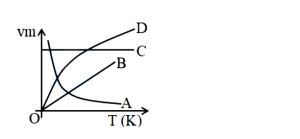
For a perfectly black body,a graph is plotted between the frequency of radiation with maximum intensity $(v_m)$ and the absolute temperature $T$. Which of the following graphs is correct?
A
$C$
B
$A$
C
$D$
D
$B$
Solution
(D) According to Wien's displacement law,$\lambda_m T = b$,where $b$ is Wien's constant.
If $v_m$ is the frequency corresponding to the wavelength $\lambda_m$,then $\lambda_m = \frac{c}{v_m}$.
Substituting this into the displacement law,we get $\left(\frac{c}{v_m}\right) T = b$.
Rearranging the terms,we find $v_m = \left(\frac{c}{b}\right) T$.
Since $c$ (speed of light) and $b$ (Wien's constant) are constants,$v_m \propto T$.
This represents a linear relationship passing through the origin,which corresponds to the straight line labeled $B$ in the graph.
Therefore,option $D$ is the correct answer.
If $v_m$ is the frequency corresponding to the wavelength $\lambda_m$,then $\lambda_m = \frac{c}{v_m}$.
Substituting this into the displacement law,we get $\left(\frac{c}{v_m}\right) T = b$.
Rearranging the terms,we find $v_m = \left(\frac{c}{b}\right) T$.
Since $c$ (speed of light) and $b$ (Wien's constant) are constants,$v_m \propto T$.
This represents a linear relationship passing through the origin,which corresponds to the straight line labeled $B$ in the graph.
Therefore,option $D$ is the correct answer.
0 likes
View Solution115
EasyMCQ
The radiation energy density per unit wavelength at temperature $T$ is maximum at a wavelength $\lambda_0$. At temperature $2T$,it will have a maximum at a wavelength
A
$\frac{\lambda_0}{4}$
B
$2 \lambda_0$
C
$4 \lambda_0$
D
$\frac{\lambda_0}{2}$
Solution
(D) According to Wien's displacement law,the product of the wavelength at which the radiation energy density is maximum $(\lambda_m)$ and the absolute temperature $(T)$ is a constant.
$\lambda_m T = \text{constant}$
Given that at temperature $T$,the maximum is at $\lambda_0$,we have:
$\lambda_0 T = \lambda' T'$
Here,$T' = 2T$. Substituting this into the equation:
$\lambda_0 T = \lambda' (2T)$
$\lambda' = \frac{\lambda_0 T}{2T} = \frac{\lambda_0}{2}$
Therefore,at temperature $2T$,the maximum energy density occurs at $\frac{\lambda_0}{2}$.
$\lambda_m T = \text{constant}$
Given that at temperature $T$,the maximum is at $\lambda_0$,we have:
$\lambda_0 T = \lambda' T'$
Here,$T' = 2T$. Substituting this into the equation:
$\lambda_0 T = \lambda' (2T)$
$\lambda' = \frac{\lambda_0 T}{2T} = \frac{\lambda_0}{2}$
Therefore,at temperature $2T$,the maximum energy density occurs at $\frac{\lambda_0}{2}$.
0 likes
View Solution116
MediumMCQ
If the temperature of a black body is doubled,the frequency at which the spectral intensity becomes maximum will be
A
unchanged
B
four times
C
doubled
D
halved
Solution
(C) According to Wien's displacement law,the wavelength corresponding to maximum spectral intensity $\lambda_m$ is inversely proportional to the absolute temperature $T$:
$\lambda_m \propto \frac{1}{T}$
Since the frequency $f$ is related to wavelength $\lambda$ by $f = \frac{c}{\lambda}$,where $c$ is the speed of light,we have $\lambda \propto \frac{1}{f}$.
Substituting this into Wien's law:
$\frac{1}{f} \propto \frac{1}{T} \Rightarrow f \propto T$
Therefore,if the temperature $T$ is doubled,the frequency $f$ at which the spectral intensity becomes maximum will also be doubled.
$\lambda_m \propto \frac{1}{T}$
Since the frequency $f$ is related to wavelength $\lambda$ by $f = \frac{c}{\lambda}$,where $c$ is the speed of light,we have $\lambda \propto \frac{1}{f}$.
Substituting this into Wien's law:
$\frac{1}{f} \propto \frac{1}{T} \Rightarrow f \propto T$
Therefore,if the temperature $T$ is doubled,the frequency $f$ at which the spectral intensity becomes maximum will also be doubled.
0 likes
View Solution117
DifficultMCQ
Three black discs $x, y, z$ have radii $1 \ m, 2 \ m$ and $3 \ m$ respectively. The wavelengths corresponding to maximum intensity are $200 \ nm, 300 \ nm$ and $400 \ nm$ respectively. The relation between emissive power $E_x, E_y$ and $E_z$ is:
A
$E_x$ is maximum
B
$E_y$ is maximum
C
$E_z$ is maximum
D
$E_x = E_y = E_z$
Solution
(A) According to Stefan-Boltzmann Law,the total emissive power $E$ of a black body is given by $E = \sigma T^4$,where $\sigma$ is the Stefan-Boltzmann constant and $T$ is the absolute temperature.
According to Wien's Displacement Law,the wavelength $\lambda_m$ corresponding to maximum intensity is inversely proportional to the absolute temperature $T$,i.e.,$T = \frac{b}{\lambda_m}$,where $b$ is Wien's constant.
Substituting $T$ in the expression for $E$,we get $E \propto (\frac{1}{\lambda_m})^4 = \frac{1}{\lambda_m^4}$.
Note that the emissive power $E$ of a black body depends only on its temperature,not on its surface area or radius.
Given $\lambda_x = 200 \ nm$,$\lambda_y = 300 \ nm$,and $\lambda_z = 400 \ nm$.
Since $E \propto \frac{1}{\lambda_m^4}$,we have:
$E_x \propto \frac{1}{200^4}$
$E_y \propto \frac{1}{300^4}$
$E_z \propto \frac{1}{400^4}$
Comparing the values,since $200 < 300 < 400$,it follows that $\frac{1}{200^4} > \frac{1}{300^4} > \frac{1}{400^4}$.
Therefore,$E_x > E_y > E_z$,which means $E_x$ is the maximum.
According to Wien's Displacement Law,the wavelength $\lambda_m$ corresponding to maximum intensity is inversely proportional to the absolute temperature $T$,i.e.,$T = \frac{b}{\lambda_m}$,where $b$ is Wien's constant.
Substituting $T$ in the expression for $E$,we get $E \propto (\frac{1}{\lambda_m})^4 = \frac{1}{\lambda_m^4}$.
Note that the emissive power $E$ of a black body depends only on its temperature,not on its surface area or radius.
Given $\lambda_x = 200 \ nm$,$\lambda_y = 300 \ nm$,and $\lambda_z = 400 \ nm$.
Since $E \propto \frac{1}{\lambda_m^4}$,we have:
$E_x \propto \frac{1}{200^4}$
$E_y \propto \frac{1}{300^4}$
$E_z \propto \frac{1}{400^4}$
Comparing the values,since $200 < 300 < 400$,it follows that $\frac{1}{200^4} > \frac{1}{300^4} > \frac{1}{400^4}$.
Therefore,$E_x > E_y > E_z$,which means $E_x$ is the maximum.
0 likes
View Solution118
MediumMCQ
Two bodies $A$ and $B$ radiate maximum energy with a wavelength difference of $4 \mu m$. The absolute temperature of body $A$ is $3$ times that of body $B$. The wavelength at which body $B$ radiates maximum energy is: (in $\mu m$)
A
$2$
B
$4$
C
$6$
D
$12$
Solution
(C) According to Wien's displacement law,the wavelength $\lambda_m$ corresponding to maximum energy emission is inversely proportional to the absolute temperature $T$:
$\lambda_m T = b$ (where $b$ is Wien's constant).
Therefore,$\lambda_{mA} T_A = \lambda_{mB} T_B$.
Given that $T_A = 3 T_B$,we substitute this into the equation:
$\lambda_{mA} (3 T_B) = \lambda_{mB} T_B \implies \lambda_{mB} = 3 \lambda_{mA}$.
We are also given the difference in wavelengths:
$\lambda_{mB} - \lambda_{mA} = 4 \mu m$.
Substituting $\lambda_{mB} = 3 \lambda_{mA}$ into the difference equation:
$3 \lambda_{mA} - \lambda_{mA} = 4 \mu m \implies 2 \lambda_{mA} = 4 \mu m \implies \lambda_{mA} = 2 \mu m$.
Now,calculate $\lambda_{mB}$:
$\lambda_{mB} = 3 \lambda_{mA} = 3(2 \mu m) = 6 \mu m$.
$\lambda_m T = b$ (where $b$ is Wien's constant).
Therefore,$\lambda_{mA} T_A = \lambda_{mB} T_B$.
Given that $T_A = 3 T_B$,we substitute this into the equation:
$\lambda_{mA} (3 T_B) = \lambda_{mB} T_B \implies \lambda_{mB} = 3 \lambda_{mA}$.
We are also given the difference in wavelengths:
$\lambda_{mB} - \lambda_{mA} = 4 \mu m$.
Substituting $\lambda_{mB} = 3 \lambda_{mA}$ into the difference equation:
$3 \lambda_{mA} - \lambda_{mA} = 4 \mu m \implies 2 \lambda_{mA} = 4 \mu m \implies \lambda_{mA} = 2 \mu m$.
Now,calculate $\lambda_{mB}$:
$\lambda_{mB} = 3 \lambda_{mA} = 3(2 \mu m) = 6 \mu m$.
0 likes
View Solution119
EasyMCQ
Two stars '$P$' and '$Q$' emit yellow and blue light respectively. The relation between their temperatures ($T_{P}$ and $T_{Q}$) is
A
$T_{P} = T_{Q}$
B
$T_{P} = \frac{T_{Q}}{2}$
C
$T_{P} > T_{Q}$
D
$T_{P} < T_{Q}$
Solution
(D) According to Wien's displacement law,the product of the wavelength of maximum emission $(\lambda_{m})$ and the absolute temperature $(T)$ is a constant,i.e.,$\lambda_{m} T = b$.
This implies that $T \propto \frac{1}{\lambda_{m}}$.
The wavelength of blue light is shorter than the wavelength of yellow light $(\lambda_{\text{blue}} < \lambda_{\text{yellow}})$.
Since the star '$Q$' emits blue light and star '$P$' emits yellow light,we have $\lambda_{Q} < \lambda_{P}$.
Therefore,$T_{Q} > T_{P}$,which can also be written as $T_{P} < T_{Q}$.
This implies that $T \propto \frac{1}{\lambda_{m}}$.
The wavelength of blue light is shorter than the wavelength of yellow light $(\lambda_{\text{blue}} < \lambda_{\text{yellow}})$.
Since the star '$Q$' emits blue light and star '$P$' emits yellow light,we have $\lambda_{Q} < \lambda_{P}$.
Therefore,$T_{Q} > T_{P}$,which can also be written as $T_{P} < T_{Q}$.
0 likes
View Solution120
EasyMCQ
$A$ black body has a maximum wavelength $\lambda_{m}$ at a temperature of $2000 \ K$. Its corresponding wavelength at a temperature of $3000 \ K$ will be:
A
$\frac{4}{9} \lambda_m$
B
$\frac{2}{3} \lambda_m$
C
$\frac{3}{2} \lambda_m$
D
$\frac{9}{4} \lambda_m$
Solution
(B) According to Wien's displacement law,the product of the wavelength of maximum emission and the absolute temperature is a constant:
$\lambda_m T = \text{constant}$
Therefore,$\lambda_m \propto \frac{1}{T}$.
Given $T_1 = 2000 \ K$ and $T_2 = 3000 \ K$,and the initial wavelength is $\lambda_m$:
$\frac{\lambda_2}{\lambda_m} = \frac{T_1}{T_2}$
$\frac{\lambda_2}{\lambda_m} = \frac{2000}{3000} = \frac{2}{3}$
$\lambda_2 = \frac{2}{3} \lambda_m$
Thus,the corresponding wavelength at $3000 \ K$ is $\frac{2}{3} \lambda_m$.
$\lambda_m T = \text{constant}$
Therefore,$\lambda_m \propto \frac{1}{T}$.
Given $T_1 = 2000 \ K$ and $T_2 = 3000 \ K$,and the initial wavelength is $\lambda_m$:
$\frac{\lambda_2}{\lambda_m} = \frac{T_1}{T_2}$
$\frac{\lambda_2}{\lambda_m} = \frac{2000}{3000} = \frac{2}{3}$
$\lambda_2 = \frac{2}{3} \lambda_m$
Thus,the corresponding wavelength at $3000 \ K$ is $\frac{2}{3} \lambda_m$.
0 likes
View Solution121
EasyMCQ
The emissive power of a sphere of area $0.04 \,m^2$ is $0.7 \,kcal \,s^{-1} \,m^{-2}$. The amount of heat radiated in $20 \,s$ is: (in $\,kcal$)
A
$0.56$
B
$0.28$
C
$5.6$
D
$2.8$
Solution
(A) The emissive power $E$ is defined as the heat energy $Q$ radiated per unit area $A$ per unit time $t$, given by the formula $E = \frac{Q}{A \cdot t}$.
To find the total heat radiated $Q$, we rearrange the formula: $Q = E \cdot A \cdot t$.
Given values are $E = 0.7 \,kcal \,s^{-1} \,m^{-2}$, $A = 0.04 \,m^2$, and $t = 20 \,s$.
Substituting these values: $Q = 0.7 \times 0.04 \times 20$.
$Q = 0.7 \times 0.8 = 0.56 \,kcal$.
Therefore, the amount of heat radiated is $0.56 \,kcal$.
To find the total heat radiated $Q$, we rearrange the formula: $Q = E \cdot A \cdot t$.
Given values are $E = 0.7 \,kcal \,s^{-1} \,m^{-2}$, $A = 0.04 \,m^2$, and $t = 20 \,s$.
Substituting these values: $Q = 0.7 \times 0.04 \times 20$.
$Q = 0.7 \times 0.8 = 0.56 \,kcal$.
Therefore, the amount of heat radiated is $0.56 \,kcal$.
0 likes
View Solution122
EasyMCQ
Assume that for solar radiation,the surface temperature of the Sun is $6000 \,K$. If Wien's constant '$b$' is $2.897 \times 10^{-3} \,m-K$,the value of the maximum wavelength will be: (in $Å$)
A
$4828$
B
$3648$
C
$6400$
D
$0.18$
Solution
(A) Given: Surface temperature $T = 6000 \,K$,Wien's constant $b = 2.897 \times 10^{-3} \,m-K$.
According to Wien's displacement law,$\lambda_{max} T = b$.
Therefore,$\lambda_{max} = \frac{b}{T} = \frac{2.897 \times 10^{-3}}{6000} \,m$.
$\lambda_{max} = 4.828 \times 10^{-7} \,m$.
Since $1 \,Å = 10^{-10} \,m$,we have $4.828 \times 10^{-7} \,m = 4828 \times 10^{-10} \,m = 4828 \,Å$.
According to Wien's displacement law,$\lambda_{max} T = b$.
Therefore,$\lambda_{max} = \frac{b}{T} = \frac{2.897 \times 10^{-3}}{6000} \,m$.
$\lambda_{max} = 4.828 \times 10^{-7} \,m$.
Since $1 \,Å = 10^{-10} \,m$,we have $4.828 \times 10^{-7} \,m = 4828 \times 10^{-10} \,m = 4828 \,Å$.
0 likes
View Solution123
EasyMCQ
Ordinary bodies $A$ and $B$ radiate maximum energy at wavelengths differing by $4 \mu m$. The absolute temperature of body $A$ is $3$ times that of body $B$. The wavelength at which body $B$ radiates maximum energy is: (in $\mu m$)
A
$12$
B
$6$
C
$4$
D
$8$
Solution
(B) According to Wien's displacement law,$\lambda_{max} T = b$ (constant).
Let $\lambda_A$ and $\lambda_B$ be the wavelengths of maximum energy for bodies $A$ and $B$,and $T_A$ and $T_B$ be their absolute temperatures.
Given: $T_A = 3 T_B$ and $\lambda_B - \lambda_A = 4 \mu m$ (since $T_A > T_B$,$\lambda_A < \lambda_B$).
From Wien's law: $\lambda_A T_A = \lambda_B T_B$.
Substituting $T_A = 3 T_B$: $\lambda_A (3 T_B) = \lambda_B T_B$,which gives $\lambda_B = 3 \lambda_A$.
Substitute this into the difference equation: $3 \lambda_A - \lambda_A = 4 \mu m$.
$2 \lambda_A = 4 \mu m \implies \lambda_A = 2 \mu m$.
Therefore,$\lambda_B = 3 \times 2 \mu m = 6 \mu m$.
Let $\lambda_A$ and $\lambda_B$ be the wavelengths of maximum energy for bodies $A$ and $B$,and $T_A$ and $T_B$ be their absolute temperatures.
Given: $T_A = 3 T_B$ and $\lambda_B - \lambda_A = 4 \mu m$ (since $T_A > T_B$,$\lambda_A < \lambda_B$).
From Wien's law: $\lambda_A T_A = \lambda_B T_B$.
Substituting $T_A = 3 T_B$: $\lambda_A (3 T_B) = \lambda_B T_B$,which gives $\lambda_B = 3 \lambda_A$.
Substitute this into the difference equation: $3 \lambda_A - \lambda_A = 4 \mu m$.
$2 \lambda_A = 4 \mu m \implies \lambda_A = 2 \mu m$.
Therefore,$\lambda_B = 3 \times 2 \mu m = 6 \mu m$.
0 likes
View Solution124
EasyMCQ
$A$ black body has a maximum wavelength $\lambda_{m}$ at a temperature of $2200 \ K$. Its corresponding wavelength at a temperature of $3300 \ K$ will be:
A
$\frac{9}{4} \lambda_{m}$
B
$\frac{3}{2} \lambda_{m}$
C
$\frac{4}{9} \lambda_{m}$
D
$\frac{2}{3} \lambda_{m}$
Solution
(D) According to Wien's displacement law,the product of the wavelength of maximum intensity $\lambda_{m}$ and the absolute temperature $T$ is a constant.
$\lambda_{m} T = \text{constant}$
Given:
$T_{1} = 2200 \ K$
$T_{2} = 3300 \ K$
Let the new wavelength be $\lambda_{m}^{\prime}$.
Using the relation $\lambda_{m} T_{1} = \lambda_{m}^{\prime} T_{2}$:
$\lambda_{m}^{\prime} = \lambda_{m} \times \frac{T_{1}}{T_{2}}$
$\lambda_{m}^{\prime} = \lambda_{m} \times \frac{2200}{3300}$
$\lambda_{m}^{\prime} = \frac{2}{3} \lambda_{m}$
$\lambda_{m} T = \text{constant}$
Given:
$T_{1} = 2200 \ K$
$T_{2} = 3300 \ K$
Let the new wavelength be $\lambda_{m}^{\prime}$.
Using the relation $\lambda_{m} T_{1} = \lambda_{m}^{\prime} T_{2}$:
$\lambda_{m}^{\prime} = \lambda_{m} \times \frac{T_{1}}{T_{2}}$
$\lambda_{m}^{\prime} = \lambda_{m} \times \frac{2200}{3300}$
$\lambda_{m}^{\prime} = \frac{2}{3} \lambda_{m}$
0 likes
View Solution125
EasyMCQ
Three black discs '$x$','$y$','$z$' have radii $1 \ m$,$2 \ m$,and $3 \ m$ respectively. The wavelengths corresponding to maximum intensity are $200 \ nm$,$300 \ nm$,and $400 \ nm$ respectively. The relation between emissive powers '$Ex$','$Ey$',and '$Ez$' is:
A
$Ex > Ey < Ez$
B
$Ex < Ey < Ez$
C
$Ex = Ey = Ez$
D
$Ex > Ey > Ez$
Solution
(D) According to Wien's displacement law,$\lambda_{m} T = b$ (constant),so $T \propto \frac{1}{\lambda_{m}}$.
According to Stefan-Boltzmann law,the total emissive power $E$ of a black body is given by $E = \sigma T^{4}$.
Substituting $T \propto \frac{1}{\lambda_{m}}$,we get $E \propto \left(\frac{1}{\lambda_{m}}\right)^{4} = \frac{1}{\lambda_{m}^{4}}$.
Note that the emissive power $E$ is independent of the surface area $A$ of the black body.
Therefore,the ratio of emissive powers is $Ex : Ey : Ez = \frac{1}{\lambda_{x}^{4}} : \frac{1}{\lambda_{y}^{4}} : \frac{1}{\lambda_{z}^{4}}$.
Substituting the given values: $Ex : Ey : Ez = \frac{1}{(200)^{4}} : \frac{1}{(300)^{4}} : \frac{1}{(400)^{4}}$.
Since $200 < 300 < 400$,it follows that $\frac{1}{200^{4}} > \frac{1}{300^{4}} > \frac{1}{400^{4}}$.
Thus,$Ex > Ey > Ez$.
According to Stefan-Boltzmann law,the total emissive power $E$ of a black body is given by $E = \sigma T^{4}$.
Substituting $T \propto \frac{1}{\lambda_{m}}$,we get $E \propto \left(\frac{1}{\lambda_{m}}\right)^{4} = \frac{1}{\lambda_{m}^{4}}$.
Note that the emissive power $E$ is independent of the surface area $A$ of the black body.
Therefore,the ratio of emissive powers is $Ex : Ey : Ez = \frac{1}{\lambda_{x}^{4}} : \frac{1}{\lambda_{y}^{4}} : \frac{1}{\lambda_{z}^{4}}$.
Substituting the given values: $Ex : Ey : Ez = \frac{1}{(200)^{4}} : \frac{1}{(300)^{4}} : \frac{1}{(400)^{4}}$.
Since $200 < 300 < 400$,it follows that $\frac{1}{200^{4}} > \frac{1}{300^{4}} > \frac{1}{400^{4}}$.
Thus,$Ex > Ey > Ez$.
0 likes
View Solution126
MediumMCQ
The maximum wavelength of radiation emitted by a star is $289.8 \ nm$. The intensity of radiation for the star is (Given: Stefan's constant $\sigma = 5.67 \times 10^{-8} \ W \ m^{-2} \ K^{-4}$,Wien's constant $b = 2898 \ \mu m \ K$)
A
$5.67 \times 10^{-12} \ W \ m^{-2}$
B
$10.67 \times 10^{14} \ W \ m^{-2}$
C
$5.67 \times 10^8 \ W \ m^{-2}$
D
$10.67 \times 10^7 \ W \ m^{-2}$
Solution
(C) Given,maximum wavelength,$\lambda_m = 289.8 \ nm = 289.8 \times 10^{-9} \ m = 2.898 \times 10^{-7} \ m$.
Stefan's constant,$\sigma = 5.67 \times 10^{-8} \ W \ m^{-2} \ K^{-4}$.
Wien's constant,$b = 2898 \ \mu m \ K = 2898 \times 10^{-6} \ m \ K$.
According to Wien's displacement law,$\lambda_m = \frac{b}{T}$,so $T = \frac{b}{\lambda_m}$.
Substituting the values,$T = \frac{2898 \times 10^{-6}}{289.8 \times 10^{-9}} = \frac{2898 \times 10^{-6}}{2.898 \times 10^{-7}} = 10^4 \ K$.
According to Stefan-Boltzmann law,the intensity of radiation $I$ is given by $I = \sigma T^4$ (assuming the star acts as a black body,$e=1$).
Substituting the values,$I = (5.67 \times 10^{-8}) \times (10^4)^4 = 5.67 \times 10^{-8} \times 10^{16} = 5.67 \times 10^8 \ W \ m^{-2}$.
Stefan's constant,$\sigma = 5.67 \times 10^{-8} \ W \ m^{-2} \ K^{-4}$.
Wien's constant,$b = 2898 \ \mu m \ K = 2898 \times 10^{-6} \ m \ K$.
According to Wien's displacement law,$\lambda_m = \frac{b}{T}$,so $T = \frac{b}{\lambda_m}$.
Substituting the values,$T = \frac{2898 \times 10^{-6}}{289.8 \times 10^{-9}} = \frac{2898 \times 10^{-6}}{2.898 \times 10^{-7}} = 10^4 \ K$.
According to Stefan-Boltzmann law,the intensity of radiation $I$ is given by $I = \sigma T^4$ (assuming the star acts as a black body,$e=1$).
Substituting the values,$I = (5.67 \times 10^{-8}) \times (10^4)^4 = 5.67 \times 10^{-8} \times 10^{16} = 5.67 \times 10^8 \ W \ m^{-2}$.
0 likes
View Solution127
EasyMCQ
The unit of Wien's constant $b$ is
A
$W m^{-2} K^{-4}$
B
$m^{-1} K^{-1}$
C
$W m^{2}$
D
$m K$
Solution
(D) According to Wien's displacement law,the product of the wavelength $\lambda_{m}$ corresponding to the maximum intensity of radiation and the absolute temperature $T$ of the body is a constant.
Mathematically,$\lambda_{m} T = b$.
Here,$\lambda_{m}$ is measured in meters $(m)$ and $T$ is measured in Kelvin $(K)$.
Therefore,the unit of Wien's constant $b$ is the product of the units of wavelength and temperature,which is $m K$.
Mathematically,$\lambda_{m} T = b$.
Here,$\lambda_{m}$ is measured in meters $(m)$ and $T$ is measured in Kelvin $(K)$.
Therefore,the unit of Wien's constant $b$ is the product of the units of wavelength and temperature,which is $m K$.
0 likes
View Solution128
MediumMCQ
We consider the radiation emitted by the human body. Which of the following statements is true?
A
The radiation is emitted during the summers and absorbed during the winters
B
The radiation emitted lies in the ultraviolet region and hence is not visible
C
The radiation emitted is in the infrared region
D
The radiation is emitted only during the day
Solution
(C) All bodies at a temperature above absolute zero emit electromagnetic radiation. The human body,being at a temperature of approximately $37^{\circ}C$ $(310 \ K)$,emits thermal radiation.
According to Wien's displacement law,the peak wavelength of this radiation corresponds to the infrared region of the electromagnetic spectrum.
The wavelength range for human body radiation is typically in the infrared region,specifically around $10 \ \mu m$.
Therefore,the radiation emitted by the human body is in the infrared region.
According to Wien's displacement law,the peak wavelength of this radiation corresponds to the infrared region of the electromagnetic spectrum.
The wavelength range for human body radiation is typically in the infrared region,specifically around $10 \ \mu m$.
Therefore,the radiation emitted by the human body is in the infrared region.
0 likes
View Solution129
MediumMCQ
Two stars $A$ and $B$ radiate maximum energy at the wavelengths of $360 \ nm$ and $480 \ nm$ respectively. Then the ratio of the surface temperatures of $A$ and $B$ is
A
$3: 4$
B
$81: 256$
C
$4: 3$
D
$256: 81$
Solution
(C) According to Wien's displacement law,the product of the wavelength of maximum emission and the absolute temperature is constant: $\lambda T = b$.
Therefore,$\lambda_A T_A = \lambda_B T_B$.
This implies the ratio of temperatures is inversely proportional to the ratio of wavelengths: $\frac{T_A}{T_B} = \frac{\lambda_B}{\lambda_A}$.
Given $\lambda_A = 360 \ nm$ and $\lambda_B = 480 \ nm$.
Substituting the values: $\frac{T_A}{T_B} = \frac{480}{360} = \frac{4}{3}$.
Thus,the ratio of the surface temperatures of $A$ and $B$ is $4: 3$.
Therefore,$\lambda_A T_A = \lambda_B T_B$.
This implies the ratio of temperatures is inversely proportional to the ratio of wavelengths: $\frac{T_A}{T_B} = \frac{\lambda_B}{\lambda_A}$.
Given $\lambda_A = 360 \ nm$ and $\lambda_B = 480 \ nm$.
Substituting the values: $\frac{T_A}{T_B} = \frac{480}{360} = \frac{4}{3}$.
Thus,the ratio of the surface temperatures of $A$ and $B$ is $4: 3$.
0 likes
View Solution130
MediumMCQ
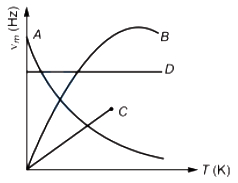
Which one of the following is the $\nu_{m}-T$ graph for a perfectly black body? Here, $\nu_{m}$ is the frequency of radiation with maximum intensity and $T$ is the absolute temperature.
A
$A$
B
$B$
C
$C$
D
$D$
Solution
(C) According to Wien's displacement law, the wavelength corresponding to maximum intensity $(\lambda_{m})$ is inversely proportional to the absolute temperature $(T)$, i.e., $\lambda_{m} T = \text{constant}$.
Since the frequency $\nu_{m}$ is related to wavelength by $\nu_{m} = c / \lambda_{m}$, we can substitute $\lambda_{m} = c / \nu_{m}$ into the displacement law.
This gives $(c / \nu_{m}) T = \text{constant}$, which simplifies to $\nu_{m} / T = \text{constant}'$ or $\nu_{m} \propto T$.
Therefore, the graph of $\nu_{m}$ versus $T$ for a perfectly black body is a straight line passing through the origin, which corresponds to line $C$ in the given figure.
Since the frequency $\nu_{m}$ is related to wavelength by $\nu_{m} = c / \lambda_{m}$, we can substitute $\lambda_{m} = c / \nu_{m}$ into the displacement law.
This gives $(c / \nu_{m}) T = \text{constant}$, which simplifies to $\nu_{m} / T = \text{constant}'$ or $\nu_{m} \propto T$.
Therefore, the graph of $\nu_{m}$ versus $T$ for a perfectly black body is a straight line passing through the origin, which corresponds to line $C$ in the given figure.
0 likes
View Solution131
EasyMCQ
The surface temperature of the stars is determined using:
A
Planck's law
B
Wien's displacement law
C
Rayleigh-Jeans law
D
Kirchhoff's law
Solution
(B) The surface temperature of the stars is determined using Wien's displacement law.
According to this law,$\lambda_{m} T = b$,where $\lambda_{m}$ is the wavelength corresponding to the maximum spectral emissive power,$T$ is the absolute temperature of the black body,and $b$ is Wien's constant.
The value of Wien's constant is approximately $2.898 \times 10^{-3} \ m \cdot K$.
By measuring the wavelength $\lambda_{m}$ at which the star emits maximum radiation,the surface temperature $T$ can be calculated as $T = b / \lambda_{m}$.
According to this law,$\lambda_{m} T = b$,where $\lambda_{m}$ is the wavelength corresponding to the maximum spectral emissive power,$T$ is the absolute temperature of the black body,and $b$ is Wien's constant.
The value of Wien's constant is approximately $2.898 \times 10^{-3} \ m \cdot K$.
By measuring the wavelength $\lambda_{m}$ at which the star emits maximum radiation,the surface temperature $T$ can be calculated as $T = b / \lambda_{m}$.
0 likes
View Solution132
EasyMCQ
The surface temperature of the sun which has maximum energy emission at $500 \,nm$ is $6000 \,K$. The temperature of a star which has maximum energy emission at $400 \,nm$ will be: (in $\,K$)
A
$8500$
B
$4500$
C
$7500$
D
$6500$
Solution
(C) According to Wien's displacement law,the product of the wavelength of maximum emission $(\lambda_m)$ and the absolute temperature $(T)$ is constant:
$\lambda_{m1} T_1 = \lambda_{m2} T_2$
Given:
$\lambda_{m1} = 500 \,nm$,$T_1 = 6000 \,K$
$\lambda_{m2} = 400 \,nm$,$T_2 = ?$
Substituting the values into the equation:
$500 \,nm \times 6000 \,K = 400 \,nm \times T_2$
$T_2 = \frac{500 \times 6000}{400}$
$T_2 = 5 \times 1500$
$T_2 = 7500 \,K$
Therefore,the temperature of the star is $7500 \,K$.
$\lambda_{m1} T_1 = \lambda_{m2} T_2$
Given:
$\lambda_{m1} = 500 \,nm$,$T_1 = 6000 \,K$
$\lambda_{m2} = 400 \,nm$,$T_2 = ?$
Substituting the values into the equation:
$500 \,nm \times 6000 \,K = 400 \,nm \times T_2$
$T_2 = \frac{500 \times 6000}{400}$
$T_2 = 5 \times 1500$
$T_2 = 7500 \,K$
Therefore,the temperature of the star is $7500 \,K$.
0 likes
View Solution133
EasyMCQ
If the wavelengths of maximum intensity of radiation emitted by two black bodies $A$ and $B$ are $0.5 \mu m$ and $0.1 \ mm$ respectively,then the ratio of the temperatures of the bodies $A$ and $B$ is
A
$5$
B
$25$
C
$100$
D
$200$
Solution
(D) According to Wien's displacement law,the product of the wavelength of maximum intensity $(\lambda_m)$ and the absolute temperature $(T)$ of a black body is constant: $\lambda_m T = b$ (where $b$ is Wien's constant).
Therefore,$T \propto \frac{1}{\lambda_m}$.
Given: $\lambda_A = 0.5 \mu m = 0.5 \times 10^{-6} \ m$ and $\lambda_B = 0.1 \ mm = 0.1 \times 10^{-3} \ m = 10^{-4} \ m$.
The ratio of temperatures is $\frac{T_A}{T_B} = \frac{\lambda_B}{\lambda_A}$.
Substituting the values: $\frac{T_A}{T_B} = \frac{10^{-4}}{0.5 \times 10^{-6}} = \frac{10^{-4}}{5 \times 10^{-7}} = \frac{1000}{5} = 200$.
Thus,the ratio of the temperatures of the bodies $A$ and $B$ is $200$.
Therefore,$T \propto \frac{1}{\lambda_m}$.
Given: $\lambda_A = 0.5 \mu m = 0.5 \times 10^{-6} \ m$ and $\lambda_B = 0.1 \ mm = 0.1 \times 10^{-3} \ m = 10^{-4} \ m$.
The ratio of temperatures is $\frac{T_A}{T_B} = \frac{\lambda_B}{\lambda_A}$.
Substituting the values: $\frac{T_A}{T_B} = \frac{10^{-4}}{0.5 \times 10^{-6}} = \frac{10^{-4}}{5 \times 10^{-7}} = \frac{1000}{5} = 200$.
Thus,the ratio of the temperatures of the bodies $A$ and $B$ is $200$.
0 likes
View Solution134
EasyMCQ
When an iron rod is heated, the variation of colour from dull red to white can be explained by
A
Boltzmann Law
B
Newton's Law of cooling
C
Stefan's Law of radiation
D
Wien's displacement Law
Solution
(D) According to Wien's displacement law, the wavelength corresponding to the maximum intensity of emission $(\lambda_m)$ is inversely proportional to the absolute temperature $(T)$ of the body, given by $\lambda_m T = b$, where $b$ is Wien's constant.
As the temperature of the iron rod increases, the wavelength of the emitted radiation decreases.
Initially, at lower temperatures, the emitted radiation is in the red part of the visible spectrum.
As the temperature increases further, the peak wavelength shifts towards shorter wavelengths (yellow, then blue, and finally white), which is a combination of all visible wavelengths.
Thus, the change in colour is explained by Wien's displacement law.
As the temperature of the iron rod increases, the wavelength of the emitted radiation decreases.
Initially, at lower temperatures, the emitted radiation is in the red part of the visible spectrum.
As the temperature increases further, the peak wavelength shifts towards shorter wavelengths (yellow, then blue, and finally white), which is a combination of all visible wavelengths.
Thus, the change in colour is explained by Wien's displacement law.
0 likes
View Solution135
EasyMCQ
Wien's displacement law states that:
A
$\lambda_m T = \text{constant}$
B
$\frac{\lambda_m}{T} = \text{constant}$
C
$\frac{T}{\lambda_m} = \text{constant}$
D
$\lambda_m + T = \text{constant}$
Solution
(A) According to Wien's displacement law, the wavelength $(\lambda_m)$ corresponding to the maximum energy emitted by a black body is inversely proportional to its absolute temperature $(T)$.
Mathematically, $\lambda_m \propto \frac{1}{T}$.
This can be written as $\lambda_m = \frac{b}{T}$, where $b$ is Wien's constant.
Therefore, $\lambda_m \cdot T = b$, which is a constant.
Mathematically, $\lambda_m \propto \frac{1}{T}$.
This can be written as $\lambda_m = \frac{b}{T}$, where $b$ is Wien's constant.
Therefore, $\lambda_m \cdot T = b$, which is a constant.
0 likes
View Solution136
MediumMCQ
$A$ body at $3000 \,K$ emits maximum energy at a wavelength of $9660 Å$. If the sun emits maximum energy at a wavelength of $4950 Å$, what would be the temperature of the sun (in $\,K$)?
A
$5855$
B
$7000$
C
$4250$
D
$8000$
Solution
(A) Given:
Temperature of the body, $T_1 = 3000 \,K$
Wavelength of maximum energy emission for the body, $\lambda_1 = 9660 Å$
Wavelength of maximum energy emission for the sun, $\lambda_2 = 4950 Å$
According to Wien's displacement law, the product of the wavelength of maximum emission and the absolute temperature is constant:
$\lambda_1 T_1 = \lambda_2 T_2$
Rearranging to find the temperature of the sun $(T_2)$:
$T_2 = \frac{\lambda_1 T_1}{\lambda_2}$
Substituting the given values:
$T_2 = \frac{9660 Å \times 3000 \,K}{4950 Å}$
$T_2 = \frac{28980000}{4950} \,K$
$T_2 \approx 5854.54 \,K$
Rounding to the nearest whole number, we get $T_2 \approx 5855 \,K$.
Temperature of the body, $T_1 = 3000 \,K$
Wavelength of maximum energy emission for the body, $\lambda_1 = 9660 Å$
Wavelength of maximum energy emission for the sun, $\lambda_2 = 4950 Å$
According to Wien's displacement law, the product of the wavelength of maximum emission and the absolute temperature is constant:
$\lambda_1 T_1 = \lambda_2 T_2$
Rearranging to find the temperature of the sun $(T_2)$:
$T_2 = \frac{\lambda_1 T_1}{\lambda_2}$
Substituting the given values:
$T_2 = \frac{9660 Å \times 3000 \,K}{4950 Å}$
$T_2 = \frac{28980000}{4950} \,K$
$T_2 \approx 5854.54 \,K$
Rounding to the nearest whole number, we get $T_2 \approx 5855 \,K$.
0 likes
View Solution137
MediumMCQ
The wavelength of maximum emitted energy $(\lambda_m)$ of a body at $700 \ K$ is $4.08 \ \mu m$. If the temperature of the body is raised to $1400 \ K$,then the value of $\lambda_m$ will be (in $\mu m$)
A
$1.02$
B
$16.32$
C
$8.16$
D
$2.04$
Solution
(D) According to Wien's displacement law,the product of the wavelength of maximum emission $(\lambda_m)$ and the absolute temperature $(T)$ is a constant,i.e.,$\lambda_m T = b$ (constant).
Therefore,$\lambda_{m_1} T_1 = \lambda_{m_2} T_2$.
Given:
$\lambda_{m_1} = 4.08 \ \mu m$
$T_1 = 700 \ K$
$T_2 = 1400 \ K$
Substituting the values:
$4.08 \times 700 = \lambda_{m_2} \times 1400$
$\lambda_{m_2} = \frac{4.08 \times 700}{1400}$
$\lambda_{m_2} = \frac{4.08}{2} = 2.04 \ \mu m$.
Thus,the new wavelength is $2.04 \ \mu m$.
Therefore,$\lambda_{m_1} T_1 = \lambda_{m_2} T_2$.
Given:
$\lambda_{m_1} = 4.08 \ \mu m$
$T_1 = 700 \ K$
$T_2 = 1400 \ K$
Substituting the values:
$4.08 \times 700 = \lambda_{m_2} \times 1400$
$\lambda_{m_2} = \frac{4.08 \times 700}{1400}$
$\lambda_{m_2} = \frac{4.08}{2} = 2.04 \ \mu m$.
Thus,the new wavelength is $2.04 \ \mu m$.
0 likes
View Solution138
EasyMCQ
The wavelength of maximum intensity of radiation emitted by a star is $289.8 \, nm$. The radiation intensity of the star is (Stefan's constant $\sigma = 5.67 \times 10^{-8} \, W m^{-2} K^{-4}$, Wien's constant $b = 2898 \, \mu m K$).
A
$5.67 \times 10^8 \, W/m^2$
B
$5.67 \times 10^4 \, W/m^2$
C
$2.89 \times 10^8 \, W/m^2$
D
$1.13 \times 10^8 \, W/m^2$
Solution
(A) Given: $\lambda_m = 289.8 \, nm = 289.8 \times 10^{-9} \, m$, $b = 2898 \, \mu m K = 2898 \times 10^{-6} \, m K$, $\sigma = 5.67 \times 10^{-8} \, W m^{-2} K^{-4}$.
Using Wien's displacement law: $\lambda_m T = b$.
$T = \frac{b}{\lambda_m} = \frac{2898 \times 10^{-6}}{289.8 \times 10^{-9}} = \frac{2898 \times 10^{-6}}{289.8 \times 10^{-9}} = 10 \times 10^3 = 10^4 \, K$.
Radiation intensity (emissive power) $E = \sigma T^4$.
$E = (5.67 \times 10^{-8}) \times (10^4)^4$.
$E = 5.67 \times 10^{-8} \times 10^{16} = 5.67 \times 10^8 \, W/m^2$.
Using Wien's displacement law: $\lambda_m T = b$.
$T = \frac{b}{\lambda_m} = \frac{2898 \times 10^{-6}}{289.8 \times 10^{-9}} = \frac{2898 \times 10^{-6}}{289.8 \times 10^{-9}} = 10 \times 10^3 = 10^4 \, K$.
Radiation intensity (emissive power) $E = \sigma T^4$.
$E = (5.67 \times 10^{-8}) \times (10^4)^4$.
$E = 5.67 \times 10^{-8} \times 10^{16} = 5.67 \times 10^8 \, W/m^2$.
0 likes
View Solution139
EasyMCQ
If $\lambda$ denotes the wavelength at which the radiative emission from a black body at a temperature $T$ is maximum,then
A
$\lambda \propto T^{-1}$
B
$\lambda \propto T^4$
C
is independent of $T$
D
$\lambda \propto T$
Solution
(A) According to Wien's displacement law,$\lambda_m \cdot T = b$,where $\lambda_m$ is the wavelength corresponding to the maximum radiation of energy from a black body,$b$ is Wien's constant,and $T$ is the absolute temperature.
From this relation,we can see that $\lambda_m = \frac{b}{T}$.
Therefore,$\lambda_m \propto \frac{1}{T}$,which can be written as $\lambda_m \propto T^{-1}$.
From this relation,we can see that $\lambda_m = \frac{b}{T}$.
Therefore,$\lambda_m \propto \frac{1}{T}$,which can be written as $\lambda_m \propto T^{-1}$.

0 likes
View Solution140
EasyMCQ
The wavelength of the radiation emitted by a black body is $6 \ mm$ and Wien's constant is $3 \times 10^{-3} \ mK$. Then the temperature of the black body is (in $K$)
A
$5$
B
$3$
C
$0.5$
D
$50$
Solution
(C) According to Wien's displacement law,the relationship between the wavelength of maximum emission $\lambda_m$ and the absolute temperature $T$ of a black body is given by $\lambda_m T = b$,where $b$ is Wien's constant.
Given:
$\lambda_m = 6 \ mm = 6 \times 10^{-3} \ m$
$b = 3 \times 10^{-3} \ mK$
Substituting these values into the formula:
$(6 \times 10^{-3} \ m) \times T = 3 \times 10^{-3} \ mK$
$T = \frac{3 \times 10^{-3}}{6 \times 10^{-3}} \ K$
$T = \frac{1}{2} \ K = 0.5 \ K$
Therefore,the temperature of the black body is $0.5 \ K$.
Given:
$\lambda_m = 6 \ mm = 6 \times 10^{-3} \ m$
$b = 3 \times 10^{-3} \ mK$
Substituting these values into the formula:
$(6 \times 10^{-3} \ m) \times T = 3 \times 10^{-3} \ mK$
$T = \frac{3 \times 10^{-3}}{6 \times 10^{-3}} \ K$
$T = \frac{1}{2} \ K = 0.5 \ K$
Therefore,the temperature of the black body is $0.5 \ K$.
0 likes
View Solution141
EasyMCQ
The wavelength of the radiation emitted by a black body is $1 \,mm$ and Wien's constant is $3 \times 10^{-3} \,mK$. Then the temperature of the black body will be (in $\,K$)
A
$3$
B
$30$
C
$300$
D
$3000$
Solution
(A) According to Wien's displacement law, the relationship between the wavelength of maximum emission and the absolute temperature of a black body is given by:
$\lambda T = b$
Where:
$\lambda$ is the wavelength of radiation = $1 \,mm = 1 \times 10^{-3} \,m$
$b$ is Wien's constant = $3 \times 10^{-3} \,mK$
$T$ is the temperature of the black body.
Substituting the values into the formula:
$T = \frac{b}{\lambda} = \frac{3 \times 10^{-3} \,mK}{1 \times 10^{-3} \,m} = 3 \,K$
Therefore, the temperature of the black body is $3 \,K$.
$\lambda T = b$
Where:
$\lambda$ is the wavelength of radiation = $1 \,mm = 1 \times 10^{-3} \,m$
$b$ is Wien's constant = $3 \times 10^{-3} \,mK$
$T$ is the temperature of the black body.
Substituting the values into the formula:
$T = \frac{b}{\lambda} = \frac{3 \times 10^{-3} \,mK}{1 \times 10^{-3} \,m} = 3 \,K$
Therefore, the temperature of the black body is $3 \,K$.
0 likes
View Solution142
MediumMCQ
Two bodies $A$ and $B$ of equal surface area have thermal emissivities of $0.01$ and $0.81$ respectively. The two bodies are radiating energy at the same rate. Maximum energy is radiated from the two bodies $A$ and $B$ at wavelengths $\lambda_A$ and $\lambda_B$ respectively. The difference in these two wavelengths is $1 \mu m$. If the temperature of body $A$ is $5802 \ K$,then the value of $\lambda_B$ is:
A
$\frac{1}{2} \mu m$
B
$1 \mu m$
C
$2 \mu m$
D
$\frac{3}{2} \mu m$
Solution
(D) According to Stefan-Boltzmann law,the power radiated is $P = e A \sigma T^4$. Since the bodies have equal surface area and radiate at the same rate $(P_A = P_B)$,we have $e_A T_A^4 = e_B T_B^4$.
Given $e_A = 0.01$,$e_B = 0.81$,and $T_A = 5802 \ K$.
Substituting the values: $0.01 \times (5802)^4 = 0.81 \times T_B^4$.
Taking the fourth root on both sides: $T_B = T_A \times (0.01 / 0.81)^{1/4} = 5802 \times (1/81)^{1/4} = 5802 / 3 = 1934 \ K$.
From Wien's displacement law,$\lambda_A T_A = \lambda_B T_B = b$ (where $b \approx 2898 \ \mu m \cdot K$).
Thus,$\lambda_A = b / T_A = 2898 / 5802 \approx 0.5 \ \mu m$.
Given $\lambda_B - \lambda_A = 1 \ \mu m$,so $\lambda_B = 1 + 0.5 = 1.5 \ \mu m = \frac{3}{2} \ \mu m$.
Given $e_A = 0.01$,$e_B = 0.81$,and $T_A = 5802 \ K$.
Substituting the values: $0.01 \times (5802)^4 = 0.81 \times T_B^4$.
Taking the fourth root on both sides: $T_B = T_A \times (0.01 / 0.81)^{1/4} = 5802 \times (1/81)^{1/4} = 5802 / 3 = 1934 \ K$.
From Wien's displacement law,$\lambda_A T_A = \lambda_B T_B = b$ (where $b \approx 2898 \ \mu m \cdot K$).
Thus,$\lambda_A = b / T_A = 2898 / 5802 \approx 0.5 \ \mu m$.
Given $\lambda_B - \lambda_A = 1 \ \mu m$,so $\lambda_B = 1 + 0.5 = 1.5 \ \mu m = \frac{3}{2} \ \mu m$.
0 likes
View Solution143
EasyMCQ
Experimental investigations show that the intensity of solar radiation is maximum for a wavelength $480 \, nm$ in the visible region. Estimate the surface temperature of the sun. Given Wien's constant $b = 2.88 \times 10^{-3} \, mK$.
A
$4000 \, K$
B
$6000 \, K$
C
$8000 \, K$
D
$10^6 \, K$
Solution
(B) According to Wien's displacement law, the product of the wavelength corresponding to maximum intensity $(\lambda_m)$ and the absolute temperature $(T)$ of the black body is a constant $(b).$
Formula: $\lambda_m T = b$
Given values:
$\lambda_m = 480 \, nm = 480 \times 10^{-9} \, m$
$b = 2.88 \times 10^{-3} \, mK$
Calculation:
$T = \frac{b}{\lambda_m}$
$T = \frac{2.88 \times 10^{-3}}{480 \times 10^{-9}}$
$T = \frac{2.88}{480} \times 10^6$
$T = 0.006 \times 10^6 = 6000 \, K$
Therefore, the surface temperature of the sun is $6000 \, K$.
Formula: $\lambda_m T = b$
Given values:
$\lambda_m = 480 \, nm = 480 \times 10^{-9} \, m$
$b = 2.88 \times 10^{-3} \, mK$
Calculation:
$T = \frac{b}{\lambda_m}$
$T = \frac{2.88 \times 10^{-3}}{480 \times 10^{-9}}$
$T = \frac{2.88}{480} \times 10^6$
$T = 0.006 \times 10^6 = 6000 \, K$
Therefore, the surface temperature of the sun is $6000 \, K$.
0 likes
View Solution10-2.Heat Transfer — Spectral Emissive Power and Wien's Displacement Law · Frequently Asked Questions
1Are these 10-2.Heat Transfer questions useful for JEE and NEET?
Yes. All questions in this section are mapped to JEE Main and NEET exam patterns. Previous year questions from JEE Main, NEET, GUJCET and state-level exams are included with full solutions.
2Can I switch to Hindi or Gujarati for these questions?
Yes. Use the language tabs in the hero section or the sidebar to view the same questions and solutions in English, Hindi or Gujarati.
3How do I generate a question paper from this subtopic?
Use the Vedclass Exam Paper Generator — select the chapter and subtopic, set difficulty, and generate Sets A, B, C, D automatically. First 3 chapters of every subject are free.
Vedclass Products
For Students
Vedclass Test Series
Mock tests in real JEE/NEET style with performance analysis. 5-day free trial.
Start Free TrialFor Teachers
Exam Paper Generator
Generate Set A/B/C/D papers from this chapter in 2 minutes. 3 chapters free.
Try FreeFor Institutes
Online Exam Module
Live online exams with unlimited students, 360° analytics & white-label branding.
See DemoFor Teachers & Institutes
Generate a 10-2.Heat Transfer Exam Paper in 2 Minutes
Select subtopic & difficulty — Sets A, B, C, D auto-generated with No Repeat logic.
First 3 chapters of every subject are free — no payment required.