
A English
Geometry of complex numbers Questions in English
Class 11 Mathematics · 4-1.Complex numbers · Geometry of complex numbers
467+
Questions
English
Language
100%
With Solutions
Showing 49 of 467 questions in English
51
DifficultMCQ
If $z = x + iy$,then the area of the triangle whose vertices are the points $z$,$iz$,and $z + iz$ is
A
$2|z|^2$
B
$\frac{1}{2}|z|^2$
C
$|z|^2$
D
$\frac{3}{2}|z|^2$
Solution
(B) Let $z = x + iy$. The vertices of the triangle are $z = (x, y)$,$iz = (-y, x)$,and $z + iz = (x - y, x + y)$.
The area $A$ of a triangle with vertices $(x_1, y_1)$,$(x_2, y_2)$,and $(x_3, y_3)$ is given by $A = \frac{1}{2} |x_1(y_2 - y_3) + x_2(y_3 - y_1) + x_3(y_1 - y_2)|$.
Substituting the coordinates:
$A = \frac{1}{2} |x(x - (x + y)) + (-y)((x + y) - y) + (x - y)(y - x)|$
$A = \frac{1}{2} |x(-y) - y(x) + (x - y)(-(x - y))|$
$A = \frac{1}{2} |-xy - xy - (x - y)^2|$
$A = \frac{1}{2} |-2xy - (x^2 - 2xy + y^2)|$
$A = \frac{1}{2} |-2xy - x^2 + 2xy - y^2|$
$A = \frac{1}{2} |-x^2 - y^2| = \frac{1}{2} (x^2 + y^2) = \frac{1}{2} |z|^2$.
The area $A$ of a triangle with vertices $(x_1, y_1)$,$(x_2, y_2)$,and $(x_3, y_3)$ is given by $A = \frac{1}{2} |x_1(y_2 - y_3) + x_2(y_3 - y_1) + x_3(y_1 - y_2)|$.
Substituting the coordinates:
$A = \frac{1}{2} |x(x - (x + y)) + (-y)((x + y) - y) + (x - y)(y - x)|$
$A = \frac{1}{2} |x(-y) - y(x) + (x - y)(-(x - y))|$
$A = \frac{1}{2} |-xy - xy - (x - y)^2|$
$A = \frac{1}{2} |-2xy - (x^2 - 2xy + y^2)|$
$A = \frac{1}{2} |-2xy - x^2 + 2xy - y^2|$
$A = \frac{1}{2} |-x^2 - y^2| = \frac{1}{2} (x^2 + y^2) = \frac{1}{2} |z|^2$.
0 likes
View Solution52
EasyMCQ
If $A, B, C$ are represented by $3 + 4i, 5 - 2i, -1 + 16i$,then $A, B, C$ are
A
Collinear
B
Vertices of an equilateral triangle
C
Vertices of an isosceles triangle
D
Vertices of a right-angled triangle
Solution
(A) The points are given by $A(3, 4), B(5, -2)$,and $C(-1, 16)$.
To check if they are collinear,we calculate the area of the triangle formed by these points:
$\text{Area} = \frac{1}{2} |x_1(y_2 - y_3) + x_2(y_3 - y_1) + x_3(y_1 - y_2)|$
$\text{Area} = \frac{1}{2} |3(-2 - 16) + 5(16 - 4) + (-1)(4 - (-2))|$
$\text{Area} = \frac{1}{2} |3(-18) + 5(12) - 1(6)|$
$\text{Area} = \frac{1}{2} |-54 + 60 - 6| = \frac{1}{2} |0| = 0$.
Since the area is $0$,the points $A, B, C$ are collinear.
To check if they are collinear,we calculate the area of the triangle formed by these points:
$\text{Area} = \frac{1}{2} |x_1(y_2 - y_3) + x_2(y_3 - y_1) + x_3(y_1 - y_2)|$
$\text{Area} = \frac{1}{2} |3(-2 - 16) + 5(16 - 4) + (-1)(4 - (-2))|$
$\text{Area} = \frac{1}{2} |3(-18) + 5(12) - 1(6)|$
$\text{Area} = \frac{1}{2} |-54 + 60 - 6| = \frac{1}{2} |0| = 0$.
Since the area is $0$,the points $A, B, C$ are collinear.
0 likes
View Solution53
EasyMCQ
If ${z_1}, {z_2}, {z_3}$ are affixes of the vertices $A, B$ and $C$ respectively of a triangle $ABC$ having centroid at $G$ such that $z = 0$ is the midpoint of $AG$,then:
A
${z_1} + {z_2} + {z_3} = 0$
B
${z_1} + 4{z_2} + {z_3} = 0$
C
${z_1} + {z_2} + 4{z_3} = 0$
D
$4{z_1} + {z_2} + {z_3} = 0$
Solution
(D) The affix of the centroid $G$ is given by $g = \frac{z_1 + z_2 + z_3}{3}$.
Since $z = 0$ is the midpoint of $AG$,the affix of the midpoint is $\frac{g + z_1}{2} = 0$.
Substituting the value of $g$,we get $\frac{\frac{z_1 + z_2 + z_3}{3} + z_1}{2} = 0$.
Multiplying by $6$,we get $(z_1 + z_2 + z_3) + 3z_1 = 0$.
Thus,$4z_1 + z_2 + z_3 = 0$.
Since $z = 0$ is the midpoint of $AG$,the affix of the midpoint is $\frac{g + z_1}{2} = 0$.
Substituting the value of $g$,we get $\frac{\frac{z_1 + z_2 + z_3}{3} + z_1}{2} = 0$.
Multiplying by $6$,we get $(z_1 + z_2 + z_3) + 3z_1 = 0$.
Thus,$4z_1 + z_2 + z_3 = 0$.
0 likes
View Solution54
MediumMCQ
Let $z_1$ and $z_2$ be two complex numbers such that $\frac{z_1}{z_2} + \frac{z_2}{z_1} = 1$. Then
A
$z_1, z_2$ are collinear
B
$z_1, z_2$ and the origin form a right-angled triangle
C
$z_1, z_2$ and the origin form an equilateral triangle
D
None of these
Solution
(C) Given $\frac{z_1}{z_2} + \frac{z_2}{z_1} = 1$.
Multiplying by $z_1 z_2$,we get $z_1^2 + z_2^2 = z_1 z_2$.
This can be rewritten as $z_1^2 + z_2^2 - z_1 z_2 = 0$.
Let $z_3 = 0$ be the origin.
The condition for three points $z_1, z_2, z_3$ to form an equilateral triangle is $z_1^2 + z_2^2 + z_3^2 = z_1 z_2 + z_2 z_3 + z_3 z_1$.
Substituting $z_3 = 0$,we get $z_1^2 + z_2^2 = z_1 z_2$,which matches our given equation.
Therefore,$z_1, z_2$ and the origin form an equilateral triangle.
Multiplying by $z_1 z_2$,we get $z_1^2 + z_2^2 = z_1 z_2$.
This can be rewritten as $z_1^2 + z_2^2 - z_1 z_2 = 0$.
Let $z_3 = 0$ be the origin.
The condition for three points $z_1, z_2, z_3$ to form an equilateral triangle is $z_1^2 + z_2^2 + z_3^2 = z_1 z_2 + z_2 z_3 + z_3 z_1$.
Substituting $z_3 = 0$,we get $z_1^2 + z_2^2 = z_1 z_2$,which matches our given equation.
Therefore,$z_1, z_2$ and the origin form an equilateral triangle.
0 likes
View Solution55
EasyMCQ
If the area of the triangle formed by the points $z, z + iz$ and $iz$ on the complex plane is $18$,then the value of $|z|$ is
A
$6$
B
$9$
C
$3\sqrt{2}$
D
$2\sqrt{3}$
Solution
(A) Let $z = x + iy$. Then the points are $A(x, y)$,$B(x - y, x + y)$,and $C(0, x)$.
Using the area formula for a triangle with vertices $(x_1, y_1), (x_2, y_2), (x_3, y_3)$:
$\text{Area} = \frac{1}{2} |x_1(y_2 - y_3) + x_2(y_3 - y_1) + x_3(y_1 - y_2)|$
$\text{Area} = \frac{1}{2} |x(x + y - x) + (x - y)(x - y) + 0(y - (x + y))|$
$\text{Area} = \frac{1}{2} |x(y) + (x - y)^2| = \frac{1}{2} |xy + x^2 - 2xy + y^2| = \frac{1}{2} |x^2 - xy + y^2|$
Alternatively,using the property of complex numbers,the area of the triangle formed by $z_1, z_2, z_3$ is $\frac{1}{2} |\text{Im}(\bar{z_1}z_2 + \bar{z_2}z_3 + \bar{z_3}z_1)|$.
For $z_1 = z, z_2 = z + iz, z_3 = iz$:
$\text{Area} = \frac{1}{2} |\text{Im}(\bar{z}(z + iz) + (\bar{z} - i\bar{z})(iz) + (-i\bar{z})(z))|$
$\text{Area} = \frac{1}{2} |\text{Im}(|z|^2 + i|z|^2 + i\bar{z}z - i^2\bar{z}z - i|z|^2)| = \frac{1}{2} |\text{Im}(|z|^2 + i|z|^2 + i|z|^2 + |z|^2 - i|z|^2)| = \frac{1}{2} |\text{Im}(2|z|^2 + i|z|^2)| = \frac{1}{2} |z|^2$.
Given $\frac{1}{2} |z|^2 = 18$,we get $|z|^2 = 36$,so $|z| = 6$.
Using the area formula for a triangle with vertices $(x_1, y_1), (x_2, y_2), (x_3, y_3)$:
$\text{Area} = \frac{1}{2} |x_1(y_2 - y_3) + x_2(y_3 - y_1) + x_3(y_1 - y_2)|$
$\text{Area} = \frac{1}{2} |x(x + y - x) + (x - y)(x - y) + 0(y - (x + y))|$
$\text{Area} = \frac{1}{2} |x(y) + (x - y)^2| = \frac{1}{2} |xy + x^2 - 2xy + y^2| = \frac{1}{2} |x^2 - xy + y^2|$
Alternatively,using the property of complex numbers,the area of the triangle formed by $z_1, z_2, z_3$ is $\frac{1}{2} |\text{Im}(\bar{z_1}z_2 + \bar{z_2}z_3 + \bar{z_3}z_1)|$.
For $z_1 = z, z_2 = z + iz, z_3 = iz$:
$\text{Area} = \frac{1}{2} |\text{Im}(\bar{z}(z + iz) + (\bar{z} - i\bar{z})(iz) + (-i\bar{z})(z))|$
$\text{Area} = \frac{1}{2} |\text{Im}(|z|^2 + i|z|^2 + i\bar{z}z - i^2\bar{z}z - i|z|^2)| = \frac{1}{2} |\text{Im}(|z|^2 + i|z|^2 + i|z|^2 + |z|^2 - i|z|^2)| = \frac{1}{2} |\text{Im}(2|z|^2 + i|z|^2)| = \frac{1}{2} |z|^2$.
Given $\frac{1}{2} |z|^2 = 18$,we get $|z|^2 = 36$,so $|z| = 6$.
0 likes
View Solution56
EasyMCQ
If ${z_1} = 1 + i$,${z_2} = -2 + 3i$,and ${z_3} = \frac{ai}{3}$,where ${i^2} = -1$,are collinear,then the value of $a$ is:
A
$-1$
B
$3$
C
$4$
D
$5$
Solution
(D) The complex numbers are given as points in the Cartesian plane:
${z_1} = (1, 1)$
${z_2} = (-2, 3)$
${z_3} = (0, \frac{a}{3})$
Since the points are collinear,the area of the triangle formed by them is zero,or the determinant of the coordinates is zero:
$\begin{vmatrix} 1 & 1 & 1 \\ -2 & 3 & 1 \\ 0 & \frac{a}{3} & 1 \end{vmatrix} = 0$
Expanding along the first column:
$1(3 - \frac{a}{3}) - (-2)(1 - \frac{a}{3}) + 0 = 0$
$3 - \frac{a}{3} + 2 - \frac{2a}{3} = 0$
$5 - a = 0$
$a = 5$
${z_1} = (1, 1)$
${z_2} = (-2, 3)$
${z_3} = (0, \frac{a}{3})$
Since the points are collinear,the area of the triangle formed by them is zero,or the determinant of the coordinates is zero:
$\begin{vmatrix} 1 & 1 & 1 \\ -2 & 3 & 1 \\ 0 & \frac{a}{3} & 1 \end{vmatrix} = 0$
Expanding along the first column:
$1(3 - \frac{a}{3}) - (-2)(1 - \frac{a}{3}) + 0 = 0$
$3 - \frac{a}{3} + 2 - \frac{2a}{3} = 0$
$5 - a = 0$
$a = 5$
0 likes
View Solution57
DifficultMCQ
The area of the triangle whose vertices are represented by the complex numbers $0, z,$ and $z{e^{i\alpha }}$ $(0 < \alpha < \pi )$ is equal to:
A
$\frac{1}{2}|z|^2 \cos \alpha $
B
$\frac{1}{2}|z|^2 \sin \alpha $
C
$\frac{1}{2}|z|^2 \sin \alpha \cos \alpha $
D
$\frac{1}{2}|z|^2$
Solution
(B) The vertices of the triangle are $z_1 = 0$,$z_2 = z$,and $z_3 = z e^{i\alpha }$.
The area of a triangle with vertices $z_1, z_2, z_3$ in the complex plane is given by $\frac{1}{2} |\text{Im}(\bar{z_1}z_2 + \bar{z_2}z_3 + \bar{z_3}z_1)|$.
Since $z_1 = 0$,the area is $\frac{1}{2} |\text{Im}(\bar{z} \cdot z e^{i\alpha })|$.
Substituting $\bar{z}z = |z|^2$,we get:
Area $= \frac{1}{2} |\text{Im}(|z|^2 e^{i\alpha })|$.
Since $e^{i\alpha } = \cos \alpha + i \sin \alpha$,we have:
Area $= \frac{1}{2} |z|^2 |\text{Im}(\cos \alpha + i \sin \alpha)|$.
Area $= \frac{1}{2} |z|^2 \sin \alpha$ (since $0 < \alpha < \pi$,$\sin \alpha > 0$).
The area of a triangle with vertices $z_1, z_2, z_3$ in the complex plane is given by $\frac{1}{2} |\text{Im}(\bar{z_1}z_2 + \bar{z_2}z_3 + \bar{z_3}z_1)|$.
Since $z_1 = 0$,the area is $\frac{1}{2} |\text{Im}(\bar{z} \cdot z e^{i\alpha })|$.
Substituting $\bar{z}z = |z|^2$,we get:
Area $= \frac{1}{2} |\text{Im}(|z|^2 e^{i\alpha })|$.
Since $e^{i\alpha } = \cos \alpha + i \sin \alpha$,we have:
Area $= \frac{1}{2} |z|^2 |\text{Im}(\cos \alpha + i \sin \alpha)|$.
Area $= \frac{1}{2} |z|^2 \sin \alpha$ (since $0 < \alpha < \pi$,$\sin \alpha > 0$).
0 likes
View Solution58
EasyMCQ
If $z_1 = 1 + 2i$,$z_2 = 2 + 3i$,and $z_3 = 3 + 4i$,then $z_1, z_2, z_3$ represent the vertices of a/an:
A
Equilateral triangle
B
Isosceles triangle
C
Right angled triangle
D
None of these (Collinear points)
Solution
(D) Given the complex numbers: $z_1 = 1 + 2i$,$z_2 = 2 + 3i$,and $z_3 = 3 + 4i$.
Calculate the distances between the points:
$|z_1 - z_2| = |(1-2) + (2-3)i| = |-1 - i| = \sqrt{(-1)^2 + (-1)^2} = \sqrt{2}$.
$|z_2 - z_3| = |(2-3) + (3-4)i| = |-1 - i| = \sqrt{(-1)^2 + (-1)^2} = \sqrt{2}$.
$|z_1 - z_3| = |(1-3) + (2-4)i| = |-2 - 2i| = \sqrt{(-2)^2 + (-2)^2} = \sqrt{8} = 2\sqrt{2}$.
Since $|z_1 - z_2| + |z_2 - z_3| = \sqrt{2} + \sqrt{2} = 2\sqrt{2} = |z_1 - z_3|$,the points are collinear and do not form a triangle.
Therefore,the correct option is $D$.
Calculate the distances between the points:
$|z_1 - z_2| = |(1-2) + (2-3)i| = |-1 - i| = \sqrt{(-1)^2 + (-1)^2} = \sqrt{2}$.
$|z_2 - z_3| = |(2-3) + (3-4)i| = |-1 - i| = \sqrt{(-1)^2 + (-1)^2} = \sqrt{2}$.
$|z_1 - z_3| = |(1-3) + (2-4)i| = |-2 - 2i| = \sqrt{(-2)^2 + (-2)^2} = \sqrt{8} = 2\sqrt{2}$.
Since $|z_1 - z_2| + |z_2 - z_3| = \sqrt{2} + \sqrt{2} = 2\sqrt{2} = |z_1 - z_3|$,the points are collinear and do not form a triangle.
Therefore,the correct option is $D$.
0 likes
View Solution59
MediumMCQ
The complex numbers $z = x + iy$ which satisfy the equation $\left| \frac{z - 5i}{z + 5i} \right| = 1$ lie on
A
Real axis
B
The line $y = 5$
C
$A$ circle passing through the origin
D
None of these
Solution
(A) Given the equation $\left| \frac{z - 5i}{z + 5i} \right| = 1$.
Substituting $z = x + iy$,we get $\left| \frac{x + i(y - 5)}{x + i(y + 5)} \right| = 1$.
Using the property $\left| \frac{z_1}{z_2} \right| = \frac{|z_1|}{|z_2|}$,we have $|x + i(y - 5)| = |x + i(y + 5)|$.
Squaring both sides,we get $x^2 + (y - 5)^2 = x^2 + (y + 5)^2$.
Expanding the squares: $x^2 + y^2 - 10y + 25 = x^2 + y^2 + 10y + 25$.
Simplifying the equation: $-10y = 10y$,which implies $20y = 0$,so $y = 0$.
The equation $y = 0$ represents the real axis.
Substituting $z = x + iy$,we get $\left| \frac{x + i(y - 5)}{x + i(y + 5)} \right| = 1$.
Using the property $\left| \frac{z_1}{z_2} \right| = \frac{|z_1|}{|z_2|}$,we have $|x + i(y - 5)| = |x + i(y + 5)|$.
Squaring both sides,we get $x^2 + (y - 5)^2 = x^2 + (y + 5)^2$.
Expanding the squares: $x^2 + y^2 - 10y + 25 = x^2 + y^2 + 10y + 25$.
Simplifying the equation: $-10y = 10y$,which implies $20y = 0$,so $y = 0$.
The equation $y = 0$ represents the real axis.
0 likes
View Solution60
DifficultMCQ
When $\frac{z + i}{z + 2}$ is purely imaginary,the locus described by the point $z$ in the Argand diagram is a
A
Circle of radius $\frac{\sqrt{5}}{2}$
B
Circle of radius $\frac{5}{4}$
C
Straight line
D
Parabola
Solution
(A) Let $z = x + iy$. Then $\frac{z + i}{z + 2} = \frac{x + i(y + 1)}{(x + 2) + iy}$.
Multiplying the numerator and denominator by the conjugate of the denominator,we get:
$\frac{[x + i(y + 1)][(x + 2) - iy]}{(x + 2)^2 + y^2} = \frac{x(x + 2) + y(y + 1) + i[(y + 1)(x + 2) - xy]}{(x + 2)^2 + y^2}$.
For the expression to be purely imaginary,the real part must be zero:
$x(x + 2) + y(y + 1) = 0 \implies x^2 + 2x + y^2 + y = 0$.
This is the equation of a circle $x^2 + y^2 + 2x + y = 0$.
The center is $(-1, -1/2)$ and the radius is $\sqrt{g^2 + f^2 - c} = \sqrt{(-1)^2 + (-1/2)^2 - 0} = \sqrt{1 + 1/4} = \frac{\sqrt{5}}{2}$.
Thus,the locus is a circle of radius $\frac{\sqrt{5}}{2}$.
Multiplying the numerator and denominator by the conjugate of the denominator,we get:
$\frac{[x + i(y + 1)][(x + 2) - iy]}{(x + 2)^2 + y^2} = \frac{x(x + 2) + y(y + 1) + i[(y + 1)(x + 2) - xy]}{(x + 2)^2 + y^2}$.
For the expression to be purely imaginary,the real part must be zero:
$x(x + 2) + y(y + 1) = 0 \implies x^2 + 2x + y^2 + y = 0$.
This is the equation of a circle $x^2 + y^2 + 2x + y = 0$.
The center is $(-1, -1/2)$ and the radius is $\sqrt{g^2 + f^2 - c} = \sqrt{(-1)^2 + (-1/2)^2 - 0} = \sqrt{1 + 1/4} = \frac{\sqrt{5}}{2}$.
Thus,the locus is a circle of radius $\frac{\sqrt{5}}{2}$.
0 likes
View Solution61
DifficultMCQ
If $|z + 1| = \sqrt{2} |z - 1|$,then the locus described by the point $z$ in the Argand diagram is a
A
Straight line
B
Circle
C
Parabola
D
None of these
Solution
(B) Given the equation $|z + 1| = \sqrt{2} |z - 1|$.
Let $z = x + iy$. Substituting this into the equation,we get $|(x + 1) + iy| = \sqrt{2} |(x - 1) + iy|$.
Squaring both sides,we have $(x + 1)^2 + y^2 = 2((x - 1)^2 + y^2)$.
Expanding the terms: $x^2 + 2x + 1 + y^2 = 2(x^2 - 2x + 1 + y^2)$.
$x^2 + 2x + 1 + y^2 = 2x^2 - 4x + 2 + 2y^2$.
Rearranging the terms to one side: $x^2 + y^2 - 6x + 1 = 0$.
This is the general equation of a circle $x^2 + y^2 + 2gx + 2fy + c = 0$ with $g = -3, f = 0, c = 1$.
Thus,the locus is a circle.
Let $z = x + iy$. Substituting this into the equation,we get $|(x + 1) + iy| = \sqrt{2} |(x - 1) + iy|$.
Squaring both sides,we have $(x + 1)^2 + y^2 = 2((x - 1)^2 + y^2)$.
Expanding the terms: $x^2 + 2x + 1 + y^2 = 2(x^2 - 2x + 1 + y^2)$.
$x^2 + 2x + 1 + y^2 = 2x^2 - 4x + 2 + 2y^2$.
Rearranging the terms to one side: $x^2 + y^2 - 6x + 1 = 0$.
This is the general equation of a circle $x^2 + y^2 + 2gx + 2fy + c = 0$ with $g = -3, f = 0, c = 1$.
Thus,the locus is a circle.
0 likes
View Solution62
MediumMCQ
The region of the complex plane for which $\left| \frac{z - a}{z + \overline{a}} \right| = 1$ where $\text{Re}(a) \neq 0$ is
A
$x$-axis
B
$y$-axis
C
The straight line $x = a$
D
None of these
Solution
(B) Given $\left| \frac{z - a}{z + \overline{a}} \right| = 1$.
This implies $|z - a| = |z + \overline{a}|$.
Squaring both sides: $|z - a|^2 = |z + \overline{a}|^2$.
Using the property $|w|^2 = w \cdot \overline{w}$,we get:
$(z - a)(\overline{z} - \overline{a}) = (z + \overline{a})(\overline{z} + a)$.
Expanding both sides:
$z\overline{z} - z\overline{a} - a\overline{z} + a\overline{a} = z\overline{z} + za + \overline{a}\overline{z} + \overline{a}a$.
Canceling $z\overline{z}$ and $a\overline{a}$ from both sides:
$-z\overline{a} - a\overline{z} = za + \overline{a}\overline{z}$.
Rearranging terms:
$za + z\overline{a} + a\overline{z} + \overline{a}\overline{z} = 0$.
$(z + \overline{z})(a + \overline{a}) = 0$.
Since $a + \overline{a} = 2\text{Re}(a) \neq 0$,we must have $z + \overline{z} = 0$.
Let $z = x + iy$,then $z + \overline{z} = (x + iy) + (x - iy) = 2x = 0$.
Thus,$x = 0$,which is the equation of the $y$-axis.
This implies $|z - a| = |z + \overline{a}|$.
Squaring both sides: $|z - a|^2 = |z + \overline{a}|^2$.
Using the property $|w|^2 = w \cdot \overline{w}$,we get:
$(z - a)(\overline{z} - \overline{a}) = (z + \overline{a})(\overline{z} + a)$.
Expanding both sides:
$z\overline{z} - z\overline{a} - a\overline{z} + a\overline{a} = z\overline{z} + za + \overline{a}\overline{z} + \overline{a}a$.
Canceling $z\overline{z}$ and $a\overline{a}$ from both sides:
$-z\overline{a} - a\overline{z} = za + \overline{a}\overline{z}$.
Rearranging terms:
$za + z\overline{a} + a\overline{z} + \overline{a}\overline{z} = 0$.
$(z + \overline{z})(a + \overline{a}) = 0$.
Since $a + \overline{a} = 2\text{Re}(a) \neq 0$,we must have $z + \overline{z} = 0$.
Let $z = x + iy$,then $z + \overline{z} = (x + iy) + (x - iy) = 2x = 0$.
Thus,$x = 0$,which is the equation of the $y$-axis.
0 likes
View Solution63
DifficultMCQ
The region of the Argand plane defined by $|z - 1| + |z + 1| \le 4$ is
A
Interior of an ellipse
B
Exterior of a circle
C
Interior and boundary of an ellipse
D
None of these
Solution
(C) The given inequality is $|z - 1| + |z + 1| \le 4$.
This is of the form $|z - z_1| + |z - z_2| \le 2a$,where $z_1 = 1$ and $z_2 = -1$.
The distance between the foci $z_1$ and $z_2$ is $2c = |1 - (-1)| = 2$,so $c = 1$.
The sum of the distances from any point $z$ to the foci is $2a = 4$,so $a = 2$.
Since $2a > 2c$,this represents the region consisting of the interior and boundary of an ellipse.
Using the relation $b^2 = a^2 - c^2$,we get $b^2 = 2^2 - 1^2 = 3$.
The equation of the ellipse is $\frac{x^2}{a^2} + \frac{y^2}{b^2} = 1$,which is $\frac{x^2}{4} + \frac{y^2}{3} = 1$.
Thus,the region is the interior and boundary of this ellipse.
This is of the form $|z - z_1| + |z - z_2| \le 2a$,where $z_1 = 1$ and $z_2 = -1$.
The distance between the foci $z_1$ and $z_2$ is $2c = |1 - (-1)| = 2$,so $c = 1$.
The sum of the distances from any point $z$ to the foci is $2a = 4$,so $a = 2$.
Since $2a > 2c$,this represents the region consisting of the interior and boundary of an ellipse.
Using the relation $b^2 = a^2 - c^2$,we get $b^2 = 2^2 - 1^2 = 3$.
The equation of the ellipse is $\frac{x^2}{a^2} + \frac{y^2}{b^2} = 1$,which is $\frac{x^2}{4} + \frac{y^2}{3} = 1$.
Thus,the region is the interior and boundary of this ellipse.
0 likes
View Solution64
MediumMCQ
The locus of the points $z$ which satisfy the condition $\text{arg} \left( \frac{z - 1}{z + 1} \right) = \frac{\pi}{3}$ is
A
$A$ straight line
B
$A$ circle
C
$A$ parabola
D
None of these
Solution
(B) Let $z = x + iy$. Then $\frac{z - 1}{z + 1} = \frac{(x - 1) + iy}{(x + 1) + iy}$.
Multiplying the numerator and denominator by the conjugate of the denominator,we get $\frac{((x - 1) + iy)((x + 1) - iy)}{(x + 1)^2 + y^2} = \frac{(x^2 + y^2 - 1) + i(2y)}{(x + 1)^2 + y^2}$.
Given $\text{arg} \left( \frac{z - 1}{z + 1} \right) = \frac{\pi}{3}$,we have $\tan^{-1} \left( \frac{2y}{x^2 + y^2 - 1} \right) = \frac{\pi}{3}$.
This implies $\frac{2y}{x^2 + y^2 - 1} = \tan \frac{\pi}{3} = \sqrt{3}$.
Rearranging the terms,we get $x^2 + y^2 - 1 = \frac{2}{\sqrt{3}}y$,or $x^2 + y^2 - \frac{2}{\sqrt{3}}y - 1 = 0$.
This is the equation of a circle.
Multiplying the numerator and denominator by the conjugate of the denominator,we get $\frac{((x - 1) + iy)((x + 1) - iy)}{(x + 1)^2 + y^2} = \frac{(x^2 + y^2 - 1) + i(2y)}{(x + 1)^2 + y^2}$.
Given $\text{arg} \left( \frac{z - 1}{z + 1} \right) = \frac{\pi}{3}$,we have $\tan^{-1} \left( \frac{2y}{x^2 + y^2 - 1} \right) = \frac{\pi}{3}$.
This implies $\frac{2y}{x^2 + y^2 - 1} = \tan \frac{\pi}{3} = \sqrt{3}$.
Rearranging the terms,we get $x^2 + y^2 - 1 = \frac{2}{\sqrt{3}}y$,or $x^2 + y^2 - \frac{2}{\sqrt{3}}y - 1 = 0$.
This is the equation of a circle.
0 likes
View Solution65
MediumMCQ
If the imaginary part of $\frac{2z + 1}{iz + 1}$ is $-2$,then the locus of the point representing $z$ in the complex plane is
A
$A$ circle
B
$A$ straight line
C
$A$ parabola
D
None of these
Solution
(B) Let $z = x + iy$. Then $\frac{2z + 1}{iz + 1} = \frac{2(x + iy) + 1}{i(x + iy) + 1} = \frac{(2x + 1) + 2iy}{(1 - y) + ix}$.
Multiplying the numerator and denominator by the conjugate of the denominator $(1 - y) - ix$:
$= \frac{[(2x + 1) + 2iy][(1 - y) - ix]}{(1 - y)^2 + x^2} = \frac{(2x + 1)(1 - y) + 2xy + i[2y(1 - y) - x(2x + 1)]}{(1 - y)^2 + x^2}$.
The imaginary part is given as $-2$:
$\frac{2y - 2y^2 - 2x^2 - x}{(1 - y)^2 + x^2} = -2$.
$2y - 2y^2 - 2x^2 - x = -2((1 - y)^2 + x^2) = -2(1 - 2y + y^2 + x^2) = -2 + 4y - 2y^2 - 2x^2$.
Simplifying the equation:
$2y - 2y^2 - 2x^2 - x = -2 + 4y - 2y^2 - 2x^2$.
$-x - 2y = -2$,which simplifies to $x + 2y - 2 = 0$.
This is the equation of a straight line.
Multiplying the numerator and denominator by the conjugate of the denominator $(1 - y) - ix$:
$= \frac{[(2x + 1) + 2iy][(1 - y) - ix]}{(1 - y)^2 + x^2} = \frac{(2x + 1)(1 - y) + 2xy + i[2y(1 - y) - x(2x + 1)]}{(1 - y)^2 + x^2}$.
The imaginary part is given as $-2$:
$\frac{2y - 2y^2 - 2x^2 - x}{(1 - y)^2 + x^2} = -2$.
$2y - 2y^2 - 2x^2 - x = -2((1 - y)^2 + x^2) = -2(1 - 2y + y^2 + x^2) = -2 + 4y - 2y^2 - 2x^2$.
Simplifying the equation:
$2y - 2y^2 - 2x^2 - x = -2 + 4y - 2y^2 - 2x^2$.
$-x - 2y = -2$,which simplifies to $x + 2y - 2 = 0$.
This is the equation of a straight line.
0 likes
View Solution66
MediumMCQ
If $z = (\lambda + 3) + i\sqrt{5 - \lambda^2}$,then the locus of $z$ is a
A
Circle
B
Straight line
C
Parabola
D
None of these
Solution
(A) Let $z = x + iy$. Then $x = \lambda + 3$ and $y = \sqrt{5 - \lambda^2}$.
From the first equation,$\lambda = x - 3$.
Substituting this into the second equation: $y^2 = 5 - (x - 3)^2$.
Rearranging the terms,we get $(x - 3)^2 + y^2 = 5$.
This is the equation of a circle with center $(3, 0)$ and radius $\sqrt{5}$.
From the first equation,$\lambda = x - 3$.
Substituting this into the second equation: $y^2 = 5 - (x - 3)^2$.
Rearranging the terms,we get $(x - 3)^2 + y^2 = 5$.
This is the equation of a circle with center $(3, 0)$ and radius $\sqrt{5}$.
0 likes
View Solution67
EasyMCQ
$A$ point $z$ moves on the Argand diagram in such a way that $|z - 3i| = 2$. Then its locus will be:
A
$A$ line parallel to the $y$-axis
B
$A$ straight line
C
$A$ circle
D
None of these
Solution
(C) The given equation is $|z - 3i| = 2$.
Let $z = x + iy$.
Substituting $z$ in the equation,we get $|x + iy - 3i| = 2$,which simplifies to $|x + i(y - 3)| = 2$.
The modulus of a complex number $a + ib$ is $\sqrt{a^2 + b^2}$.
Thus,$\sqrt{x^2 + (y - 3)^2} = 2$.
Squaring both sides,we get $x^2 + (y - 3)^2 = 4$.
This is the equation of a circle with center $(0, 3)$ and radius $2$.
Therefore,the locus is a circle.
Let $z = x + iy$.
Substituting $z$ in the equation,we get $|x + iy - 3i| = 2$,which simplifies to $|x + i(y - 3)| = 2$.
The modulus of a complex number $a + ib$ is $\sqrt{a^2 + b^2}$.
Thus,$\sqrt{x^2 + (y - 3)^2} = 2$.
Squaring both sides,we get $x^2 + (y - 3)^2 = 4$.
This is the equation of a circle with center $(0, 3)$ and radius $2$.
Therefore,the locus is a circle.
0 likes
View Solution68
EasyMCQ
If $z = x + iy$ and $|z - zi| = 1,$ then
A
$z$ lies on $x$-axis
B
$z$ lies on $y$-axis
C
$z$ lies on a circle
D
None of these
Solution
(C) Given $|z - zi| = 1$.
Substitute $z = x + iy$:
$|x + iy - i(x + iy)| = 1$
$|x + iy - ix - i^2y| = 1$
Since $i^2 = -1$,we have:
$|x + iy - ix + y| = 1$
$|(x + y) + i(y - x)| = 1$
Taking the modulus:
$\sqrt{(x + y)^2 + (y - x)^2} = 1$
$(x + y)^2 + (y - x)^2 = 1$
$(x^2 + y^2 + 2xy) + (y^2 + x^2 - 2xy) = 1$
$2x^2 + 2y^2 = 1$
$x^2 + y^2 = \frac{1}{2}$
This is the equation of a circle with center $(0, 0)$ and radius $\frac{1}{\sqrt{2}}$.
Thus,$z$ lies on a circle.
Substitute $z = x + iy$:
$|x + iy - i(x + iy)| = 1$
$|x + iy - ix - i^2y| = 1$
Since $i^2 = -1$,we have:
$|x + iy - ix + y| = 1$
$|(x + y) + i(y - x)| = 1$
Taking the modulus:
$\sqrt{(x + y)^2 + (y - x)^2} = 1$
$(x + y)^2 + (y - x)^2 = 1$
$(x^2 + y^2 + 2xy) + (y^2 + x^2 - 2xy) = 1$
$2x^2 + 2y^2 = 1$
$x^2 + y^2 = \frac{1}{2}$
This is the equation of a circle with center $(0, 0)$ and radius $\frac{1}{\sqrt{2}}$.
Thus,$z$ lies on a circle.
0 likes
View Solution69
EasyMCQ
The locus of $z$ given by $\left| \frac{z - 1}{z - i} \right| = 1$ is
A
$A$ circle
B
An ellipse
C
$A$ straight line
D
$A$ parabola
Solution
(C) Given $\left| \frac{z - 1}{z - i} \right| = 1$.
This implies $|z - 1| = |z - i|$.
Let $z = x + iy$. Then $|(x - 1) + iy| = |x + i(y - 1)|$.
Squaring both sides,we get $(x - 1)^2 + y^2 = x^2 + (y - 1)^2$.
Expanding the terms,$x^2 - 2x + 1 + y^2 = x^2 + y^2 - 2y + 1$.
Simplifying,$-2x = -2y$,which gives $x = y$ or $x - y = 0$.
This is the equation of a straight line.
This implies $|z - 1| = |z - i|$.
Let $z = x + iy$. Then $|(x - 1) + iy| = |x + i(y - 1)|$.
Squaring both sides,we get $(x - 1)^2 + y^2 = x^2 + (y - 1)^2$.
Expanding the terms,$x^2 - 2x + 1 + y^2 = x^2 + y^2 - 2y + 1$.
Simplifying,$-2x = -2y$,which gives $x = y$ or $x - y = 0$.
This is the equation of a straight line.
0 likes
View Solution70
EasyMCQ
The equation $\text{Re}(z^2) = 1$ represents which of the following?
A
$A$ circle $x^2 + y^2 = 1$
B
$A$ hyperbola $x^2 - y^2 = 1$
C
$A$ parabola or a circle
D
All of the above
Solution
(B) Let $z = x + iy$,where $x, y \in \mathbb{R}$.
Then $z^2 = (x + iy)^2 = x^2 - y^2 + 2ixy$.
The real part of $z^2$ is given by $\text{Re}(z^2) = x^2 - y^2$.
Given $\text{Re}(z^2) = 1$,we have $x^2 - y^2 = 1$.
This is the standard equation of a rectangular hyperbola.
Therefore,the correct option is $B$.
Then $z^2 = (x + iy)^2 = x^2 - y^2 + 2ixy$.
The real part of $z^2$ is given by $\text{Re}(z^2) = x^2 - y^2$.
Given $\text{Re}(z^2) = 1$,we have $x^2 - y^2 = 1$.
This is the standard equation of a rectangular hyperbola.
Therefore,the correct option is $B$.
0 likes
View Solution71
EasyMCQ
The locus represented by $|z - 1| = |z + i|$ is
A
$A$ circle of radius $1$
B
An ellipse with foci at $(1, 0)$ and $(0, -1)$
C
$A$ straight line through the origin
D
$A$ circle on the line joining $(1, 0)$ and $(0, 1)$ as diameter
Solution
(C) Let $z = x + iy$.
Given equation: $|z - 1| = |z + i|$.
Substituting $z = x + iy$:
$|x + iy - 1| = |x + iy + i|$
$|(x - 1) + iy| = |x + i(y + 1)|$
Squaring both sides:
$(x - 1)^2 + y^2 = x^2 + (y + 1)^2$
$x^2 - 2x + 1 + y^2 = x^2 + y^2 + 2y + 1$
$-2x = 2y$
$x + y = 0$
This represents a straight line passing through the origin $(0, 0)$ with a slope of $-1$.
Given equation: $|z - 1| = |z + i|$.
Substituting $z = x + iy$:
$|x + iy - 1| = |x + iy + i|$
$|(x - 1) + iy| = |x + i(y + 1)|$
Squaring both sides:
$(x - 1)^2 + y^2 = x^2 + (y + 1)^2$
$x^2 - 2x + 1 + y^2 = x^2 + y^2 + 2y + 1$
$-2x = 2y$
$x + y = 0$
This represents a straight line passing through the origin $(0, 0)$ with a slope of $-1$.
0 likes
View Solution72
DifficultMCQ
If $\log_{\sqrt{3}} \left( \frac{|z|^2 - |z| + 1}{2 + |z|} \right) < 2$,then the locus of $z$ is
A
$|z| = 5$
B
$|z| < 5$
C
$|z| > 5$
D
None of these
Solution
(B) Given the inequality: $\log_{\sqrt{3}} \left( \frac{|z|^2 - |z| + 1}{2 + |z|} \right) < 2$
Since the base $\sqrt{3} > 1$,the inequality remains in the same direction:
$\frac{|z|^2 - |z| + 1}{2 + |z|} < (\sqrt{3})^2$
$\frac{|z|^2 - |z| + 1}{2 + |z|} < 3$
$|z|^2 - |z| + 1 < 3(2 + |z|)$
$|z|^2 - |z| + 1 < 6 + 3|z|$
$|z|^2 - 4|z| - 5 < 0$
Let $t = |z|$,where $t \ge 0$. Then $t^2 - 4t - 5 < 0$.
$(t - 5)(t + 1) < 0$
This implies $-1 < t < 5$.
Since $t = |z| \ge 0$,we have $0 \le |z| < 5$.
Thus,the locus of $z$ is $|z| < 5$.
Since the base $\sqrt{3} > 1$,the inequality remains in the same direction:
$\frac{|z|^2 - |z| + 1}{2 + |z|} < (\sqrt{3})^2$
$\frac{|z|^2 - |z| + 1}{2 + |z|} < 3$
$|z|^2 - |z| + 1 < 3(2 + |z|)$
$|z|^2 - |z| + 1 < 6 + 3|z|$
$|z|^2 - 4|z| - 5 < 0$
Let $t = |z|$,where $t \ge 0$. Then $t^2 - 4t - 5 < 0$.
$(t - 5)(t + 1) < 0$
This implies $-1 < t < 5$.
Since $t = |z| \ge 0$,we have $0 \le |z| < 5$.
Thus,the locus of $z$ is $|z| < 5$.
0 likes
View Solution73
EasyMCQ
If $z = x + iy$ and $|z - 2 + i| = |z - 3 - i|$,then the locus of $z$ is:
A
$2x + 4y - 5 = 0$
B
$2x - 4y - 5 = 0$
C
$x + 2y = 0$
D
$x - 2y + 5 = 0$
Solution
(A) Given $|z - 2 + i| = |z - 3 - i|$.
Substitute $z = x + iy$ into the equation:
$|(x - 2) + i(y + 1)| = |(x - 3) + i(y - 1)|$
Squaring both sides:
$(x - 2)^2 + (y + 1)^2 = (x - 3)^2 + (y - 1)^2$
Expanding the squares:
$x^2 - 4x + 4 + y^2 + 2y + 1 = x^2 - 6x + 9 + y^2 - 2y + 1$
Canceling $x^2$ and $y^2$ from both sides:
$-4x + 2y + 5 = -6x - 2y + 10$
Rearranging the terms:
$2x + 4y - 5 = 0$
Thus,the locus of $z$ is $2x + 4y - 5 = 0$.
Substitute $z = x + iy$ into the equation:
$|(x - 2) + i(y + 1)| = |(x - 3) + i(y - 1)|$
Squaring both sides:
$(x - 2)^2 + (y + 1)^2 = (x - 3)^2 + (y - 1)^2$
Expanding the squares:
$x^2 - 4x + 4 + y^2 + 2y + 1 = x^2 - 6x + 9 + y^2 - 2y + 1$
Canceling $x^2$ and $y^2$ from both sides:
$-4x + 2y + 5 = -6x - 2y + 10$
Rearranging the terms:
$2x + 4y - 5 = 0$
Thus,the locus of $z$ is $2x + 4y - 5 = 0$.
0 likes
View Solution74
MediumMCQ
The locus of the point $z$ satisfying the equation $|iz - 1| + |z - i| = 2$ is
A
$A$ straight line
B
$A$ circle
C
An ellipse
D
$A$ pair of straight lines
Solution
(A) Given equation: $|iz - 1| + |z - i| = 2$
$|i(z - 1/i)| + |z - i| = 2$
$|i(z + i)| + |z - i| = 2$
$|i| |z + i| + |z - i| = 2$
Since $|i| = 1$,we have $|z - (-i)| + |z - i| = 2$
This is of the form $|z - z_1| + |z - z_2| = 2a$,where $z_1 = -i$ and $z_2 = i$.
The distance between $z_1$ and $z_2$ is $|z_2 - z_1| = |i - (-i)| = |2i| = 2$.
Since the sum of the distances from $z$ to two fixed points $z_1$ and $z_2$ is equal to the distance between the points themselves $(|z - z_1| + |z - z_2| = |z_1 - z_2|)$,the locus of $z$ is the line segment joining $z_1$ and $z_2$.
Thus,the locus is a straight line.
$|i(z - 1/i)| + |z - i| = 2$
$|i(z + i)| + |z - i| = 2$
$|i| |z + i| + |z - i| = 2$
Since $|i| = 1$,we have $|z - (-i)| + |z - i| = 2$
This is of the form $|z - z_1| + |z - z_2| = 2a$,where $z_1 = -i$ and $z_2 = i$.
The distance between $z_1$ and $z_2$ is $|z_2 - z_1| = |i - (-i)| = |2i| = 2$.
Since the sum of the distances from $z$ to two fixed points $z_1$ and $z_2$ is equal to the distance between the points themselves $(|z - z_1| + |z - z_2| = |z_1 - z_2|)$,the locus of $z$ is the line segment joining $z_1$ and $z_2$.
Thus,the locus is a straight line.
0 likes
View Solution75
DifficultMCQ
The locus of the point $z$ satisfying $arg\left( \frac{z - 1}{z + 1} \right) = k$ (where $k$ is non-zero) is
A
Circle with centre on $y$-axis
B
Circle with centre on $x$-axis
C
$A$ straight line parallel to $x$-axis
D
$A$ straight line making an angle $60^\circ$ with the $x$-axis
Solution
(A) Given $arg\left( \frac{z - 1}{z + 1} \right) = k$. Let $z = x + iy$.
Then $arg\left( \frac{(x - 1) + iy}{(x + 1) + iy} \right) = k$.
Using the property $arg(z_1/z_2) = arg(z_1) - arg(z_2)$,we get $arg((x - 1) + iy) - arg((x + 1) + iy) = k$.
This implies $\tan^{-1}\left( \frac{y}{x - 1} \right) - \tan^{-1}\left( \frac{y}{x + 1} \right) = k$.
Using $\tan^{-1} A - \tan^{-1} B = \tan^{-1}\left( \frac{A - B}{1 + AB} \right)$,we have $\tan^{-1}\left( \frac{\frac{y}{x - 1} - \frac{y}{x + 1}}{1 + \frac{y^2}{x^2 - 1}} \right) = k$.
Simplifying the expression inside: $\frac{y(x + 1) - y(x - 1)}{x^2 - 1 + y^2} = \tan k$.
This simplifies to $\frac{2y}{x^2 + y^2 - 1} = \tan k$,or $x^2 + y^2 - 1 = 2y \cot k$.
Rearranging gives $x^2 + y^2 - 2y \cot k - 1 = 0$.
This is the equation of a circle with centre $(0, \cot k)$,which lies on the $y$-axis.
Then $arg\left( \frac{(x - 1) + iy}{(x + 1) + iy} \right) = k$.
Using the property $arg(z_1/z_2) = arg(z_1) - arg(z_2)$,we get $arg((x - 1) + iy) - arg((x + 1) + iy) = k$.
This implies $\tan^{-1}\left( \frac{y}{x - 1} \right) - \tan^{-1}\left( \frac{y}{x + 1} \right) = k$.
Using $\tan^{-1} A - \tan^{-1} B = \tan^{-1}\left( \frac{A - B}{1 + AB} \right)$,we have $\tan^{-1}\left( \frac{\frac{y}{x - 1} - \frac{y}{x + 1}}{1 + \frac{y^2}{x^2 - 1}} \right) = k$.
Simplifying the expression inside: $\frac{y(x + 1) - y(x - 1)}{x^2 - 1 + y^2} = \tan k$.
This simplifies to $\frac{2y}{x^2 + y^2 - 1} = \tan k$,or $x^2 + y^2 - 1 = 2y \cot k$.
Rearranging gives $x^2 + y^2 - 2y \cot k - 1 = 0$.
This is the equation of a circle with centre $(0, \cot k)$,which lies on the $y$-axis.
0 likes
View Solution76
MediumMCQ
If $|z^2 - 1| = |z|^2 + 1$,then $z$ lies on
A
An ellipse
B
The imaginary axis
C
$A$ circle
D
The real axis
Solution
(B) Given $|z^2 - 1| = |z|^2 + 1$.
Let $z = x + iy$. Then $|z|^2 = x^2 + y^2$.
Substituting $z = x + iy$ into the equation:
$|(x + iy)^2 - 1| = x^2 + y^2 + 1$
$|(x^2 - y^2 - 1) + i(2xy)| = x^2 + y^2 + 1$
Squaring both sides:
$(x^2 - y^2 - 1)^2 + (2xy)^2 = (x^2 + y^2 + 1)^2$
$(x^2 - y^2 - 1)^2 + 4x^2y^2 = (x^2 + y^2 + 1)^2$
Expanding both sides:
$(x^4 + y^4 + 1 - 2x^2y^2 - 2x^2 + 2y^2) + 4x^2y^2 = x^4 + y^4 + 1 + 2x^2y^2 + 2x^2 + 2y^2$
$x^4 + y^4 + 1 + 2x^2y^2 - 2x^2 + 2y^2 = x^4 + y^4 + 1 + 2x^2y^2 + 2x^2 + 2y^2$
Subtracting common terms from both sides:
$-2x^2 = 2x^2$
$4x^2 = 0 \implies x = 0$.
Since $x = 0$,the complex number $z = 0 + iy = iy$ lies on the imaginary axis.
Let $z = x + iy$. Then $|z|^2 = x^2 + y^2$.
Substituting $z = x + iy$ into the equation:
$|(x + iy)^2 - 1| = x^2 + y^2 + 1$
$|(x^2 - y^2 - 1) + i(2xy)| = x^2 + y^2 + 1$
Squaring both sides:
$(x^2 - y^2 - 1)^2 + (2xy)^2 = (x^2 + y^2 + 1)^2$
$(x^2 - y^2 - 1)^2 + 4x^2y^2 = (x^2 + y^2 + 1)^2$
Expanding both sides:
$(x^4 + y^4 + 1 - 2x^2y^2 - 2x^2 + 2y^2) + 4x^2y^2 = x^4 + y^4 + 1 + 2x^2y^2 + 2x^2 + 2y^2$
$x^4 + y^4 + 1 + 2x^2y^2 - 2x^2 + 2y^2 = x^4 + y^4 + 1 + 2x^2y^2 + 2x^2 + 2y^2$
Subtracting common terms from both sides:
$-2x^2 = 2x^2$
$4x^2 = 0 \implies x = 0$.
Since $x = 0$,the complex number $z = 0 + iy = iy$ lies on the imaginary axis.
0 likes
View Solution77
MediumMCQ
If $z = x + iy$ and $\omega = \frac{1 - iz}{z - i}$,then $|\omega| = 1$ shows that in the complex plane:
A
$z$ lies on the imaginary axis
B
$z$ lies on the real axis
C
$z$ lies on the unit circle
D
None of these
Solution
(B) Given $\omega = \frac{1 - iz}{z - i}$ and $|\omega| = 1$.
$|\frac{1 - iz}{z - i}| = 1$
$|1 - iz| = |z - i|$
Substitute $z = x + iy$:
$|1 - i(x + iy)| = |x + iy - i|$
$|1 - ix + y| = |x + i(y - 1)|$
$|(1 + y) - ix| = |x + i(y - 1)|$
Squaring both sides:
$(1 + y)^2 + (-x)^2 = x^2 + (y - 1)^2$
$1 + y^2 + 2y + x^2 = x^2 + y^2 + 1 - 2y$
$2y = -2y$
$4y = 0 \implies y = 0$.
Since $z = x + iy$ and $y = 0$,$z = x$,which means $z$ lies on the real axis.
$|\frac{1 - iz}{z - i}| = 1$
$|1 - iz| = |z - i|$
Substitute $z = x + iy$:
$|1 - i(x + iy)| = |x + iy - i|$
$|1 - ix + y| = |x + i(y - 1)|$
$|(1 + y) - ix| = |x + i(y - 1)|$
Squaring both sides:
$(1 + y)^2 + (-x)^2 = x^2 + (y - 1)^2$
$1 + y^2 + 2y + x^2 = x^2 + y^2 + 1 - 2y$
$2y = -2y$
$4y = 0 \implies y = 0$.
Since $z = x + iy$ and $y = 0$,$z = x$,which means $z$ lies on the real axis.
0 likes
View Solution78
MediumMCQ
The equation $|z - 5i| / |z + 5i| = 12,$ where $z = x + iy,$ represents a/an
A
Circle
B
Ellipse
C
Parabola
D
No real curve
Solution
(A) Given the equation: $\frac{|z - 5i|}{|z + 5i|} = 12$
Squaring both sides: $\frac{|z - 5i|^2}{|z + 5i|^2} = 144$
Substituting $z = x + iy$: $\frac{x^2 + (y - 5)^2}{x^2 + (y + 5)^2} = 144$
$x^2 + y^2 - 10y + 25 = 144(x^2 + y^2 + 10y + 25)$
$x^2 + y^2 - 10y + 25 = 144x^2 + 144y^2 + 1440y + 3600$
$143x^2 + 143y^2 + 1450y + 3575 = 0$
This is an equation of the form $x^2 + y^2 + 2gx + 2fy + c = 0,$ which represents a circle.
Squaring both sides: $\frac{|z - 5i|^2}{|z + 5i|^2} = 144$
Substituting $z = x + iy$: $\frac{x^2 + (y - 5)^2}{x^2 + (y + 5)^2} = 144$
$x^2 + y^2 - 10y + 25 = 144(x^2 + y^2 + 10y + 25)$
$x^2 + y^2 - 10y + 25 = 144x^2 + 144y^2 + 1440y + 3600$
$143x^2 + 143y^2 + 1450y + 3575 = 0$
This is an equation of the form $x^2 + y^2 + 2gx + 2fy + c = 0,$ which represents a circle.
0 likes
View Solution79
MediumMCQ
If $z = x + iy$ and $\arg\left( \frac{z - 2}{z + 2} \right) = \frac{\pi}{6}$,then the locus of $z$ is
A
$A$ straight line
B
$A$ circle
C
$A$ parabola
D
An ellipse
Solution
(B) Given $\arg\left( \frac{z - 2}{z + 2} \right) = \frac{\pi}{6}$.
Substitute $z = x + iy$:
$\arg\left( \frac{(x - 2) + iy}{(x + 2) + iy} \right) = \frac{\pi}{6}$.
Using the property $\arg(z_1/z_2) = \arg(z_1) - \arg(z_2)$:
$\tan^{-1}\left( \frac{y}{x - 2} \right) - \tan^{-1}\left( \frac{y}{x + 2} \right) = \frac{\pi}{6}$.
Using the formula $\tan^{-1} A - \tan^{-1} B = \tan^{-1}\left( \frac{A - B}{1 + AB} \right)$:
$\tan^{-1}\left( \frac{\frac{y}{x - 2} - \frac{y}{x + 2}}{1 + \frac{y^2}{x^2 - 4}} \right) = \frac{\pi}{6}$.
$\frac{y(x + 2) - y(x - 2)}{x^2 - 4 + y^2} = \tan\left( \frac{\pi}{6} \right) = \frac{1}{\sqrt{3}}$.
$\frac{4y}{x^2 + y^2 - 4} = \frac{1}{\sqrt{3}}$.
$x^2 + y^2 - 4\sqrt{3}y - 4 = 0$.
This is the equation of a circle.
Substitute $z = x + iy$:
$\arg\left( \frac{(x - 2) + iy}{(x + 2) + iy} \right) = \frac{\pi}{6}$.
Using the property $\arg(z_1/z_2) = \arg(z_1) - \arg(z_2)$:
$\tan^{-1}\left( \frac{y}{x - 2} \right) - \tan^{-1}\left( \frac{y}{x + 2} \right) = \frac{\pi}{6}$.
Using the formula $\tan^{-1} A - \tan^{-1} B = \tan^{-1}\left( \frac{A - B}{1 + AB} \right)$:
$\tan^{-1}\left( \frac{\frac{y}{x - 2} - \frac{y}{x + 2}}{1 + \frac{y^2}{x^2 - 4}} \right) = \frac{\pi}{6}$.
$\frac{y(x + 2) - y(x - 2)}{x^2 - 4 + y^2} = \tan\left( \frac{\pi}{6} \right) = \frac{1}{\sqrt{3}}$.
$\frac{4y}{x^2 + y^2 - 4} = \frac{1}{\sqrt{3}}$.
$x^2 + y^2 - 4\sqrt{3}y - 4 = 0$.
This is the equation of a circle.
0 likes
View Solution80
DifficultMCQ
If $w = \frac{z}{z - \frac{1}{3}i}$ and $|w| = 1$,then $z$ lies on
A
$A$ straight line
B
$A$ parabola
C
An ellipse
D
$A$ circle
Solution
(A) Given $|w| = 1$,we have $\left| \frac{z}{z - \frac{i}{3}} \right| = 1$.
This implies $|z| = |z - \frac{i}{3}|$.
Let $z = x + iy$. Then $|x + iy| = |x + i(y - \frac{1}{3})|$.
Squaring both sides,we get $x^2 + y^2 = x^2 + (y - \frac{1}{3})^2$.
$x^2 + y^2 = x^2 + y^2 - \frac{2}{3}y + \frac{1}{9}$.
$0 = -\frac{2}{3}y + \frac{1}{9}$ $\Rightarrow \frac{2}{3}y = \frac{1}{9}$ $\Rightarrow y = \frac{1}{6}$.
This represents a horizontal straight line $y = \frac{1}{6}$ in the complex plane.
Therefore,$z$ lies on a straight line.
This implies $|z| = |z - \frac{i}{3}|$.
Let $z = x + iy$. Then $|x + iy| = |x + i(y - \frac{1}{3})|$.
Squaring both sides,we get $x^2 + y^2 = x^2 + (y - \frac{1}{3})^2$.
$x^2 + y^2 = x^2 + y^2 - \frac{2}{3}y + \frac{1}{9}$.
$0 = -\frac{2}{3}y + \frac{1}{9}$ $\Rightarrow \frac{2}{3}y = \frac{1}{9}$ $\Rightarrow y = \frac{1}{6}$.
This represents a horizontal straight line $y = \frac{1}{6}$ in the complex plane.
Therefore,$z$ lies on a straight line.
0 likes
View Solution81
MediumMCQ
If $|8 + z| + |z - 8| = 16$,where $z$ is a complex number,then the point $z$ will lie on
A
$A$ circle
B
$B$ An ellipse
C
$C$ $A$ straight line
D
$D$ None of these
Solution
(C) The given equation is $|z - (-8)| + |z - 8| = 16$.
This is of the form $|z - z_1| + |z - z_2| = 2a$,where $z_1 = -8$ and $z_2 = 8$.
The distance between the two fixed points $z_1$ and $z_2$ is $|8 - (-8)| = |16| = 16$.
Since the sum of the distances from $z$ to the two fixed points is equal to the distance between the points themselves $(|z - z_1| + |z - z_2| = |z_1 - z_2|)$,the locus of $z$ is the line segment joining the points $-8$ and $8$.
However,in the context of standard geometry of complex numbers,if the sum of distances equals the distance between foci,it represents a degenerate ellipse (a line segment).
Given the options provided,it is a straight line segment.
This is of the form $|z - z_1| + |z - z_2| = 2a$,where $z_1 = -8$ and $z_2 = 8$.
The distance between the two fixed points $z_1$ and $z_2$ is $|8 - (-8)| = |16| = 16$.
Since the sum of the distances from $z$ to the two fixed points is equal to the distance between the points themselves $(|z - z_1| + |z - z_2| = |z_1 - z_2|)$,the locus of $z$ is the line segment joining the points $-8$ and $8$.
However,in the context of standard geometry of complex numbers,if the sum of distances equals the distance between foci,it represents a degenerate ellipse (a line segment).
Given the options provided,it is a straight line segment.
0 likes
View Solution82
DifficultMCQ
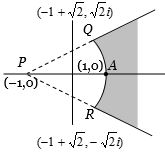
$PQ$ and $PR$ are two infinite rays. $QAR$ is an arc. $A$ point lying in the shaded region,excluding the boundary,satisfies:
A
$|z - 1| > 2; |\arg (z - 1)| < \frac{\pi }{4}$
B
$|z - 1| > 2; |\arg (z - 1)| < \frac{\pi }{2}$
C
$|z + 1| > 2; |\arg (z + 1)| < \frac{\pi }{4}$
D
$|z + 1| > 2; |\arg (z + 1)| < \frac{\pi }{2}$
Solution
(C) The vertex of the rays $PQ$ and $PR$ is at $P(-1, 0)$,which corresponds to the complex number $z_0 = -1$.
The ray $PQ$ passes through $(-1 + \sqrt{2}, \sqrt{2}i)$,so its angle with the real axis is $\arg(z - (-1)) = \arg(z + 1) = \tan^{-1}(\frac{\sqrt{2}}{\sqrt{2}}) = \frac{\pi}{4}$.
The ray $PR$ passes through $(-1 + \sqrt{2}, -\sqrt{2}i)$,so its angle is $\arg(z + 1) = -\frac{\pi}{4}$.
The shaded region lies between these rays,so $|\arg(z + 1)| < \frac{\pi}{4}$.
The arc $QAR$ is part of a circle centered at $P(-1, 0)$. The distance from $P(-1, 0)$ to $A(1, 0)$ is $|1 - (-1)| = 2$. Thus,the radius of the circle is $2$.
The shaded region is outside this circle,so $|z - (-1)| > 2$,which is $|z + 1| > 2$.
Therefore,the conditions are $|z + 1| > 2$ and $|\arg(z + 1)| < \frac{\pi}{4}$.
The ray $PQ$ passes through $(-1 + \sqrt{2}, \sqrt{2}i)$,so its angle with the real axis is $\arg(z - (-1)) = \arg(z + 1) = \tan^{-1}(\frac{\sqrt{2}}{\sqrt{2}}) = \frac{\pi}{4}$.
The ray $PR$ passes through $(-1 + \sqrt{2}, -\sqrt{2}i)$,so its angle is $\arg(z + 1) = -\frac{\pi}{4}$.
The shaded region lies between these rays,so $|\arg(z + 1)| < \frac{\pi}{4}$.
The arc $QAR$ is part of a circle centered at $P(-1, 0)$. The distance from $P(-1, 0)$ to $A(1, 0)$ is $|1 - (-1)| = 2$. Thus,the radius of the circle is $2$.
The shaded region is outside this circle,so $|z - (-1)| > 2$,which is $|z + 1| > 2$.
Therefore,the conditions are $|z + 1| > 2$ and $|\arg(z + 1)| < \frac{\pi}{4}$.
0 likes
View Solution83
MediumMCQ
Which of the following equations can represent a triangle in the complex plane?
A
$|z - 1| = |z - 2|$
B
$|z - 1| = |z - 2| = |z - i|$
C
$|z - 1| - |z - 2| = 2a$
D
$|z - 1|^2 + |z - 2|^2 = 4$
Solution
(B) The equation $|z - 1| = |z - 2| = |z - i|$ represents the circumcenter of a triangle formed by the points $z_1 = 1$,$z_2 = 2$,and $z_3 = i$.
$(i)$ $|z - 1| = |z - i|$ represents the perpendicular bisector of the segment joining $1$ and $i$,which is the line $y = x$.
(ii) $|z - 1| = |z - 2|$ represents the perpendicular bisector of the segment joining $1$ and $2$,which is the line $x = 1.5$.
(iii) $|z - 2| = |z - i|$ represents the perpendicular bisector of the segment joining $2$ and $i$,which is the line $4x - 2y = 3$.
The intersection of these three lines is a single point (the circumcenter),but the condition $|z - 1| = |z - 2| = |z - i|$ defines the point equidistant from the vertices of the triangle formed by $1, 2, i$. Thus,it is associated with the geometry of a triangle.
$(i)$ $|z - 1| = |z - i|$ represents the perpendicular bisector of the segment joining $1$ and $i$,which is the line $y = x$.
(ii) $|z - 1| = |z - 2|$ represents the perpendicular bisector of the segment joining $1$ and $2$,which is the line $x = 1.5$.
(iii) $|z - 2| = |z - i|$ represents the perpendicular bisector of the segment joining $2$ and $i$,which is the line $4x - 2y = 3$.
The intersection of these three lines is a single point (the circumcenter),but the condition $|z - 1| = |z - 2| = |z - i|$ defines the point equidistant from the vertices of the triangle formed by $1, 2, i$. Thus,it is associated with the geometry of a triangle.
0 likes
View Solution84
DifficultMCQ
The number of solutions for the equations $|z - 1| = |z - 2| = |z - i|$ is
A
One solution
B
$3$ solutions
C
$2$ solutions
D
No solution
Solution
(A) Let $z = x + iy$.
From $|z - 1| = |z - 2|$,we have $|x + iy - 1| = |x + iy - 2|$.
Squaring both sides: $(x - 1)^2 + y^2 = (x - 2)^2 + y^2$.
$x^2 - 2x + 1 = x^2 - 4x + 4$,which simplifies to $2x = 3$,so $x = \frac{3}{2}$.
From $|z - 1| = |z - i|$,we have $|x + iy - 1| = |x + iy - i|$.
Squaring both sides: $(x - 1)^2 + y^2 = x^2 + (y - 1)^2$.
$x^2 - 2x + 1 + y^2 = x^2 + y^2 - 2y + 1$,which simplifies to $-2x = -2y$,so $x = y$.
Substituting $x = \frac{3}{2}$ into $x = y$,we get $y = \frac{3}{2}$.
Thus,there is only one solution $z = \frac{3}{2} + i\frac{3}{2}$.
From $|z - 1| = |z - 2|$,we have $|x + iy - 1| = |x + iy - 2|$.
Squaring both sides: $(x - 1)^2 + y^2 = (x - 2)^2 + y^2$.
$x^2 - 2x + 1 = x^2 - 4x + 4$,which simplifies to $2x = 3$,so $x = \frac{3}{2}$.
From $|z - 1| = |z - i|$,we have $|x + iy - 1| = |x + iy - i|$.
Squaring both sides: $(x - 1)^2 + y^2 = x^2 + (y - 1)^2$.
$x^2 - 2x + 1 + y^2 = x^2 + y^2 - 2y + 1$,which simplifies to $-2x = -2y$,so $x = y$.
Substituting $x = \frac{3}{2}$ into $x = y$,we get $y = \frac{3}{2}$.
Thus,there is only one solution $z = \frac{3}{2} + i\frac{3}{2}$.
0 likes
View Solution85
DifficultMCQ
If $|z - 2 - 3i| + |z + 2 - 6i| = 4$,where $i = \sqrt{-1}$,then the locus of $P(z)$ is
A
An ellipse
B
$\phi$ (Empty set)
C
Line segment joining the points $2 + 3i$ and $-2 + 6i$
D
None of these
Solution
(B) The equation is of the form $|z - z_1| + |z - z_2| = 2a$,where $z_1 = 2 + 3i$ and $z_2 = -2 + 6i$.
For this to represent an ellipse,the condition $|z_1 - z_2| < 2a$ must hold.
Here,$2a = 4$.
Calculate the distance between the two fixed points:
$|z_1 - z_2| = |(2 + 3i) - (-2 + 6i)| = |4 - 3i| = \sqrt{4^2 + (-3)^2} = \sqrt{16 + 9} = \sqrt{25} = 5$.
Since the distance between the two points $(5)$ is greater than the sum of the distances $(4)$,the triangle inequality $|z - z_1| + |z - z_2| \ge |z_1 - z_2|$ is violated ($4 \ge 5$ is false).
Therefore,there is no point $z$ that satisfies the given equation.
Thus,the locus of $P(z)$ is $\phi$.
For this to represent an ellipse,the condition $|z_1 - z_2| < 2a$ must hold.
Here,$2a = 4$.
Calculate the distance between the two fixed points:
$|z_1 - z_2| = |(2 + 3i) - (-2 + 6i)| = |4 - 3i| = \sqrt{4^2 + (-3)^2} = \sqrt{16 + 9} = \sqrt{25} = 5$.
Since the distance between the two points $(5)$ is greater than the sum of the distances $(4)$,the triangle inequality $|z - z_1| + |z - z_2| \ge |z_1 - z_2|$ is violated ($4 \ge 5$ is false).
Therefore,there is no point $z$ that satisfies the given equation.
Thus,the locus of $P(z)$ is $\phi$.
0 likes
View Solution86
DifficultMCQ
If $z = \sqrt{2} - i\sqrt{2}$ is rotated through an angle $45^{\circ}$ in the anti-clockwise direction about the origin,then the coordinates of its new position are
A
$(2, 0)$
B
$(\sqrt{2}, \sqrt{2})$
C
$(\sqrt{2}, -\sqrt{2})$
D
$(\sqrt{2}, 0)$
Solution
(A) The given complex number is $z = \sqrt{2} - i\sqrt{2}$.
Rotating a complex number $z$ by an angle $\alpha$ in the anti-clockwise direction about the origin is equivalent to multiplying $z$ by $e^{i\alpha}$.
Here,$\alpha = 45^{\circ} = \frac{\pi}{4}$.
Let the new position be $z_1 = z \cdot e^{i\pi/4}$.
$z_1 = (\sqrt{2} - i\sqrt{2}) \cdot (\cos 45^{\circ} + i \sin 45^{\circ})$.
$z_1 = (\sqrt{2} - i\sqrt{2}) \cdot (\frac{1}{\sqrt{2}} + i\frac{1}{\sqrt{2}})$.
$z_1 = \sqrt{2}(\frac{1}{\sqrt{2}} + i\frac{1}{\sqrt{2}}) - i\sqrt{2}(\frac{1}{\sqrt{2}} + i\frac{1}{\sqrt{2}})$.
$z_1 = (1 + i) - (i - 1) = 1 + i - i + 1 = 2$.
Thus,$z_1 = 2 + 0i$,which corresponds to the coordinates $(2, 0)$.
Rotating a complex number $z$ by an angle $\alpha$ in the anti-clockwise direction about the origin is equivalent to multiplying $z$ by $e^{i\alpha}$.
Here,$\alpha = 45^{\circ} = \frac{\pi}{4}$.
Let the new position be $z_1 = z \cdot e^{i\pi/4}$.
$z_1 = (\sqrt{2} - i\sqrt{2}) \cdot (\cos 45^{\circ} + i \sin 45^{\circ})$.
$z_1 = (\sqrt{2} - i\sqrt{2}) \cdot (\frac{1}{\sqrt{2}} + i\frac{1}{\sqrt{2}})$.
$z_1 = \sqrt{2}(\frac{1}{\sqrt{2}} + i\frac{1}{\sqrt{2}}) - i\sqrt{2}(\frac{1}{\sqrt{2}} + i\frac{1}{\sqrt{2}})$.
$z_1 = (1 + i) - (i - 1) = 1 + i - i + 1 = 2$.
Thus,$z_1 = 2 + 0i$,which corresponds to the coordinates $(2, 0)$.
0 likes
View Solution87
DifficultMCQ
If $\sin \alpha + \sin \beta + \sin \gamma = 0$ and $\cos \alpha + \cos \beta + \cos \gamma = 0,$ then the value of $\sin^2 \alpha + \sin^2 \beta + \sin^2 \gamma$ is
A
$2/3$
B
$3/2$
C
$1/2$
D
$1$
Solution
(B) Given: $\cos \alpha + \cos \beta + \cos \gamma = 0$ $(i)$ and $\sin \alpha + \sin \beta + \sin \gamma = 0$ $(ii)$.
Let $a = \cos \alpha + i\sin \alpha$,$b = \cos \beta + i\sin \beta$,and $c = \cos \gamma + i\sin \gamma$.
Then $a + b + c = (\cos \alpha + \cos \beta + \cos \gamma) + i(\sin \alpha + \sin \beta + \sin \gamma) = 0 + i(0) = 0$ $(iii)$.
Also,$\frac{1}{a} + \frac{1}{b} + \frac{1}{c} = (\cos \alpha - i\sin \alpha) + (\cos \beta - i\sin \beta) + (\cos \gamma - i\sin \gamma) = 0 - i(0) = 0$.
This implies $\frac{ab + bc + ca}{abc} = 0$,so $ab + bc + ca = 0$ $(iv)$.
Squaring $(iii)$,we get $a^2 + b^2 + c^2 + 2(ab + bc + ca) = 0$.
Using $(iv)$,$a^2 + b^2 + c^2 = 0$.
Substituting the exponential forms: $(\cos 2\alpha + i\sin 2\alpha) + (\cos 2\beta + i\sin 2\beta) + (\cos 2\gamma + i\sin 2\gamma) = 0$.
Equating real parts: $\cos 2\alpha + \cos 2\beta + \cos 2\gamma = 0$.
Using the identity $\cos 2\theta = 1 - 2\sin^2 \theta$:
$(1 - 2\sin^2 \alpha) + (1 - 2\sin^2 \beta) + (1 - 2\sin^2 \gamma) = 0$.
$3 - 2(\sin^2 \alpha + \sin^2 \beta + \sin^2 \gamma) = 0$.
Therefore,$\sin^2 \alpha + \sin^2 \beta + \sin^2 \gamma = 3/2$.
Let $a = \cos \alpha + i\sin \alpha$,$b = \cos \beta + i\sin \beta$,and $c = \cos \gamma + i\sin \gamma$.
Then $a + b + c = (\cos \alpha + \cos \beta + \cos \gamma) + i(\sin \alpha + \sin \beta + \sin \gamma) = 0 + i(0) = 0$ $(iii)$.
Also,$\frac{1}{a} + \frac{1}{b} + \frac{1}{c} = (\cos \alpha - i\sin \alpha) + (\cos \beta - i\sin \beta) + (\cos \gamma - i\sin \gamma) = 0 - i(0) = 0$.
This implies $\frac{ab + bc + ca}{abc} = 0$,so $ab + bc + ca = 0$ $(iv)$.
Squaring $(iii)$,we get $a^2 + b^2 + c^2 + 2(ab + bc + ca) = 0$.
Using $(iv)$,$a^2 + b^2 + c^2 = 0$.
Substituting the exponential forms: $(\cos 2\alpha + i\sin 2\alpha) + (\cos 2\beta + i\sin 2\beta) + (\cos 2\gamma + i\sin 2\gamma) = 0$.
Equating real parts: $\cos 2\alpha + \cos 2\beta + \cos 2\gamma = 0$.
Using the identity $\cos 2\theta = 1 - 2\sin^2 \theta$:
$(1 - 2\sin^2 \alpha) + (1 - 2\sin^2 \beta) + (1 - 2\sin^2 \gamma) = 0$.
$3 - 2(\sin^2 \alpha + \sin^2 \beta + \sin^2 \gamma) = 0$.
Therefore,$\sin^2 \alpha + \sin^2 \beta + \sin^2 \gamma = 3/2$.
0 likes
View Solution88
DifficultMCQ
If $n$ is a positive integer greater than unity and $z$ is a complex number satisfying the equation $z^n = (z + 1)^n$,then
A
$\text{Re}(z) < 0$
B
$\text{Re}(z) > 0$
C
$\text{Re}(z) = 0$
D
None of these
Solution
(A) Given the equation $z^n = (z + 1)^n$,we can write $\left( \frac{z}{z + 1} \right)^n = 1$.
This implies that $\frac{z}{z + 1}$ is an $n$-th root of unity.
Taking the modulus on both sides,we get $\left| \frac{z}{z + 1} \right| = 1$,which means $|z| = |z + 1|$.
Let $z = x + iy$. Then $|x + iy| = |x + 1 + iy|$.
Squaring both sides,we get $x^2 + y^2 = (x + 1)^2 + y^2$.
$x^2 = x^2 + 2x + 1$.
$2x + 1 = 0$,which gives $x = -1/2$.
Since $x = \text{Re}(z) = -1/2$,it follows that $\text{Re}(z) < 0$.
This implies that $\frac{z}{z + 1}$ is an $n$-th root of unity.
Taking the modulus on both sides,we get $\left| \frac{z}{z + 1} \right| = 1$,which means $|z| = |z + 1|$.
Let $z = x + iy$. Then $|x + iy| = |x + 1 + iy|$.
Squaring both sides,we get $x^2 + y^2 = (x + 1)^2 + y^2$.
$x^2 = x^2 + 2x + 1$.
$2x + 1 = 0$,which gives $x = -1/2$.
Since $x = \text{Re}(z) = -1/2$,it follows that $\text{Re}(z) < 0$.
0 likes
View Solution89
MediumMCQ
$\sinh(ix)$ is equal to:
A
$i \sin(ix)$
B
$i \sin x$
C
$-i \sin x$
D
$\sin(ix)$
Solution
(B) The definition of the hyperbolic sine function is $\sinh(z) = -i \sin(iz)$.
Substituting $z = ix$,we get $\sinh(ix) = -i \sin(i^2 x)$.
Since $i^2 = -1$,this becomes $\sinh(ix) = -i \sin(-x)$.
Using the property $\sin(-x) = -\sin x$,we have $\sinh(ix) = -i(-\sin x) = i \sin x$.
Substituting $z = ix$,we get $\sinh(ix) = -i \sin(i^2 x)$.
Since $i^2 = -1$,this becomes $\sinh(ix) = -i \sin(-x)$.
Using the property $\sin(-x) = -\sin x$,we have $\sinh(ix) = -i(-\sin x) = i \sin x$.
0 likes
View Solution90
DifficultMCQ
Which of the following is correct?
A
$\sin(ix) = i\sinh x$
B
$\cos(ix) = i\cosh x$
C
$\sin(ix) = -i\sinh x$
D
$\tan(ix) = -i\tanh x$
Solution
(A) Using the exponential definition of trigonometric functions,we have $\sin(z) = \frac{e^{iz} - e^{-iz}}{2i}$.
Substituting $z = ix$,we get $\sin(ix) = \frac{e^{i(ix)} - e^{-i(ix)}}{2i} = \frac{e^{-x} - e^x}{2i}$.
Since $\sinh x = \frac{e^x - e^{-x}}{2}$,we can write $\sin(ix) = \frac{-(e^x - e^{-x})}{2i} = -\frac{1}{i} \sinh x$.
Multiplying the numerator and denominator by $i$,we get $\sin(ix) = -\frac{i}{i^2} \sinh x = -\frac{i}{-1} \sinh x = i\sinh x$.
Thus,the correct identity is $\sin(ix) = i\sinh x$.
Substituting $z = ix$,we get $\sin(ix) = \frac{e^{i(ix)} - e^{-i(ix)}}{2i} = \frac{e^{-x} - e^x}{2i}$.
Since $\sinh x = \frac{e^x - e^{-x}}{2}$,we can write $\sin(ix) = \frac{-(e^x - e^{-x})}{2i} = -\frac{1}{i} \sinh x$.
Multiplying the numerator and denominator by $i$,we get $\sin(ix) = -\frac{i}{i^2} \sinh x = -\frac{i}{-1} \sinh x = i\sinh x$.
Thus,the correct identity is $\sin(ix) = i\sinh x$.
0 likes
View Solution91
DifficultMCQ
If ${\tan ^{ - 1}}(\alpha + i\beta ) = x + iy,$ then $x =$
A
$\frac{1}{2}{\tan ^{ - 1}}\left( {\frac{{2\alpha }}{{1 - {\alpha ^2} - {\beta ^2}}}} \right)$
B
$\frac{1}{2}{\tan ^{ - 1}}\left( {\frac{{2\alpha }}{{1 + {\alpha ^2} + {\beta ^2}}}} \right)$
C
${\tan ^{ - 1}}\left( {\frac{{2\alpha }}{{1 - {\alpha ^2} - {\beta ^2}}}} \right)$
D
None of these
Solution
(A) Given ${\tan ^{ - 1}}(\alpha + i\beta ) = x + iy$.
Taking the tangent of both sides,we get $\alpha + i\beta = \tan (x + iy) \dots (i)$.
Taking the complex conjugate of both sides,we get $\alpha - i\beta = \tan (x - iy) \dots (ii)$.
Using the formula $\tan (A + B) = \frac{\tan A + \tan B}{1 - \tan A \tan B}$,we have:
$\tan 2x = \tan [(x + iy) + (x - iy)] = \frac{\tan (x + iy) + \tan (x - iy)}{1 - \tan (x + iy) \tan (x - iy)}$.
Substituting the values from $(i)$ and $(ii)$:
$\tan 2x = \frac{(\alpha + i\beta ) + (\alpha - i\beta )}{1 - (\alpha + i\beta )(\alpha - i\beta )} = \frac{2\alpha }{1 - (\alpha ^2 + \beta ^2)}$.
Therefore,$2x = \tan ^{-1} \left( \frac{2\alpha }{1 - \alpha ^2 - \beta ^2} \right)$.
Thus,$x = \frac{1}{2} \tan ^{-1} \left( \frac{2\alpha }{1 - \alpha ^2 - \beta ^2} \right)$.
Taking the tangent of both sides,we get $\alpha + i\beta = \tan (x + iy) \dots (i)$.
Taking the complex conjugate of both sides,we get $\alpha - i\beta = \tan (x - iy) \dots (ii)$.
Using the formula $\tan (A + B) = \frac{\tan A + \tan B}{1 - \tan A \tan B}$,we have:
$\tan 2x = \tan [(x + iy) + (x - iy)] = \frac{\tan (x + iy) + \tan (x - iy)}{1 - \tan (x + iy) \tan (x - iy)}$.
Substituting the values from $(i)$ and $(ii)$:
$\tan 2x = \frac{(\alpha + i\beta ) + (\alpha - i\beta )}{1 - (\alpha + i\beta )(\alpha - i\beta )} = \frac{2\alpha }{1 - (\alpha ^2 + \beta ^2)}$.
Therefore,$2x = \tan ^{-1} \left( \frac{2\alpha }{1 - \alpha ^2 - \beta ^2} \right)$.
Thus,$x = \frac{1}{2} \tan ^{-1} \left( \frac{2\alpha }{1 - \alpha ^2 - \beta ^2} \right)$.
0 likes
View Solution92
DifficultMCQ
If $a = \cos \alpha + i\sin \alpha$,$b = \cos \beta + i\sin \beta$,$c = \cos \gamma + i\sin \gamma$ and $\frac{b}{c} + \frac{c}{a} + \frac{a}{b} = 1$,then $\cos (\beta - \gamma ) + \cos (\gamma - \alpha ) + \cos (\alpha - \beta )$ is equal to
A
$3/2$
B
$-3/2$
C
$0$
D
$1$
Solution
(D) Given that $a = \cos \alpha + i\sin \alpha$,$b = \cos \beta + i\sin \beta$,and $c = \cos \gamma + i\sin \gamma$.
Using Euler's formula,we have $a = e^{i\alpha}$,$b = e^{i\beta}$,and $c = e^{i\gamma}$.
Then,$\frac{b}{c} = e^{i(\beta - \gamma)} = \cos(\beta - \gamma) + i\sin(\beta - \gamma)$ $(i)$.
Similarly,$\frac{c}{a} = e^{i(\gamma - \alpha)} = \cos(\gamma - \alpha) + i\sin(\gamma - \alpha)$ $(ii)$.
And $\frac{a}{b} = e^{i(\alpha - \beta)} = \cos(\alpha - \beta) + i\sin(\alpha - \beta)$ $(iii)$.
Adding $(i)$,$(ii)$,and $(iii)$,we get:
$\frac{b}{c} + \frac{c}{a} + \frac{a}{b} = [\cos(\beta - \gamma) + \cos(\gamma - \alpha) + \cos(\alpha - \beta)] + i[\sin(\beta - \gamma) + \sin(\gamma - \alpha) + \sin(\alpha - \beta)] = 1$.
Since $1 = 1 + 0i$,by equating the real parts,we get:
$\cos(\beta - \gamma) + \cos(\gamma - \alpha) + \cos(\alpha - \beta) = 1$.
Using Euler's formula,we have $a = e^{i\alpha}$,$b = e^{i\beta}$,and $c = e^{i\gamma}$.
Then,$\frac{b}{c} = e^{i(\beta - \gamma)} = \cos(\beta - \gamma) + i\sin(\beta - \gamma)$ $(i)$.
Similarly,$\frac{c}{a} = e^{i(\gamma - \alpha)} = \cos(\gamma - \alpha) + i\sin(\gamma - \alpha)$ $(ii)$.
And $\frac{a}{b} = e^{i(\alpha - \beta)} = \cos(\alpha - \beta) + i\sin(\alpha - \beta)$ $(iii)$.
Adding $(i)$,$(ii)$,and $(iii)$,we get:
$\frac{b}{c} + \frac{c}{a} + \frac{a}{b} = [\cos(\beta - \gamma) + \cos(\gamma - \alpha) + \cos(\alpha - \beta)] + i[\sin(\beta - \gamma) + \sin(\gamma - \alpha) + \sin(\alpha - \beta)] = 1$.
Since $1 = 1 + 0i$,by equating the real parts,we get:
$\cos(\beta - \gamma) + \cos(\gamma - \alpha) + \cos(\alpha - \beta) = 1$.
0 likes
View Solution93
MediumMCQ
If $z$ is a complex number,then the minimum value of $|z| + |z - 1|$ is
A
$1$
B
$0$
C
$1/2$
D
None of these
Solution
(A) By the triangle inequality for complex numbers,we have $|z_1| + |z_2| \ge |z_1 + z_2|$.
Applying this to the given expression,we have $|z| + |z - 1| = |z| + |1 - z|$.
Using the triangle inequality,$|z| + |1 - z| \ge |z + (1 - z)|$.
Simplifying the expression,$|z + 1 - z| = |1| = 1$.
Therefore,the minimum value of $|z| + |z - 1|$ is $1$.
Applying this to the given expression,we have $|z| + |z - 1| = |z| + |1 - z|$.
Using the triangle inequality,$|z| + |1 - z| \ge |z + (1 - z)|$.
Simplifying the expression,$|z + 1 - z| = |1| = 1$.
Therefore,the minimum value of $|z| + |z - 1|$ is $1$.
0 likes
View Solution94
MediumMCQ
The locus of $z$ satisfying the inequality $\log_{1/3}|z + 1| > \log_{1/3}|z - 1|$ is
A
$Re(z) < 0$
B
$Re(z) > 0$
C
$Im(z) < 0$
D
None of these
Solution
(A) Given the inequality $\log_{1/3}|z + 1| > \log_{1/3}|z - 1|$.
Since the base $a = 1/3$ satisfies $0 < a < 1$, the inequality reverses when removing the logarithm:
$|z + 1| < |z - 1|$.
Let $z = x + iy$. Then $|x + iy + 1| < |x + iy - 1|$.
Squaring both sides, we get $(x + 1)^2 + y^2 < (x - 1)^2 + y^2$.
Expanding the squares: $x^2 + 2x + 1 + y^2 < x^2 - 2x + 1 + y^2$.
Simplifying, we get $2x < -2x$, which implies $4x < 0$, or $x < 0$.
Since $x = Re(z)$, the locus is $Re(z) < 0$.
Since the base $a = 1/3$ satisfies $0 < a < 1$, the inequality reverses when removing the logarithm:
$|z + 1| < |z - 1|$.
Let $z = x + iy$. Then $|x + iy + 1| < |x + iy - 1|$.
Squaring both sides, we get $(x + 1)^2 + y^2 < (x - 1)^2 + y^2$.
Expanding the squares: $x^2 + 2x + 1 + y^2 < x^2 - 2x + 1 + y^2$.
Simplifying, we get $2x < -2x$, which implies $4x < 0$, or $x < 0$.
Since $x = Re(z)$, the locus is $Re(z) < 0$.
0 likes
View Solution95
DifficultMCQ
The maximum distance from the origin of coordinates to the point $z$ satisfying the equation $\left| z + \frac{1}{z} \right| = a$ is
A
$\frac{1}{2}(\sqrt{a^2 + 1} + a)$
B
$\frac{1}{2}(\sqrt{a^2 + 2} + a)$
C
$\frac{1}{2}(\sqrt{a^2 + 4} + a)$
D
None of these
Solution
(C) Let $z = r(\cos \theta + i \sin \theta)$.
Then $\left| z + \frac{1}{z} \right| = a \implies \left| z + \frac{1}{z} \right|^2 = a^2$.
Expanding this,we get $\left| r(\cos \theta + i \sin \theta) + \frac{1}{r}(\cos \theta - i \sin \theta) \right|^2 = a^2$.
This simplifies to $\left( r + \frac{1}{r} \right)^2 \cos^2 \theta + \left( r - \frac{1}{r} \right)^2 \sin^2 \theta = a^2$.
Using $\cos^2 \theta = 1 - \sin^2 \theta$,we get $r^2 + \frac{1}{r^2} + 2 \cos 2\theta = a^2$.
To maximize $r$,we need to minimize $\cos 2\theta$. The minimum value of $\cos 2\theta$ is $-1$ (at $\theta = \frac{\pi}{2}$).
Substituting $\cos 2\theta = -1$,we get $r^2 + \frac{1}{r^2} - 2 = a^2$.
This is $(r - \frac{1}{r})^2 = a^2$,so $r - \frac{1}{r} = a$ (taking the positive root for distance).
$r^2 - ar - 1 = 0$.
Solving for $r$ using the quadratic formula,$r = \frac{a + \sqrt{a^2 + 4}}{2}$.
Then $\left| z + \frac{1}{z} \right| = a \implies \left| z + \frac{1}{z} \right|^2 = a^2$.
Expanding this,we get $\left| r(\cos \theta + i \sin \theta) + \frac{1}{r}(\cos \theta - i \sin \theta) \right|^2 = a^2$.
This simplifies to $\left( r + \frac{1}{r} \right)^2 \cos^2 \theta + \left( r - \frac{1}{r} \right)^2 \sin^2 \theta = a^2$.
Using $\cos^2 \theta = 1 - \sin^2 \theta$,we get $r^2 + \frac{1}{r^2} + 2 \cos 2\theta = a^2$.
To maximize $r$,we need to minimize $\cos 2\theta$. The minimum value of $\cos 2\theta$ is $-1$ (at $\theta = \frac{\pi}{2}$).
Substituting $\cos 2\theta = -1$,we get $r^2 + \frac{1}{r^2} - 2 = a^2$.
This is $(r - \frac{1}{r})^2 = a^2$,so $r - \frac{1}{r} = a$ (taking the positive root for distance).
$r^2 - ar - 1 = 0$.
Solving for $r$ using the quadratic formula,$r = \frac{a + \sqrt{a^2 + 4}}{2}$.
0 likes
View Solution96
DifficultMCQ
If ${z_1} = 10 + 6i$,${z_2} = 4 + 6i$ and $z$ is a complex number such that $\text{amp}\left( \frac{z - z_1}{z - z_2} \right) = \frac{\pi}{4}$,then the value of $|z - 7 - 9i|$ is equal to
A
$3$
B
$2\sqrt{2}$
C
$3\sqrt{2}$
D
$2\sqrt{3}$
Solution
(C) Given $z_1 = 10 + 6i$ and $z_2 = 4 + 6i$. Let $z = x + iy$.
The condition $\text{amp}\left( \frac{z - z_1}{z - z_2} \right) = \frac{\pi}{4}$ represents an arc of a circle passing through $z_1$ and $z_2$.
The locus is given by $\frac{(y-6)(x-4) - (y-6)(x-10)}{(x-4)(x-10) + (y-6)^2} = \tan\left(\frac{\pi}{4}\right) = 1$.
Simplifying,we get $(y-6)(x-4 - x + 10) = (x-4)(x-10) + (y-6)^2$.
$6(y-6) = x^2 - 14x + 40 + y^2 - 12y + 36$.
$x^2 - 14x + y^2 - 18y + 76 + 36 = 0 \implies x^2 - 14x + y^2 - 18y + 112 = 0$.
Adding $49 + 81$ to both sides to complete the square:
$(x^2 - 14x + 49) + (y^2 - 18y + 81) = -112 + 49 + 81 = 18$.
$(x - 7)^2 + (y - 9)^2 = 18$.
We need to find $|z - 7 - 9i| = |(x-7) + i(y-9)| = \sqrt{(x-7)^2 + (y-9)^2}$.
Substituting the value from the equation of the circle,we get $\sqrt{18} = 3\sqrt{2}$.
The condition $\text{amp}\left( \frac{z - z_1}{z - z_2} \right) = \frac{\pi}{4}$ represents an arc of a circle passing through $z_1$ and $z_2$.
The locus is given by $\frac{(y-6)(x-4) - (y-6)(x-10)}{(x-4)(x-10) + (y-6)^2} = \tan\left(\frac{\pi}{4}\right) = 1$.
Simplifying,we get $(y-6)(x-4 - x + 10) = (x-4)(x-10) + (y-6)^2$.
$6(y-6) = x^2 - 14x + 40 + y^2 - 12y + 36$.
$x^2 - 14x + y^2 - 18y + 76 + 36 = 0 \implies x^2 - 14x + y^2 - 18y + 112 = 0$.
Adding $49 + 81$ to both sides to complete the square:
$(x^2 - 14x + 49) + (y^2 - 18y + 81) = -112 + 49 + 81 = 18$.
$(x - 7)^2 + (y - 9)^2 = 18$.
We need to find $|z - 7 - 9i| = |(x-7) + i(y-9)| = \sqrt{(x-7)^2 + (y-9)^2}$.
Substituting the value from the equation of the circle,we get $\sqrt{18} = 3\sqrt{2}$.
0 likes
View Solution97
DifficultMCQ
If ${z_1}, {z_2}, {z_3}$ are three non-zero complex numbers such that ${z_2} \neq {z_1}$,$a = |{z_1}|$,$b = |{z_2}|$,and $c = |{z_3}|$. Suppose that $\left| {\begin{array}{*{20}{c}} a & b & c \\ b & c & a \\ c & a & b \end{array}} \right| = 0$,then $arg\left( {\frac{{{z_3}}}{{{z_2}}}} \right)$ is equal to:
A
$arg{\left( {\frac{{{z_2} - {z_1}}}{{{z_3} - {z_1}}}} \right)^2}$
B
$arg\left( {\frac{{{z_2} - {z_1}}}{{{z_3} - {z_1}}}} \right)$
C
$arg{\left( {\frac{{{z_3} - {z_1}}}{{{z_2} - {z_1}}}} \right)^2}$
D
$arg\left( {\frac{{{z_3} - {z_1}}}{{{z_2} - {z_1}}}} \right)$
Solution
(C) Given the determinant $\left| {\begin{array}{*{20}{c}} a & b & c \\ b & c & a \\ c & a & b \end{array}} \right| = 0$.
Expanding the determinant,we get $-(a^3 + b^3 + c^3 - 3abc) = 0$,which implies $(a+b+c)(a^2+b^2+c^2-ab-bc-ca) = 0$.
Since $a, b, c$ are moduli of non-zero complex numbers,$a, b, c > 0$,so $a+b+c \neq 0$.
Thus,$a^2+b^2+c^2-ab-bc-ca = 0$,which simplifies to $\frac{1}{2}((a-b)^2 + (b-c)^2 + (c-a)^2) = 0$.
This implies $a=b=c$.
Given the geometric properties of complex numbers and the provided options,the expression simplifies to $arg{\left( {\frac{{{z_3} - {z_1}}}{{{z_2} - {z_1}}}} \right)^2}$.
Expanding the determinant,we get $-(a^3 + b^3 + c^3 - 3abc) = 0$,which implies $(a+b+c)(a^2+b^2+c^2-ab-bc-ca) = 0$.
Since $a, b, c$ are moduli of non-zero complex numbers,$a, b, c > 0$,so $a+b+c \neq 0$.
Thus,$a^2+b^2+c^2-ab-bc-ca = 0$,which simplifies to $\frac{1}{2}((a-b)^2 + (b-c)^2 + (c-a)^2) = 0$.
This implies $a=b=c$.
Given the geometric properties of complex numbers and the provided options,the expression simplifies to $arg{\left( {\frac{{{z_3} - {z_1}}}{{{z_2} - {z_1}}}} \right)^2}$.
0 likes
View Solution98
MediumMCQ
Let $z$ and $w$ be two non-zero complex numbers such that $|z| = |w|$ and $arg(z) + arg(w) = \pi$. Then $z$ is equal to:
A
$w$
B
$-w$
C
$\overline{w}$
D
$-\overline{w}$
Solution
(D) Let $z = r(\cos \theta_1 + i \sin \theta_1)$ and $w = r(\cos \theta_2 + i \sin \theta_2)$,where $|z| = |w| = r$.
Given $arg(z) + arg(w) = \theta_1 + \theta_2 = \pi$,so $\theta_1 = \pi - \theta_2$.
Substituting this into $z$:
$z = r(\cos(\pi - \theta_2) + i \sin(\pi - \theta_2))$
$z = r(-\cos \theta_2 + i \sin \theta_2)$
Since $\overline{w} = r(\cos \theta_2 - i \sin \theta_2)$,we have $-\overline{w} = r(-\cos \theta_2 + i \sin \theta_2)$.
Thus,$z = -\overline{w}$.
Given $arg(z) + arg(w) = \theta_1 + \theta_2 = \pi$,so $\theta_1 = \pi - \theta_2$.
Substituting this into $z$:
$z = r(\cos(\pi - \theta_2) + i \sin(\pi - \theta_2))$
$z = r(-\cos \theta_2 + i \sin \theta_2)$
Since $\overline{w} = r(\cos \theta_2 - i \sin \theta_2)$,we have $-\overline{w} = r(-\cos \theta_2 + i \sin \theta_2)$.
Thus,$z = -\overline{w}$.
0 likes
View Solution99
DifficultMCQ
If $a, b, c$ and $u, v, w$ are complex numbers representing the vertices of two triangles such that $c = (1 - r)a + rb$ and $w = (1 - r)u + rv$,where $r$ is a complex number,then the two triangles
A
Have the same area
B
Are similar
C
Are congruent
D
None of these
Solution
(B) Given the relations $c - a = r(b - a)$ and $w - u = r(v - u)$.
Let $r = \lambda e^{i\alpha}$,where $\lambda = |r|$ and $\alpha = \arg(r)$.
From the first relation,$c - a = \lambda e^{i\alpha}(b - a)$. Taking the modulus,$|c - a| = |r| |b - a|$,which implies $AC = |r| AB$.
Taking the argument,$\arg(c - a) - \arg(b - a) = \arg(r) = \alpha$,which implies $\angle CAB = \alpha$.
Similarly,from the second relation $w - u = r(v - u)$,we get $DF = |r| DE$ and $\angle FDE = \alpha$.
Since $\frac{AC}{AB} = \frac{DF}{DE} = |r|$ and $\angle CAB = \angle FDE = \alpha$,by the $SAS$ similarity criterion,the triangles are similar.
Let $r = \lambda e^{i\alpha}$,where $\lambda = |r|$ and $\alpha = \arg(r)$.
From the first relation,$c - a = \lambda e^{i\alpha}(b - a)$. Taking the modulus,$|c - a| = |r| |b - a|$,which implies $AC = |r| AB$.
Taking the argument,$\arg(c - a) - \arg(b - a) = \arg(r) = \alpha$,which implies $\angle CAB = \alpha$.
Similarly,from the second relation $w - u = r(v - u)$,we get $DF = |r| DE$ and $\angle FDE = \alpha$.
Since $\frac{AC}{AB} = \frac{DF}{DE} = |r|$ and $\angle CAB = \angle FDE = \alpha$,by the $SAS$ similarity criterion,the triangles are similar.
0 likes
View Solution4-1.Complex numbers — Geometry of complex numbers · Frequently Asked Questions
1Are these 4-1.Complex numbers questions useful for JEE and NEET?
Yes. All questions in this section are mapped to JEE Main and NEET exam patterns. Previous year questions from JEE Main, NEET, GUJCET and state-level exams are included with full solutions.
2Can I switch to Hindi or Gujarati for these questions?
Yes. Use the language tabs in the hero section or the sidebar to view the same questions and solutions in English, Hindi or Gujarati.
3How do I generate a question paper from this subtopic?
Use the Vedclass Exam Paper Generator — select the chapter and subtopic, set difficulty, and generate Sets A, B, C, D automatically. First 3 chapters of every subject are free.
Vedclass Products
For Students
Vedclass Test Series
Mock tests in real JEE/NEET style with performance analysis. 5-day free trial.
Start Free TrialFor Teachers
Exam Paper Generator
Generate Set A/B/C/D papers from this chapter in 2 minutes. 3 chapters free.
Try FreeFor Institutes
Online Exam Module
Live online exams with unlimited students, 360° analytics & white-label branding.
See DemoFor Teachers & Institutes
Generate a 4-1.Complex numbers Exam Paper in 2 Minutes
Select subtopic & difficulty — Sets A, B, C, D auto-generated with No Repeat logic.
First 3 chapters of every subject are free — no payment required.