
A English
Geometrical problems regarding circle and its properties Questions in English
Class 11 Mathematics · 10-1.Circle and System of Circles · Geometrical problems regarding circle and its properties
598+
Questions
English
Language
100%
With Solutions
Showing 50 of 598 questions in English
1
EasyMCQ
The angle subtended at the centre of a circle of radius $3 \text{ metres}$ by an arc of length $1 \text{ metre}$ is equal to
A
$20^{\circ}$
B
$60^{\circ}$
C
$\frac{1}{3} \text{ radian}$
D
$3 \text{ radians}$
Solution
(C) Given that the radius $(r) = 3 \text{ m}$ and the arc length $(l) = 1 \text{ m}$.
We know that the formula for the angle $(\theta)$ subtended at the centre is $\theta = \frac{l}{r}$.
Substituting the values,we get $\theta = \frac{1}{3} \text{ radian}$.
We know that the formula for the angle $(\theta)$ subtended at the centre is $\theta = \frac{l}{r}$.
Substituting the values,we get $\theta = \frac{1}{3} \text{ radian}$.
0 likes
View Solution2
EasyMCQ
$A$ circular wire of radius $7\,cm$ is cut and bent again into an arc of a circle of radius $12\,cm$. The angle subtended by the arc at the centre is ......$^o$
A
$50$
B
$210$
C
$100$
D
$60$
Solution
(B) The circumference of the circular wire with radius $r_1 = 7\,cm$ is given by $L = 2\pi r_1 = 2 \times \pi \times 7 = 14\pi\,cm$.
This wire is bent into an arc of a circle with radius $r_2 = 12\,cm$. The length of the arc is $L = 14\pi\,cm$.
The formula for the angle $\theta$ subtended by an arc at the centre is $\theta = \frac{L}{r_2}$ (in radians).
$\theta = \frac{14\pi}{12} = \frac{7\pi}{6}$ radians.
To convert radians to degrees,multiply by $\frac{180^o}{\pi}$:
$\theta = \frac{7\pi}{6} \times \frac{180^o}{\pi} = 7 \times 30^o = 210^o$.
This wire is bent into an arc of a circle with radius $r_2 = 12\,cm$. The length of the arc is $L = 14\pi\,cm$.
The formula for the angle $\theta$ subtended by an arc at the centre is $\theta = \frac{L}{r_2}$ (in radians).
$\theta = \frac{14\pi}{12} = \frac{7\pi}{6}$ radians.
To convert radians to degrees,multiply by $\frac{180^o}{\pi}$:
$\theta = \frac{7\pi}{6} \times \frac{180^o}{\pi} = 7 \times 30^o = 210^o$.
1 likes
View Solution3
EasyMCQ
The radius of the circle whose arc of length $15 \ cm$ makes an angle of $3/4$ radian at the centre is ..... $cm$.
A
$10$
B
$20$
C
$11\frac{1}{4}$
D
$22\frac{1}{2}$
Solution
(B) The relationship between the arc length $(l)$,radius $(r)$,and the angle subtended at the centre in radians $( heta)$ is given by the formula: $l = r \theta$.
Given: Arc length $l = 15 \ cm$ and angle $\theta = 3/4 \ radian$.
Substituting the values into the formula: $15 = r \times (3/4)$.
Solving for $r$: $r = 15 \times (4/3) = 5 \times 4 = 20 \ cm$.
Therefore,the radius of the circle is $20 \ cm$.
Given: Arc length $l = 15 \ cm$ and angle $\theta = 3/4 \ radian$.
Substituting the values into the formula: $15 = r \times (3/4)$.
Solving for $r$: $r = 15 \times (4/3) = 5 \times 4 = 20 \ cm$.
Therefore,the radius of the circle is $20 \ cm$.
0 likes
View Solution4
MediumMCQ
The triangle $PQR$ is inscribed in the circle $x^2 + y^2 = 25$. If $Q$ and $R$ have coordinates $(3, 4)$ and $(-4, 3)$ respectively,then $\angle QPR$ is equal to
A
$\frac{\pi}{2}$
B
$\frac{\pi}{3}$
C
$\frac{\pi}{4}$
D
$\frac{\pi}{6}$
Solution
(C) The circle is given by $x^2 + y^2 = 25$,which has its center at the origin $O(0, 0)$ and radius $r = 5$.
The coordinates of $Q$ are $(3, 4)$ and $R$ are $(-4, 3)$.
The slope of $OQ$ is $m_1 = \frac{4 - 0}{3 - 0} = \frac{4}{3}$.
The slope of $OR$ is $m_2 = \frac{3 - 0}{-4 - 0} = -\frac{3}{4}$.
Since $m_1 \times m_2 = \left(\frac{4}{3}\right) \times \left(-\frac{3}{4}\right) = -1$,the lines $OQ$ and $OR$ are perpendicular to each other.
Therefore,the central angle $\angle QOR = \frac{\pi}{2}$.
According to the circle theorem,the angle subtended by an arc at the center is double the angle subtended by it at any point on the remaining part of the circle.
Thus,$\angle QPR = \frac{1}{2} \angle QOR = \frac{1}{2} \times \frac{\pi}{2} = \frac{\pi}{4}$.
The coordinates of $Q$ are $(3, 4)$ and $R$ are $(-4, 3)$.
The slope of $OQ$ is $m_1 = \frac{4 - 0}{3 - 0} = \frac{4}{3}$.
The slope of $OR$ is $m_2 = \frac{3 - 0}{-4 - 0} = -\frac{3}{4}$.
Since $m_1 \times m_2 = \left(\frac{4}{3}\right) \times \left(-\frac{3}{4}\right) = -1$,the lines $OQ$ and $OR$ are perpendicular to each other.
Therefore,the central angle $\angle QOR = \frac{\pi}{2}$.
According to the circle theorem,the angle subtended by an arc at the center is double the angle subtended by it at any point on the remaining part of the circle.
Thus,$\angle QPR = \frac{1}{2} \angle QOR = \frac{1}{2} \times \frac{\pi}{2} = \frac{\pi}{4}$.
0 likes
View Solution5
DifficultMCQ
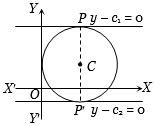
Find the equation of the pair of straight lines parallel to the $x$-axis and touching the circle $x^2 + y^2 - 6x - 4y - 12 = 0$.
A
$y^2 - 4y - 21 = 0$
B
$y^2 + 4y - 21 = 0$
C
$y^2 - 4y + 21 = 0$
D
$y^2 + 4y + 21 = 0$
Solution
(A) The given circle is $x^2 + y^2 - 6x - 4y - 12 = 0$.
Comparing with $x^2 + y^2 + 2gx + 2fy + c = 0$,we get $g = -3, f = -2, c = -12$.
The center of the circle is $(-g, -f) = (3, 2)$ and the radius $r = \sqrt{g^2 + f^2 - c} = \sqrt{(-3)^2 + (-2)^2 - (-12)} = \sqrt{9 + 4 + 12} = \sqrt{25} = 5$.
Since the lines are parallel to the $x$-axis,their equations are of the form $y = k$.
The distance from the center $(3, 2)$ to the line $y - k = 0$ must be equal to the radius $r = 5$.
Using the perpendicular distance formula,$\frac{|2 - k|}{\sqrt{0^2 + 1^2}} = 5$.
$|2 - k| = 5$.
This gives $2 - k = 5$ or $2 - k = -5$.
So,$k = -3$ or $k = 7$.
The lines are $y = -3$ and $y = 7$,which can be written as $y + 3 = 0$ and $y - 7 = 0$.
The equation of the pair of lines is $(y + 3)(y - 7) = 0$.
$y^2 - 7y + 3y - 21 = 0$.
$y^2 - 4y - 21 = 0$.
Comparing with $x^2 + y^2 + 2gx + 2fy + c = 0$,we get $g = -3, f = -2, c = -12$.
The center of the circle is $(-g, -f) = (3, 2)$ and the radius $r = \sqrt{g^2 + f^2 - c} = \sqrt{(-3)^2 + (-2)^2 - (-12)} = \sqrt{9 + 4 + 12} = \sqrt{25} = 5$.
Since the lines are parallel to the $x$-axis,their equations are of the form $y = k$.
The distance from the center $(3, 2)$ to the line $y - k = 0$ must be equal to the radius $r = 5$.
Using the perpendicular distance formula,$\frac{|2 - k|}{\sqrt{0^2 + 1^2}} = 5$.
$|2 - k| = 5$.
This gives $2 - k = 5$ or $2 - k = -5$.
So,$k = -3$ or $k = 7$.
The lines are $y = -3$ and $y = 7$,which can be written as $y + 3 = 0$ and $y - 7 = 0$.
The equation of the pair of lines is $(y + 3)(y - 7) = 0$.
$y^2 - 7y + 3y - 21 = 0$.
$y^2 - 4y - 21 = 0$.
0 likes
View Solution6
MediumMCQ
$A$ square is inscribed in the circle $x^2 + y^2 - 2x + 4y + 3 = 0$,whose sides are parallel to the coordinate axes. One vertex of the square is
A
$(1 + \sqrt{2}, -2)$
B
$(1 - \sqrt{2}, -2)$
C
$(1, -2 + \sqrt{2})$
D
None of these
Solution
(D) The equation of the circle is $x^2 + y^2 - 2x + 4y + 3 = 0$.
Comparing this with the general form $x^2 + y^2 + 2gx + 2fy + c = 0$,we get $g = -1$ and $f = 2$.
The center of the circle is $(-g, -f) = (1, -2)$ and the radius $r = \sqrt{g^2 + f^2 - c} = \sqrt{(-1)^2 + 2^2 - 3} = \sqrt{1 + 4 - 3} = \sqrt{2}$.
Since the sides of the square are parallel to the coordinate axes,the vertices of the square are at a distance $r$ from the center along the diagonals.
The vertices are $(1 \pm r \cos(45^\circ), -2 \pm r \sin(45^\circ)) = (1 \pm \sqrt{2} \cdot \frac{1}{\sqrt{2}}, -2 \pm \sqrt{2} \cdot \frac{1}{\sqrt{2}}) = (1 \pm 1, -2 \pm 1)$.
The vertices are $(2, -1), (0, -1), (0, -3), (2, -3)$.
Comparing these with the given options,none of the options match the calculated vertices.
Therefore,the correct option is $(d)$.
Comparing this with the general form $x^2 + y^2 + 2gx + 2fy + c = 0$,we get $g = -1$ and $f = 2$.
The center of the circle is $(-g, -f) = (1, -2)$ and the radius $r = \sqrt{g^2 + f^2 - c} = \sqrt{(-1)^2 + 2^2 - 3} = \sqrt{1 + 4 - 3} = \sqrt{2}$.
Since the sides of the square are parallel to the coordinate axes,the vertices of the square are at a distance $r$ from the center along the diagonals.
The vertices are $(1 \pm r \cos(45^\circ), -2 \pm r \sin(45^\circ)) = (1 \pm \sqrt{2} \cdot \frac{1}{\sqrt{2}}, -2 \pm \sqrt{2} \cdot \frac{1}{\sqrt{2}}) = (1 \pm 1, -2 \pm 1)$.
The vertices are $(2, -1), (0, -1), (0, -3), (2, -3)$.
Comparing these with the given options,none of the options match the calculated vertices.
Therefore,the correct option is $(d)$.
0 likes
View Solution7
EasyMCQ
If the line $x + 2by + 7 = 0$ is a diameter of the circle $x^2 + y^2 - 6x + 2y = 0$,then $b = $
A
$3$
B
$-5$
C
$-1$
D
$5$
Solution
(D) The equation of the circle is $x^2 + y^2 - 6x + 2y = 0$.
Comparing this with the general form $x^2 + y^2 + 2gx + 2fy + c = 0$,we get $2g = -6 \Rightarrow g = -3$ and $2f = 2 \Rightarrow f = 1$.
The center of the circle is $(-g, -f) = (3, -1)$.
Since the line $x + 2by + 7 = 0$ is a diameter,the center of the circle must lie on this line.
Substituting $(3, -1)$ into the line equation: $3 + 2b(-1) + 7 = 0$.
$10 - 2b = 0$.
$2b = 10 \Rightarrow b = 5$.
Comparing this with the general form $x^2 + y^2 + 2gx + 2fy + c = 0$,we get $2g = -6 \Rightarrow g = -3$ and $2f = 2 \Rightarrow f = 1$.
The center of the circle is $(-g, -f) = (3, -1)$.
Since the line $x + 2by + 7 = 0$ is a diameter,the center of the circle must lie on this line.
Substituting $(3, -1)$ into the line equation: $3 + 2b(-1) + 7 = 0$.
$10 - 2b = 0$.
$2b = 10 \Rightarrow b = 5$.
0 likes
View Solution8
EasyMCQ
If a circle whose centre is $(1, -3)$ touches the line $3x - 4y - 5 = 0$,then the radius of the circle is
A
$2$
B
$4$
C
$\frac{5}{2}$
D
$\frac{7}{2}$
Solution
(A) The radius of a circle that touches a line is equal to the perpendicular distance from the centre of the circle to that line.
The formula for the perpendicular distance from a point $(x_1, y_1)$ to the line $Ax + By + C = 0$ is given by $d = \frac{|Ax_1 + By_1 + C|}{\sqrt{A^2 + B^2}}$.
Given the centre $(x_1, y_1) = (1, -3)$ and the line $3x - 4y - 5 = 0$,we have $A = 3$,$B = -4$,and $C = -5$.
Substituting these values into the formula:
$r = \frac{|3(1) - 4(-3) - 5|}{\sqrt{3^2 + (-4)^2}}$
$r = \frac{|3 + 12 - 5|}{\sqrt{9 + 16}}$
$r = \frac{|10|}{\sqrt{25}}$
$r = \frac{10}{5} = 2$.
Thus,the radius of the circle is $2$.
The formula for the perpendicular distance from a point $(x_1, y_1)$ to the line $Ax + By + C = 0$ is given by $d = \frac{|Ax_1 + By_1 + C|}{\sqrt{A^2 + B^2}}$.
Given the centre $(x_1, y_1) = (1, -3)$ and the line $3x - 4y - 5 = 0$,we have $A = 3$,$B = -4$,and $C = -5$.
Substituting these values into the formula:
$r = \frac{|3(1) - 4(-3) - 5|}{\sqrt{3^2 + (-4)^2}}$
$r = \frac{|3 + 12 - 5|}{\sqrt{9 + 16}}$
$r = \frac{|10|}{\sqrt{25}}$
$r = \frac{10}{5} = 2$.
Thus,the radius of the circle is $2$.
0 likes
View Solution9
EasyMCQ
The area of the circle whose centre is at $(1, 2)$ and which passes through the point $(4, 6)$ is
A
$5\pi$
B
$10\pi$
C
$25\pi$
D
None of these
Solution
(C) The radius $r$ of the circle is the distance between the centre $(1, 2)$ and the point $(4, 6)$ on the circle.
Using the distance formula,$r = \sqrt{(4 - 1)^2 + (6 - 2)^2}$.
$r = \sqrt{3^2 + 4^2} = \sqrt{9 + 16} = \sqrt{25} = 5$.
The area of the circle is given by the formula $A = \pi r^2$.
Substituting $r = 5$,we get $A = \pi (5)^2 = 25\pi \text{ sq. units}$.
Using the distance formula,$r = \sqrt{(4 - 1)^2 + (6 - 2)^2}$.
$r = \sqrt{3^2 + 4^2} = \sqrt{9 + 16} = \sqrt{25} = 5$.
The area of the circle is given by the formula $A = \pi r^2$.
Substituting $r = 5$,we get $A = \pi (5)^2 = 25\pi \text{ sq. units}$.
0 likes
View Solution10
EasyMCQ
The circle $x^2 + y^2 + 4x - 4y + 4 = 0$ touches
A
$x$-axis
B
$y$-axis
C
$x$-axis and $y$-axis
D
None of these
Solution
(C) The given equation of the circle is $x^2 + y^2 + 4x - 4y + 4 = 0$.
Comparing this with the general equation $x^2 + y^2 + 2gx + 2fy + c = 0$,we get $2g = 4 \implies g = 2$,$2f = -4 \implies f = -2$,and $c = 4$.
The centre of the circle is $(-g, -f) = (-2, 2)$.
The radius of the circle is $r = \sqrt{g^2 + f^2 - c} = \sqrt{2^2 + (-2)^2 - 4} = \sqrt{4 + 4 - 4} = \sqrt{4} = 2$.
Since the absolute value of the $x$-coordinate of the centre is $|-2| = 2 = r$ and the absolute value of the $y$-coordinate of the centre is $|2| = 2 = r$,the circle touches both the $x$-axis and the $y$-axis.
Comparing this with the general equation $x^2 + y^2 + 2gx + 2fy + c = 0$,we get $2g = 4 \implies g = 2$,$2f = -4 \implies f = -2$,and $c = 4$.
The centre of the circle is $(-g, -f) = (-2, 2)$.
The radius of the circle is $r = \sqrt{g^2 + f^2 - c} = \sqrt{2^2 + (-2)^2 - 4} = \sqrt{4 + 4 - 4} = \sqrt{4} = 2$.
Since the absolute value of the $x$-coordinate of the centre is $|-2| = 2 = r$ and the absolute value of the $y$-coordinate of the centre is $|2| = 2 = r$,the circle touches both the $x$-axis and the $y$-axis.
0 likes
View Solution11
MediumMCQ
The equation of the circle whose radius is $5$ and which touches the circle ${x^2} + {y^2} - 2x - 4y - 20 = 0$ externally at the point $(5, 5)$ is
A
${x^2} + {y^2} - 18x - 16y - 120 = 0$
B
${x^2} + {y^2} - 18x - 16y + 120 = 0$
C
${x^2} + {y^2} + 18x + 16y - 120 = 0$
D
${x^2} + {y^2} + 18x - 16y + 120 = 0$
Solution
(B) The given circle is ${x^2} + {y^2} - 2x - 4y - 20 = 0$.
Its center $C_1 = (1, 2)$ and radius $r_1 = \sqrt{1^2 + 2^2 - (-20)} = \sqrt{25} = 5$.
Let the required circle have center $C_2 = (h, k)$ and radius $r_2 = 5$.
Since the circles touch externally at $(5, 5)$,the point $(5, 5)$ divides the line segment joining the centers $C_1(1, 2)$ and $C_2(h, k)$ in the ratio $r_1 : r_2 = 5 : 5 = 1 : 1$.
Thus,$(5, 5) = (\frac{1+h}{2}, \frac{2+k}{2})$.
Solving for $h$ and $k$:
$1 + h = 10 \Rightarrow h = 9$
$2 + k = 10 \Rightarrow k = 8$.
The equation of the required circle is $(x - 9)^2 + (y - 8)^2 = 5^2$.
Expanding this,we get ${x^2} - 18x + 81 + {y^2} - 16y + 64 = 25$.
${x^2} + {y^2} - 18x - 16y + 120 = 0$.
Its center $C_1 = (1, 2)$ and radius $r_1 = \sqrt{1^2 + 2^2 - (-20)} = \sqrt{25} = 5$.
Let the required circle have center $C_2 = (h, k)$ and radius $r_2 = 5$.
Since the circles touch externally at $(5, 5)$,the point $(5, 5)$ divides the line segment joining the centers $C_1(1, 2)$ and $C_2(h, k)$ in the ratio $r_1 : r_2 = 5 : 5 = 1 : 1$.
Thus,$(5, 5) = (\frac{1+h}{2}, \frac{2+k}{2})$.
Solving for $h$ and $k$:
$1 + h = 10 \Rightarrow h = 9$
$2 + k = 10 \Rightarrow k = 8$.
The equation of the required circle is $(x - 9)^2 + (y - 8)^2 = 5^2$.
Expanding this,we get ${x^2} - 18x + 81 + {y^2} - 16y + 64 = 25$.
${x^2} + {y^2} - 18x - 16y + 120 = 0$.
0 likes
View Solution12
EasyMCQ
The number of circles having radius $5$ and passing through the points $(-2, 0)$ and $(4, 0)$ is
A
$1$
B
$2$
C
$4$
D
Infinite
Solution
(B) Let the center of the circle be $(h, k)$.
Since the circle passes through $(-2, 0)$ and $(4, 0)$,the center must lie on the perpendicular bisector of the segment joining these points.
The midpoint of $(-2, 0)$ and $(4, 0)$ is $(\frac{-2+4}{2}, \frac{0+0}{2}) = (1, 0)$.
The perpendicular bisector is the vertical line $x = 1$,so $h = 1$.
The distance from the center $(1, k)$ to $(4, 0)$ is the radius $r = 5$.
Using the distance formula: $\sqrt{(4-1)^2 + (0-k)^2} = 5$.
$3^2 + k^2 = 5^2 \implies 9 + k^2 = 25$.
$k^2 = 16 \implies k = \pm 4$.
Thus,there are two possible centers: $(1, 4)$ and $(1, -4)$.
Therefore,there are $2$ such circles.
Since the circle passes through $(-2, 0)$ and $(4, 0)$,the center must lie on the perpendicular bisector of the segment joining these points.
The midpoint of $(-2, 0)$ and $(4, 0)$ is $(\frac{-2+4}{2}, \frac{0+0}{2}) = (1, 0)$.
The perpendicular bisector is the vertical line $x = 1$,so $h = 1$.
The distance from the center $(1, k)$ to $(4, 0)$ is the radius $r = 5$.
Using the distance formula: $\sqrt{(4-1)^2 + (0-k)^2} = 5$.
$3^2 + k^2 = 5^2 \implies 9 + k^2 = 25$.
$k^2 = 16 \implies k = \pm 4$.
Thus,there are two possible centers: $(1, 4)$ and $(1, -4)$.
Therefore,there are $2$ such circles.
0 likes
View Solution13
EasyMCQ
If the lines $3x - 4y + 4 = 0$ and $6x - 8y - 7 = 0$ are tangents to a circle,then the radius of the circle is
A
$3/2$
B
$3/4$
C
$1/10$
D
$1/20$
Solution
(B) The given lines are $3x - 4y + 4 = 0$ and $6x - 8y - 7 = 0$.
Dividing the second equation by $2$,we get $3x - 4y - 3.5 = 0$.
Since the lines are parallel,the distance between them is the diameter of the circle.
The distance $d$ between two parallel lines $ax + by + c_1 = 0$ and $ax + by + c_2 = 0$ is given by $d = \frac{|c_1 - c_2|}{\sqrt{a^2 + b^2}}$.
Here,$a = 3, b = -4, c_1 = 4, c_2 = -3.5$.
$d = \frac{|4 - (-3.5)|}{\sqrt{3^2 + (-4)^2}} = \frac{|7.5|}{\sqrt{9 + 16}} = \frac{7.5}{5} = 1.5$.
Since the diameter is $1.5$,the radius $r = \frac{d}{2} = \frac{1.5}{2} = 0.75 = \frac{3}{4}$.
Dividing the second equation by $2$,we get $3x - 4y - 3.5 = 0$.
Since the lines are parallel,the distance between them is the diameter of the circle.
The distance $d$ between two parallel lines $ax + by + c_1 = 0$ and $ax + by + c_2 = 0$ is given by $d = \frac{|c_1 - c_2|}{\sqrt{a^2 + b^2}}$.
Here,$a = 3, b = -4, c_1 = 4, c_2 = -3.5$.
$d = \frac{|4 - (-3.5)|}{\sqrt{3^2 + (-4)^2}} = \frac{|7.5|}{\sqrt{9 + 16}} = \frac{7.5}{5} = 1.5$.
Since the diameter is $1.5$,the radius $r = \frac{d}{2} = \frac{1.5}{2} = 0.75 = \frac{3}{4}$.
0 likes
View Solution14
MediumMCQ
The equation of a circle which touches both axes and the line $3x - 4y + 8 = 0$ and whose centre lies in the third quadrant is
A
$x^2 + y^2 - 4x + 4y - 4 = 0$
B
$x^2 + y^2 - 4x + 4y + 4 = 0$
C
$x^2 + y^2 + 4x + 4y + 4 = 0$
D
$x^2 + y^2 - 4x - 4y - 4 = 0$
Solution
(C) Since the circle lies in the third quadrant and touches both axes,its centre is $(-a, -a)$ and its radius is $a$,where $a > 0$.
The equation of the circle is $(x + a)^2 + (y + a)^2 = a^2$,which simplifies to $x^2 + y^2 + 2ax + 2ay + a^2 = 0$.
The circle touches the line $3x - 4y + 8 = 0$. The perpendicular distance from the centre $(-a, -a)$ to the line must equal the radius $a$:
$\left| \frac{3(-a) - 4(-a) + 8}{\sqrt{3^2 + (-4)^2}} \right| = a$
$\left| \frac{-3a + 4a + 8}{5} \right| = a$
$\left| \frac{a + 8}{5} \right| = a$
Case $1$: $a + 8 = 5a$ $\Rightarrow 4a = 8$ $\Rightarrow a = 2$.
Case $2$: $a + 8 = -5a$ $\Rightarrow 6a = -8$ $\Rightarrow a = -4/3$ (rejected as $a > 0$).
Substituting $a = 2$ into the equation $x^2 + y^2 + 2ax + 2ay + a^2 = 0$ gives:
$x^2 + y^2 + 4x + 4y + 4 = 0$.
The equation of the circle is $(x + a)^2 + (y + a)^2 = a^2$,which simplifies to $x^2 + y^2 + 2ax + 2ay + a^2 = 0$.
The circle touches the line $3x - 4y + 8 = 0$. The perpendicular distance from the centre $(-a, -a)$ to the line must equal the radius $a$:
$\left| \frac{3(-a) - 4(-a) + 8}{\sqrt{3^2 + (-4)^2}} \right| = a$
$\left| \frac{-3a + 4a + 8}{5} \right| = a$
$\left| \frac{a + 8}{5} \right| = a$
Case $1$: $a + 8 = 5a$ $\Rightarrow 4a = 8$ $\Rightarrow a = 2$.
Case $2$: $a + 8 = -5a$ $\Rightarrow 6a = -8$ $\Rightarrow a = -4/3$ (rejected as $a > 0$).
Substituting $a = 2$ into the equation $x^2 + y^2 + 2ax + 2ay + a^2 = 0$ gives:
$x^2 + y^2 + 4x + 4y + 4 = 0$.
0 likes
View Solution15
EasyMCQ
If one end of a diameter of the circle $x^2 + y^2 - 4x - 6y + 11 = 0$ is $(3, 4)$,then the other end is
A
$(0, 0)$
B
$(1, 1)$
C
$(1, 2)$
D
$(2, 1)$
Solution
(C) The given equation of the circle is $x^2 + y^2 - 4x - 6y + 11 = 0$.
Comparing this with the general form $x^2 + y^2 + 2gx + 2fy + c = 0$,we get $2g = -4 \implies g = -2$ and $2f = -6 \implies f = -3$.
The centre of the circle is $(-g, -f) = (2, 3)$.
Let the given end of the diameter be $A = (3, 4)$ and the other end be $B = (x, y)$.
Since the centre $C(2, 3)$ is the midpoint of the diameter $AB$,we have:
$\frac{3 + x}{2} = 2 \implies 3 + x = 4 \implies x = 1$
$\frac{4 + y}{2} = 3 \implies 4 + y = 6 \implies y = 2$
Thus,the other end is $(1, 2)$.
Comparing this with the general form $x^2 + y^2 + 2gx + 2fy + c = 0$,we get $2g = -4 \implies g = -2$ and $2f = -6 \implies f = -3$.
The centre of the circle is $(-g, -f) = (2, 3)$.
Let the given end of the diameter be $A = (3, 4)$ and the other end be $B = (x, y)$.
Since the centre $C(2, 3)$ is the midpoint of the diameter $AB$,we have:
$\frac{3 + x}{2} = 2 \implies 3 + x = 4 \implies x = 1$
$\frac{4 + y}{2} = 3 \implies 4 + y = 6 \implies y = 2$
Thus,the other end is $(1, 2)$.
0 likes
View Solution16
EasyMCQ
For the circle $x^2 + y^2 + 6x - 8y + 9 = 0$,which of the following statements is true?
A
Circle passes through the point $(-3, 4)$
B
Circle touches $x$-axis
C
Circle touches $y$-axis
D
None of these
Solution
(B) The given equation of the circle is $x^2 + y^2 + 6x - 8y + 9 = 0$.
Comparing this with the general equation $x^2 + y^2 + 2gx + 2fy + c = 0$,we get $g = 3$,$f = -4$,and $c = 9$.
The length of the intercept made by the circle on the $x$-axis is given by $2\sqrt{g^2 - c}$.
Substituting the values,we get $2\sqrt{3^2 - 9} = 2\sqrt{9 - 9} = 0$.
Since the intercept on the $x$-axis is $0$,the circle touches the $x$-axis.
Comparing this with the general equation $x^2 + y^2 + 2gx + 2fy + c = 0$,we get $g = 3$,$f = -4$,and $c = 9$.
The length of the intercept made by the circle on the $x$-axis is given by $2\sqrt{g^2 - c}$.
Substituting the values,we get $2\sqrt{3^2 - 9} = 2\sqrt{9 - 9} = 0$.
Since the intercept on the $x$-axis is $0$,the circle touches the $x$-axis.
0 likes
View Solution17
EasyMCQ
For the line $3x + 2y = 12$ and the circle $x^2 + y^2 - 4x - 6y + 3 = 0$,which of the following statements is true?
A
Line is a tangent to the circle
B
Line is a chord of the circle
C
Line is a diameter of the circle
D
None of these
Solution
(C) The equation of the circle is $x^2 + y^2 - 4x - 6y + 3 = 0$.
Comparing this with the general form $x^2 + y^2 + 2gx + 2fy + c = 0$,we get $g = -2$ and $f = -3$.
The centre of the circle is $(-g, -f) = (2, 3)$.
Now,check if the line $3x + 2y = 12$ passes through the centre $(2, 3)$ by substituting the coordinates:
$3(2) + 2(3) = 6 + 6 = 12$.
Since the line satisfies the equation,it passes through the centre of the circle.
Therefore,the line is a diameter of the circle.
Comparing this with the general form $x^2 + y^2 + 2gx + 2fy + c = 0$,we get $g = -2$ and $f = -3$.
The centre of the circle is $(-g, -f) = (2, 3)$.
Now,check if the line $3x + 2y = 12$ passes through the centre $(2, 3)$ by substituting the coordinates:
$3(2) + 2(3) = 6 + 6 = 12$.
Since the line satisfies the equation,it passes through the centre of the circle.
Therefore,the line is a diameter of the circle.
0 likes
View Solution18
MediumMCQ
Which of the following lines is a diameter of the circle $x^2 + y^2 - 6x - 8y - 9 = 0$?
A
$3x - 4y = 0$
B
$4x - 3y = 9$
C
$x + y = 7$
D
$x - y = 1$
Solution
(C) The given equation of the circle is $x^2 + y^2 - 6x - 8y - 9 = 0$.
Comparing this with the general equation $x^2 + y^2 + 2gx + 2fy + c = 0$,we get $2g = -6 \implies g = -3$ and $2f = -8 \implies f = -4$.
The centre of the circle is $(-g, -f) = (3, 4)$.
$A$ diameter of a circle always passes through its centre.
We check which option satisfies the point $(3, 4)$:
For option $C$: $x + y = 3 + 4 = 7$. This satisfies the equation.
Thus,the line $x + y = 7$ is a diameter.
Comparing this with the general equation $x^2 + y^2 + 2gx + 2fy + c = 0$,we get $2g = -6 \implies g = -3$ and $2f = -8 \implies f = -4$.
The centre of the circle is $(-g, -f) = (3, 4)$.
$A$ diameter of a circle always passes through its centre.
We check which option satisfies the point $(3, 4)$:
For option $C$: $x + y = 3 + 4 = 7$. This satisfies the equation.
Thus,the line $x + y = 7$ is a diameter.
0 likes
View Solution19
MediumMCQ
If the radius of the circle $x^2 + y^2 + 2gx + 2fy + c = 0$ is $r$,then it will touch both the axes if:
A
$g = f = r$
B
$g = f = c = r$
C
$g^2 = f^2 = c = r^2$
D
$g = f$ and $c^2 = r$
Solution
(C) The general equation of a circle is $x^2 + y^2 + 2gx + 2fy + c = 0$.
Its center is $(-g, -f)$ and its radius is $r = \sqrt{g^2 + f^2 - c}$.
For the circle to touch both axes,the distance from the center to both axes must be equal to the radius.
Thus,$|-g| = |-f| = r$,which implies $|g| = |f| = r$.
Also,the radius formula gives $r^2 = g^2 + f^2 - c$.
Substituting $g^2 = r^2$ and $f^2 = r^2$,we get $r^2 = r^2 + r^2 - c$,which simplifies to $c = r^2$.
Therefore,the condition is $g^2 = f^2 = c = r^2$.
Its center is $(-g, -f)$ and its radius is $r = \sqrt{g^2 + f^2 - c}$.
For the circle to touch both axes,the distance from the center to both axes must be equal to the radius.
Thus,$|-g| = |-f| = r$,which implies $|g| = |f| = r$.
Also,the radius formula gives $r^2 = g^2 + f^2 - c$.
Substituting $g^2 = r^2$ and $f^2 = r^2$,we get $r^2 = r^2 + r^2 - c$,which simplifies to $c = r^2$.
Therefore,the condition is $g^2 = f^2 = c = r^2$.
0 likes
View Solution20
EasyMCQ
If the equation $x^2 + y^2 + 2gx + 2fy + c = 0$ represents a circle with the $x$-axis as a diameter and radius $a$,then
A
$f^2 = a^2, c = 0$
B
$g^2 = a^2, c = 0$
C
$f^2 = a^2, c = g^2$
D
None of these
Solution
(D) The general equation of a circle is $x^2 + y^2 + 2gx + 2fy + c = 0$.
The center of the circle is $(-g, -f)$ and the radius is $\sqrt{g^2 + f^2 - c} = a$.
Since the $x$-axis is a diameter,the center of the circle must lie on the $x$-axis.
Therefore,the $y$-coordinate of the center must be zero,which implies $-f = 0$,so $f = 0$.
Since the circle has the $x$-axis as a diameter,it passes through the origin if the center is on the $x$-axis and it touches the $x$-axis at the origin,but here it says $x$-axis is a diameter,meaning the circle intersects the $x$-axis at two points.
For the $x$-axis to be a diameter,the center $(-g, 0)$ must lie on the $x$-axis (which is true for any $f=0$) and the distance from the center to the $x$-axis must be $0$.
The radius is $a = \sqrt{g^2 + f^2 - c}$. Since $f = 0$,$a = \sqrt{g^2 - c}$.
Squaring both sides,$a^2 = g^2 - c$,which implies $c = g^2 - a^2$.
Looking at the options provided,none of the specific relations $f=2a, g=0, c=3a^2$ etc. are generally true for all such circles.
Thus,the correct choice is $(D)$.
The center of the circle is $(-g, -f)$ and the radius is $\sqrt{g^2 + f^2 - c} = a$.
Since the $x$-axis is a diameter,the center of the circle must lie on the $x$-axis.
Therefore,the $y$-coordinate of the center must be zero,which implies $-f = 0$,so $f = 0$.
Since the circle has the $x$-axis as a diameter,it passes through the origin if the center is on the $x$-axis and it touches the $x$-axis at the origin,but here it says $x$-axis is a diameter,meaning the circle intersects the $x$-axis at two points.
For the $x$-axis to be a diameter,the center $(-g, 0)$ must lie on the $x$-axis (which is true for any $f=0$) and the distance from the center to the $x$-axis must be $0$.
The radius is $a = \sqrt{g^2 + f^2 - c}$. Since $f = 0$,$a = \sqrt{g^2 - c}$.
Squaring both sides,$a^2 = g^2 - c$,which implies $c = g^2 - a^2$.
Looking at the options provided,none of the specific relations $f=2a, g=0, c=3a^2$ etc. are generally true for all such circles.
Thus,the correct choice is $(D)$.
0 likes
View Solution21
EasyMCQ
The equation of a diameter of the circle $x^2 + y^2 - 6x + 2y = 0$ passing through the origin is:
A
$x + 3y = 0$
B
$x - 3y = 0$
C
$3x + y = 0$
D
$3x - y = 0$
Solution
(A) The given equation of the circle is $x^2 + y^2 - 6x + 2y = 0$.
Comparing this with the general equation $x^2 + y^2 + 2gx + 2fy + c = 0$,we get $2g = -6 \implies g = -3$ and $2f = 2 \implies f = 1$.
The center of the circle is $(-g, -f) = (3, -1)$.
$A$ diameter of the circle always passes through its center.
We need the equation of a line passing through the origin $(0, 0)$ and the center $(3, -1)$.
The slope $m$ of the line is $\frac{y_2 - y_1}{x_2 - x_1} = \frac{-1 - 0}{3 - 0} = -\frac{1}{3}$.
The equation of the line is $y - 0 = -\frac{1}{3}(x - 0)$,which simplifies to $3y = -x$ or $x + 3y = 0$.
Comparing this with the general equation $x^2 + y^2 + 2gx + 2fy + c = 0$,we get $2g = -6 \implies g = -3$ and $2f = 2 \implies f = 1$.
The center of the circle is $(-g, -f) = (3, -1)$.
$A$ diameter of the circle always passes through its center.
We need the equation of a line passing through the origin $(0, 0)$ and the center $(3, -1)$.
The slope $m$ of the line is $\frac{y_2 - y_1}{x_2 - x_1} = \frac{-1 - 0}{3 - 0} = -\frac{1}{3}$.
The equation of the line is $y - 0 = -\frac{1}{3}(x - 0)$,which simplifies to $3y = -x$ or $x + 3y = 0$.
0 likes
View Solution22
MediumMCQ
The equation of the circumcircle of the triangle formed by the lines $y + \sqrt{3}x = 6$,$y - \sqrt{3}x = 6$,and $y = 0$ is:
A
$x^2 + y^2 - 4y = 0$
B
$x^2 + y^2 + 4x = 0$
C
$x^2 + y^2 - 4y = 12$
D
$x^2 + y^2 + 4x = 12$
Solution
(C) The given lines are $L_1: y + \sqrt{3}x = 6$,$L_2: y - \sqrt{3}x = 6$,and $L_3: y = 0$.
Finding the vertices of the triangle:
Intersection of $L_1$ and $L_2$: $y = 6, x = 0$. Vertex $A = (0, 6)$.
Intersection of $L_1$ and $L_3$: $y = 0, \sqrt{3}x = 6 \implies x = 2\sqrt{3}$. Vertex $B = (2\sqrt{3}, 0)$.
Intersection of $L_2$ and $L_3$: $y = 0, -\sqrt{3}x = 6 \implies x = -2\sqrt{3}$. Vertex $C = (-2\sqrt{3}, 0)$.
Let the equation of the circle be $x^2 + y^2 + 2gx + 2fy + c = 0$.
Since the circle passes through $(0, 6)$,$(2\sqrt{3}, 0)$,and $(-2\sqrt{3}, 0)$:
For $(2\sqrt{3}, 0)$: $12 + 4g\sqrt{3} + c = 0$
For $(-2\sqrt{3}, 0)$: $12 - 4g\sqrt{3} + c = 0$
Adding these gives $24 + 2c = 0 \implies c = -12$. Then $4g\sqrt{3} = 0 \implies g = 0$.
For $(0, 6)$: $0^2 + 6^2 + 2f(6) - 12 = 0 \implies 36 + 12f - 12 = 0 \implies 12f = -24 \implies f = -2$.
The equation is $x^2 + y^2 - 4y - 12 = 0$,which is $x^2 + y^2 - 4y = 12$.
Finding the vertices of the triangle:
Intersection of $L_1$ and $L_2$: $y = 6, x = 0$. Vertex $A = (0, 6)$.
Intersection of $L_1$ and $L_3$: $y = 0, \sqrt{3}x = 6 \implies x = 2\sqrt{3}$. Vertex $B = (2\sqrt{3}, 0)$.
Intersection of $L_2$ and $L_3$: $y = 0, -\sqrt{3}x = 6 \implies x = -2\sqrt{3}$. Vertex $C = (-2\sqrt{3}, 0)$.
Let the equation of the circle be $x^2 + y^2 + 2gx + 2fy + c = 0$.
Since the circle passes through $(0, 6)$,$(2\sqrt{3}, 0)$,and $(-2\sqrt{3}, 0)$:
For $(2\sqrt{3}, 0)$: $12 + 4g\sqrt{3} + c = 0$
For $(-2\sqrt{3}, 0)$: $12 - 4g\sqrt{3} + c = 0$
Adding these gives $24 + 2c = 0 \implies c = -12$. Then $4g\sqrt{3} = 0 \implies g = 0$.
For $(0, 6)$: $0^2 + 6^2 + 2f(6) - 12 = 0 \implies 36 + 12f - 12 = 0 \implies 12f = -24 \implies f = -2$.
The equation is $x^2 + y^2 - 4y - 12 = 0$,which is $x^2 + y^2 - 4y = 12$.
0 likes
View Solution23
EasyMCQ
The area of a circle whose centre is $(h, k)$ and radius $a$ is
A
$\pi (h^2 + k^2 - a^2)$
B
$\pi a^2hk$
C
$\pi a^2$
D
None of these
Solution
(C) The area of a circle is given by the formula $A = \pi r^2$,where $r$ is the radius of the circle.
Given that the radius is $a$,we substitute $r = a$ into the formula.
Therefore,the area is $A = \pi a^2$.
Given that the radius is $a$,we substitute $r = a$ into the formula.
Therefore,the area is $A = \pi a^2$.
0 likes
View Solution24
MediumMCQ
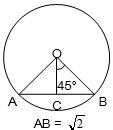
Area of the circle in which a chord of length $\sqrt{2}$ makes an angle $\frac{\pi}{2}$ at the centre is
A
$\frac{\pi}{2}$
B
$2\pi$
C
$\pi$
D
$\frac{\pi}{4}$
Solution
(C) Let $AB$ be the chord of length $\sqrt{2}$ and $O$ be the centre of the circle.
Given that the angle subtended by the chord at the centre is $\angle AOB = \frac{\pi}{2} = 90^\circ$.
In $\Delta AOB$,$OA = OB = r$ (radius of the circle).
By the Pythagorean theorem in $\Delta AOB$:
$OA^2 + OB^2 = AB^2$
$r^2 + r^2 = (\sqrt{2})^2$
$2r^2 = 2$
$r^2 = 1$
Therefore,the area of the circle is $\pi r^2 = \pi(1) = \pi$.
Given that the angle subtended by the chord at the centre is $\angle AOB = \frac{\pi}{2} = 90^\circ$.
In $\Delta AOB$,$OA = OB = r$ (radius of the circle).
By the Pythagorean theorem in $\Delta AOB$:
$OA^2 + OB^2 = AB^2$
$r^2 + r^2 = (\sqrt{2})^2$
$2r^2 = 2$
$r^2 = 1$
Therefore,the area of the circle is $\pi r^2 = \pi(1) = \pi$.
0 likes
View Solution25
EasyMCQ
If the coordinates of one end of the diameter of the circle $x^2 + y^2 - 8x - 4y + c = 0$ are $(-3, 2)$,then the coordinates of the other end are:
A
$(5, 3)$
B
$(6, 2)$
C
$(1, -8)$
D
$(11, 2)$
Solution
(D) The given equation of the circle is $x^2 + y^2 - 8x - 4y + c = 0$.
Comparing this with the general form $x^2 + y^2 + 2gx + 2fy + c = 0$,we get $2g = -8$ and $2f = -4$,which implies $g = -4$ and $f = -2$.
The center of the circle is $(-g, -f) = (4, 2)$.
Let the coordinates of the other end of the diameter be $(x, y)$.
Since the center is the midpoint of the diameter,we have:
$\frac{x + (-3)}{2} = 4 \implies x - 3 = 8 \implies x = 11$
$\frac{y + 2}{2} = 2 \implies y + 2 = 4 \implies y = 2$
Thus,the coordinates of the other end are $(11, 2)$.
Comparing this with the general form $x^2 + y^2 + 2gx + 2fy + c = 0$,we get $2g = -8$ and $2f = -4$,which implies $g = -4$ and $f = -2$.
The center of the circle is $(-g, -f) = (4, 2)$.
Let the coordinates of the other end of the diameter be $(x, y)$.
Since the center is the midpoint of the diameter,we have:
$\frac{x + (-3)}{2} = 4 \implies x - 3 = 8 \implies x = 11$
$\frac{y + 2}{2} = 2 \implies y + 2 = 4 \implies y = 2$
Thus,the coordinates of the other end are $(11, 2)$.
0 likes
View Solution26
EasyMCQ
If $(x, 3)$ and $(3, 5)$ are the extremities of a diameter of a circle with centre at $(2, y)$,then the values of $x$ and $y$ are:
A
$x = 1, y = 4$
B
$x = 4, y = 1$
C
$x = 8, y = 2$
D
None of these
Solution
(A) The centre of a circle is the midpoint of its diameter.
Given the endpoints of the diameter are $(x, 3)$ and $(3, 5)$,and the centre is $(2, y)$.
Using the midpoint formula,the centre is $(\frac{x + 3}{2}, \frac{3 + 5}{2})$.
Equating the coordinates with the given centre $(2, y)$:
$\frac{x + 3}{2} = 2 \implies x + 3 = 4 \implies x = 1$.
$\frac{3 + 5}{2} = y \implies \frac{8}{2} = y \implies y = 4$.
Thus,$x = 1$ and $y = 4$.
Given the endpoints of the diameter are $(x, 3)$ and $(3, 5)$,and the centre is $(2, y)$.
Using the midpoint formula,the centre is $(\frac{x + 3}{2}, \frac{3 + 5}{2})$.
Equating the coordinates with the given centre $(2, y)$:
$\frac{x + 3}{2} = 2 \implies x + 3 = 4 \implies x = 1$.
$\frac{3 + 5}{2} = y \implies \frac{8}{2} = y \implies y = 4$.
Thus,$x = 1$ and $y = 4$.
0 likes
View Solution27
MediumMCQ
The equation of the circle which passes through $(1, 0)$ and $(0, 1)$ and has its radius as small as possible,is
A
$x^2 + y^2 - 2x - 2y + 1 = 0$
B
$x^2 + y^2 - x - y = 0$
C
$2x^2 + 2y^2 - 3x - 3y + 1 = 0$
D
$x^2 + y^2 - 3x - 3y + 2 = 0$
Solution
(B) The radius of a circle passing through two fixed points is minimum when the line segment joining the two points is the diameter of the circle.
Given points are $A(1, 0)$ and $B(0, 1)$.
The equation of a circle with diameter endpoints $(x_1, y_1)$ and $(x_2, y_2)$ is $(x - x_1)(x - x_2) + (y - y_1)(y - y_2) = 0$.
Substituting the points $(1, 0)$ and $(0, 1)$:
$(x - 1)(x - 0) + (y - 0)(y - 1) = 0$
$x(x - 1) + y(y - 1) = 0$
$x^2 - x + y^2 - y = 0$
$x^2 + y^2 - x - y = 0$
Thus,the correct option is $B$.
Given points are $A(1, 0)$ and $B(0, 1)$.
The equation of a circle with diameter endpoints $(x_1, y_1)$ and $(x_2, y_2)$ is $(x - x_1)(x - x_2) + (y - y_1)(y - y_2) = 0$.
Substituting the points $(1, 0)$ and $(0, 1)$:
$(x - 1)(x - 0) + (y - 0)(y - 1) = 0$
$x(x - 1) + y(y - 1) = 0$
$x^2 - x + y^2 - y = 0$
$x^2 + y^2 - x - y = 0$
Thus,the correct option is $B$.
0 likes
View Solution28
EasyMCQ
The area of the curve $x^2 + y^2 = 2ax$ is
A
$\pi a^2$
B
$2\pi a^2$
C
$4\pi a^2$
D
$\frac{1}{2}\pi a^2$
Solution
(A) The given equation is $x^2 + y^2 = 2ax$.
Rearranging the terms,we get $x^2 - 2ax + y^2 = 0$.
Completing the square for $x$,we add $a^2$ to both sides: $(x^2 - 2ax + a^2) + y^2 = a^2$.
This simplifies to $(x - a)^2 + y^2 = a^2$.
This is the equation of a circle with center $(a, 0)$ and radius $r = a$.
The area of a circle is given by the formula $A = \pi r^2$.
Substituting $r = a$,we get $A = \pi a^2$.
Rearranging the terms,we get $x^2 - 2ax + y^2 = 0$.
Completing the square for $x$,we add $a^2$ to both sides: $(x^2 - 2ax + a^2) + y^2 = a^2$.
This simplifies to $(x - a)^2 + y^2 = a^2$.
This is the equation of a circle with center $(a, 0)$ and radius $r = a$.
The area of a circle is given by the formula $A = \pi r^2$.
Substituting $r = a$,we get $A = \pi a^2$.
0 likes
View Solution29
EasyMCQ
If a circle and a square have the same perimeter,then
A
Their areas are equal
B
Area of circle is larger
C
Area of square is larger
D
None of these
Solution
(B) Let $r$ be the radius of the circle and $a$ be the side length of the square.
Given that the perimeter of the circle equals the perimeter of the square:
$2\pi r = 4a \Rightarrow a = \frac{\pi r}{2}$.
Area of the circle = $\pi r^2$.
Area of the square = $a^2 = \left(\frac{\pi r}{2}\right)^2 = \frac{\pi^2 r^2}{4}$.
Comparing the areas:
$\frac{\text{Area of circle}}{\text{Area of square}} = \frac{\pi r^2}{\frac{\pi^2 r^2}{4}} = \frac{4}{\pi}$.
Since $\pi \approx 3.14$,$\frac{4}{\pi} > 1$.
Therefore,the area of the circle is larger than the area of the square.
Given that the perimeter of the circle equals the perimeter of the square:
$2\pi r = 4a \Rightarrow a = \frac{\pi r}{2}$.
Area of the circle = $\pi r^2$.
Area of the square = $a^2 = \left(\frac{\pi r}{2}\right)^2 = \frac{\pi^2 r^2}{4}$.
Comparing the areas:
$\frac{\text{Area of circle}}{\text{Area of square}} = \frac{\pi r^2}{\frac{\pi^2 r^2}{4}} = \frac{4}{\pi}$.
Since $\pi \approx 3.14$,$\frac{4}{\pi} > 1$.
Therefore,the area of the circle is larger than the area of the square.
0 likes
View Solution30
EasyMCQ
The length of the intercept that the circle $x^2 + y^2 + 10x - 6y + 9 = 0$ makes on the $x$-axis is:
A
$2$
B
$4$
C
$6$
D
$8$
Solution
(D) Comparing the given equation $x^2 + y^2 + 10x - 6y + 9 = 0$ with the general form $x^2 + y^2 + 2gx + 2fy + c = 0$,we get $g = 5$ and $c = 9$.
The length of the intercept made by the circle on the $x$-axis is given by the formula $2\sqrt{g^2 - c}$.
Substituting the values,we get $2\sqrt{5^2 - 9} = 2\sqrt{25 - 9} = 2\sqrt{16} = 2 \times 4 = 8$.
Therefore,the length of the intercept is $8$.
The length of the intercept made by the circle on the $x$-axis is given by the formula $2\sqrt{g^2 - c}$.
Substituting the values,we get $2\sqrt{5^2 - 9} = 2\sqrt{25 - 9} = 2\sqrt{16} = 2 \times 4 = 8$.
Therefore,the length of the intercept is $8$.
0 likes
View Solution31
EasyMCQ
$A$ point inside the circle $x^2 + y^2 + 3x - 3y + 2 = 0$ is
A
$(-1, 3)$
B
$(-2, 1)$
C
$(2, 1)$
D
$(-3, 2)$
Solution
(B) Let the equation of the circle be $S(x, y) = x^2 + y^2 + 3x - 3y + 2 = 0$.
$A$ point $(x_1, y_1)$ lies inside the circle if $S(x_1, y_1) < 0$.
Checking option $(A) (-1, 3)$: $S(-1, 3) = (-1)^2 + (3)^2 + 3(-1) - 3(3) + 2 = 1 + 9 - 3 - 9 + 2 = 0$. The point lies on the circle.
Checking option $(B) (-2, 1)$: $S(-2, 1) = (-2)^2 + (1)^2 + 3(-2) - 3(1) + 2 = 4 + 1 - 6 - 3 + 2 = -2$. Since $-2 < 0$,the point lies inside the circle.
Checking option $(C) (2, 1)$: $S(2, 1) = (2)^2 + (1)^2 + 3(2) - 3(1) + 2 = 4 + 1 + 6 - 3 + 2 = 10$. Since $10 > 0$,the point lies outside the circle.
Checking option $(D) (-3, 2)$: $S(-3, 2) = (-3)^2 + (2)^2 + 3(-3) - 3(2) + 2 = 9 + 4 - 9 - 6 + 2 = 0$. The point lies on the circle.
Thus,the correct option is $(B)$.
$A$ point $(x_1, y_1)$ lies inside the circle if $S(x_1, y_1) < 0$.
Checking option $(A) (-1, 3)$: $S(-1, 3) = (-1)^2 + (3)^2 + 3(-1) - 3(3) + 2 = 1 + 9 - 3 - 9 + 2 = 0$. The point lies on the circle.
Checking option $(B) (-2, 1)$: $S(-2, 1) = (-2)^2 + (1)^2 + 3(-2) - 3(1) + 2 = 4 + 1 - 6 - 3 + 2 = -2$. Since $-2 < 0$,the point lies inside the circle.
Checking option $(C) (2, 1)$: $S(2, 1) = (2)^2 + (1)^2 + 3(2) - 3(1) + 2 = 4 + 1 + 6 - 3 + 2 = 10$. Since $10 > 0$,the point lies outside the circle.
Checking option $(D) (-3, 2)$: $S(-3, 2) = (-3)^2 + (2)^2 + 3(-3) - 3(2) + 2 = 9 + 4 - 9 - 6 + 2 = 0$. The point lies on the circle.
Thus,the correct option is $(B)$.
0 likes
View Solution32
EasyMCQ
Position of the point $(1, 1)$ with respect to the circle $x^2 + y^2 - x + y - 1 = 0$ is
A
Outside the circle
B
Upon the circle
C
Inside the circle
D
None of these
Solution
(A) Let the equation of the circle be $S(x, y) = x^2 + y^2 - x + y - 1 = 0$.
To find the position of the point $(1, 1)$,we substitute $x = 1$ and $y = 1$ into the expression $S(x, y)$.
$S(1, 1) = (1)^2 + (1)^2 - (1) + (1) - 1 = 1 + 1 - 1 + 1 - 1 = 1$.
Since $S(1, 1) = 1 > 0$,the point $(1, 1)$ lies outside the circle.
To find the position of the point $(1, 1)$,we substitute $x = 1$ and $y = 1$ into the expression $S(x, y)$.
$S(1, 1) = (1)^2 + (1)^2 - (1) + (1) - 1 = 1 + 1 - 1 + 1 - 1 = 1$.
Since $S(1, 1) = 1 > 0$,the point $(1, 1)$ lies outside the circle.
0 likes
View Solution33
EasyMCQ
The length of the tangent from the point $(5, 1)$ to the circle $x^2 + y^2 + 6x - 4y - 3 = 0$ is:
A
$81$
B
$29$
C
$7$
D
$21$
Solution
(C) The length of the tangent from a point $(x_1, y_1)$ to a circle $S: x^2 + y^2 + 2gx + 2fy + c = 0$ is given by $\sqrt{S_1}$,where $S_1 = x_1^2 + y_1^2 + 2gx_1 + 2fy_1 + c$.
Given the point $(5, 1)$ and the circle $x^2 + y^2 + 6x - 4y - 3 = 0$.
Substituting the point into the circle equation:
$S_1 = (5)^2 + (1)^2 + 6(5) - 4(1) - 3$
$S_1 = 25 + 1 + 30 - 4 - 3 = 49$
Therefore,the length of the tangent is $\sqrt{S_1} = \sqrt{49} = 7$.
Given the point $(5, 1)$ and the circle $x^2 + y^2 + 6x - 4y - 3 = 0$.
Substituting the point into the circle equation:
$S_1 = (5)^2 + (1)^2 + 6(5) - 4(1) - 3$
$S_1 = 25 + 1 + 30 - 4 - 3 = 49$
Therefore,the length of the tangent is $\sqrt{S_1} = \sqrt{49} = 7$.
0 likes
View Solution34
DifficultMCQ
The circle $x^2 + y^2 - 4x - 8y - 5 = 0$ will intersect the line $3x - 4y = m$ in two distinct points,if:
A
$ - 10 < m < 5$
B
$9 < m < 20$
C
$ - 35 < m < 15$
D
None of these
Solution
(C) The given circle is $x^2 + y^2 - 4x - 8y - 5 = 0$.
Comparing with $x^2 + y^2 + 2gx + 2fy + c = 0$,we get $g = -2$,$f = -4$,and $c = -5$.
The centre of the circle is $(-g, -f) = (2, 4)$ and the radius $r = \sqrt{g^2 + f^2 - c} = \sqrt{4 + 16 + 5} = \sqrt{25} = 5$.
For the line $3x - 4y - m = 0$ to intersect the circle at two distinct points,the perpendicular distance from the centre $(2, 4)$ to the line must be less than the radius $r$.
Distance $d = \frac{|3(2) - 4(4) - m|}{\sqrt{3^2 + (-4)^2}} = \frac{|6 - 16 - m|}{\sqrt{9 + 16}} = \frac{|-10 - m|}{5}$.
We require $d < r$,so $\frac{|-10 - m|}{5} < 5$.
$|-10 - m| < 25$.
$-25 < -10 - m < 25$.
Multiplying by $-1$,we get $25 > 10 + m > -25$.
Subtracting $10$ from all parts,we get $15 > m > -35$,which is $-35 < m < 15$.
Comparing with $x^2 + y^2 + 2gx + 2fy + c = 0$,we get $g = -2$,$f = -4$,and $c = -5$.
The centre of the circle is $(-g, -f) = (2, 4)$ and the radius $r = \sqrt{g^2 + f^2 - c} = \sqrt{4 + 16 + 5} = \sqrt{25} = 5$.
For the line $3x - 4y - m = 0$ to intersect the circle at two distinct points,the perpendicular distance from the centre $(2, 4)$ to the line must be less than the radius $r$.
Distance $d = \frac{|3(2) - 4(4) - m|}{\sqrt{3^2 + (-4)^2}} = \frac{|6 - 16 - m|}{\sqrt{9 + 16}} = \frac{|-10 - m|}{5}$.
We require $d < r$,so $\frac{|-10 - m|}{5} < 5$.
$|-10 - m| < 25$.
$-25 < -10 - m < 25$.
Multiplying by $-1$,we get $25 > 10 + m > -25$.
Subtracting $10$ from all parts,we get $15 > m > -35$,which is $-35 < m < 15$.
0 likes
View Solution35
MediumMCQ
If ${c^2} > {a^2}(1 + {m^2})$,then the line $y = mx + c$ will intersect the circle ${x^2} + {y^2} = {a^2}$ at:
A
At one point
B
At two distinct points
C
At no point
D
None of these
Solution
(C) The condition for the line $y = mx + c$ to be a tangent to the circle ${x^2} + {y^2} = {a^2}$ is ${c^2} = {a^2}(1 + {m^2})$.
If ${c^2} < {a^2}(1 + {m^2})$,the line intersects the circle at two distinct points.
If ${c^2} > {a^2}(1 + {m^2})$,the distance from the center $(0, 0)$ to the line $mx - y + c = 0$ is given by $d = \frac{|c|}{\sqrt{m^2 + 1}}$.
Since ${c^2} > {a^2}(1 + {m^2})$,we have $\frac{|c|}{\sqrt{m^2 + 1}} > |a|$.
This means the perpendicular distance from the center to the line is greater than the radius of the circle.
Therefore,the line does not intersect the circle at any point.
If ${c^2} < {a^2}(1 + {m^2})$,the line intersects the circle at two distinct points.
If ${c^2} > {a^2}(1 + {m^2})$,the distance from the center $(0, 0)$ to the line $mx - y + c = 0$ is given by $d = \frac{|c|}{\sqrt{m^2 + 1}}$.
Since ${c^2} > {a^2}(1 + {m^2})$,we have $\frac{|c|}{\sqrt{m^2 + 1}} > |a|$.
This means the perpendicular distance from the center to the line is greater than the radius of the circle.
Therefore,the line does not intersect the circle at any point.
0 likes
View Solution36
MediumMCQ
The equation of the circle which touches the coordinate axes and the line $\frac{x}{3} + \frac{y}{4} = 1$,and whose centre lies in the first quadrant,is ${x^2} + {y^2} - 2cx - 2cy + {c^2} = 0$,where $c$ is:
A
$1$
B
$2$
C
$3$
D
$6$
Solution
(A) Since the circle touches both coordinate axes and lies in the first quadrant,its center is $(c, c)$ and its radius is $r = c$.
The distance from the center $(c, c)$ to the line $\frac{x}{3} + \frac{y}{4} = 1$ (or $4x + 3y - 12 = 0$) must be equal to the radius $c$.
Using the perpendicular distance formula: $\left| \frac{4c + 3c - 12}{\sqrt{4^2 + 3^2}} \right| = c$.
$\left| \frac{7c - 12}{5} \right| = c$.
This gives two cases:
Case $1$: $7c - 12 = 5c$ $\Rightarrow 2c = 12$ $\Rightarrow c = 6$.
Case $2$: $7c - 12 = -5c$ $\Rightarrow 12c = 12$ $\Rightarrow c = 1$.
Since the line $\frac{x}{3} + \frac{y}{4} = 1$ has intercepts $3$ and $4$,the circle must be smaller than the triangle formed by the axes and the line. For $c=6$,the circle lies outside the triangle. Thus,$c=1$ is the correct value for the circle touching the line internally.
The distance from the center $(c, c)$ to the line $\frac{x}{3} + \frac{y}{4} = 1$ (or $4x + 3y - 12 = 0$) must be equal to the radius $c$.
Using the perpendicular distance formula: $\left| \frac{4c + 3c - 12}{\sqrt{4^2 + 3^2}} \right| = c$.
$\left| \frac{7c - 12}{5} \right| = c$.
This gives two cases:
Case $1$: $7c - 12 = 5c$ $\Rightarrow 2c = 12$ $\Rightarrow c = 6$.
Case $2$: $7c - 12 = -5c$ $\Rightarrow 12c = 12$ $\Rightarrow c = 1$.
Since the line $\frac{x}{3} + \frac{y}{4} = 1$ has intercepts $3$ and $4$,the circle must be smaller than the triangle formed by the axes and the line. For $c=6$,the circle lies outside the triangle. Thus,$c=1$ is the correct value for the circle touching the line internally.
0 likes
View Solution37
MediumMCQ
The number of tangents which can be drawn from the point $(-1, 2)$ to the circle $x^2 + y^2 + 2x - 4y + 4 = 0$ is
A
$1$
B
$2$
C
$3$
D
$0$
Solution
(D) The equation of the circle is $x^2 + y^2 + 2x - 4y + 4 = 0$.
Let the point be $P(-1, 2)$.
To check the position of the point with respect to the circle,we calculate the power of the point $S_1$ by substituting the coordinates into the circle equation:
$S_1 = (-1)^2 + (2)^2 + 2(-1) - 4(2) + 4$
$S_1 = 1 + 4 - 2 - 8 + 4 = -1$.
Since $S_1 < 0$,the point $(-1, 2)$ lies inside the circle.
Therefore,no tangent can be drawn from this point to the circle.
Let the point be $P(-1, 2)$.
To check the position of the point with respect to the circle,we calculate the power of the point $S_1$ by substituting the coordinates into the circle equation:
$S_1 = (-1)^2 + (2)^2 + 2(-1) - 4(2) + 4$
$S_1 = 1 + 4 - 2 - 8 + 4 = -1$.
Since $S_1 < 0$,the point $(-1, 2)$ lies inside the circle.
Therefore,no tangent can be drawn from this point to the circle.
0 likes
View Solution38
MediumMCQ
The number of tangents that can be drawn from $(0, 0)$ to the circle $x^2 + y^2 + 2x + 6y - 15 = 0$ is
A
None
B
One
C
Two
D
Infinite
Solution
(A) Let the equation of the circle be $S: x^2 + y^2 + 2x + 6y - 15 = 0$.
To determine the position of the point $(0, 0)$ with respect to the circle,we substitute the coordinates $(0, 0)$ into the expression $S$.
$S_1 = (0)^2 + (0)^2 + 2(0) + 6(0) - 15 = -15$.
Since $S_1 < 0$,the point $(0, 0)$ lies inside the circle.
Therefore,no tangent can be drawn from a point inside the circle to the circle itself.
To determine the position of the point $(0, 0)$ with respect to the circle,we substitute the coordinates $(0, 0)$ into the expression $S$.
$S_1 = (0)^2 + (0)^2 + 2(0) + 6(0) - 15 = -15$.
Since $S_1 < 0$,the point $(0, 0)$ lies inside the circle.
Therefore,no tangent can be drawn from a point inside the circle to the circle itself.
0 likes
View Solution39
EasyMCQ
The position of the point $(0.1, 3.1)$ with respect to the circle $x^2 + y^2 - 2x - 4y + 3 = 0$ is:
A
At the centre of the circle
B
Inside the circle but not at the centre
C
On the circle
D
Outside the circle
Solution
(D) Let the equation of the circle be $S(x, y) = x^2 + y^2 - 2x - 4y + 3 = 0$.
To determine the position of the point $(0.1, 3.1)$,we calculate the power of the point $S_1 = S(0.1, 3.1)$.
$S_1 = (0.1)^2 + (3.1)^2 - 2(0.1) - 4(3.1) + 3$
$S_1 = 0.01 + 9.61 - 0.2 - 12.4 + 3$
$S_1 = 12.62 - 12.6 = 0.02$.
Since $S_1 > 0$,the point lies outside the circle.
To determine the position of the point $(0.1, 3.1)$,we calculate the power of the point $S_1 = S(0.1, 3.1)$.
$S_1 = (0.1)^2 + (3.1)^2 - 2(0.1) - 4(3.1) + 3$
$S_1 = 0.01 + 9.61 - 0.2 - 12.4 + 3$
$S_1 = 12.62 - 12.6 = 0.02$.
Since $S_1 > 0$,the point lies outside the circle.
0 likes
View Solution40
EasyMCQ
The points of intersection of the line $4x - 3y - 10 = 0$ and the circle $x^2 + y^2 - 2x + 4y - 20 = 0$ are
A
$(-2, -6), (4, 2)$
B
$(2, 6), (-4, -2)$
C
$(-2, 6), (-4, 2)$
D
None of these
Solution
(A) Given line: $4x - 3y - 10 = 0 \implies x = \frac{3y + 10}{4}$.
Substituting this into the circle equation $x^2 + y^2 - 2x + 4y - 20 = 0$:
$(\frac{3y + 10}{4})^2 + y^2 - 2(\frac{3y + 10}{4}) + 4y - 20 = 0$.
Multiplying by $16$ to clear the denominator:
$(3y + 10)^2 + 16y^2 - 8(3y + 10) + 64y - 320 = 0$.
$9y^2 + 60y + 100 + 16y^2 - 24y - 80 + 64y - 320 = 0$.
$25y^2 + 100y - 300 = 0$.
$y^2 + 4y - 12 = 0$.
$(y + 6)(y - 2) = 0$.
So,$y = -6$ or $y = 2$.
For $y = -6$,$x = \frac{3(-6) + 10}{4} = \frac{-8}{4} = -2$.
For $y = 2$,$x = \frac{3(2) + 10}{4} = \frac{16}{4} = 4$.
The points are $(-2, -6)$ and $(4, 2)$.
Substituting this into the circle equation $x^2 + y^2 - 2x + 4y - 20 = 0$:
$(\frac{3y + 10}{4})^2 + y^2 - 2(\frac{3y + 10}{4}) + 4y - 20 = 0$.
Multiplying by $16$ to clear the denominator:
$(3y + 10)^2 + 16y^2 - 8(3y + 10) + 64y - 320 = 0$.
$9y^2 + 60y + 100 + 16y^2 - 24y - 80 + 64y - 320 = 0$.
$25y^2 + 100y - 300 = 0$.
$y^2 + 4y - 12 = 0$.
$(y + 6)(y - 2) = 0$.
So,$y = -6$ or $y = 2$.
For $y = -6$,$x = \frac{3(-6) + 10}{4} = \frac{-8}{4} = -2$.
For $y = 2$,$x = \frac{3(2) + 10}{4} = \frac{16}{4} = 4$.
The points are $(-2, -6)$ and $(4, 2)$.
0 likes
View Solution41
DifficultMCQ
The line $y = mx + c$ intersects the circle $x^2 + y^2 = r^2$ at two real distinct points,if
A
$ - r\sqrt{1 + m^2} < c < r\sqrt{1 + m^2}$
B
$c^2 < r^2(1 + m^2)$
C
Both $(a)$ and $(b)$
D
$c^2 > r^2(1 + m^2)$
Solution
(C) The perpendicular distance from the center of the circle $(0, 0)$ to the line $mx - y + c = 0$ must be less than the radius $r$ for the line to intersect the circle at two distinct points.
The distance $d$ is given by $d = \frac{|m(0) - 1(0) + c|}{\sqrt{m^2 + (-1)^2}} = \frac{|c|}{\sqrt{1 + m^2}}$.
For two distinct points,we require $d < r$,so $\frac{|c|}{\sqrt{1 + m^2}} < r$.
This implies $|c| < r\sqrt{1 + m^2}$,which is equivalent to $c^2 < r^2(1 + m^2)$.
This inequality can also be written as $-r\sqrt{1 + m^2} < c < r\sqrt{1 + m^2}$.
The distance $d$ is given by $d = \frac{|m(0) - 1(0) + c|}{\sqrt{m^2 + (-1)^2}} = \frac{|c|}{\sqrt{1 + m^2}}$.
For two distinct points,we require $d < r$,so $\frac{|c|}{\sqrt{1 + m^2}} < r$.
This implies $|c| < r\sqrt{1 + m^2}$,which is equivalent to $c^2 < r^2(1 + m^2)$.
This inequality can also be written as $-r\sqrt{1 + m^2} < c < r\sqrt{1 + m^2}$.
0 likes
View Solution42
DifficultMCQ
The number of common tangents to two circles $x^2 + y^2 = 4$ and $x^2 + y^2 - 8x + 12 = 0$ is
A
$1$
B
$2$
C
$3$
D
$4$
Solution
(C) For the first circle $x^2 + y^2 = 4$,the center $C_1 = (0, 0)$ and radius $r_1 = 2$.
For the second circle $x^2 + y^2 - 8x + 12 = 0$,we rewrite it as $(x - 4)^2 + y^2 = 4$,so the center $C_2 = (4, 0)$ and radius $r_2 = 2$.
The distance between the centers $C_1$ and $C_2$ is $d = \sqrt{(4 - 0)^2 + (0 - 0)^2} = 4$.
Since $d = r_1 + r_2$ $(4 = 2 + 2)$,the two circles touch each other externally.
When two circles touch externally,the number of common tangents is $3$.
For the second circle $x^2 + y^2 - 8x + 12 = 0$,we rewrite it as $(x - 4)^2 + y^2 = 4$,so the center $C_2 = (4, 0)$ and radius $r_2 = 2$.
The distance between the centers $C_1$ and $C_2$ is $d = \sqrt{(4 - 0)^2 + (0 - 0)^2} = 4$.
Since $d = r_1 + r_2$ $(4 = 2 + 2)$,the two circles touch each other externally.
When two circles touch externally,the number of common tangents is $3$.
0 likes
View Solution43
DifficultMCQ
The number of common tangents to the circles ${x^2} + {y^2} - x = 0$ and ${x^2} + {y^2} + x = 0$ is:
A
$2$
B
$1$
C
$4$
D
$3$
Solution
(D) The given circles are ${x^2} + {y^2} - x = 0$ and ${x^2} + {y^2} + x = 0$.
For the first circle ${x^2} + {y^2} - x = 0$,the centre ${C_1} = (\frac{1}{2}, 0)$ and radius ${r_1} = \sqrt{(\frac{1}{2})^2 + 0^2 - 0} = \frac{1}{2}$.
For the second circle ${x^2} + {y^2} + x = 0$,the centre ${C_2} = (-\frac{1}{2}, 0)$ and radius ${r_2} = \sqrt{(-\frac{1}{2})^2 + 0^2 - 0} = \frac{1}{2}$.
The distance between the centres is ${C_1}{C_2} = \sqrt{(\frac{1}{2} - (-\frac{1}{2}))^2 + (0 - 0)^2} = \sqrt{1^2} = 1$.
Since ${C_1}{C_2} = 1$ and ${r_1} + {r_2} = \frac{1}{2} + \frac{1}{2} = 1$,we have ${C_1}{C_2} = {r_1} + {r_2}$.
This indicates that the two circles touch each other externally.
When two circles touch each other externally,the number of common tangents is $3$.
For the first circle ${x^2} + {y^2} - x = 0$,the centre ${C_1} = (\frac{1}{2}, 0)$ and radius ${r_1} = \sqrt{(\frac{1}{2})^2 + 0^2 - 0} = \frac{1}{2}$.
For the second circle ${x^2} + {y^2} + x = 0$,the centre ${C_2} = (-\frac{1}{2}, 0)$ and radius ${r_2} = \sqrt{(-\frac{1}{2})^2 + 0^2 - 0} = \frac{1}{2}$.
The distance between the centres is ${C_1}{C_2} = \sqrt{(\frac{1}{2} - (-\frac{1}{2}))^2 + (0 - 0)^2} = \sqrt{1^2} = 1$.
Since ${C_1}{C_2} = 1$ and ${r_1} + {r_2} = \frac{1}{2} + \frac{1}{2} = 1$,we have ${C_1}{C_2} = {r_1} + {r_2}$.
This indicates that the two circles touch each other externally.
When two circles touch each other externally,the number of common tangents is $3$.
0 likes
View Solution44
DifficultMCQ
If the circle $(x - h)^2 + (y - k)^2 = r^2$ touches the curve $y = x^2 + 1$ at the point $(1, 2)$,then the possible locations of the points $(h, k)$ are given by
A
$hk = 5/2$
B
$h + 2k = 5$
C
$h^2 - 4k^2 = 5$
D
$k^2 = h^2 + 1$
Solution
(B) The circle $(x - h)^2 + (y - k)^2 = r^2$ touches the curve $y = x^2 + 1$ at the point $(1, 2)$.
This implies that the normal to the curve $y = x^2 + 1$ at $(1, 2)$ must pass through the center of the circle $(h, k)$.
The derivative of the curve is $dy/dx = 2x$. At $x = 1$,the slope of the tangent is $m_t = 2(1) = 2$.
The slope of the normal at $(1, 2)$ is $m_n = -1/m_t = -1/2$.
The equation of the normal line passing through $(1, 2)$ with slope $-1/2$ is $(y - 2) = -1/2(x - 1)$,which simplifies to $2y - 4 = -x + 1$,or $x + 2y = 5$.
Since the center $(h, k)$ lies on this normal line,we have $h + 2k = 5$.
This implies that the normal to the curve $y = x^2 + 1$ at $(1, 2)$ must pass through the center of the circle $(h, k)$.
The derivative of the curve is $dy/dx = 2x$. At $x = 1$,the slope of the tangent is $m_t = 2(1) = 2$.
The slope of the normal at $(1, 2)$ is $m_n = -1/m_t = -1/2$.
The equation of the normal line passing through $(1, 2)$ with slope $-1/2$ is $(y - 2) = -1/2(x - 1)$,which simplifies to $2y - 4 = -x + 1$,or $x + 2y = 5$.
Since the center $(h, k)$ lies on this normal line,we have $h + 2k = 5$.
0 likes
View Solution45
MediumMCQ
The line $ax + by + c = 0$ is a normal to the circle $x^2 + y^2 = r^2$. The portion of the line $ax + by + c = 0$ intercepted by this circle is of length:
A
$r$
B
$r^2$
C
$2r$
D
$\sqrt{r}$
Solution
(C) normal to a circle is a line that passes through the center of the circle.
Since the given line $ax + by + c = 0$ is a normal to the circle $x^2 + y^2 = r^2$,it must pass through the center of the circle,which is $(0, 0)$.
Any line passing through the center of a circle is a diameter of that circle.
The length of the diameter of a circle with radius $r$ is $2r$.
Therefore,the length of the portion of the line intercepted by the circle is $2r$.
Since the given line $ax + by + c = 0$ is a normal to the circle $x^2 + y^2 = r^2$,it must pass through the center of the circle,which is $(0, 0)$.
Any line passing through the center of a circle is a diameter of that circle.
The length of the diameter of a circle with radius $r$ is $2r$.
Therefore,the length of the portion of the line intercepted by the circle is $2r$.
0 likes
View Solution46
DifficultMCQ
The number of common tangents to the circles $x^2 + y^2 = 1$ and $x^2 + y^2 - 4x + 3 = 0$ is
A
$1$
B
$2$
C
$3$
D
$4$
Solution
(C) For the first circle $x^2 + y^2 = 1$,the center $C_1 = (0, 0)$ and radius $r_1 = 1$.
For the second circle $x^2 + y^2 - 4x + 3 = 0$,we rewrite it as $(x-2)^2 + y^2 = 1$,so the center $C_2 = (2, 0)$ and radius $r_2 = 1$.
The distance between the centers $C_1$ and $C_2$ is $d = \sqrt{(2-0)^2 + (0-0)^2} = 2$.
Since $d = r_1 + r_2 = 1 + 1 = 2$,the two circles touch each other externally.
When two circles touch externally,the number of common tangents is $3$.
For the second circle $x^2 + y^2 - 4x + 3 = 0$,we rewrite it as $(x-2)^2 + y^2 = 1$,so the center $C_2 = (2, 0)$ and radius $r_2 = 1$.
The distance between the centers $C_1$ and $C_2$ is $d = \sqrt{(2-0)^2 + (0-0)^2} = 2$.
Since $d = r_1 + r_2 = 1 + 1 = 2$,the two circles touch each other externally.
When two circles touch externally,the number of common tangents is $3$.
0 likes
View Solution47
DifficultMCQ
The equation of the chord of the circle $x^2 + y^2 = a^2$ having $(x_1, y_1)$ as its mid-point is
A
$x y_1 + y x_1 = a^2$
B
$x_1 + y_1 = a$
C
$x x_1 + y y_1 = x_1^2 + y_1^2$
D
$x x_1 + y y_1 = a^2$
Solution
(C) The equation of a chord of a circle $S = 0$ with mid-point $(x_1, y_1)$ is given by $T = S_1$,where $T = x x_1 + y y_1 - a^2$ and $S_1 = x_1^2 + y_1^2 - a^2$.
Substituting these into the formula:
$x x_1 + y y_1 - a^2 = x_1^2 + y_1^2 - a^2$
Adding $a^2$ to both sides,we get:
$x x_1 + y y_1 = x_1^2 + y_1^2$.
Substituting these into the formula:
$x x_1 + y y_1 - a^2 = x_1^2 + y_1^2 - a^2$
Adding $a^2$ to both sides,we get:
$x x_1 + y y_1 = x_1^2 + y_1^2$.
0 likes
View Solution48
DifficultMCQ
The length of the chord intercepted by the circle $x^2 + y^2 = r^2$ on the line $\frac{x}{a} + \frac{y}{b} = 1$ is
A
$\sqrt{\frac{r^2(a^2 + b^2) - a^2b^2}{a^2 + b^2}}$
B
$2\sqrt{\frac{r^2(a^2 + b^2) - a^2b^2}{a^2 + b^2}}$
C
$2\frac{\sqrt{r^2(a^2 + b^2) - a^2b^2}}{a^2 + b^2}$
D
None of these
Solution
(B) The length of the chord is given by the formula $L = 2\sqrt{R^2 - d^2}$,where $R$ is the radius of the circle and $d$ is the perpendicular distance from the center $(0, 0)$ to the line $\frac{x}{a} + \frac{y}{b} - 1 = 0$.
The radius $R = r$.
The perpendicular distance $d = \frac{|\frac{0}{a} + \frac{0}{b} - 1|}{\sqrt{(\frac{1}{a})^2 + (\frac{1}{b})^2}} = \frac{1}{\sqrt{\frac{a^2 + b^2}{a^2b^2}}} = \frac{|ab|}{\sqrt{a^2 + b^2}}$.
Substituting these into the formula:
$L = 2\sqrt{r^2 - \frac{a^2b^2}{a^2 + b^2}}$
$L = 2\sqrt{\frac{r^2(a^2 + b^2) - a^2b^2}{a^2 + b^2}}$.
The radius $R = r$.
The perpendicular distance $d = \frac{|\frac{0}{a} + \frac{0}{b} - 1|}{\sqrt{(\frac{1}{a})^2 + (\frac{1}{b})^2}} = \frac{1}{\sqrt{\frac{a^2 + b^2}{a^2b^2}}} = \frac{|ab|}{\sqrt{a^2 + b^2}}$.
Substituting these into the formula:
$L = 2\sqrt{r^2 - \frac{a^2b^2}{a^2 + b^2}}$
$L = 2\sqrt{\frac{r^2(a^2 + b^2) - a^2b^2}{a^2 + b^2}}$.
0 likes
View Solution49
MediumMCQ
The midpoint of the chord of the circle $x^2 + y^2 = 25$ intercepted by the line $x - 2y = 2$ is
A
$\left( \frac{3}{5}, \frac{4}{5} \right)$
B
$(-2, -2)$
C
$\left( \frac{2}{5}, -\frac{4}{5} \right)$
D
$\left( \frac{8}{3}, \frac{1}{3} \right)$
Solution
(C) Let the midpoint of the chord be $M(h, k)$.
Since the line $x - 2y = 2$ is the chord,the midpoint $M$ must lie on this line,so $h - 2k = 2$.
The line segment joining the center of the circle $(0, 0)$ to the midpoint $M(h, k)$ is perpendicular to the chord $x - 2y = 2$.
The slope of the chord is $m_1 = \frac{1}{2}$.
The slope of the line segment $OM$ is $m_2 = \frac{k - 0}{h - 0} = \frac{k}{h}$.
Since $OM$ is perpendicular to the chord,$m_1 \times m_2 = -1$,which gives $\frac{1}{2} \times \frac{k}{h} = -1$,so $k = -2h$.
Substituting $k = -2h$ into the equation $h - 2k = 2$,we get $h - 2(-2h) = 2$,which implies $5h = 2$,so $h = \frac{2}{5}$.
Then $k = -2 \times \frac{2}{5} = -\frac{4}{5}$.
Thus,the midpoint is $\left( \frac{2}{5}, -\frac{4}{5} \right)$.
Since the line $x - 2y = 2$ is the chord,the midpoint $M$ must lie on this line,so $h - 2k = 2$.
The line segment joining the center of the circle $(0, 0)$ to the midpoint $M(h, k)$ is perpendicular to the chord $x - 2y = 2$.
The slope of the chord is $m_1 = \frac{1}{2}$.
The slope of the line segment $OM$ is $m_2 = \frac{k - 0}{h - 0} = \frac{k}{h}$.
Since $OM$ is perpendicular to the chord,$m_1 \times m_2 = -1$,which gives $\frac{1}{2} \times \frac{k}{h} = -1$,so $k = -2h$.
Substituting $k = -2h$ into the equation $h - 2k = 2$,we get $h - 2(-2h) = 2$,which implies $5h = 2$,so $h = \frac{2}{5}$.
Then $k = -2 \times \frac{2}{5} = -\frac{4}{5}$.
Thus,the midpoint is $\left( \frac{2}{5}, -\frac{4}{5} \right)$.
0 likes
View Solution50
MediumMCQ
The equation of the diameter of the circle $x^2 + y^2 + 2x - 4y - 11 = 0$ which bisects the chords intercepted on the line $2x - y + 3 = 0$ is
A
$x + y - 7 = 0$
B
$2x - y - 5 = 0$
C
$x + 2y - 3 = 0$
D
None of these
Solution
(C) The given circle is $x^2 + y^2 + 2x - 4y - 11 = 0$. The center of this circle is $(-g, -f) = (-1, 2)$.
The diameter that bisects a chord is perpendicular to that chord.
The given line is $2x - y + 3 = 0$,which has a slope of $m_1 = 2$.
The slope of the diameter perpendicular to this line is $m_2 = -\frac{1}{m_1} = -\frac{1}{2}$.
The equation of the line passing through the center $(-1, 2)$ with slope $-\frac{1}{2}$ is given by $y - 2 = -\frac{1}{2}(x + 1)$.
Multiplying by $2$,we get $2y - 4 = -x - 1$.
Rearranging the terms,we get $x + 2y - 3 = 0$.
The diameter that bisects a chord is perpendicular to that chord.
The given line is $2x - y + 3 = 0$,which has a slope of $m_1 = 2$.
The slope of the diameter perpendicular to this line is $m_2 = -\frac{1}{m_1} = -\frac{1}{2}$.
The equation of the line passing through the center $(-1, 2)$ with slope $-\frac{1}{2}$ is given by $y - 2 = -\frac{1}{2}(x + 1)$.
Multiplying by $2$,we get $2y - 4 = -x - 1$.
Rearranging the terms,we get $x + 2y - 3 = 0$.
0 likes
View Solution10-1.Circle and System of Circles — Geometrical problems regarding circle and its properties · Frequently Asked Questions
1Are these 10-1.Circle and System of Circles questions useful for JEE and NEET?
Yes. All questions in this section are mapped to JEE Main and NEET exam patterns. Previous year questions from JEE Main, NEET, GUJCET and state-level exams are included with full solutions.
2Can I switch to Hindi or Gujarati for these questions?
Yes. Use the language tabs in the hero section or the sidebar to view the same questions and solutions in English, Hindi or Gujarati.
3How do I generate a question paper from this subtopic?
Use the Vedclass Exam Paper Generator — select the chapter and subtopic, set difficulty, and generate Sets A, B, C, D automatically. First 3 chapters of every subject are free.
Vedclass Products
For Students
Vedclass Test Series
Mock tests in real JEE/NEET style with performance analysis. 5-day free trial.
Start Free TrialFor Teachers
Exam Paper Generator
Generate Set A/B/C/D papers from this chapter in 2 minutes. 3 chapters free.
Try FreeFor Institutes
Online Exam Module
Live online exams with unlimited students, 360° analytics & white-label branding.
See DemoFor Teachers & Institutes
Generate a 10-1.Circle and System of Circles Exam Paper in 2 Minutes
Select subtopic & difficulty — Sets A, B, C, D auto-generated with No Repeat logic.
First 3 chapters of every subject are free — no payment required.