
A English
Basic concepts Questions in English
Class 11 Chemistry · Thermodynamics · Basic concepts
401+
Questions
English
Language
100%
With Solutions
Showing 48 of 401 questions in English
351
DifficultMCQ
Two moles of an ideal gas is expanded isothermally and reversibly at $300 \ K$ from $1 \ L$ to $10 \ L$. The enthalpy change in $kJ$ is
A
$11.4 \ kJ$
B
$4.8 \ kJ$
C
$-11.4 \ kJ$
D
Zero $kJ$
Solution
(D) For an ideal gas,the enthalpy $H$ is a function of temperature only,i.e.,$H = f(T)$.
Since the process is isothermal,the temperature remains constant,so $\Delta T = 0$.
The change in enthalpy is given by $\Delta H = n C_p \Delta T$.
Since $\Delta T = 0$,the enthalpy change $\Delta H$ is $0 \ kJ$.
Since the process is isothermal,the temperature remains constant,so $\Delta T = 0$.
The change in enthalpy is given by $\Delta H = n C_p \Delta T$.
Since $\Delta T = 0$,the enthalpy change $\Delta H$ is $0 \ kJ$.
0 likes
View Solution352
MediumMCQ
Identify the equation in which the change in enthalpy is equal to the change in internal energy.
A
$2 H_2 O_{2(l)} \rightarrow 2 H_2 O_{(l)} + O_{2(g)}$
B
$C_{(s)} + O_{2(g)} \rightarrow CO_{2(g)}$
C
$PCl_{5(g)} \rightarrow PCl_{3(g)} + Cl_{2(g)}$
D
$N_{2(g)} + 3 H_{2(g)} \rightarrow 2 NH_{3(g)}$
Solution
(B) The relationship between the change in enthalpy $(\Delta H)$ and the change in internal energy $(\Delta U)$ is given by the equation: $\Delta H = \Delta U + \Delta n_g RT$.
For $\Delta H$ to be equal to $\Delta U$,the term $\Delta n_g$ must be equal to $0$.
$\Delta n_g$ is the difference between the sum of the stoichiometric coefficients of gaseous products and gaseous reactants.
For option $(B)$: $C_{(s)} + O_{2(g)} \rightarrow CO_{2(g)}$,$\Delta n_g = 1 - 1 = 0$.
Therefore,$\Delta H = \Delta U$ for this reaction.
For $\Delta H$ to be equal to $\Delta U$,the term $\Delta n_g$ must be equal to $0$.
$\Delta n_g$ is the difference between the sum of the stoichiometric coefficients of gaseous products and gaseous reactants.
For option $(B)$: $C_{(s)} + O_{2(g)} \rightarrow CO_{2(g)}$,$\Delta n_g = 1 - 1 = 0$.
Therefore,$\Delta H = \Delta U$ for this reaction.
0 likes
View Solution353
EasyMCQ
Identify the correct equation relating enthalpy $(H)$ and internal energy $(E)$.
A
$E_2 - E_1 - H_2 + H_1 = n_2RT - n_1RT$
B
$E_2 - E_1 - H_2 - H_1 = n_2RT - n_1RT$
C
$H_2 - H_1 - E_2 + E_1 = n_2RT - n_1RT$
D
$H_2 - H_1 - E_2 + E_1 = n_2RT + n_1RT$
Solution
(C) We know that $H = E + PV$.
For an ideal gas,$PV = nRT$.
Therefore,$H = E + nRT$.
For two different states at constant temperature $T$: $H_1 = E_1 + n_1RT$ and $H_2 = E_2 + n_2RT$.
Subtracting the first equation from the second: $(H_2 - H_1) = (E_2 - E_1) + (n_2RT - n_1RT)$.
Rearranging this gives: $H_2 - H_1 - E_2 + E_1 = n_2RT - n_1RT$.
For an ideal gas,$PV = nRT$.
Therefore,$H = E + nRT$.
For two different states at constant temperature $T$: $H_1 = E_1 + n_1RT$ and $H_2 = E_2 + n_2RT$.
Subtracting the first equation from the second: $(H_2 - H_1) = (E_2 - E_1) + (n_2RT - n_1RT)$.
Rearranging this gives: $H_2 - H_1 - E_2 + E_1 = n_2RT - n_1RT$.
0 likes
View Solution354
EasyMCQ
For an ideal gas,the heat of reaction at constant pressure and constant volume are related as:
A
$H + E = pV$
B
$E = H + p\Delta V$
C
$q_{p} = q_{v} + \Delta n RT$
D
None of the above
Solution
(C) For an ideal gas,the heat of reaction at constant pressure $(q_{p})$ and constant volume $(q_{v})$ are related by the enthalpy change equation.
Since $\Delta H = \Delta E + \Delta n RT$ and $\Delta H = q_{p}$ (at constant pressure) and $\Delta E = q_{v}$ (at constant volume),
Therefore,$q_{p} = q_{v} + \Delta n RT$.
Since $\Delta H = \Delta E + \Delta n RT$ and $\Delta H = q_{p}$ (at constant pressure) and $\Delta E = q_{v}$ (at constant volume),
Therefore,$q_{p} = q_{v} + \Delta n RT$.
0 likes
View Solution355
MediumMCQ
Which of the following is an intensive property?
A
temperature
B
viscosity
C
surface tension
D
all of these
Solution
(D) The properties of a system whose values are independent of the amount of substance present in the system are called intensive properties.
Examples include $temperature$,$viscosity$,$surface \ tension$,$pressure$,$density$,$molar \ heat \ capacity$,etc.
Since all the given options are independent of the amount of matter,they are all intensive properties.
Examples include $temperature$,$viscosity$,$surface \ tension$,$pressure$,$density$,$molar \ heat \ capacity$,etc.
Since all the given options are independent of the amount of matter,they are all intensive properties.
0 likes
View Solution356
MediumMCQ
Which one of the following reactions has $\Delta H = \Delta U$?
A
$CaCO_{3(s)} \xrightarrow{\Delta} CaO_{(s)} + CO_{2(g)}$
B
$C_6H_{6(l)} + \frac{15}{2}O_{2(g)} \longrightarrow 6CO_{2(g)} + 3H_2O_{(l)}$
C
$2HI_{(g)} \rightleftharpoons H_{2(g)} + I_{2(g)}$
D
$N_{2(g)} + 3H_{2(g)} \rightleftharpoons 2NH_{3(g)}$
Solution
(C) The relationship between enthalpy change $(\Delta H)$ and internal energy change $(\Delta U)$ is given by the equation: $\Delta H = \Delta U + \Delta n_g RT$.
For $\Delta H = \Delta U$ to hold true,the term $\Delta n_g$ must be equal to $0$.
$\Delta n_g$ is the difference between the sum of stoichiometric coefficients of gaseous products and gaseous reactants.
For the reaction $2HI_{(g)} \rightleftharpoons H_{2(g)} + I_{2(g)}$:
$\Delta n_g = (1 + 1) - 2 = 0$.
Therefore,for this reaction,$\Delta H = \Delta U$.
For $\Delta H = \Delta U$ to hold true,the term $\Delta n_g$ must be equal to $0$.
$\Delta n_g$ is the difference between the sum of stoichiometric coefficients of gaseous products and gaseous reactants.
For the reaction $2HI_{(g)} \rightleftharpoons H_{2(g)} + I_{2(g)}$:
$\Delta n_g = (1 + 1) - 2 = 0$.
Therefore,for this reaction,$\Delta H = \Delta U$.
0 likes
View Solution357
EasyMCQ
The work done when $2 \ mol$ of an ideal gas expands reversibly and isothermally from a volume of $1 \ L$ to $10 \ L$ at $300 \ K$ is $(R = 0.0083 \ kJ \ K^{-1} \ mol^{-1})$ (in $kJ$)
A
$5.8$
B
$0.115$
C
$58.5$
D
$11.5$
Solution
(D) Given: $n = 2 \ mol$,$V_1 = 1 \ L$,$V_2 = 10 \ L$,$T = 300 \ K$,$R = 0.0083 \ kJ \ K^{-1} \ mol^{-1}$.
For a reversible isothermal expansion,the work done is given by the formula:
$W = -2.303 \ nRT \log \frac{V_2}{V_1}$.
Substituting the values:
$W = -2.303 \times 2 \times 0.0083 \times 300 \times \log \frac{10}{1}$.
$W = -2.303 \times 2 \times 0.0083 \times 300 \times 1$.
$W = -11.47 \ kJ \approx -11.5 \ kJ$.
The magnitude of work done by the system is $11.5 \ kJ$.
For a reversible isothermal expansion,the work done is given by the formula:
$W = -2.303 \ nRT \log \frac{V_2}{V_1}$.
Substituting the values:
$W = -2.303 \times 2 \times 0.0083 \times 300 \times \log \frac{10}{1}$.
$W = -2.303 \times 2 \times 0.0083 \times 300 \times 1$.
$W = -11.47 \ kJ \approx -11.5 \ kJ$.
The magnitude of work done by the system is $11.5 \ kJ$.
0 likes
View Solution358
MediumMCQ
$A$ gas expands from a volume of $1 \ m^{3}$ to a volume of $2 \ m^{3}$ against an external pressure of $10^{5} \ Nm^{-2}$. The work done by the gas will be
A
$10^{2} \ kJ$
B
$10^{2} \ J$
C
$10^{3} \ J$
D
$10^{5} \ kJ$
Solution
(A) The work done during expansion is given by the formula $W = -P_{ext} \Delta V$.
Since the gas is expanding against an external pressure,the work done by the gas is $W = P_{ext} \Delta V$.
Given $P_{ext} = 10^{5} \ Nm^{-2}$,$V_{1} = 1 \ m^{3}$,and $V_{2} = 2 \ m^{3}$.
$\Delta V = V_{2} - V_{1} = 2 \ m^{3} - 1 \ m^{3} = 1 \ m^{3}$.
$W = 10^{5} \ Nm^{-2} \times 1 \ m^{3} = 10^{5} \ J$.
Converting to kilojoules,$10^{5} \ J = 100 \ kJ = 10^{2} \ kJ$.
Since the gas is expanding against an external pressure,the work done by the gas is $W = P_{ext} \Delta V$.
Given $P_{ext} = 10^{5} \ Nm^{-2}$,$V_{1} = 1 \ m^{3}$,and $V_{2} = 2 \ m^{3}$.
$\Delta V = V_{2} - V_{1} = 2 \ m^{3} - 1 \ m^{3} = 1 \ m^{3}$.
$W = 10^{5} \ Nm^{-2} \times 1 \ m^{3} = 10^{5} \ J$.
Converting to kilojoules,$10^{5} \ J = 100 \ kJ = 10^{2} \ kJ$.
0 likes
View Solution359
MediumMCQ
The relation between $\Delta H$ and $\Delta U$ is
A
$\Delta H = \Delta U + RT$
B
$\Delta H = \Delta U - \Delta nRT$
C
$\Delta H = \Delta U + \Delta nRT$
D
$\Delta U = \Delta H + \Delta nRT$
Solution
(C) The enthalpy change $(\Delta H)$ is related to the internal energy change $(\Delta U)$ by the equation:
$\Delta H = \Delta U + \Delta(PV)$
For gaseous reactions,this is expressed as:
$\Delta H = \Delta U + \Delta n_{g}RT$
where $\Delta n_{g}$ is the change in the number of moles of gaseous products and reactants.
$\Delta H = \Delta U + \Delta(PV)$
For gaseous reactions,this is expressed as:
$\Delta H = \Delta U + \Delta n_{g}RT$
where $\Delta n_{g}$ is the change in the number of moles of gaseous products and reactants.
0 likes
View Solution360
MediumMCQ
Identify the correct statements from the following:
$I$) Work is a path function.
$II$) Enthalpy is an extensive property.
$III$) Lattice enthalpy of ionic compounds can be obtained from Born-Haber cycle.
$I$) Work is a path function.
$II$) Enthalpy is an extensive property.
$III$) Lattice enthalpy of ionic compounds can be obtained from Born-Haber cycle.
A
$I, II$ only
B
$I, III$ only
C
$II, III$ only
D
$I, II, III$
Solution
(D) $I$) Work is a path function because it depends on the path taken to reach the final state from the initial state. This is a correct statement.
$II$) Enthalpy $(H)$ is an extensive property because it depends on the amount of matter present in the system. This is a correct statement.
$III$) Lattice enthalpy of ionic compounds can be calculated using the Born-Haber cycle,which relates lattice enthalpy to other thermodynamic data like ionization energy,electron gain enthalpy,and sublimation energy. This is a correct statement.
Therefore,all statements $I, II,$ and $III$ are correct.
$II$) Enthalpy $(H)$ is an extensive property because it depends on the amount of matter present in the system. This is a correct statement.
$III$) Lattice enthalpy of ionic compounds can be calculated using the Born-Haber cycle,which relates lattice enthalpy to other thermodynamic data like ionization energy,electron gain enthalpy,and sublimation energy. This is a correct statement.
Therefore,all statements $I, II,$ and $III$ are correct.
0 likes
View Solution361
EasyMCQ
The number of extensive and intensive properties in the list given below is respectively: density,enthalpy,mass,temperature,volume,pressure.
A
$4, 2$
B
$1, 5$
C
$2, 4$
D
$3, 3$
Solution
(D) Extensive properties depend on the amount of matter present in the system. These include: enthalpy,mass,and volume. (Total = $3$)
Intensive properties are independent of the amount of matter present in the system. These include: density,temperature,and pressure. (Total = $3$)
Therefore,the number of extensive and intensive properties is $3$ and $3$ respectively.
Intensive properties are independent of the amount of matter present in the system. These include: density,temperature,and pressure. (Total = $3$)
Therefore,the number of extensive and intensive properties is $3$ and $3$ respectively.
0 likes
View Solution362
EasyMCQ
The number of extensive properties in the following list is: enthalpy,density,volume,internal energy,temperature.
A
$4$
B
$2$
C
$3$
D
$5$
Solution
(C) Extensive properties are those that depend on the amount of matter present in the system.
From the given list:
$1$. Enthalpy $(H)$: Extensive property.
$2$. Density $(d)$: Intensive property (ratio of mass to volume).
$3$. Volume $(V)$: Extensive property.
$4$. Internal energy $(U)$: Extensive property.
$5$. Temperature $(T)$: Intensive property.
Therefore,the extensive properties are enthalpy,volume,and internal energy.
The total number of extensive properties is $3$.
From the given list:
$1$. Enthalpy $(H)$: Extensive property.
$2$. Density $(d)$: Intensive property (ratio of mass to volume).
$3$. Volume $(V)$: Extensive property.
$4$. Internal energy $(U)$: Extensive property.
$5$. Temperature $(T)$: Intensive property.
Therefore,the extensive properties are enthalpy,volume,and internal energy.
The total number of extensive properties is $3$.
0 likes
View Solution363
EasyMCQ
Identify the pair in which both are not extensive properties.
A
Internal energy,enthalpy
B
Mass,volume
C
Density,pressure
D
Heat capacity,Gibbs energy
Solution
(C) Extensive properties depend on the amount of matter present in the system,such as $Internal \ energy$,$enthalpy$,$Mass$,$volume$,$Heat \ capacity$,and $Gibbs \ energy$.
Intensive properties are independent of the amount of matter present,such as $Density$ and $pressure$.
Therefore,the pair in which both are not extensive properties (i.e.,both are intensive) is $Density$ and $pressure$.
Intensive properties are independent of the amount of matter present,such as $Density$ and $pressure$.
Therefore,the pair in which both are not extensive properties (i.e.,both are intensive) is $Density$ and $pressure$.
0 likes
View Solution364
EasyMCQ
The number of extensive and intensive properties in the following list is respectively: Mass,temperature,pressure,enthalpy,heat capacity,internal energy,density.
A
$2, 5$
B
$3, 4$
C
$4, 3$
D
$5, 2$
Solution
(C) Extensive properties depend on the amount of matter present in the system. These are: $\text{Mass}$,$\text{Enthalpy}$,$\text{Heat capacity}$,and $\text{Internal energy}$. (Total = $4$)
Intensive properties are independent of the amount of matter present in the system. These are: $\text{Temperature}$,$\text{Pressure}$,and $\text{Density}$. (Total = $3$)
Therefore,the number of extensive and intensive properties is $4$ and $3$ respectively.
Intensive properties are independent of the amount of matter present in the system. These are: $\text{Temperature}$,$\text{Pressure}$,and $\text{Density}$. (Total = $3$)
Therefore,the number of extensive and intensive properties is $4$ and $3$ respectively.
0 likes
View Solution365
EasyMCQ
Observe the following properties: Volume,enthalpy,density,temperature,heat capacity,pressure,internal energy. The number of extensive properties in the above list is
A
$4$
B
$5$
C
$6$
D
$3$
Solution
(A) Extensive properties are those that depend on the quantity or size of the matter present in the system. Their values change if the amount of matter changes.
Among the given properties:
$1$. Volume: Extensive
$2$. Enthalpy: Extensive
$3$. Density: Intensive (ratio of mass to volume)
$4$. Temperature: Intensive
$5$. Heat capacity: Extensive
$6$. Pressure: Intensive
$7$. Internal energy: Extensive
The extensive properties are Volume,Enthalpy,Heat capacity,and Internal energy.
Therefore,the total number of extensive properties is $4$.
Among the given properties:
$1$. Volume: Extensive
$2$. Enthalpy: Extensive
$3$. Density: Intensive (ratio of mass to volume)
$4$. Temperature: Intensive
$5$. Heat capacity: Extensive
$6$. Pressure: Intensive
$7$. Internal energy: Extensive
The extensive properties are Volume,Enthalpy,Heat capacity,and Internal energy.
Therefore,the total number of extensive properties is $4$.
0 likes
View Solution366
EasyMCQ
Which of the following are extensive properties?
$(A)$ Heat capacity
$(B)$ Entropy
$(C)$ Gibbs' energy
$(D)$ Concentration
$(E)$ Vapour pressure
$(A)$ Heat capacity
$(B)$ Entropy
$(C)$ Gibbs' energy
$(D)$ Concentration
$(E)$ Vapour pressure
A
$A, B$ and $C$
B
$A, B$ and $D$
C
$A, B, C$ only
D
$D$ and $E$ only
Solution
(A) Extensive properties are those properties whose value depends on the quantity or size of matter present in the system.
$(A)$ Heat capacity: Extensive property.
$(B)$ Entropy: Extensive property.
$(C)$ Gibbs' energy: Extensive property.
$(D)$ Concentration: Intensive property (independent of the amount of matter).
$(E)$ Vapour pressure: Intensive property (independent of the amount of matter).
Therefore,$A, B$ and $C$ are extensive properties.
$(A)$ Heat capacity: Extensive property.
$(B)$ Entropy: Extensive property.
$(C)$ Gibbs' energy: Extensive property.
$(D)$ Concentration: Intensive property (independent of the amount of matter).
$(E)$ Vapour pressure: Intensive property (independent of the amount of matter).
Therefore,$A, B$ and $C$ are extensive properties.
0 likes
View Solution367
EasyMCQ
Which of the following is not a state function?
A
Internal Energy
B
Work
C
Enthalpy
D
Entropy
Solution
(B) State functions are thermodynamic properties that depend only on the initial and final states of the system,not on the path taken to reach that state.
$Internal \ Energy$,$Enthalpy$,and $Entropy$ are state functions.
$Work$ and $Heat$ are path functions,meaning their values depend on the process path taken.
$Internal \ Energy$,$Enthalpy$,and $Entropy$ are state functions.
$Work$ and $Heat$ are path functions,meaning their values depend on the process path taken.
0 likes
View Solution368
EasyMCQ
Out of molar entropy $(I)$,specific volume $(II)$,heat capacity $(III)$ and volume $(IV)$,which are extensive properties?
A
$I, II$
B
$I, II, IV$
C
$II, III$
D
$III, IV$
Solution
(D) Extensive properties are those that depend on the amount of matter or mass present in the system.
$I$. Molar entropy is an intensive property because it is defined per mole.
$II$. Specific volume is an intensive property because it is defined per unit mass.
$III$. Heat capacity is an extensive property as it depends on the total mass of the substance.
$IV$. Volume is an extensive property as it depends on the total amount of matter.
Therefore,$III$ and $IV$ are extensive properties.
$I$. Molar entropy is an intensive property because it is defined per mole.
$II$. Specific volume is an intensive property because it is defined per unit mass.
$III$. Heat capacity is an extensive property as it depends on the total mass of the substance.
$IV$. Volume is an extensive property as it depends on the total amount of matter.
Therefore,$III$ and $IV$ are extensive properties.
0 likes
View Solution369
EasyMCQ
Which of the following is an extensive property?
A
Temperature
B
Volume
C
Density
D
Pressure
Solution
(B) Extensive properties are properties that depend on the amount of matter present in the system,such as volume,mass,and enthalpy.
Intensive properties are independent of the amount of matter present,such as temperature,pressure,and density.
$\text{Density} = \frac{\text{mass}}{\text{volume}} = \frac{\text{extensive property}}{\text{extensive property}} = \text{Intensive property}$.
Therefore,volume is an extensive property.
Intensive properties are independent of the amount of matter present,such as temperature,pressure,and density.
$\text{Density} = \frac{\text{mass}}{\text{volume}} = \frac{\text{extensive property}}{\text{extensive property}} = \text{Intensive property}$.
Therefore,volume is an extensive property.
0 likes
View Solution370
EasyMCQ
For a thermodynamics system,which among the following is not a state function?
A
Enthalpy
B
Internal energy
C
Free energy
D
Work
Solution
(D) State functions are path independent,such as enthalpy $(H)$,internal energy $(U)$,and free energy $(G)$.
Work $(W)$ is a path-dependent function and is not a state function.
Work $(W)$ is a path-dependent function and is not a state function.
0 likes
View Solution371
EasyMCQ
$1 \ mol$ of an ideal gas is allowed to expand isothermally and reversibly from $1 \ L$ to $5 \ L$ at $300 \ K$. The change in enthalpy (in $kJ$) is $(R = 8.3 \ J \ K^{-1} \ mol^{-1})$.
A
$1.74$
B
$2.48$
C
$0.0$
D
$4.22$
Solution
(C) For an ideal gas,the enthalpy $H$ is a function of temperature only,i.e.,$H = f(T)$.
Since the process is isothermal,the change in temperature $\Delta T = 0$.
Therefore,the change in enthalpy $\Delta H = nC_p\Delta T = 0$.
Since the process is isothermal,the change in temperature $\Delta T = 0$.
Therefore,the change in enthalpy $\Delta H = nC_p\Delta T = 0$.
0 likes
View Solution372
MediumMCQ
$A$ thermodynamic process $(B \rightarrow E)$ is shown in the graph below. The work done in this process is equal to the area under the curve. Identify the correct area representing the work done.
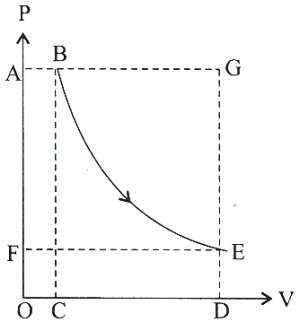
A
Area of $A-B-E-F$
B
Area of $A-B-E-D-O$
C
Area of $B-C-D-E$
D
Area of $B-G-E$
Solution
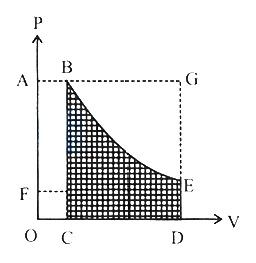
(C) In a $P-V$ diagram,the work done during a thermodynamic process is given by the area under the curve projected onto the volume axis ($V$-axis).
For the process $B \rightarrow E$,the work done is the area enclosed by the curve $BE$,the vertical lines $BC$ and $ED$,and the volume axis $CD$.
This corresponds to the area of the region $BCDE$ under the curve $BE$.
For the process $B \rightarrow E$,the work done is the area enclosed by the curve $BE$,the vertical lines $BC$ and $ED$,and the volume axis $CD$.
This corresponds to the area of the region $BCDE$ under the curve $BE$.
0 likes
View Solution373
EasyMCQ
Identify the correct equation relating $\Delta H$,$\Delta U$,and $\Delta T$ for $1 \text{ mole}$ of an ideal gas from the following $(R = \text{gas constant})$:
A
$(\Delta H)^2 = \Delta U + R \Delta T$
B
$\Delta H = (\Delta U)^2 + R \Delta T$
C
$\Delta U = \Delta H - R \Delta T$
D
$\Delta U = \Delta H + R \Delta T$
Solution
(C) The general relation between enthalpy change $(\Delta H)$ and internal energy change $(\Delta U)$ is given by:
$\Delta H = \Delta U + \Delta n_g RT$
For $1 \text{ mole}$ of an ideal gas undergoing a process where $\Delta n_g = 1$,the equation becomes:
$\Delta H = \Delta U + RT$
Rearranging this to solve for $\Delta U$:
$\Delta U = \Delta H - RT$
Since $\Delta T$ is the change in temperature,for a process where the change in moles is $1$,the term is $R \Delta T$. Thus,$\Delta U = \Delta H - R \Delta T$.
$\Delta H = \Delta U + \Delta n_g RT$
For $1 \text{ mole}$ of an ideal gas undergoing a process where $\Delta n_g = 1$,the equation becomes:
$\Delta H = \Delta U + RT$
Rearranging this to solve for $\Delta U$:
$\Delta U = \Delta H - RT$
Since $\Delta T$ is the change in temperature,for a process where the change in moles is $1$,the term is $R \Delta T$. Thus,$\Delta U = \Delta H - R \Delta T$.
0 likes
View Solution374
MediumMCQ
If the work done by $2 \ mol$ of an ideal gas during isothermal reversible expansion from $5 \ L$ to $50 \ L$ is $-189.1 \ L \ atm$,the temperature of the gas (in $^{\circ}C$) is
A
$500$
B
$227$
C
$327$
D
$127$
Solution
(B) The formula for work done in isothermal reversible expansion is $W_{rev} = -2.303 nRT \log \left(\frac{V_2}{V_1}\right)$.
Given: $n = 2 \ mol$,$V_1 = 5 \ L$,$V_2 = 50 \ L$,$W = -189.1 \ L \ atm$,and $R = 0.082 \ L \ atm \ K^{-1} \ mol^{-1}$.
Substituting the values: $-189.1 = -2.303 \times 2 \times 0.082 \times T \times \log \left(\frac{50}{5}\right)$.
$-189.1 = -2.303 \times 2 \times 0.082 \times T \times 1$.
$T = \frac{-189.1}{-2.303 \times 2 \times 0.082} \approx 500 \ K$.
Converting to Celsius: $T(^{\circ}C) = 500 - 273 = 227^{\circ}C$.
Given: $n = 2 \ mol$,$V_1 = 5 \ L$,$V_2 = 50 \ L$,$W = -189.1 \ L \ atm$,and $R = 0.082 \ L \ atm \ K^{-1} \ mol^{-1}$.
Substituting the values: $-189.1 = -2.303 \times 2 \times 0.082 \times T \times \log \left(\frac{50}{5}\right)$.
$-189.1 = -2.303 \times 2 \times 0.082 \times T \times 1$.
$T = \frac{-189.1}{-2.303 \times 2 \times 0.082} \approx 500 \ K$.
Converting to Celsius: $T(^{\circ}C) = 500 - 273 = 227^{\circ}C$.
0 likes
View Solution375
MediumMCQ
If $5 \ L$ of an ideal gas at a constant external pressure of $2 \ atm$ expands isothermally to a final volume of '$X$' $L$,the system does a work of $-2,026.4 \ J$. '$X$' (in $L$) is $(1 \ L \cdot atm = 101.32 \ J)$
A
$25$
B
$20$
C
$15$
D
$10$
Solution
(C) The work done by the system during expansion against a constant external pressure is given by the formula: $W = -P_{ext} \times (V_2 - V_1)$.
Given: $P_{ext} = 2 \ atm$,$V_1 = 5 \ L$,$V_2 = X \ L$,and $W = -2,026.4 \ J$.
First,convert the work from Joules to $L \cdot atm$ using the conversion factor $1 \ L \cdot atm = 101.32 \ J$:
$W = \frac{-2,026.4 \ J}{101.32 \ J \cdot L^{-1} \cdot atm^{-1}} = -20 \ L \cdot atm$.
Now,substitute the values into the work formula:
$-20 \ L \cdot atm = -2 \ atm \times (X - 5) \ L$.
Dividing both sides by $-2 \ atm$:
$10 = X - 5$.
Therefore,$X = 15 \ L$.
Given: $P_{ext} = 2 \ atm$,$V_1 = 5 \ L$,$V_2 = X \ L$,and $W = -2,026.4 \ J$.
First,convert the work from Joules to $L \cdot atm$ using the conversion factor $1 \ L \cdot atm = 101.32 \ J$:
$W = \frac{-2,026.4 \ J}{101.32 \ J \cdot L^{-1} \cdot atm^{-1}} = -20 \ L \cdot atm$.
Now,substitute the values into the work formula:
$-20 \ L \cdot atm = -2 \ atm \times (X - 5) \ L$.
Dividing both sides by $-2 \ atm$:
$10 = X - 5$.
Therefore,$X = 15 \ L$.
0 likes
View Solution376
EasyMCQ
Identify the correct statements from the following.
$(I)$ For adiabatic process,$\Delta U = W_{\text{adiabatic}}$
$(II)$ Work is a path function.
$(III)$ Volume is an extensive property.
$(I)$ For adiabatic process,$\Delta U = W_{\text{adiabatic}}$
$(II)$ Work is a path function.
$(III)$ Volume is an extensive property.
A
$I, II, III$
B
$I, III$ only
C
$II, III$ only
D
$I, II$ only
Solution
(A) According to the first law of thermodynamics,$\Delta U = q + W$.
For an adiabatic process,there is no heat exchange,so $q = 0$. Thus,$\Delta U = W_{\text{adiabatic}}$. Statement $I$ is correct.
Work is a path function because the amount of work done depends on the specific path taken between two states,not just the initial and final states. Statement $II$ is correct.
An extensive property is a property whose value depends on the quantity or size of matter present in the system. Volume is directly proportional to the amount of substance,making it an extensive property. Statement $III$ is correct.
Therefore,all statements $I, II,$ and $III$ are correct.
For an adiabatic process,there is no heat exchange,so $q = 0$. Thus,$\Delta U = W_{\text{adiabatic}}$. Statement $I$ is correct.
Work is a path function because the amount of work done depends on the specific path taken between two states,not just the initial and final states. Statement $II$ is correct.
An extensive property is a property whose value depends on the quantity or size of matter present in the system. Volume is directly proportional to the amount of substance,making it an extensive property. Statement $III$ is correct.
Therefore,all statements $I, II,$ and $III$ are correct.
0 likes
View Solution377
EasyMCQ
When the temperature of $2$ moles of an ideal gas is increased by $20^{\circ} C$ at constant pressure,find the work involved in the process. (in $R$)
A
$5$
B
$40$
C
$15$
D
$20$
Solution
(B) For an ideal gas,the equation of state is $PV = nRT$.
Since the pressure $P$ is constant,the change in volume $\Delta V$ due to a change in temperature $\Delta T$ is given by $P \Delta V = nR \Delta T$.
The work done $W$ in a process at constant pressure is defined as $W = P \Delta V$.
Substituting the expression for $P \Delta V$,we get $W = nR \Delta T$.
Given $n = 2$ moles and $\Delta T = 20 \ K$ (or $20^{\circ} C$),the work done is $W = 2 \times R \times 20 = 40R$.
Since the pressure $P$ is constant,the change in volume $\Delta V$ due to a change in temperature $\Delta T$ is given by $P \Delta V = nR \Delta T$.
The work done $W$ in a process at constant pressure is defined as $W = P \Delta V$.
Substituting the expression for $P \Delta V$,we get $W = nR \Delta T$.
Given $n = 2$ moles and $\Delta T = 20 \ K$ (or $20^{\circ} C$),the work done is $W = 2 \times R \times 20 = 40R$.
0 likes
View Solution378
EasyMCQ
When an ideal gas expands isothermally from $5 \ m^3$ to $10 \ m^3$ at $25 \ ^{\circ}C$ against a constant pressure of $10^7 \ N \cdot m^{-2}$,then the work done on the gas is (in $MJ$)
A
$-100$
B
$-50$
C
$-0.5$
D
$-105$
Solution
(B) The pressure $P = 10^7 \ N \cdot m^{-2}$.
Initial volume $V_i = 5 \ m^3$.
Final volume $V_f = 10 \ m^3$.
Change in volume $\Delta V = V_f - V_i = 10 \ m^3 - 5 \ m^3 = 5 \ m^3$.
The work done on the gas during expansion against constant external pressure is given by $W = -P_{ext} \Delta V$.
Substituting the values: $W = -(10^7 \ N \cdot m^{-2}) \times (5 \ m^3) = -50 \times 10^6 \ J$.
Since $1 \ MJ = 10^6 \ J$,we get $W = -50 \ MJ$.
Initial volume $V_i = 5 \ m^3$.
Final volume $V_f = 10 \ m^3$.
Change in volume $\Delta V = V_f - V_i = 10 \ m^3 - 5 \ m^3 = 5 \ m^3$.
The work done on the gas during expansion against constant external pressure is given by $W = -P_{ext} \Delta V$.
Substituting the values: $W = -(10^7 \ N \cdot m^{-2}) \times (5 \ m^3) = -50 \times 10^6 \ J$.
Since $1 \ MJ = 10^6 \ J$,we get $W = -50 \ MJ$.
0 likes
View Solution379
MediumMCQ
For an adiabatic change,which of the following is true?
A
For an adiabatic change,heat $(q)$ is non-zero.
B
For an adiabatic change,heat $(q)$ is zero.
C
For an isothermal reversible change,heat $(q)$ is zero.
D
For an isothermal process,the temperature changes.
Solution
(B) An adiabatic process is defined as a thermodynamic process in which there is no exchange of heat between the system and its surroundings.
Therefore,for an adiabatic change,the heat exchange $(q)$ is equal to zero $(q = 0)$.
Therefore,for an adiabatic change,the heat exchange $(q)$ is equal to zero $(q = 0)$.
0 likes
View Solution380
EasyMCQ
Work done by an ideal gas at a constant volume is
A
$-\frac{\Delta p}{p}$
B
$-V \Delta p$
C
$0$
D
$\frac{n R}{p}$
Solution
(C) The work done by a gas is given by the formula $W = p \Delta V$.
An isochoric process is defined as a process in which the volume remains constant,which implies $\Delta V = 0$.
Substituting this into the work formula,we get $W = p \times 0 = 0$.
Therefore,the work done by an ideal gas at a constant volume is $0$.
Hence,the correct option is $(C)$.
An isochoric process is defined as a process in which the volume remains constant,which implies $\Delta V = 0$.
Substituting this into the work formula,we get $W = p \times 0 = 0$.
Therefore,the work done by an ideal gas at a constant volume is $0$.
Hence,the correct option is $(C)$.
0 likes
View Solution381
MediumMCQ
If the work done during the isothermal reversible expansion of an ideal gas at a pressure of $10 \ atm$ from $4 \ L$ to a final volume is $-184.24 \ L \ atm$,the final volume of the gas in $L$ is
A
$40$
B
$400$
C
$8$
D
$80$
Solution
(B) For an isothermal reversible expansion of an ideal gas,the work done $(w)$ is given by the formula: $w = -2.303 \ nRT \ \log(\frac{V_f}{V_i})$.
Since $PV = nRT$,we can substitute $nRT$ with $P_i V_i$ (initial state):
$w = -2.303 \ P_i V_i \ \log(\frac{V_f}{V_i})$.
Given: $w = -184.24 \ L \ atm$,$P_i = 10 \ atm$,$V_i = 4 \ L$.
Substituting the values:
$-184.24 = -2.303 \times (10 \times 4) \times \log(\frac{V_f}{4})$.
$-184.24 = -2.303 \times 40 \times \log(\frac{V_f}{4})$.
$-184.24 = -92.12 \times \log(\frac{V_f}{4})$.
$\log(\frac{V_f}{4}) = \frac{-184.24}{-92.12} = 2$.
$\frac{V_f}{4} = 10^2 = 100$.
$V_f = 100 \times 4 = 400 \ L$.
Since $PV = nRT$,we can substitute $nRT$ with $P_i V_i$ (initial state):
$w = -2.303 \ P_i V_i \ \log(\frac{V_f}{V_i})$.
Given: $w = -184.24 \ L \ atm$,$P_i = 10 \ atm$,$V_i = 4 \ L$.
Substituting the values:
$-184.24 = -2.303 \times (10 \times 4) \times \log(\frac{V_f}{4})$.
$-184.24 = -2.303 \times 40 \times \log(\frac{V_f}{4})$.
$-184.24 = -92.12 \times \log(\frac{V_f}{4})$.
$\log(\frac{V_f}{4}) = \frac{-184.24}{-92.12} = 2$.
$\frac{V_f}{4} = 10^2 = 100$.
$V_f = 100 \times 4 = 400 \ L$.
0 likes
View Solution382
MediumMCQ
What is the enthalpy change (in $J$) for converting $9 \ g$ of $H_2O(l)$ at $+10^{\circ}C$ to $H_2O(l)$ at $+20^{\circ}C$? $(C_p(H_2O(l)) = 75 \ J \ mol^{-1} \ K^{-1})$
A
$750$
B
$75$
C
$37.5$
D
$375$
Solution
(D) The formula for enthalpy change during heating is $\Delta H = n C_p \Delta T$.
Given:
$C_p = 75 \ J \ mol^{-1} \ K^{-1}$
$T_1 = 10^{\circ}C = 283 \ K$
$T_2 = 20^{\circ}C = 293 \ K$
$\Delta T = 293 - 283 = 10 \ K$
Number of moles $(n)$ = $\frac{\text{mass}}{\text{molar mass}} = \frac{9 \ g}{18 \ g \ mol^{-1}} = 0.5 \ mol$.
Substituting the values:
$\Delta H = 0.5 \ mol \times 75 \ J \ mol^{-1} \ K^{-1} \times 10 \ K$
$\Delta H = 375 \ J$.
Given:
$C_p = 75 \ J \ mol^{-1} \ K^{-1}$
$T_1 = 10^{\circ}C = 283 \ K$
$T_2 = 20^{\circ}C = 293 \ K$
$\Delta T = 293 - 283 = 10 \ K$
Number of moles $(n)$ = $\frac{\text{mass}}{\text{molar mass}} = \frac{9 \ g}{18 \ g \ mol^{-1}} = 0.5 \ mol$.
Substituting the values:
$\Delta H = 0.5 \ mol \times 75 \ J \ mol^{-1} \ K^{-1} \times 10 \ K$
$\Delta H = 375 \ J$.
0 likes
View Solution383
EasyMCQ
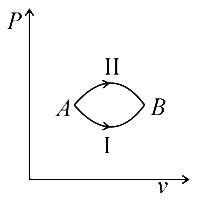
$A$ system goes from $A$ to $B$ via two processes $I$ and $II$ as shown in the figure. If $\Delta U_1$ and $\Delta U_2$ are the changes in internal energies in the processes $I$ and $II$ respectively,then:
A
$\Delta U_1 = \Delta U_2$
B
$\Delta U_1 > \Delta U_2$
C
$\Delta U_1 < \Delta U_2$
D
$\Delta U_1 \neq \Delta U_2$
Solution
(A) Internal energy $(U)$ is a state function.
State functions depend only on the initial and final states of the system and are independent of the path taken to reach the final state.
In both processes $I$ and $II$,the system starts at state $A$ and ends at state $B$.
Therefore,the change in internal energy for both processes is the same: $\Delta U_1 = U_B - U_A$ and $\Delta U_2 = U_B - U_A$.
Hence,$\Delta U_1 = \Delta U_2$.
State functions depend only on the initial and final states of the system and are independent of the path taken to reach the final state.
In both processes $I$ and $II$,the system starts at state $A$ and ends at state $B$.
Therefore,the change in internal energy for both processes is the same: $\Delta U_1 = U_B - U_A$ and $\Delta U_2 = U_B - U_A$.
Hence,$\Delta U_1 = \Delta U_2$.
0 likes
View Solution384
EasyMCQ
Observe the following properties:
$I$. Molar volume
$II$. Mass
$III$. Internal energy
$IV$. Volume
$V$. Enthalpy
$VI$. Temperature
$VII$. Density
The intensive properties in the above list are:
$I$. Molar volume
$II$. Mass
$III$. Internal energy
$IV$. Volume
$V$. Enthalpy
$VI$. Temperature
$VII$. Density
The intensive properties in the above list are:
A
$I, VI, VII$ only
B
$I, IV, VI, VII$ only
C
$I, III, IV, V$ only
D
$II, III, V$ only
Solution
(A) Intensive properties are those properties of a system that do not depend on the quantity or size of matter present in the system.
Analyzing the given list:
$I$. Molar volume: Intensive (volume per mole).
$II$. Mass: Extensive.
$III$. Internal energy: Extensive.
$IV$. Volume: Extensive.
$V$. Enthalpy: Extensive.
$VI$. Temperature: Intensive.
$VII$. Density: Intensive (mass per unit volume).
Therefore,the intensive properties are $I, VI,$ and $VII$.
Analyzing the given list:
$I$. Molar volume: Intensive (volume per mole).
$II$. Mass: Extensive.
$III$. Internal energy: Extensive.
$IV$. Volume: Extensive.
$V$. Enthalpy: Extensive.
$VI$. Temperature: Intensive.
$VII$. Density: Intensive (mass per unit volume).
Therefore,the intensive properties are $I, VI,$ and $VII$.
0 likes
View Solution385
EasyMCQ
Which of the following is not an intensive property?
A
Entropy
B
Melting point
C
Specific gravity
D
Refractive index
Solution
(A) An intensive property is a physical quantity whose value does not depend on the amount of the substance for which it is measured.
For example,the melting point of water is $0^{\circ} C$,whether you take $100 \ mL$ of water or $1 \ kg$ of water.
Other examples of intensive properties are specific gravity and refractive index.
Entropy is an extensive property,not an intensive property,because its value depends on the amount of substance present.
As the amount of substance increases,the entropy also increases.
For example,the melting point of water is $0^{\circ} C$,whether you take $100 \ mL$ of water or $1 \ kg$ of water.
Other examples of intensive properties are specific gravity and refractive index.
Entropy is an extensive property,not an intensive property,because its value depends on the amount of substance present.
As the amount of substance increases,the entropy also increases.
0 likes
View Solution386
EasyMCQ
Which of the following is not an extensive property?
A
Volume
B
Entropy
C
Heat capacity at constant volume
D
Molar heat capacity at constant pressure
Solution
(D) An extensive property is a property of matter that depends on the amount of matter present in the system. Examples include volume,entropy,and heat capacity at constant volume.
Conversely,an intensive property is independent of the amount of matter present. Molar heat capacity at constant pressure is defined for $1 \ mol$ of a substance,making it an intensive property.
Therefore,the correct answer is $(D)$.
Conversely,an intensive property is independent of the amount of matter present. Molar heat capacity at constant pressure is defined for $1 \ mol$ of a substance,making it an intensive property.
Therefore,the correct answer is $(D)$.
0 likes
View Solution387
EasyMCQ
Which one of the following is not a state function?
A
Internal energy
B
Work
C
Entropy
D
Free energy
Solution
(B) state function is a property of a system that depends only on its initial and final states,not on the path taken to reach that state.
Internal energy $(U)$,entropy $(S)$,and free energy $(G)$ are examples of state functions.
Work $(w)$ depends on the path followed by the system during a process,therefore it is a path function.
Internal energy $(U)$,entropy $(S)$,and free energy $(G)$ are examples of state functions.
Work $(w)$ depends on the path followed by the system during a process,therefore it is a path function.
0 likes
View Solution388
MediumMCQ
One mole of an ideal gas at $300 \ K$ and $20 \ atm$ expands to $2 \ atm$ under isothermal and reversible conditions. The work done by the gas is $-x \ kJ \ mol^{-1}$. The value of $x$ is $(R = 8.3 \ J \ K^{-1} \ mol^{-1})$
A
$5.73$
B
$7.37$
C
$3.75$
D
$4.57$
Solution
(A) For an isothermal reversible expansion of an ideal gas,the work done $(w)$ is given by the formula: $w = -nRT \ln(\frac{P_1}{P_2})$.
Given: $n = 1 \ mol$,$T = 300 \ K$,$P_1 = 20 \ atm$,$P_2 = 2 \ atm$,and $R = 8.3 \ J \ K^{-1} \ mol^{-1}$.
Substituting the values: $w = -1 \times 8.3 \times 300 \times \ln(\frac{20}{2})$.
$w = -2490 \times \ln(10)$.
Using $\ln(10) \approx 2.303$: $w = -2490 \times 2.303 = -5734.47 \ J \ mol^{-1}$.
Converting to $kJ \ mol^{-1}$: $w = -5.734 \ kJ \ mol^{-1}$.
Since the work done is $-x \ kJ \ mol^{-1}$,we have $-x = -5.734$,so $x = 5.73$.
Given: $n = 1 \ mol$,$T = 300 \ K$,$P_1 = 20 \ atm$,$P_2 = 2 \ atm$,and $R = 8.3 \ J \ K^{-1} \ mol^{-1}$.
Substituting the values: $w = -1 \times 8.3 \times 300 \times \ln(\frac{20}{2})$.
$w = -2490 \times \ln(10)$.
Using $\ln(10) \approx 2.303$: $w = -2490 \times 2.303 = -5734.47 \ J \ mol^{-1}$.
Converting to $kJ \ mol^{-1}$: $w = -5.734 \ kJ \ mol^{-1}$.
Since the work done is $-x \ kJ \ mol^{-1}$,we have $-x = -5.734$,so $x = 5.73$.
0 likes
View Solution389
MediumMCQ
At $61 \ K$,one mole of an ideal gas of $1.0 \ L$ volume expands isothermally and reversibly to a final volume of $10.0 \ L$. What is the work done in the expansion (in $L \ atm$)?
A
$-11.52$
B
$-23.04$
C
$-46.08$
D
$-5.76$
Solution
(A) Given: $n = 1 \ mol$,$T = 61 \ K$,$V_1 = 1.0 \ L$,$V_2 = 10.0 \ L$,$R = 0.0821 \ L \ atm \ K^{-1} \ mol^{-1}$.
For an isothermal reversible expansion,the work done is given by the formula:
$W = -nRT \ln(V_2 / V_1)$
Substituting the values into the equation:
$W = -(1) \times (0.0821) \times (61) \times \ln(10 / 1)$
$W = -5.0081 \times 2.303$
$W \approx -11.53 \ L \ atm$.
Rounding to the nearest provided option,the work done is $-11.52 \ L \ atm$.
For an isothermal reversible expansion,the work done is given by the formula:
$W = -nRT \ln(V_2 / V_1)$
Substituting the values into the equation:
$W = -(1) \times (0.0821) \times (61) \times \ln(10 / 1)$
$W = -5.0081 \times 2.303$
$W \approx -11.53 \ L \ atm$.
Rounding to the nearest provided option,the work done is $-11.52 \ L \ atm$.
0 likes
View Solution390
MediumMCQ
At $T(K)$,$2 \ mol$ of an ideal gas is allowed to expand reversibly and isothermally from a pressure of $10 \ atm$ to $1 \ atm$. The work done (in $kJ$) is $(R=8.3 \ J \ K^{-1} \ mol^{-1})$.
A
$-3.82 \times 10^{-1} \times T$
B
$-4.82 \times 10^{-1} \times T$
C
$-2.82 \times 10^{-2} \times T$
D
$-3.82 \times 10^{-2} \times T$
Solution
(D) For a reversible isothermal expansion,the work done is given by the formula: $W = -nRT \ln \frac{P_1}{P_2} = -2.303 nRT \log \frac{P_1}{P_2}$.
Given: $n = 2 \ mol$,$P_1 = 10 \ atm$,$P_2 = 1 \ atm$,$R = 8.3 \ J \ K^{-1} \ mol^{-1}$.
Substituting the values: $W = -2.303 \times 2 \times 8.3 \times T \times \log \frac{10}{1}$.
Since $\log 10 = 1$,we get $W = -2.303 \times 2 \times 8.3 \times T \times 1 = -38.2298 \times T \ J$.
To convert to $kJ$,divide by $1000$: $W = -38.2298 \times 10^{-3} \times T \ kJ \approx -3.82 \times 10^{-2} \times T \ kJ$.
Given: $n = 2 \ mol$,$P_1 = 10 \ atm$,$P_2 = 1 \ atm$,$R = 8.3 \ J \ K^{-1} \ mol^{-1}$.
Substituting the values: $W = -2.303 \times 2 \times 8.3 \times T \times \log \frac{10}{1}$.
Since $\log 10 = 1$,we get $W = -2.303 \times 2 \times 8.3 \times T \times 1 = -38.2298 \times T \ J$.
To convert to $kJ$,divide by $1000$: $W = -38.2298 \times 10^{-3} \times T \ kJ \approx -3.82 \times 10^{-2} \times T \ kJ$.
0 likes
View Solution391
MediumMCQ
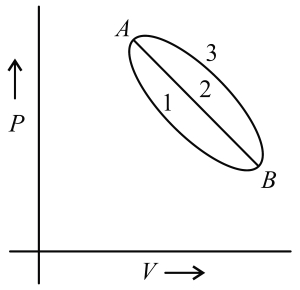
$A$ certain mass of a gas was brought from state $A$ to $B$ by following three different paths,namely $1$,$2$ and $3$,respectively. Which of the following relations is correct for the work done?
A
$W_1 = W_2 = W_3$
B
$W_1 < W_2 < W_3$
C
$W_1 > W_2 > W_3$
D
$W_1 = W_3 < W_2$
Solution
(B) Work done is equal to the area under the curve in a $P-V$ diagram.
In the given graph,the area under the path represents the work done by the gas.
Comparing the areas under the three paths,the area under path $3$ is the largest,followed by path $2$,and the area under path $1$ is the smallest.
Therefore,the work done follows the relation $W_1 < W_2 < W_3$.
In the given graph,the area under the path represents the work done by the gas.
Comparing the areas under the three paths,the area under path $3$ is the largest,followed by path $2$,and the area under path $1$ is the smallest.
Therefore,the work done follows the relation $W_1 < W_2 < W_3$.
0 likes
View Solution392
MediumMCQ
For which of the following systems,the difference between $\Delta H$ and $\Delta U$ is not significant?
$(i)$ Solids
$(ii)$ Gases
$(iii)$ Mixture of gases and liquids
$(iv)$ Liquids
$(i)$ Solids
$(ii)$ Gases
$(iii)$ Mixture of gases and liquids
$(iv)$ Liquids
A
$(i)$ and $(iv)$
B
$(i)$,$(iii)$ and $(iv)$
C
$(ii)$ and $(iv)$
D
$(ii)$ and $(iii)$
Solution
(A) The relationship between enthalpy change $(\Delta H)$ and internal energy change $(\Delta U)$ is given by the equation: $\Delta H = \Delta U + P\Delta V$.
For solids and liquids,the change in volume $(\Delta V)$ is extremely small,making the term $P\Delta V$ negligible.
Therefore,for solids and liquids,$\Delta H \approx \Delta U$.
In contrast,for gases,$\Delta V$ is significant,and $P\Delta V = \Delta n_g RT$,which is not negligible.
Thus,the difference is not significant for $(i)$ Solids and $(iv)$ Liquids.
For solids and liquids,the change in volume $(\Delta V)$ is extremely small,making the term $P\Delta V$ negligible.
Therefore,for solids and liquids,$\Delta H \approx \Delta U$.
In contrast,for gases,$\Delta V$ is significant,and $P\Delta V = \Delta n_g RT$,which is not negligible.
Thus,the difference is not significant for $(i)$ Solids and $(iv)$ Liquids.
0 likes
View Solution393
MediumMCQ
Enthalpy change for freezing of $1 \ g$ of water at $1 \ bar$ and $0^{\circ} C$ is $334 \ J$. Calculate the internal energy change in $J$ when $1 \ g$ of water is converted into ice?
A
$205$
B
$334$
C
$0$
D
$668$
Solution
(B) The relationship between enthalpy change $(\Delta H)$ and internal energy change $(\Delta U)$ is given by the equation: $\Delta H = \Delta U + P\Delta V$.
At $0^{\circ} C$ and $1 \ bar$,the change in volume $(\Delta V)$ for the freezing of $1 \ g$ of water is extremely small and negligible.
Therefore,$\Delta H \approx \Delta U$.
Given that the enthalpy change for freezing $1 \ g$ of water is $334 \ J$,the internal energy change is also approximately $334 \ J$.
At $0^{\circ} C$ and $1 \ bar$,the change in volume $(\Delta V)$ for the freezing of $1 \ g$ of water is extremely small and negligible.
Therefore,$\Delta H \approx \Delta U$.
Given that the enthalpy change for freezing $1 \ g$ of water is $334 \ J$,the internal energy change is also approximately $334 \ J$.
0 likes
View Solution394
MediumMCQ
Which of the following statements is not correct?
A
Dissolution of $NH_4Cl$ in excess of water is an endothermic process
B
Neutralisation process is always exothermic
C
The absolute value of enthalpy $(H)$ can be determined experimentally
D
The heat of reaction at constant volume is denoted by $\Delta E$
Solution
(C) The absolute value of enthalpy $(H)$ cannot be determined experimentally. Only the change in enthalpy $(\Delta H)$ during a process can be measured. Therefore,statement $C$ is incorrect.
0 likes
View Solution395
MediumMCQ
$X$ is an extensive property and $x$ is an intensive property of a thermodynamic system. Which of the following statement$(s)$ is (are) correct?
A
$xX$ is extensive
B
$\frac{x}{X}$ is intensive
C
$\frac{X}{x}$ is extensive
D
$\frac{dX}{dx}$ is intensive
Solution
(A, B, C) An extensive property depends on the amount of matter,while an intensive property is independent of the amount of matter.
$1$. The product of an intensive property $(x)$ and an extensive property $(X)$ is extensive ($xX$ is extensive).
$2$. The ratio of an intensive property $(x)$ to an extensive property $(X)$ is intensive ($\frac{x}{X}$ is intensive).
$3$. The ratio of an extensive property $(X)$ to an intensive property $(x)$ is extensive ($\frac{X}{x}$ is extensive).
$4$. The ratio of the change in an extensive property $(dX)$ to the change in an intensive property $(dx)$ is extensive ($\frac{dX}{dx}$ is extensive).
Therefore,statements $A$,$B$,and $C$ are correct.
$1$. The product of an intensive property $(x)$ and an extensive property $(X)$ is extensive ($xX$ is extensive).
$2$. The ratio of an intensive property $(x)$ to an extensive property $(X)$ is intensive ($\frac{x}{X}$ is intensive).
$3$. The ratio of an extensive property $(X)$ to an intensive property $(x)$ is extensive ($\frac{X}{x}$ is extensive).
$4$. The ratio of the change in an extensive property $(dX)$ to the change in an intensive property $(dx)$ is extensive ($\frac{dX}{dx}$ is extensive).
Therefore,statements $A$,$B$,and $C$ are correct.
0 likes
View Solution396
EasyMCQ
Among the following,which are extensive variables?
A
$H$ (Enthalpy)
B
$p$ (Pressure)
C
$E$ (Internal energy)
D
$V$ (Volume)
Solution
(A, C, D) Extensive properties are those whose values depend on the quantity or size of matter present in the system.
$H$ (Enthalpy),$E$ (Internal energy),and $V$ (Volume) are all extensive properties because they scale with the amount of substance.
$p$ (Pressure) is an intensive property as it is independent of the amount of matter.
Therefore,$H$,$E$,and $V$ are extensive variables.
$H$ (Enthalpy),$E$ (Internal energy),and $V$ (Volume) are all extensive properties because they scale with the amount of substance.
$p$ (Pressure) is an intensive property as it is independent of the amount of matter.
Therefore,$H$,$E$,and $V$ are extensive variables.
0 likes
View Solution397
EasyMCQ
Adiabatic free expansion of an ideal gas must be
A
Isobaric
B
Isochoric
C
Isothermal
D
Isoentropic
Solution
(C) According to the first law of thermodynamics,$Q = \Delta U + W$.
In an adiabatic process,$Q = 0$.
In free expansion,the external pressure $P_{ext} = 0$,so the work done $W = P_{ext} \Delta V = 0$.
Substituting these values into the first law: $0 = \Delta U + 0$,which implies $\Delta U = 0$.
For an ideal gas,internal energy $U$ is a function of temperature only $(U = f(T))$.
Since $\Delta U = 0$,the change in temperature $\Delta T = 0$,meaning the temperature remains constant.
Therefore,the process is isothermal.
In an adiabatic process,$Q = 0$.
In free expansion,the external pressure $P_{ext} = 0$,so the work done $W = P_{ext} \Delta V = 0$.
Substituting these values into the first law: $0 = \Delta U + 0$,which implies $\Delta U = 0$.
For an ideal gas,internal energy $U$ is a function of temperature only $(U = f(T))$.
Since $\Delta U = 0$,the change in temperature $\Delta T = 0$,meaning the temperature remains constant.
Therefore,the process is isothermal.
0 likes
View Solution398
DifficultMCQ
Which of the following thermodynamic relations is correct?
A
$dG = VdP - SdT$
B
$dE = TdS - PdV$
C
$dH = TdS + VdP$
D
$dG = VdP + SdT$
Solution
(A) The Gibbs free energy is defined as $G = H - TS$.
Taking the differential,we get $dG = dH - TdS - SdT$.
Since $H = U + PV$,the differential is $dH = dU + PdV + VdP$.
From the first law of thermodynamics,$dU = TdS - PdV$.
Substituting $dU$ into the expression for $dH$,we get $dH = (TdS - PdV) + PdV + VdP = TdS + VdP$.
Now,substituting $dH$ back into the expression for $dG$:
$dG = (TdS + VdP) - TdS - SdT$.
Simplifying this,we obtain $dG = VdP - SdT$.
Taking the differential,we get $dG = dH - TdS - SdT$.
Since $H = U + PV$,the differential is $dH = dU + PdV + VdP$.
From the first law of thermodynamics,$dU = TdS - PdV$.
Substituting $dU$ into the expression for $dH$,we get $dH = (TdS - PdV) + PdV + VdP = TdS + VdP$.
Now,substituting $dH$ back into the expression for $dG$:
$dG = (TdS + VdP) - TdS - SdT$.
Simplifying this,we obtain $dG = VdP - SdT$.
0 likes
View SolutionThermodynamics — Basic concepts · Frequently Asked Questions
1Are these Thermodynamics questions useful for JEE and NEET?
Yes. All questions in this section are mapped to JEE Main and NEET exam patterns. Previous year questions from JEE Main, NEET, GUJCET and state-level exams are included with full solutions.
2Can I switch to Hindi or Gujarati for these questions?
Yes. Use the language tabs in the hero section or the sidebar to view the same questions and solutions in English, Hindi or Gujarati.
3How do I generate a question paper from this subtopic?
Use the Vedclass Exam Paper Generator — select the chapter and subtopic, set difficulty, and generate Sets A, B, C, D automatically. First 3 chapters of every subject are free.
Vedclass Products
For Students
Vedclass Test Series
Mock tests in real JEE/NEET style with performance analysis. 5-day free trial.
Start Free TrialFor Teachers
Exam Paper Generator
Generate Set A/B/C/D papers from this chapter in 2 minutes. 3 chapters free.
Try FreeFor Institutes
Online Exam Module
Live online exams with unlimited students, 360° analytics & white-label branding.
See DemoFor Teachers & Institutes
Generate a Thermodynamics Exam Paper in 2 Minutes
Select subtopic & difficulty — Sets A, B, C, D auto-generated with No Repeat logic.
First 3 chapters of every subject are free — no payment required.