
A English
Discovery and Properties of anode, cathode rays neutron and Nuclear structure Questions in English
Class 11 Chemistry · Structure of Atom · Discovery and Properties of anode, cathode rays neutron and Nuclear structure
137+
Questions
English
Language
100%
With Solutions
Showing 50 of 137 questions in English
51
MediumMCQ
Alpha particles are $...$ times heavier (approximately) than neutrons.
A
$2$
B
$4$
C
$3$
D
$2\frac{1}{2}$
Solution
(B) An $\alpha$-particle is a helium nucleus,which consists of $2$ protons and $2$ neutrons,giving it a mass number of $4$.
Since the mass of a neutron is approximately $1 \ amu$ and the mass of an $\alpha$-particle is approximately $4 \ amu$,the $\alpha$-particle is $4$ times heavier than a neutron.
Therefore,the correct option is $(B)$.
Since the mass of a neutron is approximately $1 \ amu$ and the mass of an $\alpha$-particle is approximately $4 \ amu$,the $\alpha$-particle is $4$ times heavier than a neutron.
Therefore,the correct option is $(B)$.
0 likes
View Solution52
MediumMCQ
$\alpha$-particles can be detected using
A
Thin aluminum sheet
B
Barium sulphate
C
Zinc sulphide screen
D
Gold foil
Solution
(C) Rutherford first used a zinc sulphide $(ZnS)$ screen as a phosphor for the detection of $\alpha$-particles because it produces a flash of light (scintillation) when struck by an $\alpha$-particle.
0 likes
View Solution53
MediumMCQ
The $\alpha$-particle is identical with
A
Helium nucleus
B
Hydrogen nucleus
C
Electron
D
Proton
Solution
(A) The $\alpha$-particle is a high-energy particle consisting of $2$ protons and $2$ neutrons,which is identical to the nucleus of a helium atom,represented as $_2He^{4}$ or $He^{2+}$.
0 likes
View Solution54
MediumMCQ
Which particle leaves no track in a Wilson cloud chamber?
A
Electrons
B
Protons
C
$\alpha$-particles
D
Neutrons
Solution
(D) The Wilson cloud chamber detects charged particles by forming ion pairs along their path,which act as condensation nuclei for water vapor.
Since neutrons are electrically neutral,they do not cause ionization and therefore leave no visible track in the chamber.
Since neutrons are electrically neutral,they do not cause ionization and therefore leave no visible track in the chamber.
0 likes
View Solution55
MediumMCQ
Which of the following particles cannot be accelerated by an electric or magnetic field?
A
$\alpha$-particle
B
$\beta$-particle
C
Protons
D
Neutrons
Solution
(D) Charged particles like $\alpha$-particles,$\beta$-particles,and protons can be accelerated by electric and magnetic fields because they experience a force in these fields.
Neutrons are electrically neutral particles $(q = 0)$.
Since they carry no charge,they do not experience any force in an electric or magnetic field and therefore cannot be accelerated by these means.
Neutrons are electrically neutral particles $(q = 0)$.
Since they carry no charge,they do not experience any force in an electric or magnetic field and therefore cannot be accelerated by these means.
0 likes
View Solution56
DifficultMCQ
The mass of the proton is $1840$ times that of the electron. If the potential difference applied is $V$,the kinetic energy of the proton is ............ $KeV$.
A
$1840$
B
$1$
C
$\frac{1}{1840}$
D
$920$
Solution
(B) The kinetic energy $(K.E.)$ of a charged particle accelerated through a potential difference $V$ is given by $K.E. = qV$.
For a proton,the charge is $+e$.
If the potential difference is $V = 1 \, V$,the kinetic energy is $1 \, eV$.
Since $1 \, KeV = 1000 \, eV$,and the question implies a standard unit comparison where the energy gained by a proton of charge $e$ through $1 \, V$ is $1 \, eV$,the value is $1 \, KeV$ when $V$ is expressed in specific units relative to the proton's mass.
Thus,the correct option is $(B)$.
For a proton,the charge is $+e$.
If the potential difference is $V = 1 \, V$,the kinetic energy is $1 \, eV$.
Since $1 \, KeV = 1000 \, eV$,and the question implies a standard unit comparison where the energy gained by a proton of charge $e$ through $1 \, V$ is $1 \, eV$,the value is $1 \, KeV$ when $V$ is expressed in specific units relative to the proton's mass.
Thus,the correct option is $(B)$.
0 likes
View Solution57
EasyMCQ
Rutherford's alpha-particle scattering experiment first showed that the atom has a .......
A
Electron
B
Proton
C
Nucleus
D
Neutron
Solution
(C) Rutherford's alpha-particle scattering experiment involved bombarding a thin gold foil with high-energy $\alpha$-particles.
He observed that most of the particles passed through the foil undeflected,while a small fraction were deflected at large angles,and a very few bounced back.
This led to the conclusion that the positive charge and most of the mass of the atom are concentrated in a very small,dense region at the center,which he called the $Nucleus$.
He observed that most of the particles passed through the foil undeflected,while a small fraction were deflected at large angles,and a very few bounced back.
This led to the conclusion that the positive charge and most of the mass of the atom are concentrated in a very small,dense region at the center,which he called the $Nucleus$.
0 likes
View Solution58
MediumMCQ
The mass of an electron is ......... compared to the mass of the lightest nucleus.
A
$1/80$
B
$1/360$
C
$1/1840$
D
$1/1000$
Solution
(C) The mass of an electron is approximately $9.109 \times 10^{-31} \ kg$.
The lightest nucleus is the hydrogen nucleus (a proton),which has a mass of approximately $1.672 \times 10^{-27} \ kg$.
The ratio of the mass of an electron to the mass of a proton is $\frac{9.109 \times 10^{-31}}{1.672 \times 10^{-27}} \approx \frac{1}{1836}$.
Thus,the mass of an electron is approximately $\frac{1}{1840}$ of the mass of the lightest nucleus (proton).
The lightest nucleus is the hydrogen nucleus (a proton),which has a mass of approximately $1.672 \times 10^{-27} \ kg$.
The ratio of the mass of an electron to the mass of a proton is $\frac{9.109 \times 10^{-31}}{1.672 \times 10^{-27}} \approx \frac{1}{1836}$.
Thus,the mass of an electron is approximately $\frac{1}{1840}$ of the mass of the lightest nucleus (proton).
0 likes
View Solution59
MediumMCQ
Arrange the following particles in the increasing order of their $e/m$ ratio: electron $(e)$,proton $(p)$,neutron $(n)$,and $\alpha$-particle $(\alpha)$.
A
$n, p, e, \alpha$
B
$n, \alpha, p, e$
C
$n, p, \alpha, e$
D
$e, p, n, \alpha$
Solution
(B) The $e/m$ ratio (specific charge) for the given particles is as follows:
$1$. For neutron $(n)$: Charge is $0$,so $e/m = 0$.
$2$. For $\alpha$-particle $(\alpha)$: Charge is $+2e$ and mass is $4u$,so $e/m \approx 0.5 \times (e/m \text{ of proton})$.
$3$. For proton $(p)$: Charge is $+e$ and mass is $1u$,so $e/m = 9.58 \times 10^4 \, C/g$.
$4$. For electron $(e)$: Charge is $-e$ and mass is $1/1837 \, u$,so $e/m = 1.76 \times 10^8 \, C/g$.
Comparing these values: $0 < 0.5 \times (e/m \text{ of } p) < (e/m \text{ of } p) < (e/m \text{ of } e)$.
Thus,the increasing order is $n < \alpha < p < e$.
$1$. For neutron $(n)$: Charge is $0$,so $e/m = 0$.
$2$. For $\alpha$-particle $(\alpha)$: Charge is $+2e$ and mass is $4u$,so $e/m \approx 0.5 \times (e/m \text{ of proton})$.
$3$. For proton $(p)$: Charge is $+e$ and mass is $1u$,so $e/m = 9.58 \times 10^4 \, C/g$.
$4$. For electron $(e)$: Charge is $-e$ and mass is $1/1837 \, u$,so $e/m = 1.76 \times 10^8 \, C/g$.
Comparing these values: $0 < 0.5 \times (e/m \text{ of } p) < (e/m \text{ of } p) < (e/m \text{ of } e)$.
Thus,the increasing order is $n < \alpha < p < e$.
0 likes
View Solution60
MediumMCQ
$A$ positron has a mass equal to that of a/an ...... .
A
Electron
B
Neutron
C
Proton
D
Alpha particle
Solution
(A) positron is the antiparticle of an electron. It has the same mass as an electron $(9.109 \times 10^{-31} \ kg)$ but carries a positive charge of $+1$ unit. Therefore,the correct option is $A$.
0 likes
View Solution61
MediumMCQ
The space between the proton and the electron in a hydrogen atom is $......$.
A
filled with air
B
filled with ether
C
filled with electromagnetic radiation
D
empty
Solution
(D) In a hydrogen atom,the space between the nucleus (proton) and the electron is considered to be a vacuum or empty space.
According to the classical model of the atom,electrons revolve around the nucleus in empty space,and there is no medium present between them.
According to the classical model of the atom,electrons revolve around the nucleus in empty space,and there is no medium present between them.
0 likes
View Solution62
MediumMCQ
The volume of the atomic nucleus is $......$ of the volume of the atom.
A
$10^{-15}$ times the volume of the atom.
B
$10^{-5}$ times the volume of the atom.
C
$10^{-10}$ times the volume of the atom.
D
$10^{-20}$ times the volume of the atom.
Solution
(A) The radius of an atom is approximately $10^{-10} \ m$ and the radius of the nucleus is approximately $10^{-15} \ m$.
The volume of a sphere is given by $V = \frac{4}{3} \pi r^3$.
Thus,the ratio of the volume of the nucleus to the volume of the atom is:
$\frac{V_{\text{nucleus}}}{V_{\text{atom}}} = \frac{(10^{-15})^3}{(10^{-10})^3} = \frac{10^{-45}}{10^{-30}} = 10^{-15}$.
Therefore,the volume of the nucleus is $10^{-15}$ times the volume of the atom.
The volume of a sphere is given by $V = \frac{4}{3} \pi r^3$.
Thus,the ratio of the volume of the nucleus to the volume of the atom is:
$\frac{V_{\text{nucleus}}}{V_{\text{atom}}} = \frac{(10^{-15})^3}{(10^{-10})^3} = \frac{10^{-45}}{10^{-30}} = 10^{-15}$.
Therefore,the volume of the nucleus is $10^{-15}$ times the volume of the atom.
0 likes
View Solution63
MediumMCQ
Identify the correct increasing order of $e/m$ ratio for the following particles: $n, p, e, \alpha$.
A
$e, p, n, \alpha$
B
$n, p, e, \alpha$
C
$n, p, \alpha, e$
D
$n, \alpha, p, e$
Solution
(D) The $e/m$ ratio (specific charge) for the given particles is calculated as follows:
For neutron $(n)$: $\frac{e}{m} = \frac{0}{1} = 0$
For alpha particle $(\alpha)$: $\frac{e}{m} = \frac{2}{4} = 0.5$
For proton $(p)$: $\frac{e}{m} = \frac{1}{1} = 1$
For electron $(e)$: $\frac{e}{m} = \frac{1}{1/1837} = 1837$
Comparing these values,the increasing order is $n < \alpha < p < e$. Therefore,the correct option is $D$.
For neutron $(n)$: $\frac{e}{m} = \frac{0}{1} = 0$
For alpha particle $(\alpha)$: $\frac{e}{m} = \frac{2}{4} = 0.5$
For proton $(p)$: $\frac{e}{m} = \frac{1}{1} = 1$
For electron $(e)$: $\frac{e}{m} = \frac{1}{1/1837} = 1837$
Comparing these values,the increasing order is $n < \alpha < p < e$. Therefore,the correct option is $D$.
0 likes
View Solution64
MediumMCQ
Rutherford's $\alpha$-particle scattering experiment is related to the size of the ..........
A
Nucleus
B
Proton
C
Electron
D
Neutron
Solution
(A) Rutherford's $\alpha$-particle scattering experiment demonstrated that the mass and positive charge of an atom are concentrated in a very small volume at the center,which he termed the $Nucleus$. Therefore,the experiment is related to the size of the $Nucleus$.
0 likes
View Solution65
MediumMCQ
What is the ratio of the mass of a proton to the mass of an electron?
A
$1.836 \times 10^3$
B
$1.836$
C
$1.836 \times 10^2$
D
$1.836 \times 10^{-3}$
Solution
(A) The mass of a proton is approximately $1.673 \times 10^{-24} \ g$.
The mass of an electron is approximately $9.109 \times 10^{-28} \ g$.
The ratio of the mass of a proton to the mass of an electron is calculated as:
$\frac{\text{Mass of proton}}{\text{Mass of electron}} = \frac{1.673 \times 10^{-24} \ g}{9.109 \times 10^{-28} \ g} \approx 1.836 \times 10^3$.
The mass of an electron is approximately $9.109 \times 10^{-28} \ g$.
The ratio of the mass of a proton to the mass of an electron is calculated as:
$\frac{\text{Mass of proton}}{\text{Mass of electron}} = \frac{1.673 \times 10^{-24} \ g}{9.109 \times 10^{-28} \ g} \approx 1.836 \times 10^3$.
0 likes
View Solution66
MediumMCQ
The part of the atom excluding the outermost shell is known as the ...... .
A
Kernel
B
Nucleus
C
Empty space
D
None of these
Solution
(A) The atom consists of a central nucleus and surrounding electrons arranged in shells. The nucleus along with all the inner electron shells (excluding the valence shell) is collectively referred to as the atomic kernel.
0 likes
View Solution67
EasyMCQ
The discovery of ......... was made through Rutherford's scattering experiment.
A
Nucleus
B
Presence of neutrons in the nucleus
C
Nucleus and presence of neutrons in the nucleus
D
Orbital position of electrons around the nucleus
Solution
(A) Rutherford's $\alpha$-particle scattering experiment involved bombarding a thin gold foil with high-energy $\alpha$-particles.
Most of the $\alpha$-particles passed through the foil undeflected,while a small fraction was deflected at large angles,and a very few bounced back.
This led to the conclusion that the entire positive charge and most of the mass of the atom is concentrated in a very small volume at the center,which he termed the $Nucleus$.
Most of the $\alpha$-particles passed through the foil undeflected,while a small fraction was deflected at large angles,and a very few bounced back.
This led to the conclusion that the entire positive charge and most of the mass of the atom is concentrated in a very small volume at the center,which he termed the $Nucleus$.
0 likes
View Solution68
MediumMCQ
Arrange the $\frac{e}{m}$ (charge-to-mass) ratio in increasing order for the following particles: $e, p, n, \alpha$.
A
$e, p, n, \alpha$
B
$n, p, e, \alpha$
C
$n, p, \alpha, e$
D
$n, \alpha, p, e$
Solution
(D) The $\frac{e}{m}$ ratio for the given particles is calculated as follows:
$(1)$ For neutron $(n)$: $\frac{e}{m} = \frac{0}{1} = 0$
$(2)$ For alpha particle ($\alpha$ or $_2^4He^{2+}$): $\frac{e}{m} = \frac{2}{4} = 0.5$
$(3)$ For proton $(p)$: $\frac{e}{m} = \frac{1}{1} = 1$
$(4)$ For electron $(e)$: $\frac{e}{m} = \frac{1}{1/1837} = 1837$
Comparing these values: $0 < 0.5 < 1 < 1837$.
Therefore,the increasing order is $n < \alpha < p < e$.
$(1)$ For neutron $(n)$: $\frac{e}{m} = \frac{0}{1} = 0$
$(2)$ For alpha particle ($\alpha$ or $_2^4He^{2+}$): $\frac{e}{m} = \frac{2}{4} = 0.5$
$(3)$ For proton $(p)$: $\frac{e}{m} = \frac{1}{1} = 1$
$(4)$ For electron $(e)$: $\frac{e}{m} = \frac{1}{1/1837} = 1837$
Comparing these values: $0 < 0.5 < 1 < 1837$.
Therefore,the increasing order is $n < \alpha < p < e$.
0 likes
View Solution69
MediumMCQ
The ratio of specific charge of a proton to that of an $\alpha -$particle is:
A
$2 : 1$
B
$1 : 2$
C
$1 : 4$
D
$4 : 1$
Solution
(A) The specific charge is defined as the ratio of charge to mass $(q/m)$.
For a proton $(p)$: Charge = $+1e$,Mass = $1u$. Specific charge = $1e/1u = 1$.
For an $\alpha -$particle $(\alpha)$: Charge = $+2e$,Mass = $4u$. Specific charge = $2e/4u = 0.5$.
The ratio of specific charge of a proton to that of an $\alpha -$particle is $1 : 0.5$,which simplifies to $2 : 1$.
For a proton $(p)$: Charge = $+1e$,Mass = $1u$. Specific charge = $1e/1u = 1$.
For an $\alpha -$particle $(\alpha)$: Charge = $+2e$,Mass = $4u$. Specific charge = $2e/4u = 0.5$.
The ratio of specific charge of a proton to that of an $\alpha -$particle is $1 : 0.5$,which simplifies to $2 : 1$.
0 likes
View Solution70
MediumMCQ
The value of $e/m$ is maximum for which of the following?
A
$D^{+}$
B
$He^{+}$
C
$H^{+}$
D
$He^{2+}$
Solution
(C) The $e/m$ ratio (specific charge) is calculated as the ratio of charge $(e)$ to mass $(m)$.
For $D^{+}$ $(_{1}H^{2})$: $e/m = 1/2 = 0.5$
For $He^{+}$ $(_{2}He^{4})$: $e/m = 1/4 = 0.25$
For $H^{+}$ $(_{1}H^{1})$: $e/m = 1/1 = 1.0$
For $He^{2+}$ $(_{2}He^{4})$: $e/m = 2/4 = 0.5$
Comparing the values,$H^{+}$ has the maximum $e/m$ ratio.
For $D^{+}$ $(_{1}H^{2})$: $e/m = 1/2 = 0.5$
For $He^{+}$ $(_{2}He^{4})$: $e/m = 1/4 = 0.25$
For $H^{+}$ $(_{1}H^{1})$: $e/m = 1/1 = 1.0$
For $He^{2+}$ $(_{2}He^{4})$: $e/m = 2/4 = 0.5$
Comparing the values,$H^{+}$ has the maximum $e/m$ ratio.
0 likes
View Solution71
DifficultMCQ
The radius of a nucleus with mass number $A$ is given by $1.25 \times 10^{-13} \times A^{1/3} \ cm$. If the radius of the atom is $1 \ \mathring{A}$ and the mass number is $64$,calculate the fraction of the volume occupied by the nucleus.
A
$1.0 \times 10^{-3}$
B
$5.0 \times 10^{-5}$
C
$2.5 \times 10^{-2}$
D
$1.25 \times 10^{-13}$
Solution
(D) The radius of the nucleus is given by $R_{n} = 1.25 \times 10^{-13} \times A^{1/3} \ cm$.
For $A = 64$,$R_{n} = 1.25 \times 10^{-13} \times (64)^{1/3} = 1.25 \times 10^{-13} \times 4 = 5 \times 10^{-13} \ cm$.
The radius of the atom is $R_{a} = 1 \ \mathring{A} = 10^{-8} \ cm$.
The volume of the nucleus is $V_{n} = \frac{4}{3} \pi (R_{n})^3$ and the volume of the atom is $V_{a} = \frac{4}{3} \pi (R_{a})^3$.
The fraction of volume occupied by the nucleus is $\frac{V_{n}}{V_{a}} = \frac{(R_{n})^3}{(R_{a})^3} = \left( \frac{5 \times 10^{-13}}{10^{-8}} \right)^3 = (5 \times 10^{-5})^3 = 125 \times 10^{-15} = 1.25 \times 10^{-13}$.
For $A = 64$,$R_{n} = 1.25 \times 10^{-13} \times (64)^{1/3} = 1.25 \times 10^{-13} \times 4 = 5 \times 10^{-13} \ cm$.
The radius of the atom is $R_{a} = 1 \ \mathring{A} = 10^{-8} \ cm$.
The volume of the nucleus is $V_{n} = \frac{4}{3} \pi (R_{n})^3$ and the volume of the atom is $V_{a} = \frac{4}{3} \pi (R_{a})^3$.
The fraction of volume occupied by the nucleus is $\frac{V_{n}}{V_{a}} = \frac{(R_{n})^3}{(R_{a})^3} = \left( \frac{5 \times 10^{-13}}{10^{-8}} \right)^3 = (5 \times 10^{-5})^3 = 125 \times 10^{-15} = 1.25 \times 10^{-13}$.
0 likes
View Solution72
EasyMCQ
The relationship between the radius of the nucleus $(R)$ and the mass number $(A)$ is given by .......
A
$R = R_0 A^{1/2}$
B
$R = R_0 A$
C
$R = R_0 A^2$
D
$R = R_0 A^{1/3}$
Solution
(D) The radius of a nucleus is related to its mass number $(A)$ by the empirical formula $R = R_0 A^{1/3}$,where $R_0$ is a constant approximately equal to $1.4 \times 10^{-13} \, cm$ or $1.4 \, fm$.
0 likes
View Solution73
EasyMCQ
The mass of a neutron is nearly
A
$10^{-23} \ kg$
B
$10^{-24} \ kg$
C
$10^{-26} \ kg$
D
$10^{-27} \ kg$
Solution
(D) The mass of a neutron is approximately $1.675 \times 10^{-27} \ kg$.
Therefore,the order of magnitude is $10^{-27} \ kg$.
Therefore,the order of magnitude is $10^{-27} \ kg$.
0 likes
View Solution74
EasyMCQ
Positive charge in an atom is:
A
scattered all over the atom
B
Concentrated in the nucleus
C
Revolving around the nucleus
D
None is true
Solution
(B) The positive charge in an atom is concentrated at the center,which is known as the nucleus. This positive charge is due to the presence of protons within the nucleus.
0 likes
View Solution75
EasyMCQ
An atom is defined as :
A
Largest particle of matter
B
Non-divisible particle
C
The smallest particle of element
D
None
Solution
(C) An atom is defined as the smallest particle of an element that can take part in a chemical reaction. While atoms consist of subatomic particles like protons,neutrons,and electrons,they remain the fundamental unit of an element that retains its chemical properties.
0 likes
View Solution76
EasyMCQ
Which of the following is the correct statement for an electron?
A
$Electron$ is a particle having a negative charge of one unit and zero atomic mass.
B
$Electron$ is a particle having a positive charge of one unit and zero atomic mass.
C
$Electron$ is a particle having a negative charge of one unit and a mass of about $9.1 \times 10^{-28} \ g$.
D
$Electron$ is a particle having a negative charge and a mass of about $1.7 \times 10^{-24} \ g$.
Solution
(C) An $Electron$ is a subatomic particle with a negative charge of $-1$ unit $(-1.602 \times 10^{-19} \ C)$.
Its mass is approximately $9.109 \times 10^{-31} \ kg$ or $9.109 \times 10^{-28} \ g$.
In atomic mass units,its mass is considered negligible (approximately $0.000548 \ amu$),which is often approximated as zero in basic contexts.
Therefore,option $C$ provides the most accurate description regarding its charge and mass.
Its mass is approximately $9.109 \times 10^{-31} \ kg$ or $9.109 \times 10^{-28} \ g$.
In atomic mass units,its mass is considered negligible (approximately $0.000548 \ amu$),which is often approximated as zero in basic contexts.
Therefore,option $C$ provides the most accurate description regarding its charge and mass.
0 likes
View Solution77
EasyMCQ
The proton and neutron are collectively called as
A
deuteron
B
positron
C
meson
D
nucleon
Solution
(D) Protons and neutrons are the subatomic particles present in the nucleus of an atom. Collectively,these particles are known as nucleons.
0 likes
View Solution78
DifficultMCQ
The nucleus and an atom can be assumed to be spherical. The radius of the nucleus of mass number $A$ is given by $R_n = 1.25 \times 10^{-13} \times A^{1/3} \, \text{cm}$. The atomic radius is $1 \, \mathring{A}$. If the mass number is $64$,the fraction of the atomic volume that is occupied by the nucleus is:
A
$1.0 \times 10^{-3}$
B
$5.0 \times 10^{-5}$
C
$2.5 \times 10^{-2}$
D
$1.25 \times 10^{-13}$
Solution
(D) Given: Mass number $A = 64$.
Radius of nucleus $R_n = 1.25 \times 10^{-13} \times (64)^{1/3} \, \text{cm} = 1.25 \times 10^{-13} \times 4 \, \text{cm} = 5.0 \times 10^{-13} \, \text{cm}$.
Atomic radius $R_a = 1 \, \mathring{A} = 10^{-8} \, \text{cm}$.
Volume of nucleus $V_n = \frac{4}{3} \pi R_n^3$.
Volume of atom $V_a = \frac{4}{3} \pi R_a^3$.
Fraction of volume occupied = $\frac{V_n}{V_a} = \left( \frac{R_n}{R_a} \right)^3$.
Fraction = $\left( \frac{5.0 \times 10^{-13}}{10^{-8}} \right)^3 = (5.0 \times 10^{-5})^3 = 125 \times 10^{-15} = 1.25 \times 10^{-13}$.
Radius of nucleus $R_n = 1.25 \times 10^{-13} \times (64)^{1/3} \, \text{cm} = 1.25 \times 10^{-13} \times 4 \, \text{cm} = 5.0 \times 10^{-13} \, \text{cm}$.
Atomic radius $R_a = 1 \, \mathring{A} = 10^{-8} \, \text{cm}$.
Volume of nucleus $V_n = \frac{4}{3} \pi R_n^3$.
Volume of atom $V_a = \frac{4}{3} \pi R_a^3$.
Fraction of volume occupied = $\frac{V_n}{V_a} = \left( \frac{R_n}{R_a} \right)^3$.
Fraction = $\left( \frac{5.0 \times 10^{-13}}{10^{-8}} \right)^3 = (5.0 \times 10^{-5})^3 = 125 \times 10^{-15} = 1.25 \times 10^{-13}$.
0 likes
View Solution79
MediumMCQ
Radius of the nucleus is equal to $10^{-12} \ cm$ and that of the atom is equal to $10^{-8} \ cm$. What is the fraction of the volume of the atom occupied by the nucleus?
A
$10^{12}$
B
$10^{-12}$
C
$10^{-20}$
D
$10^{-4}$
Solution
(B) The volume of a sphere is given by the formula $V = \frac{4}{3} \pi r^{3}$.
Given,radius of the nucleus $r_{N} = 10^{-12} \ cm$ and radius of the atom $r_{A} = 10^{-8} \ cm$.
Volume of the nucleus $V_{N} = \frac{4}{3} \pi (10^{-12})^{3} = \frac{4}{3} \pi \times 10^{-36} \ cm^{3}$.
Volume of the atom $V_{A} = \frac{4}{3} \pi (10^{-8})^{3} = \frac{4}{3} \pi \times 10^{-24} \ cm^{3}$.
The fraction of the volume of the atom occupied by the nucleus is $\frac{V_{N}}{V_{A}} = \frac{\frac{4}{3} \pi \times 10^{-36}}{\frac{4}{3} \pi \times 10^{-24}}$.
$\frac{V_{N}}{V_{A}} = 10^{-36 - (-24)} = 10^{-12}$.
Given,radius of the nucleus $r_{N} = 10^{-12} \ cm$ and radius of the atom $r_{A} = 10^{-8} \ cm$.
Volume of the nucleus $V_{N} = \frac{4}{3} \pi (10^{-12})^{3} = \frac{4}{3} \pi \times 10^{-36} \ cm^{3}$.
Volume of the atom $V_{A} = \frac{4}{3} \pi (10^{-8})^{3} = \frac{4}{3} \pi \times 10^{-24} \ cm^{3}$.
The fraction of the volume of the atom occupied by the nucleus is $\frac{V_{N}}{V_{A}} = \frac{\frac{4}{3} \pi \times 10^{-36}}{\frac{4}{3} \pi \times 10^{-24}}$.
$\frac{V_{N}}{V_{A}} = 10^{-36 - (-24)} = 10^{-12}$.
0 likes
View Solution80
EasyMCQ
Which particle cannot be accelerated?
A
$\alpha-$particle
B
Electron
C
Neutron
D
Proton
Solution
(C) Neutrons cannot be accelerated because they are chargeless (neutral) particles.
Protons,$\alpha-$particles,and electrons ($\beta-$particles) can be accelerated because they are charged particles.
Protons,$\alpha-$particles,and electrons ($\beta-$particles) can be accelerated because they are charged particles.
0 likes
View Solution81
EasyMCQ
The radius of an atom is about
A
the same as the volume of its nucleus
B
four times the radius of its nucleus
C
$10,000$ times the radius of its nucleus
D
$10^{12}$ times the radius of its nucleus
Solution
(C) The radius of an atom is approximately $10^{-10} \ m$ $(1 \ \mathring{A})$,while the radius of its nucleus is approximately $10^{-15} \ m$ $(1 \ \text{fm})$.
Taking the ratio: $\frac{\text{Radius of atom}}{\text{Radius of nucleus}} = \frac{10^{-10} \ m}{10^{-15} \ m} = 10^5 = 100,000$.
In standard textbook approximations,the radius of an atom is often cited as being about $10,000$ to $100,000$ times the radius of the nucleus.
Given the options,$10,000$ is the most appropriate order of magnitude.
Taking the ratio: $\frac{\text{Radius of atom}}{\text{Radius of nucleus}} = \frac{10^{-10} \ m}{10^{-15} \ m} = 10^5 = 100,000$.
In standard textbook approximations,the radius of an atom is often cited as being about $10,000$ to $100,000$ times the radius of the nucleus.
Given the options,$10,000$ is the most appropriate order of magnitude.
0 likes
View Solution82
MediumMCQ
The mass of the proton is $1840$ times that of an electron. If a proton is accelerated through a potential difference of $1 \,kV$,the kinetic energy of the proton would be
A
$1 \,eV$
B
$1 \,keV$
C
$1840 \,eV$
D
$1840 \,keV$
Solution
(B) The kinetic energy $(K.E.)$ acquired by a charged particle when accelerated through a potential difference $(V)$ is given by the formula:
$K.E. = q \times V$
Where $q$ is the charge of the particle.
For a proton,the charge $q = 1 \,e$.
Given the potential difference $V = 1 \,kV$.
Therefore,$K.E. = 1 \,e \times 1 \,kV = 1 \,keV$.
The mass of the proton does not affect the kinetic energy acquired due to the potential difference,as it only depends on the charge and the potential.
$K.E. = q \times V$
Where $q$ is the charge of the particle.
For a proton,the charge $q = 1 \,e$.
Given the potential difference $V = 1 \,kV$.
Therefore,$K.E. = 1 \,e \times 1 \,kV = 1 \,keV$.
The mass of the proton does not affect the kinetic energy acquired due to the potential difference,as it only depends on the charge and the potential.
0 likes
View Solution83
EasyMCQ
The $(e/m)$ ratio for positive rays in comparison to cathode rays is
A
Very low
B
Very high
C
Same
D
None
Solution
(A) Cathode rays consist of electrons,while positive rays (anode rays) consist of positively charged gaseous ions.
The mass of an electron $(m_e \approx 9.11 \times 10^{-31} \ kg)$ is extremely small compared to the mass of even the lightest positive ion (a proton,$m_p \approx 1.67 \times 10^{-27} \ kg$).
Since the $(e/m)$ ratio is inversely proportional to the mass $(m)$,the $(e/m)$ ratio for cathode rays (electrons) is very high,whereas the $(e/m)$ ratio for positive rays is very low.
The mass of an electron $(m_e \approx 9.11 \times 10^{-31} \ kg)$ is extremely small compared to the mass of even the lightest positive ion (a proton,$m_p \approx 1.67 \times 10^{-27} \ kg$).
Since the $(e/m)$ ratio is inversely proportional to the mass $(m)$,the $(e/m)$ ratio for cathode rays (electrons) is very high,whereas the $(e/m)$ ratio for positive rays is very low.
0 likes
View Solution84
EasyMCQ
Proton is
A
Nucleus of deuterium
B
Ionised hydrogen molecule
C
Ionised hydrogen atom
D
An $\alpha$ particle
Solution
(C) Proton is an ionized hydrogen atom,represented as $H^+$.
It consists of a single proton in the nucleus and contains no neutrons or electrons.
It consists of a single proton in the nucleus and contains no neutrons or electrons.
0 likes
View Solution85
EasyMCQ
The volume occupied by the nucleus is about $ . . . . . . $ times the volume of an atom.
A
$10^{-15}$
B
$10^{15}$
C
$10^{-12}$
D
$10^{-10}$
Solution
(A) The radius of the nucleus is approximately $10^{-15} \ m$.
The radius of an atom is approximately $10^{-10} \ m$.
Assuming both are spherical,the ratio of their volumes is given by:
$\frac{V_{\text{nucleus}}}{V_{\text{atom}}} = \frac{\frac{4}{3} \pi (r_{\text{nucleus}})^3}{\frac{4}{3} \pi (r_{\text{atom}})^3} = \left( \frac{10^{-15} \ m}{10^{-10} \ m} \right)^3 = (10^{-5})^3 = 10^{-15}$.
Therefore,the volume of the nucleus is about $10^{-15}$ times the volume of the atom.
The radius of an atom is approximately $10^{-10} \ m$.
Assuming both are spherical,the ratio of their volumes is given by:
$\frac{V_{\text{nucleus}}}{V_{\text{atom}}} = \frac{\frac{4}{3} \pi (r_{\text{nucleus}})^3}{\frac{4}{3} \pi (r_{\text{atom}})^3} = \left( \frac{10^{-15} \ m}{10^{-10} \ m} \right)^3 = (10^{-5})^3 = 10^{-15}$.
Therefore,the volume of the nucleus is about $10^{-15}$ times the volume of the atom.
0 likes
View Solution86
EasyMCQ
The mass of a proton is $... \ g$.
A
$1.67493 \times 10^{-27}$
B
$1.67262 \times 10^{-27}$
C
$1.67493 \times 10^{-24}$
D
$1.67262 \times 10^{-24}$
Solution
(D) The mass of a proton is approximately $1.67262 \times 10^{-27} \ kg$ or $1.67262 \times 10^{-24} \ g$.
Since the question asks for the mass in grams,the correct value is $1.67262 \times 10^{-24} \ g$.
Since the question asks for the mass in grams,the correct value is $1.67262 \times 10^{-24} \ g$.
0 likes
View Solution87
EasyMCQ
The fact that the atom is divisible was determined from ............ .
A
Experiments with discharge tubes and cathode ray tubes
B
Study of cosmic rays and nuclear processes
C
Dalton's atomic theory
D
None of the above
Solution
(B) The discovery of subatomic particles like electrons,protons,and neutrons proved that the atom is not indivisible as proposed by Dalton.
Specifically,the study of radioactivity,cosmic rays,and various nuclear processes provided evidence that atoms can be broken down or transformed,confirming their divisibility.
Specifically,the study of radioactivity,cosmic rays,and various nuclear processes provided evidence that atoms can be broken down or transformed,confirming their divisibility.
0 likes
View Solution88
EasyMCQ
Which of the following statements regarding cathode rays is incorrect?
A
They are emitted perpendicular to the surface of the cathode.
B
Their properties depend on the nature of the cathode material.
C
Their properties do not depend on the nature of the cathode material.
D
They produce fluorescence when they strike the glass tube.
Solution
(B) Cathode rays consist of a stream of electrons. The properties of cathode rays (such as the charge-to-mass ratio,$e/m$) are independent of the nature of the gas present in the discharge tube and the material of the electrodes (cathode). Therefore,the statement that their properties depend on the nature of the cathode material is incorrect.
0 likes
View Solution89
EasyMCQ
Which of the following statements is incorrect regarding cathode rays?
A
They are a stream of electrons.
B
They are charged particles.
C
They travel at the speed of light.
D
They are deflected by an electric field.
Solution
(C) Cathode rays consist of a stream of electrons,which are negatively charged particles.
Because they have mass,they travel at speeds much lower than the speed of light $(c = 3 \times 10^8 \ m/s)$.
They are deflected by both electric and magnetic fields,confirming their charged nature.
Therefore,the statement that they travel at the speed of light is incorrect.
Because they have mass,they travel at speeds much lower than the speed of light $(c = 3 \times 10^8 \ m/s)$.
They are deflected by both electric and magnetic fields,confirming their charged nature.
Therefore,the statement that they travel at the speed of light is incorrect.
0 likes
View Solution90
MediumMCQ
An electron has mass $m$ and charge $e$. If it is accelerated from rest through a potential difference of $V$,what velocity will it attain?
A
$\sqrt{V/m}$
B
$\sqrt{eV/m}$
C
$\sqrt{2eV/m}$
D
None of these
Solution
(C) The kinetic energy $(K.E.)$ gained by an electron accelerated through a potential difference $V$ is given by $K.E. = eV$.
Since $K.E. = \frac{1}{2}mv^2$,we have $\frac{1}{2}mv^2 = eV$.
Rearranging for velocity $v$,we get $v^2 = \frac{2eV}{m}$.
Therefore,$v = \sqrt{\frac{2eV}{m}}$.
Since $K.E. = \frac{1}{2}mv^2$,we have $\frac{1}{2}mv^2 = eV$.
Rearranging for velocity $v$,we get $v^2 = \frac{2eV}{m}$.
Therefore,$v = \sqrt{\frac{2eV}{m}}$.
0 likes
View Solution91
MediumMCQ
The mass to charge ratio $(m/e)$ of a cation is $1.5 \times 10^{-8} \ kg/C$. What is the mass of the ion?
A
$2.4 \times 10^{-19} \ g$
B
$2.4 \times 10^{-27} \ g$
C
$2.4 \times 10^{-24} \ g$
D
None of these
Solution
(C) The mass to charge ratio is given as $\frac{m}{e} = 1.5 \times 10^{-8} \ kg/C$.
Assuming the ion has a unit positive charge,$e = 1.602 \times 10^{-19} \ C$.
Therefore,the mass $m = (1.5 \times 10^{-8} \ kg/C) \times (1.602 \times 10^{-19} \ C) \approx 2.403 \times 10^{-27} \ kg$.
Converting to grams: $m = 2.403 \times 10^{-27} \ kg \times 10^3 \ g/kg = 2.403 \times 10^{-24} \ g$.
Assuming the ion has a unit positive charge,$e = 1.602 \times 10^{-19} \ C$.
Therefore,the mass $m = (1.5 \times 10^{-8} \ kg/C) \times (1.602 \times 10^{-19} \ C) \approx 2.403 \times 10^{-27} \ kg$.
Converting to grams: $m = 2.403 \times 10^{-27} \ kg \times 10^3 \ g/kg = 2.403 \times 10^{-24} \ g$.
0 likes
View Solution92
EasyMCQ
The charge on an $\alpha -$ particle is ........... units.
A
$-2$
B
$+2$
C
$+1$
D
$+4$
Solution
(B) An $\alpha -$ particle is a helium nucleus,which consists of $2$ protons and $2$ neutrons.
Since protons carry a positive charge of $+1$ each and neutrons are neutral,the total charge on an $\alpha -$ particle is $+2$ units.
Since protons carry a positive charge of $+1$ each and neutrons are neutral,the total charge on an $\alpha -$ particle is $+2$ units.
0 likes
View Solution93
EasyMCQ
The volume of an atom is $10^5$ times the volume of its nucleus. If we consider the ratio of the radius of an atom to the radius of its nucleus,it is approximately $10^5$. Since volume $V = \frac{4}{3} \pi r^3$,the ratio of volumes is $(\frac{r_{atom}}{r_{nucleus}})^3 = (10^5)^3 = 10^{15}$. Therefore,the volume of an atom is $10^{15}$ times the volume of the nucleus. Choose the correct factor.
A
$10^5$
B
$10^{10}$
C
$10^{15}$
D
$10^{20}$
Solution
(C) The radius of an atom is of the order of $10^{-10} \ m$ and the radius of a nucleus is of the order of $10^{-15} \ m$.
The ratio of the radius of an atom to the radius of the nucleus is $\frac{10^{-10}}{10^{-15}} = 10^5$.
The volume of a sphere is given by $V = \frac{4}{3} \pi r^3$.
The ratio of the volume of an atom to the volume of the nucleus is $(\frac{r_{atom}}{r_{nucleus}})^3 = (10^5)^3 = 10^{15}$.
Thus,the volume of an atom is $10^{15}$ times the volume of the nucleus.
The ratio of the radius of an atom to the radius of the nucleus is $\frac{10^{-10}}{10^{-15}} = 10^5$.
The volume of a sphere is given by $V = \frac{4}{3} \pi r^3$.
The ratio of the volume of an atom to the volume of the nucleus is $(\frac{r_{atom}}{r_{nucleus}})^3 = (10^5)^3 = 10^{15}$.
Thus,the volume of an atom is $10^{15}$ times the volume of the nucleus.
0 likes
View Solution94
EasyMCQ
Rutherford's $\alpha$-particle scattering experiment is related to the size of the .....
A
Atom
B
Nucleus
C
Electron
D
Proton
Solution
(B) Rutherford's $\alpha$-particle scattering experiment involved bombarding a thin gold foil with $\alpha$-particles. The observation that most particles passed through while a very small fraction were deflected at large angles led to the conclusion that the positive charge and most of the mass of the atom are concentrated in a very small volume at the center,known as the nucleus. Thus,the experiment is fundamentally related to the size of the nucleus.
0 likes
View Solution95
Medium
$(i)$ Calculate the number of electrons which will together weigh $1 \, g$.
$(ii)$ Calculate the mass and charge of one mole of electrons.
$(ii)$ Calculate the mass and charge of one mole of electrons.
Solution
$(i)$ Mass of one electron $= 9.10939 \times 10^{-31} \, kg$.
Number of electrons that weigh $9.10939 \times 10^{-31} \, kg = 1$.
Number of electrons that will weigh $1 \, g$ $(1 \times 10^{-3} \, kg)$:
$= \frac{1 \times 10^{-3} \, kg}{9.10939 \times 10^{-31} \, kg} = 0.1098 \times 10^{28} = 1.098 \times 10^{27}$ electrons.
$(ii)$ Mass of one electron $= 9.10939 \times 10^{-31} \, kg$.
Mass of one mole of electrons $= (6.022 \times 10^{23}) \times (9.10939 \times 10^{-31} \, kg) = 5.48 \times 10^{-7} \, kg$.
Charge on one electron $= 1.6022 \times 10^{-19} \, C$.
Charge on one mole of electrons $= (1.6022 \times 10^{-19} \, C) \times (6.022 \times 10^{23}) = 9.65 \times 10^{4} \, C$.
Number of electrons that weigh $9.10939 \times 10^{-31} \, kg = 1$.
Number of electrons that will weigh $1 \, g$ $(1 \times 10^{-3} \, kg)$:
$= \frac{1 \times 10^{-3} \, kg}{9.10939 \times 10^{-31} \, kg} = 0.1098 \times 10^{28} = 1.098 \times 10^{27}$ electrons.
$(ii)$ Mass of one electron $= 9.10939 \times 10^{-31} \, kg$.
Mass of one mole of electrons $= (6.022 \times 10^{23}) \times (9.10939 \times 10^{-31} \, kg) = 5.48 \times 10^{-7} \, kg$.
Charge on one electron $= 1.6022 \times 10^{-19} \, C$.
Charge on one mole of electrons $= (1.6022 \times 10^{-19} \, C) \times (6.022 \times 10^{23}) = 9.65 \times 10^{4} \, C$.
0 likes
View Solution96
Medium
$A$ certain particle carries $2.5 \times 10^{-16} \, C$ of static electric charge. Calculate the number of electrons present in it.
Solution
(N/A) The charge on one electron is $e = 1.6022 \times 10^{-19} \, C$.
According to the quantization of charge,the total charge $q$ is given by $q = n \times e$,where $n$ is the number of electrons.
Therefore,$n = \frac{q}{e}$.
Substituting the given values:
$n = \frac{2.5 \times 10^{-16} \, C}{1.6022 \times 10^{-19} \, C} \approx 1560.35$.
Since the number of electrons must be an integer,the number of electrons present is $1560$.
According to the quantization of charge,the total charge $q$ is given by $q = n \times e$,where $n$ is the number of electrons.
Therefore,$n = \frac{q}{e}$.
Substituting the given values:
$n = \frac{2.5 \times 10^{-16} \, C}{1.6022 \times 10^{-19} \, C} \approx 1560.35$.
Since the number of electrons must be an integer,the number of electrons present is $1560$.
0 likes
View Solution97
EasyMCQ
In Millikan's experiment,static electric charge on the oil drops has been obtained by shining $X$-rays. If the static electric charge on the oil drop is $-1.282 \times 10^{-18} \ C,$ calculate the number of electrons present on it.
A
$8$
B
$5$
C
$10$
D
$2$
Solution
(A) The total charge on the oil drop is given by $q = n \times e$,where $n$ is the number of electrons and $e$ is the elementary charge of an electron $(1.6022 \times 10^{-19} \ C)$.
Given,total charge $q = 1.282 \times 10^{-18} \ C$.
Therefore,the number of electrons $n = \frac{q}{e}$.
$n = \frac{1.282 \times 10^{-18} \ C}{1.6022 \times 10^{-19} \ C} = 8.001$.
Thus,the number of electrons present on the oil drop is $8$.
Given,total charge $q = 1.282 \times 10^{-18} \ C$.
Therefore,the number of electrons $n = \frac{q}{e}$.
$n = \frac{1.282 \times 10^{-18} \ C}{1.6022 \times 10^{-19} \ C} = 8.001$.
Thus,the number of electrons present on the oil drop is $8$.
0 likes
View Solution98
Medium
Explain the discovery of the electron.
Solution
(N/A) The discovery of the electron was made by $J.J. \text{ Thomson}$ in $1897$ using a cathode ray discharge tube experiment.
$1$. $A$ discharge tube made of glass containing two thin pieces of metal,called electrodes,was sealed in it.
$2$. Electrical discharge through the gases could be observed only at very low pressures and at very high voltages.
$3$. When a high voltage was applied across the electrodes,a stream of particles started moving from the negative electrode (cathode) to the positive electrode (anode).
$4$. These were called cathode rays or cathode ray particles.
$5$. When these rays were passed through an electric field,they were deflected towards the positive plate,indicating that they carry a negative charge.
$6$. $J.J. \text{ Thomson}$ determined the charge to mass ratio $(e/m_e)$ of these particles,which were later named electrons.
$1$. $A$ discharge tube made of glass containing two thin pieces of metal,called electrodes,was sealed in it.
$2$. Electrical discharge through the gases could be observed only at very low pressures and at very high voltages.
$3$. When a high voltage was applied across the electrodes,a stream of particles started moving from the negative electrode (cathode) to the positive electrode (anode).
$4$. These were called cathode rays or cathode ray particles.
$5$. When these rays were passed through an electric field,they were deflected towards the positive plate,indicating that they carry a negative charge.
$6$. $J.J. \text{ Thomson}$ determined the charge to mass ratio $(e/m_e)$ of these particles,which were later named electrons.
0 likes
View Solution99
Medium
What is a cathode ray discharge tube? Write down its uses.
Solution
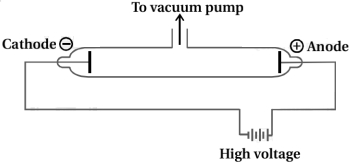
(N/A) cathode ray discharge tube is a glass tube used to study electrical discharge in gases at low pressures.
Construction:
$1$. It consists of a sealed glass tube containing two thin metal electrodes.
$2$. The tube is connected to a vacuum pump to maintain very low pressure inside.
$3$. $A$ high voltage source is connected across the electrodes.
Uses:
$1$. It is used to generate cathode rays by passing high voltage electricity through gases at very low pressure.
$2$. It helps in studying the properties of electrons and the nature of electrical discharge in gases.
Construction:
$1$. It consists of a sealed glass tube containing two thin metal electrodes.
$2$. The tube is connected to a vacuum pump to maintain very low pressure inside.
$3$. $A$ high voltage source is connected across the electrodes.
Uses:
$1$. It is used to generate cathode rays by passing high voltage electricity through gases at very low pressure.
$2$. It helps in studying the properties of electrons and the nature of electrical discharge in gases.
0 likes
View Solution100
Difficult
What are cathode rays? Write down their characteristics.
Solution
(N/A) In an evacuated cathode ray discharge tube,when a sufficiently high voltage is applied across the electrodes,current starts flowing through a stream of particles moving in the tube from the negative electrode (cathode) to the positive electrode (anode). These were called cathode rays or cathode ray particles.
Characteristics of cathode rays $OR$ Results of cathode ray discharge tube experiments:
$(i)$ The cathode rays start from the cathode and move towards the anode.
$(ii)$ These rays themselves are not visible,but their behaviour can be observed with the help of certain kinds of materials (fluorescent or phosphorescent) which glow when hit by them.
$(iii)$ In the absence of an electrical or magnetic field,these rays travel in straight lines.
$(iv)$ In the presence of an electrical or magnetic field,the behaviour of cathode rays is similar to that expected from negatively charged particles,suggesting that the cathode rays consist of negatively charged particles,called electrons.
$(v)$ The characteristics of cathode rays (electrons) do not depend upon the material of the electrodes and the nature of the gas present in the cathode ray tube. Thus,we can conclude that electrons are the basic constituent of all atoms.
Characteristics of cathode rays $OR$ Results of cathode ray discharge tube experiments:
$(i)$ The cathode rays start from the cathode and move towards the anode.
$(ii)$ These rays themselves are not visible,but their behaviour can be observed with the help of certain kinds of materials (fluorescent or phosphorescent) which glow when hit by them.
$(iii)$ In the absence of an electrical or magnetic field,these rays travel in straight lines.
$(iv)$ In the presence of an electrical or magnetic field,the behaviour of cathode rays is similar to that expected from negatively charged particles,suggesting that the cathode rays consist of negatively charged particles,called electrons.
$(v)$ The characteristics of cathode rays (electrons) do not depend upon the material of the electrodes and the nature of the gas present in the cathode ray tube. Thus,we can conclude that electrons are the basic constituent of all atoms.
0 likes
View SolutionStructure of Atom — Discovery and Properties of anode, cathode rays neutron and Nuclear structure · Frequently Asked Questions
1Are these Structure of Atom questions useful for JEE and NEET?
Yes. All questions in this section are mapped to JEE Main and NEET exam patterns. Previous year questions from JEE Main, NEET, GUJCET and state-level exams are included with full solutions.
2Can I switch to Hindi or Gujarati for these questions?
Yes. Use the language tabs in the hero section or the sidebar to view the same questions and solutions in English, Hindi or Gujarati.
3How do I generate a question paper from this subtopic?
Use the Vedclass Exam Paper Generator — select the chapter and subtopic, set difficulty, and generate Sets A, B, C, D automatically. First 3 chapters of every subject are free.
Vedclass Products
For Students
Vedclass Test Series
Mock tests in real JEE/NEET style with performance analysis. 5-day free trial.
Start Free TrialFor Teachers
Exam Paper Generator
Generate Set A/B/C/D papers from this chapter in 2 minutes. 3 chapters free.
Try FreeFor Institutes
Online Exam Module
Live online exams with unlimited students, 360° analytics & white-label branding.
See DemoFor Teachers & Institutes
Generate a Structure of Atom Exam Paper in 2 Minutes
Select subtopic & difficulty — Sets A, B, C, D auto-generated with No Repeat logic.
First 3 chapters of every subject are free — no payment required.