
A English
Discovery and Properties of anode, cathode rays neutron and Nuclear structure Questions in English
Class 11 Chemistry · Structure of Atom · Discovery and Properties of anode, cathode rays neutron and Nuclear structure
137+
Questions
English
Language
100%
With Solutions
Showing 37 of 137 questions in English
101
Difficult
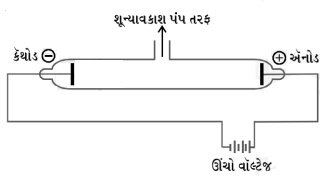
Write down the results of the cathode ray discharge tube experiment.
Solution
(N/A) In an evacuated cathode ray discharge tube,when a sufficiently high voltage is applied across the electrodes,current starts flowing through a stream of particles moving in the tube from the negative electrode (cathode) to the positive electrode (anode). These were called cathode rays or cathode ray particles.
Characteristics of cathode rays or results of cathode ray discharge tube experiments:
$(i)$. The cathode rays start from the cathode and move towards the anode.
$(ii)$. These rays themselves are not visible,but their behavior can be observed with the help of certain kinds of materials (fluorescent or phosphorescent) which glow when hit by them.
$(iii)$. In the absence of an electrical or magnetic field,these rays travel in straight lines.
$(iv)$. In the presence of an electrical or magnetic field,the behavior of cathode rays is similar to that expected from negatively charged particles,suggesting that the cathode rays consist of negatively charged particles,called electrons.
$(v)$. The characteristics of cathode rays (electrons) do not depend upon the material of the electrodes and the nature of the gas present in the cathode ray tube. Thus,we can conclude that electrons are a basic constituent of all atoms.
Characteristics of cathode rays or results of cathode ray discharge tube experiments:
$(i)$. The cathode rays start from the cathode and move towards the anode.
$(ii)$. These rays themselves are not visible,but their behavior can be observed with the help of certain kinds of materials (fluorescent or phosphorescent) which glow when hit by them.
$(iii)$. In the absence of an electrical or magnetic field,these rays travel in straight lines.
$(iv)$. In the presence of an electrical or magnetic field,the behavior of cathode rays is similar to that expected from negatively charged particles,suggesting that the cathode rays consist of negatively charged particles,called electrons.
$(v)$. The characteristics of cathode rays (electrons) do not depend upon the material of the electrodes and the nature of the gas present in the cathode ray tube. Thus,we can conclude that electrons are a basic constituent of all atoms.
0 likes
View Solution102
Advanced
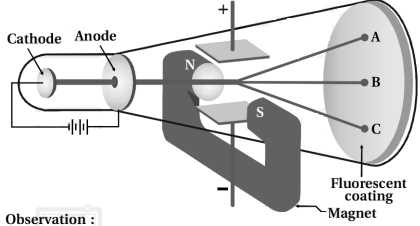
Who discovered the ratio of charge to mass of an electron and how? Explain with a diagram.
Solution
(N/A) In $1897$,$J.J. Thomson$ determined the ratio of electrical charge $(e)$ to the mass of an electron $(m_e)$ using a cathode ray tube.
The value of the ratio is:
$e / m_e = 1.758820 \times 10^{11} \ C \ kg^{-1}$
Where:
$m_e = \text{mass of the electron in } kg$
$e = \text{magnitude of the charge on the electron in coulomb } (C)$
Method:
$Thomson$ applied electric and magnetic fields perpendicular to each other on the path of the electrons.
Observations:
$1$. When only the electric field is applied,the electrons deviate from their path and hit the fluorescent screen at point $A$.
$2$. When only the magnetic field is applied,the electrons strike the screen at point $C$.
$3$. By carefully balancing the strengths of the electric and magnetic fields,it is possible to bring the electrons back to their original path,hitting the screen at point $B$.
By performing accurate measurements of these deflections,$Thomson$ was able to determine the value of $e / m_e$.
The value of the ratio is:
$e / m_e = 1.758820 \times 10^{11} \ C \ kg^{-1}$
Where:
$m_e = \text{mass of the electron in } kg$
$e = \text{magnitude of the charge on the electron in coulomb } (C)$
Method:
$Thomson$ applied electric and magnetic fields perpendicular to each other on the path of the electrons.
Observations:
$1$. When only the electric field is applied,the electrons deviate from their path and hit the fluorescent screen at point $A$.
$2$. When only the magnetic field is applied,the electrons strike the screen at point $C$.
$3$. By carefully balancing the strengths of the electric and magnetic fields,it is possible to bring the electrons back to their original path,hitting the screen at point $B$.
By performing accurate measurements of these deflections,$Thomson$ was able to determine the value of $e / m_e$.
0 likes
View Solution103
MediumMCQ
According to $J.J. Thomson$,the deflection of cathode particles in an electric discharge tube by electric and magnetic fields depends on which factors?
A
Magnitude of the negative charge on the particle
B
Mass of the particle
C
Strength of the electric or magnetic field
D
All of the above
Solution
(D) According to $J.J. Thomson$,the deflection of cathode rays (electrons) depends on the following factors:
$1$. The magnitude of the negative charge on the particle: Greater the magnitude of the charge,greater is the interaction with the electric or magnetic field,and thus greater is the deflection.
$2$. The mass of the particle: Lighter the particle,greater is the deflection.
$3$. The strength of the electric or magnetic field: The deflection increases with the increase in the voltage across the electrodes or the strength of the magnetic field.
$1$. The magnitude of the negative charge on the particle: Greater the magnitude of the charge,greater is the interaction with the electric or magnetic field,and thus greater is the deflection.
$2$. The mass of the particle: Lighter the particle,greater is the deflection.
$3$. The strength of the electric or magnetic field: The deflection increases with the increase in the voltage across the electrodes or the strength of the magnetic field.
0 likes
View Solution104
Easy
Who discovered the charge of an electron? State the charge and mass of an electron.
Solution
The charge of an electron was determined by $R. A. Millikan$ using the oil drop experiment.
The charge of an electron is approximately $-1.6022 \times 10^{-19} \ C$.
The mass of an electron is calculated using the ratio of charge to mass $(e/m_e)$:
$m_e = \frac{e}{e/m_e} = \frac{1.6022 \times 10^{-19} \ C}{1.758820 \times 10^{11} \ C \ kg^{-1}} = 9.1094 \times 10^{-31} \ kg$.
The charge of an electron is approximately $-1.6022 \times 10^{-19} \ C$.
The mass of an electron is calculated using the ratio of charge to mass $(e/m_e)$:
$m_e = \frac{e}{e/m_e} = \frac{1.6022 \times 10^{-19} \ C}{1.758820 \times 10^{11} \ C \ kg^{-1}} = 9.1094 \times 10^{-31} \ kg$.
0 likes
View Solution105
Difficult
Provide general information about the fundamental particles of an atom.
Solution
(N/A) The fundamental particles of an atom are the electron,proton,and neutron. Their characteristics are summarized in the table below:
| Properties | Electron | Proton | Neutron |
| Symbol | $e$ or ${}_{-1}e^{0}$ | $p$ or ${}_{1}^{1}p$ | $n$ or ${}_{0}^{1}n$ |
| Absolute charge $(C)$ | $-1.6022 \times 10^{-19}$ | $+1.6022 \times 10^{-19}$ | $0$ |
| Relative charge | $-1$ | $+1$ | $0$ |
| Mass $(kg)$ | $9.10939 \times 10^{-31}$ | $1.67262 \times 10^{-27}$ | $1.67493 \times 10^{-27}$ |
| Mass $(u)$ | $0.00054$ | $1.00727$ | $1.00867$ |
| Approx Mass $(u)$ | $0$ | $1$ | $1$ |
0 likes
View Solution106
Medium
Explain the discovery of protons.
Solution
(N/A) Electrical discharge carried out in a modified cathode ray tube led to the discovery of particles carrying a positive charge,also known as canal rays.
Characteristics of canal rays:
$(i)$ The positively charged particles depend upon the nature of the gas present in the cathode ray tube. These are simply the positively charged gaseous ions.
$(ii)$ The charge-to-mass ratio of the particles is found to depend on the gas from which they originate.
$(iii)$ Some of the positively charged particles carry a multiple of the fundamental unit of electrical charge.
$(iv)$ The behavior of these particles in a magnetic or electrical field is opposite to that observed for electrons or cathode rays.
The smallest and lightest positive ion was obtained from hydrogen and was called a proton $(H^{+})$.
Characteristics of canal rays:
$(i)$ The positively charged particles depend upon the nature of the gas present in the cathode ray tube. These are simply the positively charged gaseous ions.
$(ii)$ The charge-to-mass ratio of the particles is found to depend on the gas from which they originate.
$(iii)$ Some of the positively charged particles carry a multiple of the fundamental unit of electrical charge.
$(iv)$ The behavior of these particles in a magnetic or electrical field is opposite to that observed for electrons or cathode rays.
The smallest and lightest positive ion was obtained from hydrogen and was called a proton $(H^{+})$.
0 likes
View Solution107
Medium
What are canal rays? Write their characteristics.
Solution
(N/A) Electrical discharge carried out in a modified cathode ray tube led to the discovery of particles carrying a positive charge,which are known as canal rays.
Characteristics of canal rays:
$(i)$ The positively charged particles depend upon the nature of the gas present in the cathode ray tube. These are simply positively charged gaseous ions.
$(ii)$ The charge-to-mass ratio of the particles depends on the gas from which they originate.
$(iii)$ Some of the positively charged particles carry a multiple of the fundamental unit of electrical charge.
$(iv)$ The behavior of these particles in a magnetic or electrical field is opposite to that observed for electrons or cathode rays.
The smallest and lightest positive ion was obtained from hydrogen and was called a proton $(H^{+})$.
Characteristics of canal rays:
$(i)$ The positively charged particles depend upon the nature of the gas present in the cathode ray tube. These are simply positively charged gaseous ions.
$(ii)$ The charge-to-mass ratio of the particles depends on the gas from which they originate.
$(iii)$ Some of the positively charged particles carry a multiple of the fundamental unit of electrical charge.
$(iv)$ The behavior of these particles in a magnetic or electrical field is opposite to that observed for electrons or cathode rays.
The smallest and lightest positive ion was obtained from hydrogen and was called a proton $(H^{+})$.
0 likes
View Solution108
Easy
Calculate the mass of $1$ mole of neutrons in $kg$. $\left( m_n = 1.675 \times 10^{-27} \ kg \right)$
Solution
(N/A) The mass of one neutron is given as $1.675 \times 10^{-27} \ kg$.
To find the mass of $1$ mole of neutrons,we multiply the mass of a single neutron by Avogadro's number $(N_A = 6.022 \times 10^{23} \ mol^{-1})$.
Mass of $1$ mole = $1.675 \times 10^{-27} \ kg \times 6.022 \times 10^{23} \ mol^{-1} = 1.0088 \times 10^{-3} \ kg$.
To find the mass of $1$ mole of neutrons,we multiply the mass of a single neutron by Avogadro's number $(N_A = 6.022 \times 10^{23} \ mol^{-1})$.
Mass of $1$ mole = $1.675 \times 10^{-27} \ kg \times 6.022 \times 10^{23} \ mol^{-1} = 1.0088 \times 10^{-3} \ kg$.
0 likes
View Solution109
EasyMCQ
Which of the following will not show deflection from the path on passing through an electric field?
A
Proton
B
Cathode rays
C
Electron
D
Neutron
Solution
(D) $Neutron$ is a neutral particle with no net electric charge.
Because it lacks a charge,it does not experience any force when passing through an electric field,and therefore,it will not show any deflection from its path.
In contrast,$Protons$ (positively charged),$Cathode$ $rays$ (electrons,negatively charged),and $Electrons$ (negatively charged) are charged particles and will experience a force,resulting in deflection from their path when passing through an electric field.
Because it lacks a charge,it does not experience any force when passing through an electric field,and therefore,it will not show any deflection from its path.
In contrast,$Protons$ (positively charged),$Cathode$ $rays$ (electrons,negatively charged),and $Electrons$ (negatively charged) are charged particles and will experience a force,resulting in deflection from their path when passing through an electric field.
0 likes
View Solution110
EasyMCQ
From which word is the term $Atom$ derived and what is its meaning?
A
Latin,indivisible
B
Greek,indivisible
C
Greek,divisible
D
Latin,divisible
Solution
(B) The term $Atom$ is derived from the Greek word '$atomos$'.
It means '$indivisible$' or '$uncuttable$'.
It means '$indivisible$' or '$uncuttable$'.
0 likes
View Solution111
EasyMCQ
What are cathode rays?
A
Streams of positively charged particles.
B
Streams of negatively charged particles (electrons) emitted from the cathode in a discharge tube.
C
Electromagnetic radiation emitted by the anode.
D
Neutral particles moving at high speed.
Solution
(B) Cathode rays are streams of negatively charged particles known as $electrons$.
These rays are produced when a high voltage is applied across a discharge tube containing gas at a very low pressure.
The rays originate from the $cathode$ (negative electrode) and travel towards the $anode$ (positive electrode).
These rays are produced when a high voltage is applied across a discharge tube containing gas at a very low pressure.
The rays originate from the $cathode$ (negative electrode) and travel towards the $anode$ (positive electrode).
0 likes
View Solution112
Easy
What are the charge,mass,and charge-to-mass ratio of an electron?
Solution
(N/A) The charge of an electron $(e)$ is $-1.6022 \times 10^{-19} \ C$.
The mass of an electron $(m_{e})$ is $9.10939 \times 10^{-31} \ kg$.
The charge-to-mass ratio is calculated as $\frac{e}{m_{e}}$.
$\frac{e}{m_{e}} = \frac{-1.6022 \times 10^{-19} \ C}{9.10939 \times 10^{-31} \ kg} = 1.758820 \times 10^{11} \ C \ kg^{-1}$.
The mass of an electron $(m_{e})$ is $9.10939 \times 10^{-31} \ kg$.
The charge-to-mass ratio is calculated as $\frac{e}{m_{e}}$.
$\frac{e}{m_{e}} = \frac{-1.6022 \times 10^{-19} \ C}{9.10939 \times 10^{-31} \ kg} = 1.758820 \times 10^{11} \ C \ kg^{-1}$.
0 likes
View Solution113
Easy
Who determined the charge-to-mass ratio $(e/m_e)$ of an electron and how? Explain.
Solution
(N/A) $J.J. \text{ Thomson}$ determined the value of $e/m_e$ by applying perpendicular electric and magnetic fields to the path of electrons in a cathode ray tube experiment.
$R.A. \text{ Millikan}$ determined the charge of an electron using the oil drop experiment.
$R.A. \text{ Millikan}$ determined the charge of an electron using the oil drop experiment.
0 likes
View Solution114
EasyMCQ
Who discovered the proton and the neutron?
A
Proton: $Goldstein$,Neutron: $Chadwick$
B
Proton: $Rutherford$,Neutron: $Goldstein$
C
Proton: $Thomson$,Neutron: $Rutherford$
D
Proton: $Chadwick$,Neutron: $Thomson$
Solution
(A) The proton was discovered by $Goldstein$ in $1886$ through his experiments with anode rays.
The neutron was discovered by $James \ Chadwick$ in $1932$ by bombarding beryllium with alpha particles.
The neutron was discovered by $James \ Chadwick$ in $1932$ by bombarding beryllium with alpha particles.
0 likes
View Solution115
EasyMCQ
How did Chadwick discover the neutron? Explain.
A
By bombarding beryllium with alpha particles.
B
By bombarding gold foil with alpha particles.
C
By passing electricity through a gas discharge tube.
D
By observing the deflection of cathode rays.
Solution
(A) In $1932$,James Chadwick discovered the neutron by bombarding a thin sheet of beryllium with $\alpha$-particles.
This reaction produced electrically neutral particles,which he named neutrons.
The nuclear reaction is: $^9_4Be + ^4_2He \rightarrow ^{12}_6C + ^1_0n$.
This reaction produced electrically neutral particles,which he named neutrons.
The nuclear reaction is: $^9_4Be + ^4_2He \rightarrow ^{12}_6C + ^1_0n$.
0 likes
View Solution116
Easy
Write the formulas for calculating Coulombic forces and gravitational forces.
Solution
(N/A) The formula for Coulombic force is $F_c = \frac{k q_1 q_2}{r^2}$,where $k$ is Coulomb's constant,$q_1$ and $q_2$ are the charges,and $r$ is the distance between them.
The formula for gravitational force is $F_g = \frac{G m_1 m_2}{r^2}$,where $G$ is the gravitational constant,$m_1$ and $m_2$ are the masses,and $r$ is the distance between them.
The formula for gravitational force is $F_g = \frac{G m_1 m_2}{r^2}$,where $G$ is the gravitational constant,$m_1$ and $m_2$ are the masses,and $r$ is the distance between them.
0 likes
View Solution117
Easy
Are neutrons present in all atomic nuclei? Explain.
Solution
(N/A) No,neutrons are not present in all atomic nuclei. For example,the most common isotope of hydrogen,$^1H$ (protium),contains only one proton and no neutrons in its nucleus.
0 likes
View Solution118
EasyMCQ
Calculate the ratio of the diameter of an atom to the diameter of its nucleus.
A
$10^5$
B
$10^3$
C
$10^2$
D
$10^4$
Solution
(A) The diameter of the nucleus is approximately $10^{-13} \ cm$ to $10^{-12} \ cm$.
The diameter of an atom is approximately $10^{-8} \ cm$.
Therefore,the ratio of the diameter of an atom to the diameter of the nucleus is:
$\frac{\text{Diameter of atom}}{\text{Diameter of nucleus}} = \frac{10^{-8} \ cm}{10^{-13} \ cm} = 10^5$.
Thus,the atom is $10^5$ times larger than its nucleus.
The diameter of an atom is approximately $10^{-8} \ cm$.
Therefore,the ratio of the diameter of an atom to the diameter of the nucleus is:
$\frac{\text{Diameter of atom}}{\text{Diameter of nucleus}} = \frac{10^{-8} \ cm}{10^{-13} \ cm} = 10^5$.
Thus,the atom is $10^5$ times larger than its nucleus.
0 likes
View Solution119
Easy
On what factor does the intensity (brightness) of spectral lines depend?
Solution
(N/A) The intensity of spectral lines depends on the number of photons emitted or absorbed during the transition of electrons between energy levels.
0 likes
View Solution120
EasyMCQ
When an electron particle strikes a $ZnS$ screen,it produces a flash of light (scintillation). What does this indicate?
A
The wave nature of electrons
B
The particle nature of electrons
C
The dual nature of electrons
D
The mass of electrons
Solution
(B) The production of a scintillation (flash of light) on a $ZnS$ screen upon the impact of an electron indicates that the electron behaves as a discrete particle. This observation is a key piece of evidence for the particle nature of electrons.
0 likes
View Solution121
Medium
Fill in the blanks:
$(i)$ When amber or ebonite is rubbed with silk or fur,it produces $......$.
$(ii)$ In a discharge tube,the stream of particles flows from cathode to anode. This is called $......$.
$(iii)$ In a cathode ray tube,a coating of $......$ is applied as a fluorescent material.
$(iv)$ $A$ television picture tube is a type of $......$ tube.
$(i)$ When amber or ebonite is rubbed with silk or fur,it produces $......$.
$(ii)$ In a discharge tube,the stream of particles flows from cathode to anode. This is called $......$.
$(iii)$ In a cathode ray tube,a coating of $......$ is applied as a fluorescent material.
$(iv)$ $A$ television picture tube is a type of $......$ tube.
Solution
(N/A) $(i)$ Electricity
$(ii)$ Cathode rays
$(iii)$ Zinc sulphide
$(iv)$ Cathode ray
$(ii)$ Cathode rays
$(iii)$ Zinc sulphide
$(iv)$ Cathode ray
0 likes
View Solution122
Easy
Fill in the blanks given below:
$(i)$ The picture on the television screen is visible due to the presence of .......... on the screen.
$(ii)$ In the presence of electric and magnetic fields,cathode rays are known as .......... .
$(iii)$ The measurement of the $e/m_e$ ratio for electrons was performed by the scientist .......... .
$(iv)$ In a cathode ray tube,the greater the magnitude of the charge on the particles,the .......... the deflection of the particles.
$(i)$ The picture on the television screen is visible due to the presence of .......... on the screen.
$(ii)$ In the presence of electric and magnetic fields,cathode rays are known as .......... .
$(iii)$ The measurement of the $e/m_e$ ratio for electrons was performed by the scientist .......... .
$(iv)$ In a cathode ray tube,the greater the magnitude of the charge on the particles,the .......... the deflection of the particles.
Solution
(N/A) $(i)$ Phosphorescent material or fluorescent material
$(ii)$ Electrons
$(iii)$ $J$.$J$. Thomson
$(iv)$ Greater
$(ii)$ Electrons
$(iii)$ $J$.$J$. Thomson
$(iv)$ Greater
0 likes
View Solution123
Easy
Fill in the blanks:
$(i)$ $R. A. Millikan$ developed the ......... method to determine the charge of an electron.
$(ii)$ The positively charged particles in a modified cathode ray tube are called ............ .
$(iii)$ The smallest and lightest positive ion obtained from hydrogen is ........... .
$(iv)$ In the year $1932$,$Chadwick$ discovered ........... .
$(i)$ $R. A. Millikan$ developed the ......... method to determine the charge of an electron.
$(ii)$ The positively charged particles in a modified cathode ray tube are called ............ .
$(iii)$ The smallest and lightest positive ion obtained from hydrogen is ........... .
$(iv)$ In the year $1932$,$Chadwick$ discovered ........... .
Solution
(N/A) $(i)$ Oil-drop method
$(ii)$ Canal rays (or Anode rays)
$(iii)$ Proton
$(iv)$ Neutron
$(ii)$ Canal rays (or Anode rays)
$(iii)$ Proton
$(iv)$ Neutron
0 likes
View Solution124
Medium
Fill in the blanks:
$(i)$ For the discovery of neutrons,$\alpha$-particles were bombarded on a thin sheet of ......... .
$(ii)$ For the $\alpha$-particle scattering experiment,Rutherford used a gold foil of thickness ......... .
$(iii)$ The radius of an atom is approximately ......... and the radius of the nucleus is ......... .
$(iv)$ The entire positive charge of an atom is concentrated in a very small region,which is called ......... .
$(i)$ For the discovery of neutrons,$\alpha$-particles were bombarded on a thin sheet of ......... .
$(ii)$ For the $\alpha$-particle scattering experiment,Rutherford used a gold foil of thickness ......... .
$(iii)$ The radius of an atom is approximately ......... and the radius of the nucleus is ......... .
$(iv)$ The entire positive charge of an atom is concentrated in a very small region,which is called ......... .
Solution
(N/A) $(i)$ Beryllium
$(ii)$ $100 \ nm$
$(iii)$ $10^{-10} \ m, 10^{-15} \ m$
$(iv)$ Nucleus
$(ii)$ $100 \ nm$
$(iii)$ $10^{-10} \ m, 10^{-15} \ m$
$(iv)$ Nucleus
0 likes
View Solution125
Medium
Fill in the blanks given below:
$(i)$ The circular path around the nucleus in which electrons revolve at high speed is called ......... .
$(ii)$ Electrons and the nucleus are held together by ......... force.
$(iii)$ The number of $P^{+}$ in the nucleus and the sum of the number of $P^{+}$ and $n^{\circ}$ in the nucleus are represented by the symbols ...... and ......... respectively.
$(iv)$ The sum of the number of $P^{+}$ and $n^{\circ}$ in the nucleus is represented by the term ...... and the symbol .... respectively.
$(i)$ The circular path around the nucleus in which electrons revolve at high speed is called ......... .
$(ii)$ Electrons and the nucleus are held together by ......... force.
$(iii)$ The number of $P^{+}$ in the nucleus and the sum of the number of $P^{+}$ and $n^{\circ}$ in the nucleus are represented by the symbols ...... and ......... respectively.
$(iv)$ The sum of the number of $P^{+}$ and $n^{\circ}$ in the nucleus is represented by the term ...... and the symbol .... respectively.
Solution
(A) $(i)$ Orbit (or Shell)
$(ii)$ Electrostatic force of attraction
$(iii)$ $Z$ and $A$
$(iv)$ Nucleons and $A$
$(ii)$ Electrostatic force of attraction
$(iii)$ $Z$ and $A$
$(iv)$ Nucleons and $A$
0 likes
View Solution126
Medium
State whether the following statements are true or false:
$(i)$ Faraday's electrolysis experiments and cathode ray discharge tube experiments prove that protons are located in the nucleus of the atom,while electrons are located outside the nucleus.
$(ii)$ In the year $1887$,Goldstein discovered the proton.
$(iii)$ In the year $1932$,the neutron was discovered by Chadwick.
$(iv)$ The first atomic model was proposed by Thomson.
$(i)$ Faraday's electrolysis experiments and cathode ray discharge tube experiments prove that protons are located in the nucleus of the atom,while electrons are located outside the nucleus.
$(ii)$ In the year $1887$,Goldstein discovered the proton.
$(iii)$ In the year $1932$,the neutron was discovered by Chadwick.
$(iv)$ The first atomic model was proposed by Thomson.
Solution
(A) $(i)$ False. Faraday's experiments and cathode ray tubes do not directly prove the location of protons in the nucleus; this was established by Rutherford's alpha-particle scattering experiment.
$(ii)$ False. Goldstein discovered anode rays (canal rays) in $1886$,which were later identified as protons,but the discovery is generally attributed to the $1886$ experiments.
$(iii)$ True. James Chadwick discovered the neutron in $1932$.
$(iv)$ True. $J$.$J$. Thomson proposed the first atomic model (Plum Pudding Model) in $1898$.
$(ii)$ False. Goldstein discovered anode rays (canal rays) in $1886$,which were later identified as protons,but the discovery is generally attributed to the $1886$ experiments.
$(iii)$ True. James Chadwick discovered the neutron in $1932$.
$(iv)$ True. $J$.$J$. Thomson proposed the first atomic model (Plum Pudding Model) in $1898$.
0 likes
View Solution127
EasyMCQ
What is a kernel in the context of atomic structure?
A
The entire atom including valence electrons.
B
The nucleus and all inner-shell electrons of an atom.
C
The outermost shell of an atom.
D
The protons and neutrons only.
Solution
(B) In atomic structure,the term $ \text{kernel} $ refers to the nucleus of an atom along with all the electrons present in the inner shells,excluding the valence electrons.
Essentially,$ \text{Kernel} = \text{Nucleus} + \text{Inner shell electrons} $.
It represents the core of the atom that remains relatively stable during chemical bonding.
Essentially,$ \text{Kernel} = \text{Nucleus} + \text{Inner shell electrons} $.
It represents the core of the atom that remains relatively stable during chemical bonding.
0 likes
View Solution128
EasyMCQ
Which of the following particles is represented by the symbol $\alpha$?
A
$A$ proton
B
$A$ neutron
C
$A$ helium nucleus
D
An electron
Solution
(C) The symbol $\alpha$ represents an alpha particle.
An alpha particle consists of $2$ protons and $2$ neutrons,which is identical to the nucleus of a helium atom $(^4_2He^{2+})$.
Therefore,it is referred to as a helium nucleus.
An alpha particle consists of $2$ protons and $2$ neutrons,which is identical to the nucleus of a helium atom $(^4_2He^{2+})$.
Therefore,it is referred to as a helium nucleus.
0 likes
View Solution129
MediumMCQ
Among the following,the correct statement about the cathode ray discharge tube is:
A
The electrical discharge can only be observed at high pressure and at low voltage.
B
In the absence of external electrical or magnetic fields,cathode rays travel in straight lines.
C
The characteristics of cathode rays depend upon the material of the electrodes.
D
The characteristics of cathode rays depend upon the gas present in the cathode ray tube.
Solution
(B) .
Cathode rays are observed only at low pressure and high voltage.
In the absence of external electrical or magnetic fields,they travel in straight lines.
The characteristics of cathode rays are independent of the material of the electrodes or the nature of the gas present in the tube.
Cathode rays are observed only at low pressure and high voltage.
In the absence of external electrical or magnetic fields,they travel in straight lines.
The characteristics of cathode rays are independent of the material of the electrodes or the nature of the gas present in the tube.
0 likes
View Solution130
DifficultMCQ
Electrons in a cathode ray tube have been emitted with a velocity of $1000 \, m \, s^{-1}$. The number of following statements which is/are true about the emitted radiation is
Given : $h = 6 \times 10^{-34} \, Js$,$m_{e} = 9 \times 10^{-31} \, kg$.
$(A)$ The de Broglie wavelength of the electron emitted is $666.67 \, nm$.
$(B)$ The characteristic of electrons emitted depend upon the material of the electrodes of the cathode ray tube.
$(C)$ The cathode rays start from cathode and move towards anode.
$(D)$ The nature of the emitted electrons depends on the nature of the gas present in cathode ray tube.
Given : $h = 6 \times 10^{-34} \, Js$,$m_{e} = 9 \times 10^{-31} \, kg$.
$(A)$ The de Broglie wavelength of the electron emitted is $666.67 \, nm$.
$(B)$ The characteristic of electrons emitted depend upon the material of the electrodes of the cathode ray tube.
$(C)$ The cathode rays start from cathode and move towards anode.
$(D)$ The nature of the emitted electrons depends on the nature of the gas present in cathode ray tube.
A
$2$
B
$1$
C
$3$
D
$4$
Solution
(A) Calculation of de Broglie wavelength: $\lambda = \frac{h}{mv} = \frac{6 \times 10^{-34} \, Js}{(9 \times 10^{-31} \, kg) \times (1000 \, m \, s^{-1})} = 6.6667 \times 10^{-7} \, m = 666.67 \, nm$. Thus,statement $(A)$ is true.
$(B)$ The characteristics of cathode rays (electrons) are independent of the material of the electrodes. Thus,statement $(B)$ is false.
$(C)$ Cathode rays originate from the cathode and travel towards the anode. Thus,statement $(C)$ is true.
$(D)$ The nature of cathode rays is independent of the nature of the gas present in the tube. Thus,statement $(D)$ is false.
Therefore,there are $2$ true statements ($A$ and $C$).
$(B)$ The characteristics of cathode rays (electrons) are independent of the material of the electrodes. Thus,statement $(B)$ is false.
$(C)$ Cathode rays originate from the cathode and travel towards the anode. Thus,statement $(C)$ is true.
$(D)$ The nature of cathode rays is independent of the nature of the gas present in the tube. Thus,statement $(D)$ is false.
Therefore,there are $2$ true statements ($A$ and $C$).
0 likes
View Solution131
MediumMCQ
The increasing order for the values of $e/m$ $(\text{charge/mass})$ is :
A
$e, p, n, \alpha$
B
$n, p, e, \alpha$
C
$n, p, \alpha, e$
D
$n, \alpha, p, e$
Solution
(D) The $e/m$ ratio is defined as the charge-to-mass ratio of a particle.
For a neutron $(n)$,the charge is $0$,so $e/m = 0$.
For an alpha particle $(\alpha)$,the charge is $+2$ and the mass is $4 \ amu$,so $e/m = 2/4 = 0.5$.
For a proton $(p)$,the charge is $+1$ and the mass is $1 \ amu$,so $e/m = 1/1 = 1$.
For an electron $(e^-)$,the charge is $-1$ and the mass is $1/1837 \ amu$,so $e/m = 1 / (1/1837) = 1837$.
Comparing these values: $0 < 0.5 < 1 < 1837$.
Thus,the increasing order is $n < \alpha < p < e$.
For a neutron $(n)$,the charge is $0$,so $e/m = 0$.
For an alpha particle $(\alpha)$,the charge is $+2$ and the mass is $4 \ amu$,so $e/m = 2/4 = 0.5$.
For a proton $(p)$,the charge is $+1$ and the mass is $1 \ amu$,so $e/m = 1/1 = 1$.
For an electron $(e^-)$,the charge is $-1$ and the mass is $1/1837 \ amu$,so $e/m = 1 / (1/1837) = 1837$.
Comparing these values: $0 < 0.5 < 1 < 1837$.
Thus,the increasing order is $n < \alpha < p < e$.
0 likes
View Solution132
EasyMCQ
Which of the following statements is correct about the cathode rays?
$1$. These rays start from anode and move towards cathode.
$2$. They are visible with human eye.
$3$. In presence of electric and magnetic fields,they behave like positively charged particles.
$4$. Their characteristic does not depend on the nature of material at electrode.
$1$. These rays start from anode and move towards cathode.
$2$. They are visible with human eye.
$3$. In presence of electric and magnetic fields,they behave like positively charged particles.
$4$. Their characteristic does not depend on the nature of material at electrode.
A
$1$
B
$2$
C
$3$
D
$4$
Solution
(D) Characteristics of cathode rays are:
$(1)$ The cathode rays start from the cathode and move towards the anode. Thus,statement $(1)$ is incorrect.
$(2)$ These rays themselves are not visible,but their behavior can be observed with the help of fluorescent materials such as $ZnS$. Thus,statement $(2)$ is incorrect.
$(3)$ In the presence of electrical or magnetic fields,cathode rays behave like negatively charged particles,suggesting that they consist of electrons. Thus,statement $(3)$ is incorrect.
$(4)$ The characteristics of cathode rays (electrons) do not depend upon the material of the electrodes or the nature of the gas present in the cathode ray tube. Hence,statement $(4)$ is correct.
$(1)$ The cathode rays start from the cathode and move towards the anode. Thus,statement $(1)$ is incorrect.
$(2)$ These rays themselves are not visible,but their behavior can be observed with the help of fluorescent materials such as $ZnS$. Thus,statement $(2)$ is incorrect.
$(3)$ In the presence of electrical or magnetic fields,cathode rays behave like negatively charged particles,suggesting that they consist of electrons. Thus,statement $(3)$ is incorrect.
$(4)$ The characteristics of cathode rays (electrons) do not depend upon the material of the electrodes or the nature of the gas present in the cathode ray tube. Hence,statement $(4)$ is correct.
0 likes
View Solution133
EasyMCQ
The masses of an electron,a proton and a neutron respectively will be in the ratio
A
$1 : 1836.15 : 1838.68$
B
$1 : 1856.15 : 1858.68$
C
$1 : 1834.15 : 1836.68$
D
$1 : 1846.15 : 1848.68$
Solution
(A) The mass of an electron is $m_e = 9.109 \times 10^{-31} \ kg$.
The mass of a proton is $m_p = 1.672 \times 10^{-27} \ kg$.
The mass of a neutron is $m_n = 1.674 \times 10^{-27} \ kg$.
To find the ratio $m_e : m_p : m_n$,we divide each mass by the mass of the electron $(m_e)$:
Ratio $= 1 : \frac{1.672 \times 10^{-27}}{9.109 \times 10^{-31}} : \frac{1.674 \times 10^{-27}}{9.109 \times 10^{-31}}$
Ratio $\approx 1 : 1836.15 : 1838.68$.
The mass of a proton is $m_p = 1.672 \times 10^{-27} \ kg$.
The mass of a neutron is $m_n = 1.674 \times 10^{-27} \ kg$.
To find the ratio $m_e : m_p : m_n$,we divide each mass by the mass of the electron $(m_e)$:
Ratio $= 1 : \frac{1.672 \times 10^{-27}}{9.109 \times 10^{-31}} : \frac{1.674 \times 10^{-27}}{9.109 \times 10^{-31}}$
Ratio $\approx 1 : 1836.15 : 1838.68$.
0 likes
View Solution134
EasyMCQ
Match the following:
| $A$. Chadwick | $1$. Cathode rays |
| $B$. Rutherford | $2$. $X$-ray spectra |
| $C$. Moseley | $3$. Discovery of neutrons |
| $D$. $J$. $J$. Thomson | $4$. Nuclear atom model |
A
$A-4, B-1, C-2, D-3$
B
$A-3, B-2, C-4, D-1$
C
$A-3, B-4, C-2, D-1$
D
$A-3, B-4, C-1, D-2$
Solution
(C) The correct matches are:
$A$. Chadwick discovered the neutron $(A-3)$.
$B$. Rutherford proposed the nuclear model of the atom $(B-4)$.
$C$. Moseley established the relationship between atomic number and $X$-ray spectra $(C-2)$.
$D$. $J$. $J$. Thomson performed the cathode ray experiment $(D-1)$.
Therefore,the correct sequence is $A-3, B-4, C-2, D-1$.
$A$. Chadwick discovered the neutron $(A-3)$.
$B$. Rutherford proposed the nuclear model of the atom $(B-4)$.
$C$. Moseley established the relationship between atomic number and $X$-ray spectra $(C-2)$.
$D$. $J$. $J$. Thomson performed the cathode ray experiment $(D-1)$.
Therefore,the correct sequence is $A-3, B-4, C-2, D-1$.
0 likes
View Solution135
EasyMCQ
Which of the following statements is not the result of the cathode ray discharge tube experiment?
A
In the absence of electric or magnetic field,the cathode rays travel in a straight line.
B
In the presence of electric or magnetic field,the behaviour of cathode rays is similar to that expected from negatively charged particles.
C
In the presence of electric and magnetic field,the cathode rays travel in a straight line.
D
The cathode rays start from the cathode and move toward the anode.
Solution
(C) The statement that cathode rays travel in a straight line in the presence of electric and magnetic fields is incorrect.
Cathode rays are deflected by both electric and magnetic fields.
When passed between two electrically charged plates,they are deflected towards the positively charged plate.
In a magnetic field,they are deflected at a right angle to both the field and the direction of the particle's motion.
Cathode rays are deflected by both electric and magnetic fields.
When passed between two electrically charged plates,they are deflected towards the positively charged plate.
In a magnetic field,they are deflected at a right angle to both the field and the direction of the particle's motion.
0 likes
View Solution136
EasyMCQ
In the Millikan's oil drop method,which of the following forces does not act on the oil drop?
A
Gravitational force
B
Viscous force
C
Magnetic force
D
Electrostatic force
Solution
(C) In Millikan's oil drop experiment,an electrically charged droplet of oil is placed between two parallel metal plates.
$1$. Gravitational force $(F_g = mg)$ acts downwards.
$2$. Viscous force $(F_v = 6 \pi \eta r v)$ acts opposite to the direction of motion of the droplet.
$3$. Electrostatic force $(F_e = qE)$ acts on the charged droplet when an electric field is applied.
Magnetic force is not involved in this experiment as there is no magnetic field present.
Therefore,the correct option is $(C)$.
$1$. Gravitational force $(F_g = mg)$ acts downwards.
$2$. Viscous force $(F_v = 6 \pi \eta r v)$ acts opposite to the direction of motion of the droplet.
$3$. Electrostatic force $(F_e = qE)$ acts on the charged droplet when an electric field is applied.
Magnetic force is not involved in this experiment as there is no magnetic field present.
Therefore,the correct option is $(C)$.
0 likes
View Solution137
EasyMCQ
Which of the following pairs has the identical $e/m$ value?
A
An $\alpha$-particle and deuterium ion
B
$A$ proton and neutron
C
An electron and $\gamma$-rays
D
$A$ proton and deuterium ion
Solution
(A) The $e/m$ ratio (specific charge) is calculated as the ratio of charge $(e)$ to mass $(m)$.
For a proton $(H^+)$,$e/m = 1/1 = 1$.
For a deuterium ion $(D^+)$,charge is $1$ and mass is $2$,so $e/m = 1/2 = 0.5$.
For an $\alpha$-particle $(He^{2+})$,charge is $2$ and mass is $4$,so $e/m = 2/4 = 0.5$.
Since both the deuterium ion and the $\alpha$-particle have an $e/m$ ratio of $0.5$,they have identical $e/m$ values.
For a proton $(H^+)$,$e/m = 1/1 = 1$.
For a deuterium ion $(D^+)$,charge is $1$ and mass is $2$,so $e/m = 1/2 = 0.5$.
For an $\alpha$-particle $(He^{2+})$,charge is $2$ and mass is $4$,so $e/m = 2/4 = 0.5$.
Since both the deuterium ion and the $\alpha$-particle have an $e/m$ ratio of $0.5$,they have identical $e/m$ values.
0 likes
View SolutionStructure of Atom — Discovery and Properties of anode, cathode rays neutron and Nuclear structure · Frequently Asked Questions
1Are these Structure of Atom questions useful for JEE and NEET?
Yes. All questions in this section are mapped to JEE Main and NEET exam patterns. Previous year questions from JEE Main, NEET, GUJCET and state-level exams are included with full solutions.
2Can I switch to Hindi or Gujarati for these questions?
Yes. Use the language tabs in the hero section or the sidebar to view the same questions and solutions in English, Hindi or Gujarati.
3How do I generate a question paper from this subtopic?
Use the Vedclass Exam Paper Generator — select the chapter and subtopic, set difficulty, and generate Sets A, B, C, D automatically. First 3 chapters of every subject are free.
Vedclass Products
For Students
Vedclass Test Series
Mock tests in real JEE/NEET style with performance analysis. 5-day free trial.
Start Free TrialFor Teachers
Exam Paper Generator
Generate Set A/B/C/D papers from this chapter in 2 minutes. 3 chapters free.
Try FreeFor Institutes
Online Exam Module
Live online exams with unlimited students, 360° analytics & white-label branding.
See DemoFor Teachers & Institutes
Generate a Structure of Atom Exam Paper in 2 Minutes
Select subtopic & difficulty — Sets A, B, C, D auto-generated with No Repeat logic.
First 3 chapters of every subject are free — no payment required.