
A English
Characteristics and Measurable properties of gases Questions in English
Class 11 Chemistry · States of Matter · Characteristics and Measurable properties of gases
320+
Questions
English
Language
100%
With Solutions
Showing 50 of 320 questions in English
251
MediumMCQ
$A$ mixture of one mole each of $H_2$,$He$ and $O_2$ are enclosed in a cylinder of volume $V$ at temperature $T$. If the partial pressure of $H_2$ is $2 \ atm$,the total pressure of the gases in the cylinder is $....... \ atm$
A
$14$
B
$22$
C
$6$
D
$38$
Solution
(C) According to Dalton's law of partial pressure:
$p_i = x_i \times P_T$
Where $p_i$ is the partial pressure of the $i^{th}$ component,$x_i$ is the mole fraction of the $i^{th}$ component,and $P_T$ is the total pressure of the mixture.
Given: $n_{H_2} = 1 \ mol$,$n_{He} = 1 \ mol$,$n_{O_2} = 1 \ mol$.
Total moles $n_{total} = 1 + 1 + 1 = 3 \ mol$.
Mole fraction of $H_2$ is $x_{H_2} = \frac{n_{H_2}}{n_{total}} = \frac{1}{3}$.
Given partial pressure of $H_2$ is $p_{H_2} = 2 \ atm$.
Using the formula: $2 \ atm = \frac{1}{3} \times P_T$.
Therefore,$P_T = 2 \ atm \times 3 = 6 \ atm$.
$p_i = x_i \times P_T$
Where $p_i$ is the partial pressure of the $i^{th}$ component,$x_i$ is the mole fraction of the $i^{th}$ component,and $P_T$ is the total pressure of the mixture.
Given: $n_{H_2} = 1 \ mol$,$n_{He} = 1 \ mol$,$n_{O_2} = 1 \ mol$.
Total moles $n_{total} = 1 + 1 + 1 = 3 \ mol$.
Mole fraction of $H_2$ is $x_{H_2} = \frac{n_{H_2}}{n_{total}} = \frac{1}{3}$.
Given partial pressure of $H_2$ is $p_{H_2} = 2 \ atm$.
Using the formula: $2 \ atm = \frac{1}{3} \times P_T$.
Therefore,$P_T = 2 \ atm \times 3 = 6 \ atm$.
0 likes
View Solution252
MediumMCQ
$A$ mixture of $N_2$ and $Ar$ gases in a cylinder contains $7 \ g$ of $N_2$ and $8 \ g$ of $Ar$. If the total pressure of the mixture of gases in the cylinder is $27 \ bar$,the partial pressure of $N_2$ is $......... \ bar$.
[Use atomic masses (in $g \ mol^{-1}$) : $N=14, Ar=40$]
[Use atomic masses (in $g \ mol^{-1}$) : $N=14, Ar=40$]
A
$18$
B
$9$
C
$12$
D
$15$
Solution
(D) Step $1$: Calculate the number of moles of each gas.
$n_{N_2} = \frac{7 \ g}{28 \ g \ mol^{-1}} = 0.25 \ mol = \frac{1}{4} \ mol$
$n_{Ar} = \frac{8 \ g}{40 \ g \ mol^{-1}} = 0.2 \ mol = \frac{1}{5} \ mol$
Step $2$: Calculate the mole fraction of $N_2$ $(x_{N_2})$.
$x_{N_2} = \frac{n_{N_2}}{n_{N_2} + n_{Ar}} = \frac{1/4}{1/4 + 1/5} = \frac{0.25}{0.25 + 0.20} = \frac{0.25}{0.45} = \frac{5}{9}$
Step $3$: Calculate the partial pressure of $N_2$ $(p_{N_2})$.
$p_{N_2} = x_{N_2} \times P_{total} = \frac{5}{9} \times 27 \ bar = 5 \times 3 \ bar = 15 \ bar$.
$n_{N_2} = \frac{7 \ g}{28 \ g \ mol^{-1}} = 0.25 \ mol = \frac{1}{4} \ mol$
$n_{Ar} = \frac{8 \ g}{40 \ g \ mol^{-1}} = 0.2 \ mol = \frac{1}{5} \ mol$
Step $2$: Calculate the mole fraction of $N_2$ $(x_{N_2})$.
$x_{N_2} = \frac{n_{N_2}}{n_{N_2} + n_{Ar}} = \frac{1/4}{1/4 + 1/5} = \frac{0.25}{0.25 + 0.20} = \frac{0.25}{0.45} = \frac{5}{9}$
Step $3$: Calculate the partial pressure of $N_2$ $(p_{N_2})$.
$p_{N_2} = x_{N_2} \times P_{total} = \frac{5}{9} \times 27 \ bar = 5 \times 3 \ bar = 15 \ bar$.
0 likes
View Solution253
MediumMCQ
The rate of diffusion of $SO_{2}$,$CO_{2}$,$PCl_{3}$ and $SO_{3}$ are in the following order:
A
$PCl_{3} > SO_{3} > SO_{2} > CO_{2}$
B
$CO_{2} > SO_{2} > SO_{3} > PCl_{3}$
C
$SO_{2} > SO_{3} > PCl_{3} > CO_{2}$
D
$CO_{2} > SO_{2} > PCl_{3} > SO_{3}$
Solution
(B) According to Graham's Law of diffusion,the rate of diffusion $(r)$ is inversely proportional to the square root of the molar mass $(M)$: $r \propto \frac{1}{\sqrt{M}}$.
First,calculate the molar masses of the given compounds:
$M(CO_{2}) = 12 + 2 \times 16 = 44 \ g/mol$
$M(SO_{2}) = 32 + 2 \times 16 = 64 \ g/mol$
$M(SO_{3}) = 32 + 3 \times 16 = 80 \ g/mol$
$M(PCl_{3}) = 31 + 3 \times 35.5 = 31 + 106.5 = 137.5 \ g/mol$
Since the rate of diffusion is inversely proportional to the square root of the molar mass,the order of the rate of diffusion will be the reverse of the order of their molar masses:
$M(CO_{2}) < M(SO_{2}) < M(SO_{3}) < M(PCl_{3})$
Therefore,the rate of diffusion order is: $CO_{2} > SO_{2} > SO_{3} > PCl_{3}$.
First,calculate the molar masses of the given compounds:
$M(CO_{2}) = 12 + 2 \times 16 = 44 \ g/mol$
$M(SO_{2}) = 32 + 2 \times 16 = 64 \ g/mol$
$M(SO_{3}) = 32 + 3 \times 16 = 80 \ g/mol$
$M(PCl_{3}) = 31 + 3 \times 35.5 = 31 + 106.5 = 137.5 \ g/mol$
Since the rate of diffusion is inversely proportional to the square root of the molar mass,the order of the rate of diffusion will be the reverse of the order of their molar masses:
$M(CO_{2}) < M(SO_{2}) < M(SO_{3}) < M(PCl_{3})$
Therefore,the rate of diffusion order is: $CO_{2} > SO_{2} > SO_{3} > PCl_{3}$.
0 likes
View Solution254
MediumMCQ
The interaction energy of $London$ forces between two particles is proportional to $r^{x}$,where $r$ is the distance between the particles. The value of $x$ is:
A
$3$
B
$-3$
C
$-6$
D
$6$
Solution
(C) For $London$ dispersion forces,the interaction energy $E$ is inversely proportional to the sixth power of the distance $r$ between the particles.
Mathematically,$E \propto \frac{1}{r^{6}}$,which can be written as $E \propto r^{-6}$.
Therefore,comparing this to $E \propto r^{x}$,we get $x = -6$.
Mathematically,$E \propto \frac{1}{r^{6}}$,which can be written as $E \propto r^{-6}$.
Therefore,comparing this to $E \propto r^{x}$,we get $x = -6$.
0 likes
View Solution255
DifficultMCQ
The water having more dissolved $O_{2}$ is:
A
boiling water
B
water at $80^{\circ} C$
C
polluted water
D
water at $4^{\circ} C$
Solution
(D) The solubility of gases in liquids decreases with an increase in temperature.
Therefore,as the temperature of water increases,the concentration of dissolved $O_{2}$ decreases.
Among the given options,$4^{\circ} C$ is the lowest temperature.
Thus,water at $4^{\circ} C$ will have the maximum concentration of dissolved $O_{2}$.
Therefore,as the temperature of water increases,the concentration of dissolved $O_{2}$ decreases.
Among the given options,$4^{\circ} C$ is the lowest temperature.
Thus,water at $4^{\circ} C$ will have the maximum concentration of dissolved $O_{2}$.
0 likes
View Solution256
MediumMCQ
Which one is not a correct mathematical equation for Dalton's Law of partial pressure? Here $p =$ total pressure of the gaseous mixture.
A
$p = n_{1} \frac{RT}{V} + n_{2} \frac{RT}{V} + n_{3} \frac{RT}{V}$
B
$p_{i} = \chi_{i} p$,where $p_{i} =$ partial pressure of $i^{\text{th}}$ gas and $\chi_{i} =$ mole fraction of $i^{\text{th}}$ gas in the gaseous mixture.
C
$p_{i} = \chi_{i} p_{i}^{0}$,where $\chi_{i} =$ mole fraction of $i^{\text{th}}$ gas in the gaseous mixture and $p_{i}^{0} =$ pressure of $i^{\text{th}}$ gas in the pure state.
D
$p = p_{1} + p_{2} + p_{3}$
Solution
(C) Dalton's law of partial pressure states that the total pressure exerted by a mixture of non-reacting gases is equal to the sum of the partial pressures of the individual gases: $p = p_{1} + p_{2} + p_{3}$.
The partial pressure of a gas $i$ is given by $p_{i} = \chi_{i} p$,where $\chi_{i}$ is the mole fraction of the gas in the mixture.
Option $A$ is correct because $p = \sum n_{i} \frac{RT}{V} = (\sum n_{i}) \frac{RT}{V} = n_{total} \frac{RT}{V}$,which is the ideal gas law for the mixture.
Option $C$ represents Raoult's Law for solutions,not Dalton's Law for gaseous mixtures. Therefore,it is the incorrect equation.
The partial pressure of a gas $i$ is given by $p_{i} = \chi_{i} p$,where $\chi_{i}$ is the mole fraction of the gas in the mixture.
Option $A$ is correct because $p = \sum n_{i} \frac{RT}{V} = (\sum n_{i}) \frac{RT}{V} = n_{total} \frac{RT}{V}$,which is the ideal gas law for the mixture.
Option $C$ represents Raoult's Law for solutions,not Dalton's Law for gaseous mixtures. Therefore,it is the incorrect equation.
0 likes
View Solution257
MediumMCQ
$A$ mixture of hydrogen and oxygen contains $40 \%$ hydrogen by mass when the total pressure is $2.2 \, bar$. The partial pressure of hydrogen is $bar$. (Nearest Integer)
A
$1$
B
$2$
C
$3$
D
$4$
Solution
(B) Let the total mass of the mixture be $100 \, g$.
Mass of $H_2 = 40 \, g$,so moles of $H_2$ $(n_{H_2})$ $= \frac{40}{2} = 20 \, mol$.
Mass of $O_2 = 60 \, g$,so moles of $O_2$ $(n_{O_2})$ $= \frac{60}{32} = 1.875 \, mol$.
Mole fraction of $H_2$ $(x_{H_2})$ $= \frac{n_{H_2}}{n_{H_2} + n_{O_2}} = \frac{20}{20 + 1.875} = \frac{20}{21.875} \approx 0.9143$.
Partial pressure of $H_2$ $(P_{H_2})$ $= x_{H_2} \times P_{total} = 0.9143 \times 2.2 \, bar = 2.01146 \, bar$.
The nearest integer is $2 \, bar$.
Mass of $H_2 = 40 \, g$,so moles of $H_2$ $(n_{H_2})$ $= \frac{40}{2} = 20 \, mol$.
Mass of $O_2 = 60 \, g$,so moles of $O_2$ $(n_{O_2})$ $= \frac{60}{32} = 1.875 \, mol$.
Mole fraction of $H_2$ $(x_{H_2})$ $= \frac{n_{H_2}}{n_{H_2} + n_{O_2}} = \frac{20}{20 + 1.875} = \frac{20}{21.875} \approx 0.9143$.
Partial pressure of $H_2$ $(P_{H_2})$ $= x_{H_2} \times P_{total} = 0.9143 \times 2.2 \, bar = 2.01146 \, bar$.
The nearest integer is $2 \, bar$.
0 likes
View Solution258
MediumMCQ
$x \ g$ of molecular oxygen $(O_2)$ is mixed with $200 \ g$ of neon $(Ne)$. The total pressure of the nonreactive mixture of $O_2$ and $Ne$ in the cylinder is $25 \ bar$. The partial pressure of $Ne$ is $20 \ bar$ at the same temperature and volume. The value of $x$ is $....$ [Given: Molar mass of $O_2 = 32 \ g \ mol^{-1}$. Molar mass of $Ne = 20 \ g \ mol^{-1}$]
A
$89$
B
$80$
C
$60$
D
$70$
Solution
(B) According to Dalton's Law of Partial Pressures,$P_{total} = P_{O_2} + P_{Ne}$.
Given $P_{total} = 25 \ bar$ and $P_{Ne} = 20 \ bar$,so $P_{O_2} = 25 - 20 = 5 \ bar$.
Partial pressure is related to mole fraction $(X)$ by $P_i = X_i \times P_{total}$.
Moles of $Ne = \frac{200 \ g}{20 \ g \ mol^{-1}} = 10 \ mol$.
Moles of $O_2 = \frac{x \ g}{32 \ g \ mol^{-1}} = \frac{x}{32} \ mol$.
Mole fraction of $O_2$ is $X_{O_2} = \frac{n_{O_2}}{n_{O_2} + n_{Ne}} = \frac{x/32}{x/32 + 10}$.
Using $P_{O_2} = X_{O_2} \times P_{total}$,we get $5 = \left( \frac{x/32}{x/32 + 10} \right) \times 25$.
Dividing by $5$,we get $1 = \left( \frac{x/32}{x/32 + 10} \right) \times 5$.
$1 = \frac{5x/32}{(x + 320)/32} = \frac{5x}{x + 320}$.
$x + 320 = 5x \implies 4x = 320 \implies x = 80 \ g$.
Given $P_{total} = 25 \ bar$ and $P_{Ne} = 20 \ bar$,so $P_{O_2} = 25 - 20 = 5 \ bar$.
Partial pressure is related to mole fraction $(X)$ by $P_i = X_i \times P_{total}$.
Moles of $Ne = \frac{200 \ g}{20 \ g \ mol^{-1}} = 10 \ mol$.
Moles of $O_2 = \frac{x \ g}{32 \ g \ mol^{-1}} = \frac{x}{32} \ mol$.
Mole fraction of $O_2$ is $X_{O_2} = \frac{n_{O_2}}{n_{O_2} + n_{Ne}} = \frac{x/32}{x/32 + 10}$.
Using $P_{O_2} = X_{O_2} \times P_{total}$,we get $5 = \left( \frac{x/32}{x/32 + 10} \right) \times 25$.
Dividing by $5$,we get $1 = \left( \frac{x/32}{x/32 + 10} \right) \times 5$.
$1 = \frac{5x/32}{(x + 320)/32} = \frac{5x}{x + 320}$.
$x + 320 = 5x \implies 4x = 320 \implies x = 80 \ g$.
0 likes
View Solution259
DifficultMCQ
The total pressure of a mixture of non-reacting gases $X$ $(0.6 \ g)$ and $Y$ $(0.45 \ g)$ in a vessel is $740 \ mm$ of $Hg$. The partial pressure of the gas $X$ is $........ \ mm$ of $Hg$. (Nearest Integer) (Given: molar mass $X = 20 \ g \ mol^{-1}$ and $Y = 45 \ g \ mol^{-1}$)
A
$550$
B
$552$
C
$553$
D
$555$
Solution
(D) Step $1$: Calculate the number of moles of each gas.
$n_X = \frac{0.6 \ g}{20 \ g \ mol^{-1}} = 0.03 \ mol$
$n_Y = \frac{0.45 \ g}{45 \ g \ mol^{-1}} = 0.01 \ mol$
Step $2$: Calculate the mole fraction of gas $X$ $(\chi_X)$.
$\chi_X = \frac{n_X}{n_X + n_Y} = \frac{0.03}{0.03 + 0.01} = \frac{0.03}{0.04} = 0.75$
Step $3$: Calculate the partial pressure of gas $X$ $(P_X)$.
$P_X = \chi_X \times P_{total} = 0.75 \times 740 \ mm \ Hg = 555 \ mm \ Hg$
$n_X = \frac{0.6 \ g}{20 \ g \ mol^{-1}} = 0.03 \ mol$
$n_Y = \frac{0.45 \ g}{45 \ g \ mol^{-1}} = 0.01 \ mol$
Step $2$: Calculate the mole fraction of gas $X$ $(\chi_X)$.
$\chi_X = \frac{n_X}{n_X + n_Y} = \frac{0.03}{0.03 + 0.01} = \frac{0.03}{0.04} = 0.75$
Step $3$: Calculate the partial pressure of gas $X$ $(P_X)$.
$P_X = \chi_X \times P_{total} = 0.75 \times 740 \ mm \ Hg = 555 \ mm \ Hg$
0 likes
View Solution260
EasyMCQ
What is the density of water vapour at the boiling point of water?
A
$1 \times 10^{-4} \ g \ cm^{-3}$
B
$1 \ g \ cm^{-3}$
C
$6 \times 10^{-4} \ g \ cm^{-3}$
D
$4 \times 10^{-4} \ g \ cm^{-3}$
Solution
(C) The density of water vapour depends on temperature and pressure.
At the boiling point of water $(100^{\circ}C)$ and standard atmospheric pressure $(1 \ atm)$,the density of water vapour is approximately $6 \times 10^{-4} \ g \ cm^{-3}$.
At the boiling point of water $(100^{\circ}C)$ and standard atmospheric pressure $(1 \ atm)$,the density of water vapour is approximately $6 \times 10^{-4} \ g \ cm^{-3}$.
0 likes
View Solution261
EasyMCQ
The volume of $1$ mole of any pure gas at standard temperature and pressure $(STP)$ is always equal to (in $m^3$)
A
$0.022414$
B
$22.414$
C
$2.2414$
D
$0.22414$
Solution
(A) The molar volume of any ideal gas at standard temperature and pressure $(STP)$ is $22.414 \ L$.
Since $1 \ m^3 = 1000 \ L$,we have $1 \ L = 10^{-3} \ m^3$.
Therefore,$22.414 \ L = 22.414 \times 10^{-3} \ m^3 = 0.022414 \ m^3$.
Since $1 \ m^3 = 1000 \ L$,we have $1 \ L = 10^{-3} \ m^3$.
Therefore,$22.414 \ L = 22.414 \times 10^{-3} \ m^3 = 0.022414 \ m^3$.
0 likes
View Solution262
MediumMCQ
If $P_1$ is the partial pressure of a gas and $x_1$ is its mole fraction in a mixture,then the correct relation between $P_1$ and $x_1$ is:
A
$P_{total} = P_1 x_1$
B
$x_1 = \frac{P_1}{P_{total}}$
C
$P_{total} = 1 - P_1 x_1$
D
$P_{total} = P_1(1 - x_1)$
Solution
(B) According to Dalton's Law of Partial Pressures,the partial pressure of a gas $(P_1)$ in a mixture is the product of its mole fraction $(x_1)$ and the total pressure $(P_{total})$ of the mixture.
$P_1 = x_1 \cdot P_{total}$
Rearranging this equation to solve for the mole fraction $(x_1)$ gives:
$x_1 = \frac{P_1}{P_{total}}$
Therefore,the correct relation is $x_1 = \frac{P_1}{P_{total}}$.
$P_1 = x_1 \cdot P_{total}$
Rearranging this equation to solve for the mole fraction $(x_1)$ gives:
$x_1 = \frac{P_1}{P_{total}}$
Therefore,the correct relation is $x_1 = \frac{P_1}{P_{total}}$.
0 likes
View Solution263
EasyMCQ
What is the $SI$ unit of viscosity?
A
$Kg \ s^{-1}$
B
$N \ s \ m^{-2}$
C
$Kg \ s^{2}$
D
$N \ m^{-1}$
Solution
(B) The $SI$ unit of viscosity is the Pascal-second $(Pa \ s)$,which is equivalent to $N \ s \ m^{-2}$ or $Kg \ m^{-1} \ s^{-1}$.
Therefore,the correct option is $(B)$.
Therefore,the correct option is $(B)$.
0 likes
View Solution264
MediumMCQ
$A$ container consists of a mixture of $28 \ g \ N_2$,$8 \ g \ He$,and $40 \ g \ Ne$ at $25^{\circ} C$. If the total pressure exerted by the gaseous mixture is $20 \ bar$,what is the partial pressure exerted by $N_2$ (in $bar$)?
A
$2$
B
$4$
C
$5$
D
$8$
Solution
(B) $1$. Calculate the number of moles for each gas:
$n(N_2) = \frac{28 \ g}{28 \ g/mol} = 1 \ mol$
$n(He) = \frac{8 \ g}{4 \ g/mol} = 2 \ mol$
$n(Ne) = \frac{40 \ g}{20 \ g/mol} = 2 \ mol$
$2$. Calculate the total number of moles:
$n_{total} = 1 + 2 + 2 = 5 \ mol$
$3$. Calculate the mole fraction of $N_2$:
$x(N_2) = \frac{n(N_2)}{n_{total}} = \frac{1}{5} = 0.2$
$4$. Calculate the partial pressure of $N_2$ using Dalton's Law:
$P(N_2) = x(N_2) \times P_{total} = 0.2 \times 20 \ bar = 4 \ bar$
$n(N_2) = \frac{28 \ g}{28 \ g/mol} = 1 \ mol$
$n(He) = \frac{8 \ g}{4 \ g/mol} = 2 \ mol$
$n(Ne) = \frac{40 \ g}{20 \ g/mol} = 2 \ mol$
$2$. Calculate the total number of moles:
$n_{total} = 1 + 2 + 2 = 5 \ mol$
$3$. Calculate the mole fraction of $N_2$:
$x(N_2) = \frac{n(N_2)}{n_{total}} = \frac{1}{5} = 0.2$
$4$. Calculate the partial pressure of $N_2$ using Dalton's Law:
$P(N_2) = x(N_2) \times P_{total} = 0.2 \times 20 \ bar = 4 \ bar$
0 likes
View Solution265
EasyMCQ
What is the $SI$ unit of rate of diffusion for a gas?
A
$mol \cdot m^{-3} \cdot s^{-1}$
B
$m^3 \cdot s^{-1}$
C
$mol \cdot s^{-1}$
D
$m \cdot s^{-1}$
Solution
(C) The rate of diffusion is defined as the amount of gas (in moles) that diffuses per unit time.
Mathematically,$\text{Rate} = \frac{\text{Amount of substance}}{\text{Time}}$.
The $SI$ unit for the amount of substance is $mol$ and the $SI$ unit for time is $s$.
Therefore,the $SI$ unit for the rate of diffusion is $mol \cdot s^{-1}$.
Mathematically,$\text{Rate} = \frac{\text{Amount of substance}}{\text{Time}}$.
The $SI$ unit for the amount of substance is $mol$ and the $SI$ unit for time is $s$.
Therefore,the $SI$ unit for the rate of diffusion is $mol \cdot s^{-1}$.
0 likes
View Solution266
MediumMCQ
$A$ container contains equal masses of $H_2$,$He$,$CO_2$ and $Ne$ at a certain temperature. Which of the following gas exerts maximum partial pressure?
A
$H_2$
B
$He$
C
$CO_2$
D
$Ne$
Solution
(A) According to Dalton's Law of partial pressure,the partial pressure of a gas is directly proportional to its mole fraction $(P_i = X_i P_{total})$.
Since the temperature and volume are constant,the mole fraction $X_i$ is proportional to the number of moles $n_i$.
Let the mass of each gas be $m$.
The number of moles $n_i$ is given by $n_i = \frac{m}{M_i}$,where $M_i$ is the molar mass.
For $H_2$: $n = \frac{m}{2}$
For $He$: $n = \frac{m}{4}$
For $CO_2$: $n = \frac{m}{44}$
For $Ne$: $n = \frac{m}{20}$
Comparing the number of moles,the gas with the smallest molar mass will have the highest number of moles.
Since $H_2$ has the smallest molar mass $(2 \ g/mol)$,it will have the maximum number of moles and therefore exert the maximum partial pressure.
Since the temperature and volume are constant,the mole fraction $X_i$ is proportional to the number of moles $n_i$.
Let the mass of each gas be $m$.
The number of moles $n_i$ is given by $n_i = \frac{m}{M_i}$,where $M_i$ is the molar mass.
For $H_2$: $n = \frac{m}{2}$
For $He$: $n = \frac{m}{4}$
For $CO_2$: $n = \frac{m}{44}$
For $Ne$: $n = \frac{m}{20}$
Comparing the number of moles,the gas with the smallest molar mass will have the highest number of moles.
Since $H_2$ has the smallest molar mass $(2 \ g/mol)$,it will have the maximum number of moles and therefore exert the maximum partial pressure.
0 likes
View Solution267
MediumMCQ
$A$ container contains equal masses of $H_2$,$He$,$CO_2$,and $Ne$ at a certain temperature. Which of the following gases exerts minimum partial pressure?
A
$H_2$
B
$He$
C
$CO_2$
D
$Ne$
Solution
(C) According to Dalton's Law of Partial Pressure,the partial pressure of a gas is directly proportional to its mole fraction $(x_i)$ in the mixture,i.e.,$P_i = x_i \times P_{total}$.
Since $x_i = \frac{n_i}{n_{total}}$,the partial pressure is directly proportional to the number of moles $(n_i)$ of the gas.
Given that the masses $(m)$ of all gases are equal,the number of moles is calculated as $n = \frac{m}{M}$,where $M$ is the molar mass.
Thus,$n \propto \frac{1}{M}$.
The molar masses are: $M(H_2) = 2 \ g/mol$,$M(He) = 4 \ g/mol$,$M(Ne) = 20 \ g/mol$,and $M(CO_2) = 44 \ g/mol$.
Since $CO_2$ has the highest molar mass $(44 \ g/mol)$,it will have the minimum number of moles $(n = \frac{m}{44})$ for a fixed mass $m$.
Therefore,$CO_2$ exerts the minimum partial pressure.
Since $x_i = \frac{n_i}{n_{total}}$,the partial pressure is directly proportional to the number of moles $(n_i)$ of the gas.
Given that the masses $(m)$ of all gases are equal,the number of moles is calculated as $n = \frac{m}{M}$,where $M$ is the molar mass.
Thus,$n \propto \frac{1}{M}$.
The molar masses are: $M(H_2) = 2 \ g/mol$,$M(He) = 4 \ g/mol$,$M(Ne) = 20 \ g/mol$,and $M(CO_2) = 44 \ g/mol$.
Since $CO_2$ has the highest molar mass $(44 \ g/mol)$,it will have the minimum number of moles $(n = \frac{m}{44})$ for a fixed mass $m$.
Therefore,$CO_2$ exerts the minimum partial pressure.
0 likes
View Solution268
MediumMCQ
Equal masses of helium and oxygen are mixed in an empty container at $25^{\circ} C$. What is the fraction of the total pressure exerted by helium?
A
$\frac{1}{2}$
B
$\frac{1}{4}$
C
$\frac{8}{9}$
D
$\frac{7}{9}$
Solution
(C) Let the mass of both helium $(He)$ and oxygen $(O_2)$ be $m \ g$.
The molar mass of $He$ is $4 \ g/mol$ and the molar mass of $O_2$ is $32 \ g/mol$.
The number of moles of $He$ $(n_{He})$ = $\frac{m}{4}$.
The number of moles of $O_2$ $(n_{O_2})$ = $\frac{m}{32}$.
The total number of moles $(n_{total})$ = $\frac{m}{4} + \frac{m}{32} = \frac{8m + m}{32} = \frac{9m}{32}$.
According to Dalton's law of partial pressures,the fraction of total pressure exerted by a gas is equal to its mole fraction.
Mole fraction of $He$ $(x_{He})$ = $\frac{n_{He}}{n_{total}} = \frac{m/4}{9m/32} = \frac{m}{4} \times \frac{32}{9m} = \frac{8}{9}$.
The molar mass of $He$ is $4 \ g/mol$ and the molar mass of $O_2$ is $32 \ g/mol$.
The number of moles of $He$ $(n_{He})$ = $\frac{m}{4}$.
The number of moles of $O_2$ $(n_{O_2})$ = $\frac{m}{32}$.
The total number of moles $(n_{total})$ = $\frac{m}{4} + \frac{m}{32} = \frac{8m + m}{32} = \frac{9m}{32}$.
According to Dalton's law of partial pressures,the fraction of total pressure exerted by a gas is equal to its mole fraction.
Mole fraction of $He$ $(x_{He})$ = $\frac{n_{He}}{n_{total}} = \frac{m/4}{9m/32} = \frac{m}{4} \times \frac{32}{9m} = \frac{8}{9}$.
0 likes
View Solution269
MediumMCQ
$A$ container consists of a mixture of four gases: $5 \text{ g } H_2$,$8 \text{ g } He$,$50 \text{ g } CO_2$,and $20 \text{ g } Ne$ at a certain temperature. Which of the following gases exerts the minimum partial pressure?
A
$H_2$
B
$He$
C
$CO_2$
D
$Ne$
Solution
(D) The partial pressure $(P_i)$ of a gas in a mixture is directly proportional to its number of moles $(n_i)$ according to Dalton's Law of Partial Pressures ($P_i = x_i P_{total}$,where $x_i = \frac{n_i}{n_{total}}$).
Number of moles $(n)$ is calculated as $n = \frac{\text{mass}}{\text{molar mass}}$.
For $H_2$: $n = \frac{5 \text{ g}}{2 \text{ g/mol}} = 2.5 \text{ mol}$.
For $He$: $n = \frac{8 \text{ g}}{4 \text{ g/mol}} = 2.0 \text{ mol}$.
For $CO_2$: $n = \frac{50 \text{ g}}{44 \text{ g/mol}} \approx 1.136 \text{ mol}$.
For $Ne$: $n = \frac{20 \text{ g}}{20 \text{ g/mol}} = 1.0 \text{ mol}$.
Since $Ne$ has the minimum number of moles $(1.0 \text{ mol})$,it exerts the minimum partial pressure.
Number of moles $(n)$ is calculated as $n = \frac{\text{mass}}{\text{molar mass}}$.
For $H_2$: $n = \frac{5 \text{ g}}{2 \text{ g/mol}} = 2.5 \text{ mol}$.
For $He$: $n = \frac{8 \text{ g}}{4 \text{ g/mol}} = 2.0 \text{ mol}$.
For $CO_2$: $n = \frac{50 \text{ g}}{44 \text{ g/mol}} \approx 1.136 \text{ mol}$.
For $Ne$: $n = \frac{20 \text{ g}}{20 \text{ g/mol}} = 1.0 \text{ mol}$.
Since $Ne$ has the minimum number of moles $(1.0 \text{ mol})$,it exerts the minimum partial pressure.
0 likes
View Solution270
MediumMCQ
Calculate the partial pressure exerted by dioxygen from a mixture of $32 \ g$ $O_2$,$80 \ g$ $Ar$ (molar mass $40 \ g/mol$) and $4 \ g$ dihydrogen $(P_{\text{total}} = 10 \ bar)$. (in $bar$)
A
$1$
B
$2$
C
$4$
D
$5$
Solution
(B) Step $1$: Calculate the number of moles of each gas.
$n_{O_2} = \frac{32 \ g}{32 \ g/mol} = 1 \ mol$
$n_{Ar} = \frac{80 \ g}{40 \ g/mol} = 2 \ mol$
$n_{H_2} = \frac{4 \ g}{2 \ g/mol} = 2 \ mol$
Step $2$: Calculate the total number of moles.
$n_{\text{total}} = n_{O_2} + n_{Ar} + n_{H_2} = 1 + 2 + 2 = 5 \ mol$
Step $3$: Calculate the mole fraction of dioxygen $(x_{O_2})$.
$x_{O_2} = \frac{n_{O_2}}{n_{\text{total}}} = \frac{1}{5} = 0.2$
Step $4$: Calculate the partial pressure of dioxygen $(P_{O_2})$.
$P_{O_2} = x_{O_2} \times P_{\text{total}} = 0.2 \times 10 \ bar = 2 \ bar$
$n_{O_2} = \frac{32 \ g}{32 \ g/mol} = 1 \ mol$
$n_{Ar} = \frac{80 \ g}{40 \ g/mol} = 2 \ mol$
$n_{H_2} = \frac{4 \ g}{2 \ g/mol} = 2 \ mol$
Step $2$: Calculate the total number of moles.
$n_{\text{total}} = n_{O_2} + n_{Ar} + n_{H_2} = 1 + 2 + 2 = 5 \ mol$
Step $3$: Calculate the mole fraction of dioxygen $(x_{O_2})$.
$x_{O_2} = \frac{n_{O_2}}{n_{\text{total}}} = \frac{1}{5} = 0.2$
Step $4$: Calculate the partial pressure of dioxygen $(P_{O_2})$.
$P_{O_2} = x_{O_2} \times P_{\text{total}} = 0.2 \times 10 \ bar = 2 \ bar$
0 likes
View Solution271
MediumMCQ
$A$ closed container contains a mixture of non-reacting gases $A$ and $B$. The partial pressures of $A$ and $B$ are $4.5 \ bar$ and $5.5 \ bar$ respectively. Find the mole fractions of $A$ and $B$ respectively.
A
$0.035$ and $0.065$
B
$0.055$ and $0.045$
C
$0.45$ and $0.55$
D
$0.55$ and $0.45$
Solution
(C) According to Dalton's Law of Partial Pressures,the total pressure $P_{Total}$ is the sum of partial pressures of individual gases: $P_{Total} = P_A + P_B = 4.5 \ bar + 5.5 \ bar = 10.0 \ bar$.
The mole fraction $x_i$ of a gas is given by the ratio of its partial pressure to the total pressure: $x_A = \frac{P_A}{P_{Total}} = \frac{4.5 \ bar}{10.0 \ bar} = 0.45$.
Similarly,for gas $B$: $x_B = \frac{P_B}{P_{Total}} = \frac{5.5 \ bar}{10.0 \ bar} = 0.55$.
Therefore,the mole fractions of $A$ and $B$ are $0.45$ and $0.55$ respectively.
The mole fraction $x_i$ of a gas is given by the ratio of its partial pressure to the total pressure: $x_A = \frac{P_A}{P_{Total}} = \frac{4.5 \ bar}{10.0 \ bar} = 0.45$.
Similarly,for gas $B$: $x_B = \frac{P_B}{P_{Total}} = \frac{5.5 \ bar}{10.0 \ bar} = 0.55$.
Therefore,the mole fractions of $A$ and $B$ are $0.45$ and $0.55$ respectively.
0 likes
View Solution272
EasyMCQ
$A$ neon-dioxygen mixture contains $64 \ g$ $O_2$ and $160 \ g$ $Ne$. If the total pressure is $25 \ bar$,calculate the partial pressure of dioxygen. (in $bar$)
A
$5$
B
$7.5$
C
$10$
D
$20$
Solution
(A) First,calculate the number of moles for each gas:
$n_{O_2} = \frac{64 \ g}{32 \ g/mol} = 2 \ mol$
$n_{Ne} = \frac{160 \ g}{20 \ g/mol} = 8 \ mol$
Next,calculate the mole fraction of dioxygen $(x_{O_2})$:
$x_{O_2} = \frac{n_{O_2}}{n_{O_2} + n_{Ne}} = \frac{2}{2 + 8} = \frac{2}{10} = 0.2$
Finally,calculate the partial pressure of dioxygen $(P_{O_2})$ using Dalton's Law:
$P_{O_2} = x_{O_2} \times P_{Total} = 0.2 \times 25 \ bar = 5 \ bar$
$n_{O_2} = \frac{64 \ g}{32 \ g/mol} = 2 \ mol$
$n_{Ne} = \frac{160 \ g}{20 \ g/mol} = 8 \ mol$
Next,calculate the mole fraction of dioxygen $(x_{O_2})$:
$x_{O_2} = \frac{n_{O_2}}{n_{O_2} + n_{Ne}} = \frac{2}{2 + 8} = \frac{2}{10} = 0.2$
Finally,calculate the partial pressure of dioxygen $(P_{O_2})$ using Dalton's Law:
$P_{O_2} = x_{O_2} \times P_{Total} = 0.2 \times 25 \ bar = 5 \ bar$
0 likes
View Solution273
EasyMCQ
Cooking is fast in a pressure cooker,because
A
food particles are effectively smashed
B
water boils at higher temperature inside the pressure cooker
C
food is cooked at constant volume
D
loss of heat due to radiation is minimum
Solution
(B) In a pressure cooker,the pressure inside is significantly higher than the atmospheric pressure. According to the relationship between vapor pressure and boiling point,as the pressure increases,the boiling point of water also increases. Consequently,water boils at a higher temperature (above $100 \ ^{\circ}C$),which provides more thermal energy to the food,leading to faster cooking.
0 likes
View Solution274
EasyMCQ
Dalton's law of partial pressure is applicable to which one of the following systems?
A
$NH_{3} + HCl$
B
$NO + O_{2}$
C
$H_{2} + Cl_{2}$
D
$CO + H_{2}$
Solution
(D) Dalton's law of partial pressure is applicable only to a mixture of non-reacting gases.
In the given options,$NH_{3} + HCl$ react to form $NH_{4}Cl$,$NO + O_{2}$ react to form $NO_{2}$,and $H_{2} + Cl_{2}$ react to form $HCl$.
However,$CO$ and $H_{2}$ do not react with each other under normal conditions.
Therefore,Dalton's law of partial pressure is applicable to the system $CO + H_{2}$.
In the given options,$NH_{3} + HCl$ react to form $NH_{4}Cl$,$NO + O_{2}$ react to form $NO_{2}$,and $H_{2} + Cl_{2}$ react to form $HCl$.
However,$CO$ and $H_{2}$ do not react with each other under normal conditions.
Therefore,Dalton's law of partial pressure is applicable to the system $CO + H_{2}$.
0 likes
View Solution275
MediumMCQ
Assertion: Standard boiling point of a liquid is slightly higher than the normal boiling point. Reason: $1 \ bar$ pressure is slightly less than $1 \ atm$ pressure.
A
Assertion and Reason are correct statements and Reason is the correct explanation for Assertion.
B
Assertion and Reason are correct statements and Reason is not the explanation for Assertion.
C
Assertion is correct,Reason is incorrect.
D
Assertion is incorrect,Reason is correct.
Solution
(D) Assertion: The statement is incorrect because the standard boiling point (boiling point at $1 \ bar$ pressure) of a liquid is slightly lower than the normal boiling point (boiling point at $1 \ atm$ pressure).
Reason: The statement is correct because $1 \ atm = 1.01325 \ bar$,which means $1 \ bar$ pressure is slightly lower than $1 \ atm$ pressure.
Since the Assertion is incorrect and the Reason is correct,the correct option is $D$.
Reason: The statement is correct because $1 \ atm = 1.01325 \ bar$,which means $1 \ bar$ pressure is slightly lower than $1 \ atm$ pressure.
Since the Assertion is incorrect and the Reason is correct,the correct option is $D$.
0 likes
View Solution276
EasyMCQ
For any pure liquid at a pressure of $1.013 \ bar$,the temperature at which the liquid and vapor are at equilibrium is called:
A
Melting point
B
Boiling point
C
Freezing point
D
Triple point
Solution
(B) The temperature at which the vapor pressure of a liquid becomes equal to the external pressure is defined as the boiling point of the liquid.
At a standard atmospheric pressure of $1.013 \ bar$ $(1 \ atm)$,this temperature is specifically known as the normal boiling point.
At a standard atmospheric pressure of $1.013 \ bar$ $(1 \ atm)$,this temperature is specifically known as the normal boiling point.
0 likes
View Solution277
MediumMCQ
The ratio of the rate of diffusion of $SO_2$ to $CH_4$ is
A
$1: 1$
B
$1: 2$
C
$2: 1$
D
$4: 1$
Solution
(B) According to Graham's Law of diffusion,the rate of diffusion $(r)$ is inversely proportional to the square root of the molar mass $(M)$ of the gas: $r \propto \frac{1}{\sqrt{M}}$.
The molar mass of $SO_2$ is $32 + (16 \times 2) = 64 \ g/mol$.
The molar mass of $CH_4$ is $12 + (1 \times 4) = 16 \ g/mol$.
Therefore,the ratio of the rate of diffusion of $SO_2$ to $CH_4$ is:
$\frac{r_{SO_2}}{r_{CH_4}} = \sqrt{\frac{M_{CH_4}}{M_{SO_2}}} = \sqrt{\frac{16}{64}} = \sqrt{\frac{1}{4}} = \frac{1}{2}$.
Thus,the ratio is $1: 2$.
The molar mass of $SO_2$ is $32 + (16 \times 2) = 64 \ g/mol$.
The molar mass of $CH_4$ is $12 + (1 \times 4) = 16 \ g/mol$.
Therefore,the ratio of the rate of diffusion of $SO_2$ to $CH_4$ is:
$\frac{r_{SO_2}}{r_{CH_4}} = \sqrt{\frac{M_{CH_4}}{M_{SO_2}}} = \sqrt{\frac{16}{64}} = \sqrt{\frac{1}{4}} = \frac{1}{2}$.
Thus,the ratio is $1: 2$.
0 likes
View Solution278
MediumMCQ
At $T \ K$ and pressure $P$,the diffusion rate of an ideal gas is $120 \ mL \ min^{-1}$. What is the time taken (in sec.) for $3000 \ mL$ of this gas for diffusion at same temperature and pressure?
A
$25$
B
$1500$
C
$250$
D
$150$
Solution
(B) The diffusion rate is given as $120 \ mL \ min^{-1}$.
To find the time required for the diffusion of $3000 \ mL$ of the gas,we use the formula:
$\text{Time} = \frac{\text{Volume}}{\text{Rate}}$
$t = \frac{3000 \ mL}{120 \ mL \ min^{-1}} = 25 \ min$.
Since the question asks for the time in seconds:
$t = 25 \ min \times 60 \ s \ min^{-1} = 1500 \ s$.
To find the time required for the diffusion of $3000 \ mL$ of the gas,we use the formula:
$\text{Time} = \frac{\text{Volume}}{\text{Rate}}$
$t = \frac{3000 \ mL}{120 \ mL \ min^{-1}} = 25 \ min$.
Since the question asks for the time in seconds:
$t = 25 \ min \times 60 \ s \ min^{-1} = 1500 \ s$.
0 likes
View Solution279
MediumMCQ
At $T \ K$,a gaseous mixture of $H_2$ and $O_2$ containing $20 \%$ (weight/weight) of $H_2$ exerts a total pressure of $2 \ bar$. What is the partial pressure of $O_2$ (in bar)?
A
$0.2$
B
$0.1$
C
$0.4$
D
$0.6$
Solution
(C) Given: $P_{\text{total}} = 2 \ bar$.
For $100 \ g$ of the mixture,mass of $H_2 = 20 \ g$ and mass of $O_2 = 80 \ g$.
Moles of $H_2$ $(n_{H_2})$ = $\frac{20 \ g}{2 \ g/mol} = 10 \ mol$.
Moles of $O_2$ $(n_{O_2})$ = $\frac{80 \ g}{32 \ g/mol} = 2.5 \ mol$.
Mole fraction of $O_2$ $(x_{O_2})$ = $\frac{n_{O_2}}{n_{H_2} + n_{O_2}} = \frac{2.5}{10 + 2.5} = \frac{2.5}{12.5} = 0.2$.
Partial pressure of $O_2$ $(P_{O_2})$ = $x_{O_2} \times P_{\text{total}} = 0.2 \times 2 \ bar = 0.4 \ bar$.
For $100 \ g$ of the mixture,mass of $H_2 = 20 \ g$ and mass of $O_2 = 80 \ g$.
Moles of $H_2$ $(n_{H_2})$ = $\frac{20 \ g}{2 \ g/mol} = 10 \ mol$.
Moles of $O_2$ $(n_{O_2})$ = $\frac{80 \ g}{32 \ g/mol} = 2.5 \ mol$.
Mole fraction of $O_2$ $(x_{O_2})$ = $\frac{n_{O_2}}{n_{H_2} + n_{O_2}} = \frac{2.5}{10 + 2.5} = \frac{2.5}{12.5} = 0.2$.
Partial pressure of $O_2$ $(P_{O_2})$ = $x_{O_2} \times P_{\text{total}} = 0.2 \times 2 \ bar = 0.4 \ bar$.
0 likes
View Solution280
EasyMCQ
$A$ person living in $Shimla$ observed that cooking food without using a pressure cooker takes more time. The reason is that at high altitude:
A
temperature decreases
B
pressure increases
C
pressure decreases
D
temperature increases
Solution
(C) At higher altitudes,the atmospheric pressure is lower than at sea level.
Because the boiling point of water is dependent on external pressure,a decrease in atmospheric pressure leads to a decrease in the boiling point of water.
Since the water boils at a lower temperature,it cannot provide enough heat to cook the food efficiently,thus taking more time.
Because the boiling point of water is dependent on external pressure,a decrease in atmospheric pressure leads to a decrease in the boiling point of water.
Since the water boils at a lower temperature,it cannot provide enough heat to cook the food efficiently,thus taking more time.
0 likes
View Solution281
EasyMCQ
Isochores are drawn at
A
constant volume,pressure $vs$ temperature
B
constant pressure,volume $vs$ temperature
C
constant temperature,pressure $vs$ volume
D
constant temperature,volume $vs$ temperature
Solution
(A) Isochores are drawn at constant volume,$\Delta V = 0$.
We get a plot of pressure $(p)$ $vs$ temperature $(T$,in $K)$ as shown in the graph.
For $1 \ mol$ of an ideal gas,$pV = nRT$.
At isochoric condition,$V$ is constant,so $p \propto T$.
We get a plot of pressure $(p)$ $vs$ temperature $(T$,in $K)$ as shown in the graph.
For $1 \ mol$ of an ideal gas,$pV = nRT$.
At isochoric condition,$V$ is constant,so $p \propto T$.
0 likes
View Solution282
EasyMCQ
On the top of a mountain,water boils at
A
high temperature
B
same temperature
C
high pressure
D
low temperature
Solution
(D) As we go higher in altitude,the atmospheric pressure decreases.
Since the boiling point of a liquid is the temperature at which its vapor pressure equals the external atmospheric pressure,a decrease in external pressure leads to a decrease in the boiling point.
Therefore,water boils at a lower temperature on the top of a mountain.
Since the boiling point of a liquid is the temperature at which its vapor pressure equals the external atmospheric pressure,a decrease in external pressure leads to a decrease in the boiling point.
Therefore,water boils at a lower temperature on the top of a mountain.
0 likes
View Solution283
MediumMCQ
At $T \ K$,hydrogen and oxygen gases are mixed in the ratio of $1:2$ by mass in a closed vessel of volume '$V$' litres. If the total pressure of the gaseous mixture is '$p$' atm,the partial pressure of oxygen (in atm) is
A
$\frac{p}{9}$
B
$9 p$
C
$\frac{8 p}{9}$
D
$\frac{p}{6}$
Solution
(A) Let the mass of $H_2$ be $w \ g$ and the mass of $O_2$ be $2w \ g$.
Number of moles of $H_2$ $(n_{H_2})$ = $\frac{w}{2}$.
Number of moles of $O_2$ $(n_{O_2})$ = $\frac{2w}{32} = \frac{w}{16}$.
Total moles $(n_{total})$ = $\frac{w}{2} + \frac{w}{16} = \frac{8w + w}{16} = \frac{9w}{16}$.
Mole fraction of $O_2$ $(x_{O_2})$ = $\frac{n_{O_2}}{n_{total}} = \frac{w/16}{9w/16} = \frac{1}{9}$.
Partial pressure of $O_2$ = $x_{O_2} \times P_{total} = \frac{1}{9} \times p = \frac{p}{9}$ atm.
Number of moles of $H_2$ $(n_{H_2})$ = $\frac{w}{2}$.
Number of moles of $O_2$ $(n_{O_2})$ = $\frac{2w}{32} = \frac{w}{16}$.
Total moles $(n_{total})$ = $\frac{w}{2} + \frac{w}{16} = \frac{8w + w}{16} = \frac{9w}{16}$.
Mole fraction of $O_2$ $(x_{O_2})$ = $\frac{n_{O_2}}{n_{total}} = \frac{w/16}{9w/16} = \frac{1}{9}$.
Partial pressure of $O_2$ = $x_{O_2} \times P_{total} = \frac{1}{9} \times p = \frac{p}{9}$ atm.
0 likes
View Solution284
MediumMCQ
$2.0 \ g$ of $H_2$ diffuses through a porous container in $10 \ minutes$. How many grams of $O_2$ would diffuse from the same container in the same time under similar conditions (in $.0$)?
A
$2$
B
$4$
C
$16$
D
$8$
Solution
(D) According to Graham's Law of Diffusion,the rate of diffusion $r$ is inversely proportional to the square root of the molar mass $M$ of the gas: $r \propto \frac{1}{\sqrt{M}}$.
Since the time $t$ is the same,the rate of diffusion is directly proportional to the mass $w$ diffused: $r = \frac{w}{t}$.
Therefore,$\frac{w_1}{w_2} = \sqrt{\frac{M_2}{M_1}}$.
Given: $w_{H_2} = 2.0 \ g$,$M_{H_2} = 2 \ g/mol$,$M_{O_2} = 32 \ g/mol$.
Substituting the values: $\frac{2.0}{w_{O_2}} = \sqrt{\frac{2}{32}} = \sqrt{\frac{1}{16}} = \frac{1}{4}$.
$w_{O_2} = 2.0 \times 4 = 8.0 \ g$.
Since the time $t$ is the same,the rate of diffusion is directly proportional to the mass $w$ diffused: $r = \frac{w}{t}$.
Therefore,$\frac{w_1}{w_2} = \sqrt{\frac{M_2}{M_1}}$.
Given: $w_{H_2} = 2.0 \ g$,$M_{H_2} = 2 \ g/mol$,$M_{O_2} = 32 \ g/mol$.
Substituting the values: $\frac{2.0}{w_{O_2}} = \sqrt{\frac{2}{32}} = \sqrt{\frac{1}{16}} = \frac{1}{4}$.
$w_{O_2} = 2.0 \times 4 = 8.0 \ g$.
0 likes
View Solution285
MediumMCQ
At $T \ K$,equal weights of $H_2, D_2$,and $T_2$ are present in a closed vessel. The pressure exerted by this gaseous mixture is $P \ atm$. The ratio of partial pressures of $T_2, D_2$,and $H_2$ is approximately. ($H, D$ and $T$ are isotopes of hydrogen).
A
$0.33 : 0.33 : 0.33$
B
$0.18 : 0.27 : 0.54$
C
$0.25 : 0.50 : 0.25$
D
$0.54 : 0.27 : 0.18$
Solution
(B) Let the equal weight of each gas be $w \ g$. The molar masses are $M(H_2) = 2 \ g/mol$,$M(D_2) = 4 \ g/mol$,and $M(T_2) = 6 \ g/mol$.
Number of moles: $n(H_2) = \frac{w}{2}$,$n(D_2) = \frac{w}{4}$,$n(T_2) = \frac{w}{6}$.
Total moles $n_{\text{total}} = w(\frac{1}{2} + \frac{1}{4} + \frac{1}{6}) = w(\frac{6+3+2}{12}) = \frac{11w}{12}$.
Mole fractions: $x(H_2) = \frac{w/2}{11w/12} = \frac{6}{11} \approx 0.545$,$x(D_2) = \frac{w/4}{11w/12} = \frac{3}{11} \approx 0.273$,$x(T_2) = \frac{w/6}{11w/12} = \frac{2}{11} \approx 0.182$.
Since partial pressure $P_i = x_i P_{\text{total}}$,the ratio of partial pressures $P(T_2) : P(D_2) : P(H_2)$ is equal to the ratio of their mole fractions $x(T_2) : x(D_2) : x(H_2) = 0.18 : 0.27 : 0.54$.
Number of moles: $n(H_2) = \frac{w}{2}$,$n(D_2) = \frac{w}{4}$,$n(T_2) = \frac{w}{6}$.
Total moles $n_{\text{total}} = w(\frac{1}{2} + \frac{1}{4} + \frac{1}{6}) = w(\frac{6+3+2}{12}) = \frac{11w}{12}$.
Mole fractions: $x(H_2) = \frac{w/2}{11w/12} = \frac{6}{11} \approx 0.545$,$x(D_2) = \frac{w/4}{11w/12} = \frac{3}{11} \approx 0.273$,$x(T_2) = \frac{w/6}{11w/12} = \frac{2}{11} \approx 0.182$.
Since partial pressure $P_i = x_i P_{\text{total}}$,the ratio of partial pressures $P(T_2) : P(D_2) : P(H_2)$ is equal to the ratio of their mole fractions $x(T_2) : x(D_2) : x(H_2) = 0.18 : 0.27 : 0.54$.
0 likes
View Solution286
MediumMCQ
At $T(K)$,a gaseous mixture containing $H_2, He$ and $O_2$ exerted a pressure of $1 \ bar$. The weight percentage of $H_2$ and $He$ is $20$ and $16$ respectively. The partial pressure (in bar) of $H_2, He$ and $O_2$ is respectively
A
$0.625, 0.250, 0.125$
B
$0.625, 0.125, 0.250$
C
$0.250, 0.125, 0.625$
D
$0.125, 0.250, 0.625$
Solution
(A) $P_{total} = 1 \ bar$. Let total mass $= 100 \ g$.
$W(H_2) = 20 \ g, W(He) = 16 \ g, W(O_2) = 100 - (20 + 16) = 64 \ g$.
$n(H_2) = \frac{20}{2} = 10 \ mol$.
$n(He) = \frac{16}{4} = 4 \ mol$.
$n(O_2) = \frac{64}{32} = 2 \ mol$.
Total moles $= 10 + 4 + 2 = 16 \ mol$.
$x(H_2) = \frac{10}{16} = 0.625$.
$x(He) = \frac{4}{16} = 0.250$.
$x(O_2) = \frac{2}{16} = 0.125$.
Partial pressure $P_i = x_i \times P_{total}$.
$P(H_2) = 0.625 \times 1 = 0.625 \ bar$.
$P(He) = 0.250 \times 1 = 0.250 \ bar$.
$P(O_2) = 0.125 \times 1 = 0.125 \ bar$.
$W(H_2) = 20 \ g, W(He) = 16 \ g, W(O_2) = 100 - (20 + 16) = 64 \ g$.
$n(H_2) = \frac{20}{2} = 10 \ mol$.
$n(He) = \frac{16}{4} = 4 \ mol$.
$n(O_2) = \frac{64}{32} = 2 \ mol$.
Total moles $= 10 + 4 + 2 = 16 \ mol$.
$x(H_2) = \frac{10}{16} = 0.625$.
$x(He) = \frac{4}{16} = 0.250$.
$x(O_2) = \frac{2}{16} = 0.125$.
Partial pressure $P_i = x_i \times P_{total}$.
$P(H_2) = 0.625 \times 1 = 0.625 \ bar$.
$P(He) = 0.250 \times 1 = 0.250 \ bar$.
$P(O_2) = 0.125 \times 1 = 0.125 \ bar$.
0 likes
View Solution287
EasyMCQ
The ratio of rates of diffusion of helium $(He)$ to hydrogen $(H_2)$.
A
$1 : \sqrt{2}$
B
$1 : 2$
C
$1 : 4$
D
$1 : 1.229$
Solution
(A) According to Graham's Law of diffusion,the rate of diffusion $(r)$ is inversely proportional to the square root of the molar mass $(M)$: $r \propto \frac{1}{\sqrt{M}}$.
Molecular mass of $H_2$ $(M_{H_2})$ = $2 \ g/mol$.
Molecular mass of $He$ $(M_{He})$ = $4 \ g/mol$.
$\frac{r_{He}}{r_{H_2}} = \sqrt{\frac{M_{H_2}}{M_{He}}} = \sqrt{\frac{2}{4}} = \sqrt{\frac{1}{2}} = \frac{1}{\sqrt{2}}$.
Therefore,the ratio is $1 : \sqrt{2}$.
Molecular mass of $H_2$ $(M_{H_2})$ = $2 \ g/mol$.
Molecular mass of $He$ $(M_{He})$ = $4 \ g/mol$.
$\frac{r_{He}}{r_{H_2}} = \sqrt{\frac{M_{H_2}}{M_{He}}} = \sqrt{\frac{2}{4}} = \sqrt{\frac{1}{2}} = \frac{1}{\sqrt{2}}$.
Therefore,the ratio is $1 : \sqrt{2}$.
0 likes
View Solution288
DifficultMCQ
$300 \ mL$ of a gas '$x$' of molar mass $32 \ g \ mol^{-1}$ is effused in $25 \ s$. What volume of methane would effuse in the same time (in $mL$)?
A
$624$
B
$524$
C
$32$
D
$424$
Solution
(D) According to Graham's Law of diffusion,the rate of effusion $(r)$ is inversely proportional to the square root of the molar mass $(M)$: $r \propto \frac{1}{\sqrt{M}}$.
Since the time taken is the same for both gases,the ratio of the rates of effusion is equal to the ratio of the volumes effused $(V)$: $\frac{r_x}{r_{CH_4}} = \frac{V_x}{V_{CH_4}}$.
Therefore,$\frac{V_x}{V_{CH_4}} = \sqrt{\frac{M_{CH_4}}{M_x}}$.
Given: $V_x = 300 \ mL$,$M_x = 32 \ g \ mol^{-1}$,$M_{CH_4} = 16 \ g \ mol^{-1}$.
Substituting the values: $\frac{300}{V_{CH_4}} = \sqrt{\frac{16}{32}} = \sqrt{\frac{1}{2}} = \frac{1}{1.414}$.
$V_{CH_4} = 300 \times 1.414 = 424.26 \ mL \approx 424 \ mL$.
Since the time taken is the same for both gases,the ratio of the rates of effusion is equal to the ratio of the volumes effused $(V)$: $\frac{r_x}{r_{CH_4}} = \frac{V_x}{V_{CH_4}}$.
Therefore,$\frac{V_x}{V_{CH_4}} = \sqrt{\frac{M_{CH_4}}{M_x}}$.
Given: $V_x = 300 \ mL$,$M_x = 32 \ g \ mol^{-1}$,$M_{CH_4} = 16 \ g \ mol^{-1}$.
Substituting the values: $\frac{300}{V_{CH_4}} = \sqrt{\frac{16}{32}} = \sqrt{\frac{1}{2}} = \frac{1}{1.414}$.
$V_{CH_4} = 300 \times 1.414 = 424.26 \ mL \approx 424 \ mL$.
0 likes
View Solution289
EasyMCQ
If two molecules of $A$ and $B$ have molar masses of $100 \ g/mol$ and $64 \ g/mol$ respectively,and the rate of diffusion of $A$ is $12 \times 10^{-3} \ mol/s$,then the rate of diffusion of $B$ will be:
A
$15 \times 10^{-3}$
B
$64 \times 10^{-3}$
C
$36 \times 10^{-3}$
D
$10 \times 10^{-3}$
Solution
(A) According to Graham's law of diffusion,the rate of diffusion $r$ is inversely proportional to the square root of the molar mass $M$:
$\frac{r_A}{r_B} = \sqrt{\frac{M_B}{M_A}}$
Given:
$M_A = 100 \ g/mol$
$M_B = 64 \ g/mol$
$r_A = 12 \times 10^{-3} \ mol/s$
Substituting the values:
$\frac{12 \times 10^{-3}}{r_B} = \sqrt{\frac{64}{100}}$
$\frac{12 \times 10^{-3}}{r_B} = \frac{8}{10} = 0.8$
$r_B = \frac{12 \times 10^{-3}}{0.8} = 15 \times 10^{-3} \ mol/s$
$\frac{r_A}{r_B} = \sqrt{\frac{M_B}{M_A}}$
Given:
$M_A = 100 \ g/mol$
$M_B = 64 \ g/mol$
$r_A = 12 \times 10^{-3} \ mol/s$
Substituting the values:
$\frac{12 \times 10^{-3}}{r_B} = \sqrt{\frac{64}{100}}$
$\frac{12 \times 10^{-3}}{r_B} = \frac{8}{10} = 0.8$
$r_B = \frac{12 \times 10^{-3}}{0.8} = 15 \times 10^{-3} \ mol/s$
0 likes
View Solution290
EasyMCQ
$A$ gaseous mixture of $3$ gases $A$, $B$ and $C$ has a pressure of $10 \,atm$. The total number of moles is $10$. If the partial pressures of gases $A$ and $B$ are $3 \,atm$ and $1 \,atm$ respectively, and the molar mass of gas $C$ is $2 \,g/mol$, calculate the weight of $C$ in the mixture. (in $\,g$)
A
$12$
B
$24$
C
$8$
D
$2$
Solution
(A) $(I)$ According to Dalton's Law of Partial Pressures: $P_{total} = P_A + P_B + P_C$
$\Rightarrow P_C = P_{total} - (P_A + P_B) = 10 - (3 + 1) = 6 \,atm$
$(II)$ The partial pressure of a gas is given by $P_i = \chi_i \times P_{total} = (n_i / n_{total}) \times P_{total}$
$\Rightarrow P_C = (n_C / 10) \times 10 = n_C$
$\Rightarrow n_C = 6 \,mol$
$(III)$ Weight of $C = n_C \times \text{Molar Mass of } C = 6 \,mol \times 2 \,g/mol = 12 \,g$
$\Rightarrow P_C = P_{total} - (P_A + P_B) = 10 - (3 + 1) = 6 \,atm$
$(II)$ The partial pressure of a gas is given by $P_i = \chi_i \times P_{total} = (n_i / n_{total}) \times P_{total}$
$\Rightarrow P_C = (n_C / 10) \times 10 = n_C$
$\Rightarrow n_C = 6 \,mol$
$(III)$ Weight of $C = n_C \times \text{Molar Mass of } C = 6 \,mol \times 2 \,g/mol = 12 \,g$
0 likes
View Solution291
EasyMCQ
Which of the following relations is true based on the partial pressure and mole fraction?
A
$p_t = \chi_1 \times T$
B
$p_i = \chi_i \times p_{\text{total}}$
C
$\frac{p_i}{\chi_i} = V$
D
$p_i \chi_i = p_{\text{total}}$
Solution
(B) According to Dalton's law of partial pressures,the partial pressure of a gas in a mixture is equal to the product of its mole fraction and the total pressure of the mixture.
Mathematically,this is expressed as: $p_i = \chi_i \times p_{\text{total}}$.
Mathematically,this is expressed as: $p_i = \chi_i \times p_{\text{total}}$.
0 likes
View Solution292
MediumMCQ
Calculate the ratio of the effusion of $CO$ and $N_2$,when temperature and pressure gradients are held constant?
A
$1: 2$
B
$1: 1$
C
$2: 1$
D
$1: 4$
Solution
(B) According to Graham's law of effusion,the rate of effusion $(r)$ of a gas is inversely proportional to the square root of its molar mass $(M)$: $r \propto \frac{1}{\sqrt{M}}$.
For two gases $CO$ and $N_2$ at the same temperature and pressure,the ratio of their rates of effusion is given by: $\frac{r_{CO}}{r_{N_2}} = \sqrt{\frac{M_{N_2}}{M_{CO}}}$.
The molar mass of $CO$ is $12 + 16 = 28 \ g/mol$.
The molar mass of $N_2$ is $14 \times 2 = 28 \ g/mol$.
Substituting these values: $\frac{r_{CO}}{r_{N_2}} = \sqrt{\frac{28}{28}} = \sqrt{1} = 1$.
Thus,the ratio is $1: 1$.
For two gases $CO$ and $N_2$ at the same temperature and pressure,the ratio of their rates of effusion is given by: $\frac{r_{CO}}{r_{N_2}} = \sqrt{\frac{M_{N_2}}{M_{CO}}}$.
The molar mass of $CO$ is $12 + 16 = 28 \ g/mol$.
The molar mass of $N_2$ is $14 \times 2 = 28 \ g/mol$.
Substituting these values: $\frac{r_{CO}}{r_{N_2}} = \sqrt{\frac{28}{28}} = \sqrt{1} = 1$.
Thus,the ratio is $1: 1$.
0 likes
View Solution293
EasyMCQ
The ratio of rates of diffusion of gases $A$ and $B$ is $1 : 0.707$. If the molecular weight of $B$ is $32$,the molecular weight of $A$ is
A
$2$
B
$64$
C
$16$
D
$8$
Solution
(C) According to Graham's Law of diffusion,the rate of diffusion $(R)$ is inversely proportional to the square root of the molecular weight $(M)$: $R \propto \frac{1}{\sqrt{M}}$.
Therefore,the ratio of the rates of diffusion for gases $A$ and $B$ is given by: $\frac{R_A}{R_B} = \sqrt{\frac{M_B}{M_A}}$.
Given $\frac{R_A}{R_B} = \frac{1}{0.707}$ and $M_B = 32$,we substitute these values into the equation:
$\frac{1}{0.707} = \sqrt{\frac{32}{M_A}}$.
Squaring both sides,we get: $(\frac{1}{0.707})^2 = \frac{32}{M_A}$.
Since $0.707 \approx \frac{1}{\sqrt{2}}$,then $(\frac{1}{0.707})^2 \approx 2$.
So,$2 = \frac{32}{M_A}$,which gives $M_A = \frac{32}{2} = 16$.
Therefore,the ratio of the rates of diffusion for gases $A$ and $B$ is given by: $\frac{R_A}{R_B} = \sqrt{\frac{M_B}{M_A}}$.
Given $\frac{R_A}{R_B} = \frac{1}{0.707}$ and $M_B = 32$,we substitute these values into the equation:
$\frac{1}{0.707} = \sqrt{\frac{32}{M_A}}$.
Squaring both sides,we get: $(\frac{1}{0.707})^2 = \frac{32}{M_A}$.
Since $0.707 \approx \frac{1}{\sqrt{2}}$,then $(\frac{1}{0.707})^2 \approx 2$.
So,$2 = \frac{32}{M_A}$,which gives $M_A = \frac{32}{2} = 16$.
0 likes
View Solution294
MediumMCQ
At the same temperature and pressure,the rate of diffusion of gas $X$ is $3 \sqrt{3}$ times that of a gaseous hydrocarbon of molar mass $54 \ g \ mol^{-1}$. The molar mass of $X$ in $g \ mol^{-1}$ is
A
$16$
B
$2$
C
$32$
D
$28$
Solution
(B) According to Graham's Law of diffusion,the rate of diffusion $r$ is inversely proportional to the square root of the molar mass $M$: $r \propto \frac{1}{\sqrt{M}}$.
Therefore,$\frac{r_X}{r_{\text{gas}}} = \sqrt{\frac{M_{\text{gas}}}{M_X}}$.
Given that $r_X = 3 \sqrt{3} \times r_{\text{gas}}$,we have $\frac{r_X}{r_{\text{gas}}} = 3 \sqrt{3}$.
Substituting the values: $3 \sqrt{3} = \sqrt{\frac{54}{M_X}}$.
Squaring both sides: $(3 \sqrt{3})^2 = \frac{54}{M_X}$.
$27 = \frac{54}{M_X}$.
$M_X = \frac{54}{27} = 2 \ g \ mol^{-1}$.
Therefore,$\frac{r_X}{r_{\text{gas}}} = \sqrt{\frac{M_{\text{gas}}}{M_X}}$.
Given that $r_X = 3 \sqrt{3} \times r_{\text{gas}}$,we have $\frac{r_X}{r_{\text{gas}}} = 3 \sqrt{3}$.
Substituting the values: $3 \sqrt{3} = \sqrt{\frac{54}{M_X}}$.
Squaring both sides: $(3 \sqrt{3})^2 = \frac{54}{M_X}$.
$27 = \frac{54}{M_X}$.
$M_X = \frac{54}{27} = 2 \ g \ mol^{-1}$.
0 likes
View Solution295
MediumMCQ
If two gases $CH_4$ and $SO_2$ are allowed to enter from the two ends of a $1 \ km$ long vacuum tube at the same time,where will the gases meet from the $CH_4$ end (in $m$)?
A
$500$
B
$620$
C
$667$
D
$720$
Solution
(C) According to Graham's Law of Diffusion,the rate of diffusion $r$ is inversely proportional to the square root of the molar mass $M$: $r \propto \frac{1}{\sqrt{M}}$.
Let $d_1$ be the distance traveled by $CH_4$ and $d_2$ be the distance traveled by $SO_2$.
Since they start at the same time and meet at time $t$,the ratio of distances is equal to the ratio of their rates of diffusion: $\frac{d_1}{d_2} = \frac{r_{CH_4}}{r_{SO_2}} = \sqrt{\frac{M_{SO_2}}{M_{CH_4}}}$.
Given $M_{CH_4} = 16 \ g/mol$ and $M_{SO_2} = 64 \ g/mol$.
$\frac{d_1}{d_2} = \sqrt{\frac{64}{16}} = \sqrt{4} = 2$.
So,$d_1 = 2d_2$.
Since the total length is $1 \ km = 1000 \ m$,$d_1 + d_2 = 1000$.
Substituting $d_2 = \frac{d_1}{2}$,we get $d_1 + \frac{d_1}{2} = 1000$.
$\frac{3d_1}{2} = 1000 \implies d_1 = \frac{2000}{3} \approx 667 \ m$.
Let $d_1$ be the distance traveled by $CH_4$ and $d_2$ be the distance traveled by $SO_2$.
Since they start at the same time and meet at time $t$,the ratio of distances is equal to the ratio of their rates of diffusion: $\frac{d_1}{d_2} = \frac{r_{CH_4}}{r_{SO_2}} = \sqrt{\frac{M_{SO_2}}{M_{CH_4}}}$.
Given $M_{CH_4} = 16 \ g/mol$ and $M_{SO_2} = 64 \ g/mol$.
$\frac{d_1}{d_2} = \sqrt{\frac{64}{16}} = \sqrt{4} = 2$.
So,$d_1 = 2d_2$.
Since the total length is $1 \ km = 1000 \ m$,$d_1 + d_2 = 1000$.
Substituting $d_2 = \frac{d_1}{2}$,we get $d_1 + \frac{d_1}{2} = 1000$.
$\frac{3d_1}{2} = 1000 \implies d_1 = \frac{2000}{3} \approx 667 \ m$.
0 likes
View Solution296
EasyMCQ
Gaseous state is characterised by which of the following physical properties?
$I$. Gases mix evenly and completely in all proportions without any mechanical aid.
$II$. Gases exert pressure in all directions evenly.
$III$. Gases are highly compressible and have lower density than liquids and solids.
$IV$. The volume and shape of the gas is fixed.
$I$. Gases mix evenly and completely in all proportions without any mechanical aid.
$II$. Gases exert pressure in all directions evenly.
$III$. Gases are highly compressible and have lower density than liquids and solids.
$IV$. The volume and shape of the gas is fixed.
A
$I, III, IV$
B
$II, III, IV$
C
$I, II, III$
D
$I, II, IV$
Solution
(C) $(I)$ Gases mix evenly without the help of any mechanical change. The large intermolecular spaces allow molecules of different gases to mix easily.
Thus,statement $(I)$ is correct.
$(II)$ Due to the negligible intermolecular forces of attraction,gas molecules move randomly in all directions and collide with the walls of the container,exerting pressure in all directions.
Thus,statement $(II)$ is correct.
$(III)$ Gases are highly compressible because their molecules are separated by large distances compared to solids and liquids,and they have lower density.
Thus,statement $(III)$ is correct.
$(IV)$ Gases have neither a fixed shape nor a fixed volume; they occupy the entire space available to them.
Thus,statement $(IV)$ is incorrect.
Therefore,statements $(I)$,$(II)$,and $(III)$ are correct,making option $(C)$ the correct choice.
Thus,statement $(I)$ is correct.
$(II)$ Due to the negligible intermolecular forces of attraction,gas molecules move randomly in all directions and collide with the walls of the container,exerting pressure in all directions.
Thus,statement $(II)$ is correct.
$(III)$ Gases are highly compressible because their molecules are separated by large distances compared to solids and liquids,and they have lower density.
Thus,statement $(III)$ is correct.
$(IV)$ Gases have neither a fixed shape nor a fixed volume; they occupy the entire space available to them.
Thus,statement $(IV)$ is incorrect.
Therefore,statements $(I)$,$(II)$,and $(III)$ are correct,making option $(C)$ the correct choice.
0 likes
View Solution297
EasyMCQ
Given below are two statements.
Statement $I$: Viscosity of liquid decreases with increase in temperature.
Statement $II$: The units of viscosity are $kg \ m^{-1} \ s^{-2}$.
The correct answer is
Statement $I$: Viscosity of liquid decreases with increase in temperature.
Statement $II$: The units of viscosity are $kg \ m^{-1} \ s^{-2}$.
The correct answer is
A
Both statement-$I$ and statement-$II$ are correct
B
Both statement-$I$ and statement-$II$ are not correct
C
Statement-$I$ is correct but statement-$II$ is not correct
D
Statement-$I$ is not correct but statement-$II$ is correct
Solution
(C) Viscosity of liquids depends strongly on temperature. It usually decreases with increasing temperature because an increase in temperature increases the kinetic energy of the molecules,allowing them to overcome the intermolecular attractive forces.
The $SI$ unit of viscosity is Pascal-second $(Pa \ s)$,which is equivalent to $kg \ m^{-1} \ s^{-1}$.
Statement $I$ is correct,but Statement $II$ is incorrect because the unit provided is $kg \ m^{-1} \ s^{-2}$ instead of $kg \ m^{-1} \ s^{-1}$.
The $SI$ unit of viscosity is Pascal-second $(Pa \ s)$,which is equivalent to $kg \ m^{-1} \ s^{-1}$.
Statement $I$ is correct,but Statement $II$ is incorrect because the unit provided is $kg \ m^{-1} \ s^{-2}$ instead of $kg \ m^{-1} \ s^{-1}$.
0 likes
View Solution298
EasyMCQ
$A$ vessel of volume $V \ L$ contains an ideal gas at $T \ K$. The vessel is partitioned into two equal parts. The volume (in $L$) and temperature (in $K$) in each part is respectively
A
$V, \frac{T}{2}$
B
$\frac{V}{2}, T$
C
$V, T$
D
$\frac{V}{2}, \frac{T}{2}$
Solution
(B) Volume is an extensive property,meaning it depends on the quantity of matter. When the vessel is divided into two equal parts,the volume of each part becomes $\frac{V}{2} \ L$.
Temperature is an intensive property,meaning it is independent of the quantity of matter. Therefore,the temperature in each part remains $T \ K$.
Temperature is an intensive property,meaning it is independent of the quantity of matter. Therefore,the temperature in each part remains $T \ K$.
0 likes
View Solution299
EasyMCQ
$A$ $10 \ L$ vessel contains $1 \ mole$ of an ideal gas with pressure of $P \ atm$ and temperature of $T \ K$. The vessel is divided into two equal parts. The pressure (in $atm$) and temperature (in $K$) in each part is respectively:
A
$\frac{P}{2}, \frac{T}{2}$
B
$\frac{P}{2}, T$
C
$P, T$
D
$P, \frac{T}{2}$
Solution
(C) Pressure and temperature are intensive properties,which means they are independent of the amount of matter present in the system.
When a vessel is divided into two equal parts,the volume of each part becomes half,but the pressure and temperature remain the same as the original system.
Therefore,the pressure in each part is $P \ atm$ and the temperature is $T \ K$.
When a vessel is divided into two equal parts,the volume of each part becomes half,but the pressure and temperature remain the same as the original system.
Therefore,the pressure in each part is $P \ atm$ and the temperature is $T \ K$.
0 likes
View Solution300
MediumMCQ
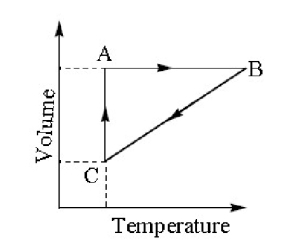
$5$ moles of a gas is allowed to pass through a series of changes as shown in the graph,in a cyclic process. The processes $C \rightarrow A$,$B \rightarrow C$ and $A \rightarrow B$ respectively are
A
Isothermal,Isochoric,Isobaric
B
Isochoric,Isobaric,Isothermal
C
Isobaric,Isochoric,Isothermal
D
Isothermal,Isobaric,Isochoric
Solution
(D) In the given $V-T$ graph:
$1$. Process $C \rightarrow A$: The temperature remains constant while the volume changes. This is an isothermal process.
$2$. Process $A \rightarrow B$: The volume remains constant while the temperature changes. This is an isochoric process.
$3$. Process $B \rightarrow C$: The graph is a straight line passing through the origin in a $V-T$ plot,which implies $V \propto T$. According to Charles's Law,this represents an isobaric process.
Therefore,the processes $C \rightarrow A$,$B \rightarrow C$,and $A \rightarrow B$ are isothermal,isobaric,and isochoric respectively.
$1$. Process $C \rightarrow A$: The temperature remains constant while the volume changes. This is an isothermal process.
$2$. Process $A \rightarrow B$: The volume remains constant while the temperature changes. This is an isochoric process.
$3$. Process $B \rightarrow C$: The graph is a straight line passing through the origin in a $V-T$ plot,which implies $V \propto T$. According to Charles's Law,this represents an isobaric process.
Therefore,the processes $C \rightarrow A$,$B \rightarrow C$,and $A \rightarrow B$ are isothermal,isobaric,and isochoric respectively.
0 likes
View SolutionStates of Matter — Characteristics and Measurable properties of gases · Frequently Asked Questions
1Are these States of Matter questions useful for JEE and NEET?
Yes. All questions in this section are mapped to JEE Main and NEET exam patterns. Previous year questions from JEE Main, NEET, GUJCET and state-level exams are included with full solutions.
2Can I switch to Hindi or Gujarati for these questions?
Yes. Use the language tabs in the hero section or the sidebar to view the same questions and solutions in English, Hindi or Gujarati.
3How do I generate a question paper from this subtopic?
Use the Vedclass Exam Paper Generator — select the chapter and subtopic, set difficulty, and generate Sets A, B, C, D automatically. First 3 chapters of every subject are free.
Vedclass Products
For Students
Vedclass Test Series
Mock tests in real JEE/NEET style with performance analysis. 5-day free trial.
Start Free TrialFor Teachers
Exam Paper Generator
Generate Set A/B/C/D papers from this chapter in 2 minutes. 3 chapters free.
Try FreeFor Institutes
Online Exam Module
Live online exams with unlimited students, 360° analytics & white-label branding.
See DemoFor Teachers & Institutes
Generate a States of Matter Exam Paper in 2 Minutes
Select subtopic & difficulty — Sets A, B, C, D auto-generated with No Repeat logic.
First 3 chapters of every subject are free — no payment required.