
A English
Characteristics and Measurable properties of gases Questions in English
Class 11 Chemistry · States of Matter · Characteristics and Measurable properties of gases
320+
Questions
English
Language
100%
With Solutions
Showing 50 of 320 questions in English
201
EasyMCQ
Why are liquids and gases categorised as fluids?
A
Because they have a fixed shape.
B
Because they have a property to flow.
C
Because they are incompressible.
D
Because they have strong intermolecular forces.
Solution
(B) Liquids and gases possess the ability to flow because their molecules are not held in fixed positions and can move past one another freely. Due to this characteristic property of flowing,they are collectively referred to as fluids.
0 likes
View Solution202
Easy
State Dalton$'$s law of partial pressures.
Solution
(N/A) Dalton$'$s law of partial pressures states that for a mixture of non-reacting gases,the total pressure exerted by the mixture is equal to the sum of the partial pressures of the individual gases.
Mathematically,it is expressed as: $P_{total} = p_1 + p_2 + p_3 + \dots + p_n$ (at constant temperature and volume),
where $P_{total}$ is the total pressure of the mixture and $p_1, p_2, \dots, p_n$ are the partial pressures of the individual gases.
Mathematically,it is expressed as: $P_{total} = p_1 + p_2 + p_3 + \dots + p_n$ (at constant temperature and volume),
where $P_{total}$ is the total pressure of the mixture and $p_1, p_2, \dots, p_n$ are the partial pressures of the individual gases.
0 likes
View Solution203
EasyMCQ
What is the boiling point of $SO_2$ gas (in $K$)?
A
$263$
B
$273$
C
$293$
D
$303$
Solution
(A) The boiling point of sulfur dioxide $(SO_2)$ is $263 \ K$.
0 likes
View Solution204
MediumMCQ
The behaviour of matter in different states is governed by various physical laws. According to you,what are the factors that determine the state of matter?
A
Temperature and pressure
B
Volume and mass
C
Temperature,pressure,volume,and mass
D
Only temperature
Solution
(C) The state of matter is primarily determined by the balance between the intermolecular forces and the thermal energy of the particles.
Factors such as $Temperature$,$Pressure$,$Volume$,and $Mass$ (or amount of substance) are the key variables that influence the physical state of matter,i.e.,$Solid$,$Liquid$,or $Gas$.
Factors such as $Temperature$,$Pressure$,$Volume$,and $Mass$ (or amount of substance) are the key variables that influence the physical state of matter,i.e.,$Solid$,$Liquid$,or $Gas$.
0 likes
View Solution205
MediumMCQ
Pressure exerted by saturated water vapour is called aqueous tension. What correction term will you apply to the total pressure to obtain the pressure of dry gas?
A
Add aqueous tension
B
Subtract aqueous tension
C
Multiply by aqueous tension
D
Divide by aqueous tension
Solution
(B) When a gas is collected over water,it becomes saturated with water vapours,which exert their own partial pressure known as aqueous tension.
The total pressure observed $(P_{\text{moist gas}})$ is the sum of the partial pressure of the dry gas and the aqueous tension:
$P_{\text{moist gas}} = P_{\text{dry gas}} + P_{\text{aqueous tension}}$
To obtain the pressure of the dry gas,we rearrange the equation:
$P_{\text{dry gas}} = P_{\text{moist gas}} - P_{\text{aqueous tension}}$
Therefore,the correction term applied is to subtract the aqueous tension from the total pressure.
The total pressure observed $(P_{\text{moist gas}})$ is the sum of the partial pressure of the dry gas and the aqueous tension:
$P_{\text{moist gas}} = P_{\text{dry gas}} + P_{\text{aqueous tension}}$
To obtain the pressure of the dry gas,we rearrange the equation:
$P_{\text{dry gas}} = P_{\text{moist gas}} - P_{\text{aqueous tension}}$
Therefore,the correction term applied is to subtract the aqueous tension from the total pressure.
0 likes
View Solution206
Medium
Name two phenomena that can be explained on the basis of surface tension.
Solution
(N/A) Two phenomena that can be explained on the basis of surface tension are as follows:
$(i)$ Rise or fall of a liquid in a capillary tube (capillary action).
$(ii)$ Spherical shape of small liquid drops.
$(i)$ Rise or fall of a liquid in a capillary tube (capillary action).
$(ii)$ Spherical shape of small liquid drops.
0 likes
View Solution207
Medium
Explain the effect of increasing the temperature of a liquid on the intermolecular forces operating between its particles. What will happen to the viscosity of a liquid if its temperature is increased?
Solution
(N/A) As the temperature of a liquid is increased,the kinetic energy of the molecules increases,which helps to overcome the intermolecular forces. Consequently,the liquid flows more easily,which results in a decrease in the viscosity of the liquid.
0 likes
View Solution208
Medium
Explain the term 'laminar flow'. Is the velocity of molecules same in all the layers in laminar flow? Explain your answer.
Solution
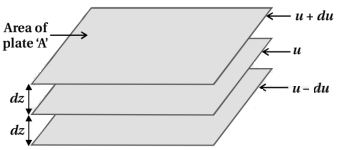
(N/A) When a liquid flows over a fixed surface,the layer of molecules in contact with the surface is stationary.
As the distance of the layers from the fixed surface increases,the velocity of the upper layers increases.
This type of flow,in which there is a regular gradation of velocity when passing from one layer to the next,is called laminar flow.
In laminar flow,the velocity of molecules is not the same in all the layers because every layer offers some resistance or friction to the layer immediately below it,resulting in a velocity gradient.
As the distance of the layers from the fixed surface increases,the velocity of the upper layers increases.
This type of flow,in which there is a regular gradation of velocity when passing from one layer to the next,is called laminar flow.
In laminar flow,the velocity of molecules is not the same in all the layers because every layer offers some resistance or friction to the layer immediately below it,resulting in a velocity gradient.
0 likes
View Solution209
MediumMCQ
What are the main states of matter?
A
Solid,Liquid,Gas
B
Solid,Liquid,Gas,Plasma
C
Solid,Liquid,Gas,Plasma,Bose-Einstein Condensate
D
Solid and Liquid only
Solution
(A) The three main states of matter are:
$(i)$ Solid
$(ii)$ Liquid
$(iii)$ Gas
Additionally,there are other states like Plasma and $BEC$ (Bose-Einstein Condensate).
$(i)$ Solid
$(ii)$ Liquid
$(iii)$ Gas
Additionally,there are other states like Plasma and $BEC$ (Bose-Einstein Condensate).
0 likes
View Solution210
MediumMCQ
Arrange the states of matter (solid,liquid,and gas) in increasing order of their energy.
A
Solid < Liquid < Gas
B
Gas < Liquid < Solid
C
Liquid < Solid < Gas
D
Solid < Gas < Liquid
Solution
(A) The kinetic energy of particles depends on the state of matter.
In solids,particles are tightly packed with minimal movement,resulting in the lowest energy.
In liquids,particles have more freedom of movement than in solids.
In gases,particles move randomly at high speeds,resulting in the highest energy.
Therefore,the increasing order of energy is $Solid < Liquid < Gas$.
In solids,particles are tightly packed with minimal movement,resulting in the lowest energy.
In liquids,particles have more freedom of movement than in solids.
In gases,particles move randomly at high speeds,resulting in the highest energy.
Therefore,the increasing order of energy is $Solid < Liquid < Gas$.
0 likes
View Solution211
MediumMCQ
Arrange the states of matter (solid,liquid,and gas) in increasing order of their thermal energy.
A
Solid < Liquid < Gas
B
Gas < Liquid < Solid
C
Liquid < Solid < Gas
D
Solid < Gas < Liquid
Solution
(A) Thermal energy is directly related to the motion of particles.
In solids,particles are fixed in position and have the least thermal energy.
In liquids,particles have more freedom of movement than in solids.
In gases,particles move randomly at high speeds,possessing the highest thermal energy.
Therefore,the increasing order of thermal energy is: $Solid < Liquid < Gas$.
In solids,particles are fixed in position and have the least thermal energy.
In liquids,particles have more freedom of movement than in solids.
In gases,particles move randomly at high speeds,possessing the highest thermal energy.
Therefore,the increasing order of thermal energy is: $Solid < Liquid < Gas$.
0 likes
View Solution212
MediumMCQ
What is the order of intermolecular forces in solids,liquids,and gases?
A
Gas > Liquid > Solid
B
Solid > Liquid > Gas
C
Liquid > Gas > Solid
D
Solid > Gas > Liquid
Solution
(B) The strength of intermolecular forces is directly related to the proximity of particles.
In gases,particles are far apart,so intermolecular forces are weakest.
In liquids,particles are closer than in gases,so forces are stronger.
In solids,particles are tightly packed,resulting in the strongest intermolecular forces.
Therefore,the order of increasing intermolecular forces is: $Gas < Liquid < Solid$.
In gases,particles are far apart,so intermolecular forces are weakest.
In liquids,particles are closer than in gases,so forces are stronger.
In solids,particles are tightly packed,resulting in the strongest intermolecular forces.
Therefore,the order of increasing intermolecular forces is: $Gas < Liquid < Solid$.
0 likes
View Solution213
MediumMCQ
What are the measurable properties of a gas?
A
Mass
B
Volume
C
Temperature and Pressure
D
All of the above
Solution
(D) The measurable properties of a gas are:
$(i)$ Mass
$(ii)$ Volume
$(iii)$ Temperature
$(iv)$ Pressure
Therefore,all these properties are measurable for a gas.
$(i)$ Mass
$(ii)$ Volume
$(iii)$ Temperature
$(iv)$ Pressure
Therefore,all these properties are measurable for a gas.
0 likes
View Solution214
Medium
Provide the $SI$ units for the following gas properties:
$(i)$ Mass $(ii)$ Volume $(iii)$ Temperature $(iv)$ Pressure
$(i)$ Mass $(ii)$ Volume $(iii)$ Temperature $(iv)$ Pressure
Solution
(N/A)
Note: $1 \, m^3 = 10^3 \, dm^3 = 1000 \, L = 10^6 \, cm^3$ and $1 \, atm = 101325 \, Pa$.
| Property | $SI$ Unit |
|---|---|
| $(i)$ Mass | Kilogram $(kg)$ |
| $(ii)$ Volume | Cubic meter $(m^3)$ |
| $(iii)$ Temperature | Kelvin $(K)$ |
| $(iv)$ Pressure | Pascal $(Pa)$ or $(N \cdot m^{-2})$ |
Note: $1 \, m^3 = 10^3 \, dm^3 = 1000 \, L = 10^6 \, cm^3$ and $1 \, atm = 101325 \, Pa$.
0 likes
View Solution215
MediumMCQ
List the different units of gas pressure.
A
$1 \ Pa = 1 \ N \ m^{-2}$
B
$1 \ bar = 10^5 \ Pa$
C
$1 \ atm = 101325 \ Pa$
D
$1 \ torr = 133.322 \ Pa$
Solution
(A) The different units of gas pressure are as follows:
$(i)$ $SI$ unit: Pascal $(Pa)$
$(ii)$ Bar $(bar)$
$(iii)$ Atmosphere $(atm)$
$(iv)$ Torr $(torr)$
$(i)$ $SI$ unit: Pascal $(Pa)$
$(ii)$ Bar $(bar)$
$(iii)$ Atmosphere $(atm)$
$(iv)$ Torr $(torr)$
0 likes
View Solution216
Easy
Show the relationship between different units of pressure.
Solution
$(i) \ 1 \, atm = 101.325 \, kPa = 101325 \, Pa = 101325 \, N \, m^{-2}$
$(ii) \ 1 \, bar = 10^5 \, Pa = 10^2 \, kPa = 10^5 \, N \, m^{-2}$
$(iii) \ 1 \, atm = 1.01325 \, bar$
$(iv) \ 1 \, atm = 76 \, cm \, Hg = 760 \, mm \, Hg = 760 \, torr$
$(v) \ 1 \, torr = 1 \, mm \, Hg$
Note: $1 \, bar$ is approximately equal to $1 \, atm$,but they are not identical.
$(ii) \ 1 \, bar = 10^5 \, Pa = 10^2 \, kPa = 10^5 \, N \, m^{-2}$
$(iii) \ 1 \, atm = 1.01325 \, bar$
$(iv) \ 1 \, atm = 76 \, cm \, Hg = 760 \, mm \, Hg = 760 \, torr$
$(v) \ 1 \, torr = 1 \, mm \, Hg$
Note: $1 \, bar$ is approximately equal to $1 \, atm$,but they are not identical.
0 likes
View Solution217
MediumMCQ
Write the order of kinetic energy for solid,liquid,and gas.
A
Solid < Liquid < Gas
B
Gas < Liquid < Solid
C
Liquid < Solid < Gas
D
Solid < Gas < Liquid
Solution
(A) The kinetic energy of particles depends on the state of matter.
In solids,particles are tightly packed and have the least kinetic energy.
In liquids,particles have more freedom of movement than in solids.
In gases,particles move randomly at high speeds,possessing the highest kinetic energy.
Therefore,the order of kinetic energy is: $Solid < Liquid < Gas$.
In solids,particles are tightly packed and have the least kinetic energy.
In liquids,particles have more freedom of movement than in solids.
In gases,particles move randomly at high speeds,possessing the highest kinetic energy.
Therefore,the order of kinetic energy is: $Solid < Liquid < Gas$.
0 likes
View Solution218
EasyMCQ
Which state of matter has a definite volume but no definite shape?
A
Solid
B
Liquid
C
Gas
D
Plasma
Solution
(B) The correct answer is $Liquid$.
Liquids have a definite volume because the intermolecular forces are strong enough to keep the molecules together,but they do not have a definite shape because the molecules can slide past each other,allowing the liquid to take the shape of the container.
Liquids have a definite volume because the intermolecular forces are strong enough to keep the molecules together,but they do not have a definite shape because the molecules can slide past each other,allowing the liquid to take the shape of the container.
0 likes
View Solution219
MediumMCQ
What is the value of $1 \, bar$ in Pascals? What does this value represent?
A
$10^{5} \, Pa$,Atmospheric pressure at sea level
B
$10^{3} \, Pa$,Pressure at the bottom of the ocean
C
$10^{2} \, Pa$,Standard vapor pressure
D
$10^{6} \, Pa$,Pressure of a gas cylinder
Solution
(A) $1 \, bar = 10^{5} \, Pa$.
This value represents the atmospheric pressure at sea level.
This value represents the atmospheric pressure at sea level.
0 likes
View Solution220
EasyMCQ
What will be the pressure at $0\,^oC$ in Kolkata,Chennai,and Mumbai (in $,bar$)?
A
$1$
B
$2$
C
$0.5$
D
$1.5$
Solution
(A) Since these cities are located at sea level,the atmospheric pressure at $0\,^oC$ $(273.15\,K)$ is considered the standard atmospheric pressure.
Therefore,the pressure is $1\,bar$ or $10^{5}\,Pa$.
Therefore,the pressure is $1\,bar$ or $10^{5}\,Pa$.
0 likes
View Solution221
Medium
What is the difference between $STP$ (or $NTP$) and $SATP$?
Solution
(N/A) $STP$ (Standard Temperature and Pressure) is defined as $273.15 \ K$ and $1 \ bar$ pressure. The molar volume of an ideal gas at $STP$ is $22.71 \ L \ mol^{-1}$.
$SATP$ (Standard Ambient Temperature and Pressure) is defined as $298.15 \ K$ and $1 \ bar$ pressure. The molar volume of an ideal gas at $SATP$ is $24.79 \ L \ mol^{-1}$.
$SATP$ (Standard Ambient Temperature and Pressure) is defined as $298.15 \ K$ and $1 \ bar$ pressure. The molar volume of an ideal gas at $SATP$ is $24.79 \ L \ mol^{-1}$.
0 likes
View Solution222
MediumMCQ
What is the absolute or Kelvin temperature scale?
A
$A$ scale starting from $0 \ K$ where $0 \ K = -273.15^{\circ}C$.
B
$A$ scale starting from $0^{\circ}C$.
C
$A$ scale based on the boiling point of water.
D
$A$ scale based on the freezing point of mercury.
Solution
(A) The absolute temperature scale,also known as the Kelvin scale,is defined such that $0 \ K$ is equivalent to $-273.15^{\circ}C$.
This scale is related to the Celsius scale by the equation: $T(K) = t(^{\circ}C) + 273.15$.
This scale is related to the Celsius scale by the equation: $T(K) = t(^{\circ}C) + 273.15$.
0 likes
View Solution223
Medium
Provide the mathematical expression for Dalton's law of partial pressure.
Solution
(N/A) According to Dalton's law of partial pressure,the total pressure exerted by a mixture of non-reacting gases is equal to the sum of the partial pressures of the individual gases.
The mathematical expression is:
$p_{total} = p_1 + p_2 + p_3 + \ldots + p_n$ $(i)$
Since $p_i = \frac{n_i RT}{V}$,the expression can be written as:
$p_{total} = (n_1 + n_2 + \ldots + n_n) \frac{RT}{V}$ (ii)
The mathematical expression is:
$p_{total} = p_1 + p_2 + p_3 + \ldots + p_n$ $(i)$
Since $p_i = \frac{n_i RT}{V}$,the expression can be written as:
$p_{total} = (n_1 + n_2 + \ldots + n_n) \frac{RT}{V}$ (ii)
0 likes
View Solution224
MediumMCQ
Write the formula to calculate the pressure of a dry gas collected over water.
A
$P_{\text{dry gas}} = P_{\text{total}} - P_{\text{water vapor}}$
B
$P_{\text{dry gas}} = P_{\text{total}} + P_{\text{water vapor}}$
C
$P_{\text{dry gas}} = P_{\text{total}} \times P_{\text{water vapor}}$
D
$P_{\text{dry gas}} = P_{\text{total}} / P_{\text{water vapor}}$
Solution
(A) When a gas is collected over water,it becomes moist and contains water vapor. The total pressure observed is the sum of the partial pressure of the dry gas and the vapor pressure of water (aqueous tension).
According to Dalton's Law of Partial Pressures: $P_{\text{total}} = P_{\text{dry gas}} + P_{\text{water vapor}}$.
Therefore,the pressure of the dry gas is calculated as: $P_{\text{dry gas}} = P_{\text{total}} - P_{\text{water vapor}}$.
According to Dalton's Law of Partial Pressures: $P_{\text{total}} = P_{\text{dry gas}} + P_{\text{water vapor}}$.
Therefore,the pressure of the dry gas is calculated as: $P_{\text{dry gas}} = P_{\text{total}} - P_{\text{water vapor}}$.
0 likes
View Solution225
Easy
Write the formula for partial pressure.
Solution
(N/A) $(i) \text{ Partial pressure } = p_{1} = \frac{n_{1} RT}{V} \dots (i)$
$(ii) \text{ Partial pressure } = p_{1} = x_{1} p_{\text{total}} \dots (ii)$
$(iii) \text{ Partial pressure } = p_{1} = \text{Volume percentage of gas} \times \frac{p_{\text{total}}}{100}$
$(ii) \text{ Partial pressure } = p_{1} = x_{1} p_{\text{total}} \dots (ii)$
$(iii) \text{ Partial pressure } = p_{1} = \text{Volume percentage of gas} \times \frac{p_{\text{total}}}{100}$
0 likes
View Solution226
MediumMCQ
In a mixture of $CO_2$ and $CH_4$ in a closed vessel at a constant temperature,the total pressure is $8.3 \times 10^4 \, Pa$. If the partial pressure of $CO_2$ is $2.8 \times 10^4 \, Pa$,what will be the partial pressure of $CH_4$?
A
$5.5 \times 10^4 \, Pa$
B
$11.1 \times 10^4 \, Pa$
C
$2.8 \times 10^4 \, Pa$
D
$8.3 \times 10^4 \, Pa$
Solution
(A) According to Dalton's Law of Partial Pressures,the total pressure $(P_{total})$ of a mixture of non-reacting gases is equal to the sum of their partial pressures.
$P_{total} = P_{CO_2} + P_{CH_4}$
Given:
$P_{total} = 8.3 \times 10^4 \, Pa$
$P_{CO_2} = 2.8 \times 10^4 \, Pa$
Substituting the values:
$8.3 \times 10^4 \, Pa = 2.8 \times 10^4 \, Pa + P_{CH_4}$
$P_{CH_4} = (8.3 - 2.8) \times 10^4 \, Pa$
$P_{CH_4} = 5.5 \times 10^4 \, Pa$
$P_{total} = P_{CO_2} + P_{CH_4}$
Given:
$P_{total} = 8.3 \times 10^4 \, Pa$
$P_{CO_2} = 2.8 \times 10^4 \, Pa$
Substituting the values:
$8.3 \times 10^4 \, Pa = 2.8 \times 10^4 \, Pa + P_{CH_4}$
$P_{CH_4} = (8.3 - 2.8) \times 10^4 \, Pa$
$P_{CH_4} = 5.5 \times 10^4 \, Pa$
0 likes
View Solution227
MediumMCQ
What is meant by payload?
A
The mass of the gas inside the balloon
B
The total mass of the balloon and the gas
C
The difference between the mass of the air displaced by the balloon and the total mass of the balloon
D
The mass of the air displaced by the balloon
Solution
(C) The payload is defined as the difference between the mass of the air displaced by the balloon and the total mass of the balloon.
0 likes
View Solution228
MediumMCQ
Why are gases highly compressible?
A
Due to strong intermolecular forces.
B
Due to large intermolecular spaces between gas molecules.
C
Due to the fixed shape of gas molecules.
D
Due to the high density of gas molecules.
Solution
(B) Gases are highly compressible because there are large intermolecular spaces between the gas molecules. When pressure is applied,these molecules come closer to each other,significantly reducing the volume.
0 likes
View Solution229
MediumMCQ
What volume does a gas occupy at $STP$?
A
The volume of the container
B
The volume of the gas molecules
C
Zero
D
Infinite
Solution
(A) At $STP$,since there are negligible forces of attraction between gas molecules,gases expand to occupy the entire available space of the container. Therefore,a gas occupies the volume of the container.
0 likes
View Solution230
Medium
Write four main properties of gases.
Solution
(N/A) $(i)$ Gases are highly compressible.
$(ii)$ Gases mix easily and diffuse throughout the available space.
$(iii)$ Gases do not have a definite shape or volume.
$(iv)$ There is negligible intermolecular attraction between gas molecules.
$(ii)$ Gases mix easily and diffuse throughout the available space.
$(iii)$ Gases do not have a definite shape or volume.
$(iv)$ There is negligible intermolecular attraction between gas molecules.
0 likes
View Solution231
MediumMCQ
If $H_2S$ and $NH_3$ gases are released simultaneously from a cylinder through a small hole,which gas will be detected first and why?
A
$H_2S$ will be detected first because it is heavier.
B
$NH_3$ will be detected first because it is lighter.
C
Both will be detected at the same time.
D
None of the above.
Solution
(B) According to Graham's Law of Diffusion,the rate of diffusion $(r)$ is inversely proportional to the square root of the molar mass $(M)$: $r \propto \frac{1}{\sqrt{M}}$.
For $NH_3$,$M = 17 \ g/mol$.
For $H_2S$,$M = 34 \ g/mol$.
Since $NH_3$ has a lower molar mass than $H_2S$,it diffuses faster and will be detected first.
For $NH_3$,$M = 17 \ g/mol$.
For $H_2S$,$M = 34 \ g/mol$.
Since $NH_3$ has a lower molar mass than $H_2S$,it diffuses faster and will be detected first.
0 likes
View Solution232
EasyMCQ
Which has higher density: dry air or moist air? Why?
A
Dry air,because it contains heavier molecules like $N_2$ $(28)$,$O_2$ $(32)$,and $CO_2$ $(44)$.
B
Moist air,because water vapor is heavier than air.
C
Both have the same density.
D
None of the above.
Solution
(A) Dry air has a higher density than moist air.
This is because dry air consists of $N_2$ $(28 \ g/mol)$,$O_2$ $(32 \ g/mol)$,and $CO_2$ $(44 \ g/mol)$,which have higher molar masses.
In moist air,some of these molecules are replaced by water vapor $(H_2O)$,which has a lower molar mass of $18 \ g/mol$.
According to Avogadro's law,at constant temperature and pressure,the density of a gas is directly proportional to its molar mass. Therefore,replacing heavier air molecules with lighter water vapor molecules decreases the overall density of the air.
This is because dry air consists of $N_2$ $(28 \ g/mol)$,$O_2$ $(32 \ g/mol)$,and $CO_2$ $(44 \ g/mol)$,which have higher molar masses.
In moist air,some of these molecules are replaced by water vapor $(H_2O)$,which has a lower molar mass of $18 \ g/mol$.
According to Avogadro's law,at constant temperature and pressure,the density of a gas is directly proportional to its molar mass. Therefore,replacing heavier air molecules with lighter water vapor molecules decreases the overall density of the air.
0 likes
View Solution233
Medium
In which of the following gas mixtures does Dalton's Law of Partial Pressure not apply? Why?
$(i)$ $CO_2 + O_2 + N_2$
$(ii)$ $CO + O_2$
$(iii)$ $NH_3 + HCl$
$(iv)$ $HCl + O_2$
$(i)$ $CO_2 + O_2 + N_2$
$(ii)$ $CO + O_2$
$(iii)$ $NH_3 + HCl$
$(iv)$ $HCl + O_2$
Solution
(B, C) Dalton's Law of Partial Pressure applies only to non-reacting gas mixtures.
$(i)$ $CO_2 + O_2 + N_2$ and $(iv)$ $HCl + O_2$ are non-reacting mixtures,so the law applies.
$(ii)$ $CO + O_2$ and $(iii)$ $NH_3 + HCl$ are reacting mixtures,so the law does not apply.
Chemical reactions:
$(ii)$ $2CO + O_2 \rightarrow 2CO_2$
$(iii)$ $NH_3 + HCl \rightarrow NH_4Cl$
$(i)$ $CO_2 + O_2 + N_2$ and $(iv)$ $HCl + O_2$ are non-reacting mixtures,so the law applies.
$(ii)$ $CO + O_2$ and $(iii)$ $NH_3 + HCl$ are reacting mixtures,so the law does not apply.
Chemical reactions:
$(ii)$ $2CO + O_2 \rightarrow 2CO_2$
$(iii)$ $NH_3 + HCl \rightarrow NH_4Cl$
0 likes
View Solution234
EasyMCQ
What is the relationship between viscosity and pressure?
A
Viscosity increases with pressure
B
Viscosity decreases with pressure
C
Viscosity is independent of pressure
D
Viscosity is inversely proportional to pressure
Solution
(A) For most liquids,viscosity increases with an increase in pressure because the molecules are forced closer together,increasing intermolecular forces.
Exception: For water $(H_2O)$,the viscosity decreases with an increase in pressure at temperatures below $32 \ ^\circ C$.
Exception: For water $(H_2O)$,the viscosity decreases with an increase in pressure at temperatures below $32 \ ^\circ C$.
0 likes
View Solution235
EasyMCQ
What is the reason that a liquid can flow from one container to another at a specific temperature?
A
Strong intermolecular forces
B
Molecules can move freely past one another
C
Fixed shape and volume
D
High kinetic energy of particles
Solution
(B) The molecules in a liquid are not held in fixed positions and can move freely past one another. This property allows the liquid to flow,be poured,and take the shape of the container it is placed in.
0 likes
View Solution236
EasyMCQ
Write the important physical properties of liquids.
A
Vapour pressure
B
Surface tension
C
Viscosity
D
All of the above
Solution
(D) The important physical properties of liquids are:
$(i)$ Vapour pressure
$(ii)$ Surface tension
$(iii)$ Viscosity
$(i)$ Vapour pressure
$(ii)$ Surface tension
$(iii)$ Viscosity
0 likes
View Solution237
Easy
What is saturated vapor pressure?
Solution
(N/A) When a liquid is partially filled in an evacuated closed container at a constant temperature,an equilibrium is established between the liquid phase and the vapor phase after some time. The vapor pressure at this equilibrium state is called 'equilibrium vapor pressure' or 'saturated vapor pressure'.
0 likes
View Solution238
EasyMCQ
On what factors does the vapor pressure of a liquid depend?
A
Temperature only
B
Nature of the liquid only
C
Both temperature and nature of the liquid
D
None of the above
Solution
(C) The vapor pressure of a liquid depends on two main factors:
$(i)$ Temperature: As the temperature increases,the kinetic energy of the molecules increases,leading to higher vapor pressure.
$(ii)$ Nature of the liquid: Liquids with weaker intermolecular forces have higher vapor pressure at a given temperature.
$(i)$ Temperature: As the temperature increases,the kinetic energy of the molecules increases,leading to higher vapor pressure.
$(ii)$ Nature of the liquid: Liquids with weaker intermolecular forces have higher vapor pressure at a given temperature.
0 likes
View Solution239
Easy
What is the boiling point?
Solution
(N/A) The temperature at which the vapor pressure of a liquid becomes equal to the external atmospheric pressure is called the boiling point of that liquid.
Normal boiling point: The boiling point at $1 \ atm$ pressure is called the normal boiling point.
Standard boiling point: The boiling point at $1 \ bar$ pressure is called the standard boiling point of the liquid.
Normal boiling point: The boiling point at $1 \ atm$ pressure is called the normal boiling point.
Standard boiling point: The boiling point at $1 \ bar$ pressure is called the standard boiling point of the liquid.
0 likes
View Solution240
Easy
Where will the boiling point be lower: at the seashore or on a mountain? Why?
Solution
(N/A) The boiling point is lower on a mountain. This is because the atmospheric pressure is lower at higher altitudes compared to the seashore.
0 likes
View Solution241
EasyMCQ
Why are surgical instruments in hospitals sterilized in an autoclave?
A
To increase the boiling point of water.
B
To decrease the boiling point of water.
C
To maintain a constant pressure.
D
To remove impurities.
Solution
(A) Surgical instruments are sterilized in an autoclave because it operates at a pressure higher than atmospheric pressure.
This increased pressure raises the boiling point of water,allowing steam to reach temperatures above $100 \ ^\circ C$.
This high-temperature steam effectively kills bacteria and microorganisms,ensuring complete sterilization.
This increased pressure raises the boiling point of water,allowing steam to reach temperatures above $100 \ ^\circ C$.
This high-temperature steam effectively kills bacteria and microorganisms,ensuring complete sterilization.
0 likes
View Solution242
EasyMCQ
Define surface tension and provide its dimensions and $SI$ unit.
A
Force per unit area,$N m^{-2}$
B
Force per unit length,$N m^{-1}$
C
Force per unit volume,$N m^{-3}$
D
Energy per unit area,$J m^{-2}$
Solution
(B) Definition: Surface tension is defined as the force acting per unit length perpendicular to the line drawn on the surface of the liquid.
Mathematical expression: $\gamma = \frac{F}{l}$
Dimensions: The force $F$ has dimensions $[MLT^{-2}]$ and length $l$ has dimensions $[L]$. Thus,surface tension has dimensions $[MLT^{-2}] / [L] = [MT^{-2}]$.
$SI$ unit: Since force is measured in $N$ and length in $m$,the $SI$ unit is $N m^{-1}$ (or $kg \ s^{-2}$).
Mathematical expression: $\gamma = \frac{F}{l}$
Dimensions: The force $F$ has dimensions $[MLT^{-2}]$ and length $l$ has dimensions $[L]$. Thus,surface tension has dimensions $[MLT^{-2}] / [L] = [MT^{-2}]$.
$SI$ unit: Since force is measured in $N$ and length in $m$,the $SI$ unit is $N m^{-1}$ (or $kg \ s^{-2}$).
0 likes
View Solution243
EasyMCQ
Which shape does a liquid have in its lowest energy state?
A
Cylindrical
B
Spherical
C
Cubical
D
Irregular
Solution
(B) liquid has its lowest energy state when its surface area is minimized. For a given volume,a sphere has the minimum surface area. Therefore,in the absence of external forces,liquid droplets tend to be $Spherical$ to minimize their surface energy.
0 likes
View Solution244
EasyMCQ
On what factor does the magnitude of surface tension depend?
A
Intermolecular forces
B
Temperature
C
Both $(A)$ and $(B)$
D
None of these
Solution
(C) The magnitude of surface tension depends on the strength of the attractive forces between the molecules.
Stronger intermolecular forces result in higher surface tension.
Surface tension decreases with an increase in temperature because increased kinetic energy reduces the effective intermolecular attraction.
Stronger intermolecular forces result in higher surface tension.
Surface tension decreases with an increase in temperature because increased kinetic energy reduces the effective intermolecular attraction.
0 likes
View Solution245
EasyMCQ
What is viscosity?
A
The resistance to flow of a liquid.
B
The measure of the internal friction between layers of a liquid as they flow past each other.
C
The force of attraction between molecules of a liquid.
D
The tendency of a liquid to maintain its shape.
Solution
(B) Viscosity is a measure of the internal resistance to flow offered by one layer of liquid to another layer while moving past each other.
0 likes
View Solution246
EasyMCQ
On what factors does the force $F$ required to maintain the flow of layers in a liquid depend?
A
Area of contact of the layers $(A)$
B
Velocity gradient $\left(\frac{dv}{dz}\right)$
C
Both $(A)$ and $(B)$
D
None of these
Solution
(C) The force $F$ required to maintain the flow of layers in a liquid depends on:
$(i)$ The area of contact of the layers $(A)$.
$(ii)$ The velocity gradient $\left(\frac{dv}{dz}\right)$.
According to Newton's law of viscosity,$F \propto A$ and $F \propto \frac{dv}{dz}$.
Therefore,$F = \eta A \left(\frac{dv}{dz}\right)$,where $\eta$ is the coefficient of viscosity.
$(i)$ The area of contact of the layers $(A)$.
$(ii)$ The velocity gradient $\left(\frac{dv}{dz}\right)$.
According to Newton's law of viscosity,$F \propto A$ and $F \propto \frac{dv}{dz}$.
Therefore,$F = \eta A \left(\frac{dv}{dz}\right)$,where $\eta$ is the coefficient of viscosity.
0 likes
View Solution247
Easy
What is the coefficient of viscosity? Give its unit.
Solution
(N/A) The force $F$ required to maintain the flow of layers in a liquid is given by the formula:
$F = \eta A \frac{dv}{dz}$
where $\eta = \frac{F}{A(dv/dz)}$.
Here,$\eta$ is the constant of proportionality and is called the coefficient of viscosity.
If the contact area $A = 1$ unit and the velocity gradient $\frac{dv}{dz} = 1$,then $\eta = F$.
Thus,the coefficient of viscosity $(\eta)$ is the force required when the velocity gradient and the contact area are unity.
Its $SI$ unit is $N \cdot s \cdot m^{-2}$ or $Pa \cdot s$ (Pascal-second).
In $kg \cdot m^{-1} \cdot s^{-1}$,the unit is $1 \ kg \cdot m^{-1} \cdot s^{-1} = 1 \ Pa \cdot s$.
The $CGS$ unit is $Poise$ $(P)$.
$1 \ P = 1 \ g \cdot cm^{-1} \cdot s^{-1} = 0.1 \ kg \cdot m^{-1} \cdot s^{-1}$.
$F = \eta A \frac{dv}{dz}$
where $\eta = \frac{F}{A(dv/dz)}$.
Here,$\eta$ is the constant of proportionality and is called the coefficient of viscosity.
If the contact area $A = 1$ unit and the velocity gradient $\frac{dv}{dz} = 1$,then $\eta = F$.
Thus,the coefficient of viscosity $(\eta)$ is the force required when the velocity gradient and the contact area are unity.
Its $SI$ unit is $N \cdot s \cdot m^{-2}$ or $Pa \cdot s$ (Pascal-second).
In $kg \cdot m^{-1} \cdot s^{-1}$,the unit is $1 \ kg \cdot m^{-1} \cdot s^{-1} = 1 \ Pa \cdot s$.
The $CGS$ unit is $Poise$ $(P)$.
$1 \ P = 1 \ g \cdot cm^{-1} \cdot s^{-1} = 0.1 \ kg \cdot m^{-1} \cdot s^{-1}$.
0 likes
View Solution248
Medium
Fill in the blanks:
$(1)$ The forces of attraction and repulsion between molecules and atoms are called ....... .
$(2)$ The attractive intermolecular forces between molecules of a substance are also known as .............. .
$(3)$ London forces are also known by the name of ........... .
$(4)$ The mathematical form of Charles's Law is ........ .
$(1)$ The forces of attraction and repulsion between molecules and atoms are called ....... .
$(2)$ The attractive intermolecular forces between molecules of a substance are also known as .............. .
$(3)$ London forces are also known by the name of ........... .
$(4)$ The mathematical form of Charles's Law is ........ .
Solution
(N/A) $(1)$ Intermolecular forces
$(2)$ Van der Waals forces
$(3)$ Dispersion forces
$(4)$ $V = k_2T$
$(2)$ Van der Waals forces
$(3)$ Dispersion forces
$(4)$ $V = k_2T$
0 likes
View Solution249
Medium
Fill in the blanks:
$(1)$ The temperature at which gases possess zero volume is called ........... .
$(2)$ In a mixture of gases,the pressure exerted by each individual gas is called .......... .
$(3)$ The pressure exerted by water vapor is known as ..... .
$(4)$ Thermal energy is directly proportional to the ..... of the substance.
$(1)$ The temperature at which gases possess zero volume is called ........... .
$(2)$ In a mixture of gases,the pressure exerted by each individual gas is called .......... .
$(3)$ The pressure exerted by water vapor is known as ..... .
$(4)$ Thermal energy is directly proportional to the ..... of the substance.
Solution
(N/A) $(1)$ Absolute zero
$(2)$ Partial pressure
$(3)$ Aqueous tension
$(4)$ Temperature
$(2)$ Partial pressure
$(3)$ Aqueous tension
$(4)$ Temperature
0 likes
View Solution250
Medium
Fill in the blanks:
$(1)$ The properties of gases were first measured by ......... .
$(2)$ The dipole-dipole interaction energy between stationary polar molecules is proportional to .......... .
$(3)$ The interaction energy between rotating polar molecules is proportional to .......... .
$(4)$ The bond energy of a hydrogen bond is about ......... $kJ \ mol^{-1}$.
$(1)$ The properties of gases were first measured by ......... .
$(2)$ The dipole-dipole interaction energy between stationary polar molecules is proportional to .......... .
$(3)$ The interaction energy between rotating polar molecules is proportional to .......... .
$(4)$ The bond energy of a hydrogen bond is about ......... $kJ \ mol^{-1}$.
Solution
(N/A) $(1)$ Robert Boyle
$(2)$ $\frac{1}{r^3}$
$(3)$ $\frac{1}{r^6}$
$(4)$ $10$ to $100$
$(2)$ $\frac{1}{r^3}$
$(3)$ $\frac{1}{r^6}$
$(4)$ $10$ to $100$
0 likes
View SolutionStates of Matter — Characteristics and Measurable properties of gases · Frequently Asked Questions
1Are these States of Matter questions useful for JEE and NEET?
Yes. All questions in this section are mapped to JEE Main and NEET exam patterns. Previous year questions from JEE Main, NEET, GUJCET and state-level exams are included with full solutions.
2Can I switch to Hindi or Gujarati for these questions?
Yes. Use the language tabs in the hero section or the sidebar to view the same questions and solutions in English, Hindi or Gujarati.
3How do I generate a question paper from this subtopic?
Use the Vedclass Exam Paper Generator — select the chapter and subtopic, set difficulty, and generate Sets A, B, C, D automatically. First 3 chapters of every subject are free.
Vedclass Products
For Students
Vedclass Test Series
Mock tests in real JEE/NEET style with performance analysis. 5-day free trial.
Start Free TrialFor Teachers
Exam Paper Generator
Generate Set A/B/C/D papers from this chapter in 2 minutes. 3 chapters free.
Try FreeFor Institutes
Online Exam Module
Live online exams with unlimited students, 360° analytics & white-label branding.
See DemoFor Teachers & Institutes
Generate a States of Matter Exam Paper in 2 Minutes
Select subtopic & difficulty — Sets A, B, C, D auto-generated with No Repeat logic.
First 3 chapters of every subject are free — no payment required.