
A English
Percentage composition and Molecular formula Questions in English
Class 11 Chemistry · Some Basic Concepts of Chemistry · Percentage composition and Molecular formula
301+
Questions
English
Language
100%
With Solutions
Showing 50 of 301 questions in English
201
EasyMCQ
Which of the following is the formula for calcium chlorite?
A
$CaCl{O_2}$
B
$Ca(ClO_4)_2$
C
$Ca(ClO_3)_2$
D
$Ca(ClO_2)_2$
Solution
(D) The chlorite ion is represented as $ClO_2^-$.
Calcium is an alkaline earth metal with a valency of $+2$,represented as $Ca^{2+}$.
To form a neutral compound,the charges must balance.
Therefore,one $Ca^{2+}$ ion combines with two $ClO_2^-$ ions.
The chemical formula is $Ca(ClO_2)_2$.
Calcium is an alkaline earth metal with a valency of $+2$,represented as $Ca^{2+}$.
To form a neutral compound,the charges must balance.
Therefore,one $Ca^{2+}$ ion combines with two $ClO_2^-$ ions.
The chemical formula is $Ca(ClO_2)_2$.
0 likes
View Solution202
DifficultMCQ
In a hydrocarbon,the mass ratio of hydrogen and carbon is $1 : 3$. The empirical formula of the hydrocarbon is
A
$CH_4$
B
$CH_2$
C
$C_2H$
D
$CH_3$
Solution
(A) The atomic mass of $H = 1 \ g/mol$ and $C = 12 \ g/mol$.
Given the mass ratio of $H : C = 1 : 3$.
To find the mole ratio,divide the mass by the respective atomic mass:
Moles of $H = 1 / 1 = 1$.
Moles of $C = 3 / 12 = 0.25$.
Now,find the simplest molar ratio:
$H : C = 1 : 0.25 = 4 : 1$.
Therefore,for every $1$ atom of $C$,there are $4$ atoms of $H$.
Hence,the empirical formula is $CH_4$.
Given the mass ratio of $H : C = 1 : 3$.
To find the mole ratio,divide the mass by the respective atomic mass:
Moles of $H = 1 / 1 = 1$.
Moles of $C = 3 / 12 = 0.25$.
Now,find the simplest molar ratio:
$H : C = 1 : 0.25 = 4 : 1$.
Therefore,for every $1$ atom of $C$,there are $4$ atoms of $H$.
Hence,the empirical formula is $CH_4$.
0 likes
View Solution203
DifficultMCQ
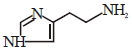
The mass percentage of nitrogen in histamine is
A
$37.84$
B
$42.67$
C
$33.33$
D
$62.16$
Solution
(A) The molecular formula of histamine is $C_5H_9N_3$.
The molar mass of histamine is $(5 \times 12) + (9 \times 1) + (3 \times 14) = 60 + 9 + 42 = 111 \ g/mol$.
The mass of nitrogen in one mole of histamine is $3 \times 14 = 42 \ g$.
The mass percentage of nitrogen is calculated as:
$\text{Mass } \% = (\frac{\text{Mass of nitrogen}}{\text{Molar mass of histamine}}) \times 100$
$\text{Mass } \% = (\frac{42}{111}) \times 100 = 37.8378 \% \approx 37.84 \%$.
The molar mass of histamine is $(5 \times 12) + (9 \times 1) + (3 \times 14) = 60 + 9 + 42 = 111 \ g/mol$.
The mass of nitrogen in one mole of histamine is $3 \times 14 = 42 \ g$.
The mass percentage of nitrogen is calculated as:
$\text{Mass } \% = (\frac{\text{Mass of nitrogen}}{\text{Molar mass of histamine}}) \times 100$
$\text{Mass } \% = (\frac{42}{111}) \times 100 = 37.8378 \% \approx 37.84 \%$.
0 likes
View Solution204
MediumMCQ
$A$ compound contains $4.07\%$ hydrogen,$24.27\%$ carbon,and $71.65\%$ chlorine. Its molar mass is $98.96\ g/mol$. What are its empirical and molecular formulas?
A
$CH_2Cl$ and $C_2H_4Cl_2$
B
$CH_2Cl$ and $CH_2Cl$
C
$C_2H_4Cl_2$ and $CH_2Cl$
D
$CH_2Cl_2$ and $C_2H_4Cl_4$
Solution
(A) Step $1.$ Conversion of mass percent to grams.
Assuming $100\ g$ of the compound,we have $4.07\ g$ hydrogen,$24.27\ g$ carbon,and $71.65\ g$ chlorine.
Step $2.$ Convert into number of moles of each element.
Moles of $H = 4.07 / 1.008 = 4.04$
Moles of $C = 24.27 / 12.01 = 2.021$
Moles of $Cl = 71.65 / 35.453 = 2.021$
Step $3.$ Divide by the smallest mole value $(2.021)$.
Ratio $H:C:Cl = 4.04/2.021 : 2.021/2.021 : 2.021/2.021 = 2:1:1$.
Step $4.$ Empirical formula is $CH_2Cl$.
Step $5.$ Molecular formula.
Empirical formula mass $= 12.01 + (2 \times 1.008) + 35.453 = 49.48\ g/mol$.
$n = \text{Molar mass} / \text{Empirical formula mass} = 98.96 / 49.48 = 2$.
Molecular formula $= n \times (CH_2Cl) = C_2H_4Cl_2$.
Assuming $100\ g$ of the compound,we have $4.07\ g$ hydrogen,$24.27\ g$ carbon,and $71.65\ g$ chlorine.
Step $2.$ Convert into number of moles of each element.
Moles of $H = 4.07 / 1.008 = 4.04$
Moles of $C = 24.27 / 12.01 = 2.021$
Moles of $Cl = 71.65 / 35.453 = 2.021$
Step $3.$ Divide by the smallest mole value $(2.021)$.
Ratio $H:C:Cl = 4.04/2.021 : 2.021/2.021 : 2.021/2.021 = 2:1:1$.
Step $4.$ Empirical formula is $CH_2Cl$.
Step $5.$ Molecular formula.
Empirical formula mass $= 12.01 + (2 \times 1.008) + 35.453 = 49.48\ g/mol$.
$n = \text{Molar mass} / \text{Empirical formula mass} = 98.96 / 49.48 = 2$.
Molecular formula $= n \times (CH_2Cl) = C_2H_4Cl_2$.
0 likes
View Solution205
Medium
Calculate the mass percent of different elements present in sodium sulphate $(Na_{2}SO_{4})$.
Solution
The molecular formula of sodium sulphate is $Na_{2}SO_{4}$.
Molar mass of $Na_{2}SO_{4} = [(2 \times 23.0) + (32.066) + 4(16.00)] = 142.066 \ g/mol$.
Mass percent of an element $= \frac{\text{Mass of that element in the compound}}{\text{Molar mass of the compound}} \times 100$.
Mass percent of sodium $= \frac{46.0}{142.066} \times 100 = 32.379 \% \approx 32.4 \%$.
Mass percent of sulphur $= \frac{32.066}{142.066} \times 100 = 22.571 \% \approx 22.6 \%$.
Mass percent of oxygen $= \frac{64.0}{142.066} \times 100 = 45.049 \% \approx 45.05 \%$.
Molar mass of $Na_{2}SO_{4} = [(2 \times 23.0) + (32.066) + 4(16.00)] = 142.066 \ g/mol$.
Mass percent of an element $= \frac{\text{Mass of that element in the compound}}{\text{Molar mass of the compound}} \times 100$.
Mass percent of sodium $= \frac{46.0}{142.066} \times 100 = 32.379 \% \approx 32.4 \%$.
Mass percent of sulphur $= \frac{32.066}{142.066} \times 100 = 22.571 \% \approx 22.6 \%$.
Mass percent of oxygen $= \frac{64.0}{142.066} \times 100 = 45.049 \% \approx 45.05 \%$.
0 likes
View Solution206
MediumMCQ
Determine the empirical formula of an oxide of iron which has $69.9 \%$ iron and $30.1 \%$ dioxygen by mass.
A
$FeO$
B
$Fe_2O_3$
C
$Fe_3O_4$
D
$Fe_2O$
Solution
(B) Relative moles of iron $= \frac{69.9}{55.85} = 1.25$
Relative moles of oxygen $= \frac{30.1}{16.00} = 1.88$
Simplest molar ratio of iron to oxygen $= 1.25 : 1.88 = 1 : 1.5 = 2 : 3$
Therefore,the empirical formula of the iron oxide is $Fe_2O_3$.
Relative moles of oxygen $= \frac{30.1}{16.00} = 1.88$
Simplest molar ratio of iron to oxygen $= 1.25 : 1.88 = 1 : 1.5 = 2 : 3$
Therefore,the empirical formula of the iron oxide is $Fe_2O_3$.
0 likes
View Solution207
Difficult
How much copper can be obtained from $100 \, g$ of copper sulphate $(CuSO_{4})$?
Solution
(N/A) $1$ mole of $CuSO_{4}$ contains $1$ mole of copper.
Molar mass of $CuSO_{4} = 63.5 + 32.00 + 4(16.00) = 159.5 \, g/mol$.
$159.5 \, g$ of $CuSO_{4}$ contains $63.5 \, g$ of copper.
Therefore,$100 \, g$ of $CuSO_{4}$ will contain $\frac{63.5 \times 100}{159.5} \, g$ of copper.
Amount of copper $= 39.81 \, g$.
Molar mass of $CuSO_{4} = 63.5 + 32.00 + 4(16.00) = 159.5 \, g/mol$.
$159.5 \, g$ of $CuSO_{4}$ contains $63.5 \, g$ of copper.
Therefore,$100 \, g$ of $CuSO_{4}$ will contain $\frac{63.5 \times 100}{159.5} \, g$ of copper.
Amount of copper $= 39.81 \, g$.
0 likes
View Solution208
MediumMCQ
Determine the molecular formula of an oxide of iron in which the mass per cent of iron and oxygen are $69.9$ and $30.1$ respectively. Given that the molar mass of the oxide is $159.69 \, g \, mol^{-1}$.
A
$FeO$
B
$Fe_2O_3$
C
$Fe_3O_4$
D
$Fe_2O_4$
Solution
(B) Mass percent of iron $(Fe) = 69.9 \%$.
Mass percent of oxygen $(O) = 30.1 \%$.
Number of moles of iron $= \frac{69.9}{55.85} = 1.25 \, mol$.
Number of moles of oxygen $= \frac{30.1}{16.0} = 1.88 \, mol$.
Ratio of iron to oxygen $= 1.25 : 1.88 = 1 : 1.5 = 2 : 3$.
Empirical formula $= Fe_2O_3$.
Empirical formula mass $= 2(55.85) + 3(16.00) = 159.7 \, g \, mol^{-1}$.
$n = \frac{\text{Molar mass}}{\text{Empirical formula mass}} = \frac{159.69}{159.7} \approx 1$.
Molecular formula $= n \times \text{Empirical formula} = 1 \times Fe_2O_3 = Fe_2O_3$.
Mass percent of oxygen $(O) = 30.1 \%$.
Number of moles of iron $= \frac{69.9}{55.85} = 1.25 \, mol$.
Number of moles of oxygen $= \frac{30.1}{16.0} = 1.88 \, mol$.
Ratio of iron to oxygen $= 1.25 : 1.88 = 1 : 1.5 = 2 : 3$.
Empirical formula $= Fe_2O_3$.
Empirical formula mass $= 2(55.85) + 3(16.00) = 159.7 \, g \, mol^{-1}$.
$n = \frac{\text{Molar mass}}{\text{Empirical formula mass}} = \frac{159.69}{159.7} \approx 1$.
Molecular formula $= n \times \text{Empirical formula} = 1 \times Fe_2O_3 = Fe_2O_3$.
0 likes
View Solution209
Difficult
$A$ welding fuel gas contains carbon and hydrogen only. Burning a small sample of it in oxygen gives $3.38 \, g$ of carbon dioxide,$0.690 \, g$ of water,and no other products. $A$ volume of $10.0 \, L$ (measured at $STP$) of this welding gas is found to weigh $11.6 \, g$. Calculate:
$(i)$ empirical formula,
$(ii)$ molar mass of the gas,and
$(iii)$ molecular formula.
$(i)$ empirical formula,
$(ii)$ molar mass of the gas,and
$(iii)$ molecular formula.
Solution
(N/A) $(i)$ $1 \, \text{mole} \, (44 \, g)$ of $CO_{2}$ contains $12 \, g$ of carbon.
$\therefore 3.38 \, g$ of $CO_{2}$ contains carbon $= \frac{12 \, g}{44 \, g} \times 3.38 \, g = 0.9217 \, g$.
$18 \, g$ of water contains $2 \, g$ of hydrogen.
$\therefore 0.690 \, g$ of water contains hydrogen $= \frac{2 \, g}{18 \, g} \times 0.690 \, g = 0.0767 \, g$.
Total mass of the sample $= 0.9217 \, g + 0.0767 \, g = 0.9984 \, g$.
Moles of carbon $= \frac{0.9217 \, g}{12.01 \, g/mol} \approx 0.0767 \, \text{mol}$.
Moles of hydrogen $= \frac{0.0767 \, g}{1.008 \, g/mol} \approx 0.0761 \, \text{mol}$.
Ratio of $C:H \approx 1:1$. Hence,the empirical formula is $CH$.
$(ii)$ Given,$10.0 \, L$ of gas at $STP$ weighs $11.6 \, g$.
$1 \, \text{mole}$ of gas at $STP$ occupies $22.4 \, L$.
Molar mass $= \frac{11.6 \, g}{10.0 \, L} \times 22.4 \, L/mol = 25.984 \, g/mol \approx 26 \, g/mol$.
$(iii)$ Empirical formula mass of $CH = 12 + 1 = 13 \, g/mol$.
$n = \frac{\text{Molar mass}}{\text{Empirical formula mass}} = \frac{26}{13} = 2$.
Molecular formula $= (CH)_{2} = C_{2}H_{2}$.
$\therefore 3.38 \, g$ of $CO_{2}$ contains carbon $= \frac{12 \, g}{44 \, g} \times 3.38 \, g = 0.9217 \, g$.
$18 \, g$ of water contains $2 \, g$ of hydrogen.
$\therefore 0.690 \, g$ of water contains hydrogen $= \frac{2 \, g}{18 \, g} \times 0.690 \, g = 0.0767 \, g$.
Total mass of the sample $= 0.9217 \, g + 0.0767 \, g = 0.9984 \, g$.
Moles of carbon $= \frac{0.9217 \, g}{12.01 \, g/mol} \approx 0.0767 \, \text{mol}$.
Moles of hydrogen $= \frac{0.0767 \, g}{1.008 \, g/mol} \approx 0.0761 \, \text{mol}$.
Ratio of $C:H \approx 1:1$. Hence,the empirical formula is $CH$.
$(ii)$ Given,$10.0 \, L$ of gas at $STP$ weighs $11.6 \, g$.
$1 \, \text{mole}$ of gas at $STP$ occupies $22.4 \, L$.
Molar mass $= \frac{11.6 \, g}{10.0 \, L} \times 22.4 \, L/mol = 25.984 \, g/mol \approx 26 \, g/mol$.
$(iii)$ Empirical formula mass of $CH = 12 + 1 = 13 \, g/mol$.
$n = \frac{\text{Molar mass}}{\text{Empirical formula mass}} = \frac{26}{13} = 2$.
Molecular formula $= (CH)_{2} = C_{2}H_{2}$.
0 likes
View Solution210
Medium
An organic compound contains $69 \%$ carbon and $4.8 \%$ hydrogen,the remainder being oxygen. Calculate the masses of carbon dioxide and water produced when $0.20 \ g$ of this substance is subjected to complete combustion.
Solution
Percentage of carbon in organic compound $= 69 \%$.
$100 \ g$ of organic compound contains $69 \ g$ of carbon.
$\therefore 0.2 \ g$ of organic compound contains $= \frac{69 \times 0.2}{100} = 0.138 \ g$ of $C$.
Molecular mass of $CO_2 = 44 \ g$.
$12 \ g$ of carbon produces $44 \ g$ of $CO_2$.
Therefore,$0.138 \ g$ of carbon produces $\frac{44 \times 0.138}{12} = 0.506 \ g$ of $CO_2$.
Percentage of hydrogen in organic compound $= 4.8 \%$.
$100 \ g$ of organic compound contains $4.8 \ g$ of hydrogen.
$\therefore 0.2 \ g$ of organic compound contains $\frac{4.8 \times 0.2}{100} = 0.0096 \ g$ of $H$.
Molecular mass of $H_2O = 18 \ g$.
$2 \ g$ of hydrogen produces $18 \ g$ of water.
$\therefore 0.0096 \ g$ of hydrogen produces $\frac{18 \times 0.0096}{2} = 0.0864 \ g$ of $H_2O$.
$100 \ g$ of organic compound contains $69 \ g$ of carbon.
$\therefore 0.2 \ g$ of organic compound contains $= \frac{69 \times 0.2}{100} = 0.138 \ g$ of $C$.
Molecular mass of $CO_2 = 44 \ g$.
$12 \ g$ of carbon produces $44 \ g$ of $CO_2$.
Therefore,$0.138 \ g$ of carbon produces $\frac{44 \times 0.138}{12} = 0.506 \ g$ of $CO_2$.
Percentage of hydrogen in organic compound $= 4.8 \%$.
$100 \ g$ of organic compound contains $4.8 \ g$ of hydrogen.
$\therefore 0.2 \ g$ of organic compound contains $\frac{4.8 \times 0.2}{100} = 0.0096 \ g$ of $H$.
Molecular mass of $H_2O = 18 \ g$.
$2 \ g$ of hydrogen produces $18 \ g$ of water.
$\therefore 0.0096 \ g$ of hydrogen produces $\frac{18 \times 0.0096}{2} = 0.0864 \ g$ of $H_2O$.
0 likes
View Solution211
Medium
Define Percentage Composition in a compound.
Solution
Percentage composition of a compound is the mass percentage of each element present in it. It helps in determining the purity of a given sample.
The formula for calculating the mass percentage of an element is:
$\text{Mass } \% \text{ of an element} = \frac{\text{mass of that element in the compound} \times 100}{\text{molar mass of the compound}}$
For example,in water $(H_2O)$:
Molar mass of water $= 18.02 \ g/mol$
$\text{Mass } \% \text{ of hydrogen} = \frac{2 \times 1.008}{18.02} \times 100 = 11.18 \%$
$\text{Mass } \% \text{ of oxygen} = \frac{16.00}{18.02} \times 100 = 88.79 \%$
Similarly,for ethanol $(C_2H_5OH)$ with molar mass $46.068 \ g/mol$:
$\text{Mass } \% \text{ of carbon} = \frac{24.02}{46.068} \times 100 = 52.14 \%$
$\text{Mass } \% \text{ of hydrogen} = \frac{6.048}{46.068} \times 100 = 13.13 \%$
$\text{Mass } \% \text{ of oxygen} = \frac{16.00}{46.068} \times 100 = 34.73 \%$
The formula for calculating the mass percentage of an element is:
$\text{Mass } \% \text{ of an element} = \frac{\text{mass of that element in the compound} \times 100}{\text{molar mass of the compound}}$
For example,in water $(H_2O)$:
Molar mass of water $= 18.02 \ g/mol$
$\text{Mass } \% \text{ of hydrogen} = \frac{2 \times 1.008}{18.02} \times 100 = 11.18 \%$
$\text{Mass } \% \text{ of oxygen} = \frac{16.00}{18.02} \times 100 = 88.79 \%$
Similarly,for ethanol $(C_2H_5OH)$ with molar mass $46.068 \ g/mol$:
$\text{Mass } \% \text{ of carbon} = \frac{24.02}{46.068} \times 100 = 52.14 \%$
$\text{Mass } \% \text{ of hydrogen} = \frac{6.048}{46.068} \times 100 = 13.13 \%$
$\text{Mass } \% \text{ of oxygen} = \frac{16.00}{46.068} \times 100 = 34.73 \%$
0 likes
View Solution212
Medium
Calculate the mass percentage of different elements present in sodium sulfate $(Na_2SO_4)$.
Solution
The molar mass of $Na_2SO_4$ is calculated as follows:
$Molar \ mass = (2 \times 22.99 \ g/mol) + 32.06 \ g/mol + (4 \times 16.00 \ g/mol) = 142.04 \ g/mol$
Mass percentage of $Na = \frac{2 \times 22.99}{142.04} \times 100 = 32.37\%$
Mass percentage of $S = \frac{32.06}{142.04} \times 100 = 22.57\%$
Mass percentage of $O = \frac{4 \times 16.00}{142.04} \times 100 = 45.06\%$
$Molar \ mass = (2 \times 22.99 \ g/mol) + 32.06 \ g/mol + (4 \times 16.00 \ g/mol) = 142.04 \ g/mol$
Mass percentage of $Na = \frac{2 \times 22.99}{142.04} \times 100 = 32.37\%$
Mass percentage of $S = \frac{32.06}{142.04} \times 100 = 22.57\%$
Mass percentage of $O = \frac{4 \times 16.00}{142.04} \times 100 = 45.06\%$
0 likes
View Solution213
MediumMCQ
Define empirical formula and molecular formula.
A
Empirical formula represents the simplest whole-number ratio of atoms of various elements present in a compound,while molecular formula shows the exact number of different types of atoms present in a molecule of a compound.
B
Empirical formula shows the exact number of atoms,while molecular formula shows the simplest ratio.
C
Both represent the same information.
D
None of the above.
Solution
(A) $1$. Empirical Formula: It is the simplest formula that represents the relative number of atoms of each element present in a molecule of the compound. For example,the empirical formula of hydrogen peroxide $(H_2O_2)$ is $HO$.
$2$. Molecular Formula: It is the formula that represents the actual number of atoms of each element present in one molecule of the compound. For example,the molecular formula of hydrogen peroxide is $H_2O_2$.
$2$. Molecular Formula: It is the formula that represents the actual number of atoms of each element present in one molecule of the compound. For example,the molecular formula of hydrogen peroxide is $H_2O_2$.
0 likes
View Solution214
Difficult
$A$ welding fuel gas contains carbon and hydrogen only. Burning a small sample of it in oxygen gives $3.38 \ g$ of carbon dioxide,$0.690 \ g$ of water and no other products. $A$ volume of $10.0 \ L$ of this welding gas (measured at $STP$) is found to weigh $11.6 \ g$. Calculate: $(i)$ Empirical formula,$(ii)$ Molar mass of the gas,$(iii)$ Molecular formula.
Solution
(N/A) Step $1$: Calculate the mass of $C$ and $H$ in the sample.
Mass of $C = \frac{12}{44} \times 3.38 \ g = 0.9218 \ g$
Mass of $H = \frac{2}{18} \times 0.690 \ g = 0.0767 \ g$
Total mass of sample $= 0.9218 + 0.0767 = 0.9985 \ g$
Step $2$: Calculate empirical formula.
Empirical formula is $CH$.
Step $3$: Calculate molar mass.
$10.0 \ L$ at $STP$ weighs $11.6 \ g$.
$22.4 \ L$ at $STP$ weighs $\frac{11.6 \times 22.4}{10.0} = 25.984 \ g \approx 26 \ g/mol$.
Step $4$: Calculate molecular formula.
$n = \frac{\text{Molar mass}}{\text{Empirical formula mass}} = \frac{26}{13} = 2$.
Molecular formula $= 2 \times CH = C_2H_2$.
Mass of $C = \frac{12}{44} \times 3.38 \ g = 0.9218 \ g$
Mass of $H = \frac{2}{18} \times 0.690 \ g = 0.0767 \ g$
Total mass of sample $= 0.9218 + 0.0767 = 0.9985 \ g$
Step $2$: Calculate empirical formula.
| Element | Mass % | Atomic Mass | Moles | Ratio |
| $C$ | $92.32$ | $12$ | $7.69$ | $1$ |
| $H$ | $7.68$ | $1$ | $7.68$ | $1$ |
Empirical formula is $CH$.
Step $3$: Calculate molar mass.
$10.0 \ L$ at $STP$ weighs $11.6 \ g$.
$22.4 \ L$ at $STP$ weighs $\frac{11.6 \times 22.4}{10.0} = 25.984 \ g \approx 26 \ g/mol$.
Step $4$: Calculate molecular formula.
$n = \frac{\text{Molar mass}}{\text{Empirical formula mass}} = \frac{26}{13} = 2$.
Molecular formula $= 2 \times CH = C_2H_2$.
0 likes
View Solution215
Medium
One compound contains $4.07\%$ Hydrogen,$24.47\%$ Carbon and $71.65\%$ Chlorine. Its molar mass is $98.96\ g/mol$. Find the empirical formula and molecular formula.
Solution
(N/A) $1$. Calculate moles of each element in $100\ g$ of the compound:
$Moles \ of \ H = \frac{4.07}{1.008} \approx 4.04$
$Moles \ of \ C = \frac{24.47}{12.01} \approx 2.04$
$Moles \ of \ Cl = \frac{71.65}{35.45} \approx 2.02$
$2$. Divide by the smallest value $(2.02)$ to get the simplest ratio:
$C: 2.04/2.02 \approx 1$
$H: 4.04/2.02 \approx 2$
$Cl: 2.02/2.02 = 1$
Empirical formula is $CH_{2}Cl$.
$3$. Calculate empirical formula mass: $12.01 + 2(1.008) + 35.45 = 49.48\ g/mol$.
$4$. Find $n = \frac{\text{Molar mass}}{\text{Empirical formula mass}} = \frac{98.96}{49.48} \approx 2$.
$5$. Molecular formula = $n \times (CH_{2}Cl) = C_{2}H_{4}Cl_{2}$.
$Moles \ of \ H = \frac{4.07}{1.008} \approx 4.04$
$Moles \ of \ C = \frac{24.47}{12.01} \approx 2.04$
$Moles \ of \ Cl = \frac{71.65}{35.45} \approx 2.02$
$2$. Divide by the smallest value $(2.02)$ to get the simplest ratio:
$C: 2.04/2.02 \approx 1$
$H: 4.04/2.02 \approx 2$
$Cl: 2.02/2.02 = 1$
Empirical formula is $CH_{2}Cl$.
$3$. Calculate empirical formula mass: $12.01 + 2(1.008) + 35.45 = 49.48\ g/mol$.
$4$. Find $n = \frac{\text{Molar mass}}{\text{Empirical formula mass}} = \frac{98.96}{49.48} \approx 2$.
$5$. Molecular formula = $n \times (CH_{2}Cl) = C_{2}H_{4}Cl_{2}$.
0 likes
View Solution216
MediumMCQ
An oxide of iron,which contains $69.9 \%$ iron and $30.1 \%$ dioxygen by mass,has the empirical formula:
A
$Fe_2O_3$
B
$Fe_3O_4$
C
$FeO$
D
$Fe_2O$
Solution
(A) To determine the empirical formula,we calculate the mole ratio of the elements:
$1$. Moles of $Fe = \frac{69.9}{55.85} \approx 1.25$
$2$. Moles of $O = \frac{30.1}{16.00} \approx 1.88$
$3$. Divide by the smallest value $(1.25)$:
$Fe: \frac{1.25}{1.25} = 1$
$O: \frac{1.88}{1.25} = 1.5$
$4$. Convert to the simplest whole number ratio by multiplying by $2$:
$Fe: 1 \times 2 = 2$
$O: 1.5 \times 2 = 3$
Thus,the empirical formula is $Fe_2O_3$.
$1$. Moles of $Fe = \frac{69.9}{55.85} \approx 1.25$
$2$. Moles of $O = \frac{30.1}{16.00} \approx 1.88$
$3$. Divide by the smallest value $(1.25)$:
$Fe: \frac{1.25}{1.25} = 1$
$O: \frac{1.88}{1.25} = 1.5$
$4$. Convert to the simplest whole number ratio by multiplying by $2$:
$Fe: 1 \times 2 = 2$
$O: 1.5 \times 2 = 3$
Thus,the empirical formula is $Fe_2O_3$.
0 likes
View Solution217
DifficultMCQ
Calculate the molecular formula of an iron oxide,in which the mass percentages of iron and oxygen are $69.9$ and $30.1$,respectively.
A
$Fe_2O_3$
B
$Fe_3O_4$
C
$FeO$
D
$Fe_2O_4$
Solution
(A) To find the empirical formula,we calculate the mole ratio of the elements:
Dividing by the smallest value $(1.25)$:
$Fe: \frac{1.25}{1.25} = 1$
$O: \frac{1.88}{1.25} = 1.5$
To get whole numbers,multiply by $2$:
$Fe: 1 \times 2 = 2$
$O: 1.5 \times 2 = 3$
Thus,the empirical formula is $Fe_2O_3$.
| Element | Mass % / Atomic Mass |
|---|---|
| $Fe$ | $\frac{69.9}{55.85} \approx 1.25$ |
| $O$ | $\frac{30.1}{16.00} \approx 1.88$ |
Dividing by the smallest value $(1.25)$:
$Fe: \frac{1.25}{1.25} = 1$
$O: \frac{1.88}{1.25} = 1.5$
To get whole numbers,multiply by $2$:
$Fe: 1 \times 2 = 2$
$O: 1.5 \times 2 = 3$
Thus,the empirical formula is $Fe_2O_3$.
0 likes
View Solution218
MediumMCQ
How much copper can be obtained from $100 \ g$ of copper sulfate $(CuSO_4)$ (in $g$)?
A
$39.81$
B
$45.20$
C
$25.50$
D
$50.00$
Solution
(A) The molar mass of $CuSO_4 = 63.54 + 32.06 + (4 \times 16.00) = 159.60 \ g \ mol^{-1}$.
In $159.60 \ g$ of $CuSO_4$,the amount of $Cu$ present is $63.54 \ g$.
Therefore,in $100 \ g$ of $CuSO_4$,the amount of $Cu$ is calculated as:
$\text{Mass of } Cu = \frac{63.54 \times 100}{159.60} = 39.81 \ g$.
In $159.60 \ g$ of $CuSO_4$,the amount of $Cu$ present is $63.54 \ g$.
Therefore,in $100 \ g$ of $CuSO_4$,the amount of $Cu$ is calculated as:
$\text{Mass of } Cu = \frac{63.54 \times 100}{159.60} = 39.81 \ g$.
0 likes
View Solution219
Medium
Calculate the mass percent of calcium,phosphorus,and oxygen in calcium phosphate $Ca_{3}(PO_{4})_{2}$.
Solution
First,calculate the molar mass of $Ca_{3}(PO_{4})_{2}$:
$= 3 \times 40 + 2 \times (31 + 4 \times 16) = 120 + 2 \times 95 = 310 \ g/mol$.
Mass percent of calcium $= \frac{3 \times 40}{310} \times 100 = \frac{120}{310} \times 100 = 38.71 \%$.
Mass percent of phosphorus $= \frac{2 \times 31}{310} \times 100 = \frac{62}{310} \times 100 = 20.00 \%$.
Mass percent of oxygen $= \frac{8 \times 16}{310} \times 100 = \frac{128}{310} \times 100 = 41.29 \%$.
$= 3 \times 40 + 2 \times (31 + 4 \times 16) = 120 + 2 \times 95 = 310 \ g/mol$.
Mass percent of calcium $= \frac{3 \times 40}{310} \times 100 = \frac{120}{310} \times 100 = 38.71 \%$.
Mass percent of phosphorus $= \frac{2 \times 31}{310} \times 100 = \frac{62}{310} \times 100 = 20.00 \%$.
Mass percent of oxygen $= \frac{8 \times 16}{310} \times 100 = \frac{128}{310} \times 100 = 41.29 \%$.
0 likes
View Solution220
MediumMCQ
$A$ compound containing $Xe$ and $F$ has $63.8\%$ of $Xe$ by mass. Calculate the oxidation number of $Xe$ in this compound.
A
$+2$
B
$+4$
C
$+6$
D
$+8$
Solution
(B) Given: Mass percentage of $Xe = 63.8\%$,so mass percentage of $F = 100 - 63.8 = 36.2\%$.
Atomic mass of $Xe = 133 \text{ g/mol}$ and $F = 19 \text{ g/mol}$.
Number of moles of $Xe = \frac{63.8}{133} \approx 0.48$.
Number of moles of $F = \frac{36.2}{19} \approx 1.905$.
Ratio of $Xe : F = 0.48 : 1.905 \approx 1 : 4$.
The empirical formula is $XeF_4$.
In $XeF_4$,let the oxidation number of $Xe$ be $x$.
$x + 4(-1) = 0 \implies x = +4$.
Therefore,the oxidation number of $Xe$ is $+4$.
Atomic mass of $Xe = 133 \text{ g/mol}$ and $F = 19 \text{ g/mol}$.
Number of moles of $Xe = \frac{63.8}{133} \approx 0.48$.
Number of moles of $F = \frac{36.2}{19} \approx 1.905$.
Ratio of $Xe : F = 0.48 : 1.905 \approx 1 : 4$.
The empirical formula is $XeF_4$.
In $XeF_4$,let the oxidation number of $Xe$ be $x$.
$x + 4(-1) = 0 \implies x = +4$.
Therefore,the oxidation number of $Xe$ is $+4$.
0 likes
View Solution221
Medium
Provide information on the percentage proportion of elements and mixtures present in Portland cement.
Solution
(N/A) The average composition of Portland cement is:
$CaO: 50-60 \%, SiO_{2}: 20-25 \%,$
$Al_{2}O_{3}: 5-10 \%, MgO: 2-3 \%,$
$Fe_{2}O_{3}: 1-2 \%, SO_{3}: 1-2 \%$
For a good quality cement,the ratio of silica $(SiO_{2})$ to alumina $(Al_{2}O_{3})$ should be between $2.5$ and $4$,and the ratio of lime $(CaO)$ to the total of the oxides of silicon $(SiO_{2})$,aluminium $(Al_{2}O_{3})$,and iron $(Fe_{2}O_{3})$ should be as close as possible to $2$.
$CaO: 50-60 \%, SiO_{2}: 20-25 \%,$
$Al_{2}O_{3}: 5-10 \%, MgO: 2-3 \%,$
$Fe_{2}O_{3}: 1-2 \%, SO_{3}: 1-2 \%$
For a good quality cement,the ratio of silica $(SiO_{2})$ to alumina $(Al_{2}O_{3})$ should be between $2.5$ and $4$,and the ratio of lime $(CaO)$ to the total of the oxides of silicon $(SiO_{2})$,aluminium $(Al_{2}O_{3})$,and iron $(Fe_{2}O_{3})$ should be as close as possible to $2$.
0 likes
View Solution222
Difficult
Calculate the percentage composition of the following elements:
$(a)$ Sulphur in $CN_4H_4S$
$(b)$ Carbon in $C_2H_4O_2$
$(c)$ Nitrogen in $CN_2H_2O$
$(d)$ Hydrogen in $C_6H_6$
Given atomic masses: $C = 12, H = 1, O = 16, N = 14, S = 32$.
$(a)$ Sulphur in $CN_4H_4S$
$(b)$ Carbon in $C_2H_4O_2$
$(c)$ Nitrogen in $CN_2H_2O$
$(d)$ Hydrogen in $C_6H_6$
Given atomic masses: $C = 12, H = 1, O = 16, N = 14, S = 32$.
Solution
(N/A) Molar mass of $CN_4H_4S = 12 + (4 \times 14) + (4 \times 1) + 32 = 12 + 56 + 4 + 32 = 104 \ g/mol$. Percentage of $S = (32 / 104) \times 100 = 30.77 \%$.
$(b)$ Molar mass of $C_2H_4O_2 = (2 \times 12) + (4 \times 1) + (2 \times 16) = 24 + 4 + 32 = 60 \ g/mol$. Percentage of $C = (24 / 60) \times 100 = 40.0 \%$.
$(c)$ Molar mass of $CN_2H_2O = 12 + 14 + (2 \times 1) + 16 = 12 + 14 + 2 + 16 = 44 \ g/mol$. Percentage of $N = (14 / 44) \times 100 = 31.82 \%$.
$(d)$ Molar mass of $C_6H_6 = (6 \times 12) + (6 \times 1) = 72 + 6 = 78 \ g/mol$. Percentage of $H = (6 / 78) \times 100 = 7.69 \%.$
$(b)$ Molar mass of $C_2H_4O_2 = (2 \times 12) + (4 \times 1) + (2 \times 16) = 24 + 4 + 32 = 60 \ g/mol$. Percentage of $C = (24 / 60) \times 100 = 40.0 \%$.
$(c)$ Molar mass of $CN_2H_2O = 12 + 14 + (2 \times 1) + 16 = 12 + 14 + 2 + 16 = 44 \ g/mol$. Percentage of $N = (14 / 44) \times 100 = 31.82 \%$.
$(d)$ Molar mass of $C_6H_6 = (6 \times 12) + (6 \times 1) = 72 + 6 = 78 \ g/mol$. Percentage of $H = (6 / 78) \times 100 = 7.69 \%.$
0 likes
View Solution223
Difficult
By combustion of $0.2475 \ g$ of an organic compound,$0.4950 \ g$ of $CO_2$ and $0.2025 \ g$ of $H_2O$ are obtained. Calculate the percentage of $C, H,$ and $O$. Given atomic masses: $C = 12, H = 1, O = 16$.
Solution
(N/A) $1$. Calculate mass of $C$: Mass of $C = (12/44) \times \text{mass of } CO_2 = (12/44) \times 0.4950 = 0.135 \ g$.
$2$. Calculate percentage of $C$: $\% C = (0.135 / 0.2475) \times 100 = 54.54\%$.
$3$. Calculate mass of $H$: Mass of $H = (2/18) \times \text{mass of } H_2O = (2/18) \times 0.2025 = 0.0225 \ g$.
$4$. Calculate percentage of $H$: $\% H = (0.0225 / 0.2475) \times 100 = 9.09\%$.
$5$. Calculate percentage of $O$: $\% O = 100 - (54.54 + 9.09) = 36.37\%$.
$2$. Calculate percentage of $C$: $\% C = (0.135 / 0.2475) \times 100 = 54.54\%$.
$3$. Calculate mass of $H$: Mass of $H = (2/18) \times \text{mass of } H_2O = (2/18) \times 0.2025 = 0.0225 \ g$.
$4$. Calculate percentage of $H$: $\% H = (0.0225 / 0.2475) \times 100 = 9.09\%$.
$5$. Calculate percentage of $O$: $\% O = 100 - (54.54 + 9.09) = 36.37\%$.
0 likes
View Solution224
EasyMCQ
Calculate the percentage composition of element $P$ in ${H_3PO_4}$. (in $\%$)
A
$31.63$
B
$32.63$
C
$30.63$
D
$33.63$
Solution
(A) The mass percentage of an element is calculated as: $\text{Mass percentage} = \frac{\text{Mass of element in compound}}{\text{Molar mass of compound}} \times 100$.
The molar mass of ${H_3PO_4} = (3 \times 1) + 31 + (4 \times 16) = 3 + 31 + 64 = 98 \ g/mol$.
The mass percentage of $P = \frac{31}{98} \times 100 = 31.63 \%$.
The molar mass of ${H_3PO_4} = (3 \times 1) + 31 + (4 \times 16) = 3 + 31 + 64 = 98 \ g/mol$.
The mass percentage of $P = \frac{31}{98} \times 100 = 31.63 \%$.
0 likes
View Solution225
DifficultMCQ
The ratio of the mass percentages of $C$ and $H$ and $C$ and $O$ of a saturated acyclic organic compound $X$ are $4 : 1$ and $3 : 4$ respectively. Then,the moles of oxygen gas required for complete combustion of two moles of organic compound $X$ is
A
$8$
B
$10$
C
$12$
D
$5$
Solution
(D) Given mass ratios: $C : H = 4 : 1$ and $C : O = 3 : 4$.
To find the combined mass ratio $C : H : O$,we equate the $C$ part: $C : H = 12 : 3$ and $C : O = 12 : 16$.
Thus,$C : H : O = 12 : 3 : 16$.
Dividing by atomic masses $(C=12, H=1, O=16)$,the mole ratio is $C : H : O = (12/12) : (3/1) : (16/16) = 1 : 3 : 1$.
The empirical formula is $CH_3O$. Since the compound is a saturated acyclic organic compound,the molecular formula is $C_2H_6O_2$ (e.g.,ethylene glycol).
The combustion reaction is: $C_2H_6O_2 + 2.5 O_2 \longrightarrow 2 CO_2 + 3 H_2O$.
For $1$ mole of $X$,$2.5$ moles of $O_2$ are required.
For $2$ moles of $X$,the moles of $O_2$ required $= 2 \times 2.5 = 5$ moles.
To find the combined mass ratio $C : H : O$,we equate the $C$ part: $C : H = 12 : 3$ and $C : O = 12 : 16$.
Thus,$C : H : O = 12 : 3 : 16$.
Dividing by atomic masses $(C=12, H=1, O=16)$,the mole ratio is $C : H : O = (12/12) : (3/1) : (16/16) = 1 : 3 : 1$.
The empirical formula is $CH_3O$. Since the compound is a saturated acyclic organic compound,the molecular formula is $C_2H_6O_2$ (e.g.,ethylene glycol).
The combustion reaction is: $C_2H_6O_2 + 2.5 O_2 \longrightarrow 2 CO_2 + 3 H_2O$.
For $1$ mole of $X$,$2.5$ moles of $O_2$ are required.
For $2$ moles of $X$,the moles of $O_2$ required $= 2 \times 2.5 = 5$ moles.
0 likes
View Solution226
MediumMCQ
Find the empirical formula of the compound if $M = 68 \%$ (Atomic mass $= 34$) and the remaining $32 \%$ is oxygen:
A
$MO$
B
$M_2O$
C
$MO_2$
D
$M_2O_3$
Solution
(A) Moles of $M = \frac{68}{34} = 2$
Moles of $O = \frac{32}{16} = 2$
Simple molar ratio $M:O = 2:2 = 1:1$
Empirical formula is $MO$.
Moles of $O = \frac{32}{16} = 2$
Simple molar ratio $M:O = 2:2 = 1:1$
Empirical formula is $MO$.
0 likes
View Solution227
MediumMCQ
Complete combustion of $750 \ g$ of an organic compound provides $420 \ g$ of $CO_2$ and $210 \ g$ of $H_2O$. The percentage composition of carbon and hydrogen in the organic compound is $15.3$ and ............. respectively. (Round off to the Nearest Integer)
A
$1$
B
$6$
C
$3$
D
$8$
Solution
(C) Mass of carbon in $420 \ g$ of $CO_2 = \frac{12}{44} \times 420 = 114.545 \ g$.
Percentage of carbon $= \frac{114.545}{750} \times 100 = 15.27 \% \approx 15.3 \%$.
Mass of hydrogen in $210 \ g$ of $H_2O = \frac{2}{18} \times 210 = 23.33 \ g$.
Percentage of hydrogen $= \frac{23.33}{750} \times 100 = 3.11 \%$.
Rounding to the nearest integer,the percentage of hydrogen is $3 \%$.
Percentage of carbon $= \frac{114.545}{750} \times 100 = 15.27 \% \approx 15.3 \%$.
Mass of hydrogen in $210 \ g$ of $H_2O = \frac{2}{18} \times 210 = 23.33 \ g$.
Percentage of hydrogen $= \frac{23.33}{750} \times 100 = 3.11 \%$.
Rounding to the nearest integer,the percentage of hydrogen is $3 \%$.
0 likes
View Solution228
MediumMCQ
Complete combustion of $1.80 \, g$ of an oxygen-containing compound $(C_xH_yO_z)$ gave $2.64 \, g$ of $CO_2$ and $1.08 \, g$ of $H_2O$. The percentage of oxygen in the organic compound is
A
$51.63$
B
$63.53$
C
$53.33$
D
$50.33$
Solution
(C) The mass of carbon in $2.64 \, g$ of $CO_2$ is: $m_C = \frac{12}{44} \times 2.64 = 0.72 \, g$.
The mass of hydrogen in $1.08 \, g$ of $H_2O$ is: $m_H = \frac{2}{18} \times 1.08 = 0.12 \, g$.
The mass of oxygen in the compound is: $m_O = \text{Total mass} - (m_C + m_H) = 1.80 - (0.72 + 0.12) = 1.80 - 0.84 = 0.96 \, g$.
The percentage of oxygen is: $\% \, O = \frac{0.96}{1.80} \times 100 = 53.33 \%$.
The mass of hydrogen in $1.08 \, g$ of $H_2O$ is: $m_H = \frac{2}{18} \times 1.08 = 0.12 \, g$.
The mass of oxygen in the compound is: $m_O = \text{Total mass} - (m_C + m_H) = 1.80 - (0.72 + 0.12) = 1.80 - 0.84 = 0.96 \, g$.
The percentage of oxygen is: $\% \, O = \frac{0.96}{1.80} \times 100 = 53.33 \%$.
0 likes
View Solution229
MediumMCQ
An organic compound contains $78\%$ (by $wt.$) carbon and the remaining percentage of hydrogen. The correct option for the empirical formula of this compound is: [Atomic $wt.$ of $C$ is $12$,$H$ is $1$]
A
$CH$
B
$CH_{2}$
C
$CH_{3}$
D
$CH_{4}$
Solution
(C) $1$. Calculate the percentage of hydrogen: $100\% - 78\% = 22\%$.
$2$. Determine the mole ratio of elements:
For $C$: $\frac{78}{12} = 6.5$.
For $H$: $\frac{22}{1} = 22$.
$3$. Divide by the smallest value $(6.5)$:
For $C$: $\frac{6.5}{6.5} = 1$.
For $H$: $\frac{22}{6.5} \approx 3.38 \approx 3$.
$4$. The empirical formula is $CH_{3}$.
$2$. Determine the mole ratio of elements:
For $C$: $\frac{78}{12} = 6.5$.
For $H$: $\frac{22}{1} = 22$.
$3$. Divide by the smallest value $(6.5)$:
For $C$: $\frac{6.5}{6.5} = 1$.
For $H$: $\frac{22}{6.5} \approx 3.38 \approx 3$.
$4$. The empirical formula is $CH_{3}$.
0 likes
View Solution230
MediumMCQ
$A$ hydrocarbon contains $85.7 \% C$. If $42 \, mg$ of the compound contains $3.01 \times 10^{20}$ molecules,the molecular formula of the compound will be
A
$C_3H_6$
B
$C_6H_{12}$
C
$C_{12}H_{24}$
D
$C_2H_4$
Solution
(B) $1$. Calculate the molar mass of the hydrocarbon:
Given $42 \, mg = 0.042 \, g$ contains $3.01 \times 10^{20}$ molecules.
Number of moles $n = \frac{3.01 \times 10^{20}}{6.022 \times 10^{23}} \approx 0.5 \times 10^{-3} \, mol = 5 \times 10^{-4} \, mol$.
Molar mass $M = \frac{\text{mass}}{\text{moles}} = \frac{0.042 \, g}{5 \times 10^{-4} \, mol} = 84 \, g/mol$.
$2$. Determine the number of atoms of $C$ and $H$:
Mass of $C = 85.7 \% \text{ of } 84 = 0.857 \times 84 \approx 72 \, g$.
Number of $C$ atoms $= \frac{72 \, g}{12 \, g/mol} = 6$.
Mass of $H = 84 - 72 = 12 \, g$.
Number of $H$ atoms $= \frac{12 \, g}{1 \, g/mol} = 12$.
$3$. Conclusion:
The molecular formula is $C_6H_{12}$.
Given $42 \, mg = 0.042 \, g$ contains $3.01 \times 10^{20}$ molecules.
Number of moles $n = \frac{3.01 \times 10^{20}}{6.022 \times 10^{23}} \approx 0.5 \times 10^{-3} \, mol = 5 \times 10^{-4} \, mol$.
Molar mass $M = \frac{\text{mass}}{\text{moles}} = \frac{0.042 \, g}{5 \times 10^{-4} \, mol} = 84 \, g/mol$.
$2$. Determine the number of atoms of $C$ and $H$:
Mass of $C = 85.7 \% \text{ of } 84 = 0.857 \times 84 \approx 72 \, g$.
Number of $C$ atoms $= \frac{72 \, g}{12 \, g/mol} = 6$.
Mass of $H = 84 - 72 = 12 \, g$.
Number of $H$ atoms $= \frac{12 \, g}{1 \, g/mol} = 12$.
$3$. Conclusion:
The molecular formula is $C_6H_{12}$.
0 likes
View Solution231
DifficultMCQ
$120 \ g$ of an organic compound that contains only carbon and hydrogen gives $330 \ g$ of $CO_{2}$ and $270 \ g$ of water on complete combustion. The percentage of carbon and hydrogen,respectively,are ...... .
A
$25$ and $75$
B
$40$ and $60$
C
$60$ and $40$
D
$75$ and $25$
Solution
(D) Given mass of organic compound $= 120 \ g$.
Mass of $CO_{2} = 330 \ g$.
Mass of $H_{2}O = 270 \ g$.
Mass of carbon $= (\text{moles of } CO_{2}) \times 12 = (330 / 44) \times 12 = 7.5 \times 12 = 90 \ g$.
Percentage of carbon $= (90 / 120) \times 100 = 75 \ \%$.
Mass of hydrogen $= (\text{moles of } H_{2}O) \times 2 = (270 / 18) \times 2 = 15 \times 2 = 30 \ g$.
Percentage of hydrogen $= (30 / 120) \times 100 = 25 \ \%$.
Therefore,the percentages are $75 \ \%$ and $25 \ \%$ respectively.
Mass of $CO_{2} = 330 \ g$.
Mass of $H_{2}O = 270 \ g$.
Mass of carbon $= (\text{moles of } CO_{2}) \times 12 = (330 / 44) \times 12 = 7.5 \times 12 = 90 \ g$.
Percentage of carbon $= (90 / 120) \times 100 = 75 \ \%$.
Mass of hydrogen $= (\text{moles of } H_{2}O) \times 2 = (270 / 18) \times 2 = 15 \times 2 = 30 \ g$.
Percentage of hydrogen $= (30 / 120) \times 100 = 25 \ \%$.
Therefore,the percentages are $75 \ \%$ and $25 \ \%$ respectively.
0 likes
View Solution232
DifficultMCQ
$A$ protein $'A'$ contains $0.30\, \%$ of glycine (molecular weight $75$). The minimum molar mass of the protein $'A'$ is $.......\, \times 10^{3} \, g\, mol^{-1}$ [nearest integer]
A
$25$
B
$250$
C
$50$
D
$2$
Solution
(A) The minimum molar mass of a protein is calculated assuming that at least one molecule of the constituent (glycine) is present in the protein molecule.
Given that $0.30\, \%$ of the protein is glycine,we have:
$0.30\, g$ of glycine in $100\, g$ of protein.
Since the molecular weight of glycine is $75\, g\, mol^{-1}$,the minimum molar mass of the protein is calculated as:
$\text{Minimum molar mass} = \frac{\text{Molecular weight of glycine} \times 100}{\text{Percentage of glycine}}$
$\text{Minimum molar mass} = \frac{75 \times 100}{0.30} = \frac{7500}{0.30} = 25000\, g\, mol^{-1}$
Converting this to the required format: $25000\, g\, mol^{-1} = 25 \times 10^{3} \, g\, mol^{-1}$.
Thus,the value is $25$.
Given that $0.30\, \%$ of the protein is glycine,we have:
$0.30\, g$ of glycine in $100\, g$ of protein.
Since the molecular weight of glycine is $75\, g\, mol^{-1}$,the minimum molar mass of the protein is calculated as:
$\text{Minimum molar mass} = \frac{\text{Molecular weight of glycine} \times 100}{\text{Percentage of glycine}}$
$\text{Minimum molar mass} = \frac{75 \times 100}{0.30} = \frac{7500}{0.30} = 25000\, g\, mol^{-1}$
Converting this to the required format: $25000\, g\, mol^{-1} = 25 \times 10^{3} \, g\, mol^{-1}$.
Thus,the value is $25$.
0 likes
View Solution233
DifficultMCQ
$116 \ g$ of a substance upon dissociation reaction,yields $7.5 \ g$ of hydrogen,$60 \ g$ of oxygen and $48.5 \ g$ of carbon. Given that the atomic masses of $H, O$ and $C$ are $1, 16$ and $12$ respectively. The data agrees with how many formulae of the following?
$(A)$ $CH_3COOH$
$(B)$ $HCHO$
$(C)$ $CH_3OOCH_3$
$(D)$ $CH_3CHO$
$(A)$ $CH_3COOH$
$(B)$ $HCHO$
$(C)$ $CH_3OOCH_3$
$(D)$ $CH_3CHO$
A
$4$
B
$3$
C
$2$
D
$1$
Solution
(C) Calculate the moles of each element present in $116 \ g$ of the substance:
Moles of $H = \frac{7.5 \ g}{1 \ g/mol} = 7.5 \ mol$
Moles of $O = \frac{60 \ g}{16 \ g/mol} = 3.75 \ mol$
Moles of $C = \frac{48.5 \ g}{12 \ g/mol} \approx 4.04 \ mol$
Dividing by the smallest value $(3.75)$:
$H: \frac{7.5}{3.75} = 2$
$O: \frac{3.75}{3.75} = 1$
$C: \frac{4.04}{3.75} \approx 1.08 \approx 1$
The empirical formula is $CH_2O$.
Now,check the given options for the empirical formula $CH_2O$:
$(A)$ $CH_3COOH$ is $C_2H_4O_2$,which simplifies to $CH_2O$.
$(B)$ $HCHO$ is $CH_2O$,which simplifies to $CH_2O$.
$(C)$ $CH_3OOCH_3$ is $C_2H_6O_2$,which does not simplify to $CH_2O$.
$(D)$ $CH_3CHO$ is $C_2H_4O$,which does not simplify to $CH_2O$.
Thus,$2$ formulae ($A$ and $B$) agree with the empirical formula $CH_2O$.
Moles of $H = \frac{7.5 \ g}{1 \ g/mol} = 7.5 \ mol$
Moles of $O = \frac{60 \ g}{16 \ g/mol} = 3.75 \ mol$
Moles of $C = \frac{48.5 \ g}{12 \ g/mol} \approx 4.04 \ mol$
Dividing by the smallest value $(3.75)$:
$H: \frac{7.5}{3.75} = 2$
$O: \frac{3.75}{3.75} = 1$
$C: \frac{4.04}{3.75} \approx 1.08 \approx 1$
The empirical formula is $CH_2O$.
Now,check the given options for the empirical formula $CH_2O$:
$(A)$ $CH_3COOH$ is $C_2H_4O_2$,which simplifies to $CH_2O$.
$(B)$ $HCHO$ is $CH_2O$,which simplifies to $CH_2O$.
$(C)$ $CH_3OOCH_3$ is $C_2H_6O_2$,which does not simplify to $CH_2O$.
$(D)$ $CH_3CHO$ is $C_2H_4O$,which does not simplify to $CH_2O$.
Thus,$2$ formulae ($A$ and $B$) agree with the empirical formula $CH_2O$.
0 likes
View Solution234
DifficultMCQ
Compound $A$ contains $8.7\,\%$ Hydrogen,$74\,\%$ Carbon and $17.3\,\%$ Nitrogen. The molecular formula of the compound is ....
Given : Atomic masses of $C$,$H$ and $N$ are $12$,$1$ and $14\, amu$ respectively.
The molar mass of the compound $A$ is $162\, g\, mol^{-1}$.
Given : Atomic masses of $C$,$H$ and $N$ are $12$,$1$ and $14\, amu$ respectively.
The molar mass of the compound $A$ is $162\, g\, mol^{-1}$.
A
$C_{4}H_{6}N_{2}$
B
$C_{2}H_{3}N$
C
$C_{5}H_{7}N$
D
$C_{10}H_{14}N_{2}$
Solution
(D)
Empirical formula $= C_{5}H_{7}N$
Empirical formula mass $= (5 \times 12) + (7 \times 1) + (1 \times 14) = 60 + 7 + 14 = 81\, g\, mol^{-1}$
Multiplying factor $(n) = \frac{\text{Molar mass}}{\text{Empirical formula mass}} = \frac{162}{81} = 2$
Molecular formula $= n \times (\text{Empirical formula}) = 2 \times (C_{5}H_{7}N) = C_{10}H_{14}N_{2}$
| $C$: $74\,\%$ | $\frac{74}{12} = 6.16$; $\frac{6.16}{1.23} \approx 5$ |
| $N$: $17.3\,\%$ | $\frac{17.3}{14} = 1.23$; $\frac{1.23}{1.23} = 1$ |
| $H$: $8.7\,\%$ | $\frac{8.7}{1} = 8.7$; $\frac{8.7}{1.23} \approx 7$ |
Empirical formula $= C_{5}H_{7}N$
Empirical formula mass $= (5 \times 12) + (7 \times 1) + (1 \times 14) = 60 + 7 + 14 = 81\, g\, mol^{-1}$
Multiplying factor $(n) = \frac{\text{Molar mass}}{\text{Empirical formula mass}} = \frac{162}{81} = 2$
Molecular formula $= n \times (\text{Empirical formula}) = 2 \times (C_{5}H_{7}N) = C_{10}H_{14}N_{2}$
0 likes
View Solution235
MediumMCQ
The complete combustion of $0.492 \, g$ of an organic compound containing $'C'$,$'H'$,and $'O'$ gives $0.793 \, g$ of $CO_{2}$ and $0.442 \, g$ of $H_{2}O$. The percentage of oxygen composition in the organic compound is .... (nearest integer)
A
$64$
B
$92$
C
$50$
D
$46$
Solution
(D) Moles of $CO_{2} = \frac{0.793}{44} \approx 0.01802 \, mol$. Since each $CO_{2}$ molecule contains one $C$ atom,moles of $C = 0.01802 \, mol$.
Weight of $C = 0.01802 \times 12 = 0.21624 \, g$.
Moles of $H_{2}O = \frac{0.442}{18} \approx 0.02456 \, mol$. Since each $H_{2}O$ molecule contains two $H$ atoms,moles of $H = 0.02456 \times 2 = 0.04912 \, mol$.
Weight of $H = 0.04912 \times 1 = 0.04912 \, g$.
Weight of $O = \text{Total weight} - (\text{Weight of } C + \text{Weight of } H)$
Weight of $O = 0.492 - (0.21624 + 0.04912) = 0.492 - 0.26536 = 0.22664 \, g$.
Percentage of $O = \frac{0.22664}{0.492} \times 100 \approx 46.06 \, \%$.
Rounding to the nearest integer,we get $46 \, \%$.
Weight of $C = 0.01802 \times 12 = 0.21624 \, g$.
Moles of $H_{2}O = \frac{0.442}{18} \approx 0.02456 \, mol$. Since each $H_{2}O$ molecule contains two $H$ atoms,moles of $H = 0.02456 \times 2 = 0.04912 \, mol$.
Weight of $H = 0.04912 \times 1 = 0.04912 \, g$.
Weight of $O = \text{Total weight} - (\text{Weight of } C + \text{Weight of } H)$
Weight of $O = 0.492 - (0.21624 + 0.04912) = 0.492 - 0.26536 = 0.22664 \, g$.
Percentage of $O = \frac{0.22664}{0.492} \times 100 \approx 46.06 \, \%$.
Rounding to the nearest integer,we get $46 \, \%$.
0 likes
View Solution236
DifficultMCQ
Hemoglobin contains $0.34 \%$ of iron by mass. The number of $Fe$ atoms in $3.3 \ g$ of hemoglobin is. (Given : Atomic mass of $Fe$ is $56 \ u, N_A = 6.022 \times 10^{23} \ mol^{-1}$)
A
$1.21 \times 10^{5}$
B
$12.0 \times 10^{16}$
C
$1.21 \times 10^{20}$
D
$3.4 \times 10^{22}$
Solution
(C) Mass of $Fe$ in $3.3 \ g$ of hemoglobin $= \frac{0.34}{100} \times 3.3 \ g = 0.01122 \ g$.
Number of moles of $Fe = \frac{\text{mass}}{\text{atomic mass}} = \frac{0.01122 \ g}{56 \ g/mol} \approx 2.0036 \times 10^{-4} \ mol$.
Number of $Fe$ atoms $= \text{moles} \times N_A = 2.0036 \times 10^{-4} \times 6.022 \times 10^{23} \approx 1.206 \times 10^{20}$ atoms.
Number of moles of $Fe = \frac{\text{mass}}{\text{atomic mass}} = \frac{0.01122 \ g}{56 \ g/mol} \approx 2.0036 \times 10^{-4} \ mol$.
Number of $Fe$ atoms $= \text{moles} \times N_A = 2.0036 \times 10^{-4} \times 6.022 \times 10^{23} \approx 1.206 \times 10^{20}$ atoms.
0 likes
View Solution237
MediumMCQ
On complete combustion of $0.492 \ g$ of an organic compound containing $C, H$ and $O$,$0.7938 \ g$ of $CO_2$ and $0.4428 \ g$ of $H_2O$ were produced. The percentage composition of oxygen in the compound is $........$
A
$46$
B
$44$
C
$43$
D
$42$
Solution
(A) Mass of organic compound $= 0.492 \ g$.
Moles of $CO_2 = \frac{0.7938 \ g}{44 \ g/mol} = 0.01804 \ mol$.
Moles of $C = 0.01804 \ mol$,so mass of $C = 0.01804 \times 12 = 0.2165 \ g$.
Moles of $H_2O = \frac{0.4428 \ g}{18 \ g/mol} = 0.0246 \ mol$.
Moles of $H = 2 \times 0.0246 = 0.0492 \ mol$,so mass of $H = 0.0492 \times 1 = 0.0492 \ g$.
Mass of $O = 0.492 - (0.2165 + 0.0492) = 0.492 - 0.2657 = 0.2263 \ g$.
Percentage of $O = \frac{0.2263}{0.492} \times 100 \approx 46 \%$.
Moles of $CO_2 = \frac{0.7938 \ g}{44 \ g/mol} = 0.01804 \ mol$.
Moles of $C = 0.01804 \ mol$,so mass of $C = 0.01804 \times 12 = 0.2165 \ g$.
Moles of $H_2O = \frac{0.4428 \ g}{18 \ g/mol} = 0.0246 \ mol$.
Moles of $H = 2 \times 0.0246 = 0.0492 \ mol$,so mass of $H = 0.0492 \times 1 = 0.0492 \ g$.
Mass of $O = 0.492 - (0.2165 + 0.0492) = 0.492 - 0.2657 = 0.2263 \ g$.
Percentage of $O = \frac{0.2263}{0.492} \times 100 \approx 46 \%$.
0 likes
View Solution238
MediumMCQ
Two elements,$X$ and $Y$,have atomic numbers $33$ and $17$,respectively. The molecular formula of a stable compound formed between them is
A
$XY$
B
$XY_2$
C
$XY_3$
D
$XY_4$
Solution
(C) $X$ with atomic number $33$ has the electronic configuration $[Ar] 3d^{10} 4s^2 4p^3$. It belongs to group $15$ and has a valency of $3$.
$Y$ with atomic number $17$ has the electronic configuration $[Ne] 3s^2 3p^5$. It belongs to group $17$ and has a valency of $1$.
To form a stable compound,the valencies are crossed:
$X^{3} Y^{1} \rightarrow XY_3$
Therefore,the molecular formula of the stable compound formed between $X$ and $Y$ is $XY_3$. For example,if $X$ is $As$ $(Z=33)$ and $Y$ is $Cl$ $(Z=17)$,the compound is $AsCl_3$.
$Y$ with atomic number $17$ has the electronic configuration $[Ne] 3s^2 3p^5$. It belongs to group $17$ and has a valency of $1$.
To form a stable compound,the valencies are crossed:
$X^{3} Y^{1} \rightarrow XY_3$
Therefore,the molecular formula of the stable compound formed between $X$ and $Y$ is $XY_3$. For example,if $X$ is $As$ $(Z=33)$ and $Y$ is $Cl$ $(Z=17)$,the compound is $AsCl_3$.
0 likes
View Solution239
MediumMCQ
$0.102 \ g$ of an organic compound $X$ was oxidised with fuming nitric acid. The resulting solution,after reaction with excess of aqueous $BaCl_2$,produced $0.233 \ g$ of $BaSO_4$ as a precipitate. Compound $X$ is likely to be: [Given: Atomic wt. of $Ba = 137$]
A
$1,4-$dithiane
B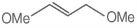
$1,4-$dimethoxybut$-2-$ene
C
tert-butylthiol
D
tetrahydrothiophene
Solution
(A) The percentage of sulfur in the organic compound is calculated as follows:
$\text{Percentage of } S = \frac{32 \times \text{mass of } BaSO_4}{233 \times \text{mass of organic compound}} \times 100$
$= \frac{32 \times 0.233}{233 \times 0.102} \times 100 = 31.37 \ \%$
Now,we calculate the percentage of sulfur in each option:
$A$: $1,4-\text{dithiane } (C_4H_8S_2)$,Molar mass $= 120 \ g/mol$. $\% S = \frac{64}{120} \times 100 = 53.33 \ \%$
$B$: $1,4-\text{dimethoxybut-2-ene}$,contains no sulfur.
$C$: $\text{tert-butylthiol } (C_4H_{10}S)$,Molar mass $= 90 \ g/mol$. $\% S = \frac{32}{90} \times 100 = 35.55 \ \%$
$D$: $\text{tetrahydrothiophene } (C_4H_8S)$,Molar mass $= 88 \ g/mol$. $\% S = \frac{32}{88} \times 100 = 36.36 \ \%$
Re-evaluating the calculation: The mass of $BaSO_4$ is $0.233 \ g$,which corresponds to $\frac{0.233}{233} = 0.001 \ mol$ of $S$. The mass of $S$ is $0.001 \times 32 = 0.032 \ g$. The percentage of $S$ is $\frac{0.032}{0.102} \times 100 \approx 31.37 \ \%$. Among the choices,$1,4-\text{dithiane}$ has two sulfur atoms. If the compound is $1,4-\text{dithiane}$,the theoretical percentage is $53.33 \ \%$. Given the options provided,$1,4-\text{dithiane}$ is the only sulfur-containing cyclic compound that fits the structural context of the options.
$\text{Percentage of } S = \frac{32 \times \text{mass of } BaSO_4}{233 \times \text{mass of organic compound}} \times 100$
$= \frac{32 \times 0.233}{233 \times 0.102} \times 100 = 31.37 \ \%$
Now,we calculate the percentage of sulfur in each option:
$A$: $1,4-\text{dithiane } (C_4H_8S_2)$,Molar mass $= 120 \ g/mol$. $\% S = \frac{64}{120} \times 100 = 53.33 \ \%$
$B$: $1,4-\text{dimethoxybut-2-ene}$,contains no sulfur.
$C$: $\text{tert-butylthiol } (C_4H_{10}S)$,Molar mass $= 90 \ g/mol$. $\% S = \frac{32}{90} \times 100 = 35.55 \ \%$
$D$: $\text{tetrahydrothiophene } (C_4H_8S)$,Molar mass $= 88 \ g/mol$. $\% S = \frac{32}{88} \times 100 = 36.36 \ \%$
Re-evaluating the calculation: The mass of $BaSO_4$ is $0.233 \ g$,which corresponds to $\frac{0.233}{233} = 0.001 \ mol$ of $S$. The mass of $S$ is $0.001 \times 32 = 0.032 \ g$. The percentage of $S$ is $\frac{0.032}{0.102} \times 100 \approx 31.37 \ \%$. Among the choices,$1,4-\text{dithiane}$ has two sulfur atoms. If the compound is $1,4-\text{dithiane}$,the theoretical percentage is $53.33 \ \%$. Given the options provided,$1,4-\text{dithiane}$ is the only sulfur-containing cyclic compound that fits the structural context of the options.
0 likes
View Solution240
MediumMCQ
$1.25 \ g$ of a metal $(M)$ reacts with oxygen completely to produce $1.68 \ g$ of metal oxide. The empirical formula of the metal oxide is
[molar mass of $M$ and $O$ are $69.7 \ g \ mol^{-1}$ and $16.0 \ g \ mol^{-1}$,respectively]
[molar mass of $M$ and $O$ are $69.7 \ g \ mol^{-1}$ and $16.0 \ g \ mol^{-1}$,respectively]
A
$M_2O$
B
$M_2O_3$
C
$MO_2$
D
$M_3O_4$
Solution
(B) Mass of metal $(M) = 1.25 \ g$
Mass of metal oxide $= 1.68 \ g$
Mass of oxygen $= 1.68 \ g - 1.25 \ g = 0.43 \ g$
Moles of $M = \frac{1.25 \ g}{69.7 \ g \ mol^{-1}} \approx 0.0179 \ mol$
Moles of $O = \frac{0.43 \ g}{16.0 \ g \ mol^{-1}} \approx 0.0269 \ mol$
Ratio of moles $(M:O) = 0.0179 : 0.0269$
Dividing by the smallest value $(0.0179)$: $1 : 1.502 \approx 1 : 1.5$
Converting to whole numbers by multiplying by $2$: $2 : 3$
$\therefore$ The empirical formula is $M_2O_3$.
Mass of metal oxide $= 1.68 \ g$
Mass of oxygen $= 1.68 \ g - 1.25 \ g = 0.43 \ g$
Moles of $M = \frac{1.25 \ g}{69.7 \ g \ mol^{-1}} \approx 0.0179 \ mol$
Moles of $O = \frac{0.43 \ g}{16.0 \ g \ mol^{-1}} \approx 0.0269 \ mol$
Ratio of moles $(M:O) = 0.0179 : 0.0269$
Dividing by the smallest value $(0.0179)$: $1 : 1.502 \approx 1 : 1.5$
Converting to whole numbers by multiplying by $2$: $2 : 3$
$\therefore$ The empirical formula is $M_2O_3$.
0 likes
View Solution241
MediumMCQ
$A$ compound has the following composition by weight: $Na = 18.60 \%$,$S = 25.80 \%$,$H = 4.02 \%$,and $O = 51.58 \%$. Assuming that all the hydrogen atoms in the compound are part of water of crystallisation,the correct molecular formula of the compound is:
A
$Na_2S_2O_3 \cdot 3H_2O$
B
$Na_2SO_4 \cdot 5H_2O$
C
$Na_2SO_4 \cdot 10H_2O$
D
$Na_2S_2O_3 \cdot 5H_2O$
Solution
(D) To find the empirical formula,we calculate the moles of each element by dividing the percentage by its atomic mass:
$Na: \frac{18.60}{23} = 0.808 \approx 0.8$
$S: \frac{25.80}{32} = 0.806 \approx 0.8$
$H: \frac{4.02}{1} = 4.02$
$O: \frac{51.58}{16} = 3.22$
Dividing by the smallest mole value $(0.8)$:
$Na: \frac{0.8}{0.8} = 1$
$S: \frac{0.8}{0.8} = 1$
$H: \frac{4.02}{0.8} \approx 5$
$O: \frac{3.22}{0.8} \approx 4$
The empirical formula is $NaSH_5O_4$. Since all $H$ atoms are in water of crystallisation $(H_2O)$,$5$ atoms of $H$ correspond to $2.5$ molecules of $H_2O$. To get whole numbers,we multiply by $2$,giving $Na_2S_2H_{10}O_8$,which is $Na_2S_2O_3 \cdot 5H_2O$.
$Na: \frac{18.60}{23} = 0.808 \approx 0.8$
$S: \frac{25.80}{32} = 0.806 \approx 0.8$
$H: \frac{4.02}{1} = 4.02$
$O: \frac{51.58}{16} = 3.22$
Dividing by the smallest mole value $(0.8)$:
$Na: \frac{0.8}{0.8} = 1$
$S: \frac{0.8}{0.8} = 1$
$H: \frac{4.02}{0.8} \approx 5$
$O: \frac{3.22}{0.8} \approx 4$
The empirical formula is $NaSH_5O_4$. Since all $H$ atoms are in water of crystallisation $(H_2O)$,$5$ atoms of $H$ correspond to $2.5$ molecules of $H_2O$. To get whole numbers,we multiply by $2$,giving $Na_2S_2H_{10}O_8$,which is $Na_2S_2O_3 \cdot 5H_2O$.
0 likes
View Solution242
MediumMCQ
One mole of one of the sodium salts listed below,having carbon content close to $14.3 \%$,produces $1 \ mole$ of carbon dioxide upon heating (atomic mass of $Na = 23, H = 1, C = 12, O = 16$). The salt is:
A
$C_2H_5COONa$
B
$NaHCO_3$
C
$HCOONa$
D
$CH_3COONa$
Solution
(B) The correct option is $B$.
$NaHCO_3$ (sodium bicarbonate) produces $CO_2$ gas upon heating according to the reaction:
$2NaHCO_3 \xrightarrow{\Delta} Na_2CO_3 + H_2O + CO_2$
From the stoichiometry,$2 \ moles$ of $NaHCO_3$ produce $1 \ mole$ of $CO_2$. However,the question asks for the salt that produces $CO_2$ and has a carbon content of approximately $14.3 \%$.
Molecular mass of $NaHCO_3 = 23 + 1 + 12 + (16 \times 3) = 84 \ g/mol$.
Percentage of carbon in $NaHCO_3 = \frac{12}{84} \times 100 \approx 14.28 \%$,which is close to $14.3 \%$.
Other salts like $CH_3COONa$ or $HCOONa$ do not produce $CO_2$ upon simple heating in the same manner.
$NaHCO_3$ (sodium bicarbonate) produces $CO_2$ gas upon heating according to the reaction:
$2NaHCO_3 \xrightarrow{\Delta} Na_2CO_3 + H_2O + CO_2$
From the stoichiometry,$2 \ moles$ of $NaHCO_3$ produce $1 \ mole$ of $CO_2$. However,the question asks for the salt that produces $CO_2$ and has a carbon content of approximately $14.3 \%$.
Molecular mass of $NaHCO_3 = 23 + 1 + 12 + (16 \times 3) = 84 \ g/mol$.
Percentage of carbon in $NaHCO_3 = \frac{12}{84} \times 100 \approx 14.28 \%$,which is close to $14.3 \%$.
Other salts like $CH_3COONa$ or $HCOONa$ do not produce $CO_2$ upon simple heating in the same manner.
0 likes
View Solution243
DifficultMCQ
The percentage of nitrogen by mass in ammonium sulphate is closest to $.....$ $\%$ (atomic masses of $H = 1, N = 14, O = 16, S = 32$ ).
A
$21$
B
$24$
C
$36$
D
$16$
Solution
(A) The chemical formula of ammonium sulphate is $(NH_4)_2SO_4$.
The molar mass of $(NH_4)_2SO_4 = 2 \times (14 + 4 \times 1) + 32 + 4 \times 16 = 2 \times 18 + 32 + 64 = 36 + 96 = 132 \ g/mol$.
The mass of nitrogen in one mole of $(NH_4)_2SO_4$ is $2 \times 14 = 28 \ g$.
The percentage of nitrogen by mass $= (\frac{28}{132}) \times 100 \approx 21.2 \ \%$.
Thus,the value is closest to $21 \ \%$.
The molar mass of $(NH_4)_2SO_4 = 2 \times (14 + 4 \times 1) + 32 + 4 \times 16 = 2 \times 18 + 32 + 64 = 36 + 96 = 132 \ g/mol$.
The mass of nitrogen in one mole of $(NH_4)_2SO_4$ is $2 \times 14 = 28 \ g$.
The percentage of nitrogen by mass $= (\frac{28}{132}) \times 100 \approx 21.2 \ \%$.
Thus,the value is closest to $21 \ \%$.
0 likes
View Solution244
MediumMCQ
The value of $x$ in $KAl(SO_4)_x \cdot 12 H_2O$ is $.....$
A
$1$
B
$2$
C
$3$
D
$4$
Solution
(B)
$KAl(SO_4)_x \cdot 12 H_2O$ is the empirical formula for potash alum,which is a double salt.
Potash alum is represented as $K_2SO_4 \cdot Al_2(SO_4)_3 \cdot 24 H_2O$.
Dividing the formula by $2$ to get the empirical formula,we get $KAl(SO_4)_2 \cdot 12 H_2O$.
Thus,the value of $x = 2$.
$KAl(SO_4)_x \cdot 12 H_2O$ is the empirical formula for potash alum,which is a double salt.
Potash alum is represented as $K_2SO_4 \cdot Al_2(SO_4)_3 \cdot 24 H_2O$.
Dividing the formula by $2$ to get the empirical formula,we get $KAl(SO_4)_2 \cdot 12 H_2O$.
Thus,the value of $x = 2$.
0 likes
View Solution245
MediumMCQ
Number of hydrogen atoms per molecule of a hydrocarbon $A$ having $85.8 \%$ carbon is $...............$. (Given : Molar mass of $A = 84 \ g \ mol^{-1}$ )
A
$13$
B
$14$
C
$15$
D
$12$
Solution
(D) The percentage of carbon is $85.8 \%$,so the percentage of hydrogen is $100 - 85.8 = 14.2 \%$.
The empirical formula is $CH_2$.
The empirical formula mass is $12 + 2(1) = 14 \ g \ mol^{-1}$.
Given the molar mass is $84 \ g \ mol^{-1}$,we find $n = \frac{84}{14} = 6$.
The molecular formula is $(CH_2)_6 = C_6H_{12}$.
Therefore,the number of hydrogen atoms per molecule is $12$.
| Element | Mole ratio |
| $C$ | $\frac{85.8}{12} = 7.15 \rightarrow 1$ |
| $H$ | $\frac{14.2}{1} = 14.2 \rightarrow 2$ |
The empirical formula is $CH_2$.
The empirical formula mass is $12 + 2(1) = 14 \ g \ mol^{-1}$.
Given the molar mass is $84 \ g \ mol^{-1}$,we find $n = \frac{84}{14} = 6$.
The molecular formula is $(CH_2)_6 = C_6H_{12}$.
Therefore,the number of hydrogen atoms per molecule is $12$.
0 likes
View Solution246
DifficultMCQ
When $0.01 \ mol$ of an organic compound containing $60 \%$ carbon was burnt completely,$4.4 \ g$ of $CO_2$ was produced. The molar mass of the compound is $......... \ g \ mol^{-1}$ (Nearest integer).
A
$100$
B
$50$
C
$200$
D
$150$
Solution
(C) Let $M$ be the molar mass of the compound in $g \ mol^{-1}$.
Mass of $0.01 \ mol$ of the compound $= 0.01 \times M \ g$.
Since the compound contains $60 \%$ carbon by mass,the mass of carbon in the compound $= 0.01 \times M \times 0.60 = 0.006 \ M \ g$.
Moles of carbon in the compound $= \frac{0.006 \ M}{12} = 0.0005 \ M$.
During combustion,all carbon in the compound is converted to $CO_2$.
Moles of $CO_2$ produced $= \frac{4.4 \ g}{44 \ g \ mol^{-1}} = 0.1 \ mol$.
Since $1 \ mol$ of $CO_2$ contains $1 \ mol$ of carbon,the moles of carbon in the compound must equal the moles of $CO_2$ produced.
Therefore,$0.0005 \ M = 0.1$.
$M = \frac{0.1}{0.0005} = 200 \ g \ mol^{-1}$.
Mass of $0.01 \ mol$ of the compound $= 0.01 \times M \ g$.
Since the compound contains $60 \%$ carbon by mass,the mass of carbon in the compound $= 0.01 \times M \times 0.60 = 0.006 \ M \ g$.
Moles of carbon in the compound $= \frac{0.006 \ M}{12} = 0.0005 \ M$.
During combustion,all carbon in the compound is converted to $CO_2$.
Moles of $CO_2$ produced $= \frac{4.4 \ g}{44 \ g \ mol^{-1}} = 0.1 \ mol$.
Since $1 \ mol$ of $CO_2$ contains $1 \ mol$ of carbon,the moles of carbon in the compound must equal the moles of $CO_2$ produced.
Therefore,$0.0005 \ M = 0.1$.
$M = \frac{0.1}{0.0005} = 200 \ g \ mol^{-1}$.
0 likes
View Solution247
MediumMCQ
On complete combustion,$0.492 \ g$ of an organic compound gave $0.792 \ g$ of $CO_2$. The $\%$ of carbon in the organic compound is $..................$ (Nearest integer)
A
$42$
B
$43$
C
$48$
D
$44$
Solution
(D) The mass of $C$ in $CO_2$ is calculated using the molar mass ratio:
Mass of $C = (12 / 44) \times 0.792 \ g = 0.216 \ g$.
The percentage of carbon in the organic compound is given by:
$\% \text{ of } C = (\text{Mass of } C / \text{Mass of compound}) \times 100$.
$\% \text{ of } C = (0.216 / 0.492) \times 100 = 43.90 \%$.
Rounding to the nearest integer,we get $44 \%$.
Thus,the correct option is $D$.
Mass of $C = (12 / 44) \times 0.792 \ g = 0.216 \ g$.
The percentage of carbon in the organic compound is given by:
$\% \text{ of } C = (\text{Mass of } C / \text{Mass of compound}) \times 100$.
$\% \text{ of } C = (0.216 / 0.492) \times 100 = 43.90 \%$.
Rounding to the nearest integer,we get $44 \%$.
Thus,the correct option is $D$.
0 likes
View Solution248
MediumMCQ
$0.5 \ g$ of an organic compound $(X)$ with $60 \%$ carbon will produce $........ \times 10^{-1} \ g$ of $CO_2$ on complete combustion.
A
$10$
B
$11$
C
$12$
D
$13$
Solution
(B) The percentage of carbon in an organic compound is given by the formula:
$\% \text{Carbon} = \frac{12}{44} \times \frac{\text{mass of } CO_2 \text{ formed}}{\text{mass of compound taken}} \times 100$
Given,$\% \text{Carbon} = 60$,$\text{mass of compound} = 0.5 \ g$.
Substituting the values:
$60 = \frac{12}{44} \times \frac{\text{mass of } CO_2}{0.5} \times 100$
$\text{mass of } CO_2 = \frac{60 \times 44 \times 0.5}{12 \times 100} \ g$
$\text{mass of } CO_2 = \frac{1320}{1200} \ g = 1.1 \ g$
Expressing $1.1 \ g$ in the form $........ \times 10^{-1} \ g$:
$1.1 \ g = 11 \times 10^{-1} \ g$
Thus,the missing value is $11$.
$\% \text{Carbon} = \frac{12}{44} \times \frac{\text{mass of } CO_2 \text{ formed}}{\text{mass of compound taken}} \times 100$
Given,$\% \text{Carbon} = 60$,$\text{mass of compound} = 0.5 \ g$.
Substituting the values:
$60 = \frac{12}{44} \times \frac{\text{mass of } CO_2}{0.5} \times 100$
$\text{mass of } CO_2 = \frac{60 \times 44 \times 0.5}{12 \times 100} \ g$
$\text{mass of } CO_2 = \frac{1320}{1200} \ g = 1.1 \ g$
Expressing $1.1 \ g$ in the form $........ \times 10^{-1} \ g$:
$1.1 \ g = 11 \times 10^{-1} \ g$
Thus,the missing value is $11$.
0 likes
View Solution249
DifficultMCQ
An organic compound has $42.1 \%$ carbon,$6.4 \%$ hydrogen and the remainder is oxygen. If its molecular weight is $342$,then its molecular formula is:
A
$C_{11}H_{18}O_{12}$
B
$C_{12}H_{20}O_{12}$
C
$C_{14}H_{20}O_{10}$
D
$C_{12}H_{22}O_{11}$
Solution
(D) $1$. Calculate the percentage of oxygen: $100 - (42.1 + 6.4) = 51.5 \%$.
$2$. Calculate the number of moles of each element in $100 \ g$ of the compound:
$n_C = \frac{42.1}{12} \approx 3.51$,$n_H = \frac{6.4}{1} = 6.4$,$n_O = \frac{51.5}{16} \approx 3.22$.
$3$. Determine the empirical formula ratio: $C : H : O = \frac{3.51}{3.22} : \frac{6.4}{3.22} : \frac{3.22}{3.22} \approx 1.09 : 1.99 : 1 \approx 1.1 : 2 : 1$.
$4$. Multiplying by $10$ gives $C_{11}H_{20}O_{10}$ (Empirical mass $\approx 312$).
$5$. Given molecular weight is $342$. For $C_{12}H_{22}O_{11}$,molecular weight $= (12 \times 12) + (22 \times 1) + (11 \times 16) = 144 + 22 + 176 = 342$.
$6$. Thus,the molecular formula is $C_{12}H_{22}O_{11}$.
$2$. Calculate the number of moles of each element in $100 \ g$ of the compound:
$n_C = \frac{42.1}{12} \approx 3.51$,$n_H = \frac{6.4}{1} = 6.4$,$n_O = \frac{51.5}{16} \approx 3.22$.
$3$. Determine the empirical formula ratio: $C : H : O = \frac{3.51}{3.22} : \frac{6.4}{3.22} : \frac{3.22}{3.22} \approx 1.09 : 1.99 : 1 \approx 1.1 : 2 : 1$.
$4$. Multiplying by $10$ gives $C_{11}H_{20}O_{10}$ (Empirical mass $\approx 312$).
$5$. Given molecular weight is $342$. For $C_{12}H_{22}O_{11}$,molecular weight $= (12 \times 12) + (22 \times 1) + (11 \times 16) = 144 + 22 + 176 = 342$.
$6$. Thus,the molecular formula is $C_{12}H_{22}O_{11}$.
0 likes
View Solution250
MediumMCQ
$A$ compound $X$ contains $32 \%$ of $A$,$20 \%$ of $B$,and the remaining percentage of $C$. Then,the empirical formula of $X$ is:
(Given atomic masses of $A = 64$,$B = 40$,$C = 32 \ u$)
(Given atomic masses of $A = 64$,$B = 40$,$C = 32 \ u$)
A
$ABC_3$
B
$AB_2C_2$
C
$ABC_4$
D
$A_2BC_2$
Solution
(A) $1$. Calculate the percentage of $C$: $100 \% - (32 \% + 20 \%) = 48 \%$.
$2$. Determine the number of moles for each element by dividing the percentage by its atomic mass:
- For $A$: $32 / 64 = 0.5$
- For $B$: $20 / 40 = 0.5$
- For $C$: $48 / 32 = 1.5$
$3$. Divide by the smallest number of moles $(0.5)$ to get the simplest ratio:
- $A$: $0.5 / 0.5 = 1$
- $B$: $0.5 / 0.5 = 1$
- $C$: $1.5 / 0.5 = 3$
$4$. The simplest whole number ratio of $A:B:C$ is $1:1:3$.
Therefore,the empirical formula of compound $X$ is $ABC_3$.
$2$. Determine the number of moles for each element by dividing the percentage by its atomic mass:
- For $A$: $32 / 64 = 0.5$
- For $B$: $20 / 40 = 0.5$
- For $C$: $48 / 32 = 1.5$
$3$. Divide by the smallest number of moles $(0.5)$ to get the simplest ratio:
- $A$: $0.5 / 0.5 = 1$
- $B$: $0.5 / 0.5 = 1$
- $C$: $1.5 / 0.5 = 3$
$4$. The simplest whole number ratio of $A:B:C$ is $1:1:3$.
Therefore,the empirical formula of compound $X$ is $ABC_3$.
1 likes
View SolutionSome Basic Concepts of Chemistry — Percentage composition and Molecular formula · Frequently Asked Questions
1Are these Some Basic Concepts of Chemistry questions useful for JEE and NEET?
Yes. All questions in this section are mapped to JEE Main and NEET exam patterns. Previous year questions from JEE Main, NEET, GUJCET and state-level exams are included with full solutions.
2Can I switch to Hindi or Gujarati for these questions?
Yes. Use the language tabs in the hero section or the sidebar to view the same questions and solutions in English, Hindi or Gujarati.
3How do I generate a question paper from this subtopic?
Use the Vedclass Exam Paper Generator — select the chapter and subtopic, set difficulty, and generate Sets A, B, C, D automatically. First 3 chapters of every subject are free.
Vedclass Products
For Students
Vedclass Test Series
Mock tests in real JEE/NEET style with performance analysis. 5-day free trial.
Start Free TrialFor Teachers
Exam Paper Generator
Generate Set A/B/C/D papers from this chapter in 2 minutes. 3 chapters free.
Try FreeFor Institutes
Online Exam Module
Live online exams with unlimited students, 360° analytics & white-label branding.
See DemoFor Teachers & Institutes
Generate a Some Basic Concepts of Chemistry Exam Paper in 2 Minutes
Select subtopic & difficulty — Sets A, B, C, D auto-generated with No Repeat logic.
First 3 chapters of every subject are free — no payment required.