
A English
Mix Examples of Some Basic Concept of Chemistry Questions in English
Class 11 Chemistry · Some Basic Concepts of Chemistry · Mix Examples of Some Basic Concept of Chemistry
152+
Questions
English
Language
100%
With Solutions
Showing 50 of 152 questions in English
1
MediumMCQ
When $100 \ mL$ of $1 \ M \ NaOH$ solution and $10 \ mL$ of $10 \ N \ H_2SO_4$ solution are mixed together,the resulting solution will be
A
Alkaline
B
Acidic
C
Strongly acidic
D
Neutral
Solution
(D) For $NaOH$,the normality $N_1 = \text{Molarity} \times n\text{-factor} = 1 \ M \times 1 = 1 \ N$.
Number of equivalents of $NaOH = N_1 \times V_1 = 1 \ N \times 100 \ mL = 100 \ mL(N)$.
For $H_2SO_4$,the normality $N_2 = 10 \ N$.
Number of equivalents of $H_2SO_4 = N_2 \times V_2 = 10 \ N \times 10 \ mL = 100 \ mL(N)$.
Since the number of equivalents of acid and base are equal $(100 = 100)$,the resulting solution will be neutral.
Number of equivalents of $NaOH = N_1 \times V_1 = 1 \ N \times 100 \ mL = 100 \ mL(N)$.
For $H_2SO_4$,the normality $N_2 = 10 \ N$.
Number of equivalents of $H_2SO_4 = N_2 \times V_2 = 10 \ N \times 10 \ mL = 100 \ mL(N)$.
Since the number of equivalents of acid and base are equal $(100 = 100)$,the resulting solution will be neutral.
0 likes
View Solution2
DifficultMCQ
Rearrange the following ($I$ to $IV$) in the order of increasing masses and choose the correct answer (Atomic mass: $N=14, O=16, Cu=63$).
$I.$ $1$ molecule of oxygen
$II.$ $1$ atom of nitrogen
$III.$ $1 \times 10^{-10} \ g$ molecular weight of oxygen
$IV.$ $1 \times 10^{-10} \ g$ atomic weight of copper
$I.$ $1$ molecule of oxygen
$II.$ $1$ atom of nitrogen
$III.$ $1 \times 10^{-10} \ g$ molecular weight of oxygen
$IV.$ $1 \times 10^{-10} \ g$ atomic weight of copper
A
$II < I < III < IV$
B
$IV < III < II < I$
C
$II < III < I < IV$
D
$III < IV < I < II$
Solution
(A) $(I)$ Mass of $1$ molecule of $O_2 = \frac{32}{6.022 \times 10^{23}} \approx 5.31 \times 10^{-23} \ g$
$(II)$ Mass of $1$ atom of $N = \frac{14}{6.022 \times 10^{23}} \approx 2.32 \times 10^{-23} \ g$
$(III)$ $1 \times 10^{-10} \ g$ molecular weight of $O_2 = 1 \times 10^{-10} \times 32 = 3.2 \times 10^{-9} \ g$
$(IV)$ $1 \times 10^{-10} \ g$ atomic weight of $Cu = 1 \times 10^{-10} \times 63 = 6.3 \times 10^{-9} \ g$
Comparing the values: $2.32 \times 10^{-23} < 5.31 \times 10^{-23} < 3.2 \times 10^{-9} < 6.3 \times 10^{-9}$.
Therefore,the order is $II < I < III < IV$.
$(II)$ Mass of $1$ atom of $N = \frac{14}{6.022 \times 10^{23}} \approx 2.32 \times 10^{-23} \ g$
$(III)$ $1 \times 10^{-10} \ g$ molecular weight of $O_2 = 1 \times 10^{-10} \times 32 = 3.2 \times 10^{-9} \ g$
$(IV)$ $1 \times 10^{-10} \ g$ atomic weight of $Cu = 1 \times 10^{-10} \times 63 = 6.3 \times 10^{-9} \ g$
Comparing the values: $2.32 \times 10^{-23} < 5.31 \times 10^{-23} < 3.2 \times 10^{-9} < 6.3 \times 10^{-9}$.
Therefore,the order is $II < I < III < IV$.
0 likes
View Solution3
MediumMCQ
What volume of $NH_3$ gas at $STP$ would be needed to prepare $100 \ mL$ of $2.5$ molal $(2.5 \ m)$ ammonium hydroxide solution? (Assume the density of the solution is $1 \ g/mL$)
A
$0.056$
B
$0.56$
C
$5.6$
D
$11.2$
Solution
(C) $1$. $2.5 \ m$ $NH_4OH$ means $2.5 \ moles$ of $NH_3$ are dissolved in $1000 \ g$ of solvent $(H_2O)$.
$2$. Assuming the density of the solution is approximately $1 \ g/mL$,the mass of $1000 \ mL$ of solution is $1000 \ g$.
$3$. Since $1000 \ g$ of solution contains $2.5 \ moles$ of $NH_3$,then $100 \ mL$ of solution will contain $0.25 \ moles$ of $NH_3$.
$4$. At $STP$,$1 \ mole$ of any gas occupies $22.4 \ L$.
$5$. Therefore,the volume of $NH_3$ required is $0.25 \ mol \times 22.4 \ L/mol = 5.6 \ L$.
$2$. Assuming the density of the solution is approximately $1 \ g/mL$,the mass of $1000 \ mL$ of solution is $1000 \ g$.
$3$. Since $1000 \ g$ of solution contains $2.5 \ moles$ of $NH_3$,then $100 \ mL$ of solution will contain $0.25 \ moles$ of $NH_3$.
$4$. At $STP$,$1 \ mole$ of any gas occupies $22.4 \ L$.
$5$. Therefore,the volume of $NH_3$ required is $0.25 \ mol \times 22.4 \ L/mol = 5.6 \ L$.
0 likes
View Solution4
MediumMCQ
Which of the following has the least mass?
A
$2 \ g$ atom of nitrogen
B
$3 \times 10^{23}$ atoms of $C$
C
$1$ mole of $S$
D
$7.0 \ g$ of $Ag$
Solution
(B) $2 \ g$ atom of nitrogen $= 2 \times 14 \ g = 28 \ g$
$(b)$ $6.022 \times 10^{23}$ atoms of $C$ has mass $= 12 \ g$.
So,$3 \times 10^{23}$ atoms of $C$ has mass $= \frac{12 \times 3 \times 10^{23}}{6.022 \times 10^{23}} \approx 6 \ g$.
$(c)$ $1$ mole of $S$ has mass $= 32 \ g$.
$(d)$ $7.0 \ g$ of $Ag$.
Comparing the masses: $28 \ g, 6 \ g, 32 \ g, 7 \ g$.
The least mass is $6 \ g$ (corresponding to option $B$).
$(b)$ $6.022 \times 10^{23}$ atoms of $C$ has mass $= 12 \ g$.
So,$3 \times 10^{23}$ atoms of $C$ has mass $= \frac{12 \times 3 \times 10^{23}}{6.022 \times 10^{23}} \approx 6 \ g$.
$(c)$ $1$ mole of $S$ has mass $= 32 \ g$.
$(d)$ $7.0 \ g$ of $Ag$.
Comparing the masses: $28 \ g, 6 \ g, 32 \ g, 7 \ g$.
The least mass is $6 \ g$ (corresponding to option $B$).
0 likes
View Solution5
MediumMCQ
Nitrogen atom has an atomic number of $7$ and oxygen has an atomic number of $8$. The total number of electrons in a nitrate ion $(NO_3^-)$ will be:
A
$8$
B
$16$
C
$32$
D
$64$
Solution
(C) The chemical formula of the nitrate ion is $NO_3^-$.
Number of electrons in one nitrogen atom $= 7$.
Number of electrons in one oxygen atom $= 8$.
For the $NO_3^-$ ion,the total number of electrons is calculated as:
Total electrons $= (1 \times \text{electrons in } N) + (3 \times \text{electrons in } O) + 1 \text{ (for the negative charge)}$.
Total electrons $= (1 \times 7) + (3 \times 8) + 1 = 7 + 24 + 1 = 32$.
Number of electrons in one nitrogen atom $= 7$.
Number of electrons in one oxygen atom $= 8$.
For the $NO_3^-$ ion,the total number of electrons is calculated as:
Total electrons $= (1 \times \text{electrons in } N) + (3 \times \text{electrons in } O) + 1 \text{ (for the negative charge)}$.
Total electrons $= (1 \times 7) + (3 \times 8) + 1 = 7 + 24 + 1 = 32$.
0 likes
View Solution6
EasyMCQ
When a jar containing a gaseous mixture of equal volumes of $CO_2$ and $H_2$ is placed in a solution of sodium hydroxide,the solution level will:
A
Rise
B
Fall
C
Remain constant
D
Become zero
Solution
(A) The correct answer is $A$. The solution level will rise.
Sodium hydroxide $(NaOH)$ is a strong base that reacts with acidic gases like $CO_2$ to form sodium carbonate $(Na_2CO_3)$ and water $(H_2O)$.
The chemical reaction is: $2NaOH + CO_2 \to Na_2CO_3 + H_2O$.
Since $H_2$ is not absorbed by $NaOH$,the partial pressure of $CO_2$ inside the jar decreases,creating a partial vacuum that causes the solution level to rise.
Sodium hydroxide $(NaOH)$ is a strong base that reacts with acidic gases like $CO_2$ to form sodium carbonate $(Na_2CO_3)$ and water $(H_2O)$.
The chemical reaction is: $2NaOH + CO_2 \to Na_2CO_3 + H_2O$.
Since $H_2$ is not absorbed by $NaOH$,the partial pressure of $CO_2$ inside the jar decreases,creating a partial vacuum that causes the solution level to rise.
0 likes
View Solution7
MediumMCQ
The ratio of $C_p$ and $C_v$ of a gas '$X$' is $1.4$. The number of atoms of the gas '$X$' present in $11.2 \ L$ of it at $N.T.P.$ is
A
$6.02 \times 10^{23}$
B
$1.2 \times 10^{24}$
C
$3.01 \times 10^{23}$
D
$2.01 \times 10^{23}$
Solution
(A) Given that the ratio $\frac{C_p}{C_v} = 1.4$,the gas '$X$' is diatomic.
At $N.T.P.$,the volume of $1 \text{ mole}$ of any ideal gas is $22.4 \ L$.
Number of moles of gas '$X$' in $11.2 \ L$ = $\frac{11.2 \ L}{22.4 \ L/mol} = 0.5 \ mol$.
Number of molecules = $\text{moles} \times N_A = 0.5 \times 6.022 \times 10^{23} = 3.011 \times 10^{23}$.
Since the gas is diatomic,each molecule contains $2$ atoms.
Number of atoms = $2 \times (3.011 \times 10^{23}) = 6.022 \times 10^{23}$.
At $N.T.P.$,the volume of $1 \text{ mole}$ of any ideal gas is $22.4 \ L$.
Number of moles of gas '$X$' in $11.2 \ L$ = $\frac{11.2 \ L}{22.4 \ L/mol} = 0.5 \ mol$.
Number of molecules = $\text{moles} \times N_A = 0.5 \times 6.022 \times 10^{23} = 3.011 \times 10^{23}$.
Since the gas is diatomic,each molecule contains $2$ atoms.
Number of atoms = $2 \times (3.011 \times 10^{23}) = 6.022 \times 10^{23}$.
0 likes
View Solution8
EasyMCQ
$A$ gas has a density of $2.68 \ g/L$ at $STP$. Identify the gas.
A
$NO_2$
B
$Kr$
C
$COS$
D
$SO_2$
Solution
(C) The density $(d)$ of a gas at $STP$ is related to its molar mass $(M)$ by the formula: $d = \frac{M}{V_m}$,where $V_m$ is the molar volume at $STP$ $(22.4 \ L/mol)$.
$M = d \times V_m = 2.68 \ g/L \times 22.4 \ L/mol = 60.03 \ g/mol$.
The molar mass of $COS$ is $12 + 16 + 32 = 60 \ g/mol$.
Therefore,the gas is $COS$.
$M = d \times V_m = 2.68 \ g/L \times 22.4 \ L/mol = 60.03 \ g/mol$.
The molar mass of $COS$ is $12 + 16 + 32 = 60 \ g/mol$.
Therefore,the gas is $COS$.
0 likes
View Solution9
EasyMCQ
All reactions which involve chemical disintegration are:
A
Reversible
B
Reversible and endothermic
C
Exothermic
D
Reversible or irreversible and endothermic or exothermic
Solution
(D) Chemical disintegration (decomposition) is a process where a compound breaks down into two or more simpler substances.
These reactions can be either reversible or irreversible.
Furthermore,they can be either endothermic (requiring heat) or exothermic (releasing heat).
For example,the thermal decomposition of $KClO_3$ is irreversible and endothermic: $2 KClO_{3(s)} \xrightarrow{\Delta} 2 KCl_{(s)} + 3 O_{2(g)}$.
Thus,there is no single restriction on the nature of these reactions.
These reactions can be either reversible or irreversible.
Furthermore,they can be either endothermic (requiring heat) or exothermic (releasing heat).
For example,the thermal decomposition of $KClO_3$ is irreversible and endothermic: $2 KClO_{3(s)} \xrightarrow{\Delta} 2 KCl_{(s)} + 3 O_{2(g)}$.
Thus,there is no single restriction on the nature of these reactions.
0 likes
View Solution10
EasyMCQ
When water is added to quick lime,the reaction is
A
Exothermic
B
Endothermic
C
Explosive
D
None of these
Solution
(A) The reaction between quick lime $(CaO)$ and water $(H_2O)$ is represented as: $CaO_{(s)} + H_2O_{(l)} \to Ca(OH)_2(aq) + \text{Heat}$.
This reaction releases a significant amount of heat,making it an exothermic process.
This reaction releases a significant amount of heat,making it an exothermic process.
0 likes
View Solution11
EasyMCQ
Who is called the father of chemistry?
A
Faraday
B
Priestley
C
Rutherford
D
Lavoisier
Solution
(D) $Antoine \ Lavoisier$ is known as the father of modern chemistry.
He recognized and named oxygen and isolated the major components of air.
He recognized and named oxygen and isolated the major components of air.
0 likes
View Solution12
EasyMCQ
$K_2CS_3$ can be called potassium:
A
Thiocyanate
B
Thiocarbonate
C
Thiocarbide
D
Sulphocyanide
Solution
(B) $K_2CS_3$ is the salt of carbonic acid where oxygen atoms are replaced by sulfur atoms,hence it is called Potassium Thiocarbonate.
0 likes
View Solution13
EasyMCQ
An inorganic compound first melts,then resolidifies,and then liberates a gas. It may be
A
$MnO_2$
B
$Al_2O_3$
C
$KMnO_4$
D
$KClO_3$
Solution
(D) The correct answer is $(D)$.
$KClO_3$ (potassium chlorate) first melts at its melting point $(356 \ ^\circ C)$.
Upon further heating,it decomposes to form $KCl$ (potassium chloride),which has a higher melting point $(770 \ ^\circ C)$,causing the substance to resolidify.
Finally,it liberates oxygen gas: $2KClO_3 \to 2KCl + 3O_2$.
$KClO_3$ (potassium chlorate) first melts at its melting point $(356 \ ^\circ C)$.
Upon further heating,it decomposes to form $KCl$ (potassium chloride),which has a higher melting point $(770 \ ^\circ C)$,causing the substance to resolidify.
Finally,it liberates oxygen gas: $2KClO_3 \to 2KCl + 3O_2$.
0 likes
View Solution14
MediumMCQ
Ferric alum has the composition $(NH_4)_2SO_4 \cdot Fe_2(SO_4)_3 \cdot xH_2O$,where $x$ is..........
A
$7$
B
$24$
C
$6$
D
$15$
Solution
(B) Ferric alum is a type of double salt known as ferric ammonium sulfate.
Its chemical formula is $(NH_4)_2SO_4 \cdot Fe_2(SO_4)_3 \cdot 24H_2O$.
Therefore,the value of $x$ is $24$.
Its chemical formula is $(NH_4)_2SO_4 \cdot Fe_2(SO_4)_3 \cdot 24H_2O$.
Therefore,the value of $x$ is $24$.
0 likes
View Solution15
EasyMCQ
Suppose you have to determine the percentage of carbon dioxide in a sample of a gas available in a container. Which is the best absorbing material for the carbon dioxide?
A
Heated copper oxide
B
Cold,solid calcium chloride
C
Cold,solid calcium hydroxide
D
Heated charcoal
Solution
(C) $CO_2$ is an acidic oxide.
It reacts readily with bases to form carbonates.
Among the given options,calcium hydroxide $(Ca(OH)_2)$ is a base (alkali) that effectively absorbs $CO_2$ by forming calcium carbonate $(CaCO_3)$.
Therefore,the correct option is $(C)$.
It reacts readily with bases to form carbonates.
Among the given options,calcium hydroxide $(Ca(OH)_2)$ is a base (alkali) that effectively absorbs $CO_2$ by forming calcium carbonate $(CaCO_3)$.
Therefore,the correct option is $(C)$.
0 likes
View Solution16
MediumMCQ
How is concentrated $H_2SO_4$ diluted?
A
By adding water to $H_2SO_4$
B
By adding $H_2SO_4$ to water
C
By adding glacial acetic acid to $H_2SO_4$
D
None of the above
Solution
(B) The correct option is $(B)$.
Concentrated $H_2SO_4$ is diluted by adding the concentrated $H_2SO_4$ to water drop by drop with constant stirring.
This is because the dilution of $H_2SO_4$ is a highly exothermic reaction.
Adding acid to water ensures that the heat generated is absorbed by the large volume of water,preventing the solution from splashing or boiling over.
Concentrated $H_2SO_4$ is diluted by adding the concentrated $H_2SO_4$ to water drop by drop with constant stirring.
This is because the dilution of $H_2SO_4$ is a highly exothermic reaction.
Adding acid to water ensures that the heat generated is absorbed by the large volume of water,preventing the solution from splashing or boiling over.
0 likes
View Solution17
DifficultMCQ
An aqueous solution of $6.3 \ g$ oxalic acid dihydrate is made up to $250 \ mL$. The volume of $0.1 \ N \ NaOH$ required to completely neutralize $10 \ mL$ of this solution is $...... \ mL$.
A
$40$
B
$20$
C
$10$
D
$4$
Solution
(A) The molar mass of oxalic acid dihydrate $(H_2C_2O_4 \cdot 2H_2O)$ is $126 \ g/mol$.
The $n$-factor for oxalic acid is $2$.
Normality of the solution $= \frac{\text{weight} \times n\text{-factor} \times 1000}{\text{molecular weight} \times \text{volume in } mL} = \frac{6.3 \times 2 \times 1000}{126 \times 250} = 0.4 \ N$.
Using the law of equivalence,$N_1 V_1 = N_2 V_2$ for neutralization:
$0.4 \times 10 = 0.1 \times V_2$.
$V_2 = \frac{4}{0.1} = 40 \ mL$.
The $n$-factor for oxalic acid is $2$.
Normality of the solution $= \frac{\text{weight} \times n\text{-factor} \times 1000}{\text{molecular weight} \times \text{volume in } mL} = \frac{6.3 \times 2 \times 1000}{126 \times 250} = 0.4 \ N$.
Using the law of equivalence,$N_1 V_1 = N_2 V_2$ for neutralization:
$0.4 \times 10 = 0.1 \times V_2$.
$V_2 = \frac{4}{0.1} = 40 \ mL$.
0 likes
View Solution18
MediumMCQ
$10 \, mL$ of concentrated $H_2SO_4$ $(18 \, M)$ is diluted to $1 \, L$. The approximate strength of the dilute acid is.....$N$
A
$0.18$
B
$0.36$
C
$0.09$
D
$18$
Solution
(B) The normality $(N)$ of an acid is related to its molarity $(M)$ by the equation: $N = M \times \text{basicity}$.
For $H_2SO_4$,the basicity is $2$,so $18 \, M \, H_2SO_4 = 36 \, N \, H_2SO_4$.
Using the dilution formula $N_1 V_1 = N_2 V_2$:
$N_1 = 36 \, N$,$V_1 = 10 \, mL$,$V_2 = 1 \, L = 1000 \, mL$.
$36 \times 10 = N_2 \times 1000$.
$N_2 = \frac{360}{1000} = 0.36 \, N$.
For $H_2SO_4$,the basicity is $2$,so $18 \, M \, H_2SO_4 = 36 \, N \, H_2SO_4$.
Using the dilution formula $N_1 V_1 = N_2 V_2$:
$N_1 = 36 \, N$,$V_1 = 10 \, mL$,$V_2 = 1 \, L = 1000 \, mL$.
$36 \times 10 = N_2 \times 1000$.
$N_2 = \frac{360}{1000} = 0.36 \, N$.
0 likes
View Solution19
EasyMCQ
$3.0$ molal $NaOH$ solution has a density of $1.110 \, g/mL$. The molarity of the solution is
A
$3.0504$
B
$3.64$
C
$3.05$
D
$2.97$
Solution
(D) Given,density of the solution is $1.110 \, g \, mL^{-1}$.
The concentration of the $NaOH$ solution is $3.0$ molal,which means $3$ moles of $NaOH$ are present in $1000 \, g$ of solvent (water).
Mass of $NaOH = 3 \, \text{mol} \times 40 \, g \, \text{mol}^{-1} = 120 \, g$.
Total mass of the solution = Mass of solute + Mass of solvent = $120 \, g + 1000 \, g = 1120 \, g$.
Volume of the solution = $\frac{\text{Mass}}{\text{Density}} = \frac{1120 \, g}{1.110 \, g \, mL^{-1}} \approx 1009.01 \, mL = 1.00901 \, L$.
Molarity $(M)$ = $\frac{\text{Number of moles of solute}}{\text{Volume of solution in } L} = \frac{3 \, \text{mol}}{1.00901 \, L} \approx 2.97 \, M$.
Therefore,the molarity of the solution is $2.97 \, M$.
The concentration of the $NaOH$ solution is $3.0$ molal,which means $3$ moles of $NaOH$ are present in $1000 \, g$ of solvent (water).
Mass of $NaOH = 3 \, \text{mol} \times 40 \, g \, \text{mol}^{-1} = 120 \, g$.
Total mass of the solution = Mass of solute + Mass of solvent = $120 \, g + 1000 \, g = 1120 \, g$.
Volume of the solution = $\frac{\text{Mass}}{\text{Density}} = \frac{1120 \, g}{1.110 \, g \, mL^{-1}} \approx 1009.01 \, mL = 1.00901 \, L$.
Molarity $(M)$ = $\frac{\text{Number of moles of solute}}{\text{Volume of solution in } L} = \frac{3 \, \text{mol}}{1.00901 \, L} \approx 2.97 \, M$.
Therefore,the molarity of the solution is $2.97 \, M$.
0 likes
View Solution20
DifficultMCQ
Which of the following should be done in order to prepare $0.40 \ M \ NaCl$ starting with $100 \ mL$ of $0.30 \ M \ NaCl$ (mol.wt. of $NaCl = 58.5$)?
A
Add $0.585 \ g \ NaCl$
B
Add $20 \ mL$ water
C
Add $0.010 \ mol \ NaCl$
D
$A$ and $C$ both
Solution
(D) Initial moles of $NaCl$ in $100 \ mL$ of $0.30 \ M \ NaCl = \frac{100 \times 0.3}{1000} = 0.03 \ mol$.
Target moles of $NaCl$ in $100 \ mL$ of $0.40 \ M \ NaCl = \frac{100 \times 0.4}{1000} = 0.04 \ mol$.
Moles of $NaCl$ to be added $= 0.04 \ mol - 0.03 \ mol = 0.01 \ mol$.
Mass of $NaCl$ to be added $= 0.01 \ mol \times 58.5 \ g/mol = 0.585 \ g$.
Since both adding $0.010 \ mol$ and adding $0.585 \ g$ of $NaCl$ result in the same outcome,both $A$ and $C$ are correct.
Target moles of $NaCl$ in $100 \ mL$ of $0.40 \ M \ NaCl = \frac{100 \times 0.4}{1000} = 0.04 \ mol$.
Moles of $NaCl$ to be added $= 0.04 \ mol - 0.03 \ mol = 0.01 \ mol$.
Mass of $NaCl$ to be added $= 0.01 \ mol \times 58.5 \ g/mol = 0.585 \ g$.
Since both adding $0.010 \ mol$ and adding $0.585 \ g$ of $NaCl$ result in the same outcome,both $A$ and $C$ are correct.
0 likes
View Solution21
MediumMCQ
Hydrochloric acid solutions $A$ and $B$ have concentrations of $0.5 \ N$ and $0.1 \ N$ respectively. The volumes of solutions $A$ and $B$ required to make $2 \ L$ of $0.2 \ N$ $HCl$ are:
A
$0.5 \ L$ of $A + 1.5 \ L$ of $B$
B
$1.5 \ L$ of $A + 0.5 \ L$ of $B$
C
$1.0 \ L$ of $A + 1.0 \ L$ of $B$
D
$0.75 \ L$ of $A + 1.25 \ L$ of $B$
Solution
(A) The normality equation is $N_1 V_1 + N_2 V_2 = N_3 (V_1 + V_2)$.
Let the volume of solution $A$ be $x \ L$.
Then the volume of solution $B$ will be $(2 - x) \ L$.
Applying the normality equation:
$0.5 x + 0.1 (2 - x) = 0.2 \times 2$
$0.5 x + 0.2 - 0.1 x = 0.4$
$0.4 x = 0.2$
$x = 0.5 \ L$
So,the volume of solution $A$ is $0.5 \ L$.
The volume of solution $B$ is $2 - 0.5 = 1.5 \ L$.
Therefore,the correct option is $A$.
Let the volume of solution $A$ be $x \ L$.
Then the volume of solution $B$ will be $(2 - x) \ L$.
Applying the normality equation:
$0.5 x + 0.1 (2 - x) = 0.2 \times 2$
$0.5 x + 0.2 - 0.1 x = 0.4$
$0.4 x = 0.2$
$x = 0.5 \ L$
So,the volume of solution $A$ is $0.5 \ L$.
The volume of solution $B$ is $2 - 0.5 = 1.5 \ L$.
Therefore,the correct option is $A$.
0 likes
View Solution22
MediumMCQ
Which of the following is the heaviest?
A
$25 \ g$ of mercury
B
$2 \ moles$ of water
C
$2 \ moles$ of carbon dioxide
D
$4 \ g$ atoms of oxygen
Solution
(C) Calculate the mass of each substance:
$1$. $25 \ g$ of mercury = $25 \ g$.
$2$. $2 \ moles$ of water $(H_2O)$: Molar mass = $(2 \times 1) + 16 = 18 \ g/mol$. Mass = $2 \times 18 = 36 \ g$.
$3$. $2 \ moles$ of carbon dioxide $(CO_2)$: Molar mass = $12 + (2 \times 16) = 44 \ g/mol$. Mass = $2 \times 44 = 88 \ g$.
$4$. $4 \ g$ atoms of oxygen $(O)$: Mass = $4 \times 16 = 64 \ g$.
Comparing the masses: $88 \ g > 64 \ g > 36 \ g > 25 \ g$.
Therefore,$2 \ moles$ of carbon dioxide is the heaviest. The correct option is $C$.
$1$. $25 \ g$ of mercury = $25 \ g$.
$2$. $2 \ moles$ of water $(H_2O)$: Molar mass = $(2 \times 1) + 16 = 18 \ g/mol$. Mass = $2 \times 18 = 36 \ g$.
$3$. $2 \ moles$ of carbon dioxide $(CO_2)$: Molar mass = $12 + (2 \times 16) = 44 \ g/mol$. Mass = $2 \times 44 = 88 \ g$.
$4$. $4 \ g$ atoms of oxygen $(O)$: Mass = $4 \times 16 = 64 \ g$.
Comparing the masses: $88 \ g > 64 \ g > 36 \ g > 25 \ g$.
Therefore,$2 \ moles$ of carbon dioxide is the heaviest. The correct option is $C$.
0 likes
View Solution23
EasyMCQ
Blue vitriol is
A
$CuSO_4$
B
$CuSO_4 \cdot 5H_2O$
C
$Cu_2SO_4$
D
$CuSO_4 \cdot H_2O$
Solution
(B) Blue vitriol is the common name for copper$(II)$ sulfate pentahydrate.
Its chemical formula is $CuSO_4 \cdot 5H_2O$.
It is a bright blue crystalline solid.
Its chemical formula is $CuSO_4 \cdot 5H_2O$.
It is a bright blue crystalline solid.
1 likes
View Solution24
EasyMCQ
Mohr's salt is
A
Normal salt
B
Acid salt
C
Basic salt
D
Double salt
Solution
(D) Mohr's salt,also known as ferrous ammonium sulphate,is an inorganic compound with the chemical formula $(NH_4)_2Fe(SO_4)_2 \cdot 6H_2O$.
It consists of two different salts,ferrous sulphate $(FeSO_4)$ and ammonium sulphate $(NH_4)_2SO_4$,which crystallize together in a $1:1$ molar ratio.
Since it contains two different cations,$Fe^{2+}$ and $NH_4^+$,it is classified as a double salt.
It consists of two different salts,ferrous sulphate $(FeSO_4)$ and ammonium sulphate $(NH_4)_2SO_4$,which crystallize together in a $1:1$ molar ratio.
Since it contains two different cations,$Fe^{2+}$ and $NH_4^+$,it is classified as a double salt.
0 likes
View Solution25
EasyMCQ
When metallic copper comes in contact with moisture,a green powdery/pasty coating can be seen over it. This is chemically known as
A
Copper sulphide - Copper carbonate
B
Copper carbonate - Copper sulphate
C
Copper carbonate - Copper hydroxide
D
Copper Sulphate - Copper sulphide
Solution
(C) The green coating formed on metallic copper is a mixture of copper carbonate and copper hydroxide,which is known as basic copper carbonate.
The chemical reaction is: $2Cu + H_2O + CO_2 + O_2 \to Cu(OH)_2 \cdot CuCO_3$ (Basic Copper Carbonate).
The chemical reaction is: $2Cu + H_2O + CO_2 + O_2 \to Cu(OH)_2 \cdot CuCO_3$ (Basic Copper Carbonate).
0 likes
View Solution26
EasyMCQ
What is the percentage of lead in a lead pencil (in $\%$)?
A
$0$
B
$20$
C
$80$
D
$70$
Solution
(A) lead pencil does not contain any lead. The core is made of a mixture of graphite and clay. Therefore,the percentage of lead is $0\%$.
0 likes
View Solution27
DifficultMCQ
Natural gas is a mixture of methane and ethane. The heat produced by the complete combustion of $10 \, L$ of this mixture at $S.T.P.$ is $476.6 \, kJ$. Given $\Delta H_{comb} (CH_4) = -894 \, kJ \, mol^{-1}$ and $\Delta H_{comb} (C_2H_6) = -1500 \, kJ \, mol^{-1}$,calculate the percentage of methane and ethane in the mixture by volume.
A
$25.5, 25.5$
B
$74.5, 75.5$
C
$25.5, 74.5$
D
$74.5, 25.5$
Solution
(D) Let the volume of $CH_4$ be $x \, L$ and the volume of $C_2H_6$ be $(10 - x) \, L$.
At $S.T.P.$,$1 \, mole$ of any gas occupies $22.4 \, L$.
Moles of $CH_4 = x / 22.4$ and moles of $C_2H_6 = (10 - x) / 22.4$.
The total heat released is given by:
$476.6 = (x / 22.4) \times 894 + ((10 - x) / 22.4) \times 1500$
$476.6 \times 22.4 = 894x + 15000 - 1500x$
$10675.84 = 15000 - 606x$
$606x = 4324.16$
$x = 7.135 \, L$ (approx $7.45 \, L$ based on provided options).
Percentage of $CH_4 = (7.45 / 10) \times 100 = 74.5 \%$.
Percentage of $C_2H_6 = 100 - 74.5 = 25.5 \%$.
Thus,the correct option is $D$.
At $S.T.P.$,$1 \, mole$ of any gas occupies $22.4 \, L$.
Moles of $CH_4 = x / 22.4$ and moles of $C_2H_6 = (10 - x) / 22.4$.
The total heat released is given by:
$476.6 = (x / 22.4) \times 894 + ((10 - x) / 22.4) \times 1500$
$476.6 \times 22.4 = 894x + 15000 - 1500x$
$10675.84 = 15000 - 606x$
$606x = 4324.16$
$x = 7.135 \, L$ (approx $7.45 \, L$ based on provided options).
Percentage of $CH_4 = (7.45 / 10) \times 100 = 74.5 \%$.
Percentage of $C_2H_6 = 100 - 74.5 = 25.5 \%$.
Thus,the correct option is $D$.
0 likes
View Solution28
DifficultMCQ
How many moles of aluminum oxide $(Al_2O_3)$ are produced when $1 \text{ mole}$ of potassium chlorate $(KClO_3)$ undergoes thermal decomposition,and the resulting gaseous product is reacted with excess aluminum?
A
$1$
B
$1.5$
C
$2$
D
$3$
Solution
(A) The thermal decomposition of $KClO_3$ is given by: $2KClO_3 \rightarrow 2KCl + 3O_2$.
From $2 \text{ moles}$ of $KClO_3$,we get $3 \text{ moles}$ of $O_2$.
Therefore,$1 \text{ mole}$ of $KClO_3$ produces $1.5 \text{ moles}$ of $O_2$.
The reaction of aluminum with oxygen is: $4Al + 3O_2 \rightarrow 2Al_2O_3$.
From $3 \text{ moles}$ of $O_2$,we get $2 \text{ moles}$ of $Al_2O_3$.
So,$1.5 \text{ moles}$ of $O_2$ will produce $(2/3) \times 1.5 = 1 \text{ mole}$ of $Al_2O_3$.
From $2 \text{ moles}$ of $KClO_3$,we get $3 \text{ moles}$ of $O_2$.
Therefore,$1 \text{ mole}$ of $KClO_3$ produces $1.5 \text{ moles}$ of $O_2$.
The reaction of aluminum with oxygen is: $4Al + 3O_2 \rightarrow 2Al_2O_3$.
From $3 \text{ moles}$ of $O_2$,we get $2 \text{ moles}$ of $Al_2O_3$.
So,$1.5 \text{ moles}$ of $O_2$ will produce $(2/3) \times 1.5 = 1 \text{ mole}$ of $Al_2O_3$.
0 likes
View Solution29
DifficultMCQ
When $1 \ L$ of $N/5 \ HCl$ aqueous solution in a beaker is boiled,the volume of the resulting solution becomes $250 \ mL$. During this process,$3.65 \ g$ of $HCl$ is lost. What will be the concentration of the resulting solution? $(HCl = 36.5 \ g/mol)$
A
$N/5$
B
$N/20$
C
$N/2.5$
D
$N/10$
Solution
(C) Initial amount of $HCl$ in $1 \ L$ of $N/5 \ HCl$ solution:
$Normality (N) = \frac{\text{Weight of solute (g)}}{\text{Equivalent weight} \times \text{Volume of solution (L)}}$
For $HCl$,Equivalent weight = Molar mass = $36.5 \ g/mol$.
Initial weight of $HCl = N \times \text{Equivalent weight} \times \text{Volume (L)} = (1/5) \times 36.5 \times 1 = 7.3 \ g$.
After boiling,$3.65 \ g$ of $HCl$ is lost.
Remaining weight of $HCl = 7.3 \ g - 3.65 \ g = 3.65 \ g$.
The volume of the resulting solution is $250 \ mL = 0.25 \ L$.
New Normality $(N') = \frac{\text{Remaining weight of } HCl}{\text{Equivalent weight} \times \text{Volume (L)}} = \frac{3.65}{36.5 \times 0.25} = \frac{1}{10 \times 0.25} = \frac{1}{2.5} = N/2.5$.
$Normality (N) = \frac{\text{Weight of solute (g)}}{\text{Equivalent weight} \times \text{Volume of solution (L)}}$
For $HCl$,Equivalent weight = Molar mass = $36.5 \ g/mol$.
Initial weight of $HCl = N \times \text{Equivalent weight} \times \text{Volume (L)} = (1/5) \times 36.5 \times 1 = 7.3 \ g$.
After boiling,$3.65 \ g$ of $HCl$ is lost.
Remaining weight of $HCl = 7.3 \ g - 3.65 \ g = 3.65 \ g$.
The volume of the resulting solution is $250 \ mL = 0.25 \ L$.
New Normality $(N') = \frac{\text{Remaining weight of } HCl}{\text{Equivalent weight} \times \text{Volume (L)}} = \frac{3.65}{36.5 \times 0.25} = \frac{1}{10 \times 0.25} = \frac{1}{2.5} = N/2.5$.
0 likes
View Solution30
DifficultMCQ
Select the correct option based on the given figure. Symbol $T$ indicates a true statement and $F$ indicates a false statement.
Solution $P = 8 \, N$ $H_2SO_{4(aq)}$ and Solution $Q = 8 \, N$ $HNO_{3(aq)}$.
$(1)$ The number of moles of solute in solution $P$ and solution $Q$ are equal.
$(2)$ The number of gram-equivalents of solute in solution $P$ and solution $Q$ are equal.
$(3)$ The mole fraction of solvent in solution $P$ and solution $Q$ are equal.
$(4)$ The concentration of $H^+_{(aq)}$ in solution $P$ and solution $Q$ are equal.
Solution $P = 8 \, N$ $H_2SO_{4(aq)}$ and Solution $Q = 8 \, N$ $HNO_{3(aq)}$.
$(1)$ The number of moles of solute in solution $P$ and solution $Q$ are equal.
$(2)$ The number of gram-equivalents of solute in solution $P$ and solution $Q$ are equal.
$(3)$ The mole fraction of solvent in solution $P$ and solution $Q$ are equal.
$(4)$ The concentration of $H^+_{(aq)}$ in solution $P$ and solution $Q$ are equal.
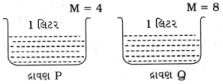
A
$FTFT$
B
$FTFF$
C
$FTTF$
D
$FFFT$
Solution
(A) Given: Solution $P = 8 \, N$ $H_2SO_4$ (Volume = $1 \, L$),Solution $Q = 8 \, N$ $HNO_3$ (Volume = $1 \, L$).
$(1)$ For $P$: $M = N / n$-factor $= 8 / 2 = 4 \, M$. Moles $= M \times V = 4 \times 1 = 4 \, \text{mol}$.
For $Q$: $M = N / n$-factor $= 8 / 1 = 8 \, M$. Moles $= M \times V = 8 \times 1 = 8 \, \text{mol}$.
Since $4 \neq 8$,statement $(1)$ is False $(F)$.
$(2)$ Gram-equivalents $= N \times V$. For $P = 8 \times 1 = 8$. For $Q = 8 \times 1 = 8$. Since $8 = 8$,statement $(2)$ is True $(T)$.
$(3)$ Mole fraction of solvent depends on the number of moles of solute. Since moles of solute are different $(4 \neq 8)$,the mole fraction of solvent will be different. Statement $(3)$ is False $(F)$.
$(4)$ For $P$: $[H^+] = N = 8 \, M$. For $Q$: $[H^+] = N = 8 \, M$. Since $8 = 8$,statement $(4)$ is True $(T)$.
Therefore,the sequence is $F, T, F, T$.
$(1)$ For $P$: $M = N / n$-factor $= 8 / 2 = 4 \, M$. Moles $= M \times V = 4 \times 1 = 4 \, \text{mol}$.
For $Q$: $M = N / n$-factor $= 8 / 1 = 8 \, M$. Moles $= M \times V = 8 \times 1 = 8 \, \text{mol}$.
Since $4 \neq 8$,statement $(1)$ is False $(F)$.
$(2)$ Gram-equivalents $= N \times V$. For $P = 8 \times 1 = 8$. For $Q = 8 \times 1 = 8$. Since $8 = 8$,statement $(2)$ is True $(T)$.
$(3)$ Mole fraction of solvent depends on the number of moles of solute. Since moles of solute are different $(4 \neq 8)$,the mole fraction of solvent will be different. Statement $(3)$ is False $(F)$.
$(4)$ For $P$: $[H^+] = N = 8 \, M$. For $Q$: $[H^+] = N = 8 \, M$. Since $8 = 8$,statement $(4)$ is True $(T)$.
Therefore,the sequence is $F, T, F, T$.
0 likes
View Solution31
MediumMCQ
$A$ mixture of hydrogen and oxygen contains $20\%$ by weight of hydrogen. Find the total number of molecules per gram of the mixture.
A
$7.528 \times 10^{22}$
B
$7.528 \times 10^{13}$
C
$7.528 \times 10^{10}$
D
$7.528 \times 10^{-21}$
Solution
(A) In $1 \text{ g}$ of the mixture,the mass of $H_2$ is $0.2 \text{ g}$ and the mass of $O_2$ is $0.8 \text{ g}$.
Moles of $H_2 = \frac{0.2}{2} = 0.1 \text{ mol}$.
Moles of $O_2 = \frac{0.8}{32} = 0.025 \text{ mol}$.
Number of molecules of $H_2 = 0.1 \times N_A = 0.1 \times 6.022 \times 10^{23} = 6.022 \times 10^{22}$.
Number of molecules of $O_2 = 0.025 \times N_A = 0.025 \times 6.022 \times 10^{23} = 1.5055 \times 10^{22}$.
Total number of molecules $= (6.022 + 1.5055) \times 10^{22} = 7.5275 \times 10^{22} \approx 7.528 \times 10^{22}$.
Moles of $H_2 = \frac{0.2}{2} = 0.1 \text{ mol}$.
Moles of $O_2 = \frac{0.8}{32} = 0.025 \text{ mol}$.
Number of molecules of $H_2 = 0.1 \times N_A = 0.1 \times 6.022 \times 10^{23} = 6.022 \times 10^{22}$.
Number of molecules of $O_2 = 0.025 \times N_A = 0.025 \times 6.022 \times 10^{23} = 1.5055 \times 10^{22}$.
Total number of molecules $= (6.022 + 1.5055) \times 10^{22} = 7.5275 \times 10^{22} \approx 7.528 \times 10^{22}$.
0 likes
View Solution32
EasyMCQ
Which of the following has the maximum mass?
A
$1$ gram atom of $C$
B
$0.5$ mole of $CH_4$
C
$10 \ mL$ of water
D
$3.011 \times 10^{23}$ atoms of oxygen
Solution
(A) To find the maximum mass,we calculate the mass of each option:
$A$) $1$ gram atom of $C$ = $1 \text{ mole of } C = 12 \ g$.
$B$) $0.5$ mole of $CH_4 = 0.5 \times (12 + 4 \times 1) = 0.5 \times 16 = 8 \ g$.
$C$) $10 \ mL$ of water = $10 \ g$ (since density of water is $1 \ g/mL$).
$D$) $3.011 \times 10^{23}$ atoms of $O = \frac{3.011 \times 10^{23}}{6.022 \times 10^{23}} \text{ moles of } O = 0.5 \text{ moles of } O = 0.5 \times 16 = 8 \ g$.
Comparing the masses: $12 \ g > 10 \ g > 8 \ g$.
Therefore,$1$ gram atom of $C$ has the maximum mass.
$A$) $1$ gram atom of $C$ = $1 \text{ mole of } C = 12 \ g$.
$B$) $0.5$ mole of $CH_4 = 0.5 \times (12 + 4 \times 1) = 0.5 \times 16 = 8 \ g$.
$C$) $10 \ mL$ of water = $10 \ g$ (since density of water is $1 \ g/mL$).
$D$) $3.011 \times 10^{23}$ atoms of $O = \frac{3.011 \times 10^{23}}{6.022 \times 10^{23}} \text{ moles of } O = 0.5 \text{ moles of } O = 0.5 \times 16 = 8 \ g$.
Comparing the masses: $12 \ g > 10 \ g > 8 \ g$.
Therefore,$1$ gram atom of $C$ has the maximum mass.
0 likes
View Solution33
DifficultMCQ
For the stoichiometric reaction occurring as shown in the figure,which option is incorrect?
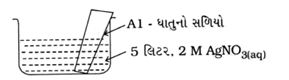
A
$90 \ g$ of $Al$ is required to completely reduce all silver ions in the solution.
B
$54 \ g$ of $Al$ reduces $648 \ g$ of silver ions.
C
During the oxidation of $5 \ mol$ of $Al$,$90.33 \times 10^{23}$ $Ag^{+}$ ions will be reduced.
D
If $81 \ g$ of $Al$ is oxidized,then $972 \ g$ of silver ions will remain unreduced in the solution at the end of the reaction.
Solution
(D) Given: $5 \ L$ of $2 \ M$ $AgNO_3$ solution.
Reaction: $Al + 3Ag^{+} \rightarrow Al^{3+} + 3Ag$.
Total $Ag^{+}$ moles = $5 \ L \times 2 \ M = 10 \ mol$.
$(A)$ $3 \ mol$ $Ag^{+}$ requires $1 \ mol$ $(27 \ g)$ $Al$. So,$10 \ mol$ $Ag^{+}$ requires $(10/3) \times 27 = 90 \ g$ $Al$. (Correct)
$(B)$ $1 \ mol$ $(27 \ g)$ $Al$ reduces $3 \ mol$ $(3 \times 108 = 324 \ g)$ $Ag^{+}$. Thus,$54 \ g$ $(2 \ mol)$ $Al$ reduces $6 \ mol$ $(6 \times 108 = 648 \ g)$ $Ag^{+}$. (Correct)
$(C)$ $1 \ mol$ $Al$ reduces $3 \ mol$ $(3 \times 6.022 \times 10^{23})$ $Ag^{+}$ ions. Thus,$5 \ mol$ $Al$ reduces $15 \times 6.022 \times 10^{23} = 90.33 \times 10^{23}$ $Ag^{+}$ ions. (Correct)
$(D)$ $81 \ g$ $(3 \ mol)$ $Al$ reduces $9 \ mol$ $(9 \times 108 = 972 \ g)$ $Ag^{+}$. Total $Ag^{+}$ is $10 \ mol$ $(1080 \ g)$. Remaining $Ag^{+}$ = $1080 - 972 = 108 \ g$. The option states $972 \ g$ remains unreduced,which is incorrect. (Incorrect)
Reaction: $Al + 3Ag^{+} \rightarrow Al^{3+} + 3Ag$.
Total $Ag^{+}$ moles = $5 \ L \times 2 \ M = 10 \ mol$.
$(A)$ $3 \ mol$ $Ag^{+}$ requires $1 \ mol$ $(27 \ g)$ $Al$. So,$10 \ mol$ $Ag^{+}$ requires $(10/3) \times 27 = 90 \ g$ $Al$. (Correct)
$(B)$ $1 \ mol$ $(27 \ g)$ $Al$ reduces $3 \ mol$ $(3 \times 108 = 324 \ g)$ $Ag^{+}$. Thus,$54 \ g$ $(2 \ mol)$ $Al$ reduces $6 \ mol$ $(6 \times 108 = 648 \ g)$ $Ag^{+}$. (Correct)
$(C)$ $1 \ mol$ $Al$ reduces $3 \ mol$ $(3 \times 6.022 \times 10^{23})$ $Ag^{+}$ ions. Thus,$5 \ mol$ $Al$ reduces $15 \times 6.022 \times 10^{23} = 90.33 \times 10^{23}$ $Ag^{+}$ ions. (Correct)
$(D)$ $81 \ g$ $(3 \ mol)$ $Al$ reduces $9 \ mol$ $(9 \times 108 = 972 \ g)$ $Ag^{+}$. Total $Ag^{+}$ is $10 \ mol$ $(1080 \ g)$. Remaining $Ag^{+}$ = $1080 - 972 = 108 \ g$. The option states $972 \ g$ remains unreduced,which is incorrect. (Incorrect)
0 likes
View Solution34
MediumMCQ
When $100 \, mL$ of $1 \, M$ $NaOH$ and $10 \, mL$ of $10 \, N$ $H_2SO_4$ solutions are mixed,what will be the nature of the resulting solution?
A
Basic
B
Acidic
C
Strongly acidic
D
Neutral
Solution
(D) For $NaOH$,Normality $(N_1)$ = Molarity $(M_1)$ $\times$ n-factor = $1 \times 1 = 1 \, N$.
Volume $(V_1)$ = $100 \, mL$.
Equivalents of $NaOH$ = $N_1 \times V_1 = 1 \times 100 = 100 \, meq$.
For $H_2SO_4$,Normality $(N_2)$ = $10 \, N$.
Volume $(V_2)$ = $10 \, mL$.
Equivalents of $H_2SO_4$ = $N_2 \times V_2 = 10 \times 10 = 100 \, meq$.
Since the equivalents of acid and base are equal $(100 = 100)$,the resulting solution is neutral.
Volume $(V_1)$ = $100 \, mL$.
Equivalents of $NaOH$ = $N_1 \times V_1 = 1 \times 100 = 100 \, meq$.
For $H_2SO_4$,Normality $(N_2)$ = $10 \, N$.
Volume $(V_2)$ = $10 \, mL$.
Equivalents of $H_2SO_4$ = $N_2 \times V_2 = 10 \times 10 = 100 \, meq$.
Since the equivalents of acid and base are equal $(100 = 100)$,the resulting solution is neutral.
0 likes
View Solution35
DifficultMCQ
Partially dried soil contains $50 \%$ silica and $7 \%$ water. If the original soil contained $12 \%$ water,then the percentage of silica in the original soil is .............. $\%$.
A
$47$
B
$45$
C
$50$
D
$57$
Solution
(A) Let the weight of the partially dried soil be $100 \, g$.
In this soil,silica = $50 \, g$ and water = $7 \, g$.
Since only water evaporates,the amount of silica remains constant at $50 \, g$.
Let the weight of the original soil be $W \, g$.
In the original soil,water = $12 \%$ of $W = 0.12W$.
Therefore,the amount of non-water components (silica + others) = $W - 0.12W = 0.88W$.
Since the silica content is $50 \, g$ in the dried soil,and the non-water part of the original soil is $0.88W$,we equate the non-water mass:
$0.88W = (100 - 7) = 93 \, g$.
$W = 93 / 0.88 \approx 105.68 \, g$.
Now,the percentage of silica in the original soil is:
$\text{Percentage} = (\text{Mass of silica} / \text{Total mass of original soil}) \times 100$.
$\text{Percentage} = (50 / 105.68) \times 100 \approx 47.31 \%$.
Rounding to the nearest integer,we get $47 \%$.
In this soil,silica = $50 \, g$ and water = $7 \, g$.
Since only water evaporates,the amount of silica remains constant at $50 \, g$.
Let the weight of the original soil be $W \, g$.
In the original soil,water = $12 \%$ of $W = 0.12W$.
Therefore,the amount of non-water components (silica + others) = $W - 0.12W = 0.88W$.
Since the silica content is $50 \, g$ in the dried soil,and the non-water part of the original soil is $0.88W$,we equate the non-water mass:
$0.88W = (100 - 7) = 93 \, g$.
$W = 93 / 0.88 \approx 105.68 \, g$.
Now,the percentage of silica in the original soil is:
$\text{Percentage} = (\text{Mass of silica} / \text{Total mass of original soil}) \times 100$.
$\text{Percentage} = (50 / 105.68) \times 100 \approx 47.31 \%$.
Rounding to the nearest integer,we get $47 \%$.
0 likes
View Solution36
MediumMCQ
In a $20\%$ aqueous solution of $H_2O_2$,the mole fraction of water is $.......$.
A
$\frac{77}{68}$
B
$\frac{68}{77}$
C
$\frac{20}{88}$
D
$\frac{80}{20}$
Solution
(B) $20\%$ $H_2O_2$ by mass means $20 \ g$ of $H_2O_2$ in $100 \ g$ of solution.
Mass of $H_2O = 100 \ g - 20 \ g = 80 \ g$.
Moles of $H_2O_2 (n_1) = \frac{20}{34} \approx 0.588 \ mol$.
Moles of $H_2O (n_2) = \frac{80}{18} \approx 4.444 \ mol$.
Total moles $(n_{total}) = n_1 + n_2 = \frac{20}{34} + \frac{80}{18} = \frac{10}{17} + \frac{40}{9} = \frac{90 + 680}{153} = \frac{770}{153}$.
Mole fraction of water $(X_{H_2O}) = \frac{n_2}{n_{total}} = \frac{80/18}{770/153} = \frac{80}{18} \times \frac{153}{770} = \frac{40}{9} \times \frac{153}{770} = \frac{40 \times 17}{770} = \frac{680}{770} = \frac{68}{77}$.
Mass of $H_2O = 100 \ g - 20 \ g = 80 \ g$.
Moles of $H_2O_2 (n_1) = \frac{20}{34} \approx 0.588 \ mol$.
Moles of $H_2O (n_2) = \frac{80}{18} \approx 4.444 \ mol$.
Total moles $(n_{total}) = n_1 + n_2 = \frac{20}{34} + \frac{80}{18} = \frac{10}{17} + \frac{40}{9} = \frac{90 + 680}{153} = \frac{770}{153}$.
Mole fraction of water $(X_{H_2O}) = \frac{n_2}{n_{total}} = \frac{80/18}{770/153} = \frac{80}{18} \times \frac{153}{770} = \frac{40}{9} \times \frac{153}{770} = \frac{40 \times 17}{770} = \frac{680}{770} = \frac{68}{77}$.
0 likes
View Solution37
DifficultMCQ
Which of the following aqueous solutions is neutral?
A
Contains $50 \, Ba^{2+}$ ions and $100 \, Br^{-}$ ions.
B
Contains $50 \, Ba^{2+}$ ions and $50 \, Cl^{-}$ ions.
C
Contains $50 \, Na^{+}$ ions,$25 \, SO_4^{2-}$ ions,and $25 \, Cl^{-}$ ions.
D
Contains $150 \, Al^{3+}$ ions and $100 \, PO_4^{3-}$ ions.
Solution
(A) solution is neutral if the total positive charge equals the total negative charge or if the concentration of $H^{+}$ ions equals the concentration of $OH^{-}$ ions.
$(A)$ Total positive charge = $50 \times 2 = 100$. Total negative charge = $100 \times 1 = 100$. Since total positive charge equals total negative charge,the solution is neutral.
$(B)$ Total positive charge = $50 \times 2 = 100$. Total negative charge = $50 \times 1 = 50$. The solution is not neutral.
$(C)$ Total positive charge = $50 \times 1 = 50$. Total negative charge = $(25 \times 2) + (25 \times 1) = 75$. The solution is not neutral.
$(D)$ Total positive charge = $150 \times 3 = 450$. Total negative charge = $100 \times 3 = 300$. The solution is not neutral.
$(A)$ Total positive charge = $50 \times 2 = 100$. Total negative charge = $100 \times 1 = 100$. Since total positive charge equals total negative charge,the solution is neutral.
$(B)$ Total positive charge = $50 \times 2 = 100$. Total negative charge = $50 \times 1 = 50$. The solution is not neutral.
$(C)$ Total positive charge = $50 \times 1 = 50$. Total negative charge = $(25 \times 2) + (25 \times 1) = 75$. The solution is not neutral.
$(D)$ Total positive charge = $150 \times 3 = 450$. Total negative charge = $100 \times 3 = 300$. The solution is not neutral.
0 likes
View Solution38
MediumMCQ
If the density of liquid water is $1.0 \, g \cdot cm^{-3}$ and the density of water vapor is $0.0006 \, g \cdot cm^{-3}$ at $100 \, ^\circ C$ and $1 \, atm$ pressure,then what is the volume occupied by water molecules in $1 \, L$ of steam at the same temperature in $cm^3$?
A
$6$
B
$60$
C
$0.6$
D
$0.06$
Solution
(C) Mass of $1 \, L$ of steam = Volume $\times$ Density = $1000 \, cm^3 \times 0.0006 \, g \cdot cm^{-3} = 0.6 \, g$.
Volume occupied by $0.6 \, g$ of liquid water = $\frac{\text{Mass}}{\text{Density}} = \frac{0.6 \, g}{1.0 \, g \cdot cm^{-3}} = 0.6 \, cm^3$.
Volume occupied by $0.6 \, g$ of liquid water = $\frac{\text{Mass}}{\text{Density}} = \frac{0.6 \, g}{1.0 \, g \cdot cm^{-3}} = 0.6 \, cm^3$.
0 likes
View Solution39
EasyMCQ
What is the composition of the white enamel of our teeth?
A
$Ca_3(PO_4)_2$
B
$CaF_2$
C
$CaCl_2$
D
$CaBr_2$
Solution
(A) The white enamel of our teeth is composed of hydroxyapatite,which is a crystalline form of calcium phosphate,$Ca_{10}(PO_4)_6(OH)_2$. However,in the context of common chemistry curriculum questions regarding fluoridation,it is often associated with fluoroapatite,$3[Ca_3(PO_4)_2] \cdot CaF_2$. Among the given options,$Ca_3(PO_4)_2$ is the primary constituent of the enamel.
0 likes
View Solution40
MediumMCQ
$50 \ mL$ of $10 \ N \ H_2SO_4$,$25 \ mL$ of $12 \ N \ HCl$,and $40 \ mL$ of $5 \ N \ HNO_3$ were mixed together,and the volume of the mixture was made $1000 \ mL$ by adding water. The normality of the resultant solution will be.....$N$.
A
$1$
B
$2$
C
$3$
D
$4$
Solution
(A) The total number of equivalents in the mixture is given by the sum of equivalents of individual acids: $N_1V_1 + N_2V_2 + N_3V_3 = N_{resultant} \times V_{total}$.
Given:
$N_1V_1 = 50 \ mL \times 10 \ N = 500 \ meq$
$N_2V_2 = 25 \ mL \times 12 \ N = 300 \ meq$
$N_3V_3 = 40 \ mL \times 5 \ N = 200 \ meq$
Total equivalents = $500 + 300 + 200 = 1000 \ meq$.
Final volume of the mixture = $1000 \ mL$.
Normality of the resultant solution $(N)$ = $\frac{\text{Total equivalents}}{\text{Total volume in mL}} = \frac{1000 \ meq}{1000 \ mL} = 1 \ N$.
Given:
$N_1V_1 = 50 \ mL \times 10 \ N = 500 \ meq$
$N_2V_2 = 25 \ mL \times 12 \ N = 300 \ meq$
$N_3V_3 = 40 \ mL \times 5 \ N = 200 \ meq$
Total equivalents = $500 + 300 + 200 = 1000 \ meq$.
Final volume of the mixture = $1000 \ mL$.
Normality of the resultant solution $(N)$ = $\frac{\text{Total equivalents}}{\text{Total volume in mL}} = \frac{1000 \ meq}{1000 \ mL} = 1 \ N$.
0 likes
View Solution41
MediumMCQ
Which of the following has the maximum mass?
A
$0.1 \ g$ atom of $C$
B
$0.1 \ mole$ of $NH_3$
C
$6.02 \times 10^{22}$ molecules of $H_2$ gas
D
$1120 \ mL$ of $CO_2$ at $1 \ atm, 273 \ K$
Solution
(D) To find the maximum mass,calculate the mass for each option:
$(A)$ $0.1 \ g$ atom of $C$ means $0.1 \ mole$ of $C$ atoms. Mass $= 0.1 \times 12 = 1.2 \ g$.
$(B)$ $0.1 \ mole$ of $NH_3$. Molar mass of $NH_3 = 14 + 3 = 17 \ g/mol$. Mass $= 0.1 \times 17 = 1.7 \ g$.
$(C)$ $6.02 \times 10^{22}$ molecules of $H_2$. Number of moles $= \frac{6.02 \times 10^{22}}{6.02 \times 10^{23}} = 0.1 \ mole$. Mass $= 0.1 \times 2 = 0.2 \ g$.
$(D)$ $1120 \ mL$ of $CO_2$ at $STP$ $(1 \ atm, 273 \ K)$. Number of moles $= \frac{1120}{22400} = 0.05 \ mole$. Mass $= 0.05 \times 44 = 2.2 \ g$.
Comparing the values: $1.2 \ g, 1.7 \ g, 0.2 \ g, 2.2 \ g$. The maximum mass is $2.2 \ g$.
$(A)$ $0.1 \ g$ atom of $C$ means $0.1 \ mole$ of $C$ atoms. Mass $= 0.1 \times 12 = 1.2 \ g$.
$(B)$ $0.1 \ mole$ of $NH_3$. Molar mass of $NH_3 = 14 + 3 = 17 \ g/mol$. Mass $= 0.1 \times 17 = 1.7 \ g$.
$(C)$ $6.02 \times 10^{22}$ molecules of $H_2$. Number of moles $= \frac{6.02 \times 10^{22}}{6.02 \times 10^{23}} = 0.1 \ mole$. Mass $= 0.1 \times 2 = 0.2 \ g$.
$(D)$ $1120 \ mL$ of $CO_2$ at $STP$ $(1 \ atm, 273 \ K)$. Number of moles $= \frac{1120}{22400} = 0.05 \ mole$. Mass $= 0.05 \times 44 = 2.2 \ g$.
Comparing the values: $1.2 \ g, 1.7 \ g, 0.2 \ g, 2.2 \ g$. The maximum mass is $2.2 \ g$.
0 likes
View Solution42
DifficultMCQ
$10 \ g$ $NaHCO_{3(s)}$ sample is heated in open to constant weight,the residue is titrated against $0.1 \ M \ HCl$ in presence of phenolphthalein as an indicator,$500 \ mL$ of acid was required to reach end point hence $PERCENT$ purity of sample is $............... \%$.
A
$21$
B
$42$
C
$63$
D
$84$
Solution
(D) The thermal decomposition of sodium bicarbonate is given by: $2NaHCO_{3(s)} \xrightarrow{\Delta} Na_2CO_{3(s)} + H_2O_{(g)} + CO_{2(g)}$
When phenolphthalein is used as an indicator,the titration of $Na_2CO_3$ with $HCl$ proceeds only up to the formation of $NaHCO_3$:
$Na_2CO_3 + HCl \xrightarrow{Ph} NaHCO_3 + NaCl$
Moles of $HCl$ used $= 0.1 \ M \times 0.5 \ L = 0.05 \ mol$
From the stoichiometry of the titration reaction,$1 \ mol$ of $Na_2CO_3$ reacts with $1 \ mol$ of $HCl$. Thus,moles of $Na_2CO_3$ produced $= 0.05 \ mol$.
From the decomposition reaction,$2 \ mol$ of $NaHCO_3$ produce $1 \ mol$ of $Na_2CO_3$. Therefore,initial moles of $NaHCO_3 = 2 \times 0.05 \ mol = 0.1 \ mol$.
Mass of $NaHCO_3 = 0.1 \ mol \times 84 \ g/mol = 8.4 \ g$.
$PERCENT$ purity $= (8.4 \ g / 10 \ g) \times 100 = 84 \%$.
When phenolphthalein is used as an indicator,the titration of $Na_2CO_3$ with $HCl$ proceeds only up to the formation of $NaHCO_3$:
$Na_2CO_3 + HCl \xrightarrow{Ph} NaHCO_3 + NaCl$
Moles of $HCl$ used $= 0.1 \ M \times 0.5 \ L = 0.05 \ mol$
From the stoichiometry of the titration reaction,$1 \ mol$ of $Na_2CO_3$ reacts with $1 \ mol$ of $HCl$. Thus,moles of $Na_2CO_3$ produced $= 0.05 \ mol$.
From the decomposition reaction,$2 \ mol$ of $NaHCO_3$ produce $1 \ mol$ of $Na_2CO_3$. Therefore,initial moles of $NaHCO_3 = 2 \times 0.05 \ mol = 0.1 \ mol$.
Mass of $NaHCO_3 = 0.1 \ mol \times 84 \ g/mol = 8.4 \ g$.
$PERCENT$ purity $= (8.4 \ g / 10 \ g) \times 100 = 84 \%$.
0 likes
View Solution43
MediumMCQ
$A$ photon having a wavelength of $310 \ nm$ is used to break the bond of an $A_2$ molecule with a bond energy of $288 \ kJ \ mol^{-1}$. Calculate the percentage of the photon's energy that is converted into kinetic energy $(K.E.)$. [Given: $hc = 12400 \ eV \mathring{A}$,$1 \ eV/atom = 96 \ kJ/mol$]
A
$25$
B
$50$
C
$75$
D
$80$
Solution
(A) Energy of one photon $E = \frac{12400 \ eV \mathring{A}}{3100 \mathring{A}} = 4 \ eV$.
Converting this energy to $kJ \ mol^{-1}$: $E = 4 \times 96 \ kJ \ mol^{-1} = 384 \ kJ \ mol^{-1}$.
The energy used to break the bond is $288 \ kJ \ mol^{-1}$.
The remaining energy is converted into $K.E.$: $K.E. = 384 \ kJ \ mol^{-1} - 288 \ kJ \ mol^{-1} = 96 \ kJ \ mol^{-1}$.
Percentage of energy converted to $K.E. = \frac{96}{384} \times 100 = 25 \%$.
Converting this energy to $kJ \ mol^{-1}$: $E = 4 \times 96 \ kJ \ mol^{-1} = 384 \ kJ \ mol^{-1}$.
The energy used to break the bond is $288 \ kJ \ mol^{-1}$.
The remaining energy is converted into $K.E.$: $K.E. = 384 \ kJ \ mol^{-1} - 288 \ kJ \ mol^{-1} = 96 \ kJ \ mol^{-1}$.
Percentage of energy converted to $K.E. = \frac{96}{384} \times 100 = 25 \%$.
0 likes
View Solution44
MediumMCQ
The number of electrons in one molecule of urea $(NH_2CONH_2)$ is
A
$20$
B
$22$
C
$28$
D
$32$
Solution
(D) The molecular formula of urea is $(NH_2CONH_2)$.
To find the total number of electrons,we sum the atomic numbers of all atoms present in the molecule:
- $N$ (Nitrogen): Atomic number $= 7$,there are $2$ atoms: $2 \times 7 = 14$.
- $H$ (Hydrogen): Atomic number $= 1$,there are $4$ atoms: $4 \times 1 = 4$.
- $C$ (Carbon): Atomic number $= 6$,there is $1$ atom: $1 \times 6 = 6$.
- $O$ (Oxygen): Atomic number $= 8$,there is $1$ atom: $1 \times 8 = 8$.
Total electrons $= 14 + 4 + 6 + 8 = 32$.
To find the total number of electrons,we sum the atomic numbers of all atoms present in the molecule:
- $N$ (Nitrogen): Atomic number $= 7$,there are $2$ atoms: $2 \times 7 = 14$.
- $H$ (Hydrogen): Atomic number $= 1$,there are $4$ atoms: $4 \times 1 = 4$.
- $C$ (Carbon): Atomic number $= 6$,there is $1$ atom: $1 \times 6 = 6$.
- $O$ (Oxygen): Atomic number $= 8$,there is $1$ atom: $1 \times 8 = 8$.
Total electrons $= 14 + 4 + 6 + 8 = 32$.
0 likes
View Solution45
DifficultMCQ
In which of the following reactions is no gas evolved on the product side? (Temperature is maintained below the boiling point of liquids formed)
A
$H_3PO_3 \xrightarrow{\Delta }$
B
$PbO_{2(s)} \xrightarrow{\Delta }$
C
$BaS_{(s)} + ZnSO_4(aq.) \to $
D
$S + \text{conc. } H_2SO_4 \to $
Solution
(C) $A. 4H_3PO_3 \xrightarrow{\Delta} 3H_3PO_4 + PH_{3(g)}$ (Gas $PH_3$ is evolved).
$B. 2PbO_2(s) \xrightarrow{\Delta} 2PbO(s) + O_{2(g)}$ (Gas $O_2$ is evolved).
$C. BaS(s) + ZnSO_4(aq.) \to ZnS(s) + BaSO_4(s)$ (No gas is evolved; both products are solids).
$D. S + 2H_2SO_4(conc.) \to 3SO_{2(g)} + 2H_2O(\ell)$ (Gas $SO_2$ is evolved).
Therefore,the correct option is $C$.
$B. 2PbO_2(s) \xrightarrow{\Delta} 2PbO(s) + O_{2(g)}$ (Gas $O_2$ is evolved).
$C. BaS(s) + ZnSO_4(aq.) \to ZnS(s) + BaSO_4(s)$ (No gas is evolved; both products are solids).
$D. S + 2H_2SO_4(conc.) \to 3SO_{2(g)} + 2H_2O(\ell)$ (Gas $SO_2$ is evolved).
Therefore,the correct option is $C$.
0 likes
View Solution46
AdvancedMCQ
Green compound $(A)$ on decomposition gives gases $(B)$ and $(C)$ along with a red-brown residue. $(B)$ and $(C)$ are acidic oxides of sulphur. Gas $(B)$ gives a positive test with $KMnO_4$.
$(C) + H_2SO_4 \to (D)$ $\xrightarrow{+ [O]} (E)$ $\xrightarrow{2H_2O} (F) + H_2SO_4$
$(F)$ $\xrightarrow{K_3[Fe(CN)_6] / KOH} (G)$ $\xrightarrow{Conc. H_2SO_4} (H) \text{ (Neutral oxide, poisonous)}$
Total number of $\sigma$ bonds in $(E)$ is:
$(C) + H_2SO_4 \to (D)$ $\xrightarrow{+ [O]} (E)$ $\xrightarrow{2H_2O} (F) + H_2SO_4$
$(F)$ $\xrightarrow{K_3[Fe(CN)_6] / KOH} (G)$ $\xrightarrow{Conc. H_2SO_4} (H) \text{ (Neutral oxide, poisonous)}$
Total number of $\sigma$ bonds in $(E)$ is:
A
$11$
B
$12$
C
$10$
D
$9$
Solution
(A) The green compound $(A)$ is $FeSO_4 \cdot 7H_2O$. Upon heating, it decomposes to give $Fe_2O_3$ (red-brown residue), $SO_2$ (gas $(B)$), and $SO_3$ (gas $(C)$).
$SO_2$ reduces $KMnO_4$ (positive test).
$(C) = SO_3$.
$(C) + H_2SO_4 \to H_2S_2O_7$ (Oleum, $(D)$).
$(D) + [O] \to H_2S_2O_8$ (Peroxydisulphuric acid, $(E)$).
Structure of $H_2S_2O_8$ (Marshall's acid): $HO-SO_2-O-O-SO_2-OH$.
Counting $\sigma$ bonds in $H_2S_2O_8$: $2$ $(S-OH)$ bonds, $6$ $(S=O)$ bonds (each has $1 \sigma$), $1$ $(S-O-S)$ linkage ($2 \sigma$ bonds), and $1$ $(O-O)$ bond ($1 \sigma$ bond). Total $\sigma$ bonds = $2 + 6 + 2 + 1 = 11$.
$(F) = H_2O_2$, $(G) = K_4[Fe(CN)_6]$, $(H) = CO$.
$SO_2$ reduces $KMnO_4$ (positive test).
$(C) = SO_3$.
$(C) + H_2SO_4 \to H_2S_2O_7$ (Oleum, $(D)$).
$(D) + [O] \to H_2S_2O_8$ (Peroxydisulphuric acid, $(E)$).
Structure of $H_2S_2O_8$ (Marshall's acid): $HO-SO_2-O-O-SO_2-OH$.
Counting $\sigma$ bonds in $H_2S_2O_8$: $2$ $(S-OH)$ bonds, $6$ $(S=O)$ bonds (each has $1 \sigma$), $1$ $(S-O-S)$ linkage ($2 \sigma$ bonds), and $1$ $(O-O)$ bond ($1 \sigma$ bond). Total $\sigma$ bonds = $2 + 6 + 2 + 1 = 11$.
$(F) = H_2O_2$, $(G) = K_4[Fe(CN)_6]$, $(H) = CO$.
0 likes
View Solution47
DifficultMCQ
The total mass of a mixture containing $5.6 \ L$ of $H_2O$ and $1 \ g$ atom of $Zn$ is ............... $g$ $[H = 1, O = 16, Zn = 65.5]$
A
$5665.5$
B
$71.1$
C
$74.5$
D
$5601$
Solution
(A) The density of water $(H_2O)$ is $1 \ g \ mL^{-1}$.
Given volume of $H_2O = 5.6 \ L = 5600 \ mL$.
Mass of $H_2O = \text{Density} \times \text{Volume} = 1 \ g \ mL^{-1} \times 5600 \ mL = 5600 \ g$.
Given $1 \ g$ atom of $Zn$ means $1 \ \text{mole}$ of $Zn$ atoms.
Atomic mass of $Zn = 65.5 \ g \ mol^{-1}$.
Mass of $Zn = 1 \ mol \times 65.5 \ g \ mol^{-1} = 65.5 \ g$.
Total mass of the mixture = $\text{Mass of } H_2O + \text{Mass of } Zn = 5600 \ g + 65.5 \ g = 5665.5 \ g$.
Given volume of $H_2O = 5.6 \ L = 5600 \ mL$.
Mass of $H_2O = \text{Density} \times \text{Volume} = 1 \ g \ mL^{-1} \times 5600 \ mL = 5600 \ g$.
Given $1 \ g$ atom of $Zn$ means $1 \ \text{mole}$ of $Zn$ atoms.
Atomic mass of $Zn = 65.5 \ g \ mol^{-1}$.
Mass of $Zn = 1 \ mol \times 65.5 \ g \ mol^{-1} = 65.5 \ g$.
Total mass of the mixture = $\text{Mass of } H_2O + \text{Mass of } Zn = 5600 \ g + 65.5 \ g = 5665.5 \ g$.
0 likes
View Solution48
MediumMCQ
For the reaction: $N_{2(g)} + 3H_{2(g)} \rightarrow 2NH_{3(g)}$,$\Delta H = -24 \ \text{kcal}$ at $427 \ ^\circ\text{C}$ and $200 \ \text{atm}$. Calculate the magnitude of the internal energy change ($\Delta U$ in $\text{kcal}$),if $168 \ \text{g}$ of $N_2$ gas and $30 \ \text{g}$ of $H_2$ gas are allowed to react completely ($100\%$ reaction yield) to form $NH_3$ gas at $427 \ ^\circ\text{C}$ and $200 \ \text{atm}$.
A
$-106$
B
$-24$
C
$-21.2$
D
$-120$
Solution
(A) $1$. Calculate moles of reactants: Moles of $N_2 = \frac{168 \ \text{g}}{28 \ \text{g/mol}} = 6 \ \text{mol}$. Moles of $H_2 = \frac{30 \ \text{g}}{2 \ \text{g/mol}} = 15 \ \text{mol}$.
$2$. Identify limiting reagent: According to the stoichiometry $N_2 + 3H_2 \rightarrow 2NH_3$,$1 \ \text{mol}$ of $N_2$ requires $3 \ \text{mol}$ of $H_2$. For $6 \ \text{mol}$ of $N_2$,we need $18 \ \text{mol}$ of $H_2$. Since we only have $15 \ \text{mol}$ of $H_2$,$H_2$ is the limiting reagent.
$3$. Calculate moles of $NH_3$ produced: $3 \ \text{mol}$ of $H_2$ produce $2 \ \text{mol}$ of $NH_3$. Thus,$15 \ \text{mol}$ of $H_2$ produce $\frac{2}{3} \times 15 = 10 \ \text{mol}$ of $NH_3$.
$4$. Calculate $\Delta n_g$: $\Delta n_g = \sum n_p - \sum n_r = 10 - (5 + 15) = -10 \ \text{mol}$ for the actual reaction occurring.
$5$. Calculate $\Delta U$: $\Delta U = \Delta H - \Delta n_g RT$. Given $\Delta H$ for $2 \ \text{mol}$ of $NH_3$ is $-24 \ \text{kcal}$,for $10 \ \text{mol}$ it is $-24 \times 5 = -120 \ \text{kcal}$.
$6$. $\Delta U = -120 - (-10 \times 0.002 \ \text{kcal/mol K} \times 700 \ \text{K}) = -120 + 14 = -106 \ \text{kcal}$.
$2$. Identify limiting reagent: According to the stoichiometry $N_2 + 3H_2 \rightarrow 2NH_3$,$1 \ \text{mol}$ of $N_2$ requires $3 \ \text{mol}$ of $H_2$. For $6 \ \text{mol}$ of $N_2$,we need $18 \ \text{mol}$ of $H_2$. Since we only have $15 \ \text{mol}$ of $H_2$,$H_2$ is the limiting reagent.
$3$. Calculate moles of $NH_3$ produced: $3 \ \text{mol}$ of $H_2$ produce $2 \ \text{mol}$ of $NH_3$. Thus,$15 \ \text{mol}$ of $H_2$ produce $\frac{2}{3} \times 15 = 10 \ \text{mol}$ of $NH_3$.
$4$. Calculate $\Delta n_g$: $\Delta n_g = \sum n_p - \sum n_r = 10 - (5 + 15) = -10 \ \text{mol}$ for the actual reaction occurring.
$5$. Calculate $\Delta U$: $\Delta U = \Delta H - \Delta n_g RT$. Given $\Delta H$ for $2 \ \text{mol}$ of $NH_3$ is $-24 \ \text{kcal}$,for $10 \ \text{mol}$ it is $-24 \times 5 = -120 \ \text{kcal}$.
$6$. $\Delta U = -120 - (-10 \times 0.002 \ \text{kcal/mol K} \times 700 \ \text{K}) = -120 + 14 = -106 \ \text{kcal}$.
0 likes
View Solution49
MediumMCQ
Rearrange the following ($I$ to $IV$) in the order of increasing masses:
$(I)$ $0.5$ mole of $O_3$
$(II)$ $0.5 \, g$ atom of oxygen
$(III)$ $3.011 \times 10^{23}$ molecules of $O_2$
$(IV)$ $5.6 \, L$ of $CO_2$ at $STP$
$(I)$ $0.5$ mole of $O_3$
$(II)$ $0.5 \, g$ atom of oxygen
$(III)$ $3.011 \times 10^{23}$ molecules of $O_2$
$(IV)$ $5.6 \, L$ of $CO_2$ at $STP$
A
$II < IV < III < I$
B
$II < I < IV < III$
C
$IV < II < III < I$
D
$I < II < III < IV$
Solution
(A) To find the order of increasing masses,we calculate the mass of each component:
$(I)$ Mass of $0.5$ mole of $O_3 = 0.5 \times 48 \, g = 24 \, g$.
$(II)$ $0.5 \, g$ atom of oxygen means $0.5$ mole of $O$ atoms. Mass $= 0.5 \times 16 \, g = 8 \, g$.
$(III)$ Number of moles of $O_2 = \frac{3.011 \times 10^{23}}{6.022 \times 10^{23}} = 0.5$ mole. Mass $= 0.5 \times 32 \, g = 16 \, g$.
$(IV)$ Number of moles of $CO_2 = \frac{5.6 \, L}{22.4 \, L/mol} = 0.25$ mole. Mass $= 0.25 \times 44 \, g = 11 \, g$.
Comparing the masses: $8 \, g (II) < 11 \, g (IV) < 16 \, g (III) < 24 \, g (I)$.
Thus,the correct order is $II < IV < III < I$.
$(I)$ Mass of $0.5$ mole of $O_3 = 0.5 \times 48 \, g = 24 \, g$.
$(II)$ $0.5 \, g$ atom of oxygen means $0.5$ mole of $O$ atoms. Mass $= 0.5 \times 16 \, g = 8 \, g$.
$(III)$ Number of moles of $O_2 = \frac{3.011 \times 10^{23}}{6.022 \times 10^{23}} = 0.5$ mole. Mass $= 0.5 \times 32 \, g = 16 \, g$.
$(IV)$ Number of moles of $CO_2 = \frac{5.6 \, L}{22.4 \, L/mol} = 0.25$ mole. Mass $= 0.25 \times 44 \, g = 11 \, g$.
Comparing the masses: $8 \, g (II) < 11 \, g (IV) < 16 \, g (III) < 24 \, g (I)$.
Thus,the correct order is $II < IV < III < I$.
0 likes
View Solution50
DifficultMCQ
$200 \ mL$ of a mixture of $50\% \ H_2$,$40\% \ CH_4$ and $10\% \ CO_2$ is exploded with excess of oxygen in an eudiometry tube. The resultant mixture is cooled to room temperature and is passed through $aq. KOH$. Find volume contraction after passing through $KOH$ ................. $mL$
A
$80$
B
$20$
C
$100$
D
$50$
Solution
(C) Initial composition of $200 \ mL$ mixture:
$H_2 = 50\% \text{ of } 200 = 100 \ mL$
$CH_4 = 40\% \text{ of } 200 = 80 \ mL$
$CO_2 = 10\% \text{ of } 200 = 20 \ mL$
Combustion reactions:
$2H_2(g) + O_2(g) \to 2H_2O(l)$
$100 \ mL \ H_2$ consumes $50 \ mL \ O_2$ and produces $0 \ mL \ CO_2$.
$CH_4(g) + 2O_2(g) \to CO_2(g) + 2H_2O(l)$
$80 \ mL \ CH_4$ consumes $160 \ mL \ O_2$ and produces $80 \ mL \ CO_2$.
Total $CO_2$ produced = $80 \ mL$ (from $CH_4$) + $20 \ mL$ (initial $CO_2$) = $100 \ mL$.
When passed through $aq. KOH$,$CO_2$ is absorbed:
$CO_2(g) + 2KOH(aq) \to K_2CO_3(aq) + H_2O(l)$
Volume contraction = Volume of $CO_2$ absorbed = $100 \ mL$.
$H_2 = 50\% \text{ of } 200 = 100 \ mL$
$CH_4 = 40\% \text{ of } 200 = 80 \ mL$
$CO_2 = 10\% \text{ of } 200 = 20 \ mL$
Combustion reactions:
$2H_2(g) + O_2(g) \to 2H_2O(l)$
$100 \ mL \ H_2$ consumes $50 \ mL \ O_2$ and produces $0 \ mL \ CO_2$.
$CH_4(g) + 2O_2(g) \to CO_2(g) + 2H_2O(l)$
$80 \ mL \ CH_4$ consumes $160 \ mL \ O_2$ and produces $80 \ mL \ CO_2$.
Total $CO_2$ produced = $80 \ mL$ (from $CH_4$) + $20 \ mL$ (initial $CO_2$) = $100 \ mL$.
When passed through $aq. KOH$,$CO_2$ is absorbed:
$CO_2(g) + 2KOH(aq) \to K_2CO_3(aq) + H_2O(l)$
Volume contraction = Volume of $CO_2$ absorbed = $100 \ mL$.
0 likes
View SolutionSome Basic Concepts of Chemistry — Mix Examples of Some Basic Concept of Chemistry · Frequently Asked Questions
1Are these Some Basic Concepts of Chemistry questions useful for JEE and NEET?
Yes. All questions in this section are mapped to JEE Main and NEET exam patterns. Previous year questions from JEE Main, NEET, GUJCET and state-level exams are included with full solutions.
2Can I switch to Hindi or Gujarati for these questions?
Yes. Use the language tabs in the hero section or the sidebar to view the same questions and solutions in English, Hindi or Gujarati.
3How do I generate a question paper from this subtopic?
Use the Vedclass Exam Paper Generator — select the chapter and subtopic, set difficulty, and generate Sets A, B, C, D automatically. First 3 chapters of every subject are free.
Vedclass Products
For Students
Vedclass Test Series
Mock tests in real JEE/NEET style with performance analysis. 5-day free trial.
Start Free TrialFor Teachers
Exam Paper Generator
Generate Set A/B/C/D papers from this chapter in 2 minutes. 3 chapters free.
Try FreeFor Institutes
Online Exam Module
Live online exams with unlimited students, 360° analytics & white-label branding.
See DemoFor Teachers & Institutes
Generate a Some Basic Concepts of Chemistry Exam Paper in 2 Minutes
Select subtopic & difficulty — Sets A, B, C, D auto-generated with No Repeat logic.
First 3 chapters of every subject are free — no payment required.