
A English
Matter and Separation of mixture Questions in English
Class 11 Chemistry · Some Basic Concepts of Chemistry · Matter and Separation of mixture
75+
Questions
English
Language
100%
With Solutions
Showing 50 of 75 questions in English
1
EasyMCQ
Which of the following contains only one element?
A
Marble
B
Diamond
C
Glass
D
Sand
Solution
(B) $Diamond$ is an allotrope of carbon and is therefore made up of only one element,carbon.
Glass is a mixture mainly composed of silica and sodium carbonate.
Marble is mainly $CaCO_3$ and sand is composed of $SiO_2$.
Glass is a mixture mainly composed of silica and sodium carbonate.
Marble is mainly $CaCO_3$ and sand is composed of $SiO_2$.
0 likes
View Solution2
EasyMCQ
Which one of the following is not an element?
A
Diamond
B
Graphite
C
Silica
D
Ozone
Solution
(C) $SiO_2$ (Silica) is a compound,not an element,as it consists of silicon and oxygen atoms.
Diamond and graphite are allotropes of carbon $(C)$,which is an element.
Ozone $(O_3)$ is an allotrope of oxygen,which is an element.
Diamond and graphite are allotropes of carbon $(C)$,which is an element.
Ozone $(O_3)$ is an allotrope of oxygen,which is an element.
0 likes
View Solution3
MediumMCQ
$A$ mixture of $ZnCl_2$ and $PbCl_2$ can be separated by
A
Distillation
B
Crystallization
C
Sublimation
D
Adding acetic acid
Solution
(B) $ZnCl_2$ and $PbCl_2$ have different solubilities in water at different temperatures.
$PbCl_2$ is sparingly soluble in cold water but soluble in hot water,whereas $ZnCl_2$ is highly soluble in water.
Therefore,the mixture can be separated by the method of fractional crystallization.
$PbCl_2$ is sparingly soluble in cold water but soluble in hot water,whereas $ZnCl_2$ is highly soluble in water.
Therefore,the mixture can be separated by the method of fractional crystallization.
0 likes
View Solution4
MediumMCQ
$A$ mixture of sand and sulphur may best be separated by:
A
Fractional crystallisation from aqueous solution
B
Magnetic method
C
Fractional distillation
D
Dissolving in $CS_2$ and filtering
Solution
(D) The mixture of sand and sulphur can be separated by dissolving it in carbon disulphide $(CS_2)$ and filtering.
Sulphur is soluble in $CS_2$,whereas sand is insoluble.
When the mixture is added to $CS_2$,sulphur dissolves,leaving sand as a residue.
Upon filtration,the sand is collected on the filter paper,and the filtrate containing dissolved sulphur is evaporated to recover the solid sulphur.
Sulphur is soluble in $CS_2$,whereas sand is insoluble.
When the mixture is added to $CS_2$,sulphur dissolves,leaving sand as a residue.
Upon filtration,the sand is collected on the filter paper,and the filtrate containing dissolved sulphur is evaporated to recover the solid sulphur.
0 likes
View Solution5
EasyMCQ
Percentage of lead in lead pencil is
A
$0$
B
$20$
C
$80$
D
$70$
Solution
(A) Pencils are not made of lead; they are made from a mixture of clay and graphite.
Therefore,the percentage of lead present in a lead pencil is $0\,\%$.
Therefore,the percentage of lead present in a lead pencil is $0\,\%$.
0 likes
View Solution6
MediumMCQ
Which element exists as a solid at $25\,^{\circ}C$ and $1$ atmospheric pressure among the following?
A
$Br$
B
$Cl$
C
$Hg$
D
$P$
Solution
(D) At $25\,^{\circ}C$ and $1$ atmospheric pressure:
$Br$ (Bromine) is a liquid.
$Cl$ (Chlorine) is a gas.
$Hg$ (Mercury) is a liquid.
$P$ (Phosphorus) exists as a solid (e.g.,white phosphorus has a melting point of $44\,^{\circ}C$).
Therefore,the correct option is $D$.
$Br$ (Bromine) is a liquid.
$Cl$ (Chlorine) is a gas.
$Hg$ (Mercury) is a liquid.
$P$ (Phosphorus) exists as a solid (e.g.,white phosphorus has a melting point of $44\,^{\circ}C$).
Therefore,the correct option is $D$.
0 likes
View Solution7
MediumMCQ
Which of the following compounds shows sublimation?
A
$NH_4Cl$
B
$CaCO_3$
C
$BaSO_4$
D
$CaHPO_3$
Solution
(A) The correct answer is $(A)$.
Sublimation is the process in which a solid substance changes directly into the gaseous state upon heating without passing through the liquid state.
$NH_4Cl$ (Ammonium chloride) is a well-known example of a substance that undergoes sublimation.
Other common examples include $I_2$ (Iodine) and camphor.
Sublimation is the process in which a solid substance changes directly into the gaseous state upon heating without passing through the liquid state.
$NH_4Cl$ (Ammonium chloride) is a well-known example of a substance that undergoes sublimation.
Other common examples include $I_2$ (Iodine) and camphor.
0 likes
View Solution8
MediumMCQ
The best method for the separation of naphthalene and benzoic acid from their mixture is
A
Chromatography
B
Crystallisation
C
Distillation
D
Sublimation
Solution
(B) The correct answer is $(B)$.
Benzoic acid is soluble in hot water,whereas naphthalene is insoluble in water.
Therefore,when the mixture is dissolved in hot water and filtered,benzoic acid passes through the filter paper as a filtrate,while naphthalene remains as a residue.
Upon cooling the filtrate,benzoic acid crystallizes out.
Benzoic acid is soluble in hot water,whereas naphthalene is insoluble in water.
Therefore,when the mixture is dissolved in hot water and filtered,benzoic acid passes through the filter paper as a filtrate,while naphthalene remains as a residue.
Upon cooling the filtrate,benzoic acid crystallizes out.
0 likes
View Solution9
DifficultMCQ
How will you separate a miscible solution of benzene and $CHCl_3$?
A
Sublimation
B
Filtration
C
Distillation
D
Crystallisation
Solution
(C) Distillation,specifically fractional distillation,is used because the boiling points of benzene $(80\,^{\circ}C)$ and chloroform $(61.5\,^{\circ}C)$ are relatively close.
Fractional distillation involves repeated distillations and condensations within a fractionating column.
As a result of these processes at each point in the column,the vapors rising up become richer in the more volatile component (chloroform),while the liquid falling back into the flask becomes richer in the less volatile component (benzene).
Thus,the liquid with the lower boiling point distills first,followed by the liquid with the higher boiling point.
Fractional distillation involves repeated distillations and condensations within a fractionating column.
As a result of these processes at each point in the column,the vapors rising up become richer in the more volatile component (chloroform),while the liquid falling back into the flask becomes richer in the less volatile component (benzene).
Thus,the liquid with the lower boiling point distills first,followed by the liquid with the higher boiling point.
0 likes
View Solution10
MediumMCQ
$A$ mixture of camphor and benzoic acid can be separated by:
A
Chemical method
B
Sublimation
C
Fractional distillation
D
Extraction with a solvent
Solution
(A) An aqueous solution of $NaHCO_3$ is used to separate the mixture.
Benzoic acid reacts with $NaHCO_3$ to form water-soluble sodium benzoate.
Camphor does not react and remains insoluble,allowing for easy separation via filtration.
Benzoic acid is later recovered by adding $HCl$ to the filtrate.
Benzoic acid reacts with $NaHCO_3$ to form water-soluble sodium benzoate.
Camphor does not react and remains insoluble,allowing for easy separation via filtration.
Benzoic acid is later recovered by adding $HCl$ to the filtrate.
0 likes
View Solution11
MediumMCQ
In the fractional distillation of crude petroleum,which of the following statements is correct?
A
Petrol condenses at the bottom of the column.
B
The gases condense at the top of the column.
C
High boiling constituents condense at the bottom of the column.
D
High boiling constituents condense at the top of the column.
Solution
(C) In the fractional distillation of crude petroleum,the column is maintained at a temperature gradient where the temperature decreases from bottom to top.
Components with high boiling points condense at the bottom where the temperature is higher.
Components with low boiling points (gases) rise to the top and condense where the temperature is lower.
Therefore,both $B$ and $C$ are technically correct,but $C$ is the standard textbook description for the separation principle.
Components with high boiling points condense at the bottom where the temperature is higher.
Components with low boiling points (gases) rise to the top and condense where the temperature is lower.
Therefore,both $B$ and $C$ are technically correct,but $C$ is the standard textbook description for the separation principle.
0 likes
View Solution12
EasyMCQ
Which of the following substances consists of only one element?
A
Marble
B
Sand
C
Diamond
D
Glass
Solution
(C) The correct answer is $(C)$.
Diamond is an allotrope of carbon and consists of only carbon atoms,making it a pure substance composed of a single element.
Marble is calcium carbonate $(CaCO_3)$,sand is silicon dioxide $(SiO_2)$,and glass is a mixture of various silicates.
Diamond is an allotrope of carbon and consists of only carbon atoms,making it a pure substance composed of a single element.
Marble is calcium carbonate $(CaCO_3)$,sand is silicon dioxide $(SiO_2)$,and glass is a mixture of various silicates.
0 likes
View Solution13
EasyMCQ
Which of the following substances sublimes upon heating?
A
Magnesium chloride
B
Silver chloride
C
Mercurous chloride
D
Sodium chloride
Solution
(C) Sublimation is the process where a solid directly converts into a gas without passing through the liquid phase.
Among the given options,$Hg_2Cl_2$ (Mercurous chloride) sublimes upon heating.
$MgCl_2$,$AgCl$,and $NaCl$ are ionic solids that melt at high temperatures rather than subliming.
Among the given options,$Hg_2Cl_2$ (Mercurous chloride) sublimes upon heating.
$MgCl_2$,$AgCl$,and $NaCl$ are ionic solids that melt at high temperatures rather than subliming.
0 likes
View Solution14
EasyMCQ
Which of the following pairs of elements might form an alloy?
A
$A$. Zinc and lead
B
$B$. Iron and mercury
C
$C$. Iron and carbon
D
$D$. Mercury and platinum
Solution
(C) An alloy is a homogeneous mixture of two or more metals or a metal and a non-metal.
$C$. Iron and carbon form steel,which is a well-known alloy.
While other combinations like amalgams (mercury with metals) can exist,iron and carbon is the most standard example of an alloy in the context of metallurgy.
$C$. Iron and carbon form steel,which is a well-known alloy.
While other combinations like amalgams (mercury with metals) can exist,iron and carbon is the most standard example of an alloy in the context of metallurgy.
0 likes
View Solution15
MediumMCQ
Which of the following is not an element?
A
Graphite
B
Diamond
C
$22$-carat gold
D
Rhombic sulphur
Solution
(C) $22$-carat gold is an alloy of gold and copper,hence it is a mixture,not an element.
0 likes
View Solution16
EasyMCQ
What method can be used for the separation of two volatile liquids that have a significant difference in their boiling points?
A
Fractional distillation
B
Steam distillation
C
Distillation under reduced pressure
D
Simple distillation
Solution
(D) Simple distillation is used for the separation of two volatile liquids that have a significant difference in their boiling points. In this process,the liquid with the lower boiling point vaporizes first,is condensed,and then collected.
0 likes
View Solution17
EasyMCQ
Which is the best method to separate a mixture of benzoic acid and naphthalene?
A
Chromatography
B
Crystallization
C
Distillation
D
Sublimation
Solution
(B) The best method is to use hot water. Benzoic acid is soluble in hot water,whereas naphthalene is insoluble in water. By filtering the hot mixture,naphthalene can be separated as a residue,and benzoic acid can be recovered from the filtrate upon cooling.
0 likes
View Solution18
EasyMCQ
Suggest a method to separate a mixture of acetone and ethanol.
A
Sublimation
B
Crystallization
C
Fractional distillation
D
Distillation
Solution
(C) Acetone and ethanol are miscible liquids with a difference in their boiling points of less than $25 \ K$.
Fractional distillation is the most suitable method for separating two miscible liquids whose boiling points differ by less than $25 \ K$.
Therefore,the correct method is fractional distillation.
Fractional distillation is the most suitable method for separating two miscible liquids whose boiling points differ by less than $25 \ K$.
Therefore,the correct method is fractional distillation.
0 likes
View Solution19
EasyMCQ
When is fractional distillation used?
A
When the difference between the melting points of two solids is small.
B
When the difference between the boiling points of two liquids is large.
C
When the difference between the boiling points of two liquids is small.
D
When the difference between the melting points of two solids is large.
Solution
(C) Fractional distillation is a technique used for the separation of a mixture of two or more miscible liquids that have boiling points close to each other.
In this process,the vapors of the mixture are passed through a fractionating column,which provides many surfaces for heat exchange,allowing the more volatile component to be separated from the less volatile one.
In this process,the vapors of the mixture are passed through a fractionating column,which provides many surfaces for heat exchange,allowing the more volatile component to be separated from the less volatile one.
0 likes
View Solution20
EasyMCQ
Name the method used for the separation of a mixture of iodine and sodium chloride.
A
Crystallization
B
Fractional crystallization
C
Sublimation
D
Steam distillation
Solution
(C) Iodine $(I_2)$ is a sublime substance,meaning it changes directly from a solid to a gas upon heating. Sodium chloride $(NaCl)$ is a non-sublime substance. Therefore,the mixture of iodine and sodium chloride can be separated by the process of sublimation,where iodine sublimes and is collected as a solid on a cool surface,leaving behind $NaCl$.
0 likes
View Solution21
EasyMCQ
Suggest a method for the separation of a mixture of methanol and acetone.
A
Simple distillation
B
Fractional distillation
C
Fractional crystallization
D
Fractional extraction
Solution
(B) Methanol $(CH_3OH)$ and acetone $(CH_3COCH_3)$ are miscible liquids with a difference in their boiling points of less than $25 \ K$.
Fractional distillation is the most suitable method for separating two miscible liquids whose boiling points differ by less than $25 \ K$.
Therefore,the correct method is fractional distillation.
Fractional distillation is the most suitable method for separating two miscible liquids whose boiling points differ by less than $25 \ K$.
Therefore,the correct method is fractional distillation.
0 likes
View Solution22
EasyMCQ
Which method is used to separate a mixture of $KCl$ and $KClO_3$?
A
Crystallization
B
Fractional crystallization
C
Sublimation
D
Filtration
Solution
(B) The separation of $KCl$ and $KClO_3$ is based on the difference in their solubilities in water at different temperatures.
$KClO_3$ is much more soluble in hot water than in cold water,whereas the solubility of $KCl$ does not change significantly with temperature.
Therefore,fractional crystallization is used to separate these two salts from their mixture.
$KClO_3$ is much more soluble in hot water than in cold water,whereas the solubility of $KCl$ does not change significantly with temperature.
Therefore,fractional crystallization is used to separate these two salts from their mixture.
0 likes
View Solution23
MediumMCQ
Name the appropriate method to separate a mixture of calcium sulfate and camphor.
A
Crystallization
B
Sublimation
C
Distillation
D
None of the above
Solution
(B) Camphor is a sublime substance,meaning it changes directly from a solid to a gas upon heating. Calcium sulfate is a non-sublime substance. Therefore,the mixture can be separated by the process of $Sublimation$.
0 likes
View Solution24
EasyMCQ
How will you separate a mixture of benzene and chloroform?
A
Sublimation
B
Filtration
C
Distillation
D
Crystallization
Solution
(C) Benzene and chloroform are miscible liquids with different boiling points. Benzene has a boiling point of $80.1 \ ^\circ C$ and chloroform has a boiling point of $61.2 \ ^\circ C$. Since the difference in their boiling points is significant,they can be separated by the process of $Distillation$.
0 likes
View Solution25
EasyMCQ
Which of the following substances is not an element?
A
Graphite
B
Diamond
C
$22$ carat gold
D
Rhombic sulphur
Solution
(C) $22$ carat gold is an alloy of gold and copper (or silver),hence it is a mixture,not a pure element.
0 likes
View Solution26
MediumMCQ
$A$ mixture of sand and iodine can be separated by
A
Crystallisation
B
Sublimation
C
Distillation
D
Fractional distillation
Solution
(B) Iodine exhibits the property of sublimation. When the mixture is heated,iodine converts directly from a solid to a gaseous state,leaving the sand behind. The iodine vapours can then be condensed on a cool surface to obtain pure iodine.
0 likes
View Solution27
DifficultMCQ
One sample of atmospheric air is found to have $0.03\%$ of carbon dioxide and another sample $0.04\%$. This is evidence that
A
The law of constant composition is not always true
B
The law of multiple proportions is true
C
Air is a compound
D
Air is a mixture
Solution
(D) The composition of air varies from place to place and time to time.
Since the percentage of components like carbon dioxide is not fixed,it indicates that air is a mixture.
$A$ mixture does not have a fixed chemical composition,unlike a compound.
Since the percentage of components like carbon dioxide is not fixed,it indicates that air is a mixture.
$A$ mixture does not have a fixed chemical composition,unlike a compound.
0 likes
View Solution28
EasyMCQ
According to Dalton's atomic theory,the smallest particle in which matter can exist,is called
A
an atom
B
an ion
C
an electron
D
a molecule
Solution
(A) $DALTON$'$S$ $ATOMIC$ $THEORY$ :
$1.$ Matter is made up of very small indivisible particles called atoms.
$2.$ All the atoms of a given element are identical in all respects,i.e.,mass,shape,size,etc.
$3.$ Atoms cannot be created nor destroyed by any chemical process.
$4.$ Atoms of different elements are different in nature.
Therefore,according to Dalton,the smallest particle of matter is an atom.
$1.$ Matter is made up of very small indivisible particles called atoms.
$2.$ All the atoms of a given element are identical in all respects,i.e.,mass,shape,size,etc.
$3.$ Atoms cannot be created nor destroyed by any chemical process.
$4.$ Atoms of different elements are different in nature.
Therefore,according to Dalton,the smallest particle of matter is an atom.
0 likes
View Solution29
MediumMCQ
The correct match between items $I$ and $II$ is
| Item-$I$ (Mixture) | Item-$II$ (Separation method) |
| $(a)$ $H_2O :$ Sugar | $p.$ Sublimation |
| $(b)$ $H_2O :$ Aniline | $q.$ Recrystallization |
| $(c)$ $H_2O :$ Toluene | $r.$ Steam distillation |
| $s.$ Differential extraction |
A
$a-s, b-r, c-p$
B
$a-q, b-r, c-s$
C
$a-r, b-p, c-s$
D
$a-q, b-r, c-p$
Solution
(B) The correct matching is as follows:
$(a)$ $H_2O :$ Sugar $\rightarrow$ $q.$ Recrystallization (Sugar is purified by recrystallization from water).
$(b)$ $H_2O :$ Aniline $\rightarrow$ $r.$ Steam distillation (Aniline is steam volatile and is separated from water by steam distillation).
$(c)$ $H_2O :$ Toluene $\rightarrow$ $s.$ Differential extraction (Toluene is an organic solvent immiscible with water and can be extracted using a separating funnel).
Thus,the correct match is $a-q, b-r, c-s$.
$(a)$ $H_2O :$ Sugar $\rightarrow$ $q.$ Recrystallization (Sugar is purified by recrystallization from water).
$(b)$ $H_2O :$ Aniline $\rightarrow$ $r.$ Steam distillation (Aniline is steam volatile and is separated from water by steam distillation).
$(c)$ $H_2O :$ Toluene $\rightarrow$ $s.$ Differential extraction (Toluene is an organic solvent immiscible with water and can be extracted using a separating funnel).
Thus,the correct match is $a-q, b-r, c-s$.
0 likes
View Solution30
EasyMCQ
Which of the following substances undergoes sublimation?
A
$ZnCl_2$
B
$CuCl_2$
C
$AgCl$
D
$NH_4Cl$
Solution
(D) Sublimation is the process where a solid directly converts into a gas without passing through the liquid state. $NH_4Cl$ (Ammonium chloride) is a well-known substance that undergoes sublimation upon heating.
0 likes
View Solution31
MediumMCQ
In a closed container,there is a mixture of $SO_2$,$CO_2$,and $O_2$ gases. Which sequence of reagents can be helpful to separate them?
$(I)$ Limewater
$(II)$ Acidified potassium dichromate
$(III)$ Alkaline pyrogallol
$(I)$ Limewater
$(II)$ Acidified potassium dichromate
$(III)$ Alkaline pyrogallol
A
$(I)$,$(II)$,and $(III)$
B
$(II)$,$(I)$,and $(III)$
C
$(III)$,$(II)$,and $(I)$
D
$(III)$,$(I)$,and $(II)$
Solution
(B) To separate the mixture of $SO_2$,$CO_2$,and $O_2$ gases,we need to use reagents that selectively absorb each gas.
$1$. First,pass the mixture through acidified potassium dichromate $(K_2Cr_2O_7/H^+)$. This reagent acts as an oxidizing agent and selectively absorbs $SO_2$ gas via a redox reaction.
$2$. Next,pass the remaining mixture ($CO_2$ and $O_2$) through limewater $(Ca(OH)_2)$. Limewater is a basic solution that reacts with the acidic gas $CO_2$ to form calcium carbonate,thereby absorbing $CO_2$.
$3$. Finally,the remaining $O_2$ gas can be absorbed by alkaline pyrogallol.
Thus,the correct sequence is $(II)$,$(I)$,$(III)$.
$1$. First,pass the mixture through acidified potassium dichromate $(K_2Cr_2O_7/H^+)$. This reagent acts as an oxidizing agent and selectively absorbs $SO_2$ gas via a redox reaction.
$2$. Next,pass the remaining mixture ($CO_2$ and $O_2$) through limewater $(Ca(OH)_2)$. Limewater is a basic solution that reacts with the acidic gas $CO_2$ to form calcium carbonate,thereby absorbing $CO_2$.
$3$. Finally,the remaining $O_2$ gas can be absorbed by alkaline pyrogallol.
Thus,the correct sequence is $(II)$,$(I)$,$(III)$.
0 likes
View Solution32
EasyMCQ
Which of the following is an example of a heterogeneous mixture?
A
Mixture of zinc in copper
B
Mixture of sugar and water
C
Mixture of $NaCl$ and $Fe$
D
Air
Solution
(C) heterogeneous mixture is a mixture where the components are not uniformly distributed throughout the mixture.
$NaCl$ (sodium chloride) and $Fe$ (iron) are both solids at room temperature.
When mixed together,they form a solid-solid mixture where the individual particles of $NaCl$ and $Fe$ remain distinct and visible,making it a heterogeneous mixture.
In contrast,sugar in water,air,and alloys like zinc in copper (brass) form homogeneous mixtures.
$NaCl$ (sodium chloride) and $Fe$ (iron) are both solids at room temperature.
When mixed together,they form a solid-solid mixture where the individual particles of $NaCl$ and $Fe$ remain distinct and visible,making it a heterogeneous mixture.
In contrast,sugar in water,air,and alloys like zinc in copper (brass) form homogeneous mixtures.
0 likes
View Solution33
MediumMCQ
Which of the following undergoes sublimation?
A
$ZnCl_2$
B
$CuCl_2$
C
$AgCl$
D
$NH_4Cl$
Solution
(D) Sublimation is the process where a substance transitions directly from a solid state to a gaseous state without passing through the liquid phase.
Among the given options,$NH_4Cl$ (Ammonium chloride) is a well-known substance that undergoes sublimation upon heating.
Among the given options,$NH_4Cl$ (Ammonium chloride) is a well-known substance that undergoes sublimation upon heating.
0 likes
View Solution34
Difficult
Define the nature of matter.
Solution
(N/A) Anything that has mass and occupies space is called matter. For example,a book,pen,pencil,water,air,and all living beings are composed of matter because they possess mass and occupy space.
The matter can be classified into two categories:
$(i)$ According to physical state (solid,liquid,gas).
$(ii)$ According to chemical state (elements,compounds,mixtures).
The matter can be classified into two categories:
$(i)$ According to physical state (solid,liquid,gas).
$(ii)$ According to chemical state (elements,compounds,mixtures).
0 likes
View Solution35
Medium
Classify matter according to physical state.
Solution
(N/A) The matter can exist in three physical states:
$(i)$ Solid
$(ii)$ Liquid
$(iii)$ Gas
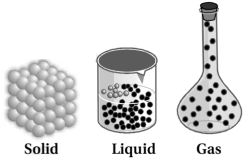
The constituent particles of matter in these three states can be represented as shown in the figure.
In solids,these particles are held very close to each other in an orderly fashion and there is not much freedom of movement.
In liquids,the particles are close to each other but they can move around.
However,in gases,the particles are far apart as compared to those present in solid or liquid states and their movement is easy and fast.
$(i)$ Solid
$(ii)$ Liquid
$(iii)$ Gas
The constituent particles of matter in these three states can be represented as shown in the figure.
In solids,these particles are held very close to each other in an orderly fashion and there is not much freedom of movement.
In liquids,the particles are close to each other but they can move around.
However,in gases,the particles are far apart as compared to those present in solid or liquid states and their movement is easy and fast.
0 likes
View Solution36
Medium
Describe the method,which can be used to separate two compounds with different solubilities in a solvent $S$.
Solution
(N/A) Fractional crystallisation is the method used for separating two compounds with different solubilities in a solvent $S$. The process of fractional crystallisation is carried out in four steps.
$(a)$ Preparation of the solution: The powdered mixture is taken in a flask and the solvent is added to it slowly and stirred simultaneously. The solvent is added until the solute is just dissolved. This saturated solution is then heated.
$(b)$ Filtration of the solution: The hot saturated solution is then filtered through a filter paper into a China dish.
$(c)$ Fractional crystallisation: The solution in the China dish is allowed to cool. The less soluble compound crystallises first,while the more soluble compound remains in the solution. After separating these crystals from the mother liquor,the latter is concentrated once again. The hot solution is allowed to cool,and consequently,the crystals of the more soluble compound are obtained.
$(d)$ Isolation and drying: These crystals are separated from the mother liquor by filtration. Finally,the crystals are dried.
$(a)$ Preparation of the solution: The powdered mixture is taken in a flask and the solvent is added to it slowly and stirred simultaneously. The solvent is added until the solute is just dissolved. This saturated solution is then heated.
$(b)$ Filtration of the solution: The hot saturated solution is then filtered through a filter paper into a China dish.
$(c)$ Fractional crystallisation: The solution in the China dish is allowed to cool. The less soluble compound crystallises first,while the more soluble compound remains in the solution. After separating these crystals from the mother liquor,the latter is concentrated once again. The hot solution is allowed to cool,and consequently,the crystals of the more soluble compound are obtained.
$(d)$ Isolation and drying: These crystals are separated from the mother liquor by filtration. Finally,the crystals are dried.
0 likes
View Solution37
EasyMCQ
Name a suitable technique for the separation of the components from a mixture of calcium sulphate and camphor.
A
Sublimation
B
Distillation
C
Crystallization
D
Filtration
Solution
(A) The process of $sublimation$ is used to separate a mixture of camphor and calcium sulphate.
In this process,the sublimable compound changes from solid to vapour state without passing through the liquid state.
Camphor is a sublimable compound,whereas calcium sulphate is a non-sublimable solid.
Hence,on heating,camphor will sublime while calcium sulphate will be left behind.
In this process,the sublimable compound changes from solid to vapour state without passing through the liquid state.
Camphor is a sublimable compound,whereas calcium sulphate is a non-sublimable solid.
Hence,on heating,camphor will sublime while calcium sulphate will be left behind.
0 likes
View Solution38
MediumMCQ
Describe the characteristics of matter based on its different physical states.
A
Solids have definite volume and shape.
B
Liquids have definite volume but no definite shape.
C
Gases have neither definite volume nor definite shape.
D
All of the above.
Solution
(D) Different states of matter exhibit the following characteristics:
$(i)$ Solids have definite volume and definite shape.
$(ii)$ Liquids have definite volume but not a definite shape. They take the shape of the container in which they are placed.
$(iii)$ Gases have neither definite volume nor definite shape. They completely occupy the container in which they are placed.
These three states of matter are interconvertible by changing the conditions of temperature and pressure.
$\text{SOLID}$ $\xrightarrow[\text{cool}]{\text{heat}} \text{LIQUID}$ $\xrightarrow[\text{cool}]{\text{heat}} \text{GAS}$
On heating,a solid usually changes to a liquid,and the liquid on further heating changes to the gaseous (or vapour) state.
In the reverse process,a gas on cooling liquefies to the liquid state,and the liquid on further cooling freezes to the solid state.
$(i)$ Solids have definite volume and definite shape.
$(ii)$ Liquids have definite volume but not a definite shape. They take the shape of the container in which they are placed.
$(iii)$ Gases have neither definite volume nor definite shape. They completely occupy the container in which they are placed.
These three states of matter are interconvertible by changing the conditions of temperature and pressure.
$\text{SOLID}$ $\xrightarrow[\text{cool}]{\text{heat}} \text{LIQUID}$ $\xrightarrow[\text{cool}]{\text{heat}} \text{GAS}$
On heating,a solid usually changes to a liquid,and the liquid on further heating changes to the gaseous (or vapour) state.
In the reverse process,a gas on cooling liquefies to the liquid state,and the liquid on further cooling freezes to the solid state.
0 likes
View Solution39
Medium
Explain the classification of matter based on chemical properties (macroscopic level).
Solution
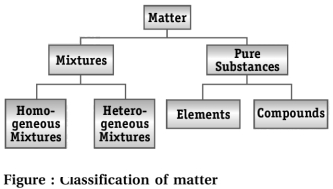
(N/A) At the macroscopic or bulk level,matter can be classified as mixtures or pure substances. These can be further sub-divided as shown in the figure.
Many of the substances present around us are mixtures. For example,sugar solution in water,air,tea,etc.
$A$ mixture contains two or more substances present in it,which are called its components.
Pure substances have characteristics different from mixtures. They have a fixed composition,whereas mixtures may contain the components in any ratio and their composition is variable. Examples include copper,silver,gold,water,glucose,etc.
Glucose contains carbon,hydrogen,and oxygen in a fixed ratio and thus,like all other pure substances,has a fixed composition.
The constituents of pure substances cannot be separated by simple physical methods.
Many of the substances present around us are mixtures. For example,sugar solution in water,air,tea,etc.
$A$ mixture contains two or more substances present in it,which are called its components.
Pure substances have characteristics different from mixtures. They have a fixed composition,whereas mixtures may contain the components in any ratio and their composition is variable. Examples include copper,silver,gold,water,glucose,etc.
Glucose contains carbon,hydrogen,and oxygen in a fixed ratio and thus,like all other pure substances,has a fixed composition.
The constituents of pure substances cannot be separated by simple physical methods.
0 likes
View Solution40
Medium
Define mixture and its types.
Solution
(N/A) mixture is a substance that contains two or more components (elements or compounds) mixed in any proportion.
Mixtures are classified into two types:
$(i)$ Homogeneous mixture: In this type,the components are completely mixed,and the composition is uniform throughout. Examples include $Sugar$ solution and air.
$(ii)$ Heterogeneous mixture: In this type,the composition is not uniform throughout,and the different components can often be observed separately. Examples include a mixture of salt and sugar,or grains and pulses with dirt particles.
The components of a mixture can be separated by physical methods such as hand-picking,filtration,crystallization,and distillation.
Mixtures are classified into two types:
$(i)$ Homogeneous mixture: In this type,the components are completely mixed,and the composition is uniform throughout. Examples include $Sugar$ solution and air.
$(ii)$ Heterogeneous mixture: In this type,the composition is not uniform throughout,and the different components can often be observed separately. Examples include a mixture of salt and sugar,or grains and pulses with dirt particles.
The components of a mixture can be separated by physical methods such as hand-picking,filtration,crystallization,and distillation.
0 likes
View Solution41
Medium
Define an element and provide examples.
Solution
(N/A) An element consists of only one type of particles. These particles may be atoms or molecules.
$1$. All atoms in an element are of the same type,but atoms of different elements differ in their nature.
$2$. Some elements,such as sodium $(Na)$ or copper $(Cu)$,contain single atoms as their constituent particles.
$3$. In other elements,two or more atoms combine to form molecules. For example,hydrogen $(H_2)$,nitrogen $(N_2)$,and oxygen $(O_2)$ gases consist of molecules where two atoms combine to form the respective molecule.
$1$. All atoms in an element are of the same type,but atoms of different elements differ in their nature.
$2$. Some elements,such as sodium $(Na)$ or copper $(Cu)$,contain single atoms as their constituent particles.
$3$. In other elements,two or more atoms combine to form molecules. For example,hydrogen $(H_2)$,nitrogen $(N_2)$,and oxygen $(O_2)$ gases consist of molecules where two atoms combine to form the respective molecule.
0 likes
View Solution42
Medium
Explain the concept of a compound.
Solution
(N/A) When two or more atoms of different elements combine,the molecule of a compound is obtained. Examples include water $(H_2O)$,ammonia $(NH_3)$,carbon dioxide $(CO_2)$,and sugar $(C_{12}H_{22}O_{11})$.
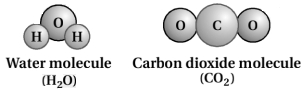
The molecules of water and carbon dioxide are represented in the figure.
According to the figure,a water molecule comprises two hydrogen atoms and one oxygen atom. Similarly,a molecule of carbon dioxide contains two oxygen atoms combined with one carbon atom.
Thus,the atoms of different elements are present in a compound in a fixed and definite ratio,and this ratio is characteristic of a particular compound.
The properties of a compound are different from those of its constituent elements.
For example,hydrogen and oxygen are gases,whereas the compound formed by their combination,i.e.,water,is a liquid. Hydrogen burns with a pop sound and oxygen is a supporter of combustion,but water is used as a fire extinguisher.
Moreover,the constituents of a compound cannot be separated into simpler substances by physical methods. They can be separated only by chemical methods.
The molecules of water and carbon dioxide are represented in the figure.
According to the figure,a water molecule comprises two hydrogen atoms and one oxygen atom. Similarly,a molecule of carbon dioxide contains two oxygen atoms combined with one carbon atom.
Thus,the atoms of different elements are present in a compound in a fixed and definite ratio,and this ratio is characteristic of a particular compound.
The properties of a compound are different from those of its constituent elements.
For example,hydrogen and oxygen are gases,whereas the compound formed by their combination,i.e.,water,is a liquid. Hydrogen burns with a pop sound and oxygen is a supporter of combustion,but water is used as a fire extinguisher.
Moreover,the constituents of a compound cannot be separated into simpler substances by physical methods. They can be separated only by chemical methods.
0 likes
View Solution43
Medium
Write down the properties of matter.
Solution
(N/A) Every substance has unique or characteristic properties. These properties can be classified into two categories: $(i)$ Physical properties and $(ii)$ Chemical properties.
$(i)$ Physical properties: These are properties that can be measured or observed without changing the identity or the composition of the substance. Examples include colour,odour,melting point,density,etc.
$(ii)$ Chemical properties: The measurement or observation of chemical properties requires a chemical change to occur. Examples include acidity,basicity,and combustibility.
Many properties of matter,such as length,area,and volume,are quantitative in nature. Any quantitative observation or measurement is represented by a number followed by the units in which it is measured.
$(i)$ Physical properties: These are properties that can be measured or observed without changing the identity or the composition of the substance. Examples include colour,odour,melting point,density,etc.
$(ii)$ Chemical properties: The measurement or observation of chemical properties requires a chemical change to occur. Examples include acidity,basicity,and combustibility.
Many properties of matter,such as length,area,and volume,are quantitative in nature. Any quantitative observation or measurement is represented by a number followed by the units in which it is measured.
0 likes
View Solution44
Medium
What is sublimation? Give its uses and examples.
Solution
(N/A) Definition: Sublimation is the process in which a solid substance changes directly into its vapour state upon heating,without passing through the liquid state.
Uses: It is used to separate sublimable organic compounds from non-sublimable impurities.
Examples: The sublimation technique is used for the purification of a mixture of $CaSO_4$ (calcium sulphate) and camphor. Camphor undergoes sublimation and is collected as a solid upon cooling,while $CaSO_4$ remains as a residue at the bottom.
Uses: It is used to separate sublimable organic compounds from non-sublimable impurities.
Examples: The sublimation technique is used for the purification of a mixture of $CaSO_4$ (calcium sulphate) and camphor. Camphor undergoes sublimation and is collected as a solid upon cooling,while $CaSO_4$ remains as a residue at the bottom.
0 likes
View Solution45
EasyMCQ
Name a suitable technique of separation of the components from a mixture of calcium sulphate and camphor.
A
Sublimation
B
Distillation
C
Crystallization
D
Filtration
Solution
(A) Camphor is a sublime substance,whereas calcium sulphate is not. Therefore,the $Sublimation$ technique is suitable for the separation of the components from a mixture of calcium sulphate and camphor.
0 likes
View Solution46
Medium
Describe the method that can be used to separate two compounds with different solubilities in a solvent $S$.
Solution
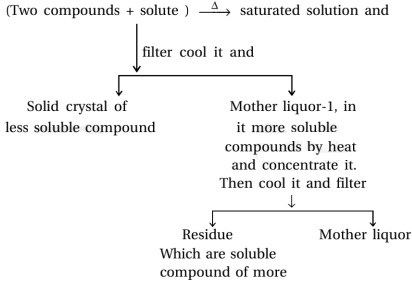
(N/A) The fractional crystallisation method is used to separate two compounds with different solubilities in a solvent.
$1$. Both compounds are dissolved in a solvent to form a hot saturated solution.
$2$. Upon cooling,the compound which is less soluble crystallises first.
$3$. These crystals are separated by filtration.
$4$. The remaining solution (mother liquor) contains the more soluble compound.
$5$. This solution is concentrated by heating and then cooled to induce crystallisation of the more soluble compound,which is then separated by filtration.
$1$. Both compounds are dissolved in a solvent to form a hot saturated solution.
$2$. Upon cooling,the compound which is less soluble crystallises first.
$3$. These crystals are separated by filtration.
$4$. The remaining solution (mother liquor) contains the more soluble compound.
$5$. This solution is concentrated by heating and then cooled to induce crystallisation of the more soluble compound,which is then separated by filtration.
0 likes
View Solution47
EasyMCQ
What type of mixture is an alloy? Explain.
A
Homogeneous mixture
B
Heterogeneous mixture
C
Compound
D
Element
Solution
(A) An alloy is a $homogeneous$ mixture of two or more metals or a metal and a non-metal.
It is considered a solid solution because the components are uniformly distributed throughout the material and cannot be separated by simple physical methods.
It is considered a solid solution because the components are uniformly distributed throughout the material and cannot be separated by simple physical methods.
0 likes
View Solution48
EasyMCQ
What are the fundamental components of matter?
A
Atoms and molecules
B
Protons and electrons
C
Cells and tissues
D
Elements and compounds
Solution
(A) The fundamental components of matter are known as atoms and molecules. Atoms are the smallest unit of an element,while molecules are formed by the combination of two or more atoms.
0 likes
View Solution49
EasyMCQ
What is an element?
A
$A$ substance that can be broken down into simpler substances by chemical means.
B
$A$ pure substance consisting of only one type of atom.
C
$A$ mixture of two or more different types of atoms.
D
$A$ compound formed by the chemical combination of elements.
Solution
(B) An element is defined as a pure substance that consists of only one type of atom.
It cannot be decomposed into simpler substances by ordinary chemical or physical methods.
Examples include $Fe$,$Au$,$O_2$,and $H_2$.
It cannot be decomposed into simpler substances by ordinary chemical or physical methods.
Examples include $Fe$,$Au$,$O_2$,and $H_2$.
0 likes
View Solution50
MediumMCQ
What is the process of converting a solid directly into a gaseous state called?
A
Evaporation
B
Sublimation
C
Condensation
D
Deposition
Solution
(B) The process of converting a solid directly into a gaseous state without passing through the liquid state is called $Sublimation$.
Evaporation is the conversion of liquid to gas.
Condensation is the conversion of gas to liquid.
Deposition is the conversion of gas directly to solid.
Evaporation is the conversion of liquid to gas.
Condensation is the conversion of gas to liquid.
Deposition is the conversion of gas directly to solid.
0 likes
View SolutionSome Basic Concepts of Chemistry — Matter and Separation of mixture · Frequently Asked Questions
1Are these Some Basic Concepts of Chemistry questions useful for JEE and NEET?
Yes. All questions in this section are mapped to JEE Main and NEET exam patterns. Previous year questions from JEE Main, NEET, GUJCET and state-level exams are included with full solutions.
2Can I switch to Hindi or Gujarati for these questions?
Yes. Use the language tabs in the hero section or the sidebar to view the same questions and solutions in English, Hindi or Gujarati.
3How do I generate a question paper from this subtopic?
Use the Vedclass Exam Paper Generator — select the chapter and subtopic, set difficulty, and generate Sets A, B, C, D automatically. First 3 chapters of every subject are free.
Vedclass Products
For Students
Vedclass Test Series
Mock tests in real JEE/NEET style with performance analysis. 5-day free trial.
Start Free TrialFor Teachers
Exam Paper Generator
Generate Set A/B/C/D papers from this chapter in 2 minutes. 3 chapters free.
Try FreeFor Institutes
Online Exam Module
Live online exams with unlimited students, 360° analytics & white-label branding.
See DemoFor Teachers & Institutes
Generate a Some Basic Concepts of Chemistry Exam Paper in 2 Minutes
Select subtopic & difficulty — Sets A, B, C, D auto-generated with No Repeat logic.
First 3 chapters of every subject are free — no payment required.