
A English
Percentage composition and Molecular formula Questions in English
Class 11 Chemistry · Some Basic Concepts of Chemistry · Percentage composition and Molecular formula
301+
Questions
English
Language
100%
With Solutions
Showing 47 of 301 questions in English
251
DifficultMCQ
The value of $n$ in the molecular formula $Be_n Al_2 Si_6 O_{18}$ is
A
$1$
B
$2$
C
$3$
D
$4$
Solution
(C) The mineral Beryl has the chemical formula $Be_3 Al_2 Si_6 O_{18}$.
To determine $n$ using the principle of charge neutrality (sum of oxidation states $= 0$):
$Be = +2$,$Al = +3$,$Si = +4$,$O = -2$
$n(+2) + 2(+3) + 6(+4) + 18(-2) = 0$
$2n + 6 + 24 - 36 = 0$
$2n - 6 = 0$
$2n = 6$
$n = 3$
To determine $n$ using the principle of charge neutrality (sum of oxidation states $= 0$):
$Be = +2$,$Al = +3$,$Si = +4$,$O = -2$
$n(+2) + 2(+3) + 6(+4) + 18(-2) = 0$
$2n + 6 + 24 - 36 = 0$
$2n - 6 = 0$
$2n = 6$
$n = 3$
0 likes
View Solution252
DifficultMCQ
$0.01 \ mol$ of an organic compound $(X)$ containing $10\%$ hydrogen,on complete combustion produced $0.9 \ g \ H_2O$. Molar mass of $(X)$ is $.......... \ g \ mol^{-1}$.
A
$100$
B
$200$
C
$300$
D
$400$
Solution
(A) Moles of $H_2O$ produced $= \frac{0.9 \ g}{18 \ g \ mol^{-1}} = 0.05 \ mol$.
Moles of $H$ atoms $= 0.05 \ mol \times 2 = 0.1 \ mol$.
Mass of $H$ atoms in $0.01 \ mol$ of $(X) = 0.1 \ mol \times 1 \ g \ mol^{-1} = 0.1 \ g$.
Mass of $H$ atoms in $1 \ mol$ of $(X) = \frac{0.1 \ g}{0.01 \ mol} = 10 \ g \ mol^{-1}$.
Given that the compound contains $10\%$ hydrogen by mass,we have:
$10\% = \frac{\text{Mass of } H \text{ in } 1 \ mol \text{ of } (X)}{\text{Molar mass of } (X)} \times 100$.
$10 = \frac{10}{M} \times 100$.
$M = 100 \ g \ mol^{-1}$.
Moles of $H$ atoms $= 0.05 \ mol \times 2 = 0.1 \ mol$.
Mass of $H$ atoms in $0.01 \ mol$ of $(X) = 0.1 \ mol \times 1 \ g \ mol^{-1} = 0.1 \ g$.
Mass of $H$ atoms in $1 \ mol$ of $(X) = \frac{0.1 \ g}{0.01 \ mol} = 10 \ g \ mol^{-1}$.
Given that the compound contains $10\%$ hydrogen by mass,we have:
$10\% = \frac{\text{Mass of } H \text{ in } 1 \ mol \text{ of } (X)}{\text{Molar mass of } (X)} \times 100$.
$10 = \frac{10}{M} \times 100$.
$M = 100 \ g \ mol^{-1}$.
0 likes
View Solution253
MediumMCQ
The elemental composition of a compound is $54.2 \% C$,$9.2 \% H$,and $36.6 \% O$. If the molar mass of the compound is $132 \ g \ mol^{-1}$,the molecular formula of the compound is: [Given: The relative atomic mass of $C:H:O = 12:1:16$]
A
$C_4H_9O_3$
B
$C_6H_{12}O_6$
C
$C_6H_{12}O_3$
D
$C_4H_8O_2$
Solution
(C) Step $1$: Calculate the moles of each element in $100 \ g$ of the compound:
$n_C = \frac{54.2}{12} = 4.516$
$n_H = \frac{9.2}{1} = 9.2$
$n_O = \frac{36.6}{16} = 2.287$
Step $2$: Determine the simplest molar ratio by dividing by the smallest value $(2.287)$:
$C = \frac{4.516}{2.287} \approx 2$
$H = \frac{9.2}{2.287} \approx 4$
$O = \frac{2.287}{2.287} = 1$
Step $3$: The empirical formula is $C_2H_4O$.
Step $4$: Calculate the empirical formula mass:
$E.F. \text{ mass} = (2 \times 12) + (4 \times 1) + (1 \times 16) = 24 + 4 + 16 = 44 \ g \ mol^{-1}$.
Step $5$: Calculate the value of $n$ (where $n = \frac{\text{Molar mass}}{\text{E.F. mass}}$):
$n = \frac{132}{44} = 3$.
Step $6$: Determine the molecular formula:
$\text{Molecular formula} = (C_2H_4O)_3 = C_6H_{12}O_3$.
$n_C = \frac{54.2}{12} = 4.516$
$n_H = \frac{9.2}{1} = 9.2$
$n_O = \frac{36.6}{16} = 2.287$
Step $2$: Determine the simplest molar ratio by dividing by the smallest value $(2.287)$:
$C = \frac{4.516}{2.287} \approx 2$
$H = \frac{9.2}{2.287} \approx 4$
$O = \frac{2.287}{2.287} = 1$
Step $3$: The empirical formula is $C_2H_4O$.
Step $4$: Calculate the empirical formula mass:
$E.F. \text{ mass} = (2 \times 12) + (4 \times 1) + (1 \times 16) = 24 + 4 + 16 = 44 \ g \ mol^{-1}$.
Step $5$: Calculate the value of $n$ (where $n = \frac{\text{Molar mass}}{\text{E.F. mass}}$):
$n = \frac{132}{44} = 3$.
Step $6$: Determine the molecular formula:
$\text{Molecular formula} = (C_2H_4O)_3 = C_6H_{12}O_3$.
0 likes
View Solution254
MediumMCQ
Quantitative analysis of an organic compound $(X)$ shows the following percentage composition: $C: 14.5\%$,$Cl: 64.46\%$,and $H: 1.8\%$. The empirical formula mass of the compound $(X)$ is $.......... \times 10^{-1}$. (Given molar mass in $g \ mol^{-1}$ of $C: 12, H: 1, O: 16, Cl: 35.5$)
A
$1755$
B
$1655$
C
$1266$
D
$1245$
Solution
(B) Total percentage of $C, H, Cl = 14.5 + 1.8 + 64.46 = 80.76\%$.
Percentage of Oxygen $(O) = 100 - 80.76 = 19.24\%$.
Relative number of moles:
$n_C = \frac{14.5}{12} = 1.208$
$n_H = \frac{1.8}{1} = 1.8$
$n_{Cl} = \frac{64.46}{35.5} = 1.815$
$n_O = \frac{19.24}{16} = 1.2025$
Simplest molar ratio (divide by $1.2025$):
$C: \frac{1.208}{1.2025} \approx 1$
$H: \frac{1.8}{1.2025} \approx 1.5$
$Cl: \frac{1.815}{1.2025} \approx 1.5$
$O: \frac{1.2025}{1.2025} = 1$
Simplest whole number ratio $(\times 2)$: $C: 2, H: 3, Cl: 3, O: 2$.
Empirical formula: $C_2H_3Cl_3O_2$.
Empirical formula mass $= (2 \times 12) + (3 \times 1) + (3 \times 35.5) + (2 \times 16) = 24 + 3 + 106.5 + 32 = 165.5 \ g \ mol^{-1}$.
Value $= 1655 \times 10^{-1}$.
Percentage of Oxygen $(O) = 100 - 80.76 = 19.24\%$.
Relative number of moles:
$n_C = \frac{14.5}{12} = 1.208$
$n_H = \frac{1.8}{1} = 1.8$
$n_{Cl} = \frac{64.46}{35.5} = 1.815$
$n_O = \frac{19.24}{16} = 1.2025$
Simplest molar ratio (divide by $1.2025$):
$C: \frac{1.208}{1.2025} \approx 1$
$H: \frac{1.8}{1.2025} \approx 1.5$
$Cl: \frac{1.815}{1.2025} \approx 1.5$
$O: \frac{1.2025}{1.2025} = 1$
Simplest whole number ratio $(\times 2)$: $C: 2, H: 3, Cl: 3, O: 2$.
Empirical formula: $C_2H_3Cl_3O_2$.
Empirical formula mass $= (2 \times 12) + (3 \times 1) + (3 \times 35.5) + (2 \times 16) = 24 + 3 + 106.5 + 32 = 165.5 \ g \ mol^{-1}$.
Value $= 1655 \times 10^{-1}$.
0 likes
View Solution255
DifficultMCQ
On complete combustion,$1.0 \ g$ of an organic compound $(X)$ gave $1.46 \ g$ of $CO_2$ and $0.567 \ g$ of $H_2O$. The empirical formula mass of compound $(X)$ is $.......... \ g \ mol^{-1}$. (Given molar mass in $g \ mol^{-1}: C: 12, H: 1, O: 16$)
A
$30$
B
$45$
C
$60$
D
$15$
Solution
(A) Moles of $C = n_{CO_2} = \frac{1.46}{44} \approx 0.03318 \ mol$.
Mass of $C = 0.03318 \times 12 = 0.398 \ g$.
Moles of $H = 2 \times n_{H_2O} = 2 \times \frac{0.567}{18} = 0.063 \ mol$.
Mass of $H = 0.063 \times 1 = 0.063 \ g$.
Mass of $O = 1.0 - (0.398 + 0.063) = 0.539 \ g$.
Moles of $O = \frac{0.539}{16} \approx 0.0337 \ mol$.
Ratio of $C:H:O = 0.03318 : 0.063 : 0.0337 \approx 1:2:1$.
Empirical formula $= CH_2O$.
Empirical formula mass $= 12 + (2 \times 1) + 16 = 30 \ g \ mol^{-1}$.
Mass of $C = 0.03318 \times 12 = 0.398 \ g$.
Moles of $H = 2 \times n_{H_2O} = 2 \times \frac{0.567}{18} = 0.063 \ mol$.
Mass of $H = 0.063 \times 1 = 0.063 \ g$.
Mass of $O = 1.0 - (0.398 + 0.063) = 0.539 \ g$.
Moles of $O = \frac{0.539}{16} \approx 0.0337 \ mol$.
Ratio of $C:H:O = 0.03318 : 0.063 : 0.0337 \approx 1:2:1$.
Empirical formula $= CH_2O$.
Empirical formula mass $= 12 + (2 \times 1) + 16 = 30 \ g \ mol^{-1}$.
0 likes
View Solution256
DifficultMCQ
$0.5 \ g$ of an organic compound on combustion gave $1.46 \ g$ of $CO_2$ and $0.9 \ g$ of $H_2O$. The percentage of carbon in the compound is $...........$ ($NEAREST$ $INTEGER$). [$GIVEN$: Molar mass in $g \ mol^{-1}$: $C: 12, H: 1, O: 16$]
A
$70$
B
$80$
C
$90$
D
$100$
Solution
(B) The percentage of carbon in an organic compound is calculated using the formula: $\% \text{ of } C = \frac{12}{44} \times \frac{\text{mass of } CO_2}{\text{mass of compound}} \times 100$.
Substituting the given values: $\% \text{ of } C = \frac{12}{44} \times \frac{1.46}{0.5} \times 100$.
Calculating the value: $\% \text{ of } C = 0.2727 \times 2.92 \times 100 = 79.636\%$.
Rounding to the nearest integer,we get $80\%$.
Substituting the given values: $\% \text{ of } C = \frac{12}{44} \times \frac{1.46}{0.5} \times 100$.
Calculating the value: $\% \text{ of } C = 0.2727 \times 2.92 \times 100 = 79.636\%$.
Rounding to the nearest integer,we get $80\%$.
0 likes
View Solution257
MediumMCQ
An organic compound weighing $500 \ mg$ produced $220 \ mg$ of $CO_2$ on complete combustion. The percentage composition of carbon in the compound is $..........\%$. $(nearest \ integer)$ $(Given \ molar \ mass \ in \ g \ mol^{-1} \ of \ C: 12, O: 16)$
A
$12$
B
$22$
C
$32$
D
$42$
Solution
(A) The combustion reaction is: $\text{Organic compound} \xrightarrow{\Delta, CuO} CO_2 + H_2O$
$1.$ Calculate the moles of $CO_2$ produced:
$n_{CO_2} = \frac{220 \times 10^{-3} \ g}{44 \ g \ mol^{-1}} = 5 \times 10^{-3} \ mol$
$2.$ Calculate the mass of carbon in $CO_2$:
Since $1 \ mol$ of $CO_2$ contains $1 \ mol$ of $C$,the moles of $C$ are $5 \times 10^{-3} \ mol$.
$m_{C} = 5 \times 10^{-3} \ mol \times 12 \ g \ mol^{-1} = 60 \times 10^{-3} \ g = 60 \ mg$
$3.$ Calculate the percentage of carbon:
$\% \ C = \frac{\text{mass of } C}{\text{mass of compound}} \times 100 = \frac{60 \ mg}{500 \ mg} \times 100 = 12 \%$
$1.$ Calculate the moles of $CO_2$ produced:
$n_{CO_2} = \frac{220 \times 10^{-3} \ g}{44 \ g \ mol^{-1}} = 5 \times 10^{-3} \ mol$
$2.$ Calculate the mass of carbon in $CO_2$:
Since $1 \ mol$ of $CO_2$ contains $1 \ mol$ of $C$,the moles of $C$ are $5 \times 10^{-3} \ mol$.
$m_{C} = 5 \times 10^{-3} \ mol \times 12 \ g \ mol^{-1} = 60 \times 10^{-3} \ g = 60 \ mg$
$3.$ Calculate the percentage of carbon:
$\% \ C = \frac{\text{mass of } C}{\text{mass of compound}} \times 100 = \frac{60 \ mg}{500 \ mg} \times 100 = 12 \%$
0 likes
View Solution258
MediumMCQ
On combustion,$0.210 \ g$ of an organic compound containing $C$,$H$,and $O$ gave $0.127 \ g$ $H_2O$ and $0.307 \ g$ $CO_2$. The percentages of hydrogen and oxygen in the given organic compound respectively are $:$
A
$53.41, 39.6$
B
$6.72, 53.41$
C
$7.55, 43.85$
D
$6.72, 39.87$
Solution
(B) In the combustion of an organic compound,all $C$ in $CO_2$ and all $H$ in $H_2O$ comes from the organic compound.
Mass of $C$ in $CO_2 = \frac{12}{44} \times 0.307 \ g = 0.0837 \ g$.
Mass of $H$ in $H_2O = \frac{2}{18} \times 0.127 \ g = 0.0141 \ g$.
Percentage of $H = \frac{0.0141}{0.210} \times 100 = 6.714 \% \approx 6.72 \%$.
Mass of $O$ in the compound = Total mass - (Mass of $C$ + Mass of $H$) = $0.210 - (0.0837 + 0.0141) = 0.1122 \ g$.
Percentage of $O = \frac{0.1122}{0.210} \times 100 = 53.428 \% \approx 53.41 \%$.
Therefore,the percentages of $H$ and $O$ are $6.72 \%$ and $53.41 \%$ respectively.
Mass of $C$ in $CO_2 = \frac{12}{44} \times 0.307 \ g = 0.0837 \ g$.
Mass of $H$ in $H_2O = \frac{2}{18} \times 0.127 \ g = 0.0141 \ g$.
Percentage of $H = \frac{0.0141}{0.210} \times 100 = 6.714 \% \approx 6.72 \%$.
Mass of $O$ in the compound = Total mass - (Mass of $C$ + Mass of $H$) = $0.210 - (0.0837 + 0.0141) = 0.1122 \ g$.
Percentage of $O = \frac{0.1122}{0.210} \times 100 = 53.428 \% \approx 53.41 \%$.
Therefore,the percentages of $H$ and $O$ are $6.72 \%$ and $53.41 \%$ respectively.
0 likes
View Solution259
MediumMCQ
If the fertilizers listed below are priced according to their nitrogen content,which will be the least expensive per $50 \ kg$ bag?
A
Urea,$(NH_2)_2CO$
B
Ammonia,$NH_3$
C
Ammonium nitrate,$NH_4NO_3$
D
Guanidine,$HNC(NH_2)_2$
Solution
(C) To determine the least expensive fertilizer,we calculate the percentage of nitrogen $(N)$ in each compound:
$1$. Urea,$(NH_2)_2CO$: Molar mass = $60 \ g/mol$. $\% \ N = (28/60) \times 100 = 46.7 \%$.
$2$. Ammonia,$NH_3$: Molar mass = $17 \ g/mol$. $\% \ N = (14/17) \times 100 = 82.3 \%$.
$3$. Ammonium nitrate,$NH_4NO_3$: Molar mass = $80 \ g/mol$. $\% \ N = (28/80) \times 100 = 35 \%$.
$4$. Guanidine,$HNC(NH_2)_2$: Molar mass = $59 \ g/mol$. $\% \ N = (42/59) \times 100 = 71.1 \%$.
Since the price is based on nitrogen content,the fertilizer with the lowest percentage of nitrogen will be the least expensive per $50 \ kg$ bag. Therefore,ammonium nitrate is the least expensive.
$1$. Urea,$(NH_2)_2CO$: Molar mass = $60 \ g/mol$. $\% \ N = (28/60) \times 100 = 46.7 \%$.
$2$. Ammonia,$NH_3$: Molar mass = $17 \ g/mol$. $\% \ N = (14/17) \times 100 = 82.3 \%$.
$3$. Ammonium nitrate,$NH_4NO_3$: Molar mass = $80 \ g/mol$. $\% \ N = (28/80) \times 100 = 35 \%$.
$4$. Guanidine,$HNC(NH_2)_2$: Molar mass = $59 \ g/mol$. $\% \ N = (42/59) \times 100 = 71.1 \%$.
Since the price is based on nitrogen content,the fertilizer with the lowest percentage of nitrogen will be the least expensive per $50 \ kg$ bag. Therefore,ammonium nitrate is the least expensive.
0 likes
View Solution260
MediumMCQ
An organic compound on analysis gives the following data: $C = 57.82 \%$,$H = 3.6 \%$ and the rest is oxygen. Its vapour density is $83$. Calculate its molecular formula.
A
$C_8H_6O_6$
B
$C_8H_6O_4$
C
$C_4H_3O_2$
D
$C_6H_6O_6$
Solution
(B) $1$. Calculate the percentage of oxygen: $O = 100 - (57.82 + 3.6) = 38.58 \%$.
$2$. Determine the empirical formula:
$C: \frac{57.82}{12} = 4.818 \Rightarrow \frac{4.818}{2.41} = 2$
$H: \frac{3.6}{1} = 3.6 \Rightarrow \frac{3.6}{2.41} = 1.5 = \frac{3}{2}$
$O: \frac{38.58}{16} = 2.41 \Rightarrow \frac{2.41}{2.41} = 1$
Multiplying by $2$ to get whole numbers: $C = 4, H = 3, O = 2$.
Empirical Formula ($E$.$F$.) = $C_4H_3O_2$.
$3$. Calculate Empirical Formula Mass ($E$.$F$.$M$.): $(4 \times 12) + (3 \times 1) + (2 \times 16) = 48 + 3 + 32 = 83$.
$4$. Calculate Molecular Formula Mass ($M$.$F$.$M$.): $2 \times \text{Vapour Density} = 2 \times 83 = 166$.
$5$. Calculate $n$: $n = \frac{M.F.M.}{E.F.M.} = \frac{166}{83} = 2$.
$6$. Molecular Formula = $n \times E.F. = 2 \times C_4H_3O_2 = C_8H_6O_4$.
$2$. Determine the empirical formula:
$C: \frac{57.82}{12} = 4.818 \Rightarrow \frac{4.818}{2.41} = 2$
$H: \frac{3.6}{1} = 3.6 \Rightarrow \frac{3.6}{2.41} = 1.5 = \frac{3}{2}$
$O: \frac{38.58}{16} = 2.41 \Rightarrow \frac{2.41}{2.41} = 1$
Multiplying by $2$ to get whole numbers: $C = 4, H = 3, O = 2$.
Empirical Formula ($E$.$F$.) = $C_4H_3O_2$.
$3$. Calculate Empirical Formula Mass ($E$.$F$.$M$.): $(4 \times 12) + (3 \times 1) + (2 \times 16) = 48 + 3 + 32 = 83$.
$4$. Calculate Molecular Formula Mass ($M$.$F$.$M$.): $2 \times \text{Vapour Density} = 2 \times 83 = 166$.
$5$. Calculate $n$: $n = \frac{M.F.M.}{E.F.M.} = \frac{166}{83} = 2$.
$6$. Molecular Formula = $n \times E.F. = 2 \times C_4H_3O_2 = C_8H_6O_4$.
0 likes
View Solution261
EasyMCQ
An organic compound contains carbon,hydrogen,and oxygen. Its elemental analysis gives $38.71 \%$ of $C$ and $9.67 \%$ of $H$. The empirical formula of the compound would be $:-$
A
$CHO$
B
$CH_4O$
C
$CH_3O$
D
$CH_2O$
Solution
(C) $1$. Calculate the percentage of oxygen: $\% O = 100 - (38.71 + 9.67) = 51.62 \%$.
$2$. Calculate the relative number of moles for each element:
$C = \frac{38.71}{12} = 3.226$
$H = \frac{9.67}{1} = 9.67$
$O = \frac{51.62}{16} = 3.226$
$3$. Determine the simplest molar ratio by dividing by the smallest value $(3.226)$:
$C = \frac{3.226}{3.226} = 1$
$H = \frac{9.67}{3.226} \approx 3$
$O = \frac{3.226}{3.226} = 1$
$4$. The empirical formula is $CH_3O$.
$2$. Calculate the relative number of moles for each element:
$C = \frac{38.71}{12} = 3.226$
$H = \frac{9.67}{1} = 9.67$
$O = \frac{51.62}{16} = 3.226$
$3$. Determine the simplest molar ratio by dividing by the smallest value $(3.226)$:
$C = \frac{3.226}{3.226} = 1$
$H = \frac{9.67}{3.226} \approx 3$
$O = \frac{3.226}{3.226} = 1$
$4$. The empirical formula is $CH_3O$.
0 likes
View Solution262
MediumMCQ
$0.44 \ g$ of a colourless oxide of nitrogen occupies $224 \ mL$ at $\text{STP}.$ The compound is $-$
A
$N_2O$
B
$NO$
C
$N_2O_4$
D
$NO_2$
Solution
(A) At $\text{STP}$,$224 \ mL$ of the gas weighs $0.44 \ g$.
Since $22400 \ mL$ $(1 \ mol)$ of any gas at $\text{STP}$ weighs equal to its molar mass,
Molar mass $= \frac{0.44 \ g}{224 \ mL} \times 22400 \ mL = 44 \ g/mol$.
The molar mass of $N_2O$ is $(2 \times 14) + 16 = 44 \ g/mol$.
Therefore,the compound is $N_2O$.
Since $22400 \ mL$ $(1 \ mol)$ of any gas at $\text{STP}$ weighs equal to its molar mass,
Molar mass $= \frac{0.44 \ g}{224 \ mL} \times 22400 \ mL = 44 \ g/mol$.
The molar mass of $N_2O$ is $(2 \times 14) + 16 = 44 \ g/mol$.
Therefore,the compound is $N_2O$.
0 likes
View Solution263
EasyMCQ
What is the mass percent of oxygen in ethanol $(C_2H_5OH)$ (in $\%$)?
A
$52.14$
B
$13.13$
C
$16$
D
$34.73$
Solution
(D) The chemical formula of ethanol is $C_2H_5OH$.
The molar mass of $C_2H_5OH = (2 \times 12.01) + (6 \times 1.008) + (1 \times 16.00) = 46.07 \text{ g/mol}$.
The mass of oxygen in $1 \text{ mole}$ of $C_2H_5OH$ is $16.00 \text{ g}$.
The mass percent of oxygen $= \frac{\text{Mass of Oxygen}}{\text{Molar mass of } C_2H_5OH} \times 100$.
Mass percent $= \frac{16.00}{46.07} \times 100 \approx 34.73 \% $.
The molar mass of $C_2H_5OH = (2 \times 12.01) + (6 \times 1.008) + (1 \times 16.00) = 46.07 \text{ g/mol}$.
The mass of oxygen in $1 \text{ mole}$ of $C_2H_5OH$ is $16.00 \text{ g}$.
The mass percent of oxygen $= \frac{\text{Mass of Oxygen}}{\text{Molar mass of } C_2H_5OH} \times 100$.
Mass percent $= \frac{16.00}{46.07} \times 100 \approx 34.73 \% $.
0 likes
View Solution264
MediumMCQ
Haemoglobin contains $0.33 \%$ of iron by mass. The molecular mass of haemoglobin is $67200$. The number of iron atoms present in one molecule of haemoglobin is: (Atomic mass of $Fe = 56$)
A
$6$
B
$1$
C
$4$
D
$2$
Solution
(C) Mass of iron in one molecule of haemoglobin $= \frac{0.33}{100} \times 67200 = 221.76 \ g/mol$.
Number of iron atoms $= \frac{\text{Mass of iron in one molecule}}{\text{Atomic mass of } Fe} = \frac{221.76}{56} = 3.96$.
Since the number of atoms must be an integer,we round $3.96$ to $4$.
Number of iron atoms $= \frac{\text{Mass of iron in one molecule}}{\text{Atomic mass of } Fe} = \frac{221.76}{56} = 3.96$.
Since the number of atoms must be an integer,we round $3.96$ to $4$.
0 likes
View Solution265
MediumMCQ
The molecular mass of an organic monobasic acid is $129$ and the value of $n$ is $2$. What is the empirical formula mass of the compound?
A
$158.0$
B
$193.5$
C
$64.5$
D
$258$
Solution
(C) The relationship between molecular mass,empirical formula mass,and the integer $n$ is given by the formula:
$\text{Molecular mass} = n \times \text{Empirical formula mass}$
Given that the molecular mass is $129$ and $n = 2$:
$\text{Empirical formula mass} = \frac{\text{Molecular mass}}{n} = \frac{129}{2} = 64.5$.
$\text{Molecular mass} = n \times \text{Empirical formula mass}$
Given that the molecular mass is $129$ and $n = 2$:
$\text{Empirical formula mass} = \frac{\text{Molecular mass}}{n} = \frac{129}{2} = 64.5$.
0 likes
View Solution266
EasyMCQ
An organic compound was found to contain $40.0 \% C$ and $6.66 \% H$. Find its molecular formula (molar mass $= 180$).
A
$C_{22} H_{24} O_{11}$
B
$C_{2} H_{4} O_{2}$
C
$CH_{2} O$
D
$C_{6} H_{12} O_{6}$
Solution
(D) First,calculate the percentage of oxygen: $\% O = 100 - (40.0 + 6.66) = 53.34 \%$.
Construct the table for empirical formula calculation:
Empirical formula $= CH_{2} O$.
Empirical formula mass $= 12 + (2 \times 1) + 16 = 30$.
Calculate $n = \text{Molar mass} / \text{Empirical formula mass} = 180 / 30 = 6$.
Molecular formula $= n \times (\text{Empirical formula}) = 6 \times (CH_{2} O) = C_{6} H_{12} O_{6}$.
Construct the table for empirical formula calculation:
| Element | % Composition | Atomic Mass | Mole Ratio | Simple Ratio |
|---|---|---|---|---|
| $C$ | $40.0$ | $12$ | $40/12 = 3.33$ | $1$ |
| $H$ | $6.66$ | $1$ | $6.66/1 = 6.66$ | $2$ |
| $O$ | $53.34$ | $16$ | $53.34/16 = 3.33$ | $1$ |
Empirical formula $= CH_{2} O$.
Empirical formula mass $= 12 + (2 \times 1) + 16 = 30$.
Calculate $n = \text{Molar mass} / \text{Empirical formula mass} = 180 / 30 = 6$.
Molecular formula $= n \times (\text{Empirical formula}) = 6 \times (CH_{2} O) = C_{6} H_{12} O_{6}$.
0 likes
View Solution267
MediumMCQ
Find the empirical formula of an organic compound if it contains $18.6 \% C$,$1.55 \% H$,and $55.04 \% Cl$. (Atomic masses: $C=12$,$H=1$,$Cl=35.5$,$O=16$)
A
$C_{2}H_{2}Cl_{2}O_{2}$
B
$CH_{2}ClO$
C
$CHClO$
D
$CHClO_{2}$
Solution
(C) $1$. Calculate the percentage of oxygen: $\% O = 100 - (18.6 + 1.55 + 55.04) = 24.81 \%$.
$2$. Calculate the moles of each element in $100 \ g$ of the compound:
$n_C = \frac{18.6}{12} = 1.55$,
$n_H = \frac{1.55}{1} = 1.55$,
$n_{Cl} = \frac{55.04}{35.5} = 1.55$,
$n_O = \frac{24.81}{16} = 1.55$.
$3$. Determine the simplest molar ratio: $1.55 : 1.55 : 1.55 : 1.55 = 1 : 1 : 1 : 1$.
$4$. The empirical formula is $CHClO$.
$2$. Calculate the moles of each element in $100 \ g$ of the compound:
$n_C = \frac{18.6}{12} = 1.55$,
$n_H = \frac{1.55}{1} = 1.55$,
$n_{Cl} = \frac{55.04}{35.5} = 1.55$,
$n_O = \frac{24.81}{16} = 1.55$.
$3$. Determine the simplest molar ratio: $1.55 : 1.55 : 1.55 : 1.55 = 1 : 1 : 1 : 1$.
$4$. The empirical formula is $CHClO$.
0 likes
View Solution268
MediumMCQ
What is the percentage of carbon in urea (in $\%$)? $(At. mass C = 12, H = 1, N = 14, O = 16)$
A
$20$
B
$26.6$
C
$6.67$
D
$46.0$
Solution
(A) The chemical formula of urea is $NH_2CONH_2$.
The molar mass of urea is $(2 \times 14) + (4 \times 1) + 12 + 16 = 60 \ g/mol$.
The number of carbon atoms in one molecule of urea is $1$.
The percentage of carbon by mass is calculated as: $\frac{\text{Mass of Carbon}}{\text{Molar mass of Urea}} \times 100 = \frac{12}{60} \times 100 = 20 \%$.
The molar mass of urea is $(2 \times 14) + (4 \times 1) + 12 + 16 = 60 \ g/mol$.
The number of carbon atoms in one molecule of urea is $1$.
The percentage of carbon by mass is calculated as: $\frac{\text{Mass of Carbon}}{\text{Molar mass of Urea}} \times 100 = \frac{12}{60} \times 100 = 20 \%$.
0 likes
View Solution269
MediumMCQ
What is the percentage by mass of oxygen in $NaOH$? (Atomic mass of $Na=23 \ u, O=16 \ u, H=1 \ u$)
A
$16$
B
$20$
C
$40$
D
$60$
Solution
(C) The molar mass of $NaOH$ is calculated as: $23 + 16 + 1 = 40 \ u$.
The percentage by mass of oxygen is given by the formula: $\frac{\text{Atomic mass of } O}{\text{Molar mass of } NaOH} \times 100$.
Substituting the values: $\frac{16}{40} \times 100 = 40 \%$.
The percentage by mass of oxygen is given by the formula: $\frac{\text{Atomic mass of } O}{\text{Molar mass of } NaOH} \times 100$.
Substituting the values: $\frac{16}{40} \times 100 = 40 \%$.
0 likes
View Solution270
EasyMCQ
What is the mass percentage of carbon in urea (in $\%$)? (molar mass of urea $= 60 \ g \ mol^{-1}$)
A
$28.0$
B
$20.0$
C
$26.67$
D
$46.67$
Solution
(B) The molecular formula of urea is $NH_2CONH_2$.
We know that the mass percentage of an element in a compound is given by:
$\text{Mass percentage} = \frac{\text{Total mass of the element in one mole of compound}}{\text{Molar mass of the compound}} \times 100$
In one mole of urea $(NH_2CONH_2)$,there is $1$ mole of carbon atom.
The molar mass of carbon is $12 \ g \ mol^{-1}$.
The molar mass of urea is given as $60 \ g \ mol^{-1}$.
Therefore,the mass percentage of carbon in urea $= \frac{12 \ g \ mol^{-1}}{60 \ g \ mol^{-1}} \times 100 = 20 \%$.
Hence,option $B$ is correct.
We know that the mass percentage of an element in a compound is given by:
$\text{Mass percentage} = \frac{\text{Total mass of the element in one mole of compound}}{\text{Molar mass of the compound}} \times 100$
In one mole of urea $(NH_2CONH_2)$,there is $1$ mole of carbon atom.
The molar mass of carbon is $12 \ g \ mol^{-1}$.
The molar mass of urea is given as $60 \ g \ mol^{-1}$.
Therefore,the mass percentage of carbon in urea $= \frac{12 \ g \ mol^{-1}}{60 \ g \ mol^{-1}} \times 100 = 20 \%$.
Hence,option $B$ is correct.
0 likes
View Solution271
DifficultMCQ
An oxygen-containing organic compound was found to contain $52 \%$ carbon and $13 \%$ hydrogen. Its vapour density is $23$. The compound reacts with sodium metal to liberate hydrogen. $A$ functional isomer of this compound is
A
ethanal
B
methoxy methane
C
methoxy ethane
D
ethanol
Solution
(B) The percentage of oxygen $= 100 - (52 + 13) = 35 \%$.
Calculating the empirical formula:
$C: 52/12 = 4.33 \rightarrow 2$
$H: 13/1 = 13.00 \rightarrow 6$
$O: 35/16 = 2.18 \rightarrow 1$
Empirical formula $= C_2H_6O$.
Empirical formula weight $= 2 \times 12 + 6 \times 1 + 16 = 46$.
Molecular weight $= 2 \times \text{vapour density} = 2 \times 23 = 46$.
Since molecular weight equals empirical formula weight,the molecular formula is $C_2H_6O$.
Since the compound reacts with sodium metal to liberate $H_2$ gas,it must be an alcohol,which is $C_2H_5OH$ (ethanol).
The functional isomer of ethanol $(C_2H_5OH)$ is methoxy methane $(CH_3OCH_3)$.
Calculating the empirical formula:
$C: 52/12 = 4.33 \rightarrow 2$
$H: 13/1 = 13.00 \rightarrow 6$
$O: 35/16 = 2.18 \rightarrow 1$
Empirical formula $= C_2H_6O$.
Empirical formula weight $= 2 \times 12 + 6 \times 1 + 16 = 46$.
Molecular weight $= 2 \times \text{vapour density} = 2 \times 23 = 46$.
Since molecular weight equals empirical formula weight,the molecular formula is $C_2H_6O$.
Since the compound reacts with sodium metal to liberate $H_2$ gas,it must be an alcohol,which is $C_2H_5OH$ (ethanol).
The functional isomer of ethanol $(C_2H_5OH)$ is methoxy methane $(CH_3OCH_3)$.
0 likes
View Solution272
EasyMCQ
$A$ pure compound contains $2.4 \ g$ of $C$,$1.2 \times 10^{23}$ atoms of $H$,and $0.2 \ mol$ of oxygen atoms. Its empirical formula is
A
$C_{2}HO$
B
$C_{2}H_{2}O_{2}$
C
$CH_{2}O$
D
$CHO$
Solution
(D) Moles of carbon $= \frac{2.4 \ g}{12 \ g/mol} = 0.2 \ mol$
Moles of $H = \frac{1.2 \times 10^{23}}{6.022 \times 10^{23}} \approx 0.2 \ mol$
Moles of oxygen atoms $= 0.2 \ mol$
The molar ratio of $C:H:O$ is $0.2:0.2:0.2$,which simplifies to $1:1:1$.
Therefore,the empirical formula is $CHO$.
Moles of $H = \frac{1.2 \times 10^{23}}{6.022 \times 10^{23}} \approx 0.2 \ mol$
Moles of oxygen atoms $= 0.2 \ mol$
The molar ratio of $C:H:O$ is $0.2:0.2:0.2$,which simplifies to $1:1:1$.
Therefore,the empirical formula is $CHO$.
0 likes
View Solution273
EasyMCQ
$0.48 \ g$ of an organic compound on complete combustion produced $0.22 \ g$ of $CO_2$. The percentage of $C$ in the given organic compound is
A
$25$
B
$50$
C
$12.5$
D
$87.5$
Solution
(C) Given,
Mass of organic compound $= 0.48 \ g$
Mass of $CO_2$ produced $= 0.22 \ g$
$\% C = ?$
Using the formula:
$\% C = \frac{12}{44} \times \frac{\text{mass of } CO_2}{\text{mass of organic compound}} \times 100$
$= \frac{12}{44} \times \frac{0.22}{0.48} \times 100$
$= \frac{1}{44} \times \frac{0.22}{0.04} \times 100$
$= 12.5 \%$
Mass of organic compound $= 0.48 \ g$
Mass of $CO_2$ produced $= 0.22 \ g$
$\% C = ?$
Using the formula:
$\% C = \frac{12}{44} \times \frac{\text{mass of } CO_2}{\text{mass of organic compound}} \times 100$
$= \frac{12}{44} \times \frac{0.22}{0.48} \times 100$
$= \frac{1}{44} \times \frac{0.22}{0.04} \times 100$
$= 12.5 \%$
0 likes
View Solution274
DifficultMCQ
An organic compound contains $C = 40\%$,$H = 13.33\%$,and $N = 46.67\%$. Its empirical formula is:
A
$C_{2}H_{2}N$
B
$C_{3}H_{7}N$
C
$CH_{4}N$
D
$CHN$
Solution
(C) To find the empirical formula,we calculate the relative number of moles of each element:
The empirical formula is $CH_{4}N$.
| Element | Percentage (%) / Atomic Mass | Relative Moles | Simplest Ratio |
| $C$ | $40 / 12$ | $3.33$ | $3.33 / 3.33 = 1$ |
| $H$ | $13.33 / 1$ | $13.33$ | $13.33 / 3.33 \approx 4$ |
| $N$ | $46.67 / 14$ | $3.33$ | $3.33 / 3.33 = 1$ |
The empirical formula is $CH_{4}N$.
0 likes
View Solution275
DifficultMCQ
$0.30 \ g$ of an organic compound containing $C$,$H$ and $O$ on combustion yields $0.44 \ g \ CO_2$ and $0.18 \ g \ H_2O$. If $1 \ mol$ of the compound weighs $60 \ g$,then the molecular formula of the compound is:
A
$CH_2O$
B
$C_3H_8O$
C
$C_4H_6O$
D
$C_2H_4O_2$
Solution
(D) $1$. Calculate the mass of $C$ and $H$ in the compound:
Mass of $C = \frac{12}{44} \times 0.44 \ g = 0.12 \ g$
Mass of $H = \frac{2}{18} \times 0.18 \ g = 0.02 \ g$
Mass of $O = 0.30 - (0.12 + 0.02) = 0.16 \ g$
$2$. Calculate the molar ratio:
Moles of $C = \frac{0.12}{12} = 0.01$
Moles of $H = \frac{0.02}{1} = 0.02$
Moles of $O = \frac{0.16}{16} = 0.01$
$3$. Determine the empirical formula:
The ratio $C:H:O = 0.01:0.02:0.01 = 1:2:1$. Thus,the empirical formula is $CH_2O$.
$4$. Determine the molecular formula:
Empirical formula mass $= 12 + 2(1) + 16 = 30 \ g \ mol^{-1}$.
$n = \frac{\text{Molecular mass}}{\text{Empirical formula mass}} = \frac{60}{30} = 2$.
Molecular formula $= 2 \times (CH_2O) = C_2H_4O_2$.
Mass of $C = \frac{12}{44} \times 0.44 \ g = 0.12 \ g$
Mass of $H = \frac{2}{18} \times 0.18 \ g = 0.02 \ g$
Mass of $O = 0.30 - (0.12 + 0.02) = 0.16 \ g$
$2$. Calculate the molar ratio:
Moles of $C = \frac{0.12}{12} = 0.01$
Moles of $H = \frac{0.02}{1} = 0.02$
Moles of $O = \frac{0.16}{16} = 0.01$
$3$. Determine the empirical formula:
The ratio $C:H:O = 0.01:0.02:0.01 = 1:2:1$. Thus,the empirical formula is $CH_2O$.
$4$. Determine the molecular formula:
Empirical formula mass $= 12 + 2(1) + 16 = 30 \ g \ mol^{-1}$.
$n = \frac{\text{Molecular mass}}{\text{Empirical formula mass}} = \frac{60}{30} = 2$.
Molecular formula $= 2 \times (CH_2O) = C_2H_4O_2$.
0 likes
View Solution276
DifficultMCQ
The empirical formula of a compound is $CH_2O$ and its molecular mass is $90$. The molecular formula of the compound is:
A
$C_3H_6O_3$
B
$C_2H_4O_2$
C
$C_6H_{12}O_6$
D
$CH_2O$
Solution
(A) The empirical formula of the compound is $CH_2O$.
Empirical formula mass $= (1 \times 12) + (2 \times 1) + (1 \times 16) = 30 \ g/mol$.
Molecular mass $= 90 \ g/mol$.
Calculate the value of $n$ using the formula: $n = \frac{\text{Molecular mass}}{\text{Empirical formula mass}} = \frac{90}{30} = 3$.
The molecular formula is given by $n \times (\text{Empirical formula}) = 3 \times CH_2O = C_3H_6O_3$.
Empirical formula mass $= (1 \times 12) + (2 \times 1) + (1 \times 16) = 30 \ g/mol$.
Molecular mass $= 90 \ g/mol$.
Calculate the value of $n$ using the formula: $n = \frac{\text{Molecular mass}}{\text{Empirical formula mass}} = \frac{90}{30} = 3$.
The molecular formula is given by $n \times (\text{Empirical formula}) = 3 \times CH_2O = C_3H_6O_3$.
0 likes
View Solution277
EasyMCQ
The molecular formula of potash alum is
A
$KAl(SO_4)_2 \cdot 12H_2O$
B
$K_2SO_4 \cdot Al_2(SO_4)_3 \cdot 12H_2O$
C
$K_2SO_4 \cdot Al_2(SO_4)_3 \cdot 24H_2O$
D
$KAl_2(SO_4)_3 \cdot 24H_2O$
Solution
(C) Potash alum is a double salt with the chemical formula $K_2SO_4 \cdot Al_2(SO_4)_3 \cdot 24H_2O$.
This can also be written as $2KAl(SO_4)_2 \cdot 12H_2O$.
Summing the atoms: $K_2$,$Al_2$,$S_4$,$O_{40}$,$H_{48}$.
Thus,the molecular formula is $K_2Al_2S_4H_{48}O_{40}$.
This can also be written as $2KAl(SO_4)_2 \cdot 12H_2O$.
Summing the atoms: $K_2$,$Al_2$,$S_4$,$O_{40}$,$H_{48}$.
Thus,the molecular formula is $K_2Al_2S_4H_{48}O_{40}$.
0 likes
View Solution278
DifficultMCQ
On reduction with hydrogen,$3.6 \ g$ of an oxide of metal $(M)$ left $3.2 \ g$ of the metal. If the atomic weight of the metal is $64$,the formula of the oxide is:
A
$M_2O_3$
B
$M_2O$
C
$MO$
D
$MO_2$
Solution
(B) Moles of metal $(M) = \frac{3.2 \ g}{64 \ g/mol} = 0.05 \ mol$.
Weight of oxygen $= 3.6 \ g - 3.2 \ g = 0.4 \ g$.
Moles of oxygen $= \frac{0.4 \ g}{16 \ g/mol} = 0.025 \ mol$.
Ratio of moles of $M : O = 0.05 : 0.025 = 2 : 1$.
Therefore,the formula of the oxide is $M_2O$.
Hence,the correct option is $(B)$.
Weight of oxygen $= 3.6 \ g - 3.2 \ g = 0.4 \ g$.
Moles of oxygen $= \frac{0.4 \ g}{16 \ g/mol} = 0.025 \ mol$.
Ratio of moles of $M : O = 0.05 : 0.025 = 2 : 1$.
Therefore,the formula of the oxide is $M_2O$.
Hence,the correct option is $(B)$.
0 likes
View Solution279
EasyMCQ
The mass $\%$ of carbon in $C_{57}H_{110}O_6$ is
A
$57.95$
B
$62.35$
C
$73.45$
D
$76.85$
Solution
(D) Molecular mass of $C_{57}H_{110}O_6 = (12 \times 57) + (110 \times 1) + (6 \times 16) = 684 + 110 + 96 = 890$.
Mass $\%$ of $C = \frac{\text{Mass of } C}{\text{Molecular mass of compound}} \times 100 = \frac{684}{890} \times 100 = 76.85 \%$
Mass $\%$ of $C = \frac{\text{Mass of } C}{\text{Molecular mass of compound}} \times 100 = \frac{684}{890} \times 100 = 76.85 \%$
0 likes
View Solution280
MediumMCQ
The weight percentage of $C$ and $H$ in a hydrocarbon is in the ratio of $4: 1$. What is its empirical formula?
A
$CH$
B
$CH_2$
C
$CH_3$
D
$CH_4$
Solution
(C) Let the mass of $C$ be $4x$ and the mass of $H$ be $1x$.
Number of moles of $C = \frac{4x}{12} = \frac{x}{3}$.
Number of moles of $H = \frac{1x}{1} = x$.
Ratio of moles of $C:H = \frac{x}{3} : x = \frac{1}{3} : 1 = 1 : 3$.
Therefore,the empirical formula is $CH_3$.
Number of moles of $C = \frac{4x}{12} = \frac{x}{3}$.
Number of moles of $H = \frac{1x}{1} = x$.
Ratio of moles of $C:H = \frac{x}{3} : x = \frac{1}{3} : 1 = 1 : 3$.
Therefore,the empirical formula is $CH_3$.
0 likes
View Solution281
EasyMCQ
The empirical formula of Calgon is
A
$Na_2PO_3$
B
$NaP_2O_3$
C
$NaPO_3$
D
$Na_3PO_3$
Solution
(C) The chemical formula of Calgon is $Na_2[Na_4(PO_3)_6]$.
Calgon is the trade name for sodium hexametaphosphate,which has the molecular formula $(NaPO_3)_6$.
An empirical formula represents the simplest whole-number ratio of atoms of each element in a compound.
For $(NaPO_3)_6$,the ratio of $Na:P:O$ is $6:6:18$,which simplifies to $1:1:3$.
Therefore,the empirical formula is $NaPO_3$.
Calgon is the trade name for sodium hexametaphosphate,which has the molecular formula $(NaPO_3)_6$.
An empirical formula represents the simplest whole-number ratio of atoms of each element in a compound.
For $(NaPO_3)_6$,the ratio of $Na:P:O$ is $6:6:18$,which simplifies to $1:1:3$.
Therefore,the empirical formula is $NaPO_3$.
0 likes
View Solution282
MediumMCQ
Two oxides of a metal $X$ contain $50 \%$ and $40 \%$ of oxygen respectively. If the formula of the first oxide is $XO_2$,then the formula of the second oxide is:
A
$X_2O_3$
B
$X_2O_5$
C
$XO_3$
D
$X_2O$
Solution
(C) In the first oxide $XO_2$,the percentage of oxygen is $50 \%$. This means the percentage of metal $X$ is also $50 \%$.
Since the mass of $2$ oxygen atoms is $2 \times 16 = 32 \ g$,and this corresponds to $50 \%$ of the total mass,the mass of $X$ must also be $32 \ g$.
In the second oxide,the percentage of oxygen is $40 \%$,which implies the percentage of metal $X$ is $60 \%$.
Since the mass of $X$ remains $32 \ g$,we have $60 \% \equiv 32 \ g$.
Therefore,$40 \% \equiv \frac{32}{60} \times 40 = \frac{64}{3} \approx 21.33 \ g$.
Wait,let us re-evaluate: If $X$ is $60 \%$ and $O$ is $40 \%$,then $\frac{\text{mass of } X}{\text{mass of } O} = \frac{60}{40} = 1.5$.
Given mass of $X = 32 \ g$,mass of oxygen $= \frac{32}{1.5} = 21.33 \ g$.
Number of oxygen atoms $= \frac{21.33}{16} = 1.33$. This does not yield an integer.
Let us re-read: 'Two oxides of $X$ contain $50 \%$ and $40 \%$ of non-metal'. If $X$ is the non-metal,then in $XO_2$,$X$ is $50 \%$.
Mass of $X = 32 \ g$. In the second oxide,$X$ is $40 \%$,so oxygen is $60 \%$.
Ratio $\frac{O}{X} = \frac{60}{40} = 1.5$.
Mass of $O = 1.5 \times 32 = 48 \ g$.
Number of $O$ atoms $= \frac{48}{16} = 3$.
Thus,the formula is $XO_3$.
Since the mass of $2$ oxygen atoms is $2 \times 16 = 32 \ g$,and this corresponds to $50 \%$ of the total mass,the mass of $X$ must also be $32 \ g$.
In the second oxide,the percentage of oxygen is $40 \%$,which implies the percentage of metal $X$ is $60 \%$.
Since the mass of $X$ remains $32 \ g$,we have $60 \% \equiv 32 \ g$.
Therefore,$40 \% \equiv \frac{32}{60} \times 40 = \frac{64}{3} \approx 21.33 \ g$.
Wait,let us re-evaluate: If $X$ is $60 \%$ and $O$ is $40 \%$,then $\frac{\text{mass of } X}{\text{mass of } O} = \frac{60}{40} = 1.5$.
Given mass of $X = 32 \ g$,mass of oxygen $= \frac{32}{1.5} = 21.33 \ g$.
Number of oxygen atoms $= \frac{21.33}{16} = 1.33$. This does not yield an integer.
Let us re-read: 'Two oxides of $X$ contain $50 \%$ and $40 \%$ of non-metal'. If $X$ is the non-metal,then in $XO_2$,$X$ is $50 \%$.
Mass of $X = 32 \ g$. In the second oxide,$X$ is $40 \%$,so oxygen is $60 \%$.
Ratio $\frac{O}{X} = \frac{60}{40} = 1.5$.
Mass of $O = 1.5 \times 32 = 48 \ g$.
Number of $O$ atoms $= \frac{48}{16} = 3$.
Thus,the formula is $XO_3$.
0 likes
View Solution283
MediumMCQ
$A$ carbon compound contains $12.8 \%$ of carbon,$2.1 \%$ of hydrogen and $85.1 \%$ of bromine. The molecular weight of the compound is $187.9$. Calculate the molecular formula of the compound. (Atomic weight: $H=1.008, C=12.0, Br=79.9$)
A
$CH_3Br$
B
$CH_2Br_2I$
C
$C_2H_4Br_2$
D
$C_2H_3Br_3$
Solution
(C) To find the empirical formula,calculate the mole ratio of each element:
Carbon: $\frac{12.8}{12.0} = 1.066$
Hydrogen: $\frac{2.1}{1.008} = 2.083$
Bromine: $\frac{85.1}{79.9} = 1.065$
Dividing by the smallest value $(1.065)$:
Carbon: $\frac{1.066}{1.065} \approx 1$
Hydrogen: $\frac{2.083}{1.065} \approx 2$
Bromine: $\frac{1.065}{1.065} = 1$
Thus,the empirical formula is $CH_2Br$.
Empirical formula mass $= 12.0 + 2(1.008) + 79.9 = 93.996 \approx 94$.
Calculate the factor $n = \frac{\text{Molecular mass}}{\text{Empirical formula mass}} = \frac{187.9}{94} = 2$.
Molecular formula $= n \times (\text{Empirical formula}) = 2 \times (CH_2Br) = C_2H_4Br_2$.
Carbon: $\frac{12.8}{12.0} = 1.066$
Hydrogen: $\frac{2.1}{1.008} = 2.083$
Bromine: $\frac{85.1}{79.9} = 1.065$
Dividing by the smallest value $(1.065)$:
Carbon: $\frac{1.066}{1.065} \approx 1$
Hydrogen: $\frac{2.083}{1.065} \approx 2$
Bromine: $\frac{1.065}{1.065} = 1$
Thus,the empirical formula is $CH_2Br$.
Empirical formula mass $= 12.0 + 2(1.008) + 79.9 = 93.996 \approx 94$.
Calculate the factor $n = \frac{\text{Molecular mass}}{\text{Empirical formula mass}} = \frac{187.9}{94} = 2$.
Molecular formula $= n \times (\text{Empirical formula}) = 2 \times (CH_2Br) = C_2H_4Br_2$.
0 likes
View Solution284
EasyMCQ
In each molecule of carbon tetrachloride,the mass percent of carbon and chlorine respectively are
A
$76.86$ and $23.14$
B
$7.84$ and $92.80$
C
$23.14$ and $76.86$
D
$78.41$ and $9.25$
Solution
(B) The mass percentage of an element in a compound is calculated as: $\text{Mass } \% = \frac{\text{Total mass of the element}}{\text{Molar mass of the compound}} \times 100$.
In $CCl_4$,the molar mass is $12.01 + 4 \times 35.45 = 153.81 \approx 154 \ g/mol$.
Mass percentage of $C = \frac{12.01}{153.81} \times 100 \approx 7.81 \%$.
Mass percentage of $Cl = \frac{4 \times 35.45}{153.81} \times 100 \approx 92.19 \%$.
Given the options provided,the closest values are $7.84$ and $92.80$.
In $CCl_4$,the molar mass is $12.01 + 4 \times 35.45 = 153.81 \approx 154 \ g/mol$.
Mass percentage of $C = \frac{12.01}{153.81} \times 100 \approx 7.81 \%$.
Mass percentage of $Cl = \frac{4 \times 35.45}{153.81} \times 100 \approx 92.19 \%$.
Given the options provided,the closest values are $7.84$ and $92.80$.
0 likes
View Solution285
MediumMCQ
$0.765 \ g$ of an acid gives $0.535 \ g$ of $CO_2$ and $0.13 \ g$ of $H_2O$. The ratio of the percentage of $C$ and $H$ is:
A
$19 : 2$
B
$18 : 11$
C
$20 : 17$
D
$1 : 7$
Solution
(A) Given,mass of $CO_2 = 0.535 \ g$ and mass of $H_2O = 0.13 \ g$.
Mass of compound $= 0.765 \ g$.
Percentage of $C = \frac{12}{44} \times \frac{0.535}{0.765} \times 100 \approx 19.07 \%$.
Percentage of $H = \frac{2}{18} \times \frac{0.13}{0.765} \times 100 \approx 1.88 \% \approx 2.00 \%$.
Ratio of percentage of $C$ and $H = 19.07 : 1.88 \approx 19 : 2$.
Mass of compound $= 0.765 \ g$.
Percentage of $C = \frac{12}{44} \times \frac{0.535}{0.765} \times 100 \approx 19.07 \%$.
Percentage of $H = \frac{2}{18} \times \frac{0.13}{0.765} \times 100 \approx 1.88 \% \approx 2.00 \%$.
Ratio of percentage of $C$ and $H = 19.07 : 1.88 \approx 19 : 2$.
0 likes
View Solution286
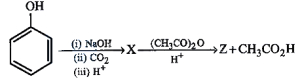
DifficultMCQ
What is the percentage of carbon in the product '$Z$' formed in the reaction?
A
$40$
B
$50$
C
$70$
D
$60$
Solution
(D) The reaction sequence is the Kolbe-Schmitt reaction followed by acetylation to form aspirin $(C_9H_8O_4)$.
$1$. Phenol reacts with $NaOH$, $CO_2$, and $H^+$ to form salicylic acid.
$2$. Salicylic acid reacts with acetic anhydride $((CH_3CO)_2O)$ in the presence of $H^+$ to form aspirin $(Z)$ and acetic acid $(CH_3COOH)$.
$3$. The molecular formula of aspirin $(Z)$ is $C_9H_8O_4$.
$4$. The molar mass of $C_9H_8O_4 = (9 \times 12) + (8 \times 1) + (4 \times 16) = 108 + 8 + 64 = 180 \ g/mol$.
$5$. The mass of carbon in one mole of $C_9H_8O_4 = 9 \times 12 = 108 \ g$.
$6$. Percentage of carbon = $\frac{\text{Mass of Carbon}}{\text{Molar Mass of } Z} \times 100 = \frac{108}{180} \times 100 = 60 \%$.
$1$. Phenol reacts with $NaOH$, $CO_2$, and $H^+$ to form salicylic acid.
$2$. Salicylic acid reacts with acetic anhydride $((CH_3CO)_2O)$ in the presence of $H^+$ to form aspirin $(Z)$ and acetic acid $(CH_3COOH)$.
$3$. The molecular formula of aspirin $(Z)$ is $C_9H_8O_4$.
$4$. The molar mass of $C_9H_8O_4 = (9 \times 12) + (8 \times 1) + (4 \times 16) = 108 + 8 + 64 = 180 \ g/mol$.
$5$. The mass of carbon in one mole of $C_9H_8O_4 = 9 \times 12 = 108 \ g$.
$6$. Percentage of carbon = $\frac{\text{Mass of Carbon}}{\text{Molar Mass of } Z} \times 100 = \frac{108}{180} \times 100 = 60 \%$.
0 likes
View Solution287
MediumMCQ
The number of grams of oxygen in $32.2 \ g$ of $Na_2SO_4 \cdot 10H_2O$ is approximately (in $g$)
A
$32.2$
B
$22.4$
C
$11.2$
D
$64.4$
Solution
(B) The atomic masses of elements are: $Na = 23 \ g/mol$,$S = 32 \ g/mol$,$O = 16 \ g/mol$,$H = 1 \ g/mol$.
The molecular mass of $Na_2SO_4 \cdot 10H_2O = (2 \times 23) + 32 + (4 \times 16) + (10 \times 18) = 46 + 32 + 64 + 180 = 322 \ g/mol$.
Given mass of $Na_2SO_4 \cdot 10H_2O = 32.2 \ g$.
Moles of $Na_2SO_4 \cdot 10H_2O = \frac{32.2 \ g}{322 \ g/mol} = 0.1 \ mol$.
In one mole of $Na_2SO_4 \cdot 10H_2O$,there are $4$ oxygen atoms in $Na_2SO_4$ and $10$ oxygen atoms in $10H_2O$,totaling $14$ oxygen atoms.
Moles of oxygen atoms $= 0.1 \ mol \times 14 = 1.4 \ mol$.
Mass of oxygen $= 1.4 \ mol \times 16 \ g/mol = 22.4 \ g$.
The molecular mass of $Na_2SO_4 \cdot 10H_2O = (2 \times 23) + 32 + (4 \times 16) + (10 \times 18) = 46 + 32 + 64 + 180 = 322 \ g/mol$.
Given mass of $Na_2SO_4 \cdot 10H_2O = 32.2 \ g$.
Moles of $Na_2SO_4 \cdot 10H_2O = \frac{32.2 \ g}{322 \ g/mol} = 0.1 \ mol$.
In one mole of $Na_2SO_4 \cdot 10H_2O$,there are $4$ oxygen atoms in $Na_2SO_4$ and $10$ oxygen atoms in $10H_2O$,totaling $14$ oxygen atoms.
Moles of oxygen atoms $= 0.1 \ mol \times 14 = 1.4 \ mol$.
Mass of oxygen $= 1.4 \ mol \times 16 \ g/mol = 22.4 \ g$.
0 likes
View Solution288
MediumMCQ
An organic compound contains $60\ \%\ C$,$4.48\ \%\ H$,and $35.5\ \%\ O$. Its empirical formula is:
A
$C_9H_8O_4$
B
$C_5H_4O_2$
C
$C_5H_4O_4$
D
$C_9H_7O_6$
Solution
(A) To find the empirical formula,we calculate the molar ratio of the elements:
$1$. Moles of $C = \frac{60}{12} = 5.0$
$2$. Moles of $H = \frac{4.48}{1} = 4.48$
$3$. Moles of $O = \frac{35.5}{16} \approx 2.22$
Divide each by the smallest value $(2.22)$:
$C: \frac{5.0}{2.22} \approx 2.25$
$H: \frac{4.48}{2.22} \approx 2.0$
$O: \frac{2.22}{2.22} = 1.0$
Multiplying by $4$ to get whole numbers: $C = 9, H = 8, O = 4$.
Thus,the empirical formula is $C_9H_8O_4$.
$1$. Moles of $C = \frac{60}{12} = 5.0$
$2$. Moles of $H = \frac{4.48}{1} = 4.48$
$3$. Moles of $O = \frac{35.5}{16} \approx 2.22$
Divide each by the smallest value $(2.22)$:
$C: \frac{5.0}{2.22} \approx 2.25$
$H: \frac{4.48}{2.22} \approx 2.0$
$O: \frac{2.22}{2.22} = 1.0$
Multiplying by $4$ to get whole numbers: $C = 9, H = 8, O = 4$.
Thus,the empirical formula is $C_9H_8O_4$.
0 likes
View Solution289
MediumMCQ
The empirical formula of a compound is $C_2H_5O$ and its vapour density is $45$. What is the molecular formula of the compound?
A
$C_2H_5O$
B
$C_6H_{13}O_3$
C
$C_4H_{10}O_2$
D
$C_6H_{15}O_3$
Solution
(C) Given,empirical formula of compound $= C_2H_5O$
Vapour density $= 45$
Molecular weight $= 2 \times \text{vapour density} = 2 \times 45 = 90$
Empirical formula mass $= (2 \times 12) + (5 \times 1) + (1 \times 16) = 24 + 5 + 16 = 45$
Calculate the value of $n$ using the formula: $n = \frac{\text{Molecular weight}}{\text{Empirical formula mass}} = \frac{90}{45} = 2$
Molecular formula $= n \times (\text{empirical formula}) = 2 \times (C_2H_5O) = C_4H_{10}O_2$
Vapour density $= 45$
Molecular weight $= 2 \times \text{vapour density} = 2 \times 45 = 90$
Empirical formula mass $= (2 \times 12) + (5 \times 1) + (1 \times 16) = 24 + 5 + 16 = 45$
Calculate the value of $n$ using the formula: $n = \frac{\text{Molecular weight}}{\text{Empirical formula mass}} = \frac{90}{45} = 2$
Molecular formula $= n \times (\text{empirical formula}) = 2 \times (C_2H_5O) = C_4H_{10}O_2$
0 likes
View Solution290
DifficultMCQ
An organic compound containing $C$,$H$,and $O$ has $13.13 \% H$,$52.14 \% C$,and $34.73 \% O$. Its molar mass is $46.068 \ g/mol$. What are its empirical and molecular formulae?
A
$C_2H_6O, C_4H_{12}O_2$
B
$CH_3O, C_2H_6O_2$
C
$C_2H_6O, C_2H_6O$
D
$C_2H_6O_2, C_3H_9O_4$
Solution
(C) To determine the empirical formula,we calculate the molar ratio of the elements:
$C: \frac{52.14}{12} = 4.345 \implies \frac{4.345}{2.17} \approx 2$
$H: \frac{13.13}{1} = 13.13 \implies \frac{13.13}{2.17} \approx 6$
$O: \frac{34.73}{16} = 2.17 \implies \frac{2.17}{2.17} = 1$
Thus,the empirical formula is $C_2H_6O$.
Empirical formula mass $= 2(12) + 6(1) + 1(16) = 24 + 6 + 16 = 46 \ g/mol$.
Given molar mass $= 46.068 \ g/mol$.
$n = \frac{\text{Molar mass}}{\text{Empirical formula mass}} = \frac{46.068}{46} \approx 1$.
Therefore,the molecular formula is $(C_2H_6O)_1 = C_2H_6O$.
$C: \frac{52.14}{12} = 4.345 \implies \frac{4.345}{2.17} \approx 2$
$H: \frac{13.13}{1} = 13.13 \implies \frac{13.13}{2.17} \approx 6$
$O: \frac{34.73}{16} = 2.17 \implies \frac{2.17}{2.17} = 1$
Thus,the empirical formula is $C_2H_6O$.
Empirical formula mass $= 2(12) + 6(1) + 1(16) = 24 + 6 + 16 = 46 \ g/mol$.
Given molar mass $= 46.068 \ g/mol$.
$n = \frac{\text{Molar mass}}{\text{Empirical formula mass}} = \frac{46.068}{46} \approx 1$.
Therefore,the molecular formula is $(C_2H_6O)_1 = C_2H_6O$.
0 likes
View Solution291
EasyMCQ
An organic compound containing $C$ and $H$ has $92.3 \%$ of carbon. Its empirical formula is:
A
$CH$
B
$CH_3$
C
$CH_2$
D
$CH_4$
Solution
(A) The percentage of $C$ is $92.3 \%$,so the percentage of $H$ is $100 - 92.3 = 7.7 \%$.
Thus,the empirical formula is $CH$.
| Element | Atomic Ratio (Percentage / Atomic Mass) | Simple Molar Ratio |
| $C$ | $92.3 / 12 = 7.69$ | $7.69 / 7.69 = 1$ |
| $H$ | $7.7 / 1 = 7.70$ | $7.70 / 7.69 \approx 1$ |
Thus,the empirical formula is $CH$.
0 likes
View Solution292
MediumMCQ
$4 \ g$ of a hydrocarbon on complete combustion gave $12.571 \ g$ of $CO_2$ and $5.143 \ g$ of water. What is the empirical formula of the hydrocarbon?
A
$CH$
B
$CH_2$
C
$CH_3$
D
$C_2H_3$
Solution
(B) Mass of $C = \frac{12}{44} \times 12.571 \ g = 3.428 \ g$
Mass of $H = \frac{2}{18} \times 5.143 \ g = 0.571 \ g$
Moles of $C = \frac{3.428}{12} = 0.2857$
Moles of $H = \frac{0.571}{1} = 0.571$
Ratio of $C:H = 0.2857 : 0.571 \approx 1 : 2$
$\therefore$ Empirical formula $= CH_2$
Mass of $H = \frac{2}{18} \times 5.143 \ g = 0.571 \ g$
Moles of $C = \frac{3.428}{12} = 0.2857$
Moles of $H = \frac{0.571}{1} = 0.571$
Ratio of $C:H = 0.2857 : 0.571 \approx 1 : 2$
| Element | Mass $(g)$ | Moles | Simple Ratio |
| $C$ | $3.428$ | $0.2857$ | $1$ |
| $H$ | $0.571$ | $0.571$ | $2$ |
$\therefore$ Empirical formula $= CH_2$
0 likes
View Solution293
MediumMCQ
In the crystalline solid $MSO_{4} \cdot nH_{2}O$ of molar mass $250 \ g \ mol^{-1}$,the percentage of anhydrous salt is $64$ by weight. The value of $n$ is
A
$2$
B
$3$
C
$5$
D
$7$
Solution
(C) The molar mass of the crystalline solid $MSO_{4} \cdot nH_{2}O$ is $250 \ g \ mol^{-1}$.
Given that the percentage of anhydrous salt $(MSO_{4})$ is $64\%$,the percentage of water $(H_{2}O)$ is $100\% - 64\% = 36\%$.
Mass of $H_{2}O = \frac{36}{100} \times 250 = 90 \ g$.
Moles of $H_{2}O = \frac{90 \ g}{18 \ g \ mol^{-1}} = 5 \ mol$.
Since the formula is $MSO_{4} \cdot nH_{2}O$,the value of $n$ corresponds to the number of moles of water,which is $5$.
Hence,option $(C)$ is the correct answer.
Given that the percentage of anhydrous salt $(MSO_{4})$ is $64\%$,the percentage of water $(H_{2}O)$ is $100\% - 64\% = 36\%$.
Mass of $H_{2}O = \frac{36}{100} \times 250 = 90 \ g$.
Moles of $H_{2}O = \frac{90 \ g}{18 \ g \ mol^{-1}} = 5 \ mol$.
Since the formula is $MSO_{4} \cdot nH_{2}O$,the value of $n$ corresponds to the number of moles of water,which is $5$.
Hence,option $(C)$ is the correct answer.
0 likes
View Solution294
MediumMCQ
An organic compound made of $C$,$H$ and $N$ contains $20 \%$ nitrogen. Its molecular weight is:
A
$70$
B
$140$
C
$100$
D
$65$
Solution
(A) The atomic weight of nitrogen is $14 \ g/mol$. In an organic molecule,there must be at least one nitrogen atom present.
Given that the compound contains $20 \%$ nitrogen by mass.
Let the molecular weight be $M$.
Then,$\frac{14}{M} \times 100 = 20$.
Solving for $M$: $M = \frac{14 \times 100}{20} = 70 \ g/mol$.
Thus,the molecular weight is $70$.
Given that the compound contains $20 \%$ nitrogen by mass.
Let the molecular weight be $M$.
Then,$\frac{14}{M} \times 100 = 20$.
Solving for $M$: $M = \frac{14 \times 100}{20} = 70 \ g/mol$.
Thus,the molecular weight is $70$.
0 likes
View Solution295
DifficultMCQ
By usual analysis,$1.00 \ g$ of compound $(X)$ gave $1.79 \ g$ of magnesium pyrophosphate. The percentage of phosphorus in compound $(X)$ is: (nearest integer)
(Given,molar mass in $g \ mol^{-1}$; $O=16, Mg=24, P=31$)
(Given,molar mass in $g \ mol^{-1}$; $O=16, Mg=24, P=31$)
A
$50$
B
$30$
C
$20$
D
$40$
Solution
(A) The molar mass of magnesium pyrophosphate $(Mg_2P_2O_7)$ is: $2 \times 24 + 2 \times 31 + 7 \times 16 = 48 + 62 + 112 = 222 \ g \ mol^{-1}$.
The moles of $Mg_2P_2O_7$ formed = $\frac{1.79 \ g}{222 \ g \ mol^{-1}} \approx 0.008063 \ mol$.
Since each mole of $Mg_2P_2O_7$ contains $2 \ mol$ of phosphorus atoms,the moles of $P$ = $2 \times 0.008063 = 0.016126 \ mol$.
Mass of phosphorus = $0.016126 \ mol \times 31 \ g \ mol^{-1} \approx 0.4999 \ g$.
Percentage of phosphorus = $\frac{\text{Mass of } P}{\text{Mass of compound } X} \times 100 = \frac{0.4999}{1.00} \times 100 = 49.99\%$.
Rounding to the nearest integer,we get $50\%$.
The moles of $Mg_2P_2O_7$ formed = $\frac{1.79 \ g}{222 \ g \ mol^{-1}} \approx 0.008063 \ mol$.
Since each mole of $Mg_2P_2O_7$ contains $2 \ mol$ of phosphorus atoms,the moles of $P$ = $2 \times 0.008063 = 0.016126 \ mol$.
Mass of phosphorus = $0.016126 \ mol \times 31 \ g \ mol^{-1} \approx 0.4999 \ g$.
Percentage of phosphorus = $\frac{\text{Mass of } P}{\text{Mass of compound } X} \times 100 = \frac{0.4999}{1.00} \times 100 = 49.99\%$.
Rounding to the nearest integer,we get $50\%$.
0 likes
View Solution296
DifficultMCQ
Complete combustion of $X$ g of an organic compound gave $0.25$ g of $CO_2$ and $0.12$ g of $H_2O$. If the percentage of carbon is $25\%$ and of hydrogen is $4.89\%$,then $X = \_\_\_\_ \times 10^{-3}$ g. (Nearest integer) (Molar mass of $C$,$H$ and $O$ are $12, 1$ and $16$ g mol$^{-1}$ respectively.)
A
$273$
B
$27$
C
$2730$
D
$227$
Solution
(A) Mass of $CO_2 = 0.25$ g. Moles of $CO_2 = \frac{0.25}{44} \approx 0.00568$ mol.
Mass of $C = \text{Moles of } CO_2 \times 12 = 0.00568 \times 12 = 0.06818$ g.
Given percentage of $C = 25\%$.
So,$0.06818 = 0.25 \times X \implies X = \frac{0.06818}{0.25} = 0.2727$ g.
Similarly for $H$,Mass of $H_2O = 0.12$ g.
Moles of $H_2O = \frac{0.12}{18} \approx 0.00666$ mol.
Mass of $H = 0.00666 \times 2 = 0.01333$ g.
Given percentage of $H = 4.89\%$.
So,$0.01333 = 0.0489 \times X \implies X = \frac{0.01333}{0.0489} = 0.2726$ g.
Thus,$X \approx 0.273$ g.
Expressing as $273 \times 10^{-3}$ g.
Mass of $C = \text{Moles of } CO_2 \times 12 = 0.00568 \times 12 = 0.06818$ g.
Given percentage of $C = 25\%$.
So,$0.06818 = 0.25 \times X \implies X = \frac{0.06818}{0.25} = 0.2727$ g.
Similarly for $H$,Mass of $H_2O = 0.12$ g.
Moles of $H_2O = \frac{0.12}{18} \approx 0.00666$ mol.
Mass of $H = 0.00666 \times 2 = 0.01333$ g.
Given percentage of $H = 4.89\%$.
So,$0.01333 = 0.0489 \times X \implies X = \frac{0.01333}{0.0489} = 0.2726$ g.
Thus,$X \approx 0.273$ g.
Expressing as $273 \times 10^{-3}$ g.
0 likes
View Solution297
DifficultMCQ
An oxide of iron contains $69.9\%$ iron. Its empirical formula is: (Given: Molar mass of $Fe$ and $O$ are $56$ and $16 \text{ g mol}^{-1}$ respectively.)
A
$FeO$
B
$Fe_2O_3$
C
$Fe_3O_4$
D
$FeO_3$
Solution
(B) $1$. Percentage of $Fe = 69.9\%$. Therefore,percentage of $O = 100\% - 69.9\% = 30.1\%$.
$2$. Calculate moles of each element:
Moles of $Fe = \frac{69.9}{56} = 1.248 \text{ mol}$.
Moles of $O = \frac{30.1}{16} = 1.881 \text{ mol}$.
$3$. Determine the simplest molar ratio:
Divide by the smallest value $(1.248)$:
$Fe = \frac{1.248}{1.248} = 1$.
$O = \frac{1.881}{1.248} \approx 1.5$.
$4$. Convert to whole numbers:
Multiply by $2$ to get $Fe : O = 2 : 3$.
$5$. Thus,the empirical formula is $Fe_2O_3$.
$2$. Calculate moles of each element:
Moles of $Fe = \frac{69.9}{56} = 1.248 \text{ mol}$.
Moles of $O = \frac{30.1}{16} = 1.881 \text{ mol}$.
$3$. Determine the simplest molar ratio:
Divide by the smallest value $(1.248)$:
$Fe = \frac{1.248}{1.248} = 1$.
$O = \frac{1.881}{1.248} \approx 1.5$.
$4$. Convert to whole numbers:
Multiply by $2$ to get $Fe : O = 2 : 3$.
$5$. Thus,the empirical formula is $Fe_2O_3$.
0 likes
View SolutionSome Basic Concepts of Chemistry — Percentage composition and Molecular formula · Frequently Asked Questions
1Are these Some Basic Concepts of Chemistry questions useful for JEE and NEET?
Yes. All questions in this section are mapped to JEE Main and NEET exam patterns. Previous year questions from JEE Main, NEET, GUJCET and state-level exams are included with full solutions.
2Can I switch to Hindi or Gujarati for these questions?
Yes. Use the language tabs in the hero section or the sidebar to view the same questions and solutions in English, Hindi or Gujarati.
3How do I generate a question paper from this subtopic?
Use the Vedclass Exam Paper Generator — select the chapter and subtopic, set difficulty, and generate Sets A, B, C, D automatically. First 3 chapters of every subject are free.
Vedclass Products
For Students
Vedclass Test Series
Mock tests in real JEE/NEET style with performance analysis. 5-day free trial.
Start Free TrialFor Teachers
Exam Paper Generator
Generate Set A/B/C/D papers from this chapter in 2 minutes. 3 chapters free.
Try FreeFor Institutes
Online Exam Module
Live online exams with unlimited students, 360° analytics & white-label branding.
See DemoFor Teachers & Institutes
Generate a Some Basic Concepts of Chemistry Exam Paper in 2 Minutes
Select subtopic & difficulty — Sets A, B, C, D auto-generated with No Repeat logic.
First 3 chapters of every subject are free — no payment required.