
A English
Boron family Questions in English
Class 11 Chemistry · p-Block Elements (Class 11) · Boron family
528+
Questions
English
Language
100%
With Solutions
Showing 50 of 528 questions in English
351
Medium
Boron fluoride exists as $BF_3$ but boron hydride does not exist as $BH_3$. Give reason. In which form does it exist? Explain its structure.
Solution
(N/A) In $BF_3$,the lone pair of electrons on the fluorine atom is donated to the vacant $p$-orbital of the boron atom through $p\pi-p\pi$ back bonding. This delocalization of electrons reduces the electron deficiency of the boron atom,thereby decreasing its Lewis acidic character and increasing the stability of $BF_3$.
In $BH_3$,there is no lone pair of electrons on the $H$ atom to participate in back bonding. Therefore,$BH_3$ dimerizes to form $B_2H_6$ (diborane) to achieve stability.
Structure of $B_2H_6$: In diborane,the four terminal $H$ atoms and two $B$ atoms lie in the same plane. The two bridging $H$ atoms lie above and below this plane. Each boron atom is $sp^3$ hybridized. The bridging $H$ atoms are involved in $3$-center-$2$-electron $(3c-2e)$ bonds,also known as banana bonds.
In $BH_3$,there is no lone pair of electrons on the $H$ atom to participate in back bonding. Therefore,$BH_3$ dimerizes to form $B_2H_6$ (diborane) to achieve stability.
Structure of $B_2H_6$: In diborane,the four terminal $H$ atoms and two $B$ atoms lie in the same plane. The two bridging $H$ atoms lie above and below this plane. Each boron atom is $sp^3$ hybridized. The bridging $H$ atoms are involved in $3$-center-$2$-electron $(3c-2e)$ bonds,also known as banana bonds.
0 likes
View Solution352
Difficult
$A$. What are silicones? State the uses of silicones.
$B$. What are boranes? Give chemical equation for the preparation of diborane.
$B$. What are boranes? Give chemical equation for the preparation of diborane.
Solution
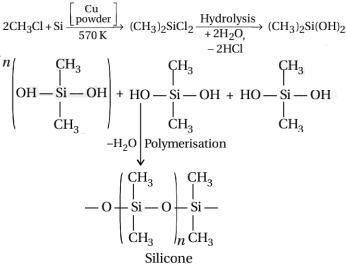
(N/A) . Silicones are a group of organosilicon polymers,which have $(R_{2}SiO)$ as a repeating unit. The starting materials for the manufacture of silicones are alkyl or aryl substituted silicon chlorides,$R_{n}SiCl_{(4-n)}$,where $R$ is an alkyl or aryl group.
When methyl chloride reacts with silicon in the presence of copper as a catalyst at a temperature of $570 \ K$,various types of methyl substituted chlorosilanes of formula $MeSiCl_{3}$,$Me_{2}SiCl_{2}$,and $Me_{3}SiCl$ with a small amount of $Me_{4}Si$ are formed.
Hydrolysis of dimethyl dichlorosilane,$(CH_{3})_{2}SiCl_{2}$,followed by condensation polymerization yields straight-chain polymers.
Uses: They are used as sealants,greases,and electrical insulators,and for the waterproofing of fabrics. Being biocompatible,they are also used in surgical and cosmetic implants.
$B$. Boranes are the binary compounds of boron and hydrogen,similar to alkanes. These are covalent hydrides with the formula $B_{2}H_{6}$,called diborane.
Preparation of diborane: It is prepared by treating boron trifluoride with $LiAlH_{4}$ in diethyl ether.
$4BF_{3} + 3LiAlH_{4} \rightarrow 2B_{2}H_{6} + 3LiF + 3AlF_{3}$
$B_{2}H_{6}$ is produced on an industrial scale by the reaction of $BF_{3}$ with $NaH$ (sodium hydride):
$2BF_{3} + 6NaH \xrightarrow{450 \ K} B_{2}H_{6} + 6NaF$
When methyl chloride reacts with silicon in the presence of copper as a catalyst at a temperature of $570 \ K$,various types of methyl substituted chlorosilanes of formula $MeSiCl_{3}$,$Me_{2}SiCl_{2}$,and $Me_{3}SiCl$ with a small amount of $Me_{4}Si$ are formed.
Hydrolysis of dimethyl dichlorosilane,$(CH_{3})_{2}SiCl_{2}$,followed by condensation polymerization yields straight-chain polymers.
Uses: They are used as sealants,greases,and electrical insulators,and for the waterproofing of fabrics. Being biocompatible,they are also used in surgical and cosmetic implants.
$B$. Boranes are the binary compounds of boron and hydrogen,similar to alkanes. These are covalent hydrides with the formula $B_{2}H_{6}$,called diborane.
Preparation of diborane: It is prepared by treating boron trifluoride with $LiAlH_{4}$ in diethyl ether.
$4BF_{3} + 3LiAlH_{4} \rightarrow 2B_{2}H_{6} + 3LiF + 3AlF_{3}$
$B_{2}H_{6}$ is produced on an industrial scale by the reaction of $BF_{3}$ with $NaH$ (sodium hydride):
$2BF_{3} + 6NaH \xrightarrow{450 \ K} B_{2}H_{6} + 6NaF$
0 likes
View Solution353
Medium
$A$ compound $(A)$ of boron reacts with $NMe_3$ to give an adduct $(B)$ which on hydrolysis gives a compound $(C)$ and hydrogen gas. Compound $(C)$ is an acid. Identify the compounds $A, B$ and $C$. Give the reactions involved.
Solution
(N/A) Compound $(A)$ of boron reacts with $NMe_3$ to form an adduct $(B)$,indicating that $(A)$ is a Lewis acid. Since $(B)$ on hydrolysis yields an acid $(C)$ and $H_2$ gas,$(A)$ is identified as $B_2H_6$,$(B)$ is the adduct $BH_3 \cdot NMe_3$,and $(C)$ is boric acid $(H_3BO_3)$.
The reactions are as follows:
$B_2H_6 + 2NMe_3 \rightarrow 2BH_3 \cdot NMe_3$
$(A) \text{ (Diborane)} + \text{Reactant} \rightarrow (B) \text{ (Adduct)}$
$BH_3 \cdot NMe_3 + 3H_2O \rightarrow H_3BO_3 + NMe_3 + 3H_2$
$(B) + \text{Hydrolysis} \rightarrow (C) \text{ (Boric acid)} + \text{Byproducts}$
The reactions are as follows:
$B_2H_6 + 2NMe_3 \rightarrow 2BH_3 \cdot NMe_3$
$(A) \text{ (Diborane)} + \text{Reactant} \rightarrow (B) \text{ (Adduct)}$
$BH_3 \cdot NMe_3 + 3H_2O \rightarrow H_3BO_3 + NMe_3 + 3H_2$
$(B) + \text{Hydrolysis} \rightarrow (C) \text{ (Boric acid)} + \text{Byproducts}$
0 likes
View Solution354
Medium
$A$ nonmetallic element of group $13$,used in making bulletproof vests,is an extremely hard solid of black colour. It can exist in many allotropic forms and has an unusually high melting point. Its trifluoride acts as a Lewis acid towards ammonia. The element exhibits a maximum covalence of four. Identify the element and write the reaction of its trifluoride with ammonia. Explain why the trifluoride acts as a Lewis acid.
Solution
(N/A) The element is Boron $(B)$.
Reaction: $BF_3 + NH_3 \rightarrow F_3B \leftarrow NH_3$
Explanation: In $BF_3$,the boron atom has only $6$ electrons in its valence shell (incomplete octet). Therefore,it is electron-deficient and acts as a Lewis acid by accepting a lone pair of electrons from the Lewis base,ammonia $(NH_3)$.
Reaction: $BF_3 + NH_3 \rightarrow F_3B \leftarrow NH_3$
Explanation: In $BF_3$,the boron atom has only $6$ electrons in its valence shell (incomplete octet). Therefore,it is electron-deficient and acts as a Lewis acid by accepting a lone pair of electrons from the Lewis base,ammonia $(NH_3)$.
0 likes
View Solution355
MediumMCQ
In a molecule of pyrophosphoric acid $(H_4P_2O_7)$,the number of $P-OH$,$P=O$ and $P-O-P$ bonds/moiety(ies) respectively are:
A
$3, 3$ and $3$
B
$2, 4$ and $1$
C
$4, 2$ and $0$
D
$4, 2$ and $1$
Solution
(D) The chemical formula of pyrophosphoric acid is $H_4P_2O_7$.
By observing its structure:
$1$. There are $4$ $P-OH$ bonds (two on each phosphorus atom).
$2$. There are $2$ $P=O$ bonds (one on each phosphorus atom).
$3$. There is $1$ $P-O-P$ linkage connecting the two phosphorus atoms.
Therefore,the number of $P-OH$,$P=O$,and $P-O-P$ bonds are $4, 2$,and $1$ respectively.
By observing its structure:
$1$. There are $4$ $P-OH$ bonds (two on each phosphorus atom).
$2$. There are $2$ $P=O$ bonds (one on each phosphorus atom).
$3$. There is $1$ $P-O-P$ linkage connecting the two phosphorus atoms.
Therefore,the number of $P-OH$,$P=O$,and $P-O-P$ bonds are $4, 2$,and $1$ respectively.
0 likes
View Solution356
MediumMCQ
Which pair of oxides is acidic in nature?
A
$B_2O_3, CaO$
B
$B_2O_3, SiO_2$
C
$N_2O, BaO$
D
$CaO, SiO_2$
Solution
(B) $B_2O_3$ and $SiO_2$ are acidic oxides.
Generally,oxides of non-metals are acidic in nature.
$CaO$ and $BaO$ are basic oxides (metal oxides),and $N_2O$ is a neutral oxide.
Generally,oxides of non-metals are acidic in nature.
$CaO$ and $BaO$ are basic oxides (metal oxides),and $N_2O$ is a neutral oxide.
0 likes
View Solution357
DifficultMCQ
The set in which compounds have different nature is:
A
$B(OH)_{3}$ and $H_{3}PO_{3}$
B
$B(OH)_{3}$ and $Al(OH)_{3}$
C
$NaOH$ and $Ca(OH)_{2}$
D
$Be(OH)_{2}$ and $Al(OH)_{3}$
Solution
(B) $B(OH)_{3}$ is a weak Lewis acid,while $H_{3}PO_{3}$ is a dibasic acid. Both are acidic in nature.
$B(OH)_{3}$ is acidic in nature,whereas $Al(OH)_{3}$ is amphoteric in nature.
$NaOH$ and $Ca(OH)_{2}$ are both basic in nature.
$Be(OH)_{2}$ and $Al(OH)_{3}$ are both amphoteric in nature.
Therefore,the set with different natures is $B(OH)_{3}$ and $Al(OH)_{3}$.
$B(OH)_{3}$ is acidic in nature,whereas $Al(OH)_{3}$ is amphoteric in nature.
$NaOH$ and $Ca(OH)_{2}$ are both basic in nature.
$Be(OH)_{2}$ and $Al(OH)_{3}$ are both amphoteric in nature.
Therefore,the set with different natures is $B(OH)_{3}$ and $Al(OH)_{3}$.
0 likes
View Solution358
DifficultMCQ
Given below are the statements about diborane.
$(a)$ Diborane is prepared by the oxidation of $NaBH_{4}$ with $I_{2}$.
$(b)$ Each boron atom is in $sp^{2}$ hybridized state.
$(c)$ Diborane has one bridged $3$ centre$-2-$electron bond.
$(d)$ Diborane is a planar molecule.
The option with correct statement$(s)$ is :
$(a)$ Diborane is prepared by the oxidation of $NaBH_{4}$ with $I_{2}$.
$(b)$ Each boron atom is in $sp^{2}$ hybridized state.
$(c)$ Diborane has one bridged $3$ centre$-2-$electron bond.
$(d)$ Diborane is a planar molecule.
The option with correct statement$(s)$ is :
A
$(c)$ and $(d)$ only
B
$(c)$ only
C
$(a)$ only
D
$(a)$ and $(b)$ only
Solution
(C) Statement $(a)$ is correct: Diborane is prepared by the reaction of $NaBH_{4}$ with $I_{2}$ as follows: $2 NaBH_{4} + I_{2} \rightarrow B_{2}H_{6} + 2 NaI + H_{2}$.
Statement $(b)$ is incorrect: In diborane,each boron atom is $sp^{3}$ hybridized.
Statement $(c)$ is incorrect: Diborane has two bridged $3$ centre$-2$ electron $(3c-2e^-)$ bonds,not one.
Statement $(d)$ is incorrect: Diborane is a non-planar molecule.
Therefore,only statement $(a)$ is correct.
Statement $(b)$ is incorrect: In diborane,each boron atom is $sp^{3}$ hybridized.
Statement $(c)$ is incorrect: Diborane has two bridged $3$ centre$-2$ electron $(3c-2e^-)$ bonds,not one.
Statement $(d)$ is incorrect: Diborane is a non-planar molecule.
Therefore,only statement $(a)$ is correct.
0 likes
View Solution359
MediumMCQ
Which of the following statements is not correct about diborane $(B_2H_6)$?
A
The four terminal $B-H$ bonds are two-centre-two-electron bonds.
B
The four terminal hydrogen atoms and the two boron atoms lie in one plane.
C
Both the boron atoms are $sp^2$ hybridized.
D
There are two $3$-centre-$2$-electron bonds.
Solution
(C) In diborane $(B_2H_6)$,each boron atom undergoes $sp^3$ hybridization,not $sp^2$.
Diborane has a non-planar structure where the two bridging hydrogen atoms lie in a plane perpendicular to the plane containing the four terminal hydrogen atoms and the two boron atoms.
Therefore,the statement that both boron atoms are $sp^2$ hybridized is incorrect.
Diborane has a non-planar structure where the two bridging hydrogen atoms lie in a plane perpendicular to the plane containing the four terminal hydrogen atoms and the two boron atoms.
Therefore,the statement that both boron atoms are $sp^2$ hybridized is incorrect.
0 likes
View Solution360
EasyMCQ
Identify the correct statement for $B_2H_6$ from those given below.
$(A)$ In $B_2H_6$,all $B-H$ bonds are equivalent.
$(B)$ In $B_2H_6$ there are four $3$-centre-$2$-electron bonds.
$(C)$ $B_2H_6$ is a Lewis acid.
$(D)$ $B_2H_6$ can be synthesized from both $BF_3$ and $NaBH_4$.
$(E)$ $B_2H_6$ is a planar molecule.
Choose the most appropriate answer from the options given below.
$(A)$ In $B_2H_6$,all $B-H$ bonds are equivalent.
$(B)$ In $B_2H_6$ there are four $3$-centre-$2$-electron bonds.
$(C)$ $B_2H_6$ is a Lewis acid.
$(D)$ $B_2H_6$ can be synthesized from both $BF_3$ and $NaBH_4$.
$(E)$ $B_2H_6$ is a planar molecule.
Choose the most appropriate answer from the options given below.
A
$(A)$ and $(E)$ only
B
$(B)$,$(C)$ and $(E)$ only
C
$(C)$ and $(D)$ only
D
$(C)$ and $(E)$ only
Solution
(C) Analysis of statements:
$(A)$ Incorrect: $B_2H_6$ has two types of $B-H$ bonds: terminal $B-H$ bonds (covalent) and bridging $B-H-B$ bonds ($3$-centre-$2$-electron).
$(B)$ Incorrect: $B_2H_6$ contains two $3$-centre-$2$-electron bonds,not four.
$(C)$ Correct: $B_2H_6$ is an electron-deficient molecule and acts as a Lewis acid.
$(D)$ Correct: $B_2H_6$ can be synthesized by the reaction: $3NaBH_4 + 4BF_3 \rightarrow 2B_2H_6 + 3NaBF_4$.
$(E)$ Incorrect: $B_2H_6$ is a non-planar molecule.
Therefore,statements $(C)$ and $(D)$ are correct.
$(A)$ Incorrect: $B_2H_6$ has two types of $B-H$ bonds: terminal $B-H$ bonds (covalent) and bridging $B-H-B$ bonds ($3$-centre-$2$-electron).
$(B)$ Incorrect: $B_2H_6$ contains two $3$-centre-$2$-electron bonds,not four.
$(C)$ Correct: $B_2H_6$ is an electron-deficient molecule and acts as a Lewis acid.
$(D)$ Correct: $B_2H_6$ can be synthesized by the reaction: $3NaBH_4 + 4BF_3 \rightarrow 2B_2H_6 + 3NaBF_4$.
$(E)$ Incorrect: $B_2H_6$ is a non-planar molecule.
Therefore,statements $(C)$ and $(D)$ are correct.
0 likes
View Solution361
MediumMCQ
Aqueous solution of which of the following boron compounds will be strongly basic in nature?
A
$NaBH_4$
B
$LiBH_4$
C
$B_2H_6$
D
$Na_2B_4O_7$
Solution
(D) Borax $(Na_2B_4O_7 \cdot 10H_2O)$ dissolves in water to form orthoboric acid $(H_3BO_3)$ and sodium hydroxide $(NaOH)$.
$Na_2B_4O_7 + 7H_2O \rightarrow 2NaOH + 4H_3BO_3$.
Since $NaOH$ is a strong base and $H_3BO_3$ is a very weak acid,the resulting aqueous solution is strongly basic.
$Na_2B_4O_7 + 7H_2O \rightarrow 2NaOH + 4H_3BO_3$.
Since $NaOH$ is a strong base and $H_3BO_3$ is a very weak acid,the resulting aqueous solution is strongly basic.
0 likes
View Solution362
MediumMCQ
Match the List-$I$ with List-$II$.
Choose the most appropriate answer from the options given below:
| List-$I$ (Element) | List-$II$ (Application) |
|---|---|
| $A$. $Cs$ | $I$. High temperature thermometer |
| $B$. $Ga$ | $II$. Water repellent sprays |
| $C$. $B$ | $III$. Photoelectric cells |
| $D$. $Si$ | $IV$. Bullet proof vest |
Choose the most appropriate answer from the options given below:
A
$A-III, B-I, C-IV, D-II$
B
$A-IV, B-III, C-II, D-I$
C
$A-II, B-III, C-IV, D-I$
D
$A-I, B-IV, C-II, D-III$
Solution
(A) $Cs$ (Caesium) is used in photoelectric cells due to its low ionization energy.
$Ga$ (Gallium) has a high boiling point and is used in high temperature thermometers.
$B$ (Boron) fibres are used in making bullet-proof vests.
$Si$ (Silicon) based silicones are used in water repellent sprays due to their non-polar alkyl groups.
Therefore,the correct matching is $A-III, B-I, C-IV, D-II$.
$Ga$ (Gallium) has a high boiling point and is used in high temperature thermometers.
$B$ (Boron) fibres are used in making bullet-proof vests.
$Si$ (Silicon) based silicones are used in water repellent sprays due to their non-polar alkyl groups.
Therefore,the correct matching is $A-III, B-I, C-IV, D-II$.
0 likes
View Solution363
MediumMCQ
The total number of acidic oxides from the following list is: $NO$,$N_2O$,$B_2O_3$,$N_2O_5$,$CO$,$SO_3$,$P_4O_{10}$
A
$3$
B
$4$
C
$5$
D
$6$
Solution
(B) Neutral oxides are: $NO$,$N_2O$,and $CO$.
Acidic oxides are: $B_2O_3$,$N_2O_5$,$SO_3$,and $P_4O_{10}$.
Therefore,the total number of acidic oxides is $4$.
Acidic oxides are: $B_2O_3$,$N_2O_5$,$SO_3$,and $P_4O_{10}$.
Therefore,the total number of acidic oxides is $4$.
0 likes
View Solution364
MediumMCQ
The geometry around boron in the product '$B$' formed from the following reaction is
$BF_{3} + NaH \xrightarrow{450 \ K} A + NaF$
$A + NMe_{3} \rightarrow B$
$BF_{3} + NaH \xrightarrow{450 \ K} A + NaF$
$A + NMe_{3} \rightarrow B$
A
trigonal planar
B
tetrahedral
C
pyramidal
D
square planar
Solution
(B) The given reactions are:
$2BF_{3} + 6NaH \xrightarrow{450 \ K} B_{2}H_{6} + 6NaF$
$B_{2}H_{6} + 2NMe_{3} \rightarrow 2[BH_{3} \leftarrow NMe_{3}]$
Here,$A$ is $B_{2}H_{6}$ (diborane) and $B$ is the adduct $[BH_{3} \leftarrow NMe_{3}]$.
In the adduct $[BH_{3} \leftarrow NMe_{3}]$,the boron atom is bonded to three hydrogen atoms and one nitrogen atom.
The boron atom is $sp^{3}$ hybridized and possesses a tetrahedral geometry.
$2BF_{3} + 6NaH \xrightarrow{450 \ K} B_{2}H_{6} + 6NaF$
$B_{2}H_{6} + 2NMe_{3} \rightarrow 2[BH_{3} \leftarrow NMe_{3}]$
Here,$A$ is $B_{2}H_{6}$ (diborane) and $B$ is the adduct $[BH_{3} \leftarrow NMe_{3}]$.
In the adduct $[BH_{3} \leftarrow NMe_{3}]$,the boron atom is bonded to three hydrogen atoms and one nitrogen atom.
The boron atom is $sp^{3}$ hybridized and possesses a tetrahedral geometry.
0 likes
View Solution365
MediumMCQ
Given below are two statements: one is labelled as Assertion $A$ and the other is labelled as Reason $R$.
Assertion $A$ : Boric acid is a weak acid.
Reason $R$ : Boric acid is not able to release $H^{+}$ ion on its own. It receives $OH^{-}$ ion from water and releases $H^{+}$ ion.
In the light of the above statements,choose the most appropriate answer from the options given below.
Assertion $A$ : Boric acid is a weak acid.
Reason $R$ : Boric acid is not able to release $H^{+}$ ion on its own. It receives $OH^{-}$ ion from water and releases $H^{+}$ ion.
In the light of the above statements,choose the most appropriate answer from the options given below.
A
Both $A$ and $R$ are correct and $R$ is the correct explanation of $A$
B
Both $A$ and $R$ are correct but $R$ is $NOT$ the correct explanation of $A$
C
$A$ is correct but $R$ is not correct
D
$A$ is not correct but $R$ is correct
Solution
(A) Boric acid ($H_3BO_3$ or $B(OH)_3$) is a weak monobasic Lewis acid.
It does not act as a proton donor (Brønsted acid) by releasing $H^{+}$ ions directly.
Instead,it acts as a Lewis acid by accepting a lone pair of electrons from the $OH^{-}$ ion of a water molecule.
The reaction is: $B(OH)_3 + 2H_2O \rightleftharpoons [B(OH)_4]^- + H_3O^+$.
This process releases $H^{+}$ ions (as $H_3O^+$) into the solution,which is why it exhibits acidic properties.
Therefore,both Assertion $A$ and Reason $R$ are correct,and $R$ is the correct explanation of $A$.
It does not act as a proton donor (Brønsted acid) by releasing $H^{+}$ ions directly.
Instead,it acts as a Lewis acid by accepting a lone pair of electrons from the $OH^{-}$ ion of a water molecule.
The reaction is: $B(OH)_3 + 2H_2O \rightleftharpoons [B(OH)_4]^- + H_3O^+$.
This process releases $H^{+}$ ions (as $H_3O^+$) into the solution,which is why it exhibits acidic properties.
Therefore,both Assertion $A$ and Reason $R$ are correct,and $R$ is the correct explanation of $A$.
0 likes
View Solution366
MediumMCQ
Borazine,also known as inorganic benzene,can be prepared by the reaction of $3$ equivalents of "$X$" with $6$ equivalents of "$Y$". "$X$" and "$Y$",respectively,are:
A
$B(OH)_3$ and $NH_3$
B
$B_2H_6$ and $NH_3$
C
$B_2H_6$ and $HN_3$
D
$NH_3$ and $B_2O_3$
Solution
(B) The preparation of borazine $(B_3N_3H_6)$ involves the reaction of diborane $(B_2H_6)$ with ammonia $(NH_3)$ at high temperatures.
The balanced chemical equation is:
$3 B_2H_6 + 6 NH_3 \xrightarrow{\Delta} 2 B_3N_3H_6 + 12 H_2$
Here,$X$ is $B_2H_6$ and $Y$ is $NH_3$.
The balanced chemical equation is:
$3 B_2H_6 + 6 NH_3 \xrightarrow{\Delta} 2 B_3N_3H_6 + 12 H_2$
Here,$X$ is $B_2H_6$ and $Y$ is $NH_3$.
0 likes
View Solution367
EasyMCQ
Given below are two statements: one is labelled as Assertion $A$ and the other is labelled as Reason $R$.
Assertion $A$: Boron is unable to form $BF_{6}^{3-}$.
Reason $R$: Size of $B$ is very small.
In the light of the above statements,choose the correct answer from the options given below.
Assertion $A$: Boron is unable to form $BF_{6}^{3-}$.
Reason $R$: Size of $B$ is very small.
In the light of the above statements,choose the correct answer from the options given below.
A
Both $A$ and $R$ are true and $R$ is the correct explanation of $A$.
B
Both $A$ and $R$ are true but $R$ is not the correct explanation of $A$.
C
$A$ is true but $R$ is false.
D
$A$ is false but $R$ is true.
Solution
(B) Assertion $A$ is true: Boron cannot form $BF_{6}^{3-}$ because it lacks $d$-orbitals in its valence shell,which prevents the expansion of its octet.
Reason $R$ is true: The size of the Boron atom is indeed very small.
Conclusion: While both statements are true,the inability to form $BF_{6}^{3-}$ is primarily due to the absence of $d$-orbitals,not just the small size of the atom. Therefore,$R$ is not the correct explanation for $A$.
Reason $R$ is true: The size of the Boron atom is indeed very small.
Conclusion: While both statements are true,the inability to form $BF_{6}^{3-}$ is primarily due to the absence of $d$-orbitals,not just the small size of the atom. Therefore,$R$ is not the correct explanation for $A$.
0 likes
View Solution368
MediumMCQ
When borax is heated with $CoO$ on a platinum loop,the blue coloured bead formed is largely due to
A
$B_{2}O_{3}$
B
$Co(BO_{2})_{2}$
C
$CoB_{4}O_{7}$
D
$Co[B_{4}O_{5}(OH)_{4}]$
Solution
(B) The borax bead test involves the following reactions:
$Na_{2}B_{4}O_{7} \cdot 10 H_{2}O \xrightarrow{\Delta} Na_{2}B_{4}O_{7} + 10 H_{2}O$
$Na_{2}B_{4}O_{7} \xrightarrow{\Delta} 2 NaBO_{2} + B_{2}O_{3}$
$B_{2}O_{3} + CoO \rightarrow Co(BO_{2})_{2} \text{ (cobalt (II) metaborate)}$
The blue coloured bead is due to the formation of cobalt $(II)$ metaborate,$Co(BO_{2})_{2}$.
$Na_{2}B_{4}O_{7} \cdot 10 H_{2}O \xrightarrow{\Delta} Na_{2}B_{4}O_{7} + 10 H_{2}O$
$Na_{2}B_{4}O_{7} \xrightarrow{\Delta} 2 NaBO_{2} + B_{2}O_{3}$
$B_{2}O_{3} + CoO \rightarrow Co(BO_{2})_{2} \text{ (cobalt (II) metaborate)}$
The blue coloured bead is due to the formation of cobalt $(II)$ metaborate,$Co(BO_{2})_{2}$.
0 likes
View Solution369
DifficultMCQ
Sodium borohydride upon treatment with iodine produces a Lewis acid $(X)$,which on heating with ammonia produces a cyclic compound $(Y)$ and a colourless gas $(Z)$. $X, Y$ and $Z$ are $....$
A
$X= BH_3; Y= BH_3 \cdot NH_3; Z= N_2$
B
$X= B_2H_6; Y= B_3N_3H_6; Z= H_2$
C
$X= B_2H_6; Y= B_6H_6; Z= H_2$
D
$X= B_2H_6; Y= B_3N_3H_6; Z= N_2$
Solution
(B) The reaction of sodium borohydride with iodine produces diborane,which is a Lewis acid $(X = B_2H_6)$.
$2 NaBH_4 + I_2 \xrightarrow{\text{Diglyme}} B_2H_6(X) + H_2 + 2 NaI$
Heating diborane with ammonia in a $1:2$ molar ratio produces borazine,which is a cyclic compound $(Y = B_3N_3H_6)$ and hydrogen gas $(Z = H_2)$.
$3 B_2H_6 + 6 NH_3 \xrightarrow{\Delta} 2 B_3N_3H_6(Y) + 12 H_2(Z) \uparrow$
$2 NaBH_4 + I_2 \xrightarrow{\text{Diglyme}} B_2H_6(X) + H_2 + 2 NaI$
Heating diborane with ammonia in a $1:2$ molar ratio produces borazine,which is a cyclic compound $(Y = B_3N_3H_6)$ and hydrogen gas $(Z = H_2)$.
$3 B_2H_6 + 6 NH_3 \xrightarrow{\Delta} 2 B_3N_3H_6(Y) + 12 H_2(Z) \uparrow$
0 likes
View Solution370
MediumMCQ
When a mixture of diborane and ammonia is heated,the final product is:
A
$BH_3$
B
$NH_4BH_4$
C
$NH_2NH_2$
D
$B_3N_3H_6$
Solution
(D) When a mixture of diborane $(B_2H_6)$ and ammonia $(NH_3)$ is heated at high temperatures,the final product is borazine $(B_3N_3H_6)$,which is also known as inorganic benzene.
The reaction is given by:
$3B_2H_6 + 6NH_3 \rightarrow 2B_3N_3H_6 + 12H_2$
Borazine is structurally similar to benzene and exhibits similar chemical properties.
The reaction is given by:
$3B_2H_6 + 6NH_3 \rightarrow 2B_3N_3H_6 + 12H_2$
Borazine is structurally similar to benzene and exhibits similar chemical properties.
0 likes
View Solution371
MediumMCQ
The Lewis acid strength of $BBr_3$,$BCl_3$,and $BF_3$ is in the order:
A
$BBr_3 < BCl_3 < BF_3$
B
$BCl_3 < BF_3 < BBr_3$
C
$BF_3 < BCl_3 < BBr_3$
D
$BBr_3 < BF_3 < BCl_3$
Solution
(C) The given boron trihalides are electron-deficient molecules that act as Lewis acids by accepting an electron pair.
The Lewis acid strength is determined by the extent of $ppi-ppi$ back-bonding between the halogen atom and the boron atom.
In $BF_3$,the $2p-2p$ back-bonding is most effective due to the similar size of the orbitals,which reduces the electron deficiency of the boron atom significantly.
As the size of the halogen increases from $F$ to $Cl$ to $Br$,the effectiveness of back-bonding decreases $(2p-2p > 2p-3p > 2p-4p)$.
Therefore,the electron deficiency on boron increases in the order $BF_3 < BCl_3 < BBr_3$,making $BBr_3$ the strongest Lewis acid.
The Lewis acid strength is determined by the extent of $ppi-ppi$ back-bonding between the halogen atom and the boron atom.
In $BF_3$,the $2p-2p$ back-bonding is most effective due to the similar size of the orbitals,which reduces the electron deficiency of the boron atom significantly.
As the size of the halogen increases from $F$ to $Cl$ to $Br$,the effectiveness of back-bonding decreases $(2p-2p > 2p-3p > 2p-4p)$.
Therefore,the electron deficiency on boron increases in the order $BF_3 < BCl_3 < BBr_3$,making $BBr_3$ the strongest Lewis acid.
0 likes
View Solution372
MediumMCQ
The element that combines with oxygen to give an amphoteric oxide is
A
$N$
B
$P$
C
$Al$
D
$Na$
Solution
(C) $Al$ is the correct answer.
Amphoteric oxides are those oxides that exhibit both acidic and basic properties.
Among the given elements,$Al$ reacts with oxygen to form $Al_2O_3$,which is amphoteric.
$N_2(g) + O_2(g) \longrightarrow 2NO_2(g)$ (Acidic oxide)
$P_4(s) + 5O_2(g) \longrightarrow P_4O_{10}(s)$ (Acidic oxide)
$4Al(s) + 3O_2(g) \longrightarrow 2Al_2O_3(s)$ (Amphoteric oxide)
$2Na(s) + O_2(g) \longrightarrow Na_2O_2(s)$ (Basic oxide)
Amphoteric oxides are those oxides that exhibit both acidic and basic properties.
Among the given elements,$Al$ reacts with oxygen to form $Al_2O_3$,which is amphoteric.
$N_2(g) + O_2(g) \longrightarrow 2NO_2(g)$ (Acidic oxide)
$P_4(s) + 5O_2(g) \longrightarrow P_4O_{10}(s)$ (Acidic oxide)
$4Al(s) + 3O_2(g) \longrightarrow 2Al_2O_3(s)$ (Amphoteric oxide)
$2Na(s) + O_2(g) \longrightarrow Na_2O_2(s)$ (Basic oxide)
0 likes
View Solution373
DifficultMCQ
Hydrolysis of $BCl_3$ gives $X$,which on treatment with sodium carbonate produces $Y$. $X$ and $Y$,respectively,are
A
$H_3BO_3$ and $NaBO_2$
B
$H_3BO_3$ and $Na_2B_4O_7$
C
$B_2O_3$ and $NaBO_2$
D
$B_2O_3$ and $Na_2B_4O_7$
Solution
(B) The hydrolysis of $BCl_3$ results in the formation of boric acid $(X)$.
$BCl_3 + 3H_2O \longrightarrow H_3BO_3 (X) + 3HCl$
When boric acid $(X)$ reacts with sodium carbonate $(Na_2CO_3)$,it produces sodium tetraborate $(Y)$,carbon dioxide,and water.
$4H_3BO_3 + Na_2CO_3 \longrightarrow Na_2B_4O_7 (Y) + CO_2 + 6H_2O$
Therefore,$X$ is $H_3BO_3$ and $Y$ is $Na_2B_4O_7$.
$BCl_3 + 3H_2O \longrightarrow H_3BO_3 (X) + 3HCl$
When boric acid $(X)$ reacts with sodium carbonate $(Na_2CO_3)$,it produces sodium tetraborate $(Y)$,carbon dioxide,and water.
$4H_3BO_3 + Na_2CO_3 \longrightarrow Na_2B_4O_7 (Y) + CO_2 + 6H_2O$
Therefore,$X$ is $H_3BO_3$ and $Y$ is $Na_2B_4O_7$.
0 likes
View Solution374
DifficultMCQ
In the structure of borax,the numbers of boron atoms and $B-O-B$ units,respectively,are
A
$4$ and $5$
B
$4$ and $3$
C
$5$ and $4$
D
$5$ and $3$
Solution
(A) The chemical formula of borax is $Na_2[B_4O_5(OH)_4] \cdot 8H_2O$.
The anionic part of borax is the tetranuclear unit $[B_4O_5(OH)_4]^{2-}$.
In this structure,there are $4$ boron atoms.
Looking at the structure,there are $5$ oxygen atoms bridging the boron atoms,forming $5$ $B-O-B$ linkages.
Therefore,the number of boron atoms is $4$ and the number of $B-O-B$ units is $5$.
The anionic part of borax is the tetranuclear unit $[B_4O_5(OH)_4]^{2-}$.
In this structure,there are $4$ boron atoms.
Looking at the structure,there are $5$ oxygen atoms bridging the boron atoms,forming $5$ $B-O-B$ linkages.
Therefore,the number of boron atoms is $4$ and the number of $B-O-B$ units is $5$.
0 likes
View Solution375
MediumMCQ
$Al_2O_3$ reacts with
A
only water
B
only acids
C
only alkalis
D
both acids and alkalis
Solution
(D)
$Al_2O_3$ is an amphoteric oxide (those oxides which show both the properties of acids and bases),so it can react both with acids and alkalis,e.g.
$Al_2O_3 + 6HCl \longrightarrow 2AlCl_3 + 3H_2O$
$Al_2O_3 + 2NaOH + 3H_2O \longrightarrow 2Na[Al(OH)_4]$
$Al_2O_3$ is an amphoteric oxide (those oxides which show both the properties of acids and bases),so it can react both with acids and alkalis,e.g.
$Al_2O_3 + 6HCl \longrightarrow 2AlCl_3 + 3H_2O$
$Al_2O_3 + 2NaOH + 3H_2O \longrightarrow 2Na[Al(OH)_4]$
0 likes
View Solution376
MediumMCQ
The number of $P-H$ bond$(s)$ in $H_3PO_2, H_3PO_3$ and $H_3PO_4$,respectively,is
A
$2, 0, 1$
B
$1, 1, 1$
C
$2, 0, 0$
D
$2, 1, 0$
Solution
(D) The structures of the given oxoacids of phosphorus are as follows:
$H_3PO_2$ (Hypophosphorous acid): Contains $2$ $P-H$ bonds.
$H_3PO_3$ (Phosphorous acid): Contains $1$ $P-H$ bond.
$H_3PO_4$ (Orthophosphoric acid): Contains $0$ $P-H$ bonds.
Thus,the number of $P-H$ bonds in $H_3PO_2, H_3PO_3$ and $H_3PO_4$ are $2, 1$ and $0$ respectively.
Therefore,the correct option is $D$.
$H_3PO_2$ (Hypophosphorous acid): Contains $2$ $P-H$ bonds.
$H_3PO_3$ (Phosphorous acid): Contains $1$ $P-H$ bond.
$H_3PO_4$ (Orthophosphoric acid): Contains $0$ $P-H$ bonds.
Thus,the number of $P-H$ bonds in $H_3PO_2, H_3PO_3$ and $H_3PO_4$ are $2, 1$ and $0$ respectively.
Therefore,the correct option is $D$.
0 likes
View Solution377
MediumMCQ
The number of acidic protons present in $H_3PO_2$,$H_3PO_3$ and $H_3PO_4$ respectively,are .....
A
$1$,$2$ and $3$
B
$2$,$3$ and $3$
C
$1$,$2$ and $2$
D
$3$,$3$ and $3$
Solution
(A) The acidity of oxoacids of phosphorus depends on the number of $OH$ groups directly attached to the phosphorus atom. Protons attached directly to the phosphorus atom are not acidic.
$1$. In $H_3PO_2$ (hypophosphorous acid),there is one $P-OH$ group,so it is monobasic (number of acidic protons = $1$).
$2$. In $H_3PO_3$ (phosphorous acid),there are two $P-OH$ groups,so it is dibasic (number of acidic protons = $2$).
$3$. In $H_3PO_4$ (phosphoric acid),there are three $P-OH$ groups,so it is tribasic (number of acidic protons = $3$).
Therefore,the number of acidic protons are $1$,$2$ and $3$ respectively. The correct option is $A$.
$1$. In $H_3PO_2$ (hypophosphorous acid),there is one $P-OH$ group,so it is monobasic (number of acidic protons = $1$).
$2$. In $H_3PO_3$ (phosphorous acid),there are two $P-OH$ groups,so it is dibasic (number of acidic protons = $2$).
$3$. In $H_3PO_4$ (phosphoric acid),there are three $P-OH$ groups,so it is tribasic (number of acidic protons = $3$).
Therefore,the number of acidic protons are $1$,$2$ and $3$ respectively. The correct option is $A$.
0 likes
View Solution378
MediumMCQ
Boric acid is solid,whereas $BF_3$ is gas at room temperature because of
A
Strong ionic bond in Boric acid
B
Strong van der Waal's interaction in Boric acid
C
Strong hydrogen bond in Boric acid
D
Strong covalent bond in $BF_3$
Solution
(C) Boric acid $(H_3BO_3)$ molecules are linked together by strong intermolecular hydrogen bonding,which results in a layered solid structure at room temperature.
In contrast,$BF_3$ is a monomeric covalent molecule with weak van der Waals forces of attraction between its molecules,making it a gas at room temperature.
In contrast,$BF_3$ is a monomeric covalent molecule with weak van der Waals forces of attraction between its molecules,making it a gas at room temperature.
0 likes
View Solution379
MediumMCQ
The Lewis acid character of boron trihalides follows the order:
A
$BBr_3 > BI_3 > BCl_3 > BF_3$
B
$BCl_3 > BF_3 > BBr_3 > BI_3$
C
$BF_3 > BCl_3 > BBr_3 > BI_3$
D
$BI_3 > BBr_3 > BCl_3 > BF_3$
Solution
(D) The Lewis acidity of boron trihalides is determined by the extent of $p\pi-p\pi$ back bonding between the halogen atom and the boron atom.
In $BF_3$,the $2p-2p$ overlap is most effective,resulting in the strongest back bonding,which reduces the electron deficiency of the boron atom.
As we move from $BF_3$ to $BI_3$,the size of the halogen atom increases,making the $p\pi-p\pi$ overlap less effective $(2p-2p > 2p-3p > 2p-4p > 2p-5p)$.
Consequently,the extent of back bonding decreases,and the Lewis acidity increases in the order: $BF_3 < BCl_3 < BBr_3 < BI_3$.
In $BF_3$,the $2p-2p$ overlap is most effective,resulting in the strongest back bonding,which reduces the electron deficiency of the boron atom.
As we move from $BF_3$ to $BI_3$,the size of the halogen atom increases,making the $p\pi-p\pi$ overlap less effective $(2p-2p > 2p-3p > 2p-4p > 2p-5p)$.
Consequently,the extent of back bonding decreases,and the Lewis acidity increases in the order: $BF_3 < BCl_3 < BBr_3 < BI_3$.
0 likes
View Solution380
MediumMCQ
Match List-$I$ with List-$II$:
Choose the correct answer from the options given below:
| List-$I$ | List-$II$ |
| $a$. Borax | $i$. $NaBO_2$ |
| $b$. Kernite | $ii$. $Na_2B_4O_7 \cdot 4H_2O$ |
| $c$. Orthoboric acid | $iii$. $H_3BO_3$ |
| $d$. Borax bead | $iv$. $Na_2B_4O_7 \cdot 10H_2O$ |
Choose the correct answer from the options given below:
A
$a-iv, b-ii, c-iii, d-i$
B
$a-ii, b-iv, c-iii, d-i$
C
$a-iii, b-i, c-iv, d-ii$
D
$a-i, b-iii, c-iv, d-ii$
Solution
(A) The chemical formulas for the given compounds are as follows:
$a$. Borax: $Na_2B_4O_7 \cdot 10H_2O$
$b$. Kernite: $Na_2B_4O_7 \cdot 4H_2O$
$c$. Orthoboric acid: $H_3BO_3$
$d$. Borax bead: $NaBO_2$
Therefore,the correct matching is $a-iv, b-ii, c-iii, d-i$.
$a$. Borax: $Na_2B_4O_7 \cdot 10H_2O$
$b$. Kernite: $Na_2B_4O_7 \cdot 4H_2O$
$c$. Orthoboric acid: $H_3BO_3$
$d$. Borax bead: $NaBO_2$
Therefore,the correct matching is $a-iv, b-ii, c-iii, d-i$.
0 likes
View Solution381
MediumMCQ
$Na_2B_4O_7 \stackrel{\text{heat}}{\longrightarrow} X + NaBO_2$
In the above reaction,the product $X$ is:
In the above reaction,the product $X$ is:
A
$H_3BO_3$
B
$B_2O_3$
C
$Na_2B_2O_5$
D
$NaB_3O_5$
Solution
(B) When borax $(Na_2B_4O_7 \cdot 10H_2O)$ is heated,it first loses its water of crystallization and then melts to form a transparent liquid which solidifies into a glass-like mass consisting of sodium metaborate $(NaBO_2)$ and boric anhydride $(B_2O_3)$.
The balanced chemical equation is:
$Na_2B_4O_7 \stackrel{\Delta}{\longrightarrow} 2NaBO_2 + B_2O_3$
Thus,the product $X$ is $B_2O_3$.
The balanced chemical equation is:
$Na_2B_4O_7 \stackrel{\Delta}{\longrightarrow} 2NaBO_2 + B_2O_3$
Thus,the product $X$ is $B_2O_3$.
0 likes
View Solution382
MediumMCQ
Group-$13$ elements react with $O_2$ to form oxides of the type $M_2O_3$ ($M =$ element). Which among the following is the most basic oxide?
A
$Al_2O_3$
B
$Ga_2O_3$
C
$Tl_2O_3$
D
$B_2O_3$
Solution
(C) The basic character of oxides of Group-$13$ elements increases down the group as the metallic or electropositive character of the elements increases.
The trend in the nature of oxides is as follows:
$B_2O_3$ (acidic) < $Al_2O_3$ (amphoteric) < $Ga_2O_3$ (amphoteric) < $In_2O_3$ (basic) < $Tl_2O_3$ (most basic).
Therefore,$Tl_2O_3$ is the most basic oxide.
The trend in the nature of oxides is as follows:
$B_2O_3$ (acidic) < $Al_2O_3$ (amphoteric) < $Ga_2O_3$ (amphoteric) < $In_2O_3$ (basic) < $Tl_2O_3$ (most basic).
Therefore,$Tl_2O_3$ is the most basic oxide.
0 likes
View Solution383
MediumMCQ
Given below are two statements:
Statement $I$: Boron is extremely hard,indicating its high lattice energy.
Statement $II$: Boron has the highest melting and boiling point compared to its other group members.
In the light of the above statements,choose the most appropriate answer from the options given below:
Statement $I$: Boron is extremely hard,indicating its high lattice energy.
Statement $II$: Boron has the highest melting and boiling point compared to its other group members.
In the light of the above statements,choose the most appropriate answer from the options given below:
A
Statement $I$ is incorrect but Statement $II$ is correct.
B
Both Statement $I$ and Statement $II$ are correct.
C
Statement $I$ is correct but Statement $II$ is incorrect.
D
Both Statement $I$ and Statement $II$ are incorrect.
Solution
(B) Boron is non-metallic in nature. It is an extremely hard,black-colored solid that exists in many allotropic forms.
Due to its very strong crystalline lattice,boron has an unusually high melting point and boiling point compared to other members of Group $13$.
Thus,both statements are correct.
Due to its very strong crystalline lattice,boron has an unusually high melting point and boiling point compared to other members of Group $13$.
| Element | $B$ | $Al$ | $Ga$ | $In$ | $Tl$ |
| Melting point $(K)$ | $2453$ | $933$ | $303$ | $430$ | $576$ |
| Boiling point $(K)$ | $3923$ | $2740$ | $2676$ | $2353$ | $1730$ |
Thus,both statements are correct.
0 likes
View Solution384
MediumMCQ
The incorrect statement from the following for borazine is:
A
It has electronic delocalization.
B
It contains banana bonds.
C
It can react with water.
D
It is a cyclic compound.
Solution
(B) Borazine $(B_{3}N_{3}H_{6})$ is an inorganic benzene analog.
It exhibits electronic delocalization due to the overlap of $p$-orbitals of $B$ and $N$ atoms.
It is a cyclic compound.
It reacts with water to form boric acid,ammonia,and hydrogen gas:
$B_{3}N_{3}H_{6} + 9H_{2}O \rightarrow 3NH_{3} + 3H_{3}BO_{3} + 3H_{2}$.
Banana bonds are characteristic of diborane $(B_{2}H_{6})$,not borazine.
Therefore,the statement that it contains banana bonds is incorrect.
It exhibits electronic delocalization due to the overlap of $p$-orbitals of $B$ and $N$ atoms.
It is a cyclic compound.
It reacts with water to form boric acid,ammonia,and hydrogen gas:
$B_{3}N_{3}H_{6} + 9H_{2}O \rightarrow 3NH_{3} + 3H_{3}BO_{3} + 3H_{2}$.
Banana bonds are characteristic of diborane $(B_{2}H_{6})$,not borazine.
Therefore,the statement that it contains banana bonds is incorrect.
0 likes
View Solution385
MediumMCQ
The covalency and oxidation state respectively of boron in $[BF_4]^-$ are
A
$4$ and $3$
B
$4$ and $4$
C
$3$ and $4$
D
$3$ and $5$
Solution
(A) In the $[BF_4]^-$ ion,Boron forms $4$ covalent bonds with $4$ fluorine atoms. Therefore,the covalency of Boron is $4$.
To find the oxidation state of Boron $(x)$:
$x + 4 \times (-1) = -1$
$x - 4 = -1$
$x = +3$
Thus,the covalency is $4$ and the oxidation state is $+3$.
To find the oxidation state of Boron $(x)$:
$x + 4 \times (-1) = -1$
$x - 4 = -1$
$x = +3$
Thus,the covalency is $4$ and the oxidation state is $+3$.
0 likes
View Solution386
MediumMCQ
If the formula of Borax is $Na_2B_4O_x(OH)_y \cdot zH_2O$,then $x+y+z = ...........$.
A
$16$
B
$15$
C
$14$
D
$17$
Solution
(D) The chemical formula of Borax is $Na_2[B_4O_5(OH)_4] \cdot 8H_2O$.
Comparing this with the given formula $Na_2B_4O_x(OH)_y \cdot zH_2O$,we get $x = 5$,$y = 4$,and $z = 8$.
Therefore,$x + y + z = 5 + 4 + 8 = 17$.
Comparing this with the given formula $Na_2B_4O_x(OH)_y \cdot zH_2O$,we get $x = 5$,$y = 4$,and $z = 8$.
Therefore,$x + y + z = 5 + 4 + 8 = 17$.
0 likes
View Solution387
DifficultMCQ
Below are two statements,one labeled as Assertion $(A)$ and the other as Reason $(R):$
Assertion $(A)$: Among group $13$ elements,boron's melting point is unusually high $(2453 \ K)$.
Reason $(R):$ Solid boron has a strong crystalline lattice.
In the context of the above statements,choose the correct answer from the following options:
Assertion $(A)$: Among group $13$ elements,boron's melting point is unusually high $(2453 \ K)$.
Reason $(R):$ Solid boron has a strong crystalline lattice.
In the context of the above statements,choose the correct answer from the following options:
A
Both $A$ and $R$ are true,but $R$ is not the correct explanation of $A.$
B
Both $A$ and $R$ are true,but $R$ is the correct explanation of $A.$
C
$A$ is true,but $R$ is false.
D
$A$ is false,but $R$ is true.
Solution
(B) Boron exists as a giant covalent polymer in its solid state,which results in a very strong crystalline lattice structure.
Due to this strong lattice,a large amount of energy is required to break the bonds,leading to an unusually high melting point $(2453 \ K)$ compared to other group $13$ elements.
Therefore,both Assertion $(A)$ and Reason $(R)$ are true,and $(R)$ is the correct explanation of $(A)$.
Due to this strong lattice,a large amount of energy is required to break the bonds,leading to an unusually high melting point $(2453 \ K)$ compared to other group $13$ elements.
Therefore,both Assertion $(A)$ and Reason $(R)$ are true,and $(R)$ is the correct explanation of $(A)$.
0 likes
View Solution388
DifficultMCQ
Identify the incorrect pair from the following:
A
Fluorspar $- BF_3$
B
Cryolite $- Na_3AlF_6$
C
Fluoroapatite $- 3Ca_3(PO_4)_2 \cdot CaF_2$
D
Carnallite $- KCl \cdot MgCl_2 \cdot 6H_2O$
Solution
(A) The chemical formula for Fluorspar is $CaF_2$,not $BF_3$.
Therefore,the pair Fluorspar $- BF_3$ is incorrect.
Therefore,the pair Fluorspar $- BF_3$ is incorrect.
0 likes
View Solution389
DifficultMCQ
Given below are two statements:
Statement $I$: Group $13$ trivalent halides get easily hydrolyzed by water due to their covalent nature.
Statement $II$: $AlCl_3$ upon hydrolysis in acidified aqueous solution forms octahedral $[Al(H_2O)_6]^{3+}$ ion.
In the light of the above statements,choose the correct answer from the options given below:
Statement $I$: Group $13$ trivalent halides get easily hydrolyzed by water due to their covalent nature.
Statement $II$: $AlCl_3$ upon hydrolysis in acidified aqueous solution forms octahedral $[Al(H_2O)_6]^{3+}$ ion.
In the light of the above statements,choose the correct answer from the options given below:
A
Statement $I$ is true but statement $II$ is false
B
Statement $I$ is false but statement $II$ is true
C
Both statement $I$ and statement $II$ are false
D
Both statement $I$ and statement $II$ are true
Solution
(D) Statement $I$ is true: Group $13$ trivalent halides (except $AlF_3$) are covalent in nature and undergo hydrolysis in water.
Statement $II$ is true: In acidified aqueous solution,$AlCl_3$ exists as the octahedral $[Al(H_2O)_6]^{3+}$ ion,where $Al$ is $sp^3d^2$ hybridized.
Therefore,both statements are correct.
Statement $II$ is true: In acidified aqueous solution,$AlCl_3$ exists as the octahedral $[Al(H_2O)_6]^{3+}$ ion,where $Al$ is $sp^3d^2$ hybridized.
Therefore,both statements are correct.
0 likes
View Solution390
MediumMCQ
The number of neutrons present in the more abundant isotope of boron is $x$. Amorphous boron upon heating with air forms a product,in which the oxidation state of boron is $y$. The value of $x+y$ is ...
A
$4$
B
$6$
C
$3$
D
$9$
Solution
(D) The more abundant isotope of boron is $^{11}B$.
Number of neutrons in $^{11}B = 11 - 5 = 6$.
So,$x = 6$.
Amorphous boron reacts with air (oxygen) upon heating to form boron trioxide: $4B + 3O_2 \rightarrow 2B_2O_3$.
In $B_2O_3$,the oxidation state of boron is $+3$.
So,$y = 3$.
Therefore,$x + y = 6 + 3 = 9$.
Number of neutrons in $^{11}B = 11 - 5 = 6$.
So,$x = 6$.
Amorphous boron reacts with air (oxygen) upon heating to form boron trioxide: $4B + 3O_2 \rightarrow 2B_2O_3$.
In $B_2O_3$,the oxidation state of boron is $+3$.
So,$y = 3$.
Therefore,$x + y = 6 + 3 = 9$.
0 likes
View Solution391
MediumMCQ
The correct statements from the following are:
$(A)$ The decreasing order of atomic radii of group $13$ elements is $Tl > In > Ga > Al > B$.
$(B)$ Down the group $13$ electronegativity decreases from top to bottom.
$(C)$ $Al$ dissolves in dil. $HCl$ and liberates $H_2$,but conc. $HNO_3$ renders $Al$ passive by forming a protective oxide layer on the surface.
$(D)$ All elements of group $13$ exhibit a highly stable $+1$ oxidation state.
$(E)$ Hybridisation of $Al$ in $[Al(H_2O)_6]^{3+}$ ion is $sp^3d^2$.
Choose the correct answer from the options given below:
$(A)$ The decreasing order of atomic radii of group $13$ elements is $Tl > In > Ga > Al > B$.
$(B)$ Down the group $13$ electronegativity decreases from top to bottom.
$(C)$ $Al$ dissolves in dil. $HCl$ and liberates $H_2$,but conc. $HNO_3$ renders $Al$ passive by forming a protective oxide layer on the surface.
$(D)$ All elements of group $13$ exhibit a highly stable $+1$ oxidation state.
$(E)$ Hybridisation of $Al$ in $[Al(H_2O)_6]^{3+}$ ion is $sp^3d^2$.
Choose the correct answer from the options given below:
A
$(C)$ and $(E)$ only
B
$(A)$,$(C)$ and $(E)$ only
C
$(A)$,$(B)$,$(C)$ and $(E)$ only
D
$(A)$ and $(C)$ only
Solution
(A) Incorrect. The correct order of atomic radii is $Tl > In > Al > Ga > B$ due to the poor shielding effect of $d$-orbitals in $Ga$.
$(B)$ Incorrect. Electronegativity first decreases from $B$ to $Al$ and then increases slightly due to the poor shielding effect of $d$-electrons.
$(C)$ Correct. $Al$ reacts with dil. $HCl$ to release $H_2$ gas,but conc. $HNO_3$ forms a protective oxide layer $(Al_2O_3)$ on the surface,making it passive.
$(D)$ Incorrect. $B$ and $Al$ are most stable in the $+3$ oxidation state. The stability of the $+1$ oxidation state increases down the group due to the inert pair effect.
$(E)$ Correct. In $[Al(H_2O)_6]^{3+}$,$Al$ is $sp^3d^2$ hybridized (octahedral geometry).
Therefore,statements $(C)$ and $(E)$ are correct.
$(B)$ Incorrect. Electronegativity first decreases from $B$ to $Al$ and then increases slightly due to the poor shielding effect of $d$-electrons.
$(C)$ Correct. $Al$ reacts with dil. $HCl$ to release $H_2$ gas,but conc. $HNO_3$ forms a protective oxide layer $(Al_2O_3)$ on the surface,making it passive.
$(D)$ Incorrect. $B$ and $Al$ are most stable in the $+3$ oxidation state. The stability of the $+1$ oxidation state increases down the group due to the inert pair effect.
$(E)$ Correct. In $[Al(H_2O)_6]^{3+}$,$Al$ is $sp^3d^2$ hybridized (octahedral geometry).
Therefore,statements $(C)$ and $(E)$ are correct.
0 likes
View Solution392
MediumMCQ
Given below are two statements :
Statement $I$ : Gallium is used in the manufacturing of thermometers.
Statement $II$ : $A$ thermometer containing gallium is useful for measuring the freezing point $(256 \ K)$ of brine solution.
In the light of the above statement,choose the correct answer from the options given below :
Statement $I$ : Gallium is used in the manufacturing of thermometers.
Statement $II$ : $A$ thermometer containing gallium is useful for measuring the freezing point $(256 \ K)$ of brine solution.
In the light of the above statement,choose the correct answer from the options given below :
A
Both Statement $I$ and Statement $II$ are false.
B
Statement $I$ is false but Statement $II$ is true.
C
Both Statement $I$ and Statement $II$ are true.
D
Statement $I$ is true but Statement $II$ is false.
Solution
(D) Statement-$I$ is correct because Gallium $(Ga)$ has a very high boiling point $(2676 \ K)$ and a low melting point $(302.9 \ K)$,making it suitable for high-temperature thermometers.
Statement-$II$ is false because a thermometer containing Gallium is used to measure high temperatures,not low temperatures like the freezing point of brine $(256 \ K)$.
Therefore,Statement-$I$ is true but Statement-$II$ is false.
Statement-$II$ is false because a thermometer containing Gallium is used to measure high temperatures,not low temperatures like the freezing point of brine $(256 \ K)$.
Therefore,Statement-$I$ is true but Statement-$II$ is false.
0 likes
View Solution393
MediumMCQ
Given below are two statements: One is labelled as Assertion $A$ and the other is labelled as Reason $R$:
Assertion $A$ : The stability order of $+1$ oxidation state of $Ga$,$In$ and $Tl$ is $Ga < In < Tl$.
Reason $R$ : The inert pair effect stabilizes the lower oxidation state down the group.
In the light of the above statements,choose the correct answer from the options given below :
Assertion $A$ : The stability order of $+1$ oxidation state of $Ga$,$In$ and $Tl$ is $Ga < In < Tl$.
Reason $R$ : The inert pair effect stabilizes the lower oxidation state down the group.
In the light of the above statements,choose the correct answer from the options given below :
A
Both $A$ and $R$ are true and $R$ is the correct explanation of $A$.
B
$A$ is true but $R$ is false.
C
Both $A$ and $R$ are true but $R$ is $NOT$ the correct explanation of $A$.
D
$A$ is false but $R$ is true.
Solution
(A) The stability of the $+1$ oxidation state increases down the group $13$ due to the inert pair effect,which is the reluctance of the $ns^2$ electrons to participate in bonding.
As we move from $Ga$ to $Tl$,the energy required to unpair the $ns^2$ electrons increases,making the $+1$ oxidation state more stable.
Therefore,the stability order is $Ga^{+1} < In^{+1} < Tl^{+1}$.
Both Assertion $A$ and Reason $R$ are true,and $R$ is the correct explanation of $A$.
As we move from $Ga$ to $Tl$,the energy required to unpair the $ns^2$ electrons increases,making the $+1$ oxidation state more stable.
Therefore,the stability order is $Ga^{+1} < In^{+1} < Tl^{+1}$.
Both Assertion $A$ and Reason $R$ are true,and $R$ is the correct explanation of $A$.
0 likes
View Solution394
MediumMCQ
Identify the correct statements about $p$-block elements and their compounds.
$(A)$ Non-metals have higher electronegativity than metals.
$(B)$ Non-metals have lower ionisation enthalpy than metals.
$(C)$ Compounds formed between highly reactive non-metals and highly reactive metals are generally ionic.
$(D)$ The non-metal oxides are generally basic in nature.
$(E)$ The metal oxides are generally acidic or neutral in nature.
$(A)$ Non-metals have higher electronegativity than metals.
$(B)$ Non-metals have lower ionisation enthalpy than metals.
$(C)$ Compounds formed between highly reactive non-metals and highly reactive metals are generally ionic.
$(D)$ The non-metal oxides are generally basic in nature.
$(E)$ The metal oxides are generally acidic or neutral in nature.
A
$D$ and $E$ only
B
$A$ and $C$ only
C
$B$ and $E$ only
D
$B$ and $D$ only
Solution
(B) Statement $(A)$ is correct: Non-metals have higher electronegativity compared to metals due to their smaller size and higher effective nuclear charge.
Statement $(B)$ is incorrect: Non-metals have higher ionisation enthalpy than metals because they hold their valence electrons more tightly.
Statement $(C)$ is correct: Highly reactive metals (low electronegativity) and highly reactive non-metals (high electronegativity) form ionic compounds due to a large electronegativity difference.
Statement $(D)$ is incorrect: Non-metal oxides are generally acidic in nature.
Statement $(E)$ is incorrect: Metal oxides are generally basic in nature.
Therefore,statements $(A)$ and $(C)$ are correct.
Statement $(B)$ is incorrect: Non-metals have higher ionisation enthalpy than metals because they hold their valence electrons more tightly.
Statement $(C)$ is correct: Highly reactive metals (low electronegativity) and highly reactive non-metals (high electronegativity) form ionic compounds due to a large electronegativity difference.
Statement $(D)$ is incorrect: Non-metal oxides are generally acidic in nature.
Statement $(E)$ is incorrect: Metal oxides are generally basic in nature.
Therefore,statements $(A)$ and $(C)$ are correct.
0 likes
View Solution395
MediumMCQ
Match List-$I$ with List-$II$. Choose the correct answer from the options given below:
| List-$I$ | List-$II$ |
| $A$. Melting point $[K]$ | $I$. $Tl > In > Ga > Al > B$ |
| $B$. Ionic Radius $[M^{+3} / pm]$ | $II$. $B > Tl > Al \approx Ga > In$ |
| $C$. $\Delta_{i} H_1 [kJ \ mol^{-1}]$ | $III$. $Tl > In > Al > Ga > B$ |
| $D$. Atomic Radius $[pm]$ | $IV$. $B > Al > Tl > In > Ga$ |
A
$A-III, B-IV, C-I, D-II$
B
$A-II, B-III, C-IV, D-I$
C
$A-IV, B-I, C-II, D-III$
D
$A-I, B-II, C-III, D-IV$
Solution
(C) The correct matches are as follows:
$A$. Melting point $[K]$: The order is $B > Al > Tl > In > Ga$,which corresponds to $IV$.
$B$. Ionic Radius $[M^{+3} / pm]$: The order is $Tl > In > Ga > Al > B$,which corresponds to $I$.
$C$. $\Delta_{i} H_1 [kJ \ mol^{-1}]$: The order is $B > Tl > Al \approx Ga > In$,which corresponds to $II$.
$D$. Atomic Radius $[pm]$: The order is $Tl > In > Al > Ga > B$,which corresponds to $III$.
Therefore,the correct sequence is $A-IV, B-I, C-II, D-III$.
$A$. Melting point $[K]$: The order is $B > Al > Tl > In > Ga$,which corresponds to $IV$.
$B$. Ionic Radius $[M^{+3} / pm]$: The order is $Tl > In > Ga > Al > B$,which corresponds to $I$.
$C$. $\Delta_{i} H_1 [kJ \ mol^{-1}]$: The order is $B > Tl > Al \approx Ga > In$,which corresponds to $II$.
$D$. Atomic Radius $[pm]$: The order is $Tl > In > Al > Ga > B$,which corresponds to $III$.
Therefore,the correct sequence is $A-IV, B-I, C-II, D-III$.
0 likes
View Solution396
AdvancedMCQ
$B(OH)_3 + NaOH \rightleftharpoons NaBO_2 + Na[B(OH)_4] + H_2O$
How can this reaction be made to proceed in the forward direction?
How can this reaction be made to proceed in the forward direction?
A
addition of $cis-1,2-diol$
B
addition of borax
C
addition of $trans-1,2-diol$
D
addition of $Na_2HPO_4$
Solution
(A) The reaction $B(OH)_3 + NaOH \rightleftharpoons Na[B(OH)_4]$ is an equilibrium reaction.
By adding a $cis-1,2-diol$ (like glycerol or mannitol),a stable chelated complex is formed with the borate ion $[B(OH)_4]^-$.
This removal of the product $[B(OH)_4]^-$ from the equilibrium mixture shifts the reaction in the forward direction according to Le Chatelier's principle.
By adding a $cis-1,2-diol$ (like glycerol or mannitol),a stable chelated complex is formed with the borate ion $[B(OH)_4]^-$.
This removal of the product $[B(OH)_4]^-$ from the equilibrium mixture shifts the reaction in the forward direction according to Le Chatelier's principle.
0 likes
View Solution397
AdvancedMCQ
Match the following:
| Column $I$ | Column $II$ |
| $A$. $Bi^{3+} \longrightarrow (BiO)^{+}$ | $P$. Heat |
| $B$. $[AlO_2]^{-} \longrightarrow Al(OH)_3$ | $Q$. Hydrolysis |
| $C$. $SiO_4^{4-} \longrightarrow Si_2O_7^{6-}$ | $R$. Acidification |
| $D$. $(B_4O_7^{2-}) \longrightarrow [B(OH)_3]$ | $S$. Dilution by water |
A
$A-Q; B-R; C-P; D-Q, R$
B
$A-P; B-Q; C-R; D-Q, R$
C
$A-Q; B-R; C-Q; D-R, P$
D
$A-Q; B-P; C-S; D-R, Q$
Solution
(A) . $Bi^{3+} + H_2O \longrightarrow BiO^+ + 2H^+$. This is a hydrolysis reaction.
$B$. $[AlO_2]^- + H_2O + H^+ \longrightarrow Al(OH)_3$. This is acidification of aluminate.
$C$. $2SiO_4^{4-} + 2H^+ \longrightarrow Si_2O_7^{6-} + H_2O$. This is a condensation reaction involving heat (pyrolysis).
$D$. $B_4O_7^{2-} + 2H^+ + 5H_2O \longrightarrow 4B(OH)_3$. This involves both acidification and hydrolysis.
Therefore,the correct matching is $A-Q, B-R, C-P, D-Q, R$.
$B$. $[AlO_2]^- + H_2O + H^+ \longrightarrow Al(OH)_3$. This is acidification of aluminate.
$C$. $2SiO_4^{4-} + 2H^+ \longrightarrow Si_2O_7^{6-} + H_2O$. This is a condensation reaction involving heat (pyrolysis).
$D$. $B_4O_7^{2-} + 2H^+ + 5H_2O \longrightarrow 4B(OH)_3$. This involves both acidification and hydrolysis.
Therefore,the correct matching is $A-Q, B-R, C-P, D-Q, R$.
0 likes
View Solution398
AdvancedMCQ
$STATEMENT-1$: In water,orthoboric acid behaves as a weak monobasic acid. because
$STATEMENT-2$: In water,orthoboric acid acts as a proton donor.
$STATEMENT-2$: In water,orthoboric acid acts as a proton donor.
A
$Statement-1$ is True,$Statement-2$ is True; $Statement-2$ is a correct explanation for $Statement-1$.
B
$Statement-1$ is True,$Statement-2$ is True; $Statement-2$ is $NOT$ a correct explanation for $Statement-1$.
C
$Statement-1$ is True,$Statement-2$ is False.
D
$Statement-1$ is False,$Statement-2$ is True.
Solution
(C) $H_3BO_3$ (orthoboric acid) is a weak Lewis acid.
It reacts with water as follows:
$H_3BO_3 + H_2O \rightleftharpoons [B(OH)_4]^- + H^+$
It does not act as a proton donor (Brønsted-Lowry acid); instead,it accepts an $OH^-$ ion from water molecules to release a proton.
Therefore,$Statement-1$ is True,but $Statement-2$ is False.
Hence,the correct option is $(C)$.
It reacts with water as follows:
$H_3BO_3 + H_2O \rightleftharpoons [B(OH)_4]^- + H^+$
It does not act as a proton donor (Brønsted-Lowry acid); instead,it accepts an $OH^-$ ion from water molecules to release a proton.
Therefore,$Statement-1$ is True,but $Statement-2$ is False.
Hence,the correct option is $(C)$.
0 likes
View Solution399
AdvancedMCQ
The crystalline form of borax has
$(A)$ tetranuclear $\left[B_4O_5(OH)_4\right]^{2-}$ unit
$(B)$ all boron atoms in the same plane
$(C)$ equal number of $sp^2$ and $sp^3$ hybridized boron atoms
$(D)$ one terminal hydroxide per boron atom
$(A)$ tetranuclear $\left[B_4O_5(OH)_4\right]^{2-}$ unit
$(B)$ all boron atoms in the same plane
$(C)$ equal number of $sp^2$ and $sp^3$ hybridized boron atoms
$(D)$ one terminal hydroxide per boron atom
A
$A, C$
B
$B, C$
C
$A, C, B$
D
$A, C, D$
Solution
(D) The correct formula of borax is $Na_2\left[B_4O_5(OH)_4\right] \cdot 8H_2O$.
$1$. Borax contains a tetranuclear unit $\left[B_4O_5(OH)_4\right]^{2-}$,which consists of two $sp^3$ hybridized boron atoms and two $sp^2$ hybridized boron atoms.
$2$. Since there are two $sp^3$ and two $sp^2$ boron atoms,the number of $sp^2$ and $sp^3$ hybridized boron atoms is equal.
$3$. In the structure,each of the four boron atoms is bonded to one terminal hydroxide $(-OH)$ group.
$4$. The boron atoms are not all in the same plane due to the tetrahedral geometry of the $sp^3$ hybridized boron atoms.
Therefore,statements $A$,$C$,and $D$ are correct.
$1$. Borax contains a tetranuclear unit $\left[B_4O_5(OH)_4\right]^{2-}$,which consists of two $sp^3$ hybridized boron atoms and two $sp^2$ hybridized boron atoms.
$2$. Since there are two $sp^3$ and two $sp^2$ boron atoms,the number of $sp^2$ and $sp^3$ hybridized boron atoms is equal.
$3$. In the structure,each of the four boron atoms is bonded to one terminal hydroxide $(-OH)$ group.
$4$. The boron atoms are not all in the same plane due to the tetrahedral geometry of the $sp^3$ hybridized boron atoms.
Therefore,statements $A$,$C$,and $D$ are correct.
0 likes
View Solution400
AdvancedMCQ
The correct statement$(s)$ for orthoboric acid $(H_3BO_3)$ is/are:
$(A)$ It behaves as a weak acid in water due to self-ionization.
$(B)$ Acidity of its aqueous solution increases upon addition of ethylene glycol.
$(C)$ It has a three-dimensional structure due to hydrogen bonding.
$(D)$ It is a weak electrolyte in water.
$(A)$ It behaves as a weak acid in water due to self-ionization.
$(B)$ Acidity of its aqueous solution increases upon addition of ethylene glycol.
$(C)$ It has a three-dimensional structure due to hydrogen bonding.
$(D)$ It is a weak electrolyte in water.
A
$(B, D)$
B
$(B, C)$
C
$(A, C)$
D
$(A, D)$
Solution
(A) $H_3BO_3$ does not undergo self-ionization. It acts as a weak acid in water by accepting an $OH^-$ ion from water,releasing $H^+$ ions,thus it is a weak electrolyte.
$H_3BO_3 + H_2O \rightarrow [B(OH)_4]^- + H^+$
On adding cis-diols like ethylene glycol,they form stable chelated complexing species with the borate ion,which shifts the equilibrium to the right,thereby increasing the acidity.
$ [B(OH)_4]^- + 2 \text{ ethylene glycol} \rightarrow [B(\text{glycol})_2]^- + 4H_2O $
Orthoboric acid has a layered,two-dimensional structure due to intermolecular hydrogen bonding between the planar $BO_3^{3-}$ units. Therefore,statement $(C)$ is incorrect.
$H_3BO_3 + H_2O \rightarrow [B(OH)_4]^- + H^+$
On adding cis-diols like ethylene glycol,they form stable chelated complexing species with the borate ion,which shifts the equilibrium to the right,thereby increasing the acidity.
$ [B(OH)_4]^- + 2 \text{ ethylene glycol} \rightarrow [B(\text{glycol})_2]^- + 4H_2O $
Orthoboric acid has a layered,two-dimensional structure due to intermolecular hydrogen bonding between the planar $BO_3^{3-}$ units. Therefore,statement $(C)$ is incorrect.
0 likes
View Solutionp-Block Elements (Class 11) — Boron family · Frequently Asked Questions
1Are these p-Block Elements (Class 11) questions useful for JEE and NEET?
Yes. All questions in this section are mapped to JEE Main and NEET exam patterns. Previous year questions from JEE Main, NEET, GUJCET and state-level exams are included with full solutions.
2Can I switch to Hindi or Gujarati for these questions?
Yes. Use the language tabs in the hero section or the sidebar to view the same questions and solutions in English, Hindi or Gujarati.
3How do I generate a question paper from this subtopic?
Use the Vedclass Exam Paper Generator — select the chapter and subtopic, set difficulty, and generate Sets A, B, C, D automatically. First 3 chapters of every subject are free.
Vedclass Products
For Students
Vedclass Test Series
Mock tests in real JEE/NEET style with performance analysis. 5-day free trial.
Start Free TrialFor Teachers
Exam Paper Generator
Generate Set A/B/C/D papers from this chapter in 2 minutes. 3 chapters free.
Try FreeFor Institutes
Online Exam Module
Live online exams with unlimited students, 360° analytics & white-label branding.
See DemoFor Teachers & Institutes
Generate a p-Block Elements (Class 11) Exam Paper in 2 Minutes
Select subtopic & difficulty — Sets A, B, C, D auto-generated with No Repeat logic.
First 3 chapters of every subject are free — no payment required.