
A English
Boron family Questions in English
Class 11 Chemistry · p-Block Elements (Class 11) · Boron family
528+
Questions
English
Language
100%
With Solutions
Showing 50 of 528 questions in English
251
MediumMCQ
What is the correct order of melting points for the elements of group $13$?
A
$B > Al > Ga > In > Tl$
B
$B > Al > Tl > In > Ga$
C
$B > Ga > Al > In > Tl$
D
$B > Tl > In > Al > Ga$
Solution
(B) The melting points of group $13$ elements do not show a regular trend due to the differences in their atomic structures and the effect of the $d$-block contraction (specifically in $Ga$).
The melting points are as follows:
$B$ $(2349 \ K)$ > $Al$ $(933 \ K)$ > $Tl$ $(577 \ K)$ > $In$ $(429 \ K)$ > $Ga$ $(303 \ K)$.
Thus,the correct order is $B > Al > Tl > In > Ga$.
The melting points are as follows:
$B$ $(2349 \ K)$ > $Al$ $(933 \ K)$ > $Tl$ $(577 \ K)$ > $In$ $(429 \ K)$ > $Ga$ $(303 \ K)$.
Thus,the correct order is $B > Al > Tl > In > Ga$.
0 likes
View Solution252
MediumMCQ
Which of the following halides of group $13$ elements is the most acidic?
A
$BF_3$
B
$AlCl_3$
C
$BCl_3$
D
$BBr_3$
Solution
(D) The acidity of group $13$ trihalides $(BX_3)$ depends on the extent of back-bonding between the halogen and the boron atom.
In $BF_3$,the small size of the fluorine atom allows for effective $p\pi-p\pi$ back-bonding from the filled $2p$ orbital of $F$ to the empty $2p$ orbital of $B$.
As the size of the halogen increases from $F$ to $I$,the effectiveness of back-bonding decreases,making the boron atom more electron-deficient and thus more acidic.
Therefore,the order of Lewis acidity is $BF_3 < BCl_3 < BBr_3 < BI_3$.
Among the given options,$BBr_3$ is the most acidic.
In $BF_3$,the small size of the fluorine atom allows for effective $p\pi-p\pi$ back-bonding from the filled $2p$ orbital of $F$ to the empty $2p$ orbital of $B$.
As the size of the halogen increases from $F$ to $I$,the effectiveness of back-bonding decreases,making the boron atom more electron-deficient and thus more acidic.
Therefore,the order of Lewis acidity is $BF_3 < BCl_3 < BBr_3 < BI_3$.
Among the given options,$BBr_3$ is the most acidic.
0 likes
View Solution253
MediumMCQ
Which of the following oxides is amphoteric in nature?
A
$B_2O_3$
B
$In_2O_3$
C
$Ga_2O_3$
D
$Tl_2O_3$
Solution
(C) The oxides of Group $13$ elements show a trend in their acidic and basic character.
$B_2O_3$ is acidic in nature.
$Al_2O_3$ and $Ga_2O_3$ are amphoteric in nature,meaning they react with both acids and bases.
$In_2O_3$ and $Tl_2O_3$ are basic in nature.
Therefore,$Ga_2O_3$ is the amphoteric oxide among the given options.
$B_2O_3$ is acidic in nature.
$Al_2O_3$ and $Ga_2O_3$ are amphoteric in nature,meaning they react with both acids and bases.
$In_2O_3$ and $Tl_2O_3$ are basic in nature.
Therefore,$Ga_2O_3$ is the amphoteric oxide among the given options.
0 likes
View Solution254
MediumMCQ
What is the decreasing order of Lewis acid strength of boron halides?
A
$BF_3 > BCl_3 > BBr_3$
B
$BBr_3 > BCl_3 > BF_3$
C
$BCl_3 > BF_3 > BBr_3$
D
$BCl_3 > BBr_3 > BF_3$
Solution
(B) The Lewis acid strength of boron halides depends on the extent of back-bonding between the lone pair of the halogen and the empty $p$-orbital of boron.
In $BF_3$,the $2p-2p$ back-bonding is most effective due to the small size of fluorine,which significantly reduces the electron deficiency of boron.
As the size of the halogen increases from $F$ to $I$,the effectiveness of back-bonding decreases ($2p-3p$ in $BCl_3$,$2p-4p$ in $BBr_3$).
Therefore,the electron deficiency of boron increases from $BF_3$ to $BI_3$,making $BBr_3$ a stronger Lewis acid than $BCl_3$,which is stronger than $BF_3$.
The correct order is $BBr_3 > BCl_3 > BF_3$.
In $BF_3$,the $2p-2p$ back-bonding is most effective due to the small size of fluorine,which significantly reduces the electron deficiency of boron.
As the size of the halogen increases from $F$ to $I$,the effectiveness of back-bonding decreases ($2p-3p$ in $BCl_3$,$2p-4p$ in $BBr_3$).
Therefore,the electron deficiency of boron increases from $BF_3$ to $BI_3$,making $BBr_3$ a stronger Lewis acid than $BCl_3$,which is stronger than $BF_3$.
The correct order is $BBr_3 > BCl_3 > BF_3$.
0 likes
View Solution255
MediumMCQ
For the following halides: $(1) \ BCl_3$,$(2) \ AlCl_3$,$(3) \ GaCl_3$,$(4) \ InCl_3$,what is the decreasing order of their Lewis acid strength?
A
$1 > 2 > 3 > 4$
B
$4 > 3 > 2 > 1$
C
$3 > 4 > 2 > 1$
D
$2 > 3 > 4 > 1$
Solution
(A) The Lewis acid strength of group $13$ trihalides depends on the tendency to accept an electron pair.
$BCl_3$ is the strongest Lewis acid because boron has the smallest size,leading to a high charge density and a strong tendency to complete its octet via back-bonding,but it is also the most electron-deficient.
As we move down the group from $B$ to $In$,the size of the central metal atom increases,which decreases the electron-accepting tendency.
Therefore,the decreasing order of Lewis acid strength is $BCl_3 > AlCl_3 > GaCl_3 > InCl_3$.
$BCl_3$ is the strongest Lewis acid because boron has the smallest size,leading to a high charge density and a strong tendency to complete its octet via back-bonding,but it is also the most electron-deficient.
As we move down the group from $B$ to $In$,the size of the central metal atom increases,which decreases the electron-accepting tendency.
Therefore,the decreasing order of Lewis acid strength is $BCl_3 > AlCl_3 > GaCl_3 > InCl_3$.
0 likes
View Solution256
MediumMCQ
Which of the following hydroxides is acidic?
A
$Al(OH)_3$
B
$Ga(OH)_3$
C
$Tl(OH)_3$
D
$B(OH)_3$
Solution
(D) In group $13$ elements,the acidic character of hydroxides decreases down the group as the metallic character increases.
$B(OH)_3$ (also written as $H_3BO_3$) is a weak monobasic Lewis acid because it accepts an $OH^-$ ion from water to release $H^+$ ions: $B(OH)_3 + H_2O \rightleftharpoons [B(OH)_4]^- + H^+$.
$Al(OH)_3$ and $Ga(OH)_3$ are amphoteric in nature.
$Tl(OH)_3$ is basic in nature due to the large size and lower ionization energy of $Tl$.
$B(OH)_3$ (also written as $H_3BO_3$) is a weak monobasic Lewis acid because it accepts an $OH^-$ ion from water to release $H^+$ ions: $B(OH)_3 + H_2O \rightleftharpoons [B(OH)_4]^- + H^+$.
$Al(OH)_3$ and $Ga(OH)_3$ are amphoteric in nature.
$Tl(OH)_3$ is basic in nature due to the large size and lower ionization energy of $Tl$.
0 likes
View Solution257
MediumMCQ
Which of the following statements is incorrect for $B_2H_6$?
A
It contains two types of $H$ atoms.
B
It contains a $B-B$ covalent bond.
C
Rotation around the $B-B$ bond is not possible.
D
Four hydrogen atoms are in the same plane with two boron atoms.
Solution
(B) The structure of diborane $(B_2H_6)$ consists of two boron atoms and six hydrogen atoms.
It has two terminal $BH_2$ groups and two bridging hydrogen atoms $(B-H-B)$.
There is no direct $B-B$ covalent bond in $B_2H_6$.
Therefore,the statement that it contains a $B-B$ covalent bond is incorrect.
It has two terminal $BH_2$ groups and two bridging hydrogen atoms $(B-H-B)$.
There is no direct $B-B$ covalent bond in $B_2H_6$.
Therefore,the statement that it contains a $B-B$ covalent bond is incorrect.
0 likes
View Solution258
MediumMCQ
Which of the following properties does not support the anomalous behavior of $Boron$?
A
Small size
B
High electronegativity
C
High ionization energy
D
Formation of trihalides
Solution
(D) The anomalous behavior of $Boron$ is primarily due to its small size,high electronegativity,and high ionization energy compared to other members of Group $13$.
$Boron$ forms covalent compounds and exhibits a maximum covalency of $4$ due to the absence of $d$-orbitals.
Formation of trihalides is a common property shared by all members of Group $13$ (e.g.,$AlCl_3$,$GaCl_3$),and therefore,it does not explain the anomalous behavior of $Boron$ specifically.
$Boron$ forms covalent compounds and exhibits a maximum covalency of $4$ due to the absence of $d$-orbitals.
Formation of trihalides is a common property shared by all members of Group $13$ (e.g.,$AlCl_3$,$GaCl_3$),and therefore,it does not explain the anomalous behavior of $Boron$ specifically.
0 likes
View Solution259
MediumMCQ
Two elements $X$ and $Y$ react with highly electropositive metals to form binary compounds,which upon hydrolysis yield borane and silane,respectively. What are $X$ and $Y$?
A
$B, Si$
B
$Si, B$
C
$Al, B$
D
$B, Al$
Solution
(A) Highly electropositive metals (like $Mg$) react with Boron $(B)$ to form magnesium boride $(Mg_3B_2)$ and with Silicon $(Si)$ to form magnesium silicide $(Mg_2Si)$.
Hydrolysis of $Mg_3B_2$ yields borane $(B_2H_6)$:
$Mg_3B_2 + 6H_2O \rightarrow 3Mg(OH)_2 + B_2H_6$
Hydrolysis of $Mg_2Si$ yields silane $(SiH_4)$:
$Mg_2Si + 4H_2O \rightarrow 2Mg(OH)_2 + SiH_4$
Therefore,$X$ is $B$ and $Y$ is $Si$.
Hydrolysis of $Mg_3B_2$ yields borane $(B_2H_6)$:
$Mg_3B_2 + 6H_2O \rightarrow 3Mg(OH)_2 + B_2H_6$
Hydrolysis of $Mg_2Si$ yields silane $(SiH_4)$:
$Mg_2Si + 4H_2O \rightarrow 2Mg(OH)_2 + SiH_4$
Therefore,$X$ is $B$ and $Y$ is $Si$.
0 likes
View Solution260
MediumMCQ
The reason for the polymeric nature of boric acid is .....
A
Its acidic property
B
Presence of hydrogen bonds
C
Its monobasic property
D
Its geometry
Solution
(B) Boric acid $(H_3BO_3)$ exists as a layered structure in the solid state.
In this structure,the planar $BO_3^{3-}$ units are linked together by hydrogen bonds.
This extensive hydrogen bonding leads to the formation of a two-dimensional polymeric sheet structure.
In this structure,the planar $BO_3^{3-}$ units are linked together by hydrogen bonds.
This extensive hydrogen bonding leads to the formation of a two-dimensional polymeric sheet structure.
0 likes
View Solution261
MediumMCQ
Which of the following statements is correct?
A
$BCl_3$ and $AlCl_3$ are both Lewis acids,and $BCl_3$ is stronger than $AlCl_3$.
B
$BCl_3$ and $AlCl_3$ are both Lewis acids,and $AlCl_3$ is stronger than $BCl_3$.
C
$BCl_3$ and $AlCl_3$ are both equally strong Lewis acids.
D
$BCl_3$ and $AlCl_3$ are not Lewis acids.
Solution
(B) $BCl_3$ and $AlCl_3$ are both electron-deficient compounds and act as Lewis acids.
In $BCl_3$,the boron atom undergoes back-bonding ($ppi-ppi$ back-bonding) from the chlorine lone pairs to the empty $2p$ orbital of boron,which reduces its electron deficiency.
In $AlCl_3$,the $3p$ orbital of aluminum is larger,making the $ppi-ppi$ back-bonding with chlorine less effective compared to boron.
Therefore,$AlCl_3$ is more electron-deficient and acts as a stronger Lewis acid than $BCl_3$.
In $BCl_3$,the boron atom undergoes back-bonding ($ppi-ppi$ back-bonding) from the chlorine lone pairs to the empty $2p$ orbital of boron,which reduces its electron deficiency.
In $AlCl_3$,the $3p$ orbital of aluminum is larger,making the $ppi-ppi$ back-bonding with chlorine less effective compared to boron.
Therefore,$AlCl_3$ is more electron-deficient and acts as a stronger Lewis acid than $BCl_3$.
0 likes
View Solution262
MediumMCQ
When orthoboric acid is heated,the residue left is ...
A
Boron
B
Metaboric acid
C
Boric anhydride
D
Borax
Solution
(C) On heating orthoboric acid $(H_3BO_3)$ at $373 \ K$,it loses a water molecule to form metaboric acid $(HBO_2)$.
$H_3BO_3 \xrightarrow{373 \ K} HBO_2 + H_2O$
On further heating at higher temperatures,it loses more water to form boric anhydride $(B_2O_3)$.
$2HBO_2 \xrightarrow{\Delta} B_2O_3 + H_2O$
Thus,the final residue left is boric anhydride $(B_2O_3)$.
$H_3BO_3 \xrightarrow{373 \ K} HBO_2 + H_2O$
On further heating at higher temperatures,it loses more water to form boric anhydride $(B_2O_3)$.
$2HBO_2 \xrightarrow{\Delta} B_2O_3 + H_2O$
Thus,the final residue left is boric anhydride $(B_2O_3)$.
0 likes
View Solution263
MediumMCQ
Which of the following statements is incorrect?
A
Boron trifluoride is a strong Lewis base
B
Aluminium is a good reducing agent
C
$B$ resembles $Si$ in many of its properties
D
Boron shows $+3$ oxidation state
Solution
(A) Boron trifluoride $(BF_3)$ has an incomplete octet of electrons on the Boron atom,making it electron-deficient. Therefore,it acts as a strong Lewis acid,not a Lewis base. Thus,the statement in option $A$ is incorrect.
0 likes
View Solution264
EasyMCQ
Which of the following compounds of boron is the hardest?
A
Boron oxide
B
Boron nitride
C
Boron carbide
D
Boron hydride
Solution
(C) Boron carbide $(B_4C)$ is known as one of the hardest materials known,ranking just below diamond and cubic boron nitride in terms of hardness. It is widely used in industrial applications such as tank armor and bulletproof vests due to its extreme hardness and low density.
0 likes
View Solution265
MediumMCQ
In which of the following does the inert pair effect play a significant role?
A
$F$
B
$Al$
C
$Si$
D
$Tl$
Solution
(D) The inert pair effect refers to the tendency of the two electrons in the outermost $s$-orbital to remain unshared in compounds of post-transition elements.
This effect becomes increasingly prominent as we move down a group in the $p$-block elements.
Among the given options,$Tl$ (Thallium) belongs to Group $13$.
Due to the inert pair effect,the stability of the $+1$ oxidation state increases down the group,making $Tl^+$ more stable than $Tl^{3+}$.
Therefore,the inert pair effect is significant in $Tl$.
This effect becomes increasingly prominent as we move down a group in the $p$-block elements.
Among the given options,$Tl$ (Thallium) belongs to Group $13$.
Due to the inert pair effect,the stability of the $+1$ oxidation state increases down the group,making $Tl^+$ more stable than $Tl^{3+}$.
Therefore,the inert pair effect is significant in $Tl$.
0 likes
View Solution266
MediumMCQ
Which of the following statements is correct?
A
The hydroxide of aluminum is more acidic than the hydroxide of boron.
B
The hydroxide of boron is basic,while that of aluminum is amphoteric.
C
The hydroxide of boron is acidic,while that of aluminum is amphoteric.
D
The hydroxides of $B$ and $Al$ are both amphoteric.
Solution
(C) The hydroxide of boron,$B(OH)_3$ (or $H_3BO_3$),acts as a weak Lewis acid because it accepts an $OH^-$ ion from water,releasing $H^+$ ions. Thus,it is acidic in nature.
On the other hand,aluminum hydroxide,$Al(OH)_3$,reacts with both acids and bases,which characterizes it as an amphoteric substance.
Therefore,the correct statement is that the hydroxide of boron is acidic,while that of aluminum is amphoteric.
On the other hand,aluminum hydroxide,$Al(OH)_3$,reacts with both acids and bases,which characterizes it as an amphoteric substance.
Therefore,the correct statement is that the hydroxide of boron is acidic,while that of aluminum is amphoteric.
0 likes
View Solution267
MediumMCQ
Which of the following is isostructural with graphite?
A
$B$
B
$B_4C$
C
$B_2H_6$
D
$BN$
Solution
(D) Graphite has a layered structure where each carbon atom is $sp^2$ hybridized and arranged in hexagonal rings.
Boron nitride $(BN)$,often called 'inorganic graphite',has a similar layered structure where boron and nitrogen atoms alternate in hexagonal rings.
Both structures are isostructural due to the similarity in the arrangement of atoms in layers.
Boron nitride $(BN)$,often called 'inorganic graphite',has a similar layered structure where boron and nitrogen atoms alternate in hexagonal rings.
Both structures are isostructural due to the similarity in the arrangement of atoms in layers.
0 likes
View Solution268
MediumMCQ
Borax is used as a cleansing agent because on dissolving in water it gives:
A
Alkaline solution
B
Acidic solution
C
Bleaching solution
D
Colloidal solution
Solution
(A) Borax is $Na_2B_4O_7 \cdot 10H_2O$. It gives an alkaline solution upon dissolution in water because it is a salt of a strong base $(NaOH)$ and a weak acid $(H_3BO_3)$.
The hydrolysis reaction is:
$Na_2B_4O_7 + 7H_2O \to 2NaOH + 4H_3BO_3$
Since $NaOH$ is a strong base,the resulting solution is alkaline,which helps in cleaning.
The hydrolysis reaction is:
$Na_2B_4O_7 + 7H_2O \to 2NaOH + 4H_3BO_3$
Since $NaOH$ is a strong base,the resulting solution is alkaline,which helps in cleaning.
0 likes
View Solution269
MediumMCQ
Which of the following oxides is strongly basic?
A
$B_2O_3$
B
$Al_2O_3$
C
$Ga_2O_3$
D
$Tl_2O_3$
Solution
(D) In Group $13$ elements,the metallic character increases down the group as the ionization energy decreases.
$B_2O_3$ is acidic,$Al_2O_3$ and $Ga_2O_3$ are amphoteric,while $In_2O_3$ and $Tl_2O_3$ are basic.
Among the given options,$Tl_2O_3$ is the most metallic and thus exhibits the strongest basic character.
The correct sequence of increasing basic strength is $B_2O_3 < Al_2O_3 < Ga_2O_3 < In_2O_3 < Tl_2O_3$.
$B_2O_3$ is acidic,$Al_2O_3$ and $Ga_2O_3$ are amphoteric,while $In_2O_3$ and $Tl_2O_3$ are basic.
Among the given options,$Tl_2O_3$ is the most metallic and thus exhibits the strongest basic character.
The correct sequence of increasing basic strength is $B_2O_3 < Al_2O_3 < Ga_2O_3 < In_2O_3 < Tl_2O_3$.
0 likes
View Solution270
EasyMCQ
Chemically,borax is:
A
Sodium metaborate
B
Sodium orthoborate
C
Sodium tetraborate
D
Sodium tetraborate decahydrate
Solution
(D) Chemically,borax is known as sodium tetraborate decahydrate.
Its chemical formula is $Na_2B_4O_7 \cdot 10H_2O$.
Its chemical formula is $Na_2B_4O_7 \cdot 10H_2O$.
0 likes
View Solution271
EasyMCQ
The correct formula of borax is
A
$Na_2[B_4O_4(OH)_3] \cdot 9 H_2O$
B
$Na_2[B_4O_5(OH)_4] \cdot 8 H_2O$
C
$Na_2[B_4O_6(OH)_5] \cdot 7 H_2O$
D
$Na_2[B_4O_7(OH)_6] \cdot 6 H_2O$
Solution
(B) Borax is a compound of boron,which is chemically known as sodium tetraborate decahydrate.
Its structural formula is represented as $Na_2[B_4O_5(OH)_4] \cdot 8 H_2O$.
Its structural formula is represented as $Na_2[B_4O_5(OH)_4] \cdot 8 H_2O$.
0 likes
View Solution272
MediumMCQ
Assertion : Boron is a metalloid.
Reason : Boron shows metallic nature.
Reason : Boron shows metallic nature.
A
If both Assertion and Reason are correct and the Reason is a correct explanation of the Assertion.
B
If both Assertion and Reason are correct but Reason is not a correct explanation of the Assertion.
C
If the Assertion is correct but Reason is incorrect.
D
If both the Assertion and Reason are incorrect.
Solution
(C) Boron is a metalloid,which means it exhibits properties intermediate between metals and non-metals. Thus,the Assertion is true.
While boron shows some metallic character (like high melting point and hardness),it is primarily characterized by its non-metallic behavior in many chemical reactions. The statement 'Boron shows metallic nature' is too broad and does not explain why it is classified as a metalloid. In fact,boron is predominantly non-metallic in its chemical behavior. Therefore,the Reason is considered incorrect in the context of defining its metalloid nature.
While boron shows some metallic character (like high melting point and hardness),it is primarily characterized by its non-metallic behavior in many chemical reactions. The statement 'Boron shows metallic nature' is too broad and does not explain why it is classified as a metalloid. In fact,boron is predominantly non-metallic in its chemical behavior. Therefore,the Reason is considered incorrect in the context of defining its metalloid nature.
0 likes
View Solution273
MediumMCQ
Which one of the following elements is unable to form $MF_{6}^{3-}$ ion?
A
$Ga$
B
$Al$
C
$B$
D
$In$
Solution
(C) The general formula for the complex ion is $MF_{6}^{3-}$.
Boron $(B)$ belongs to the $2^{nd}$ period and has a maximum covalency of $4$ because it lacks vacant $d$-orbitals in its valence shell.
Therefore,it cannot expand its octet to form the $BF_{6}^{3-}$ ion.
Other elements like $Al$,$Ga$,and $In$ have vacant $d$-orbitals and can form such complex ions.
Boron $(B)$ belongs to the $2^{nd}$ period and has a maximum covalency of $4$ because it lacks vacant $d$-orbitals in its valence shell.
Therefore,it cannot expand its octet to form the $BF_{6}^{3-}$ ion.
Other elements like $Al$,$Ga$,and $In$ have vacant $d$-orbitals and can form such complex ions.
0 likes
View Solution274
EasyMCQ
The correct order of atomic radii in group $13$ elements is
A
$B < Al < In < Ga < Tl$
B
$B < Al < Ga < In < Tl$
C
$B < Ga < Al < Tl < In$
D
$B < Ga < Al < In < Tl$
Solution
(D) In group $13$,the atomic radii increase down the group from $B$ to $Al$.
However,due to the poor shielding effect of $d$-electrons in $Ga$ (transition contraction),the atomic radius of $Ga$ is slightly smaller than that of $Al$.
Thus,the correct order is $B < Ga < Al < In < Tl$.
However,due to the poor shielding effect of $d$-electrons in $Ga$ (transition contraction),the atomic radius of $Ga$ is slightly smaller than that of $Al$.
Thus,the correct order is $B < Ga < Al < In < Tl$.
0 likes
View Solution275
DifficultMCQ
The reaction of $H_{3}N_{3}B_{3}Cl_{3}$ $(A)$ with $LiBH_{4}$ in tetrahydrofuran gives inorganic benzene $(B)$. Further,the reaction of $(A)$ with $(C)$ leads to $H_{3}N_{3}B_{3}(Me)_{3}$. Then,compounds $(B)$ and $(C)$ respectively,are
A
Boron nitride and $MeBr$
B
Borazine and $MeMgBr$
C
Borazine and $MeBr$
D
Diborane and $MeMgBr$
Solution
(B) The reaction of $B$-trichloroborazine $(A)$ with $LiBH_{4}$ in tetrahydrofuran $(THF)$ is a reduction reaction that yields borazine $(B)$,which is known as inorganic benzene:
$H_{3}N_{3}B_{3}Cl_{3} + 3LiBH_{4} \rightarrow H_{3}N_{3}B_{3}H_{3} (B) + 3LiCl + 3BH_{3}THF$.
The reaction of $(A)$ with a Grignard reagent like $MeMgBr$ $(C)$ results in the methylation of the boron atoms:
$H_{3}N_{3}B_{3}Cl_{3} + 3MeMgBr (C) \rightarrow H_{3}N_{3}B_{3}(Me)_{3} + 3MgBrCl$.
Thus,$(B)$ is borazine and $(C)$ is $MeMgBr$.
$H_{3}N_{3}B_{3}Cl_{3} + 3LiBH_{4} \rightarrow H_{3}N_{3}B_{3}H_{3} (B) + 3LiCl + 3BH_{3}THF$.
The reaction of $(A)$ with a Grignard reagent like $MeMgBr$ $(C)$ results in the methylation of the boron atoms:
$H_{3}N_{3}B_{3}Cl_{3} + 3MeMgBr (C) \rightarrow H_{3}N_{3}B_{3}(Me)_{3} + 3MgBrCl$.
Thus,$(B)$ is borazine and $(C)$ is $MeMgBr$.
0 likes
View Solution276
Easy
White fumes appear around the bottle of anhydrous aluminium chloride. Give reason.
Solution
(N/A) Anhydrous aluminium chloride $(AlCl_3)$ is highly hygroscopic and undergoes partial hydrolysis with atmospheric moisture to liberate $HCl$ gas. This $HCl$ gas reacts with atmospheric water vapor to form droplets of hydrochloric acid,which appear as white fumes.
0 likes
View Solution277
Easy
Boron is unable to form $BF_{6}^{3-}$ ion. Explain.
Solution
(N/A) Boron belongs to the second period and has an electronic configuration of $1s^2 2s^2 2p^1$.
Due to the absence of $d$-orbitals in its valence shell,boron cannot expand its octet beyond $8$ electrons.
Consequently,the maximum covalency of boron is limited to $4$.
Therefore,it cannot form the $BF_{6}^{3-}$ ion,which would require a covalency of $6$.
Due to the absence of $d$-orbitals in its valence shell,boron cannot expand its octet beyond $8$ electrons.
Consequently,the maximum covalency of boron is limited to $4$.
Therefore,it cannot form the $BF_{6}^{3-}$ ion,which would require a covalency of $6$.
0 likes
View Solution278
Easy
Why is boric acid considered as a weak acid?
Solution
(N/A) Boric acid $(H_3BO_3)$ is considered a weak acid because it does not act as a proton donor $(H^+)$ by itself. Instead,it acts as a Lewis acid by accepting a lone pair of electrons from the $OH^-$ ion of a water molecule to complete its octet. The reaction is: $B(OH)_3 + 2H_2O \rightleftharpoons [B(OH)_4]^- + H_3O^+$. The release of $H^+$ ions is a result of this interaction with water,making it a weak monobasic Lewis acid.
0 likes
View Solution279
Medium
Discuss the pattern of variation in the oxidation states of $(i)$ $B$ to $Tl$ and $(ii)$ $C$ to $Pb$.
Solution
(N/A) $(i)$ $B$ to $Tl$: The electronic configuration of group $13$ elements is $ns^2 np^1$. Therefore,the most common oxidation state exhibited by them should be $+3$. However,only boron and aluminium practically show the $+3$ oxidation state. The remaining elements,i.e.,$Ga$,$In$,$Tl$,show both $+1$ and $+3$ oxidation states. On moving down the group,the $+1$ state becomes more stable due to the inert pair effect. The two electrons present in the $s$-shell are strongly attracted by the nucleus and do not participate in bonding. This effect becomes more prominent down the group. Hence,$Ga(+1)$ is unstable,$In(+1)$ is fairly stable,and $Tl(+1)$ is very stable. The stability of the $+3$ oxidation state decreases down the group.
$(ii)$ $C$ to $Pb$: The electronic configuration of group $14$ elements is $ns^2 np^2$. Therefore,the most common oxidation state should be $+4$. However,the $+2$ oxidation state becomes more common down the group. $C$ and $Si$ mostly show the $+4$ state. On moving down the group,the higher oxidation state becomes less stable due to the inert pair effect. Thus,although $Ge$,$Sn$,and $Pb$ show both $+2$ and $+4$ states,the stability of the lower oxidation state $(+2)$ increases and that of the higher oxidation state $(+4)$ decreases down the group.
Stability of $+2$ state increases: $C < Si < Ge < Sn < Pb$
Stability of $+4$ state decreases: $C > Si > Ge > Sn > Pb$
| Group $13$ element | Oxidation state |
| $B$ | $+3$ |
| $Al$ | $+3$ |
| $Ga, In, Tl$ | $+1, +3$ |
$(ii)$ $C$ to $Pb$: The electronic configuration of group $14$ elements is $ns^2 np^2$. Therefore,the most common oxidation state should be $+4$. However,the $+2$ oxidation state becomes more common down the group. $C$ and $Si$ mostly show the $+4$ state. On moving down the group,the higher oxidation state becomes less stable due to the inert pair effect. Thus,although $Ge$,$Sn$,and $Pb$ show both $+2$ and $+4$ states,the stability of the lower oxidation state $(+2)$ increases and that of the higher oxidation state $(+4)$ decreases down the group.
| Group $14$ element | Oxidation state |
| $C$ | $+4$ |
| $Si$ | $+4$ |
| $Ge, Sn, Pb$ | $+2, +4$ |
Stability of $+2$ state increases: $C < Si < Ge < Sn < Pb$
Stability of $+4$ state decreases: $C > Si > Ge > Sn > Pb$
0 likes
View Solution280
Medium
Why does boron trifluoride $(BF_3)$ behave as a Lewis acid?
Solution
(N/A) The electronic configuration of boron $(B)$ is $2s^2 2p^1$. It has three electrons in its valence shell.
Thus,it can form only three covalent bonds with fluorine atoms.
This means that there are only six electrons around the boron atom in $BF_3$,and its octet remains incomplete.
Because the boron atom is electron-deficient,it has a vacant $p$-orbital that can accept a lone pair of electrons.
Hence,$BF_3$ acts as a Lewis acid.
Thus,it can form only three covalent bonds with fluorine atoms.
This means that there are only six electrons around the boron atom in $BF_3$,and its octet remains incomplete.
Because the boron atom is electron-deficient,it has a vacant $p$-orbital that can accept a lone pair of electrons.
Hence,$BF_3$ acts as a Lewis acid.
0 likes
View Solution281
Medium
Consider the compounds,$BCl_3$ and $CCl_4$. How will they behave with water? Justify.
Solution
(N/A) $BCl_3$ acts as a Lewis acid and readily undergoes hydrolysis to form boric acid:
$BCl_3 + 3H_2O \longrightarrow 3HCl + B(OH)_3$
$CCl_4$ resists hydrolysis completely because carbon lacks vacant $d$-orbitals to accept electrons from water molecules to form an intermediate. Thus,when mixed,they form separate layers:
$CCl_4 + H_2O \longrightarrow \text{No reaction}$
$BCl_3 + 3H_2O \longrightarrow 3HCl + B(OH)_3$
$CCl_4$ resists hydrolysis completely because carbon lacks vacant $d$-orbitals to accept electrons from water molecules to form an intermediate. Thus,when mixed,they form separate layers:
$CCl_4 + H_2O \longrightarrow \text{No reaction}$
0 likes
View Solution282
Easy
Is boric acid a protic acid? Explain.
Solution
(N/A) Boric acid is not a protic acid. It is a weak monobasic Lewis acid.
It does not donate a proton $(H^+)$ directly. Instead,it acts as a Lewis acid by accepting a lone pair of electrons from the hydroxyl $(OH^-)$ ion of a water molecule.
The reaction is:
$B(OH)_3 + 2H_2O \longrightarrow [B(OH)_4]^- + H_3O^+$
It does not donate a proton $(H^+)$ directly. Instead,it acts as a Lewis acid by accepting a lone pair of electrons from the hydroxyl $(OH^-)$ ion of a water molecule.
The reaction is:
$B(OH)_3 + 2H_2O \longrightarrow [B(OH)_4]^- + H_3O^+$
0 likes
View Solution283
Easy
Explain what happens when boric acid is heated.
Solution
(N/A) On heating orthoboric acid $(H_3BO_3)$ at $370 \, K$ or above,it loses a water molecule to form metaboric acid $(HBO_2)$.
On further heating at red heat,it loses more water to yield boric oxide $(B_2O_3)$.
The reactions are as follows:
$H_3BO_3 \xrightarrow[370 \, K]{\Delta} HBO_2 + H_2O$
$2HBO_2 \xrightarrow[red \, hot]{\Delta} B_2O_3 + H_2O$
On further heating at red heat,it loses more water to yield boric oxide $(B_2O_3)$.
The reactions are as follows:
$H_3BO_3 \xrightarrow[370 \, K]{\Delta} HBO_2 + H_2O$
$2HBO_2 \xrightarrow[red \, hot]{\Delta} B_2O_3 + H_2O$
0 likes
View Solution284
Medium
What are electron-deficient compounds? Are $BCl_3$ and $SiCl_4$ electron-deficient species?
Solution
(N/A) Electron-deficient compounds are those in which the central atom has an incomplete octet,meaning it has fewer than $8$ electrons in its valence shell.
$(i)$ $BCl_3$:
Boron $(B)$ has $3$ valence electrons. Upon forming $3$ covalent bonds with chlorine atoms,the total number of electrons around the boron atom becomes $6$. Since it has fewer than $8$ electrons,$BCl_3$ is an electron-deficient species.
$(ii)$ $SiCl_4$:
Silicon $(Si)$ has $4$ valence electrons. Upon forming $4$ covalent bonds with $4$ chlorine atoms,the total number of electrons around the silicon atom becomes $8$. Since it has a complete octet,$SiCl_4$ is not an electron-deficient species.
$(i)$ $BCl_3$:
Boron $(B)$ has $3$ valence electrons. Upon forming $3$ covalent bonds with chlorine atoms,the total number of electrons around the boron atom becomes $6$. Since it has fewer than $8$ electrons,$BCl_3$ is an electron-deficient species.
$(ii)$ $SiCl_4$:
Silicon $(Si)$ has $4$ valence electrons. Upon forming $4$ covalent bonds with $4$ chlorine atoms,the total number of electrons around the silicon atom becomes $8$. Since it has a complete octet,$SiCl_4$ is not an electron-deficient species.
0 likes
View Solution285
Easy
How would you explain the lower atomic radius of $Ga$ as compared to $Al$?
Solution
(N/A)
Although $Ga$ has one additional electron shell compared to $Al$, its atomic radius is smaller. This is due to the poor shielding effect of the $3d$-electrons. The $d$-electrons provide ineffective shielding of the nuclear charge, leading to a higher effective nuclear charge $(Z_{eff})$ experienced by the valence electrons in $Ga$ compared to $Al$, which pulls the valence shell closer to the nucleus.
| Element | Atomic radius $(pm)$ |
| Aluminium $(Al)$ | $143$ |
| Gallium $(Ga)$ | $135$ |
Although $Ga$ has one additional electron shell compared to $Al$, its atomic radius is smaller. This is due to the poor shielding effect of the $3d$-electrons. The $d$-electrons provide ineffective shielding of the nuclear charge, leading to a higher effective nuclear charge $(Z_{eff})$ experienced by the valence electrons in $Ga$ compared to $Al$, which pulls the valence shell closer to the nucleus.
0 likes
View Solution286
Difficult
$A$ certain salt $X$ gives the following results:
$(i)$ Its aqueous solution is alkaline to litmus.
$(ii)$ It swells up to a glassy material $Y$ on strong heating.
$(iii)$ When conc. $H_{2}SO_{4}$ is added to a hot solution of $X,$ white crystals of an acid $Z$ separate out.
Write equations for all the above reactions and identify $X, Y,$ and $Z$.
$(i)$ Its aqueous solution is alkaline to litmus.
$(ii)$ It swells up to a glassy material $Y$ on strong heating.
$(iii)$ When conc. $H_{2}SO_{4}$ is added to a hot solution of $X,$ white crystals of an acid $Z$ separate out.
Write equations for all the above reactions and identify $X, Y,$ and $Z$.
Solution
(N/A) The given salt is alkaline to litmus. Therefore,$X$ is a salt of a strong base and a weak acid. Also,when $X$ is strongly heated,it swells to form substance $Y$. Therefore,$X$ must be borax $(Na_{2}B_{4}O_{7} \cdot 10H_{2}O)$.
$(i)$ Aqueous solution of borax is alkaline due to hydrolysis:
$Na_{2}B_{4}O_{7} + 7H_{2}O \rightarrow 2NaOH + 4H_{3}BO_{3}$
$(ii)$ On heating,borax loses water and swells to form a glassy bead $Y$ consisting of sodium metaborate $(NaBO_{2})$ and boric anhydride $(B_{2}O_{3})$:
$Na_{2}B_{4}O_{7} \cdot 10H_{2}O$ $\xrightarrow{\Delta} Na_{2}B_{4}O_{7}$ $\xrightarrow{\Delta} 2NaBO_{2} + B_{2}O_{3} (Y)$
$(iii)$ When concentrated $H_{2}SO_{4}$ is added to a hot solution of borax,white crystals of orthoboric acid $(Z)$ are formed:
$Na_{2}B_{4}O_{7} + H_{2}SO_{4} + 5H_{2}O \rightarrow Na_{2}SO_{4} + 4H_{3}BO_{3} (Z)$
Thus,$X = Na_{2}B_{4}O_{7} \cdot 10H_{2}O$,$Y = NaBO_{2} + B_{2}O_{3}$,and $Z = H_{3}BO_{3}$.
$(i)$ Aqueous solution of borax is alkaline due to hydrolysis:
$Na_{2}B_{4}O_{7} + 7H_{2}O \rightarrow 2NaOH + 4H_{3}BO_{3}$
$(ii)$ On heating,borax loses water and swells to form a glassy bead $Y$ consisting of sodium metaborate $(NaBO_{2})$ and boric anhydride $(B_{2}O_{3})$:
$Na_{2}B_{4}O_{7} \cdot 10H_{2}O$ $\xrightarrow{\Delta} Na_{2}B_{4}O_{7}$ $\xrightarrow{\Delta} 2NaBO_{2} + B_{2}O_{3} (Y)$
$(iii)$ When concentrated $H_{2}SO_{4}$ is added to a hot solution of borax,white crystals of orthoboric acid $(Z)$ are formed:
$Na_{2}B_{4}O_{7} + H_{2}SO_{4} + 5H_{2}O \rightarrow Na_{2}SO_{4} + 4H_{3}BO_{3} (Z)$
Thus,$X = Na_{2}B_{4}O_{7} \cdot 10H_{2}O$,$Y = NaBO_{2} + B_{2}O_{3}$,and $Z = H_{3}BO_{3}$.
0 likes
View Solution287
Medium
Write balanced chemical equations for the following reactions:
$(i)$ $BF_3 + LiH \rightarrow$
$(ii)$ $B_2H_6 + H_2O \rightarrow$
$(iii)$ $NaH + B_2H_6 \rightarrow$
$(iv)$ $H_3BO_3 \xrightarrow{\Delta}$
$(v)$ $Al + NaOH \rightarrow$
$(vi)$ $B_2H_6 + NH_3 \rightarrow$
$(i)$ $BF_3 + LiH \rightarrow$
$(ii)$ $B_2H_6 + H_2O \rightarrow$
$(iii)$ $NaH + B_2H_6 \rightarrow$
$(iv)$ $H_3BO_3 \xrightarrow{\Delta}$
$(v)$ $Al + NaOH \rightarrow$
$(vi)$ $B_2H_6 + NH_3 \rightarrow$
Solution
(N/A) $(i)$ $2BF_3 + 6LiH \rightarrow B_2H_6 + 6LiF$
$(ii)$ $B_2H_6 + 6H_2O \rightarrow 2H_3BO_3 + 6H_2$
$(iii)$ $B_2H_6 + 2NaH \xrightarrow{\text{ether}} 2NaBH_4$
$(iv)$ $4H_3BO_3$ $\xrightarrow{\Delta} 4HBO_2$ $\xrightarrow{410 \ K} H_2B_4O_7$ $\xrightarrow{\text{red hot}} 2B_2O_3$
$(v)$ $2Al + 2NaOH + 6H_2O \rightarrow 2Na[Al(OH)_4] + 3H_2$
$(vi)$ $3B_2H_6 + 6NH_3 \rightarrow 2B_3N_3H_6 + 12H_2$
$(ii)$ $B_2H_6 + 6H_2O \rightarrow 2H_3BO_3 + 6H_2$
$(iii)$ $B_2H_6 + 2NaH \xrightarrow{\text{ether}} 2NaBH_4$
$(iv)$ $4H_3BO_3$ $\xrightarrow{\Delta} 4HBO_2$ $\xrightarrow{410 \ K} H_2B_4O_7$ $\xrightarrow{\text{red hot}} 2B_2O_3$
$(v)$ $2Al + 2NaOH + 6H_2O \rightarrow 2Na[Al(OH)_4] + 3H_2$
$(vi)$ $3B_2H_6 + 6NH_3 \rightarrow 2B_3N_3H_6 + 12H_2$
0 likes
View Solution288
EasyMCQ
Boric acid is polymeric due to
A
its acidic nature
B
the presence of hydrogen bonds
C
its monobasic nature
D
its geometry
Solution
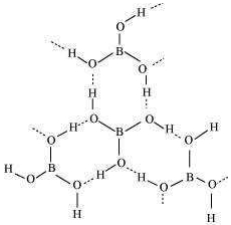
(B) Boric acid $(H_3BO_3)$ exists as a layered structure in the solid state.
These layers are held together by intermolecular hydrogen bonds,which result in its polymeric nature.
The dotted lines in the structure represent these hydrogen bonds.
These layers are held together by intermolecular hydrogen bonds,which result in its polymeric nature.
The dotted lines in the structure represent these hydrogen bonds.
0 likes
View Solution289
EasyMCQ
The type of hybridisation of boron in diborane is
A
$sp$
B
$sp^{2}$
C
$sp^{3}$
D
$dsp^{2}$
Solution
(C) In diborane $(B_2H_6)$,each boron atom is bonded to four hydrogen atoms (two terminal and two bridging).
Since each boron atom forms four sigma bonds,it undergoes $sp^{3}$ hybridisation.
Since each boron atom forms four sigma bonds,it undergoes $sp^{3}$ hybridisation.
0 likes
View Solution290
Medium
Give the origin and occurrence of group $13$ elements.
Solution
(N/A) Boron is a typical non-metal.
Aluminium is a metal but shows many chemical similarities to boron,while gallium,indium,thallium,and nihonium are almost exclusively metallic in character.
Boron is a fairly rare element; it mainly occurs as orthoboric acid $(H_{3}BO_{3})$,borax $(Na_{2}B_{4}O_{7} \cdot 10H_{2}O)$,and kernite $(Na_{2}B_{4}O_{7} \cdot 4H_{2}O)$.
In India,borax occurs in Puga Valley (Ladakh) and Sambhar Lake (Rajasthan). The abundance of boron in the earth's crust is less than $0.0001 \%$ by mass.
There are two isotopic forms of boron: $^{10}B$ $(19 \%)$ and $^{11}B$ $(81 \%)$.
Aluminium is the most abundant metal and the third most abundant element in the earth's crust ($8.3 \%$ by mass) after oxygen $(45.5 \%)$ and $Si$ $(27.7 \%)$.
Bauxite $(Al_{2}O_{3} \cdot 2H_{2}O)$ and cryolite $(Na_{3}AlF_{6})$ are the important minerals of aluminium. In India,it is found as mica in Madhya Pradesh,Karnataka,Orissa,and Jammu.
Gallium,indium,and thallium are less abundant elements in nature.
Aluminium is a metal but shows many chemical similarities to boron,while gallium,indium,thallium,and nihonium are almost exclusively metallic in character.
Boron is a fairly rare element; it mainly occurs as orthoboric acid $(H_{3}BO_{3})$,borax $(Na_{2}B_{4}O_{7} \cdot 10H_{2}O)$,and kernite $(Na_{2}B_{4}O_{7} \cdot 4H_{2}O)$.
In India,borax occurs in Puga Valley (Ladakh) and Sambhar Lake (Rajasthan). The abundance of boron in the earth's crust is less than $0.0001 \%$ by mass.
There are two isotopic forms of boron: $^{10}B$ $(19 \%)$ and $^{11}B$ $(81 \%)$.
Aluminium is the most abundant metal and the third most abundant element in the earth's crust ($8.3 \%$ by mass) after oxygen $(45.5 \%)$ and $Si$ $(27.7 \%)$.
Bauxite $(Al_{2}O_{3} \cdot 2H_{2}O)$ and cryolite $(Na_{3}AlF_{6})$ are the important minerals of aluminium. In India,it is found as mica in Madhya Pradesh,Karnataka,Orissa,and Jammu.
Gallium,indium,and thallium are less abundant elements in nature.
0 likes
View Solution291
Medium
Explain the atomic radius of elements of the boron family.
Solution
(N/A) On moving down the group, for each successive member, one extra shell of electrons is added, and therefore, the atomic radius is expected to increase.
However, a deviation is observed. The atomic radius of $Ga$ $(135 \text{ pm})$ is less than that of $Al$ $(143 \text{ pm})$.
This can be explained by the variation in the inner core of the electronic configuration. The presence of additional $10$ $d$-electrons offers only poor screening (shielding) effect for the outer electrons from the increased nuclear charge in gallium.
Consequently, the effective nuclear charge increases, causing the atomic radius of gallium to be smaller than that of aluminium. However, regular periodicity is observed in the case of ionic radius.
However, a deviation is observed. The atomic radius of $Ga$ $(135 \text{ pm})$ is less than that of $Al$ $(143 \text{ pm})$.
This can be explained by the variation in the inner core of the electronic configuration. The presence of additional $10$ $d$-electrons offers only poor screening (shielding) effect for the outer electrons from the increased nuclear charge in gallium.
Consequently, the effective nuclear charge increases, causing the atomic radius of gallium to be smaller than that of aluminium. However, regular periodicity is observed in the case of ionic radius.
0 likes
View Solution292
Medium
Explain ionization enthalpy and electronegativity for elements of the Boron family.
Solution
(N/A) Ionization Enthalpy: The ionization enthalpy values do not decrease smoothly down the group as expected from general trends. The decrease from $B$ to $Al$ is associated with an increase in atomic size.
The observed discontinuity in the ionization enthalpy values between $Al$ and $Ga$ and between $In$ and $Tl$ is due to the poor shielding effect of $d$- and $f$-electrons,which fail to compensate for the increase in nuclear charge. The order of ionization enthalpies is $\Delta_{i}H_{1} < \Delta_{i}H_{2} < \Delta_{i}H_{3}$.
Electronegativity: Down the group,electronegativity first decreases from $B$ to $Al$ and then increases marginally. This is due to the discrepancies in the atomic size of the elements.
The observed discontinuity in the ionization enthalpy values between $Al$ and $Ga$ and between $In$ and $Tl$ is due to the poor shielding effect of $d$- and $f$-electrons,which fail to compensate for the increase in nuclear charge. The order of ionization enthalpies is $\Delta_{i}H_{1} < \Delta_{i}H_{2} < \Delta_{i}H_{3}$.
Electronegativity: Down the group,electronegativity first decreases from $B$ to $Al$ and then increases marginally. This is due to the discrepancies in the atomic size of the elements.
0 likes
View Solution293
Difficult
The first ionization enthalpy values (in $kJ\, mol^{-1}$) of group $13$ elements are:
How would you explain this deviation from the general trend?
| Element | $B$ | $Al$ | $Ga$ | $In$ | $Tl$ |
|---|---|---|---|---|---|
| Ionization Enthalpy | $801$ | $577$ | $579$ | $558$ | $589$ |
How would you explain this deviation from the general trend?
Solution
(N/A) In general,ionization enthalpy in a group decreases with an increase in atomic number.
This trend is observed from $B$ to $Al$. However,$Ga$ has an unexpectedly higher ionization enthalpy than $Al$.
This is because,in the case of $Ga$,there are ten $d$-electrons in its inner electronic configuration.
The $d$-electrons have poor shielding ability and therefore,shield the nuclear charge less effectively than $s$ and $p$-electrons.
As a result,the outer electron is held more strongly by the nucleus,leading to a slight increase in ionization enthalpy despite the increase in atomic size from $Al$ to $Ga$.
$A$ similar increase is observed from $In$ to $Tl$,which is due to the presence of $14$ $f$-electrons in the inner electronic configuration of $Tl$,which have an even poorer shielding effect than $d$-electrons.
This trend is observed from $B$ to $Al$. However,$Ga$ has an unexpectedly higher ionization enthalpy than $Al$.
This is because,in the case of $Ga$,there are ten $d$-electrons in its inner electronic configuration.
The $d$-electrons have poor shielding ability and therefore,shield the nuclear charge less effectively than $s$ and $p$-electrons.
As a result,the outer electron is held more strongly by the nucleus,leading to a slight increase in ionization enthalpy despite the increase in atomic size from $Al$ to $Ga$.
$A$ similar increase is observed from $In$ to $Tl$,which is due to the presence of $14$ $f$-electrons in the inner electronic configuration of $Tl$,which have an even poorer shielding effect than $d$-electrons.
0 likes
View Solution294
Difficult
What is the difference between the first member of a group and the other elements in the $s$- and $p$-block? Why?
Solution
(N/A) The first member of each group differs from the other elements in the same group due to their small size,high charge density,and high electronegativity.
$(i)$ Smaller atomic and ionic radii: The first member has a significantly smaller atomic and ionic radius compared to the subsequent members of the same group.
$(ii)$ Absence of $d$-orbitals: The first member of each group has only four valence orbitals $(2s, 2p_x, 2p_y, 2p_z)$ available for bonding,limiting its maximum covalency to $4$ (e.g.,Boron forms $[BF_4]^-$,while Aluminium can form $[AlF_6]^{3-}$).
$(iii)$ Ability to form $p_{\pi}-p_{\pi}$ multiple bonds: The first member of $p$-block elements has a greater ability to form $p_{\pi}-p_{\pi}$ multiple bonds with itself (e.g.,$C=C, C \equiv C, N=N, N \equiv N$) and with other elements of the second period (e.g.,$C=O, C=N, N=O$),whereas heavier elements do not form such bonds effectively.
$(i)$ Smaller atomic and ionic radii: The first member has a significantly smaller atomic and ionic radius compared to the subsequent members of the same group.
$(ii)$ Absence of $d$-orbitals: The first member of each group has only four valence orbitals $(2s, 2p_x, 2p_y, 2p_z)$ available for bonding,limiting its maximum covalency to $4$ (e.g.,Boron forms $[BF_4]^-$,while Aluminium can form $[AlF_6]^{3-}$).
$(iii)$ Ability to form $p_{\pi}-p_{\pi}$ multiple bonds: The first member of $p$-block elements has a greater ability to form $p_{\pi}-p_{\pi}$ multiple bonds with itself (e.g.,$C=C, C \equiv C, N=N, N \equiv N$) and with other elements of the second period (e.g.,$C=O, C=N, N=O$),whereas heavier elements do not form such bonds effectively.
0 likes
View Solution295
Easy
Explain the physical characteristics of group $13$ elements.
Solution
(N/A) Boron is non-metallic in nature. It is an extremely hard and black-coloured solid.
It exists in many allotropic forms. Due to its very strong crystalline lattice,boron has an unusually high melting point.
The rest of the members are soft metals with low melting points and high electrical conductivity.
It is worthwhile to note that gallium,with an unusually low melting point $(303 \ K)$,can exist in a liquid state during summer.
Its high boiling point $(2676 \ K)$ makes it a useful material for measuring high temperatures.
The density of the elements increases down the group from boron to thallium.
It exists in many allotropic forms. Due to its very strong crystalline lattice,boron has an unusually high melting point.
The rest of the members are soft metals with low melting points and high electrical conductivity.
It is worthwhile to note that gallium,with an unusually low melting point $(303 \ K)$,can exist in a liquid state during summer.
Its high boiling point $(2676 \ K)$ makes it a useful material for measuring high temperatures.
The density of the elements increases down the group from boron to thallium.
0 likes
View Solution296
Easy
Discuss the pattern of variation in the oxidation states of $(i)$ $B$ to $Tl$ and $(ii)$ $C$ to $Pb$.
Solution
(N/A) $(i)$ $B$ to $Tl$: The electronic configuration of group $13$ elements is $ns^2 np^1$. Therefore,the most common oxidation state exhibited by them should be $+3$. However,it is only boron and aluminium which practically show the $+3$ oxidation state.
The remaining elements,i.e.,$Ga$,$In$,$Tl$,show both the $+1$ and $+3$ oxidation states. On moving down the group,the $+1$ state becomes more stable. For example,$Tl(+1)$ is more stable than $Tl(+3)$. This is because of the inert pair effect.
The two electrons present in the $s$-shell are strongly attracted by the nucleus and do not participate in bonding. This inert pair effect becomes more and more prominent on moving down the group. Hence,$Ga(+1)$ is unstable,$In(+1)$ is fairly stable and $Tl(+1)$ is very stable.
The stability of the $+3$ oxidation state decreases on moving down the group.
$(ii)$ $C$ to $Pb$: The electronic configuration of group $14$ elements is $ns^2 np^2$. Therefore,the most common oxidation state exhibited by them should be $+4$. However,the $+2$ oxidation state becomes more and more common on moving down the group. $C$ and $Si$ mostly show the $+4$ state.
On moving down the group,the higher oxidation state becomes less stable. This is because of the inert pair effect. Thus,although $Ge, Sn$ and $Pb$ show both the $+2$ and $+4$ states,the stability of the lower oxidation state increases and that of the higher oxidation state decreases on moving down the group.
The remaining elements,i.e.,$Ga$,$In$,$Tl$,show both the $+1$ and $+3$ oxidation states. On moving down the group,the $+1$ state becomes more stable. For example,$Tl(+1)$ is more stable than $Tl(+3)$. This is because of the inert pair effect.
The two electrons present in the $s$-shell are strongly attracted by the nucleus and do not participate in bonding. This inert pair effect becomes more and more prominent on moving down the group. Hence,$Ga(+1)$ is unstable,$In(+1)$ is fairly stable and $Tl(+1)$ is very stable.
| Elements | $B, Al, Ga, In, Tl$ |
| Oxidation number | $B(+3), Al(+3), Ga(+1, +3), In(+1, +3), Tl(+1, +3)$ |
The stability of the $+3$ oxidation state decreases on moving down the group.
$(ii)$ $C$ to $Pb$: The electronic configuration of group $14$ elements is $ns^2 np^2$. Therefore,the most common oxidation state exhibited by them should be $+4$. However,the $+2$ oxidation state becomes more and more common on moving down the group. $C$ and $Si$ mostly show the $+4$ state.
On moving down the group,the higher oxidation state becomes less stable. This is because of the inert pair effect. Thus,although $Ge, Sn$ and $Pb$ show both the $+2$ and $+4$ states,the stability of the lower oxidation state increases and that of the higher oxidation state decreases on moving down the group.
| Elements | $C, Si, Ge, Sn, Pb$ |
| Oxidation number | $C(+4), Si(+4), Ge(+2, +4), Sn(+2, +4), Pb(+2, +4)$ |
0 likes
View Solution297
Advanced
Describe the chemical properties of the elements of group $13$.
Solution
(N/A) Due to the small size of boron,the sum of its first three ionization enthalpies is very high. This prevents it from forming $3+$ ions and forces it to form only covalent compounds.
As we move from $B$ to $Al$,the sum of the first three ionization enthalpies of $Al$ decreases considerably,allowing it to form $Al^{3+}$ ions. Aluminium is a highly electro-positive metal.
Down the group,due to the poor shielding effect of intervening $d$ and $f$ orbitals,the increased effective nuclear charge holds $ns$ electrons tightly (inert pair effect),restricting their participation in bonding.
Consequently,only $p$-orbital electrons may be involved in bonding. In $Ga$,$In$,and $Tl$,both $+1$ and $+3$ oxidation states are observed.
The relative stability of the $+1$ oxidation state increases for heavier elements: $Al < Ga < In < Tl$.
In thallium,the $+1$ oxidation state is predominant,while the $+3$ oxidation state is highly oxidizing.
Compounds in the $+1$ oxidation state are more ionic than those in the $+3$ oxidation state.
In the trivalent state,the central atom in these compounds (e.g.,boron in $BCl_3$) has only six electrons. Such electron-deficient molecules act as Lewis acids.
The tendency to act as a Lewis acid decreases down the group. For example,$BCl_3$ accepts a lone pair from ammonia to form $BCl_3 \cdot NH_3$.
As we move from $B$ to $Al$,the sum of the first three ionization enthalpies of $Al$ decreases considerably,allowing it to form $Al^{3+}$ ions. Aluminium is a highly electro-positive metal.
Down the group,due to the poor shielding effect of intervening $d$ and $f$ orbitals,the increased effective nuclear charge holds $ns$ electrons tightly (inert pair effect),restricting their participation in bonding.
Consequently,only $p$-orbital electrons may be involved in bonding. In $Ga$,$In$,and $Tl$,both $+1$ and $+3$ oxidation states are observed.
The relative stability of the $+1$ oxidation state increases for heavier elements: $Al < Ga < In < Tl$.
In thallium,the $+1$ oxidation state is predominant,while the $+3$ oxidation state is highly oxidizing.
Compounds in the $+1$ oxidation state are more ionic than those in the $+3$ oxidation state.
In the trivalent state,the central atom in these compounds (e.g.,boron in $BCl_3$) has only six electrons. Such electron-deficient molecules act as Lewis acids.
The tendency to act as a Lewis acid decreases down the group. For example,$BCl_3$ accepts a lone pair from ammonia to form $BCl_3 \cdot NH_3$.
0 likes
View Solution298
Easy
Consider the compounds,$BCl_3$ and $CCl_4$. How will they behave with water? Justify.
Solution
(N/A) $BCl_3$ is an electron-deficient molecule. The $B$ atom has an incomplete octet and accepts a lone pair of electrons from water,leading to hydrolysis to form boric acid:
$BCl_3 + 3 H_2O \rightarrow H_3BO_3 + 3 HCl$
On the other hand,$CCl_4$ is an electron-precise molecule. The $C$ atom has a complete octet and lacks vacant $d$-orbitals to expand its coordination number. Therefore,it cannot accept electrons from water,and $CCl_4$ does not undergo hydrolysis.
$BCl_3 + 3 H_2O \rightarrow H_3BO_3 + 3 HCl$
On the other hand,$CCl_4$ is an electron-precise molecule. The $C$ atom has a complete octet and lacks vacant $d$-orbitals to expand its coordination number. Therefore,it cannot accept electrons from water,and $CCl_4$ does not undergo hydrolysis.
0 likes
View Solution299
Easy
Write reactions to justify the amphoteric nature of aluminium.
Solution
(N/A) substance is called amphoteric if it displays characteristics of both acids and bases. Aluminium dissolves in both acids and bases,showing amphoteric behaviour.
Reaction with acid:
$2 Al(s) + 6 HCl(aq) \rightarrow 2 AlCl_{3}(aq) + 3 H_{2}(g)$
Reaction with base:
$2 Al(s) + 2 NaOH(aq) + 6 H_{2}O(l) \rightarrow 2 Na[Al(OH)_{4}](aq) + 3 H_{2}(g)$
Reaction with acid:
$2 Al(s) + 6 HCl(aq) \rightarrow 2 AlCl_{3}(aq) + 3 H_{2}(g)$
Reaction with base:
$2 Al(s) + 2 NaOH(aq) + 6 H_{2}O(l) \rightarrow 2 Na[Al(OH)_{4}](aq) + 3 H_{2}(g)$
0 likes
View Solution300
Medium
When metal $X$ is treated with sodium hydroxide,a white precipitate $(A)$ is obtained,which is soluble in excess of $NaOH$ to give soluble complex $(B)$. Compound $(A)$ is soluble in dilute $HCl$ to form compound $(C)$. The compound $(A)$ when heated strongly gives $(D)$,which is used to extract metal. Identify $(X), (A), (B), (C)$ and $(D)$. Write suitable equations to support their identities.
Solution
(N/A) The given metal $X$ is $Al$. The reactions are as follows:
$1$. $2 Al + 2 NaOH + 6 H_2O \rightarrow 2 Na[Al(OH)_4] + 3 H_2$ (Note: $Al(OH)_3$ is the intermediate white precipitate $(A)$).
$2$. $Al(OH)_3 + NaOH \rightarrow Na[Al(OH)_4]$ (Soluble complex $(B)$).
$3$. $Al(OH)_3 + 3 HCl \rightarrow AlCl_3 + 3 H_2O$ (Compound $(C)$ is $AlCl_3$).
$4$. $2 Al(OH)_3 \xrightarrow{\Delta} Al_2O_3 + 3 H_2O$ (Compound $(D)$ is $Al_2O_3$,which is used in the extraction of $Al$).
$1$. $2 Al + 2 NaOH + 6 H_2O \rightarrow 2 Na[Al(OH)_4] + 3 H_2$ (Note: $Al(OH)_3$ is the intermediate white precipitate $(A)$).
$2$. $Al(OH)_3 + NaOH \rightarrow Na[Al(OH)_4]$ (Soluble complex $(B)$).
$3$. $Al(OH)_3 + 3 HCl \rightarrow AlCl_3 + 3 H_2O$ (Compound $(C)$ is $AlCl_3$).
$4$. $2 Al(OH)_3 \xrightarrow{\Delta} Al_2O_3 + 3 H_2O$ (Compound $(D)$ is $Al_2O_3$,which is used in the extraction of $Al$).
0 likes
View Solutionp-Block Elements (Class 11) — Boron family · Frequently Asked Questions
1Are these p-Block Elements (Class 11) questions useful for JEE and NEET?
Yes. All questions in this section are mapped to JEE Main and NEET exam patterns. Previous year questions from JEE Main, NEET, GUJCET and state-level exams are included with full solutions.
2Can I switch to Hindi or Gujarati for these questions?
Yes. Use the language tabs in the hero section or the sidebar to view the same questions and solutions in English, Hindi or Gujarati.
3How do I generate a question paper from this subtopic?
Use the Vedclass Exam Paper Generator — select the chapter and subtopic, set difficulty, and generate Sets A, B, C, D automatically. First 3 chapters of every subject are free.
Vedclass Products
For Students
Vedclass Test Series
Mock tests in real JEE/NEET style with performance analysis. 5-day free trial.
Start Free TrialFor Teachers
Exam Paper Generator
Generate Set A/B/C/D papers from this chapter in 2 minutes. 3 chapters free.
Try FreeFor Institutes
Online Exam Module
Live online exams with unlimited students, 360° analytics & white-label branding.
See DemoFor Teachers & Institutes
Generate a p-Block Elements (Class 11) Exam Paper in 2 Minutes
Select subtopic & difficulty — Sets A, B, C, D auto-generated with No Repeat logic.
First 3 chapters of every subject are free — no payment required.