
A English
Boron family Questions in English
Class 11 Chemistry · p-Block Elements (Class 11) · Boron family
528+
Questions
English
Language
100%
With Solutions
Showing 45 of 528 questions in English
451
MediumMCQ
The material used in the nuclear industry as protective shields and control rods is
A
Borax
B
Metal boride
C
Boric acid
D
Boric oxide
Solution
(B) In the nuclear industry,materials with high neutron absorption cross-sections are required for control rods and protective shields. $Metal \ borides$ (such as $B_4C$) are widely used for this purpose because boron has a high capacity to absorb neutrons.
0 likes
View Solution452
EasyMCQ
Which of the following is not correct regarding Orthoboric acid $(H_3BO_3)$?
A
Orthoboric acid can be prepared by the reaction of $HCl$ with $Na_2B_4O_7$.
B
Orthoboric acid releases three $H^{+}$ ions in water.
C
Orthoboric acid when heated above $370 \ K$ forms $HBO_2$.
D
$HBO_2$ on further heating forms $B_2O_3$.
Solution
(B) Orthoboric acid $(H_3BO_3)$ is a weak monobasic Lewis acid.
It acts as a Lewis acid by accepting a pair of electrons from $OH^-$ ions in water: $B(OH)_3 + 2H_2O \rightarrow [B(OH)_4]^- + H_3O^+$.
It does not release three $H^+$ ions in water; it releases only one $H^+$ ion via the hydrolysis of the boron center.
Therefore,the statement that it releases three $H^+$ ions is incorrect.
It acts as a Lewis acid by accepting a pair of electrons from $OH^-$ ions in water: $B(OH)_3 + 2H_2O \rightarrow [B(OH)_4]^- + H_3O^+$.
It does not release three $H^+$ ions in water; it releases only one $H^+$ ion via the hydrolysis of the boron center.
Therefore,the statement that it releases three $H^+$ ions is incorrect.
0 likes
View Solution453
MediumMCQ
What is $Z$ in the following reactions?
$BCl_3 + H_2 \xrightarrow[450^{\circ}C]{Cu-Al} X + HCl$
$X \xrightarrow{\text{methylation}} Z$
$BCl_3 + H_2 \xrightarrow[450^{\circ}C]{Cu-Al} X + HCl$
$X \xrightarrow{\text{methylation}} Z$
A
$(CH_3)BH_2$
B
$(CH_3)_4B_2H_2$
C
$(CH_3)_3B_2H_3$
D
$(CH_3)_6B_2$
Solution
(B) The reaction of $BCl_3$ with $H_2$ in the presence of a $Cu-Al$ catalyst at $450^{\circ}C$ produces diborane $(B_2H_6)$ as $X$.
$2BCl_3 + 6H_2 \xrightarrow{Cu-Al, 450^{\circ}C} B_2H_6 + 6HCl$
Methylation of diborane $(B_2H_6)$ with methyl chloride $(CH_3Cl)$ leads to the formation of tetramethyldiborane as $Z$.
$B_2H_6 + 4CH_3Cl \rightarrow (CH_3)_4B_2H_2 + 4HCl$
Thus,$Z$ is $(CH_3)_4B_2H_2$.
$2BCl_3 + 6H_2 \xrightarrow{Cu-Al, 450^{\circ}C} B_2H_6 + 6HCl$
Methylation of diborane $(B_2H_6)$ with methyl chloride $(CH_3Cl)$ leads to the formation of tetramethyldiborane as $Z$.
$B_2H_6 + 4CH_3Cl \rightarrow (CH_3)_4B_2H_2 + 4HCl$
Thus,$Z$ is $(CH_3)_4B_2H_2$.
0 likes
View Solution454
EasyMCQ
The correct order of melting points of $Al$,$Ga$,$In$ is
A
$Ga < In < Al$
B
$In < Ga < Al$
C
$Al < Ga < In$
D
$Ga < Al < In$
Solution
(A) The melting points of group $13$ elements are influenced by their metallic bonding and crystal structure.
The melting points of group $13$ elements follow the order: $B > Al > Tl > In > Ga$.
Gallium $(Ga)$ has an unusually low melting point of $303 \ K$ because it exists as $Ga_2$ molecules in the solid state,which are held by weak van der Waals forces.
Therefore,the correct order for $Al$,$Ga$,and $In$ is $Ga < In < Al$.
The melting points of group $13$ elements follow the order: $B > Al > Tl > In > Ga$.
Gallium $(Ga)$ has an unusually low melting point of $303 \ K$ because it exists as $Ga_2$ molecules in the solid state,which are held by weak van der Waals forces.
Therefore,the correct order for $Al$,$Ga$,and $In$ is $Ga < In < Al$.
0 likes
View Solution455
MediumMCQ
$AlF_3$ is soluble in $HF$ only in the presence of $KF$ due to the formation of:
A
$AlH_3$
B
$[AlH_6]^{3-}$
C
$[AlF_6]^{3-}$
D
$K[AlF_3H]$
Solution
(C) $AlF_3$ is insoluble in anhydrous $HF$ because it lacks free $F^-$ ions to interact with the $Al^{3+}$ center.
In the presence of $KF$,$KF$ dissociates to provide $F^-$ ions,which react with $AlF_3$ to form a soluble complex.
The reaction is:
$AlF_3 + 3KF \rightarrow K_3[AlF_6]$
This complex dissociates into $3K^+$ and $[AlF_6]^{3-}$.
Therefore,the correct option is $[AlF_6]^{3-}$.
In the presence of $KF$,$KF$ dissociates to provide $F^-$ ions,which react with $AlF_3$ to form a soluble complex.
The reaction is:
$AlF_3 + 3KF \rightarrow K_3[AlF_6]$
This complex dissociates into $3K^+$ and $[AlF_6]^{3-}$.
Therefore,the correct option is $[AlF_6]^{3-}$.
0 likes
View Solution456
EasyMCQ
Identify the correct statements from the following :
$I$. $Ga_2O_3$ is an amphoteric oxide.
$II$. The dimer of aluminium chloride has three $Al-Cl-Al$ bridge bonds.
$III$. Boron is a very hard refractory solid of high melting temperature.
$I$. $Ga_2O_3$ is an amphoteric oxide.
$II$. The dimer of aluminium chloride has three $Al-Cl-Al$ bridge bonds.
$III$. Boron is a very hard refractory solid of high melting temperature.
A
$I$,$II$ only
B
$I$,$III$ only
C
$II$,$III$ only
D
$I$,$II$,$III$
Solution
(B) $(I)$ $Ga_2O_3$ is an amphoteric oxide. This is a correct statement as it reacts with both acids and bases:
Reaction with an acid: $Ga_2O_3 + 6 HCl \longrightarrow 2 GaCl_3 + 3 H_2O$
Reaction with a base: $Ga_2O_3 + 2 NaOH \longrightarrow 2 NaGaO_2 + H_2O$
$(II)$ The dimer of aluminium chloride $(Al_2Cl_6)$ has only two $Al-Cl-Al$ bridge bonds,not three. The structure consists of two $AlCl_4$ tetrahedra sharing a common edge.
$(III)$ Boron is a very hard refractory solid with a high melting temperature $(2349 \ K)$,which is a correct statement.
Therefore,statements $I$ and $III$ are correct. The correct option is $(b)$.
Reaction with an acid: $Ga_2O_3 + 6 HCl \longrightarrow 2 GaCl_3 + 3 H_2O$
Reaction with a base: $Ga_2O_3 + 2 NaOH \longrightarrow 2 NaGaO_2 + H_2O$
$(II)$ The dimer of aluminium chloride $(Al_2Cl_6)$ has only two $Al-Cl-Al$ bridge bonds,not three. The structure consists of two $AlCl_4$ tetrahedra sharing a common edge.
$(III)$ Boron is a very hard refractory solid with a high melting temperature $(2349 \ K)$,which is a correct statement.
Therefore,statements $I$ and $III$ are correct. The correct option is $(b)$.
0 likes
View Solution457
EasyMCQ
Which of the following is not associated with water molecules?
A
$Cryolite$ $(Na_3AlF_6)$
B
$Bauxite$ $(Al_2O_3 \cdot 2H_2O)$
C
$Kernite$ $(Na_2B_4O_7 \cdot 4H_2O)$
D
$Borax$ $(Na_2B_4O_7 \cdot 10H_2O)$
Solution
(A) The chemical formula for $Cryolite$ is $Na_3AlF_6$. It is an anhydrous mineral and does not contain any water of crystallization.
$Bauxite$ is $Al_2O_3 \cdot 2H_2O$,which contains water molecules.
$Kernite$ is $Na_2B_4O_7 \cdot 4H_2O$,which contains water molecules.
$Borax$ is $Na_2B_4O_7 \cdot 10H_2O$,which contains water molecules.
Therefore,$Cryolite$ is the correct answer.
$Bauxite$ is $Al_2O_3 \cdot 2H_2O$,which contains water molecules.
$Kernite$ is $Na_2B_4O_7 \cdot 4H_2O$,which contains water molecules.
$Borax$ is $Na_2B_4O_7 \cdot 10H_2O$,which contains water molecules.
Therefore,$Cryolite$ is the correct answer.
0 likes
View Solution458
MediumMCQ
In the reactions $I$ and $II$,the covalencies of $Be$ and $Al$ in $X$ and $Y$ are respectively:
$I$ $Be(OH)_2 + NaOH \text{ (excess)} \rightarrow X$
$II$ $Al(OH)_3 + NaOH \text{ (excess)} \rightarrow Y$
$I$ $Be(OH)_2 + NaOH \text{ (excess)} \rightarrow X$
$II$ $Al(OH)_3 + NaOH \text{ (excess)} \rightarrow Y$
A
$4, 6$
B
$4, 4$
C
$6, 4$
D
$3, 6$
Solution
(B) The reaction $I$ is: $Be(OH)_2 + 2NaOH \text{ (excess)} \rightarrow Na_2[Be(OH)_4] \text{ (X)}$. The covalency of $Be$ in $[Be(OH)_4]^{2-}$ is $4$.
The reaction $II$ is: $Al(OH)_3 + NaOH \text{ (excess)} \rightarrow Na[Al(OH)_4] \text{ (Y)}$. The covalency of $Al$ in $[Al(OH)_4]^{-}$ is $4$.
Thus,the covalencies of $Be$ and $Al$ in $X$ and $Y$ are $4$ and $4$ respectively.
The reaction $II$ is: $Al(OH)_3 + NaOH \text{ (excess)} \rightarrow Na[Al(OH)_4] \text{ (Y)}$. The covalency of $Al$ in $[Al(OH)_4]^{-}$ is $4$.
Thus,the covalencies of $Be$ and $Al$ in $X$ and $Y$ are $4$ and $4$ respectively.
0 likes
View Solution459
MediumMCQ
The general formula of the compounds formed when group $13$ elements $(A)$ react with group $16$ elements $(B)$ is
A
$AB$
B
$A_3B_2$
C
$A_2B_3$
D
$A_3B_3$
Solution
(C) Group $13$ elements (boron family) typically exhibit a valency of $+3$.
Group $16$ elements (oxygen family) typically exhibit a valency of $-2$.
To form a neutral compound,the charges must be balanced.
Using the criss-cross method:
$A^{+3}$ and $B^{-2}$
By swapping the charges,we get $A_2B_3$.
Therefore,the general formula is $A_2B_3$.
Group $16$ elements (oxygen family) typically exhibit a valency of $-2$.
To form a neutral compound,the charges must be balanced.
Using the criss-cross method:
$A^{+3}$ and $B^{-2}$
By swapping the charges,we get $A_2B_3$.
Therefore,the general formula is $A_2B_3$.
0 likes
View Solution460
EasyMCQ
Which one of the following forms a basic oxide?
A
$B$
B
$Tl$
C
$Al$
D
$Ga$
Solution
(B) The basic character of an oxide increases with an increase in the metallic character of the element.
As we move down the group,the metallic character increases.
Among the given elements ($B$,$Al$,$Ga$,$Tl$),$Tl$ $(Thallium)$ is at the bottom of the group and thus possesses the highest metallic character.
Therefore,$Tl$ forms a basic oxide.
$B$ $(Boron)$ forms an acidic oxide,while $Al$ $(Aluminium)$ and $Ga$ $(Gallium)$ form amphoteric oxides.
As we move down the group,the metallic character increases.
Among the given elements ($B$,$Al$,$Ga$,$Tl$),$Tl$ $(Thallium)$ is at the bottom of the group and thus possesses the highest metallic character.
Therefore,$Tl$ forms a basic oxide.
$B$ $(Boron)$ forms an acidic oxide,while $Al$ $(Aluminium)$ and $Ga$ $(Gallium)$ form amphoteric oxides.
0 likes
View Solution461
EasyMCQ
Kernite and cryolite are the minerals of two elements $X$ and $Z$. Respectively $X$ and $Z$ are
A
$B, Ga$
B
$B, Al$
C
$Al, In$
D
$B, Tl$
Solution
(B) Kernite is a mineral of Boron $(B)$ with the formula $Na_2B_4O_6(OH)_2 \cdot 3H_2O$.
Cryolite is a mineral of Aluminum $(Al)$ with the formula $Na_3AlF_6$.
Therefore,$X$ is $B$ and $Z$ is $Al$.
Cryolite is a mineral of Aluminum $(Al)$ with the formula $Na_3AlF_6$.
Therefore,$X$ is $B$ and $Z$ is $Al$.
0 likes
View Solution462
MediumMCQ
The correct statements about the compounds of boron are:
$I$. In borax bead test,the colour of cobalt metaborate is blue.
$II$. Diborane is prepared by the oxidation of sodium borohydride with iodine.
$III$. In diborane,the oxidation state of hydrogen is $+1$.
$IV$. Boric acid is a tribasic acid.
$I$. In borax bead test,the colour of cobalt metaborate is blue.
$II$. Diborane is prepared by the oxidation of sodium borohydride with iodine.
$III$. In diborane,the oxidation state of hydrogen is $+1$.
$IV$. Boric acid is a tribasic acid.
A
$I$ & $II$
B
$III$ & $IV$
C
$I$ & $III$
D
$II$ & $IV$
Solution
(A) $I$. In the borax bead test,cobalt oxide reacts with $B_2O_3$ to form cobalt metaborate,$Co(BO_2)_2$,which is blue in color. This statement is correct.
$II$. Diborane $(B_2H_6)$ is prepared by the reaction of sodium borohydride $(NaBH_4)$ with iodine $(I_2)$: $2NaBH_4 + I_2 \rightarrow B_2H_6 + 2NaI + H_2$. This statement is correct.
$III$. In diborane $(B_2H_6)$,boron is more electropositive than hydrogen,so the oxidation state of hydrogen is $-1$. This statement is incorrect.
$IV$. Boric acid $(H_3BO_3)$ is a weak monobasic Lewis acid,not a tribasic acid,as it accepts $OH^-$ ions from water. This statement is incorrect.
Therefore,statements $I$ and $II$ are correct.
$II$. Diborane $(B_2H_6)$ is prepared by the reaction of sodium borohydride $(NaBH_4)$ with iodine $(I_2)$: $2NaBH_4 + I_2 \rightarrow B_2H_6 + 2NaI + H_2$. This statement is correct.
$III$. In diborane $(B_2H_6)$,boron is more electropositive than hydrogen,so the oxidation state of hydrogen is $-1$. This statement is incorrect.
$IV$. Boric acid $(H_3BO_3)$ is a weak monobasic Lewis acid,not a tribasic acid,as it accepts $OH^-$ ions from water. This statement is incorrect.
Therefore,statements $I$ and $II$ are correct.
0 likes
View Solution463
MediumMCQ
Which of the following is an incorrect statement about the compounds of group $13$ elements?
A
All the trihalides exist except $TlI_3$
B
Trihalides on hydrolysis form tetrahedral species
C
Diborane is an example of electron precise hydride
D
Hydrolysis of diborane gives boric acid
Solution
(C) The correct answer is $C$.
$A$: $TlI_3$ does not exist because $Tl^{3+}$ is a strong oxidizing agent and $I^-$ is a strong reducing agent,leading to the formation of $TlI$ and $I_2$.
$B$: Trihalides like $BCl_3$ undergo hydrolysis to form $[B(OH)_4]^-$,which is a tetrahedral species.
$C$: Diborane $(B_2H_6)$ is an electron-deficient hydride,not an electron-precise hydride,as it has fewer electrons than required for standard covalent bonding.
$D$: Hydrolysis of diborane $(B_2H_6 + 6H_2O \rightarrow 2H_3BO_3 + 6H_2)$ yields boric acid $(H_3BO_3)$.
$A$: $TlI_3$ does not exist because $Tl^{3+}$ is a strong oxidizing agent and $I^-$ is a strong reducing agent,leading to the formation of $TlI$ and $I_2$.
$B$: Trihalides like $BCl_3$ undergo hydrolysis to form $[B(OH)_4]^-$,which is a tetrahedral species.
$C$: Diborane $(B_2H_6)$ is an electron-deficient hydride,not an electron-precise hydride,as it has fewer electrons than required for standard covalent bonding.
$D$: Hydrolysis of diborane $(B_2H_6 + 6H_2O \rightarrow 2H_3BO_3 + 6H_2)$ yields boric acid $(H_3BO_3)$.
0 likes
View Solution464
MediumMCQ
Diborane on hydrolysis gives a compound $X$. The correct statements about $X$ are
$I$. It is a tribasic acid
$II$. It is a weak monobasic acid
$III$. It has a layer structure
$IV$. It is highly soluble in water
$I$. It is a tribasic acid
$II$. It is a weak monobasic acid
$III$. It has a layer structure
$IV$. It is highly soluble in water
A
$I$ & $III$
B
$II$ & $III$
C
$II$ & $IV$
D
$I$ & $IV$
Solution
(B) The hydrolysis of diborane $(B_2H_6)$ is represented by the reaction: $B_2H_6 + 6H_2O \rightarrow 2H_3BO_3 + 6H_2$.
Thus,the compound $X$ is orthoboric acid $(H_3BO_3)$.
Regarding the properties of $H_3BO_3$:
$I$. It is a weak monobasic acid,not a tribasic acid,because it acts as a Lewis acid by accepting an $OH^-$ ion from water: $B(OH)_3 + 2H_2O \rightarrow [B(OH)_4]^- + H_3O^+$.
$II$. This statement is correct.
$III$. It has a layer structure in the solid state where planar $BO_3$ units are linked by hydrogen bonds. This statement is correct.
$IV$. It is sparingly soluble in cold water but its solubility increases with temperature. Thus,it is not considered 'highly' soluble.
Therefore,the correct statements are $II$ and $III$.
Thus,the compound $X$ is orthoboric acid $(H_3BO_3)$.
Regarding the properties of $H_3BO_3$:
$I$. It is a weak monobasic acid,not a tribasic acid,because it acts as a Lewis acid by accepting an $OH^-$ ion from water: $B(OH)_3 + 2H_2O \rightarrow [B(OH)_4]^- + H_3O^+$.
$II$. This statement is correct.
$III$. It has a layer structure in the solid state where planar $BO_3$ units are linked by hydrogen bonds. This statement is correct.
$IV$. It is sparingly soluble in cold water but its solubility increases with temperature. Thus,it is not considered 'highly' soluble.
Therefore,the correct statements are $II$ and $III$.
0 likes
View Solution465
DifficultMCQ
Boron trifluoride on reaction with lithium aluminium hydride in ether gives $LiF$,$AlF_3$ and $X$. $X$ on reaction with $NH_3$ gives $Y$. $Y$ on further heating gives a compound $Z$. The number of $\sigma$-bonds and $\pi$-bonds in $Z$ are $x$ and $y$ respectively. $(x+y)$ is equal to
A
$15$
B
$12$
C
$14$
D
$18$
Solution
(A) The reaction of $BF_3$ with $LiAlH_4$ in ether produces diborane $(B_2H_6)$ as $X$:
$4BF_3 + 3LiAlH_4 \rightarrow 2B_2H_6 + 3LiF + 3AlF_3$.
$X$ $(B_2H_6)$ reacts with $NH_3$ to form an adduct,which on heating gives inorganic benzene (borazine,$B_3N_3H_6$) as $Z$:
$3B_2H_6 + 6NH_3$ $\rightarrow 3[BH_2(NH_3)_2]^+[BH_4]^-$ $\xrightarrow{\Delta} 2B_3N_3H_6 + 12H_2$.
Borazine $(B_3N_3H_6)$ has a cyclic structure similar to benzene.
It contains $12$ $\sigma$-bonds ($6$ $B-N$ and $6$ $B-H/N-H$ bonds) and $3$ $\pi$-bonds.
Thus,$x = 12$ and $y = 3$.
$(x + y) = 12 + 3 = 15$.
$4BF_3 + 3LiAlH_4 \rightarrow 2B_2H_6 + 3LiF + 3AlF_3$.
$X$ $(B_2H_6)$ reacts with $NH_3$ to form an adduct,which on heating gives inorganic benzene (borazine,$B_3N_3H_6$) as $Z$:
$3B_2H_6 + 6NH_3$ $\rightarrow 3[BH_2(NH_3)_2]^+[BH_4]^-$ $\xrightarrow{\Delta} 2B_3N_3H_6 + 12H_2$.
Borazine $(B_3N_3H_6)$ has a cyclic structure similar to benzene.
It contains $12$ $\sigma$-bonds ($6$ $B-N$ and $6$ $B-H/N-H$ bonds) and $3$ $\pi$-bonds.
Thus,$x = 12$ and $y = 3$.
$(x + y) = 12 + 3 = 15$.
0 likes
View Solution466
MediumMCQ
Consider the following reactions (not balanced):
$BF_3 + NaH \xrightarrow{450 \ K} X + NaF$
$X + H_2O \longrightarrow Y + H_2 \uparrow$
The correct statements about $X$ and $Y$ are:
$I$. $X$ is an electron-deficient molecule
$II$. In $X$,$B-B$ bond is present
$III$. $Y$ is a weak tribasic acid
$IV$. $Y$ acts as a Lewis acid
$BF_3 + NaH \xrightarrow{450 \ K} X + NaF$
$X + H_2O \longrightarrow Y + H_2 \uparrow$
The correct statements about $X$ and $Y$ are:
$I$. $X$ is an electron-deficient molecule
$II$. In $X$,$B-B$ bond is present
$III$. $Y$ is a weak tribasic acid
$IV$. $Y$ acts as a Lewis acid
A
$I$ and $IV$
B
$II$ and $III$
C
$II$ and $IV$
D
$I$ and $III$
Solution
(A) On balancing the equation $(1)$:
$2BF_3 + 6NaH \xrightarrow{450 \ K} B_2H_6 + 6NaF$
So,$X$ is $B_2H_6$ (diborane).
Balancing the equation $(2)$:
$B_2H_6 + 6H_2O \longrightarrow 2B(OH)_3 + 6H_2 \uparrow$
So,$Y$ is $B(OH)_3$ (boric acid).
$I$. $X$ $(B_2H_6)$ is an electron-deficient molecule (contains $3c-2e^-$ bonds). This is correct.
$II$. In $X$ $(B_2H_6)$,there is no direct $B-B$ bond; it has two bridging hydrogen atoms $(B-H-B)$. This is incorrect.
$III$. $Y$ $(B(OH)_3)$ is a weak monobasic Lewis acid,not a tribasic acid. This is incorrect.
$IV$. $Y$ $(B(OH)_3)$ acts as a Lewis acid as it accepts a lone pair of electrons from $OH^-$ ions. This is correct.
Therefore,statements $I$ and $IV$ are correct.
$2BF_3 + 6NaH \xrightarrow{450 \ K} B_2H_6 + 6NaF$
So,$X$ is $B_2H_6$ (diborane).
Balancing the equation $(2)$:
$B_2H_6 + 6H_2O \longrightarrow 2B(OH)_3 + 6H_2 \uparrow$
So,$Y$ is $B(OH)_3$ (boric acid).
$I$. $X$ $(B_2H_6)$ is an electron-deficient molecule (contains $3c-2e^-$ bonds). This is correct.
$II$. In $X$ $(B_2H_6)$,there is no direct $B-B$ bond; it has two bridging hydrogen atoms $(B-H-B)$. This is incorrect.
$III$. $Y$ $(B(OH)_3)$ is a weak monobasic Lewis acid,not a tribasic acid. This is incorrect.
$IV$. $Y$ $(B(OH)_3)$ acts as a Lewis acid as it accepts a lone pair of electrons from $OH^-$ ions. This is correct.
Therefore,statements $I$ and $IV$ are correct.
0 likes
View Solution467
DifficultMCQ
Observe the following reactions (not balanced):
$BF_3 + LiAlH_4 \xrightarrow{(C_2H_5)_2O} X + LiF + AlF_3$
$X + NaH \longrightarrow Y$
The incorrect statement about $Y$ is:
$BF_3 + LiAlH_4 \xrightarrow{(C_2H_5)_2O} X + LiF + AlF_3$
$X + NaH \longrightarrow Y$
The incorrect statement about $Y$ is:
A
It is a good oxidizing agent
B
It is a good reducing agent
C
Oxidation state of hydrogen in it is $-1$
D
Oxidation of it with iodine gives diborane
Solution
(A) The first reaction is: $4BF_3 + 3LiAlH_4 \xrightarrow{(C_2H_5)_2O} 2B_2H_6 + 3LiF + 3AlF_3$. Here,$X$ is $B_2H_6$ (diborane).
The second reaction is: $B_2H_6 + 2NaH \longrightarrow 2NaBH_4$. Here,$Y$ is $NaBH_4$ (sodium borohydride).
$NaBH_4$ contains the $BH_4^-$ ion,where hydrogen is in the $-1$ oxidation state.
$NaBH_4$ is a well-known reducing agent,not an oxidizing agent.
Therefore,the statement 'It is a good oxidizing agent' is incorrect.
The second reaction is: $B_2H_6 + 2NaH \longrightarrow 2NaBH_4$. Here,$Y$ is $NaBH_4$ (sodium borohydride).
$NaBH_4$ contains the $BH_4^-$ ion,where hydrogen is in the $-1$ oxidation state.
$NaBH_4$ is a well-known reducing agent,not an oxidizing agent.
Therefore,the statement 'It is a good oxidizing agent' is incorrect.
0 likes
View Solution468
DifficultMCQ
What are $X$ and $Y$ respectively in the following reactions?
$X \xleftarrow{CO} B_2 H_6 \xrightarrow[(C_2 H_5)_2 O]{NaH} Y$
$X \xleftarrow{CO} B_2 H_6 \xrightarrow[(C_2 H_5)_2 O]{NaH} Y$
A
$BH_3 \cdot 2 CO ; NaBO_2$
B
$BH_3 \cdot CO ; NaBH_4$
C
$BH_3 \cdot CO ; NaBO_2$
D
$BH_3 \cdot CO ; Na_2 B_4 O_7$
Solution
(B) The reaction of diborane $(B_2 H_6)$ with carbon monoxide $(CO)$ under pressure yields the borane carbonyl adduct,$BH_3 \cdot CO$ $(X)$.
$B_2 H_6 + 2 CO \rightarrow 2 BH_3 \cdot CO$
The reaction of diborane $(B_2 H_6)$ with sodium hydride $(NaH)$ in the presence of diethyl ether $((C_2 H_5)_2 O)$ yields sodium borohydride,$NaBH_4$ $(Y)$.
$B_2 H_6 + 2 NaH \xrightarrow{(C_2 H_5)_2 O} 2 NaBH_4$
Therefore,$X = BH_3 \cdot CO$ and $Y = NaBH_4$.
$B_2 H_6 + 2 CO \rightarrow 2 BH_3 \cdot CO$
The reaction of diborane $(B_2 H_6)$ with sodium hydride $(NaH)$ in the presence of diethyl ether $((C_2 H_5)_2 O)$ yields sodium borohydride,$NaBH_4$ $(Y)$.
$B_2 H_6 + 2 NaH \xrightarrow{(C_2 H_5)_2 O} 2 NaBH_4$
Therefore,$X = BH_3 \cdot CO$ and $Y = NaBH_4$.
0 likes
View Solution469
EasyMCQ
The correct formula of borax is $Na_2[B_4O_5(OH)_4] \cdot 8H_2O$. If the formula is represented as $Na_2[B_4O_5(OH)_x] \cdot yH_2O$,then the sum of $x$ and $y$ is:
A
$14$
B
$09$
C
$12$
D
$10$
Solution
(C) The chemical formula of borax is $Na_2[B_4O_5(OH)_4] \cdot 8H_2O$.
Comparing this with the given expression $Na_2[B_4O_5(OH)_x] \cdot yH_2O$,we get:
$x = 4$
$y = 8$
Therefore,the sum $x + y = 4 + 8 = 12$.
Comparing this with the given expression $Na_2[B_4O_5(OH)_x] \cdot yH_2O$,we get:
$x = 4$
$y = 8$
Therefore,the sum $x + y = 4 + 8 = 12$.
0 likes
View Solution470
EasyMCQ
Consider the following statements about group $13$ elements:
$A$. $AlCl_3$ achieves stability by forming a dimer.
$B$. $BCl_3$ is an electron-deficient molecule.
$C$. $E^0_{M^{3+}/M^0} \ (V)$ is $+1.26 \ V$ for aluminium.
$D$. In $+1$ oxidation state,thallium is unstable.
The incorrect statements are:
$A$. $AlCl_3$ achieves stability by forming a dimer.
$B$. $BCl_3$ is an electron-deficient molecule.
$C$. $E^0_{M^{3+}/M^0} \ (V)$ is $+1.26 \ V$ for aluminium.
$D$. In $+1$ oxidation state,thallium is unstable.
The incorrect statements are:
A
$C$ & $D$ only
B
$A$ & $B$ only
C
$A$ & $D$ only
D
$B$ & $C$ only
Solution
(A) Statement $A$ is correct: $AlCl_3$ forms a dimer $(Al_2Cl_6)$ to complete its octet.
Statement $B$ is correct: $BCl_3$ has only $6$ electrons in the valence shell of boron,making it electron-deficient.
Statement $C$ is incorrect: The standard reduction potential $E^0_{Al^{3+}/Al}$ is $-1.66 \ V$,not $+1.26 \ V$.
Statement $D$ is incorrect: Due to the inert pair effect,the $+1$ oxidation state of thallium $(Tl^+)$ is more stable than the $+3$ oxidation state $(Tl^{3+})$.
Therefore,statements $C$ and $D$ are incorrect.
Statement $B$ is correct: $BCl_3$ has only $6$ electrons in the valence shell of boron,making it electron-deficient.
Statement $C$ is incorrect: The standard reduction potential $E^0_{Al^{3+}/Al}$ is $-1.66 \ V$,not $+1.26 \ V$.
Statement $D$ is incorrect: Due to the inert pair effect,the $+1$ oxidation state of thallium $(Tl^+)$ is more stable than the $+3$ oxidation state $(Tl^{3+})$.
Therefore,statements $C$ and $D$ are incorrect.
0 likes
View Solution471
EasyMCQ
The correct order of Lewis acidic character of boron trihalides is
A
$BF_3 > BCl_3 > BI_3 > BBr_3$
B
$BI_3 > BBr_3 > BF_3 > BCl_3$
C
$BI_3 > BBr_3 > BCl_3 > BF_3$
D
$BF_3 > BCl_3 > BBr_3 > BI_3$
Solution
(C) The Lewis acidity of boron trihalides depends on the extent of $p\pi-p\pi$ back-bonding between the halogen atom and the boron atom.
In $BF_3$,the small size of the $F$ atom allows for effective $2p-2p$ back-bonding,which reduces the electron deficiency of the boron atom.
As we move from $F$ to $I$,the size of the halogen atom increases,making the $p\pi-p\pi$ back-bonding less effective.
Therefore,the electron deficiency of the boron atom increases,leading to an increase in Lewis acidic character.
The correct order is $BI_3 > BBr_3 > BCl_3 > BF_3$.
In $BF_3$,the small size of the $F$ atom allows for effective $2p-2p$ back-bonding,which reduces the electron deficiency of the boron atom.
As we move from $F$ to $I$,the size of the halogen atom increases,making the $p\pi-p\pi$ back-bonding less effective.
Therefore,the electron deficiency of the boron atom increases,leading to an increase in Lewis acidic character.
The correct order is $BI_3 > BBr_3 > BCl_3 > BF_3$.
0 likes
View Solution472
EasyMCQ
Assertion $(A)$: $[B(OH_2)_6]^{3+}$ and $[B(OH)_4]^{-}$ form octahedral and tetrahedral structures.
Reason $(R)$: Being electron deficient,boron readily reacts with Lewis bases like $H_2O$ and $OH^{-}$.
The correct option among the following is
Reason $(R)$: Being electron deficient,boron readily reacts with Lewis bases like $H_2O$ and $OH^{-}$.
The correct option among the following is
A
$A$ is true,$R$ is true and $R$ is the correct explanation for $A$
B
$A$ is true,$R$ is true but $R$ is not the correct explanation for $A$
C
$A$ is true but $R$ is false
D
$A$ is false but $R$ is true
Solution
(D) The assertion is false because boron has a small atomic size and lacks $d$-orbitals in its valence shell,which prevents it from expanding its coordination number beyond $4$. Therefore,the formation of an octahedral $[B(OH_2)_6]^{3+}$ complex is impossible.
However,the reason is true because boron is electron-deficient ($sextet$ of electrons) and acts as a Lewis acid,reacting with Lewis bases like $OH^{-}$ to form the stable tetrahedral $[B(OH)_4]^{-}$ ion.
Thus,$A$ is false but $R$ is true.
However,the reason is true because boron is electron-deficient ($sextet$ of electrons) and acts as a Lewis acid,reacting with Lewis bases like $OH^{-}$ to form the stable tetrahedral $[B(OH)_4]^{-}$ ion.
Thus,$A$ is false but $R$ is true.
0 likes
View Solution473
MediumMCQ
$A$ black coloured element with $ns^2 np^1$ outer electronic configuration cannot react with air in its crystalline form. However,in amorphous form,it gives an oxide in air which is acidic in nature. Identify the element.
A
Boron
B
Aluminium
C
Gallium
D
Indium
Solution
(A) The element with $ns^2 np^1$ configuration is a member of Group $13$.
Boron $(B)$ is a black-coloured non-metal that exists in crystalline and amorphous forms.
Crystalline boron is very hard and unreactive towards air at room temperature.
Amorphous boron reacts with oxygen in the air to form boron trioxide $(B_2O_3)$,which is acidic in nature:
$4B(s) + 3O_2(g) \rightarrow 2B_2O_3(s)$
$B_2O_3$ further reacts with water to form boric acid:
$B_2O_3(s) + 3H_2O(l) \rightarrow 2B(OH)_3(aq)$
Boron $(B)$ is a black-coloured non-metal that exists in crystalline and amorphous forms.
Crystalline boron is very hard and unreactive towards air at room temperature.
Amorphous boron reacts with oxygen in the air to form boron trioxide $(B_2O_3)$,which is acidic in nature:
$4B(s) + 3O_2(g) \rightarrow 2B_2O_3(s)$
$B_2O_3$ further reacts with water to form boric acid:
$B_2O_3(s) + 3H_2O(l) \rightarrow 2B(OH)_3(aq)$
0 likes
View Solution474
EasyMCQ
Which of the following complex ions does not exist?
A
$[B(H_2O)_6]^{3+}$
B
$[Al(H_2O)_6]^{3+}$
C
$[Ga(H_2O)_6]^{3+}$
D
$[In(H_2O)_6]^{3+}$
Solution
(A) Boron has the atomic number $5$ and electronic configuration $1s^2 2s^2 2p^1$.
Due to the absence of $d$-orbitals in the valence shell,boron cannot expand its coordination number beyond $4$.
Therefore,it cannot form a hexacoordinated complex like $[B(H_2O)_6]^{3+}$.
Thus,the complex $[B(H_2O)_6]^{3+}$ does not exist.
Due to the absence of $d$-orbitals in the valence shell,boron cannot expand its coordination number beyond $4$.
Therefore,it cannot form a hexacoordinated complex like $[B(H_2O)_6]^{3+}$.
Thus,the complex $[B(H_2O)_6]^{3+}$ does not exist.
0 likes
View Solution475
MediumMCQ
The set of amphoteric oxides among the given oxides are $Ga_2O_3, As_4O_{10}, Sb_4O_{10}, B_2O_3, Tl_2O$.
A
$Tl_2O, B_2O_3$
B
$Sb_4O_{10}, B_2O_3, Ga_2O_3$
C
$Ga_2O_3, Tl_2O, As_4O_{10}$
D
$Ga_2O_3, As_4O_{10}, Sb_4O_{10}$
Solution
(D) Amphoteric oxides are those that exhibit both acidic and basic properties.
$Ga_2O_3$ is a well-known amphoteric oxide.
$As_4O_{10}$ and $Sb_4O_{10}$ are also amphoteric in nature as they show acidic character with strong bases and basic character with strong acids.
$B_2O_3$ is acidic,and $Tl_2O$ is basic.
Therefore,the set of amphoteric oxides is $Ga_2O_3, As_4O_{10}, Sb_4O_{10}$.
$Ga_2O_3$ is a well-known amphoteric oxide.
$As_4O_{10}$ and $Sb_4O_{10}$ are also amphoteric in nature as they show acidic character with strong bases and basic character with strong acids.
$B_2O_3$ is acidic,and $Tl_2O$ is basic.
Therefore,the set of amphoteric oxides is $Ga_2O_3, As_4O_{10}, Sb_4O_{10}$.
0 likes
View Solution476
DifficultMCQ
Match the following reactions in Column-$1$ with their main products in Column-$2$.
The correct match is:
| Column-$1$ (Reaction) | Column-$2$ (Main product) |
|---|---|
| $A$. $B_2H_6 + 2CO \longrightarrow$ | $I$. $B_2O_3$ |
| $B$. $B_2H_6 + 3O_2 \longrightarrow$ | $II$. $2BH_3 \cdot CO$ |
| $C$. $B_2H_6 + 6H_2O \longrightarrow$ | $III$. $2H_3BO_3$ |
The correct match is:
A
$A-IV, B-I, C-III$
B
$A-II, B-III, C-V$
C
$A-IV, B-III, C-I$
D
$A-II, B-I, C-III$
Solution
(D) $1$. Diborane $(B_2H_6)$ is an electron-deficient species that acts as a Lewis acid. It reacts with carbon monoxide $(CO)$,a Lewis base,to form a coordinate bond adduct:
$B_2H_6 + 2CO \longrightarrow 2BH_3 \cdot CO$ $(A-II)$
$2$. Diborane burns in oxygen to form boron trioxide $(B_2O_3)$:
$B_2H_6 + 3O_2 \longrightarrow B_2O_3 + 3H_2O$ $(B-I)$
$3$. Diborane undergoes hydrolysis with water to produce boric acid $(H_3BO_3)$:
$B_2H_6 + 6H_2O \longrightarrow 2H_3BO_3 + 6H_2$ $(C-III)$
Thus,the correct match is $A-II, B-I, C-III$.
$B_2H_6 + 2CO \longrightarrow 2BH_3 \cdot CO$ $(A-II)$
$2$. Diborane burns in oxygen to form boron trioxide $(B_2O_3)$:
$B_2H_6 + 3O_2 \longrightarrow B_2O_3 + 3H_2O$ $(B-I)$
$3$. Diborane undergoes hydrolysis with water to produce boric acid $(H_3BO_3)$:
$B_2H_6 + 6H_2O \longrightarrow 2H_3BO_3 + 6H_2$ $(C-III)$
Thus,the correct match is $A-II, B-I, C-III$.
0 likes
View Solution477
EasyMCQ
Which of the following is an amphoteric hydroxide?
A
$Al(OH)_3$
B
$In(OH)_3$
C
$B(OH)_3$
D
$Tl(OH)_3$
Solution
(A) $Al(OH)_3$ acts as a base and reacts with acid $HCl$ to give salt and water:
$Al(OH)_3 + 3HCl \longrightarrow AlCl_3 + 3H_2O$
$Al(OH)_3$ also acts as an acid and reacts with base $NaOH$ to give salt and water:
$Al(OH)_3 + NaOH \longrightarrow Na[Al(OH)_4]$
Since $Al(OH)_3$ reacts with both acids and bases,it is amphoteric in nature.
$Al(OH)_3 + 3HCl \longrightarrow AlCl_3 + 3H_2O$
$Al(OH)_3$ also acts as an acid and reacts with base $NaOH$ to give salt and water:
$Al(OH)_3 + NaOH \longrightarrow Na[Al(OH)_4]$
Since $Al(OH)_3$ reacts with both acids and bases,it is amphoteric in nature.
0 likes
View Solution478
EasyMCQ
$H_3BO_3$ is
A
Monobasic and weak Lewis acid
B
Monobasic and weak Bronsted acid
C
Monobasic and strong Lewis acid
D
Tribasic and weak Bronsted acid
Solution
(A) $H_3BO_3$ (boric acid) is a weak monobasic Lewis acid.
It does not dissociate to give $H^+$ ions directly.
Instead,it accepts an $OH^-$ ion from water to form $[B(OH)_4]^-$ and releases $H^+$ (as $H_3O^+$),as shown in the reaction:
$B(OH)_3 + 2H_2O \rightleftharpoons [B(OH)_4]^- + H_3O^+$
It does not dissociate to give $H^+$ ions directly.
Instead,it accepts an $OH^-$ ion from water to form $[B(OH)_4]^-$ and releases $H^+$ (as $H_3O^+$),as shown in the reaction:
$B(OH)_3 + 2H_2O \rightleftharpoons [B(OH)_4]^- + H_3O^+$
0 likes
View Solution479
EasyMCQ
Hybridisation of boron in diborane is
A
$sp$
B
$sp^2$
C
$sp^3$
D
$sp^3d$
Solution
(C) In diborane $(B_2H_6)$,each boron atom is bonded to four hydrogen atoms (two terminal and two bridging).
To accommodate these four bonds,the boron atom undergoes $sp^3$ hybridisation.
Three of the $sp^3$ hybrid orbitals contain one electron each,while one is empty.
The two terminal $B-H$ bonds are normal covalent bonds,while the two bridging $B-H-B$ bonds are three-center two-electron $(3c-2e)$ bonds,often referred to as banana bonds.
Therefore,the hybridisation of boron in diborane is $sp^3$.
To accommodate these four bonds,the boron atom undergoes $sp^3$ hybridisation.
Three of the $sp^3$ hybrid orbitals contain one electron each,while one is empty.
The two terminal $B-H$ bonds are normal covalent bonds,while the two bridging $B-H-B$ bonds are three-center two-electron $(3c-2e)$ bonds,often referred to as banana bonds.
Therefore,the hybridisation of boron in diborane is $sp^3$.
0 likes
View Solution480
MediumMCQ
An aqueous solution of borax is
A
neutral
B
amphoteric
C
basic
D
acidic
Solution
(C) Borax has the formula $Na_2[B_4O_5(OH)_4] \cdot 8 H_2O$.
When dissolved in water,it undergoes hydrolysis to form orthoboric acid $(H_3BO_3)$ and sodium hydroxide $(NaOH)$.
Since $NaOH$ is a strong base and $H_3BO_3$ is a very weak acid,the resulting aqueous solution is basic in nature.
When dissolved in water,it undergoes hydrolysis to form orthoboric acid $(H_3BO_3)$ and sodium hydroxide $(NaOH)$.
Since $NaOH$ is a strong base and $H_3BO_3$ is a very weak acid,the resulting aqueous solution is basic in nature.
0 likes
View Solution481
MediumMCQ
When orthoboric acid $(H_3BO_3)$ is subjected to strong heating,the residue left is
A
diborane
B
boron
C
boric anhydride
D
borax
Solution
(C) On strong heating,orthoboric acid $(H_3BO_3)$ first dehydrates to form metaboric acid $(HBO_2)$ and water.
Upon further heating,metaboric acid decomposes into boric oxide $(B_2O_3)$,also known as boric anhydride,and water.
The overall reaction is:
$2 H_3BO_3 \xrightarrow{\Delta} B_2O_3 + 3 H_2O$
Upon further heating,metaboric acid decomposes into boric oxide $(B_2O_3)$,also known as boric anhydride,and water.
The overall reaction is:
$2 H_3BO_3 \xrightarrow{\Delta} B_2O_3 + 3 H_2O$
0 likes
View Solution482
MediumMCQ
Borax is converted into crystalline boron by the following steps :
$Borax$ $\xrightarrow{HCl} (X)$ $\xrightarrow{\Delta} B_2O_3$ $\xrightarrow{\Delta, Y} B$
Identify $X$ and $Y$ respectively.
$Borax$ $\xrightarrow{HCl} (X)$ $\xrightarrow{\Delta} B_2O_3$ $\xrightarrow{\Delta, Y} B$
Identify $X$ and $Y$ respectively.
A
$H_3BO_3$ and $Mg$
B
$H_3BO_3$ and $Al$
C
$H_3BO_3$ and $C$
D
$H_3BO_3$ and $Sn$
Solution
(A) The conversion of borax to crystalline boron proceeds as follows:
$1. Na_2B_4O_7 \cdot 10H_2O + 2HCl \rightarrow 4H_3BO_3 + 2NaCl + 5H_2O$
Here,$(X) = H_3BO_3$.
$2. 2H_3BO_3 \xrightarrow{\Delta} B_2O_3 + 3H_2O$
$3. B_2O_3 + 3Mg \xrightarrow{\Delta} 2B + 3MgO$
Here,$(Y) = Mg$.
Thus,$X$ is $H_3BO_3$ and $Y$ is $Mg$.
$1. Na_2B_4O_7 \cdot 10H_2O + 2HCl \rightarrow 4H_3BO_3 + 2NaCl + 5H_2O$
Here,$(X) = H_3BO_3$.
$2. 2H_3BO_3 \xrightarrow{\Delta} B_2O_3 + 3H_2O$
$3. B_2O_3 + 3Mg \xrightarrow{\Delta} 2B + 3MgO$
Here,$(Y) = Mg$.
Thus,$X$ is $H_3BO_3$ and $Y$ is $Mg$.
0 likes
View Solution483
MediumMCQ
Match the following compounds in List-$I$ with their uses in List-$II$:
| List-$I$ (Compounds) | List-$II$ (Uses) |
| $A$. Boron-$10$ | $I$. Antiseptic |
| $B$. Borax | $II$. Bullet proof vest |
| $C$. Boron-fibre | $III$. Neutron absorber |
| $D$. Orthoboric acid | $IV$. Heat resistance glasses |
A
$A-III, B-IV, C-II, D-I$
B
$A-I, B-III, C-II, D-IV$
C
$A-III, B-II, C-IV, D-I$
D
$A-IV, B-III, C-II, D-I$
Solution
(A) . Boron-$10$ is used as a neutron absorber $(III)$.
$B$. Borax is used in the manufacture of heat resistance glasses $(IV)$.
$C$. Boron-fibre is used in bullet proof vests $(II)$.
$D$. Orthoboric acid is used as a mild antiseptic $(I)$.
Therefore,the correct match is $A-III, B-IV, C-II, D-I$.
$B$. Borax is used in the manufacture of heat resistance glasses $(IV)$.
$C$. Boron-fibre is used in bullet proof vests $(II)$.
$D$. Orthoboric acid is used as a mild antiseptic $(I)$.
Therefore,the correct match is $A-III, B-IV, C-II, D-I$.
0 likes
View Solution484
MediumMCQ
Pick the correct statement.
$I$. Borax is a white crystalline solid containing $\left[B_4 O_5(OH)_4\right]^{2-}$ units.
$II$. The aqueous solution of borax is acidic in nature.
$III$. Cobalt gives a blue color in the borax bead test.
$I$. Borax is a white crystalline solid containing $\left[B_4 O_5(OH)_4\right]^{2-}$ units.
$II$. The aqueous solution of borax is acidic in nature.
$III$. Cobalt gives a blue color in the borax bead test.
A
$I$ and $II$
B
$I$ and $III$
C
Only $II$
D
$II$ and $III$
Solution
(B) $I$. The structural formula of borax $(Na_2 B_4 O_7 \cdot 10 H_2 O)$ is $Na_2[B_4 O_5(OH)_4] \cdot 8 H_2 O$,which contains the $\left[B_4 O_5(OH)_4\right]^{2-}$ unit. Thus,statement $I$ is correct.
$II$. The aqueous solution of borax is basic in nature because it hydrolyzes to form $H_3 BO_3$ (a weak acid) and $NaOH$ (a strong base). The reaction is: $Na_2 B_4 O_7 + 7 H_2 O \longrightarrow 4 H_3 BO_3 + 2 NaOH$. Thus,statement $II$ is incorrect.
$III$. In the borax bead test,cobalt $(Co)$ forms cobalt metaborate,$Co(BO_2)_2$,which is blue in color. Thus,statement $III$ is correct.
Therefore,the correct statements are $I$ and $III$.
$II$. The aqueous solution of borax is basic in nature because it hydrolyzes to form $H_3 BO_3$ (a weak acid) and $NaOH$ (a strong base). The reaction is: $Na_2 B_4 O_7 + 7 H_2 O \longrightarrow 4 H_3 BO_3 + 2 NaOH$. Thus,statement $II$ is incorrect.
$III$. In the borax bead test,cobalt $(Co)$ forms cobalt metaborate,$Co(BO_2)_2$,which is blue in color. Thus,statement $III$ is correct.
Therefore,the correct statements are $I$ and $III$.
0 likes
View Solution485
EasyMCQ
Which one of the following is correct relating to diborane $(B_2H_6)$?
A
Colourless liquid
B
Colourless solid
C
Colourless gas
D
Colourless gel
Solution
(C) Diborane $(B_2H_6)$ is a colourless,highly toxic,and pyrophoric gas at room temperature.
It has a repulsively sweet odour and is widely used as a chemical reagent in organic synthesis.
Therefore,the correct option is $(C)$.
It has a repulsively sweet odour and is widely used as a chemical reagent in organic synthesis.
Therefore,the correct option is $(C)$.
0 likes
View Solution486
MediumMCQ
$A$ and $B$ are formed when borax is dissolved in water. $C$ and $B$ are formed when borax is reacted with aqueous $HCl$ solution. What are $A$ and $C$ respectively?
A
$NaCl, NaOH$
B
$NaOH, NaCl$
C
$NaBO_2, NaCl$
D
$NaOH, NaBO_2$
Solution
(B) The reaction of borax $(Na_2B_4O_7)$ with water is:
$Na_2B_4O_7 + 7H_2O \rightarrow 4H_3BO_3 (B) + 2NaOH (A)$
The reaction of borax with dilute $HCl$ is:
$Na_2B_4O_7 + 2HCl + 5H_2O \rightarrow 2NaCl (C) + 4H_3BO_3 (B)$
From the above reactions,we identify $(A) = NaOH$ and $(C) = NaCl$.
Therefore,the correct option is $(B)$.
$Na_2B_4O_7 + 7H_2O \rightarrow 4H_3BO_3 (B) + 2NaOH (A)$
The reaction of borax with dilute $HCl$ is:
$Na_2B_4O_7 + 2HCl + 5H_2O \rightarrow 2NaCl (C) + 4H_3BO_3 (B)$
From the above reactions,we identify $(A) = NaOH$ and $(C) = NaCl$.
Therefore,the correct option is $(B)$.
0 likes
View Solution487
MediumMCQ
Identify the correct statements from the following:
$(a)$ In orthoboric acid,boron is in planar geometry.
$(b)$ In $BCl_3 \cdot NH_3$,boron has tetrahedral geometry.
$(c)$ Aqueous solution of borax is acidic.
$(a)$ In orthoboric acid,boron is in planar geometry.
$(b)$ In $BCl_3 \cdot NH_3$,boron has tetrahedral geometry.
$(c)$ Aqueous solution of borax is acidic.
A
$a, b$
B
$b, c$
C
$a, c$
D
$a, b, c$
Solution
(A) $1.$ In orthoboric acid $H_3BO_3$,boron is $sp^2$ hybridized and thus has a planar geometry.
$2.$ In $BCl_3 \cdot NH_3$,boron is $sp^3$ hybridized due to the formation of a coordinate bond with $NH_3$,resulting in a tetrahedral geometry.
$3.$ Borax is a salt of a strong base $(NaOH)$ and a weak acid $(H_3BO_3)$. Therefore,its aqueous solution is basic in nature,not acidic.
Thus,statements $(a)$ and $(b)$ are correct.
$2.$ In $BCl_3 \cdot NH_3$,boron is $sp^3$ hybridized due to the formation of a coordinate bond with $NH_3$,resulting in a tetrahedral geometry.
$3.$ Borax is a salt of a strong base $(NaOH)$ and a weak acid $(H_3BO_3)$. Therefore,its aqueous solution is basic in nature,not acidic.
Thus,statements $(a)$ and $(b)$ are correct.
0 likes
View Solution488
EasyMCQ
The formula of borax is
A
$Na_2 B_4 O_7 \cdot 5 H_2 O$
B
$Na_2 B_4 O_7 \cdot 7 H_2 O$
C
$Na_2 B_4 O_7 \cdot 10 H_2 O$
D
$Na_2 B_4 O_7 \cdot 2 H_2 O$
Solution
(C) The chemical formula of borax is $Na_2 B_4 O_7 \cdot 10 H_2 O$,which is more accurately represented as $Na_2 [B_4 O_5 (OH)_4] \cdot 8 H_2 O$.
$Na_2 B_4 O_7 \cdot 5 H_2 O$ is known as tincalconite (borax pentahydrate).
$Na_2 B_4 O_7 \cdot 7 H_2 O$ and $Na_2 B_4 O_7 \cdot 2 H_2 O$ are not standard common forms of borax.
$Na_2 B_4 O_7 \cdot 5 H_2 O$ is known as tincalconite (borax pentahydrate).
$Na_2 B_4 O_7 \cdot 7 H_2 O$ and $Na_2 B_4 O_7 \cdot 2 H_2 O$ are not standard common forms of borax.
0 likes
View Solution489
EasyMCQ
Which of the following statements about $BF_4^{-}$ and $AlF_6^{3-}$ are correct?
$(i)$ $B$ and $Al$ differ in their oxidation states.
$(ii)$ $B$ and $Al$ differ in their covalency.
$(iii)$ $B$ obeys the octet rule.
$(iv)$ $B$ and $Al$ are in diagonal relationship.
$(i)$ $B$ and $Al$ differ in their oxidation states.
$(ii)$ $B$ and $Al$ differ in their covalency.
$(iii)$ $B$ obeys the octet rule.
$(iv)$ $B$ and $Al$ are in diagonal relationship.
A
$(i)$,$(ii)$
B
$(ii)$,$(iii)$,$(iv)$
C
$(i)$,$(ii)$,$(iii)$
D
$(ii)$,$(iii)$
Solution
(D) In $BF_4^{-}$,the oxidation state of $B$ is $+3$. In $AlF_6^{3-}$,the oxidation state of $Al$ is $+3$. Thus,statement $(i)$ is incorrect.
In $BF_4^{-}$,the covalency of $B$ is $4$. In $AlF_6^{3-}$,the covalency of $Al$ is $6$. Thus,statement $(ii)$ is correct.
In $BF_4^{-}$,$B$ is surrounded by $4$ bonds,meaning $8$ electrons in its valence shell,so it obeys the octet rule. Thus,statement $(iii)$ is correct.
$B$ and $Al$ do not have a diagonal relationship; $B$ has a diagonal relationship with $Si$. Thus,statement $(iv)$ is incorrect.
Therefore,statements $(ii)$ and $(iii)$ are correct.
In $BF_4^{-}$,the covalency of $B$ is $4$. In $AlF_6^{3-}$,the covalency of $Al$ is $6$. Thus,statement $(ii)$ is correct.
In $BF_4^{-}$,$B$ is surrounded by $4$ bonds,meaning $8$ electrons in its valence shell,so it obeys the octet rule. Thus,statement $(iii)$ is correct.
$B$ and $Al$ do not have a diagonal relationship; $B$ has a diagonal relationship with $Si$. Thus,statement $(iv)$ is incorrect.
Therefore,statements $(ii)$ and $(iii)$ are correct.
0 likes
View Solution490
EasyMCQ
When borax is dissolved in water,the product formed is
A
$H_3BO_3$
B
$H_2BO_3$
C
$B_2H_6$
D
$B_2O_3$
Solution
(A) Borax is $Na_2B_4O_7 \cdot 10H_2O$.
When dissolved in water,it undergoes hydrolysis:
$Na_2B_4O_7 + 7H_2O \longrightarrow 2NaOH + 4H_3BO_3$.
Thus,the products formed are sodium hydroxide $(NaOH)$ and orthoboric acid $(H_3BO_3)$.
When dissolved in water,it undergoes hydrolysis:
$Na_2B_4O_7 + 7H_2O \longrightarrow 2NaOH + 4H_3BO_3$.
Thus,the products formed are sodium hydroxide $(NaOH)$ and orthoboric acid $(H_3BO_3)$.
0 likes
View Solution491
MediumMCQ
Diborane reacts with ammonia to form $X$,which on heating gives $H_2$ and borazine. $X$ is
A
$[BH_2(NH_3)_2]^+[BH_4]^-$
B
$B_3N_3H_6$
C
$BH_3 \cdot NH_3$
D
$[BH(NH_3)_3]^+[BH_4]^-$
Solution
(A) The reaction of diborane $(B_2H_6)$ with ammonia $(NH_3)$ at low temperature results in the formation of an ionic adduct $X$,which is diammoniate of diborane,$[BH_2(NH_3)_2]^+[BH_4]^-$.
The chemical equation is: $B_2H_6 + 2NH_3 \longrightarrow [BH_2(NH_3)_2]^+[BH_4]^-$.
Upon heating,this compound $X$ undergoes decomposition to form borazine $(B_3N_3H_6)$ and hydrogen gas $(H_2)$: $3[BH_2(NH_3)_2]^+[BH_4]^- \xrightarrow{\Delta} 2B_3N_3H_6 + 12H_2$.
The chemical equation is: $B_2H_6 + 2NH_3 \longrightarrow [BH_2(NH_3)_2]^+[BH_4]^-$.
Upon heating,this compound $X$ undergoes decomposition to form borazine $(B_3N_3H_6)$ and hydrogen gas $(H_2)$: $3[BH_2(NH_3)_2]^+[BH_4]^- \xrightarrow{\Delta} 2B_3N_3H_6 + 12H_2$.
0 likes
View Solution492
EasyMCQ
The bonding in diborane $(B_2H_6)$ can be described by
A
$4$ two-centre-two-electron bonds and $2$ three-centre-two-electron bonds
B
$3$ two-centre-two-electron bonds and $3$ three-centre-two-electron bonds
C
$2$ two-centre-two-electron bonds and $4$ three-centre-two-electron bonds
D
$4$ two-centre-two-electron bonds and $4$ two-centre-two-electron bonds
Solution
(A) The molecular formula of diborane is $B_2H_6$.
In the structure of diborane,there are $4$ terminal $B-H$ bonds which are $2$-centre-$2$-electron $(2C-2e^-)$ bonds.
Additionally,there are $2$ bridging $B-H-B$ bonds,which are $3$-centre-$2$-electron $(3C-2e^-)$ bonds.
Therefore,the bonding consists of $4$ two-centre-two-electron bonds and $2$ three-centre-two-electron bonds.
In the structure of diborane,there are $4$ terminal $B-H$ bonds which are $2$-centre-$2$-electron $(2C-2e^-)$ bonds.
Additionally,there are $2$ bridging $B-H-B$ bonds,which are $3$-centre-$2$-electron $(3C-2e^-)$ bonds.
Therefore,the bonding consists of $4$ two-centre-two-electron bonds and $2$ three-centre-two-electron bonds.
0 likes
View Solution493
DifficultMCQ
Diborane reacts with $HCl$ in the presence of $AlCl_3$ and liberates:
A
$H_2$
B
$Cl_2$
C
$BCl_3$
D
$Cl_2$ and $BCl_3$
Solution
(A) Diborane $(B_2H_6)$ reacts with $HCl$ in the presence of $AlCl_3$ as a catalyst to undergo hydrochlorination,which results in the liberation of hydrogen gas $(H_2)$.
The chemical reaction is as follows:
$B_2H_6 + HCl \xrightarrow{AlCl_3} B_2H_5Cl + H_2 \uparrow$
The chemical reaction is as follows:
$B_2H_6 + HCl \xrightarrow{AlCl_3} B_2H_5Cl + H_2 \uparrow$
0 likes
View Solution494
DifficultMCQ
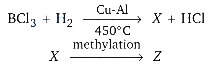
What is $Z$ in the following reactions?
A
$CH_3BH_2$
B
$(CH_3)_4B_2H_2$
C
$(CH_3)_3B_2H_3$
D
$(CH_3)_6B_2$
Solution
(B) The reaction of $BCl_3$ with $H_2$ in the presence of a $Cu-Al$ catalyst at $450^{\circ}C$ produces diborane $(B_2H_6)$ as product $X$:
$2BCl_3 + 6H_2 \xrightarrow{Cu-Al, 450^{\circ}C} B_2H_6 + 6HCl$
Diborane $(B_2H_6)$ undergoes methylation with $CH_3Cl$ to form tetramethyldiborane,which is $Z$:
$B_2H_6 + 4CH_3Cl \rightarrow (CH_3)_4B_2H_2 + 4HCl$
Thus,$Z$ is $(CH_3)_4B_2H_2$.
$2BCl_3 + 6H_2 \xrightarrow{Cu-Al, 450^{\circ}C} B_2H_6 + 6HCl$
Diborane $(B_2H_6)$ undergoes methylation with $CH_3Cl$ to form tetramethyldiborane,which is $Z$:
$B_2H_6 + 4CH_3Cl \rightarrow (CH_3)_4B_2H_2 + 4HCl$
Thus,$Z$ is $(CH_3)_4B_2H_2$.
0 likes
View Solution495
MediumMCQ
Which one of the following statements is not correct?
A
Moissan boron is amorphous
B
The reaction between boron and concentrated $HNO_3$ gives $N_2 O$
C
Amorphous boron on heating with oxygen forms $B_2 O_3$
D
Boron is a non-conductor of electricity
Solution
(B) Boron reacts with concentrated $HNO_3$ to form orthoboric acid $(H_3BO_3)$ and nitrogen dioxide $(NO_2)$.
The balanced chemical equation is:
$B + 3HNO_3 \longrightarrow H_3BO_3 + 3NO_2$
Therefore,the statement that boron reacts with concentrated $HNO_3$ to give $N_2O$ is incorrect.
The balanced chemical equation is:
$B + 3HNO_3 \longrightarrow H_3BO_3 + 3NO_2$
Therefore,the statement that boron reacts with concentrated $HNO_3$ to give $N_2O$ is incorrect.
0 likes
View Solutionp-Block Elements (Class 11) — Boron family · Frequently Asked Questions
1Are these p-Block Elements (Class 11) questions useful for JEE and NEET?
Yes. All questions in this section are mapped to JEE Main and NEET exam patterns. Previous year questions from JEE Main, NEET, GUJCET and state-level exams are included with full solutions.
2Can I switch to Hindi or Gujarati for these questions?
Yes. Use the language tabs in the hero section or the sidebar to view the same questions and solutions in English, Hindi or Gujarati.
3How do I generate a question paper from this subtopic?
Use the Vedclass Exam Paper Generator — select the chapter and subtopic, set difficulty, and generate Sets A, B, C, D automatically. First 3 chapters of every subject are free.
Vedclass Products
For Students
Vedclass Test Series
Mock tests in real JEE/NEET style with performance analysis. 5-day free trial.
Start Free TrialFor Teachers
Exam Paper Generator
Generate Set A/B/C/D papers from this chapter in 2 minutes. 3 chapters free.
Try FreeFor Institutes
Online Exam Module
Live online exams with unlimited students, 360° analytics & white-label branding.
See DemoFor Teachers & Institutes
Generate a p-Block Elements (Class 11) Exam Paper in 2 Minutes
Select subtopic & difficulty — Sets A, B, C, D auto-generated with No Repeat logic.
First 3 chapters of every subject are free — no payment required.