
A English
Boron family Questions in English
Class 11 Chemistry · p-Block Elements (Class 11) · Boron family
528+
Questions
English
Language
100%
With Solutions
Showing 50 of 528 questions in English
401
MediumMCQ
The compound$(s)$ which react$(s)$ with $NH_3$ to give boron nitride $(BN)$ is(are):
A
$A, B$
B
$B, C$
C
$A, C$
D
$A, D$
Solution
(B) $B_2H_6$ and $B_2O_3$ react with $NH_3$ to form boron nitride $(BN)$.
$1.$ $B_2H_6$ reacts with $NH_3$ at high temperatures to form borazine $(B_3N_3H_6)$,which upon further heating yields boron nitride $(BN)$:
$3B_2H_6 + 6NH_3 \rightarrow 2B_3N_3H_6 + 12H_2$
$B_3N_3H_6 \xrightarrow{\Delta} (BN)_n$
$2.$ $B_2O_3$ reacts with $NH_3$ at high temperatures $(1200^{\circ}C)$ to produce boron nitride:
$B_2O_3 + 2NH_3 \xrightarrow{1200^{\circ}C} 2BN + 3H_2O$
$B$ is an element,not a compound. $HBF_4$ reacts with $NH_3$ to form ammonium tetrafluoroborate $(NH_4BF_4)$.
$1.$ $B_2H_6$ reacts with $NH_3$ at high temperatures to form borazine $(B_3N_3H_6)$,which upon further heating yields boron nitride $(BN)$:
$3B_2H_6 + 6NH_3 \rightarrow 2B_3N_3H_6 + 12H_2$
$B_3N_3H_6 \xrightarrow{\Delta} (BN)_n$
$2.$ $B_2O_3$ reacts with $NH_3$ at high temperatures $(1200^{\circ}C)$ to produce boron nitride:
$B_2O_3 + 2NH_3 \xrightarrow{1200^{\circ}C} 2BN + 3H_2O$
$B$ is an element,not a compound. $HBF_4$ reacts with $NH_3$ to form ammonium tetrafluoroborate $(NH_4BF_4)$.
0 likes
View Solution402
MediumMCQ
The correct orders among the following are
$A$. Atomic radius $: B < Al < Ga < In < Tl$
$B$. Electronegativity $: Al < Ga < In < Tl < B$
$C$. Density $: Tl < In < Ga < Al < B$
$D$. $1^{st}$ Ionisation Energy $: In < Al < Ga < Tl < B$
Choose the correct answer from the options given below $:$
$A$. Atomic radius $: B < Al < Ga < In < Tl$
$B$. Electronegativity $: Al < Ga < In < Tl < B$
$C$. Density $: Tl < In < Ga < Al < B$
$D$. $1^{st}$ Ionisation Energy $: In < Al < Ga < Tl < B$
Choose the correct answer from the options given below $:$
A
$B$ and $D$ Only
B
$A$ and $C$ Only
C
$C$ and $D$ Only
D
$A$ and $B$ Only
Solution
(A)
$A$. Atomic radius order: $B < Ga < Al < In < Tl$. Thus,statement $A$ is incorrect.
$B$. Electronegativity order: $Al < Ga < In < Tl < B$. Thus,statement $B$ is correct.
$C$. Density order: $B < Al < Ga < In < Tl$. Thus,statement $C$ is incorrect.
$D$. $1^{st}$ Ionisation Energy order: $In < Al < Ga < Tl < B$. Thus,statement $D$ is correct.
Therefore,the correct statements are $B$ and $D$.
| Property | $B$ | $Al$ | $Ga$ | $In$ | $Tl$ |
| Atomic radius $(pm)$ | $88$ | $143$ | $135$ | $167$ | $170$ |
| Electronegativity | $2.0$ | $1.5$ | $1.6$ | $1.7$ | $1.8$ |
| Density $(g/cm^3)$ | $2.35$ | $2.7$ | $5.9$ | $7.31$ | $11.85$ |
| $IE_1$ $(kJ/mol)$ | $801$ | $577$ | $579$ | $558$ | $589$ |
$A$. Atomic radius order: $B < Ga < Al < In < Tl$. Thus,statement $A$ is incorrect.
$B$. Electronegativity order: $Al < Ga < In < Tl < B$. Thus,statement $B$ is correct.
$C$. Density order: $B < Al < Ga < In < Tl$. Thus,statement $C$ is incorrect.
$D$. $1^{st}$ Ionisation Energy order: $In < Al < Ga < Tl < B$. Thus,statement $D$ is correct.
Therefore,the correct statements are $B$ and $D$.
0 likes
View Solution403
DifficultMCQ
The correct statements from the following are $:$
$(A)$ $Tl^{3+}$ is a powerful oxidising agent
$(B)$ $Al^{3+}$ does not get reduced easily
$(C)$ Both $Al^{3+}$ and $Tl^{3+}$ are very stable in solution
$(D)$ $Tl^{+}$ is more stable than $Tl^{3+}$
$(E)$ $Al^{3+}$ and $Tl^{+}$ are highly stable
Choose the correct answer from the options given below $:$
$(A)$ $Tl^{3+}$ is a powerful oxidising agent
$(B)$ $Al^{3+}$ does not get reduced easily
$(C)$ Both $Al^{3+}$ and $Tl^{3+}$ are very stable in solution
$(D)$ $Tl^{+}$ is more stable than $Tl^{3+}$
$(E)$ $Al^{3+}$ and $Tl^{+}$ are highly stable
Choose the correct answer from the options given below $:$
A
$(A), (B), (C), (D) \text{ and } (E)$
B
$(A), (B), (D) \text{ and } (E) \text{ only}$
C
$(B), (D) \text{ and } (E) \text{ only}$
D
$(A), (C) \text{ and } (D) \text{ only}$
Solution
(B) $(i)$ Statement $(A)$ is true: Due to the inert pair effect,$Tl^{+}$ is more stable than $Tl^{3+}$. Therefore,$Tl^{3+}$ acts as a powerful oxidising agent to gain electrons and form the more stable $Tl^{+}$ state.
$(ii)$ Statement $(B)$ is true: The standard reduction potential $E^0_{Al^{3+}/Al} = -1.66 \ V$ is very low,meaning $Al^{3+}$ is not easily reduced.
$(iii)$ Statement $(C)$ is false: $Tl^{3+}$ is unstable in solution due to the inert pair effect.
$(iv)$ Statement $(D)$ is true: $Tl^{+}$ is more stable than $Tl^{3+}$ due to the inert pair effect.
$(v)$ Statement $(E)$ is true: $Al^{3+}$ is the most stable oxidation state for Aluminum,and $Tl^{+}$ is the most stable oxidation state for Thallium.
Thus,statements $(A), (B), (D), \text{ and } (E)$ are correct.
$(ii)$ Statement $(B)$ is true: The standard reduction potential $E^0_{Al^{3+}/Al} = -1.66 \ V$ is very low,meaning $Al^{3+}$ is not easily reduced.
$(iii)$ Statement $(C)$ is false: $Tl^{3+}$ is unstable in solution due to the inert pair effect.
$(iv)$ Statement $(D)$ is true: $Tl^{+}$ is more stable than $Tl^{3+}$ due to the inert pair effect.
$(v)$ Statement $(E)$ is true: $Al^{3+}$ is the most stable oxidation state for Aluminum,and $Tl^{+}$ is the most stable oxidation state for Thallium.
Thus,statements $(A), (B), (D), \text{ and } (E)$ are correct.
0 likes
View Solution404
MediumMCQ
Which of the following is the most basic oxide?
A
$B_2O_3$
B
$Al_2O_3$
C
$Ga_2O_3$
D
$In_2O_3$
Solution
(D) In the $p$-block elements of group $13$,the metallic character increases as we move down the group from $B$ to $Tl$.
As metallic character increases,the basic nature of the oxides increases.
$B_2O_3$ is acidic,$Al_2O_3$ and $Ga_2O_3$ are amphoteric,while $In_2O_3$ and $Tl_2O_3$ are basic.
Therefore,among the given options,$In_2O_3$ is the most basic oxide.
As metallic character increases,the basic nature of the oxides increases.
$B_2O_3$ is acidic,$Al_2O_3$ and $Ga_2O_3$ are amphoteric,while $In_2O_3$ and $Tl_2O_3$ are basic.
Therefore,among the given options,$In_2O_3$ is the most basic oxide.
0 likes
View Solution405
MediumMCQ
$BCl_3$ and $AlCl_3$ exist in $:-$
A
monomer and dimer respectively
B
dimer and monomer respectively
C
monomer and monomer respectively
D
dimer and dimer respectively
Solution
(A) $BCl_3$ is a monomer because the boron atom is small and cannot accommodate four chlorine atoms around it due to steric hindrance,and it is electron-deficient with an incomplete octet.
$AlCl_3$ exists as a dimer $(Al_2Cl_6)$ in the vapor state or in non-polar solvents to complete the octet of the aluminum atom through coordinate bonding,where chlorine atoms act as bridges.
$AlCl_3$ exists as a dimer $(Al_2Cl_6)$ in the vapor state or in non-polar solvents to complete the octet of the aluminum atom through coordinate bonding,where chlorine atoms act as bridges.
0 likes
View Solution406
MediumMCQ
Which one of the following metallic oxides exhibits amphoteric nature?
A
$CaO$
B
$Na_{2}O$
C
$BaO$
D
$Al_{2}O_{3}$
Solution
(D) $Al_{2}O_{3}$ is an amphoteric metallic oxide because it reacts with both acids and bases.
$Al_{2}O_{3} + 6HCl \rightarrow 2AlCl_{3} + 3H_{2}O$
$Al_{2}O_{3} + 2NaOH \rightarrow 2NaAlO_{2} + H_{2}O$
$Al_{2}O_{3} + 6HCl \rightarrow 2AlCl_{3} + 3H_{2}O$
$Al_{2}O_{3} + 2NaOH \rightarrow 2NaAlO_{2} + H_{2}O$
0 likes
View Solution407
MediumMCQ
Addition of mineral acid to an aqueous solution of Borax,the following compound is formed:
A
Boron hydride
B
Orthoboric acid
C
Meta boric acid
D
Pyroboric acid
Solution
(B) When a mineral acid (like $HCl$) is added to an aqueous solution of Borax $(Na_{2}B_{4}O_{7} \cdot 10H_{2}O)$,it reacts to form orthoboric acid $(H_{3}BO_{3})$.
The chemical reaction is:
$Na_{2}B_{4}O_{7} + 2HCl + 5H_{2}O \rightarrow 4H_{3}BO_{3} + 2NaCl$
The chemical reaction is:
$Na_{2}B_{4}O_{7} + 2HCl + 5H_{2}O \rightarrow 4H_{3}BO_{3} + 2NaCl$
0 likes
View Solution408
EasyMCQ
In the reaction $B(OH)_{3} + 2 H_{2}O \rightarrow [B(OH)_{4}]^{-} + H_{3}O^{+}$,$B(OH)_{3}$ functions as:
A
Bronsted acid
B
Lewis acid
C
Protonic acid
D
Lewis base
Solution
(B) . Boric acid $(B(OH)_{3})$ is a weak monobasic acid. It does not dissociate to give $H^{+}$ ions directly; instead,it acts as a Lewis acid by accepting a lone pair of electrons from the oxygen atom of a water molecule to form the $[B(OH)_{4}]^{-}$ complex.
0 likes
View Solution409
DifficultMCQ
$A$ Lewis acid '$X$' reacts with $LiAlH_{4}$ in ether medium to give a highly toxic gas. This gas when heated with $NH_{3}$ gives a compound commonly known as inorganic benzene. The gas is
A
$B_{2}O_{3}$
B
$B_{2}H_{6}$
C
$B_{3}N_{3}H_{6}$
D
$BF_{3}$
Solution
(B) The reaction of a Lewis acid like $BCl_{3}$ with $LiAlH_{4}$ in an ether medium produces diborane $(B_{2}H_{6})$,which is a highly toxic gas.
$4BCl_{3} + 3LiAlH_{4} \rightarrow 2B_{2}H_{6} + 3AlCl_{3} + 3LiCl$
When diborane $(B_{2}H_{6})$ is heated with ammonia $(NH_{3})$,it forms borazine $(B_{3}N_{3}H_{6})$,which is commonly known as inorganic benzene.
$3B_{2}H_{6} + 6NH_{3} \rightarrow 2B_{3}N_{3}H_{6} + 12H_{2}$
Thus,the toxic gas is $B_{2}H_{6}$.
$4BCl_{3} + 3LiAlH_{4} \rightarrow 2B_{2}H_{6} + 3AlCl_{3} + 3LiCl$
When diborane $(B_{2}H_{6})$ is heated with ammonia $(NH_{3})$,it forms borazine $(B_{3}N_{3}H_{6})$,which is commonly known as inorganic benzene.
$3B_{2}H_{6} + 6NH_{3} \rightarrow 2B_{3}N_{3}H_{6} + 12H_{2}$
Thus,the toxic gas is $B_{2}H_{6}$.
0 likes
View Solution410
EasyMCQ
Aluminium $(III)$ chloride forms a dimer because aluminium
A
belongs to boron family.
B
has a very high ionisation enthalpy.
C
can have higher coordination number.
D
is next to magnesium.
Solution
(C) $AlCl_3$ forms a dimer and exists as $Al_2Cl_6$ because it is an electron-deficient compound with an incomplete octet.
To complete its octet,the aluminium atom accepts a lone pair of electrons from the chlorine atom of another $AlCl_3$ molecule,forming a coordinate bond.
This process allows the aluminium atom to increase its coordination number from $3$ to $4$.
To complete its octet,the aluminium atom accepts a lone pair of electrons from the chlorine atom of another $AlCl_3$ molecule,forming a coordinate bond.
This process allows the aluminium atom to increase its coordination number from $3$ to $4$.
0 likes
View Solution411
EasyMCQ
Relative stability orders of $+1$ and $+3$ oxidation states of $Ga, In, Tl$ are respectively:
A
$Tl^{+} > In^{+} > Ga^{+}, Ga^{3+} > In^{3+} > Tl^{3+}$
B
$Ga^{+} > In^{+} > Tl^{+}, Tl^{3+} > In^{3+} > Ga^{3+}$
C
$Ga^{+} > In^{+} > Tl^{+}, Ga^{3+} > In^{3+} > Tl^{3+}$
D
$Tl^{+} > In^{+} > Ga^{+}, Tl^{3+} > In^{3+} > Ga^{3+}$
Solution
(A) Due to the inert pair effect,the stability of the $+1$ oxidation state increases down the group $13$ elements because the $ns^2$ electrons become more reluctant to participate in bonding.
Thus,the stability order for the $+1$ state is $Tl^{+} > In^{+} > Ga^{+}$.
Conversely,the stability of the $+3$ oxidation state decreases down the group.
Thus,the stability order for the $+3$ state is $Ga^{3+} > In^{3+} > Tl^{3+}$.
Therefore,the correct order is $Tl^{+} > In^{+} > Ga^{+}$ and $Ga^{3+} > In^{3+} > Tl^{3+}$.
Thus,the stability order for the $+1$ state is $Tl^{+} > In^{+} > Ga^{+}$.
Conversely,the stability of the $+3$ oxidation state decreases down the group.
Thus,the stability order for the $+3$ state is $Ga^{3+} > In^{3+} > Tl^{3+}$.
Therefore,the correct order is $Tl^{+} > In^{+} > Ga^{+}$ and $Ga^{3+} > In^{3+} > Tl^{3+}$.
0 likes
View Solution412
EasyMCQ
Which of the following represents the structure of inorganic benzene?
A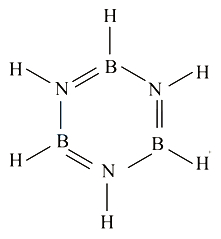
B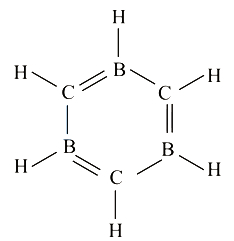
C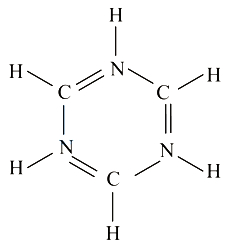
D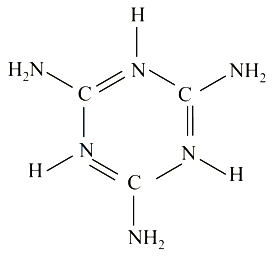
Solution
(A) Inorganic benzene,also known as borazine $(B_3N_3H_6)$,is isoelectronic with benzene $(C_6H_6)$.
It consists of a hexagonal ring with alternating boron and nitrogen atoms,where each boron and nitrogen atom is bonded to one hydrogen atom.
The structure is stabilized by resonance,similar to benzene,and is often represented with partial charges on the atoms $(B^{\delta-}-N^{\delta+})$ due to the difference in electronegativity between boron and nitrogen.
Option $A$ correctly depicts this alternating $B-N$ hexagonal structure.
It consists of a hexagonal ring with alternating boron and nitrogen atoms,where each boron and nitrogen atom is bonded to one hydrogen atom.
The structure is stabilized by resonance,similar to benzene,and is often represented with partial charges on the atoms $(B^{\delta-}-N^{\delta+})$ due to the difference in electronegativity between boron and nitrogen.
Option $A$ correctly depicts this alternating $B-N$ hexagonal structure.
0 likes
View Solution413
MediumMCQ
Which of the following orders is not correct against the given property?
A
$Ga < In < Tl < Al$ - melting point
B
$Al < Ga < In < Tl < B$ - Electronegativity
C
$B < Al < Ga < In < Tl$ - density
D
$B < Al > Ga < In < Tl$ - atomic radius
Solution
(A) The melting point order for Group $13$ elements is $Ga < In < Al < Tl < B$. Thus,option $A$ is incorrect.
The electronegativity order is $Tl < In < Ga < Al < B$. Thus,option $B$ is incorrect.
The density order is $B < Al < Ga < In < Tl$. Thus,option $C$ is correct.
The atomic radius order is $B < Al > Ga < In < Tl$. Thus,option $D$ is correct.
Note: In many competitive contexts,this question is considered to have multiple incorrect statements ($A$ and $B$). However,based on standard trends,$A$ is the most frequently cited incorrect order.
The electronegativity order is $Tl < In < Ga < Al < B$. Thus,option $B$ is incorrect.
The density order is $B < Al < Ga < In < Tl$. Thus,option $C$ is correct.
The atomic radius order is $B < Al > Ga < In < Tl$. Thus,option $D$ is correct.
Note: In many competitive contexts,this question is considered to have multiple incorrect statements ($A$ and $B$). However,based on standard trends,$A$ is the most frequently cited incorrect order.
0 likes
View Solution414
EasyMCQ
The possible oxidation states of group $13$ elements is/are
A
$+3$
B
$+1, +3$
C
$+1$
D
$+1, +2, +3$
Solution
(B) The general electronic configuration of group $13$ elements is $ns^2 np^1$.
Due to the presence of these valence electrons,the elements exhibit oxidation states of $+3$ and $+1$.
As we move down the group,the stability of the $+1$ oxidation state increases due to the inert pair effect,which is the reluctance of the $ns^2$ electrons to participate in bonding.
Therefore,the possible oxidation states are $+1$ and $+3$.
Due to the presence of these valence electrons,the elements exhibit oxidation states of $+3$ and $+1$.
As we move down the group,the stability of the $+1$ oxidation state increases due to the inert pair effect,which is the reluctance of the $ns^2$ electrons to participate in bonding.
Therefore,the possible oxidation states are $+1$ and $+3$.
0 likes
View Solution415
EasyMCQ
Identify the correct statements from the following:
$(i)$ The atomic radius of $Al$ is lower than the atomic radius of $Ga$.
$(ii)$ Boron exists in many allotropic forms.
$(iii)$ The melting point of $Ga$ is lowest among the group $13$ elements.
$(i)$ The atomic radius of $Al$ is lower than the atomic radius of $Ga$.
$(ii)$ Boron exists in many allotropic forms.
$(iii)$ The melting point of $Ga$ is lowest among the group $13$ elements.
A
$i, ii, iii$
B
$ii, iii$
C
$i, ii$
D
$i, iii$
Solution
(B) Statement $(i)$ is incorrect: The atomic radius of $Al$ $(143 \ pm)$ is actually larger than that of $Ga$ $(135 \ pm)$ due to the poor shielding effect of $d$-electrons in $Ga$.
Statement $(ii)$ is correct: Boron exists in several allotropic forms such as $\alpha$-rhombohedral, $\beta$-rhombohedral, and $\beta$-tetragonal.
Statement $(iii)$ is correct: The melting point of $Ga$ $(303 \ K)$ is the lowest among group $13$ elements due to its unique crystal structure.
Therefore, statements $(ii)$ and $(iii)$ are correct.
Statement $(ii)$ is correct: Boron exists in several allotropic forms such as $\alpha$-rhombohedral, $\beta$-rhombohedral, and $\beta$-tetragonal.
Statement $(iii)$ is correct: The melting point of $Ga$ $(303 \ K)$ is the lowest among group $13$ elements due to its unique crystal structure.
Therefore, statements $(ii)$ and $(iii)$ are correct.
0 likes
View Solution416
EasyMCQ
Which element belongs to the family of elements that also includes the element gallium?
A
Carbon
B
Aluminium
C
Iron
D
Arsenic
Solution
(B) In the periodic table of elements,gallium $(Ga)$ belongs to the boron family (group $13$).
This group includes the elements boron $(B)$,aluminium $(Al)$,gallium $(Ga)$,indium $(In)$,and thallium $(Tl)$.
Therefore,aluminium $(Al)$ belongs to the same family as gallium $(Ga)$.
The electronic configuration of these elements shows they have $ns^2 np^1$ valence shell configuration.
$Ga (Z=31) = [Ar] 3d^{10} 4s^2 4p^1$
$Al (Z=13) = [Ne] 3s^2 3p^1$
This group includes the elements boron $(B)$,aluminium $(Al)$,gallium $(Ga)$,indium $(In)$,and thallium $(Tl)$.
Therefore,aluminium $(Al)$ belongs to the same family as gallium $(Ga)$.
The electronic configuration of these elements shows they have $ns^2 np^1$ valence shell configuration.
$Ga (Z=31) = [Ar] 3d^{10} 4s^2 4p^1$
$Al (Z=13) = [Ne] 3s^2 3p^1$
0 likes
View Solution417
EasyMCQ
In the following unbalanced reaction,the product formed is $Al_2O_3 + NaOH_{(aq)} + H_2O \longrightarrow$
A
$Na_3[Al(OH)_6]$
B
$Na_3[Al(OH)_4]$
C
$Na_2[Al(OH)_5]$
D
$Na[Al(OH)_6]$
Solution
(A) Aluminium oxide $(Al_2O_3)$ is amphoteric in nature and reacts with an aqueous solution of sodium hydroxide $(NaOH)$ to form a soluble complex,sodium hexahydroxyaluminate$(III)$.
The balanced chemical equation is:
$Al_2O_3 + 2NaOH + 3H_2O \longrightarrow 2Na[Al(OH)_4]$ or more commonly represented as $Al_2O_3 + 6NaOH + 3H_2O \longrightarrow 2Na_3[Al(OH)_6]$ depending on the concentration. In the context of the Bayer process,the product is $Na[Al(OH)_4]$. However,given the options provided,$Na_3[Al(OH)_6]$ is the standard complex representing the hexahydroxyaluminate ion.
The balanced chemical equation is:
$Al_2O_3 + 2NaOH + 3H_2O \longrightarrow 2Na[Al(OH)_4]$ or more commonly represented as $Al_2O_3 + 6NaOH + 3H_2O \longrightarrow 2Na_3[Al(OH)_6]$ depending on the concentration. In the context of the Bayer process,the product is $Na[Al(OH)_4]$. However,given the options provided,$Na_3[Al(OH)_6]$ is the standard complex representing the hexahydroxyaluminate ion.
0 likes
View Solution418
MediumMCQ
In the structure of diborane $(B_2H_6)$,the number of $2$-centre-$2$-electron $(2c-2e)$ bonds is $X$ and the number of $3$-centre-$2$-electron $(3c-2e)$ bonds is $Y$. The value of $(X+Y)$ is:
A
$5$
B
$6$
C
$4$
D
$8$
Solution
(B) The structure of diborane $(B_2H_6)$ consists of two boron atoms and six hydrogen atoms.
There are $4$ terminal hydrogen atoms,each bonded to a boron atom by a $2$-centre-$2$-electron $(2c-2e)$ bond. Thus,$X = 4$.
There are $2$ bridging hydrogen atoms,each involved in a $3$-centre-$2$-electron $(3c-2e)$ bond with the two boron atoms. Thus,$Y = 2$.
The value of $(X+Y) = 4 + 2 = 6$.
There are $4$ terminal hydrogen atoms,each bonded to a boron atom by a $2$-centre-$2$-electron $(2c-2e)$ bond. Thus,$X = 4$.
There are $2$ bridging hydrogen atoms,each involved in a $3$-centre-$2$-electron $(3c-2e)$ bond with the two boron atoms. Thus,$Y = 2$.
The value of $(X+Y) = 4 + 2 = 6$.
0 likes
View Solution419
MediumMCQ
The incorrect statement from the following is:
A
Aluminium dissolves in conc. $HNO_3$ and liberates $H_2$ gas
B
Borazole contains $12$ $\sigma$ and $3$ $\pi$ bonds
C
Gallium oxide is amphoteric in nature
D
$BF_3$ is a Lewis acid
Solution
(A) . Aluminium becomes passive in concentrated $HNO_3$ due to the formation of a protective oxide layer on its surface,so it does not liberate $H_2$ gas. This statement is incorrect.
$B$. Borazole $(B_3N_3H_6)$ has a structure similar to benzene. It contains $12$ $\sigma$ bonds ($6$ $B-H$ and $N-H$ bonds,and $6$ $B-N$ bonds) and $3$ $\pi$ bonds. This statement is correct.
$C$. Gallium oxide $(Ga_2O_3)$ is amphoteric in nature as it reacts with both acids and bases. This statement is correct.
$D$. $BF_3$ has an incomplete octet on the Boron atom,making it an electron-deficient species and thus a Lewis acid. This statement is correct.
$B$. Borazole $(B_3N_3H_6)$ has a structure similar to benzene. It contains $12$ $\sigma$ bonds ($6$ $B-H$ and $N-H$ bonds,and $6$ $B-N$ bonds) and $3$ $\pi$ bonds. This statement is correct.
$C$. Gallium oxide $(Ga_2O_3)$ is amphoteric in nature as it reacts with both acids and bases. This statement is correct.
$D$. $BF_3$ has an incomplete octet on the Boron atom,making it an electron-deficient species and thus a Lewis acid. This statement is correct.
0 likes
View Solution420
EasyMCQ
Identify the reaction in which diborane is produced on an industrial scale.
A
Reaction of $BF_3$ with $LiAlH_4$ in diethyl ether
B
Oxidation of $NaBH_4$ with $I_2$
C
Reaction of $BF_3$ with $NaH$ at $450 \ K$
D
By heating $H_3BO_3$ to above $370 \ K$ temperature
Solution
(C) On an industrial scale,diborane $(B_2H_6)$ is prepared by the reaction of boron trifluoride $(BF_3)$ with sodium hydride $(NaH)$ at $450 \ K$.
The chemical equation for this reaction is:
$2BF_3 + 6NaH \xrightarrow{450 \ K} B_2H_6 + 6NaF$
Therefore,the correct option is $C$.
The chemical equation for this reaction is:
$2BF_3 + 6NaH \xrightarrow{450 \ K} B_2H_6 + 6NaF$
Therefore,the correct option is $C$.
0 likes
View Solution421
MediumMCQ
Identify the incorrect statement about the group $13$ elements.
A
Nature of aqueous solution of borax is alkaline.
B
Orthoboric acid is a weak tribasic acid.
C
Metaboric acid on heating gives an acidic oxide.
D
$LiBH_4$ acts as a reducing agent.
Solution
(B) $1$. Borax $(Na_2B_4O_7 \cdot 10H_2O)$ in water hydrolyzes to give $NaOH$ and $H_3BO_3$. Since $NaOH$ is a strong base and $H_3BO_3$ is a weak acid,the solution is alkaline. This statement is correct.
$2$. Orthoboric acid $(H_3BO_3)$ is a weak monobasic Lewis acid. It acts as an acid by accepting a hydroxyl ion $(OH^-)$ from water,not by donating protons. Therefore,calling it a tribasic acid is incorrect.
$3$. Metaboric acid $(HBO_2)$ on heating gives boron trioxide $(B_2O_3)$,which is an acidic oxide. This statement is correct.
$4$. $LiBH_4$ is a well-known reducing agent used in organic synthesis. This statement is correct.
Thus,the incorrect statement is $B$.
$2$. Orthoboric acid $(H_3BO_3)$ is a weak monobasic Lewis acid. It acts as an acid by accepting a hydroxyl ion $(OH^-)$ from water,not by donating protons. Therefore,calling it a tribasic acid is incorrect.
$3$. Metaboric acid $(HBO_2)$ on heating gives boron trioxide $(B_2O_3)$,which is an acidic oxide. This statement is correct.
$4$. $LiBH_4$ is a well-known reducing agent used in organic synthesis. This statement is correct.
Thus,the incorrect statement is $B$.
0 likes
View Solution422
MediumMCQ
Select the correct statements from the following:
$A$) Aluminium liberates $H_2$ gas with dil. $HCl$ but not with aqueous $NaOH$.
$B$) Formula of sodium metaborate is $Na_3BO_3$.
$C$) Boric acid is a weak monobasic acid.
$D$) For thallium,$+1$ state is more stable than $+3$ state.
$A$) Aluminium liberates $H_2$ gas with dil. $HCl$ but not with aqueous $NaOH$.
$B$) Formula of sodium metaborate is $Na_3BO_3$.
$C$) Boric acid is a weak monobasic acid.
$D$) For thallium,$+1$ state is more stable than $+3$ state.
A
$A$ & $B$
B
$B$ & $C$
C
$C$ & $D$
D
$A$ & $D$
Solution
(C) ) Incorrect: Aluminium is amphoteric and reacts with both $HCl$ and $NaOH$ to liberate $H_2$ gas.
$B$) Incorrect: The formula of sodium metaborate is $NaBO_2$. $Na_3BO_3$ is sodium orthoborate.
$C$) Correct: Boric acid $(H_3BO_3)$ acts as a weak monobasic Lewis acid by accepting $OH^-$ from water: $B(OH)_3 + 2H_2O \rightarrow [B(OH)_4]^- + H_3O^+$.
$D$) Correct: Due to the inert pair effect,the stability of the $+1$ oxidation state increases down the group $13$ $(Al < Ga < In < Tl)$,making $Tl^+$ more stable than $Tl^{3+}$.
$B$) Incorrect: The formula of sodium metaborate is $NaBO_2$. $Na_3BO_3$ is sodium orthoborate.
$C$) Correct: Boric acid $(H_3BO_3)$ acts as a weak monobasic Lewis acid by accepting $OH^-$ from water: $B(OH)_3 + 2H_2O \rightarrow [B(OH)_4]^- + H_3O^+$.
$D$) Correct: Due to the inert pair effect,the stability of the $+1$ oxidation state increases down the group $13$ $(Al < Ga < In < Tl)$,making $Tl^+$ more stable than $Tl^{3+}$.
0 likes
View Solution423
DifficultMCQ
Identify the correct statements:
$i$. Oxidation of $NaBH_4$ with $I_2$ gives $B_2H_6$
$ii$. $B_2H_6$ burns in oxygen and releases an enormous amount of energy
$iii$. $B_2H_6$ on hydrolysis gives a tribasic acid
$i$. Oxidation of $NaBH_4$ with $I_2$ gives $B_2H_6$
$ii$. $B_2H_6$ burns in oxygen and releases an enormous amount of energy
$iii$. $B_2H_6$ on hydrolysis gives a tribasic acid
A
$i, ii, iii$
B
$i, ii$ only
C
$i, iii$ only
D
$ii, iii$ only
Solution
(B) $(i)$ $2NaBH_4 + I_2 \rightarrow B_2H_6 + 2NaI + H_2$. This statement is correct.
$(ii)$ $B_2H_6 + 3O_2 \rightarrow B_2O_3 + 3H_2O + \text{Energy}$. This statement is correct as diborane is highly flammable.
$(iii)$ $B_2H_6 + 6H_2O \rightarrow 2B(OH)_3 + 6H_2$. $B(OH)_3$ (orthoboric acid) acts as a weak monobasic Lewis acid by accepting $OH^-$ from water: $B(OH)_3 + 2H_2O \rightleftharpoons [B(OH)_4]^- + H_3O^+$. Thus,statement $iii$ is incorrect.
$(ii)$ $B_2H_6 + 3O_2 \rightarrow B_2O_3 + 3H_2O + \text{Energy}$. This statement is correct as diborane is highly flammable.
$(iii)$ $B_2H_6 + 6H_2O \rightarrow 2B(OH)_3 + 6H_2$. $B(OH)_3$ (orthoboric acid) acts as a weak monobasic Lewis acid by accepting $OH^-$ from water: $B(OH)_3 + 2H_2O \rightleftharpoons [B(OH)_4]^- + H_3O^+$. Thus,statement $iii$ is incorrect.
0 likes
View Solution424
MediumMCQ
$A$ Lewis acid '$X$' reacts with $LiAlH_4$ in ether medium to give a highly toxic gas,'$Y$'. '$Y$' when heated with $NH_3$ gives a compound known as inorganic benzene. '$Y$' burns in oxygen and gives $H_2O$ and '$Z$'. '$Z$' is
A
Basic oxide
B
Acidic oxide
C
Amphoteric acid
D
Neutral oxide
Solution
(B) The reaction of the Lewis acid $BF_3$ $(X)$ with $LiAlH_4$ in ether produces diborane,$B_2H_6$ $(Y)$,which is a highly toxic gas.
$4BF_3 + 3LiAlH_4 \rightarrow 2B_2H_6 + 3LiF + 3AlF_3$
When $B_2H_6$ $(Y)$ is heated with $NH_3$,it forms borazine $(B_3N_3H_6)$,which is known as inorganic benzene.
$3B_2H_6 + 6NH_3 \rightarrow 2B_3N_3H_6 + 12H_2$
When $B_2H_6$ $(Y)$ burns in oxygen,it produces $B_2O_3$ $(Z)$ and $H_2O$.
$B_2H_6 + 3O_2 \rightarrow B_2O_3 + 3H_2O$
$B_2O_3$ is a non-metallic oxide,and non-metallic oxides are acidic in nature. Therefore,'$Z$' is an acidic oxide.
$4BF_3 + 3LiAlH_4 \rightarrow 2B_2H_6 + 3LiF + 3AlF_3$
When $B_2H_6$ $(Y)$ is heated with $NH_3$,it forms borazine $(B_3N_3H_6)$,which is known as inorganic benzene.
$3B_2H_6 + 6NH_3 \rightarrow 2B_3N_3H_6 + 12H_2$
When $B_2H_6$ $(Y)$ burns in oxygen,it produces $B_2O_3$ $(Z)$ and $H_2O$.
$B_2H_6 + 3O_2 \rightarrow B_2O_3 + 3H_2O$
$B_2O_3$ is a non-metallic oxide,and non-metallic oxides are acidic in nature. Therefore,'$Z$' is an acidic oxide.
0 likes
View Solution425
EasyMCQ
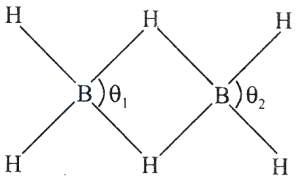
In the given structure of Diborane,$\theta_1$ and $\theta_2$ are respectively:
A
$101^{\circ}, 118^{\circ}$
B
$118^{\circ}, 101^{\circ}$
C
$97^{\circ}, 120^{\circ}$
D
$120^{\circ}, 97^{\circ}$
Solution
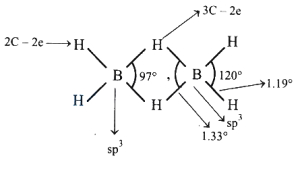
(C) In the structure of diborane $(B_2H_6)$,there are two types of hydrogen atoms: terminal and bridging.
$1$. The terminal $B-H$ bonds are $2$-center-$2$-electron $(2C-2e)$ bonds.
$2$. The bridging $B-H-B$ bonds are $3$-center-$2$-electron $(3C-2e)$ bonds.
$3$. The angle $\theta_1$ represents the $H-B-H$ bond angle between the two bridging hydrogen atoms,which is approximately $97^{\circ}$.
$4$. The angle $\theta_2$ represents the $H-B-H$ bond angle between the two terminal hydrogen atoms,which is approximately $120^{\circ}$.
Therefore,$\theta_1 = 97^{\circ}$ and $\theta_2 = 120^{\circ}$.
$1$. The terminal $B-H$ bonds are $2$-center-$2$-electron $(2C-2e)$ bonds.
$2$. The bridging $B-H-B$ bonds are $3$-center-$2$-electron $(3C-2e)$ bonds.
$3$. The angle $\theta_1$ represents the $H-B-H$ bond angle between the two bridging hydrogen atoms,which is approximately $97^{\circ}$.
$4$. The angle $\theta_2$ represents the $H-B-H$ bond angle between the two terminal hydrogen atoms,which is approximately $120^{\circ}$.
Therefore,$\theta_1 = 97^{\circ}$ and $\theta_2 = 120^{\circ}$.
0 likes
View Solution426
MediumMCQ
In which of the following reactions is hydrogen one of the products?
$i$. $2NaBH_4 + I_2 \longrightarrow$
$ii$. $2BF_3 + 6NaH \xrightarrow{450 \ K}$
$iii$. $4BF_3 + 3LiAlH_4 \longrightarrow$
$iv$. $3B_2H_6 + 6NH_3 \xrightarrow{\text{heat}} 2B_3N_3H_6 + 12H_2$
$i$. $2NaBH_4 + I_2 \longrightarrow$
$ii$. $2BF_3 + 6NaH \xrightarrow{450 \ K}$
$iii$. $4BF_3 + 3LiAlH_4 \longrightarrow$
$iv$. $3B_2H_6 + 6NH_3 \xrightarrow{\text{heat}} 2B_3N_3H_6 + 12H_2$
A
$ii, iii$
B
$i, ii$
C
$i, iv$
D
$iii, iv$
Solution
(C) $(i)$ $2NaBH_4 + I_2 \longrightarrow B_2H_6 + 2NaI + H_2$
$(ii)$ $2BF_3 + 6NaH \xrightarrow{450 \ K} B_2H_6 + 6NaF$
$(iii)$ $4BF_3 + 3LiAlH_4 \longrightarrow 2B_2H_6 + 3LiF + 3AlF_3$
$(iv)$ $3B_2H_6 + 6NH_3 \xrightarrow{\text{heat}} 2B_3N_3H_6 + 12H_2$
In reaction $(i)$,$H_2$ is produced as a byproduct.
In reaction $(iv)$,$H_2$ is produced as a byproduct.
Therefore,in reactions $(i)$ and $(iv)$,hydrogen is one of the products.
$(ii)$ $2BF_3 + 6NaH \xrightarrow{450 \ K} B_2H_6 + 6NaF$
$(iii)$ $4BF_3 + 3LiAlH_4 \longrightarrow 2B_2H_6 + 3LiF + 3AlF_3$
$(iv)$ $3B_2H_6 + 6NH_3 \xrightarrow{\text{heat}} 2B_3N_3H_6 + 12H_2$
In reaction $(i)$,$H_2$ is produced as a byproduct.
In reaction $(iv)$,$H_2$ is produced as a byproduct.
Therefore,in reactions $(i)$ and $(iv)$,hydrogen is one of the products.
0 likes
View Solution427
EasyMCQ
Identify the correct sets:
$i$. Boron fibres - bullet proof vest
$ii$. Metal borides - protective shields
$iii$. Borax - glass wool
Correct option is
$i$. Boron fibres - bullet proof vest
$ii$. Metal borides - protective shields
$iii$. Borax - glass wool
Correct option is
A
$i, ii$ only
B
$i, ii, iii$
C
$i, iii$ only
D
$ii, iii$ only
Solution
(B) Boron fibres are used for making bullet-proof vests.
Metal borides are used as protective shields because they have the capacity to absorb neutrons.
Borax is used in the manufacture of glass and glass wool to increase the mechanical strength and durability of the glass.
Therefore,all three statements are correct.
Metal borides are used as protective shields because they have the capacity to absorb neutrons.
Borax is used in the manufacture of glass and glass wool to increase the mechanical strength and durability of the glass.
Therefore,all three statements are correct.
0 likes
View Solution428
EasyMCQ
Match the following:
The correct answer is:
| List-$I$ (Group $13$ element) | List-$II$ (Metallic radius,$pm$) |
|---|---|
| $A$. $Al$ | $I$. $135$ |
| $B$. $Ga$ | $II$. $143$ |
| $C$. $In$ | $III$. $170$ |
| $D$. $Tl$ | $IV$. $167$ |
The correct answer is:
A
$A-I, B-II, C-IV, D-III$
B
$A-II, B-I, C-IV, D-III$
C
$A-III, B-IV, C-II, D-I$
D
$A-II, B-I, C-III, D-IV$
Solution
(B) The metallic radii of Group $13$ elements are as follows:
$Al = 143 \ pm$
$Ga = 135 \ pm$
$In = 167 \ pm$
$Tl = 170 \ pm$
The metallic radius generally increases down the group, but $Ga$ has a smaller radius than $Al$ due to the poor shielding effect of $d$-electrons, which increases the effective nuclear charge.
Therefore, the correct matching is $A-II, B-I, C-IV, D-III$.
$Al = 143 \ pm$
$Ga = 135 \ pm$
$In = 167 \ pm$
$Tl = 170 \ pm$
The metallic radius generally increases down the group, but $Ga$ has a smaller radius than $Al$ due to the poor shielding effect of $d$-electrons, which increases the effective nuclear charge.
Therefore, the correct matching is $A-II, B-I, C-IV, D-III$.
0 likes
View Solution429
EasyMCQ
Which of the following statements are not correct?
$i$. Atomic radius of $Ga$ is less than that of $Al$
$ii$. The order of ionization enthalpy of group $13$ elements is $B > Al > Ga > In > Tl$
$iii$. Boron trioxide is amphoteric in nature
$i$. Atomic radius of $Ga$ is less than that of $Al$
$ii$. The order of ionization enthalpy of group $13$ elements is $B > Al > Ga > In > Tl$
$iii$. Boron trioxide is amphoteric in nature
A
$ii, iii$ only
B
$i, iii$ only
C
$i, ii$ only
D
$i, ii, iii$
Solution
(A) The order of atomic radii of group $13$ elements is $B < Ga < Al < In < Tl$. This is due to the poor shielding effect of $3d$-electrons in $Ga$,which makes its atomic radius slightly smaller than that of $Al$. Thus,statement $(i)$ is correct.
The correct order of ionization enthalpy for group $13$ elements is $B > Tl > Ga > Al > In$. This anomaly is due to the poor shielding effect of $d$ and $f$ orbitals. Thus,statement $(ii)$ is incorrect.
Boron trioxide $(B_2O_3)$ is acidic in nature because it is a non-metal oxide and reacts with water to form boric acid $(H_3BO_3)$. Thus,statement $(iii)$ is incorrect.
Therefore,statements $(ii)$ and $(iii)$ are not correct.
The correct order of ionization enthalpy for group $13$ elements is $B > Tl > Ga > Al > In$. This anomaly is due to the poor shielding effect of $d$ and $f$ orbitals. Thus,statement $(ii)$ is incorrect.
Boron trioxide $(B_2O_3)$ is acidic in nature because it is a non-metal oxide and reacts with water to form boric acid $(H_3BO_3)$. Thus,statement $(iii)$ is incorrect.
Therefore,statements $(ii)$ and $(iii)$ are not correct.
0 likes
View Solution430
EasyMCQ
The number of water molecules present in borax,kernite and bauxite respectively are
A
$10, 4, 2$
B
$5, 1, 2$
C
$4, 2, 3$
D
$10, 4, 10$
Solution
(A) The chemical formulas for the given compounds are as follows:
Borax: $Na_2B_4O_7 \cdot 10H_2O$ (contains $10$ water molecules).
Kernite: $Na_2B_4O_7 \cdot 4H_2O$ (contains $4$ water molecules).
Bauxite: $Al_2O_3 \cdot 2H_2O$ (contains $2$ water molecules).
Therefore,the number of water molecules are $10, 4, 2$ respectively.
Borax: $Na_2B_4O_7 \cdot 10H_2O$ (contains $10$ water molecules).
Kernite: $Na_2B_4O_7 \cdot 4H_2O$ (contains $4$ water molecules).
Bauxite: $Al_2O_3 \cdot 2H_2O$ (contains $2$ water molecules).
Therefore,the number of water molecules are $10, 4, 2$ respectively.
0 likes
View Solution431
EasyMCQ
Statement $I$: Boron does not exhibit allotropy.
Statement $II$: Boron is an extremely hard and black-coloured solid.
Statement $II$: Boron is an extremely hard and black-coloured solid.
A
Both $I$ & $II$ are correct
B
Both $I$ & $II$ are not correct
C
$I$ is correct but $II$ is not correct
D
$I$ is not correct but $II$ is correct
Solution
(D) Boron exhibits allotropy and exists in several crystalline forms such as $\alpha-$rhombohedral,$\beta-$rhombohedral,and $\beta-$tetragonal,as well as an amorphous form. Therefore,Statement $I$ is incorrect.
Boron is an extremely hard,black-coloured solid with a very high melting point due to its strong covalent crystal lattice structure. Therefore,Statement $II$ is correct.
Boron is an extremely hard,black-coloured solid with a very high melting point due to its strong covalent crystal lattice structure. Therefore,Statement $II$ is correct.
0 likes
View Solution432
EasyMCQ
Which one of the following statements is correct?
A
Thallium is more electropositive than aluminium
B
Boron has high electrical conductivity
C
An aqueous solution of orthoboric acid is generally used as a mild antiseptic
D
Boron-$11$ $(^{11}B)$ isotope has high ability to absorb neutrons
Solution
(C) The electronegativity of $Thallium$ $(Tl)$ is $1.62$ and $Aluminium$ $(Al)$ is $1.61$ on the $Pauling$ scale,making $Al$ slightly more electropositive than $Tl$.
Boron is a poor conductor of electricity at low temperatures.
$^{10}B$ isotope has a high ability to absorb neutrons,not $^{11}B$.
An aqueous solution of orthoboric acid $(H_3BO_3)$ is a weak acid and is commonly used as a mild antiseptic for eyes and skin.
Boron is a poor conductor of electricity at low temperatures.
$^{10}B$ isotope has a high ability to absorb neutrons,not $^{11}B$.
An aqueous solution of orthoboric acid $(H_3BO_3)$ is a weak acid and is commonly used as a mild antiseptic for eyes and skin.
0 likes
View Solution433
EasyMCQ
Identify the correct statements about Boron.
$I.$ It has a high melting point.
$II.$ It has a high density.
$III.$ It has high electrical conductivity.
$IV.$ The $^{10}B$ isotope of it has a high ability to absorb neutrons.
$I.$ It has a high melting point.
$II.$ It has a high density.
$III.$ It has high electrical conductivity.
$IV.$ The $^{10}B$ isotope of it has a high ability to absorb neutrons.
A
$I, II$ only
B
$II, III$ only
C
$III, IV$ only
D
$I, IV$ only
Solution
(D) Boron exists as a very hard,black,non-metallic solid with a very strong crystalline lattice,which gives it an unusually high melting point.
Boron is a non-metal and is a poor conductor of electricity,whereas other members of the group are metals and conduct electricity.
The density of boron is relatively low compared to other elements in the group.
The $^{10}B$ isotope has a high ability to absorb neutrons,making it useful in nuclear reactors as control rods and protective shields.
Boron is a non-metal and is a poor conductor of electricity,whereas other members of the group are metals and conduct electricity.
The density of boron is relatively low compared to other elements in the group.
The $^{10}B$ isotope has a high ability to absorb neutrons,making it useful in nuclear reactors as control rods and protective shields.
0 likes
View Solution434
EasyMCQ
Identify the correct statements about the anomalous behaviour of Boron:
$I$. Boron trihalides can form dimeric structures.
$II$. Boron shows $+1$ as a stable oxidation state.
$III$. Maximum covalency of Boron is four.
$IV$. Boron does not form $BF_{6}^{3-}$ ion.
$I$. Boron trihalides can form dimeric structures.
$II$. Boron shows $+1$ as a stable oxidation state.
$III$. Maximum covalency of Boron is four.
$IV$. Boron does not form $BF_{6}^{3-}$ ion.
A
$I, II$ only
B
$II, III$ only
C
$III, IV$ only
D
$I, IV$ only
Solution
(C) Due to its smaller size and unavailability of $d$-orbitals,boron exhibits properties that contrast with other elements of the boron family.
$I$. Boron trihalides do not form dimeric structures; they complete their octet through back bonding. Other members of this group can form dimeric structures.
$II$. Boron does not show $+1$ as a stable oxidation state. As we move down the group,the stability of the $+1$ oxidation state increases due to the inert pair effect. The $+1$ oxidation state of Boron is highly unstable.
$III$. The maximum covalency of Boron is four,as it lacks $d$-orbitals and cannot accommodate more than eight electrons in its valence shell.
$IV$. Boron does not form $BF_{6}^{3-}$ ion because it cannot expand its octet beyond eight electrons.
$I$. Boron trihalides do not form dimeric structures; they complete their octet through back bonding. Other members of this group can form dimeric structures.
$II$. Boron does not show $+1$ as a stable oxidation state. As we move down the group,the stability of the $+1$ oxidation state increases due to the inert pair effect. The $+1$ oxidation state of Boron is highly unstable.
$III$. The maximum covalency of Boron is four,as it lacks $d$-orbitals and cannot accommodate more than eight electrons in its valence shell.
$IV$. Boron does not form $BF_{6}^{3-}$ ion because it cannot expand its octet beyond eight electrons.
0 likes
View Solution435
MediumMCQ
Identify the $P$ and $Q$ of the following reaction: $P + Q \longrightarrow [B(OH)_4]^{-} + H_3O^{+}$
A
$P = H_3BO_3 ; Q = 3H_2O$
B
$P = H_3BO_3 ; Q = 2H_2O$
C
$P = HBO_2 ; Q = 2H_2O$
D
$P = 2H_3BO_3 ; Q = H_2O$
Solution
(B) The given reaction is the hydrolysis of boric acid in water:
$H_3BO_3 + 2H_2O \longrightarrow [B(OH)_4]^{-} + H_3O^{+}$
Comparing this with the given equation $P + Q \longrightarrow [B(OH)_4]^{-} + H_3O^{+}$,we get:
$P = H_3BO_3$
$Q = 2H_2O$
In this reaction,$H_3BO_3$ acts as a Lewis acid by accepting an $OH^{-}$ ion from water.
$H_3BO_3 + 2H_2O \longrightarrow [B(OH)_4]^{-} + H_3O^{+}$
Comparing this with the given equation $P + Q \longrightarrow [B(OH)_4]^{-} + H_3O^{+}$,we get:
$P = H_3BO_3$
$Q = 2H_2O$
In this reaction,$H_3BO_3$ acts as a Lewis acid by accepting an $OH^{-}$ ion from water.
0 likes
View Solution436
EasyMCQ
Borax dissolves in water and forms a product of boron $(X)$. Identify the compound $X$.
A
$HBO_2$
B
$B_2O_3$
C
$NaBO_2$
D
$H_3BO_3$
Solution
(D) Borax $(Na_2B_4O_7 \cdot 10H_2O)$ dissolves in water to form an alkaline solution due to hydrolysis.
The reaction is: $Na_2B_4O_7 \cdot 10H_2O + 7H_2O \rightarrow 2NaOH + 4H_3BO_3$.
Here,$H_3BO_3$ is orthoboric acid,which is the product of boron $(X)$.
The reaction is: $Na_2B_4O_7 \cdot 10H_2O + 7H_2O \rightarrow 2NaOH + 4H_3BO_3$.
Here,$H_3BO_3$ is orthoboric acid,which is the product of boron $(X)$.
0 likes
View Solution437
DifficultMCQ
When borax is dissolved in water,it gives an alkaline solution. The alkaline solution consists of the following products:
A
$NaOH \text{ and } H_3BO_3$
B
$Na_2B_4O_7 \text{ and } H_3BO_3$
C
$NaHCO_3 \text{ and } H_3BO_3$
D
$Na_2CO_3 \text{ and } H_3BO_3$
Solution
(A) When borax $(Na_2B_4O_7 \cdot 10H_2O)$ is dissolved in water,it undergoes hydrolysis to form orthoboric acid and sodium hydroxide.
The reaction is as follows:
$Na_2B_4O_7 + 7H_2O \rightarrow 2NaOH + 4H_3BO_3$
Since $NaOH$ is a strong base,the resulting solution is alkaline in nature.
The reaction is as follows:
$Na_2B_4O_7 + 7H_2O \rightarrow 2NaOH + 4H_3BO_3$
Since $NaOH$ is a strong base,the resulting solution is alkaline in nature.
0 likes
View Solution438
MediumMCQ
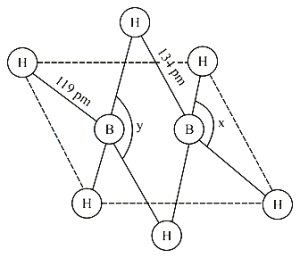
The structure of diborane $B_2H_6$ is given below. Identify the bond angles $x, y$. In diborane,which bonds are commonly known as banana-bonds?
A
$x = 120^{\circ}, y = 97^{\circ}$ and $3-$centered$-2-$electron bonds
B
$x = 101^{\circ}, y = 118^{\circ}$ and $2-$centered$-3-$electron bonds
C
$x = 118^{\circ}, y = 79^{\circ}$ and ionic bond between the two $B$'s
D
$x = 79^{\circ}, y = 118^{\circ}$ and ionic bond between the two $B$'s
Solution
(A) Diborane $(B_2H_6)$ is an electron-deficient molecule.
In its structure,the four terminal hydrogen atoms and two boron atoms lie in the same plane.
The two bridging hydrogen atoms lie above and below this plane.
The terminal $B-H$ bonds are normal $2-$centered$-2-$electron $(2c-2e)$ bonds with a bond angle of $120^{\circ}$ $(x)$.
The bridging $B-H-B$ bonds are $3-$centered$-2-$electron $(3c-2e)$ bonds,which are commonly known as banana-bonds or tau-bonds.
The bridging $H-B-H$ bond angle $(y)$ is $97^{\circ}$.
In its structure,the four terminal hydrogen atoms and two boron atoms lie in the same plane.
The two bridging hydrogen atoms lie above and below this plane.
The terminal $B-H$ bonds are normal $2-$centered$-2-$electron $(2c-2e)$ bonds with a bond angle of $120^{\circ}$ $(x)$.
The bridging $B-H-B$ bonds are $3-$centered$-2-$electron $(3c-2e)$ bonds,which are commonly known as banana-bonds or tau-bonds.
The bridging $H-B-H$ bond angle $(y)$ is $97^{\circ}$.
0 likes
View Solution439
MediumMCQ
$H_3BO_3$ or $B(OH)_3$ is considered as an acid because its molecule
A
Combines with proton from water molecule
B
Accepts $OH^{-}$ from water,releasing a proton
C
Contains replaceable $H^{+}$ ion
D
Can donate proton easily
Solution
(B) $H_3BO_3$ is a weak monobasic Lewis acid. It does not dissociate to give $H^{+}$ ions directly in water.
Instead,it acts as a Lewis acid by accepting an $OH^{-}$ ion from the water molecule.
This process releases a proton $(H^{+})$ from the water molecule,thereby increasing the acidity of the solution.
The reaction is: $B(OH)_3 + 2H_2O \rightarrow [B(OH)_4]^{-} + H_3O^{+}$.
Therefore,$H_3BO_3$ is considered an acid because its molecule accepts $OH^{-}$ from water,releasing a proton.
Instead,it acts as a Lewis acid by accepting an $OH^{-}$ ion from the water molecule.
This process releases a proton $(H^{+})$ from the water molecule,thereby increasing the acidity of the solution.
The reaction is: $B(OH)_3 + 2H_2O \rightarrow [B(OH)_4]^{-} + H_3O^{+}$.
Therefore,$H_3BO_3$ is considered an acid because its molecule accepts $OH^{-}$ from water,releasing a proton.
0 likes
View Solution440
MediumMCQ
Boron compounds behave as Lewis acids because of their
A
electron rich nature
B
electron deficient nature
C
ionisation properties
D
proton donating nature
Solution
(B) Boron compounds are often employed as Lewis acids due to their strong electrophilic nature,which is caused by a vacant $p$-orbital that can accept electrons.
Boron behaves as a Lewis acid because it has only $3$ valence electrons,leaving its octet incomplete.
For example,$B_2H_6$ is an electron-deficient compound.
The electronic configuration of Boron is $B (Z=5) = [He] 2s^2 2p^1$.
This results in a total of $6$ electrons in the valence shell of the central atom in compounds like $BF_3$,which is less than the $8$ required for a complete octet.
Boron behaves as a Lewis acid because it has only $3$ valence electrons,leaving its octet incomplete.
For example,$B_2H_6$ is an electron-deficient compound.
The electronic configuration of Boron is $B (Z=5) = [He] 2s^2 2p^1$.
This results in a total of $6$ electrons in the valence shell of the central atom in compounds like $BF_3$,which is less than the $8$ required for a complete octet.
0 likes
View Solution441
MediumMCQ
$A$ compound $X$,of boron reacts with $NH_3$ on heating to give another compound $Y$,which is called inorganic benzene. The compound $X$ can be prepared by treating $BF_3$ with lithium aluminium hydride. The compounds $X$ and $Y$ are represented by the formulas.
A
$B_2H_6, B_3N_3H_6$
B
$B_2O_3, B_3N_3H_6$
C
$BF_3, B_3N_3H_6$
D
$B_3N_3H_6, B_2H_6$
Solution
(A) $BF_3 \xrightarrow{LiAlH_4} B_2H_6 (X)$
$3B_2H_6 + 6NH_3 \xrightarrow{\Delta} 2B_3N_3H_6 (Y) + 12H_2$
Compound $X$ is $B_2H_6$ (Diborane).
Compound $Y$ is $B_3N_3H_6$ (Borazine),which is known as inorganic benzene.
$3B_2H_6 + 6NH_3 \xrightarrow{\Delta} 2B_3N_3H_6 (Y) + 12H_2$
Compound $X$ is $B_2H_6$ (Diborane).
Compound $Y$ is $B_3N_3H_6$ (Borazine),which is known as inorganic benzene.
0 likes
View Solution442
MediumMCQ
Which of the following compounds are formed when boron trichloride is treated with water?
A
$H_3BO_3 + HCl$
B
$B_2H_6 + HCl$
C
$B_2O_3 + HCl$
D
$HBO_3 + HCl$
Solution
(A) When boron trichloride $(BCl_3)$ reacts with water,it undergoes hydrolysis to form boric acid $(H_3BO_3)$ and hydrochloric acid $(HCl)$.
The balanced chemical equation is:
$BCl_3 + 3H_2O \longrightarrow H_3BO_3 + 3HCl$
The balanced chemical equation is:
$BCl_3 + 3H_2O \longrightarrow H_3BO_3 + 3HCl$
0 likes
View Solution443
MediumMCQ
Boron halides are usually Lewis acids in nature. This is due to:
A
Presence of six valence electrons
B
Their ionic character
C
Presence of lone pair of electrons
D
Their covalent character
Solution
(A) Boron halides $(BX_3)$ have a central boron atom bonded to three halogen atoms.
In these molecules,boron has only $6$ electrons in its valence shell (an incomplete octet).
Due to this electron deficiency,they act as Lewis acids by accepting a lone pair of electrons from a Lewis base to complete their octet.
In these molecules,boron has only $6$ electrons in its valence shell (an incomplete octet).
Due to this electron deficiency,they act as Lewis acids by accepting a lone pair of electrons from a Lewis base to complete their octet.
0 likes
View Solution444
MediumMCQ
In the following reactions:
$3B_2H_6 + 6NH_3 \text{ (excess)} \xrightarrow{\Delta} 2B_3N_3H_6 + 12H_2$
$6NaH + 2BF_3 \xrightarrow{450 \ K} B_2H_6 + 6NaF$
$B_2H_6 + 6H_2O \longrightarrow 2H_3BO_3 + 6H_2$
$X, Y$ and $Z$ are respectively:
$3B_2H_6 + 6NH_3 \text{ (excess)} \xrightarrow{\Delta} 2B_3N_3H_6 + 12H_2$
$6NaH + 2BF_3 \xrightarrow{450 \ K} B_2H_6 + 6NaF$
$B_2H_6 + 6H_2O \longrightarrow 2H_3BO_3 + 6H_2$
$X, Y$ and $Z$ are respectively:
A
$B_2H_6, LiBH_4, H_3BO_3$
B
$B_3N_3H_6, B_2H_6, H_3BO_3$
C
$(BN)_n, LiBH_4, HBO_2$
D
$B_2H_6, B_2H_6, HBO_2$
Solution
(B) From the given chemical reactions:
$1$. The reaction of diborane with excess ammonia at high temperature produces inorganic benzene $(B_3N_3H_6)$,so $X = B_3N_3H_6$.
$2$. The reaction of sodium hydride with boron trifluoride produces diborane $(B_2H_6)$,so $Y = B_2H_6$.
$3$. The hydrolysis of diborane produces orthoboric acid $(H_3BO_3)$,so $Z = H_3BO_3$.
Therefore,the correct sequence is $X = B_3N_3H_6, Y = B_2H_6, Z = H_3BO_3$.
Hence,option $(b)$ is correct.
$1$. The reaction of diborane with excess ammonia at high temperature produces inorganic benzene $(B_3N_3H_6)$,so $X = B_3N_3H_6$.
$2$. The reaction of sodium hydride with boron trifluoride produces diborane $(B_2H_6)$,so $Y = B_2H_6$.
$3$. The hydrolysis of diborane produces orthoboric acid $(H_3BO_3)$,so $Z = H_3BO_3$.
Therefore,the correct sequence is $X = B_3N_3H_6, Y = B_2H_6, Z = H_3BO_3$.
Hence,option $(b)$ is correct.
0 likes
View Solution445
DifficultMCQ
Which of the following reactions can be used to prepare diborane?
$I. BF_3 + LiAlH_4 \xrightarrow{\text{ether}}$
$II. BF_3 + NaH \xrightarrow{450 \ K}$
$III. Na_2B_4O_7 + H_2O \longrightarrow$
$IV. NaBH_4 + I_2 \longrightarrow$
$I. BF_3 + LiAlH_4 \xrightarrow{\text{ether}}$
$II. BF_3 + NaH \xrightarrow{450 \ K}$
$III. Na_2B_4O_7 + H_2O \longrightarrow$
$IV. NaBH_4 + I_2 \longrightarrow$
A
$I, II, IV$
B
$II, III$ only
C
$III, IV$ only
D
$I, II, III$
Solution
(A) Diborane $(B_2H_6)$ can be prepared by the following reactions:
$I. 4BF_3 + 3LiAlH_4 \xrightarrow{\text{ether}} 2B_2H_6 + 3LiF + 3AlF_3$
$II. 2BF_3 + 6NaH \xrightarrow{450 \ K} B_2H_6 + 6NaF$
$IV. 2NaBH_4 + I_2 \longrightarrow B_2H_6 + 2NaI + H_2$
Reaction $III$ $(Na_2B_4O_7 + H_2O)$ is a hydrolysis reaction of borax which does not produce diborane.
Thus,reactions $I, II,$ and $IV$ are used to prepare diborane.
$I. 4BF_3 + 3LiAlH_4 \xrightarrow{\text{ether}} 2B_2H_6 + 3LiF + 3AlF_3$
$II. 2BF_3 + 6NaH \xrightarrow{450 \ K} B_2H_6 + 6NaF$
$IV. 2NaBH_4 + I_2 \longrightarrow B_2H_6 + 2NaI + H_2$
Reaction $III$ $(Na_2B_4O_7 + H_2O)$ is a hydrolysis reaction of borax which does not produce diborane.
Thus,reactions $I, II,$ and $IV$ are used to prepare diborane.
0 likes
View Solution446
EasyMCQ
Identify the correct statements from the following:
$i$. $H_3BO_3$ is a monobasic acid.
$ii$. The correct formula of borax is $Na_2[B_4O_5(OH)_4] \cdot 8H_2O$.
$iii$. $NaBH_4$ is a reducing agent.
$i$. $H_3BO_3$ is a monobasic acid.
$ii$. The correct formula of borax is $Na_2[B_4O_5(OH)_4] \cdot 8H_2O$.
$iii$. $NaBH_4$ is a reducing agent.
A
$i, ii, iii$
B
$i, ii$ only
C
$ii, iii$ only
D
$i, iii$ only
Solution
(A) The explanations of the given statements are as follows:
$(i)$ $H_3BO_3$ (orthoboric acid) is a monobasic Lewis acid. In aqueous solution,it accepts an $OH^-$ ion from water to form $[B(OH)_4]^-$ and releases $H^+$,acting as a Lewis acid.
$B(OH)_3 + H_2O \rightleftharpoons [B(OH)_4]^- + H^+$
$(ii)$ The correct formula for borax is $Na_2[B_4O_5(OH)_4] \cdot 8H_2O$. This statement is correct.
$(iii)$ $NaBH_4$ (sodium borohydride) is a well-known reducing agent used in organic chemistry to reduce aldehydes and ketones to alcohols. This statement is correct.
Since all three statements are correct,the correct option is $A$.
$(i)$ $H_3BO_3$ (orthoboric acid) is a monobasic Lewis acid. In aqueous solution,it accepts an $OH^-$ ion from water to form $[B(OH)_4]^-$ and releases $H^+$,acting as a Lewis acid.
$B(OH)_3 + H_2O \rightleftharpoons [B(OH)_4]^- + H^+$
$(ii)$ The correct formula for borax is $Na_2[B_4O_5(OH)_4] \cdot 8H_2O$. This statement is correct.
$(iii)$ $NaBH_4$ (sodium borohydride) is a well-known reducing agent used in organic chemistry to reduce aldehydes and ketones to alcohols. This statement is correct.
Since all three statements are correct,the correct option is $A$.
0 likes
View Solution447
EasyMCQ
$A$ few grams of borax is dissolved in distilled water. The $pH$ range of the resultant solution is
A
$1 - 4$
B
$4 - 7$
C
$2 - 5$
D
$7 - 14$
Solution
(D) Borax $(Na_2B_4O_7 \cdot 10H_2O)$ dissolves in water to form an alkaline solution due to hydrolysis.
The reaction is as follows:
$Na_2B_4O_7 + 7H_2O \rightarrow 2NaOH + 4H_3BO_3$
Here,$NaOH$ is a strong base and $H_3BO_3$ (orthoboric acid) is a very weak acid.
Since the solution contains a strong base,the resultant solution is basic in nature.
Therefore,the $pH$ of the solution is greater than $7$,which falls in the range of $7 - 14$.
The reaction is as follows:
$Na_2B_4O_7 + 7H_2O \rightarrow 2NaOH + 4H_3BO_3$
Here,$NaOH$ is a strong base and $H_3BO_3$ (orthoboric acid) is a very weak acid.
Since the solution contains a strong base,the resultant solution is basic in nature.
Therefore,the $pH$ of the solution is greater than $7$,which falls in the range of $7 - 14$.
0 likes
View Solution448
EasyMCQ
In the structure of $B_2H_6$,the number of $BH_2$ groups present in one plane,and the number of $B-H$ terminal bonds,$B-B$ bonds,and $B-H-B$ bridge bonds are respectively:
A
$2, 4, 0, 2$
B
$3, 2, 2, 2$
C
$2, 2, 2, 2$
D
$2, 4, 2, 0$
Solution
(A) The structure of $B_2H_6$ (diborane) consists of two $BH_2$ groups in the same plane.
There are $4$ terminal $B-H$ bonds,which are $2$-centered-$2$-electron $(2c-2e)$ bonds.
There are $2$ bridge $B-H-B$ bonds,which are $3$-centered-$2$-electron $(3c-2e)$ bonds.
There is no direct $B-B$ bond in $B_2H_6$.
Thus,the number of $BH_2$ groups in one plane is $2$,terminal $B-H$ bonds is $4$,$B-B$ bonds is $0$,and $B-H-B$ bridge bonds is $2$.
There are $4$ terminal $B-H$ bonds,which are $2$-centered-$2$-electron $(2c-2e)$ bonds.
There are $2$ bridge $B-H-B$ bonds,which are $3$-centered-$2$-electron $(3c-2e)$ bonds.
There is no direct $B-B$ bond in $B_2H_6$.
Thus,the number of $BH_2$ groups in one plane is $2$,terminal $B-H$ bonds is $4$,$B-B$ bonds is $0$,and $B-H-B$ bridge bonds is $2$.
0 likes
View Solution449
EasyMCQ
Identify the correct statements from the following:
$a$) Borax gives blue coloured $Co(BO_2)_2$ when heated with $Co^{2+}$ salt.
$b$) The correct formula of Borax is $Na_2[B_4O_5(OH)_4] \cdot 8H_2O$.
$c$) Trihalides of boron are Lewis bases.
$a$) Borax gives blue coloured $Co(BO_2)_2$ when heated with $Co^{2+}$ salt.
$b$) The correct formula of Borax is $Na_2[B_4O_5(OH)_4] \cdot 8H_2O$.
$c$) Trihalides of boron are Lewis bases.
A
$a, b, c$
B
$a, c$
C
$a, b$
D
$b, c$
Solution
(C) Statement $a$ is correct: Borax bead test involves heating borax with a metal salt like $Co^{2+}$,forming a characteristic blue-coloured cobalt metaborate,$Co(BO_2)_2$.
Statement $b$ is correct: The structural formula of borax is $Na_2[B_4O_5(OH)_4] \cdot 8H_2O$.
Statement $c$ is incorrect: Boron trihalides $(BX_3)$ are electron-deficient compounds with an incomplete octet on the boron atom,making them Lewis acids,not Lewis bases.
Therefore,statements $a$ and $b$ are correct.
Statement $b$ is correct: The structural formula of borax is $Na_2[B_4O_5(OH)_4] \cdot 8H_2O$.
Statement $c$ is incorrect: Boron trihalides $(BX_3)$ are electron-deficient compounds with an incomplete octet on the boron atom,making them Lewis acids,not Lewis bases.
Therefore,statements $a$ and $b$ are correct.
0 likes
View Solution450
EasyMCQ
In diborane $(B_2H_6)$,the number of $2$-centre-$2$-electron bonds and $3$-centre-$2$-electron bonds respectively are:
A
$2, 4$
B
$3, 3$
C
$4, 2$
D
$4, 0$
Solution
(C) The structure of diborane $(B_2H_6)$ consists of two boron atoms and six hydrogen atoms.
There are four terminal $B-H$ bonds,which are $2$-centre-$2$-electron $(2c-2e)$ bonds.
There are two bridging $B-H-B$ bonds,which are $3$-centre-$2$-electron $(3c-2e)$ bonds.
Therefore,the number of $2c-2e$ bonds is $4$ and the number of $3c-2e$ bonds is $2$.
There are four terminal $B-H$ bonds,which are $2$-centre-$2$-electron $(2c-2e)$ bonds.
There are two bridging $B-H-B$ bonds,which are $3$-centre-$2$-electron $(3c-2e)$ bonds.
Therefore,the number of $2c-2e$ bonds is $4$ and the number of $3c-2e$ bonds is $2$.
0 likes
View Solutionp-Block Elements (Class 11) — Boron family · Frequently Asked Questions
1Are these p-Block Elements (Class 11) questions useful for JEE and NEET?
Yes. All questions in this section are mapped to JEE Main and NEET exam patterns. Previous year questions from JEE Main, NEET, GUJCET and state-level exams are included with full solutions.
2Can I switch to Hindi or Gujarati for these questions?
Yes. Use the language tabs in the hero section or the sidebar to view the same questions and solutions in English, Hindi or Gujarati.
3How do I generate a question paper from this subtopic?
Use the Vedclass Exam Paper Generator — select the chapter and subtopic, set difficulty, and generate Sets A, B, C, D automatically. First 3 chapters of every subject are free.
Vedclass Products
For Students
Vedclass Test Series
Mock tests in real JEE/NEET style with performance analysis. 5-day free trial.
Start Free TrialFor Teachers
Exam Paper Generator
Generate Set A/B/C/D papers from this chapter in 2 minutes. 3 chapters free.
Try FreeFor Institutes
Online Exam Module
Live online exams with unlimited students, 360° analytics & white-label branding.
See DemoFor Teachers & Institutes
Generate a p-Block Elements (Class 11) Exam Paper in 2 Minutes
Select subtopic & difficulty — Sets A, B, C, D auto-generated with No Repeat logic.
First 3 chapters of every subject are free — no payment required.