
A English
Boron family Questions in English
Class 11 Chemistry · p-Block Elements (Class 11) · Boron family
528+
Questions
English
Language
100%
With Solutions
Showing 50 of 528 questions in English
301
Medium
Give important trends and anomalous properties of boron.
Solution
(N/A) Certain important trends can be observed in the chemical behaviour of group-$13$ elements. The trichlorides,bromides,and iodides of all these elements are covalent in nature and are hydrolysed in water.
Species like tetrahedral $[M(OH)_{4}]^{-}$ and octahedral $[M(H_{2}O)_{6}]^{3+}$ exist in aqueous medium,except for boron.
The monomeric trihalides,being electron-deficient,are strong Lewis acids. Boron trifluoride $(BF_{3})$ easily reacts with Lewis bases such as $NH_{3}$ to complete the octet around boron.
Due to the absence of $d$-orbitals,the maximum covalence of $B$ is $4$. Since $d$-orbitals are available in $Al$ and other elements,their maximum covalence can exceed $4$.
Most other metal halides (e.g.,$AlCl_{3}$) are dimerised through halogen bridging (e.g.,$Al_{2}Cl_{6}$). The metal species completes its octet by accepting electrons from the halogen in these bridged molecules.
Species like tetrahedral $[M(OH)_{4}]^{-}$ and octahedral $[M(H_{2}O)_{6}]^{3+}$ exist in aqueous medium,except for boron.
The monomeric trihalides,being electron-deficient,are strong Lewis acids. Boron trifluoride $(BF_{3})$ easily reacts with Lewis bases such as $NH_{3}$ to complete the octet around boron.
Due to the absence of $d$-orbitals,the maximum covalence of $B$ is $4$. Since $d$-orbitals are available in $Al$ and other elements,their maximum covalence can exceed $4$.
Most other metal halides (e.g.,$AlCl_{3}$) are dimerised through halogen bridging (e.g.,$Al_{2}Cl_{6}$). The metal species completes its octet by accepting electrons from the halogen in these bridged molecules.
0 likes
View Solution302
Medium
Explain the physical and chemical properties of borax.
Solution
(N/A) Borax is the most important compound of boron.
Formula: The actual structure contains the tetranuclear units $[B_{4}O_{5}(OH)_{4}]^{2-}$,so the correct formula is $Na_{2}[B_{4}O_{5}(OH)_{4}] \cdot 8 H_{2}O$.
Physical Properties: It is a white crystalline solid. It dissolves in water to give an alkaline solution due to hydrolysis:
$Na_{2}B_{4}O_{7} + 7 H_{2}O \rightarrow 2 NaOH + 4 H_{3}BO_{3}$ (Orthoboric acid).
Chemical Properties (Borax Bead Test): On heating,borax loses water molecules and swells. On further heating,it turns into a transparent liquid that solidifies into a glass-like material called a borax bead:
$Na_{2}B_{4}O_{7} \cdot 10 H_{2}O$ $\xrightarrow{\Delta} Na_{2}B_{4}O_{7}$ $\xrightarrow{\Delta} 2 NaBO_{2} + B_{2}O_{3}$ (Sodium metaborate and Boric anhydride).
The metaborates of transition metals have characteristic colors,allowing for identification in the laboratory. For example,heating borax with $CoO$ on a platinum wire loop forms a blue $Co(BO_{2})_{2}$ bead.
Formula: The actual structure contains the tetranuclear units $[B_{4}O_{5}(OH)_{4}]^{2-}$,so the correct formula is $Na_{2}[B_{4}O_{5}(OH)_{4}] \cdot 8 H_{2}O$.
Physical Properties: It is a white crystalline solid. It dissolves in water to give an alkaline solution due to hydrolysis:
$Na_{2}B_{4}O_{7} + 7 H_{2}O \rightarrow 2 NaOH + 4 H_{3}BO_{3}$ (Orthoboric acid).
Chemical Properties (Borax Bead Test): On heating,borax loses water molecules and swells. On further heating,it turns into a transparent liquid that solidifies into a glass-like material called a borax bead:
$Na_{2}B_{4}O_{7} \cdot 10 H_{2}O$ $\xrightarrow{\Delta} Na_{2}B_{4}O_{7}$ $\xrightarrow{\Delta} 2 NaBO_{2} + B_{2}O_{3}$ (Sodium metaborate and Boric anhydride).
The metaborates of transition metals have characteristic colors,allowing for identification in the laboratory. For example,heating borax with $CoO$ on a platinum wire loop forms a blue $Co(BO_{2})_{2}$ bead.
0 likes
View Solution303
Difficult
Give the physical and chemical properties of orthoboric acid $(H_3BO_3)$.
Solution
(N/A) Physical properties :
$\rightarrow$ Orthoboric acid,$H_3BO_3$,is a white crystalline solid with a soapy touch.
$\rightarrow$ It is sparingly soluble in water but highly soluble in hot water.
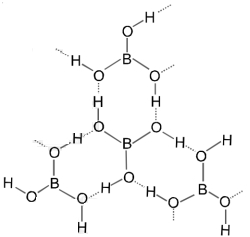
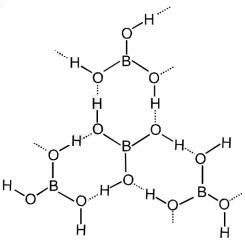
$\rightarrow$ It has a layer structure in which planar $BO_3$ units are joined by hydrogen bonds as shown in the figure.
Chemical properties :
$\rightarrow$ It can be prepared by acidifying an aqueous solution of borax :
$Na_2B_4O_7 + 2 HCl + 5 H_2O \rightarrow 2 NaCl + 4 B(OH)_3$
$\rightarrow$ Boric acid is a weak monobasic acid. It is not a protonic acid but acts as a Lewis acid by accepting electrons from a hydroxyl ion :
$B(OH)_3 + 2 HOH \rightarrow [B(OH)_4]^- + H_3O^+$
$\rightarrow$ On heating,orthoboric acid above $370 \ K$ forms metaboric acid,$HBO_2$,which on further heating yields boric oxide,$B_2O_3$ :
$H_3BO_3$ $\xrightarrow{\Delta} HBO_2$ $\xrightarrow{\Delta} B_2O_3$
$\rightarrow$ Orthoboric acid,$H_3BO_3$,is a white crystalline solid with a soapy touch.
$\rightarrow$ It is sparingly soluble in water but highly soluble in hot water.
$\rightarrow$ It has a layer structure in which planar $BO_3$ units are joined by hydrogen bonds as shown in the figure.
Chemical properties :
$\rightarrow$ It can be prepared by acidifying an aqueous solution of borax :
$Na_2B_4O_7 + 2 HCl + 5 H_2O \rightarrow 2 NaCl + 4 B(OH)_3$
$\rightarrow$ Boric acid is a weak monobasic acid. It is not a protonic acid but acts as a Lewis acid by accepting electrons from a hydroxyl ion :
$B(OH)_3 + 2 HOH \rightarrow [B(OH)_4]^- + H_3O^+$
$\rightarrow$ On heating,orthoboric acid above $370 \ K$ forms metaboric acid,$HBO_2$,which on further heating yields boric oxide,$B_2O_3$ :
$H_3BO_3$ $\xrightarrow{\Delta} HBO_2$ $\xrightarrow{\Delta} B_2O_3$
0 likes
View Solution304
Easy
Is boric acid a protic acid? Explain.
Solution
(N/A) Boric acid ($H_3BO_3$ or $B(OH)_3$) is not a protic acid.
$A$ protic acid is defined as a substance that donates a proton $(H^+)$ in an aqueous solution.
Boric acid acts as a weak monobasic Lewis acid.
It accepts a lone pair of electrons from the $OH^-$ ion of water to form the $[B(OH)_4]^-$ complex,thereby releasing $H^+$ ions into the solution:
$B(OH)_3 + 2H_2O \longrightarrow [B(OH)_4]^- + H_3O^+$
$A$ protic acid is defined as a substance that donates a proton $(H^+)$ in an aqueous solution.
Boric acid acts as a weak monobasic Lewis acid.
It accepts a lone pair of electrons from the $OH^-$ ion of water to form the $[B(OH)_4]^-$ complex,thereby releasing $H^+$ ions into the solution:
$B(OH)_3 + 2H_2O \longrightarrow [B(OH)_4]^- + H_3O^+$
0 likes
View Solution305
Easy
Explain what happens when boric acid is heated.
Solution
On heating orthoboric acid $(H_{3}BO_{3})$ at $370 \ K$ or above,it loses a water molecule to form metaboric acid $(HBO_{2})$.
On further heating,metaboric acid loses more water to yield boric oxide $(B_{2}O_{3})$.
The reactions are as follows:
$H_{3}BO_{3} \xrightarrow{370 \ K} HBO_{2} + H_{2}O$
$2HBO_{2} \xrightarrow{\Delta} B_{2}O_{3} + H_{2}O$
On further heating,metaboric acid loses more water to yield boric oxide $(B_{2}O_{3})$.
The reactions are as follows:
$H_{3}BO_{3} \xrightarrow{370 \ K} HBO_{2} + H_{2}O$
$2HBO_{2} \xrightarrow{\Delta} B_{2}O_{3} + H_{2}O$
0 likes
View Solution306
Medium
$A$ certain salt $X$ gives the following results:
$(i)$ Its aqueous solution is alkaline to litmus.
$(ii)$ It swells up to a glassy material $Y$ on strong heating.
$(iii)$ When conc. $H_2SO_4$ is added to a hot solution of $X$,white crystals of an acid $Z$ separate out.
Identify $X, Y$ and $Z$ and write the equations for the reactions.
$(i)$ Its aqueous solution is alkaline to litmus.
$(ii)$ It swells up to a glassy material $Y$ on strong heating.
$(iii)$ When conc. $H_2SO_4$ is added to a hot solution of $X$,white crystals of an acid $Z$ separate out.
Identify $X, Y$ and $Z$ and write the equations for the reactions.
Solution
(A) $(i)$ The salt $X$ is alkaline to litmus,indicating it is a salt of a strong base and a weak acid. Upon strong heating,it swells to form a glassy material $Y$. This behavior is characteristic of borax $(Na_2B_4O_7 \cdot 10H_2O)$.
$Na_2B_4O_7 \cdot 10H_2O + 7H_2O \rightarrow 2NaOH + 4H_3BO_3$
$(ii)$ On heating,borax loses water and swells to form a glassy bead $Y$ consisting of sodium metaborate $(NaBO_2)$ and boric anhydride $(B_2O_3)$.
$Na_2B_4O_7 \cdot 10H_2O \xrightarrow{\Delta} Na_2B_4O_7 + 10H_2O$
$Na_2B_4O_7 \xrightarrow{\Delta} 2NaBO_2 + B_2O_3 (Y)$
$(iii)$ When concentrated $H_2SO_4$ is added to a hot solution of borax,white crystals of orthoboric acid $(Z = H_3BO_3)$ are formed.
$Na_2B_4O_7 \cdot 10H_2O + H_2SO_4 \rightarrow Na_2SO_4 + 4H_3BO_3 (Z) + 5H_2O$
$Na_2B_4O_7 \cdot 10H_2O + 7H_2O \rightarrow 2NaOH + 4H_3BO_3$
$(ii)$ On heating,borax loses water and swells to form a glassy bead $Y$ consisting of sodium metaborate $(NaBO_2)$ and boric anhydride $(B_2O_3)$.
$Na_2B_4O_7 \cdot 10H_2O \xrightarrow{\Delta} Na_2B_4O_7 + 10H_2O$
$Na_2B_4O_7 \xrightarrow{\Delta} 2NaBO_2 + B_2O_3 (Y)$
$(iii)$ When concentrated $H_2SO_4$ is added to a hot solution of borax,white crystals of orthoboric acid $(Z = H_3BO_3)$ are formed.
$Na_2B_4O_7 \cdot 10H_2O + H_2SO_4 \rightarrow Na_2SO_4 + 4H_3BO_3 (Z) + 5H_2O$
0 likes
View Solution307
Advanced
Write the preparation of diborane and describe its physical and chemical properties.
Solution
(N/A) Preparation:
- The simplest boron hydride known is diborane. It is prepared by treating boron trifluoride with $LiAlH_{4}$ in diethyl ether.
$4 BF_{3} + 3 LiAlH_{4} \rightarrow 2 B_{2}H_{6} + 3 LiF + 3 AlF_{3}$
- $A$ convenient laboratory method for the preparation of diborane involves the oxidation of sodium borohydride with iodine.
$I_{2} + 2 NaBH_{4} \rightarrow B_{2}H_{6} + 2 NaI + H_{2}$
- Diborane is produced on an industrial scale by the reaction of $BF_{3}$ with sodium hydride.
$2 BF_{3} + 6 NaH \stackrel{450 \ K}{\longrightarrow} B_{2}H_{6} + 6 NaF$
Physical properties:
- Diborane is a colourless,highly toxic gas with a boiling point of $180 \ K$.
- Diborane catches fire spontaneously upon exposure to air.
- It burns in oxygen,releasing an enormous amount of energy.
Chemical properties:
- Boranes are readily hydrolyzed by water to give boric acid.
$B_{2}H_{6(g)} + 6 H_{2}O_{(l)} \rightarrow 2 B(OH)_{3(aq)} + 6 H_{2(g)}$
- Diborane undergoes cleavage reactions with Lewis bases $(L)$ to give borane adducts,$BH_{3} \cdot L$.
$B_{2}H_{6} + 2 NMe_{3} \rightarrow 2 BH_{3} \cdot NMe_{3}$
$B_{2}H_{6} + 2 CO \rightarrow 2 BH_{3} \cdot CO$
- Reaction of ammonia with diborane initially gives $B_{2}H_{6} \cdot 2 NH_{3}$,which is formulated as $[BH_{2}(NH_{3})_{2}]^{+}[BH_{4}]^{-}$; further heating gives borazine,$B_{3}N_{3}H_{6}$,known as "inorganic benzene" due to its ring structure with alternate $BH$ and $NH$ groups.
$3 B_{2}H_{6} + 6 NH_{3}$ $\rightarrow 2[BH_{2}(NH_{3})_{2}]^{+}[BH_{4}]^{-} \stackrel{\Delta}{}$ ${\longrightarrow} 2 B_{3}N_{3}H_{6} + 12 H_{2}$
- The simplest boron hydride known is diborane. It is prepared by treating boron trifluoride with $LiAlH_{4}$ in diethyl ether.
$4 BF_{3} + 3 LiAlH_{4} \rightarrow 2 B_{2}H_{6} + 3 LiF + 3 AlF_{3}$
- $A$ convenient laboratory method for the preparation of diborane involves the oxidation of sodium borohydride with iodine.
$I_{2} + 2 NaBH_{4} \rightarrow B_{2}H_{6} + 2 NaI + H_{2}$
- Diborane is produced on an industrial scale by the reaction of $BF_{3}$ with sodium hydride.
$2 BF_{3} + 6 NaH \stackrel{450 \ K}{\longrightarrow} B_{2}H_{6} + 6 NaF$
Physical properties:
- Diborane is a colourless,highly toxic gas with a boiling point of $180 \ K$.
- Diborane catches fire spontaneously upon exposure to air.
- It burns in oxygen,releasing an enormous amount of energy.
Chemical properties:
- Boranes are readily hydrolyzed by water to give boric acid.
$B_{2}H_{6(g)} + 6 H_{2}O_{(l)} \rightarrow 2 B(OH)_{3(aq)} + 6 H_{2(g)}$
- Diborane undergoes cleavage reactions with Lewis bases $(L)$ to give borane adducts,$BH_{3} \cdot L$.
$B_{2}H_{6} + 2 NMe_{3} \rightarrow 2 BH_{3} \cdot NMe_{3}$
$B_{2}H_{6} + 2 CO \rightarrow 2 BH_{3} \cdot CO$
- Reaction of ammonia with diborane initially gives $B_{2}H_{6} \cdot 2 NH_{3}$,which is formulated as $[BH_{2}(NH_{3})_{2}]^{+}[BH_{4}]^{-}$; further heating gives borazine,$B_{3}N_{3}H_{6}$,known as "inorganic benzene" due to its ring structure with alternate $BH$ and $NH$ groups.
$3 B_{2}H_{6} + 6 NH_{3}$ $\rightarrow 2[BH_{2}(NH_{3})_{2}]^{+}[BH_{4}]^{-} \stackrel{\Delta}{}$ ${\longrightarrow} 2 B_{3}N_{3}H_{6} + 12 H_{2}$
0 likes
View Solution308
Medium
Explain the structures of diborane and boric acid.
Solution
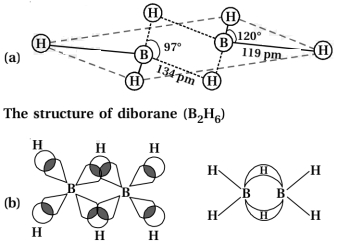
(N/A) Diborane $(B_2H_6)$ is an electron-deficient compound with only $12$ valence electrons. The two $B$ atoms and four terminal $H$ atoms lie in the same plane,while the two bridging $H$ atoms lie in a perpendicular plane (one above and one below). The terminal $B-H$ bonds are $2c-2e$ (two-center-two-electron) bonds,and the bridging $B-H-B$ bonds are $3c-2e$ (three-center-two-electron) bonds.
$(b)$ Boric acid $(H_3BO_3)$ has a layered structure. Each planar $BO_3^{3-}$ unit is linked to others through $H$ atoms. The $H$ atoms form covalent bonds with the oxygen atoms of the $BO_3$ unit and hydrogen bonds with the oxygen atoms of adjacent $BO_3$ units.
$(b)$ Boric acid $(H_3BO_3)$ has a layered structure. Each planar $BO_3^{3-}$ unit is linked to others through $H$ atoms. The $H$ atoms form covalent bonds with the oxygen atoms of the $BO_3$ unit and hydrogen bonds with the oxygen atoms of adjacent $BO_3$ units.
0 likes
View Solution309
Medium
What happens when:
$(a)$ Borax is heated strongly,
$(b)$ Boric acid is added to water,
$(c)$ Aluminium is treated with dilute $NaOH$,
$(d)$ $BF_{3}$ is reacted with ammonia?
$(a)$ Borax is heated strongly,
$(b)$ Boric acid is added to water,
$(c)$ Aluminium is treated with dilute $NaOH$,
$(d)$ $BF_{3}$ is reacted with ammonia?
Solution
(N/A) When heated,borax loses water of crystallization and swells. On further heating,it melts to form a transparent liquid,which solidifies into a glass-like material known as borax bead.
$Na_{2}B_{4}O_{7} \cdot 10H_{2}O \xrightarrow{\Delta} Na_{2}B_{4}O_{7} + 10H_{2}O$
$(b)$ Boric acid acts as a weak monobasic Lewis acid in water. It accepts an $OH^{-}$ ion from water to form the tetrahydroxoborate ion.
$B(OH)_{3} + 2H_{2}O \rightleftharpoons [B(OH)_{4}]^{-} + H_{3}O^{+}$
$(c)$ Aluminium reacts with dilute $NaOH$ to form sodium tetrahydroxoaluminate$(III)$ and releases hydrogen gas.
$2Al(s) + 2NaOH(aq) + 6H_{2}O(l) \rightarrow 2Na[Al(OH)_{4}](aq) + 3H_{2}(g)$
$(d)$ $BF_{3}$ acts as a Lewis acid and $NH_{3}$ acts as a Lewis base. They react to form an adduct,completing the octet of boron.
$F_{3}B + :NH_{3} \rightarrow F_{3}B \leftarrow NH_{3}$
$Na_{2}B_{4}O_{7} \cdot 10H_{2}O \xrightarrow{\Delta} Na_{2}B_{4}O_{7} + 10H_{2}O$
$(b)$ Boric acid acts as a weak monobasic Lewis acid in water. It accepts an $OH^{-}$ ion from water to form the tetrahydroxoborate ion.
$B(OH)_{3} + 2H_{2}O \rightleftharpoons [B(OH)_{4}]^{-} + H_{3}O^{+}$
$(c)$ Aluminium reacts with dilute $NaOH$ to form sodium tetrahydroxoaluminate$(III)$ and releases hydrogen gas.
$2Al(s) + 2NaOH(aq) + 6H_{2}O(l) \rightarrow 2Na[Al(OH)_{4}](aq) + 3H_{2}(g)$
$(d)$ $BF_{3}$ acts as a Lewis acid and $NH_{3}$ acts as a Lewis base. They react to form an adduct,completing the octet of boron.
$F_{3}B + :NH_{3} \rightarrow F_{3}B \leftarrow NH_{3}$
0 likes
View Solution310
Medium
Write balanced equations for :
$(i) \, BF_{3} + LiH \to $
$(ii) \, B_{2}H_{6} + H_{2}O \to $
$(iii) \, NaH + B_{2}H_{6} \to $
$(iv) \, H_{3}BO_{3} \xrightarrow{\Delta }$
$(v) \, Al + NaOH \to $
$(vi) \, B_{2}H_{6} + NH_{3} \to $
$(i) \, BF_{3} + LiH \to $
$(ii) \, B_{2}H_{6} + H_{2}O \to $
$(iii) \, NaH + B_{2}H_{6} \to $
$(iv) \, H_{3}BO_{3} \xrightarrow{\Delta }$
$(v) \, Al + NaOH \to $
$(vi) \, B_{2}H_{6} + NH_{3} \to $
Solution
(N/A) $(i) \, 2 BF_{3} + 6 LiH \rightarrow B_{2}H_{6} + 6 LiF$
$(ii) \, B_{2}H_{6} + 6 H_{2}O \rightarrow 2 H_{3}BO_{3} + 6 H_{2}$ (Boric acid)
$(iii) \, 2 NaH + B_{2}H_{6} \rightarrow 2 Na[BH_{4}]$ (Sodium borohydride)
$(iv) \, H_{3}BO_{3} \xrightarrow{\Delta } HBO_{2} + H_{2}O$ (Metaboric acid)
$4 HBO_{2} \xrightarrow{\Delta } H_{2}B_{4}O_{7} + H_{2}O$
$H_{2}B_{4}O_{7} \xrightarrow{\Delta } 2 B_{2}O_{3} + H_{2}O$ (Tetraboric acid and Boron trioxide)
$(v) \, 2 Al + 2 NaOH + 6 H_{2}O \rightarrow 2 Na[Al(OH)_{4}] + 3 H_{2}$
$(vi) \, B_{2}H_{6} + 2 NH_{3} \rightarrow 2 BH_{3} \cdot NH_{3}$
$(ii) \, B_{2}H_{6} + 6 H_{2}O \rightarrow 2 H_{3}BO_{3} + 6 H_{2}$ (Boric acid)
$(iii) \, 2 NaH + B_{2}H_{6} \rightarrow 2 Na[BH_{4}]$ (Sodium borohydride)
$(iv) \, H_{3}BO_{3} \xrightarrow{\Delta } HBO_{2} + H_{2}O$ (Metaboric acid)
$4 HBO_{2} \xrightarrow{\Delta } H_{2}B_{4}O_{7} + H_{2}O$
$H_{2}B_{4}O_{7} \xrightarrow{\Delta } 2 B_{2}O_{3} + H_{2}O$ (Tetraboric acid and Boron trioxide)
$(v) \, 2 Al + 2 NaOH + 6 H_{2}O \rightarrow 2 Na[Al(OH)_{4}] + 3 H_{2}$
$(vi) \, B_{2}H_{6} + 2 NH_{3} \rightarrow 2 BH_{3} \cdot NH_{3}$
0 likes
View Solution311
Medium
Give uses of boron and its compounds.
Solution
(N/A) Boron,being an extremely hard refractory solid with a high melting point,low density,and very low electrical conductivity,finds many applications.
$1$. Boron fibers are used in making bullet-proof vests and light composite materials for aircraft.
$2$. The boron-$10$ $({}^{10}B)$ isotope has a high ability to absorb neutrons; therefore,metal borides are used in the nuclear industry as protective shields and control rods.
$3$. The main industrial application of borax and boric acid is in the manufacture of heat-resistant glasses (e.g.,Pyrex),glass-wool,and fiberglass.
$4$. Borax is also used as a flux for soldering metals,for heat,scratch,and stain-resistant glazed coatings on earthenwares,and as a constituent of medicinal soaps.
$5$. An aqueous solution of orthoboric acid is generally used as a mild antiseptic.
$1$. Boron fibers are used in making bullet-proof vests and light composite materials for aircraft.
$2$. The boron-$10$ $({}^{10}B)$ isotope has a high ability to absorb neutrons; therefore,metal borides are used in the nuclear industry as protective shields and control rods.
$3$. The main industrial application of borax and boric acid is in the manufacture of heat-resistant glasses (e.g.,Pyrex),glass-wool,and fiberglass.
$4$. Borax is also used as a flux for soldering metals,for heat,scratch,and stain-resistant glazed coatings on earthenwares,and as a constituent of medicinal soaps.
$5$. An aqueous solution of orthoboric acid is generally used as a mild antiseptic.
0 likes
View Solution312
Easy
Give the uses of $Al$ and its compounds.
Solution
(N/A) $Aluminium$ is a bright silvery-white metal with high tensile strength. It possesses high electrical and thermal conductivity. On a weight-to-weight basis,the electrical conductivity of $Aluminium$ is twice that of $Copper$.
$Aluminium$ is used extensively in industry and everyday life. It forms alloys with $Cu, Mn, Mg, Si,$ and $Zn$. $Aluminium$ and its alloys can be shaped into pipes,tubes,rods,wires,plates,or foils,and therefore,find uses in packaging,utensil making,construction,and the aerospace and transportation industries.
The use of $Aluminium$ and its compounds for domestic purposes has been reduced considerably due to their potential toxic nature.
$Aluminium$ is used extensively in industry and everyday life. It forms alloys with $Cu, Mn, Mg, Si,$ and $Zn$. $Aluminium$ and its alloys can be shaped into pipes,tubes,rods,wires,plates,or foils,and therefore,find uses in packaging,utensil making,construction,and the aerospace and transportation industries.
The use of $Aluminium$ and its compounds for domestic purposes has been reduced considerably due to their potential toxic nature.
0 likes
View Solution313
Easy
Describe the physical properties of $B$ and $Al$.
Solution
(N/A) Properties of $B$: $(i)$ $B$ has a high melting point,low density,and very low electrical conductivity.
$(ii)$ It is an extremely hard,high-temperature resistant solid element.
Properties of $Al$: $(i)$ It is a silvery-white lustrous metal.
$(ii)$ It possesses high electrical and thermal conductivity.
$(iii)$ By weight,$Al$ has twice the conductivity of $Cu$.
$(ii)$ It is an extremely hard,high-temperature resistant solid element.
Properties of $Al$: $(i)$ It is a silvery-white lustrous metal.
$(ii)$ It possesses high electrical and thermal conductivity.
$(iii)$ By weight,$Al$ has twice the conductivity of $Cu$.
0 likes
View Solution314
Easy
Give reasons: Aluminium alloys are used to make aircraft bodies.
Solution
(N/A) Aluminium is characterized by its high strength-to-weight ratio,meaning it is very light yet strong.
It can be alloyed with metals like $Cu, Mn, Mg, Si,$ and $Zn$ to significantly enhance its mechanical properties,such as tensile strength and corrosion resistance.
Additionally,it is highly malleable and ductile,allowing it to be shaped into complex aerodynamic structures.
Due to these properties,aluminium alloys are ideal for the construction of aircraft bodies.
It can be alloyed with metals like $Cu, Mn, Mg, Si,$ and $Zn$ to significantly enhance its mechanical properties,such as tensile strength and corrosion resistance.
Additionally,it is highly malleable and ductile,allowing it to be shaped into complex aerodynamic structures.
Due to these properties,aluminium alloys are ideal for the construction of aircraft bodies.
0 likes
View Solution315
EasyMCQ
Give the names of the group $13$ elements.
A
Boron,Aluminum,Gallium,Indium,Thallium
B
Carbon,Silicon,Germanium,Tin,Lead
C
Nitrogen,Phosphorus,Arsenic,Antimony,Bismuth
D
Oxygen,Sulfur,Selenium,Tellurium,Polonium
Solution
(A) The group $13$ elements are Boron $(B)$,Aluminum $(Al)$,Gallium $(Ga)$,Indium $(In)$,and Thallium $(Tl)$.
They possess a general valence shell electronic configuration of $ns^{2} np^{1}$.
They possess a general valence shell electronic configuration of $ns^{2} np^{1}$.
0 likes
View Solution316
EasyMCQ
Give the increasing order of group $13$ elements for atomic radius.
A
$B < Al < Ga < In < Tl$
B
$B < Ga < Al < In < Tl$
C
$B < Al < In < Ga < Tl$
D
$Tl < In < Ga < Al < B$
Solution
(B) The atomic radius of group $13$ elements generally increases down the group due to the addition of new shells.
However,$Ga$ has a smaller atomic radius than $Al$ due to the poor shielding effect of $d$-electrons,which increases the effective nuclear charge.
The correct increasing order is: $B < Ga < Al < In < Tl$.
However,$Ga$ has a smaller atomic radius than $Al$ due to the poor shielding effect of $d$-electrons,which increases the effective nuclear charge.
The correct increasing order is: $B < Ga < Al < In < Tl$.
0 likes
View Solution317
EasyMCQ
Which hydrated elements of group $13$ are found as polymers in nature?
A
$Al, Ga, In$
B
$B, Al, Ga$
C
$Ga, In, Tl$
D
$B, Ga, In$
Solution
(A) The hydrated forms of group $13$ elements $Al$,$Ga$,and $In$ exist as polymers in nature due to their ability to form coordinate bonds and bridge structures.
Boron,being a non-metal with a small atomic size,does not form such polymeric hydrated structures.
Boron,being a non-metal with a small atomic size,does not form such polymeric hydrated structures.
0 likes
View Solution318
EasyMCQ
Which hydroxides of group $13$ are amphoteric in nature?
A
$Al(OH)_3$ and $Ga(OH)_3$
B
$B(OH)_3$ and $Al(OH)_3$
C
$Ga(OH)_3$ and $In(OH)_3$
D
$In(OH)_3$ and $Tl(OH)_3$
Solution
(A) The hydroxides of group $13$ elements show a trend in their acidic and basic character.
$B(OH)_3$ is weakly acidic.
$Al(OH)_3$ and $Ga(OH)_3$ are amphoteric in nature,meaning they react with both acids and bases.
$In(OH)_3$ and $Tl(OH)_3$ are basic in nature.
$B(OH)_3$ is weakly acidic.
$Al(OH)_3$ and $Ga(OH)_3$ are amphoteric in nature,meaning they react with both acids and bases.
$In(OH)_3$ and $Tl(OH)_3$ are basic in nature.
0 likes
View Solution319
Easy
Draw the structure of diborene $(B_2H_4)$.
Solution
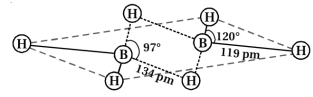
(N/A) The structure of diborene $(B_2H_4)$ is analogous to ethene $(C_2H_4)$.
It consists of two boron atoms bonded to each other with a $B-B$ bond length of $134 \text{ pm}$.
Each boron atom is further bonded to two terminal hydrogen atoms with a $B-H$ bond length of $119 \text{ pm}$.
The $H-B-H$ bond angle is approximately $120^{\circ}$, and the $B-B-H$ bond angle is approximately $97^{\circ}$.
The structure is planar, similar to ethene, where the boron atoms are $sp^2$ hybridized.
It consists of two boron atoms bonded to each other with a $B-B$ bond length of $134 \text{ pm}$.
Each boron atom is further bonded to two terminal hydrogen atoms with a $B-H$ bond length of $119 \text{ pm}$.
The $H-B-H$ bond angle is approximately $120^{\circ}$, and the $B-B-H$ bond angle is approximately $97^{\circ}$.
The structure is planar, similar to ethene, where the boron atoms are $sp^2$ hybridized.
0 likes
View Solution320
EasyMCQ
Give the chemical reaction of aluminum with dilute $HCl$.
A
$2 Al + 6 HCl \rightarrow 2 AlCl_3 + 3 H_2$
B
$2 Al + 6 HCl + 12 H_2O \rightarrow 2[Al(H_2O)_6]Cl_3 + 3 H_2$
C
$Al + 3 HCl \rightarrow AlCl_3 + 1.5 H_2$
D
$Al + HCl \rightarrow AlCl + H_2$
Solution
(B) Aluminum reacts with dilute $HCl$ to form the hydrated aluminum chloride complex and releases hydrogen gas.
The balanced chemical equation is:
$2 Al + 6 HCl + 12 H_2O \rightarrow 2[Al(H_2O)_6]Cl_3 + 3 H_2$
The balanced chemical equation is:
$2 Al + 6 HCl + 12 H_2O \rightarrow 2[Al(H_2O)_6]Cl_3 + 3 H_2$
0 likes
View Solution321
Easy
Give the chemical reaction for the preparation of a borax bead.
Solution
(N/A) $Na_{2}B_{4}O_{7} \cdot 10H_{2}O \xrightarrow{\Delta} Na_{2}B_{4}O_{7} + 10H_{2}O$
$Na_{2}B_{4}O_{7} \xrightarrow{\Delta} 2NaBO_{2} + B_{2}O_{3}$
The mixture of $NaBO_{2}$ (sodium metaborate) and $B_{2}O_{3}$ (boric anhydride) forms a transparent,glassy bead known as the borax bead.
$Na_{2}B_{4}O_{7} \xrightarrow{\Delta} 2NaBO_{2} + B_{2}O_{3}$
The mixture of $NaBO_{2}$ (sodium metaborate) and $B_{2}O_{3}$ (boric anhydride) forms a transparent,glassy bead known as the borax bead.
0 likes
View Solution322
Easy
Draw the structure of $Al_2Cl_6$ and give the uses of $AlCl_3$.
Solution
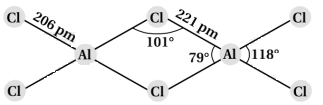
(N/A) Structure: $Al_2Cl_6$ exists as a dimer where two $AlCl_3$ units are joined by two chlorine bridges. Each $Al$ atom is $sp^3$ hybridized and bonded to four chlorine atoms in a tetrahedral geometry.
Uses of $AlCl_3$:
$1$. It acts as a strong Lewis acid.
$2$. It is used as a catalyst in Friedel-Crafts alkylation and acylation reactions.
$3$. It is used in the manufacture of dyes,drugs,and perfumes.
Uses of $AlCl_3$:
$1$. It acts as a strong Lewis acid.
$2$. It is used as a catalyst in Friedel-Crafts alkylation and acylation reactions.
$3$. It is used in the manufacture of dyes,drugs,and perfumes.
0 likes
View Solution323
Easy
Mention the isotopes of boron.
Solution
(N/A) Boron exists in nature as two stable isotopes:
$(i)$ ${}^{10}B$ $(19 \%)$
(ii) ${}^{11}B$ $(81 \%)$
$(i)$ ${}^{10}B$ $(19 \%)$
(ii) ${}^{11}B$ $(81 \%)$
0 likes
View Solution324
EasyMCQ
Which elements of group $13$ possess both $+1$ and $+3$ oxidation state?
A
$B, Al, Ga$
B
$Al, Ga, In$
C
$Ga, In, Tl$
D
$B, Al, In$
Solution
(C) Group $13$ elements have a valence shell electronic configuration of $ns^2 np^1$.
Due to the inert pair effect,the stability of the $+1$ oxidation state increases down the group $(Al < Ga < In < Tl)$.
While $B$ and $Al$ primarily show $+3$ oxidation state,$Ga, In,$ and $Tl$ exhibit both $+1$ and $+3$ oxidation states due to the increasing reluctance of the $ns^2$ electrons to participate in bonding.
Due to the inert pair effect,the stability of the $+1$ oxidation state increases down the group $(Al < Ga < In < Tl)$.
While $B$ and $Al$ primarily show $+3$ oxidation state,$Ga, In,$ and $Tl$ exhibit both $+1$ and $+3$ oxidation states due to the increasing reluctance of the $ns^2$ electrons to participate in bonding.
0 likes
View Solution325
EasyMCQ
Write the chemical reaction of $Al$ with aqueous alkali.
A
$2 Al + 2 NaOH + 6 H_{2}O \rightarrow 2 Na[Al(OH)_{4}] + 3 H_{2}$
B
$2 Al + 6 NaOH \rightarrow 2 Na_{3}AlO_{3} + 3 H_{2}$
C
$Al + NaOH + H_{2}O \rightarrow NaAlO_{2} + H_{2}$
D
$Al + 3 NaOH \rightarrow Al(OH)_{3} + 3 Na$
Solution
(A) Aluminum reacts with aqueous alkali (like $NaOH$) to form sodium tetrahydroxoaluminate$(III)$ and releases hydrogen gas.
The balanced chemical equation is:
$2 Al(s) + 2 NaOH(aq) + 6 H_{2}O(l) \rightarrow 2 Na[Al(OH)_{4}](aq) + 3 H_{2}(g)$
The balanced chemical equation is:
$2 Al(s) + 2 NaOH(aq) + 6 H_{2}O(l) \rightarrow 2 Na[Al(OH)_{4}](aq) + 3 H_{2}(g)$
0 likes
View Solution326
EasyMCQ
Which elements of group $13$,except $B$,can form tetrahedral and octahedral complexes in aqueous medium?
A
$Al, Ga, In, Tl$
B
$Al, Ga, In$
C
$Ga, In, Tl$
D
$Al, Ga$
Solution
(B) In group $13$,elements other than $B$ (Boron) can form complexes with different coordination numbers.
$Al$,$Ga$,and $In$ can form tetrahedral species like $\left[M(OH)_{4}\right]^{-}$ and octahedral species like $\left[M(H_{2}O)_{6}\right]^{3+}$ in an aqueous medium.
$Tl$ (Thallium) typically shows $+1$ oxidation state stability and does not readily form these specific octahedral complexes in the same manner as $Al, Ga,$ and $In$.
$Al$,$Ga$,and $In$ can form tetrahedral species like $\left[M(OH)_{4}\right]^{-}$ and octahedral species like $\left[M(H_{2}O)_{6}\right]^{3+}$ in an aqueous medium.
$Tl$ (Thallium) typically shows $+1$ oxidation state stability and does not readily form these specific octahedral complexes in the same manner as $Al, Ga,$ and $In$.
0 likes
View Solution327
EasyMCQ
Give a suitable laboratory preparation method for diborane.
A
Reaction of $BF_{3}$ with $LiAlH_{4}$ in diethyl ether.
B
Reaction of $NaBH_{4}$ with $I_{2}$ in diglyme.
C
Thermal decomposition of $B_{2}H_{6}$.
D
Reaction of $BCl_{3}$ with $H_{2}$.
Solution
(B) The most common laboratory preparation of diborane $(B_{2}H_{6})$ involves the oxidation of sodium borohydride $(NaBH_{4})$ with iodine $(I_{2})$ in a solvent like diglyme.
The balanced chemical equation is:
$2NaBH_{4} + I_{2} \rightarrow B_{2}H_{6} + 2NaI + H_{2}$
The balanced chemical equation is:
$2NaBH_{4} + I_{2} \rightarrow B_{2}H_{6} + 2NaI + H_{2}$
0 likes
View Solution328
Easy
Give the industrial preparation for diborane.
Solution
(N/A) The industrial preparation of diborane $(B_{2}H_{6})$ involves the reaction of boron trifluoride $(BF_{3})$ with sodium hydride $(NaH)$ at $450 \ K$:
$2 BF_{3} + 6 NaH \xrightarrow{450 \ K} B_{2}H_{6} + 6 NaF$
$2 BF_{3} + 6 NaH \xrightarrow{450 \ K} B_{2}H_{6} + 6 NaF$
0 likes
View Solution329
Easy
Write the chemical reaction to prepare inorganic benzene $(B_3N_3H_6)$.
Solution
(N/A) The preparation of inorganic benzene (borazine) involves the reaction of diborane with ammonia at high temperatures:
$3 B_2H_6 + 6 NH_3 \rightarrow 2 B_3N_3H_6 + 12 H_2$
Alternatively,it can be represented as a two-step process:
$3 B_2H_6 + 6 NH_3$ $\rightarrow 3 [BH_2(NH_3)_2]^+ [BH_4]^-$ $\xrightarrow{\Delta} 2 B_3N_3H_6 + 12 H_2$
$3 B_2H_6 + 6 NH_3 \rightarrow 2 B_3N_3H_6 + 12 H_2$
Alternatively,it can be represented as a two-step process:
$3 B_2H_6 + 6 NH_3$ $\rightarrow 3 [BH_2(NH_3)_2]^+ [BH_4]^-$ $\xrightarrow{\Delta} 2 B_3N_3H_6 + 12 H_2$
0 likes
View Solution330
Easy
Give uses of Borax.
Solution
(N/A) Borax $(Na_2B_4O_7 \cdot 10H_2O)$ is used as a flux for soldering metals.
It is also used for making heat,scratch,and stain-resistant glazed coatings on earthenwares and pottery.
It is also used for making heat,scratch,and stain-resistant glazed coatings on earthenwares and pottery.
0 likes
View Solution331
EasyMCQ
Dilute aqueous solution of $.......$ acid is used as an antibiotic.
A
$Boric \ acid$
B
$Nitric \ acid$
C
$Sulfuric \ acid$
D
$Hydrochloric \ acid$
Solution
(A) The dilute aqueous solution of $H_3BO_3$ (orthoboric acid) is used as a mild antiseptic and antibiotic.
0 likes
View Solution332
EasyMCQ
Name the metals with which $Al$ can form alloys.
A
$Cu, Mn, Mg, Si, Zn$
B
$Fe, Ni, Cr, Co$
C
$Au, Ag, Pt, Pd$
D
$Pb, Sn, Bi, Sb$
Solution
(A) $Al$ (Aluminum) forms various important alloys with metals such as $Cu$ (Copper),$Mn$ (Manganese),$Mg$ (Magnesium),and $Zn$ (Zinc).
$Si$ (Silicon) is also commonly added to improve casting properties,although it is a metalloid.
$Si$ (Silicon) is also commonly added to improve casting properties,although it is a metalloid.
0 likes
View Solution333
Easy
State the uses of aluminium and copper.
Solution
(N/A) Aluminium:
$1$. Aluminium foils are used as wrappers for food materials.
$2$. The fine dust of the metal is used in paints and lacquers.
$3$. Aluminium,being highly reactive,is used in the extraction of chromium and manganese from their oxides.
$4$. Aluminium wires are used as electricity conductors.
$5$. Alloys containing aluminium are light and very useful.
Copper:
$1$. Copper is used in making wires for the electrical industry and for water and steam pipes.
$2$. It is also used in several alloys that are tougher than the metal itself,e.g.,brass (with zinc),bronze (with tin),and coinage alloy (with nickel).
$1$. Aluminium foils are used as wrappers for food materials.
$2$. The fine dust of the metal is used in paints and lacquers.
$3$. Aluminium,being highly reactive,is used in the extraction of chromium and manganese from their oxides.
$4$. Aluminium wires are used as electricity conductors.
$5$. Alloys containing aluminium are light and very useful.
Copper:
$1$. Copper is used in making wires for the electrical industry and for water and steam pipes.
$2$. It is also used in several alloys that are tougher than the metal itself,e.g.,brass (with zinc),bronze (with tin),and coinage alloy (with nickel).
0 likes
View Solution334
EasyMCQ
What are the freezing and boiling points of ammonia $(NH_3)$?
A
$198.4 \ K$ and $239.7 \ K$
B
$195.2 \ K$ and $239.7 \ K$
C
$198.4 \ K$ and $273.15 \ K$
D
$195.2 \ K$ and $273.15 \ K$
Solution
(A) The freezing point of ammonia $(NH_3)$ is $198.4 \ K$.
The boiling point of ammonia $(NH_3)$ is $239.7 \ K$.
Therefore,the correct values are $198.4 \ K$ and $239.7 \ K$.
The boiling point of ammonia $(NH_3)$ is $239.7 \ K$.
Therefore,the correct values are $198.4 \ K$ and $239.7 \ K$.
0 likes
View Solution335
Easy
Match Column-$I$ with Column-$II$ :
| Column-$I$ | Column-$II$ |
| $A$. $Bi^{+3} \to (BiO)^{+}$ | $P$. Heat |
| $B$. $[AlO_2]^{-} \to Al(OH)_3$ | $Q$. Hydrolysis |
| $C$. $SiO_4^{-4} \to Si_2O_7^{-6}$ | $R$. Acidification |
| $D$. $(B_4O_7)^{-2} \to [B(OH)_3]$ | $S$. Dilution with water |
Solution
(A-Q, B-S, C-R,P, D-Q,R) $A-Q$: $Bi^{+3}$ undergoes hydrolysis to form bismuthyl ion $(BiO)^{+}$.
$B-S$: $[AlO_2]^{-}$ (aluminate ion) on dilution with water precipitates $Al(OH)_3$.
$C-R, P$: $SiO_4^{-4}$ units condense to form $Si_2O_7^{-6}$ upon acidification or heating.
$D-Q, R$: Borate ions $(B_4O_7)^{-2}$ undergo hydrolysis and acidification to form boric acid $[B(OH)_3]$.
$B-S$: $[AlO_2]^{-}$ (aluminate ion) on dilution with water precipitates $Al(OH)_3$.
$C-R, P$: $SiO_4^{-4}$ units condense to form $Si_2O_7^{-6}$ upon acidification or heating.
$D-Q, R$: Borate ions $(B_4O_7)^{-2}$ undergo hydrolysis and acidification to form boric acid $[B(OH)_3]$.
0 likes
View Solution336
Medium
Draw the structures of $BCl_3.NH_3$ and $AlCl_3$ (dimer).
Solution
(N/A) In $BCl_3$,Boron is attached to three chlorine atoms by covalent bonds,but the octet of Boron is incomplete. It requires two electrons to complete its octet.
Such electron-deficient molecules have a tendency to accept a pair of electrons to achieve a stable electronic configuration and thus behave as Lewis acids.
$BCl_3$ easily accepts a lone pair of electrons from ammonia $(NH_3)$ to form the adduct $BCl_3.NH_3$:
$H_3N: + BCl_3$ $\rightarrow H_3N$ $\rightarrow BCl_3$
$AlCl_3$ achieves stability by forming a dimer,$Al_2Cl_6$. In the dimer,each Aluminum atom is bonded to four chlorine atoms,two of which are bridging chlorine atoms. The structure is shown below:
(See the provided image for the $Al_2Cl_6$ dimer structure.)
Such electron-deficient molecules have a tendency to accept a pair of electrons to achieve a stable electronic configuration and thus behave as Lewis acids.
$BCl_3$ easily accepts a lone pair of electrons from ammonia $(NH_3)$ to form the adduct $BCl_3.NH_3$:
$H_3N: + BCl_3$ $\rightarrow H_3N$ $\rightarrow BCl_3$
$AlCl_3$ achieves stability by forming a dimer,$Al_2Cl_6$. In the dimer,each Aluminum atom is bonded to four chlorine atoms,two of which are bridging chlorine atoms. The structure is shown below:
(See the provided image for the $Al_2Cl_6$ dimer structure.)
0 likes
View Solution337
Medium
Explain the nature of boric acid $(H_3BO_3)$ as a Lewis acid in water. The structure of $H_3BO_3$ is given below:
$H-O-B(OH)_2$
$H-O-B(OH)_2$
Solution
(N/A) Boric acid $(H_3BO_3)$ acts as a weak monobasic Lewis acid in water.
It does not release $H^+$ ions directly. Instead,it accepts a lone pair of electrons from an $OH^-$ ion provided by the water molecule to complete its octet.
The reaction is as follows:
$B(OH)_3 + 2H_2O \rightarrow [B(OH)_4]^- + H_3O^+$
It does not release $H^+$ ions directly. Instead,it accepts a lone pair of electrons from an $OH^-$ ion provided by the water molecule to complete its octet.
The reaction is as follows:
$B(OH)_3 + 2H_2O \rightarrow [B(OH)_4]^- + H_3O^+$
0 likes
View Solution338
Medium
Draw the structure of boric acid showing hydrogen bonding. Which species is present in water? What is the hybridization of boron in this species?
Solution
(N/A) Boric acid $(H_{3}BO_{3})$ has a layered structure in which planar $H_{3}BO_{3}$ units are joined by hydrogen bonds,forming hexagonal rings as shown in the structure.
Boric acid is a weak monobasic acid. It is not a protonic acid but acts as a Lewis acid by accepting electrons from a hydroxyl ion.
In water,boric acid is present in the form of the $[B(OH)_{4}]^{-}$ species.
The hybridization of boron in this species is $sp^{3}$.
The reaction is: $B(OH)_{3} + 2H_{2}O \rightarrow [B(OH)_{4}]^{-} + H_{3}O^{+}$
Boric acid is a weak monobasic acid. It is not a protonic acid but acts as a Lewis acid by accepting electrons from a hydroxyl ion.
In water,boric acid is present in the form of the $[B(OH)_{4}]^{-}$ species.
The hybridization of boron in this species is $sp^{3}$.
The reaction is: $B(OH)_{3} + 2H_{2}O \rightarrow [B(OH)_{4}]^{-} + H_{3}O^{+}$
0 likes
View Solution339
Medium
Explain why the following compounds behave as Lewis acids?
$(A)$ $BCl_3$
$(B)$ $AlCl_3$
$(A)$ $BCl_3$
$(B)$ $AlCl_3$
Solution
(N/A) $BCl_3$ and $AlCl_3$ are electron-deficient compounds because the central metal atom has an incomplete octet. Therefore,they act as Lewis acids by accepting a lone pair of electrons.
0 likes
View Solution340
Medium
Aluminum dissolves in mineral acids and aqueous alkalis and thus shows amphoteric character. $A$ piece of aluminum foil is treated with dilute hydrochloric acid or dilute sodium hydroxide solution in a test tube and on bringing a burning match stick near the mouth of the test tube,a pop sound indicates the evolution of hydrogen gas. The same activity when performed with concentrated nitric acid,the reaction does not proceed. Explain the reason.
Solution
(N/A) Aluminum is amphoteric in nature; it reacts with acids and bases to produce salt and $H_{2}$ gas. The evolution of $H_{2}$ gas is confirmed by the pop sound produced when a burning matchstick is brought near the mouth of the test tube.
$2 Al(s) + 6 HCl(aq) \rightarrow 2 AlCl_{3}(aq) + 3 H_{2}(g)$
$2 Al(s) + 2 NaOH(aq) + 6 H_{2}O(l) \rightarrow 2 Na[Al(OH)_{4}](aq) + 3 H_{2}(g)$
When $Al$ reacts with concentrated $HNO_{3}$,a thin,non-porous,and inert layer of aluminum oxide $(Al_{2}O_{3})$ forms on the surface of the metal. This layer acts as a protective barrier,preventing further reaction between the metal and the acid,a phenomenon known as passivation.
$2 Al(s) + 6 HCl(aq) \rightarrow 2 AlCl_{3}(aq) + 3 H_{2}(g)$
$2 Al(s) + 2 NaOH(aq) + 6 H_{2}O(l) \rightarrow 2 Na[Al(OH)_{4}](aq) + 3 H_{2}(g)$
When $Al$ reacts with concentrated $HNO_{3}$,a thin,non-porous,and inert layer of aluminum oxide $(Al_{2}O_{3})$ forms on the surface of the metal. This layer acts as a protective barrier,preventing further reaction between the metal and the acid,a phenomenon known as passivation.
0 likes
View Solution341
Difficult
Explain the following:
$(1)$ Gallium has higher ionisation enthalpy than aluminum.
$(2)$ Boron does not exist as $B^{3+}$ ion.
$(1)$ Gallium has higher ionisation enthalpy than aluminum.
$(2)$ Boron does not exist as $B^{3+}$ ion.
Solution
(N/A) $(1)$ The first ionization enthalpy of $Ga$ $(579 \ kJ \ mol^{-1})$ is higher than that of $Al$ $(577 \ kJ \ mol^{-1})$ because the $d$-electrons present in $Ga$ have a poor shielding effect. This leads to a higher effective nuclear charge,which holds the valence electrons more tightly.
$(2)$ Boron has a very small atomic size and a very high sum of the first three ionization enthalpies $(\Delta_{i}H_{1} + \Delta_{i}H_{2} + \Delta_{i}H_{3})$. The energy required to remove three electrons is too high to be compensated by the lattice energy or hydration energy,so boron does not form $B^{3+}$ ions and instead forms covalent compounds.
$(2)$ Boron has a very small atomic size and a very high sum of the first three ionization enthalpies $(\Delta_{i}H_{1} + \Delta_{i}H_{2} + \Delta_{i}H_{3})$. The energy required to remove three electrons is too high to be compensated by the lattice energy or hydration energy,so boron does not form $B^{3+}$ ions and instead forms covalent compounds.
0 likes
View Solution342
Difficult
Explain the following:
$(1)$ Aluminum forms $[AlF_6]^{3-}$ ion but boron does not form $[BF_6]^{3-}$ ion.
$(2)$ $PbX_2$ is more stable than $PbX_4$.
$(1)$ Aluminum forms $[AlF_6]^{3-}$ ion but boron does not form $[BF_6]^{3-}$ ion.
$(2)$ $PbX_2$ is more stable than $PbX_4$.
Solution
(N/A) $Al$ has vacant '$d$' orbitals and can expand its coordination number to form $[AlF_6]^{3-}$.
On the other hand,Boron does not have '$d$' orbitals and cannot expand its covalence beyond $4$,thus it forms $[BF_4]^{-}$ instead of $[BF_6]^{3-}$.
Due to the inert pair effect,the $+2$ oxidation state is more stable than the $+4$ oxidation state for lead $(Pb)$.
On the other hand,Boron does not have '$d$' orbitals and cannot expand its covalence beyond $4$,thus it forms $[BF_4]^{-}$ instead of $[BF_6]^{3-}$.
Due to the inert pair effect,the $+2$ oxidation state is more stable than the $+4$ oxidation state for lead $(Pb)$.
0 likes
View Solution343
Difficult
Explain the following:
$(1)$ $BF_3$ does not hydrolyze.
$(2)$ Why does the element silicon not form a graphite-like structure,whereas carbon does?
$(1)$ $BF_3$ does not hydrolyze.
$(2)$ Why does the element silicon not form a graphite-like structure,whereas carbon does?
Solution
(N/A) $(1)$ $BF_3$ undergoes partial hydrolysis. The $HF$ produced reacts with $H_3BO_3$ to form fluoroboric acid,preventing complete hydrolysis:
$4BF_3 + 3H_2O \rightarrow H_3BO_3 + 3H^+ + 3[BF_4]^-$
$(2)$ In graphite,carbon atoms are $sp^2$ hybridized and form $p\pi-p\pi$ double bonds due to their small size and high electronegativity. Silicon,due to its larger atomic size and lower electronegativity,cannot form stable $p\pi-p\pi$ multiple bonds,and therefore cannot form a graphite-like structure.
$4BF_3 + 3H_2O \rightarrow H_3BO_3 + 3H^+ + 3[BF_4]^-$
$(2)$ In graphite,carbon atoms are $sp^2$ hybridized and form $p\pi-p\pi$ double bonds due to their small size and high electronegativity. Silicon,due to its larger atomic size and lower electronegativity,cannot form stable $p\pi-p\pi$ multiple bonds,and therefore cannot form a graphite-like structure.
0 likes
View Solution344
MediumMCQ
Identify the compounds $A$,$X$ and $Z$ in the following reactions :
$A + 2HCl + 5H_2O \to 2NaCl + X$
$X$ $\xrightarrow[370 \ K]{\Delta} HBO_2$ $\xrightarrow[> 370 \ K]{\Delta} Z$
$A + 2HCl + 5H_2O \to 2NaCl + X$
$X$ $\xrightarrow[370 \ K]{\Delta} HBO_2$ $\xrightarrow[> 370 \ K]{\Delta} Z$
A
$A = Na_2B_4O_7, X = H_3BO_3, Z = B_2O_3$
B
$A = Na_2B_4O_7, X = HBO_2, Z = B_2O_3$
C
$A = Na_2B_4O_7, X = H_3BO_3, Z = HBO_2$
D
$A = Na_2B_4O_7, X = B_2O_3, Z = H_3BO_3$
Solution
(A) The reaction of borax $(Na_2B_4O_7)$ with $HCl$ and water is given by:
$Na_2B_4O_7 + 2HCl + 5H_2O \to 2NaCl + 4H_3BO_3$
Thus,$A = Na_2B_4O_7$ and $X = H_3BO_3$.
On heating orthoboric acid $(H_3BO_3)$ at $370 \ K$,it forms metaboric acid $(HBO_2)$:
$H_3BO_3 \xrightarrow[370 \ K]{\Delta} HBO_2 + H_2O$
On further heating above $370 \ K$,metaboric acid $(HBO_2)$ dehydrates to form boron trioxide $(B_2O_3)$:
$2HBO_2 \xrightarrow[> 370 \ K]{\Delta} B_2O_3 + H_2O$
Therefore,$Z = B_2O_3$.
$Na_2B_4O_7 + 2HCl + 5H_2O \to 2NaCl + 4H_3BO_3$
Thus,$A = Na_2B_4O_7$ and $X = H_3BO_3$.
On heating orthoboric acid $(H_3BO_3)$ at $370 \ K$,it forms metaboric acid $(HBO_2)$:
$H_3BO_3 \xrightarrow[370 \ K]{\Delta} HBO_2 + H_2O$
On further heating above $370 \ K$,metaboric acid $(HBO_2)$ dehydrates to form boron trioxide $(B_2O_3)$:
$2HBO_2 \xrightarrow[> 370 \ K]{\Delta} B_2O_3 + H_2O$
Therefore,$Z = B_2O_3$.
0 likes
View Solution345
Medium
Complete the following chemical equations:
$4BF_{3} + 3LiAlH_{4} \to 2B_{2}H_{6} (X) + 3LiF + 3AlF_{3}$
$B_{2}H_{6} (X) + 6H_{2}O \to 2H_{3}BO_{3} (Y) + 6H_{2}$
$B_{2}H_{6} (X) + 3O_{2} \xrightarrow{\Delta} B_{2}O_{3} + 3H_{2}O$
$4BF_{3} + 3LiAlH_{4} \to 2B_{2}H_{6} (X) + 3LiF + 3AlF_{3}$
$B_{2}H_{6} (X) + 6H_{2}O \to 2H_{3}BO_{3} (Y) + 6H_{2}$
$B_{2}H_{6} (X) + 3O_{2} \xrightarrow{\Delta} B_{2}O_{3} + 3H_{2}O$
Solution
The given reactions represent the synthesis and chemical properties of diborane $(B_{2}H_{6})$.
$(i)$ The reaction of boron trifluoride with lithium aluminium hydride produces diborane: $4BF_{3} + 3LiAlH_{4} \to 2B_{2}H_{6} (X) + 3LiF + 3AlF_{3}$.
$(ii)$ Diborane reacts with water to form orthoboric acid: $B_{2}H_{6} + 6H_{2}O \to 2H_{3}BO_{3} (Y) + 6H_{2}$.
$(iii)$ Diborane undergoes combustion in oxygen to form boron trioxide and water: $B_{2}H_{6} + 3O_{2} \xrightarrow{\Delta} B_{2}O_{3} + 3H_{2}O$.
Therefore,$X = B_{2}H_{6}$ and $Y = H_{3}BO_{3}$.
$(i)$ The reaction of boron trifluoride with lithium aluminium hydride produces diborane: $4BF_{3} + 3LiAlH_{4} \to 2B_{2}H_{6} (X) + 3LiF + 3AlF_{3}$.
$(ii)$ Diborane reacts with water to form orthoboric acid: $B_{2}H_{6} + 6H_{2}O \to 2H_{3}BO_{3} (Y) + 6H_{2}$.
$(iii)$ Diborane undergoes combustion in oxygen to form boron trioxide and water: $B_{2}H_{6} + 3O_{2} \xrightarrow{\Delta} B_{2}O_{3} + 3H_{2}O$.
Therefore,$X = B_{2}H_{6}$ and $Y = H_{3}BO_{3}$.
0 likes
View Solution346
Medium
Match the species given in Column-$I$ with properties given in Column-$II$.
| Column-$I$ | Column-$II$ |
|---|---|
| $A$. Diborane | $1$. Used as a flux for soldering metals |
| $B$. Gallium | $2$. Crystalline form of silica |
| $C$. Borax | $3$. Banana bonds |
| $D$. Alumino silicate | $4$. Low melting,high boiling,useful for measuring high temperatures |
| $E$. Quartz | $5$. Used as catalyst in petrochemical industries |
Solution
(A-3, B-4, C-1, D-5, E-2) $A-3, B-4, C-1, D-5, E-2$
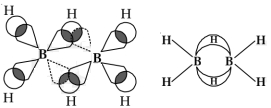
$(A)$ In $B_2H_6$,each $B$ atom uses $sp^3$ hybrids for bonding. Out of the four $sp^3$ hybrids on each $B$ atom,one is without an electron shown in broken lines. The terminal $B-H$ bonds are normal $2$-centre-$2$-electron bonds but the two bridge bonds are $3$-centre-$2$-electron bonds. The $3$-centre-$2$-electron bridge bonds are also referred to as banana bonds.
$(B)$ Gallium with an unusually low melting point $(303 \ K)$,could exist in a liquid state during summer. Its high boiling point $(2676 \ K)$ makes it a useful material for measuring high temperatures.
$(C)$ Borax is used as a flux for soldering metals,and for heat,scratch,and stain-resistant glazed coating to earthenwares.
$(D)$ Zeolites are aluminosilicates and are widely used as catalysts in petrochemical industries for cracking of hydrocarbons and isomerization,e.g.,$ZSM-5$ (a type of zeolite) is used to convert alcohols directly into gasoline.
$(E)$ Quartz,cristobalite,and tridymite are some of the crystalline forms of silica.
$(A)$ In $B_2H_6$,each $B$ atom uses $sp^3$ hybrids for bonding. Out of the four $sp^3$ hybrids on each $B$ atom,one is without an electron shown in broken lines. The terminal $B-H$ bonds are normal $2$-centre-$2$-electron bonds but the two bridge bonds are $3$-centre-$2$-electron bonds. The $3$-centre-$2$-electron bridge bonds are also referred to as banana bonds.
$(B)$ Gallium with an unusually low melting point $(303 \ K)$,could exist in a liquid state during summer. Its high boiling point $(2676 \ K)$ makes it a useful material for measuring high temperatures.
$(C)$ Borax is used as a flux for soldering metals,and for heat,scratch,and stain-resistant glazed coating to earthenwares.
$(D)$ Zeolites are aluminosilicates and are widely used as catalysts in petrochemical industries for cracking of hydrocarbons and isomerization,e.g.,$ZSM-5$ (a type of zeolite) is used to convert alcohols directly into gasoline.
$(E)$ Quartz,cristobalite,and tridymite are some of the crystalline forms of silica.
0 likes
View Solution347
Difficult
Describe the general trends in the following properties of the elements in Groups $13$ and $14$.
$(A)$ Atomic size
$(B)$ Ionization enthalpy
$(C)$ Metallic character
$(D)$ Oxidation states
$(E)$ Nature of halides
$(A)$ Atomic size
$(B)$ Ionization enthalpy
$(C)$ Metallic character
$(D)$ Oxidation states
$(E)$ Nature of halides
Solution
(N/A) For Group $13$:
$(A)$ Atomic size: Atomic radius generally increases down the group due to the addition of new shells. However,$Ga$ has a smaller atomic radius than $Al$ due to poor shielding by $d$-electrons.
$(B)$ Ionization enthalpy: The trend is irregular $(B > Al < Ga > In < Tl)$ due to the shielding effect of $d$ and $f$ orbitals and the increase in nuclear charge.
$(C)$ Metallic character: Increases down the group as ionization energy decreases.
$(D)$ Oxidation states: Group $13$ shows $+3$ and $+1$ (due to inert pair effect). Group $14$ shows $+4$ and $+2$.
$(E)$ Nature of halides: Group $13$ forms $MX_3$ type halides. Group $14$ forms $MX_2$ and $MX_4$ type halides.
$(A)$ Atomic size: Atomic radius generally increases down the group due to the addition of new shells. However,$Ga$ has a smaller atomic radius than $Al$ due to poor shielding by $d$-electrons.
$(B)$ Ionization enthalpy: The trend is irregular $(B > Al < Ga > In < Tl)$ due to the shielding effect of $d$ and $f$ orbitals and the increase in nuclear charge.
$(C)$ Metallic character: Increases down the group as ionization energy decreases.
$(D)$ Oxidation states: Group $13$ shows $+3$ and $+1$ (due to inert pair effect). Group $14$ shows $+4$ and $+2$.
$(E)$ Nature of halides: Group $13$ forms $MX_3$ type halides. Group $14$ forms $MX_2$ and $MX_4$ type halides.
0 likes
View Solution348
Medium
When an aqueous solution of borax is acidified with hydrochloric acid,a white crystalline solid is formed which is soapy to touch. Is this solid acidic or basic in nature? Explain.
Solution
(N/A) An aqueous solution of borax is acidified with $HCl$ to produce boric acid $(H_{3}BO_{3})$,which appears as a white crystalline solid and is soapy to the touch.
The chemical reaction is:
$Na_{2}B_{4}O_{7} + 2HCl + 5H_{2}O \rightarrow 2NaCl + 4H_{3}BO_{3}$
This solid is acidic in nature. Boric acid is a weak monobasic Lewis acid. It does not act as a protonic acid (it does not release $H^{+}$ ions directly); instead,it acts as a Lewis acid by accepting a lone pair of electrons from a hydroxyl ion $(OH^{-})$ from water:
$B(OH)_{3} + 2H_{2}O \rightarrow [B(OH)_{4}]^{-} + H_{3}O^{+}$
The chemical reaction is:
$Na_{2}B_{4}O_{7} + 2HCl + 5H_{2}O \rightarrow 2NaCl + 4H_{3}BO_{3}$
This solid is acidic in nature. Boric acid is a weak monobasic Lewis acid. It does not act as a protonic acid (it does not release $H^{+}$ ions directly); instead,it acts as a Lewis acid by accepting a lone pair of electrons from a hydroxyl ion $(OH^{-})$ from water:
$B(OH)_{3} + 2H_{2}O \rightarrow [B(OH)_{4}]^{-} + H_{3}O^{+}$
0 likes
View Solution349
Difficult
Three pairs of compounds are given below. Identify the compound in each pair which has the group $13$ element in a more stable oxidation state. Give reasons for your choice and state the nature of bonding. $(A)$ $TlCl_3, TlCl$ $(B)$ $AlCl_3, AlCl$ $(C)$ $InCl_3, InCl$
Solution
(A-D) $TlCl$ is more stable than $TlCl_3$ because,moving down the group,the lower oxidation state $(+1)$ becomes more stable due to the inert pair effect. $TlCl$ is ionic,while $TlCl_3$ is covalent.
$(B)$ $AlCl_3$ is more stable than $AlCl$ because $Al$ does not exhibit the inert pair effect. $AlCl_3$ is a covalent compound that acts as a Lewis acid.
$(C)$ $InCl$ is more stable than $InCl_3$ due to the inert pair effect,which makes the $+1$ oxidation state more stable for heavier elements. $In$ exhibits both $+3$ and $+1$ oxidation states. The reaction is: $3 InCl_{(aq)} \rightarrow 2 In_{(s)} + In_{(aq)}^{3+} + 3 Cl_{(aq)}^{-}$
$(B)$ $AlCl_3$ is more stable than $AlCl$ because $Al$ does not exhibit the inert pair effect. $AlCl_3$ is a covalent compound that acts as a Lewis acid.
$(C)$ $InCl$ is more stable than $InCl_3$ due to the inert pair effect,which makes the $+1$ oxidation state more stable for heavier elements. $In$ exhibits both $+3$ and $+1$ oxidation states. The reaction is: $3 InCl_{(aq)} \rightarrow 2 In_{(s)} + In_{(aq)}^{3+} + 3 Cl_{(aq)}^{-}$
0 likes
View Solution350
Medium
$BCl_3$ exists as a monomer,whereas $AlCl_3$ is dimerized through halogen bridging. Give reason. Explain the structure of the dimer of $AlCl_3$ also.
Solution
$BCl_3$ does not dimerize because of the small size of the boron atom. Boron cannot accommodate four large-sized chloride ions around it due to steric hindrance.
$AlCl_3$ exists as a dimer in which $Al$ uses its vacant $3p$-orbital to coordinate with a $Cl$ atom from another $AlCl_3$ unit to complete its octet.
$AlCl_3$ achieves stability by forming a dimer,$Al_2Cl_6$,where two $Al$ atoms are bridged by two $Cl$ atoms. The structure consists of two $AlCl_4$ tetrahedra sharing a common edge.
$AlCl_3$ exists as a dimer in which $Al$ uses its vacant $3p$-orbital to coordinate with a $Cl$ atom from another $AlCl_3$ unit to complete its octet.
$AlCl_3$ achieves stability by forming a dimer,$Al_2Cl_6$,where two $Al$ atoms are bridged by two $Cl$ atoms. The structure consists of two $AlCl_4$ tetrahedra sharing a common edge.
0 likes
View Solutionp-Block Elements (Class 11) — Boron family · Frequently Asked Questions
1Are these p-Block Elements (Class 11) questions useful for JEE and NEET?
Yes. All questions in this section are mapped to JEE Main and NEET exam patterns. Previous year questions from JEE Main, NEET, GUJCET and state-level exams are included with full solutions.
2Can I switch to Hindi or Gujarati for these questions?
Yes. Use the language tabs in the hero section or the sidebar to view the same questions and solutions in English, Hindi or Gujarati.
3How do I generate a question paper from this subtopic?
Use the Vedclass Exam Paper Generator — select the chapter and subtopic, set difficulty, and generate Sets A, B, C, D automatically. First 3 chapters of every subject are free.
Vedclass Products
For Students
Vedclass Test Series
Mock tests in real JEE/NEET style with performance analysis. 5-day free trial.
Start Free TrialFor Teachers
Exam Paper Generator
Generate Set A/B/C/D papers from this chapter in 2 minutes. 3 chapters free.
Try FreeFor Institutes
Online Exam Module
Live online exams with unlimited students, 360° analytics & white-label branding.
See DemoFor Teachers & Institutes
Generate a p-Block Elements (Class 11) Exam Paper in 2 Minutes
Select subtopic & difficulty — Sets A, B, C, D auto-generated with No Repeat logic.
First 3 chapters of every subject are free — no payment required.