
A English
Aromatic hydrocarbon Questions in English
Class 11 Chemistry · Hydrocarbons · Aromatic hydrocarbon
872+
Questions
English
Language
100%
With Solutions
Showing 20 of 872 questions in English
851
MediumMCQ
The compound prepared by a substitution reaction of benzene is
A
acetophenone
B
glyoxal
C
cyclohexane
D
hexabromo cyclohexane
Solution
(A) Acetophenone can be prepared from benzene by its electrophilic substitution (Friedel-Crafts acylation) reaction as follows:
$C_6H_6 + CH_3COCl \xrightarrow{Anhyd. AlCl_3} C_6H_5COCH_3 + HCl$
In this reaction,the hydrogen atom of the benzene ring is replaced by an acetyl group $(-COCH_3)$,which is a characteristic electrophilic substitution reaction.
$C_6H_6 + CH_3COCl \xrightarrow{Anhyd. AlCl_3} C_6H_5COCH_3 + HCl$
In this reaction,the hydrogen atom of the benzene ring is replaced by an acetyl group $(-COCH_3)$,which is a characteristic electrophilic substitution reaction.
0 likes
View Solution852
MediumMCQ
What is the molecular formula of the product formed when benzene is reacted with ethyl chloride in the presence of anhydrous aluminium chloride?
A
$C_8H_{10}$
B
$C_6H_6$
C
$C_8H_8$
D
$C_6H_5Cl$
Solution
(A) In the presence of a Lewis acid (like $AlCl_3$),benzene undergoes an electrophilic substitution reaction with an alkyl halide. This reaction is known as Friedel-Crafts alkylation.
The reaction is as follows:
$C_6H_6 + C_2H_5Cl \xrightarrow{AlCl_3} C_6H_5-C_2H_5 + HCl$
The product formed is ethylbenzene,which has the molecular formula $C_8H_{10}$.
The reaction is as follows:
$C_6H_6 + C_2H_5Cl \xrightarrow{AlCl_3} C_6H_5-C_2H_5 + HCl$
The product formed is ethylbenzene,which has the molecular formula $C_8H_{10}$.
0 likes
View Solution853
MediumMCQ
Which one of the following is used in the preparation of styrene?
A
$CH_3CHO$
B
$P_2O_5$
C
$CH_4$
D
$C_6H_6$
Solution
(D) Styrene $(C_6H_5CH=CH_2)$ is prepared from benzene $(C_6H_6)$ in two steps:
$1$. Ethylbenzene is prepared by the alkylation of benzene with ethene in the presence of an $AlCl_3$ catalyst: $C_6H_6 + CH_2=CH_2 \xrightarrow{AlCl_3} C_6H_5CH_2CH_3$.
$2$. Ethylbenzene is then dehydrogenated at high temperature $(700^{\circ}C)$ using a catalyst (typically iron oxide or $Al_2O_3$) to produce styrene: $C_6H_5CH_2CH_3 \xrightarrow{700^{\circ}C, \text{catalyst}} C_6H_5CH=CH_2 + H_2$.
$1$. Ethylbenzene is prepared by the alkylation of benzene with ethene in the presence of an $AlCl_3$ catalyst: $C_6H_6 + CH_2=CH_2 \xrightarrow{AlCl_3} C_6H_5CH_2CH_3$.
$2$. Ethylbenzene is then dehydrogenated at high temperature $(700^{\circ}C)$ using a catalyst (typically iron oxide or $Al_2O_3$) to produce styrene: $C_6H_5CH_2CH_3 \xrightarrow{700^{\circ}C, \text{catalyst}} C_6H_5CH=CH_2 + H_2$.
0 likes
View Solution854
DifficultMCQ
Ozonolysis of $o$-xylene produces:

A
$I:III = 1:2$
B
$II:III = 2:1$
C
$I:II:III = 1:2:3$
D
$I:II:III = 3:2:1$
Solution
(C) $o$-Xylene exists in two resonance structures. Ozonolysis of these structures breaks the double bonds to form dicarbonyl compounds.
Structure $I$ is $CH_3-CO-CO-CH_3$ (butane$-2,3-$dione).
Structure $II$ is $CH_3-CO-CHO$ ($2$-oxopropanal).
Structure $III$ is $CHO-CHO$ (ethanedial).
From the resonance structures of $o$-xylene,ozonolysis yields:
$1$ mole of $I$ (butane$-2,3-$dione),
$2$ moles of $II$ ($2$-oxopropanal),
$3$ moles of $III$ (ethanedial).
Therefore,the ratio of the products is $I:II:III = 1:2:3$.
Structure $I$ is $CH_3-CO-CO-CH_3$ (butane$-2,3-$dione).
Structure $II$ is $CH_3-CO-CHO$ ($2$-oxopropanal).
Structure $III$ is $CHO-CHO$ (ethanedial).
From the resonance structures of $o$-xylene,ozonolysis yields:
$1$ mole of $I$ (butane$-2,3-$dione),
$2$ moles of $II$ ($2$-oxopropanal),
$3$ moles of $III$ (ethanedial).
Therefore,the ratio of the products is $I:II:III = 1:2:3$.
0 likes
View Solution855
DifficultMCQ
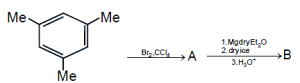
The compounds $A$ and $B$ are respectively
A
$A$ = $1,3,5-$tris(bromomethyl)benzene; $B$ = $1,3,5-$benzenetricarboxylic acid
B
$A$ = $1-$bromo$-3,5-$dimethylbenzene; $B$ = $3,5-$dimethylbenzoic acid
C
$A$ = $2-$bromo$-1,3,5-$trimethylbenzene; $B$ = $2,4,6-$trimethylbenzoic acid
D
$A$ = $2,4,6-$tribromo$-1,3,5-$trimethylbenzene; $B$ = $2,4,6-$trimethylbenzene$-1,3,5-$tricarboxylic acid
Solution
(C) $1$. The starting material is $1,3,5$-trimethylbenzene (mesitylene).
$2$. Electrophilic aromatic substitution with $Br_2$ in $CCl_4$ occurs at the position ortho to the methyl groups. Since all positions are equivalent,it forms $2$-bromo-$1,3,5$-trimethylbenzene $(A)$.
$3$. Treatment of $A$ with $Mg$ in dry ether forms the Grignard reagent,$2,4,6$-trimethylphenylmagnesium bromide.
$4$. Reaction of the Grignard reagent with dry ice $(CO_2)$ followed by acidic workup $(H_3O^+)$ yields the corresponding carboxylic acid,$2,4,6$-trimethylbenzoic acid $(B)$.
$2$. Electrophilic aromatic substitution with $Br_2$ in $CCl_4$ occurs at the position ortho to the methyl groups. Since all positions are equivalent,it forms $2$-bromo-$1,3,5$-trimethylbenzene $(A)$.
$3$. Treatment of $A$ with $Mg$ in dry ether forms the Grignard reagent,$2,4,6$-trimethylphenylmagnesium bromide.
$4$. Reaction of the Grignard reagent with dry ice $(CO_2)$ followed by acidic workup $(H_3O^+)$ yields the corresponding carboxylic acid,$2,4,6$-trimethylbenzoic acid $(B)$.
0 likes
View Solution856
DifficultMCQ
From the following compounds,choose the one which is not aromatic.
A
Cyclopropenyl cation
B
Cyclooctatetraene
C
Cyclopentadienyl anion
D
$6-$(dimethylamino)fulvene
Solution
(B) For a compound to be aromatic,it must satisfy $H$ückel's rule:
$(I)$ The molecule must be cyclic.
$(II)$ The molecule must be planar.
$(III)$ The molecule must be fully conjugated (all atoms in the ring must have an unhybridized $p$-orbital).
$(IV)$ The molecule must have $(4n+2) \pi$ electrons,where $n = 0, 1, 2, ...$.
Analysis of the given compounds:
$(A)$ Cyclopropenyl cation: Cyclic,planar,conjugated,and has $2 \pi$ electrons $(n=0)$. It is aromatic.
$(B)$ Cyclooctatetraene: It has $8 \pi$ electrons ($4n$ system,$n=2$). Furthermore,it adopts a non-planar 'tub' shape to avoid anti-aromaticity. Thus,it is non-aromatic.
$(C)$ Cyclopentadienyl anion: Cyclic,planar,conjugated,and has $6 \pi$ electrons $(n=1)$. It is aromatic.
$(D)$ $6-$(dimethylamino)fulvene: This is a substituted fulvene derivative that exhibits aromatic character due to the contribution of a dipolar resonance structure where the five-membered ring becomes a cyclopentadienyl anion ($6 \pi$ electrons).
Therefore,cyclooctatetraene is not aromatic.
$(I)$ The molecule must be cyclic.
$(II)$ The molecule must be planar.
$(III)$ The molecule must be fully conjugated (all atoms in the ring must have an unhybridized $p$-orbital).
$(IV)$ The molecule must have $(4n+2) \pi$ electrons,where $n = 0, 1, 2, ...$.
Analysis of the given compounds:
$(A)$ Cyclopropenyl cation: Cyclic,planar,conjugated,and has $2 \pi$ electrons $(n=0)$. It is aromatic.
$(B)$ Cyclooctatetraene: It has $8 \pi$ electrons ($4n$ system,$n=2$). Furthermore,it adopts a non-planar 'tub' shape to avoid anti-aromaticity. Thus,it is non-aromatic.
$(C)$ Cyclopentadienyl anion: Cyclic,planar,conjugated,and has $6 \pi$ electrons $(n=1)$. It is aromatic.
$(D)$ $6-$(dimethylamino)fulvene: This is a substituted fulvene derivative that exhibits aromatic character due to the contribution of a dipolar resonance structure where the five-membered ring becomes a cyclopentadienyl anion ($6 \pi$ electrons).
Therefore,cyclooctatetraene is not aromatic.
0 likes
View Solution857
MediumMCQ
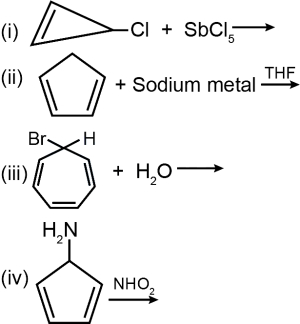
The total number of aromatic species generated in the following reactions is:
A
zero
B
$2$
C
$3$
D
$4$
Solution
(C) To determine the aromaticity,we use the Huckel rule: a cyclic,planar,fully conjugated system with $(4n+2)$ $\pi$-electrons is aromatic,where $n$ is an integer $(0, 1, 2, \dots)$.
$(i)$ Cyclopropenyl chloride reacts with $SbCl_5$ to form the cyclopropenyl cation,which has $2$ $\pi$-electrons $(n=0)$. This is aromatic.
$(ii)$ Cyclopentadiene reacts with sodium metal to form the cyclopentadienyl anion,which has $6$ $\pi$-electrons $(n=1)$. This is aromatic.
$(iii)$ $7$-Bromocyclohepta-$1,3,5$-triene reacts with water to form the tropylium cation,which has $6$ $\pi$-electrons $(n=1)$. This is aromatic.
$(iv)$ Cyclopentadienylamine reacts with $HNO_2$ to form a $4$ $\pi$-electron system (cyclopentadienyl cation),which is anti-aromatic (not aromatic).
Therefore,there are $3$ aromatic species generated.
$(i)$ Cyclopropenyl chloride reacts with $SbCl_5$ to form the cyclopropenyl cation,which has $2$ $\pi$-electrons $(n=0)$. This is aromatic.
$(ii)$ Cyclopentadiene reacts with sodium metal to form the cyclopentadienyl anion,which has $6$ $\pi$-electrons $(n=1)$. This is aromatic.
$(iii)$ $7$-Bromocyclohepta-$1,3,5$-triene reacts with water to form the tropylium cation,which has $6$ $\pi$-electrons $(n=1)$. This is aromatic.
$(iv)$ Cyclopentadienylamine reacts with $HNO_2$ to form a $4$ $\pi$-electron system (cyclopentadienyl cation),which is anti-aromatic (not aromatic).
Therefore,there are $3$ aromatic species generated.
0 likes
View Solution858
MediumMCQ
Friedel-Crafts reaction using $MeCl$ and anhydrous $AlCl_3$ will take place most efficiently with
A
benzene
B
nitrobenzene
C
acetophenone
D
toluene
Solution
(D) The Friedel-Crafts reaction is an electrophilic aromatic substitution reaction.
It requires an electron-rich aromatic ring to react efficiently with the electrophile $(CH_3^+)$.
Nitrobenzene and acetophenone contain electron-withdrawing groups ($-NO_2$ and $-COCH_3$ respectively),which deactivate the benzene ring towards electrophilic substitution.
Benzene is moderately reactive.
Toluene contains a methyl group $(-CH_3)$,which is an electron-donating group due to the $+I$ effect and hyperconjugation.
This increases the electron density of the benzene ring,making it the most reactive among the given options towards electrophilic substitution.
It requires an electron-rich aromatic ring to react efficiently with the electrophile $(CH_3^+)$.
Nitrobenzene and acetophenone contain electron-withdrawing groups ($-NO_2$ and $-COCH_3$ respectively),which deactivate the benzene ring towards electrophilic substitution.
Benzene is moderately reactive.
Toluene contains a methyl group $(-CH_3)$,which is an electron-donating group due to the $+I$ effect and hyperconjugation.
This increases the electron density of the benzene ring,making it the most reactive among the given options towards electrophilic substitution.
0 likes
View Solution859
MediumMCQ
Toluene reacts with mixed acid at $25^{\circ} C$ to produce
A
nearly equal amounts of $o-$ and $m-$ nitrotoluene
B
$p-$ nitrotoluene (only)
C
Predominantly $o-$ nitrotoluene and $p-$ nitrotoluene
D
$2, 4, 6-$ trinitrotoluene (only)
Solution
(C) The methyl group $(-CH_3)$ in toluene is an electron-donating group by inductive effect and hyperconjugation.
It is an ortho- and para-directing group.
Therefore,the nitration of toluene with a mixture of concentrated $HNO_3$ and $H_2SO_4$ at $25^{\circ} C$ yields a mixture of $o-$nitrotoluene and $p-$nitrotoluene as the major products,with a very small amount of $m-$nitrotoluene.
Thus,the reaction produces predominantly $o-$nitrotoluene and $p-$nitrotoluene.
It is an ortho- and para-directing group.
Therefore,the nitration of toluene with a mixture of concentrated $HNO_3$ and $H_2SO_4$ at $25^{\circ} C$ yields a mixture of $o-$nitrotoluene and $p-$nitrotoluene as the major products,with a very small amount of $m-$nitrotoluene.
Thus,the reaction produces predominantly $o-$nitrotoluene and $p-$nitrotoluene.
0 likes
View Solution860
EasyMCQ
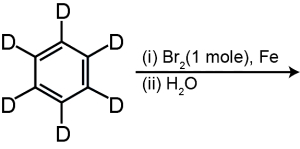
The major product$(s)$ obtained from the following reaction of $1 \ mole$ of hexadeuteriobenzene $(C_6D_6)$ is/are:
A
Bromopentadeuteriobenzene $(C_6D_5Br)$
B
Hexadeuteriobiphenyl
C
Dibromotetradeuteriobenzene
D
Monodeuterio-pentabromobenzene
Solution
(A) The reaction of hexadeuteriobenzene $(C_6D_6)$ with $Br_2$ in the presence of $Fe$ is an electrophilic aromatic substitution reaction.
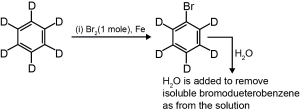
Since $1 \ mole$ of $Br_2$ is used,one deuterium atom is replaced by a bromine atom to form bromopentadeuteriobenzene $(C_6D_5Br)$.
The addition of $H_2O$ is a standard workup procedure to remove inorganic salts or quench the reaction.
Thus,the major product is bromopentadeuteriobenzene.
Since $1 \ mole$ of $Br_2$ is used,one deuterium atom is replaced by a bromine atom to form bromopentadeuteriobenzene $(C_6D_5Br)$.
The addition of $H_2O$ is a standard workup procedure to remove inorganic salts or quench the reaction.
Thus,the major product is bromopentadeuteriobenzene.
0 likes
View Solution861
MediumMCQ
$1,4-$dimethylbenzene on heating with anhydrous $AlCl_{3}$ and $HCl$ produces
A
$1,2-$dimethylbenzene
B
$1,3-$dimethylbenzene
C
$1,2,3-$trimethylbenzene
D
ethylbenzene
Solution
(B) The reaction of $1,4-$dimethylbenzene ($p-$xylene) with anhydrous $AlCl_{3}$ and $HCl$ is an example of an isomerization reaction.
Under these acidic conditions,the methyl groups undergo rearrangement to form the more thermodynamically stable isomer.
$1,3-$dimethylbenzene ($m-$xylene) is more stable than $1,4-$dimethylbenzene ($p-$xylene) due to the reduced steric hindrance and electronic factors in the meta-substituted product.
Therefore,the reaction produces $1,3-$dimethylbenzene.
Under these acidic conditions,the methyl groups undergo rearrangement to form the more thermodynamically stable isomer.
$1,3-$dimethylbenzene ($m-$xylene) is more stable than $1,4-$dimethylbenzene ($p-$xylene) due to the reduced steric hindrance and electronic factors in the meta-substituted product.
Therefore,the reaction produces $1,3-$dimethylbenzene.
0 likes
View Solution862
DifficultMCQ
The best reagent for nuclear iodination of aromatic compounds is:
A
$KI / CH_{3}COCH_{3}$
B
$I_{2} / CH_{3}CN$
C
$KI / CH_{3}COOH$
D
$I_{2} / HNO_{3}$
Solution
(D) Nuclear iodination of aromatic compounds is a reversible electrophilic substitution reaction.
$I_{2}$ is a weak electrophile and the reaction produces $HI$ as a byproduct,which is a strong reducing agent and can reduce the iodinated product back to the starting material.
To drive the reaction forward,an oxidizing agent like $HNO_{3}$ is used to oxidize $HI$ to $I_{2}$,thereby preventing the reverse reaction.
$2HI + 2HNO_{3} \rightarrow I_{2} + 2NO_{2} + 2H_{2}O$.
Thus,$I_{2} / HNO_{3}$ is the best reagent for this purpose.
$I_{2}$ is a weak electrophile and the reaction produces $HI$ as a byproduct,which is a strong reducing agent and can reduce the iodinated product back to the starting material.
To drive the reaction forward,an oxidizing agent like $HNO_{3}$ is used to oxidize $HI$ to $I_{2}$,thereby preventing the reverse reaction.
$2HI + 2HNO_{3} \rightarrow I_{2} + 2NO_{2} + 2H_{2}O$.
Thus,$I_{2} / HNO_{3}$ is the best reagent for this purpose.
0 likes
View Solution863
DifficultMCQ
Identify the correct method for the synthesis of the compound shown below from the following alternatives.
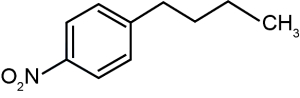
A
Benzene $\xrightarrow{CH_3CH_2CH_2CH_2Cl, AlCl_3}$ $\xrightarrow{HNO_3, H_2SO_4}$
B
Benzene $\xrightarrow{CH_3CH_2CH_2COCl, AlCl_3}$ $\xrightarrow{Zn/Hg, HCl/\Delta}$ $\xrightarrow{HNO_3, H_2SO_4}$
C
Benzene $\xrightarrow{CH_3CH_2CH_2COCl, AlCl_3}$ $\xrightarrow{HNO_3, H_2SO_4}$ $\xrightarrow{Zn/Hg, HCl/\Delta}$
D
Benzene $\xrightarrow{CH_3CH_2CH_2COCl, AlCl_3}$ $\xrightarrow{KMnO_4, OH^-}$ $\xrightarrow{HNO_3, H_2SO_4}$
Solution
(B) The synthesis of $1$-butyl-$4$-nitrobenzene involves the following steps:
$1$. Friedel-Crafts acylation of benzene with butanoyl chloride $(CH_3CH_2CH_2COCl)$ in the presence of $AlCl_3$ gives $1$-phenylbutan-$1$-one.
$2$. Clemmensen reduction of the ketone using $Zn/Hg$ and $HCl$ with heat reduces the carbonyl group to a methylene group,yielding butylbenzene.
$3$. Nitration of butylbenzene using a mixture of concentrated $HNO_3$ and $H_2SO_4$ introduces the nitro group at the para position because the alkyl group is an ortho/para-directing group.
$1$. Friedel-Crafts acylation of benzene with butanoyl chloride $(CH_3CH_2CH_2COCl)$ in the presence of $AlCl_3$ gives $1$-phenylbutan-$1$-one.
$2$. Clemmensen reduction of the ketone using $Zn/Hg$ and $HCl$ with heat reduces the carbonyl group to a methylene group,yielding butylbenzene.
$3$. Nitration of butylbenzene using a mixture of concentrated $HNO_3$ and $H_2SO_4$ introduces the nitro group at the para position because the alkyl group is an ortho/para-directing group.
0 likes
View Solution864
MediumMCQ
Reaction of benzene with $Me_{3}CCOCl$ in the presence of anhydrous $AlCl_{3}$ gives:
A
$Ph-N(O)=CMe_{3}$
B
$Ph-CMe_{3}$
C
$p-Me_{3}C-C_{6}H_{4}-COCMe_{3}$
D
$Ph-COCMe_{3} \cdot AlCl_{3}$
Solution
(B) The reaction of benzene with $Me_{3}CCOCl$ (pivaloyl chloride) in the presence of anhydrous $AlCl_{3}$ is a Friedel-Crafts acylation reaction.
However,because the acyl group is bulky ($tert$-butyl group),the intermediate acylium ion is highly hindered.
Under these conditions,the reaction often proceeds with decarbonylation,leading to the formation of $tert$-butylbenzene $(Ph-CMe_{3})$ as the major product.
The reaction proceeds as follows:
$C_{6}H_{6} + Me_{3}CCOCl \xrightarrow{Anhy. AlCl_{3}} C_{6}H_{5}COCMe_{3} + HCl$
$C_{6}H_{5}COCMe_{3} \xrightarrow{-CO} C_{6}H_{5}CMe_{3}$
However,because the acyl group is bulky ($tert$-butyl group),the intermediate acylium ion is highly hindered.
Under these conditions,the reaction often proceeds with decarbonylation,leading to the formation of $tert$-butylbenzene $(Ph-CMe_{3})$ as the major product.
The reaction proceeds as follows:
$C_{6}H_{6} + Me_{3}CCOCl \xrightarrow{Anhy. AlCl_{3}} C_{6}H_{5}COCMe_{3} + HCl$
$C_{6}H_{5}COCMe_{3} \xrightarrow{-CO} C_{6}H_{5}CMe_{3}$
0 likes
View Solution865
MediumMCQ
The ease of nitration of the following three hydrocarbons follows the order: $(I)$ Toluene,$(II)$ $m$-Xylene,$(III)$ $p$-Xylene.
A
$II = III \approx I$
B
$I = II > III$
C
$III > II > I$
D
$II > III > I$
Solution
(C) Nitration is an electrophilic aromatic substitution reaction. The rate of reaction depends on the electron density of the benzene ring. Higher electron density leads to faster nitration.
$(I)$ Toluene has one methyl group $(-CH_3)$ which is electron-donating by the inductive effect $(+I)$ and hyperconjugation.
$(II)$ $m$-Xylene has two methyl groups. The electron density is increased by two methyl groups.
$(III)$ $p$-Xylene has two methyl groups. Similar to $m$-xylene,it has two electron-donating groups.
Comparing $m$-xylene and $p$-xylene: In $p$-xylene,the two methyl groups are at the para positions,which provides more effective stabilization of the intermediate arenium ion compared to $m$-xylene due to the resonance and hyperconjugation effects being more pronounced at the para position relative to the site of electrophilic attack.
Thus,the order of reactivity is $p$-xylene $(III)$ > $m$-xylene $(II)$ > toluene $(I)$.
$(I)$ Toluene has one methyl group $(-CH_3)$ which is electron-donating by the inductive effect $(+I)$ and hyperconjugation.
$(II)$ $m$-Xylene has two methyl groups. The electron density is increased by two methyl groups.
$(III)$ $p$-Xylene has two methyl groups. Similar to $m$-xylene,it has two electron-donating groups.
Comparing $m$-xylene and $p$-xylene: In $p$-xylene,the two methyl groups are at the para positions,which provides more effective stabilization of the intermediate arenium ion compared to $m$-xylene due to the resonance and hyperconjugation effects being more pronounced at the para position relative to the site of electrophilic attack.
Thus,the order of reactivity is $p$-xylene $(III)$ > $m$-xylene $(II)$ > toluene $(I)$.
0 likes
View Solution866
DifficultMCQ
Identify the correct statements:
The presence of $-NO_{2}$ group in a benzene ring:
The presence of $-NO_{2}$ group in a benzene ring:
A
$B$ and $D$ Only
B
$C$ and $A$ Only
C
$A$ and $D$ Only
D
$B$ and $C$ Only
Solution
(D) The $-NO_{2}$ group is a strong electron-withdrawing group due to its $-I$ and $-M$ effects.
$1$. It reduces the electron density of the benzene ring,thereby deactivating it towards electrophilic aromatic substitution (Statement $B$ is correct).
$2$. It increases the susceptibility of the ring towards nucleophilic attack by stabilizing the intermediate carbanion (Meisenheimer complex) through its $-M$ effect,thereby activating the ring towards nucleophilic aromatic substitution (Statement $C$ is correct).
Therefore,statements $B$ and $C$ are correct.
$1$. It reduces the electron density of the benzene ring,thereby deactivating it towards electrophilic aromatic substitution (Statement $B$ is correct).
$2$. It increases the susceptibility of the ring towards nucleophilic attack by stabilizing the intermediate carbanion (Meisenheimer complex) through its $-M$ effect,thereby activating the ring towards nucleophilic aromatic substitution (Statement $C$ is correct).
Therefore,statements $B$ and $C$ are correct.
0 likes
View Solution867
DifficultMCQ
Consider the following sequence of reactions. The major product $P$ is:
A
B
C
D
Solution
(A) The reaction sequence typically involves the oxidation of an alkyl side chain on a benzene ring. When an alkyl group (like an ethyl or propyl group) is attached to a benzene ring,treatment with strong oxidizing agents such as alkaline $KMnO_4$ followed by acidification results in the oxidation of the benzylic carbon to a carboxylic acid group $(-COOH)$. The remaining part of the side chain is cleaved. Therefore,the major product $P$ is a benzoic acid derivative.
0 likes
View Solution868
MediumMCQ
For the following Friedel-Crafts alkylation reaction,which of the statements are correct?
$A$. Major product is n-propyl benzene.
$B$. iso-propyl carbocation intermediate is also generated.
$C$. Multiple substitution is inevitable.
$D$. Introducing electron-donating substituent on benzene will not produce any alkyl benzene.
$A$. Major product is n-propyl benzene.
$B$. iso-propyl carbocation intermediate is also generated.
$C$. Multiple substitution is inevitable.
$D$. Introducing electron-donating substituent on benzene will not produce any alkyl benzene.

A
$A$ and $D$ only
B
$B$ and $C$ only
C
$A$ and $C$ only
D
$B$ and $D$ only
Solution
(B) Friedel-Crafts alkylation of benzene with $n$-propyl chloride gives $iso$-propylbenzene as the major product because the $n$-propyl carbocation undergoes rearrangement to form a more stable $iso$-propyl carbocation: $CH_3CH_2CH_2^+ \rightarrow CH_3CH^+CH_3$.
Thus,Statement $B$ is correct.
Furthermore,alkylation of benzene increases the electron density on the ring,making it more reactive towards further electrophilic substitution,hence multiple substitution is a common byproduct. Thus,Statement $C$ is also correct.
Thus,Statement $B$ is correct.
Furthermore,alkylation of benzene increases the electron density on the ring,making it more reactive towards further electrophilic substitution,hence multiple substitution is a common byproduct. Thus,Statement $C$ is also correct.
0 likes
View Solution869
DifficultMCQ
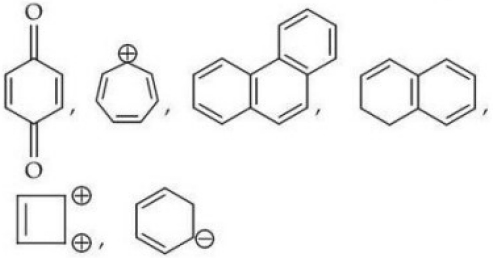
The total number of aromatic compounds/species from the following is:
A
$6$
B
$4$
C
$3$
D
$5$
Solution
(C) species is aromatic if it is cyclic,planar,fully conjugated,and follows $H$ückel's rule $(4n+2) \pi$ electrons.
$1$. $p$-Benzoquinone: Non-aromatic (contains $sp^3$ hybridized carbonyl carbons).
$2$. Cycloheptatrienyl cation: Aromatic ($6\pi$ electrons,cyclic,planar,fully conjugated).
$3$. Phenanthrene: Aromatic ($14\pi$ electrons,cyclic,planar,fully conjugated).
$4$. $1,4-$Cyclohexadiene: Non-aromatic (contains $sp^3$ hybridized carbons).
$5$. Cyclobutadiene dication: Aromatic ($2\pi$ electrons,cyclic,planar,fully conjugated).
$6$. Cyclohexadienyl anion: Non-aromatic (contains $sp^3$ hybridized carbon).
Thus,the aromatic species are: Cycloheptatrienyl cation,Phenanthrene,and Cyclobutadiene dication.
Total count = $3$.
$1$. $p$-Benzoquinone: Non-aromatic (contains $sp^3$ hybridized carbonyl carbons).
$2$. Cycloheptatrienyl cation: Aromatic ($6\pi$ electrons,cyclic,planar,fully conjugated).
$3$. Phenanthrene: Aromatic ($14\pi$ electrons,cyclic,planar,fully conjugated).
$4$. $1,4-$Cyclohexadiene: Non-aromatic (contains $sp^3$ hybridized carbons).
$5$. Cyclobutadiene dication: Aromatic ($2\pi$ electrons,cyclic,planar,fully conjugated).
$6$. Cyclohexadienyl anion: Non-aromatic (contains $sp^3$ hybridized carbon).
Thus,the aromatic species are: Cycloheptatrienyl cation,Phenanthrene,and Cyclobutadiene dication.
Total count = $3$.
0 likes
View Solution870
MediumMCQ
The number of chlorine atoms present in the organic products $X$ and $Y$ of the following reactions,respectively,are:
$\text{Benzene} + 6Cl_2 \xrightarrow[\text{dark, cold}]{\text{Anhydr. } AlCl_3} X$
$\text{Benzene} + 3Cl_2 \xrightarrow{UV, 500 \text{ K}} Y$
$\text{Benzene} + 6Cl_2 \xrightarrow[\text{dark, cold}]{\text{Anhydr. } AlCl_3} X$
$\text{Benzene} + 3Cl_2 \xrightarrow{UV, 500 \text{ K}} Y$
A
$3$ and $3$
B
$6$ and $6$
C
$6$ and $3$
D
$3$ and $6$
Solution
(B) $1$. In the first reaction,benzene reacts with $6Cl_2$ in the presence of anhydrous $AlCl_3$ (a Lewis acid) under dark and cold conditions. This is an electrophilic substitution reaction where all hydrogen atoms of benzene are replaced by chlorine atoms,resulting in hexachlorobenzene $(C_6Cl_6)$. Thus,$X$ contains $6$ chlorine atoms.
$2$. In the second reaction,benzene reacts with $3Cl_2$ in the presence of $UV$ light at $500 \text{ K}$. This is a free radical addition reaction. Benzene undergoes addition to form benzene hexachloride $(C_6H_6Cl_6)$,which contains $6$ chlorine atoms. Thus,$Y$ contains $6$ chlorine atoms.
$3$. Therefore,the number of chlorine atoms in $X$ and $Y$ are $6$ and $6$,respectively.
$2$. In the second reaction,benzene reacts with $3Cl_2$ in the presence of $UV$ light at $500 \text{ K}$. This is a free radical addition reaction. Benzene undergoes addition to form benzene hexachloride $(C_6H_6Cl_6)$,which contains $6$ chlorine atoms. Thus,$Y$ contains $6$ chlorine atoms.
$3$. Therefore,the number of chlorine atoms in $X$ and $Y$ are $6$ and $6$,respectively.
0 likes
View SolutionHydrocarbons — Aromatic hydrocarbon · Frequently Asked Questions
1Are these Hydrocarbons questions useful for JEE and NEET?
Yes. All questions in this section are mapped to JEE Main and NEET exam patterns. Previous year questions from JEE Main, NEET, GUJCET and state-level exams are included with full solutions.
2Can I switch to Hindi or Gujarati for these questions?
Yes. Use the language tabs in the hero section or the sidebar to view the same questions and solutions in English, Hindi or Gujarati.
3How do I generate a question paper from this subtopic?
Use the Vedclass Exam Paper Generator — select the chapter and subtopic, set difficulty, and generate Sets A, B, C, D automatically. First 3 chapters of every subject are free.
Vedclass Products
For Students
Vedclass Test Series
Mock tests in real JEE/NEET style with performance analysis. 5-day free trial.
Start Free TrialFor Teachers
Exam Paper Generator
Generate Set A/B/C/D papers from this chapter in 2 minutes. 3 chapters free.
Try FreeFor Institutes
Online Exam Module
Live online exams with unlimited students, 360° analytics & white-label branding.
See DemoFor Teachers & Institutes
Generate a Hydrocarbons Exam Paper in 2 Minutes
Select subtopic & difficulty — Sets A, B, C, D auto-generated with No Repeat logic.
First 3 chapters of every subject are free — no payment required.