
A English
Ionisation energy Questions in English
Class 11 Chemistry · Classification of Elements and Periodicity in Properties · Ionisation energy
402+
Questions
English
Language
100%
With Solutions
Showing 50 of 402 questions in English
201
MediumMCQ
The incorrect statement among the following is:
A
The first ionization potential of $Al$ is less than the first ionization potential of $Mg$.
B
The second ionization potential of $Mg$ is greater than the second ionization potential of $Na$.
C
The first ionization potential of $Na$ is less than the first ionization potential of $Mg$.
D
The third ionization potential of $Mg$ is greater than the third ionization potential of $Al$.
Solution
(B) $1$. The first ionization potential $(IE_1)$ of $Mg$ $(3s^2)$ is higher than $Al$ $(3s^2 3p^1)$ due to the stable fully-filled $s$-orbital. Statement $A$ is correct.
$2$. $Na^+$ has a stable noble gas configuration $(1s^2 2s^2 2p^6)$. Removing a second electron from $Na^+$ requires significantly more energy than removing a second electron from $Mg^+$ $(3s^1)$. Thus,the second ionization potential $(IE_2)$ of $Na$ is much greater than that of $Mg$. Statement $B$ is incorrect.
$3$. $IE_1$ of $Na$ $([Ne] 3s^1)$ is less than $Mg$ $([Ne] 3s^2)$. Statement $C$ is correct.
$4$. $Mg^{2+}$ has a stable noble gas configuration $(1s^2 2s^2 2p^6)$. Removing a third electron from $Mg^{2+}$ requires much higher energy than removing a third electron from $Al^{2+}$ $(3s^1)$. Statement $D$ is correct.
$2$. $Na^+$ has a stable noble gas configuration $(1s^2 2s^2 2p^6)$. Removing a second electron from $Na^+$ requires significantly more energy than removing a second electron from $Mg^+$ $(3s^1)$. Thus,the second ionization potential $(IE_2)$ of $Na$ is much greater than that of $Mg$. Statement $B$ is incorrect.
$3$. $IE_1$ of $Na$ $([Ne] 3s^1)$ is less than $Mg$ $([Ne] 3s^2)$. Statement $C$ is correct.
$4$. $Mg^{2+}$ has a stable noble gas configuration $(1s^2 2s^2 2p^6)$. Removing a third electron from $Mg^{2+}$ requires much higher energy than removing a third electron from $Al^{2+}$ $(3s^1)$. Statement $D$ is correct.
0 likes
View Solution202
DifficultMCQ
The correct values of ionization enthalpies (in $kJ \ mol^{-1}$) of $Si, P, Cl$ and $S$ respectively are
A
$786, 1012, 999, 1256$
B
$1012, 786, 999, 1256$
C
$786, 1012, 1256, 999$
D
$786, 999, 1012, 1256$
Solution
(D) The first ionization enthalpy values for the given elements are: $Si = 786 \ kJ \ mol^{-1}$,$P = 1012 \ kJ \ mol^{-1}$,$S = 999 \ kJ \ mol^{-1}$,and $Cl = 1256 \ kJ \ mol^{-1}$.
Across a period,ionization enthalpy generally increases due to increasing effective nuclear charge and decreasing atomic size.
However,$P$ $(3s^2 3p^3)$ has a stable half-filled $p$-orbital configuration,which makes its ionization enthalpy higher than that of $S$ $(3s^2 3p^4)$.
Therefore,the correct order is $Si < S < P < Cl$,and the corresponding values are $786, 999, 1012, 1256$.
Across a period,ionization enthalpy generally increases due to increasing effective nuclear charge and decreasing atomic size.
However,$P$ $(3s^2 3p^3)$ has a stable half-filled $p$-orbital configuration,which makes its ionization enthalpy higher than that of $S$ $(3s^2 3p^4)$.
Therefore,the correct order is $Si < S < P < Cl$,and the corresponding values are $786, 999, 1012, 1256$.
0 likes
View Solution203
MediumMCQ
The third ionization energy is maximum for
A
Nitrogen
B
Phosphorus
C
Aluminium
D
Boron
Solution
(D) The electronic configuration of Boron $(Z=5)$ is $1s^2 2s^2 2p^1$.
After losing $3$ electrons,Boron attains the stable noble gas configuration of Helium $(1s^2)$.
Removing the third electron from Boron requires breaking the stable $2s^2$ shell,which involves a very high amount of energy compared to the other elements listed.
Therefore,Boron has the maximum third ionization energy.
After losing $3$ electrons,Boron attains the stable noble gas configuration of Helium $(1s^2)$.
Removing the third electron from Boron requires breaking the stable $2s^2$ shell,which involves a very high amount of energy compared to the other elements listed.
Therefore,Boron has the maximum third ionization energy.
0 likes
View Solution204
AdvancedMCQ
Consider the following ionisation reactions:
If the monovalent positive ion of $A$,divalent positive ion of $B$,and trivalent positive ion of $C$ have zero electrons,then which of the following is the incorrect order of the corresponding $I.E.$?
| $A_{(g)} \to A^{+}_{(g)} + e^-, \ A_1$ | $B_{(g)} \to B^{+}_{(g)} + e^-, \ B_1$ |
| $B^{+}_{(g)} \to B^{2+}_{(g)} + e^-, \ B_2$ | $C_{(g)} \to C^{+}_{(g)} + e^-, \ C_1$ |
| $C^{+}_{(g)} \to C^{2+}_{(g)} + e^-, \ C_2$ | $C^{2+}_{(g)} \to C^{3+}_{(g)} + e^-, \ C_3$ |
If the monovalent positive ion of $A$,divalent positive ion of $B$,and trivalent positive ion of $C$ have zero electrons,then which of the following is the incorrect order of the corresponding $I.E.$?
A
$C_3 > B_2 > A_1$
B
$B_1 > A_1 > C_1$
C
$C_3 > C_2 > B_2$
D
$B_2 > C_3 > A_1$
Solution
(D) Given that $A^{+}$,$B^{2+}$,and $C^{3+}$ have zero electrons,these ions must be $H^{+}$,$He^{2+}$,and $Li^{3+}$.
Thus,the neutral atoms are $A = H$ $(1s^1)$,$B = He$ $(1s^2)$,and $C = Li$ $(1s^2 \ 2s^1)$.
Comparing the ionization energies:
$A_1 = IE_1(H) = 13.6 \ eV$
$B_1 = IE_1(He) = 24.6 \ eV$
$B_2 = IE_2(He) = 54.4 \ eV$
$C_1 = IE_1(Li) = 5.4 \ eV$
$C_2 = IE_2(Li) = 75.6 \ eV$
$C_3 = IE_3(Li) = 122.4 \ eV$
Comparing the values:
$C_3 (122.4) > C_2 (75.6) > B_2 (54.4) > B_1 (24.6) > A_1 (13.6) > C_1 (5.4)$.
Evaluating the options:
$A$. $C_3 > B_2 > A_1$ $(122.4 > 54.4 > 13.6)$ is correct.
$B$. $B_1 > A_1 > C_1$ $(24.6 > 13.6 > 5.4)$ is correct.
$C$. $C_3 > C_2 > B_2$ $(122.4 > 75.6 > 54.4)$ is correct.
$D$. $B_2 > C_3 > A_1$ $(54.4 > 122.4 > 13.6)$ is incorrect.
Therefore,the incorrect order is $D$.
Thus,the neutral atoms are $A = H$ $(1s^1)$,$B = He$ $(1s^2)$,and $C = Li$ $(1s^2 \ 2s^1)$.
Comparing the ionization energies:
$A_1 = IE_1(H) = 13.6 \ eV$
$B_1 = IE_1(He) = 24.6 \ eV$
$B_2 = IE_2(He) = 54.4 \ eV$
$C_1 = IE_1(Li) = 5.4 \ eV$
$C_2 = IE_2(Li) = 75.6 \ eV$
$C_3 = IE_3(Li) = 122.4 \ eV$
Comparing the values:
$C_3 (122.4) > C_2 (75.6) > B_2 (54.4) > B_1 (24.6) > A_1 (13.6) > C_1 (5.4)$.
Evaluating the options:
$A$. $C_3 > B_2 > A_1$ $(122.4 > 54.4 > 13.6)$ is correct.
$B$. $B_1 > A_1 > C_1$ $(24.6 > 13.6 > 5.4)$ is correct.
$C$. $C_3 > C_2 > B_2$ $(122.4 > 75.6 > 54.4)$ is correct.
$D$. $B_2 > C_3 > A_1$ $(54.4 > 122.4 > 13.6)$ is incorrect.
Therefore,the incorrect order is $D$.
0 likes
View Solution205
DifficultMCQ
Which of the following statements is incorrect?
A
The second ionisation energy of $Se$ is greater than the second ionisation energy of $As$.
B
The first ionisation energy of $C^{2+}$ ion is greater than the first ionisation energy of $N^{2+}$ ion.
C
The third ionisation energy of $F$ is greater than the third ionisation energy of $O$.
D
Halogens have the highest $I.E.$ in their respective periods.
Solution
(A) The electronic configuration of $Se$ $(Z=34)$ is $[Ar] 3d^{10} 4s^2 4p^4$. The second ionisation energy involves removing an electron from $Se^+$. Since $As$ $(Z=33)$ has a stable half-filled $4p^3$ configuration,removing the second electron from $As^+$ is harder than from $Se^+$. Thus,the statement is incorrect.
$(b)$ $C^{2+}$ has a stable $2s^2$ configuration,making its ionisation energy higher than $N^{2+}$ $(2p^1)$.
$(c)$ $F^{2+}$ has a stable $2p^3$ half-filled configuration,making its third ionisation energy higher than $O^{2+}$ $(2p^2)$.
$(d)$ Noble gases,not halogens,have the highest $I.E.$ in their respective periods due to their stable octet configuration.
$(b)$ $C^{2+}$ has a stable $2s^2$ configuration,making its ionisation energy higher than $N^{2+}$ $(2p^1)$.
$(c)$ $F^{2+}$ has a stable $2p^3$ half-filled configuration,making its third ionisation energy higher than $O^{2+}$ $(2p^2)$.
$(d)$ Noble gases,not halogens,have the highest $I.E.$ in their respective periods due to their stable octet configuration.
0 likes
View Solution206
DifficultMCQ
The first three ionisation energies (in $kJ/mol$) of three representative elements are given below:
Which of the following options is incorrect?
| Element | $IE_1$ | $IE_2$ | $IE_3$ |
| $P$ | $495.8$ | $4562$ | $6910$ |
| $Q$ | $737.7$ | $1451$ | $7733$ |
| $R$ | $577.5$ | $1817$ | $2745$ |
Which of the following options is incorrect?
A
$Q$: Alkaline earth metal
B
$P$: Alkali metal
C
$R$: $s-block$ element
D
They belong to the same period
Solution
(C) For element $P$,the large jump between $IE_1$ $(495.8)$ and $IE_2$ $(4562)$ indicates it has $1$ valence electron,identifying it as an alkali metal.
For element $Q$,the large jump between $IE_2$ $(1451)$ and $IE_3$ $(7733)$ indicates it has $2$ valence electrons,identifying it as an alkaline earth metal.
For element $R$,the jumps between $IE_1, IE_2,$ and $IE_3$ are relatively small,suggesting it has $3$ valence electrons (e.g.,Aluminum),making it a $p-block$ element.
Since $P, Q,$ and $R$ represent elements with $1, 2,$ and $3$ valence electrons respectively,they are likely in the same period (e.g.,$Na, Mg, Al$).
Thus,the statement '$R$: $s-block$ element' is incorrect.
For element $Q$,the large jump between $IE_2$ $(1451)$ and $IE_3$ $(7733)$ indicates it has $2$ valence electrons,identifying it as an alkaline earth metal.
For element $R$,the jumps between $IE_1, IE_2,$ and $IE_3$ are relatively small,suggesting it has $3$ valence electrons (e.g.,Aluminum),making it a $p-block$ element.
Since $P, Q,$ and $R$ represent elements with $1, 2,$ and $3$ valence electrons respectively,they are likely in the same period (e.g.,$Na, Mg, Al$).
Thus,the statement '$R$: $s-block$ element' is incorrect.
0 likes
View Solution207
MediumMCQ
Mercury is the only metal which is liquid at $0 \, ^{\circ}C$. This is due to its
A
Very high ionisation energy and weak metallic bond
B
Low ionisation potential
C
High atomic weight
D
High vapour pressure
Solution
(A) The ionization energy of mercury $(Hg)$ is very high,which prevents the sharing of electrons for metallic bonding.
Consequently,the metallic bonds between mercury atoms are very weak.
Due to these weak metallic bonds,mercury remains in a liquid state at $0 \, ^{\circ}C$.
Consequently,the metallic bonds between mercury atoms are very weak.
Due to these weak metallic bonds,mercury remains in a liquid state at $0 \, ^{\circ}C$.
0 likes
View Solution208
EasyMCQ
The first ionization potential values (in $eV$) for nitrogen and oxygen atoms are respectively:
A
$14.6, 13.6$
B
$13.6, 14.6$
C
$13.6, 13.6$
D
$14.6, 14.6$
Solution
(A) The electronic configuration of nitrogen $(N)$ is $1s^2 2s^2 2p^3$,which is a stable half-filled $p$-orbital configuration.
Oxygen $(O)$ has the configuration $1s^2 2s^2 2p^4$.
Due to the extra stability of the half-filled $2p$ subshell in nitrogen,it requires more energy to remove an electron compared to oxygen.
Therefore,the first ionization potential of nitrogen $(14.6 \ eV)$ is higher than that of oxygen $(13.6 \ eV)$.
Oxygen $(O)$ has the configuration $1s^2 2s^2 2p^4$.
Due to the extra stability of the half-filled $2p$ subshell in nitrogen,it requires more energy to remove an electron compared to oxygen.
Therefore,the first ionization potential of nitrogen $(14.6 \ eV)$ is higher than that of oxygen $(13.6 \ eV)$.
0 likes
View Solution209
MediumMCQ
Which of the following elements are at the peaks of the ionization energy trend?
A
$Ne, K, Rb, Cs$
B
$Na, Mg, Cl, I$
C
$Cl, Br, I, F$
D
$He, Ne, Ar, Kr$
Solution
(D) The ionization energy increases across a period and decreases down a group.
Noble gases have the highest ionization energy in their respective periods due to their stable electronic configuration $(ns^2 np^6)$.
Therefore,elements like $He, Ne, Ar, Kr$ represent the peaks of ionization energy in the periodic table.
Noble gases have the highest ionization energy in their respective periods due to their stable electronic configuration $(ns^2 np^6)$.
Therefore,elements like $He, Ne, Ar, Kr$ represent the peaks of ionization energy in the periodic table.
0 likes
View Solution210
EasyMCQ
The value of ionization energy of noble gases is ......... .
A
Zero
B
Low
C
High
D
Negative
Solution
(C) Noble gases have stable electronic configurations $(ns^2 np^6)$,which makes it very difficult to remove an electron from their valence shell. Therefore,they possess very high ionization energy values.
0 likes
View Solution211
MediumMCQ
Which of the following is the incorrect order of ionisation energy $(I.E.)$?
A
$Pb$ $(I.E.)$ > $Sn$ $(I.E.)$
B
$Na^{+}$ $(I.E.)$ > $Mg^{+}$ $(I.E.)$
C
$Li^{+}$ $(I.E.)$ < $O^{+}$ $(I.E.)$
D
$Be^{+}$ $(I.E.)$ < $C^{+}$ $(I.E.)$
Solution
(C) $1$. $Pb$ $(I.E.)$ > $Sn$ $(I.E.)$: Due to the inert pair effect and poor shielding of $4f$ and $5d$ electrons,$Pb$ has a higher effective nuclear charge than $Sn$,making its $I.E.$ higher. This is correct.
$2$. $Na^{+}$ $(I.E.)$ > $Mg^{+}$ $(I.E.)$: $Na^{+}$ has a stable noble gas configuration $(1s^2 2s^2 2p^6)$,while $Mg^{+}$ has a $3s^1$ configuration. Removing an electron from a stable octet requires significantly more energy. This is correct.
$3$. $Li^{+}$ $(I.E.)$ < $O^{+}$ $(I.E.)$: $Li^{+}$ $(1s^2)$ is a stable noble gas configuration,whereas $O^{+}$ $(1s^2 2s^2 2p^3)$ has a half-filled $p$-orbital. However,the $I.E.$ of $Li^{+}$ is extremely high due to the removal of an electron from the $1s$ shell. Thus,$Li^{+}$ $(I.E.)$ > $O^{+}$ $(I.E.)$. This is incorrect.
$4$. $Be^{+}$ $(I.E.)$ < $C^{+}$ $(I.E.)$: $Be^{+}$ $(1s^2 2s^1)$ has a lower $I.E.$ than $C^{+}$ $(1s^2 2s^2 2p^1)$ because $C^{+}$ has a higher effective nuclear charge. This is correct.
$2$. $Na^{+}$ $(I.E.)$ > $Mg^{+}$ $(I.E.)$: $Na^{+}$ has a stable noble gas configuration $(1s^2 2s^2 2p^6)$,while $Mg^{+}$ has a $3s^1$ configuration. Removing an electron from a stable octet requires significantly more energy. This is correct.
$3$. $Li^{+}$ $(I.E.)$ < $O^{+}$ $(I.E.)$: $Li^{+}$ $(1s^2)$ is a stable noble gas configuration,whereas $O^{+}$ $(1s^2 2s^2 2p^3)$ has a half-filled $p$-orbital. However,the $I.E.$ of $Li^{+}$ is extremely high due to the removal of an electron from the $1s$ shell. Thus,$Li^{+}$ $(I.E.)$ > $O^{+}$ $(I.E.)$. This is incorrect.
$4$. $Be^{+}$ $(I.E.)$ < $C^{+}$ $(I.E.)$: $Be^{+}$ $(1s^2 2s^1)$ has a lower $I.E.$ than $C^{+}$ $(1s^2 2s^2 2p^1)$ because $C^{+}$ has a higher effective nuclear charge. This is correct.
0 likes
View Solution212
DifficultMCQ
If energy absorbed for conversion of $M_{(g)}$ into $M_{(g)}^{+}$ for $Li, Be, B, C$ and $N$ is $a, b, c, d$ and $e$ (in $k\,cal/mol$) respectively,then the correct order will be:
A
$a < b < c < d < e$
B
$a < c < b < e < d$
C
$a < c < b < d < e$
D
None
Solution
(C) The energy absorbed for the conversion of $M_{(g)}$ to $M_{(g)}^{+}$ is the first ionization energy $(IE_1)$.
For the elements $Li, Be, B, C, N$ (period $2$),the general trend of $IE_1$ increases across the period due to increasing effective nuclear charge.
However,there are exceptions due to stable electronic configurations:
$Li (1s^2 2s^1) = a$
$Be (1s^2 2s^2) = b$ (fully filled $s$-orbital,higher than $B$)
$B (1s^2 2s^2 2p^1) = c$
$C (1s^2 2s^2 2p^2) = d$
$N (1s^2 2s^2 2p^3) = e$ (half-filled $p$-orbital,higher than $O$)
The order is $Li < B < Be < C < N$,which corresponds to $a < c < b < d < e$.
For the elements $Li, Be, B, C, N$ (period $2$),the general trend of $IE_1$ increases across the period due to increasing effective nuclear charge.
However,there are exceptions due to stable electronic configurations:
$Li (1s^2 2s^1) = a$
$Be (1s^2 2s^2) = b$ (fully filled $s$-orbital,higher than $B$)
$B (1s^2 2s^2 2p^1) = c$
$C (1s^2 2s^2 2p^2) = d$
$N (1s^2 2s^2 2p^3) = e$ (half-filled $p$-orbital,higher than $O$)
The order is $Li < B < Be < C < N$,which corresponds to $a < c < b < d < e$.
0 likes
View Solution213
MediumMCQ
Element having highest $I.P.$ value is
A
$Ne$
B
$He$
C
$Be$
D
$N$
Solution
(B) The ionization potential $(I.P.)$ increases across a period and decreases down a group.
Among the given elements,$He$ (Helium) is a noble gas located at the top of the periodic table.
It has the smallest atomic size and a stable electronic configuration $(1s^2)$,which makes it extremely difficult to remove an electron.
Therefore,$He$ has the highest $I.P.$ value among all elements in the periodic table.
Among the given elements,$He$ (Helium) is a noble gas located at the top of the periodic table.
It has the smallest atomic size and a stable electronic configuration $(1s^2)$,which makes it extremely difficult to remove an electron.
Therefore,$He$ has the highest $I.P.$ value among all elements in the periodic table.
0 likes
View Solution214
MediumMCQ
Identify the incorrect match regarding Ionization Potential $(I.P.)$ trends:
| $I.P.$ \text{ Trend} | Reason |
| $A$. $N > O$ | Half-filled configuration |
| $B$. $Zr < Hf$ | Lanthanide contraction |
| $C$. $Na > K$ | $Z_{eff}$ |
| $D$. $Al < Ga$ | Transition contraction |
A
Only $A$
B
$A, B, D$
C
Only $C$
D
Only $C, D$
Solution
(C) Let us analyze each option:
$A$. $N (2s^2 2p^3) > O (2s^2 2p^4)$: Nitrogen has a stable half-filled $p$-orbital,making its $I.P.$ higher than Oxygen. This is correct.
$B$. $Zr < Hf$: Due to Lanthanide contraction,the size of $Hf$ is similar to $Zr$,but $Hf$ has a higher effective nuclear charge,leading to a higher $I.P.$ for $Hf$. Thus,$Zr < Hf$ is correct.
$C$. $Na > K$: As we move down a group,the size increases and $I.P.$ decreases. $Na$ is above $K$,so $Na > K$ is correct. However,the reason given is $Z_{eff}$. While $Z_{eff}$ plays a role,the primary reason for the trend in a group is the increase in the number of shells and shielding effect. This is often considered a mismatch in context.
$D$. $Al < Ga$: $Ga$ has a higher $I.P.$ than $Al$ due to poor shielding by $d$-electrons (Transition contraction). This is correct.
Therefore,the statement $C$ is the incorrect match because the primary reason for $Na > K$ is the increase in atomic size/number of shells,not just $Z_{eff}$.
$A$. $N (2s^2 2p^3) > O (2s^2 2p^4)$: Nitrogen has a stable half-filled $p$-orbital,making its $I.P.$ higher than Oxygen. This is correct.
$B$. $Zr < Hf$: Due to Lanthanide contraction,the size of $Hf$ is similar to $Zr$,but $Hf$ has a higher effective nuclear charge,leading to a higher $I.P.$ for $Hf$. Thus,$Zr < Hf$ is correct.
$C$. $Na > K$: As we move down a group,the size increases and $I.P.$ decreases. $Na$ is above $K$,so $Na > K$ is correct. However,the reason given is $Z_{eff}$. While $Z_{eff}$ plays a role,the primary reason for the trend in a group is the increase in the number of shells and shielding effect. This is often considered a mismatch in context.
$D$. $Al < Ga$: $Ga$ has a higher $I.P.$ than $Al$ due to poor shielding by $d$-electrons (Transition contraction). This is correct.
Therefore,the statement $C$ is the incorrect match because the primary reason for $Na > K$ is the increase in atomic size/number of shells,not just $Z_{eff}$.
0 likes
View Solution215
MediumMCQ
The ionisation potentials of $Li$ and $K$ are $5.4 \ eV$ and $4.3 \ eV$ respectively. The ionisation potential of $Na$ will be ................ $eV$.
A
$9.7$
B
$1.1$
C
$4.9$
D
$5.1$
0 likes
View Solution216
EasyMCQ
The first ionization enthalpies of $N$ and $O$ are respectively....... $eV$.
A
$14.6, 13.6$
B
$13.6, 14.6$
C
$13.6, 13.6$
D
$14.6, 14.6$
Solution
(A) The electronic configuration of Nitrogen ($N$,$Z=7$) is $1s^2 2s^2 2p^3$.
Because of the stable half-filled $2p$ subshell,it has a higher ionization enthalpy.
The electronic configuration of Oxygen ($O$,$Z=8$) is $1s^2 2s^2 2p^4$.
Due to the removal of an electron from a more stable $2p^3$ configuration in Nitrogen compared to the $2p^4$ configuration in Oxygen,Nitrogen has a higher first ionization enthalpy $(14.6 \ eV)$ than Oxygen $(13.6 \ eV)$.
Because of the stable half-filled $2p$ subshell,it has a higher ionization enthalpy.
The electronic configuration of Oxygen ($O$,$Z=8$) is $1s^2 2s^2 2p^4$.
Due to the removal of an electron from a more stable $2p^3$ configuration in Nitrogen compared to the $2p^4$ configuration in Oxygen,Nitrogen has a higher first ionization enthalpy $(14.6 \ eV)$ than Oxygen $(13.6 \ eV)$.
0 likes
View Solution217
MediumMCQ
Which of the following electronic configurations represents the atom with the lowest first ionization enthalpy?
A
$ns^2 np^6$
B
$ns^2 np^4$
C
$ns^2 np^5$
D
$ns^2 np^3$
Solution
(B) The first ionization enthalpy depends on the stability of the electronic configuration and the effective nuclear charge.
$ns^2 np^6$ represents a noble gas configuration,which is highly stable and has the highest ionization enthalpy.
$ns^2 np^3$ represents a half-filled p-orbital,which is also extra stable.
Comparing $ns^2 np^4$ and $ns^2 np^5$,the $ns^2 np^4$ configuration has a lower effective nuclear charge and less stability compared to the half-filled or fully-filled states,making it easier to remove an electron compared to the others listed in the context of periodic trends.
However,among the given options,$ns^2 np^4$ has the lowest ionization energy because it is neither half-filled nor fully-filled,and it is further to the left in the period compared to $ns^2 np^5$ and $ns^2 np^6$.
$ns^2 np^6$ represents a noble gas configuration,which is highly stable and has the highest ionization enthalpy.
$ns^2 np^3$ represents a half-filled p-orbital,which is also extra stable.
Comparing $ns^2 np^4$ and $ns^2 np^5$,the $ns^2 np^4$ configuration has a lower effective nuclear charge and less stability compared to the half-filled or fully-filled states,making it easier to remove an electron compared to the others listed in the context of periodic trends.
However,among the given options,$ns^2 np^4$ has the lowest ionization energy because it is neither half-filled nor fully-filled,and it is further to the left in the period compared to $ns^2 np^5$ and $ns^2 np^6$.
0 likes
View Solution218
MediumMCQ
The second ionization enthalpy of an element is always higher than its first ionization enthalpy because
A
The cation is always smaller than the neutral atom
B
It is easier to remove an electron from a cation
C
Ionization is an endothermic process
D
The cation always has a stable half-filled or fully-filled valence shell electronic configuration
Solution
(A) The first ionization enthalpy $(IE_1)$ is the energy required to remove the first electron from a neutral atom.
After the removal of the first electron,the remaining electrons are more strongly attracted by the nucleus because the effective nuclear charge increases while the number of electrons decreases.
Additionally,the cation formed is smaller than the neutral atom,which increases the electrostatic force of attraction between the nucleus and the remaining electrons.
Therefore,more energy is required to remove the second electron,making the second ionization enthalpy $(IE_2)$ always greater than the first $(IE_1)$.
After the removal of the first electron,the remaining electrons are more strongly attracted by the nucleus because the effective nuclear charge increases while the number of electrons decreases.
Additionally,the cation formed is smaller than the neutral atom,which increases the electrostatic force of attraction between the nucleus and the remaining electrons.
Therefore,more energy is required to remove the second electron,making the second ionization enthalpy $(IE_2)$ always greater than the first $(IE_1)$.
0 likes
View Solution219
EasyMCQ
Which of the following elements has the highest first ionization enthalpy?
A
$Be$
B
$He$
C
$Li$
D
$Fe$
Solution
(B) The first ionization enthalpy is the energy required to remove the most loosely bound electron from an isolated gaseous atom.
Noble gases,such as $He$,have a completely filled valence shell ($1s^2$ for $He$),which makes them exceptionally stable.
Due to this stable electronic configuration and high effective nuclear charge,removing an electron from $He$ requires the highest amount of energy compared to the other elements listed ($Be$,$Li$,$Fe$).
Noble gases,such as $He$,have a completely filled valence shell ($1s^2$ for $He$),which makes them exceptionally stable.
Due to this stable electronic configuration and high effective nuclear charge,removing an electron from $He$ requires the highest amount of energy compared to the other elements listed ($Be$,$Li$,$Fe$).
0 likes
View Solution220
MediumMCQ
Which of the following represents the correct order of first ionization enthalpy?
$(i) \ Li < B < Be < C$ $(ii) \ O < N < F$ $(iii) \ Be < N < Ne$
$(i) \ Li < B < Be < C$ $(ii) \ O < N < F$ $(iii) \ Be < N < Ne$
A
$(i), (ii)$
B
$(ii), (iii)$
C
$(i), (iii)$
D
$(i), (ii), (iii)$
Solution
(D) The first ionization enthalpy $(IE_1)$ generally increases across a period,but there are exceptions due to stable electronic configurations (fully filled or half-filled orbitals).
$(i) \ Li < B < Be < C$: The correct order is $Li < B < Be < C$. $Be$ $(1s^2 2s^2)$ has a higher $IE_1$ than $B$ $(1s^2 2s^2 2p^1)$ because of the stable fully filled $2s$ orbital. Thus,the statement is correct.
$(ii) \ O < N < F$: The correct order is $O < N < F$. $N$ $(1s^2 2s^2 2p^3)$ has a higher $IE_1$ than $O$ $(1s^2 2s^2 2p^4)$ due to the stable half-filled $2p$ subshell. Thus,the statement is correct.
$(iii) \ Be < N < Ne$: $Be$ $(IE_1 \approx 899 \ kJ/mol)$,$N$ $(IE_1 \approx 1402 \ kJ/mol)$,and $Ne$ $(IE_1 \approx 2080 \ kJ/mol)$. The order $Be < N < Ne$ is correct.
Therefore,all three statements are correct.
$(i) \ Li < B < Be < C$: The correct order is $Li < B < Be < C$. $Be$ $(1s^2 2s^2)$ has a higher $IE_1$ than $B$ $(1s^2 2s^2 2p^1)$ because of the stable fully filled $2s$ orbital. Thus,the statement is correct.
$(ii) \ O < N < F$: The correct order is $O < N < F$. $N$ $(1s^2 2s^2 2p^3)$ has a higher $IE_1$ than $O$ $(1s^2 2s^2 2p^4)$ due to the stable half-filled $2p$ subshell. Thus,the statement is correct.
$(iii) \ Be < N < Ne$: $Be$ $(IE_1 \approx 899 \ kJ/mol)$,$N$ $(IE_1 \approx 1402 \ kJ/mol)$,and $Ne$ $(IE_1 \approx 2080 \ kJ/mol)$. The order $Be < N < Ne$ is correct.
Therefore,all three statements are correct.
0 likes
View Solution221
EasyMCQ
The first ionization enthalpy of $O$ is less than that of $N$,because .........
A
The former is more electronegative than the latter.
B
The former has partially filled orbitals,while the latter has half-filled orbitals.
C
The former is larger than the latter.
D
The electron affinity of the former is less than that of the latter.
Solution
(B) The electronic configuration of $N$ $(Z=7)$ is $1s^2 2s^2 2p^3$.
It has a stable half-filled $p$-orbital configuration.
The electronic configuration of $O$ $(Z=8)$ is $1s^2 2s^2 2p^4$.
Removing an electron from the stable half-filled $2p^3$ orbital of $N$ requires more energy than removing an electron from the $2p^4$ orbital of $O$.
Therefore,the first ionization enthalpy of $O$ is less than that of $N$.
It has a stable half-filled $p$-orbital configuration.
The electronic configuration of $O$ $(Z=8)$ is $1s^2 2s^2 2p^4$.
Removing an electron from the stable half-filled $2p^3$ orbital of $N$ requires more energy than removing an electron from the $2p^4$ orbital of $O$.
Therefore,the first ionization enthalpy of $O$ is less than that of $N$.
0 likes
View Solution222
MediumMCQ
Which of the following electronic configurations has the highest ionization enthalpy?
A
$[Ne]\, 3s^2\, 3p^3$
B
$[Ne]\, 3s^2\, 3p^4$
C
$[Ne]\, 3s^2\, 3p^5$
D
$[Ne]\, 3s^2$
Solution
(C) Ionization enthalpy generally increases across a period from left to right due to an increase in effective nuclear charge.
However,stability of electronic configurations plays a significant role.
Option $A$ $([Ne]\, 3s^2\, 3p^3)$ represents a half-filled $p$-orbital,which is exceptionally stable.
Option $D$ $([Ne]\, 3s^2)$ represents a fully-filled $s$-orbital,which is also stable,but it belongs to a lower group $(Group\, 2)$ compared to the $p$-block elements.
Comparing elements in the same period $(Period\, 3)$: $3s^2$ (Magnesium),$3s^2\, 3p^3$ (Phosphorus),$3s^2\, 3p^4$ (Sulfur),and $3s^2\, 3p^5$ (Chlorine).
Chlorine $(3s^2\, 3p^5)$ has the highest effective nuclear charge among these,making it the most difficult to remove an electron from.
Therefore,$[Ne]\, 3s^2\, 3p^5$ has the highest ionization enthalpy.
However,stability of electronic configurations plays a significant role.
Option $A$ $([Ne]\, 3s^2\, 3p^3)$ represents a half-filled $p$-orbital,which is exceptionally stable.
Option $D$ $([Ne]\, 3s^2)$ represents a fully-filled $s$-orbital,which is also stable,but it belongs to a lower group $(Group\, 2)$ compared to the $p$-block elements.
Comparing elements in the same period $(Period\, 3)$: $3s^2$ (Magnesium),$3s^2\, 3p^3$ (Phosphorus),$3s^2\, 3p^4$ (Sulfur),and $3s^2\, 3p^5$ (Chlorine).
Chlorine $(3s^2\, 3p^5)$ has the highest effective nuclear charge among these,making it the most difficult to remove an electron from.
Therefore,$[Ne]\, 3s^2\, 3p^5$ has the highest ionization enthalpy.
0 likes
View Solution223
DifficultMCQ
The values of $\Delta _iH_1, \Delta _iH_2, \Delta _iH_3$,and $\Delta _iH_4$ for an atom are $7.5 \ eV, 25.6 \ eV, 48.6 \ eV$,and $170.6 \ eV$ respectively. Determine the electronic configuration of the atom.
A
$1s^2 \ 2s^2 \ 2p^3 \ 3s^1$
B
$1s^2 \ 2s^2 \ 2p^6 \ 3s^2 \ 3p^1$
C
$1s^2 \ 2s^2 \ 2p^6 \ 3s^2 \ 3p^3$
D
$1s^2 \ 2s^2 \ 2p^6 \ 3s^2$
Solution
(B) The successive ionization energies are given as: $\Delta _iH_1 = 7.5 \ eV$,$\Delta _iH_2 = 25.6 \ eV$,$\Delta _iH_3 = 48.6 \ eV$,and $\Delta _iH_4 = 170.6 \ eV$.
$A$ large jump in ionization energy indicates the removal of an electron from a stable,fully-filled or half-filled shell (noble gas configuration).
Here,the jump from $\Delta _iH_3$ $(48.6 \ eV)$ to $\Delta _iH_4$ $(170.6 \ eV)$ is very large,which suggests that the atom has $3$ valence electrons.
Among the given options,the configuration $1s^2 \ 2s^2 \ 2p^6 \ 3s^2 \ 3p^1$ (Aluminum,$Z=13$) has $3$ valence electrons in the $3s$ and $3p$ orbitals.
Therefore,the correct electronic configuration is $1s^2 \ 2s^2 \ 2p^6 \ 3s^2 \ 3p^1$.
$A$ large jump in ionization energy indicates the removal of an electron from a stable,fully-filled or half-filled shell (noble gas configuration).
Here,the jump from $\Delta _iH_3$ $(48.6 \ eV)$ to $\Delta _iH_4$ $(170.6 \ eV)$ is very large,which suggests that the atom has $3$ valence electrons.
Among the given options,the configuration $1s^2 \ 2s^2 \ 2p^6 \ 3s^2 \ 3p^1$ (Aluminum,$Z=13$) has $3$ valence electrons in the $3s$ and $3p$ orbitals.
Therefore,the correct electronic configuration is $1s^2 \ 2s^2 \ 2p^6 \ 3s^2 \ 3p^1$.
0 likes
View Solution224
MediumMCQ
For $Mg$,the values of $\Delta_iH_1$ and $\Delta_iH_2$ are $178 \, kcal \, mol^{-1}$ and $348 \, kcal \, mol^{-1}$ respectively. The enthalpy change for the reaction $Mg \to Mg^{2+} + 2e^-$ is ............. $kcal \, mol^{-1}$.
A
$+ 170$
B
$+ 526$
C
$- 170$
D
$- 526$
Solution
(B) The enthalpy change for the process $Mg \to Mg^{2+} + 2e^-$ is the sum of the first and second ionization enthalpies.
Given:
$\Delta_iH_1 = 178 \, kcal \, mol^{-1}$
$\Delta_iH_2 = 348 \, kcal \, mol^{-1}$
Total enthalpy change $\Delta H = \Delta_iH_1 + \Delta_iH_2$
$\Delta H = 178 + 348 = 526 \, kcal \, mol^{-1}$
Since ionization is an endothermic process,the value is positive.
Given:
$\Delta_iH_1 = 178 \, kcal \, mol^{-1}$
$\Delta_iH_2 = 348 \, kcal \, mol^{-1}$
Total enthalpy change $\Delta H = \Delta_iH_1 + \Delta_iH_2$
$\Delta H = 178 + 348 = 526 \, kcal \, mol^{-1}$
Since ionization is an endothermic process,the value is positive.
0 likes
View Solution225
MediumMCQ
Which of the following represents the correct order of ionization enthalpy?
$(i) Be^{+} > Be$ $(ii) Be > Be^{+}$ $(iii) C > Be$ $(iv) B > Be$
$(i) Be^{+} > Be$ $(ii) Be > Be^{+}$ $(iii) C > Be$ $(iv) B > Be$
A
$ii, iii$
B
$iii, iv$
C
$i, iii$
D
None of these
Solution
(C) The ionization enthalpy $(IE)$ is the energy required to remove an electron from a gaseous atom or ion.
$(i)$ Removing an electron from a positively charged ion $(Be^{+})$ requires more energy than removing it from a neutral atom $(Be)$ because the effective nuclear charge is higher in the ion. Thus,$IE(Be^{+}) > IE(Be)$ is correct.
$(ii)$ $Be > Be^{+}$ is incorrect based on the logic above.
$(iii)$ Across a period from left to right,$IE$ generally increases. Since $C$ is to the right of $Be$,$IE(C) > IE(Be)$ is correct.
$(iv)$ $B$ has a lower $IE$ than $Be$ because $Be$ has a stable fully-filled $2s^{2}$ configuration. Thus,$IE(B) < IE(Be)$ is correct,making $B > Be$ incorrect.
Therefore,the correct statements are $(i)$ and $(iii)$.
$(i)$ Removing an electron from a positively charged ion $(Be^{+})$ requires more energy than removing it from a neutral atom $(Be)$ because the effective nuclear charge is higher in the ion. Thus,$IE(Be^{+}) > IE(Be)$ is correct.
$(ii)$ $Be > Be^{+}$ is incorrect based on the logic above.
$(iii)$ Across a period from left to right,$IE$ generally increases. Since $C$ is to the right of $Be$,$IE(C) > IE(Be)$ is correct.
$(iv)$ $B$ has a lower $IE$ than $Be$ because $Be$ has a stable fully-filled $2s^{2}$ configuration. Thus,$IE(B) < IE(Be)$ is correct,making $B > Be$ incorrect.
Therefore,the correct statements are $(i)$ and $(iii)$.
0 likes
View Solution226
EasyMCQ
In which of the following electronic configurations will there be a large difference between the second and third ionization energy?
A
$1s^2\, 2s^2\, 2p^6\, 3s^1$
B
$1s^2\, 2s^2\, 2p^6\, 3s^2\, 3p^1$
C
$1s^2\, 2s^2\, 2p^6\, 3s^2\, 3p^6$
D
$1s^2\, 2s^2\, 2p^6\, 3s^2$
Solution
(D) The ionization energy increases significantly when an electron is removed from a stable,noble gas-like configuration or a completely filled shell.
For option $D$,the configuration is $1s^2\, 2s^2\, 2p^6\, 3s^2$ (Magnesium,$Z=12$).
The first ionization energy removes one $3s$ electron.
The second ionization energy removes the second $3s$ electron.
After removing two electrons,the configuration becomes $1s^2\, 2s^2\, 2p^6$,which is the stable neon noble gas configuration.
Therefore,removing the third electron requires a very high amount of energy,leading to a large difference between the second and third ionization energies.
For option $D$,the configuration is $1s^2\, 2s^2\, 2p^6\, 3s^2$ (Magnesium,$Z=12$).
The first ionization energy removes one $3s$ electron.
The second ionization energy removes the second $3s$ electron.
After removing two electrons,the configuration becomes $1s^2\, 2s^2\, 2p^6$,which is the stable neon noble gas configuration.
Therefore,removing the third electron requires a very high amount of energy,leading to a large difference between the second and third ionization energies.
0 likes
View Solution227
DifficultMCQ
For an element,the values of $IP_1, IP_2, IP_3, IP_4$ and $IP_5$ are $7.1, 14.3, 34.5, 46.8$ and $162.2 \ eV$ respectively. Which of the following is the most likely element?
A
$Na$
B
$Si$
C
$F$
D
$Ca$
Solution
(B) The ionization energy values are given as: $IP_1 = 7.1 \ eV$,$IP_2 = 14.3 \ eV$,$IP_3 = 34.5 \ eV$,$IP_4 = 46.8 \ eV$,and $IP_5 = 162.2 \ eV$.
To identify the element,we look for the largest jump in successive ionization energy values.
The jump from $IP_4$ $(46.8 \ eV)$ to $IP_5$ $(162.2 \ eV)$ is very large,which indicates that the $5^{th}$ electron is being removed from a stable,noble gas-like inner shell configuration.
This implies the element has $4$ valence electrons.
Among the given options,$Si$ (Silicon) has an electronic configuration of $[Ne] 3s^2 3p^2$,which has $4$ valence electrons.
Therefore,the element is $Si$.
To identify the element,we look for the largest jump in successive ionization energy values.
The jump from $IP_4$ $(46.8 \ eV)$ to $IP_5$ $(162.2 \ eV)$ is very large,which indicates that the $5^{th}$ electron is being removed from a stable,noble gas-like inner shell configuration.
This implies the element has $4$ valence electrons.
Among the given options,$Si$ (Silicon) has an electronic configuration of $[Ne] 3s^2 3p^2$,which has $4$ valence electrons.
Therefore,the element is $Si$.
0 likes
View Solution228
DifficultMCQ
Which of the following sets is correct regarding the ionization potential?
A
$Li > K > B$
B
$B > Li > K$
C
$Cs > Li > K$
D
$Cs < Li < K$
Solution
(B) The ionization potential $(IP)$ generally increases across a period from left to right and decreases down a group.
Comparing the elements $B$ (Boron,group $13$,period $2$),$Li$ (Lithium,group $1$,period $2$),and $K$ (Potassium,group $1$,period $4$):
$1$. $B$ is in period $2$ and group $13$,so it has a higher $IP$ than $Li$ (group $1$,period $2$).
$2$. $Li$ is in period $2$ and $K$ is in period $4$ (same group $1$),so $Li$ has a higher $IP$ than $K$.
Therefore,the correct order is $B > Li > K$.
Comparing the elements $B$ (Boron,group $13$,period $2$),$Li$ (Lithium,group $1$,period $2$),and $K$ (Potassium,group $1$,period $4$):
$1$. $B$ is in period $2$ and group $13$,so it has a higher $IP$ than $Li$ (group $1$,period $2$).
$2$. $Li$ is in period $2$ and $K$ is in period $4$ (same group $1$),so $Li$ has a higher $IP$ than $K$.
Therefore,the correct order is $B > Li > K$.
0 likes
View Solution229
DifficultMCQ
Based on the values of $IE_1$ and $IE_2$,which of the following represents an alkali metal?
A
| $X$ | $IE_1 = 100, IE_2 = 110$ |
B
| $Y$ | $IE_1 = 95, IE_2 = 120$ |
C
| $Z$ | $IE_1 = 195, IE_2 = 500$ |
D
| $M$ | $IE_1 = 200, IE_2 = 250$ |
Solution
(C) Alkali metals have a general electronic configuration of $ns^1$.
They have a low first ionization energy $(IE_1)$ because removing the single valence electron results in a stable noble gas configuration.
However,the second ionization energy $(IE_2)$ is significantly higher because it involves removing an electron from a stable,fully filled inner shell (noble gas core).
Comparing the options:
$X: IE_2/IE_1 = 1.1$
$Y: IE_2/IE_1 = 1.26$
$Z: IE_2/IE_1 = 2.56$
$M: IE_2/IE_1 = 1.25$
Option $Z$ shows a large jump between $IE_1$ and $IE_2$,which is characteristic of an alkali metal.
They have a low first ionization energy $(IE_1)$ because removing the single valence electron results in a stable noble gas configuration.
However,the second ionization energy $(IE_2)$ is significantly higher because it involves removing an electron from a stable,fully filled inner shell (noble gas core).
Comparing the options:
$X: IE_2/IE_1 = 1.1$
$Y: IE_2/IE_1 = 1.26$
$Z: IE_2/IE_1 = 2.56$
$M: IE_2/IE_1 = 1.25$
Option $Z$ shows a large jump between $IE_1$ and $IE_2$,which is characteristic of an alkali metal.
0 likes
View Solution230
MediumMCQ
The successive ionization enthalpy values for an unknown element are $\Delta_i H_1 = 899 \ kJ/mol$,$\Delta_i H_2 = 1757 \ kJ/mol$,$\Delta_i H_3 = 14847 \ kJ/mol$,and $\Delta_i H_4 = 17948 \ kJ/mol$. To which group of the periodic table does this element belong?
A
Carbon group
B
Boron group
C
Alkaline earth metal group
D
Nitrogen group
Solution
(C) The successive ionization enthalpy values are given as: $\Delta_i H_1 = 899 \ kJ/mol$,$\Delta_i H_2 = 1757 \ kJ/mol$,$\Delta_i H_3 = 14847 \ kJ/mol$,and $\Delta_i H_4 = 17948 \ kJ/mol$.
We observe a very large jump in energy between the second and third ionization enthalpies ($\Delta_i H_2$ to $\Delta_i H_3$).
This indicates that the element has $2$ valence electrons in its outermost shell,as removing the third electron requires breaking a stable noble gas configuration.
Elements with $2$ valence electrons belong to Group $2$,which is the alkaline earth metal group.
We observe a very large jump in energy between the second and third ionization enthalpies ($\Delta_i H_2$ to $\Delta_i H_3$).
This indicates that the element has $2$ valence electrons in its outermost shell,as removing the third electron requires breaking a stable noble gas configuration.
Elements with $2$ valence electrons belong to Group $2$,which is the alkaline earth metal group.
0 likes
View Solution231
EasyMCQ
In a group of elements,as the atomic number increases,which of the following is $NOT$ observed?
A
Ionization energy increases
B
Electron affinity decreases
C
Electronegativity decreases
D
Atomic radius increases
Solution
(A) As we move down a group in the periodic table,the atomic number increases.
$1$. The atomic radius increases due to the addition of new shells.
$2$. The ionization energy decreases because the valence electrons are further from the nucleus and more shielded.
$3$. Electronegativity decreases as the attraction between the nucleus and shared pair of electrons decreases.
$4$. Electron affinity generally decreases as the size of the atom increases,making it harder to add an electron.
Therefore,the statement 'Ionization energy increases' is incorrect.
$1$. The atomic radius increases due to the addition of new shells.
$2$. The ionization energy decreases because the valence electrons are further from the nucleus and more shielded.
$3$. Electronegativity decreases as the attraction between the nucleus and shared pair of electrons decreases.
$4$. Electron affinity generally decreases as the size of the atom increases,making it harder to add an electron.
Therefore,the statement 'Ionization energy increases' is incorrect.
0 likes
View Solution232
MediumMCQ
The first ionization enthalpy of $Al$ is lower than that of $Mg$ because .......................
A
$Al$ has a larger atomic size than $Mg$.
B
$Al$ has a smaller atomic size than $Mg$.
C
$Al$ has one unpaired electron in the $3p$ orbital.
D
$Mg$ has a completely filled $3s$ orbital.
Solution
(D) The electronic configuration of $Mg$ $(Z=12)$ is $[Ne] 3s^2$,which is a stable,completely filled orbital configuration.
The electronic configuration of $Al$ $(Z=13)$ is $[Ne] 3s^2 3p^1$.
Removing an electron from $Mg$ requires breaking the stable,fully filled $3s$ subshell,which requires more energy.
In $Al$,the electron is removed from the $3p$ orbital,which is easier as it is shielded by the $3s$ electrons and is less stable than the fully filled $3s$ subshell.
Therefore,the first ionization enthalpy of $Al$ is lower than that of $Mg$ due to the stable electronic configuration of $Mg$.
The electronic configuration of $Al$ $(Z=13)$ is $[Ne] 3s^2 3p^1$.
Removing an electron from $Mg$ requires breaking the stable,fully filled $3s$ subshell,which requires more energy.
In $Al$,the electron is removed from the $3p$ orbital,which is easier as it is shielded by the $3s$ electrons and is less stable than the fully filled $3s$ subshell.
Therefore,the first ionization enthalpy of $Al$ is lower than that of $Mg$ due to the stable electronic configuration of $Mg$.
0 likes
View Solution233
MediumMCQ
Which of the following statements is correct regarding the first $(I)$ and second $(II)$ ionization enthalpies of sodium $(Na)$ and magnesium $(Mg)$?
A
$I(Mg) = II(Na)$
B
$I(Na) > I(Mg)$
C
$II(Mg) > II(Na)$
D
$II(Na) > II(Mg)$
Solution
(D) The electronic configuration of $Na$ is $[Ne] 3s^1$ and $Mg$ is $[Ne] 3s^2$.
For the first ionization enthalpy $(I)$,$Mg$ has a stable fully-filled $s$-orbital,so $I(Mg) > I(Na)$.
For the second ionization enthalpy $(II)$,$Na^+$ has the stable noble gas configuration $[Ne]$,making it very difficult to remove the second electron.
Conversely,$Mg^+$ has the configuration $[Ne] 3s^1$,from which the second electron is relatively easier to remove.
Therefore,$II(Na) > II(Mg)$.
For the first ionization enthalpy $(I)$,$Mg$ has a stable fully-filled $s$-orbital,so $I(Mg) > I(Na)$.
For the second ionization enthalpy $(II)$,$Na^+$ has the stable noble gas configuration $[Ne]$,making it very difficult to remove the second electron.
Conversely,$Mg^+$ has the configuration $[Ne] 3s^1$,from which the second electron is relatively easier to remove.
Therefore,$II(Na) > II(Mg)$.
1 likes
View Solution234
DifficultMCQ
The atomic numbers of elements $X, Y$,and $Z$ are $19, 37$,and $55$ respectively. Which of the following statements is correct?
A
Their ionization potential will increase with increasing atomic number.
B
The ionization potential of $Y$ will be between that of $X$ and $Z$.
C
The ionization potential of $Z$ will be the highest.
D
The ionization potential of $Y$ will be the highest.
0 likes
View Solution235
DifficultMCQ
Match List-$I$ with List-$II$ with correct code:
| List-$I$ ($IE_1, IE_2, IE_3$ in $kJ \ mol^{-1}$) | List-$II$ (Element) |
|---|---|
| $A$. $1510$ | $1$. $H$ |
| $B$. $495, 6500, 10200$ | $2$. $Li$ |
| $C$. $840, 1630, 13100$ | $3$. $Be$ |
| $D$. $600, 2050, 3100$ | $4$. $B$ |
A
$A-1, B-2, C-3, D-4$
B
$A-3, B-4, C-2, D-1$
C
$A-4, B-3, C-1, D-2$
D
$A-1, B-3, C-2, D-4$
Solution
(A) To match the ionization energies $(IE)$,we look at the valence electrons and the jump in energy after removing all valence electrons:
$1$. $H$ $(1s^1)$: Only $1$ electron,so $IE_1 = 1312 \ kJ \ mol^{-1}$ (matches $A$ approx $1510$).
$2$. $Li$ $(1s^2 2s^1)$: $1$ valence electron,large jump after $IE_1$. $IE_1=520, IE_2=7300$ (matches $B$ $495, 6500, 10200$).
$3$. $Be$ $(1s^2 2s^2)$: $2$ valence electrons,large jump after $IE_2$. $IE_1=899, IE_2=1757, IE_3=14848$ (matches $C$ $840, 1630, 13100$).
$4$. $B$ $(1s^2 2s^2 2p^1)$: $3$ valence electrons,large jump after $IE_3$. $IE_1=801, IE_2=2427, IE_3=3660$ (matches $D$ $600, 2050, 3100$).
Thus,the correct match is $A-1, B-2, C-3, D-4$.
$1$. $H$ $(1s^1)$: Only $1$ electron,so $IE_1 = 1312 \ kJ \ mol^{-1}$ (matches $A$ approx $1510$).
$2$. $Li$ $(1s^2 2s^1)$: $1$ valence electron,large jump after $IE_1$. $IE_1=520, IE_2=7300$ (matches $B$ $495, 6500, 10200$).
$3$. $Be$ $(1s^2 2s^2)$: $2$ valence electrons,large jump after $IE_2$. $IE_1=899, IE_2=1757, IE_3=14848$ (matches $C$ $840, 1630, 13100$).
$4$. $B$ $(1s^2 2s^2 2p^1)$: $3$ valence electrons,large jump after $IE_3$. $IE_1=801, IE_2=2427, IE_3=3660$ (matches $D$ $600, 2050, 3100$).
Thus,the correct match is $A-1, B-2, C-3, D-4$.
0 likes
View Solution236
MediumMCQ
From the following elements,which of them has the highest second ionisation potential?
A
$N$
B
$O$
C
$C$
D
$F$
Solution
(D) The second ionisation potential $(IE_2)$ corresponds to the energy required to remove an electron from a unipositive ion $(M^+ \rightarrow M^{2+} + e^-)$.
Electronic configurations of the elements:
$C (Z=6): 1s^2 2s^2 2p^2 \rightarrow C^+: 1s^2 2s^2 2p^1$
$N (Z=7): 1s^2 2s^2 2p^3 \rightarrow N^+: 1s^2 2s^2 2p^2$
$O (Z=8): 1s^2 2s^2 2p^4 \rightarrow O^+: 1s^2 2s^2 2p^3$
$F (Z=9): 1s^2 2s^2 2p^5 \rightarrow F^+: 1s^2 2s^2 2p^4$
Among these,$N^+$ has a stable half-filled $2p^2$ configuration,but $O^+$ has a $2p^3$ configuration which is half-filled and exceptionally stable.
However,the second ionisation potential generally increases across a period due to increasing effective nuclear charge.
Comparing $N^+$ and $O^+$,the removal of an electron from $N^+$ $(2p^2)$ is easier than from $O^+$ $(2p^3)$.
Comparing $O^+$ and $F^+$,$F^+$ has a higher effective nuclear charge than $O^+$,making it harder to remove an electron from $F^+$.
Thus,$F$ has the highest second ionisation potential among the given options.
Electronic configurations of the elements:
$C (Z=6): 1s^2 2s^2 2p^2 \rightarrow C^+: 1s^2 2s^2 2p^1$
$N (Z=7): 1s^2 2s^2 2p^3 \rightarrow N^+: 1s^2 2s^2 2p^2$
$O (Z=8): 1s^2 2s^2 2p^4 \rightarrow O^+: 1s^2 2s^2 2p^3$
$F (Z=9): 1s^2 2s^2 2p^5 \rightarrow F^+: 1s^2 2s^2 2p^4$
Among these,$N^+$ has a stable half-filled $2p^2$ configuration,but $O^+$ has a $2p^3$ configuration which is half-filled and exceptionally stable.
However,the second ionisation potential generally increases across a period due to increasing effective nuclear charge.
Comparing $N^+$ and $O^+$,the removal of an electron from $N^+$ $(2p^2)$ is easier than from $O^+$ $(2p^3)$.
Comparing $O^+$ and $F^+$,$F^+$ has a higher effective nuclear charge than $O^+$,making it harder to remove an electron from $F^+$.
Thus,$F$ has the highest second ionisation potential among the given options.
0 likes
View Solution237
DifficultMCQ
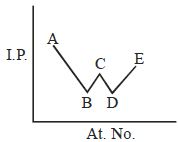
The graph shows the variation of Ionization Potential $(I.P.)$ with Atomic Number $(At. No.)$ for elements $A$ to $E$. If these elements belong to the same group in the periodic table,identify the group.
A
$13$ group
B
$1$ group
C
$2$ group
D
Inert gas
Solution
(A) In a group,the Ionization Potential $(I.P.)$ generally decreases from top to bottom due to an increase in atomic size and shielding effect.
However,the graph shows an irregular trend $(A > B < C > D < E)$.
This specific zig-zag pattern of $I.P.$ values is characteristic of elements in group $13$ (e.g.,$B, Al, Ga, In, Tl$).
In group $13$,the $I.P.$ decreases from $B$ to $Al$,then increases from $Al$ to $Ga$ due to poor shielding of $d$-electrons,decreases from $Ga$ to $In$,and increases from $In$ to $Tl$ due to poor shielding of $f$-electrons.
Therefore,the group is $13$.
However,the graph shows an irregular trend $(A > B < C > D < E)$.
This specific zig-zag pattern of $I.P.$ values is characteristic of elements in group $13$ (e.g.,$B, Al, Ga, In, Tl$).
In group $13$,the $I.P.$ decreases from $B$ to $Al$,then increases from $Al$ to $Ga$ due to poor shielding of $d$-electrons,decreases from $Ga$ to $In$,and increases from $In$ to $Tl$ due to poor shielding of $f$-electrons.
Therefore,the group is $13$.
0 likes
View Solution238
DifficultMCQ
Find the highest ratio of $IP$ values of the given pair of elements.
A
$He : Ne$
B
$Ne : Ar$
C
$He : Xe$
D
$Kr : Xe$
Solution
(C) The Ionization Potential $(IP)$ decreases down a group as the atomic size increases and the valence electrons are further from the nucleus.
For noble gases,the $IP$ values are: $He (2372 \ kJ/mol)$,$Ne (2080 \ kJ/mol)$,$Ar (1520 \ kJ/mol)$,$Kr (1351 \ kJ/mol)$,$Xe (1170 \ kJ/mol)$.
Calculating the ratios:
$A) He/Ne = 2372/2080 \approx 1.14$
$B) Ne/Ar = 2080/1520 \approx 1.37$
$C) He/Xe = 2372/1170 \approx 2.03$
$D) Kr/Xe = 1351/1170 \approx 1.15$
The highest ratio is obtained for the pair $He : Xe$.
For noble gases,the $IP$ values are: $He (2372 \ kJ/mol)$,$Ne (2080 \ kJ/mol)$,$Ar (1520 \ kJ/mol)$,$Kr (1351 \ kJ/mol)$,$Xe (1170 \ kJ/mol)$.
Calculating the ratios:
$A) He/Ne = 2372/2080 \approx 1.14$
$B) Ne/Ar = 2080/1520 \approx 1.37$
$C) He/Xe = 2372/1170 \approx 2.03$
$D) Kr/Xe = 1351/1170 \approx 1.15$
The highest ratio is obtained for the pair $He : Xe$.
0 likes
View Solution239
MediumMCQ
The successive ionization energies of an element $(A)$ are given as $IE_1 = 20 \ eV, IE_2 = 45 \ eV, IE_3 = 150 \ eV, IE_4 = 900 \ eV, IE_5 = 1800 \ eV$. What is the formula of the halide of $(A)$?
A
$AX$
B
$AX_3$
C
$AX_4$
D
$AX_5$
Solution
(B) The successive ionization energies are $IE_1 = 20 \ eV, IE_2 = 45 \ eV, IE_3 = 150 \ eV, IE_4 = 900 \ eV, IE_5 = 1800 \ eV$.
There is a large jump in ionization energy between $IE_3$ and $IE_4$ $(900 - 150 = 750 \ eV)$.
This indicates that the fourth electron is being removed from a stable noble gas core,meaning the element $(A)$ has $3$ valence electrons.
Therefore,the stable oxidation state of $(A)$ is $+3$.
Thus,the formula of the halide of $(A)$ is $AX_3$.
There is a large jump in ionization energy between $IE_3$ and $IE_4$ $(900 - 150 = 750 \ eV)$.
This indicates that the fourth electron is being removed from a stable noble gas core,meaning the element $(A)$ has $3$ valence electrons.
Therefore,the stable oxidation state of $(A)$ is $+3$.
Thus,the formula of the halide of $(A)$ is $AX_3$.
0 likes
View Solution240
MediumMCQ
Which of the following isoelectronic series would lose an electron most easily?
A
$S^{2-}$
B
$Cl^{-}$
C
$Ar$
D
$K^{+}$
Solution
(A) The given species $S^{2-}$,$Cl^{-}$,$Ar$,and $K^{+}$ are isoelectronic,meaning they all have $18$ electrons.
For isoelectronic species,the ease of losing an electron (ionization energy) depends on the nuclear charge (number of protons).
As the nuclear charge increases,the attraction between the nucleus and the valence electrons increases,making it harder to remove an electron.
The nuclear charges are: $S^{2-} (Z=16)$,$Cl^{-} (Z=17)$,$Ar (Z=18)$,and $K^{+} (Z=19)$.
Since $S^{2-}$ has the lowest nuclear charge $(Z=16)$,it has the weakest hold on its electrons,making it the easiest to lose an electron.
For isoelectronic species,the ease of losing an electron (ionization energy) depends on the nuclear charge (number of protons).
As the nuclear charge increases,the attraction between the nucleus and the valence electrons increases,making it harder to remove an electron.
The nuclear charges are: $S^{2-} (Z=16)$,$Cl^{-} (Z=17)$,$Ar (Z=18)$,and $K^{+} (Z=19)$.
Since $S^{2-}$ has the lowest nuclear charge $(Z=16)$,it has the weakest hold on its electrons,making it the easiest to lose an electron.
0 likes
View Solution241
AdvancedMCQ
The sum of $IE_1 + IE_2$ and $IE_3 + IE_4$ for elements $P$ and $Q$ are given below:
Then,according to the given information,the incorrect statement$(s)$ is/are:
| Element | $IE_1 + IE_2$ $(kJ/mol)$ | $IE_3 + IE_4$ $(kJ/mol)$ |
|---|---|---|
| $P$ | $2.45$ | $8.82$ |
| $Q$ | $2.85$ | $6.11$ |
Then,according to the given information,the incorrect statement$(s)$ is/are:
A
$P^{2+}$ is more stable than $Q^{2+}$
B
$P^{4+}$ is more stable than $Q^{4+}$
C
$P^{4+}$ is less stable than $Q^{4+}$
D
Both $(A)$ and $(C)$
Solution
(B) The stability of an ion depends on the energy required to reach that oxidation state. $A$ lower sum of ionization energies $(IE)$ indicates that the corresponding ion is more stable.
For $P^{2+}$ and $Q^{2+}$: The sum of $IE_1 + IE_2$ is $2.45 \ kJ/mol$ for $P$ and $2.85 \ kJ/mol$ for $Q$. Since $2.45 < 2.85$,$P^{2+}$ is more stable than $Q^{2+}$. Thus,statement $(A)$ is correct.
For $P^{4+}$ and $Q^{4+}$: The sum of $IE_1 + IE_2 + IE_3 + IE_4$ is $(2.45 + 8.82) = 11.27 \ kJ/mol$ for $P$ and $(2.85 + 6.11) = 8.96 \ kJ/mol$ for $Q$. Since $8.96 < 11.27$,$Q^{4+}$ is more stable than $P^{4+}$.
Therefore,statement $(B)$ ($P^{4+}$ is more stable than $Q^{4+}$) is incorrect,and statement $(C)$ ($P^{4+}$ is less stable than $Q^{4+}$) is correct.
The question asks for the incorrect statement$(s)$. Only $(B)$ is incorrect.
For $P^{2+}$ and $Q^{2+}$: The sum of $IE_1 + IE_2$ is $2.45 \ kJ/mol$ for $P$ and $2.85 \ kJ/mol$ for $Q$. Since $2.45 < 2.85$,$P^{2+}$ is more stable than $Q^{2+}$. Thus,statement $(A)$ is correct.
For $P^{4+}$ and $Q^{4+}$: The sum of $IE_1 + IE_2 + IE_3 + IE_4$ is $(2.45 + 8.82) = 11.27 \ kJ/mol$ for $P$ and $(2.85 + 6.11) = 8.96 \ kJ/mol$ for $Q$. Since $8.96 < 11.27$,$Q^{4+}$ is more stable than $P^{4+}$.
Therefore,statement $(B)$ ($P^{4+}$ is more stable than $Q^{4+}$) is incorrect,and statement $(C)$ ($P^{4+}$ is less stable than $Q^{4+}$) is correct.
The question asks for the incorrect statement$(s)$. Only $(B)$ is incorrect.
0 likes
View Solution242
MediumMCQ
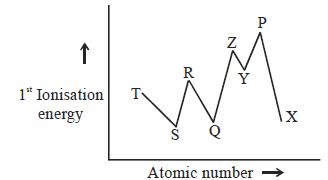
In the given graph,which point represents an alkali metal with the least atomic number?
A
$X$
B
$T$
C
$S$
D
$P$
Solution
(C) Alkali metals have the lowest first ionization energy $(I.E.)$ in their respective periods.
In the given graph,the points $S$ and $Q$ represent alkali metals because they show the minimum values of $I.E.$
Since the graph plots $I.E.$ against atomic number,the point $S$ appears before $Q$ on the atomic number axis.
Therefore,$S$ represents the alkali metal with the least atomic number among the given options.
In the given graph,the points $S$ and $Q$ represent alkali metals because they show the minimum values of $I.E.$
Since the graph plots $I.E.$ against atomic number,the point $S$ appears before $Q$ on the atomic number axis.
Therefore,$S$ represents the alkali metal with the least atomic number among the given options.
0 likes
View Solution243
MediumMCQ
Which of the following elements has the highest metallic character?
Element $-$ $IP$ (Ionization Potential)
Element $-$ $IP$ (Ionization Potential)
A
$P - 17 \ eV$
B
$Q - 2 \ eV$
C
$R - 10 \ eV$
D
$S - 13 \ eV$
Solution
(B) Metallic character is inversely proportional to the Ionization Potential $(IP)$.
Elements with lower $IP$ values lose electrons more easily,exhibiting higher metallic character.
Comparing the given values: $P = 17 \ eV$,$Q = 2 \ eV$,$R = 10 \ eV$,$S = 13 \ eV$.
The element $Q$ has the lowest $IP$ value $(2 \ eV)$,therefore it possesses the highest metallic character.
Elements with lower $IP$ values lose electrons more easily,exhibiting higher metallic character.
Comparing the given values: $P = 17 \ eV$,$Q = 2 \ eV$,$R = 10 \ eV$,$S = 13 \ eV$.
The element $Q$ has the lowest $IP$ value $(2 \ eV)$,therefore it possesses the highest metallic character.
0 likes
View Solution244
DifficultMCQ
The incorrect relation among the following is
A
$(Al)_{IE_1} < (Mg)_{IE_1}$
B
$(Mg)_{IE_2} > (Na)_{IE_2}$
C
$(Na)_{IE_1} < (Mg)_{IE_1}$
D
$(Mg)_{IE_3} > (Al)_{IE_3}$
Solution
(B) The first ionization energy $(IE_1)$ of $Mg$ $([Ne] 3s^2)$ is higher than $Al$ $([Ne] 3s^2 3p^1)$ because $Mg$ has a stable fully-filled $s$-orbital. Thus,$(Al)_{IE_1} < (Mg)_{IE_1}$ is correct.
For $IE_2$,$Na$ $([Ne] 3s^1)$ loses its second electron from the stable $2p^6$ configuration,while $Mg$ $([Ne] 3s^2)$ loses its second electron from the $3s^1$ orbital. Thus,$(Na)_{IE_2} > (Mg)_{IE_2}$. Therefore,the relation $(Mg)_{IE_2} > (Na)_{IE_2}$ is incorrect.
$(Na)_{IE_1} < (Mg)_{IE_1}$ is correct due to the stable configuration of $Mg$.
$(Mg)_{IE_3} > (Al)_{IE_3}$ is correct because $Mg^{2+}$ has a stable noble gas configuration,making the removal of the third electron very difficult compared to $Al^{2+}$.
For $IE_2$,$Na$ $([Ne] 3s^1)$ loses its second electron from the stable $2p^6$ configuration,while $Mg$ $([Ne] 3s^2)$ loses its second electron from the $3s^1$ orbital. Thus,$(Na)_{IE_2} > (Mg)_{IE_2}$. Therefore,the relation $(Mg)_{IE_2} > (Na)_{IE_2}$ is incorrect.
$(Na)_{IE_1} < (Mg)_{IE_1}$ is correct due to the stable configuration of $Mg$.
$(Mg)_{IE_3} > (Al)_{IE_3}$ is correct because $Mg^{2+}$ has a stable noble gas configuration,making the removal of the third electron very difficult compared to $Al^{2+}$.
0 likes
View Solution245
MediumMCQ
When first ionisation energy is plotted against the atomic number,the peaks in the curve are occupied by
A
halogens
B
rare gases
C
alkali metals
D
transition elements
Solution
(B) Generally,the first ionisation energy increases as we move across a period in the periodic table.
Rare gases (noble gases) possess a stable electronic configuration $(ns^2 np^6)$,which makes it very difficult to remove an electron from their valence shell.
Therefore,they have the highest first ionisation energy in their respective periods.
Consequently,the peaks in the plot of first ionisation energy versus atomic number are occupied by rare gases.
Rare gases (noble gases) possess a stable electronic configuration $(ns^2 np^6)$,which makes it very difficult to remove an electron from their valence shell.
Therefore,they have the highest first ionisation energy in their respective periods.
Consequently,the peaks in the plot of first ionisation energy versus atomic number are occupied by rare gases.
0 likes
View Solution246
MediumMCQ
The incorrect statement is:
A
The second ionisation energy of $Se$ is greater than that of the second ionisation energy of $As$.
B
The first ionisation energy of $C^{2+}$ ion is greater than that of the first ionisation energy of $N^{2+}$ ion.
C
The third ionisation energy of $F$ is greater than that of the third ionisation energy of $O$.
D
Halogens have the highest $I.E.$ in their respective periods.
Solution
(D) . $Se$ $([Ar] 3d^{10} 4s^2 4p^4)$ and $As$ $([Ar] 3d^{10} 4s^2 4p^3)$. After removing one electron,$Se^+$ has $4p^3$ and $As^+$ has $4p^2$. Removing the second electron from $Se^+$ is harder due to the stable half-filled $p$-orbital,so this statement is correct.
$B$. $C^{2+}$ has $1s^2 2s^2$ configuration,while $N^{2+}$ has $1s^2 2s^2 2p^1$. Removing an electron from the stable $2s^2$ shell of $C^{2+}$ requires more energy than from the $2p^1$ orbital of $N^{2+}$. This statement is correct.
$C$. $F^{2+}$ has $1s^2 2s^2 2p^3$ and $O^{2+}$ has $1s^2 2s^2 2p^2$. Removing the third electron from $F^{2+}$ (half-filled $p$-orbital) is harder than from $O^{2+}$. This statement is correct.
$D$. Noble gases have the highest $I.E.$ in their respective periods,not halogens. Therefore,this statement is incorrect.
$B$. $C^{2+}$ has $1s^2 2s^2$ configuration,while $N^{2+}$ has $1s^2 2s^2 2p^1$. Removing an electron from the stable $2s^2$ shell of $C^{2+}$ requires more energy than from the $2p^1$ orbital of $N^{2+}$. This statement is correct.
$C$. $F^{2+}$ has $1s^2 2s^2 2p^3$ and $O^{2+}$ has $1s^2 2s^2 2p^2$. Removing the third electron from $F^{2+}$ (half-filled $p$-orbital) is harder than from $O^{2+}$. This statement is correct.
$D$. Noble gases have the highest $I.E.$ in their respective periods,not halogens. Therefore,this statement is incorrect.
0 likes
View Solution247
MediumMCQ
Which electronic configuration shows the minimum first ionisation energy?
A
$1s^2, 2s^2, 2p^5$
B
$1s^2, 2s^2, 2p^6, 3s^2, 3p^1$
C
$1s^2, 2s^2, 2p^6, 3s^1$
D
$1s^2, 2s^2, 2p^6$
Solution
(C) The first ionisation energy $(IE_1)$ is the energy required to remove the most loosely bound electron from an isolated gaseous atom.
Alkali metals have the lowest first ionisation energy in their respective periods because they have a stable noble gas core plus one valence electron in the $ns^1$ orbital.
Comparing the options:
$A$: $1s^2, 2s^2, 2p^5$ (Fluorine,a halogen,has high $IE_1$)
$B$: $1s^2, 2s^2, 2p^6, 3s^2, 3p^1$ (Aluminium,group $13$)
$C$: $1s^2, 2s^2, 2p^6, 3s^1$ (Sodium,an alkali metal,group $1$)
$D$: $1s^2, 2s^2, 2p^6$ (Neon,a noble gas,has very high $IE_1$)
Therefore,the configuration $1s^2, 2s^2, 2p^6, 3s^1$ corresponds to an alkali metal,which has the minimum first ionisation energy among the given choices.
Alkali metals have the lowest first ionisation energy in their respective periods because they have a stable noble gas core plus one valence electron in the $ns^1$ orbital.
Comparing the options:
$A$: $1s^2, 2s^2, 2p^5$ (Fluorine,a halogen,has high $IE_1$)
$B$: $1s^2, 2s^2, 2p^6, 3s^2, 3p^1$ (Aluminium,group $13$)
$C$: $1s^2, 2s^2, 2p^6, 3s^1$ (Sodium,an alkali metal,group $1$)
$D$: $1s^2, 2s^2, 2p^6$ (Neon,a noble gas,has very high $IE_1$)
Therefore,the configuration $1s^2, 2s^2, 2p^6, 3s^1$ corresponds to an alkali metal,which has the minimum first ionisation energy among the given choices.
0 likes
View Solution248
MediumMCQ
Which of the following processes represents the highest ionization energy?
A
$Ba(g) \to Ba^+(g) + e^-$
B
$Ca(g) \to Ca^+(g) + e^-$
C
$Ca^+(g) \to Ca^{2+}(g) + e^-$
D
$Mg(g) \to Mg^{2+}(g) + 2e^-$
Solution
(C) The ionization energy $(IE)$ is the energy required to remove an electron from a gaseous atom or ion.
Successive ionization energies increase significantly because it becomes harder to remove an electron from an increasingly positive ion.
Option $A$ and $B$ represent the first ionization energy $(IE_1)$ of $Ba$ and $Ca$ respectively.
Option $C$ represents the second ionization energy $(IE_2)$ of $Ca$,which is significantly higher than $IE_1$.
Option $D$ represents the total energy for the removal of two electrons $(IE_1 + IE_2)$ from $Mg$.
Comparing the processes,the removal of the second electron from a cation (as in option $C$) or the cumulative energy for two electrons (as in option $D$) involves higher energy values than a single first ionization.
However,the second ionization energy of $Ca$ $(IE_2)$ is a specific high-energy step compared to the first ionization of larger atoms like $Ba$ or $Ca$. Given the standard comparison of $IE$ values,the process $Ca^+(g) \to Ca^{2+}(g) + e^-$ requires the most energy among the single-step processes listed.
Successive ionization energies increase significantly because it becomes harder to remove an electron from an increasingly positive ion.
Option $A$ and $B$ represent the first ionization energy $(IE_1)$ of $Ba$ and $Ca$ respectively.
Option $C$ represents the second ionization energy $(IE_2)$ of $Ca$,which is significantly higher than $IE_1$.
Option $D$ represents the total energy for the removal of two electrons $(IE_1 + IE_2)$ from $Mg$.
Comparing the processes,the removal of the second electron from a cation (as in option $C$) or the cumulative energy for two electrons (as in option $D$) involves higher energy values than a single first ionization.
However,the second ionization energy of $Ca$ $(IE_2)$ is a specific high-energy step compared to the first ionization of larger atoms like $Ba$ or $Ca$. Given the standard comparison of $IE$ values,the process $Ca^+(g) \to Ca^{2+}(g) + e^-$ requires the most energy among the single-step processes listed.
0 likes
View Solution249
MediumMCQ
Which of the following represents the correct decreasing order of the first ionization energy for $Ba$,$Sr$,$Ca$,and $Mg$?
A
$Mg > Ca > Sr > Ba$
B
$Ca > Sr > Ba > Mg$
C
$Sr > Ba > Mg > Ca$
D
$Ba > Mg > Ca > Sr$
Solution
(A) The first ionization energy of elements in a group decreases as we move down the group due to an increase in atomic size and shielding effect.
For the alkaline earth metals (Group $2$),the order of elements from top to bottom is $Be, Mg, Ca, Sr, Ba, Ra$.
Therefore,the decreasing order of first ionization energy is $Mg > Ca > Sr > Ba$.
Thus,the correct option is $A$.
For the alkaline earth metals (Group $2$),the order of elements from top to bottom is $Be, Mg, Ca, Sr, Ba, Ra$.
Therefore,the decreasing order of first ionization energy is $Mg > Ca > Sr > Ba$.
Thus,the correct option is $A$.
0 likes
View Solution250
MediumMCQ
The first ionization energy of alkaline earth metals is higher than that of alkali metals. This is due to:
A
Increase in nuclear charge of alkaline earth metals
B
Decrease in nuclear charge of alkaline earth metals
C
No change in nuclear charge
D
None of the above
Solution
(A) The first ionization energy of alkaline earth metals $(Group \ 2)$ is higher than that of alkali metals $(Group \ 1)$ because alkaline earth metals have a smaller atomic size and a higher nuclear charge compared to alkali metals in the same period.
Due to the higher nuclear charge,the valence electrons are more strongly attracted by the nucleus,making it more difficult to remove an electron,thus resulting in higher ionization energy.
Due to the higher nuclear charge,the valence electrons are more strongly attracted by the nucleus,making it more difficult to remove an electron,thus resulting in higher ionization energy.
0 likes
View SolutionClassification of Elements and Periodicity in Properties — Ionisation energy · Frequently Asked Questions
1Are these Classification of Elements and Periodicity in Properties questions useful for JEE and NEET?
Yes. All questions in this section are mapped to JEE Main and NEET exam patterns. Previous year questions from JEE Main, NEET, GUJCET and state-level exams are included with full solutions.
2Can I switch to Hindi or Gujarati for these questions?
Yes. Use the language tabs in the hero section or the sidebar to view the same questions and solutions in English, Hindi or Gujarati.
3How do I generate a question paper from this subtopic?
Use the Vedclass Exam Paper Generator — select the chapter and subtopic, set difficulty, and generate Sets A, B, C, D automatically. First 3 chapters of every subject are free.
Vedclass Products
For Students
Vedclass Test Series
Mock tests in real JEE/NEET style with performance analysis. 5-day free trial.
Start Free TrialFor Teachers
Exam Paper Generator
Generate Set A/B/C/D papers from this chapter in 2 minutes. 3 chapters free.
Try FreeFor Institutes
Online Exam Module
Live online exams with unlimited students, 360° analytics & white-label branding.
See DemoFor Teachers & Institutes
Generate a Classification of Elements and Periodicity in Properties Exam Paper in 2 Minutes
Select subtopic & difficulty — Sets A, B, C, D auto-generated with No Repeat logic.
First 3 chapters of every subject are free — no payment required.