
A English
History of periodic table Questions in English
Class 11 Chemistry · Classification of Elements and Periodicity in Properties · History of periodic table
51+
Questions
English
Language
100%
With Solutions
Showing 50 of 51 questions in English
1
EasyMCQ
"The properties of the elements are a periodic function of their atomic numbers." This statement was given by:
A
$N. \, Bohr$
B
$J.W. \, Dobereiner$
C
$D.I. \, Mendeleev$
D
$H.G.J. \, Moseley$
Solution
(D) The Modern Periodic Law states that the physical and chemical properties of elements are a periodic function of their atomic numbers. This law was proposed by $H.G.J. \, Moseley$ in $1913$ based on his experiments with $X$-ray spectra of elements. Before this,$Mendeleev$ had proposed the periodic law based on atomic mass.
0 likes
View Solution2
EasyMCQ
The telluric helix was given by
A
De Chan Courtois
B
Newlands
C
$L$. Meyer
D
Mendeleef
Solution
(A) The telluric helix,also known as the $vis \text{ } tellurique$,was a three-dimensional arrangement of elements proposed by the French geologist $A.E. \text{ } B. \text{ } de \text{ } Chancourtois$ in $1862$.
He arranged the elements in order of increasing atomic weights along a helix on the surface of a cylinder.
He arranged the elements in order of increasing atomic weights along a helix on the surface of a cylinder.
0 likes
View Solution3
EasyMCQ
Mendeleev's periodic law is based on
A
Atomic weight
B
Atomic number
C
Number of neutrons
D
None of the above
Solution
(A) Mendeleev's periodic law states that the physical and chemical properties of elements are a periodic function of their atomic weights.
0 likes
View Solution4
MediumMCQ
Which of the following is a Dobereiner triad?
A
$Na, K, Rb$
B
$Mg, S, As$
C
$Cl, Br, I$
D
$P, S, As$
Solution
(C) According to Dobereiner's law of triads,the atomic mass of the central element is approximately the arithmetic mean of the atomic masses of the other two elements in the triad.
For the triad $Cl, Br, I$:
Atomic mass of $Cl = 35.5$
Atomic mass of $I = 127$
Arithmetic mean = $\frac{35.5 + 127}{2} = 81.25$
This value is close to the actual atomic mass of $Br$ $(80)$.
Thus,$Cl, Br, I$ forms a Dobereiner triad.
For the triad $Cl, Br, I$:
Atomic mass of $Cl = 35.5$
Atomic mass of $I = 127$
Arithmetic mean = $\frac{35.5 + 127}{2} = 81.25$
This value is close to the actual atomic mass of $Br$ $(80)$.
Thus,$Cl, Br, I$ forms a Dobereiner triad.
0 likes
View Solution5
EasyMCQ
The most important active step in the development of the periodic table was taken by
A
Mendeleev
B
Dalton
C
Avogadro
D
Cavendish
Solution
(A) The most important active step in the development of the periodic table was taken by $Mendeleev$.
Although other scientists made significant contributions toward the classification of elements,$Mendeleev$ organized the elements based on their atomic weights and periodic properties,which significantly advanced the field more than anyone else.
Although other scientists made significant contributions toward the classification of elements,$Mendeleev$ organized the elements based on their atomic weights and periodic properties,which significantly advanced the field more than anyone else.
0 likes
View Solution6
EasyMCQ
The element or elements whose position is anomalous in the periodic table is
A
Halogens
B
$Fe, Co$ and $Ni$
C
Inert gases
D
Hydrogen
Solution
(D) Hydrogen shows anomalous behavior because it exhibits similarities with both alkali metals (Group $1$) and halogens (Group $17$). Due to this dual nature,its position in the periodic table is considered unique or anomalous.
0 likes
View Solution7
EasyMCQ
Whose name is not associated with the development of the Periodic Table?
A
Lothar Meyer
B
Newlands
C
Prout
D
Rutherford
Solution
(D) The development of the Periodic Table involved several scientists such as $Lothar \text{ } Meyer$ (Atomic volume curve),$Newlands$ (Law of Octaves),and $Prout$ (Prout's Hypothesis). $Rutherford$ is primarily known for his contributions to atomic structure,specifically the discovery of the atomic nucleus,and is not associated with the development of the Periodic Table.
0 likes
View Solution8
EasyMCQ
Who stated that the properties of elements are a periodic function of their atomic number?
A
Niels Bohr
B
$J$. $W$. Dobereiner
C
$H$. $G$. $J$. Moseley
D
$D$. $I$. Mendeleev
Solution
(C) $H$. $G$. $J$. Moseley proposed the Modern Periodic Law,which states that the physical and chemical properties of elements are a periodic function of their atomic numbers $(Z)$.
0 likes
View Solution9
EasyMCQ
The modern periodic table is based on the atomic number of the elements. The experiment which proved the significance of the atomic number was:
A
Millikan's oil drop experiment
B
Moseley's work on $X$-ray spectra
C
Bragg's work on $X$-ray diffraction
D
Discovery of $X$-rays by Rontgen
Solution
(B) Moseley's work on $X$-ray spectra established that the frequency of $X$-rays emitted by an element is related to its atomic number $(Z)$ by the equation $\sqrt{\nu} = a(Z - b)$,which proved the significance of the atomic number over atomic mass.
0 likes
View Solution10
EasyMCQ
"The properties of the elements are periodic function of their atomic numbers." This statement was given by:
A
$N. Bohr$
B
$J.W. Dobereiner$
C
$D.I. Mendeleev$
D
$H.G.J. Moseley$
Solution
(D) The modern periodic law states that the physical and chemical properties of elements are a periodic function of their atomic numbers.
This law was proposed by $H.G.J. Moseley$ in $1913$ based on his experiments with $X$-ray spectra of elements.
Therefore,the correct option is $D$.
This law was proposed by $H.G.J. Moseley$ in $1913$ based on his experiments with $X$-ray spectra of elements.
Therefore,the correct option is $D$.
0 likes
View Solution11
MediumMCQ
In the Lothar Meyer curve,the descending position (next to the peak) is held by which of the following?
A
Halogens
B
Alkaline earth metals
C
$d-$ block elements
D
Alkali metals
Solution
(B) Lothar Meyer plotted atomic volume against atomic mass.
In this curve,the peaks are occupied by alkali metals (like $Li, Na, K, Rb, Cs$).
The descending part of the curve is occupied by alkaline earth metals (like $Be, Mg, Ca, Sr, Ba$).
The ascending part of the curve is occupied by halogens.
Therefore,the descending position next to the peak is held by alkaline earth metals.
In this curve,the peaks are occupied by alkali metals (like $Li, Na, K, Rb, Cs$).
The descending part of the curve is occupied by alkaline earth metals (like $Be, Mg, Ca, Sr, Ba$).
The ascending part of the curve is occupied by halogens.
Therefore,the descending position next to the peak is held by alkaline earth metals.
0 likes
View Solution12
DifficultMCQ
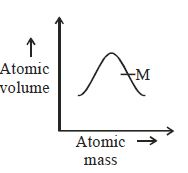
What will be the formula of '$M$' nitrate based on the given Lothar Meyer curve?
A
$M_2NO_3$
B
$MNO_3$
C
$M(NO_3)_2$
D
$M(NO_2)_2$
Solution
(C) According to the Lothar Meyer curve,elements located on the descending part of the curve are Alkaline Earth Metals $(AEM)$.
Since $M$ is an Alkaline Earth Metal,its valency is $+2$.
Therefore,the nitrate of $M$ will be formed by the combination of $M^{2+}$ and $NO_3^-$.
The chemical formula is $M(NO_3)_2$.
Since $M$ is an Alkaline Earth Metal,its valency is $+2$.
Therefore,the nitrate of $M$ will be formed by the combination of $M^{2+}$ and $NO_3^-$.
The chemical formula is $M(NO_3)_2$.
0 likes
View Solution13
MediumMCQ
Which of the following is a Dobereiner's triad?
A
$Ne, Ar, Fe$
B
$Li, Na, Rb$
C
$F, Cl, Br$
D
None of these
Solution
(D) Dobereiner's law of triads states that the atomic mass of the middle element is approximately the arithmetic mean of the atomic masses of the other two elements in the triad.
For the set $(Li, Na, K)$,the atomic masses are $7, 23, 39$. The mean of $Li$ and $K$ is $(7+39)/2 = 23$,which is the atomic mass of $Na$.
For the set $(Cl, Br, I)$,the atomic masses are $35.5, 80, 127$. The mean of $Cl$ and $I$ is $(35.5+127)/2 = 81.25$,which is approximately $80$.
In the given options,none of the sets represent a valid Dobereiner's triad. Therefore,the correct option is $D$.
For the set $(Li, Na, K)$,the atomic masses are $7, 23, 39$. The mean of $Li$ and $K$ is $(7+39)/2 = 23$,which is the atomic mass of $Na$.
For the set $(Cl, Br, I)$,the atomic masses are $35.5, 80, 127$. The mean of $Cl$ and $I$ is $(35.5+127)/2 = 81.25$,which is approximately $80$.
In the given options,none of the sets represent a valid Dobereiner's triad. Therefore,the correct option is $D$.
0 likes
View Solution14
MediumMCQ
The atomic masses of $Cl$ and $I$ are $35.5$ and $127$ respectively. According to Dobereiner's law of triads,the atomic mass of $Br$ will be ............ .
A
$80$
B
$162.5$
C
$81.25$
D
$91.5$
Solution
(C) According to Dobereiner's law of triads,the atomic mass of the middle element is approximately the arithmetic mean of the atomic masses of the other two elements in the triad.
For the triad $(Cl, Br, I)$:
Atomic mass of $Br = \frac{\text{Atomic mass of } Cl + \text{Atomic mass of } I}{2}$
Atomic mass of $Br = \frac{35.5 + 127}{2}$
Atomic mass of $Br = \frac{162.5}{2} = 81.25$
For the triad $(Cl, Br, I)$:
Atomic mass of $Br = \frac{\text{Atomic mass of } Cl + \text{Atomic mass of } I}{2}$
Atomic mass of $Br = \frac{35.5 + 127}{2}$
Atomic mass of $Br = \frac{162.5}{2} = 81.25$
0 likes
View Solution15
EasyMCQ
Which scientist used atomic volume as the basis for the periodic classification of elements?
A
Niels Bohr
B
Mendeleev
C
Lothar Meyer
D
Newlands
Solution
(C) Lothar Meyer plotted a graph between atomic volume and atomic mass of elements. He observed that elements with similar properties occupied similar positions on the curve. Thus,he used atomic volume as the basis for the periodic classification of elements.
0 likes
View Solution16
EasyMCQ
Which elements were at the peaks of the Lothar Meyer curve?
A
Alkali metals
B
Highly electropositive elements
C
Elements with large atomic volumes
D
All of the above
Solution
(D) Lothar Meyer plotted the atomic volume against the atomic mass of elements.
He observed that elements with similar properties occupied similar positions on the curve.
Specifically,the alkali metals $(Li, Na, K, Rb, Cs)$ occupied the peaks of the curve.
These elements are highly electropositive and possess the largest atomic volumes in their respective periods.
He observed that elements with similar properties occupied similar positions on the curve.
Specifically,the alkali metals $(Li, Na, K, Rb, Cs)$ occupied the peaks of the curve.
These elements are highly electropositive and possess the largest atomic volumes in their respective periods.
0 likes
View Solution17
EasyMCQ
The modern periodic table,based on the experiment of atomic number which highlights the significance of atomic number,is associated with:
A
Bragg's $X$-ray diffraction work
B
Moseley's $X$-ray spectroscopy work
C
Millikan's oil drop experiment
D
Lothar Meyer's atomic volume vs. atomic mass curve
Solution
(B) Henry Moseley,through his experiments on $X$-ray spectra of various elements,demonstrated that the frequency of $X$-rays emitted by an element is related to its atomic number $(Z)$ rather than its atomic mass.
This discovery led to the formulation of the Modern Periodic Law,which states that the physical and chemical properties of elements are a periodic function of their atomic numbers.
This discovery led to the formulation of the Modern Periodic Law,which states that the physical and chemical properties of elements are a periodic function of their atomic numbers.
0 likes
View Solution18
EasyMCQ
The law of triads is applicable to a group of
A
$Cl, Br, I$
B
$C, N, O$
C
$Na, K, Rb$
D
$H, O, N$
Solution
(A) According to the law of triads,the atomic weight of the middle element is approximately the arithmetic mean of the atomic weights of the first and third elements in the triad.
For the triad $Cl, Br, I$:
Atomic weight of $Br = \frac{\text{Atomic weight of } Cl + \text{Atomic weight of } I}{2} = \frac{35.5 + 127}{2} = 81.25 \approx 80$.
For the triad $Cl, Br, I$:
Atomic weight of $Br = \frac{\text{Atomic weight of } Cl + \text{Atomic weight of } I}{2} = \frac{35.5 + 127}{2} = 81.25 \approx 80$.
0 likes
View Solution19
Medium
Which important property did Mendeleev use to classify the elements in his periodic table and did he stick to that?
Solution
(N/A) Mendeleev arranged the elements in his periodic table ordered by atomic weight or mass. He arranged the elements in periods and groups in order of their increasing atomic weight. He placed the elements with similar properties in the same group.
However,he did not stick to this arrangement for long. He found out that if the elements were arranged strictly in order of their increasing atomic weights,then some elements did not fit within this scheme of classification.
Therefore,he ignored the order of atomic weights in some cases. For example,the atomic weight of iodine $(I)$ is lower than that of tellurium $(Te)$. Still,Mendeleev placed tellurium (in Group $VI$) before iodine (in Group $VII$) simply because iodine's properties are so similar to fluorine $(F)$,chlorine $(Cl)$,and bromine $(Br)$.
However,he did not stick to this arrangement for long. He found out that if the elements were arranged strictly in order of their increasing atomic weights,then some elements did not fit within this scheme of classification.
Therefore,he ignored the order of atomic weights in some cases. For example,the atomic weight of iodine $(I)$ is lower than that of tellurium $(Te)$. Still,Mendeleev placed tellurium (in Group $VI$) before iodine (in Group $VII$) simply because iodine's properties are so similar to fluorine $(F)$,chlorine $(Cl)$,and bromine $(Br)$.
0 likes
View Solution20
Easy
What is the basic difference in approach between the Mendeleev's Periodic Law and the Modern Periodic Law?
Solution
(N/A) Mendeleev's Periodic Law states that the physical and chemical properties of elements are periodic functions of their atomic weights. On the other hand,the Modern Periodic Law states that the physical and chemical properties of elements are periodic functions of their atomic numbers.
0 likes
View Solution21
Medium
What is the importance of the Periodic Table?
Solution
(N/A) The periodic table is arguably the most important concept in chemistry,both in principle and in practice. It serves as an everyday support for students,suggests new avenues of research to professionals,and provides a succinct organization of the whole of chemistry.
It is a remarkable demonstration of the fact that the chemical elements are not a random cluster of entities but instead display trends and lie together in families.
An awareness of the periodic table is essential to anyone who wishes to understand the world and see how it is built up from the fundamental building blocks of chemistry,the chemical elements.
It is a remarkable demonstration of the fact that the chemical elements are not a random cluster of entities but instead display trends and lie together in families.
An awareness of the periodic table is essential to anyone who wishes to understand the world and see how it is built up from the fundamental building blocks of chemistry,the chemical elements.
0 likes
View Solution22
Medium
What is the periodic table according to Glenn $T$. Seaborg?
Solution
(N/A) According to Glenn $T$. Seaborg,the periodic table is arguably the most important concept in chemistry,both in principle and in practice.
It serves as an everyday support for students,suggests new avenues of research to professionals,and provides a succinct organization of the whole of chemistry.
It is a remarkable demonstration of the fact that the chemical elements are not a random cluster of entities but instead display trends and lie together in families.
An awareness of the periodic table is essential to anyone who wishes to understand the world and see how it is built up from the fundamental building blocks of chemistry,the chemical elements.
It serves as an everyday support for students,suggests new avenues of research to professionals,and provides a succinct organization of the whole of chemistry.
It is a remarkable demonstration of the fact that the chemical elements are not a random cluster of entities but instead display trends and lie together in families.
An awareness of the periodic table is essential to anyone who wishes to understand the world and see how it is built up from the fundamental building blocks of chemistry,the chemical elements.
0 likes
View Solution23
Medium
Why do we need to classify elements?
Solution
(N/A) We know by now that the elements are the basic units of all types of matter. In $1800$,only $31$ elements were known. By $1865$,the number of identified elements had more than doubled to $63$. At present,$114$ elements are known. Of them,the recently discovered elements are man-made. Efforts to synthesize new elements are continuing. With such a large number of elements,it is very difficult to study the chemistry of all these elements and their innumerable compounds individually. To ease this problem,scientists searched for a systematic way to organize their knowledge by classifying the elements. This not only rationalizes known chemical facts about elements but also helps in predicting new ones for further study.
0 likes
View Solution24
Difficult
Briefly describe the contributions of various scientists to the development of the Periodic Table.
Solution
(N/A)
| Scientist and Country | Year and Contribution |
|---|---|
| $1$. Johann Dobereiner (Chemist),German | $1829$. Law of Triads: He noted a similarity among the physical and chemical properties of groups of three elements (triads). The atomic weight of the middle element was approximately the average of the other two. |
| $2$. $A.E.B.$ de Chancourtois (Geologist),French | $1862$. Telluric Helix: He arranged known elements in order of increasing atomic weights on a cylindrical table to display the periodic recurrence of properties. |
| $3$. John Alexander Newlands (Chemist),English | $1865$. Law of Octaves: He arranged elements in increasing order of atomic weights and noted that every eighth element had properties similar to the first. |
| $4$. Dmitri Mendeleev (Chemist),Russian | $1869$. Periodic Law: "The properties of the elements are a periodic function of their atomic weights." He created the first comprehensive periodic table. |
| $5$. Lothar Meyer (Chemist),German | $1868$. Atomic Volume Curve: He plotted physical properties like atomic volume against atomic weight,showing a periodically repeated pattern. |
| $6$. Henry Moseley (Physicist),English | $1913$. Modern Periodic Law: He observed that the square root of $X$-ray frequency $(\sqrt{\nu})$ plotted against atomic number $(Z)$ gives a straight line. He stated: "The physical and chemical properties of elements are periodic functions of their atomic number." |
0 likes
View Solution25
Advanced
Write a note on the genesis of the periodic table.
Solution
(N/A)
| Scientist | Contribution |
| $1$. Johann Dobereiner | Proposed the $Law \ of \ Triads$ $(1829)$,stating that the atomic weight of the middle element is approximately the average of the other two. |
| $2$. $A.E.B.$ de Chancourtois | Proposed the $Telluric \ Helix$ $(1862)$,a cylindrical arrangement of elements based on increasing atomic weights. |
| $3$. John Newlands | Proposed the $Law \ of \ Octaves$ $(1865)$,observing that every eighth element has properties similar to the first. |
| $4$. Dmitri Mendeleev | Formulated the $Periodic \ Law$ $(1869)$,stating that properties of elements are a periodic function of their atomic weights. |
| $5$. Lothar Meyer | Plotted physical properties like atomic volume against atomic weight,showing a periodic pattern $(1868)$. |
| $6$. Henry Moseley | Established the $Modern \ Periodic \ Law$ $(1913)$ by showing that properties are a periodic function of atomic number $(Z)$. |
0 likes
View Solution26
Medium
Explain the "Law of Triads" with examples.
Solution
(N/A) The German chemist,Johann Dobereiner,was the first to consider the idea of trends among the properties of elements.
He noted a similarity among the physical and chemical properties of groups of three elements,which he called "Triads".
"Law of Triads":
- "The atomic weight of the middle element of each of the Triads was approximately the arithmetic mean of the atomic weights of the other two elements."
Conclusion: The atomic weight of the middle element is approximately equal to the average of the atomic weights of the first and third elements.
He noted a similarity among the physical and chemical properties of groups of three elements,which he called "Triads".
"Law of Triads":
- "The atomic weight of the middle element of each of the Triads was approximately the arithmetic mean of the atomic weights of the other two elements."
| Triad Number | Elements and Atomic Weights | Average of $1^{st}$ and $3^{rd}$ element |
| $(1)$ | $Li(7), Na(23), K(39)$ | $(7+39) / 2 = 23$ |
| $(2)$ | $Ca(40), Sr(88), Ba(137)$ | $(40+137) / 2 = 88.5$ |
| $(3)$ | $Cl(35.5), Br(80), I(127)$ | $(35.5+127) / 2 = 81.25$ |
Conclusion: The atomic weight of the middle element is approximately equal to the average of the atomic weights of the first and third elements.
0 likes
View Solution27
Medium
Explain the contribution of Newlands to the periodic table.
Solution
(N/A) John Alexander Newlands in $1865$ proposed the Law of Octaves.
- Law: "Every eighth element has properties similar to the first element."
- The relationship is analogous to the musical scale,where every eighth note resembles the first. For his work,he was later awarded the Davy Medal in $1887$ by the Royal Society,London.
- Law: "Every eighth element has properties similar to the first element."
- The relationship is analogous to the musical scale,where every eighth note resembles the first. For his work,he was later awarded the Davy Medal in $1887$ by the Royal Society,London.
| Element | $Li, Be, B, C, N, O, F$ |
| At. wt. | $7, 9, 11, 12, 14, 16, 19$ |
| Element | $Na, Mg, Al, Si, P, S, Cl$ |
| At. wt. | $23, 24, 27, 29, 31, 32, 35.5$ |
| Element | $K, Ca$ |
| At. wt. | $39, 40$ |
0 likes
View Solution28
Medium
Explain the Law of Octaves given by Newland.
Solution
(N/A) John Alexander Newland in $1865$ proposed the Law of Octaves.
- Law: "Every eighth element has properties similar to the first element."
- The relationship is analogous to the musical scale where every eighth note resembles the first. For his work,he was later awarded the Davy Medal in $1887$ by the Royal Society,London.
- Law: "Every eighth element has properties similar to the first element."
- The relationship is analogous to the musical scale where every eighth note resembles the first. For his work,he was later awarded the Davy Medal in $1887$ by the Royal Society,London.
| Element | $Li$ | $Be$ | $B$ | $C$ | $N$ | $O$ | $F$ |
| At. wt. | $7$ | $9$ | $11$ | $12$ | $14$ | $16$ | $19$ |
| Element | $Na$ | $Mg$ | $Al$ | $Si$ | $P$ | $S$ | $Cl$ |
| At. wt. | $23$ | $24$ | $27$ | $29$ | $31$ | $32$ | $35.5$ |
| Element | $K$ | $Ca$ | - | - | - | - | - |
| At. wt. | $39$ | $40$ | - | - | - | - | - |
0 likes
View Solution29
Difficult
What were the important contributions of Mendeleev's periodic table?
Solution
(N/A) Mendeleev's periodic table was one of the greatest achievements in the development of chemistry. Some of the important contributions are:
$(A)$ Systematic study of the elements:
- It simplified the study of the chemistry of elements.
- Knowing the properties of one element in a group,the properties of other elements in the same group could be easily predicted.
- This made it very useful for studying and remembering the properties of a large number of elements.
$(B)$ Correction of atomic mass:
- It helped in correcting the atomic masses of some elements based on their positions in the table.
- For example,the atomic mass of beryllium was corrected from $13.5$ to $9$.
- Similarly,the atomic masses of indium,gold,platinum,etc.,were corrected.
$(C)$ Prediction of new elements:
- At the time of Mendeleev,only $56$ elements were known.
- While arranging these elements,he left gaps for undiscovered elements.
- He predicted the properties of these elements based on their positions.
- The observed properties of these elements,when discovered later,were found to be similar to those predicted by Mendeleev.
$(A)$ Systematic study of the elements:
- It simplified the study of the chemistry of elements.
- Knowing the properties of one element in a group,the properties of other elements in the same group could be easily predicted.
- This made it very useful for studying and remembering the properties of a large number of elements.
$(B)$ Correction of atomic mass:
- It helped in correcting the atomic masses of some elements based on their positions in the table.
- For example,the atomic mass of beryllium was corrected from $13.5$ to $9$.
- Similarly,the atomic masses of indium,gold,platinum,etc.,were corrected.
$(C)$ Prediction of new elements:
- At the time of Mendeleev,only $56$ elements were known.
- While arranging these elements,he left gaps for undiscovered elements.
- He predicted the properties of these elements based on their positions.
- The observed properties of these elements,when discovered later,were found to be similar to those predicted by Mendeleev.
| $Group/Element$ | $Atomic$ $weight/Note$ |
| $VI$. Tellurium | $127.6$. Higher atomic weight |
| $VII$. Iodine | $126.4$. Lower atomic weight |
0 likes
View Solution30
Difficult
Describe Mendeleev's periodic table.
Solution
(N/A) Mendeleev's periodic law states that the physical and chemical properties of elements are a periodic function of their atomic weights.
Key features of Mendeleev's periodic table include:
$1$. Elements were arranged in order of increasing atomic weights.
$2$. It consisted of $8$ vertical columns called groups and $7$ horizontal rows called periods.
$3$. Mendeleev left gaps for elements that were yet to be discovered (e.g.,Eka-boron,Eka-aluminium,and Eka-silicon).
$4$. It allowed for the systematic study of elements and predicted the properties of unknown elements.
Key features of Mendeleev's periodic table include:
$1$. Elements were arranged in order of increasing atomic weights.
$2$. It consisted of $8$ vertical columns called groups and $7$ horizontal rows called periods.
$3$. Mendeleev left gaps for elements that were yet to be discovered (e.g.,Eka-boron,Eka-aluminium,and Eka-silicon).
$4$. It allowed for the systematic study of elements and predicted the properties of unknown elements.
0 likes
View Solution31
Advanced
Write the drawbacks in Mendeleev's periodic table that led to its modification.
Solution
(N/A) The drawbacks of Mendeleev's periodic table are as follows:
$(i)$ Elements with similar properties were placed in different groups,while some elements with different properties were placed in the same group. For example,alkali metals $(Li, Na, K)$ were grouped with coinage metals $(Cu, Ag, Au)$,despite their distinct chemical properties. Conversely,chemically similar elements like $Cu$ and $Hg$ were placed in different groups.
$(ii)$ In some cases,elements with higher atomic weights were placed before elements with lower atomic weights to maintain the grouping of elements with similar chemical properties. Examples include the pairs $(Ar, K)$ and $(Co, Ni)$.
$(iii)$ Isotopes were not assigned separate positions in the periodic table,which contradicts the principle of classification based on atomic weight.
$(iv)$ The position of hydrogen remained controversial,as it shows properties similar to both alkali metals and halogens.
$(v)$ The arrangement of elements in group $VIII$ into three triads lacked a clear justification.
$(vi)$ The existence of even and odd series in the $IV, V,$ and $VI$ long periods could not be explained.
$(vii)$ The periodic table did not provide a proper position for the lanthanides and actinides.
$(i)$ Elements with similar properties were placed in different groups,while some elements with different properties were placed in the same group. For example,alkali metals $(Li, Na, K)$ were grouped with coinage metals $(Cu, Ag, Au)$,despite their distinct chemical properties. Conversely,chemically similar elements like $Cu$ and $Hg$ were placed in different groups.
$(ii)$ In some cases,elements with higher atomic weights were placed before elements with lower atomic weights to maintain the grouping of elements with similar chemical properties. Examples include the pairs $(Ar, K)$ and $(Co, Ni)$.
$(iii)$ Isotopes were not assigned separate positions in the periodic table,which contradicts the principle of classification based on atomic weight.
$(iv)$ The position of hydrogen remained controversial,as it shows properties similar to both alkali metals and halogens.
$(v)$ The arrangement of elements in group $VIII$ into three triads lacked a clear justification.
$(vi)$ The existence of even and odd series in the $IV, V,$ and $VI$ long periods could not be explained.
$(vii)$ The periodic table did not provide a proper position for the lanthanides and actinides.
0 likes
View Solution32
Medium
On the basis of which important property did Mendeleev classify the elements in his periodic table? Was he able to stick to it firmly? Explain.
Solution
(N/A) Mendeleev classified the elements in his periodic table based on their $Atomic \ Mass$. He could not stick to it firmly because he had to prioritize the similarity in physical and chemical properties of elements over the strict adherence to increasing atomic mass,leading to some anomalies.
0 likes
View Solution33
MediumMCQ
What is the fundamental difference between Mendeleev's periodic law and the modern periodic law?
A
Mendeleev's law is based on atomic mass,while the modern law is based on atomic number.
B
Mendeleev's law is based on atomic number,while the modern law is based on atomic mass.
C
Both are based on atomic mass.
D
Both are based on atomic number.
Solution
(A) Mendeleev's periodic law states that the properties of elements are a periodic function of their $atomic \ mass$.
In contrast,the modern periodic law states that the physical and chemical properties of elements are a periodic function of their $atomic \ number$.
In contrast,the modern periodic law states that the physical and chemical properties of elements are a periodic function of their $atomic \ number$.
0 likes
View Solution34
Easy
Which medals were awarded to Newlands and Seaborg for their work?
Solution
(N/A) Newlands: Awarded the Davy Medal by the Royal Society,London in $1887$.
Glenn $T$. Seaborg: Awarded the Nobel Prize in Chemistry in $1951$. To honor him,the element with atomic number $106$ was named Seaborgium $(Sg)$.
Glenn $T$. Seaborg: Awarded the Nobel Prize in Chemistry in $1951$. To honor him,the element with atomic number $106$ was named Seaborgium $(Sg)$.
0 likes
View Solution35
EasyMCQ
$Li, Na, K$ form a Dobereiner's triad. If the atomic masses of $Li$ and $K$ are $7$ and $39$ respectively,what will be the atomic mass of $Na$?
A
$23$
B
$46$
C
$15$
D
$32$
Solution
(A) According to Dobereiner's Law of Triads,the atomic mass of the middle element is approximately the arithmetic mean of the atomic masses of the other two elements.
Atomic mass of $Li = 7$
Atomic mass of $K = 39$
Atomic mass of $Na = \frac{Atomic \ mass \ of \ Li + Atomic \ mass \ of \ K}{2}$
Atomic mass of $Na = \frac{7 + 39}{2} = \frac{46}{2} = 23$
Atomic mass of $Li = 7$
Atomic mass of $K = 39$
Atomic mass of $Na = \frac{Atomic \ mass \ of \ Li + Atomic \ mass \ of \ K}{2}$
Atomic mass of $Na = \frac{7 + 39}{2} = \frac{46}{2} = 23$
0 likes
View Solution36
Easy
Name the scientists who contributed to the development of the periodic table and state their respective laws or contributions.
Solution
(N/A) $1$. Johann Wolfgang $D$öbereiner: Law of Triads
$2$. $A$.$E$.$B$. de Chancourtois: Cylindrical arrangement of elements
$3$. John Alexander Newlands: Law of Octaves
$4$. Dmitri Mendeleev: Periodic Law
$5$. Henry Moseley: Modern Periodic Law
$2$. $A$.$E$.$B$. de Chancourtois: Cylindrical arrangement of elements
$3$. John Alexander Newlands: Law of Octaves
$4$. Dmitri Mendeleev: Periodic Law
$5$. Henry Moseley: Modern Periodic Law
0 likes
View Solution37
EasyMCQ
How many periods and groups are there in Mendeleev's periodic table?
A
$7$ periods and $8$ groups
B
$7$ periods and $18$ groups
C
$8$ periods and $7$ groups
D
$6$ periods and $8$ groups
Solution
(A) Mendeleev's periodic table consists of $7$ horizontal rows called periods and $8$ vertical columns called groups. Each group is further divided into two subgroups,$A$ and $B$.
0 likes
View Solution38
EasyMCQ
On the basis of which property did Mendeleev arrange the elements?
A
Atomic number
B
Atomic mass
C
Electronegativity
D
Valency
Solution
(B) Mendeleev arranged the elements primarily on the basis of their $Atomic \ mass$.
He observed that the properties of elements are a periodic function of their $Atomic \ mass$.
For example,he placed $I$ (atomic mass $126.9$) after $Te$ (atomic mass $127.6$) in group-$VII$ based on chemical properties,despite the atomic mass of $I$ being lower than $Te$.
He observed that the properties of elements are a periodic function of their $Atomic \ mass$.
For example,he placed $I$ (atomic mass $126.9$) after $Te$ (atomic mass $127.6$) in group-$VII$ based on chemical properties,despite the atomic mass of $I$ being lower than $Te$.
0 likes
View Solution39
Difficult
Which elements did Mendeleev leave gaps for in his periodic table and what names did he give them?
Solution
(N/A) Mendeleev predicted the existence of several elements that were not discovered at that time. He left gaps in his periodic table for these elements and named them by prefixing the word '$eka-$' (Sanskrit for 'one') to the name of the element immediately preceding them in the same group.
| $Element$ | $Mendeleev's$ $Name$ |
| $Gallium$ | $Eka-aluminium$ |
| $Germanium$ | $Eka-silicon$ |
0 likes
View Solution40
EasyMCQ
What was the basis for Mendeleev's classification of elements in his periodic table?
A
Atomic number
B
Atomic mass
C
Electronic configuration
D
Electronegativity
Solution
(B) Mendeleev's periodic table was primarily based on the following factors:
$(i)$ Atomic mass (Periodic Law): Elements were arranged in increasing order of their atomic masses.
$(ii)$ Similarity in physical and chemical properties: Elements with similar properties were grouped together.
$(iii)$ Formula of compounds: He considered the formulas of hydrides and oxides formed by the elements.
$(i)$ Atomic mass (Periodic Law): Elements were arranged in increasing order of their atomic masses.
$(ii)$ Similarity in physical and chemical properties: Elements with similar properties were grouped together.
$(iii)$ Formula of compounds: He considered the formulas of hydrides and oxides formed by the elements.
0 likes
View Solution41
EasyMCQ
Which of the following information was not known at the time when Mendeleev's periodic table was constructed?
A
Atomic mass
B
Atomic number
C
Valency
D
Chemical properties
Solution
(B) At the time of the construction of Mendeleev's periodic table,the following information was not known:
$(i)$ Internal structure of atoms
$(ii)$ Subatomic particles (like protons,neutrons,and electrons)
$(iii)$ Electronic configuration of elements
Therefore,the concept of atomic number was not known,as it is based on the number of protons.
$(i)$ Internal structure of atoms
$(ii)$ Subatomic particles (like protons,neutrons,and electrons)
$(iii)$ Electronic configuration of elements
Therefore,the concept of atomic number was not known,as it is based on the number of protons.
0 likes
View Solution42
Medium
Fill in the blanks given below:
$(i)$ The first scientist to think about the properties of elements was ......... .
$(ii)$ The relationship of properties of elements suggested by Dobereiner is known as ........... .
$(iii)$ The Law of Octaves was proposed by the chemist ......... .
$(iv)$ The first periodic table was constructed by .......... and .......... .
$(i)$ The first scientist to think about the properties of elements was ......... .
$(ii)$ The relationship of properties of elements suggested by Dobereiner is known as ........... .
$(iii)$ The Law of Octaves was proposed by the chemist ......... .
$(iv)$ The first periodic table was constructed by .......... and .......... .
Solution
(N/A) $(i)$ Johann Wolfgang $D$öbereiner
$(ii)$ Law of Triads
$(iii)$ John Alexander Newlands
$(iv)$ Dmitri Mendeleev and Lothar Meyer
$(ii)$ Law of Triads
$(iii)$ John Alexander Newlands
$(iv)$ Dmitri Mendeleev and Lothar Meyer
0 likes
View Solution43
Medium
State whether the following statements are true or false:
$(i)$ The first periodic table was proposed by Dobereiner.
$(ii)$ The law of octaves was proposed by Newlands in $1865$.
$(iii)$ Mendeleev was the first to propose the periodic law.
$(iv)$ Mendeleev named Eka-aluminium as Germanium and Eka-silicon as Gallium.
$(i)$ The first periodic table was proposed by Dobereiner.
$(ii)$ The law of octaves was proposed by Newlands in $1865$.
$(iii)$ Mendeleev was the first to propose the periodic law.
$(iv)$ Mendeleev named Eka-aluminium as Germanium and Eka-silicon as Gallium.
Solution
(N/A) $(i)$ False: The first periodic table was proposed by Mendeleev,while Dobereiner proposed the law of triads.
$(ii)$ True: John Newlands proposed the law of octaves in $1865$.
$(iii)$ True: Dmitri Mendeleev is credited with formulating the periodic law based on atomic mass.
$(iv)$ False: Mendeleev named Eka-aluminium as Gallium and Eka-silicon as Germanium.
$(ii)$ True: John Newlands proposed the law of octaves in $1865$.
$(iii)$ True: Dmitri Mendeleev is credited with formulating the periodic law based on atomic mass.
$(iv)$ False: Mendeleev named Eka-aluminium as Gallium and Eka-silicon as Germanium.
0 likes
View Solution44
Medium
State whether the following statements are true or false:
$(i)$ The chart of elements presented by $Courtois$ could predict the stoichiometry of oxides of some metals.
$(ii)$ $Li, Na, Rb$ are known as $Döbereiner's$ triads.
$(iii)$ In $1863$,$Newlands$ classified the $56$ discovered elements into $18$ groups.
$(iv)$ $Mendeleev's$ periodic table is based on the atomic number of elements.
$(i)$ The chart of elements presented by $Courtois$ could predict the stoichiometry of oxides of some metals.
$(ii)$ $Li, Na, Rb$ are known as $Döbereiner's$ triads.
$(iii)$ In $1863$,$Newlands$ classified the $56$ discovered elements into $18$ groups.
$(iv)$ $Mendeleev's$ periodic table is based on the atomic number of elements.
Solution
(A) $(i)$ True: $Courtois$ studied the properties of elements and their oxides.
$(ii)$ False: $Li, Na, K$ form $Döbereiner's$ triad,not $Li, Na, Rb$.
$(iii)$ False: $Newlands$ arranged $56$ elements into $7$ groups (octaves),not $18$.
$(iv)$ False: $Mendeleev's$ periodic table was based on atomic mass,not atomic number.
$(ii)$ False: $Li, Na, K$ form $Döbereiner's$ triad,not $Li, Na, Rb$.
$(iii)$ False: $Newlands$ arranged $56$ elements into $7$ groups (octaves),not $18$.
$(iv)$ False: $Mendeleev's$ periodic table was based on atomic mass,not atomic number.
0 likes
View Solution45
Easy
Match the following and select the correct option.
| List-$I$ | List-$II$ |
| $(1)$ Lothar Meyer | $(A)$ First to present a periodic table showing correct arrangement up to Calcium. |
| $(2)$ $A$.$E$.$B$. de Chancourtois | $(B)$ Arranged elements in horizontal and vertical rows based on atomic weight. |
| $(3)$ Newlands | $(C)$ Discovered the element with atomic number $101$. |
| $(4)$ Seaborg | $(D)$ Suggested that arrangement based on atomic weight is an important concept in the periodic table. |
| $(E)$ Presented the first possible periodic table. | |
| $(F)$ Arranged elements into groups of three. | |
| $(G)$ Law of Octaves. |
Solution
(A) $(1-B), (2-E), (3-A), (4-C)$
0 likes
View Solution46
MediumMCQ
Which one of the following statements for $D.I.$ Mendeleev is incorrect?
A
At the time he proposed the Periodic Table of elements,the structure of the atom was known.
B
The element with atomic number $101$ is named after him.
C
He invented an accurate barometer.
D
He authored the textbook $-$ Principles of Chemistry.
Solution
(A) At the time $D.I.$ Mendeleev proposed the periodic table,the structure of the atom was unknown. Therefore,statement $A$ is incorrect.
0 likes
View Solution47
MediumMCQ
Mendeleev's periodic law states that the properties of elements are a periodic function of their
A
reactivity of elements
B
atomic size
C
atomic mass
D
electronic configuration
Solution
(C) The correct answer is $C$.
According to Mendeleev's periodic law,the physical and chemical properties of the elements are a periodic function of their atomic mass.
According to Mendeleev's periodic law,the physical and chemical properties of the elements are a periodic function of their atomic mass.
0 likes
View Solution48
MediumMCQ
Given below are two statements :
Statement $(I):$ According to the Law of Octaves,the elements were arranged in the increasing order of their atomic number.
Statement $(II) :$ Meyer observed a periodically repeated pattern upon plotting physical properties of certain elements against their respective atomic numbers.
In the light of the above statements,choose the correct answer from the options given below :
Statement $(I):$ According to the Law of Octaves,the elements were arranged in the increasing order of their atomic number.
Statement $(II) :$ Meyer observed a periodically repeated pattern upon plotting physical properties of certain elements against their respective atomic numbers.
In the light of the above statements,choose the correct answer from the options given below :
A
Statement $I$ is false but Statement $II$ is true
B
Both Statement $I$ and Statement $II$ are true
C
Statement $I$ is true but Statement $II$ is false
D
Both Statement $I$ and Statement $II$ are false
Solution
(D) Statement $(I)$ is false because the Law of Octaves,proposed by Newlands,arranged elements in the increasing order of their atomic weights,not atomic numbers.
Statement $(II)$ is false because Lothar Meyer plotted physical properties (like atomic volume) against atomic weights,not atomic numbers.
Statement $(II)$ is false because Lothar Meyer plotted physical properties (like atomic volume) against atomic weights,not atomic numbers.
0 likes
View Solution49
MediumMCQ
Given below are the atomic masses of the elements:
Which of the following does not form a $Dobereiner's$ triad?
| Element | $Li$ | $Na$ | $Cl$ | $K$ | $Ca$ | $Br$ | $Sr$ | $I$ | $Ba$ |
|---|---|---|---|---|---|---|---|---|---|
| Atomic Mass $(g \cdot mol^{-1})$ | $7$ | $23$ | $35.5$ | $39$ | $40$ | $80$ | $88$ | $127$ | $137$ |
Which of the following does not form a $Dobereiner's$ triad?
A
$Ba, Sr, Ca$
B
$Cl, Br, I$
C
$Cl, K, Ca$
D
$Li, Na, K$
Solution
(C) According to $Dobereiner's$ law of triads,the atomic mass of the middle element is approximately the arithmetic mean of the atomic masses of the other two elements.
$1$. For $Li, Na, K$: $\frac{7 + 39}{2} = 23$ (Forms a triad).
$2$. For $Ca, Sr, Ba$: $\frac{40 + 137}{2} = 88.5 \approx 88$ (Forms a triad).
$3$. For $Cl, Br, I$: $\frac{35.5 + 127}{2} = 81.25 \approx 80$ (Forms a triad).
$4$. For $Cl, K, Ca$: The atomic masses are $35.5, 39,$ and $40$. The average of $35.5$ and $40$ is $37.75$,which is not equal to $39$. Thus,it does not form a triad.
$1$. For $Li, Na, K$: $\frac{7 + 39}{2} = 23$ (Forms a triad).
$2$. For $Ca, Sr, Ba$: $\frac{40 + 137}{2} = 88.5 \approx 88$ (Forms a triad).
$3$. For $Cl, Br, I$: $\frac{35.5 + 127}{2} = 81.25 \approx 80$ (Forms a triad).
$4$. For $Cl, K, Ca$: The atomic masses are $35.5, 39,$ and $40$. The average of $35.5$ and $40$ is $37.75$,which is not equal to $39$. Thus,it does not form a triad.
0 likes
View Solution50
EasyMCQ
"The properties of elements are periodic functions of their atomic weights." This periodic law was given by
A
Dobereiner
B
Lothar Meyer
C
Mendeleev
D
Alexander
Solution
(C) "The properties of elements are periodic functions of their atomic weights." This statement is known as $Mendeleev's$ periodic law.
0 likes
View SolutionClassification of Elements and Periodicity in Properties — History of periodic table · Frequently Asked Questions
1Are these Classification of Elements and Periodicity in Properties questions useful for JEE and NEET?
Yes. All questions in this section are mapped to JEE Main and NEET exam patterns. Previous year questions from JEE Main, NEET, GUJCET and state-level exams are included with full solutions.
2Can I switch to Hindi or Gujarati for these questions?
Yes. Use the language tabs in the hero section or the sidebar to view the same questions and solutions in English, Hindi or Gujarati.
3How do I generate a question paper from this subtopic?
Use the Vedclass Exam Paper Generator — select the chapter and subtopic, set difficulty, and generate Sets A, B, C, D automatically. First 3 chapters of every subject are free.
Vedclass Products
For Students
Vedclass Test Series
Mock tests in real JEE/NEET style with performance analysis. 5-day free trial.
Start Free TrialFor Teachers
Exam Paper Generator
Generate Set A/B/C/D papers from this chapter in 2 minutes. 3 chapters free.
Try FreeFor Institutes
Online Exam Module
Live online exams with unlimited students, 360° analytics & white-label branding.
See DemoFor Teachers & Institutes
Generate a Classification of Elements and Periodicity in Properties Exam Paper in 2 Minutes
Select subtopic & difficulty — Sets A, B, C, D auto-generated with No Repeat logic.
First 3 chapters of every subject are free — no payment required.