
A English
Ionisation energy Questions in English
Class 11 Chemistry · Classification of Elements and Periodicity in Properties · Ionisation energy
402+
Questions
English
Language
100%
With Solutions
Showing 49 of 402 questions in English
101
EasyMCQ
Which of the following processes will have the maximum ionization energy?
A
$Ba \to Ba^+ + e^-$
B
$Ca \to Ca^+ + e^-$
C
$Ca \to Ca^{2+} + 2e^-$
D
$Mg \to Mg^{2+} + 2e^-$
Solution
(D) Ionization energy increases with the removal of successive electrons from the same atom because the effective nuclear charge increases.
Comparing the options:
$A$ and $B$ represent the first ionization energy $(IE_1)$ of $Ba$ and $Ca$ respectively. Since $IE_1$ decreases down the group,$IE_1(Ca) > IE_1(Ba)$.
$C$ and $D$ represent the sum of the first and second ionization energies $(IE_1 + IE_2)$ for $Ca$ and $Mg$ respectively.
Since $Mg$ is above $Ca$ in the periodic table,$IE_1(Mg) > IE_1(Ca)$ and $IE_2(Mg) > IE_2(Ca)$.
Therefore,the total energy required for $Mg \to Mg^{2+} + 2e^-$ is the highest among the given options.
Comparing the options:
$A$ and $B$ represent the first ionization energy $(IE_1)$ of $Ba$ and $Ca$ respectively. Since $IE_1$ decreases down the group,$IE_1(Ca) > IE_1(Ba)$.
$C$ and $D$ represent the sum of the first and second ionization energies $(IE_1 + IE_2)$ for $Ca$ and $Mg$ respectively.
Since $Mg$ is above $Ca$ in the periodic table,$IE_1(Mg) > IE_1(Ca)$ and $IE_2(Mg) > IE_2(Ca)$.
Therefore,the total energy required for $Mg \to Mg^{2+} + 2e^-$ is the highest among the given options.
0 likes
View Solution102
EasyMCQ
Which of the following represents the correct decreasing order of the first ionization enthalpy of $Ba, Sr, Ca,$ and $Mg$?
A
$Mg > Ca > Sr > Ba$
B
$Ca > Sr > Ba > Mg$
C
$Sr > Ba > Mg > Ca$
D
$Ba > Mg > Ca > Sr$
Solution
(A) The first ionization enthalpy decreases as we move down the group in the periodic table due to an increase in atomic size and shielding effect.
Since $Mg, Ca, Sr,$ and $Ba$ belong to Group $2$ (alkaline earth metals) and are arranged in the order $Mg < Ca < Sr < Ba$ down the group,the decreasing order of their first ionization enthalpy is $Mg > Ca > Sr > Ba$.
Since $Mg, Ca, Sr,$ and $Ba$ belong to Group $2$ (alkaline earth metals) and are arranged in the order $Mg < Ca < Sr < Ba$ down the group,the decreasing order of their first ionization enthalpy is $Mg > Ca > Sr > Ba$.
0 likes
View Solution103
EasyMCQ
The first ionization energy of alkaline earth metals is higher than that of alkali metals. This is due to...
A
Increase in the nuclear charge of alkaline earth metals.
B
Decrease in the nuclear charge of alkaline earth metals.
C
No change in the nuclear charge.
D
None of the above.
Solution
(A) The first ionization energy of alkaline earth metals is higher than that of alkali metals because of the increased nuclear charge and smaller atomic size compared to alkali metals in the same period.
0 likes
View Solution104
EasyMCQ
The atomic numbers of $V, Cr, Mn$ and $Fe$ are $23, 24, 25$ and $26$ respectively. Which of these elements will have the highest second ionization enthalpy?
A
$V$
B
$Cr$
C
$Mn$
D
$Fe$
Solution
(B) The electronic configurations of the given elements are:
$V (Z=23): [Ar] 3d^3 4s^2$
$Cr (Z=24): [Ar] 3d^5 4s^1$
$Mn (Z=25): [Ar] 3d^5 4s^2$
$Fe (Z=26): [Ar] 3d^6 4s^2$
For the second ionization enthalpy,we remove one electron from the $M^+$ ion:
$V^+: [Ar] 3d^3 4s^1$
$Cr^+: [Ar] 3d^5$
$Mn^+: [Ar] 3d^5 4s^1$
$Fe^+: [Ar] 3d^6 4s^1$
Removing the second electron from $Cr^+$ is difficult because it has a stable half-filled $3d^5$ configuration. Therefore,$Cr$ has the highest second ionization enthalpy.
$V (Z=23): [Ar] 3d^3 4s^2$
$Cr (Z=24): [Ar] 3d^5 4s^1$
$Mn (Z=25): [Ar] 3d^5 4s^2$
$Fe (Z=26): [Ar] 3d^6 4s^2$
For the second ionization enthalpy,we remove one electron from the $M^+$ ion:
$V^+: [Ar] 3d^3 4s^1$
$Cr^+: [Ar] 3d^5$
$Mn^+: [Ar] 3d^5 4s^1$
$Fe^+: [Ar] 3d^6 4s^1$
Removing the second electron from $Cr^+$ is difficult because it has a stable half-filled $3d^5$ configuration. Therefore,$Cr$ has the highest second ionization enthalpy.
0 likes
View Solution105
MediumMCQ
The correct order of second ionization potential of carbon,nitrogen,oxygen and fluorine is
A
$C > N > O > F$
B
$O > N > F > C$
C
$O > F > N > C$
D
$F > O > N > C$
Solution
(C) The electronic configurations of the elements are: $C (2s^2 2p^2)$,$N (2s^2 2p^3)$,$O (2s^2 2p^4)$,$F (2s^2 2p^5)$.
After the removal of the first electron,the configurations become: $C^+ (2s^2 2p^1)$,$N^+ (2s^2 2p^2)$,$O^+ (2s^2 2p^3)$,$F^+ (2s^2 2p^4)$.
The second ionization potential involves removing an electron from these cations.
$O^+$ has a stable half-filled $2p^3$ configuration,making it the most difficult to remove an electron from.
Following the periodic trend and stability,the order of second ionization potential is $O > F > N > C$.
After the removal of the first electron,the configurations become: $C^+ (2s^2 2p^1)$,$N^+ (2s^2 2p^2)$,$O^+ (2s^2 2p^3)$,$F^+ (2s^2 2p^4)$.
The second ionization potential involves removing an electron from these cations.
$O^+$ has a stable half-filled $2p^3$ configuration,making it the most difficult to remove an electron from.
Following the periodic trend and stability,the order of second ionization potential is $O > F > N > C$.
0 likes
View Solution106
MediumMCQ
Which of the following species has the highest ionisation potential?
A
$Li^{+}$
B
$Mg^{+}$
C
$Al^{+}$
D
$Ne$
Solution
(A) The ionisation potential refers to the energy required to remove an electron from a gaseous atom or ion.
Comparing the species:
$Li^{+}$ $(1s^2)$ has a stable noble gas configuration (isoelectronic with $He$).
$Mg^{+}$ $([Ne] 3s^1)$ has one electron in the $3s$ orbital.
$Al^{+}$ $([Ne] 3s^2)$ has two electrons in the $3s$ orbital.
$Ne$ $(1s^2 2s^2 2p^6)$ is a neutral noble gas.
Among these,$Li^{+}$ has the highest effective nuclear charge relative to its size and a very stable $1s^2$ configuration,making it the most difficult to remove an electron from.
Therefore,$Li^{+}$ has the highest ionisation potential.
Comparing the species:
$Li^{+}$ $(1s^2)$ has a stable noble gas configuration (isoelectronic with $He$).
$Mg^{+}$ $([Ne] 3s^1)$ has one electron in the $3s$ orbital.
$Al^{+}$ $([Ne] 3s^2)$ has two electrons in the $3s$ orbital.
$Ne$ $(1s^2 2s^2 2p^6)$ is a neutral noble gas.
Among these,$Li^{+}$ has the highest effective nuclear charge relative to its size and a very stable $1s^2$ configuration,making it the most difficult to remove an electron from.
Therefore,$Li^{+}$ has the highest ionisation potential.
0 likes
View Solution107
EasyMCQ
Which of the following orders for ionisation energy is correct?
A
$Be > B > C > N > O$
B
$B < Be < C < O < N$
C
$B < Be < C < N < O$
D
$B < Be < N < C < O$
Solution
(B) The general trend for ionisation energy $(IE)$ increases across a period from left to right due to an increase in effective nuclear charge.
However,there are exceptions due to stable electronic configurations.
$Be$ $(1s^2 2s^2)$ has a fully filled $2s$ orbital,making its $IE$ higher than $B$ $(1s^2 2s^2 2p^1)$.
$N$ $(1s^2 2s^2 2p^3)$ has a stable half-filled $p$-orbital,making its $IE$ higher than $O$ $(1s^2 2s^2 2p^4)$.
Therefore,the correct order is $B < Be < C < O < N$.
However,there are exceptions due to stable electronic configurations.
$Be$ $(1s^2 2s^2)$ has a fully filled $2s$ orbital,making its $IE$ higher than $B$ $(1s^2 2s^2 2p^1)$.
$N$ $(1s^2 2s^2 2p^3)$ has a stable half-filled $p$-orbital,making its $IE$ higher than $O$ $(1s^2 2s^2 2p^4)$.
Therefore,the correct order is $B < Be < C < O < N$.
0 likes
View Solution108
DifficultMCQ
Amongst the elements with the following electronic configurations,which one of them may have the highest ionisation energy?
A
$Ne [3s^2 3p^2]$
B
$Ar [3d^{10} 4s^2 4p^3]$
C
$Ne [3s^2 3p^1]$
D
$Ne [3s^2 3p^3]$
Solution
(D) Ionisation energy generally increases across a period due to a decrease in atomic size and effective nuclear charge.
Comparing the configurations:
$A: [Ne] 3s^2 3p^2$ (Period $3$,Group $14$)
$B: [Ar] 3d^{10} 4s^2 4p^3$ (Period $4$,Group $15$)
$C: [Ne] 3s^2 3p^1$ (Period $3$,Group $13$)
$D: [Ne] 3s^2 3p^3$ (Period $3$,Group $15$)
Elements in Period $3$ have smaller atomic radii than those in Period $4$,so elements in Period $3$ generally have higher ionisation energies than those in Period $4$.
Among the Period $3$ elements $(A, C, D)$,the configuration $[Ne] 3s^2 3p^3$ corresponds to a half-filled $p$-orbital,which is exceptionally stable.
Therefore,$[Ne] 3s^2 3p^3$ has the highest ionisation energy.
Comparing the configurations:
$A: [Ne] 3s^2 3p^2$ (Period $3$,Group $14$)
$B: [Ar] 3d^{10} 4s^2 4p^3$ (Period $4$,Group $15$)
$C: [Ne] 3s^2 3p^1$ (Period $3$,Group $13$)
$D: [Ne] 3s^2 3p^3$ (Period $3$,Group $15$)
Elements in Period $3$ have smaller atomic radii than those in Period $4$,so elements in Period $3$ generally have higher ionisation energies than those in Period $4$.
Among the Period $3$ elements $(A, C, D)$,the configuration $[Ne] 3s^2 3p^3$ corresponds to a half-filled $p$-orbital,which is exceptionally stable.
Therefore,$[Ne] 3s^2 3p^3$ has the highest ionisation energy.
0 likes
View Solution109
EasyMCQ
With which of the following electronic configurations does an atom have the lowest ionisation enthalpy?
A
$1s^2 \ 2s^2 \ 2p^3$
B
$1s^2 \ 2s^2 \ 2p^5 \ 3s^1$
C
$1s^2 \ 2s^2 \ 2p^6$
D
$1s^2 \ 2s^2 \ 2p^5$
Solution
(B) Ionisation enthalpy is the energy required to remove the most loosely bound electron from an isolated gaseous atom.
As the principal quantum number $(n)$ increases,the distance of the valence electron from the nucleus increases,leading to a decrease in the effective nuclear charge experienced by the electron.
Option $B$ $(1s^2 \ 2s^2 \ 2p^5 \ 3s^1)$ represents an atom with its valence electron in the $n=3$ shell,which is further from the nucleus compared to the electrons in the $n=2$ shell in the other options.
Therefore,the electron in the $3s$ orbital is held least tightly,resulting in the lowest ionisation enthalpy.
As the principal quantum number $(n)$ increases,the distance of the valence electron from the nucleus increases,leading to a decrease in the effective nuclear charge experienced by the electron.
Option $B$ $(1s^2 \ 2s^2 \ 2p^5 \ 3s^1)$ represents an atom with its valence electron in the $n=3$ shell,which is further from the nucleus compared to the electrons in the $n=2$ shell in the other options.
Therefore,the electron in the $3s$ orbital is held least tightly,resulting in the lowest ionisation enthalpy.
0 likes
View Solution110
DifficultMCQ
Which of the following represents the correct order of increasing first ionization enthalpy for $Ca, Ba, S, Se$ and $Ar$?
A
$Ca < S < Ba < Se < Ar$
B
$S < Se < Ca < Ba < Ar$
C
$Ba < Ca < Se < S < Ar$
D
$Ca < Ba < S < Se < Ar$
Solution
(C) The first ionization enthalpy $(IE_1)$ generally increases across a period due to an increase in effective nuclear charge and decreases down a group due to an increase in atomic size and shielding effect.
$1$. Comparing elements in the same period: $S$ (Group $16$,Period $3$) and $Ar$ (Group $18$,Period $3$). $Ar$ has a stable noble gas configuration,so it has the highest $IE_1$ among the given elements.
$2$. Comparing elements in the same group: $Ca$ (Group $2$,Period $4$) and $Ba$ (Group $2$,Period $6$). Since $Ba$ is below $Ca$,$IE_1$ of $Ba < Ca$.
$3$. Comparing $S$ and $Se$: $S$ (Period $3$) and $Se$ (Period $4$). Since $Se$ is below $S$,$IE_1$ of $Se < S$.
$4$. Combining the trends: $Ba < Ca < Se < S < Ar$.
Therefore,the correct order is $Ba < Ca < Se < S < Ar$.
$1$. Comparing elements in the same period: $S$ (Group $16$,Period $3$) and $Ar$ (Group $18$,Period $3$). $Ar$ has a stable noble gas configuration,so it has the highest $IE_1$ among the given elements.
$2$. Comparing elements in the same group: $Ca$ (Group $2$,Period $4$) and $Ba$ (Group $2$,Period $6$). Since $Ba$ is below $Ca$,$IE_1$ of $Ba < Ca$.
$3$. Comparing $S$ and $Se$: $S$ (Period $3$) and $Se$ (Period $4$). Since $Se$ is below $S$,$IE_1$ of $Se < S$.
$4$. Combining the trends: $Ba < Ca < Se < S < Ar$.
Therefore,the correct order is $Ba < Ca < Se < S < Ar$.
0 likes
View Solution111
DifficultMCQ
The first ionisation potential of $Na$ is $5.1 \, eV$. The value of electron gain enthalpy of $Na^{+}$ will be : ............... $eV$
A
$-2.55$
B
$-5.1$
C
$-10.2$
D
$+2.55$
Solution
(B) The first ionization process is represented as: $Na \rightarrow Na^{+} + e^{-}$,where $IE = 5.1 \, eV$.
The electron gain enthalpy of $Na^{+}$ corresponds to the reverse process: $Na^{+} + e^{-} \rightarrow Na$.
Since the second reaction is the exact inverse of the first reaction,the energy change is equal in magnitude but opposite in sign.
Therefore,the electron gain enthalpy of $Na^{+}$ is $\Delta H_{eg} = -IE = -5.1 \, eV$.
The electron gain enthalpy of $Na^{+}$ corresponds to the reverse process: $Na^{+} + e^{-} \rightarrow Na$.
Since the second reaction is the exact inverse of the first reaction,the energy change is equal in magnitude but opposite in sign.
Therefore,the electron gain enthalpy of $Na^{+}$ is $\Delta H_{eg} = -IE = -5.1 \, eV$.
0 likes
View Solution112
MediumMCQ
Which of the following atoms has the highest first ionization energy?
A
$K$
B
$Sc$
C
$Rb$
D
$Na$
Solution
(B) The first ionization energy is the energy required to remove the most loosely bound electron from an isolated gaseous atom.
$K$ $(Z=19)$ and $Na$ $(Z=11)$ are alkali metals (Group $1$),which have the lowest ionization energies in their respective periods.
$Rb$ $(Z=37)$ is also an alkali metal with an even lower ionization energy than $K$ due to its larger atomic size.
$Sc$ $(Z=21)$ is a $d$-block transition metal.
Transition metals generally have higher first ionization energies compared to alkali metals in the same or adjacent periods because of their smaller atomic radii and higher effective nuclear charge,which holds the valence electrons more tightly.
$K$ $(Z=19)$ and $Na$ $(Z=11)$ are alkali metals (Group $1$),which have the lowest ionization energies in their respective periods.
$Rb$ $(Z=37)$ is also an alkali metal with an even lower ionization energy than $K$ due to its larger atomic size.
$Sc$ $(Z=21)$ is a $d$-block transition metal.
Transition metals generally have higher first ionization energies compared to alkali metals in the same or adjacent periods because of their smaller atomic radii and higher effective nuclear charge,which holds the valence electrons more tightly.
0 likes
View Solution113
MediumMCQ
The increasing order of the first ionization enthalpies of the elements $B$,$P$,$S$ and $F$ (lowest first) is:
A
$B < S < P < F$
B
$B < P < S < F$
C
$F < S < P < B$
D
$P < S < B < F$
Solution
(A) The first ionization enthalpy generally increases across a period from left to right due to an increase in effective nuclear charge.
$B$ (Boron,group $13$) has the lowest ionization enthalpy among the given elements.
Comparing $P$ (Phosphorus,group $15$) and $S$ (Sulfur,group $16$),$P$ has a higher ionization enthalpy than $S$ because $P$ has a stable half-filled $p$-orbital configuration $(3s^2 3p^3)$.
$F$ (Fluorine,group $17$) has the highest ionization enthalpy due to its small size and high effective nuclear charge.
Thus,the order is $B < S < P < F$.
$B$ (Boron,group $13$) has the lowest ionization enthalpy among the given elements.
Comparing $P$ (Phosphorus,group $15$) and $S$ (Sulfur,group $16$),$P$ has a higher ionization enthalpy than $S$ because $P$ has a stable half-filled $p$-orbital configuration $(3s^2 3p^3)$.
$F$ (Fluorine,group $17$) has the highest ionization enthalpy due to its small size and high effective nuclear charge.
Thus,the order is $B < S < P < F$.
0 likes
View Solution114
DifficultMCQ
Among the following elements,the one having the highest ionisation energy is :-
A
$(Ne) 3s^2 3p^1$
B
$(Ne) 3s^2 3p^4$
C
$(Ne) 3s^2 3p^3$
D
$(Ar) 3d^{10} 4s^2 4p^2$
Solution
(C) The $IE$ increases along a period and decreases down the group.
Group $15$ elements have a half-filled $p$-subshell $(ns^2 np^3)$,which provides extra stability compared to group $16$ elements $(ns^2 np^4)$.
Comparing the given electronic configurations:
Option $A$ is $Al$ $(3s^2 3p^1)$,Option $B$ is $S$ $(3s^2 3p^4)$,Option $C$ is $P$ $(3s^2 3p^3)$,and Option $D$ is $Ge$ $(4s^2 4p^2)$.
Since $P$ has a stable half-filled configuration,it possesses the highest $IE$ among the given options.
Group $15$ elements have a half-filled $p$-subshell $(ns^2 np^3)$,which provides extra stability compared to group $16$ elements $(ns^2 np^4)$.
Comparing the given electronic configurations:
Option $A$ is $Al$ $(3s^2 3p^1)$,Option $B$ is $S$ $(3s^2 3p^4)$,Option $C$ is $P$ $(3s^2 3p^3)$,and Option $D$ is $Ge$ $(4s^2 4p^2)$.
Since $P$ has a stable half-filled configuration,it possesses the highest $IE$ among the given options.
0 likes
View Solution115
EasyMCQ
What may be the first ionisation energy of $Na$ if it has an effective nuclear charge of $1.84$,assuming the Bohr model of the $H$-atom is effective on it? (in $eV$)
A
$13.6$
B
$46$
C
$1.51$
D
$5.1$
Solution
(D) According to the Bohr model,the energy of an electron in an orbit is given by $E_n = -13.6 \times \frac{Z_{eff}^2}{n^2} \, eV$.
For $Na$ $(Z=11)$,the valence electron is in the $3s$ orbital,so $n=3$.
The ionisation energy $(I.E.)$ is the energy required to remove the electron from $n=3$ to $n=\infty$,which is equal to the magnitude of the energy of the $n=3$ state.
$I.E. = 13.6 \times \frac{Z_{eff}^2}{n^2} \, eV$.
Given $Z_{eff} = 1.84$ and $n = 3$:
$I.E. = 13.6 \times \frac{(1.84)^2}{3^2} = 13.6 \times \frac{3.3856}{9} \approx 5.11 \, eV$.
For $Na$ $(Z=11)$,the valence electron is in the $3s$ orbital,so $n=3$.
The ionisation energy $(I.E.)$ is the energy required to remove the electron from $n=3$ to $n=\infty$,which is equal to the magnitude of the energy of the $n=3$ state.
$I.E. = 13.6 \times \frac{Z_{eff}^2}{n^2} \, eV$.
Given $Z_{eff} = 1.84$ and $n = 3$:
$I.E. = 13.6 \times \frac{(1.84)^2}{3^2} = 13.6 \times \frac{3.3856}{9} \approx 5.11 \, eV$.
0 likes
View Solution116
DifficultMCQ
The incorrect statement among the following is:
A
The first ionization potential of $Al$ is less than the first ionization potential of $Mg$.
B
The second ionization potential of $Al$ is greater than the second ionization potential of $Mg$.
C
The first ionization potential of $Mg$ is greater than the third ionization potential of $Al$.
D
The third ionization potential of $Mg$ is greater than the third ionization potential of $Al$.
Solution
(C) Electronic configurations: $Mg (Z=12): [Ne] 3s^2$,$Al (Z=13): [Ne] 3s^2 3p^1$.
$1$. First ionization potential $(IE_1)$: $Mg$ has a stable fully-filled $3s$ orbital,so $IE_1(Mg) > IE_1(Al)$. Thus,statement $A$ is correct.
$2$. Second ionization potential $(IE_2)$: $Mg^+$ is $[Ne] 3s^1$,$Al^+$ is $[Ne] 3s^2$. Removing an electron from $Al^+$ is harder due to the stable $3s^2$ configuration,so $IE_2(Al) > IE_2(Mg)$. Thus,statement $B$ is correct.
$3$. Third ionization potential $(IE_3)$: $Mg^{2+}$ is $[Ne]$,$Al^{2+}$ is $[Ne] 3s^1$. $Mg^{2+}$ has a noble gas configuration,making it extremely difficult to remove the third electron. Thus,$IE_3(Mg) > IE_3(Al)$. Thus,statement $D$ is correct.
$4$. Comparing $IE_1(Mg)$ and $IE_3(Al)$: $IE_1(Mg)$ is relatively low (removing from $3s^2$),while $IE_3(Al)$ is very high (removing from $3s^2$ after $3p^1$ and $3s^1$ are gone). Therefore,$IE_3(Al) > IE_1(Mg)$. Statement $C$ is incorrect.
$1$. First ionization potential $(IE_1)$: $Mg$ has a stable fully-filled $3s$ orbital,so $IE_1(Mg) > IE_1(Al)$. Thus,statement $A$ is correct.
$2$. Second ionization potential $(IE_2)$: $Mg^+$ is $[Ne] 3s^1$,$Al^+$ is $[Ne] 3s^2$. Removing an electron from $Al^+$ is harder due to the stable $3s^2$ configuration,so $IE_2(Al) > IE_2(Mg)$. Thus,statement $B$ is correct.
$3$. Third ionization potential $(IE_3)$: $Mg^{2+}$ is $[Ne]$,$Al^{2+}$ is $[Ne] 3s^1$. $Mg^{2+}$ has a noble gas configuration,making it extremely difficult to remove the third electron. Thus,$IE_3(Mg) > IE_3(Al)$. Thus,statement $D$ is correct.
$4$. Comparing $IE_1(Mg)$ and $IE_3(Al)$: $IE_1(Mg)$ is relatively low (removing from $3s^2$),while $IE_3(Al)$ is very high (removing from $3s^2$ after $3p^1$ and $3s^1$ are gone). Therefore,$IE_3(Al) > IE_1(Mg)$. Statement $C$ is incorrect.
0 likes
View Solution117
DifficultMCQ
Which among the following orders of second $IP$ (Ionization Potential) is correct?
A
$Mn > Cr$
B
$Zn > Cu$
C
$Na > Cu$
D
$Cr > K$
Solution
(C) The second ionization potential $(IP_2)$ corresponds to the energy required to remove an electron from a unipositive ion $(M^+ \rightarrow M^{2+} + e^-)$.
$1$. For $Mn$ $(3d^5 4s^2)$,$Mn^+$ is $3d^5 4s^1$. For $Cr$ $(3d^5 4s^1)$,$Cr^+$ is $3d^5$. Since $Cr^+$ has a stable half-filled $d$-subshell,removing the second electron from $Cr^+$ is harder than from $Mn^+$. Thus,$Cr > Mn$.
$2$. For $Zn$ $(3d^{10} 4s^2)$,$Zn^+$ is $3d^{10} 4s^1$. For $Cu$ $(3d^{10} 4s^1)$,$Cu^+$ is $3d^{10}$. $Cu^+$ has a stable fully-filled $d$-subshell,making $IP_2$ of $Cu$ higher than $Zn$. Thus,$Cu > Zn$.
$3$. For $Na$ $([Ne] 3s^1)$,$Na^+$ is $[Ne]$ (stable noble gas configuration). For $Cu$ $([Ar] 3d^{10} 4s^1)$,$Cu^+$ is $[Ar] 3d^{10}$. The removal of an electron from the stable noble gas core of $Na^+$ requires significantly more energy than from $Cu^+$. Thus,$Na > Cu$.
$4$. For $Cr$ $([Ar] 3d^5 4s^1)$,$Cr^+$ is $3d^5$. For $K$ $([Ar] 4s^1)$,$K^+$ is $[Ar]$. $K^+$ has a stable noble gas configuration,so $IP_2$ of $K$ is very high. Thus,$K > Cr$.
Comparing the options,$Na > Cu$ is the correct order.
$1$. For $Mn$ $(3d^5 4s^2)$,$Mn^+$ is $3d^5 4s^1$. For $Cr$ $(3d^5 4s^1)$,$Cr^+$ is $3d^5$. Since $Cr^+$ has a stable half-filled $d$-subshell,removing the second electron from $Cr^+$ is harder than from $Mn^+$. Thus,$Cr > Mn$.
$2$. For $Zn$ $(3d^{10} 4s^2)$,$Zn^+$ is $3d^{10} 4s^1$. For $Cu$ $(3d^{10} 4s^1)$,$Cu^+$ is $3d^{10}$. $Cu^+$ has a stable fully-filled $d$-subshell,making $IP_2$ of $Cu$ higher than $Zn$. Thus,$Cu > Zn$.
$3$. For $Na$ $([Ne] 3s^1)$,$Na^+$ is $[Ne]$ (stable noble gas configuration). For $Cu$ $([Ar] 3d^{10} 4s^1)$,$Cu^+$ is $[Ar] 3d^{10}$. The removal of an electron from the stable noble gas core of $Na^+$ requires significantly more energy than from $Cu^+$. Thus,$Na > Cu$.
$4$. For $Cr$ $([Ar] 3d^5 4s^1)$,$Cr^+$ is $3d^5$. For $K$ $([Ar] 4s^1)$,$K^+$ is $[Ar]$. $K^+$ has a stable noble gas configuration,so $IP_2$ of $K$ is very high. Thus,$K > Cr$.
Comparing the options,$Na > Cu$ is the correct order.
0 likes
View Solution118
EasyMCQ
Amongst the following elements with their electronic configurations given below,which one has the highest ionization energy?
A
$[Ne] 3s^2 3p^1$
B
$[Ne] 3s^2 3p^3$
C
$[Ne] 3s^2 3p^2$
D
$[Ar] 3d^{10} 4s^2 4p^3$
Solution
(B) Ionization energy is the energy required to remove the most loosely bound electron from an isolated gaseous atom.
$A$. $[Ne] 3s^2 3p^1$ (Aluminum): Has one electron in the $p$-orbital,relatively easy to remove.
$B$. $[Ne] 3s^2 3p^3$ (Phosphorus): Has a half-filled $p$-orbital $(p^3)$,which is highly stable,making it difficult to remove an electron.
$C$. $[Ne] 3s^2 3p^2$ (Silicon): Has a partially filled $p$-orbital,easier to remove than $p^3$.
$D$. $[Ar] 3d^{10} 4s^2 4p^3$ (Arsenic): Also has a half-filled $p$-orbital $(4p^3)$,but since it is in the $4^{th}$ shell,the electron is further from the nucleus compared to the $3p$ electron in Phosphorus.
Comparing $B$ and $D$,the $3p$ electrons are more strongly attracted to the nucleus than $4p$ electrons due to smaller atomic size. Therefore,the ionization energy of $[Ne] 3s^2 3p^3$ is higher than that of $[Ar] 3d^{10} 4s^2 4p^3$.
$A$. $[Ne] 3s^2 3p^1$ (Aluminum): Has one electron in the $p$-orbital,relatively easy to remove.
$B$. $[Ne] 3s^2 3p^3$ (Phosphorus): Has a half-filled $p$-orbital $(p^3)$,which is highly stable,making it difficult to remove an electron.
$C$. $[Ne] 3s^2 3p^2$ (Silicon): Has a partially filled $p$-orbital,easier to remove than $p^3$.
$D$. $[Ar] 3d^{10} 4s^2 4p^3$ (Arsenic): Also has a half-filled $p$-orbital $(4p^3)$,but since it is in the $4^{th}$ shell,the electron is further from the nucleus compared to the $3p$ electron in Phosphorus.
Comparing $B$ and $D$,the $3p$ electrons are more strongly attracted to the nucleus than $4p$ electrons due to smaller atomic size. Therefore,the ionization energy of $[Ne] 3s^2 3p^3$ is higher than that of $[Ar] 3d^{10} 4s^2 4p^3$.
0 likes
View Solution119
MediumMCQ
In the $2^{nd}$ period,which element has the highest value of the sum of the $1^{st}$ and $2^{nd}$ ionization energy $(I.E.)$?
A
$Ne$
B
$N$
C
$Li$
D
$F$
Solution
(A) The ionization energy $(I.E.)$ generally increases across a period from left to right due to an increase in effective nuclear charge.
For the $2^{nd}$ period elements $(Li, Be, B, C, N, O, F, Ne)$,the $1^{st}$ $I.E.$ is highest for $Ne$ (noble gas).
The $2^{nd}$ $I.E.$ corresponds to the energy required to remove an electron from a unipositive ion $(M^+)$.
For $Ne$,the $1^{st}$ $I.E.$ is very high,and the $2^{nd}$ $I.E.$ is even higher because the electron is being removed from a stable octet configuration.
Comparing the sum of $1^{st}$ and $2^{nd}$ $I.E.$,$Ne$ has the highest value because both its $1^{st}$ and $2^{nd}$ ionization energies are significantly higher than those of other elements in the same period.
For the $2^{nd}$ period elements $(Li, Be, B, C, N, O, F, Ne)$,the $1^{st}$ $I.E.$ is highest for $Ne$ (noble gas).
The $2^{nd}$ $I.E.$ corresponds to the energy required to remove an electron from a unipositive ion $(M^+)$.
For $Ne$,the $1^{st}$ $I.E.$ is very high,and the $2^{nd}$ $I.E.$ is even higher because the electron is being removed from a stable octet configuration.
Comparing the sum of $1^{st}$ and $2^{nd}$ $I.E.$,$Ne$ has the highest value because both its $1^{st}$ and $2^{nd}$ ionization energies are significantly higher than those of other elements in the same period.
0 likes
View Solution120
EasyMCQ
Which particle may be removed from a stable neutral atom with the least energy change?
A
An $\alpha$ particle
B
$A$ neutron
C
$A$ proton
D
An electron
Solution
(D) The energy required to remove a particle from an atom depends on the binding energy of that particle within the atom.
$1$. An $\alpha$ particle,a proton,and a neutron are located within the nucleus and are held together by strong nuclear forces,which require a very high amount of energy to overcome.
$2$. An electron is located in the extranuclear region and is held by electrostatic forces of attraction with the nucleus.
$3$. The energy required to remove an electron (ionization energy) is significantly lower than the energy required to remove nucleons from the nucleus.
Therefore,an electron can be removed with the least energy change.
$1$. An $\alpha$ particle,a proton,and a neutron are located within the nucleus and are held together by strong nuclear forces,which require a very high amount of energy to overcome.
$2$. An electron is located in the extranuclear region and is held by electrostatic forces of attraction with the nucleus.
$3$. The energy required to remove an electron (ionization energy) is significantly lower than the energy required to remove nucleons from the nucleus.
Therefore,an electron can be removed with the least energy change.
0 likes
View Solution121
MediumMCQ
The ionization potential of sodium is $5.48 \ eV$. The $I.P.$ of potassium is ............. $eV$
A
Equal to that of sodium
B
$5.68$
C
$4.34$
D
$10.88$
Solution
(C) The ionization potential $(I.P.)$ decreases as we move down a group in the periodic table.
This is due to the increase in atomic size,which reduces the electrostatic force of attraction between the nucleus and the valence electrons.
Additionally,the shielding or screening effect increases,which further decreases the ionization potential.
Since potassium $(K)$ is below sodium $(Na)$ in Group $1$,its $I.P.$ must be lower than $5.48 \ eV$.
The experimental value for the $I.P.$ of potassium is approximately $4.34 \ eV$.
This is due to the increase in atomic size,which reduces the electrostatic force of attraction between the nucleus and the valence electrons.
Additionally,the shielding or screening effect increases,which further decreases the ionization potential.
Since potassium $(K)$ is below sodium $(Na)$ in Group $1$,its $I.P.$ must be lower than $5.48 \ eV$.
The experimental value for the $I.P.$ of potassium is approximately $4.34 \ eV$.
0 likes
View Solution122
MediumMCQ
The correct order of second ionisation potentials $(IP)$ of $Ca$,$Ba$ and $K$ is
A
$K > Ca > Ba$
B
$Ba > Ca > K$
C
$K > Ba > Ca$
D
$K = Ba = Ca$
Solution
(A) The electronic configurations are: $K (Z=19): [Ar] 4s^1$,$Ca (Z=20): [Ar] 4s^2$,$Ba (Z=56): [Xe] 6s^2$.
After the first ionization,the configurations become: $K^+: [Ar]$,$Ca^+: [Ar] 4s^1$,$Ba^+: [Xe] 6s^1$.
The second ionization potential involves removing an electron from these ions.
For $K^+$,the electron is removed from the stable noble gas configuration $([Ar])$,which requires a very high amount of energy.
For $Ca^+$ and $Ba^+$,the second electron is removed from the $ns^1$ orbital.
Comparing $Ca^+$ and $Ba^+$,$Ca$ is above $Ba$ in the group,so $Ca^+$ has a smaller size and higher effective nuclear charge,making its second $IP$ higher than that of $Ba^+$.
Therefore,the order is $K > Ca > Ba$.
After the first ionization,the configurations become: $K^+: [Ar]$,$Ca^+: [Ar] 4s^1$,$Ba^+: [Xe] 6s^1$.
The second ionization potential involves removing an electron from these ions.
For $K^+$,the electron is removed from the stable noble gas configuration $([Ar])$,which requires a very high amount of energy.
For $Ca^+$ and $Ba^+$,the second electron is removed from the $ns^1$ orbital.
Comparing $Ca^+$ and $Ba^+$,$Ca$ is above $Ba$ in the group,so $Ca^+$ has a smaller size and higher effective nuclear charge,making its second $IP$ higher than that of $Ba^+$.
Therefore,the order is $K > Ca > Ba$.
0 likes
View Solution123
MediumMCQ
If $X$ and $Y$ are the second ionisation potentials of alkali and alkaline earth metals of the same period,then:
A
$X > Y$
B
$X < Y$
C
$X = Y$
D
$X << Y$
Solution
(A) The general electronic configuration of an alkali metal is $ns^1$. After the removal of the first electron (first ionization energy),it attains a stable noble gas configuration (octet). Therefore,the removal of the second electron requires a very high amount of energy (second ionization energy).
In contrast,the general electronic configuration of an alkaline earth metal is $ns^2$. After the removal of the first electron,it attains an $ns^1$ configuration. The removal of the second electron is relatively easier compared to the alkali metal because it does not involve breaking a stable noble gas core.
Thus,the second ionization energy of an alkali metal $(X)$ is significantly higher than that of an alkaline earth metal $(Y)$ of the same period.
Therefore,the correct relation is $X > Y$.
In contrast,the general electronic configuration of an alkaline earth metal is $ns^2$. After the removal of the first electron,it attains an $ns^1$ configuration. The removal of the second electron is relatively easier compared to the alkali metal because it does not involve breaking a stable noble gas core.
Thus,the second ionization energy of an alkali metal $(X)$ is significantly higher than that of an alkaline earth metal $(Y)$ of the same period.
Therefore,the correct relation is $X > Y$.
0 likes
View Solution124
MediumMCQ
Select the gas-phase reaction$(s)$ which can proceed spontaneously?
A
$Cl^{-} + I \to I^{-} + Cl$
B
$Si^{+} + Cl \to Si + Cl^{+}$
C
Both $(A)$ and $(B)$
D
$Kr + He^{+} \to Kr^{+} + He$
Solution
(D) reaction proceeds spontaneously if the ionization energy of the product species is lower than that of the reactant species,or if the electron affinity of the product is higher than that of the reactant.
In option $(D)$,$Kr + He^{+} \to Kr^{+} + He$,the ionization energy of $Kr$ $(13.99 \ eV)$ is significantly lower than the ionization energy of $He$ $(24.58 \ eV)$.
Since $He^{+}$ has a higher electron affinity (or ionization potential) than $Kr$,the electron will transfer from $Kr$ to $He^{+}$ to form the more stable $Kr^{+}$ and $He$ atoms.
Thus,the reaction $Kr + He^{+} \to Kr^{+} + He$ is spontaneous.
In option $(D)$,$Kr + He^{+} \to Kr^{+} + He$,the ionization energy of $Kr$ $(13.99 \ eV)$ is significantly lower than the ionization energy of $He$ $(24.58 \ eV)$.
Since $He^{+}$ has a higher electron affinity (or ionization potential) than $Kr$,the electron will transfer from $Kr$ to $He^{+}$ to form the more stable $Kr^{+}$ and $He$ atoms.
Thus,the reaction $Kr + He^{+} \to Kr^{+} + He$ is spontaneous.
0 likes
View Solution125
DifficultMCQ
Which of the following sets has the highest sum of $IE$ values compared to all other sets mentioned?
A
$IE_1$ of $He$,$IE_2$ of $Li$,$IE_2$ of $Ca$
B
$IE_1$ of $He$,$IE_2$ of $Li$,$IE_3$ of $Mg$
C
$IE_1$ of $Li$,$He$,and $K$
D
$IE_2$ of $Na$,$Ba$,and $Sr$
Solution
(B) To determine the highest sum,we evaluate the ionization energies $(IE)$:
$1$. $IE_1$ of $He$ is very high $(2372 \ kJ/mol)$.
$2$. $IE_2$ of $Li$ is very high $(7298 \ kJ/mol)$ because it involves removing an electron from a stable $1s^2$ configuration.
$3$. $IE_3$ of $Mg$ is also very high $(7733 \ kJ/mol)$ as it involves removing an electron from a stable $2p^6$ configuration.
Comparing the sets:
Set $A$: $IE_1(He) + IE_2(Li) + IE_2(Ca) = 2372 + 7298 + 1145 = 10815 \ kJ/mol$.
Set $B$: $IE_1(He) + IE_2(Li) + IE_3(Mg) = 2372 + 7298 + 7733 = 17403 \ kJ/mol$.
Set $C$: $IE_1(Li) + IE_1(He) + IE_1(K) = 520 + 2372 + 419 = 3311 \ kJ/mol$.
Set $D$: $IE_2(Na) + IE_2(Ba) + IE_2(Sr) = 4562 + 965 + 1064 = 6591 \ kJ/mol$.
Thus,Set $B$ has the highest sum.
$1$. $IE_1$ of $He$ is very high $(2372 \ kJ/mol)$.
$2$. $IE_2$ of $Li$ is very high $(7298 \ kJ/mol)$ because it involves removing an electron from a stable $1s^2$ configuration.
$3$. $IE_3$ of $Mg$ is also very high $(7733 \ kJ/mol)$ as it involves removing an electron from a stable $2p^6$ configuration.
Comparing the sets:
Set $A$: $IE_1(He) + IE_2(Li) + IE_2(Ca) = 2372 + 7298 + 1145 = 10815 \ kJ/mol$.
Set $B$: $IE_1(He) + IE_2(Li) + IE_3(Mg) = 2372 + 7298 + 7733 = 17403 \ kJ/mol$.
Set $C$: $IE_1(Li) + IE_1(He) + IE_1(K) = 520 + 2372 + 419 = 3311 \ kJ/mol$.
Set $D$: $IE_2(Na) + IE_2(Ba) + IE_2(Sr) = 4562 + 965 + 1064 = 6591 \ kJ/mol$.
Thus,Set $B$ has the highest sum.
0 likes
View Solution126
EasyMCQ
Which of the following has maximum first ionisation energy?
A
$Pd$ (atomic no. $= 46$)
B
$Ag$ (atomic no. $= 47$)
C
$Rb$ (atomic no. $= 37$)
D
$Y$ (atomic no. $= 39$)
Solution
(A) The electronic configurations are as follows:
$Pd (46): [Kr] \, 4d^{10} 5s^{0}$
$Ag (47): [Kr] \, 4d^{10} 5s^{1}$
$Rb (37): [Kr] \, 5s^{1}$
$Y (39): [Kr] \, 4d^{1} 5s^{2}$
Ionisation energy depends on the stability of the electronic configuration and the effective nuclear charge.
$Pd$ has a completely filled $4d^{10}$ subshell and no electrons in the $5s$ orbital,making it highly stable.
Removing an electron from the stable $4d^{10}$ configuration of $Pd$ requires the highest amount of energy compared to the others,where electrons are removed from $5s$ or $4d$ orbitals with less stability or lower effective nuclear charge.
Therefore,$Pd$ has the maximum first ionisation energy.
$Pd (46): [Kr] \, 4d^{10} 5s^{0}$
$Ag (47): [Kr] \, 4d^{10} 5s^{1}$
$Rb (37): [Kr] \, 5s^{1}$
$Y (39): [Kr] \, 4d^{1} 5s^{2}$
Ionisation energy depends on the stability of the electronic configuration and the effective nuclear charge.
$Pd$ has a completely filled $4d^{10}$ subshell and no electrons in the $5s$ orbital,making it highly stable.
Removing an electron from the stable $4d^{10}$ configuration of $Pd$ requires the highest amount of energy compared to the others,where electrons are removed from $5s$ or $4d$ orbitals with less stability or lower effective nuclear charge.
Therefore,$Pd$ has the maximum first ionisation energy.
0 likes
View Solution127
EasyMCQ
Find the incorrect comparison of second ionisation energy.
A
$Te > Sb$
B
$In > Sr$
C
$He > B$
D
$Fe < Fe^{+}$
Solution
(B) The second ionisation energy $(IE_2)$ refers to the energy required to remove an electron from a unipositive ion.
$1$. For $Te$ $(5s^2 5p^4)$ and $Sb$ $(5s^2 5p^3)$: The $IE_2$ of $Te$ is higher than $Sb$ because $Sb^+$ has a stable half-filled $p^2$ configuration,but $Te^+$ has a $p^3$ configuration. Actually,$Sb$ has a stable half-filled $p^3$ configuration,so removing the second electron from $Sb^+$ is harder than from $Te^+$. Thus,$Te > Sb$ is correct.
$2$. For $In$ $(5s^2 5p^1)$ and $Sr$ $(5s^2)$: $Sr^+$ has a stable $s^1$ configuration,while $In^+$ has a $s^2$ configuration. Removing an electron from $Sr^+$ is harder,so $Sr > In$. The comparison $In > Sr$ is incorrect.
$3$. $He$ has a very high $IE_2$ due to its noble gas configuration.
$4$. $Fe < Fe^+$ is a comparison of ionisation energy,which is conceptually incorrect as $IE$ refers to neutral atoms,but $Fe^+$ is already an ion. The question asks for the incorrect comparison among the options provided regarding $IE_2$ trends.
$1$. For $Te$ $(5s^2 5p^4)$ and $Sb$ $(5s^2 5p^3)$: The $IE_2$ of $Te$ is higher than $Sb$ because $Sb^+$ has a stable half-filled $p^2$ configuration,but $Te^+$ has a $p^3$ configuration. Actually,$Sb$ has a stable half-filled $p^3$ configuration,so removing the second electron from $Sb^+$ is harder than from $Te^+$. Thus,$Te > Sb$ is correct.
$2$. For $In$ $(5s^2 5p^1)$ and $Sr$ $(5s^2)$: $Sr^+$ has a stable $s^1$ configuration,while $In^+$ has a $s^2$ configuration. Removing an electron from $Sr^+$ is harder,so $Sr > In$. The comparison $In > Sr$ is incorrect.
$3$. $He$ has a very high $IE_2$ due to its noble gas configuration.
$4$. $Fe < Fe^+$ is a comparison of ionisation energy,which is conceptually incorrect as $IE$ refers to neutral atoms,but $Fe^+$ is already an ion. The question asks for the incorrect comparison among the options provided regarding $IE_2$ trends.
0 likes
View Solution128
MediumMCQ
In which of the following pairs does the molecule have a higher $IE_1$ value compared to its corresponding atom?
A
$F_2$ and $F$
B
$O_2$ and $O$
C
$N_2$ and $N$
D
All of these
Solution
(D) The first ionization energy $(IE_1)$ of a molecule is generally higher than that of its constituent atom because the electrons in a molecule are held more strongly due to the formation of stable covalent bonds and the increased effective nuclear charge experienced by the bonding electrons.
For $F_2$,$O_2$,and $N_2$,the bond dissociation energy and the stability of the molecular orbitals result in a higher energy requirement to remove an electron compared to the isolated atoms ($F$,$O$,and $N$ respectively).
Therefore,for all the given pairs,the molecule has a higher $IE_1$ value than its corresponding atom.
For $F_2$,$O_2$,and $N_2$,the bond dissociation energy and the stability of the molecular orbitals result in a higher energy requirement to remove an electron compared to the isolated atoms ($F$,$O$,and $N$ respectively).
Therefore,for all the given pairs,the molecule has a higher $IE_1$ value than its corresponding atom.
0 likes
View Solution129
MediumMCQ
Triad-$I$ $[N^{3-}, O^{2-}, Na^{+}]$
Triad-$II$ $[N^{+}, C^{+}, O^{+}]$
Choose the species of lowest $IP$ from triad-$I$ and highest $IP$ from triad-$II$ respectively.
Triad-$II$ $[N^{+}, C^{+}, O^{+}]$
Choose the species of lowest $IP$ from triad-$I$ and highest $IP$ from triad-$II$ respectively.
A
$N^{3-}, O^{+}$
B
$Na^{+}, C^{+}$
C
$N^{3-}, N^{+}$
D
$O^{2-}, C^{+}$
Solution
(A) For Triad-$I$ $[N^{3-}, O^{2-}, Na^{+}]$: These are isoelectronic species with $10$ electrons. The $IP$ increases as the nuclear charge $(Z)$ increases. The $Z$ values are $N=7, O=8, Na=11$. Thus,the $IP$ order is $N^{3-} < O^{2-} < Na^{+}$. The species with the lowest $IP$ is $N^{3-}$.
For Triad-$II$ $[N^{+}, C^{+}, O^{+}]$: These are ions of elements in the same period. $IP$ generally increases from left to right across a period. The order of $Z$ is $C(6) < N(7) < O(8)$. Thus,the $IP$ order is $C^{+} < N^{+} < O^{+}$. The species with the highest $IP$ is $O^{+}$.
For Triad-$II$ $[N^{+}, C^{+}, O^{+}]$: These are ions of elements in the same period. $IP$ generally increases from left to right across a period. The order of $Z$ is $C(6) < N(7) < O(8)$. Thus,the $IP$ order is $C^{+} < N^{+} < O^{+}$. The species with the highest $IP$ is $O^{+}$.
0 likes
View Solution130
MediumMCQ
The first ionisation energy of oxygen is less than that of nitrogen. Which of the following is the correct reason for this observation?
A
Lesser effective nuclear charge of oxygen than nitrogen
B
Lesser atomic size of oxygen than nitrogen
C
Greater inter-electron repulsion between two electrons in the same $p$-orbital counter balances the increase in effective nuclear charge on moving from nitrogen to oxygen
D
Greater effective nuclear charge of oxygen than nitrogen
Solution
(C) The electronic configuration of nitrogen $(N)$ is $1s^2 2s^2 2p^3$,which is a stable half-filled $p$-orbital configuration.
Oxygen $(O)$ has the configuration $1s^2 2s^2 2p^4$.
Although oxygen has a higher effective nuclear charge than nitrogen,the $2p^4$ configuration of oxygen experiences greater inter-electron repulsion between two electrons in the same $p$-orbital.
This repulsion makes it easier to remove an electron from oxygen compared to the stable half-filled configuration of nitrogen,thus resulting in a lower first ionisation energy for oxygen.
Oxygen $(O)$ has the configuration $1s^2 2s^2 2p^4$.
Although oxygen has a higher effective nuclear charge than nitrogen,the $2p^4$ configuration of oxygen experiences greater inter-electron repulsion between two electrons in the same $p$-orbital.
This repulsion makes it easier to remove an electron from oxygen compared to the stable half-filled configuration of nitrogen,thus resulting in a lower first ionisation energy for oxygen.
0 likes
View Solution131
MediumMCQ
The ionisation energy of nitrogen is more than that of oxygen because :-
A
Nitrogen has half-filled $p$-orbitals
B
Nitrogen is left to the oxygen in the same period of the periodic table
C
Nitrogen contains less number of electrons
D
Nitrogen is less electronegative
Solution
(A) The electronic configuration of Nitrogen $(N)$ is $1s^2 2s^2 2p^3$,which contains a half-filled $p$-orbital.
This half-filled $p$-orbital configuration is exceptionally stable.
Therefore,more energy is required to remove an electron from the stable half-filled $p$-orbital of Nitrogen compared to the $2p^4$ configuration of Oxygen.
This half-filled $p$-orbital configuration is exceptionally stable.
Therefore,more energy is required to remove an electron from the stable half-filled $p$-orbital of Nitrogen compared to the $2p^4$ configuration of Oxygen.
0 likes
View Solution132
MediumMCQ
The first ionisation potentials $(eV)$ of $Be$ and $B$ respectively are :-
A
$8.29 \ eV, 9.32 \ eV$
B
$9.32 \ eV, 9.32 \ eV$
C
$8.29 \ eV, 8.29 \ eV$
D
$9.32 \ eV, 8.29 \ eV$
Solution
(D) The first ionization potentials $(eV)$ of $Be$ and $B$ are $9.32 \ eV$ and $8.29 \ eV$ respectively.
Generally,as we move from left to right in a period,the ionization potential increases due to an increase in effective nuclear charge.
However,in the case of $Be$ $(Z=4)$ and $B$ $(Z=5)$,$Be$ has a higher ionization potential than $B$ because $Be$ has a stable,completely filled $2s$ orbital configuration $(1s^2 2s^2)$,which requires more energy to remove an electron compared to the $2p^1$ electron in Boron.
Therefore,option $D$ is correct.
Generally,as we move from left to right in a period,the ionization potential increases due to an increase in effective nuclear charge.
However,in the case of $Be$ $(Z=4)$ and $B$ $(Z=5)$,$Be$ has a higher ionization potential than $B$ because $Be$ has a stable,completely filled $2s$ orbital configuration $(1s^2 2s^2)$,which requires more energy to remove an electron compared to the $2p^1$ electron in Boron.
Therefore,option $D$ is correct.
0 likes
View Solution133
MediumMCQ
The first four ionisation energy values of an element are $191$,$578$,$872$ and $5962 \ kcal$. The number of valence electrons in the element is :-
A
$1$
B
$2$
C
$3$
D
$4$
Solution
(C) The successive ionization energies are $IE_1 = 191 \ kcal$,$IE_2 = 578 \ kcal$,$IE_3 = 872 \ kcal$,and $IE_4 = 5962 \ kcal$.
$A$ large jump in ionization energy occurs between the third and fourth ionization energies $(IE_4 - IE_3 = 5962 - 872 = 5090 \ kcal)$.
This indicates that the first three electrons are removed from the valence shell,while the fourth electron is removed from a stable inner shell.
Therefore,the element has $3$ valence electrons.
$A$ large jump in ionization energy occurs between the third and fourth ionization energies $(IE_4 - IE_3 = 5962 - 872 = 5090 \ kcal)$.
This indicates that the first three electrons are removed from the valence shell,while the fourth electron is removed from a stable inner shell.
Therefore,the element has $3$ valence electrons.
0 likes
View Solution134
DifficultMCQ
The first ionisation potential of $Na$,$Mg$,$Al$ and $Si$ are in the order :-
A
$Na < Mg > Al < Si$
B
$Na > Mg > Al > Si$
C
$Na < Mg < Al < Si$
D
$Na > Mg > Al < Si$
Solution
(A) As we move across the period,nuclear charge increases and atomic size decreases,hence ionization enthalpy generally increases.
For $Al$ $(3s^{2} 3p^{1})$,the electron is removed from a partially filled $3p$ orbital.
For $Mg$ $(3s^{2})$,the electron is removed from a stable,fully filled $3s$ orbital.
Removal of an electron from a stable,fully filled orbital requires more energy than removal from a partially filled orbital.
Thus,the ionization enthalpy of $Mg$ is greater than that of $Al$.
The correct order of first ionization enthalpies is: $Na < Mg > Al < Si$.
For $Al$ $(3s^{2} 3p^{1})$,the electron is removed from a partially filled $3p$ orbital.
For $Mg$ $(3s^{2})$,the electron is removed from a stable,fully filled $3s$ orbital.
Removal of an electron from a stable,fully filled orbital requires more energy than removal from a partially filled orbital.
Thus,the ionization enthalpy of $Mg$ is greater than that of $Al$.
The correct order of first ionization enthalpies is: $Na < Mg > Al < Si$.
0 likes
View Solution135
DifficultMCQ
The successive ionisation energy values for an element $X$ are given below. Element $X$ belongs to which group?
$1^{st} \text{ IE} = 410 \ kJ \ mol^{-1}$
$2^{nd} \text{ IE} = 820 \ kJ \ mol^{-1}$
$3^{rd} \text{ IE} = 1100 \ kJ \ mol^{-1}$
$4^{th} \text{ IE} = 1500 \ kJ \ mol^{-1}$
$5^{th} \text{ IE} = 3200 \ kJ \ mol^{-1}$
$1^{st} \text{ IE} = 410 \ kJ \ mol^{-1}$
$2^{nd} \text{ IE} = 820 \ kJ \ mol^{-1}$
$3^{rd} \text{ IE} = 1100 \ kJ \ mol^{-1}$
$4^{th} \text{ IE} = 1500 \ kJ \ mol^{-1}$
$5^{th} \text{ IE} = 3200 \ kJ \ mol^{-1}$
A
$14$
B
$13$
C
$15$
D
$12$
0 likes
View Solution136
MediumMCQ
The correct order of the second ionization energy of $C$,$N$,$O$,and $F$ is :-
A
$C > N > O > F$
B
$O > N > F > C$
C
$O > F > N > C$
D
$F > O > N > C$
Solution
(C) The electronic configurations of the elements are:
$C (Z=6): 1s^2 2s^2 2p^2$
$N (Z=7): 1s^2 2s^2 2p^3$
$O (Z=8): 1s^2 2s^2 2p^4$
$F (Z=9): 1s^2 2s^2 2p^5$
For the second ionization energy,we remove one electron to form the $M^+$ ion:
$C^+: 1s^2 2s^2 2p^1$
$N^+: 1s^2 2s^2 2p^2$
$O^+: 1s^2 2s^2 2p^3$ (Half-filled $p$-orbital,highly stable)
$F^+: 1s^2 2s^2 2p^4$
Due to the stable half-filled $2p^3$ configuration of $O^+$,it has the highest second ionization energy.
Comparing the remaining,$F^+$ has a higher effective nuclear charge than $N^+$,and $N^+$ is higher than $C^+$.
Therefore,the correct order is $O > F > N > C$.
$C (Z=6): 1s^2 2s^2 2p^2$
$N (Z=7): 1s^2 2s^2 2p^3$
$O (Z=8): 1s^2 2s^2 2p^4$
$F (Z=9): 1s^2 2s^2 2p^5$
For the second ionization energy,we remove one electron to form the $M^+$ ion:
$C^+: 1s^2 2s^2 2p^1$
$N^+: 1s^2 2s^2 2p^2$
$O^+: 1s^2 2s^2 2p^3$ (Half-filled $p$-orbital,highly stable)
$F^+: 1s^2 2s^2 2p^4$
Due to the stable half-filled $2p^3$ configuration of $O^+$,it has the highest second ionization energy.
Comparing the remaining,$F^+$ has a higher effective nuclear charge than $N^+$,and $N^+$ is higher than $C^+$.
Therefore,the correct order is $O > F > N > C$.
0 likes
View Solution137
DifficultMCQ
"On moving left to right,ionization energy increases due to increasing $Z_{eff}$." In which of the following pairs is the above statement $NOT$ $CORRECT$?
A
$Na, Mg$
B
$Mg, Al$
C
$O, F$
D
$B, C$
Solution
(B) The general trend is that ionization energy increases from left to right across a period due to an increase in effective nuclear charge $(Z_{eff})$.
However,there are exceptions due to stable electronic configurations.
For the pair $Mg$ $([Ne] 3s^2)$ and $Al$ $([Ne] 3s^2 3p^1)$,the ionization energy of $Mg$ is higher than that of $Al$ because $Mg$ has a fully filled $s$-orbital,which is more stable.
Therefore,the statement is not correct for the pair $Mg, Al$.
However,there are exceptions due to stable electronic configurations.
For the pair $Mg$ $([Ne] 3s^2)$ and $Al$ $([Ne] 3s^2 3p^1)$,the ionization energy of $Mg$ is higher than that of $Al$ because $Mg$ has a fully filled $s$-orbital,which is more stable.
Therefore,the statement is not correct for the pair $Mg, Al$.
0 likes
View Solution138
MediumMCQ
The correct order of $2^{nd}$ ionisation potential of carbon,nitrogen,oxygen and fluorine is
A
$C > N > O > F$
B
$O > N > F > C$
C
$O > F > N > C$
D
$F > O > N > C$
Solution
(C) The $2^{nd}$ ionisation potential corresponds to the energy required to remove an electron from a unipositive ion $(M^+)$.
The electronic configurations of the unipositive ions are:
$C^+ (1s^2 2s^2 2p^1)$
$N^+ (1s^2 2s^2 2p^2)$
$O^+ (1s^2 2s^2 2p^3)$
$F^+ (1s^2 2s^2 2p^4)$
$O^+$ has a stable half-filled $2p^3$ configuration,which makes it very difficult to remove the second electron,resulting in the highest $2^{nd}$ ionisation potential.
Comparing the others,$F^+$ has a higher effective nuclear charge than $N^+$,and $N^+$ has a higher effective nuclear charge than $C^+$.
Thus,the correct order is $O > F > N > C$.
The electronic configurations of the unipositive ions are:
$C^+ (1s^2 2s^2 2p^1)$
$N^+ (1s^2 2s^2 2p^2)$
$O^+ (1s^2 2s^2 2p^3)$
$F^+ (1s^2 2s^2 2p^4)$
$O^+$ has a stable half-filled $2p^3$ configuration,which makes it very difficult to remove the second electron,resulting in the highest $2^{nd}$ ionisation potential.
Comparing the others,$F^+$ has a higher effective nuclear charge than $N^+$,and $N^+$ has a higher effective nuclear charge than $C^+$.
Thus,the correct order is $O > F > N > C$.
0 likes
View Solution139
MediumMCQ
Which has maximum first ionization potential?
A
$C$
B
$N$
C
$B$
D
$O$
Solution
(B) The electronic configurations of the elements in their valence shells are:
$B: 2s^2 2p^1$
$C: 2s^2 2p^2$
$N: 2s^2 2p^3$
$O: 2s^2 2p^4$
Ionization potential generally increases across a period from left to right.
However,$N$ has a stable half-filled $p$-orbital configuration $(2p^3)$,which requires more energy to remove an electron compared to $O$ $(2p^4)$.
Thus,the order of first ionization potential is $B < C < O < N$.
Therefore,$N$ has the maximum first ionization potential.
$B: 2s^2 2p^1$
$C: 2s^2 2p^2$
$N: 2s^2 2p^3$
$O: 2s^2 2p^4$
Ionization potential generally increases across a period from left to right.
However,$N$ has a stable half-filled $p$-orbital configuration $(2p^3)$,which requires more energy to remove an electron compared to $O$ $(2p^4)$.
Thus,the order of first ionization potential is $B < C < O < N$.
Therefore,$N$ has the maximum first ionization potential.
0 likes
View Solution140
MediumMCQ
The second ionisation potential of $Li, Be,$ and $B$ follows the order:
A
$Li > Be > B$
B
$Li > B > Be$
C
$Be > Li > B$
D
$B > Be > Li$
Solution
(B) The electronic configurations for the species formed after the first ionisation are:
$Li^+: 1s^2$ (Stable noble gas configuration)
$Be^+: 1s^2 2s^1$
$B^+: 1s^2 2s^2$ (Stable fully filled $2s$ subshell)
To remove the second electron:
For $Li^+$,we must remove an electron from the stable $1s^2$ shell,which requires very high energy.
For $B^+$,we must remove an electron from the stable $2s^2$ subshell.
For $Be^+$,we remove an electron from the $2s^1$ orbital,which is easier than removing from $B^+$.
Therefore,the order of second ionisation potential is $Li > B > Be$.
$Li^+: 1s^2$ (Stable noble gas configuration)
$Be^+: 1s^2 2s^1$
$B^+: 1s^2 2s^2$ (Stable fully filled $2s$ subshell)
To remove the second electron:
For $Li^+$,we must remove an electron from the stable $1s^2$ shell,which requires very high energy.
For $B^+$,we must remove an electron from the stable $2s^2$ subshell.
For $Be^+$,we remove an electron from the $2s^1$ orbital,which is easier than removing from $B^+$.
Therefore,the order of second ionisation potential is $Li > B > Be$.
0 likes
View Solution141
MediumMCQ
The first ionization potential $(IP)$ of $Be$ $(Z=4)$ is higher than which of the following elements?
$(a) B (Z=5)$
$(b) Mg (Z=12)$
$(c) Li (Z=3)$
$(d) Al (Z=13)$
$(e) K (Z=19)$
$(a) B (Z=5)$
$(b) Mg (Z=12)$
$(c) Li (Z=3)$
$(d) Al (Z=13)$
$(e) K (Z=19)$
A
$a$ and $b$
B
$a, b$ and $d$
C
$a, b, d$ and $e$
D
$a, b, c, d$ and $e$
Solution
(D) The electronic configuration of $Be$ is $1s^2 2s^2$. Due to the fully filled $2s$ orbital,$Be$ has a very high ionization potential.
$1$. $Be$ vs $B$: $Be$ $(1s^2 2s^2)$ has a higher $IP$ than $B$ $(1s^2 2s^2 2p^1)$ because removing an electron from a fully filled $s$-orbital is more difficult than removing it from a $p$-orbital.
$2$. $Be$ vs $Mg$: $Be$ is in the $2^{nd}$ period and $Mg$ is in the $3^{rd}$ period. $IP$ decreases down the group,so $IP$ of $Be > Mg$.
$3$. $Be$ vs $Li$: $Be$ $(1s^2 2s^2)$ has a higher $IP$ than $Li$ $(1s^2 2s^1)$ due to higher effective nuclear charge.
$4$. $Be$ vs $Al$: $Be$ is in the $2^{nd}$ period and $Al$ is in the $3^{rd}$ period. $Be$ has a higher $IP$ than $Al$.
$5$. $Be$ vs $K$: $K$ is an alkali metal in the $4^{th}$ period with a very low $IP$. Thus,$IP$ of $Be > K$.
Therefore,the $IP$ of $Be$ is higher than all the given elements $(a, b, c, d, e)$.
$1$. $Be$ vs $B$: $Be$ $(1s^2 2s^2)$ has a higher $IP$ than $B$ $(1s^2 2s^2 2p^1)$ because removing an electron from a fully filled $s$-orbital is more difficult than removing it from a $p$-orbital.
$2$. $Be$ vs $Mg$: $Be$ is in the $2^{nd}$ period and $Mg$ is in the $3^{rd}$ period. $IP$ decreases down the group,so $IP$ of $Be > Mg$.
$3$. $Be$ vs $Li$: $Be$ $(1s^2 2s^2)$ has a higher $IP$ than $Li$ $(1s^2 2s^1)$ due to higher effective nuclear charge.
$4$. $Be$ vs $Al$: $Be$ is in the $2^{nd}$ period and $Al$ is in the $3^{rd}$ period. $Be$ has a higher $IP$ than $Al$.
$5$. $Be$ vs $K$: $K$ is an alkali metal in the $4^{th}$ period with a very low $IP$. Thus,$IP$ of $Be > K$.
Therefore,the $IP$ of $Be$ is higher than all the given elements $(a, b, c, d, e)$.
0 likes
View Solution142
MediumMCQ
In which of the following arrangements is the order not correct according to the property indicated against it?
A
Increasing size : $Al^{3+} < Mg^{2+} < Na^{+} < F^{-}$
B
Increasing $IE_1$ : $B < C < N < O$
C
Increasing $EA_1$ : $I < Br < F < Cl$
D
Increasing metallic radius : $Li < Na < K < Rb$
Solution
(B) In the arrangement of option $B$,the order is not correct according to the property indicated against it.
The correct order for increasing first ionisation energy $(IE_1)$ is $B < C < O < N$.
The ionisation energy of $N$ is higher than that of $O$. This is because $N$ $(2s^2 2p^3)$ has a stable half-filled $p$-orbital configuration,which requires more energy to remove an electron compared to $O$ $(2s^2 2p^4)$.
The correct order for increasing first ionisation energy $(IE_1)$ is $B < C < O < N$.
The ionisation energy of $N$ is higher than that of $O$. This is because $N$ $(2s^2 2p^3)$ has a stable half-filled $p$-orbital configuration,which requires more energy to remove an electron compared to $O$ $(2s^2 2p^4)$.
0 likes
View Solution143
MediumMCQ
Which of the following statements is wrong?
A
The first ionization potential of $Al$ is less than the first ionization potential of $Mg$.
B
The second ionization potential of $Mg$ is greater than the second ionization potential of $Na$.
C
The first ionization potential of $Na$ is less than the first ionization potential of $Mg$.
D
The third ionization potential of $Mg$ is greater than the third ionization potential of $Al$.
Solution
(B) The electronic configuration of $Mg$ is $[Ne] 3s^2$ and $Na$ is $[Ne] 3s^1$.
After the removal of one electron,$Mg^+$ becomes $[Ne] 3s^1$ and $Na^+$ becomes $[Ne] 2s^2 2p^6$ (stable noble gas configuration).
Since $Na^+$ has a stable noble gas configuration,it is extremely difficult to remove a second electron from it.
Therefore,the second ionization potential of $Na$ is significantly higher than that of $Mg$.
Thus,the statement that the second ionization potential of $Mg$ is greater than that of $Na$ is incorrect.
After the removal of one electron,$Mg^+$ becomes $[Ne] 3s^1$ and $Na^+$ becomes $[Ne] 2s^2 2p^6$ (stable noble gas configuration).
Since $Na^+$ has a stable noble gas configuration,it is extremely difficult to remove a second electron from it.
Therefore,the second ionization potential of $Na$ is significantly higher than that of $Mg$.
Thus,the statement that the second ionization potential of $Mg$ is greater than that of $Na$ is incorrect.
0 likes
View Solution144
EasyMCQ
The incorrect order of $1^{st}$ $IP$ of the elements is
A
$Al > Ga$
B
$P > S$
C
$Cu < Zn$
D
$Zr < Hf$
Solution
(A) The $1^{st}$ Ionization Potential $(IP)$ trends are as follows:
$1$. For $Al$ $(13)$ and $Ga$ $(31)$,$Ga$ has a higher $IP$ than $Al$ due to the poor shielding effect of $d$-electrons,so $Al < Ga$ is correct.
$2$. For $P$ $(15)$ and $S$ $(16)$,$P$ has a stable half-filled $p$-orbital configuration $(3s^2 3p^3)$,making its $IP$ higher than $S$ $(3s^2 3p^4)$. Thus,$P > S$ is correct.
$3$. For $Cu$ and $Zn$,$Zn$ has a fully filled $d^{10}s^2$ configuration,making its $IP$ higher than $Cu$. Thus,$Cu < Zn$ is correct.
$4$. For $Zr$ and $Hf$,due to the lanthanoid contraction,the $IP$ of $Hf$ is slightly higher than $Zr$. Thus,$Zr < Hf$ is correct.
Wait,re-evaluating the options: $Al$ $(577 \ kJ/mol)$ vs $Ga$ $(579 \ kJ/mol)$,so $Al < Ga$. $P$ $(1012 \ kJ/mol)$ vs $S$ $(1000 \ kJ/mol)$,so $P > S$. $Cu$ $(745 \ kJ/mol)$ vs $Zn$ $(906 \ kJ/mol)$,so $Cu < Zn$. $Zr$ $(640 \ kJ/mol)$ vs $Hf$ $(658 \ kJ/mol)$,so $Zr < Hf$.
Actually,in many textbooks,$Al > Ga$ is considered the incorrect order because $Ga$ is expected to be lower but is actually higher. However,looking at the options provided,$P > S$ is a standard trend. Let's re-check $Al > Ga$. $Al$ is $577$ and $Ga$ is $579$. So $Al < Ga$. The statement $Al > Ga$ is indeed incorrect.
$1$. For $Al$ $(13)$ and $Ga$ $(31)$,$Ga$ has a higher $IP$ than $Al$ due to the poor shielding effect of $d$-electrons,so $Al < Ga$ is correct.
$2$. For $P$ $(15)$ and $S$ $(16)$,$P$ has a stable half-filled $p$-orbital configuration $(3s^2 3p^3)$,making its $IP$ higher than $S$ $(3s^2 3p^4)$. Thus,$P > S$ is correct.
$3$. For $Cu$ and $Zn$,$Zn$ has a fully filled $d^{10}s^2$ configuration,making its $IP$ higher than $Cu$. Thus,$Cu < Zn$ is correct.
$4$. For $Zr$ and $Hf$,due to the lanthanoid contraction,the $IP$ of $Hf$ is slightly higher than $Zr$. Thus,$Zr < Hf$ is correct.
Wait,re-evaluating the options: $Al$ $(577 \ kJ/mol)$ vs $Ga$ $(579 \ kJ/mol)$,so $Al < Ga$. $P$ $(1012 \ kJ/mol)$ vs $S$ $(1000 \ kJ/mol)$,so $P > S$. $Cu$ $(745 \ kJ/mol)$ vs $Zn$ $(906 \ kJ/mol)$,so $Cu < Zn$. $Zr$ $(640 \ kJ/mol)$ vs $Hf$ $(658 \ kJ/mol)$,so $Zr < Hf$.
Actually,in many textbooks,$Al > Ga$ is considered the incorrect order because $Ga$ is expected to be lower but is actually higher. However,looking at the options provided,$P > S$ is a standard trend. Let's re-check $Al > Ga$. $Al$ is $577$ and $Ga$ is $579$. So $Al < Ga$. The statement $Al > Ga$ is indeed incorrect.
0 likes
View Solution145
MediumMCQ
In the given graph,which point represents an alkali metal with the least atomic number (Period number $= 3$)?
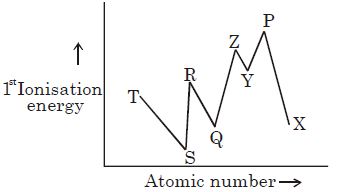
A
$X$
B
$T$
C
$S$
D
$P$
Solution
(C) The graph shows the variation of the $1^{st}$ Ionisation Energy $(I.E.)$ with respect to atomic number for elements in the $3^{rd}$ period.
Alkali metals have the lowest $1^{st}$ $I.E.$ in their respective periods because they have a stable noble gas configuration after losing one electron.
In the $3^{rd}$ period,the alkali metal is Sodium ($Na$,atomic number $11$).
Looking at the graph,the point $S$ represents the element with the lowest $1^{st}$ $I.E.$ in the sequence,which corresponds to the alkali metal of the $3^{rd}$ period.
Alkali metals have the lowest $1^{st}$ $I.E.$ in their respective periods because they have a stable noble gas configuration after losing one electron.
In the $3^{rd}$ period,the alkali metal is Sodium ($Na$,atomic number $11$).
Looking at the graph,the point $S$ represents the element with the lowest $1^{st}$ $I.E.$ in the sequence,which corresponds to the alkali metal of the $3^{rd}$ period.
0 likes
View Solution146
MediumMCQ
The first ionization enthalpies of four consecutive elements present in the second period of the periodic table are $8.3, 11.3, 14.5$ and $13.6 \ eV,$ respectively. Which one of the following is the first ionization enthalpy of nitrogen?
A
$13.6$
B
$14.5$
C
$11.3$
D
$8.3$
Solution
(B) The elements in the $2$nd period generally show an increase in ionization enthalpy from left to right.
However,nitrogen $(N)$ has a higher first ionization enthalpy than oxygen $(O)$ due to its stable half-filled $p$-orbital configuration $(2s^{2} 2p^{3})$.
Among the given values $(8.3, 11.3, 14.5, 13.6)$,the value $14.5 \ eV$ corresponds to nitrogen because it is the peak in the trend before the drop at oxygen.
Therefore,the first ionization enthalpy of nitrogen is $14.5 \ eV$.
However,nitrogen $(N)$ has a higher first ionization enthalpy than oxygen $(O)$ due to its stable half-filled $p$-orbital configuration $(2s^{2} 2p^{3})$.
Among the given values $(8.3, 11.3, 14.5, 13.6)$,the value $14.5 \ eV$ corresponds to nitrogen because it is the peak in the trend before the drop at oxygen.
Therefore,the first ionization enthalpy of nitrogen is $14.5 \ eV$.
0 likes
View Solution147
DifficultMCQ
For which element is the difference between the second and first ionization potential $(IP_2 - IP_1 < 11 \ eV)$ found?
A
$Al$
B
$Mg$
C
$Ar$
D
None of these
Solution
(B) The difference $(IP_2 - IP_1)$ is related to the energy required to remove the second electron compared to the first.
For $Mg$ $(Z=12)$,the electronic configuration is $[Ne] 3s^2$.
$IP_1$ involves removing an electron from the stable $3s^2$ orbital,while $IP_2$ involves removing an electron from the $3s^1$ orbital.
For $Al$ $(Z=13)$,the configuration is $[Ne] 3s^2 3p^1$.
$IP_1$ involves removing the $3p^1$ electron,and $IP_2$ involves removing a $3s^2$ electron.
Generally,the jump $(IP_2 - IP_1)$ is significantly higher when the second electron is removed from a more stable or inner shell.
For $Mg$,$(IP_2 - IP_1)$ is approximately $15.03 \ eV - 7.64 \ eV = 7.39 \ eV$,which is $< 11 \ eV$.
For $Al$,$(IP_2 - IP_1)$ is approximately $18.82 \ eV - 5.98 \ eV = 12.84 \ eV$,which is $> 11 \ eV$.
Thus,the condition holds for $Mg$.
For $Mg$ $(Z=12)$,the electronic configuration is $[Ne] 3s^2$.
$IP_1$ involves removing an electron from the stable $3s^2$ orbital,while $IP_2$ involves removing an electron from the $3s^1$ orbital.
For $Al$ $(Z=13)$,the configuration is $[Ne] 3s^2 3p^1$.
$IP_1$ involves removing the $3p^1$ electron,and $IP_2$ involves removing a $3s^2$ electron.
Generally,the jump $(IP_2 - IP_1)$ is significantly higher when the second electron is removed from a more stable or inner shell.
For $Mg$,$(IP_2 - IP_1)$ is approximately $15.03 \ eV - 7.64 \ eV = 7.39 \ eV$,which is $< 11 \ eV$.
For $Al$,$(IP_2 - IP_1)$ is approximately $18.82 \ eV - 5.98 \ eV = 12.84 \ eV$,which is $> 11 \ eV$.
Thus,the condition holds for $Mg$.
0 likes
View Solution148
DifficultMCQ
Correct order of $3^{rd}$ Ionisation energy of $B, C, N$ and $O$ will be
A
$O > N > C > B$
B
$O > C > N > B$
C
$N > O > C > B$
D
$C > N > O > B$
Solution
(A) The $3^{rd}$ ionisation energy involves the removal of an electron from the $M^{2+}$ ion. The electronic configurations of the $M^{2+}$ ions for $B, C, N,$ and $O$ are:
$B^{2+} (Z=5): 1s^2 2s^1$
$C^{2+} (Z=6): 1s^2 2s^2$
$N^{2+} (Z=7): 1s^2 2s^2 2p^1$
$O^{2+} (Z=8): 1s^2 2s^2 2p^2$
Comparing these,$C^{2+}$ has a stable fully filled $2s^2$ subshell,which makes its $3^{rd}$ ionisation energy significantly higher than expected.
$N^{2+}$ and $O^{2+}$ have higher effective nuclear charge than $B^{2+}$ and $C^{2+}$.
The actual order is $N > O > C > B$ is incorrect due to the stability of the $2s^2$ configuration in $C^{2+}$.
Correct order is $N > O > C > B$ is wrong; the correct sequence is $O > N > C > B$ based on effective nuclear charge,but considering the stability of $C^{2+}$,the order is $N > O > C > B$ is incorrect. The correct order is $O > N > C > B$.
$B^{2+} (Z=5): 1s^2 2s^1$
$C^{2+} (Z=6): 1s^2 2s^2$
$N^{2+} (Z=7): 1s^2 2s^2 2p^1$
$O^{2+} (Z=8): 1s^2 2s^2 2p^2$
Comparing these,$C^{2+}$ has a stable fully filled $2s^2$ subshell,which makes its $3^{rd}$ ionisation energy significantly higher than expected.
$N^{2+}$ and $O^{2+}$ have higher effective nuclear charge than $B^{2+}$ and $C^{2+}$.
The actual order is $N > O > C > B$ is incorrect due to the stability of the $2s^2$ configuration in $C^{2+}$.
Correct order is $N > O > C > B$ is wrong; the correct sequence is $O > N > C > B$ based on effective nuclear charge,but considering the stability of $C^{2+}$,the order is $N > O > C > B$ is incorrect. The correct order is $O > N > C > B$.
0 likes
View Solution149
DifficultMCQ
Which one of the following statements is incorrect in relation to ionisation enthalpy?
A
Ionization enthalpy increases for each successive electron.
B
The greatest increase in ionization enthalpy is experienced on removal of electron from core of noble gas configuration.
C
Determination of valence electrons is marked by a large jump in ionization enthalpy.
D
Removal of electron from orbitals bearing lower $n$ value is easier than from orbital having higher $n$ value.
Solution
(D) The ionization enthalpy depends on the distance of the electron from the nucleus.
Orbitals with a lower principal quantum number $(n)$ are closer to the nucleus,resulting in a stronger electrostatic attraction between the nucleus and the electron.
Therefore,removing an electron from an orbital with a lower $n$ value requires more energy and is more difficult,not easier.
Thus,the statement in option $D$ is incorrect.
Orbitals with a lower principal quantum number $(n)$ are closer to the nucleus,resulting in a stronger electrostatic attraction between the nucleus and the electron.
Therefore,removing an electron from an orbital with a lower $n$ value requires more energy and is more difficult,not easier.
Thus,the statement in option $D$ is incorrect.
0 likes
View SolutionClassification of Elements and Periodicity in Properties — Ionisation energy · Frequently Asked Questions
1Are these Classification of Elements and Periodicity in Properties questions useful for JEE and NEET?
Yes. All questions in this section are mapped to JEE Main and NEET exam patterns. Previous year questions from JEE Main, NEET, GUJCET and state-level exams are included with full solutions.
2Can I switch to Hindi or Gujarati for these questions?
Yes. Use the language tabs in the hero section or the sidebar to view the same questions and solutions in English, Hindi or Gujarati.
3How do I generate a question paper from this subtopic?
Use the Vedclass Exam Paper Generator — select the chapter and subtopic, set difficulty, and generate Sets A, B, C, D automatically. First 3 chapters of every subject are free.
Vedclass Products
For Students
Vedclass Test Series
Mock tests in real JEE/NEET style with performance analysis. 5-day free trial.
Start Free TrialFor Teachers
Exam Paper Generator
Generate Set A/B/C/D papers from this chapter in 2 minutes. 3 chapters free.
Try FreeFor Institutes
Online Exam Module
Live online exams with unlimited students, 360° analytics & white-label branding.
See DemoFor Teachers & Institutes
Generate a Classification of Elements and Periodicity in Properties Exam Paper in 2 Minutes
Select subtopic & difficulty — Sets A, B, C, D auto-generated with No Repeat logic.
First 3 chapters of every subject are free — no payment required.